EP2833432A2 - Batteriepack - Google Patents
Batteriepack Download PDFInfo
- Publication number
- EP2833432A2 EP2833432A2 EP13195841.5A EP13195841A EP2833432A2 EP 2833432 A2 EP2833432 A2 EP 2833432A2 EP 13195841 A EP13195841 A EP 13195841A EP 2833432 A2 EP2833432 A2 EP 2833432A2
- Authority
- EP
- European Patent Office
- Prior art keywords
- region
- terminal
- battery pack
- conductive tab
- battery
- Prior art date
- Legal status (The legal status is an assumption and is not a legal conclusion. Google has not performed a legal analysis and makes no representation as to the accuracy of the status listed.)
- Withdrawn
Links
Images






Classifications
-
- H—ELECTRICITY
- H01—ELECTRIC ELEMENTS
- H01M—PROCESSES OR MEANS, e.g. BATTERIES, FOR THE DIRECT CONVERSION OF CHEMICAL ENERGY INTO ELECTRICAL ENERGY
- H01M50/00—Constructional details or processes of manufacture of the non-active parts of electrochemical cells other than fuel cells, e.g. hybrid cells
- H01M50/50—Current conducting connections for cells or batteries
-
- H—ELECTRICITY
- H01—ELECTRIC ELEMENTS
- H01M—PROCESSES OR MEANS, e.g. BATTERIES, FOR THE DIRECT CONVERSION OF CHEMICAL ENERGY INTO ELECTRICAL ENERGY
- H01M50/00—Constructional details or processes of manufacture of the non-active parts of electrochemical cells other than fuel cells, e.g. hybrid cells
- H01M50/20—Mountings; Secondary casings or frames; Racks, modules or packs; Suspension devices; Shock absorbers; Transport or carrying devices; Holders
- H01M50/204—Racks, modules or packs for multiple batteries or multiple cells
- H01M50/207—Racks, modules or packs for multiple batteries or multiple cells characterised by their shape
- H01M50/213—Racks, modules or packs for multiple batteries or multiple cells characterised by their shape adapted for cells having curved cross-section, e.g. round or elliptic
-
- H—ELECTRICITY
- H01—ELECTRIC ELEMENTS
- H01M—PROCESSES OR MEANS, e.g. BATTERIES, FOR THE DIRECT CONVERSION OF CHEMICAL ENERGY INTO ELECTRICAL ENERGY
- H01M50/00—Constructional details or processes of manufacture of the non-active parts of electrochemical cells other than fuel cells, e.g. hybrid cells
- H01M50/20—Mountings; Secondary casings or frames; Racks, modules or packs; Suspension devices; Shock absorbers; Transport or carrying devices; Holders
- H01M50/284—Mountings; Secondary casings or frames; Racks, modules or packs; Suspension devices; Shock absorbers; Transport or carrying devices; Holders with incorporated circuit boards, e.g. printed circuit boards [PCB]
-
- H—ELECTRICITY
- H01—ELECTRIC ELEMENTS
- H01M—PROCESSES OR MEANS, e.g. BATTERIES, FOR THE DIRECT CONVERSION OF CHEMICAL ENERGY INTO ELECTRICAL ENERGY
- H01M50/00—Constructional details or processes of manufacture of the non-active parts of electrochemical cells other than fuel cells, e.g. hybrid cells
- H01M50/20—Mountings; Secondary casings or frames; Racks, modules or packs; Suspension devices; Shock absorbers; Transport or carrying devices; Holders
- H01M50/298—Mountings; Secondary casings or frames; Racks, modules or packs; Suspension devices; Shock absorbers; Transport or carrying devices; Holders characterised by the wiring of battery packs
-
- H—ELECTRICITY
- H01—ELECTRIC ELEMENTS
- H01M—PROCESSES OR MEANS, e.g. BATTERIES, FOR THE DIRECT CONVERSION OF CHEMICAL ENERGY INTO ELECTRICAL ENERGY
- H01M50/00—Constructional details or processes of manufacture of the non-active parts of electrochemical cells other than fuel cells, e.g. hybrid cells
- H01M50/50—Current conducting connections for cells or batteries
- H01M50/502—Interconnectors for connecting terminals of adjacent batteries; Interconnectors for connecting cells outside a battery casing
- H01M50/519—Interconnectors for connecting terminals of adjacent batteries; Interconnectors for connecting cells outside a battery casing comprising printed circuit boards [PCB]
-
- H—ELECTRICITY
- H01—ELECTRIC ELEMENTS
- H01M—PROCESSES OR MEANS, e.g. BATTERIES, FOR THE DIRECT CONVERSION OF CHEMICAL ENERGY INTO ELECTRICAL ENERGY
- H01M50/00—Constructional details or processes of manufacture of the non-active parts of electrochemical cells other than fuel cells, e.g. hybrid cells
- H01M50/50—Current conducting connections for cells or batteries
- H01M50/531—Electrode connections inside a battery casing
-
- H—ELECTRICITY
- H01—ELECTRIC ELEMENTS
- H01M—PROCESSES OR MEANS, e.g. BATTERIES, FOR THE DIRECT CONVERSION OF CHEMICAL ENERGY INTO ELECTRICAL ENERGY
- H01M50/00—Constructional details or processes of manufacture of the non-active parts of electrochemical cells other than fuel cells, e.g. hybrid cells
- H01M50/50—Current conducting connections for cells or batteries
- H01M50/543—Terminals
- H01M50/547—Terminals characterised by the disposition of the terminals on the cells
- H01M50/548—Terminals characterised by the disposition of the terminals on the cells on opposite sides of the cell
-
- H—ELECTRICITY
- H01—ELECTRIC ELEMENTS
- H01M—PROCESSES OR MEANS, e.g. BATTERIES, FOR THE DIRECT CONVERSION OF CHEMICAL ENERGY INTO ELECTRICAL ENERGY
- H01M50/00—Constructional details or processes of manufacture of the non-active parts of electrochemical cells other than fuel cells, e.g. hybrid cells
- H01M50/50—Current conducting connections for cells or batteries
- H01M50/543—Terminals
- H01M50/552—Terminals characterised by their shape
- H01M50/559—Terminals adapted for cells having curved cross-section, e.g. round, elliptic or button cells
-
- H—ELECTRICITY
- H01—ELECTRIC ELEMENTS
- H01M—PROCESSES OR MEANS, e.g. BATTERIES, FOR THE DIRECT CONVERSION OF CHEMICAL ENERGY INTO ELECTRICAL ENERGY
- H01M10/00—Secondary cells; Manufacture thereof
- H01M10/42—Methods or arrangements for servicing or maintenance of secondary cells or secondary half-cells
- H01M10/425—Structural combination with electronic components, e.g. electronic circuits integrated to the outside of the casing
- H01M2010/4271—Battery management systems including electronic circuits, e.g. control of current or voltage to keep battery in healthy state, cell balancing
-
- Y—GENERAL TAGGING OF NEW TECHNOLOGICAL DEVELOPMENTS; GENERAL TAGGING OF CROSS-SECTIONAL TECHNOLOGIES SPANNING OVER SEVERAL SECTIONS OF THE IPC; TECHNICAL SUBJECTS COVERED BY FORMER USPC CROSS-REFERENCE ART COLLECTIONS [XRACs] AND DIGESTS
- Y02—TECHNOLOGIES OR APPLICATIONS FOR MITIGATION OR ADAPTATION AGAINST CLIMATE CHANGE
- Y02E—REDUCTION OF GREENHOUSE GAS [GHG] EMISSIONS, RELATED TO ENERGY GENERATION, TRANSMISSION OR DISTRIBUTION
- Y02E60/00—Enabling technologies; Technologies with a potential or indirect contribution to GHG emissions mitigation
- Y02E60/10—Energy storage using batteries
Definitions
- the present invention relates to a battery pack.
- a battery pack in general, includes a plurality of battery cells, a battery monitoring system board and a housing accommodating the plurality of battery cells and the battery monitoring system board.
- the plurality of battery cells are electrically connected to each other by a conductive tab.
- the conductive tab is electrically connected to the battery monitoring system board by a wire.
- a conductive tab is also required to allow higher currents to flow therein.
- the conductive tab is generally designed to have a smaller area and/or thickness than a diameter and/or thickness of a battery cell, there may be a problem with the recently developed large-capacity, high-performance battery pack in that the conductive tab is melted due to the high current or over current.
- a specially designed jig for mounting a conductive tab has conventionally been used in temporarily mounting the conductive tab in the battery cell and a specially designed jig for connecting the conductive tab has conventionally been used in connecting the conductive tab to the battery cell. Accordingly, in the conventional art, a plurality of specially designed jigs are required to connect the conductive tab to the battery cell, so that a conductive tab connecting process becomes complicated and a connecting time is prolonged.
- Embodiments of the invention aim to provide a battery pack, which includes a conductive tab electrically connected to a battery cell using a structure in which the conductive tab is fitted into the battery cell, so that the conductive tab is not melted and broken even with high current and/or over-current, thereby providing the battery pack suitable for achieving large-capacity and high-performance.
- a battery pack which includes a conductive tab mounted in a battery cell in a self-aligned manner, so that a separate jig for mounting and welding the conductive tab is not required, thereby providing the battery pack capable of facilitating mounting and welding of the conductive tab. Accordingly, the present invention provides a battery pack including:
- the terminal region of the battery cell may be roughly disk-shaped and the terminal support region may be substantially cylindrical.
- the terminal region of the battery cell may be a positive electrode terminal or a negative electrode terminal.
- An insulation member may further be disposed between the terminal support region of the battery cell and the contacting region of the conductive tab.
- connection region of the conductive tab may be roughly disk-shaped, the contacting region may be substantially cylindrical, and the first and second extension regions may be shaped of substantially flat plates.
- a plurality of welding regions electrically welded to the terminal region of the battery cell may be provided in the connection region of the conductive tab.
- One or more throughholes for distributing welding current during the electrically welding of the plurality of welding regions may be provided in the connection region of the conductive tab.
- connection region of the conductive tab may have an area ranging from 1/4 ⁇ r 2 to 3/4 ⁇ r 2 (where r is a radius of the connection region).
- One end of the wire may be electrically connected to the first extension region or the second extension region of the conductive tab and the other end of the wire may be electrically connected to the battery monitoring system board.
- the second extension region extends from the first extension region in a substantially vertical direction and may extend from the contacting region.
- the second extension region extends from the first extension region in a substantially horizontal direction and may be separated from the contacting region.
- the second extension region extending from the first extension region in a substantially horizontal direction may be directly electrically connected to the battery monitoring system board.
- the second extension region extending from the first extension region in a substantially horizontal direction may pass through the battery monitoring system board to then be soldered.
- a cup-shaped conductive tab is electrically connected to a battery cell using a structure in which the cup-shaped conductive tab is fitted into the battery cell, so that the conductive tab is not melted and broken even with high current and/or over-current, thereby providing the battery pack suitable for achieving large-capacity and high-performance.
- a cup-shaped conductive tab is mounted in a battery cell in a self-aligned manner, so that a separate jig for mounting and welding the conductive tab is not required, thereby providing the battery pack capable of facilitating mounting and welding of the conductive tab.
- first, second, etc. may be used herein to describe various members, elements, regions, layers and/or parts, these members, elements, regions, layers and/or parts should not be limited by these terms. These terms are only used to distinguish one member, element, region, layer and/or part from another member, element, region, layer and/or part. Thus, for example, a first member, element, region, layer and/or part discussed below could be termed a second member, element, region, layer and/or part without departing from the teachings of the present invention.
- conductive tab used herein means a conductor electrically connected to two battery cells or one battery cell or electrically connecting a battery cell and a battery monitoring system board. Further, the term “conductive tab” used herein means a conductor electrically connected to a battery monitoring system board through a separate wire or directly electrically connected a battery monitoring system board. Additionally, the term “conductive tab” used herein means a conductor coupled to an entire circumference of a cylindrical battery cell or to a partial circumference (arc) of the battery.
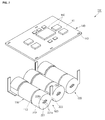
- FIGS. 1a, 1b and 1c are a circuit view, a perspective view and a partly exploded perspective view of a battery pack according to an embodiment of the present invention.
- the battery pack 100 includes a battery cell 110, a conductive tab 120 electrically connected to the battery cell 110, a wire 130 electrically connected to the conductive tab 120, and a battery monitoring system board 140 electrically connected to the wire 130.
- the battery pack 100 may further include a housing (or a case) accommodating the battery cell 110, the conductive tab 120, the wire 130 and the battery monitoring system board 140.
- the battery cell 110 includes a terminal region 111 and a terminal support region 112 extending from the terminal region 111 substantially perpendicular to a surface of the terminal region 111.
- the terminal region 111 is roughly disk-shaped and the terminal support region 112 is shaped of a cylinder extending from the terminal region 111 in a substantially perpendicular direction. That is to say, the battery cell 110 is generally cylindrical.
- the present invention does not limit the shape of the battery cell to the cylindrical battery cell, and the battery cell according to the present invention may be a prismatic battery cell or a pouch type battery cell.
- an insulating thermally shrinkable tube (not shown) is coupled to the whole terminal support region 112 and an insulation member 113 shaped of a hollow cylinder may be additionally coupled to a partial region of a surface of the terminal support region 112. Therefore, the terminal region 111 of the battery cell 110 is exposed through the insulating thermally shrinkable tube and the insulation member 113, and when the conductive tab 120 is coupled to the terminal region 111 and the terminal support region 112, the conductive tab 120 is directly electrically connected to only the terminal region 111.
- the terminal region 111 is a positive electrode terminal or a negative electrode terminal. In an example, if the terminal region 111 of one side is a positive electrode terminal, the terminal region of the other side is a negative electrode terminal, and vice versa.
- three battery cells 110 connected to each other in series are exemplified. However, in some cases, three battery cells 110 may be connected to each other in parallel. Of course, the present invention does not limit the number of battery cells 110 connected in series and/or in parallel.
- the battery cell 110 may be one selected from the group consisting of a lithium ion battery, a lithium polymer battery, a lithium iron phosphate battery, a nickel cadmium battery, a nickel manganese hydrogen battery.
- the conductive tab 120 is electrically connected to the battery cell 110.
- the conductive tab 120 includes first conductive tabs 121 a and 121 b electrically connected to two battery cells 110, and second conductive tabs 122a and 122b electrically connected to one battery cell 110. As illustrated in FIG. 1b , when three battery cells 110 are connected in series, two first conductive tabs 121 a and 121 b and two second conductive tabs 122a and 122b are provided.
- the battery cell 110 is divided into a first battery cell 110a, a second battery cell 110b and a third battery cell 110c.
- first conductive tabs 121 a and 121 b are divided into a first first conductive tab 121 a and a second first conductive tab 121 b
- second conductive tabs 122a and 122b are divided into a first second conductive tab 122a and a second second conductive tab 122b.
- the first first conductive tab 121 a electrically connects the terminal region 111 of the first battery cell 110a (e.g., a negative electrode terminal) to the terminal region 111 of the second battery cell 110b (e.g., a positive electrode terminal).
- the second first conductive tab 121 b electrically connects the terminal region 111 of the second battery cell 110b (e.g., a negative electrode terminal) to the terminal region 111 of the third battery cell 110c (e.g., a positive electrode terminal).
- the wire 130 electrically connects the battery cell 110 to the battery monitoring system board 140 and includes a first first wire 131 a and a second first wire 131 b and a second first wire 132a and a second second wire 132b.
- the first first wire 131 a electrically connects the first first conductive tab 121 a to the battery monitoring system board 140
- the second first wire 131 b electrically connects the second first conductive tab 121 b to the battery monitoring system board 140.
- the first first wire 131 a is a sensing wire for sensing a voltage of the second battery cell 110b
- the second first wire 131 b is a sensing wire for sensing a voltage of the third battery cell 110c.
- the first second wire 132a electrically connects the first second conductive tab 122a, that is, the terminal region 111 of the first battery cell 110a (e.g., a positive electrode terminal) to the battery monitoring system board 140
- the second second wire 132b electrically connects the second second conductive tab 122b, that is, the terminal region 111 of the third battery cell 110c (e.g., a negative electrode terminal) to the battery monitoring system board 140.
- the first second wire 132a and the second second wire 132b correspond to high current paths or over-current paths through which charge current and discharge current of the battery pack 100 may flow or may allow the battery monitoring system board 140 to sense the overall voltage of the battery pack 100.
- the first second wire 132a may also serve as a sensing wire for sensing a voltage of the first battery cell 110a.
- the second second wire 132b may also serve as a sensing wire for sensing a ground voltage of the battery pack 100.
- the battery monitoring system board 140 is mounted on the plurality of battery cells 110 with an insulation member (not shown) disposed therebetween, and monitors the voltages, currents and temperatures of the battery cells 110.
- the battery monitoring system board 140 includes a printed circuit board 141 and a plurality of electric/electronic devices 142 mounted on the printed circuit board 141.
- a plurality of conductive vias 143 are formed in the printed circuit board 141, and the wire 130 is inserted into and soldered to the conductive vias 143.
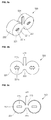
- FIGS. 2a to 2c are a perspective view, a front view and a rear view illustrating a conductive tab in a battery pack according to an embodiment of the present invention.
- the conductive tab 220 includes a connection region 221 electrically connected to a terminal region 111 of a battery cell 110, a contacting region 222 extending from the connection region 221 in a substantially perpendicular direction and closely contacting the terminal support region 112 of the battery cell 110, a first extension region 223 outwardly extending from the connection region 221, and a second extension region 224 extending from the first extension region 223 and the contacting region 222.
- the conductive tab 220 connects two battery cells 110 to each other in parallel or in series. Therefore, the connection region 221 and the contacting region 222 are symmetrically formed at opposite sides of the first and second extension regions 223 and 224. That is to say, the connection region 221 and the contacting region 222 of the conductive tab 220 are formed at opposite sides of the first and second extension regions 223 and 224.
- the conductive tab 220 may be made of one selected from the group consisting of aluminum, an aluminum alloy, copper, a copper alloy, nickel, a nickel alloy, iron, an iron alloy.
- connection region 221 of the conductive tab 220 is substantially disk-shaped, like the terminal region 111 of the battery cell 110. However, a diameter of the connection region 221 is slightly larger than a diameter of the terminal region 111.
- a plurality of welding regions 221 a electrically welded to the terminal region 111 of the battery cell 110 may be provided in the connection region 221.
- one or more throughholes 221 b for distributing welding current without being concentrated during the electrically welding of the plurality of welding regions may be provided in the connection region 221.
- the contacting region 222 of the conductive tab 220 is substantially cylindrical, like the terminal support region 112 of the battery cell 110. However, a diameter of the contacting region 222 is slightly larger than a diameter of the terminal support region 112. In addition, since the contacting region 222 closely contacts the insulation member 113 surrounding the terminal support region 112 of the battery cell 110, it is not electrically connected to the terminal support region 112 of the battery cell 110. Therefore, the positive and negative electrode terminals of the same battery cell 110 are not simultaneously short-circuited by the contacting region 222 of the conductive tab 220.
- the contacting region 222 is formed to extend from the connection region 221, it increases the overall area of the conductive tab 220, thereby allowing relatively high current and/or over-current to flow. Therefore, the conductive tab 220 according to the present invention is suitably used for large-capacity, high-performance battery pack.
- the contacting region 222 allows the conductive tab 220 to be stably mounted in the terminal region 111 and the terminal support region 112 of the battery cell 110 with the connection region 221 during welding of the conductive tab 220, so that a separate jig for mounting the conductive tab 220 and/or a separate jig for connecting the conductive tab 220 may not be required.
- a length of the contacting region 222 is preferably less than half the overall length of the battery cell 110 (that is, the overall length of the terminal support region 112). In such a manner, one-side conductive tab 220 coupled to the terminal region 111 of one side and the other-side conductive tab 220 coupled to the terminal region 111 of the other side may not be electrically short-circuited.
- the first extension region 223 is shaped of a flat plate extending in a substantially horizontal direction and outwardly from the connection region 221.
- a width of the first extension region 223 may be equal to or smaller than a diameter of the connection region 221. In the illustrated embodiment, the width of the first extension region 223 is smaller than the diameter of the connection region 221, but aspects of the present invention are not limited thereto.
- the second extension region 224 is shaped of a flat plate extending in a substantially vertical direction and outwardly from the first extension region 223.
- the second extension region 224 is shaped of a flat plate outwardly extending from both of the contacting region 222 and the first extension region 223.
- a width of the second extension region 224 may be equal to or smaller than a diameter of the contacting region 222.
- the second extension region 224 may be formed at opposite sides (for example, at upper and lower sides) of the first extension region 223. Further, the second extension region 224 may be interposed between two battery cells 110.
- the overall width of the first and second extension regions 223 and 224 in which current flows from one battery cell 110 to another battery cell 110, may be equal to or smaller than the overall width of the connection region 221 and the contacting region 222. Accordingly, even if relatively high current and/or over-current flows through the first and second extension regions 223 and 224, the first and second extension regions 223 and 224 may not be melted or broken.
- the conductive tab 220 according to the present invention has a larger area than the terminal region 111 of the battery cell 110, so that it may be suitably used for large-capacity, high-performance battery pack.
- the conductive tab 220 according to the embodiment of the present invention can be stably mounted in the battery cell 110 in a self-aligned manner, a separate jig for mounting and welding the conductive tab 220 is not required, thereby facilitating mounting and welding of the conductive tab 220.
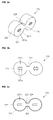
- FIGS. 3a to 3c are rear views illustrating a conductive tab in a battery pack according to another embodiment of the present invention.
- a connection region 221 of a conductive tab 220a has an area of approximately 1/4 ⁇ r 2 .
- a connection region 221 of a conductive tab 220b has an area of approximately 1/2 ⁇ r 2 .
- a connection region 221 of a conductive tab 220c has an area of approximately 3/4 ⁇ r 2 .
- r is a radius of the connection region.
- the connection region 221 of the conductive tab 220 may have various areas.
- Each of the conductive tabs 220 shown in FIGS. 3a to 3c has a contacting region 222 extending from the connection region 221 in a substantially perpendicular direction.
- connection region 221 is connected to the terminal region 111 of the battery cell 110 and the contacting region 222 closely contacts a terminal support region 112 of the battery cell 110, a current flowing area is increased, and a separate jig for mounting and welding the conductive tab 220 is not required during an assembling process.
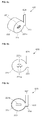
- FIGS. 4a to 4c are a perspective view, a front view and a rear view illustrating a conductive tab in a battery pack according to another embodiment of the present invention.
- the conductive tab 320 in a battery pack includes a connection region 321 electrically connected to a terminal region 111 of a battery cell 110, a contacting region 322 extending from the connection region 321 in a substantially perpendicular direction and closely contacting a terminal support region 112 of the battery cell 110, a first extension region 323 outwardly extending from the connection region 321, and a second extension region 324 extending from the first extension region 323 and the contacting region 322.
- the conductive tab 320 is electrically connected to one battery cell 110. That is to say, unlike the conductive tab 220 shown in FIGS.
- the conductive tab 320 shown in FIGS. 4a to 4c includes only one connection region 321 and only one contacting region 322 formed at one side of the first and second extension regions 223 and 224.
- the conductive tab 320 shown in FIGS. 4a to 4c is substantially the same as the conductive tab 220 shown in FIGS. 2a to 2c in view of structure and material, except that the conductive tab 320 shown in FIGS. 4a to 4c has only one connection region 321 and only one contacting region 322, and additional explanations will be omitted.
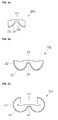
- FIGS. 5a to 5c are rear views illustrating a conductive tab in a battery pack according to another embodiment of the present invention.
- a connection region 321 of a conductive tab 320a has an area of approximately 1/4 ⁇ r 2 .
- a connection region 321 of a conductive tab 320b has an area of approximately 1/2 ⁇ r 2 .
- a connection region 321 of a conductive tab 320c has an area of approximately 3/4 ⁇ r 2 .
- the conductive tabs 320a, 320b and 320c shown in FIGS. 5a to 5c is substantially the same as the conductive tabs 220a, 220b and 220c shown in FIGS. 4a to 4c in view of structure and material, except that each of the conductive tabs 320a, 320b and 320c has only one connection region 321 and only one contacting region 322, and additional explanations will be omitted.
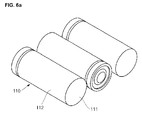
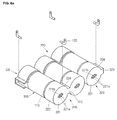
- FIGS. 6a to 6e are perspective views illustrating a method of assembling a battery pack according to another embodiment of the present invention.
- a plurality of battery cells 110 each including a substantially disk-shaped terminal region 111 and a substantially cylindrical terminal support region 112 extending from the terminal region 11 in a substantially perpendicular direction are arranged in a line.
- the terminal region 111 may be a positive electrode terminal or a negative electrode terminal.
- an insulation member 113 is coupled to a terminal support region 112 of the battery cell 110 and only the terminal region 111 is exposed to the outside, the conductive tab 220 including a connection region 221, a contacting region 222, and first and second extension regions 223 and 224 is coupled to the battery cell 110. That is to say, the connection region 221 of the conductive tab 220 is made to contact the terminal region 111 of the battery cell 110, and the contacting region 222 of the conductive tab 220 is made to closely contact the terminal support region 112 of the battery cell 110.
- symmetrically formed conductive tabs 220 are coupled to two battery cells 110 connected in series or in parallel, and an asymmetrically formed conductive tab 320 is coupled to the battery cells 110.
- conductive tabs 220 and 320 are electrically connected to the battery cell 110 by welding tools 410. That is to say, the welding tools 410 are disposed to face each other about throughholes 221 b provided in the connection regions 221 and 321 of the conductive tabs 220 and 320, and welding current is then applied to the welding tools 410, thereby forming a plurality of welding regions 221 a at opposite positions of the throughholes 221 b provided in the conductive tabs 220 and 320.
- throughholes 221 b serve to distribute welding current, thereby preventing the conductive tabs 220 and 320 or the battery cell 110 from being damaged.
- one end of the wire 130 is welded to each of the second extension regions 224 and 324 provided in the conductive tabs 220 and 320.
- one end of the wire 130 may also be welded to each of the connection regions 221 and 321, the contacting regions 222 and 322 or the first extension regions 223 and 323 provided in the conductive tabs 220 and 320.
- each wire 130 is electrically connected to the battery monitoring system board 140.
- the wire 130 is coupled to each of the conductive vias 143 provided in the battery monitoring system board 140 and then soldered.
- the conductive tab can be stably mounted in the battery cell in a self-aligned manner, a separate jig for mounting and welding the conductive tab is not required, thereby facilitating mounting and welding of the conductive tab.
- FIG. 7 is a partly exploded perspective view of a battery pack according to another embodiment of the present invention.
- a conductive tab 520 is directly electrically connected to a battery monitoring system board 140 without a separate wire.
- at least one second extension region 524 is separated from a contacting region 222 and outwardly extends in substantially parallel to a first extension region 223. That is to say, the second extension region is provided at upper and lower portions of the first extension region 223, and the upper second extension region 524 is detached from the contacting region 222 and is bent upwardly such that the second extension region 524 extends substantially parallel to the first extension region 223.
- the second extension region 524 may extend with various angles with respect to the first extension region 223 according to positions of the conductive vias 143 formed in the battery monitoring system board 140. In some cases, the second extension region 524 may be bent at various angles from a predetermined position.
- the conductive vias 143 are formed in the battery monitoring system board 140 corresponding to the second extension region 524, and the second extension region 524 is coupled to the conductive vias 143 and then soldered.
- the conductive tab 520 is directly electrically connected to the battery monitoring system board 140 without a separate wire, thereby simply and easily establishing an electrical connection process of the battery cell 110 and the battery monitoring system board 140.
- the electrical resistance therebetween is small, thereby minimizing an area where heat is generated when high current and/or over-current flows between the battery cell and the battery monitoring system board.
- FIGS. 8a to 8c are a perspective view, a front view and a rear view illustrating a conductive tab in a battery pack according to another embodiment of the present invention.
- a conductive tab 520 may be used in electrically connecting two battery cells 110.
- second extension regions are formed at upper and lower portions of a first extension region 223, and the upper second extension region 524 is separated from contacting regions 222 extends outwardly. That is to say, the second extension region 524 upwardly extends and is substantially parallel to the first extension region 223.
- FIGS. 9a to 9c are a perspective view, a front view and a rear view illustrating a conductive tab in a battery pack according to another embodiment of the present invention.
- a conductive tab 620 is electrically connected to one battery cell 110.
- an upper second extension region 524 is separated from one contacting region 222 and extends upwardly.
- the second extension region 524 is substantially parallel to the first extension region 223.
- the conductive tab 520 shown in FIGS. 8a to 8c and the conductive tab 620 shown in FIGS. 9a to 9c may include a connection region having an area of approximately 1/4 ⁇ r 2 to 3/4 ⁇ r 2 , like the conductive tab shown in FIGS. 3a to 3c and/or the conductive tab shown in FIGS. 5a to 5c .
- the conductive tab is not melted and broken even with high current and/or over-current, thereby providing the battery pack suitable for achieving large-capacity and high-performance.
Landscapes
- Chemical & Material Sciences (AREA)
- Chemical Kinetics & Catalysis (AREA)
- Electrochemistry (AREA)
- General Chemical & Material Sciences (AREA)
- Connection Of Batteries Or Terminals (AREA)
- Battery Mounting, Suspending (AREA)
Applications Claiming Priority (2)
| Application Number | Priority Date | Filing Date | Title |
|---|---|---|---|
| US201361860543P | 2013-07-31 | 2013-07-31 | |
| US14/085,015 US20150037657A1 (en) | 2013-07-31 | 2013-11-20 | Battery pack |
Publications (2)
| Publication Number | Publication Date |
|---|---|
| EP2833432A2 true EP2833432A2 (de) | 2015-02-04 |
| EP2833432A3 EP2833432A3 (de) | 2015-02-11 |
Family
ID=49683633
Family Applications (1)
| Application Number | Title | Priority Date | Filing Date |
|---|---|---|---|
| EP13195841.5A Withdrawn EP2833432A3 (de) | 2013-07-31 | 2013-12-05 | Batteriepack |
Country Status (3)
| Country | Link |
|---|---|
| US (1) | US20150037657A1 (de) |
| EP (1) | EP2833432A3 (de) |
| KR (1) | KR20150015342A (de) |
Cited By (1)
| Publication number | Priority date | Publication date | Assignee | Title |
|---|---|---|---|---|
| CN112117399A (zh) * | 2019-06-21 | 2020-12-22 | 比亚迪股份有限公司 | 单体电池、动力电池包和车辆 |
Families Citing this family (5)
| Publication number | Priority date | Publication date | Assignee | Title |
|---|---|---|---|---|
| FR3013900B1 (fr) * | 2013-11-22 | 2015-12-11 | Blue Solutions | Module de stockage d'energie, comprenant une pluralite d'ensembles de stockage d'energie |
| KR102395752B1 (ko) * | 2015-08-04 | 2022-05-09 | 삼성에스디아이 주식회사 | 배터리 팩 |
| DE102016225184A1 (de) * | 2016-12-15 | 2018-06-21 | Robert Bosch Gmbh | Batteriemodul mit Batteriezellsystem und Umhüllung |
| KR102409424B1 (ko) * | 2017-08-29 | 2022-06-15 | 주식회사 엘지에너지솔루션 | 배터리 모듈 및 그 제조 방법 |
| EP4531166A1 (de) * | 2023-09-27 | 2025-04-02 | NXP USA, Inc. | Batteriesystem |
Family Cites Families (5)
| Publication number | Priority date | Publication date | Assignee | Title |
|---|---|---|---|---|
| TWI285452B (en) * | 2005-11-16 | 2007-08-11 | Simplo Technology Co Ltd | Protective battery holding structure |
| KR100869803B1 (ko) * | 2007-01-31 | 2008-11-21 | 삼성에스디아이 주식회사 | 전지 모듈 |
| WO2011111721A1 (ja) * | 2010-03-10 | 2011-09-15 | 株式会社キャプテックス | 電池接続用具およびそれを用いた組電池モジュール |
| US20120045665A1 (en) * | 2010-08-17 | 2012-02-23 | Samsung Sdi Co., Ltd. | Battery pack |
| FR2979472B1 (fr) * | 2011-08-29 | 2013-08-23 | Batscap Sa | Connecteur dispose entre deux ensembles de stockage d'energie |
-
2013
- 2013-11-20 US US14/085,015 patent/US20150037657A1/en not_active Abandoned
- 2013-11-21 KR KR1020130142414A patent/KR20150015342A/ko not_active Withdrawn
- 2013-12-05 EP EP13195841.5A patent/EP2833432A3/de not_active Withdrawn
Non-Patent Citations (1)
| Title |
|---|
| None |
Cited By (1)
| Publication number | Priority date | Publication date | Assignee | Title |
|---|---|---|---|---|
| CN112117399A (zh) * | 2019-06-21 | 2020-12-22 | 比亚迪股份有限公司 | 单体电池、动力电池包和车辆 |
Also Published As
| Publication number | Publication date |
|---|---|
| KR20150015342A (ko) | 2015-02-10 |
| US20150037657A1 (en) | 2015-02-05 |
| EP2833432A3 (de) | 2015-02-11 |
Similar Documents
| Publication | Publication Date | Title |
|---|---|---|
| US11302981B2 (en) | Battery pack | |
| CN110178244B (zh) | 用于电池结构、互连、感测和平衡的系统和方法 | |
| CN101682017B (zh) | 组装型电连接构件及包含该电连接构件的二次电池组 | |
| EP2107624B1 (de) | Batteriepack | |
| KR102505613B1 (ko) | 배터리 팩 | |
| KR102437502B1 (ko) | 배터리 모듈 | |
| KR100922471B1 (ko) | 이차전지용 보호회로기판 및 이를 이용한 이차 전지 | |
| EP2866281B1 (de) | Wiederaufladbare Batterie mit Sicherungseinheit | |
| US8771851B2 (en) | Battery pack | |
| KR102332338B1 (ko) | 배터리 팩 | |
| EP2421070A1 (de) | Batteriepack | |
| JP6022348B2 (ja) | 電池パック | |
| EP2933856B1 (de) | Wiederaufladbare batterie mit stromverteilungselement | |
| EP2905824A1 (de) | Batteriepack | |
| US20150037657A1 (en) | Battery pack | |
| US9667006B2 (en) | Electrically symmetrical battery cell connector | |
| CN113054330A (zh) | 电池模组和具有其的动力电池包、电动汽车 | |
| EP3264495B1 (de) | Stromabnehmende plattenanordnung und batteriepack damit | |
| KR20190068253A (ko) | 배터리 모듈 | |
| EP2424006A1 (de) | Batteriepack | |
| KR20190023581A (ko) | 배터리 모듈 및 그 제조 방법 | |
| WO2012077404A1 (ja) | 電池パック | |
| KR20160139807A (ko) | 배터리 팩 | |
| WO2012093452A1 (ja) | 電池パック | |
| KR20190042342A (ko) | 배터리 모듈 및 배터리 팩 |
Legal Events
| Date | Code | Title | Description |
|---|---|---|---|
| PUAL | Search report despatched |
Free format text: ORIGINAL CODE: 0009013 |
|
| 17P | Request for examination filed |
Effective date: 20131205 |
|
| AK | Designated contracting states |
Kind code of ref document: A2 Designated state(s): AL AT BE BG CH CY CZ DE DK EE ES FI FR GB GR HR HU IE IS IT LI LT LU LV MC MK MT NL NO PL PT RO RS SE SI SK SM TR |
|
| AX | Request for extension of the european patent |
Extension state: BA ME |
|
| PUAI | Public reference made under article 153(3) epc to a published international application that has entered the european phase |
Free format text: ORIGINAL CODE: 0009012 |
|
| AK | Designated contracting states |
Kind code of ref document: A3 Designated state(s): AL AT BE BG CH CY CZ DE DK EE ES FI FR GB GR HR HU IE IS IT LI LT LU LV MC MK MT NL NO PL PT RO RS SE SI SK SM TR |
|
| AX | Request for extension of the european patent |
Extension state: BA ME |
|
| RIC1 | Information provided on ipc code assigned before grant |
Ipc: H01M 2/10 20060101AFI20150108BHEP Ipc: H01M 2/20 20060101ALI20150108BHEP |
|
| R17P | Request for examination filed (corrected) |
Effective date: 20150727 |
|
| RBV | Designated contracting states (corrected) |
Designated state(s): AL AT BE BG CH CY CZ DE DK EE ES FI FR GB GR HR HU IE IS IT LI LT LU LV MC MK MT NL NO PL PT RO RS SE SI SK SM TR |
|
| 17Q | First examination report despatched |
Effective date: 20160411 |
|
| STAA | Information on the status of an ep patent application or granted ep patent |
Free format text: STATUS: THE APPLICATION IS DEEMED TO BE WITHDRAWN |
|
| 18D | Application deemed to be withdrawn |
Effective date: 20160823 |