EP2833652A1 - Automatische Hörgerätanpassung im Laufe der Zeit über mobile Anwendung - Google Patents
Automatische Hörgerätanpassung im Laufe der Zeit über mobile Anwendung Download PDFInfo
- Publication number
- EP2833652A1 EP2833652A1 EP14179553.4A EP14179553A EP2833652A1 EP 2833652 A1 EP2833652 A1 EP 2833652A1 EP 14179553 A EP14179553 A EP 14179553A EP 2833652 A1 EP2833652 A1 EP 2833652A1
- Authority
- EP
- European Patent Office
- Prior art keywords
- hearing
- hearing aid
- communication module
- signal processing
- wireless device
- Prior art date
- Legal status (The legal status is an assumption and is not a legal conclusion. Google has not performed a legal analysis and makes no representation as to the accuracy of the status listed.)
- Withdrawn
Links
Images


Classifications
-
- H—ELECTRICITY
- H04—ELECTRIC COMMUNICATION TECHNIQUE
- H04R—LOUDSPEAKERS, MICROPHONES, GRAMOPHONE PICK-UPS OR LIKE ACOUSTIC ELECTROMECHANICAL TRANSDUCERS; ELECTRIC HEARING AIDS; PUBLIC ADDRESS SYSTEMS
- H04R25/00—Electric hearing aids
- H04R25/70—Adaptation of deaf aid to hearing loss, e.g. initial electronic fitting
-
- H—ELECTRICITY
- H04—ELECTRIC COMMUNICATION TECHNIQUE
- H04R—LOUDSPEAKERS, MICROPHONES, GRAMOPHONE PICK-UPS OR LIKE ACOUSTIC ELECTROMECHANICAL TRANSDUCERS; ELECTRIC HEARING AIDS; PUBLIC ADDRESS SYSTEMS
- H04R25/00—Electric hearing aids
- H04R25/55—Electric hearing aids using an external connection, either wireless or wired
- H04R25/554—Electric hearing aids using an external connection, either wireless or wired using a wireless connection, e.g. between microphone and amplifier or using Tcoils
-
- H—ELECTRICITY
- H04—ELECTRIC COMMUNICATION TECHNIQUE
- H04R—LOUDSPEAKERS, MICROPHONES, GRAMOPHONE PICK-UPS OR LIKE ACOUSTIC ELECTROMECHANICAL TRANSDUCERS; ELECTRIC HEARING AIDS; PUBLIC ADDRESS SYSTEMS
- H04R2225/00—Details of deaf aids covered by H04R25/00, not provided for in any of its subgroups
- H04R2225/39—Aspects relating to automatic logging of sound environment parameters and the performance of the hearing aid during use, e.g. histogram logging, or of user selected programs or settings in the hearing aid, e.g. usage logging
-
- H—ELECTRICITY
- H04—ELECTRIC COMMUNICATION TECHNIQUE
- H04R—LOUDSPEAKERS, MICROPHONES, GRAMOPHONE PICK-UPS OR LIKE ACOUSTIC ELECTROMECHANICAL TRANSDUCERS; ELECTRIC HEARING AIDS; PUBLIC ADDRESS SYSTEMS
- H04R2225/00—Details of deaf aids covered by H04R25/00, not provided for in any of its subgroups
- H04R2225/55—Communication between hearing aids and external devices via a network for data exchange
-
- H—ELECTRICITY
- H04—ELECTRIC COMMUNICATION TECHNIQUE
- H04R—LOUDSPEAKERS, MICROPHONES, GRAMOPHONE PICK-UPS OR LIKE ACOUSTIC ELECTROMECHANICAL TRANSDUCERS; ELECTRIC HEARING AIDS; PUBLIC ADDRESS SYSTEMS
- H04R2225/00—Details of deaf aids covered by H04R25/00, not provided for in any of its subgroups
- H04R2225/61—Aspects relating to mechanical or electronic switches or control elements, e.g. functioning
-
- H—ELECTRICITY
- H04—ELECTRIC COMMUNICATION TECHNIQUE
- H04R—LOUDSPEAKERS, MICROPHONES, GRAMOPHONE PICK-UPS OR LIKE ACOUSTIC ELECTROMECHANICAL TRANSDUCERS; ELECTRIC HEARING AIDS; PUBLIC ADDRESS SYSTEMS
- H04R25/00—Electric hearing aids
- H04R25/55—Electric hearing aids using an external connection, either wireless or wired
- H04R25/558—Remote control, e.g. of amplification, frequency
Definitions
- the present subject matter relates generally to hearing assistance systems, and in particular to methods and apparatus for programming hearing assistance devices using initial settings that are adjusted to more optimal settings over a period of time.
- a hearing assistance device such as a hearing aid, may include a signal processor in communication with a microphone and receiver. Sound signals detected by the microphone and/or otherwise communicated to the hearing assistance device are processed by the signal processor to be heard by a listener.
- Modem hearing assistance devices may include programmable devices that have settings based on the hearing and needs of each individual listener such as a hearing aid wearer.
- Hearing aid settings may be optimized for a wearer through a process of patient interview and device adjustment. Multiple iterations of such interview and adjustment may be needed before sound quality as perceived by the wearer becomes satisfactory. This may require multiple visits to an audiologist's office. Thus, there is a need for a more efficient process for fitting the hearing aid for the wearer.
- the present disclosure relates to a hearing assistance system for delivering sounds to a listener provides for subjective, listener-driven programming of a hearing assistance device, such as a hearing aid, using a mobile device.
- Hearing assistance devices such as hearing aids, typically include an enclosure or housing, a microphone, hearing assistance device electronics including processing electronics, and a speaker or receiver.
- the speaker or receiver of a hearing assistance device is placed substantially in or near the ear canal of a wearer such that amplified sound waves may be directed towards an ear drum of the wearer.
- the receiver may include a tubular structure that directs sound from the speaker to the ear drum.
- Hearing professionals desire the ability to program hearing aids with less gain initially in order to let the patient adapt to wearing a hearing aid, thereby improving the experience of the patient while becoming acclimated to the hearing aid.
- the patient is typically instructed to come back to the professional so that the professional may manually increase the gain in steps over time.
- An example technique for hearing aid adjustment is discussed in U.S. Patent No. 7,206,424 , which is incorporated by reference herein in its entirety.
- hearing aid fitting software may allow a hearing professional the ability to configure the desired final hearing aid settings for the patient and an initial starting point for any variety of settings (gain, compression, noise management, and any other setting a hearing professional might manipulate).
- the professional can also set a time frame for adaptation to occur across.
- the individualized settings and the time frame for adaptation may all be configured in the hearing aid firmware and read out by a specific mobile application.
- the mobile application may be installed on a remote mobile device, such as a smart phone or other wireless remote control device, and communicate with the hearing aid firmware via a wireless connection.
- the hearing assistance system includes a hearing aid device and a remote mobile device.
- the hearing aid device is configured to receive real time data, for example absolute time values, ambient noise values, or updated configuration data from the remote mobile device via a wireless connection.
- the wireless connection may be established over any appropriate wireless frequency or protocol (e.g., 2.4 GHz, 900 MHz, Wi-Fi, Bluetooth, etc.), or combination thereof.
- the hearing aid device may be configured to send information, for example volume settings, battery life or configuration data to the remote mobile device via the wireless connection.
- a user interface on the remote mobile device may display and provide a patient with information about the settings, performance, battery life or other information with respect to the hearing aid device.
- a hearing assistance system may combine hearing aid firmware in a hearing aid that is capable of connecting wirelessly to a mobile device, and a mobile software application on the mobile device that includes fitting or acclimation software, to create a method for the professional to prescribe starting settings and targeted settings for an initial hearing aid fitting.
- a real time clock in the mobile device may be utilized to coordinate automatic changes made to the hearing aid by the mobile software application. The changes to the hearing aid may be communicated over a wireless link between the mobile device and the hearing aid.
- a user may launch a mobile application on a remote device that is configured to communicate with a hearing aid device of the user.
- the application may receive and store information from the hearing aid device such as the initial starting point settings, final user settings, and a time frame for adaptation configured by the hearing professional.
- the mobile application may utilize the information to setup automatic gradual changes to the hearing aid to move from starting to final user settings over that desired time frame.
- the mobile application may have advantages over the hearing aid, including the presence of a real time clock to make these adjustments over defined period of time unique to the individual.
- the mobile application may have an additional advantage of having access to greater computing resources (e.g., processing power or battery power) than the hearing aid, which may provide for a benefit of increasing the battery life of a battery in the hearing aid by offloading processing tasks from the hearing aid.
- an automatic adaption scheme for hearing aid fittings through a system that combines fitting software in a mobile software application may also provide the professional with the ability to remotely receive notifications about the extent of the user's adaptation to the hearing aid, or to control or adjust the time frame or other settings of the hearing aid.
- the Professional may have the ability to provide any mix of settings for a starting point and a desired fitting point to help the patient adapt easier. This helps the patient ease into their hearing aid fitting without returning to the professional. Additional benefits include easier adaptation, earlier satisfaction, and lower return rates.
- the proliferation of smartphones and tablet computers across the world may also help to create a demand for the convergence of hearing aid technologies with smartphone applications.
- a method for fitting a hearing assistance device for a listener is provided.
- a plurality of presets including predetermined settings for a plurality of parameters of a signal processing algorithm may be included in a hearing aid and a hearing aid application stored on a mobile device.
- the hearing aid application provides for a calculation of when to transition between a pair of presets of the plurality of presets so as to improve the performance of the hearing aid as perceived by the listener.
- An input sound signal is processed to produce an output sound signal to be delivered to the listener by executing the signal processing algorithm at the hearing aid using the selected values of the plurality of parameters established by the hearing aid appellation on the mobile device.
- the mobile device may receive inputs from one or more sensors or modules (e.g., microphones, timers, clocks, GPS receivers, radio receivers, or other devices) to determine when to transition between presets.
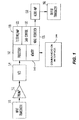
- FIG. 1 is a block diagram of the components of an exemplary hearing aid.
- a hearing aid is a wearable electronic device for correcting hearing loss by amplifying sound.
- the electronic circuitry of the device is contained within a housing that is commonly either placed in the external ear canal or behind the ear.
- Transducers for converting sound to an electrical signal and vice-versa may be integrated into the housing or external to it.
- the basic components of an exemplary hearing aid are shown in Fig. 1 .
- a microphone or other input transducer 110 receives sound waves from the environment and converts the sound into an input signal. After amplification by pre-amplifier 112, the input signal is sampled and digitized by A/D converter 114.
- inventions may incorporate an input transducer that produces a digital output directly.
- the device's signal processing circuitry 100 processes the digitized input signal into an output signal in a manner that compensates for the patient's hearing deficit.
- the output signal is then passed to an audio amplifier 150 that drives an output transducer 160 for converting the output signal into an audio output, such as a speaker within an earphone.
- the signal processing circuitry 100 includes a programmable controller made up of a processor 140 and associated memory 142 for storing executable code and data.
- the overall operation of the device is determined by the programming of the controller, which programming may be modified via a communication interface 144.
- the communication interface 210 allows input of data to a parameter modifying area of the memory 142 so that parameters affecting device operation may be changed.
- the communication interface 144 may provide interaction with a variety of devices for configuring the hearing aid such as industry standard programmers, wireless devices, mobile phones, or belt-worn appliances.
- the signal processing modules 120, 130, and 135 may represent specific code executed by the controller or may represent additional hardware components.
- the filtering and amplifying module 120 amplifies the input signal in a frequency specific manner as defined by one or more signal processing parameters specified by the controller. As described above, the patient's hearing deficit is compensated by selectively amplifying those frequencies at which the patient has a below normal hearing threshold. Other signal processing functions may also be performed in particular embodiments.
- the example illustrated in Fig. 1 also includes a gain control module 130 and a noise reduction module 135.
- the gain control module 130 dynamically adjusts the amplification in accordance with the amplitude of the input signal.
- Compression is a form of automatic gain control that decreases the gain of the filtering and amplifying circuit to prevent signal distortion at high input signal levels and improves the clarity of sound perceived by the patient.
- Other gain control circuits may perform other functions such as controlling gain in a frequency specific manner.
- the noise reduction module 135 performs functions such as suppression of ambient background noise and feedback cancellation.
- the signal processing circuitry 100 may be implemented in a variety of different ways, such as with an integrated digital signal processor or with a mixture of discrete analog and digital components.
- the signal processing may be performed by a mixture of analog and digital components having inputs that are controllable by the controller that define how the input signal is processed, or the signal processing functions may be implemented solely as code executed by the controller.
- controller module
- circuitry should therefore be taken to encompass either discrete circuit elements or a processor executing programmed instructions contained in a processor-readable storage medium.
- the programmable controller specifies one or more signal processing parameters to the filtering and amplifying module and/or other signal processing modules that determine the manner in which the input signal is converted into the output signal.
- the one or more signal processing parameters that define a particular mode of operation are referred to herein as a signal processing parameter set.
- a signal processing parameter set thus defines at least one operative characteristic of the hearing aid's signal processing circuit.
- a particular signal processing parameter set may, for example, define the frequency response of the filtering and amplifying circuit and define the manner in which amplification is performed by the device.
- the parameter set may also define the manner in which those functions are performed.
- a hearing aid programmed with a parameter set that provides optimal compensation may not be initially well tolerated by the patient.
- the controller is programmed to select a parameter set from a group of such sets in a defined sequence such that the hearing aid progressively adjusts from a sub-optimal to an optimal level of compensation delivered to the patient.
- the patient is tested to determine an optimal signal processing parameter set that compensates for the patient's hearing deficit. From that information, a sub-optimal parameter set that is initially more comfortable for the patient can also determined, as can a group of such sets that gradually increase the degree of compensation.
- the controller of the hearing aid may then be programmed to select a signal processing parameter set for use by the signal processing circuitry by sequencing through the group of signal processing parameter sets over time so that the patient's hearing is gradually compensated at increasingly optimal levels until the optimal signal processing parameter set is reached.
- each parameter set may include one or more frequency response parameters that define the amplification gain of the signal processing circuit at a particular frequency.
- the controller of the hearing aid may be configured to transition between the group of signal processing parameters in response to receiving a specific command from a remote device via a communication interface, or in response to receiving time date from the remote device via the communication interface.
- the specific command may indicate that the wearer of the hearing aid has entered a noisy environment (e.g., a loud restaurant) and a signal processing parameter with a higher level of noise reduction should be implemented by the controller.
- the overall gain of the hearing aid may be gradually increased with each successively selected signal processing parameter set. If the patient has a high frequency hearing deficit, the group of parameter sets may be defined so that sequencing through them results in a gradual increase in the high frequency gain of the hearing aid. Conversely, if the patient has a low frequency hearing deficit, the hearing aid may be programmed to gradually increase the low frequency gain with each successively selected parameter set. In this manner, the patient is allowed to adapt to the previously unheard sounds through the automatic operation of the hearing aid.
- hearing aid in delivering optimal compensation may also be automatically adjusted toward the optimal level with successively selected parameter sets such as compression parameters that define the amplification gain of the signal processing circuit at a particular input signal level, parameters defining frequency specific compression, noise reduction parameters, and parameters related to multi-channel processing.
- parameter sets such as compression parameters that define the amplification gain of the signal processing circuit at a particular input signal level, parameters defining frequency specific compression, noise reduction parameters, and parameters related to multi-channel processing.
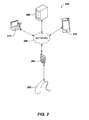
- FIG. 2 is a block diagram illustrating an example of a signal processing system 200 for use in a hearing assistance system.
- System 200 includes a hearing aid device 202, for example the device depicted in FIG. 1 , a mobile device 204, such as a smart phone or personal data assistant.
- the mobile device 204 may be configured to communicate via a network 206, such as a cellular telephone network or the Internet, with a remote device 208.
- the remote device 208 may include a server, or any other computing device.
- a personal computer 210, a mobile device 212, a tablet computer, or any other computing device having a user interface may communicate with the hearing aid device 202 or the mobile device 204 via the network 206.
- a care provider may be able to receive a notification if a patient wearing the hearing aid device 202 has not turned the hearing aid on during a specified period of time.
- the notification may be generated by an application on the mobile device 204 in response to a failure to communicate with the hearing aid device 202 for a predetermined number of hours or days.
- a hearing professional may interact with the personal computer 210 to request data from the hearing aid device 202 in response to a query or complaint by the wearer of the hearing aid device 202.
- An application on the mobile device 204 may retrieve from the hearing aid device 202, or an internal memory in the mobile device 204, any data corresponding to the performance of the hearing aid device 202 or configuration settings that have been in use by the hearing aid device 202.
- FIG. 3 is a flow chart illustrating an example of a method 300 for hearing assistance device communication and programming.
- the method 300 may be performed by a hearing aid device such as the hearing aid device 202 depicted in FIG. 2 or the exemplary hearing aid of FIG. 1 .
- a device may operate with an initial parameter configuration.
- a hearing aid device may be configured with an initial factory setting that provides a minimum of sound amplification and maximum noise reduction, or a hearing professional may establish a set of initial parameters based on one or more tests performed on a specific patient that will be fitted with the device.
- the device may establish communication with a wireless device.
- the wireless device may be a mobile device, such as a smart phone or personal data assistant, as depicted in FIG. 2 .
- the communications may be established according to any appropriate wireless communication protocol (e.g., Bluetooth, or one of the Institute of Electrical and Electronics Engineers (IEEE) 802.11 standards).
- IEEE Institute of Electrical and Electronics Engineers
- the device may receive data from the wireless device.
- the data may include, for example, configuration parameters, time data, sensor data, or any other information that be utilized by the device to change or improve the operation of the device.
- the device may provide device information to the wireless device.
- the device information may include, for example: total operating time, batter life, current configuration settings, a count of power cycles, an amount of elapsed time since power-on, or any other device specific data.
- the device may update the device's configuration (e.g., parameters, software, firmware, etc.) based on the data received from the wireless device.
- the data may include an upgrade to firmware in the device, new configuration settings, or time data that may trigger the device to transition from a first set of parameters to a second set of parameters.
- any process flow is applicable to software, firmware, hardware, and hybrid implementations.
- FIG. 4 is a block diagram illustrating an example machine 400 upon which any one or more of the techniques (e.g., methodologies) discussed herein may be performed.
- the machine 400 may operate as a standalone device or may be connected (e.g., networked) to other machines.
- the machine 400 may operate in the capacity of a server machine, a client machine, or both in server-client network environments.
- the machine 400 may act as a peer machine in peer-to-peer (P2P) (or other distributed) network environments.
- P2P peer-to-peer
- the machine 400 may be a personal computer (PC), a tablet PC, a Personal Digital Assistant (PDA), a mobile telephone, a web appliance, or any machine capable of executing instructions (sequential or otherwise) that specify actions to be taken by that machine.
- PC personal computer
- PDA Personal Digital Assistant
- a mobile telephone a web appliance
- machine shall also be taken to include any collection of machines that individually or jointly execute a set (or multiple sets) of instructions to perform any one or more of the methodologies discussed herein, such as cloud computing, software as a service (SaaS), other computer cluster configurations.
- SaaS software as a service
- Examples, as described herein, may include, or may operate on, logic or a number of components, modules, or mechanisms.
- Modules are tangible entities capable of performing specified operations and may be configured or arranged in a certain manner.
- circuits may be arranged (e.g., internally or with respect to external entities such as other circuits) in a specified manner as a module.
- the whole or part of one or more computer systems (e.g., a standalone, client or server computer system) or one or more hardware processors may be configured by firmware or software (e.g., instructions, an application portion, or an application) as a module that operates to perform specified operations.
- the software may reside (1) on a non-transitory machine-readable medium or (2) in a transmission signal.
- the software when executed by the underlying hardware of the module, causes the hardware to perform the specified operations.
- module is understood to encompass a tangible entity, be that an entity that is physically constructed, specifically configured (e.g., hardwired), or temporarily (e.g., transitorily) configured (e.g., programmed) to operate in a specified manner or to perform part or all of any operation described herein.
- each of the modules need not be instantiated at any one moment in time.
- the modules comprise a general-purpose hardware processor configured using software
- the general-purpose hardware processor may be configured as respective different modules at different times.
- Software may accordingly configure a hardware processor, for example, to constitute a particular module at one instance of time and to constitute a different module at a different instance of time.
- Machine 400 may include a hardware processor 402 (e.g., a processing unit, a graphics processing unit (GPU), a hardware processor core, or any combination thereof), a main memory 404, and a static memory 406, some or all of which may communicate with each other via a link 408 (e.g., a bus, link, interconnect, or the like).
- the machine 400 may further include a display device 410, an input device 412 (e.g., a keyboard), and a user interface (UI) navigation device 414 (e.g., a mouse).
- the display device 410, input device 412, and UI navigation device 414 may be a touch screen display.
- the machine 400 may additionally include a mass storage (e.g., drive unit) 416, a signal generation device 418 (e.g., a speaker), a network interface device 420, and one or more sensors 421, such as a global positioning system (GPS) sensor, camera, video recorder, compass, accelerometer, or other sensor.
- the machine 400 may include an output controller 428, such as a serial (e.g., universal serial bus (USB), parallel, or other wired or wireless (e.g., infrared (IR)) connection to communicate or control one or more peripheral devices (e.g., a printer, card reader, etc.).
- a serial e.g., universal serial bus (USB), parallel, or other wired or wireless (e.g., infrared (IR) connection to communicate or control one or more peripheral devices (e.g., a printer, card reader, etc.).
- USB universal serial bus
- IR infrared
- the mass storage 416 may include a machine-readable medium 422 on which is stored one or more sets of data structures or instructions 424 (e.g., software) embodying or utilized by any one or more of the techniques or functions described herein.
- the instructions 424 may also reside, completely or at least partially, within the main memory 404, within static memory 406, or within the hardware processor 402 during execution thereof by the machine 400.
- one or any combination of the hardware processor 402, the main memory 404, the static memory 406, or the mass storage 416 may constitute machine readable media.
- machine-readable medium 422 is illustrated as a single medium, the term “machine readable medium” may include a single medium or multiple media (e.g., a centralized or distributed database, and/or associated caches and servers) that configured to store the one or more instructions 424.
- machine readable medium may include a single medium or multiple media (e.g., a centralized or distributed database, and/or associated caches and servers) that configured to store the one or more instructions 424.
- machine-readable medium may include any tangible medium that is capable of storing, encoding, or carrying instructions for execution by the machine 400 and that cause the machine 400 to perform any one or more of the techniques of the present disclosure, or that is capable of storing, encoding or carrying data structures used by or associated with such instructions.
- Non-limiting machine-readable medium examples may include solid-state memories, and optical and magnetic media.
- machine-readable media may include: non-volatile memory, such as semiconductor memory devices (e.g., Electrically Programmable Read-Only Memory (EPROM), Electrically Erasable Programmable Read-Only Memory (EEPROM)) and flash memory devices; magnetic disks, such as internal hard disks and removable disks; magneto-optical disks; and CD-ROM and DVD-ROM disks.
- non-volatile memory such as semiconductor memory devices (e.g., Electrically Programmable Read-Only Memory (EPROM), Electrically Erasable Programmable Read-Only Memory (EEPROM)) and flash memory devices
- EPROM Electrically Programmable Read-Only Memory
- EEPROM Electrically Erasable Programmable Read-Only Memory
- flash memory devices e.g., Electrically Erasable Programmable Read-Only Memory (EEPROM)
- EPROM Electrically Programmable Read-Only Memory
- EEPROM Electrically Erasable Programmable Read-Only Memory
- flash memory devices e.g., Electrically Era
- the instructions 424 may further be transmitted or received over a communications network 426 using a transmission medium via the network interface device 420 utilizing any one of a number of transfer protocols (e.g., frame relay, internet protocol (IP), transmission control protocol (TCP), user datagram protocol (UDP), hypertext transfer protocol (HTTP), etc.).
- transfer protocols e.g., frame relay, internet protocol (IP), transmission control protocol (TCP), user datagram protocol (UDP), hypertext transfer protocol (HTTP), etc.
- Example communication networks may include a local area network (LAN), a wide area network (WAN), a packet data network (e.g., the Internet), mobile telephone networks (e.g., cellular networks), Plain Old Telephone (POTS) networks, and wireless data networks (e.g., Institute of Electrical and Electronics Engineers (IEEE) 802.11 family of standards known as Wi-Fi®, IEEE 802.16 family of standards known as WiMax®), peer-to-peer (P2P) networks, among others.
- the network interface device 420 may include one or more physical jacks (e.g., Ethernet, coaxial, or phone jacks) or one or more antennas to connect to the communications network 426.
- the network interface device 420 may include a plurality of antennas to wirelessly communicate using at least one of single-input multiple-output (SIMO), multiple-input multiple-output (MIMO), or multiple-input single-output (MISO) techniques.
- SIMO single-input multiple-output
- MIMO multiple-input multiple-output
- MISO multiple-input single-output
- transmission medium shall be taken to include any intangible medium that is capable of storing, encoding or carrying instructions for execution by the machine 400, and includes digital or analog communications signals or other intangible medium to facilitate communication of such software.
- a hearing assistance device that supports wireless communications from other devices. It is further understood that many hearing assistance devices may be used without departing from the scope of the present subject matter and that the devices depicted in the figures are intended to demonstrate the subject matter, but not in a limited, exhaustive, or exclusive sense. It is also understood that the present subject matter can be used with a device designed for use in the right ear or the left ear or both ears of the wearer.
- hearing assistance devices including hearing aids, including but not limited to, behind-the-ear (BTE), in-the-ear (ITE), in-the-canal (ITC), receiver-in-canal (RIC), or completely-in-the-canal (CIC) type hearing aids.
- BTE behind-the-ear
- ITE in-the-ear
- ITC in-the-canal
- RIC receiver-in-canal
- CIC completely-in-the-canal
- hearing assistance devices may include devices that reside substantially behind the ear or over the ear.
- Such devices may include hearing aids with receivers associated with the electronics portion of the behind-the-ear device, or hearing aids of the type having receivers in the ear canal of the user, including but not limited to receiver-in-canal (RIC) or receiver-in-the-ear (RITE) designs.
- RIC receiver-in-canal
- RITE receiver-in-the-ear
- digital hearing aids referenced in this patent application include a processor.
- a processor programmed to provide corrections to hearing impairments
- programmable gains are employed to tailor the hearing aid output to a wearer's particular hearing impairment.
- the processor may be a digital signal processor (DSP), microprocessor, microcontroller, other digital logic, or combinations thereof.
- DSP digital signal processor
- the processing of signals referenced in this application can be performed using the processor. Processing may be done in the digital domain, the analog domain, or combinations thereof. Processing may be done using subband processing techniques. Processing may be done with frequency domain or time domain approaches. Some processing may involve both frequency and time domain aspects.
- drawings may omit certain blocks that perform frequency synthesis, frequency analysis, analog-to-digital conversion, digital-to-analog conversion, amplification, and certain types of filtering and processing.
- the processor is adapted to perform instructions stored in memory which may or may not be explicitly shown.
- Various types of memory may be used, including volatile and nonvolatile forms of memory.
- instructions are performed by the processor to perform a number of signal processing tasks.
- analog components are in communication with the processor to perform signal tasks, such as microphone reception, or receiver sound embodiments (i.e., in applications where such transducers are used).
- different realizations of the block diagrams, circuits, and processes set forth herein may occur without departing from the scope of the present subject matter.
- the hearing assistance device may include additional electronics, such as wireless communications electronics that can include support standard or nonstandard communications.
- standard wireless communications include link protocols including, but not limited to, BluetoothTM, IEEE 802.11(wireless LANs), 802.15 (WPANs), 802.16 (WiMAX), cellular protocols including, but not limited to CDMA and GSM, ZigBee, and ultra-wideband (UWB) technologies.
- Such protocols support radio frequency communications and some support infrared communications.
- it is possible that other forms of wireless communications can be used such as ultrasonic, optical, and others.
- Hearing assistance devices typically include an enclosure or housing, a microphone, hearing assistance device electronics including processing electronics, and a speaker or receiver. It is understood that in various embodiments the microphone is optional. Thus, the examples set forth herein are intended to be demonstrative and not a limiting or exhaustive depiction of variations.
Landscapes
- Engineering & Computer Science (AREA)
- Health & Medical Sciences (AREA)
- General Health & Medical Sciences (AREA)
- Neurosurgery (AREA)
- Otolaryngology (AREA)
- Physics & Mathematics (AREA)
- Acoustics & Sound (AREA)
- Signal Processing (AREA)
- Computer Networks & Wireless Communication (AREA)
- Telephone Function (AREA)
- Circuit For Audible Band Transducer (AREA)
Applications Claiming Priority (1)
| Application Number | Priority Date | Filing Date | Title |
|---|---|---|---|
| US13/958,212 US8965016B1 (en) | 2013-08-02 | 2013-08-02 | Automatic hearing aid adaptation over time via mobile application |
Publications (1)
| Publication Number | Publication Date |
|---|---|
| EP2833652A1 true EP2833652A1 (de) | 2015-02-04 |
Family
ID=51257428
Family Applications (1)
| Application Number | Title | Priority Date | Filing Date |
|---|---|---|---|
| EP14179553.4A Withdrawn EP2833652A1 (de) | 2013-08-02 | 2014-08-01 | Automatische Hörgerätanpassung im Laufe der Zeit über mobile Anwendung |
Country Status (2)
| Country | Link |
|---|---|
| US (2) | US8965016B1 (de) |
| EP (1) | EP2833652A1 (de) |
Cited By (2)
| Publication number | Priority date | Publication date | Assignee | Title |
|---|---|---|---|---|
| EP3267695A1 (de) * | 2016-07-04 | 2018-01-10 | GN Hearing A/S | Automatisches abtasten von parametern für hörgeräte |
| CN110166922A (zh) * | 2019-05-30 | 2019-08-23 | 深圳市安特信技术有限公司 | 基于蓝牙耳机的测试通信系统及方法 |
Families Citing this family (17)
| Publication number | Priority date | Publication date | Assignee | Title |
|---|---|---|---|---|
| AU2012369343B2 (en) * | 2012-02-07 | 2015-04-30 | Widex A/S | Hearing aid fitting system and a method of fitting a hearing aid system |
| DK3036915T3 (en) * | 2013-08-20 | 2018-11-26 | Widex As | HEARING WITH AN ADAPTIVE CLASSIFIER |
| JP2015173369A (ja) * | 2014-03-12 | 2015-10-01 | ソニー株式会社 | 信号処理装置、信号処理方法、およびプログラム |
| EP3117229B1 (de) * | 2014-03-14 | 2018-12-26 | ZPower, LLC | Batterieladevorrichtungskommunikationssystem |
| DK3057340T3 (da) * | 2015-02-13 | 2019-08-19 | Oticon As | Partnermikrofonenhed og et høresystem, der omfatter en partnermikrofonenhed |
| US9723415B2 (en) * | 2015-06-19 | 2017-08-01 | Gn Hearing A/S | Performance based in situ optimization of hearing aids |
| US10575108B2 (en) | 2015-08-24 | 2020-02-25 | Cochlear Limited | Prosthesis functionality control and data presentation |
| US10348891B2 (en) | 2015-09-06 | 2019-07-09 | Deborah M. Manchester | System for real time, remote access to and adjustment of patient hearing aid with patient in normal life environment |
| US10853021B2 (en) | 2016-04-06 | 2020-12-01 | Universal Electronics Inc. | System and method for pairing a hearing device and an appliance |
| EP3334186B1 (de) * | 2016-12-08 | 2021-03-03 | GN Hearing A/S | Hörsystem und verfahren zur wiederherstellung von hörvorrichtungsdaten |
| EP3937513A1 (de) * | 2016-12-08 | 2022-01-12 | GN Hearing A/S | Hörsystem, vorrichtungen und verfahren zur sicherung der kommunikation für eine benutzeranwendung |
| US10382872B2 (en) | 2017-08-31 | 2019-08-13 | Starkey Laboratories, Inc. | Hearing device with user driven settings adjustment |
| CN110545504A (zh) | 2018-05-29 | 2019-12-06 | 洞见未来科技股份有限公司 | 个人听力装置、外部声音处理装置及相关计算机程序产品 |
| US11445307B2 (en) * | 2018-08-31 | 2022-09-13 | Indian Institute Of Technology Bombay | Personal communication device as a hearing aid with real-time interactive user interface |
| DE102020214329A1 (de) * | 2020-11-13 | 2022-05-19 | Sivantos Pte. Ltd. | Verfahren zur Unterstützung bei der Nutzung eines Hörgerätes und Hörgerät |
| US11665490B2 (en) | 2021-02-03 | 2023-05-30 | Helen Of Troy Limited | Auditory device cable arrangement |
| EP4593423A1 (de) * | 2024-01-23 | 2025-07-30 | Sonova AG | Kurzfristige akklimatisierung für hörgerätebenutzer |
Citations (3)
| Publication number | Priority date | Publication date | Assignee | Title |
|---|---|---|---|---|
| US7206424B2 (en) | 2002-05-16 | 2007-04-17 | Starkey Laboratories, Inc. | Hearing aid with time-varying performance |
| WO2011069504A1 (en) * | 2009-12-09 | 2011-06-16 | Widex A/S | Method of processing a signal in a hearing aid, a method of fitting a hearing aid and a hearing aid |
| US20110249839A1 (en) * | 2010-04-13 | 2011-10-13 | Audiotoniq, Inc. | System and Method of Progressive Hearing Device Adjustment |
Family Cites Families (42)
| Publication number | Priority date | Publication date | Assignee | Title |
|---|---|---|---|---|
| US3527901A (en) | 1967-03-28 | 1970-09-08 | Dahlberg Electronics | Hearing aid having resilient housing |
| US4637402A (en) | 1980-04-28 | 1987-01-20 | Adelman Roger A | Method for quantitatively measuring a hearing defect |
| US4366349A (en) | 1980-04-28 | 1982-12-28 | Adelman Roger A | Generalized signal processing hearing aid |
| US4419544A (en) | 1982-04-26 | 1983-12-06 | Adelman Roger A | Signal processing apparatus |
| US4396806B2 (en) | 1980-10-20 | 1998-06-02 | A & L Ventures I | Hearing aid amplifier |
| US4471490A (en) | 1983-02-16 | 1984-09-11 | Gaspare Bellafiore | Hearing aid |
| JP2935266B2 (ja) | 1987-05-11 | 1999-08-16 | ジャンポルスキー、アーサー | 逆説的補聴器 |
| US4882762A (en) | 1988-02-23 | 1989-11-21 | Resound Corporation | Multi-band programmable compression system |
| US4989251A (en) | 1988-05-10 | 1991-01-29 | Diaphon Development Ab | Hearing aid programming interface and method |
| DE69233156T2 (de) | 1991-01-17 | 2004-07-08 | Adelman, Roger A. | Verbessertes hörgerät |
| EP0674463A1 (de) | 1994-03-23 | 1995-09-27 | Siemens Audiologische Technik GmbH | Programmierbares Hörgerät |
| US5502769A (en) | 1994-04-28 | 1996-03-26 | Starkey Laboratories, Inc. | Interface module for programmable hearing instrument |
| DE4418203C2 (de) | 1994-05-25 | 1997-09-11 | Siemens Audiologische Technik | Verfahren zum Anpassen der Übertragungscharakteristik eines Hörgerätes |
| US5659621A (en) | 1994-08-31 | 1997-08-19 | Argosy Electronics, Inc. | Magnetically controllable hearing aid |
| US5553152A (en) | 1994-08-31 | 1996-09-03 | Argosy Electronics, Inc. | Apparatus and method for magnetically controlling a hearing aid |
| US5581747A (en) | 1994-11-25 | 1996-12-03 | Starkey Labs., Inc. | Communication system for programmable devices employing a circuit shift register |
| US5862238A (en) | 1995-09-11 | 1999-01-19 | Starkey Laboratories, Inc. | Hearing aid having input and output gain compression circuits |
| US5822442A (en) | 1995-09-11 | 1998-10-13 | Starkey Labs, Inc. | Gain compression amplfier providing a linear compression function |
| DE19542961C1 (de) | 1995-11-17 | 1997-05-15 | Siemens Audiologische Technik | Schaltung zum Betrieb eines Hörgerätes sowie Hörgerät |
| JPH09182194A (ja) | 1995-12-27 | 1997-07-11 | Nec Corp | 補聴器 |
| EP0798947A1 (de) | 1996-03-27 | 1997-10-01 | Siemens Audiologische Technik GmbH | Verfahren und Schaltung zur Verarbeitung von Daten, insbesondere Signaldaten in einem digitalen programmierbaren Hörgerät |
| US5757933A (en) | 1996-12-11 | 1998-05-26 | Micro Ear Technology, Inc. | In-the-ear hearing aid with directional microphone system |
| US6449662B1 (en) | 1997-01-13 | 2002-09-10 | Micro Ear Technology, Inc. | System for programming hearing aids |
| US6236731B1 (en) | 1997-04-16 | 2001-05-22 | Dspfactory Ltd. | Filterbank structure and method for filtering and separating an information signal into different bands, particularly for audio signal in hearing aids |
| US5825631A (en) | 1997-04-16 | 1998-10-20 | Starkey Laboratories | Method for connecting two substrates in a thick film hybrid circuit |
| US6240192B1 (en) | 1997-04-16 | 2001-05-29 | Dspfactory Ltd. | Apparatus for and method of filtering in an digital hearing aid, including an application specific integrated circuit and a programmable digital signal processor |
| US6366863B1 (en) | 1998-01-09 | 2002-04-02 | Micro Ear Technology Inc. | Portable hearing-related analysis system |
| US6347148B1 (en) | 1998-04-16 | 2002-02-12 | Dspfactory Ltd. | Method and apparatus for feedback reduction in acoustic systems, particularly in hearing aids |
| EP0964603A1 (de) | 1998-06-10 | 1999-12-15 | Oticon A/S | Verfahren zur Verarbeitung von Tonsignalen und Vorrichtung zur Durchführung des Verfahrens |
| ATE518383T1 (de) | 1998-10-07 | 2011-08-15 | Oticon As | Rückkopplungsbehandlung für ein hörgerät |
| DK199900017A (da) | 1999-01-08 | 2000-07-09 | Gn Resound As | Tidsstyret høreapparat |
| ATE253288T1 (de) | 1999-09-02 | 2003-11-15 | Beltone Netherlands B V | Hörgerät und externe einheit zur kommunikation mit demselben |
| DE10021985A1 (de) | 2000-04-14 | 2001-10-25 | Simon Kammermeier | Hörgerät mit betriebszeitgesteuerter Anpassung |
| ATE513424T1 (de) | 2000-11-14 | 2011-07-15 | Gn Resound As | Hörhilfegerät mit datenspeicherung und fehlerschutz |
| US20020076073A1 (en) | 2000-12-19 | 2002-06-20 | Taenzer Jon C. | Automatically switched hearing aid communications earpiece |
| DE102005008316B4 (de) | 2005-02-23 | 2008-11-13 | Siemens Audiologische Technik Gmbh | Hörvorrichtung und Verfahren zum Überwachen des Hörvermögens eines Minderhörenden |
| EP2280562A3 (de) | 2005-11-03 | 2011-02-09 | Phonak Ag | Hörsystem, Hörgerät und Verfahren zur Bedienung und Wartung eines Hörgeräts |
| US8005232B2 (en) * | 2006-11-06 | 2011-08-23 | Phonak Ag | Method for assisting a user of a hearing system and corresponding hearing system |
| US8284968B2 (en) * | 2007-04-25 | 2012-10-09 | Schumaier Daniel R | Preprogrammed hearing assistance device with user selection of program |
| US8472634B2 (en) * | 2007-04-25 | 2013-06-25 | Daniel R. Schumaier | Preprogrammed hearing assistance device with audiometric testing capability |
| US9129291B2 (en) | 2008-09-22 | 2015-09-08 | Personics Holdings, Llc | Personalized sound management and method |
| EP2581038B1 (de) | 2011-10-14 | 2017-12-13 | Oticon A/S | Automatische Hörgerätanpassung in Echtzeit basierend auf durch den Gehörgang evozierte Potenzialen |
-
2013
- 2013-08-02 US US13/958,212 patent/US8965016B1/en active Active
-
2014
- 2014-08-01 EP EP14179553.4A patent/EP2833652A1/de not_active Withdrawn
-
2015
- 2015-01-14 US US14/596,771 patent/US20150125014A1/en not_active Abandoned
Patent Citations (3)
| Publication number | Priority date | Publication date | Assignee | Title |
|---|---|---|---|---|
| US7206424B2 (en) | 2002-05-16 | 2007-04-17 | Starkey Laboratories, Inc. | Hearing aid with time-varying performance |
| WO2011069504A1 (en) * | 2009-12-09 | 2011-06-16 | Widex A/S | Method of processing a signal in a hearing aid, a method of fitting a hearing aid and a hearing aid |
| US20110249839A1 (en) * | 2010-04-13 | 2011-10-13 | Audiotoniq, Inc. | System and Method of Progressive Hearing Device Adjustment |
Cited By (3)
| Publication number | Priority date | Publication date | Assignee | Title |
|---|---|---|---|---|
| EP3267695A1 (de) * | 2016-07-04 | 2018-01-10 | GN Hearing A/S | Automatisches abtasten von parametern für hörgeräte |
| US10321242B2 (en) | 2016-07-04 | 2019-06-11 | Gn Hearing A/S | Automated scanning for hearing aid parameters |
| CN110166922A (zh) * | 2019-05-30 | 2019-08-23 | 深圳市安特信技术有限公司 | 基于蓝牙耳机的测试通信系统及方法 |
Also Published As
| Publication number | Publication date |
|---|---|
| US8965016B1 (en) | 2015-02-24 |
| US20150036851A1 (en) | 2015-02-05 |
| US20150125014A1 (en) | 2015-05-07 |
Similar Documents
| Publication | Publication Date | Title |
|---|---|---|
| US8965016B1 (en) | Automatic hearing aid adaptation over time via mobile application | |
| US20230232173A1 (en) | User adjustment interface using remote computing resource | |
| EP2799985A2 (de) | Unauffällige Firmwareupdates für Hörgeräte | |
| US10484804B2 (en) | Hearing assistance device ear-to-ear communication using an intermediate device | |
| US20170230759A1 (en) | Wireless environment interference diagnostic hearing assistance device system | |
| US20260025622A1 (en) | Active noise control for sound quality in hearing devices | |
| EP2779698A2 (de) | Verfahren und Vorrichtung zur Anzeige von Interferenzen für eine drahtlose Hörgeräteprogrammierervorrichtung | |
| EP4404593A1 (de) | Einstellung individueller akustischer kopplungsparameter einer audiovorrichtung | |
| US12335688B2 (en) | Artifact detection and logging for tuning of feedback canceller | |
| US12100411B2 (en) | SNR profile adaptive hearing assistance attenuation | |
| US11570562B2 (en) | Hearing assistance device fitting based on heart rate sensor | |
| US12047746B2 (en) | Audio feedback reduction system for hearing assistance devices, audio feedback reduction method and non-transitory machine-readable storage medium | |
| EP3065422B1 (de) | Techniken zur verbesserung der verarbeitungsfähigkeit in hörgeräten | |
| US8824668B2 (en) | Communication system comprising a telephone and a listening device, and transmission method | |
| US20250024211A1 (en) | Hearing aid and cochlear implant wireless system | |
| US20250126419A1 (en) | Telecoil tick-artifact mitigation for binaural hearing instruments | |
| US20240323618A1 (en) | Reducing comb filtering for hearing devices | |
| US12501222B2 (en) | Telecoil predicted repeating system interference canceller | |
| US20250126416A1 (en) | Temperature sensing for left-right determination in hearing devices |
Legal Events
| Date | Code | Title | Description |
|---|---|---|---|
| 17P | Request for examination filed |
Effective date: 20140801 |
|
| AK | Designated contracting states |
Kind code of ref document: A1 Designated state(s): AL AT BE BG CH CY CZ DE DK EE ES FI FR GB GR HR HU IE IS IT LI LT LU LV MC MK MT NL NO PL PT RO RS SE SI SK SM TR |
|
| AX | Request for extension of the european patent |
Extension state: BA ME |
|
| PUAI | Public reference made under article 153(3) epc to a published international application that has entered the european phase |
Free format text: ORIGINAL CODE: 0009012 |
|
| STAA | Information on the status of an ep patent application or granted ep patent |
Free format text: STATUS: THE APPLICATION IS DEEMED TO BE WITHDRAWN |
|
| 18D | Application deemed to be withdrawn |
Effective date: 20150805 |