EP2834090B1 - Reifen und rad-reifen-anordnung mit erweiterter mobilität - Google Patents
Reifen und rad-reifen-anordnung mit erweiterter mobilität Download PDFInfo
- Publication number
- EP2834090B1 EP2834090B1 EP13713450.8A EP13713450A EP2834090B1 EP 2834090 B1 EP2834090 B1 EP 2834090B1 EP 13713450 A EP13713450 A EP 13713450A EP 2834090 B1 EP2834090 B1 EP 2834090B1
- Authority
- EP
- European Patent Office
- Prior art keywords
- styrene
- elastomer
- phr
- radially
- tire
- Prior art date
- Legal status (The legal status is an assumption and is not a legal conclusion. Google has not performed a legal analysis and makes no representation as to the accuracy of the status listed.)
- Active
Links
Images



Classifications
-
- B—PERFORMING OPERATIONS; TRANSPORTING
- B60—VEHICLES IN GENERAL
- B60C—VEHICLE TYRES; TYRE INFLATION; TYRE CHANGING; CONNECTING VALVES TO INFLATABLE ELASTIC BODIES IN GENERAL; DEVICES OR ARRANGEMENTS RELATED TO TYRES
- B60C19/00—Tyre parts or constructions not otherwise provided for
- B60C19/12—Puncture preventing arrangements
-
- B—PERFORMING OPERATIONS; TRANSPORTING
- B60—VEHICLES IN GENERAL
- B60C—VEHICLE TYRES; TYRE INFLATION; TYRE CHANGING; CONNECTING VALVES TO INFLATABLE ELASTIC BODIES IN GENERAL; DEVICES OR ARRANGEMENTS RELATED TO TYRES
- B60C19/00—Tyre parts or constructions not otherwise provided for
- B60C19/12—Puncture preventing arrangements
- B60C19/122—Puncture preventing arrangements disposed inside of the inner liner
-
- B—PERFORMING OPERATIONS; TRANSPORTING
- B60—VEHICLES IN GENERAL
- B60C—VEHICLE TYRES; TYRE INFLATION; TYRE CHANGING; CONNECTING VALVES TO INFLATABLE ELASTIC BODIES IN GENERAL; DEVICES OR ARRANGEMENTS RELATED TO TYRES
- B60C1/00—Tyres characterised by the chemical composition or the physical arrangement or mixture of the composition
-
- B—PERFORMING OPERATIONS; TRANSPORTING
- B60—VEHICLES IN GENERAL
- B60C—VEHICLE TYRES; TYRE INFLATION; TYRE CHANGING; CONNECTING VALVES TO INFLATABLE ELASTIC BODIES IN GENERAL; DEVICES OR ARRANGEMENTS RELATED TO TYRES
- B60C1/00—Tyres characterised by the chemical composition or the physical arrangement or mixture of the composition
- B60C1/0008—Compositions of the inner liner
-
- B—PERFORMING OPERATIONS; TRANSPORTING
- B60—VEHICLES IN GENERAL
- B60C—VEHICLE TYRES; TYRE INFLATION; TYRE CHANGING; CONNECTING VALVES TO INFLATABLE ELASTIC BODIES IN GENERAL; DEVICES OR ARRANGEMENTS RELATED TO TYRES
- B60C15/00—Tyre beads, e.g. ply turn-up or overlap
- B60C15/0009—Tyre beads, e.g. ply turn-up or overlap features of the carcass terminal portion
-
- B—PERFORMING OPERATIONS; TRANSPORTING
- B60—VEHICLES IN GENERAL
- B60C—VEHICLE TYRES; TYRE INFLATION; TYRE CHANGING; CONNECTING VALVES TO INFLATABLE ELASTIC BODIES IN GENERAL; DEVICES OR ARRANGEMENTS RELATED TO TYRES
- B60C15/00—Tyre beads, e.g. ply turn-up or overlap
- B60C15/04—Bead cores
-
- B—PERFORMING OPERATIONS; TRANSPORTING
- B60—VEHICLES IN GENERAL
- B60C—VEHICLE TYRES; TYRE INFLATION; TYRE CHANGING; CONNECTING VALVES TO INFLATABLE ELASTIC BODIES IN GENERAL; DEVICES OR ARRANGEMENTS RELATED TO TYRES
- B60C15/00—Tyre beads, e.g. ply turn-up or overlap
- B60C15/06—Flipper strips, fillers, or chafing strips and reinforcing layers for the construction of the bead
-
- B—PERFORMING OPERATIONS; TRANSPORTING
- B60—VEHICLES IN GENERAL
- B60C—VEHICLE TYRES; TYRE INFLATION; TYRE CHANGING; CONNECTING VALVES TO INFLATABLE ELASTIC BODIES IN GENERAL; DEVICES OR ARRANGEMENTS RELATED TO TYRES
- B60C15/00—Tyre beads, e.g. ply turn-up or overlap
- B60C15/06—Flipper strips, fillers, or chafing strips and reinforcing layers for the construction of the bead
- B60C15/0603—Flipper strips, fillers, or chafing strips and reinforcing layers for the construction of the bead characterised by features of the bead filler or apex
-
- B—PERFORMING OPERATIONS; TRANSPORTING
- B60—VEHICLES IN GENERAL
- B60C—VEHICLE TYRES; TYRE INFLATION; TYRE CHANGING; CONNECTING VALVES TO INFLATABLE ELASTIC BODIES IN GENERAL; DEVICES OR ARRANGEMENTS RELATED TO TYRES
- B60C17/00—Tyres characterised by means enabling restricted operation in damaged or deflated condition; Accessories therefor
- B60C17/0009—Tyres characterised by means enabling restricted operation in damaged or deflated condition; Accessories therefor comprising sidewall rubber inserts, e.g. crescent shaped inserts
-
- B—PERFORMING OPERATIONS; TRANSPORTING
- B29—WORKING OF PLASTICS; WORKING OF SUBSTANCES IN A PLASTIC STATE IN GENERAL
- B29C—SHAPING OR JOINING OF PLASTICS; SHAPING OF MATERIAL IN A PLASTIC STATE, NOT OTHERWISE PROVIDED FOR; AFTER-TREATMENT OF THE SHAPED PRODUCTS, e.g. REPAIRING
- B29C73/00—Repairing of articles made from plastics or substances in a plastic state, e.g. of articles shaped or produced by using techniques covered by this subclass or subclass B29D
- B29C73/16—Auto-repairing or self-sealing arrangements or agents
- B29C73/163—Sealing compositions or agents, e.g. combined with propellant agents
-
- B—PERFORMING OPERATIONS; TRANSPORTING
- B60—VEHICLES IN GENERAL
- B60C—VEHICLE TYRES; TYRE INFLATION; TYRE CHANGING; CONNECTING VALVES TO INFLATABLE ELASTIC BODIES IN GENERAL; DEVICES OR ARRANGEMENTS RELATED TO TYRES
- B60C15/00—Tyre beads, e.g. ply turn-up or overlap
- B60C15/0009—Tyre beads, e.g. ply turn-up or overlap features of the carcass terminal portion
- B60C2015/009—Height of the carcass terminal portion defined in terms of a numerical value or ratio in proportion to section height
-
- B—PERFORMING OPERATIONS; TRANSPORTING
- B60—VEHICLES IN GENERAL
- B60C—VEHICLE TYRES; TYRE INFLATION; TYRE CHANGING; CONNECTING VALVES TO INFLATABLE ELASTIC BODIES IN GENERAL; DEVICES OR ARRANGEMENTS RELATED TO TYRES
- B60C15/00—Tyre beads, e.g. ply turn-up or overlap
- B60C15/04—Bead cores
- B60C2015/048—Polygonal cores characterised by the winding sequence
-
- B—PERFORMING OPERATIONS; TRANSPORTING
- B60—VEHICLES IN GENERAL
- B60C—VEHICLE TYRES; TYRE INFLATION; TYRE CHANGING; CONNECTING VALVES TO INFLATABLE ELASTIC BODIES IN GENERAL; DEVICES OR ARRANGEMENTS RELATED TO TYRES
- B60C15/00—Tyre beads, e.g. ply turn-up or overlap
- B60C15/06—Flipper strips, fillers, or chafing strips and reinforcing layers for the construction of the bead
- B60C15/0603—Flipper strips, fillers, or chafing strips and reinforcing layers for the construction of the bead characterised by features of the bead filler or apex
- B60C2015/061—Dimensions of the bead filler in terms of numerical values or ratio in proportion to section height
-
- B—PERFORMING OPERATIONS; TRANSPORTING
- B60—VEHICLES IN GENERAL
- B60C—VEHICLE TYRES; TYRE INFLATION; TYRE CHANGING; CONNECTING VALVES TO INFLATABLE ELASTIC BODIES IN GENERAL; DEVICES OR ARRANGEMENTS RELATED TO TYRES
- B60C15/00—Tyre beads, e.g. ply turn-up or overlap
- B60C15/06—Flipper strips, fillers, or chafing strips and reinforcing layers for the construction of the bead
- B60C2015/0614—Flipper strips, fillers, or chafing strips and reinforcing layers for the construction of the bead characterised by features of the chafer or clinch portion, i.e. the part of the bead contacting the rim
-
- B—PERFORMING OPERATIONS; TRANSPORTING
- B60—VEHICLES IN GENERAL
- B60C—VEHICLE TYRES; TYRE INFLATION; TYRE CHANGING; CONNECTING VALVES TO INFLATABLE ELASTIC BODIES IN GENERAL; DEVICES OR ARRANGEMENTS RELATED TO TYRES
- B60C15/00—Tyre beads, e.g. ply turn-up or overlap
- B60C15/06—Flipper strips, fillers, or chafing strips and reinforcing layers for the construction of the bead
- B60C2015/0617—Flipper strips, fillers, or chafing strips and reinforcing layers for the construction of the bead comprising a cushion rubber other than the chafer or clinch rubber
-
- B—PERFORMING OPERATIONS; TRANSPORTING
- B60—VEHICLES IN GENERAL
- B60C—VEHICLE TYRES; TYRE INFLATION; TYRE CHANGING; CONNECTING VALVES TO INFLATABLE ELASTIC BODIES IN GENERAL; DEVICES OR ARRANGEMENTS RELATED TO TYRES
- B60C15/00—Tyre beads, e.g. ply turn-up or overlap
- B60C15/06—Flipper strips, fillers, or chafing strips and reinforcing layers for the construction of the bead
- B60C2015/0617—Flipper strips, fillers, or chafing strips and reinforcing layers for the construction of the bead comprising a cushion rubber other than the chafer or clinch rubber
- B60C2015/0621—Flipper strips, fillers, or chafing strips and reinforcing layers for the construction of the bead comprising a cushion rubber other than the chafer or clinch rubber adjacent to the carcass turnup portion
-
- B—PERFORMING OPERATIONS; TRANSPORTING
- B60—VEHICLES IN GENERAL
- B60C—VEHICLE TYRES; TYRE INFLATION; TYRE CHANGING; CONNECTING VALVES TO INFLATABLE ELASTIC BODIES IN GENERAL; DEVICES OR ARRANGEMENTS RELATED TO TYRES
- B60C17/00—Tyres characterised by means enabling restricted operation in damaged or deflated condition; Accessories therefor
- B60C17/0009—Tyres characterised by means enabling restricted operation in damaged or deflated condition; Accessories therefor comprising sidewall rubber inserts, e.g. crescent shaped inserts
- B60C2017/0054—Physical properties or dimensions of the inserts
- B60C2017/0072—Thickness
-
- B—PERFORMING OPERATIONS; TRANSPORTING
- B60—VEHICLES IN GENERAL
- B60C—VEHICLE TYRES; TYRE INFLATION; TYRE CHANGING; CONNECTING VALVES TO INFLATABLE ELASTIC BODIES IN GENERAL; DEVICES OR ARRANGEMENTS RELATED TO TYRES
- B60C23/00—Devices for measuring, signalling, controlling, or distributing tyre pressure or temperature, specially adapted for mounting on vehicles; Arrangement of tyre inflating devices on vehicles, e.g. of pumps or of tanks; Tyre cooling arrangements
- B60C23/02—Signalling devices actuated by tyre pressure
- B60C23/04—Signalling devices actuated by tyre pressure mounted on the wheel or tyre
-
- Y—GENERAL TAGGING OF NEW TECHNOLOGICAL DEVELOPMENTS; GENERAL TAGGING OF CROSS-SECTIONAL TECHNOLOGIES SPANNING OVER SEVERAL SECTIONS OF THE IPC; TECHNICAL SUBJECTS COVERED BY FORMER USPC CROSS-REFERENCE ART COLLECTIONS [XRACs] AND DIGESTS
- Y10—TECHNICAL SUBJECTS COVERED BY FORMER USPC
- Y10T—TECHNICAL SUBJECTS COVERED BY FORMER US CLASSIFICATION
- Y10T152/00—Resilient tires and wheels
- Y10T152/10—Tires, resilient
- Y10T152/10495—Pneumatic tire or inner tube
- Y10T152/10666—Automatic sealing of punctures [e.g., self-healing, etc.]
-
- Y—GENERAL TAGGING OF NEW TECHNOLOGICAL DEVELOPMENTS; GENERAL TAGGING OF CROSS-SECTIONAL TECHNOLOGIES SPANNING OVER SEVERAL SECTIONS OF THE IPC; TECHNICAL SUBJECTS COVERED BY FORMER USPC CROSS-REFERENCE ART COLLECTIONS [XRACs] AND DIGESTS
- Y10—TECHNICAL SUBJECTS COVERED BY FORMER USPC
- Y10T—TECHNICAL SUBJECTS COVERED BY FORMER US CLASSIFICATION
- Y10T152/00—Resilient tires and wheels
- Y10T152/10—Tires, resilient
- Y10T152/10495—Pneumatic tire or inner tube
- Y10T152/10666—Automatic sealing of punctures [e.g., self-healing, etc.]
- Y10T152/10675—Using flowable coating or composition
-
- Y—GENERAL TAGGING OF NEW TECHNOLOGICAL DEVELOPMENTS; GENERAL TAGGING OF CROSS-SECTIONAL TECHNOLOGIES SPANNING OVER SEVERAL SECTIONS OF THE IPC; TECHNICAL SUBJECTS COVERED BY FORMER USPC CROSS-REFERENCE ART COLLECTIONS [XRACs] AND DIGESTS
- Y10—TECHNICAL SUBJECTS COVERED BY FORMER USPC
- Y10T—TECHNICAL SUBJECTS COVERED BY FORMER US CLASSIFICATION
- Y10T152/00—Resilient tires and wheels
- Y10T152/10—Tires, resilient
- Y10T152/10495—Pneumatic tire or inner tube
- Y10T152/10666—Automatic sealing of punctures [e.g., self-healing, etc.]
- Y10T152/10675—Using flowable coating or composition
- Y10T152/10684—On inner surface of tubeless tire
-
- Y—GENERAL TAGGING OF NEW TECHNOLOGICAL DEVELOPMENTS; GENERAL TAGGING OF CROSS-SECTIONAL TECHNOLOGIES SPANNING OVER SEVERAL SECTIONS OF THE IPC; TECHNICAL SUBJECTS COVERED BY FORMER USPC CROSS-REFERENCE ART COLLECTIONS [XRACs] AND DIGESTS
- Y10—TECHNICAL SUBJECTS COVERED BY FORMER USPC
- Y10T—TECHNICAL SUBJECTS COVERED BY FORMER US CLASSIFICATION
- Y10T152/00—Resilient tires and wheels
- Y10T152/10—Tires, resilient
- Y10T152/10495—Pneumatic tire or inner tube
- Y10T152/10819—Characterized by the structure of the bead portion of the tire
- Y10T152/10828—Chafer or sealing strips
-
- Y—GENERAL TAGGING OF NEW TECHNOLOGICAL DEVELOPMENTS; GENERAL TAGGING OF CROSS-SECTIONAL TECHNOLOGIES SPANNING OVER SEVERAL SECTIONS OF THE IPC; TECHNICAL SUBJECTS COVERED BY FORMER USPC CROSS-REFERENCE ART COLLECTIONS [XRACs] AND DIGESTS
- Y10—TECHNICAL SUBJECTS COVERED BY FORMER USPC
- Y10T—TECHNICAL SUBJECTS COVERED BY FORMER US CLASSIFICATION
- Y10T152/00—Resilient tires and wheels
- Y10T152/10—Tires, resilient
- Y10T152/10495—Pneumatic tire or inner tube
- Y10T152/10819—Characterized by the structure of the bead portion of the tire
- Y10T152/10837—Bead characterized by the radial extent of apex, flipper or chafer into tire sidewall
-
- Y—GENERAL TAGGING OF NEW TECHNOLOGICAL DEVELOPMENTS; GENERAL TAGGING OF CROSS-SECTIONAL TECHNOLOGIES SPANNING OVER SEVERAL SECTIONS OF THE IPC; TECHNICAL SUBJECTS COVERED BY FORMER USPC CROSS-REFERENCE ART COLLECTIONS [XRACs] AND DIGESTS
- Y10—TECHNICAL SUBJECTS COVERED BY FORMER USPC
- Y10T—TECHNICAL SUBJECTS COVERED BY FORMER US CLASSIFICATION
- Y10T152/00—Resilient tires and wheels
- Y10T152/10—Tires, resilient
- Y10T152/10495—Pneumatic tire or inner tube
- Y10T152/10819—Characterized by the structure of the bead portion of the tire
- Y10T152/10846—Bead characterized by the chemical composition and or physical properties of elastomers or the like
Definitions
- the present invention relates to tires, and more particularly to tires adapted to provide extended mobility to the vehicle equipped with them.
- a tire having the technical features of the preamble of claim 1 is known from the document WO-A-0154929 .
- the document US 5,916,921 has an aerosol container comprising an aqueous latex emulsion mixed with various products including fibrous products and a propellant.
- this container is intended to be fixed to the valve of the tire and to send into the internal cavity of the tire the propellant gas and the sealing / repair emulsion.
- the tire is then re-inflated at least partially, the emulsion closes the perforation and can be rolled again, at a reduced speed first to distribute the emulsion well over the entire internal surface of the tire and then normally.
- Tire repair kits and aerosol cans are only temporary repairs. It should not exceed a given speed of about 80 km / h and have his tire checked or changed quickly.
- Tire manufacturers have also proposed tires provided on their inner wall or in their structure with a layer of elastic products, viscous or pasty, called “self-sealing products", for sealing the perforations.
- the document WO 2008/080556 A1 presents an example of such a tire.
- These tires are not as such indestructible, but the perforations are normally closed or closed by the self-sealing product.
- these tires equipped with a layer of self-sealing product have the advantage of not requiring stopping the vehicle.
- the piercing objects are too large or when the perforations are outside the areas facing the self-sealing product layers, these tires do not solve the problem of punctures.
- Tire manufacturers have also thought of introducing structural reinforcing elements into the tire / wheel assembly that allow the tire to continue to roll in the event of pressure loss due to a puncture. These reinforcing elements can be placed in the tire structure, as in the document WO 2002/030689 A1 , it is called a self-supporting tire, or constitute a support support as proposed in the document EP 0 673 324 B1 . Self-supporting tires and support supports allow a vehicle equipped with it to continue to drive, at least over a limited distance and at a reduced speed, regardless of the severity of the puncture. However, these solutions are expensive and cause, during normal use of the vehicle, a degradation of some of the tire performance, such as comfort or resistance or rolling.
- the subject of the invention is a tire according to claim 1.
- Said tire is in the form of a torus open radially internally with an inner wall and an outer wall, said inner wall being at least partly covered with a waterproof layer, a top, two flanks and two beads, a crown reinforcement and a carcass reinforcement anchored in the two beads and extending at least from said beads to the top, characterized in that said sealing layer is at least partly covered by a layer of self-sealing product, and in that each bead having an annular reinforcing structure, said annular reinforcing structure comprises several windings of a single wire , arranged axially side by side in several radially superposed layers so as to define a hexagonal cross section.
- this annular reinforcement structure has the advantage that, the beads being mounted on the seats of a rim of geometry H2 of the ETRTO and the internal cavity defined by the inner wall of the tire and the rim being at atmospheric pressure. , the beads of the tire can be easily adapted to support a rolling with a transverse acceleration of 0.5 g without any detachment of the beads of the corresponding seats of the rim.
- This adaptation is achieved by decreasing the development of the annular reinforcement structure by a few millimeters compared to a conventional structure to reinforce the strength of the bead loosening. A person skilled in the art usually makes this adaptation.
- the advantage of the annular reinforcement structure described is to allow this reinforcement of the resistance to loosening without penalizing the assembly and disassembly of the tire on its rim on the one hand and without penalizing the manufacture of the tire on the other hand.
- the tire according to the invention thus associates the presence of a layer of self-sealing product and a bead structure adapted to limit the risks of loosening of the beads during a rolling at zero inflation pressure or rolling flat under conditions normal use.
- This tire has a layer of self-sealing product, that is to say that the vast majority of punctures will have no effect on the internal inflation pressure, but in the case where this layer can not avoid the loss of pressure of the tire, it has been found that the presence of this layer makes it possible to significantly increase the distance that the tire can travel in flat running while maintaining the possibility of driving the vehicle since the beads remain in place on the seats of the rim.
- the presence of this self-sealing layer makes it possible to delay the damage to the sidewalls of the tire by lubricating effect especially.
- This tire allows the vehicle, regardless of the severity of a puncture or puncture, to continue to drive for at least a few kilometers which allows to leave a dangerous area. This is achieved without any degradation of comfort performance, rolling resistance or normal use behavior.
- annular reinforcing structure or rod as described has the advantage of having a high torsional rigidity, very useful for reinforcing the resistance to loosening of the bead of the tire while keeping a hexagonal general shape which facilitates the realization of the pneumatic. With respect to a braided rod, the development of the rod may remain within acceptable values to allow possible mounting and dismounting of the tire on its rim.
- the wire used is a gummed wire of section selected from the group of circular, square, rectangular and hexagonal sections.
- the radially superposed layers are arranged in the 3-4-5-4-3 configuration.
- the radially superposed layers are arranged according to the 3-4-3-2 configuration.
- This embodiment has the advantage of having substantially the same efficiency as the previous while allowing a gain in mass.
- the section of the wire has its largest dimension of between 1 and 1.8 mm.
- the section of the wire may be circular with a diameter of between 1 and 1.6 mm, and preferably between 1.5 and 1.6 mm.
- the section of the wire may be hexagonal with a side between 0.7 and 0.9 mm.
- the advantage of a hexagonal section of the wire is to further reinforce the torsional rigidity of the bead wire, which is very favorable for the resistance to loosening when rolling a bead flat.
- the beads further comprising a rubber compound called protector intended to come into contact with a rim seat and extending partly axially outwardly relative to said outer strip
- the assembly formed by the rubber compounding tamping , outer band and protector has a maximum thickness E, measured in any radial plane in one direction perpendicular to the forward strand of the carcass reinforcement with the assembly, such that the E / DRL ratio is greater than 15% and preferably greater than 20%.
- the bead structure thus described in the two previous embodiments has the advantage of being very squat which enhances its ability to resist a detachment under transverse acceleration.
- the 10% extension module of the rubber mixes tamping, outer band and protector is between 5 and 15 MPa.
- Such an expansion module makes it possible to use reduced hysteresis rubber mixtures with respect to the rubber compounding compounds usually used, which offers an advantage in terms of rolling resistance of the tire.
- the carcass reinforcement comprises a plurality of carcass reinforcement elements disposed adjacently and circumferentially aligned in at least two circumferential alignments, the reinforcing elements of a circumferential alignment being anchored in the two beads by a reversal around the annular reinforcing structure, so as to form in each bead a forward and a return strand, each back strand extending radially outwardly to an end located at a radial distance DRR from the radially innermost point of the annular reinforcement structure of the bead, the radial distance DRR is greater than or equal to 50% of the radial height H of the tire.
- This structure of flanks and beads with two carcass plies has the advantage of being more resistant to pothole impact.
- each bead comprising a rubber compound called tamping and a rubber compound called protective, the stuffing being located radially outside the annular reinforcing structure and at least partially between the forward strand and the return strand of the carcass reinforcement, the protector being intended to come into contact with a rim seat, the 10% extension module of the rubber mixes tamping and protector is between 5 and 15 MPa.
- such an extension module makes it possible to use reduced hysteresis rubber mixtures with respect to the mixtures rubbery stuffing usually used which offers an advantage in terms of rolling resistance of the tire.
- an additional reinforcing lens is disposed at the edges between the impervious layer and the carcass reinforcement, and this additional reinforcing lens is a rubber compound with a maximum thickness of between 0.5 and 10 mm and preferably between 0.5 and 4 mm.
- Such an additional lens enhances the structural lift of the tire and increases the life of the tire during a flat run, but also increases the resistance to loosening of the beads.
- the maximum thickness of the additional lens is between 0.5 and 2.5 mm in order not to penalize the rolling resistance of the tire.
- Such additional thickness of the lens does not prevent contact between the bead and the sidewall of the tire during a flat run, but substantially increases the life of this tire when running with an inflation pressure. residual of the order of 0.1 bar for example and also substantially increases the resistance to loosening of the bead during a run flat.
- the layer of self-sealing product is disposed on the tight layer opposite the top.
- the layer of self-sealing product extends over the sealing layer facing at least a portion of the sidewalls.
- the self-sealing layer may comprise at least one (parts per hundred by weight of solid elastomer) a styrenic thermoplastic elastomer (so-called "TPS”) and more than 200 phr of an extension oil of said elastomer.
- TPS thermoplastic thermoplastic elastomer
- TPS may be the major elastomer of the self-sealing layer.
- the TPS elastomer may be selected from the group consisting of styrene / butadiene / styrene block copolymers (SBS), styrene / isoprene / styrene (SIS), styrene / isoprene / butadiene / styrene (SIBS), styrene / ethylene / butylene / styrene (SEBS), styrene / ethylene / propylene / styrene (SEPS), styrene / ethylene / ethylene / propylene / styrene (SEEPS) and mixtures of these copolymers.
- SBS styrene / butadiene / styrene block copolymers
- SIBS styrene / isoprene / butadiene / st
- the TPS elastomer is chosen from the group consisting of SEBS copolymers, SEPS copolymers and mixtures of these copolymers.
- the unsaturated diene elastomer is advantageously chosen from the group consisting of polybutadienes, natural rubber, synthetic polyisoprenes, butadiene copolymers, isoprene copolymers and mixtures of such elastomers.
- the unsaturated diene elastomer may advantageously be an isoprene elastomer, preferably selected from the group consisting of natural rubber, synthetic polyisoprenes and mixtures of such elastomers.
- the level of unsaturated diene elastomer is greater than 50 phr, preferably greater than 70 phr.
- the invention also relates to an assembly comprising a wheel and a tire as previously described, as it further comprises a device for measuring the inflation pressure of the inner cavity of the wheel and tire assembly.
- the device for measuring the inflation pressure makes it possible to warn early enough to carry out the repair of the tire or its change before the inflation pressure becomes very low and thus before any damage to the structure of the tire.
- Such a device may be a pressure sensor attached to the valve of the wheel or the inner surface of the tire or placed in the structure thereof.
- the invention particularly relates to tires for equipping tourism-type motor vehicles as well as SUV ( "Sport Utility Vehicles” ) and vans.
- radial it is appropriate to distinguish several different uses of the word by the person skilled in the art.
- the term refers to a radius of the tire. It is in this sense that a point P1 is said to be “radially interior” at a point P2 (or “radially inside” of the point P2) if it is closer to the axis rotation of the tire as the point P2.
- a point P3 is said to be “radially external to” a point P4 (or “radially outside” of the point P4) if it is farther from the axis of rotation of the tire than the point P4.
- a wire or a reinforcement is said to be "radial" when the wire or reinforcing elements of the reinforcement make with the circumferential direction an angle greater than or equal to 80 ° and less than or equal to 90 °.
- the term "yarn” is to be understood in a very general sense and includes yarns in the form of monofilaments, multifilaments, a rope, a plied yarn or a yarn. equivalent assembly, and this regardless of the material constituting the wire or surface treatment to promote its connection with a rubber mix.
- radial section or “radial section” here means a section or section along a plane which contains the axis of rotation of the tire.
- An “axial” direction is a direction parallel to the axis of rotation of the tire.
- a point P5 is said to be “axially inner” at a point P6 (or “axially inside” of the point P6) if it is closer to the median plane of the tire than the point P6.
- a point P7 is said to be “axially outside at” a point P8 (or “axially outside” of the point P8) if it is farther from the median plane of the tire than the point P8.
- the “median plane” of the tire is the plane which is perpendicular to the axis of rotation of the tire and which is equidistant from the annular reinforcing structures of each bead.
- a "circumferential" direction is a direction that is perpendicular to both a tire radius and the axial direction.
- Two reinforcing elements are said to be "parallel" in this document when the angle formed between the two elements is less than or equal to 20 °.
- rubber mix refers to a rubber composition comprising at least one elastomer and a filler.
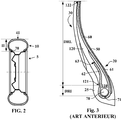
- the figure 1 shows schematically, in radial section, a quarter of a tire 10 according to the prior art.
- the tire 10 comprises two beads 20 intended to come into contact with a mounting rim (not shown), each bead 20 having an annular reinforcing structure, in this case a bead wire 70.
- Two sidewalls 30 extend the beads 20 radially towards the bead. outside and unite in a vertex 25 comprising a crown reinforcement formed of a first layer of reinforcements 80 and a second layer of reinforcements 90, and radially surmounted by a tread 40.
- Each reinforcing layer comprises wire reinforcements, embedded in a matrix formed of rubber mix.
- the reinforcements of each reinforcing layer are substantially parallel to each other; the reinforcements of the two layers are crossed from one layer to another at an angle of about 20 °, as is well known to those skilled in the art for so-called radial tires.
- the tire 10 also comprises a carcass reinforcement 60 which extends from the beads 20 through the sidewalls 30 to the apex 25.
- This carcass reinforcement 60 here comprises wire reinforcements oriented substantially radially, that is to say making with the circumferential direction an angle greater than or equal to 65 ° and less than or equal to 90 °.
- the carcass reinforcement 60 comprises a plurality of carcass reinforcing elements and is anchored in the two beads 20 by a turn around the rod 70, so as to form in each bead a forward strand 61 and a return strand 62.
- the return strand extends radially outwardly to an end 63 located at a radial distance DRR from the point 71 radially the innermost of the annular reinforcing structure of the bead, the radial distance DRR is usually greater or equal to 15% of the radial height H of the tire.
- the "radial height" H of a tire is defined as the radial distance between the radially innermost point 71 of the annular reinforcing structure 70 of the bead 20 and the point 41 ( figure 2 ) radially the outermost of the tread 40 when the tire 10 is mounted on a mounting rim 5 (as shown in FIG. figure 2 ) and inflated to its operating pressure.
- Each bead includes a stuffing 110, the stuffing being located radially outside the bead wire 70 and, for a good part, between the leading strand 61 and the return strand 62 of the carcass reinforcement 60.
- the stuffing 110 extends radially outwardly from the radially innermost point 71 of the annular reinforcement structure of the bead, to the point 111 situated at a radial distance DRB from the point 71, the radial distance DRB is usually greater than or equal to 20% of the radial height H of the tire.
- the stuffing 110 extends to the equator of the tire.
- equator of the tire for the purpose of this document, is meant the radial height of the point of the greatest axial extension of the carcass reinforcement. In a radial section of the tire, the equator appears as the axial straight line passing through the points where the carcass reinforcement has its greatest axial width when the tire is mounted on the rim and inflated.
- the radial height of the point closest to the half-height H / 2 of the tire is considered to be the equator of the tire.
- the equator thus defined should not be confused with the median plane 130 of the tire which is also sometimes called “equator” in the documents of the prior art.
- DRB is chosen such that the stuffing does not extend radially outside the equator of the tire.
- the beads 20 also include a rubber compound called "protector" intended to come into contact with a rim seat.
- the protector 25 is placed radially inwardly relative to the annular reinforcing structure 70 and the carcass reinforcement overturns and extends axially externally on either side of the strands 61 and 62 of the carcass reinforcement 60 .
- the annular reinforcing structure or rod is here a so-called braided rod, that is to say that it comprises a core of mild steel around which are wound a (the) wire (s) or cable (s) on a or more layers.
- the inner surface of the tire 10 is covered with a waterproof layer or inner liner 50.
- each outer band 120 extends radially outwardly from a radially inner end 121 located at a radial distance DRI from point 71 radially inwardly of the annular reinforcing structure 70 of the bead, DRI being usually less than or equal to at 20% of the radial height H of the tire, to a radially outer end 122, the radial distance DRL between the radially outer end 122 of the outer strip and the radially inner end 121 of the outer strip being greater than or equal to at 30% of the radial height H of the tire.
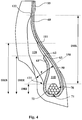
- the figure 4 presents a first embodiment of the tire according to one of the objects of the invention.
- This tire comprises a layer of self-sealing product 55 disposed on a portion of the sealing layer or inner liner 50.
- the layer of self-sealing product is placed opposite the top 25 of the tire and extends axially over a large part of the flanks 30.
- the end of the layer 55 is shown. This layer of self-sealing product 55 makes it possible to treat most of the punctures by closing them.
- This tire also comprises a rod 70 formed of several windings of a single wire 72, arranged axially side by side in several layers (C1, C2, C3, C4) radially superimposed so as to define a hexagonal cross section.
- the assembly of the rod of the figure 4 corresponds to a construction of four layers, going radially from the inside to the outside: 3-4-3-2.
- the layer C1 adjacent to the point 71 comprises 3 windings arranged axially side by side, then the adjacent layer C2 is 4 windings, then C3 has 3 windings and the last layer C4 disposed the outermost radially comprises two alignments.
- the figure 6 corresponds to this construction.
- the wire has a diameter equal to 1.55 mm. This thread is erased (not shown).
- the figure 5 presents another example of preferential windings with a five-layer construction (C1, C2, C3, C4 and C1): 3-4-5-4-3. This construction comprises 19 windings and the previous one 12.
- the wire 72 may also have a diameter of 1.3 mm. In this case, depending on the sizing of the bead and the forces to be supported, the number and distribution of circumferential windings is to be adapted.
- the figure 7 has a section of construction rod similar to that of the figure 6 , with four layers (C1, C2, C3 and C4) but made with a wire 73 of hexagonal cross section.
- the use of this wire reinforces the torsional stiffness of the rod without increasing its mass.
- the bead structure of this tire ( Fig. 4 ) is similar to that of the figure 3 with a single carcass ply 60, a carcass ply reversal whose return strands 62 extend radially outwardly to an end 63 located at a radial distance DRR from the point 71 radially furthest inside the bead wire 70.
- the radial distance DRR is greater than or equal to 7% and less than or equal to 30% of the radial height H of the tire.
- the bead also comprises a filling 110 which extends radially outwardly to a radial distance DRB of point 71.
- the radial distance DRB is between 20 and 45% of the radial height H of the tire.
- the bead also comprises an outer band 120 whose radially inner end 121 is located at a radial distance DRI of the point 71, DRI is between 1 and 10% of the radial height H.
- DRI is between 1 and 10% of the radial height H.
- the radial extent DRL, radial distance between the two ends 121 and 122, is between 35 and 50% of the radial height H of the tire.
- the bead also includes a rubber compound called a protector 25 for engaging a rim seat. This protector extends partially axially outwardly relative to the outer band 120.
- the assembly formed by the rubber compound tamping, outer band and protector has a maximum thickness E, measured in any radial plane in a direction 150 perpendicular to the forward strand 61 of the carcass reinforcement.
- This maximum thickness E is such that the E / DRL ratio is greater than 15% and preferably greater than 20%. In the case presented, this ratio is of the order of 28%.
- This high form factor D / DRL shows that the structure of the bead is very squat, which coupled with the very rigid torsional nature of the annular reinforcement structure provides the tire with excellent resistance to loosening of these beads during a rolling flat.
- the foregoing rubber mixes have a 10% extension modulus of between 5 and 15 MPa. These relatively low values make it possible to use reduced hysteresis mixtures, which offers an advantage in terms of rolling resistance of the tire.
- 10% extension module is meant a secant modulus of extension at 10% of deformation and at room temperature (23 ° C), the measurement is carried out after a first cycle of accommodation up to 10% of deformation. .
- the figure 8 presents an alternative embodiment of a tire according to one of the objects of the invention.
- a layer of self-sealing product 55 is disposed on a portion of the inner liner 50.
- the layer of self-sealing product is placed facing the top 25 of the tire and extends axially to sidewalls 30 of the tire.
- the carcass reinforcement comprises a first circumferential alignment of reinforcements 60 or first carcass ply, anchored in the bead 20 by a reversal around the bead wire 70, and a second circumferential alignment of reinforcements or second carcass ply 65.
- This second carcass ply 65 extends substantially between the annular reinforcing structure 70 and the top.
- the structure of the bead 20 comprises, as before, a bead wire 70 formed of several windings of a single wire 72, arranged axially side by side in several radially superposed layers so as to define a hexagonal cross section.
- the figures 5 have preferred winding structures for this embodiment.
- the return strands 62 extend radially outwardly to an end 63 located at a radial distance DRR from the point 71 radially the innermost of the annular reinforcing structure of the bead, the radial distance DRR is greater or equal to 50% of the radial height H of the tire.
- This very high value of the radial distance DRR, associated with the high torsional rigidity of the bead wire 70, makes it possible to obtain excellent resistance to unhooking while running flat on this tire.
- the bead 20 also comprises a rubbery compound called a protector 25 and, as before, the 10% padding and protector expansion modules are between 5 and 15 MPa.
- any range of values designated by the expression “between a and b” represents the range of values greater than “a” and less than “b” (i.e., terminals a and b excluded). while any range of values designated by the term “from a to b” means the range of values from “a” to "b” (i.e., including the strict limits a and b).
- composition based on is generally meant a composition comprising the mixture and / or the reaction product of its various components, some of these components may be capable of (or intended to) react with each other at least in part, during the various phases of manufacture of the composition, for example during its eventual crosslinking or vulcanization (firing) final.
- the self-sealing layer 55 comprises a styrenic thermoplastic elastomer (called "TPS") and more than 200 phr of an elastomer extension oil.
- Styrenic thermoplastic elastomers are thermoplastic elastomers in the form of styrene-based block copolymers.
- thermoplastic polymers and elastomers consist in a known manner of rigid polystyrene blocks connected by flexible elastomer blocks, for example polybutadiene, polyisoprene or poly (ethylene / butylene). They are often triblock elastomers with two rigid segments connected by a flexible segment. The rigid and flexible segments can be arranged linearly, star or connected.
- the TPS elastomer is selected from the group consisting of styrene / butadiene / styrene block copolymers (SBS), styrene / isoprene / styrene (SIS), styrene / isoprene / butadiene / styrene (SIBS), styrene / ethylene / butylene / styrene (SEBS), styrene / ethylene / propylene / styrene (SEPS), styrene / ethylene / ethylene / propylene / styrene (SEEPS) and mixtures of these copolymers.
- SBS styrene / butadiene / styrene block copolymers
- SIBS styrene / isoprene / butadiene / sty
- the elastomer is selected from the group consisting of SEBS copolymers, SEPS copolymers and mixtures of these copolymers.
- the TPS elastomer may constitute the entire elastomer matrix or the majority (preferably more than 50%, more preferably more than 70%) of the latter when it comprises one or more other elastomers (s). ), thermoplastic or not, for example of the diene type.
- Such a self-sealing layer may be preformed by extrusion of a flat profile of suitable dimensions for its application on a manufacturing drum.
- An example of realization is presented in the document FR 2 925 388 .
- the self-sealing layer 55 consists of an elastomer composition comprising at least, as majority elastomer (preferably for more than 50 phr), an unsaturated diene elastomer, between 30 and 90 phr. a hydrocarbon resin and a liquid plasticizer with a glass transition temperature or Tg of less than -20 ° C, at a level of between 0 and 60 phr (ie parts by weight per hundred parts of solid elastomer). It has another essential characteristic of being devoid of charge or of having less than 120 phr.
- elastomer or "diene” rubber it is recalled that should be understood, in known manner, an elastomer derived at least in part (ie, a homopolymer or a copolymer) of monomers dienes (monomers carrying two carbon-carbon double bonds, conjugated or not).
- diene elastomers can be classified into two categories, saturated or unsaturated.
- the term "unsaturated” (or “essentially unsaturated") diene elastomer is understood herein to mean a diene elastomer derived at least in part from monomers conjugated dienes having a level of units or units derived from conjugated dienes that is greater than 30% (mole%);
- diene elastomers such as butyl rubbers or copolymers of dienes and alpha-olefins of the EPDM type which can be described as “saturated” or "essentially saturated” diene elastomers because of their their reduced level of units of diene origin (always less than 15 mol%).
- an unsaturated diene elastomer whose content (mol%) of units of diene origin (conjugated dienes) is greater than 50%, such a diene elastomer being more preferably chosen from the group consisting of polybutadienes (BR), natural rubber (NR), synthetic polyisoprenes (IR), copolymers of butadienes (eg butadiene-styrene or SBR), isoprene copolymers (of course, other than butyl rubber) and mixtures of such elastomers .
- the unsaturated diene elastomer of the composition is by definition solid.
- its number-average molecular weight (Mn) is between 100,000 and 5,000,000, more preferably between 200,000 and 4,000,000 g / mol.
- the Mn value is determined in known manner, for example by SEC: tetrahydrofuran solvent; temperature 35 ° C; concentration 1 g / l; flow rate 1 ml / min; filtered solution on 0.45 ⁇ m porosity filter before injection; Moore calibration with standards (polyisoprene); set of 4 "WATERS” columns in series (“STYRAGEL” HMW7, HMW6E, and 2 HT6E); differential refractometer detection ("WATERS 2410") and its associated operating software (“WATERS EMPOWER”).
- the unsaturated diene elastomer of the composition of the self-sealing layer is an isoprene elastomer.
- isoprene elastomer is meant in known manner a homopolymer or copolymer of isoprene, in other words a diene elastomer chosen from the group consisting of natural rubber (NR), synthetic polyisoprenes (IR), butadiene-isoprene copolymers (BIR), styrene-isoprene copolymers (SIR), styrene-butadiene-isoprene copolymers (SBIR) and mixtures of these elastomers.
- NR natural rubber
- IR synthetic polyisoprenes
- BIR butadiene-isoprene copolymers
- SIR styrene-isoprene copolymers
- SBIR styrene-butadiene-isopre
- This isoprene elastomer is preferably natural rubber or synthetic cis-1,4 polyisoprene; among these synthetic polyisoprenes, polyisoprenes having a (molar%) content of cis-1,4 bonds are preferentially used. greater than 90%, more preferably still greater than 95%, especially greater than 98%.
- the above unsaturated diene elastomer in particular an isoprene elastomer such as natural rubber, may constitute the whole of the elastomer matrix or the majority (by weight for more than 50%, more preferably for more than 70%) of the latter when it comprises one or more other elastomer (s), diene or non-dienic, for example of the thermoplastic type.
- the level of unsaturated diene elastomer (solid), in particular of isoprene elastomer such as natural rubber is greater than 50 phr, more preferably greater than 70 phr. More preferably still, this level of unsaturated diene elastomer, in particular of isoprene elastomer such as natural rubber, is greater than 80 phr.
- polystyrene resin examples include butadiene-styrene copolymers (SBR), butadiene-isoprene copolymers (BIR) and styrene-butadiene-isoprene copolymers (SBIR).
- SBR butadiene-styrene copolymers
- BIR butadiene-isoprene copolymers
- SBIR styrene-butadiene-isoprene copolymers
- SBR copolymers having a styrene content of between 5% and 50% by weight and more particularly between 20% and 40%, a 1,2-butadiene content of the butadiene part of between 4% and 65%, a trans-1,4 linkages content of between 20% and 80%, BIR copolymers having an isoprene content of between 5% and 90% by weight and a Tg of -40 ° C to -80 ° C, SBIR copolymers having a styrene content of between 5% and 50% by weight and more particularly between 10% and 40%, an isoprene content of between 15% and 60% by weight and more particularly between 20% and 50%, a content of in butadiene of between 5% and 50% by weight and more particularly between 20% and 40%, a content in units -1,2 of the butadiene part of between 4% and 85%, a content of trans-1,4 units of the butadiene part of between 6% and 80%, a content of -1,2 units plus
- the elastomer A is a homopolymer of butadiene, in other words a polybutadiene (BR), this polybutadiene preferentially having a cis-1,4 bond content (mol%) of greater than 90%, more preferably higher than at 95%.
- BR polybutadiene
- Elastomer B is natural rubber or synthetic polyisoprene; among the synthetic polyisoprenes, cis-1,4 polyisoprenes are preferentially used, preferably those having a cis-1,4 bond content (mol%) of greater than 90%, more preferably still greater than 95%, especially greater than 98%; %.
- the elastomers A and B above can be for example block, statistical, sequenced, microsequenced, and be prepared in dispersion or in solution; they may be coupled and / or starred and / or connected or functionalized, for example with a coupling agent and / or starring or functionalization.
- the weight ratio elastomer A: elastomer B is preferably in a range from 20:80 to 80:20, more preferably still in a range from 30:70 to 70:30, in particular 40 to 70:30. 60 to 60:40.
- Elastomers A and B are by definition solid.
- solid means any substance that does not have the capacity to take up, at the latest after 24 hours, under the sole effect of gravity and at ambient temperature (23 ° C.), the shape of the container that contains it.
- the elastomers A and B and their cutting are characterized by a very high viscosity: their Mooney viscosity in the raw state (ie, not crosslinked).
- ML (1 + 4), measured at 100 ° C is preferably greater than 20, more preferably greater than 30, in particular between 30 and 130.
- the Mooney viscosity or plasticity characterizes in a known manner solid substances.
- An oscillatory consistometer as described in ASTM D1646 (1999) is used.
- the Mooney plasticity measurement is carried out according to the following principle: the sample analyzed in the green state (ie, before firing) is molded (shaped) in a cylindrical chamber heated to a given temperature (for example 35 ° C or 100 ° C). After one minute of preheating, the rotor rotates within the test tube at 2 revolutions / minute and the useful torque is measured to maintain this movement after 4 minutes of rotation.
- solid elastomer is also understood to mean a high molecular weight elastomer, that is to say having typically a number-average molecular weight (Mn) which is greater than 100,000 g / mol; preferably, in such a solid elastomer, at least 80%, more preferably at least 90% of the area of the distribution of molar masses (measured by SEC) is located above 100,000 g / mol.
- Mn number-average molecular weight
- the number-average molar mass (Mn) of each of the elastomers A and B is between 100,000 and 5,000,000 g / mol, more preferably between 150,000 and 4,000,000 g / mol; in particular it is between 200,000 and 3,000,000 g / mol, more particularly between 200,000 and 1,500,000 g / mol.
- their polymolecularity index Ip (Mw / Mn) is between 1.0 and 10.0, in particular between 1.0 and 3.0 with regard to elastomer A, between 3.0 and 8, 0 for elastomer B.
- the average molar mass and / or the molar mass distribution of the elastomers A and B may for example opt for a wide distribution of molar masses. If it wishes to favor the fluidity of the self-sealing composition, it may favor rather the proportion of low molar masses. According to another particular embodiment, combinable or not with the above, it may also focus on the proportion of intermediate molar masses in order to optimize rather the self-sealing function (filling) of the composition. According to another particular embodiment, it may prefer rather the proportion of high molar masses in order to increase the mechanical strength of the self-sealing composition.
- Obtaining these different molar mass distributions can be done for example by mixing different diene elastomers (elastomers A and / or elastomers B).
- the cutting of solid elastomers A and B above constitutes the only solid elastomer present in the self-sealing composition of the invention, that is to say that the overall rate of the two elastomers A and B is then 100 phr; in other words, the levels of elastomer A and elastomer B are therefore each comprised in a range from 10 to 90 phr, preferably from 20 to 80 phr, more preferably from 30 to 70 phr, in particular from 40 to 60 phr.
- the cutting of elastomers A and B when the cutting of elastomers A and B does not constitute the only solid elastomer of the composition of the invention, said cutting preferably constitutes the solid elastomer predominant by weight in the composition of the invention; more preferably, the overall level of the two elastomers A and B is then greater than 50 phr, more preferably greater than 70 phr, in particular greater than 80 phr.
- the cutting of elastomers A and B could be associated with other (solid) minor elastomers by weight, whether they are unsaturated or saturated diene elastomers (for example butyl), or elastomers other than diene, for example thermoplastic styrene elastomers (so-called "TPS"), for example selected from the group consisting of styrene / butadiene / styrene block copolymers (SBS), styrene / isoprene styrene / styrene (SIS), styrene / butadiene / isoprene / styrene (SBIS), styrene / isobutylene / styrene (SIBS), styrene / ethylene / butylene / styrene (SEBS), sttyrene / solid minor e
- the second essential constituent of the self-sealing composition according to this second embodiment is a hydrocarbon resin.
- resin is hereby reserved, by definition known to those skilled in the art, to a compound that is solid at room temperature (23 ° C), as opposed to a liquid plasticizer such as an oil.
- Hydrocarbon resins are polymers well known to those skilled in the art, essentially based on carbon and hydrogen, which can be used in particular as plasticizers or tackifying agents in polymer matrices. They are inherently miscible (ie, compatible) with the levels used with the polymer compositions for which they are intended, so as to act as true diluents. They have been described, for example, in the book entitled Hydrocarbon Resins by R. Mildenberg, M. Zander and G. Collin (New York, VCH, 1997, ISBN 3-527-28617-9 ) of which chapter 5 is devoted to their applications, in particular in pneumatic rubber (5.5 “Rubber Tires and Mechanical Goods” ).
- Tg glass transition temperature
- these hydrocarbon resins can also be described as thermoplastic resins in that they soften by heating and can thus be molded. They can also be defined by a point or softening point , the temperature at which the product, for example in the form of powder, agglutinates; this datum tends to replace the melting point, which is rather poorly defined, of resins in general.
- the softening temperature of a hydrocarbon resin is generally about 50 to 60 ° C higher than the Tg value.
- the softening temperature of the resin is preferably greater than 40 ° C (in particular between 40 ° C and 140 ° C), more preferably greater than 50 ° C (in particular between 50 ° C and 135 ° C).
- Said resin is used at a weight content of between 30 and 90 phr. Below 30 phr, the anti-puncture performance was found to be insufficient because of excessive rigidity of the composition, whereas beyond 90 phr, there is an insufficient mechanical strength of the material with in addition, a risk of degraded performance at high temperature (typically greater than 60 ° C).
- the level of resin is preferably between 40 and 80 phr, more preferably still at least equal to 45 phr, in particular within a range of 45 to 75 phr.
- Tg is measured according to ASTM D3418 (1999).
- the softening point is measured according to ISO 4625 ("Ring and Ball” method).
- the macrostructure (Mw, Mn and Ip) is determined by steric exclusion chromatography (SEC): solvent tetrahydrofuran; temperature 35 ° C; concentration 1 g / l; flow rate 1 ml / min; filtered solution on 0.45 ⁇ m porosity filter before injection; Moore calibration with polystyrene standards; set of 3 "WATERS” columns in series (“STYRAGEL” HR4E, HR1 and HR0.5); differential refractometer detection (“WATERS 2410") and its associated operating software (“WATERS EMPOWER”).
- hydrocarbon resins By way of examples of such hydrocarbon resins, mention may be made of those selected from the group consisting of homopolymer or copolymer resins of cyclopentadiene (abbreviated as CPD) or dicyclopentadiene (abbreviated to DCPD), terpene homopolymer or copolymer resins. C5 homopolymer or copolymer resins and mixtures of these resins.
- CPD cyclopentadiene
- DCPD dicyclopentadiene
- copolymer resins mention may be made more particularly of those selected from the group consisting of (D) CPD / vinylaromatic copolymer resins, (D) CPD / terpene copolymer resins, (D) copolymer resins CPD / C5 cut, terpene / vinylaromatic copolymer resins, C5 / vinylaromatic cut copolymer resins, and mixtures of these resins.
- pene here combines in a known manner the alpha-pinene, beta-pinene and limonene monomers; preferably, a limonene monomer is used which is present in a known manner in the form of three possible isomers: L-limonene (laevorotatory enantiomer), D-limonene (dextrorotatory enantiomer), or the dipentene, racemic of the dextrorotatory and levorotatory enantiomers. .
- Suitable vinylaromatic monomers are, for example, styrene, alpha-methylstyrene, ortho-methylstyrene, meta-methylstyrene, para-methylstyrene, vinyl-toluene, para-tert-butylstyrene, methoxystyrenes, chlorostyrenes, hydroxystyrenes, vinylmesitylene, divinylbenzene, vinylnaphthalene, any vinylaromatic monomer from a C 9 cut (or more generally a C 8 to C 10 cut).
- the resins selected from the group consisting of homopolymer resins (D) CPD, copolymer resins (D) CPD / styrene, polylimonene resins, limonene / styrene copolymer resins, resins of limonene / D copolymer (CPD), C5 / styrene cut copolymer resins, C5 / C9 cut copolymer resins, and mixtures of these resins.
- D homopolymer resins
- D copolymer resins
- D copolymer resins
- polylimonene resins limonene / styrene copolymer resins
- resins of limonene / D copolymer (CPD) resins of limonene / D copolymer
- C5 / styrene cut copolymer resins C5 / C9 cut copolymer resins
- Another essential feature of the self-sealing layer composition according to this second embodiment is that it comprises from 0 to less than 120 phr of at least one (that is to say one or more) charges, of which 0 is less than of 30 phr of at least one (i.e. one or more) reinforcing filler.
- charge here is meant any type of charge, whether it is reinforcing (typically nanometric particles, and preferably of average size by weight less than 500 nm, especially between 20 and 200 nm) or that it is non-reinforcing or inert (typically with micrometric particles, and preferably of average size by weight greater than 1 micron, for example between 2 and 200 microns).
- the average size by weight is measured in a manner well known to those skilled in the art (for example, according to the application WO2009 / 083160 paragraph I.1).
- fillers known to be reinforcing by those skilled in the art, mention will in particular be made of carbon black or a reinforcing inorganic filler.
- a reinforcing inorganic filler such as silica in the presence of a coupling agent, or a blend of these two types of filler.
- the silica is a reinforcing filler in the presence of a coupling agent allowing it to bind to the elastomer.
- carbon blacks for example, all carbon blacks, especially blacks conventionally used in pneumatic tires, are suitable. Among these are, for example, carbon blacks of (ASTM) grade 300, 600, 700 or 900 (for example N326, N330, N347, N375, N683, N772, N990).
- Suitable reinforcing inorganic fillers are, in particular, highly dispersible mineral fillers of the silica (SiO 2 ) type, in particular precipitated or fumed silicas having a BET surface area of less than 450 m 2 / g, preferably from 30 to 400 m 2 / g.
- fillers other than reinforcing agents or inert fillers known to those skilled in the art, mention will be made in particular of those selected from the group consisting of ashes (ie, combustion residues) and microparticles of natural calcium carbonates ( chalk) or synthetics, synthetic or natural silicates (such as kaolin, talc, mica, silicate), silicas (in the absence of coupling agent), titanium oxides, aluminas, aluminosilicates (clay, bentonite ), and their mixtures.
- Coloring or coloring fillers for example pigments, may advantageously be used to color the composition according to the desired color.
- the composition of the invention comprises a non-reinforcing filler selected from the group consisting of chalk, talc, kaolin and mixtures thereof.
- the physical state under which the charge is presented is indifferent, whether in the form of powder, microbeads, granules, beads or any other suitable densified form.
- charge is also understood to mean mixtures of different fillers, reinforcing and / or non-reinforcing.
- fillers reinforcing or otherwise, are usually there to give dimensional stability, that is to say a minimum mechanical strength to the final composition. It is preferably all the less in the composition that the filler is known as reinforcing vis-à-vis an elastomer, especially a diene elastomer such as natural rubber or polybutadiene.
- the composition of the invention comprises from 0 to less than 100 phr of filler, preferably from 0 to less than 70 phr, of which 0 to less than 15 phr of reinforcing filler, preferably 0 to less than 10 phr. reinforcing filler.
- the composition of the invention comprises from 0 to 70 phr of charge of which 0 to less than 5 phr of reinforcing filler.
- the composition of the invention comprises a non-reinforcing filler, at a rate ranging from 5 to 70 phr, preferably from 10 to 30 phr.
- the invention may notably be divided into two embodiments, depending on the charge rate. Indeed, a too high amount of charge penalizes the required properties of flexibility, deformability and creepability, while the presence of a certain amount of charge (for example from 30 to less than 120 phr), allows to improve the processability, and to reduce the cost.
- the composition is very weakly charged, that is to say it comprises from 0 to less than 30 phr of charge in total (of which 0 to less than 30 phr of reinforcing filler ), preferably 0 to less than 30 phr, of which 0 to less than 15 phr of reinforcing filler (more preferably 0 to less than 10 phr of reinforcing filler).
- this composition has the advantage of allowing a self-sealing composition having good anti-puncture properties cold and hot.
- a reinforcing filler is present in the composition of the invention, its content is preferably less than 5 phr (ie between 0 and 5 phr), in particular less than 2 phr ( between 0 and 2 phr).
- Such levels have proved particularly favorable to the manufacturing process of the composition of the invention, while offering the latter excellent self-sealing performance.
- a rate of between 0.5 and 2 phr is more preferably used, in particular when it is carbon black.
- a non-reinforcing filler if a non-reinforcing filler is used, its level is preferably from 5 to less than 30 phr, in particular from 10 to less than 30 phr.
- the composition comprises from 30 to less than 120 phr of filler, preferably from more than 30 to less than 100 phr, and more preferably from 35 to 80 phr, of which, according to this second embodiment, 0 to less than 30 phr of reinforcing filler (more preferably 0 to less than 15 phr).
- this composition has the advantage of improving the processability, and to reduce the cost while not being too penalized as to its properties of flexibility, deformability and creepability.
- this second embodiment gives the composition a significantly improved puncture performance.
- a reinforcing filler is present in the composition of the invention, its content is preferably less than 5 phr (ie between 0 and 5 phr), in particular less than 2 phr (either between 0 and 2 phr).
- Such levels have proved particularly favorable to the manufacturing process of the composition of the invention, while offering the latter excellent self-sealing performance.
- a rate of between 0.5 and 2 phr is more preferably used, in particular when it is carbon black.
- the non-reinforcing filler content is from 5 to less than 120 phr, in particular from 10 to less than 100 phr and more preferably from 15 to 80 phr.
- the non-reinforcing filler content is in a range from 25 to 50 phr, more preferably from 30 to 50 phr.
- composition of the layer of self-sealing product according to the second embodiment may further comprise, at a rate of less than 60 phr (in other words between 0 and 60 phr), a liquid plasticizer (at 23.degree. ) said "low Tg” whose function is in particular to soften the matrix by diluting the diene elastomer and the hydrocarbon resin, improving in particular the performance of self-sealing "cold” (that is to say, typically for a temperature below 0 ° C); its Tg is by definition less than -20 ° C, it is preferably lower than -40 ° C.
- any liquid elastomer, any extension oil, whether aromatic or non-aromatic, more generally any liquid plasticizer known for its plasticizing properties vis-à-vis elastomers, especially diene, is usable.
- these plasticizers or these oils, more or less viscous are liquids (that is to say, as a reminder, substances having the capacity to eventually take on the shape of their container) , in particular as opposed to hydrocarbon resins which are inherently solid at room temperature.
- liquid elastomers with a low average molecular weight (Mn), typically between 300 and 90,000, more generally between 400 and 50,000, for example in the form of depolymerized natural rubber, liquid BR, SBR or IR, as described for example in patent documents US 4,913,209 , US 5,085,942 and US 5,295,525 supra.
- Mn average molecular weight
- Extension oils are also suitable, in particular those chosen from the group consisting of polyolefinic oils (that is to say those resulting from the polymerization of olefins, monoolefins or diolefins), paraffinic oils and naphthenic oils (at low temperatures). or high viscosity, hydrogenated or not), aromatic oils or DAE ( Distillate Aromatic Extracts ), oils MES ( Medium Extracted Solvates ), oils TDAE ( Treated Distillate Aromatic Extracts ), mineral oils, vegetable oils (and their oligomers , eg rapeseed, soybean, sunflower oils) and mixtures of these oils.
- polyolefinic oils that is to say those resulting from the polymerization of olefins, monoolefins or diolefins
- paraffinic oils and naphthenic oils at low temperatures. or high viscosity, hydrogenated or not
- aromatic oils or DAE Distillate Aromatic Extracts
- oils MES Medium Extracted Solv
- a polybutene-type oil is used, for example a polyisobutylene oil (abbreviated as "PIB"), which has demonstrated an excellent compromise of properties compared to the other oils tested, in particular to a conventional oil of paraffinic type.
- PIB polyisobutylene oil
- PIB oils are sold in particular by UNIVAR under the name “Dynapak Poly” (eg “Dynapak Poly 190”), by BASF under the names “Glissopal” (eg “Glissopal 1000”) or "Oppanol "(Eg” Oppanol B12 "); paraffinic oils are marketed for example by EXXON under the name “Telura 618” or by Repsol under the name "Extensol 51".
- liquid plasticizers are ethers, esters, phosphates and sulphonates plasticizers, more particularly those chosen from esters and phosphates.
- phosphate plasticizers include those containing between 12 and 30 carbon atoms, for example trioctyl phosphate.
- ester plasticizers include, for example, compounds selected from the group consisting of trimellitates, pyromellitates, phthalates, 1,2-cyclohexane dicarboxylates, adipates, azelates, sebacates, glycerol triesters and mixtures thereof. of these compounds.
- preferential glycerol triesters of those which consist for the most part (for more than 50%, more preferably for more than 80% by weight) of a C 18 unsaturated fatty acid; that is, a fatty acid selected from the group consisting of oleic acid, linoleic acid, linolenic acid and mixtures of these acids. More preferably, whether of synthetic or natural origin (for example vegetable oils of sunflower or rapeseed), the fatty acid used is more than 50% by weight, more preferably still more than 80% by weight. % by weight of oleic acid.
- Such triesters (trioleates) with a high oleic acid content are well known, they have been described for example in the application WO 02/088238 (or US 2004/0127617 ), as plasticizers in tire treads.
- the number-average molecular mass (Mn) of the liquid plasticizer is preferably between 400 and 25,000 g / mol, more preferably between 800 and 10,000 g / mol.
- Mn number-average molecular mass
- a mass Mn of between 1000 and 4000 g / mol has proved to be an excellent compromise for the intended applications, in particular for use in a tire.
- the number-average molecular mass (Mn) of the plasticizer can be determined in known manner, in particular by SEC, the sample being solubilized beforehand in tetrahydrofuran at a concentration of approximately 1 g / l; then the solution is filtered on a 0.45 ⁇ m porosity filter before injection.
- the equipment is the "WATERS alliance" chromatographic chain.
- the elution solvent is tetrahydrofuran
- the flow rate is 1 ml / min
- the temperature of the system is 35 ° C.
- the analysis time is 30 minutes.
- the injected volume of the solution of the polymer sample is 100 ⁇ l.
- the detector is a "WATERS 2410" differential refractometer and its associated software for the exploitation of chromatographic data is the “WATERS MILLENIUM” system.
- the masses Molecular averages calculated are relative to a calibration curve made with polystyrene standards.
- the liquid plasticizer is preferably selected from the group consisting of liquid elastomers, polyolefin oils, naphthenic oils, paraffinic oils, DAE oils, MES oils, TDAE oils, mineral oils, vegetable oils, ethers plasticizers, ester plasticizers, phosphate plasticizers, sulphonate plasticizers and mixtures of these compounds. More preferably, this liquid plasticizer is selected from the group consisting of liquid elastomers, polyolefin oils, vegetable oils and mixtures of these compounds.
- the level of liquid plasticizer is in a range of 5 to 40 phr, more preferably in a range of 10 to 30 phr.
- the elastomeric composition may have too rigidity for some applications while beyond the maximum recommended, there is a risk of insufficient cohesion of the composition and degraded auto-sealing properties.
- the basic constituents of the self-sealing layer previously described namely unsaturated diene elastomer, hydrocarbon plasticizing resin, liquid plasticizer and optional filler are sufficient on their own for the self-sealing composition to fully fulfill its anti-puncture function vis-à-vis -vis tires in which it is used.
- additives may be added, typically in small amounts (preferably at levels of less than 20 phr, more preferably less than 15 phr), such as, for example, protective agents such as anti-UV, anti-oxidants or anti-oxidants.
- protective agents such as anti-UV, anti-oxidants or anti-oxidants.
- ozonants various other stabilizers, coloring agents advantageously used for coloring the self-sealing composition.
- fibers, in the form of short fibers or pulp could be optionally added to give more cohesion to the self-sealing composition.
- the self-sealing composition further comprises a system for crosslinking the unsaturated diene elastomer which may consist of one or more compounds.
- This crosslinking agent is preferably a crosslinking agent based on sulfur and / or a sulfur donor. In other words, this crosslinking agent is an agent called "vulcanization".
- the vulcanizing agent comprises sulfur and, as a vulcanization activator, a guanidine derivative, that is to say a substituted guanidine.
- a guanidine derivative that is to say a substituted guanidine.
- Substituted guanidines are well known to those skilled in the art (see for example WO 00/05300 ): non-limiting examples include N, N'-diphenylguanidine (abbreviated "DPG"), triphenylguanidine or di-o-tolylguanidine. DPG is preferably used.
- the sulfur content is for example between 0.1 and 1.5 phr, in particular between 0.2 and 1.2 phr (especially between 0.2 and 1.0 phr) and the level of guanidine derivative is itself even between 0 and 1.5 phr, in particular between 0 and 1.0 phr (especially in a range of 0.2 to 0.5 phr).
- the composition may therefore be devoid of such an accelerator, or at most comprise less than 1 phr, more preferably less than 0.5 phr.
- any compound capable of acting as an accelerator for vulcanization of diene elastomers in the presence of sulfur, especially thiazole type accelerators and that their derivatives, sulfenamides type accelerators, thiuram, dithiocarbamates, dithiophosphates, thioureas and xanthates.
- Examples of such accelerators include the following compounds: 2-mercaptobenzothiazyl disulfide (abbreviated "MBTS”), N-cyclohexyl-2-benzothiazyl sulfenamide (“CBS”), N, N-dicyclohexyl- 2-benzothiazylsulfenamide (“DCBS”), N-tert-butyl-2-benzothiazylsulfenamide (“TBBS”), N-tert-butyl-2-benzothiazylsulfenimide (“TBSI”), zinc dibenzyldithiocarbamate (“ZBEC”) 1-phenyl-2,4-dithiobiuret (“DTB”), zinc dibuthylphosphorodithioate (“ZBPD”), zinc 2-ethylhexylphosphorodithioate (“ZDT / S”), bis O, O-di (2-ethylhexyl) -thiophosphonyl disulfide ("DA
- the vulcanizing agent comprises a sulfur donor.
- the amount of such a sulfur donor will preferably be adjusted between 0.5 and 15 phr, more preferably between 0.5 and 10 phr (especially between 1 and 5 phr), in particular so as to reach the preferential equivalent sulfur levels. previously indicated.
- R 1 and R 2 could form a bivalent hydrocarbon radical having 4 to 7 carbon atoms.
- thiuram polysulfides are chosen more preferentially from the group consisting of tetrabenzylthiuram disulfide ("TBzTD”), disulphide of tetramethylthiuram (“TMTD”), dipentamethylenethiuram tetrasulfide (“DPTT”), and mixtures of such compounds. More preferably, TBzTD is used, particularly at the preferential levels indicated above for a sulfur donor (ie between 0.1 and 15 phr, more preferably between 0.5 and 10 phr, in particular between 1 and 5 phr).
- a sulfur donor ie between 0.1 and 15 phr, more preferably between 0.5 and 10 phr, in particular between 1 and 5 phr.
- composition of the invention could also comprise, preferentially in a minor weight fraction relative to the cutting of solid elastomers A and B, solid polymers other than elastomers, such as, for example thermoplastic polymers.
- the self-sealing composition could also comprise, still in a minority weight fraction relative to the unsaturated diene elastomer, polymers other than elastomers, such as, for example, thermoplastic polymers compatible with the diene elastomer. unsaturated.
- composition of the self-sealing layer according to the second embodiment described above may be manufactured by any appropriate means, for example by mixing and / or mixing in paddle or cylinder mixers, until an intimate mixture is obtained. and homogeneous of its different components.
- the composition in the absence of charge, or at least a significant amount of charge, the composition is weakly cohesive. This lack of cohesion may be such that the stickiness of the composition, due moreover to the presence of a relatively high content of hydrocarbon resin, is not compensated and prevails; it then follows a risk of parasitic bonding on the mixing tools, which can be unacceptable under conditions of industrial implementation.
- the first and second temperatures above are of course those of the masterbatch and the self-sealing composition, respectively, measurable in situ and not the set temperatures of the mixers themselves.
- masterbatch (or “masterbatch”) is meant here, by definition, the mixture of at least the diene elastomer and the hydrocarbon resin, a precursor mixture of the final self-sealing composition, ready for use. employment.
- the liquid plasticizer may be incorporated at any time, in whole or in part, especially during the manufacture of the masterbatch itself (in this case, before, during or after incorporation of the hydrocarbon resin in the diene elastomer), "to hot “(that is to say at a temperature above the softening temperature of the resin) as at a lower temperature, or for example after manufacture of the masterbatch (in this case, before, during or after the addition of the system crosslinking).
- additives may be incorporated in this masterbatch, whether they are intended for the actual masterbatch (for example a stabilizing agent, a coloring or anti-UV agent, an antioxidant, etc.) or for the final self-sealing composition at which is the masterbatch.
- the diene elastomer is brought into contact with the hydrocarbon resin for manufacturing the masterbatch.
- the resin In the initial state, that is to say before contact with the elastomer, the resin may be in the solid state or in the liquid state.
- the solid diene elastomer is brought into contact with the hydrocarbon resin in the liquid state. It suffices for this to heat the resin to a temperature above its softening temperature.
- the temperature of hot mixing is typically greater than 70 ° C, most often greater than 90 ° C, for example between 100 ° C and 150 ° C.
- liquid plasticizer during step a) of manufacture of the masterbatch itself, more preferably in this case either at the same time as the hydrocarbon resin, or after introduction of the latter.
- a mixture of the hydrocarbon resin and the liquid plasticizer may be prepared prior to incorporation into the diene elastomer.
- Step b) of incorporation of the crosslinking system is conducted at a temperature preferably below 80 ° C, further preferably lower than the softening temperature of the resin.
- the mixing temperature of step b) is preferably less than 50 ° C, more preferably between 20 ° C and 40 ° C.
- an intermediate cooling step of the masterbatch to bring its temperature to a value below 100 ° C, preferably below 80 ° C, in particular below the softening temperature of the resin, this before introduction (step b)) of the crosslinking system in the masterbatch previously prepared.
- a filler such as carbon black
- it may be introduced during step a), that is to say at the same time as the unsaturated diene elastomer and the hydrocarbon resin, or during of step b) that is to say, at the same time as the crosslinking system. It has been found that a very small proportion of carbon black, preferably between 0.5 and 2 phr, further improves the mixing and the manufacture of the composition, as well as its final extrudability.
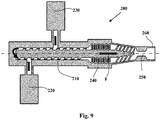
- the step a) of manufacture of the masterbatch is preferably carried out in a screw mixer-extruder as schematized for example in a simple manner to the figure 9 .
- a screw mixer-extruder 200 essentially comprising a screw (for example a single-screw) extrusion 210, a first dosing pump 220 for the diene elastomer (solid) and at least a second dosing pump 230 for the resin (solid or liquid) and the liquid plasticizer.
- the hydrocarbon resin and the liquid plasticizer can be introduced for example by means of a single metering pump, if they have already been mixed beforehand, or else introduced separately by means of a second pump and third pump (third pump not represented on the figure 9 , for simplification), respectively.
- the dosing pumps 220, 230 allow to increase the pressure while maintaining the control of the dosage and the initial characteristics of the materials, the dissociation of the dosing functions (elastomer, resin and liquid plasticizer) and mixing also providing better control of the process.
- the products, pushed by the extrusion screw, are intimately mixed under the very strong shear provided by the rotation of the screw, thus progressing through the mixer, for example up to a portion 240 called "chopper-homogenizer" zone at the exit of which the final masterbatch 250 thus obtained, progressing in the direction of arrow F, is finally extruded through a die 260 for extruding the product to the desired dimensions.
- the masterbatch thus extruded, ready to be used, is then transferred and cooled for example on an external cylinder mixer for introduction of the crosslinking system and the optional charge, the temperature inside said external mixer being kept below 100 ° C, preferably below 80 ° C, and moreover preferably being lower than the softening temperature of the resin.
- the above cylinders are cooled, for example by circulation of water, at a temperature below 40 ° C., preferably below 30 ° C., so as to avoid any parasitic bonding of the composition onto the walls of the mixer. .
- Tires figures 4 and 8 can be manufactured, as indicated in the document WO 2011/032886 by incorporating a self-sealing layer in a non-vulcanized tire blank using a manufacturing drum and other techniques customary in the manufacture of pneumatic tires.
- a protective layer for example a chlorinated thermoplastic film, is applied first to the manufacturing drum.
- This protective layer can be wrapped around the manufacturing drum and then welded.
- We can also put in place a protective sleeve welded beforehand. Then, all the other usual components of the tire are applied successively.
- the self-sealing product layer is disposed directly on the protective layer.
- This layer has been previously pre-formed by any known technique, for example extrusion or calendering. Its thickness is preferably greater than 0.3 mm, more preferably between 0.5 and 10 mm (in particular for pneumatic tires of passenger vehicles between 1 and 5 mm). A tight layer is then placed on the self-sealing layer, followed by the carcass ply.
- the tire blank is then shaped to take the form of a torus.
- the protective layer consisting of a composition based on a chlorinated thermoplastic polymer film has a sufficiently low stiffness, a sufficient uniaxial and biaxial extensibility and is sufficiently bonded to the surface of the self-sealing layer because of the tackiness of this layer. to follow the movements of the tire blank without detaching or tearing.
- the crown plies and the tread are placed on the blank of the tire.
- the completed sketch is placed in a mold of baking and is vulcanized.
- the protective layer protects the mold's cooking membrane from contact with the self-sealing layer.
- the protective layer remains attached to the self-sealing layer. This protective layer has no cracks or tears and peels off without any difficulty from the baking membrane.
- Tires figures 4 and 8 can also be manufactured using a rigid core imposing the shape of the inner cavity of the bandage.
- the protective layer is then applied first to the surface of the core and then to all the other constituents of the tire.
- the application on the kernel is performed in the order required by the final architecture.
- the constituents of the tire are placed directly in their final place, without undergoing any conformation at any time of manufacture.
- This confection can notably use the devices described in the EP 0 243 851 for laying the wires of the carcass reinforcement, EP 0 248 301 for the laying of top reinforcements and EP 0 264 600 for the application of rubber compounds.
- the tire can be molded and vulcanized as exposed in the U.S. Patent 4,895,692 .
- the presence of the protective layer makes it possible, as in the case of the baking membrane, to easily separate the tire from the core at the end of the vulcanization phase.
- the layers of self-sealing product presented to figures 4 and 8 correspond to the second embodiment described above. These layers consist of a self-sealing composition comprising the three essential constituents that are natural rubber (100 phr), about 50 phr of hydrocarbon resin ("Escorez 2101” from Exxon Mobil - softening point equal to about 90 ° C) and about 15 phr of liquid polybutadiene ("Ricon 154" from the company Sartomer Cray Valley - Mn equal to about 5200); it also comprises a very small amount (1 phr) of carbon black (N772).
- a self-sealing composition comprising the three essential constituents that are natural rubber (100 phr), about 50 phr of hydrocarbon resin ("Escorez 2101" from Exxon Mobil - softening point equal to about 90 ° C) and about 15 phr of liquid polybutadiene ("Ricon 154" from the company Sartomer Cray Valley - Mn equal to about
- the extruder used had two different feeds (hoppers) (NR on the one hand, resin and plasticizer liquid on the other hand premixed at a temperature of 130 to 140 ° C approximately) and a liquid injection pump under pressure for the liquid resin / plasticizer mixture (injected at a temperature of about 100 to 110 ° C); when the elastomer, the resin and the liquid plasticizer are thus intimately mixed, it has been found that the parasitic tackiness of the composition decreases very significantly.
- the above extruder was provided with a die for extruding the masterbatch to the desired dimensions to an external cylinder mixer for final incorporation of the other components, namely the sulfur vulcanization system (e.g. 5 or 1.2 phr) and DPG (for example 0.3 phr) and carbon black (at a rate of 1 phr), at a low temperature maintained at a value of less than + 30 ° C. (circulation cooling of the rolls) of water).
- the sulfur vulcanization system e.g. 5 or 1.2 phr
- DPG for example 0.3 phr
- carbon black at a rate of 1 phr
- test method used to characterize the peel strength of run-flat tires is described in document EP 1 650 543 A2 .
- This method consists, after bringing the inflation pressure of the tire and wheel assembly to a zero value at the test site, to impose a sudden support on the deflated side, with an entry speed set to 60 km / h, by a fast rotation of the steering wheel.
- the rotational speeds of the steering wheel for the support are greater than 500 ° / s.
- the test takes place in a succession of passages where, as and when, the flying angles imposed increase starting at 90 °.
- the steering wheel angle is maintained by the driver for two seconds and then the driver notes the maximum acceleration noted and recommences the maneuver with an upper steering wheel angle.
- the test vehicle is equipped with acceleration sensors. The speed is either deduced from the measured accelerations or measured directly.
- the test is completed when the tire under test unhooks or when the steering wheel comes to a stop.
- the test method for self-supporting or support bearing pneumatic tires is to roll the entire tire and test wheel in a flat condition, at nominal load, in a straight line and at a speed of 80 km / h until the driver picks up signals such as vibrations indicating that the tire is damaged.
- Tests were carried out on tires corresponding to figures 4 (Pneumatic B) and 8 (Pneumatic T) with and without a layer of self-sealing product 55 mounted on rims and a vehicle similar to the previous tests.
- the self-sealing layer has a thickness of 3 mm.
- This tire withstood rolling at 150 km / h at a rated load of 400 kg, with no loss of pressure for more than 1500 km, beyond which the roll was stopped.
- the tire thus perforated loses its pressure in less than one minute, becoming totally unfit for rolling.
Landscapes
- Engineering & Computer Science (AREA)
- Mechanical Engineering (AREA)
- Tires In General (AREA)
- Ropes Or Cables (AREA)
Claims (15)
- Reifen in Form eines radial innen offenen Rings mit einer Innenwand und einer Außenwand, wobei die Innenwand mindestens zum Teil von einer dichten Schicht (50) abgedeckt ist, mit einer Lauffläche (25), zwei Flanken (30) und zwei Wülsten (20), einer Laufflächenbewehrung (80, 90) und einer Karkassenbewehrung (60), die in den zwei Wülsten verankert ist und sich mindestens von den Wülsten bis zu der Lauffläche erstreckt, wobei jeder Wulst eine ringförmige Verstärkungsstruktur (70) umfasst, wobei die ringförmige Verstärkungsstruktur mehrere Wicklungen eines einzigen Metalldrahts umfasst, die axial nebeneinander in mehreren Schichten radial übereinander liegend derart eingerichtet sind, dass sie einen sechseckigen Querschnitt bilden, dadurch gekennzeichnet, dass die dichte Schicht mindestens zum Teil von einer selbst dichtenden Produktschicht (55) abgedeckt ist, dass eine zusätzliche Verstärkungslinse in dem Bereich der Flanken zwischen der dichten Schicht und der Karkassenbewehrung angeordnet ist, und die zusätzliche Verstärkungslinse ein Kautschukgemisch mit einer maximalen Stärke zwischen 0,5 und 10 mm und bevorzugt zwischen 0,5 und 4 mm ist, und dass:- die Karkassenbewehrung eine Vielzahl von Karkassenverstärkungselementen umfasst, die nebeneinander und umfangsmäßig ausgerichtet sind und in den zwei Wülsten durch eine Umkehrung um die ringförmige Verstärkungsstruktur derart verankert sind, dass in jedem Wulst ein Hinlauftrum (61) und ein Rücklauftrum (62) gebildet wird, wobei sich jedes Rücklauftrum radial außerhalb bis zu einem Ende (63) erstreckt, das in einem radialen Abstand DRR von dem Punkt (71) liegt, der radial am weitesten innerhalb der ringförmigen Verstärkungsstruktur der Wulst ist, wobei der radiale Abstand DRR größer oder gleich 7 % und kleiner oder gleich 30 % der radialen Höhe H des Reifens ist,- jeder Wulst ein Kautschukgemisch, Packung genannt, umfasst, wobei die Packung radial außerhalb der ringförmigen Verstärkungsstruktur und mindestens teilweise zwischen dem Hinlauftrum und dem Rücklauftrum der Karkassenbewehrung liegt, wobei sich die Packung radial außerhalb des Punkts erstreckt, der radial am weitesten innerhalb der ringförmigen Verstärkungsstruktur des Wulsts liegt, bis zu einem radialen Abstand DRB von dem Punkt, wobei der radiale Abstand DRB zwischen 20 und 45 % der radialen Höhe H des Reifens liegt,- jeder Wulst außerdem ein Kautschukgemisch umfasst, das Außenband (120) genannt wird, das axial außerhalb der Karkassenbewehrung und der Packung platziert ist, wobei sich jedes Außenband radial zwischen einem radial inneren Ende (121) des Außenbands und einem radial äußeren Ende (122) des Außenbands erstreckt, wobei das radial innere Ende (121) des Außenbands in einem Abstand DRI von dem Punkt (71) liegt, der radial am weitesten innerhalb der ringförmigen Verstärkungsstruktur des Wulsts liegt, wobei der radiale Abstand DRI zwischen 1 und 10 % der radialen Höhe H des Reifens liegt, wobei das radial äußere Ende (122) des Außenbands in einem Abstand DRL von dem Punkt (71) liegt, der radial am weitesten innerhalb der ringförmigen Verstärkungsstruktur des Wulsts liegt, wobei der radiale Abstand DRL zwischen 35 und 50 % der radialen Höhe H des Reifens liegt.
- Reifen nach Anspruch 1, wobei der Querschnitt des Metalldrahts aus der Gruppe der kreisförmigen, quadratischen, rechteckigen und sechseckigen Querschnitte ausgewählt ist.
- Reifen nach einem der Ansprüche 1 und 2, wobei die radial übereinander liegenden Schichten gemäß der Konfiguration 3-4-5-4-3 eingerichtet sind.
- Reifen nach einem der Ansprüche 1 und 2, wobei die radial übereinander liegenden Schichten gemäß der Konfiguration 3-4-3-2 eingerichtet sind.
- Reifen nach einem der vorhergehenden Ansprüche, wobei der Querschnitt des Metalldrahts an seinem größten Maß zwischen 1 und 1,8 mm liegt.
- Reifen nach einem der vorhergehenden Ansprüche, wobei die Wülste, die außerdem ein Kautschukgemisch, das Schutz genannt wird, umfassen, das dazu bestimmt ist, mit einem Felgensitz in Berührung zu kommen und sich zum Teil axial außerhalb in Bezug zu dem Außenband erstreckt, die Einheit, die aus den Kautschukgemischen Packung, Außenband und Schutz gebildet ist, eine maximale Stärke E hat, die in jeder radialen Ebene in eine Richtung (150) senkrecht zu dem Hinlauftrum der Karkassenbewehrung mit der Einheit derart gemessen wird, dass das Verhältnis E/DRL größer ist als 15 % und bevorzugt größer als 20 %.
- Reifen nach Anspruch 6, wobei das Dehnungsmodul zu 10 % der Kautschukgemische Packung, Außenband und Schutz zwischen 5 und 15 MPa liegt.
- Reifen nach einem der vorhergehenden Ansprüche, wobei die maximale Stärke der zusätzlichen Linse zwischen 0,5 und 2,5 mm liegt.
- Reifen nach einem der vorhergehenden Ansprüche, wobei die selbstdichtende Schicht mindestens (wobei pce Gewichtsanteile pro einhundert Elastomeranteile bedeutet) ein Styrol-Thermoplastelastomer ("TPS" genannt) und mehr als 200 pce eines Verlängerungsöls des Elastomers umfasst.
- Reifen nach Anspruch 9, wobei das TPS das Hauptanteilelastomer der selbstdichtenden Schicht ist.
- Reifen nach einem der Ansprüche 9 und 10, wobei das TPS-Elastomer aus der Gruppe ausgewählt ist, die aus Styrol/Butadien/Styrol (SBS)-, Styrol/Isopren/Styrol (SIS)-, Styrol/Isopren/Butadien/Styrol (SIBS)-, Styrol/Ethylen/Butylen/Styrol (SEBS)-, Styrol/Ethylen/Propylen/Styrol (SEPS)-, Styrol/Ethylen/Ethylen/Propylen/Styrol (SEEPS)-Blockcopolymeren und den Gemischen dieser Copolymere besteht.
- Reifen nach Anspruch 11, wobei das TPS-Elastomer aus der Gruppe ausgewählt ist, die aus den Copolymeren SEBS, den Copolymeren SEPS und den Gemischen dieser Copolymere besteht.
- Reifen nach einem der Ansprüche 1 bis 8, wobei die selbstdichtende Schicht mindestens (wobei pce Gewichtsanteile pro einhundert Elastomerfeststoffanteile bedeutet):(a) als Hauptanteilelastomer ein ungesättigtes Dienelastomer,(b) zwischen 30 und 90 pce eines Kohlenwasserstoffharzes,(c) einen flüssigen Weichmacher, dessen Tg (Glasübergangstemperatur) niedriger ist als - 20 °C, mit einem Gewichtsanteil zwischen 0 und 60 pce, und(d) von 0 bis weniger als 120 pce eines Füllstoffs umfasst.
- Reifen nach Anspruch 13, wobei das ungesättigte Dienelastomer aus der Gruppe ausgewählt ist, die aus den Polybutadienen, dem Naturkautschuk, den Kunst-Polyisoprenen, den Butadien-Copolymeren, den Isopren-Copolymeren und den Gemischen solcher Elastomere besteht.
- Reifen nach Anspruch 14, wobei das ungesättigte Dienelastomer ein Isopren-Elastomer ist, das bevorzugt aus der Gruppe ausgewählt ist, die aus dem Naturkautschuk, den Kunst-Polyisoprenen und den Gemischen solcher Elastomere besteht.
Applications Claiming Priority (2)
| Application Number | Priority Date | Filing Date | Title |
|---|---|---|---|
| FR1253124A FR2989032B1 (fr) | 2012-04-05 | 2012-04-05 | Pneumatique et ensemble pneumatique-roue a mobilite etendue |
| PCT/EP2013/056932 WO2013150024A1 (fr) | 2012-04-05 | 2013-04-02 | Pneumatique et ensemble pneumatique-roue a mobilite etendue |
Publications (3)
| Publication Number | Publication Date |
|---|---|
| EP2834090A1 EP2834090A1 (de) | 2015-02-11 |
| EP2834090B1 true EP2834090B1 (de) | 2017-06-14 |
| EP2834090B8 EP2834090B8 (de) | 2017-08-30 |
Family
ID=48044804
Family Applications (1)
| Application Number | Title | Priority Date | Filing Date |
|---|---|---|---|
| EP13713450.8A Active EP2834090B8 (de) | 2012-04-05 | 2013-04-02 | Reifen und rad-reifen-anordnung mit erweiterter mobilität |
Country Status (10)
| Country | Link |
|---|---|
| US (1) | US10369850B2 (de) |
| EP (1) | EP2834090B8 (de) |
| JP (1) | JP6182814B2 (de) |
| KR (1) | KR20140142268A (de) |
| CN (1) | CN104245366B (de) |
| BR (1) | BR112014023515B1 (de) |
| FR (1) | FR2989032B1 (de) |
| IN (1) | IN2014DN07516A (de) |
| RU (1) | RU2014144258A (de) |
| WO (1) | WO2013150024A1 (de) |
Families Citing this family (27)
| Publication number | Priority date | Publication date | Assignee | Title |
|---|---|---|---|---|
| FR3014743B1 (fr) * | 2013-12-12 | 2017-07-21 | Michelin & Cie | Pneumatique a carcasse radiale ou croisee renforce |
| FR3014742B1 (fr) * | 2013-12-12 | 2017-10-20 | Michelin & Cie | Pneumatique a carcasse radiale ou croisee renforce |
| JP6271258B2 (ja) * | 2014-01-10 | 2018-01-31 | 住友ゴム工業株式会社 | 空気入りタイヤ |
| US11267297B2 (en) * | 2014-01-30 | 2022-03-08 | Sumitomo Rubber Industries, Ltd. | Sealant tire |
| JP6308224B2 (ja) * | 2016-01-12 | 2018-04-11 | 横浜ゴム株式会社 | 空気入りタイヤ |
| FR3053931B1 (fr) * | 2016-07-13 | 2018-07-13 | Compagnie Generale Des Etablissements Michelin | Pneumatique dont la zone du bourrelet est allegee |
| FR3056449A1 (fr) * | 2016-09-26 | 2018-03-30 | Compagnie Generale Des Etablissements Michelin | Adaptateur pour ensemble roulant et ensemble roulant le comprenant |
| JP6880768B2 (ja) * | 2017-01-23 | 2021-06-02 | 横浜ゴム株式会社 | 空気入りタイヤ |
| FR3067976B1 (fr) * | 2017-06-22 | 2019-07-26 | Compagnie Generale Des Etablissements Michelin | Pneumatique adapte pour roulage a plat equipe d'un organe electronique |
| FR3067975B1 (fr) * | 2017-06-22 | 2019-07-26 | Compagnie Generale Des Etablissements Michelin | Pneumatique adapte pour roulage a plat equipe d'un organe electronique |
| FR3069193A1 (fr) * | 2017-07-19 | 2019-01-25 | Compagnie Generale Des Etablissements Michelin | Pneumatique allege |
| CN111183049B (zh) * | 2017-10-06 | 2022-03-11 | 株式会社普利司通 | 轮胎用胎圈构件、轮胎以及轮胎用胎圈构件的制造方法 |
| FR3073858B1 (fr) * | 2017-11-17 | 2019-10-18 | Compagnie Generale Des Etablissements Michelin | Pneumatique pourvu d'un flanc externe comportant un plastifiant liquide presentant une basse temperature de transition vitreuse |
| CN107953728B (zh) * | 2017-11-27 | 2020-02-11 | 江苏兴达钢帘线股份有限公司 | 一种缆型胎圈及轮胎 |
| JP6954060B2 (ja) | 2017-11-30 | 2021-10-27 | 横浜ゴム株式会社 | 空気入りタイヤ |
| CN111491811A (zh) * | 2017-11-30 | 2020-08-04 | 米其林集团总公司 | 充气轮胎 |
| JP6662366B2 (ja) * | 2017-12-01 | 2020-03-11 | 横浜ゴム株式会社 | 空気入りタイヤ |
| JP6773014B2 (ja) * | 2017-12-06 | 2020-10-21 | 横浜ゴム株式会社 | 空気入りタイヤ |
| JP6773013B2 (ja) * | 2017-12-06 | 2020-10-21 | 横浜ゴム株式会社 | 空気入りタイヤ |
| FR3083005B1 (fr) * | 2018-06-21 | 2020-11-20 | Michelin & Cie | Dispositif en matrice elastomere comprenant des charges piezoelectriques et des electrodes |
| FR3097162B1 (fr) | 2019-06-14 | 2021-05-21 | Michelin & Cie | Procédé de fabrication d’une couche étanche entrant dans la composition d’un pneumatique |
| CN110588252A (zh) * | 2019-10-25 | 2019-12-20 | 青岛森麒麟轮胎股份有限公司 | 一种辅助胶条,包含其的复合胎侧以及轮胎 |
| DE112021000298B4 (de) * | 2020-02-17 | 2023-07-27 | The Yokohama Rubber Co., Ltd. | Luftreifen |
| CN111845210A (zh) * | 2020-06-02 | 2020-10-30 | 山东玲珑轮胎股份有限公司 | 一种轮胎 |
| JP7477759B2 (ja) * | 2020-06-03 | 2024-05-02 | 横浜ゴム株式会社 | 空気入りタイヤ |
| CN114352664A (zh) * | 2021-12-28 | 2022-04-15 | 浙江戈尔德智能悬架股份有限公司 | 一种空气弹簧钢丝圈、缠绕盘及具有该钢丝圈的空气弹簧 |
| JP2025108812A (ja) * | 2024-01-11 | 2025-07-24 | Toyo Tire株式会社 | シーラント用組成物及び空気入りタイヤ |
Family Cites Families (45)
| Publication number | Priority date | Publication date | Assignee | Title |
|---|---|---|---|---|
| US4067235A (en) * | 1974-11-27 | 1978-01-10 | Consolidated Freightways, Inc. | Method and apparatus for measuring air pressure in pneumatic tires |
| US4193437A (en) * | 1977-09-16 | 1980-03-18 | The B. F. Goodrich Company | Self supporting tire |
| FR2425333A1 (fr) * | 1978-05-10 | 1979-12-07 | Kleber Colombes | Pneumatique de securite |
| IT1163837B (it) * | 1983-07-22 | 1987-04-08 | Pirelli | Pneumatico per motocicli |
| US5085942A (en) | 1985-01-22 | 1992-02-04 | The Uniroyal Goodrich Tire Company | Sealant product, laminate thereof, and pneumatic tire constructed therewith |
| US4913209A (en) | 1985-01-22 | 1990-04-03 | The Uniroyal Goodrich Tire Company | Sealant product, laminate thereof, and pneumatic tire constructed therewith |
| FR2597784B1 (fr) | 1986-04-25 | 1990-10-26 | Michelin & Cie | Procede et appareil de fabrication de renforcements pour pneumatiques |
| FR2597783B1 (fr) | 1986-04-25 | 1988-08-26 | Michelin & Cie | Moule rigide pour le moulage et la vulcanisation de pneumatiques |
| JPS62255205A (ja) * | 1986-04-30 | 1987-11-07 | Bridgestone Corp | 空気入り安全タイヤ |
| FR2599297B1 (fr) | 1986-06-02 | 1988-08-12 | Michelin & Cie | Procede et machine de fabrication d'un renforcement pour pneumatiques |
| FR2603841B1 (fr) | 1986-09-17 | 1989-02-24 | Michelin & Cie | Procede de fabrication d'un pneumatique avec pose des produits caoutchouteux et des elements de renforcement sur un support, dispositif de pose des produits caoutchouteux et machine qui utilise de tel(s) dispositif(s) |
| IT1246044B (it) * | 1990-12-21 | 1994-11-07 | Pirelli | Procedimento per realizzare un pneumatico per ruote di veicoli e pneumatico ottenuto |
| US5295525A (en) | 1992-06-22 | 1994-03-22 | Michelin Recherche Et Technique S.A. | Puncture sealant formulation |
| FR2699121B1 (fr) | 1992-12-11 | 1995-03-17 | Michelin & Cie | Ensemble formé d'un pneumatique, d'une jante et d'un anneau de soutien. |
| ES2238680T3 (es) | 1994-06-23 | 2005-09-01 | Chugai Seiyaku Kabushiki Kaisha | Utilizacion de valina para la preparacion de un medicamento para la regeneracion del higado. |
| FR2740778A1 (fr) | 1995-11-07 | 1997-05-09 | Michelin & Cie | Composition de caoutchouc a base de silice et de polymere dienique fonctionalise ayant une fonction silanol terminale |
| US5916931A (en) | 1995-12-11 | 1999-06-29 | Engine Fog Inc. | Tire inflating and puncture sealing composition |
| FR2765882B1 (fr) | 1997-07-11 | 1999-09-03 | Michelin & Cie | Composition de caoutchouc a base de noir de carbone ayant de la silice fixee a sa surface et de polymere dienique fonctionnalise alcoxysilane |
| JP4073068B2 (ja) * | 1997-12-10 | 2008-04-09 | 株式会社ブリヂストン | 空気入りタイヤ |
| ATE225820T1 (de) | 1998-07-22 | 2002-10-15 | Michelin Soc Tech | Haftvermittlerzusammensetzung (weisser füllstoff/dienrubber) die ein alkoxysilanpolysulfid, ein enamin und ein guanidinderivat enthält |
| FR2787744A1 (fr) * | 1998-12-24 | 2000-06-30 | Michelin Soc Tech | Bourrelet de pneumatique radial |
| AU3020001A (en) * | 2000-01-27 | 2001-08-07 | Pirelli Pneumatici S.P.A. | Tyre with bead core with hexagonal section |
| US7201199B2 (en) * | 2000-01-27 | 2007-04-10 | Pirelli Pneumatici S.P.A. | Tire with bead core with hexagonal section |
| EP1127909B1 (de) | 2000-02-24 | 2005-03-09 | Société de Technologie Michelin | Vulkanisierbare Kautschukmischung zur Herstellung eines Luftreifens und Luftreifen, der eine solche Zusammensetzung enthält |
| JP5462428B2 (ja) | 2000-05-26 | 2014-04-02 | コンパニー ゼネラール デ エタブリッスマン ミシュラン | タイヤトレッドとして使用可能なゴム組成物 |
| WO2002030689A1 (en) | 2000-10-10 | 2002-04-18 | Societe De Technologie Michelin | Tire bead with angled anchoring zone |
| CN1271131C (zh) | 2001-03-12 | 2006-08-23 | 米其林技术公司 | 轮胎胎面用橡胶组合物 |
| JP3961258B2 (ja) | 2001-10-10 | 2007-08-22 | 株式会社ミツトヨ | タッチセンサ、および微細形状測定装置用プローブ |
| FR2854404B1 (fr) | 2003-04-29 | 2005-07-01 | Michelin Soc Tech | Procede d'obtention d'un elastomere greffe a groupes fonctionnels le long de la chaine et compositions de caoutchouc |
| US7093633B2 (en) * | 2003-10-29 | 2006-08-22 | The Goodyear Tire & Rubber Company | Self-supporting pneumatic tire |
| JP4296541B2 (ja) | 2004-04-22 | 2009-07-15 | 清水建設株式会社 | ブレースダンパー |
| FR2877088B1 (fr) | 2004-10-25 | 2007-01-12 | Michelin Soc Tech | Methode de decoincement d'un pneumatique |
| FR2908987B1 (fr) * | 2006-11-28 | 2009-01-23 | Oreal | Composition photoprotectrice contenant un derive de 1,3,5-triazine photosensible, un derive du dibenzoylmethane, et un s-triazine siliciee et substituee par deux groupes aminobenzaotes ou aminobenzamides |
| FR2910382B1 (fr) | 2006-12-22 | 2009-03-06 | Michelin Soc Tech | Pneumatique avec une couche auto-obturante |
| FR2910478B1 (fr) | 2006-12-22 | 2009-03-06 | Michelin Soc Tech | Composition auto-obturante pour objet pneumatique |
| FR2925388A1 (fr) | 2007-12-21 | 2009-06-26 | Michelin Soc Tech | Dispositif et procede de preparation d'un profile d'un gel thermoplastique elastomere |
| FR2925914B1 (fr) | 2007-12-28 | 2011-02-25 | Michelin Soc Tech | Composition de caoutchouc pour bande de roulement |
| US20090294007A1 (en) * | 2008-06-02 | 2009-12-03 | Walter Vorreiter | Performance tire with sidewall insert |
| FR2940187B1 (fr) | 2008-12-22 | 2010-12-24 | Michelin Soc Tech | Pneumatique ayant des bourrelets perfectionnes |
| FR2940188B1 (fr) * | 2008-12-22 | 2010-12-24 | Michelin Soc Tech | Pneumatique ayant des bourrelets perfectionnes |
| FR2948321B1 (fr) | 2009-07-22 | 2011-11-18 | Michelin Soc Tech | Bandage pneumatique avec couche auto-obturante integree. |
| FR2949998B1 (fr) | 2009-09-15 | 2011-10-07 | Michelin Soc Tech | Bandage pneumatique avec couche auto-obturante integree |
| FR2955581B1 (fr) * | 2010-01-28 | 2012-02-17 | Michelin Soc Tech | Procede de fabrication d'une composition d'elastomere a propriete auto-obturante |
| FR2961128B1 (fr) * | 2010-06-15 | 2012-06-15 | Michelin Soc Tech | Pneumatique ayant des bourrelets perfectionnes. |
| FR2968601B1 (fr) | 2010-12-14 | 2012-12-28 | Michelin Soc Tech | Pneumatique ayant des bourrelets perfectionnes. |
-
2012
- 2012-04-05 FR FR1253124A patent/FR2989032B1/fr not_active Expired - Fee Related
-
2013
- 2013-04-02 RU RU2014144258A patent/RU2014144258A/ru not_active Application Discontinuation
- 2013-04-02 IN IN7516DEN2014 patent/IN2014DN07516A/en unknown
- 2013-04-02 WO PCT/EP2013/056932 patent/WO2013150024A1/fr not_active Ceased
- 2013-04-02 US US14/389,882 patent/US10369850B2/en active Active
- 2013-04-02 JP JP2015503858A patent/JP6182814B2/ja not_active Expired - Fee Related
- 2013-04-02 KR KR20147027546A patent/KR20140142268A/ko not_active Withdrawn
- 2013-04-02 BR BR112014023515-5A patent/BR112014023515B1/pt not_active IP Right Cessation
- 2013-04-02 CN CN201380017936.9A patent/CN104245366B/zh active Active
- 2013-04-02 EP EP13713450.8A patent/EP2834090B8/de active Active
Also Published As
| Publication number | Publication date |
|---|---|
| CN104245366B (zh) | 2019-06-04 |
| US10369850B2 (en) | 2019-08-06 |
| FR2989032A1 (fr) | 2013-10-11 |
| BR112014023515B1 (pt) | 2021-06-08 |
| KR20140142268A (ko) | 2014-12-11 |
| JP2015516911A (ja) | 2015-06-18 |
| CN104245366A (zh) | 2014-12-24 |
| FR2989032B1 (fr) | 2015-04-10 |
| BR112014023515A8 (pt) | 2018-01-02 |
| JP6182814B2 (ja) | 2017-08-23 |
| EP2834090A1 (de) | 2015-02-11 |
| RU2014144258A (ru) | 2016-05-27 |
| IN2014DN07516A (de) | 2015-04-24 |
| US20150075691A1 (en) | 2015-03-19 |
| WO2013150024A1 (fr) | 2013-10-10 |
| EP2834090B8 (de) | 2017-08-30 |
| BR112014023515A2 (de) | 2017-06-20 |
Similar Documents
| Publication | Publication Date | Title |
|---|---|---|
| FR2989032A1 (fr) | Pneumatique et ensemble pneumatique-roue a mobilite etendue | |
| EP2321118B1 (de) | Selbstabdichtende zusammensetzung für ein pneumatisches objekt | |
| EP2736708B1 (de) | Selbstdichtende elastomerzusammensetzung für ein druckluftobjekt | |
| EP2528753B1 (de) | Selbstabdichtende elastomerzusammensetzung für fahrzeugluftreifen | |
| EP2310444B1 (de) | Verfahren zur herstellung einer selbstabdichtenden zusammensetzung | |
| EP2477803B1 (de) | Reifen mit inegrierter selbsverschliessender schicht und integrierter schutzschicht | |
| EP2528965B1 (de) | Verfahren zur herstellung einer selbstabdichtenden elastomerzusammensetzung | |
| EP2512836B1 (de) | Reifen mit integrierter selbstverschliessender schicht | |
| FR2955587A1 (fr) | Composition d'elastomere pour objet pneumatique, a propriete auto-obturante | |
| EP2307489B1 (de) | Verfahren zur herstellung einer selbstheilenden zusammensetzung | |
| FR2955581A1 (fr) | Procede de fabrication d'une composition d'elastomere a propriete auto-obturante | |
| FR2934275A1 (fr) | Composition auto-obturante pour objet pneumatique | |
| WO2011009909A1 (fr) | Bandage pneumatique avec couche auto-obturante integree | |
| EP2958758B1 (de) | Selbstdichtender reifen mit zusätzlicher seitenwandverstärkung | |
| EP2958759A1 (de) | Selbstdichtender reifen mit zusätzlicher seitenwandverstärkung | |
| WO2016078810A1 (fr) | Ensemble roulant | |
| WO2014096213A1 (fr) | Ensemble pneumatique-roue a mobilite etendue | |
| FR2948606A1 (fr) | Bandage pneumatique avec couche auto-obturante integree. |
Legal Events
| Date | Code | Title | Description |
|---|---|---|---|
| PUAI | Public reference made under article 153(3) epc to a published international application that has entered the european phase |
Free format text: ORIGINAL CODE: 0009012 |
|
| 17P | Request for examination filed |
Effective date: 20141105 |
|
| AK | Designated contracting states |
Kind code of ref document: A1 Designated state(s): AL AT BE BG CH CY CZ DE DK EE ES FI FR GB GR HR HU IE IS IT LI LT LU LV MC MK MT NL NO PL PT RO RS SE SI SK SM TR |
|
| AX | Request for extension of the european patent |
Extension state: BA ME |
|
| DAX | Request for extension of the european patent (deleted) | ||
| GRAP | Despatch of communication of intention to grant a patent |
Free format text: ORIGINAL CODE: EPIDOSNIGR1 |
|
| INTG | Intention to grant announced |
Effective date: 20161220 |
|
| GRAS | Grant fee paid |
Free format text: ORIGINAL CODE: EPIDOSNIGR3 |
|
| GRAA | (expected) grant |
Free format text: ORIGINAL CODE: 0009210 |
|
| AK | Designated contracting states |
Kind code of ref document: B1 Designated state(s): AL AT BE BG CH CY CZ DE DK EE ES FI FR GB GR HR HU IE IS IT LI LT LU LV MC MK MT NL NO PL PT RO RS SE SI SK SM TR |
|
| REG | Reference to a national code |
Ref country code: GB Ref legal event code: FG4D Free format text: NOT ENGLISH |
|
| REG | Reference to a national code |
Ref country code: CH Ref legal event code: EP Ref country code: AT Ref legal event code: REF Ref document number: 900584 Country of ref document: AT Kind code of ref document: T Effective date: 20170615 |
|
| RAP2 | Party data changed (patent owner data changed or rights of a patent transferred) |
Owner name: COMPAGNIE GENERALE DES ETABLISSEMENTS MICHELIN |
|
| REG | Reference to a national code |
Ref country code: IE Ref legal event code: FG4D Free format text: LANGUAGE OF EP DOCUMENT: FRENCH |
|
| RAP2 | Party data changed (patent owner data changed or rights of a patent transferred) |
Owner name: COMPAGNIE GENERALE DES ETABLISSEMENTS MICHELIN |
|
| REG | Reference to a national code |
Ref country code: DE Ref legal event code: R096 Ref document number: 602013022220 Country of ref document: DE |
|
| REG | Reference to a national code |
Ref country code: NL Ref legal event code: FP |
|
| REG | Reference to a national code |
Ref country code: LT Ref legal event code: MG4D |
|
| PG25 | Lapsed in a contracting state [announced via postgrant information from national office to epo] |
Ref country code: FI Free format text: LAPSE BECAUSE OF FAILURE TO SUBMIT A TRANSLATION OF THE DESCRIPTION OR TO PAY THE FEE WITHIN THE PRESCRIBED TIME-LIMIT Effective date: 20170614 Ref country code: LT Free format text: LAPSE BECAUSE OF FAILURE TO SUBMIT A TRANSLATION OF THE DESCRIPTION OR TO PAY THE FEE WITHIN THE PRESCRIBED TIME-LIMIT Effective date: 20170614 Ref country code: HR Free format text: LAPSE BECAUSE OF FAILURE TO SUBMIT A TRANSLATION OF THE DESCRIPTION OR TO PAY THE FEE WITHIN THE PRESCRIBED TIME-LIMIT Effective date: 20170614 Ref country code: NO Free format text: LAPSE BECAUSE OF FAILURE TO SUBMIT A TRANSLATION OF THE DESCRIPTION OR TO PAY THE FEE WITHIN THE PRESCRIBED TIME-LIMIT Effective date: 20170914 Ref country code: GR Free format text: LAPSE BECAUSE OF FAILURE TO SUBMIT A TRANSLATION OF THE DESCRIPTION OR TO PAY THE FEE WITHIN THE PRESCRIBED TIME-LIMIT Effective date: 20170915 |
|
| REG | Reference to a national code |
Ref country code: AT Ref legal event code: MK05 Ref document number: 900584 Country of ref document: AT Kind code of ref document: T Effective date: 20170614 |
|
| PG25 | Lapsed in a contracting state [announced via postgrant information from national office to epo] |
Ref country code: LV Free format text: LAPSE BECAUSE OF FAILURE TO SUBMIT A TRANSLATION OF THE DESCRIPTION OR TO PAY THE FEE WITHIN THE PRESCRIBED TIME-LIMIT Effective date: 20170614 Ref country code: RS Free format text: LAPSE BECAUSE OF FAILURE TO SUBMIT A TRANSLATION OF THE DESCRIPTION OR TO PAY THE FEE WITHIN THE PRESCRIBED TIME-LIMIT Effective date: 20170614 Ref country code: BG Free format text: LAPSE BECAUSE OF FAILURE TO SUBMIT A TRANSLATION OF THE DESCRIPTION OR TO PAY THE FEE WITHIN THE PRESCRIBED TIME-LIMIT Effective date: 20170914 Ref country code: SE Free format text: LAPSE BECAUSE OF FAILURE TO SUBMIT A TRANSLATION OF THE DESCRIPTION OR TO PAY THE FEE WITHIN THE PRESCRIBED TIME-LIMIT Effective date: 20170614 |
|
| PG25 | Lapsed in a contracting state [announced via postgrant information from national office to epo] |
Ref country code: CZ Free format text: LAPSE BECAUSE OF FAILURE TO SUBMIT A TRANSLATION OF THE DESCRIPTION OR TO PAY THE FEE WITHIN THE PRESCRIBED TIME-LIMIT Effective date: 20170614 Ref country code: EE Free format text: LAPSE BECAUSE OF FAILURE TO SUBMIT A TRANSLATION OF THE DESCRIPTION OR TO PAY THE FEE WITHIN THE PRESCRIBED TIME-LIMIT Effective date: 20170614 Ref country code: RO Free format text: LAPSE BECAUSE OF FAILURE TO SUBMIT A TRANSLATION OF THE DESCRIPTION OR TO PAY THE FEE WITHIN THE PRESCRIBED TIME-LIMIT Effective date: 20170614 Ref country code: SK Free format text: LAPSE BECAUSE OF FAILURE TO SUBMIT A TRANSLATION OF THE DESCRIPTION OR TO PAY THE FEE WITHIN THE PRESCRIBED TIME-LIMIT Effective date: 20170614 Ref country code: AT Free format text: LAPSE BECAUSE OF FAILURE TO SUBMIT A TRANSLATION OF THE DESCRIPTION OR TO PAY THE FEE WITHIN THE PRESCRIBED TIME-LIMIT Effective date: 20170614 |
|
| PG25 | Lapsed in a contracting state [announced via postgrant information from national office to epo] |
Ref country code: PL Free format text: LAPSE BECAUSE OF FAILURE TO SUBMIT A TRANSLATION OF THE DESCRIPTION OR TO PAY THE FEE WITHIN THE PRESCRIBED TIME-LIMIT Effective date: 20170614 Ref country code: SM Free format text: LAPSE BECAUSE OF FAILURE TO SUBMIT A TRANSLATION OF THE DESCRIPTION OR TO PAY THE FEE WITHIN THE PRESCRIBED TIME-LIMIT Effective date: 20170614 Ref country code: ES Free format text: LAPSE BECAUSE OF FAILURE TO SUBMIT A TRANSLATION OF THE DESCRIPTION OR TO PAY THE FEE WITHIN THE PRESCRIBED TIME-LIMIT Effective date: 20170614 Ref country code: IS Free format text: LAPSE BECAUSE OF FAILURE TO SUBMIT A TRANSLATION OF THE DESCRIPTION OR TO PAY THE FEE WITHIN THE PRESCRIBED TIME-LIMIT Effective date: 20171014 Ref country code: IT Free format text: LAPSE BECAUSE OF FAILURE TO SUBMIT A TRANSLATION OF THE DESCRIPTION OR TO PAY THE FEE WITHIN THE PRESCRIBED TIME-LIMIT Effective date: 20170614 |
|
| REG | Reference to a national code |
Ref country code: DE Ref legal event code: R097 Ref document number: 602013022220 Country of ref document: DE |
|
| PLBE | No opposition filed within time limit |
Free format text: ORIGINAL CODE: 0009261 |
|
| REG | Reference to a national code |
Ref country code: FR Ref legal event code: PLFP Year of fee payment: 6 |
|
| STAA | Information on the status of an ep patent application or granted ep patent |
Free format text: STATUS: NO OPPOSITION FILED WITHIN TIME LIMIT |
|
| PG25 | Lapsed in a contracting state [announced via postgrant information from national office to epo] |
Ref country code: DK Free format text: LAPSE BECAUSE OF FAILURE TO SUBMIT A TRANSLATION OF THE DESCRIPTION OR TO PAY THE FEE WITHIN THE PRESCRIBED TIME-LIMIT Effective date: 20170614 |
|
| 26N | No opposition filed |
Effective date: 20180315 |
|
| PG25 | Lapsed in a contracting state [announced via postgrant information from national office to epo] |
Ref country code: SI Free format text: LAPSE BECAUSE OF FAILURE TO SUBMIT A TRANSLATION OF THE DESCRIPTION OR TO PAY THE FEE WITHIN THE PRESCRIBED TIME-LIMIT Effective date: 20170614 |
|
| PG25 | Lapsed in a contracting state [announced via postgrant information from national office to epo] |
Ref country code: MT Free format text: LAPSE BECAUSE OF FAILURE TO SUBMIT A TRANSLATION OF THE DESCRIPTION OR TO PAY THE FEE WITHIN THE PRESCRIBED TIME-LIMIT Effective date: 20170614 |
|
| PG25 | Lapsed in a contracting state [announced via postgrant information from national office to epo] |
Ref country code: MC Free format text: LAPSE BECAUSE OF FAILURE TO SUBMIT A TRANSLATION OF THE DESCRIPTION OR TO PAY THE FEE WITHIN THE PRESCRIBED TIME-LIMIT Effective date: 20170614 |
|
| REG | Reference to a national code |
Ref country code: CH Ref legal event code: PL |
|
| REG | Reference to a national code |
Ref country code: BE Ref legal event code: MM Effective date: 20180430 |
|
| GBPC | Gb: european patent ceased through non-payment of renewal fee |
Effective date: 20180402 |
|
| REG | Reference to a national code |
Ref country code: IE Ref legal event code: MM4A |
|
| PG25 | Lapsed in a contracting state [announced via postgrant information from national office to epo] |
Ref country code: LU Free format text: LAPSE BECAUSE OF NON-PAYMENT OF DUE FEES Effective date: 20180402 |
|
| PG25 | Lapsed in a contracting state [announced via postgrant information from national office to epo] |
Ref country code: LI Free format text: LAPSE BECAUSE OF NON-PAYMENT OF DUE FEES Effective date: 20180430 Ref country code: GB Free format text: LAPSE BECAUSE OF NON-PAYMENT OF DUE FEES Effective date: 20180402 Ref country code: CH Free format text: LAPSE BECAUSE OF NON-PAYMENT OF DUE FEES Effective date: 20180430 Ref country code: BE Free format text: LAPSE BECAUSE OF NON-PAYMENT OF DUE FEES Effective date: 20180430 |
|
| PG25 | Lapsed in a contracting state [announced via postgrant information from national office to epo] |
Ref country code: IE Free format text: LAPSE BECAUSE OF NON-PAYMENT OF DUE FEES Effective date: 20180402 |
|
| PG25 | Lapsed in a contracting state [announced via postgrant information from national office to epo] |
Ref country code: TR Free format text: LAPSE BECAUSE OF FAILURE TO SUBMIT A TRANSLATION OF THE DESCRIPTION OR TO PAY THE FEE WITHIN THE PRESCRIBED TIME-LIMIT Effective date: 20170614 |
|
| PG25 | Lapsed in a contracting state [announced via postgrant information from national office to epo] |
Ref country code: HU Free format text: LAPSE BECAUSE OF FAILURE TO SUBMIT A TRANSLATION OF THE DESCRIPTION OR TO PAY THE FEE WITHIN THE PRESCRIBED TIME-LIMIT; INVALID AB INITIO Effective date: 20130402 Ref country code: PT Free format text: LAPSE BECAUSE OF FAILURE TO SUBMIT A TRANSLATION OF THE DESCRIPTION OR TO PAY THE FEE WITHIN THE PRESCRIBED TIME-LIMIT Effective date: 20170614 |
|
| PG25 | Lapsed in a contracting state [announced via postgrant information from national office to epo] |
Ref country code: CY Free format text: LAPSE BECAUSE OF FAILURE TO SUBMIT A TRANSLATION OF THE DESCRIPTION OR TO PAY THE FEE WITHIN THE PRESCRIBED TIME-LIMIT Effective date: 20170614 Ref country code: MK Free format text: LAPSE BECAUSE OF NON-PAYMENT OF DUE FEES Effective date: 20170614 |
|
| PG25 | Lapsed in a contracting state [announced via postgrant information from national office to epo] |
Ref country code: AL Free format text: LAPSE BECAUSE OF FAILURE TO SUBMIT A TRANSLATION OF THE DESCRIPTION OR TO PAY THE FEE WITHIN THE PRESCRIBED TIME-LIMIT Effective date: 20170614 |
|
| PGFP | Annual fee paid to national office [announced via postgrant information from national office to epo] |
Ref country code: NL Payment date: 20200427 Year of fee payment: 8 |
|
| REG | Reference to a national code |
Ref country code: NL Ref legal event code: MM Effective date: 20210501 |
|
| PG25 | Lapsed in a contracting state [announced via postgrant information from national office to epo] |
Ref country code: NL Free format text: LAPSE BECAUSE OF NON-PAYMENT OF DUE FEES Effective date: 20210501 |
|
| PGFP | Annual fee paid to national office [announced via postgrant information from national office to epo] |
Ref country code: DE Payment date: 20250422 Year of fee payment: 13 |
|
| PGFP | Annual fee paid to national office [announced via postgrant information from national office to epo] |
Ref country code: FR Payment date: 20250425 Year of fee payment: 13 |