EP2834672B1 - Procédé permettant d'établir une distinction entre la sismicité naturelle et la sismicité induite - Google Patents
Procédé permettant d'établir une distinction entre la sismicité naturelle et la sismicité induite Download PDFInfo
- Publication number
- EP2834672B1 EP2834672B1 EP12745617.6A EP12745617A EP2834672B1 EP 2834672 B1 EP2834672 B1 EP 2834672B1 EP 12745617 A EP12745617 A EP 12745617A EP 2834672 B1 EP2834672 B1 EP 2834672B1
- Authority
- EP
- European Patent Office
- Prior art keywords
- seismicity
- time
- function
- ncc
- time function
- Prior art date
- Legal status (The legal status is an assumption and is not a legal conclusion. Google has not performed a legal analysis and makes no representation as to the accuracy of the status listed.)
- Not-in-force
Links
Images



Classifications
-
- G—PHYSICS
- G01—MEASURING; TESTING
- G01V—GEOPHYSICS; GRAVITATIONAL MEASUREMENTS; DETECTING MASSES OR OBJECTS; TAGS
- G01V1/00—Seismology; Seismic or acoustic prospecting or detecting
- G01V1/28—Processing seismic data, e.g. for interpretation or for event detection
- G01V1/30—Analysis
- G01V1/308—Time lapse or 4D effects, e.g. production related effects to the formation
-
- G—PHYSICS
- G01—MEASURING; TESTING
- G01V—GEOPHYSICS; GRAVITATIONAL MEASUREMENTS; DETECTING MASSES OR OBJECTS; TAGS
- G01V1/00—Seismology; Seismic or acoustic prospecting or detecting
- G01V1/28—Processing seismic data, e.g. for interpretation or for event detection
- G01V1/288—Event detection in seismic signals, e.g. microseismics
-
- G—PHYSICS
- G01—MEASURING; TESTING
- G01V—GEOPHYSICS; GRAVITATIONAL MEASUREMENTS; DETECTING MASSES OR OBJECTS; TAGS
- G01V1/00—Seismology; Seismic or acoustic prospecting or detecting
- G01V1/28—Processing seismic data, e.g. for interpretation or for event detection
- G01V1/36—Effecting static or dynamic corrections on records, e.g. correcting spread; Correlating seismic signals; Eliminating effects of unwanted energy
-
- G—PHYSICS
- G06—COMPUTING OR CALCULATING; COUNTING
- G06F—ELECTRIC DIGITAL DATA PROCESSING
- G06F17/00—Digital computing or data processing equipment or methods, specially adapted for specific functions
- G06F17/10—Complex mathematical operations
- G06F17/14—Fourier, Walsh or analogous domain transformations, e.g. Laplace, Hilbert, Karhunen-Loeve, transforms
- G06F17/141—Discrete Fourier transforms
-
- G—PHYSICS
- G01—MEASURING; TESTING
- G01V—GEOPHYSICS; GRAVITATIONAL MEASUREMENTS; DETECTING MASSES OR OBJECTS; TAGS
- G01V2210/00—Details of seismic processing or analysis
- G01V2210/10—Aspects of acoustic signal generation or detection
- G01V2210/12—Signal generation
- G01V2210/123—Passive source, e.g. microseismics
- G01V2210/1232—Earthquakes
-
- G—PHYSICS
- G01—MEASURING; TESTING
- G01V—GEOPHYSICS; GRAVITATIONAL MEASUREMENTS; DETECTING MASSES OR OBJECTS; TAGS
- G01V2210/00—Details of seismic processing or analysis
- G01V2210/10—Aspects of acoustic signal generation or detection
- G01V2210/12—Signal generation
- G01V2210/123—Passive source, e.g. microseismics
- G01V2210/1234—Hydrocarbon reservoir, e.g. spontaneous or induced fracturing
Definitions
- the invention pertains generally to the field of seismicity. Particularly it relates to the seismic monitoring useful in the mining industry or oil and gas extraction industry. It also has applications in the seismic exploration for underground water reservoirs as well as the global issue of CO 2 sequestration. Specifically, the present invention relates to the method that provides objective criteria to determine temporal association of seismicity and various types of human activity, particularly associated with mining industry.
- Proving or disproving causal relationship between seismicity and human activity is difficult.
- One of the key aspects of proving causal relationship is temporal relations, where human activity precedes seismicity and increase of human activity causes increase of seismicity.
- Such relationship can be used by operating companies, authorities or insurances to take appropriate action.
- the seismicity, potentially connected to the production-well treatment, may be threat to households and infrastructure with relatively strong societal impact.
- the method that enables to provide an objective determining whether the seismic activity (seismicity) occurring within a certain area is induced or triggered by industrial mining/extraction activity or whether the seismicity is naturally occurring is strongly needed in the branch of industry.
- the present inventors have recently proposed (Oprsal and Eisner, 2012) to use 'useful function' by removing running mean.
- present invention discloses significant improvement on the method based on removal of the running mean and other adjustments.
- the inventors of the present invention discovered how to obtain objective criteria for decision when determining whether the seismic activity (seismicity) occurring within a certain area is induced (or triggered) by human activity (e.g. geophysical treatment) associated particularly with mining/extracting industry, such as injection or production of fluids such as brine or gas injection, or whether the recorded seismicity is naturally occurring.
- human activity e.g. geophysical treatment
- the term 'induced' seismicity involves also term 'triggered' seismicity.
- the essence of the invented method lies in the providing of objective criteria to determine temporal association of seismicity and human activity.
- the result is given by logical YES/NO answer to a question 'are the seismicity and human activity statistically independent?' The answer is not obvious even in case of large amount of various data acquired during the treatment (see below), and the up-to-date scientific literature does not give clear answer to such question and the.
- the injection into a well is not the only case of application.
- any subterranean activity such as mining, strip mining, gas production or even natural one, such as freshwater sinkhole fill can induce seismic activity.
- the method according to the present invention, enables to distinguish whether seismicity is temporarily related to human technical activity (e.g. injection treatment) or to any natural process. It is based on analyzing the seismicity measure of human activity (for example well treatment data) and on further data processing.
- the method requires an acquisition of seismic data by a monitoring system, and processing the acquired data.
- Data acquisition consists of seismic monitoring network, which are distributed on surface or subsurface and continuously record seismic data. From these records, seismic events are detected and through a process of earthquake location they can be located and their sizes (magnitudes) can be determined.
- the term 'seismicity' means detected seismic events from certain area (either located or not located). This seismicity together with some measure of human activity (e.g. injection rate, pressure of injected fluids, etc.) is used to process in two combined branches. Each of the branches (divided after human activity and seismicity data acquisition) can be used independently and can lead to decision whether the temporal coherent seismicity is statistically related or independent on human activities.
- determining the relationship between the human activity for example geophysical treatment (quantified by injection rate, for example) and seismicity through cross correlation is used as a tool to investigate the possibility of inducing seismicity.
- the injection volumes, as well as the seismicity are both positive functions. While direct cross correlation of such functions does not indicate relationship between two phenomena (giving high cross correlation values even for positive random functions), instead, the cross correlation of their 'effective time functions' (e.g. original functions with weighted filtered part subtracted) is used.
- Normalized cross correlation (NCC) values for 'effective time functions' may peak at statistically insignificant 0.5 and -0.5 in for unrelated phenomena (i.e. no induced seismicity), while they are positive peaks above 0.5 indicates statistically significant temporal relationship between seismicity and human activity (injection treatment).
- time function means any measured and recorded discrete time history such as (injection-related) injection volumes, wellhead pressure, precipitation, seismic or co-seismic geophysical appearance of limited choice such as number of seismic events with magnitude larger or smaller than given magnitude (mechanism, stress drop or any other parameter) in a given volume (distance, distance interval, depth interval or any other measure); inclination, water spring discharge, geo-electric field, pore pressure, etc.
- the time function is a digitized discrete representation (with typically regular sampling) of originally continuous value as a function of time.
- cross correlation' is used for a calculated parameter that evaluates similarity among the time functions, the normalized cross correlation has a peak value between -1 and 1.
- NCC normalized cross correlation function
- MATLAB Signal Processing Toolbox MathWorks, Natick, Massachusetts, U.S.A.
- 'xcorr(A,B,'coeff')' For using the MATLAB 'xcorr' function to compute NCC, the function input discrete signals are internally normalized to have auto-correlations at zero lag equal to 1.0.
- the time functions have to be of the same length, or the one with shorter non-zero part is zero padded to meet the interval, where the larger one is non-zero.
- the 'xcorr' is different from MATLAB Statistics Toolbox's 'corr' that computes correlation.
- the cross-correlation can be performed for complex analytical signals (where real part is signal, imaginary part is Hilbert transform of the signal).
- the resulting NCC is a complex function its absolute value can be taken as a measure of temporal correlation.
- Use of other cross-correlation technique implementation such as MATLAB 'corr', from definition of correlation coefficients of discrete signals, etc. does not have influence on the presented method. However, some of the used implementations may differ in the resulting NCC function.
- the method according to the present invention comprises some or all of the following steps:
- ETF The preferred way to obtain ETF is transforming the TF into Fourier spectral domain by discrete Fourier transformation (see e.g. WO 2001/059481 ), multiplying the real and imaginary part of it by a filtering function (FF) and transforming the result back into time domain to obtain ETF.
- FF filtering function
- the ETF can be created by subtracting the mean value from a function. This is known as the Pearson's test.
- Network geometry for measuring the seismic data should be designed to meet the IASPEI manual of observatory practice demands.
- the basic parametres of a such network are the distance between receivers in the monitoring network and geometry. Data of present regional stations can be used.
- RNCC renormalized cross correlation
- the normalized cross-correlation ranges between -1 and +1 and may indicate physical relationship if close to 1.
- MATLAB Statistics Toolbox (MathWorks, Natick, Massachusetts, MA 01760-2098, U.S.A.) was used as a preferred mathematical tool. It is to note that 'xcorr' is different from MATLAB Statistics Toolbox's 'corr' that computes correlation specified in Equation (4). The NCC function from MATLAB Signal Processing Toolbox 'xcorr(A,B,'coeff')' is used. Hence the respective ⁇ and ⁇ apply to the longer of the intervals for both inputs. Formulae (1,2) and (4, 5), giving value of maximum (or plateau) of the cross-correlation, are valid in sense of average of realizations or infinite signal limit, being an estimate for current realization of independent functions (see Figure 1 ).
- NCC TE Equation 2, 'max_xcross(theor)' value in all figures
- Figure 1 shows random function with non-zero means, and their NCC.
- the random realization of these two variables is exactly the same, but their statistical features of the latter are computed including the zero-padded interval as in MATLAB.
- the plateau amplitude is consistent (in average) with the theoretically obtained value of the normalized cross correlation.
- the envelope of NCC would be triangle. In this case the NCC is a trapezoid with maximum amplitude decreased due to normalization.
- First branch of the method comprising steps 1 , 2, 3A - 5A and 6 (( Fig. 5 ) is showing how to treat the non-preprocessed data in the decision process. It is normalization of NCC of the original time functions normalized to theoretically expected NCC of independent time functions, NCC TE . The resulting newly normalized cross correlation for time functions RNCC is given in formula 3, wherein NCC for time functions, NCC TF , is estimated according to formula 1 and the expected NCC, NCC TE , is estimated according to formula 2.
- Equation 3 The result given in equation 3 is not obvious because the NCC for random time functions ( Fig. 1 ), and NCC for induced seismicity and injected volumes ( Fig. 4 ) give statistically significant values of NCC peaks 0.764 and 0.81, respectively, without a possibility to distinguish between these two cases.
- ETF effective time functions
- ETF electrospray spectral domain
- FF filtering function
- Example in Fig. 3 shows single-peak NCC function.
- the unique peak means that there is only one possible time shift (here approximately zero) to match the ETF's.
- the ETF can be created by subtracting the mean value from a function. This is known as the Pearson's test.
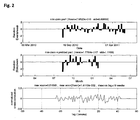
- Fig. 2 shows Pearson's test of Fig. 1 data (or the cross correlation of ETF's of Fig. 1 data) with very low NCC (0.21) which would be significantly lower for longer time series or average of multiple random realizations.
- the NCC ETF has global maximum at approximately zero time corresponding to a short time lag between the two time functions.
- the value of global maximum is above statistical significance (i.e. above 0.5) and it is positive. Cross correlation without such features implies that the seismicity is not related to the human activity.
- the decision in form of 'seismicity is not induced' or 'seismicity is probably induced' can be made.
- the decision is based on statistical independence of the time functions as depicted in the bottom parts of the flow chart in Fig. 5 .
- the most suitable threshold values for YES/NO decision which we have found are approximately 0.45 for A-branch process and approximately 0.60 for B-branch process.
- the decision threshold values are based on the empirical knowledge, they were calibrated on the time functions of the human-induced seismicity and natural seismicity known from prior art.
- the person skilled in the art is aware of the fact that the present threshold values are region-dependent and thus are demonstrated as preferred values in the specific examples.
- the skilled person also knows the routine approach how to test/calibrate the threshold values useful for realization of the present invention.
- the same applies to the final decisions which are influenced by the current knowledge of pertinent geophysical processes and by obtained data accuracy. Hence the skilled person is aware that final answer 'Seismicity is induced' is not given with 100% of probability.
- Both process branches A and B can be used jointly to provide combined statistical significance decision ( Fig. 5 ).
- the anwers determine whether the seismicity is probably induced, probably not induced, or that the relationship is not statistically significant.
- the term 'undetermined' stands for situation in Fig 5 , steps 5A or 5B, when statistical sicnificancy is between two threshold values for ,YES' and ,NO ⁇ answers, respectively.
Landscapes
- Physics & Mathematics (AREA)
- Engineering & Computer Science (AREA)
- General Physics & Mathematics (AREA)
- Remote Sensing (AREA)
- Life Sciences & Earth Sciences (AREA)
- Environmental & Geological Engineering (AREA)
- Mathematical Physics (AREA)
- Geology (AREA)
- General Life Sciences & Earth Sciences (AREA)
- Acoustics & Sound (AREA)
- Geophysics (AREA)
- Data Mining & Analysis (AREA)
- Computational Mathematics (AREA)
- Mathematical Analysis (AREA)
- Mathematical Optimization (AREA)
- Pure & Applied Mathematics (AREA)
- Theoretical Computer Science (AREA)
- Business, Economics & Management (AREA)
- Emergency Management (AREA)
- Discrete Mathematics (AREA)
- Databases & Information Systems (AREA)
- Software Systems (AREA)
- General Engineering & Computer Science (AREA)
- Algebra (AREA)
- Fluid Mechanics (AREA)
- Geophysics And Detection Of Objects (AREA)
Claims (3)
- Procédé, mis en oeuvre par ordinateur, pour différencier entre une sismicité naturelle et une sismicité induite, comprenant une étape d'acquisition de données d'activité humaine et d'acquisition de données de sismicité, par un système de surveillance, pour le même emplacement et la même période de temps, et pour transformer les données de sismicité et les données d'activité humaine en la première fonction temporelle et la seconde fonction temporelle, respectivement, caractérisé en ce qu'il comprend les étapes ci-dessous consistant à :- déterminer une corrélation croisée normalisée, NCCTF, entre la première fonction temporelle et la seconde fonction temporelle ;- déterminer une corrélation croisée re-normalisée, RNCC, sur la base d'une corrélation croisée normalisée théoriquement attendue, NCCTE, dans lequel la corrélation NCCTE est calculée en présumant que la première fonction temporelle et la seconde fonction temporelle sont mutuellement indépendantes ;- évaluer la signification statistique de la corrélation RNCC ;- évaluer la probabilité que la sismicité soit induite par l'activité humaine, sur la base de la signification statistique de la corrélation RNCC.
- Procédé, mis en oeuvre par ordinateur, pour différencier entre une sismicité naturelle et une sismicité induite, comprenant une étape d'acquisition de données d'activité humaine et d'acquisition de données de sismicité, par un système de surveillance, pour le même emplacement et la même période de temps, et pour transformer les données de sismicité et les données d'activité humaine en la première fonction temporelle et la seconde fonction temporelle, respectivement, caractérisé en ce qu'il comprend les étapes ci-dessous consistant à :- obtenir la première fonction temporelle efficace et la seconde fonction temporelle efficace, par une transformation mathématique de la première fonction temporelle et de la seconde fonction temporelle, respectivement ;- déterminer la corrélation croisée normalisée entre la première fonction temporelle efficace et la seconde fonction temporelle efficace, NCCETF ;- évaluer la signification statistique de la corrélation NCCETF ;- évaluer la probabilité que la sismicité soit induite par l'activité humaine, sur la base de la signification statistique de la corrélation NCCETF.
- Procédé selon la revendication 2, caractérisé en ce que la transformation mathématique est sélectionnée parmi les procédés suivants consistant à :- transformer la fonction temporelle dans le domaine spectral de Fourier, par une transformée de Fourier discrète, multiplier sa partie réelle et sa partie imaginaire par une fonction de filtrage, et retransformer le résultat dans le domaine temporel ;- soustraire la valeur moyenne d'une fonction ;- mettre en oeuvre un filtrage passe-haut, passe-bas ou passe-bande d'une fonction dans le domaine de Fourier, par un filtre arbitraire ;- mettre en oeuvre un filtrage passe-bas d'une fonction dans le domaine temporel, en soustrayant une moyenne de fenêtre d'exécution, facultativement en utilisant un intervalle de temps de fenêtre pondérée dont la pondération est dépendante du temps.
Applications Claiming Priority (1)
| Application Number | Priority Date | Filing Date | Title |
|---|---|---|---|
| PCT/CZ2012/000058 WO2014000718A1 (fr) | 2012-06-29 | 2012-06-29 | Procédé permettant d'établir une distinction entre la sismicité naturelle et la sismicité induite |
Publications (2)
| Publication Number | Publication Date |
|---|---|
| EP2834672A1 EP2834672A1 (fr) | 2015-02-11 |
| EP2834672B1 true EP2834672B1 (fr) | 2017-05-17 |
Family
ID=46640501
Family Applications (1)
| Application Number | Title | Priority Date | Filing Date |
|---|---|---|---|
| EP12745617.6A Not-in-force EP2834672B1 (fr) | 2012-06-29 | 2012-06-29 | Procédé permettant d'établir une distinction entre la sismicité naturelle et la sismicité induite |
Country Status (4)
| Country | Link |
|---|---|
| US (1) | US20140365134A1 (fr) |
| EP (1) | EP2834672B1 (fr) |
| ES (1) | ES2629684T3 (fr) |
| WO (1) | WO2014000718A1 (fr) |
Families Citing this family (2)
| Publication number | Priority date | Publication date | Assignee | Title |
|---|---|---|---|---|
| US9416641B2 (en) * | 2012-11-04 | 2016-08-16 | Schlumberger Technology Corporation | Borehole microseismic systems and methods |
| US9520910B1 (en) * | 2015-09-24 | 2016-12-13 | Nxp B.V. | Receiver component and method for enhancing a detection range of a time-tracking process in a receiver |
Family Cites Families (4)
| Publication number | Priority date | Publication date | Assignee | Title |
|---|---|---|---|---|
| US5191557A (en) * | 1986-12-30 | 1993-03-02 | Gas Research Institute | Signal processing to enable utilization of a rig reference sensor with a drill bit seismic source |
| FR2805051B1 (fr) | 2000-02-14 | 2002-12-06 | Geophysique Cie Gle | Methode de surveillance sismique d'une zone souterraine par utilisation simultanee de plusieurs sources vibrosismiques |
| EP2374029A2 (fr) * | 2009-01-05 | 2011-10-12 | Services Pétroliers Schlumberger | Traitement de données de série chronologique intégrées dans un bruit fort |
| CN102639812A (zh) * | 2009-09-11 | 2012-08-15 | C12能源公司 | 基于流体注射的地下储层分析 |
-
2012
- 2012-06-29 US US14/352,271 patent/US20140365134A1/en not_active Abandoned
- 2012-06-29 EP EP12745617.6A patent/EP2834672B1/fr not_active Not-in-force
- 2012-06-29 WO PCT/CZ2012/000058 patent/WO2014000718A1/fr not_active Ceased
- 2012-06-29 ES ES12745617.6T patent/ES2629684T3/es active Active
Also Published As
| Publication number | Publication date |
|---|---|
| WO2014000718A1 (fr) | 2014-01-03 |
| US20140365134A1 (en) | 2014-12-11 |
| EP2834672A1 (fr) | 2015-02-11 |
| ES2629684T3 (es) | 2017-08-14 |
Similar Documents
| Publication | Publication Date | Title |
|---|---|---|
| US20200217979A1 (en) | Observation-driven method based on iir wiener filter for microseismic data denoising | |
| Haghshenas et al. | Empirical evaluation of microtremor H/V spectral ratio | |
| CA2842398C (fr) | Estimation des dimensions d'une fracture a partir de donnees microsismiques | |
| CN113687440A (zh) | 基于米兰科维奇旋回的古水深定量恢复方法和存储介质 | |
| EP3571379B1 (fr) | Procédé d'évaluation de la connectivité entre un premier puits et un second puits dans un champ pétrolifère et système associé | |
| US8681583B2 (en) | Method for calculating spatial and temporal distribution of the Gutenberg-Richter parameter for induced subsurface seismic events and its application to evaluation of subsurface formations | |
| US10126453B2 (en) | Processing seismic data to remote noise | |
| CN103713317A (zh) | 基于对时变子波进行分频段处理的反褶积方法 | |
| US20080159074A1 (en) | System and method for quality control of noisy data | |
| Roden et al. | Relating seismic interpretation to reserve/resource calculations: Insights from a DHI consortium | |
| EP2818896A2 (fr) | Procédé et appareil d'estimation d'un paramètre d'un volume souterrain | |
| US8218394B2 (en) | Method for imaging the earths subsurface using passive seismic interferometry and adaptive velocity filtering | |
| Telesca et al. | Dynamical characterization of the 1982–2015 seismicity of Aswan region (Egypt) | |
| Wilson et al. | Fractal interrelationships between topography and structure | |
| Dimri et al. | Fractal analysis of aftershock sequence of the Bhuj earthquake: A wavelet-based approach | |
| EP2834672B1 (fr) | Procédé permettant d'établir une distinction entre la sismicité naturelle et la sismicité induite | |
| CN104122590B (zh) | 一种基于电磁勘探的油气检测方法及系统 | |
| US7908086B2 (en) | System and method for filtering seismic noise data to analyze seismic events | |
| Rickett et al. | Compaction and 4-D time strain at the Genesis Field | |
| CN105467447A (zh) | 相控趋势能量匹配的地震保幅评价方法 | |
| Telesca | Fractal, Informational and Topological Methods for the Analysis of Discrete and Continuous Seismic Time Series: An Overview | |
| Watkins et al. | Wavelet analysis and filtering to identify dominant orientations of permeability anisotropy | |
| Paonita | Long-range correlation and nonlinearity in geochemical time series of gas discharges from Mt. Etna, and changes with 2001 and 2002–2003 eruptions | |
| Oktariena et al. | Gabor Deconvolution as Preliminary Method to Reduce Pitfall in Deeper Target Seismic Data | |
| Telesca et al. | Investigating the spatial variability of the time-scaling properties in Italian seismicity |
Legal Events
| Date | Code | Title | Description |
|---|---|---|---|
| PUAI | Public reference made under article 153(3) epc to a published international application that has entered the european phase |
Free format text: ORIGINAL CODE: 0009012 |
|
| 17P | Request for examination filed |
Effective date: 20141107 |
|
| AK | Designated contracting states |
Kind code of ref document: A1 Designated state(s): AL AT BE BG CH CY CZ DE DK EE ES FI FR GB GR HR HU IE IS IT LI LT LU LV MC MK MT NL NO PL PT RO RS SE SI SK SM TR |
|
| AX | Request for extension of the european patent |
Extension state: BA ME |
|
| RIN1 | Information on inventor provided before grant (corrected) |
Inventor name: OPRSAL, IVO Inventor name: EISNER, LEO |
|
| 17Q | First examination report despatched |
Effective date: 20150716 |
|
| DAX | Request for extension of the european patent (deleted) | ||
| RIC1 | Information provided on ipc code assigned before grant |
Ipc: G01V 1/28 20060101AFI20161110BHEP |
|
| GRAP | Despatch of communication of intention to grant a patent |
Free format text: ORIGINAL CODE: EPIDOSNIGR1 |
|
| INTG | Intention to grant announced |
Effective date: 20161221 |
|
| GRAS | Grant fee paid |
Free format text: ORIGINAL CODE: EPIDOSNIGR3 |
|
| GRAA | (expected) grant |
Free format text: ORIGINAL CODE: 0009210 |
|
| AK | Designated contracting states |
Kind code of ref document: B1 Designated state(s): AL AT BE BG CH CY CZ DE DK EE ES FI FR GB GR HR HU IE IS IT LI LT LU LV MC MK MT NL NO PL PT RO RS SE SI SK SM TR |
|
| REG | Reference to a national code |
Ref country code: GB Ref legal event code: FG4D |
|
| REG | Reference to a national code |
Ref country code: CH Ref legal event code: EP |
|
| REG | Reference to a national code |
Ref country code: IE Ref legal event code: FG4D |
|
| REG | Reference to a national code |
Ref country code: AT Ref legal event code: REF Ref document number: 894963 Country of ref document: AT Kind code of ref document: T Effective date: 20170615 |
|
| REG | Reference to a national code |
Ref country code: DE Ref legal event code: R096 Ref document number: 602012032559 Country of ref document: DE |
|
| REG | Reference to a national code |
Ref country code: ES Ref legal event code: FG2A Ref document number: 2629684 Country of ref document: ES Kind code of ref document: T3 Effective date: 20170814 |
|
| REG | Reference to a national code |
Ref country code: NL Ref legal event code: MP Effective date: 20170517 |
|
| REG | Reference to a national code |
Ref country code: LT Ref legal event code: MG4D |
|
| REG | Reference to a national code |
Ref country code: AT Ref legal event code: MK05 Ref document number: 894963 Country of ref document: AT Kind code of ref document: T Effective date: 20170517 |
|
| PG25 | Lapsed in a contracting state [announced via postgrant information from national office to epo] |
Ref country code: LT Free format text: LAPSE BECAUSE OF FAILURE TO SUBMIT A TRANSLATION OF THE DESCRIPTION OR TO PAY THE FEE WITHIN THE PRESCRIBED TIME-LIMIT Effective date: 20170517 Ref country code: HR Free format text: LAPSE BECAUSE OF FAILURE TO SUBMIT A TRANSLATION OF THE DESCRIPTION OR TO PAY THE FEE WITHIN THE PRESCRIBED TIME-LIMIT Effective date: 20170517 Ref country code: NO Free format text: LAPSE BECAUSE OF FAILURE TO SUBMIT A TRANSLATION OF THE DESCRIPTION OR TO PAY THE FEE WITHIN THE PRESCRIBED TIME-LIMIT Effective date: 20170817 Ref country code: GR Free format text: LAPSE BECAUSE OF FAILURE TO SUBMIT A TRANSLATION OF THE DESCRIPTION OR TO PAY THE FEE WITHIN THE PRESCRIBED TIME-LIMIT Effective date: 20170818 Ref country code: AT Free format text: LAPSE BECAUSE OF FAILURE TO SUBMIT A TRANSLATION OF THE DESCRIPTION OR TO PAY THE FEE WITHIN THE PRESCRIBED TIME-LIMIT Effective date: 20170517 Ref country code: FI Free format text: LAPSE BECAUSE OF FAILURE TO SUBMIT A TRANSLATION OF THE DESCRIPTION OR TO PAY THE FEE WITHIN THE PRESCRIBED TIME-LIMIT Effective date: 20170517 |
|
| PG25 | Lapsed in a contracting state [announced via postgrant information from national office to epo] |
Ref country code: IS Free format text: LAPSE BECAUSE OF FAILURE TO SUBMIT A TRANSLATION OF THE DESCRIPTION OR TO PAY THE FEE WITHIN THE PRESCRIBED TIME-LIMIT Effective date: 20170917 Ref country code: LV Free format text: LAPSE BECAUSE OF FAILURE TO SUBMIT A TRANSLATION OF THE DESCRIPTION OR TO PAY THE FEE WITHIN THE PRESCRIBED TIME-LIMIT Effective date: 20170517 Ref country code: SE Free format text: LAPSE BECAUSE OF FAILURE TO SUBMIT A TRANSLATION OF THE DESCRIPTION OR TO PAY THE FEE WITHIN THE PRESCRIBED TIME-LIMIT Effective date: 20170517 Ref country code: BG Free format text: LAPSE BECAUSE OF FAILURE TO SUBMIT A TRANSLATION OF THE DESCRIPTION OR TO PAY THE FEE WITHIN THE PRESCRIBED TIME-LIMIT Effective date: 20170817 Ref country code: RS Free format text: LAPSE BECAUSE OF FAILURE TO SUBMIT A TRANSLATION OF THE DESCRIPTION OR TO PAY THE FEE WITHIN THE PRESCRIBED TIME-LIMIT Effective date: 20170517 Ref country code: PL Free format text: LAPSE BECAUSE OF FAILURE TO SUBMIT A TRANSLATION OF THE DESCRIPTION OR TO PAY THE FEE WITHIN THE PRESCRIBED TIME-LIMIT Effective date: 20170517 Ref country code: NL Free format text: LAPSE BECAUSE OF FAILURE TO SUBMIT A TRANSLATION OF THE DESCRIPTION OR TO PAY THE FEE WITHIN THE PRESCRIBED TIME-LIMIT Effective date: 20170517 |
|
| REG | Reference to a national code |
Ref country code: DE Ref legal event code: R119 Ref document number: 602012032559 Country of ref document: DE |
|
| PG25 | Lapsed in a contracting state [announced via postgrant information from national office to epo] |
Ref country code: SK Free format text: LAPSE BECAUSE OF FAILURE TO SUBMIT A TRANSLATION OF THE DESCRIPTION OR TO PAY THE FEE WITHIN THE PRESCRIBED TIME-LIMIT Effective date: 20170517 Ref country code: EE Free format text: LAPSE BECAUSE OF FAILURE TO SUBMIT A TRANSLATION OF THE DESCRIPTION OR TO PAY THE FEE WITHIN THE PRESCRIBED TIME-LIMIT Effective date: 20170517 Ref country code: CZ Free format text: LAPSE BECAUSE OF FAILURE TO SUBMIT A TRANSLATION OF THE DESCRIPTION OR TO PAY THE FEE WITHIN THE PRESCRIBED TIME-LIMIT Effective date: 20170517 Ref country code: DK Free format text: LAPSE BECAUSE OF FAILURE TO SUBMIT A TRANSLATION OF THE DESCRIPTION OR TO PAY THE FEE WITHIN THE PRESCRIBED TIME-LIMIT Effective date: 20170517 Ref country code: RO Free format text: LAPSE BECAUSE OF FAILURE TO SUBMIT A TRANSLATION OF THE DESCRIPTION OR TO PAY THE FEE WITHIN THE PRESCRIBED TIME-LIMIT Effective date: 20170517 |
|
| REG | Reference to a national code |
Ref country code: CH Ref legal event code: PL |
|
| PG25 | Lapsed in a contracting state [announced via postgrant information from national office to epo] |
Ref country code: SM Free format text: LAPSE BECAUSE OF FAILURE TO SUBMIT A TRANSLATION OF THE DESCRIPTION OR TO PAY THE FEE WITHIN THE PRESCRIBED TIME-LIMIT Effective date: 20170517 Ref country code: IT Free format text: LAPSE BECAUSE OF FAILURE TO SUBMIT A TRANSLATION OF THE DESCRIPTION OR TO PAY THE FEE WITHIN THE PRESCRIBED TIME-LIMIT Effective date: 20170517 |
|
| PLBE | No opposition filed within time limit |
Free format text: ORIGINAL CODE: 0009261 |
|
| STAA | Information on the status of an ep patent application or granted ep patent |
Free format text: STATUS: NO OPPOSITION FILED WITHIN TIME LIMIT |
|
| REG | Reference to a national code |
Ref country code: FR Ref legal event code: ST Effective date: 20180228 |
|
| REG | Reference to a national code |
Ref country code: IE Ref legal event code: MM4A |
|
| 26N | No opposition filed |
Effective date: 20180220 |
|
| PG25 | Lapsed in a contracting state [announced via postgrant information from national office to epo] |
Ref country code: IE Free format text: LAPSE BECAUSE OF NON-PAYMENT OF DUE FEES Effective date: 20170629 Ref country code: LI Free format text: LAPSE BECAUSE OF NON-PAYMENT OF DUE FEES Effective date: 20170630 Ref country code: DE Free format text: LAPSE BECAUSE OF NON-PAYMENT OF DUE FEES Effective date: 20180103 Ref country code: LU Free format text: LAPSE BECAUSE OF NON-PAYMENT OF DUE FEES Effective date: 20170629 Ref country code: CH Free format text: LAPSE BECAUSE OF NON-PAYMENT OF DUE FEES Effective date: 20170630 |
|
| PG25 | Lapsed in a contracting state [announced via postgrant information from national office to epo] |
Ref country code: FR Free format text: LAPSE BECAUSE OF NON-PAYMENT OF DUE FEES Effective date: 20170717 Ref country code: SI Free format text: LAPSE BECAUSE OF FAILURE TO SUBMIT A TRANSLATION OF THE DESCRIPTION OR TO PAY THE FEE WITHIN THE PRESCRIBED TIME-LIMIT Effective date: 20170517 |
|
| REG | Reference to a national code |
Ref country code: BE Ref legal event code: MM Effective date: 20170630 |
|
| PG25 | Lapsed in a contracting state [announced via postgrant information from national office to epo] |
Ref country code: BE Free format text: LAPSE BECAUSE OF NON-PAYMENT OF DUE FEES Effective date: 20170630 |
|
| PG25 | Lapsed in a contracting state [announced via postgrant information from national office to epo] |
Ref country code: MT Free format text: LAPSE BECAUSE OF NON-PAYMENT OF DUE FEES Effective date: 20170629 |
|
| PG25 | Lapsed in a contracting state [announced via postgrant information from national office to epo] |
Ref country code: HU Free format text: LAPSE BECAUSE OF FAILURE TO SUBMIT A TRANSLATION OF THE DESCRIPTION OR TO PAY THE FEE WITHIN THE PRESCRIBED TIME-LIMIT; INVALID AB INITIO Effective date: 20120629 Ref country code: MC Free format text: LAPSE BECAUSE OF FAILURE TO SUBMIT A TRANSLATION OF THE DESCRIPTION OR TO PAY THE FEE WITHIN THE PRESCRIBED TIME-LIMIT Effective date: 20170517 |
|
| PG25 | Lapsed in a contracting state [announced via postgrant information from national office to epo] |
Ref country code: CY Free format text: LAPSE BECAUSE OF FAILURE TO SUBMIT A TRANSLATION OF THE DESCRIPTION OR TO PAY THE FEE WITHIN THE PRESCRIBED TIME-LIMIT Effective date: 20170517 |
|
| PGFP | Annual fee paid to national office [announced via postgrant information from national office to epo] |
Ref country code: GB Payment date: 20190612 Year of fee payment: 8 Ref country code: ES Payment date: 20190701 Year of fee payment: 8 |
|
| PG25 | Lapsed in a contracting state [announced via postgrant information from national office to epo] |
Ref country code: MK Free format text: LAPSE BECAUSE OF FAILURE TO SUBMIT A TRANSLATION OF THE DESCRIPTION OR TO PAY THE FEE WITHIN THE PRESCRIBED TIME-LIMIT Effective date: 20170517 |
|
| PG25 | Lapsed in a contracting state [announced via postgrant information from national office to epo] |
Ref country code: TR Free format text: LAPSE BECAUSE OF FAILURE TO SUBMIT A TRANSLATION OF THE DESCRIPTION OR TO PAY THE FEE WITHIN THE PRESCRIBED TIME-LIMIT Effective date: 20170517 |
|
| PG25 | Lapsed in a contracting state [announced via postgrant information from national office to epo] |
Ref country code: PT Free format text: LAPSE BECAUSE OF FAILURE TO SUBMIT A TRANSLATION OF THE DESCRIPTION OR TO PAY THE FEE WITHIN THE PRESCRIBED TIME-LIMIT Effective date: 20170517 |
|
| PG25 | Lapsed in a contracting state [announced via postgrant information from national office to epo] |
Ref country code: AL Free format text: LAPSE BECAUSE OF FAILURE TO SUBMIT A TRANSLATION OF THE DESCRIPTION OR TO PAY THE FEE WITHIN THE PRESCRIBED TIME-LIMIT Effective date: 20170517 |
|
| GBPC | Gb: european patent ceased through non-payment of renewal fee |
Effective date: 20200629 |
|
| PG25 | Lapsed in a contracting state [announced via postgrant information from national office to epo] |
Ref country code: GB Free format text: LAPSE BECAUSE OF NON-PAYMENT OF DUE FEES Effective date: 20200629 |
|
| REG | Reference to a national code |
Ref country code: ES Ref legal event code: FD2A Effective date: 20211105 |
|
| PG25 | Lapsed in a contracting state [announced via postgrant information from national office to epo] |
Ref country code: ES Free format text: LAPSE BECAUSE OF NON-PAYMENT OF DUE FEES Effective date: 20200630 |