EP2835413A2 - Particule d'une matière solide similaire au charbon, utilisations et procédé de fabrication - Google Patents
Particule d'une matière solide similaire au charbon, utilisations et procédé de fabrication Download PDFInfo
- Publication number
- EP2835413A2 EP2835413A2 EP14180275.1A EP14180275A EP2835413A2 EP 2835413 A2 EP2835413 A2 EP 2835413A2 EP 14180275 A EP14180275 A EP 14180275A EP 2835413 A2 EP2835413 A2 EP 2835413A2
- Authority
- EP
- European Patent Office
- Prior art keywords
- particles
- slurry
- coal
- solid
- plastic material
- Prior art date
- Legal status (The legal status is an assumption and is not a legal conclusion. Google has not performed a legal analysis and makes no representation as to the accuracy of the status listed.)
- Granted
Links
Images


Classifications
-
- C—CHEMISTRY; METALLURGY
- C10—PETROLEUM, GAS OR COKE INDUSTRIES; TECHNICAL GASES CONTAINING CARBON MONOXIDE; FUELS; LUBRICANTS; PEAT
- C10L—FUELS NOT OTHERWISE PROVIDED FOR; NATURAL GAS; SYNTHETIC NATURAL GAS OBTAINED BY PROCESSES NOT COVERED BY SUBCLASSES C10G OR C10K; LIQUIFIED PETROLEUM GAS; USE OF ADDITIVES TO FUELS OR FIRES; FIRE-LIGHTERS
- C10L9/00—Treating solid fuels to improve their combustion
- C10L9/08—Treating solid fuels to improve their combustion by heat treatments, e.g. calcining
- C10L9/086—Hydrothermal carbonization
-
- C—CHEMISTRY; METALLURGY
- C10—PETROLEUM, GAS OR COKE INDUSTRIES; TECHNICAL GASES CONTAINING CARBON MONOXIDE; FUELS; LUBRICANTS; PEAT
- C10L—FUELS NOT OTHERWISE PROVIDED FOR; NATURAL GAS; SYNTHETIC NATURAL GAS OBTAINED BY PROCESSES NOT COVERED BY SUBCLASSES C10G OR C10K; LIQUIFIED PETROLEUM GAS; USE OF ADDITIVES TO FUELS OR FIRES; FIRE-LIGHTERS
- C10L5/00—Solid fuels
- C10L5/40—Solid fuels essentially based on materials of non-mineral origin
- C10L5/406—Solid fuels essentially based on materials of non-mineral origin on plastic
-
- Y—GENERAL TAGGING OF NEW TECHNOLOGICAL DEVELOPMENTS; GENERAL TAGGING OF CROSS-SECTIONAL TECHNOLOGIES SPANNING OVER SEVERAL SECTIONS OF THE IPC; TECHNICAL SUBJECTS COVERED BY FORMER USPC CROSS-REFERENCE ART COLLECTIONS [XRACs] AND DIGESTS
- Y02—TECHNOLOGIES OR APPLICATIONS FOR MITIGATION OR ADAPTATION AGAINST CLIMATE CHANGE
- Y02E—REDUCTION OF GREENHOUSE GAS [GHG] EMISSIONS, RELATED TO ENERGY GENERATION, TRANSMISSION OR DISTRIBUTION
- Y02E50/00—Technologies for the production of fuel of non-fossil origin
- Y02E50/10—Biofuels, e.g. bio-diesel
-
- Y—GENERAL TAGGING OF NEW TECHNOLOGICAL DEVELOPMENTS; GENERAL TAGGING OF CROSS-SECTIONAL TECHNOLOGIES SPANNING OVER SEVERAL SECTIONS OF THE IPC; TECHNICAL SUBJECTS COVERED BY FORMER USPC CROSS-REFERENCE ART COLLECTIONS [XRACs] AND DIGESTS
- Y02—TECHNOLOGIES OR APPLICATIONS FOR MITIGATION OR ADAPTATION AGAINST CLIMATE CHANGE
- Y02E—REDUCTION OF GREENHOUSE GAS [GHG] EMISSIONS, RELATED TO ENERGY GENERATION, TRANSMISSION OR DISTRIBUTION
- Y02E50/00—Technologies for the production of fuel of non-fossil origin
- Y02E50/30—Fuel from waste, e.g. synthetic alcohol or diesel
Definitions
- the invention relates to processes for the preparation of particles of a coal-like solid, corresponding particles, and their uses and corresponding products comprising corresponding particles.
- the WO 2008/113309 describes a process for wet-chemical conversion of biomass by hydrothermal carbonization, the process being carried out in a reaction volume below the surface of the earth.
- the WO 2009/127727 describes the production of a coal-like material from biomass using a polymerization initiator.
- the WO 2008/138637 describes a method for operating a plant for the hydrothermal carbonization of biomass and an associated device.
- the WO 2010/0066881 describes a process for preparing a hydrothermal hybrid material by adding a copolymerizable compound to biomass.
- the WO 2010/092040 describes a process for producing a coal-like material from biomass using countercurrent vapor.
- the EP 1 970 431 A1 relates to a method and associated apparatus for hydrothermal carbonization.
- the EP 2 130 893 A2 describes a process for the hydrothermal carbonization of biomass, which is pre-dehydrated and optionally acidified, and wherein the process waste heat is used to dry the resulting product.
- the DE 10 2008 058 444 A1 describes methods and devices for the production of fuels or fuels.
- all of the references relate to the conversion of biomass into coal-like products, that is, starting materials that also provide the basis for natural coal formation. There is thus a need for further development of hydrothermal carbonization to circumvent this limitation. It is an object of the present invention to provide particles of a coal-like solid which is not substantially biomass-based, further in providing corresponding manufacturing processes, and to provide uses of such particles and products containing such particles.
- the object is achieved by a method having the features of the main claim and by process products, namely particles of a coal-like solid or slurries thereof, and their uses or derived products according to the features of the independent claims.
- the present application describes and relates in a first aspect to a process for the preparation of particles of a coal-like solid, wherein an aqueous reaction mixture comprising a plastic material containing one or more hydrolyzable plastics selected from polyurethanes and / or polyesters, and further biological Material, wherein the weight ratio of plastic material to biological material is 750: 1 to 1.5: 1, at a pressure of 2 to 60 bar and a temperature of 195 ° C to 225 ° C in the presence of a catalyst selected from an acid, a base and / or a metal-based or sulfur-based catalyst over a period of from 0.1 to 48 hours and recover the resulting slurry of carbonaceous solid particles and the particles in the slurry, or the particles after reducing the water content the slurry, at least one comminution adding an organic solvent which is selected from n-propanol, isopropanol, acetone, 1-butanol, 2-butanol, diethyl ether, dimethyl ether,
- an organic solvent is added to the slurry of particles of the coal-like solid, or the particles after reducing the water content, and receives a slurry of particles or particles with an increased proportion of particles of smaller size, the organic solvent being selected from n -Propanol, isopropanol, acetone or a mixture of two or more representatives thereof.
- size fractionation of the particles of the coal-like solid is carried out.
- the method optionally reduces the water content of the obtained slurry, further subjecting the slurry or the particles obtained after reduction of the water content to a comminution step, furthermore in the case of a slurry whose water content reduces to obtain the particles Particles added an organic solvent, further carried out with the particles in the organic solvent size fractionation and separation of size fractions obtained from each other, optionally further optionally added an organic solvent to the particles of the size fractions obtained, and the resulting particles are recovered.
- the plastic material comprises polyester, polyurethane, flexible polyurethane foam, rigid polyurethane foam, medium-hard polyurethane foam integral hard foam, shredder light fraction or a mixture of two or more representatives thereof.
- the plastic material comprises either flexible polyurethane foam or consists thereof, and the reaction takes place in a temperature range of 218 ° C to 222 ° C; or the plastic material comprises or consists of rigid polyurethane foam and the reaction takes place in a temperature range from 198 ° C to 202 ° C; or the plastic material comprises or consists of medium-hard polyurethane foam, and the reaction is carried out in a temperature range of 198 ° C to 202 ° C, followed by mechanical comminution, an optional reduction of the Water content, and adding an organic solvent, optionally followed by centrifugation for size fractionation followed by separation of the sediment and supernatant and adding organic solvent to the sediment and supernatant, respectively.
- the biological material is selected from cellulose, starch, cellulose or starch-containing materials, sewage sludge, sewage sludge coal, cellulosic or starchy biomasses, jatropha, plant residues, in particular foliage, food residues, or mixtures of two or more representatives thereof.
- the reaction takes place in an acidic pH range, in particular at a maximum of pH 4.5, or in a basic range, in particular at least pH 8.5.
- a metal-based catalyst which is selected from iron salts and / or iron nanoparticles.
- flexible polyurethane foam is reacted in a temperature range of 198 ° C to 202 ° C.
- Another object of the invention relates to a slurry of particles of a coal-like solid or particles of a coal-like solid, each obtained via a process according to the invention without or with reduction of the water content.
- Particular further developments relate to such slurries or particles, wherein at least 90% of the particles have a maximum size of at most 75 ⁇ m, and / or at least 50% of the particles have a maximum size of not more than 25 ⁇ m, and / or at least 10% of the particles have a maximum size have a maximum of 1 micron.
- a further aspect relates to the use of a slurry of particles, or of particles of a coal-like solid, as a carbon black replacement, wherein the slurries and / or the particles are each prepared by a process according to the invention, or are prepared by reacting plastic material, wherein an aqueous reaction mixture comprising 1 to 75 weight percent plastic material at a pressure of 2 to 60 bar and a temperature of 180 to 250 ° C in the presence of a catalyst which is selected from an acid Base and / or a metal-based or sulfur-based catalyst over a period of 0.1 to 48 hours and the resulting slurry of particles of a coal-like solid wins.
- a further aspect accordingly relates to a carbon black replacement comprising or optionally consisting of a slurry of particles of a coal-like solid, or of the particles of a coal-like solid itself.
- the carbon black replacement comprises 1 to 99 weight percent of carbonaceous solid particles and 99 to 1 weight percent industrial carbon black, and optionally a balance of 100 weight percent provided by one or more additives, or optionally consists thereof.
- Another aspect relates to the use of a slurry according to the invention of particles or particles of the invention or a carbon black replacement according to the invention as a filler, as a reinforcing filler, as a UV stabilizer, as a conductivity, as a pigment, as a component of paint compositions, cosmetic compositions, building materials, plastics or Rubbers, or for the production of the aforementioned products, and further relates to corresponding products.
- the present application describes and relates in a first aspect to a process for the preparation of particles of a coal-like solid, wherein an aqueous A reaction mixture comprising a plastic material containing one or more hydrolyzable plastics selected from polyurethanes and / or polyesters, and further comprising biological material, wherein the weight ratio of plastic material to biological material is 750: 1 to 1.5: 1, at a pressure of 2 to 60 bar and a temperature of 195 ° C to 225 ° C in the presence of a catalyst selected from an acid, a base and / or a metal-based or sulfur-based catalyst, over a period of 0.1 to 48 hours and the resulting slurry of particles of a coal-like solid extracts and optionally reduces the water content of the slurry by separating reaction effluents to obtain the particles of the coal-like solid.
- an aqueous A reaction mixture comprising a plastic material containing one or more hydrolyzable plastics selected from polyurethanes and / or polyesters,
- the process comprises one or more steps selected from reducing the water content of the slurry to obtain the particles of the coal-like solid, and / or adding an organic solvent to obtain an increased number of smaller-sized particles, and / or at least one comminution step.
- the particles in the slurry, or particles after reducing the water content of the slurry are subjected to at least one comminuting step selected from: adding an organic solvent selected from n-propanol, isopropanol, acetone, 1-butanol , 2-butanol, diethyl ether, dimethyl ether, benzene, toluene or xylene, or mixtures of two or more thereof; mechanical comminution by grinding; Ultrasound treatment; Generation of shear forces; chemical crushing; and / or thermal comminution. Accordingly, a combination of two or more of the aforementioned measures suitable as comminution steps is also possible.
- the aqueous reaction mixture which is essentially a more or less concentrated aqueous suspension or optionally dispersion of plastic material, partially or completely transferred into a slurry of particles of a coal-like solid, so a coal slurry.
- the coal-like solid is similar in appearance and properties to natural coal and has a higher carbon content compared to the starting plastic material.
- tarry optionally tacky intermediates, which are composed of coarser particles, up to the actual coal-like solid in macroscopic form, ie in the form rather large conglomerates or chunks are present.
- the plastic material contains polyhalogenated plastic before the conversion, then it will this usually more or less reacted depending on the degree of halogenation.
- incompletely reacted polyhalogenated plastic may be separated from the carbonaceous solid particles in the coal slurry, for example, by filtration, sedimentation, flotation, or other methods known in the art.
- non-plastics such as metal or ceramic components of the plastic material originally used for the reaction may equally be separated from the particles of carbonaceous solid in the coal slurry.
- the slurry of particles of the coal-like solid can be partially or completely recovered after the intended period of time or after reaching a desired degree of conversion, for example, be removed from the reaction vessel.
- Preferred is a complete or substantially complete reaction in the coal-like solid or particles of the coal-like solid.
- the degree of implementation achieved in each case can be determined, for example, by taking random samples.
- the water content of the resultant coal slurry is reduced by separating off reaction wastewater, that is to say the aqueous phase resulting from the aqueous reaction mixture during the course of the reaction.
- the slurry is a thin or concentrated suspension or dispersion.
- the solids content may be less than 5% by weight, for example 0.1% to 4% by weight.
- the solids content of more concentrated suspensions or dispersions may be, for example, in the range of 5% to 90%, especially in the range of 10% to 75%, such as 25% to 50%, for example about 30%.
- the separation of the reaction wastewater is carried out by customary methods, such as mechanical dehumidification and / or thermal drying.
- mechanical dehumidification is usually a residual moisture of about 20% achievable.
- mechanical dehumidification are sedimentation and separation of the substantially sediment-free liquid phase from the sedimented solid phase; Filtration, for example in the form of gravity filtration, wherein the loaded with particles of coal-like solid liquid phase is pressed by a weight force through a filter and generally residual moisture of 15 to 25% possible; Pressure or vacuum filtration whereby the pressure differential across the filter is increased by a pressure applied in front of the filter or by a vacuum applied downstream of the filter to effect a faster filtration; Centrifugation and in particular Filter centrifugation, wherein usually residual moisture of less than 10% can be achieved; and press filtration, which is used primarily in the dewatering of fine and fine-grained slurries, wherein the driving potential is the continuous reduction of the process space, such as a cylinder containing the slurry into which a
- thermal drying examples include contact drying, in which the slurry is on a heated surface from which heat energy is released; convection drying, where heat energy is transferred to the slurry by a hot gas; and radiation drying, in which the energy is introduced into the slurry by radiation.
- mechanical dehumidification requires less energy than thermal drying.
- the separation of reaction effluent via mechanical dehumidification accordingly takes place.
- additional thermal drying may take place in a subsequent step.
- the water content to be achieved may be selected according to the need or the intended use of the resulting coal-like solid, for example, from about 45 to 60%, i. the content of lignite, to about 2 to 5%, i. the content of hard coal. In addition to reducing the water content and the consistency of the slurry or the coal-like solid can be changed.
- a fine particle structure may be maintained or optionally produced by comminuting larger particles, or small particles may be compounded into larger particles or blocks, for example by compression, so that a macroscopic carbon-like solid is increasingly obtained.
- the provision of small particles is preferred.
- the reduction of the water content of the slurry of carbonaceous solid particles ranges, for example, depending on a planned further use, from concentrating the slurry to removing the reaction effluent to obtain a dry matter from particles of the coal-like solid.
- the particles are subjected to one or more comminution steps.
- the comminution can be carried out within the scope of the reaction, for example directly in a reaction vessel in which the process takes place, or after removal of the slurry of the particles of the coal-like solid, wherein the comminution can then take place in the slurry itself, or after separation of the particles from the reaction medium and optionally in a new medium or in a dried state.
- the crushing step (s) may take place before or after the optional reduction of the water content.
- crushing steps are suitable ultrasonic treatment, for example in a liquid medium, such as the reaction medium or other medium such as a washing medium after removal from a reaction vessel, the generation of shear forces, such as by stirring or panning in a liquid, mechanical grinding by grinding, such as in ball mills, chemical comminution by decomposing chemicals, thermal comminution by increasing the temperature or by lowering the temperature, for example in the presence of a crystallizing out aqueous phase, or combinations of one or more of these procedures.
- a comminuting step is carried out by grinding either the slurry or particles after reducing the water content of the slurry, for example in a ball mill.
- the slurry of particles of the coal-like solid or the particles of the coal-like solid are subjected to one or more post-processing steps.
- the pH may be changed from that prevailing in the reaction mixture, or the slurry of particles of the coal-like solid or the particles of the coal-like solid may be subjected to one or more washing steps, for example with water, deionized or distilled water, one or more a plurality of organic solvents, such as polar or apolar solvents, or a mixture of one or more of the abovementioned representatives, wherein the washing steps serve approximately for the removal of by-products formed in the context of the reaction.
- known procedures such as sedimentation, centrifugation or filtration can be used.
- an organic solvent which is selected from n-propanol, isopropanol, acetone, 1-butanol, 2-butanol, diethyl ether, dimethyl ether, benzene is added to the slurry of particles of the coal-like solid or the particles after reducing the water content , Toluene or xylene, or mixtures of two or more members thereof.
- the organic solvent may be an apolar solvent selected from benzene, toluene or xylene, but is preferably a polar organic solvent, and is selected from n-propanol, isopropanol, 1-butanol, 2-butanol, diethyl ether, dimethyl ether and acetone or Mixtures of two or more representatives thereof. Particularly preferably it is isopropanol, acetone or a mixture of isopropanol and acetone.
- the addition may be carried out once or several times, optionally after removal of a preceding solvent, that is, for example, a sequence of the aforementioned solvents, in any order, such as a sequence of acetone and isopropanol.
- a size fractionation of the particles of the coal-like solid can be carried out, for example, to separate or enrich certain size ranges.
- the fractionation can be carried out during the process or after its completion in an aqueous phase, for example in the presence of the reaction mixture or reaction effluent, or after partial or complete replacement of the reaction mixture or reaction effluent in another aqueous or non-aqueous phase, such as by filtration, sedimentation, Flotation, centrifugation or density gradient centrifugation, size exclusion chromatography and the like, or after removal of the aqueous or non-aqueous phase, such as by sieving or air drying dried particles of the coal-like solid.
- particles of a desired size range can be selected, for example with regard to a planned use of the particles in products, the particles of corresponding size ranges require.
- Large particle fractions may be subjected to comminution processes, such as mechanical comminution by milling or sonicating, or reintroduced into the reaction mixture of a carbonaceous solids particle production process to achieve further particle size reduction.
- size fractionation is carried out by centrifugation or filtration, the sediment of the centrifugation or the filter residue usually representing size fractions with comparatively large particles and the supernatant of the centrifugation or the filtrate usually representing size fractions with comparatively small particles.
- size fractionation is carried out directly after the slurry or particles obtained therein are obtained to obtain desired size fractions.
- the slurries or the particles of the slurries are treated in one step or sequentially, optionally repeatedly, with one or more of the aforementioned organic solvents, preferably isopropanol, acetone or a mixture of isopropanol and acetone, to obtain the Increase number of smaller particles, whereupon size fractionation is performed to separate smaller from larger particles.
- size fractionation of the slurry or particles obtained therefrom is carried out, and any or all of the size fractions obtained are extracted in one step or sequentially, optionally repeatedly, with one or more of the aforementioned organic solvents, preferably isopropanol, acetone or a mixture Isopropanol and acetone are added to effect size reduction.
- organic solvents preferably isopropanol, acetone or a mixture Isopropanol and acetone are added to effect size reduction.
- step a) the water content of the obtained slurry is reduced; in a step b) subjecting the slurry or the particles obtained after reduction of the water content to a comminution step; in a step c) in the event that there is a slurry whose water content is reduced; in a step d) adding an organic solvent to the particles; and in a step e) size fractionation with the particles in the organic solvent, after which size fractions obtained are separated from each other; optionally in a step f) an organic solvent is added again to the particles of the size fractions obtained; and in a step g) the obtained particles are recovered.
- the solvents of steps d) and f) may be the same or different.
- a slurry obtained in a step b) is subjected to a ball milling step, the slurry is dried in a step d), acetone is added as an organic solvent to the dried particles in a step d), and size fractionation by centrifugation is carried out as step e) , The size fractions obtained in the form of the sediment and the supernatant are then added separately from each other in step f) with isopropanol as the organic solvent, whereby a reduction in size is again effected.
- the recovery according to step g) can be carried out by methods known in the art, for example, again by centrifugation or by removal of the solvent, for example in vacuo.
- plastic material is understood as meaning a material comprising plastic which extends from a pure plastic to mixtures containing plastics.
- plastic is used in the usual sense and refers to a synthetically produced substance, for example a substance produced in the course of an organic synthesis, for example a polymer produced by polymerization, polyaddition and / or polycondensation from one or more different monomers.
- Plastics are classified according to a conventional classification in thermosetting plastics, thermoplastics, elastomers and thermoplastic elastomers.
- plastics are polyethylene, polycarbonate, polyacrylic, polymethacrylic, polyacrylamide, polystyrene, acrylonitrile-butadiene rubber, styrene-butadiene rubber, chloroprene rubber, butadiene rubber and ethylene-propylene-diene rubber, and polyurethane, wherein special embodiments is provided that the plastic material comprises as plastics only hydrolyzable plastics, for example polyesters, polyamides and / or polyurethanes.
- plastic lignin, so wood, but not.
- the plastics may, optionally, depending on their original purpose, other substances such as plasticizers, microbicidal substances, antioxidants, stabilizers, for example, to UV light, flame retardants, dyes or residues of polymerization initiators.
- Plastics also include those that are not based on petroleum-based feedstocks but are derived from renewable raw materials as part of a sustainable and renewable concept, either as part of a chemical synthesis or as part of biotechnological or microbiological processes through appropriately designed enzymes or production organisms.
- the aforementioned plastic-containing mixtures are either mixtures of pure plastics, or mixtures that also include one or more non-plastics such as metal, ceramic or biological material.
- the plastics in such mixtures, which also comprise non-plastics constitute the relatively largest proportion by weight or volume, for example at least 75%, at least 80%, at least 90%, at least 95%, at least 98%. or at least 99%.
- Non-limiting examples of blends of pure plastics are those resulting from the dismantling or recycling of commodities, such as the recycling of automobiles, toys, or electrical appliances such as refrigerators, coffee makers, computers, computer printers, ink cartridges, or toner cartridges from printers building erection or refurbishment, such as cable sheathing, excess or damaged plastic trim or plastic parts, such as sockets, insulation materials such as polystyrene or polyurethane panels, or official recycling or recycling systems, such as the "Yellow Sack" or "Yellow Bin” system Germany, where appropriate, before a separation of other materials such as metals was made.
- commodities such as the recycling of automobiles, toys, or electrical appliances such as refrigerators, coffee makers, computers, computer printers, ink cartridges, or toner cartridges from printers building erection or refurbishment, such as cable sheathing, excess or damaged plastic trim or plastic parts, such as sockets, insulation materials such as polystyrene or polyurethane panels, or official recycling or recycling systems,
- plastics that are produced in the retail trade, such as plastic bags made of polyethylene or polypropylene, bottles made of polyethylene or polyethylene terephthalate (so-called PET bottles), for example from the beverage industry.
- Non-limiting examples of blends that also contain non-plastics include plastic packaging, such as postal envelopes containing, for example, paper remnants of labeling fields or metal parts of fastener elements; Disposable plastic utensils or plastic utensils that adhere to leftovers; Sanitary or hygienic articles such as used toothbrushes or cotton swabs; or disposable plastic articles used in medicine or medical or biological research, such as catheters, medical or body fluid storage bags, plastic and paper sterile packaging, cell culture bottles or petri dishes, optionally with residual liquid or solid nutrient media which may have previously rendered harmless biological hazard material was, for example, by autoclaving or sterilizing, for example by means of chemical agents or by irradiation.
- the plastic material in pure or substantially pure form, for example, less than 25 weight percent, in particular less than 10 weight percent or less than 5 weight percent or 0 percent non-plastic material, so non-plastics used extensively to a beneficial to use controlled starting material for the process.
- the plastic material is not used in a form which is selected from household waste, municipal waste or industrial waste. These types of garbage could each comprise additional non-plastic material, such as glass or metal, which would be found in the resulting coal slurry, optionally in a converted form. To reduce the content of non-plastic material, optional household waste, municipal waste, or industrial waste may be used in the process with respect to the plastic material.
- plastic material contains no polyhalogenated plastic or contains substantially no polyhalogenated plastic, for example, less than 10, 5 or 1 weight percent of polyhalogenated plastic based on the total weight of the plastics.
- the plastic material contains less than 10 weight percent, less than 5 weight percent, less than 1 weight percent, or 0 weight percent of inert polyhalogenated plastics, such as polytetrafluoroethylene, based on the total weight of the plastics in the plastic material.
- the plastic material according to the first aspect used in the production of the particles of the coal-like solid contains one or more hydrolyzable plastics selected from polyurethanes and / or polyesters, or consists of polyurethanes, polyesters and / or a mixture thereof.
- the plastic material consists of polyurethane or a polyurethane mixture, or of polyester or a polyester mixture, for example of polyethylene terephthalate or a polyethylene terephthalate mixture.
- the plastic material is preferably used in the comminuted state, in particular if it comprises non-swellable plastic in water.
- customary comminution methods can be used
- the plastic material may be cut, torn, shredded, shredded, granulated, ground or powdered, optionally after prior reduction in temperature to increase brittleness.
- the size of the plastic particles used are about 0.5 cm 3 to 10 cm 3 (0.5 ml to 10 ml), such as 1 cm 3 to 5 cm 3 , especially for porous or high surface area plastic material, or Plastic particles with a diameter, measured at the largest point, of a maximum of about 10, 5, 2, 1, 0.5, 0.1, 0.05 or 0.01 millimeters.
- the comminution can be carried out during the implementation of the method by appropriate devices in the reaction vessel, but preferably the reaction vessel is filled with plastic material in already comminuted form.
- the plastic material is transferred into the coal-like solid, it being assumed - without wishing to be bound by theory - that as the size of the plastic material used decreases, the coal-like solid increasingly forms in the form of particles of the coal-like solid.
- the aqueous reaction mixture thus essentially represents a suspension of the plastic material in an aqueous medium.
- the aqueous reaction mixture preferably comprises 1 to 75 weight percent plastic material based on the total weight of the reaction mixture, such as 2 to 50 weight percent, 5 to 40 weight percent, 10 to 30 weight percent, or 15 to 25 weight percent. %, for example about 5, 10 15, 20, 25, 30, 35, 40, 45, 50, 55, 60, 65, 70 or 75 percent by weight.
- the process is carried out at a pressure in the range of 2 to 60 bars, such as 5 to 50 bars, 10 to 40 bars, or 20 to 30 bars, for example about 10, 15, 20, 25, 30, 35, 40 , 45, 50, 55 or 60 bar.
- the temperature during operation of the process is in a range of 180 ° C to 250 ° C, such as 190 ° C to 245 ° C, 200 ° C to 240 ° C, 210 ° C to 235, or 215 ° C to 230 ° C, such as 185, 190, 200, 210, 215, 220, 225, 230, 235, 240 or 250 ° C.
- a desired temperature and a desired pressure are predetermined, but it is understood by those skilled in the art that during the implementation of a method, the actual values may deviate from the desired values or fluctuate around them, and optionally controlled accordingly or can be readjusted.
- the temperature and pressure can be actively controlled. According to a particular embodiment, only the temperature is actively controlled, wherein the pressure due to the present temperature of the aqueous reaction mixture in a predetermined reaction volume as the equilibrium pressure passive. The reaction takes place over a period of 0.1 to 48 hours, for example about 1 to 36 hours, 2 to 24 hours, 3 to 12 hours, 3 to 7 hours, 4 to 6 hours, or 4 to 8 hours, such as 2, 3, 4, 5, 6, 7, 8, 9, 10, 12, 15, 18 or 24 hours.
- the implementation is done under exclusion of air. It can be carried out in particular under anaerobic conditions.
- suitable measures for generating anaerobic conditions are known, for example by expelling oxygen from the aqueous reaction mixture by heating, by steam generation and / or by purging with an inert gas such as nitrogen.
- the reaction takes place in the presence of at least one catalyst selected from an acid, a base and / or a metal-based or sulfur-based catalyst.
- Suitable acids are any inorganic or organic acids which are water-soluble and stable under the reaction conditions.
- Non-limiting examples of inorganic acids include hydrochloric acid, sulfuric acid, nitric acid and phosphoric acid.
- Non-limiting examples of organic acids include linear or branched, saturated or unsaturated carboxylic acids, especially linear, saturated monocarboxylic acids such as formic acid, acetic acid, propionic acid, butyric acid or pentanoic acid, hexanoic acid, heptanoic acid; Dicarboxylic acids such as oxalic acid (ethanedioic acid), malonic acid (propanedioic acid), succinic acid (butanedioic acid), glutaric acid (pentanedioic acid), adipic acid (hexanedioic acid), malic acid (2-hydroxybutanedioic acid), tartaric acid (2,3-dihydroxybutanedioic acid); and
- inorganic or organic bases are usable which are water-soluble and stable under the reaction conditions.
- inorganic bases include alkali metal hydroxides such as lithium hydroxide, sodium hydroxide and potassium hydroxide, alkaline earth metal hydroxides such as magnesium hydroxide or calcium hydroxide.
- organic bases include monoethanolamine (1-aminoethanol), diethanolamine (2,2'-iminobisethanol), triethanolamine (tris (2-hydroxyethyl) amine), piperidine, and tetrabutylammonium hydroxide.
- the base is an inorganic base, such as sodium hydroxide, or a mixture of inorganic bases.
- the reaction mixture may comprise one or more metal-based or sulfur-based catalysts.
- metal-based catalysts are iron catalysts, for example, soluble iron catalysts such as iron (II or III) nitrates or iron (II or III) sulfates and organic iron (II or III) compounds such as acetates, acetylacetonates, Gluconates, malonates, oxalates, phthalates, succinates and citrates, and mixtures thereof; or solid catalysts of iron or iron alloys, furthermore nanoparticles of iron or iron alloys, optionally in each case in immobilized form, preferably in finely dispersed form.
- alkali metals in particular lithium, sodium, potassium and rubidium, which can be added, for example, in oxide form.
- alkaline earth metals in particular magnesium, calcium and optionally barium, which can also be added, for example, in oxide form.
- metal-based catalysts are metal oxides such as alumina (Al 2 O 3 ), hafnium oxide (HfO 2 ), magnesia (MnO), tantalum oxide (TiO 2 ), zirconia, zirconia (ZrO 2 ), or metals such as ruthenium , Rhodium or palladium, optionally immobilized on solid support or in dispersed form.
- sulfur-based catalysts examples include sulfates, such as zinc sulfate, copper sulfate, magnesium sulfate, nickel sulfate, or esters of sulfuric acid having the general formula XO-SO 2 -O-X ', where X and X' independently represent an organic radical, for example an alkyl , which may optionally be substituted, or stand for hydrogen.
- the process according to the invention is carried out in a pH range from 0 to 7, preferably at an acidic pH of less than 7.
- a pH of at most 4.5 is preferred, for example a pH range of 0 to 4.5, 0.5 to 4, or 1 to 3.5, for example a pH of about 4, 3, 5, 3, 2.5, 2, 1.5 or 1.
- the setting of a corresponding acidic pH can be carried out in particular by one of the abovementioned acids.
- reaction wastewater incurred by previously carrying out another process according to the invention may be used for the adjustment of the pH.
- the process is carried out in the basic pH range of more than 7 to 14, in particular in the range of higher pH values, such as in the range of pH 8.5 to 14 or pH 9.0 to 13.5, for example about pH 9, pH 10, pH 11, pH 12, pH 13 or pH 14.
- the setting of a corresponding basic pH can be carried out in particular by one of the abovementioned bases, and / or analogously by addition of reaction wastewater from a previous process according to the invention carried out at basic pH.
- the process control can be designed so that before starting the reaction by the inventive method a desired pH value is set and the process then proceeds without further control of the pH.
- an acidic or basic pH desired value is specified in the course of the process, although it is understandable to the person skilled in the art that during the execution of a method, the respective actual value can deviate from or fluctuate around the desired value, so that in the course of the process, a readjustment of the pH can be carried out.
- a pH value it is possible to specify a pH range within which regulation takes place.
- a metal-based catalyst selected from iron salts and iron nanoparticles is used.
- Iron nanoparticles are known to the person skilled in the art, for example in the form of iron oxide nanoparticles, as described, for example, in US Pat Samanta et al., Journal of Materials Chemistry, 18: 1204-1208 (2008 ), or in Lyon et al., Nanoletters, 4 (4): 719-723 (2004 ).
- Hydrothermal carbonization processes described in the prior art mimic the natural, geological process of coal formation.
- This biomass is used as a starting material, ie a substrate that essentially corresponds to the natural substrates of geological coal formation, which is to be imitated by the hydrothermal carbonization basically.
- plastic material can also be converted into a coal-like solid or particles thereof, although both the chemical structure and the microscopic and macroscopic structure of the plastic material differ from biomass.
- the conversion of plastic material into particles of a coal-like solid can be improved, for example under less extreme conditions such as more neutral pH, lower temperature or shorter process time, if the reaction mixture in addition to the plastic material in addition biological material includes. Accordingly, the reaction mixture contains biological material, wherein the weight ratio of plastic material to biological material 750: 1 to 1.5: 1.
- biological material is understood as meaning plant, animal or microorganism material, for example complete plants or plant parts such as leaves, stems, roots or seeds, such as garden plant waste or crops; complete carcases or body parts, such as meat, offal or offal of any kind, body exudates; or mixtures or products thereof, such as food, kitchen waste, leftovers, whereby leftovers include, in particular, residues which are produced in the preparation of food and remnants of prepared foods and residues obtained in food production, such as by-products or wastes, for example whey as a by-product the cheese production; furthermore derived products of the abovementioned substances, such as animal fats or vegetable oils; Excrements and their by-products such as manure, liquid manure, liquid manure or sewage sludge, as well as technical derived products such as animal fat based oils or vegetable oils; Sewage sludge coal as a product of hydrothermal carbonation or reaction effluent from hydrothermal carbonization, such as obtained
- biological material are cell masses which have been produced especially for use in a method according to the invention, for example bacterial suspensions, algae suspensions or protozoan suspensions. Isolated organic acids added to the reaction mixture do not count as a biological material.
- poorly miscible or hydrophobic substances can be used with water, such as oils or, in particular, vegetable oils, for example with a volume fraction of up to 50%, in particular up to 25%.
- the reaction mixture may comprise appropriate surfactants or surface-active substances which the person skilled in the art can readily ascertain. Examples of these are art-recognized nonionic, anionic, cationic or amphoteric surfactants.
- the weight ratio of plastic material to biological material can be chosen within a wide range, for example from 750: 1 to 1.5: 1. Preferably, however, the plastic material is in significant excess. In the context of the invention, it has surprisingly been found that even small amounts of biological material favor the reaction. Accordingly, the weight ratio of plastic material to biological material is particularly preferably 100: 1 to 1.5: 1, for example 50: 1 to 1.6: 1, in particular 25: 1 to 1.7: 1.
- the biological material is preferably selected from cellulose, starch, cellulosic and starchy materials, sewage sludge, sewage sludge coal, jatropha, food wastes, plant residues such as leaves, especially oak leaves, or mixtures of two or more members thereof.
- Jatropha From plants in general or plants of the genus Jatropha, the whole plant or any parts of plants, such as roots, stems, leaves, petioles or seeds, in each case in uncut or comminuted form, or oil obtained from the seeds, or mixtures of one or more representatives thereof be used.
- Jatropha is well suited in that it is a fast-growing plant that is readily available as a biological material, particularly for carrying out the process on an industrial scale. However, other fast-growing plants are particularly suitable.
- the biological material except one or more representatives, which are selected from wood, paper or paper products, and agricultural plant material.
- the plastic material may comprise, in addition to polyurethanes and / or polyesters, any plastics or mixtures thereof.
- the plastic material comprises shredder light fraction, polyester, polyurethane (PUR), wherein the polyurethane is preferably selected from flexible polyurethane foam (flexible polyurethane foam), rigid polyurethane foam (rigid polyurethane foam), and / or medium-hard polyurethane. Foam, or mixture of two or more representatives thereof, or consists in particular of one or more of the aforementioned representatives.
- the plastic material consists either of polyester, for example of polyethylene terephthalate or mixtures of different polyethylene terephthalate derivatives, or of polyurethane, or of flexible polyurethane foam, or of medium-hard polyurethane foam, or of rigid polyurethane foam, or of a mixture of two or three Representatives selected from soft polyurethane foam, medium-hard polyurethane foam and rigid polyurethane foam.
- shredder light fraction is well known to those skilled in the art of waste management and generally describes a heterogeneous mixture which may consist of various plastics, organic and inorganic materials, the concrete composition depending on the nature of the shredded waste.
- shredder light fraction is the recycling of refrigerators, the foaming of the cavities of rigid polyurethane foam, possibly with the admixture of other plastics, such as plastics, which are due to bushings of cables.
- Shredder light fraction from the Refrigerator recycling can also contain mineral components, for example due to fillers contained in the PUR.
- polyurethane is understood as meaning a polymer which has as a characteristic group the urethane group according to the following formula (I):
- the most important representatives of this group are mixtures of the isomers 2,4-toluene diisocyanate and 2,6-toluene diisocyanate (TDI), and mixtures of isomers of diphenylmethane diisocyanate (MDI), for which, as non-limiting examples, diphenylmethane-2,2'-diisocyanate ( 2,2'-MDI), diphenylmethane-2,4'-diisocyanate (2,4'-MDI) and diphenylmethane-4,4'-diisocyanate (4,4'-MDI), and prepolymerized MDI.
- 2,2'-MDI diphenylmethane-2,2'-diisocyanate
- 2,4'-MDI diphenylmethane-2,4'-diisocyanate
- 4,4'-MDI diphenylmethane-4,4'-diisocyanate
- TDI 80 is the most important diisocyanate in soft foam production, where the number 80 refers to the percentage of the highly reactive 2,4-toluene diisocyanate isomer.
- Polyol components used are preferably polyethers, polyesters or diamines.
- the properties can also be modified by adding stabilizers such as silicone-polyether copolymers, epoxides, benzophenone and other substances.
- additives can vary the properties of the foam. For example, phosphoric acid ester is used as a flame retardant.
- mechanical reinforcing agents such as carbon fibers can be incorporated into the foams.
- fillers such as calcium carbonate can be used.
- Non-limiting examples of sources of plastic material consisting of or comprising polyurethane are production waste of the mattress industry, the automotive industry, the construction industry, the furniture industry, the footwear industry, the electrical industry and the sports / leisure industry, or defective or unused products thereof Industries, such as mattresses; Body or other vehicle parts such as bumpers, dashboards, headrests, armrests or carpets; Wall panels or pipe insulation; Furniture or furniture parts; Shoes or shoe parts, such as soles or shoe caps; Cable sheathing, connectors, connectors or parts thereof; or sports equipment such as snowboards or rollers of roller skates.
- PUR foams Polyurethane foams (hereinafter also referred to as PUR foams), which are selected from the following compositions, can be used within the scope of the process according to the invention: PUR flexible foams based on nonreactive polyether polyols (so-called standard polyether polyols) having molecular weights of about 3000 g / mol, filled ( with SAN copolymers, ie styrene-acrylonitrile copolymers) or unfilled; PUR flexible foams based on reactive high resilience polyether polyols with molecular weights of more than 3000 g / mol, filled (with SAN copolymers or PHD, ie polyurea dispersion) or unfilled; PUR flexible foams based on reactive 6-functional polyether polyols; PUR flexible foams based on Hypersoft polyether polyols; PUR flexible foams based on polyether polyols and mixtures thereof, which lead to viscoelastic foams and
- the PU foams comprise one or more representatives from the product family of flexible foams and / or one or more representatives from the product family of rigid foams and / or one or more representatives from the product family of medium-hard foams.
- Flexible foams include plastics such as standard polyether foams, high-resilience polyether foams, combustion modified polyether (CME) foams, combustion modified high resilience polyether (CMHR) foams, viscoelastic polyether foams, and polyester foams.
- CME combustion modified polyether
- CMHR combustion modified high resilience polyether
- Exemplary compositions are known to those skilled in the art and are described, for example, in the references DE 3630225 C2 . US 3,905,924 and DE 10 2007 051 089 A1 ,
- These flexible foams optionally comprise one or more additional components selected from: catalysts of the type known per se, such as tertiary amines and reactive (incorporable) amines; Tin (II) compounds and zinc compounds, surface active additives such as emulsifiers, foam stabilizers, flame retardants, sorbitol, glycerol, diamines, urea, tertiary amines, and siloxane-based or non-siloxane-based stabilizers.
- catalysts of the type known per se such as tertiary amines and reactive (incorporable) amines
- Tin (II) compounds and zinc compounds Tin (II) compounds and zinc compounds
- surface active additives such as emulsifiers, foam stabilizers, flame retardants, sorbitol, glycerol, diamines, urea, tertiary amines, and siloxane-based or non-siloxane-based stabilizers.
- Medium-hard foams are in principle flexible foams, but can be distinguished from these by a greater compressive strength, for example compression hardnesses of about 7 kPa or more.
- the rigid foams of this particular development can be found, for example, in products such as insulating boards (also as sandwich elements with various cover layers), foams, spray foams, foams produced by the overlay process, foams for solar panel fillings, foams for pipe insulation, filling and assembly foams and slab foams.
- products such as insulating boards (also as sandwich elements with various cover layers), foams, spray foams, foams produced by the overlay process, foams for solar panel fillings, foams for pipe insulation, filling and assembly foams and slab foams.
- the plastic material comprises or consists of a rigid polyurethane foam, wherein the reaction takes place in a temperature range from 198 ° C to 202 ° C, in particular at 200 ° C.
- the process preferably takes place in a pH range of 2 to 4, for example at pH 3, and / or over a period of 3 to 5 hours, for example over 4 hours.
- This embodiment is particularly suitable for the production of particles with a size of less than 4 microns or less than 3 microns, determined as equivalent size over laser light scattering.
- the plastic material either comprises or consists of a flexible polyurethane foam or comprises or consists of a rigid polyurethane foam, wherein the reaction takes place in a temperature range from 218 ° C. to 222 ° C., in particular at 220 ° C.
- the process preferably takes place in a pH range of 2 to 4, for example at pH 3, and / or over a period of 3 to 5 hours, for example over 4 hours.
- This embodiment is particularly suitable for the production of particles with a size of less than 4 microns of flexible polyurethane foam, or of particles of a size of less than 0.8 microns or less than 0.3 microns, each determined as equivalent size via laser light scattering ,
- the plastic material comprises or consists of a medium-hard polyurethane foam, the reaction being carried out in a temperature range of 198 ° C to 202 ° C, followed by mechanical comminution, optional reduction of the water content, and addition of an organic solvent.
- an organic solvent which is, for example, acetone, isopropanol or a mixture thereof, but preferably acetone
- centrifugation for size fractionation may optionally follow.
- the sediment obtained by the centrifugation and the supernatant obtained are separated, and an organic solvent which is, for example, acetone, isopropanol or a mixture thereof, but preferably isopropanol, is added to the sediment or supernatant, respectively.
- the mechanical comminution takes place for example by grinding, for example in a ball mill.
- the particles may be used in the solvent for a planned use, or the solvent may be removed to obtain dried particles.
- the reaction mixture comprises 1 to 75 weight percent, preferably 2 to 50 weight percent, for example 3 to 5 weight percent plastic material selected from polyurethane, especially polyurethane foam, polyester, especially polyethylene terephthalate, shredded light fraction or mixtures thereof, ie mixtures of two or more of the foregoing, and 0.1 to 25% by weight of biological material, but maintaining a weight ratio in the range of 750: 1 to 1.5: 1, and wherein the reaction is carried out at a temperature of 195 ° C to 225 ° C ° C, in particular 200 ° C to 220 ° C takes place.
- plastic material selected from polyurethane, especially polyurethane foam, polyester, especially polyethylene terephthalate, shredded light fraction or mixtures thereof, ie mixtures of two or more of the foregoing, and 0.1 to 25% by weight of biological material, but maintaining a weight ratio in the range of 750: 1 to 1.5: 1, and wherein the reaction is carried out at a temperature of 195 ° C to 225 ° C
- the process according to the invention can be carried out batchwise, continuously or semicontinuously.
- the starting materials ie in particular the plastic material and the biological material
- the reaction vessel is loaded with a new batch of plastic material.
- no new plastic material is supplied, however, if necessary, acid and / or base can be supplied if the actual pH deviates too much from the desired pH or nominal pH range. For technical reasons, after removal of the slurry of particles of the coal-like solid, a small portion of it may still remain in the reaction vessel.
- plastic material is not fed into the reaction vessel just once before the reaction starts, but continuously, so that new plastic material is fed in at any time.
- the resulting slurry of carbonaceous solid particles is also continuously withdrawn.
- the feed and the removal take place at different locations, in particular, the reaction mixture can be pushed from the point of the feed to the point of removal or by active means within the reaction vessel be transported. Accordingly, there is a low degree of conversion at points near the feed point, wherein the reaction mixture migrates to the sampling point or transported and having a higher degree of conversion with increasing approach to the sampling point.
- Semicontinuous methods represent every possible transitional form between the two aforementioned methods.
- the removal of the slurry of carbonaceous solid particles may not be substantially complete after a batch process has been performed so that a portion of the slurry also forms part of the batch of the next reaction.
- the slurry may then, as one type of starter material, assist in the reaction of the plastic material of this next batch, especially if unreacted intermediates are still present in the slurry.
- the feeding of new plastic material can not be carried out continuously, so that not at any time, but rather only at certain times, for example periodically or after detection of a certain degree of conversion of the plastic material in the reaction vessel, new plastic material is fed becomes.
- reaction vessel for example, any type of customary device can be used or easily adapted by the skilled person for the purposes of the method according to the invention.
- pressure vessels or pressure reactors designed for batch filling and reaction volumes from the laboratory scale, for example 0.1 to 10 liters over intermediate ranges of 10 liters to 1 cubic meter up to large industrial scales ranging from 1 cubic meter to dozens or hundreds of Provide cubic meters.
- the pressure vessels or pressure reactors may be designed for continuous or semi-continuous operation and include pressure locks for feeding plastic material or removing the slurry of particles of the coal-like solid.
- reaction wastewater obtained being optionally recycled wholly or partly to a reaction mixture.
- the reaction wastewater obtained may be recycled to the same process as that in which it was obtained, or, optionally after storage, may be used for another process according to the invention, which is temporally or spatially separate from that Process in which the reaction wastewater was originally produced.
- the separation of the reaction wastewater can be carried out directly in the reaction vessel, for example by aspiration of the reaction wastewater through a filter neck which retains particulate or solid material wholly or substantially, leaving a more concentrated with respect to the particulate or solid material reaction mixture.
- the reaction mixture is partially or completely removed from the reaction vessel, so that a separation of reaction wastewater takes place outside the reaction vessel.
- the separated reaction wastewater is then recycled to a reaction mixture.
- the reaction wastewater may be the same reaction mixture from which the reaction wastewater was originally removed, wherein the reaction wastewater can also be supplied in a modified form.
- the reaction effluent is supplied at a different temperature or at a different pH, for example in order to regulate the temperature or the pH in the reaction vessel to a desired value or range.
- Unchanged reaction wastewater can be used in particular in batch operation to partially or completely form the reaction mixture in a new reaction vessel.
- Reaction wastewater separated off in the course of a thermal drying can, if appropriate after condensation, form a new reaction mixture or be fed to an already existing reaction mixture.
- the reaction wastewater is used repeatedly or repeatedly. This is particularly advantageous when comparatively low or high pH values are present, since the reaction wastewater does not have to be neutralized or disposed of as chemical waste, but practically completely or at least partially remains in a cycle in the process.
- the present invention furthermore relates to a slurry of particles of the coal-like solid or particles of the coal-like solid which are obtainable or obtained in each case in the context of a method according to the claims or the above description with the embodiments, developments or combinations thereof described there, that is to say optionally these processes were made.
- such particles contained in such a slurry or recovered from it in isolated form characterized in that at least 90% of the particles have a maximum size of 75 microns maximum where appropriate, coarse fractions of the slurry, such as those with sizes greater than 0.04 millimeters, 0.042 millimeters, 0.125 millimeters, one or two millimeters are removed or not taken into account, so that corresponding size-selected fractions are considered, so for example those in Size range up to 0.04 millimeters, 0.042 millimeters, 0.125 millimeters, one or two millimeters.
- Particles of this embodiment are particularly suitable for the uses disclosed below.
- the size of the particles is determined as equivalence size via a laser particle measuring device which fulfills the requirements of the ISO 13320 standard.
- the size of the particles is accordingly in the two-digit or single-digit micrometer range, or in the submicrometer range.
- the sizes of the particles down to the three-digit nanometer range can be used for the size information in the context of the present invention, in particular a measurement in a measuring range of 80 nm to 42 microns.
- the invention further relates to the use of slurries of particles of a coal-like solid or of particles of a coal-like solid itself.
- slurries of particles of a coal-like solid or particles of a coal-like solid obtained via a previously described process according to the invention are used as soot substitution used for the production of a carbon black replacement.
- slurries of particles of a coal-like solid or particles of a coal-like solid itself are used as carbon black substitutes prepared by reacting an aqueous reaction mixture comprising a plastic material containing one or more hydrolyzable plastics, which are preferably selected from polyurethanes and / or polyesters, and further comprising biological material, wherein the weight ratio of plastic material to biological material is preferably 750: 1 to 1.5: 1, at a pressure of 2 to 60 bar and a temperature of 180 ° C to 250 ° C , preferably 195 ° C to 225 ° C, in the presence of a catalyst selected from an acid, a base and / or a metal-based or sulfur-based catalyst over a period of 0.1 to 48 hours, and recovering the resulting slurry from Particles of a coal-like solid.
- a plastic material containing one or more hydrolyzable plastics which are preferably selected from polyurethanes and / or polyesters
- biological material wherein the weight ratio of plastic material to biological
- the recovery of the slurry according to the more extensive embodiment is preferably followed by one or more steps selected from a reduction of the water content to recover the particles, a solvent treatment and / or a size reduction step to increase the number of particles and / or size fractionation.
- plastic material biological material, reaction periods, acids, bases and catalysts based on metal or sulfur, optionally pH or pH ranges and optionally further details of the process as defined above
- the weight fraction of 1 to 75 weight percent plastic material refers on the total weight of the reaction mixture and comprises for example 2 to 50 wt .-%, 5 to 40 wt .-%, 10 to 30 wt .-%, or 15 to 25 wt .-%, for example, about 5, 10 15, 20, 25, 30, 35, 40, 45, 50, 55, 60, 65, 70 or 75 percent by weight.
- less than 10 percent by weight of the plastics contained in the plastic material is polyhalogenated plastics.
- the invention relates to a carbon black replacement comprising or consisting of a corresponding slurry of particles of a coal-like solid or particles of a coal-like solid.
- the soot substitute thus consists of a slurry of particles of a coal-like solid which can be used directly, or particles of coal-like solid which can be used directly.
- the carbon black replacement comprises one or more additives which, independently of the intended use of the carbon black replacement, are independently selected from algicides, bases, biocides, dispersants, electrisable metal particles, emulsifiers, defoamers, dyes, flame retardants, flow improvers , Fungicides, antifreezes, fragrances, preservatives, surface-active agents, pigments, buffer substances, acids and / or rheology additives, vehicles such as fats, waxes, oils or emulsions, UV inhibitors, further additives mentioned below, and the like.
- additives which, independently of the intended use of the carbon black replacement, are independently selected from algicides, bases, biocides, dispersants, electrisable metal particles, emulsifiers, defoamers, dyes, flame retardants, flow improvers , Fungicides, antifreezes, fragrances, preservatives, surface-active agents, pigments, buffer substances, acids and / or rhe
- the present invention thus advantageously provides options for replacing so-called industrial carbon black with a carbon black replacement which is produced in a resource-saving manner by reacting plastic material already present.
- Industrial carbon black is an important technical intermediate used in a variety of end products.
- Industrial carbon black is well known to those skilled in the art and is produced, for example, as combustion soot by incomplete combustion of hydrocarbons or as a carbon black by thermal decomposition.
- industrial carbon black is used in thermal reactors, especially ovens in which a fuel is controlled burned together with air, as described for example in the patents US 7,431,909 B1 and US 7,655,209 B2 ,
- the carbon black replacement comprises 1 to 99 weight percent of carbonaceous solid particles, for example up to 99 weight percent, up to 95 weight percent, up to 90 weight percent, up to 80 weight percent, up to 70 weight percent, up to 60 weight percent, to from 50 weight percent, up to 40 weight percent, up to 30 weight percent, up to 20 weight percent, up to 10 weight percent, or up to 5 weight percent, and further from 99 to 1 weight percent industrial carbon black, for example up to 99 weight percent, up to 95 Percent by weight, up to 90 percent by weight, up to 80 percent by weight, up to 70 percent by weight, up to 60 percent by weight, up to 50 percent by weight, up to 40 percent by weight, up to 30 percent by weight, up to 20 percent by weight, up to 10 percent by weight, or up to 5 weight percent industrial soot.
- the carbon black substitute of this embodiment may consist solely of carbonaceous solid particles and industrial carbon black, or may additionally comprise one or more additives, for example, as per the above non-exhaustive list, which provide 100 weight percent differential amounts.
- Another object of the invention relates to the use of such a carbon black substitute as a filler, as a reinforcing filler, as a UV stabilizer, as a conductivity mediator, as a pigment, as a component of or as an admixture to color compositions, inks, toners, cosmetic compositions, building materials, plastics, or rubbers, and thus also corresponding color compositions, cosmetic compositions, building materials, plastics, or rubbers which comprise a carbon black replacement according to the invention, or the use of such a carbon black replacement for the production of the abovementioned products, as well as these abovementioned products which have a carbon black Replacement include or consist of.
- Carbon black replacement as a filler serves to provide a portion of the volume of a material. Carbon black replacement as a reinforcing filler not only provides volume, but also helps to provide certain properties of the material. Carbon black replacement as a UV stabilizer absorbs ultraviolet radiation and / or helps increase the UV resistance of the material in which it is contained or coated. Soot substitution as a conductivity mediator allows the conduction of electrical current and is suitable, for example, for the production of electrodes or conductive pastes. Russ replacement As pigment itself provides an intrinsic color or is suitable to modify in interaction with other pigments or dyes their colors and thus the ultimately perceived by a viewer color.
- color compositions are any products, with the exception of cosmetic compositions, which can be used to produce a colored or achromatic color on a substrate or in a liquid, or for the production of graphic elements or characters on a substrate.
- Non-limiting examples of colorant compositions are emulsion paints, inks and toners.
- the weight fraction of the particles or the carbon black replacement is 1 to 80 weight percent, 5 to 50 weight percent, 7 to 35 weight percent, or 10 to 20 weight percent, each based on the total weight of the color composition.
- the replacement of carbon black is thus used in emulsion paints or for the production of emulsion paints, which is understood to mean any type of paints based on dispersions in aqueous or organic liquids or emulsions. Examples of these are low-viscosity paints and viscous paints, which are used, for example, for house walls, and topcoats, ie water-suspendable inks of pigments and fillers.
- the replacement of carbon black serves as a pigment and gives the emulsion paint its color, or modifies the optionally given by further pigments and / or dyes color of the emulsion paint.
- Corresponding emulsion paints optionally comprise one or more further pigments in dispersed form and / or one or more dyes in dissolved form, and / or one or more additional customary auxiliaries, which may be selected, for example, from algicides, bases, biocides, fungicides, dispersants, defoamers , Antifreezes, surfactants, buffering agents, acids and / or rheology additives. Soot substitute containing or consisting of emulsion paints are thus also an object of the present invention.
- inks are understood to be thin-bodied slurries or dispersions which may optionally additionally comprise one or more further additives.
- suitable additives one of which or more than one member may be independently contained in the inks, are soluble dyes including fluorescent dyes; inorganic and / or organic solvents such as ethanol, ethyl acetate, toluene and / or xylene and / or each derivatives thereof; Dispersing aids; Binders for improved adhesion to the described or painted paper or substrate, such as shellac solutions or resin solutions, for example saponified acrylic resin solutions; thixotropic additives such as silica gels; Buffer substances; Thickening agents, such as for viscous or pasty inks, for example selected from polysaccharides such as carboxymethylcellulose or hydroxypropylcellulose, xanthan gums, guar gums, welangum
- Non-limiting examples of inks are inks for fountain pens; Inks for ballpoint pens, which preferably contain one or more thickening agents; Gel inks, which preferably contain one or more thixotropic additives; Inks for inkjet printers; and showers.
- toners are those used in printers or photocopiers.
- particles of a coal-like solid in the single-digit micron range or in the submicrometer range are used for this purpose.
- Carbon black replacement containing or consisting of inks or toners are thus also an object of the present invention.
- the invention relates to cosmetic compositions containing or consisting of a carbon black replacement, for example mascaras, eyeliners, eye shadows, colored hair gels, lipsticks, nail polishes, cosmetic powders, facial colors, such as for carnival or sporting events, and tattoo inks.
- the cosmetic compositions optionally contain one or more additives, such as fillers; Thickening agents, such as tragacanth; oily, waxy or emulsion-like raw materials; dyes; Odors; UV inhibitors; and / or preservatives.
- the invention relates to building materials comprising a carbon black replacement according to the invention, for example, concrete, gypsum, filler or ceramics such as tiles, whose color and / or consistency is modified by the addition of carbon black replacement.
- a carbon black replacement for example, concrete, gypsum, filler or ceramics such as tiles, whose color and / or consistency is modified by the addition of carbon black replacement.
- the invention relates to plastics comprising a carbon black replacement according to the invention.
- the replacement of carbon black can provide the color of the plastics, or modify a color already present in the plastic.
- the invention relates to rubbers comprising a carbon black replacement according to the invention.
- rubber is understood in the context of the invention as a general generic term for natural rubbers and synthetic rubbers.
- Non-limiting examples of synthetic rubbers include chloroprene rubber (CR according to DIN ISO 1629), ethylene-propylene-diene rubber (EPDM), acrylonitrile-butadiene rubber (NBR), polybutadiene rubber (BR), polyisoprene rubber (IR ), Isobutylene / isoprene rubber (IIR), styrene-butadiene rubber (SBR), styrene-butadiene latex (SBL) and silicone rubber (VMQ), further the aforementioned rubbers modified with additional functional groups such as carboxy-, Epoxy or silanonyl groups, as well as mixtures of two or more of these unmodified or modified rubbers.
- the term also includes rubber as vulcanized rubber, for example, soft rubber containing about 5 to 10 percent
- Rubber comprising a carbon black replacement according to the invention is used according to particular embodiments for rubber mats, for seals, for pressure-absorbing parts such as rubber mounts, for garments such as rain or wet weather wear or rain or wet weather shoes, such as raincoats or fishing pants and rubber boots, for Diving suits, for rubberized tarpaulins, or for vehicle tires, for example as an inner layer or as a tread. Particularly for vehicle tires, particles of the coal-like solid in the sub-micron range are preferably provided in the carbon black replacement.
- the carbon black replacement according to the invention can be used in particular as a reinforcing filler which not only fills volumes in the sense of a filler, but also contributes to achieving one or more desired properties of the rubber mixture, for example a desired abrasion resistance, a desired tensile strength and / or or liability.
- slurries of particles of a coal-like solid may be used directly, optionally after replacing the reaction effluent with a controlled aqueous or liquid phase, or particles in dried form.
- a slurry of carbonaceous solid particles may be used, optionally after replacement of the reaction effluent with a controlled one aqueous phase.
- the particles of a coal-like solid may be added in dried or substantially anhydrous form in the context of the production of such products, for example in cosmetic powders, toners or in the context of rubber processing.
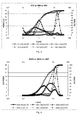
- the size distribution was determined by scattering of laser light using an Analyzer 22 Micro Tec plus (Fritsch), wherein according to a principle known to those skilled equivalence sizes of particles were determined. For the measurements, the particles were taken up in isopropanol. The result obtained was the index Q3 (x), which indicates what percentage of the total sample volume is contained in particles smaller than a certain particle size, or the index dQ3 (x), which indicates what percentage of the total sample volume is in particles lie in a certain size interval.
- the particle size corresponds to an equivalent size, ie the diameter of an idealized spherical particle, which would produce the same measurement signal in the laser light scattering.
- the representation in the figures was made according to the DIN standard with respect to the particle size distributions DIN ISO 9276-1 (presentation of the results of particle size analyzes - Part 1: Graphical representation).
- 250 ml decomposition vessels (Berghof Products + Instruments GmbH, Eningen, Germany) were used to carry out the process in order to rapidly enforce the large number of samples processed in the context of the invention.
- the digestion vessels were placed in a temperature controlled oven at the appropriate temperature. Due to the maximum permissible temperature change of the digestion vessels of 50K / h, the oven was not preheated to 200 ° C or another, comparably high temperature, but was heated together with the contents.
- the reaction period started to run when the target temperature was reached. After the end of the reaction time, cooling takes place by switching off the furnace and opening its door.
- the hard foam used was crushed PUR rigid foam boards of the "EUROWALL®” type (purchased from Recticel IDC, 9230 Wetteren, Belgium).
- the polyurethane foam boards contained 100 parts by weight of a polyol mixture (polyether and polyester polyols) having a functionality of 3.7 to 4.5, 10 parts by weight of flame retardant, 0.5 to 1 parts by weight of water, 15 to 25 parts by weight of pentane as a foaming agent, 2 to 2 , 5 parts by weight silicone-based surfactant, 1.5 to 2.5 parts by weight and 180 to 220 parts by weight of polymeric MDI having a functionality of 2.6 to 2.9.
- ES 7 Sample material was investigated which was retained on sieves with an exclusion size of 200, 125 or 63 ⁇ m or on a nanofilter (0.2 ⁇ m).
- the trailing indices C.L, C.S and C.R indicate samples from the supernatant of a second centrifugation, from the sediment of a second centrifugation or ground samples from a slurry, respectively, as further explained below.
- Example 2 Size determination of particles according to the invention of a coal-like solid
- the slurry obtained from rigid foam had the largest proportion of small particles of less than 42 ⁇ m overall, since 90% of the particles corresponded to an equivalent size of less than 2.3 ⁇ m, 50% were in the submicrometer range and 10% smaller than 400 nanometers were.
- the slurry obtained with flexible foam had the largest proportion of small particles below the exclusion limit of approximately 42 ⁇ m, since 90% of the particles had an equivalent size of less than 3.6 ⁇ m. In fact, no particles larger than 8 ⁇ m were detected during the measurement.
- the slurry of Sample 3 reacted at 220 ° C contained a larger proportion of small particles overall since 90% thereof was smaller than 3.6 ⁇ m and 50% smaller than 1.9 ⁇ m.
- the sample was then dried for 11 hours at 70 ° C in a heating oven and then in air in a fume hood for 4 days. Thereafter, 0.1 g of the dried sample was taken up in 100 ml of isopropanol, stirred for 1 h on a magnetic stirrer and then examined by laser light scattering. The results are in are in Tab. 8 and Fig. 2 shown.
- the sample was also after 11 hours at 70 ° C in a heating oven and then dried in air in a fume hood for 4 days. Thereafter, 0.5 g of sample was added to 50 ml of 99% acetone and stirred for 1 hour on a magnetic stirrer (if necessary, 10 ml of acetone were added and stirred for 5 minutes to supplement acetone, followed by a first centrifugation for 65 minutes.
- the supernatant from the first centrifugation was removed and added to the remaining sediment with 20 ml of acetone and stirred for 30 min on a magnetic stirrer. This was followed by a second centrifugation over 65 min.
- medium-hard polyurethane foam had a high proportion of small particles, since 90% of the particles were smaller than 12.5 microns.
- Identical samples ES 7 were used. An aliquot of the slurry from the electric reactor was filtered from the 125 micron size paper filters, then centrifuged at 13 g for 20 minutes. Part of the supernatant was filtered through a syringe-mounted nanofilter with an exclusion limit of 0.2 ⁇ m, and the retentate was used for size measurement. Another aliquot of the slurry was vacuum dried in one (Sanplatec) for 48 hours.
- Fig. 5 shows a scanning electron micrograph of spherical particles from sample 19.
- a part figure shows the original recording, the figure next to it is a schematic representation.
- the spherical particles have diameters of 0.4 to 0.6 microns and are located on the surface of an even larger particle from which they releasable, wherein the release can be promoted as described herein, in particular by treatment with solvents.
- Sample 1 Sample 2 Sample 3 Sample 4 1% K center 1% K center 1% K center 1% K center A 2 8th 3 4 3 3 4 3 2 1 8th B 3 6 4 3 3 1 5 4 6 3 3 C 5 3 2 4 5 3 4 3 6 0 4 medium 3 6 1 4 4 2 2 4 3 5 1 5 Sample 9 Sample 10 Sample 11 Sample 12 1% C center 1% C center 1% C center 1% C center A 2 4 4 2 6 2 4 3 3 6 2 2 B 6 2 2 3 1 4 5 2 3 5 5 C 5 3 2 5 2 3 7 3 6 1 3 medium 4 3 3 3 3 3 3 5 3 2 6 3 2 Sample 17 Sample 18 Sample 19 Sample 20 1% C center 1% C center 1% C center 1% C center A 9 1 4 4 2 6 4 5 4 1 B 7 4 5 1 4 2 4 4 3 5 2 C 5 3 2 3 5 2 7 1 2 2 4 3 medium 7 3 1 4 3 3 5 3 2 3 4 2 Control 1 Control 2 Control 3 GE GE center LUFA center GE LUFA center A 9 1 4 4 2 6 6
- the test was considered valid as not a single compost worm was found dead in one of the samples after 20 hours. An avoidance of the particle-containing soil by compost worms could not be determined.
- the method described is suitable for the implementation of plastic material, in particular for the environmentally friendly and value-added use of waste or production residues.
- the obtained slurries of particles and the particles themselves have a variety of uses and can be used as products or as a raw material for the production of products.
Landscapes
- Chemical & Material Sciences (AREA)
- Oil, Petroleum & Natural Gas (AREA)
- Organic Chemistry (AREA)
- Physics & Mathematics (AREA)
- Thermal Sciences (AREA)
- Engineering & Computer Science (AREA)
- Combustion & Propulsion (AREA)
- Separation, Recovery Or Treatment Of Waste Materials Containing Plastics (AREA)
- Carbon And Carbon Compounds (AREA)
- Processes Of Treating Macromolecular Substances (AREA)
Priority Applications (3)
| Application Number | Priority Date | Filing Date | Title |
|---|---|---|---|
| PL14180275T PL2835413T3 (pl) | 2013-08-07 | 2014-08-07 | Cząstki węglopodobnego ciała stałego, ich zastosowania i sposób wytwarzania |
| SI201431282T SI2835413T1 (sl) | 2013-08-07 | 2014-08-07 | Delci premogu podobne trdne snovi, uporaba in postopek izdelave |
| HRP20191282TT HRP20191282T1 (hr) | 2013-08-07 | 2019-07-16 | Čestice krutine slične ugljenu, njihova uporaba i postupak za njihovu proizvodnju |
Applications Claiming Priority (1)
| Application Number | Priority Date | Filing Date | Title |
|---|---|---|---|
| DE102013013085.9A DE102013013085B3 (de) | 2013-08-07 | 2013-08-07 | Partikel eines kohleähnlichen Feststoffs, Verwendungen und Herstellungsverfahren |
Publications (3)
| Publication Number | Publication Date |
|---|---|
| EP2835413A2 true EP2835413A2 (fr) | 2015-02-11 |
| EP2835413A3 EP2835413A3 (fr) | 2015-02-18 |
| EP2835413B1 EP2835413B1 (fr) | 2019-04-17 |
Family
ID=51302911
Family Applications (1)
| Application Number | Title | Priority Date | Filing Date |
|---|---|---|---|
| EP14180275.1A Active EP2835413B1 (fr) | 2013-08-07 | 2014-08-07 | Particule d'une matière solide similaire au charbon, utilisations et procédé de fabrication |
Country Status (8)
| Country | Link |
|---|---|
| EP (1) | EP2835413B1 (fr) |
| DE (1) | DE102013013085B3 (fr) |
| DK (1) | DK2835413T3 (fr) |
| ES (1) | ES2736027T3 (fr) |
| HR (1) | HRP20191282T1 (fr) |
| PL (1) | PL2835413T3 (fr) |
| PT (1) | PT2835413T (fr) |
| SI (1) | SI2835413T1 (fr) |
Cited By (4)
| Publication number | Priority date | Publication date | Assignee | Title |
|---|---|---|---|---|
| CN108906348A (zh) * | 2018-03-05 | 2018-11-30 | 中国标准化研究院 | 分离土壤中微塑料和纤维素结晶的分离装置及分离方法 |
| CN109294685A (zh) * | 2018-11-09 | 2019-02-01 | 重庆满隆污泥处理有限责任公司 | 基于工业污泥的燃料制作方法 |
| CN113308282A (zh) * | 2021-05-19 | 2021-08-27 | 山东华鲁恒升化工股份有限公司 | 一种水煤浆及其制备方法和应用 |
| CN118437469A (zh) * | 2024-05-31 | 2024-08-06 | 云南黄金矿业集团股份有限公司 | 一种大直径半自磨+球磨系统的装补球方法 |
Families Citing this family (1)
| Publication number | Priority date | Publication date | Assignee | Title |
|---|---|---|---|---|
| CN115261097B (zh) * | 2022-09-06 | 2024-01-19 | 山西潞安煤基清洁能源有限责任公司 | 一种液态排渣气化炉原料煤助熔剂的制备方法 |
Citations (14)
| Publication number | Priority date | Publication date | Assignee | Title |
|---|---|---|---|---|
| US3905924A (en) | 1973-01-22 | 1975-09-16 | Union Carbide Corp | Process for preparation of high resilience polyether urethane foam |
| DE2832253A1 (de) | 1978-07-22 | 1980-01-31 | Bayer Ag | Verfahren zur herstellung von formschaumstoffen |
| DE3630225C2 (fr) | 1986-09-05 | 1989-02-16 | Bayer Ag, 5090 Leverkusen, De | |
| EP0318784A2 (fr) | 1987-12-01 | 1989-06-07 | Bayer Ag | Procédé de préparation de polyétherpolyol à base de l'o-toluylènediamine, et application dans le domaine des polyuréthanes et polyisocyanurates |
| DE102007051089A1 (de) | 2006-10-25 | 2008-05-29 | Köhler und Krafft GmbH & Co. KG | Verfahren zum Herstellen eines veredelten Schaumes und Verwendung desselben |
| EP1970431A1 (fr) | 2007-03-13 | 2008-09-17 | Loritus GmbH | Dispositif et procédé de carbonisation hydrothermale de biomasses |
| WO2008113309A1 (fr) | 2007-03-22 | 2008-09-25 | Fraunhofer-Gesellschaft zur Förderung der angewandten Forschung e.V. | Procédé de transformation chimique par voie humide de la biomasse par carbonisation thermohydraulique |
| US7431909B1 (en) | 1998-12-04 | 2008-10-07 | Cabot Corporation | Process for production of carbon black |
| WO2008138637A2 (fr) | 2007-05-11 | 2008-11-20 | Suncoal Industries Gmbh | Procédé et dispositif de carbonisation hydrothermale (htc) de biomasse à l'aide d'une installation htc |
| DE102008058444A1 (de) | 2007-11-21 | 2009-05-28 | Antacor Ltd. | Verfahren und Vorrichtung zur Herstellung von Werk- oder Brennstoffen |
| WO2009127727A1 (fr) | 2008-04-17 | 2009-10-22 | Csl Carbon Solutions Ltd. | Procédé de conversion de biomasse en matériau de type charbon, au moyen d'une carbonisation hydrothermale |
| EP2130893A2 (fr) | 2008-06-05 | 2009-12-09 | TerraNova Energy GmbH & Co. KG | Procédé de fabrication de charbon, notamment de boue de charbon |
| WO2010006688A2 (fr) | 2008-07-15 | 2010-01-21 | Oxea Deutschland Gmbh | Procédé de production de néopentylglycol par scission de composés à haut point d'ébullition issus du processus de production |
| WO2010092040A1 (fr) | 2009-02-10 | 2010-08-19 | Csl Carbon Solutions Ltd. | Procédé hydrothermal pour la préparation d'un matériau de type charbon à partir d'une biomasse et colonne d'évaporation |
Family Cites Families (5)
| Publication number | Priority date | Publication date | Assignee | Title |
|---|---|---|---|---|
| US9139791B2 (en) * | 2008-02-13 | 2015-09-22 | Hydrocoal Technologies, Llc | Processing device for improved utilization of fuel solids |
| DE102011004398A1 (de) * | 2011-02-18 | 2012-08-23 | Siemens Aktiengesellschaft | Verfahren und Reaktor zur hydrothermalen Karbonisierung von Biomasse |
| DE102012002098A1 (de) * | 2012-02-06 | 2013-08-08 | Eurofoam Deutschland Gmbh | Hydrothermale Karbonisierung von Kunststoffmaterial |
| DE102012104236A1 (de) * | 2012-05-15 | 2013-12-05 | Brandenburgische Technische Universität Cottbus | Verfahren zur Behandlung und Separation von Cellulose-Kunststoff-Mischprodukten |
| DE102012011522A1 (de) * | 2012-06-09 | 2013-12-12 | Leibniz-Institut für Oberflächenmodifizierung e.V. | Verfahren zur Herstellung einer homogenen und hoch stabilen Dispersion von Kohlenstoffnanopartikeln in Lösungsmitteln oder eines Granulats aus dieser und dessen Verwendung |
-
2013
- 2013-08-07 DE DE102013013085.9A patent/DE102013013085B3/de not_active Expired - Fee Related
-
2014
- 2014-08-07 EP EP14180275.1A patent/EP2835413B1/fr active Active
- 2014-08-07 SI SI201431282T patent/SI2835413T1/sl unknown
- 2014-08-07 PL PL14180275T patent/PL2835413T3/pl unknown
- 2014-08-07 DK DK14180275.1T patent/DK2835413T3/da active
- 2014-08-07 PT PT14180275T patent/PT2835413T/pt unknown
- 2014-08-07 ES ES14180275T patent/ES2736027T3/es active Active
-
2019
- 2019-07-16 HR HRP20191282TT patent/HRP20191282T1/hr unknown
Patent Citations (15)
| Publication number | Priority date | Publication date | Assignee | Title |
|---|---|---|---|---|
| US3905924A (en) | 1973-01-22 | 1975-09-16 | Union Carbide Corp | Process for preparation of high resilience polyether urethane foam |
| DE2832253A1 (de) | 1978-07-22 | 1980-01-31 | Bayer Ag | Verfahren zur herstellung von formschaumstoffen |
| DE3630225C2 (fr) | 1986-09-05 | 1989-02-16 | Bayer Ag, 5090 Leverkusen, De | |
| EP0318784A2 (fr) | 1987-12-01 | 1989-06-07 | Bayer Ag | Procédé de préparation de polyétherpolyol à base de l'o-toluylènediamine, et application dans le domaine des polyuréthanes et polyisocyanurates |
| US7655209B2 (en) | 1998-12-04 | 2010-02-02 | Cabot Corporation | Process for production of carbon black |
| US7431909B1 (en) | 1998-12-04 | 2008-10-07 | Cabot Corporation | Process for production of carbon black |
| DE102007051089A1 (de) | 2006-10-25 | 2008-05-29 | Köhler und Krafft GmbH & Co. KG | Verfahren zum Herstellen eines veredelten Schaumes und Verwendung desselben |
| EP1970431A1 (fr) | 2007-03-13 | 2008-09-17 | Loritus GmbH | Dispositif et procédé de carbonisation hydrothermale de biomasses |
| WO2008113309A1 (fr) | 2007-03-22 | 2008-09-25 | Fraunhofer-Gesellschaft zur Förderung der angewandten Forschung e.V. | Procédé de transformation chimique par voie humide de la biomasse par carbonisation thermohydraulique |
| WO2008138637A2 (fr) | 2007-05-11 | 2008-11-20 | Suncoal Industries Gmbh | Procédé et dispositif de carbonisation hydrothermale (htc) de biomasse à l'aide d'une installation htc |
| DE102008058444A1 (de) | 2007-11-21 | 2009-05-28 | Antacor Ltd. | Verfahren und Vorrichtung zur Herstellung von Werk- oder Brennstoffen |
| WO2009127727A1 (fr) | 2008-04-17 | 2009-10-22 | Csl Carbon Solutions Ltd. | Procédé de conversion de biomasse en matériau de type charbon, au moyen d'une carbonisation hydrothermale |
| EP2130893A2 (fr) | 2008-06-05 | 2009-12-09 | TerraNova Energy GmbH & Co. KG | Procédé de fabrication de charbon, notamment de boue de charbon |
| WO2010006688A2 (fr) | 2008-07-15 | 2010-01-21 | Oxea Deutschland Gmbh | Procédé de production de néopentylglycol par scission de composés à haut point d'ébullition issus du processus de production |
| WO2010092040A1 (fr) | 2009-02-10 | 2010-08-19 | Csl Carbon Solutions Ltd. | Procédé hydrothermal pour la préparation d'un matériau de type charbon à partir d'une biomasse et colonne d'évaporation |
Non-Patent Citations (3)
| Title |
|---|
| "Ullmann's Encyclopedia of Industrial Chemistry", vol. 28, 2003, WILEY-VHC VERLAG GMBH & CO. KGAA, pages: 667 - 722 |
| LYON ET AL., NANOLETTERS, vol. 4, no. 4, 2004, pages 719 - 723 |
| SAMANTA ET AL., JOURNAL OF MATERIALS CHEMISTRY, vol. 18, 2008, pages 1204 - 1208 |
Cited By (5)
| Publication number | Priority date | Publication date | Assignee | Title |
|---|---|---|---|---|
| CN108906348A (zh) * | 2018-03-05 | 2018-11-30 | 中国标准化研究院 | 分离土壤中微塑料和纤维素结晶的分离装置及分离方法 |
| CN108906348B (zh) * | 2018-03-05 | 2023-10-10 | 中国标准化研究院 | 分离土壤中微塑料和纤维素结晶的分离装置及分离方法 |
| CN109294685A (zh) * | 2018-11-09 | 2019-02-01 | 重庆满隆污泥处理有限责任公司 | 基于工业污泥的燃料制作方法 |
| CN113308282A (zh) * | 2021-05-19 | 2021-08-27 | 山东华鲁恒升化工股份有限公司 | 一种水煤浆及其制备方法和应用 |
| CN118437469A (zh) * | 2024-05-31 | 2024-08-06 | 云南黄金矿业集团股份有限公司 | 一种大直径半自磨+球磨系统的装补球方法 |
Also Published As
| Publication number | Publication date |
|---|---|
| EP2835413A3 (fr) | 2015-02-18 |
| HRP20191282T1 (hr) | 2019-10-18 |
| PL2835413T3 (pl) | 2020-06-01 |
| EP2835413B1 (fr) | 2019-04-17 |
| DK2835413T3 (da) | 2019-07-29 |
| DE102013013085B3 (de) | 2015-02-05 |
| PT2835413T (pt) | 2019-07-19 |
| ES2736027T3 (es) | 2019-12-23 |
| SI2835413T1 (sl) | 2019-10-30 |
Similar Documents
| Publication | Publication Date | Title |
|---|---|---|
| EP2835413B1 (fr) | Particule d'une matière solide similaire au charbon, utilisations et procédé de fabrication | |
| EP3740318B1 (fr) | Procédé mécanochimique de fabrication de produits de valeur exempts de substances polluantes organiques persistantes et autres composés organohalogénés à partir de déchets de matières plastiques et de stratifiés en matière plastique | |
| DE102012002098A1 (de) | Hydrothermale Karbonisierung von Kunststoffmaterial | |
| DE10327954B4 (de) | Verbesserte Verfahren zur Herstellung von Ethanol und Methan aus Getreide | |
| EP2997079A1 (fr) | Produit en biomatériau à base de coques ou cosses de graines de tournesol | |
| EP2603577A1 (fr) | Particules de verre magnétiques à employer dans des installations de production de biogaz, des processus de fermentation et des processus de séparation | |
| Keller et al. | Polyurethane foams synthesis with cassava waste for biodiesel removal from water bodies | |
| WO1994014886A1 (fr) | Composition pour une matiere, notamment pour une matiere a mouler par injection | |
| EP0680490B1 (fr) | Procede de fabrication d'un produit contenant des polysaccharides, et compositions de polysaccharides | |
| DE102021205222A1 (de) | Verfahren zur Herstellung eines Zuschlagstoffes für ein Kunststoffteil und einen solchen Zuschlagstoff enthaltendes Kunststoffteil | |
| DE102012007900B4 (de) | Verfahren zur Aufbereitung von organischen Abfallstoffen, insbesondere von Gärresten aus Biogasanlagen | |
| CH698774B1 (de) | Verfahren zur Herstellung eines Talkprodukts mit hohem Reinheitsgrad. | |
| EP3300498A2 (fr) | Procédé pour préparer des substances concentrées, liquides ou pâteuses à partir de matières premières de diverses origines, à plusieurs constituants, contenant une substance humique | |
| EP1399486B1 (fr) | Procede de production d'amidon ou de produits a base d'amidon, a partir de matieres premieres vegetales contenant de l'amidon | |
| DE102011002728A1 (de) | Kautschukzusammensetzungen, umfassend ein Ölgemisch aus einem Petroleumöl und einem Öl auf Biobasis sowie Verfahren zum Herstellen davon | |
| EP2179047B1 (fr) | Préparations lipophiles | |
| WO2023030624A1 (fr) | Procédé et installation de traitement de substrat biologique | |
| EP2664656B1 (fr) | Composite à pigment blanc | |
| DE2809531A1 (de) | Verfahren und herstellung eines futtermittels | |
| EP2217635A1 (fr) | Système composite biodégradable, et son utilisation | |
| DE102012215760A1 (de) | Bitumen-Masse, Bitumen-Massen-Deckschicht und Verfahren zur Herstellung einer Bitumen-Masse | |
| WO2006074727A1 (fr) | Procede de production de farine a partir de seigle et de triticale et utilisation de ladite farine | |
| DE2942048C2 (de) | Verfahren zur Abtrennung von nicht fermentierbaren Bestandteilen aus städtischem Abfall | |
| DE4427879A1 (de) | Biologisch abbaubare Wachskompositionen | |
| DE102022113375A1 (de) | Umsetzung von Polyurethan in einem Extruder |
Legal Events
| Date | Code | Title | Description |
|---|---|---|---|
| PUAL | Search report despatched |
Free format text: ORIGINAL CODE: 0009013 |
|
| PUAI | Public reference made under article 153(3) epc to a published international application that has entered the european phase |
Free format text: ORIGINAL CODE: 0009012 |
|
| 17P | Request for examination filed |
Effective date: 20140807 |
|
| AK | Designated contracting states |
Kind code of ref document: A2 Designated state(s): AL AT BE BG CH CY CZ DE DK EE ES FI FR GB GR HR HU IE IS IT LI LT LU LV MC MK MT NL NO PL PT RO RS SE SI SK SM TR |
|
| AX | Request for extension of the european patent |
Extension state: BA ME |
|
| AK | Designated contracting states |
Kind code of ref document: A3 Designated state(s): AL AT BE BG CH CY CZ DE DK EE ES FI FR GB GR HR HU IE IS IT LI LT LU LV MC MK MT NL NO PL PT RO RS SE SI SK SM TR |
|
| AX | Request for extension of the european patent |
Extension state: BA ME |
|
| RIC1 | Information provided on ipc code assigned before grant |
Ipc: C10L 9/08 20060101AFI20150113BHEP Ipc: C10L 5/40 20060101ALI20150113BHEP |
|
| R17P | Request for examination filed (corrected) |
Effective date: 20150818 |
|
| RBV | Designated contracting states (corrected) |
Designated state(s): AL AT BE BG CH CY CZ DE DK EE ES FI FR GB GR HR HU IE IS IT LI LT LU LV MC MK MT NL NO PL PT RO RS SE SI SK SM TR |
|
| STAA | Information on the status of an ep patent application or granted ep patent |
Free format text: STATUS: EXAMINATION IS IN PROGRESS |
|
| 17Q | First examination report despatched |
Effective date: 20161208 |
|
| GRAP | Despatch of communication of intention to grant a patent |
Free format text: ORIGINAL CODE: EPIDOSNIGR1 |
|
| STAA | Information on the status of an ep patent application or granted ep patent |
Free format text: STATUS: GRANT OF PATENT IS INTENDED |
|
| INTG | Intention to grant announced |
Effective date: 20181029 |
|
| GRAS | Grant fee paid |
Free format text: ORIGINAL CODE: EPIDOSNIGR3 |
|
| GRAA | (expected) grant |
Free format text: ORIGINAL CODE: 0009210 |
|
| STAA | Information on the status of an ep patent application or granted ep patent |
Free format text: STATUS: THE PATENT HAS BEEN GRANTED |
|
| AK | Designated contracting states |
Kind code of ref document: B1 Designated state(s): AL AT BE BG CH CY CZ DE DK EE ES FI FR GB GR HR HU IE IS IT LI LT LU LV MC MK MT NL NO PL PT RO RS SE SI SK SM TR |
|
| AX | Request for extension of the european patent |
Extension state: BA ME |
|
| REG | Reference to a national code |
Ref country code: GB Ref legal event code: FG4D Free format text: NOT ENGLISH |
|
| RIN1 | Information on inventor provided before grant (corrected) |
Inventor name: MILDENBERGER, MORITZ Inventor name: BETTINGER, HERBERT Inventor name: BOTTLINGER, MICHAEL |
|
| REG | Reference to a national code |
Ref country code: CH Ref legal event code: EP |
|
| REG | Reference to a national code |
Ref country code: DE Ref legal event code: R096 Ref document number: 502014011440 Country of ref document: DE |
|
| REG | Reference to a national code |
Ref country code: AT Ref legal event code: REF Ref document number: 1121546 Country of ref document: AT Kind code of ref document: T Effective date: 20190515 Ref country code: IE Ref legal event code: FG4D Free format text: LANGUAGE OF EP DOCUMENT: GERMAN |
|
| REG | Reference to a national code |
Ref country code: RO Ref legal event code: EPE |
|
| REG | Reference to a national code |
Ref country code: HR Ref legal event code: TUEP Ref document number: P20191282 Country of ref document: HR |
|
| REG | Reference to a national code |
Ref country code: PT Ref legal event code: SC4A Ref document number: 2835413 Country of ref document: PT Date of ref document: 20190719 Kind code of ref document: T Free format text: AVAILABILITY OF NATIONAL TRANSLATION Effective date: 20190715 |
|
| REG | Reference to a national code |
Ref country code: DK Ref legal event code: T3 Effective date: 20190724 |
|
| REG | Reference to a national code |
Ref country code: NL Ref legal event code: FP |
|
| REG | Reference to a national code |
Ref country code: SE Ref legal event code: TRGR |
|
| REG | Reference to a national code |
Ref country code: LT Ref legal event code: MG4D |
|
| REG | Reference to a national code |
Ref country code: SK Ref legal event code: T3 Ref document number: E 31557 Country of ref document: SK |
|
| REG | Reference to a national code |
Ref country code: HR Ref legal event code: ODRP Ref document number: P20191282 Country of ref document: HR Payment date: 20190806 Year of fee payment: 6 |
|
| REG | Reference to a national code |
Ref country code: HR Ref legal event code: T1PR Ref document number: P20191282 Country of ref document: HR |
|
| PG25 | Lapsed in a contracting state [announced via postgrant information from national office to epo] |
Ref country code: FI Free format text: LAPSE BECAUSE OF FAILURE TO SUBMIT A TRANSLATION OF THE DESCRIPTION OR TO PAY THE FEE WITHIN THE PRESCRIBED TIME-LIMIT Effective date: 20190417 Ref country code: AL Free format text: LAPSE BECAUSE OF FAILURE TO SUBMIT A TRANSLATION OF THE DESCRIPTION OR TO PAY THE FEE WITHIN THE PRESCRIBED TIME-LIMIT Effective date: 20190417 Ref country code: NO Free format text: LAPSE BECAUSE OF FAILURE TO SUBMIT A TRANSLATION OF THE DESCRIPTION OR TO PAY THE FEE WITHIN THE PRESCRIBED TIME-LIMIT Effective date: 20190717 Ref country code: LT Free format text: LAPSE BECAUSE OF FAILURE TO SUBMIT A TRANSLATION OF THE DESCRIPTION OR TO PAY THE FEE WITHIN THE PRESCRIBED TIME-LIMIT Effective date: 20190417 |
|
| PG25 | Lapsed in a contracting state [announced via postgrant information from national office to epo] |
Ref country code: LV Free format text: LAPSE BECAUSE OF FAILURE TO SUBMIT A TRANSLATION OF THE DESCRIPTION OR TO PAY THE FEE WITHIN THE PRESCRIBED TIME-LIMIT Effective date: 20190417 Ref country code: RS Free format text: LAPSE BECAUSE OF FAILURE TO SUBMIT A TRANSLATION OF THE DESCRIPTION OR TO PAY THE FEE WITHIN THE PRESCRIBED TIME-LIMIT Effective date: 20190417 Ref country code: BG Free format text: LAPSE BECAUSE OF FAILURE TO SUBMIT A TRANSLATION OF THE DESCRIPTION OR TO PAY THE FEE WITHIN THE PRESCRIBED TIME-LIMIT Effective date: 20190717 Ref country code: GR Free format text: LAPSE BECAUSE OF FAILURE TO SUBMIT A TRANSLATION OF THE DESCRIPTION OR TO PAY THE FEE WITHIN THE PRESCRIBED TIME-LIMIT Effective date: 20190718 |
|
| REG | Reference to a national code |
Ref country code: ES Ref legal event code: FG2A Ref document number: 2736027 Country of ref document: ES Kind code of ref document: T3 Effective date: 20191223 |
|
| PG25 | Lapsed in a contracting state [announced via postgrant information from national office to epo] |
Ref country code: IS Free format text: LAPSE BECAUSE OF FAILURE TO SUBMIT A TRANSLATION OF THE DESCRIPTION OR TO PAY THE FEE WITHIN THE PRESCRIBED TIME-LIMIT Effective date: 20190817 |
|
| REG | Reference to a national code |
Ref country code: DE Ref legal event code: R097 Ref document number: 502014011440 Country of ref document: DE |
|
| PG25 | Lapsed in a contracting state [announced via postgrant information from national office to epo] |
Ref country code: EE Free format text: LAPSE BECAUSE OF FAILURE TO SUBMIT A TRANSLATION OF THE DESCRIPTION OR TO PAY THE FEE WITHIN THE PRESCRIBED TIME-LIMIT Effective date: 20190417 |
|
| PLBE | No opposition filed within time limit |
Free format text: ORIGINAL CODE: 0009261 |
|
| STAA | Information on the status of an ep patent application or granted ep patent |
Free format text: STATUS: NO OPPOSITION FILED WITHIN TIME LIMIT |
|
| PG25 | Lapsed in a contracting state [announced via postgrant information from national office to epo] |
Ref country code: SM Free format text: LAPSE BECAUSE OF FAILURE TO SUBMIT A TRANSLATION OF THE DESCRIPTION OR TO PAY THE FEE WITHIN THE PRESCRIBED TIME-LIMIT Effective date: 20190417 |
|
| 26N | No opposition filed |
Effective date: 20200120 |
|
| PG25 | Lapsed in a contracting state [announced via postgrant information from national office to epo] |
Ref country code: TR Free format text: LAPSE BECAUSE OF FAILURE TO SUBMIT A TRANSLATION OF THE DESCRIPTION OR TO PAY THE FEE WITHIN THE PRESCRIBED TIME-LIMIT Effective date: 20190417 |
|
| PG25 | Lapsed in a contracting state [announced via postgrant information from national office to epo] |
Ref country code: LU Free format text: LAPSE BECAUSE OF NON-PAYMENT OF DUE FEES Effective date: 20190807 Ref country code: MC Free format text: LAPSE BECAUSE OF FAILURE TO SUBMIT A TRANSLATION OF THE DESCRIPTION OR TO PAY THE FEE WITHIN THE PRESCRIBED TIME-LIMIT Effective date: 20190417 |
|
| PG25 | Lapsed in a contracting state [announced via postgrant information from national office to epo] |
Ref country code: IE Free format text: LAPSE BECAUSE OF NON-PAYMENT OF DUE FEES Effective date: 20190807 |
|
| REG | Reference to a national code |
Ref country code: HR Ref legal event code: ODRP Ref document number: P20191282 Country of ref document: HR Payment date: 20200728 Year of fee payment: 7 |
|
| PG25 | Lapsed in a contracting state [announced via postgrant information from national office to epo] |
Ref country code: CY Free format text: LAPSE BECAUSE OF FAILURE TO SUBMIT A TRANSLATION OF THE DESCRIPTION OR TO PAY THE FEE WITHIN THE PRESCRIBED TIME-LIMIT Effective date: 20190417 |
|
| PG25 | Lapsed in a contracting state [announced via postgrant information from national office to epo] |
Ref country code: HU Free format text: LAPSE BECAUSE OF FAILURE TO SUBMIT A TRANSLATION OF THE DESCRIPTION OR TO PAY THE FEE WITHIN THE PRESCRIBED TIME-LIMIT; INVALID AB INITIO Effective date: 20140807 Ref country code: MT Free format text: LAPSE BECAUSE OF FAILURE TO SUBMIT A TRANSLATION OF THE DESCRIPTION OR TO PAY THE FEE WITHIN THE PRESCRIBED TIME-LIMIT Effective date: 20190417 |
|
| REG | Reference to a national code |
Ref country code: HR Ref legal event code: ODRP Ref document number: P20191282 Country of ref document: HR Payment date: 20210802 Year of fee payment: 8 |
|
| PG25 | Lapsed in a contracting state [announced via postgrant information from national office to epo] |
Ref country code: MK Free format text: LAPSE BECAUSE OF FAILURE TO SUBMIT A TRANSLATION OF THE DESCRIPTION OR TO PAY THE FEE WITHIN THE PRESCRIBED TIME-LIMIT Effective date: 20190417 |
|
| REG | Reference to a national code |
Ref country code: DE Ref legal event code: R081 Ref document number: 502014011440 Country of ref document: DE Owner name: NEVEON GERMANY GMBH, DE Free format text: FORMER OWNER: EUROFOAM DEUTSCHLAND GMBH SCHAUMSTOFFE, 65203 WIESBADEN, DE |
|
| REG | Reference to a national code |
Ref country code: HR Ref legal event code: ODRP Ref document number: P20191282 Country of ref document: HR Payment date: 20220803 Year of fee payment: 9 |
|
| PGFP | Annual fee paid to national office [announced via postgrant information from national office to epo] |
Ref country code: SK Payment date: 20220802 Year of fee payment: 9 Ref country code: SE Payment date: 20220824 Year of fee payment: 9 Ref country code: HR Payment date: 20220803 Year of fee payment: 9 Ref country code: DK Payment date: 20220824 Year of fee payment: 9 Ref country code: CZ Payment date: 20220803 Year of fee payment: 9 |
|
| PGFP | Annual fee paid to national office [announced via postgrant information from national office to epo] |
Ref country code: CH Payment date: 20220824 Year of fee payment: 9 |
|
| REG | Reference to a national code |
Ref country code: HR Ref legal event code: PBON Ref document number: P20191282 Country of ref document: HR Effective date: 20230807 |
|
| REG | Reference to a national code |
Ref country code: DK Ref legal event code: EBP Effective date: 20230831 |
|
| REG | Reference to a national code |
Ref country code: SK Ref legal event code: MM4A Ref document number: E 31557 Country of ref document: SK Effective date: 20230807 |
|
| REG | Reference to a national code |
Ref country code: CH Ref legal event code: PL |
|
| PG25 | Lapsed in a contracting state [announced via postgrant information from national office to epo] |
Ref country code: CZ Free format text: LAPSE BECAUSE OF NON-PAYMENT OF DUE FEES Effective date: 20230807 Ref country code: SK Free format text: LAPSE BECAUSE OF NON-PAYMENT OF DUE FEES Effective date: 20230807 Ref country code: CH Free format text: LAPSE BECAUSE OF NON-PAYMENT OF DUE FEES Effective date: 20230831 |
|
| PG25 | Lapsed in a contracting state [announced via postgrant information from national office to epo] |
Ref country code: SE Free format text: LAPSE BECAUSE OF NON-PAYMENT OF DUE FEES Effective date: 20230808 Ref country code: HR Free format text: LAPSE BECAUSE OF NON-PAYMENT OF DUE FEES Effective date: 20230807 |
|
| PG25 | Lapsed in a contracting state [announced via postgrant information from national office to epo] |
Ref country code: DK Free format text: LAPSE BECAUSE OF NON-PAYMENT OF DUE FEES Effective date: 20230831 |
|
| PG25 | Lapsed in a contracting state [announced via postgrant information from national office to epo] |
Ref country code: DK Free format text: LAPSE BECAUSE OF NON-PAYMENT OF DUE FEES Effective date: 20230831 |
|
| PGFP | Annual fee paid to national office [announced via postgrant information from national office to epo] |
Ref country code: GB Payment date: 20240822 Year of fee payment: 11 |
|
| PGFP | Annual fee paid to national office [announced via postgrant information from national office to epo] |
Ref country code: ES Payment date: 20240918 Year of fee payment: 11 |
|
| PGFP | Annual fee paid to national office [announced via postgrant information from national office to epo] |
Ref country code: SI Payment date: 20240729 Year of fee payment: 11 |
|
| PGFP | Annual fee paid to national office [announced via postgrant information from national office to epo] |
Ref country code: RO Payment date: 20240730 Year of fee payment: 11 Ref country code: IT Payment date: 20240830 Year of fee payment: 11 |
|
| PGFP | Annual fee paid to national office [announced via postgrant information from national office to epo] |
Ref country code: NL Payment date: 20250821 Year of fee payment: 12 |
|
| PGFP | Annual fee paid to national office [announced via postgrant information from national office to epo] |
Ref country code: PT Payment date: 20250728 Year of fee payment: 12 |
|
| PGFP | Annual fee paid to national office [announced via postgrant information from national office to epo] |
Ref country code: DE Payment date: 20250821 Year of fee payment: 12 |
|
| PGFP | Annual fee paid to national office [announced via postgrant information from national office to epo] |
Ref country code: PL Payment date: 20250729 Year of fee payment: 12 |
|
| PGFP | Annual fee paid to national office [announced via postgrant information from national office to epo] |
Ref country code: BE Payment date: 20250820 Year of fee payment: 12 |
|
| PGFP | Annual fee paid to national office [announced via postgrant information from national office to epo] |
Ref country code: AT Payment date: 20250819 Year of fee payment: 12 Ref country code: FR Payment date: 20250821 Year of fee payment: 12 |
|
| REG | Reference to a national code |
Ref country code: NL Ref legal event code: HC Owner name: NEVEON GERMANY GMBH; DE Free format text: DETAILS ASSIGNMENT: CHANGE OF OWNER(S), CHANGE OF OWNER(S) NAME; FORMER OWNER NAME: EUROFOAM DEUTSCHLAND GMBH SCHAUMSTOFFE Effective date: 20260319 |
|
| PG25 | Lapsed in a contracting state [announced via postgrant information from national office to epo] |
Ref country code: RO Free format text: LAPSE BECAUSE OF NON-PAYMENT OF DUE FEES Effective date: 20250807 |
|
| GBPC | Gb: european patent ceased through non-payment of renewal fee |
Effective date: 20250807 |