EP2835849A1 - Verfahren zur herstellung eines positivelektroden-aktivmaterials für wasserfreie sekundärbatterien, positivelektrode für wasserfreie sekundärbatterien und wasserfreie sekundärbatterie - Google Patents
Verfahren zur herstellung eines positivelektroden-aktivmaterials für wasserfreie sekundärbatterien, positivelektrode für wasserfreie sekundärbatterien und wasserfreie sekundärbatterie Download PDFInfo
- Publication number
- EP2835849A1 EP2835849A1 EP13772289.8A EP13772289A EP2835849A1 EP 2835849 A1 EP2835849 A1 EP 2835849A1 EP 13772289 A EP13772289 A EP 13772289A EP 2835849 A1 EP2835849 A1 EP 2835849A1
- Authority
- EP
- European Patent Office
- Prior art keywords
- positive electrode
- active material
- electrode active
- nonaqueous secondary
- calcining
- Prior art date
- Legal status (The legal status is an assumption and is not a legal conclusion. Google has not performed a legal analysis and makes no representation as to the accuracy of the status listed.)
- Withdrawn
Links
- 239000007774 positive electrode material Substances 0.000 title claims abstract description 121
- 238000004519 manufacturing process Methods 0.000 title claims abstract description 24
- 238000001354 calcination Methods 0.000 claims abstract description 126
- OKTJSMMVPCPJKN-UHFFFAOYSA-N Carbon Chemical compound [C] OKTJSMMVPCPJKN-UHFFFAOYSA-N 0.000 claims abstract description 77
- 239000012298 atmosphere Substances 0.000 claims abstract description 66
- 229910052799 carbon Inorganic materials 0.000 claims abstract description 65
- 238000000034 method Methods 0.000 claims abstract description 50
- 239000002994 raw material Substances 0.000 claims abstract description 48
- 239000000463 material Substances 0.000 claims abstract description 45
- 239000011149 active material Substances 0.000 claims abstract description 41
- 229910052751 metal Inorganic materials 0.000 claims abstract description 28
- 239000000126 substance Substances 0.000 claims abstract description 26
- 230000001590 oxidative effect Effects 0.000 claims abstract description 23
- 238000002156 mixing Methods 0.000 claims abstract description 18
- 239000002184 metal Substances 0.000 claims abstract description 17
- QVGXLLKOCUKJST-UHFFFAOYSA-N atomic oxygen Chemical compound [O] QVGXLLKOCUKJST-UHFFFAOYSA-N 0.000 claims abstract description 10
- 239000001301 oxygen Substances 0.000 claims abstract description 10
- 229910052760 oxygen Inorganic materials 0.000 claims abstract description 10
- 229910052723 transition metal Inorganic materials 0.000 claims abstract description 9
- 150000001450 anions Chemical class 0.000 claims abstract description 8
- 229910052783 alkali metal Inorganic materials 0.000 claims abstract description 6
- 150000001340 alkali metals Chemical class 0.000 claims abstract description 6
- 229910052784 alkaline earth metal Inorganic materials 0.000 claims abstract description 6
- 150000001342 alkaline earth metals Chemical class 0.000 claims abstract description 6
- 239000000203 mixture Substances 0.000 claims description 31
- 238000002425 crystallisation Methods 0.000 claims description 29
- 230000008025 crystallization Effects 0.000 claims description 29
- 229910011849 LiFe0.2Mn0.8PO4 Inorganic materials 0.000 claims description 15
- 229910052493 LiFePO4 Inorganic materials 0.000 claims description 13
- 229910000668 LiMnPO4 Inorganic materials 0.000 claims description 13
- 229910001305 LiMPO4 Inorganic materials 0.000 claims description 9
- 239000003792 electrolyte Substances 0.000 claims description 7
- 229910052748 manganese Inorganic materials 0.000 claims description 7
- 229910052742 iron Inorganic materials 0.000 claims description 6
- 229910052759 nickel Inorganic materials 0.000 claims description 6
- 229910052609 olivine Inorganic materials 0.000 description 52
- 239000010450 olivine Substances 0.000 description 52
- 239000002245 particle Substances 0.000 description 46
- WHXSMMKQMYFTQS-UHFFFAOYSA-N Lithium Chemical compound [Li] WHXSMMKQMYFTQS-UHFFFAOYSA-N 0.000 description 32
- 229910052744 lithium Inorganic materials 0.000 description 32
- 230000000052 comparative effect Effects 0.000 description 22
- XKRFYHLGVUSROY-UHFFFAOYSA-N Argon Chemical compound [Ar] XKRFYHLGVUSROY-UHFFFAOYSA-N 0.000 description 20
- 239000011230 binding agent Substances 0.000 description 18
- 239000013081 microcrystal Substances 0.000 description 18
- 238000007796 conventional method Methods 0.000 description 17
- 239000013078 crystal Substances 0.000 description 17
- 239000011572 manganese Substances 0.000 description 17
- 239000003795 chemical substances by application Substances 0.000 description 16
- 239000011248 coating agent Substances 0.000 description 16
- 238000000576 coating method Methods 0.000 description 16
- 230000015572 biosynthetic process Effects 0.000 description 15
- 238000003786 synthesis reaction Methods 0.000 description 15
- 230000003247 decreasing effect Effects 0.000 description 14
- 239000012535 impurity Substances 0.000 description 14
- XEEYBQQBJWHFJM-UHFFFAOYSA-N iron Substances [Fe] XEEYBQQBJWHFJM-UHFFFAOYSA-N 0.000 description 13
- 150000001875 compounds Chemical class 0.000 description 11
- 229910052786 argon Inorganic materials 0.000 description 10
- 239000011777 magnesium Substances 0.000 description 9
- 150000003839 salts Chemical class 0.000 description 9
- 239000000243 solution Substances 0.000 description 9
- 238000010304 firing Methods 0.000 description 7
- 150000002500 ions Chemical class 0.000 description 7
- SECXISVLQFMRJM-UHFFFAOYSA-N N-Methylpyrrolidone Chemical compound CN1CCCC1=O SECXISVLQFMRJM-UHFFFAOYSA-N 0.000 description 6
- 239000006230 acetylene black Substances 0.000 description 6
- 238000009792 diffusion process Methods 0.000 description 6
- 230000000694 effects Effects 0.000 description 6
- 239000007789 gas Substances 0.000 description 6
- XLYOFNOQVPJJNP-ZSJDYOACSA-N heavy water Substances [2H]O[2H] XLYOFNOQVPJJNP-ZSJDYOACSA-N 0.000 description 6
- 238000005259 measurement Methods 0.000 description 6
- 229910021645 metal ion Inorganic materials 0.000 description 6
- 239000000843 powder Substances 0.000 description 6
- 230000002194 synthesizing effect Effects 0.000 description 6
- 229930006000 Sucrose Natural products 0.000 description 5
- CZMRCDWAGMRECN-UGDNZRGBSA-N Sucrose Chemical compound O[C@H]1[C@H](O)[C@@H](CO)O[C@@]1(CO)O[C@@H]1[C@H](O)[C@@H](O)[C@H](O)[C@@H](CO)O1 CZMRCDWAGMRECN-UGDNZRGBSA-N 0.000 description 5
- SNKMVYBWZDHJHE-UHFFFAOYSA-M lithium;dihydrogen phosphate Chemical compound [Li+].OP(O)([O-])=O SNKMVYBWZDHJHE-UHFFFAOYSA-M 0.000 description 5
- 239000005720 sucrose Substances 0.000 description 5
- 238000001308 synthesis method Methods 0.000 description 5
- 229910052782 aluminium Inorganic materials 0.000 description 4
- 229910002804 graphite Inorganic materials 0.000 description 4
- 239000010439 graphite Substances 0.000 description 4
- 238000010348 incorporation Methods 0.000 description 4
- 239000011812 mixed powder Substances 0.000 description 4
- 150000007524 organic acids Chemical class 0.000 description 4
- -1 oxalic acid salt Chemical class 0.000 description 4
- 229920000447 polyanionic polymer Polymers 0.000 description 4
- 239000002904 solvent Substances 0.000 description 4
- WEVYAHXRMPXWCK-UHFFFAOYSA-N Acetonitrile Chemical compound CC#N WEVYAHXRMPXWCK-UHFFFAOYSA-N 0.000 description 3
- KMTRUDSVKNLOMY-UHFFFAOYSA-N Ethylene carbonate Chemical compound O=C1OCCO1 KMTRUDSVKNLOMY-UHFFFAOYSA-N 0.000 description 3
- 229910000904 FeC2O4 Inorganic materials 0.000 description 3
- WMFOQBRAJBCJND-UHFFFAOYSA-M Lithium hydroxide Chemical compound [Li+].[OH-] WMFOQBRAJBCJND-UHFFFAOYSA-M 0.000 description 3
- XAGFODPZIPBFFR-UHFFFAOYSA-N aluminium Chemical compound [Al] XAGFODPZIPBFFR-UHFFFAOYSA-N 0.000 description 3
- 238000006243 chemical reaction Methods 0.000 description 3
- 239000000470 constituent Substances 0.000 description 3
- 239000008151 electrolyte solution Substances 0.000 description 3
- 239000010419 fine particle Substances 0.000 description 3
- 238000001027 hydrothermal synthesis Methods 0.000 description 3
- 230000006872 improvement Effects 0.000 description 3
- NPLZZSLZTJVZSX-UHFFFAOYSA-L iron(2+);oxalate;dihydrate Chemical compound O.O.[Fe+2].[O-]C(=O)C([O-])=O NPLZZSLZTJVZSX-UHFFFAOYSA-L 0.000 description 3
- HDJUVFZHZGPHCQ-UHFFFAOYSA-L manganese(2+);oxalate;dihydrate Chemical compound O.O.[Mn+2].[O-]C(=O)C([O-])=O HDJUVFZHZGPHCQ-UHFFFAOYSA-L 0.000 description 3
- 238000012360 testing method Methods 0.000 description 3
- 150000003624 transition metals Chemical class 0.000 description 3
- VAYTZRYEBVHVLE-UHFFFAOYSA-N 1,3-dioxol-2-one Chemical compound O=C1OC=CO1 VAYTZRYEBVHVLE-UHFFFAOYSA-N 0.000 description 2
- YEJRWHAVMIAJKC-UHFFFAOYSA-N 4-Butyrolactone Chemical compound O=C1CCCO1 YEJRWHAVMIAJKC-UHFFFAOYSA-N 0.000 description 2
- 229910001290 LiPF6 Inorganic materials 0.000 description 2
- 229920000459 Nitrile rubber Polymers 0.000 description 2
- MUBZPKHOEPUJKR-UHFFFAOYSA-N Oxalic acid Natural products OC(=O)C(O)=O MUBZPKHOEPUJKR-UHFFFAOYSA-N 0.000 description 2
- 239000002033 PVDF binder Substances 0.000 description 2
- 238000002441 X-ray diffraction Methods 0.000 description 2
- 239000011324 bead Substances 0.000 description 2
- 239000003575 carbonaceous material Substances 0.000 description 2
- 150000004649 carbonic acid derivatives Chemical class 0.000 description 2
- 239000011362 coarse particle Substances 0.000 description 2
- 238000000354 decomposition reaction Methods 0.000 description 2
- 230000008034 disappearance Effects 0.000 description 2
- 238000007599 discharging Methods 0.000 description 2
- 238000001035 drying Methods 0.000 description 2
- JBTWLSYIZRCDFO-UHFFFAOYSA-N ethyl methyl carbonate Chemical compound CCOC(=O)OC JBTWLSYIZRCDFO-UHFFFAOYSA-N 0.000 description 2
- 230000002349 favourable effect Effects 0.000 description 2
- 239000011888 foil Substances 0.000 description 2
- 230000002779 inactivation Effects 0.000 description 2
- 239000011261 inert gas Substances 0.000 description 2
- 239000012212 insulator Substances 0.000 description 2
- 229910003002 lithium salt Inorganic materials 0.000 description 2
- 159000000002 lithium salts Chemical class 0.000 description 2
- VTHJTEIRLNZDEV-UHFFFAOYSA-L magnesium dihydroxide Chemical compound [OH-].[OH-].[Mg+2] VTHJTEIRLNZDEV-UHFFFAOYSA-L 0.000 description 2
- 239000000347 magnesium hydroxide Substances 0.000 description 2
- 229910001862 magnesium hydroxide Inorganic materials 0.000 description 2
- NUJOXMJBOLGQSY-UHFFFAOYSA-N manganese dioxide Chemical compound O=[Mn]=O NUJOXMJBOLGQSY-UHFFFAOYSA-N 0.000 description 2
- 239000007773 negative electrode material Substances 0.000 description 2
- 229920002239 polyacrylonitrile Polymers 0.000 description 2
- 239000011802 pulverized particle Substances 0.000 description 2
- 239000002002 slurry Substances 0.000 description 2
- 229920003048 styrene butadiene rubber Polymers 0.000 description 2
- AVFZOVWCLRSYKC-UHFFFAOYSA-N 1-methylpyrrolidine Chemical compound CN1CCCC1 AVFZOVWCLRSYKC-UHFFFAOYSA-N 0.000 description 1
- BTBUEUYNUDRHOZ-UHFFFAOYSA-N Borate Chemical compound [O-]B([O-])[O-] BTBUEUYNUDRHOZ-UHFFFAOYSA-N 0.000 description 1
- RYGMFSIKBFXOCR-UHFFFAOYSA-N Copper Chemical compound [Cu] RYGMFSIKBFXOCR-UHFFFAOYSA-N 0.000 description 1
- OIFBSDVPJOWBCH-UHFFFAOYSA-N Diethyl carbonate Chemical compound CCOC(=O)OCC OIFBSDVPJOWBCH-UHFFFAOYSA-N 0.000 description 1
- XTHFKEDIFFGKHM-UHFFFAOYSA-N Dimethoxyethane Chemical compound COCCOC XTHFKEDIFFGKHM-UHFFFAOYSA-N 0.000 description 1
- 229910010364 Li2MSiO4 Inorganic materials 0.000 description 1
- 229910012425 Li3Fe2 (PO4)3 Inorganic materials 0.000 description 1
- 229910000552 LiCF3SO3 Inorganic materials 0.000 description 1
- 229910010695 LiFeP2O7 Inorganic materials 0.000 description 1
- 229910011154 LiMBO3 Inorganic materials 0.000 description 1
- 229910013406 LiN(SO2CF3)2 Inorganic materials 0.000 description 1
- 229910013426 LiN(SO2F)2 Inorganic materials 0.000 description 1
- PWHULOQIROXLJO-UHFFFAOYSA-N Manganese Chemical compound [Mn] PWHULOQIROXLJO-UHFFFAOYSA-N 0.000 description 1
- AHVYPIQETPWLSZ-UHFFFAOYSA-N N-methyl-pyrrolidine Natural products CN1CC=CC1 AHVYPIQETPWLSZ-UHFFFAOYSA-N 0.000 description 1
- BPQQTUXANYXVAA-UHFFFAOYSA-N Orthosilicate Chemical compound [O-][Si]([O-])([O-])[O-] BPQQTUXANYXVAA-UHFFFAOYSA-N 0.000 description 1
- 239000004698 Polyethylene Substances 0.000 description 1
- 239000004743 Polypropylene Substances 0.000 description 1
- 239000002174 Styrene-butadiene Substances 0.000 description 1
- 150000001242 acetic acid derivatives Chemical class 0.000 description 1
- 239000002253 acid Substances 0.000 description 1
- 239000000654 additive Substances 0.000 description 1
- 230000000996 additive effect Effects 0.000 description 1
- 239000003513 alkali Substances 0.000 description 1
- 239000000956 alloy Substances 0.000 description 1
- 229910045601 alloy Inorganic materials 0.000 description 1
- LFVGISIMTYGQHF-UHFFFAOYSA-N ammonium dihydrogen phosphate Chemical compound [NH4+].OP(O)([O-])=O LFVGISIMTYGQHF-UHFFFAOYSA-N 0.000 description 1
- 229910000387 ammonium dihydrogen phosphate Inorganic materials 0.000 description 1
- 229910003481 amorphous carbon Inorganic materials 0.000 description 1
- 239000012300 argon atmosphere Substances 0.000 description 1
- 125000004429 atom Chemical group 0.000 description 1
- 229910052791 calcium Inorganic materials 0.000 description 1
- 150000001720 carbohydrates Chemical class 0.000 description 1
- 239000010406 cathode material Substances 0.000 description 1
- 238000007600 charging Methods 0.000 description 1
- 239000013522 chelant Substances 0.000 description 1
- 239000002738 chelating agent Substances 0.000 description 1
- 239000003638 chemical reducing agent Substances 0.000 description 1
- 229910017052 cobalt Inorganic materials 0.000 description 1
- 239000010941 cobalt Substances 0.000 description 1
- GUTLYIVDDKVIGB-UHFFFAOYSA-N cobalt atom Chemical compound [Co] GUTLYIVDDKVIGB-UHFFFAOYSA-N 0.000 description 1
- 239000000571 coke Substances 0.000 description 1
- 238000010277 constant-current charging Methods 0.000 description 1
- 229920001577 copolymer Polymers 0.000 description 1
- 239000011889 copper foil Substances 0.000 description 1
- 150000005676 cyclic carbonates Chemical class 0.000 description 1
- 125000004122 cyclic group Chemical group 0.000 description 1
- 238000011161 development Methods 0.000 description 1
- 230000018109 developmental process Effects 0.000 description 1
- MNNHAPBLZZVQHP-UHFFFAOYSA-N diammonium hydrogen phosphate Chemical compound [NH4+].[NH4+].OP([O-])([O-])=O MNNHAPBLZZVQHP-UHFFFAOYSA-N 0.000 description 1
- 229910000388 diammonium phosphate Inorganic materials 0.000 description 1
- 235000019838 diammonium phosphate Nutrition 0.000 description 1
- QHGJSLXSVXVKHZ-UHFFFAOYSA-N dilithium;dioxido(dioxo)manganese Chemical compound [Li+].[Li+].[O-][Mn]([O-])(=O)=O QHGJSLXSVXVKHZ-UHFFFAOYSA-N 0.000 description 1
- 239000007772 electrode material Substances 0.000 description 1
- 238000005516 engineering process Methods 0.000 description 1
- 239000011245 gel electrolyte Substances 0.000 description 1
- 239000011521 glass Substances 0.000 description 1
- 239000003365 glass fiber Substances 0.000 description 1
- 238000010438 heat treatment Methods 0.000 description 1
- 229930195733 hydrocarbon Natural products 0.000 description 1
- 150000002430 hydrocarbons Chemical class 0.000 description 1
- 229910052909 inorganic silicate Inorganic materials 0.000 description 1
- 238000003780 insertion Methods 0.000 description 1
- 230000037431 insertion Effects 0.000 description 1
- JEIPFZHSYJVQDO-UHFFFAOYSA-N iron(III) oxide Inorganic materials O=[Fe]O[Fe]=O JEIPFZHSYJVQDO-UHFFFAOYSA-N 0.000 description 1
- XIXADJRWDQXREU-UHFFFAOYSA-M lithium acetate Chemical compound [Li+].CC([O-])=O XIXADJRWDQXREU-UHFFFAOYSA-M 0.000 description 1
- XGZVUEUWXADBQD-UHFFFAOYSA-L lithium carbonate Chemical compound [Li+].[Li+].[O-]C([O-])=O XGZVUEUWXADBQD-UHFFFAOYSA-L 0.000 description 1
- 229910052808 lithium carbonate Inorganic materials 0.000 description 1
- 229910001416 lithium ion Inorganic materials 0.000 description 1
- 229910001496 lithium tetrafluoroborate Inorganic materials 0.000 description 1
- QSZMZKBZAYQGRS-UHFFFAOYSA-N lithium;bis(trifluoromethylsulfonyl)azanide Chemical compound [Li+].FC(F)(F)S(=O)(=O)[N-]S(=O)(=O)C(F)(F)F QSZMZKBZAYQGRS-UHFFFAOYSA-N 0.000 description 1
- 230000004807 localization Effects 0.000 description 1
- 229910052749 magnesium Inorganic materials 0.000 description 1
- GEYXPJBPASPPLI-UHFFFAOYSA-N manganese(III) oxide Inorganic materials O=[Mn]O[Mn]=O GEYXPJBPASPPLI-UHFFFAOYSA-N 0.000 description 1
- 239000012528 membrane Substances 0.000 description 1
- 229910044991 metal oxide Inorganic materials 0.000 description 1
- 150000004706 metal oxides Chemical class 0.000 description 1
- 229910052976 metal sulfide Inorganic materials 0.000 description 1
- 239000012046 mixed solvent Substances 0.000 description 1
- 238000012986 modification Methods 0.000 description 1
- 230000004048 modification Effects 0.000 description 1
- 235000019837 monoammonium phosphate Nutrition 0.000 description 1
- 239000004570 mortar (masonry) Substances 0.000 description 1
- 235000006408 oxalic acid Nutrition 0.000 description 1
- 125000004430 oxygen atom Chemical group O* 0.000 description 1
- 239000003973 paint Substances 0.000 description 1
- 229920000573 polyethylene Polymers 0.000 description 1
- 229920000642 polymer Polymers 0.000 description 1
- 229920000098 polyolefin Polymers 0.000 description 1
- 229920001155 polypropylene Polymers 0.000 description 1
- 238000001556 precipitation Methods 0.000 description 1
- 230000008569 process Effects 0.000 description 1
- RUOJZAUFBMNUDX-UHFFFAOYSA-N propylene carbonate Chemical compound CC1COC(=O)O1 RUOJZAUFBMNUDX-UHFFFAOYSA-N 0.000 description 1
- 238000010298 pulverizing process Methods 0.000 description 1
- 238000004080 punching Methods 0.000 description 1
- 239000002296 pyrolytic carbon Substances 0.000 description 1
- 238000006479 redox reaction Methods 0.000 description 1
- 230000009467 reduction Effects 0.000 description 1
- 230000000452 restraining effect Effects 0.000 description 1
- 239000007784 solid electrolyte Substances 0.000 description 1
- 229910052596 spinel Inorganic materials 0.000 description 1
- 239000011029 spinel Substances 0.000 description 1
- 239000013589 supplement Substances 0.000 description 1
- 239000013077 target material Substances 0.000 description 1
- 238000002076 thermal analysis method Methods 0.000 description 1
- 229910052718 tin Inorganic materials 0.000 description 1
- 230000007704 transition Effects 0.000 description 1
- XLYOFNOQVPJJNP-UHFFFAOYSA-N water Substances O XLYOFNOQVPJJNP-UHFFFAOYSA-N 0.000 description 1
- 229910052725 zinc Inorganic materials 0.000 description 1
Images



Classifications
-
- H—ELECTRICITY
- H01—ELECTRIC ELEMENTS
- H01M—PROCESSES OR MEANS, e.g. BATTERIES, FOR THE DIRECT CONVERSION OF CHEMICAL ENERGY INTO ELECTRICAL ENERGY
- H01M4/00—Electrodes
- H01M4/02—Electrodes composed of, or comprising, active material
- H01M4/36—Selection of substances as active materials, active masses, active liquids
- H01M4/58—Selection of substances as active materials, active masses, active liquids of inorganic compounds other than oxides or hydroxides, e.g. sulfides, selenides, tellurides, halogenides or LiCoFy; of polyanionic structures, e.g. phosphates, silicates or borates
- H01M4/5825—Oxygenated metallic salts or polyanionic structures, e.g. borates, phosphates, silicates, olivines
-
- C—CHEMISTRY; METALLURGY
- C01—INORGANIC CHEMISTRY
- C01B—NON-METALLIC ELEMENTS; COMPOUNDS THEREOF; METALLOIDS OR COMPOUNDS THEREOF NOT COVERED BY SUBCLASS C01C
- C01B37/00—Compounds having molecular sieve properties but not having base-exchange properties
-
- H—ELECTRICITY
- H01—ELECTRIC ELEMENTS
- H01M—PROCESSES OR MEANS, e.g. BATTERIES, FOR THE DIRECT CONVERSION OF CHEMICAL ENERGY INTO ELECTRICAL ENERGY
- H01M10/00—Secondary cells; Manufacture thereof
- H01M10/05—Accumulators with non-aqueous electrolyte
- H01M10/052—Li-accumulators
- H01M10/0525—Rocking-chair batteries, i.e. batteries with lithium insertion or intercalation in both electrodes; Lithium-ion batteries
-
- H—ELECTRICITY
- H01—ELECTRIC ELEMENTS
- H01M—PROCESSES OR MEANS, e.g. BATTERIES, FOR THE DIRECT CONVERSION OF CHEMICAL ENERGY INTO ELECTRICAL ENERGY
- H01M4/00—Electrodes
- H01M4/02—Electrodes composed of, or comprising, active material
- H01M4/13—Electrodes for accumulators with non-aqueous electrolyte, e.g. for lithium-accumulators; Processes of manufacture thereof
- H01M4/131—Electrodes based on mixed oxides or hydroxides, or on mixtures of oxides or hydroxides, e.g. LiCoOx
-
- H—ELECTRICITY
- H01—ELECTRIC ELEMENTS
- H01M—PROCESSES OR MEANS, e.g. BATTERIES, FOR THE DIRECT CONVERSION OF CHEMICAL ENERGY INTO ELECTRICAL ENERGY
- H01M4/00—Electrodes
- H01M4/02—Electrodes composed of, or comprising, active material
- H01M4/13—Electrodes for accumulators with non-aqueous electrolyte, e.g. for lithium-accumulators; Processes of manufacture thereof
- H01M4/136—Electrodes based on inorganic compounds other than oxides or hydroxides, e.g. sulfides, selenides, tellurides, halogenides or LiCoFy
-
- H—ELECTRICITY
- H01—ELECTRIC ELEMENTS
- H01M—PROCESSES OR MEANS, e.g. BATTERIES, FOR THE DIRECT CONVERSION OF CHEMICAL ENERGY INTO ELECTRICAL ENERGY
- H01M4/00—Electrodes
- H01M4/02—Electrodes composed of, or comprising, active material
- H01M4/36—Selection of substances as active materials, active masses, active liquids
- H01M4/362—Composites
- H01M4/366—Composites as layered products
-
- H—ELECTRICITY
- H01—ELECTRIC ELEMENTS
- H01M—PROCESSES OR MEANS, e.g. BATTERIES, FOR THE DIRECT CONVERSION OF CHEMICAL ENERGY INTO ELECTRICAL ENERGY
- H01M4/00—Electrodes
- H01M4/02—Electrodes composed of, or comprising, active material
- H01M4/36—Selection of substances as active materials, active masses, active liquids
- H01M4/48—Selection of substances as active materials, active masses, active liquids of inorganic oxides or hydroxides
- H01M4/485—Selection of substances as active materials, active masses, active liquids of inorganic oxides or hydroxides of mixed oxides or hydroxides for inserting or intercalating light metals, e.g. LiTi2O4 or LiTi2OxFy
-
- H—ELECTRICITY
- H01—ELECTRIC ELEMENTS
- H01M—PROCESSES OR MEANS, e.g. BATTERIES, FOR THE DIRECT CONVERSION OF CHEMICAL ENERGY INTO ELECTRICAL ENERGY
- H01M4/00—Electrodes
- H01M4/02—Electrodes composed of, or comprising, active material
- H01M4/36—Selection of substances as active materials, active masses, active liquids
- H01M4/48—Selection of substances as active materials, active masses, active liquids of inorganic oxides or hydroxides
- H01M4/50—Selection of substances as active materials, active masses, active liquids of inorganic oxides or hydroxides of manganese
- H01M4/505—Selection of substances as active materials, active masses, active liquids of inorganic oxides or hydroxides of manganese of mixed oxides or hydroxides containing manganese for inserting or intercalating light metals, e.g. LiMn2O4 or LiMn2OxFy
-
- H—ELECTRICITY
- H01—ELECTRIC ELEMENTS
- H01M—PROCESSES OR MEANS, e.g. BATTERIES, FOR THE DIRECT CONVERSION OF CHEMICAL ENERGY INTO ELECTRICAL ENERGY
- H01M4/00—Electrodes
- H01M4/02—Electrodes composed of, or comprising, active material
- H01M4/36—Selection of substances as active materials, active masses, active liquids
- H01M4/58—Selection of substances as active materials, active masses, active liquids of inorganic compounds other than oxides or hydroxides, e.g. sulfides, selenides, tellurides, halogenides or LiCoFy; of polyanionic structures, e.g. phosphates, silicates or borates
- H01M4/583—Carbonaceous material, e.g. graphite-intercalation compounds or CFx
- H01M4/587—Carbonaceous material, e.g. graphite-intercalation compounds or CFx for inserting or intercalating light metals
-
- H—ELECTRICITY
- H01—ELECTRIC ELEMENTS
- H01M—PROCESSES OR MEANS, e.g. BATTERIES, FOR THE DIRECT CONVERSION OF CHEMICAL ENERGY INTO ELECTRICAL ENERGY
- H01M4/00—Electrodes
- H01M4/02—Electrodes composed of, or comprising, active material
- H01M4/62—Selection of inactive substances as ingredients for active masses, e.g. binders, fillers
- H01M4/624—Electric conductive fillers
- H01M4/625—Carbon or graphite
-
- H—ELECTRICITY
- H01—ELECTRIC ELEMENTS
- H01M—PROCESSES OR MEANS, e.g. BATTERIES, FOR THE DIRECT CONVERSION OF CHEMICAL ENERGY INTO ELECTRICAL ENERGY
- H01M4/00—Electrodes
- H01M4/02—Electrodes composed of, or comprising, active material
- H01M4/64—Carriers or collectors
- H01M4/66—Selection of materials
- H01M4/661—Metal or alloys, e.g. alloy coatings
- H01M4/662—Alloys
-
- H—ELECTRICITY
- H01—ELECTRIC ELEMENTS
- H01M—PROCESSES OR MEANS, e.g. BATTERIES, FOR THE DIRECT CONVERSION OF CHEMICAL ENERGY INTO ELECTRICAL ENERGY
- H01M4/00—Electrodes
- H01M4/02—Electrodes composed of, or comprising, active material
- H01M4/04—Processes of manufacture in general
- H01M4/0471—Processes of manufacture in general involving thermal treatment, e.g. firing, sintering, backing particulate active material, thermal decomposition, pyrolysis
-
- Y—GENERAL TAGGING OF NEW TECHNOLOGICAL DEVELOPMENTS; GENERAL TAGGING OF CROSS-SECTIONAL TECHNOLOGIES SPANNING OVER SEVERAL SECTIONS OF THE IPC; TECHNICAL SUBJECTS COVERED BY FORMER USPC CROSS-REFERENCE ART COLLECTIONS [XRACs] AND DIGESTS
- Y02—TECHNOLOGIES OR APPLICATIONS FOR MITIGATION OR ADAPTATION AGAINST CLIMATE CHANGE
- Y02E—REDUCTION OF GREENHOUSE GAS [GHG] EMISSIONS, RELATED TO ENERGY GENERATION, TRANSMISSION OR DISTRIBUTION
- Y02E60/00—Enabling technologies; Technologies with a potential or indirect contribution to GHG emissions mitigation
- Y02E60/10—Energy storage using batteries
Definitions
- the present invention relates to a method for producing a positive electrode active material for nonaqueous secondary batteries, the positive electrode active material being represented by a chemical formula of A x MD y O z wherein A is an alkali metal or an alkaline earth metal, M is one or more metal elements comprising at least one transition metal element, D is a typical element being covalently bondable to oxygen O to form an anion, and x, y and z, respectively, satisfy the relationships 0 ⁇ x ⁇ 2, 1 ⁇ y ⁇ 2 and 3 ⁇ z ⁇ 7, or a chemical formula of LiMPO 4 wherein M is one or more metal elements comprising at least one selected from Fe, Mn, Co and Ni; a positive electrode active material (usable) for nonaqueous secondary batteries; and a nonaqueous secondary battery.
- A is an alkali metal or an alkaline earth metal
- M is one or more metal elements comprising at least one transition metal element
- D is a typical element being covalently bondable to oxygen
- Lithium manganate which is one of the alternative materials and has a spinel structure, has problems that this compound is insufficient in discharge capacity and manganese is melted out at high temperature.
- Lithium nickelate which can be expected to have a high capacity, has a problem about thermal stability at high temperature.
- olivine type positive electrode active material (called “olivine” hereinafter) has been expected as a positive electrode active material.
- Olivine is represented by a chemical formula of LiMPO 4 wherein M is a transition metal. Olivine has, in the structure thereof, strong P-O bonds, so that even at high temperature, oxygen does not leave from this material. Thus, olivine is high in thermal stability and excellent in safety.
- olivine has a drawback of being poor in electron conductivity and ion conductivity.
- olivine has a problem that a discharge capacity cannot be sufficiently taken out therefrom. This is because strong p-O bonds are present in olivine so that electrons are unfavorably localized therein.
- olivine In order to improve nonaqueous secondary batteries in safety, suggested are not only olivine but also an active material having a polyanion (anion in which a single typical element is bonded to plural oxygen atoms, such as PO 4 3- , BO 3 3- or SiO 4 4- ), an example of the active material being typically olivine (and other examples thereof being LiMPO 4 , Li 2 MSiO 4 and LiMBO 3 wherein M is a transition metal, and the active material being to be referred to as the "polyanionic active material” hereinafter.)
- the polyanionic active material is poor in electroconductivity because of the localization of electrons therein to have the same problem as the above-mentioned material olivine.
- Patent Literature 1 techniques of coating the surface of olivine with carbon are suggested to improve olivine in electron conductivity.
- Patent Literature 1 In order to improve olivine in electron conductivity and ion conductivity, a technique is suggested in which particles of olivine are decreased in diameter to increase olivine in reaction area to shorten the diffusion distance (for example, Non Patent Literature 1).
- Examples of the method for coating olivine with carbon include a method of mixing olivine with acetylene black or graphite, and causing olivine to adhere closely to the C-based material in, for example, a ball mill; and a method of mixing olivine with an organic substance such as a saccharide, an organic acid or pitch, and then firing the mixture.
- the method for decreasing particles of olivine in diameter may be a method of restraining the growth of olivine by lowering the firing temperature, or by mixing of olivine with a carbon source.
- the resultant battery cannot gain a high capacity. This matter demonstrates that an improvement of olivine in properties is insufficient only by decreasing particles thereof in diameter or coating olivine with carbon.
- olivine As a method for producing olivine, known are methods of synthesizing fine particles of LiFePO 4 , or techniques of decreasing particles of olivine in diameter, and coating the particles with carbon to yield particles improved in electroconductivity.
- One of the methods of synthesizing fine particles of LiPO 4 is a synthesizing method using an organic acid complex manner.
- the organic acid complex manner is a synthesizing manner of using a chelate effect that an organic acid has to dissolve raw materials, drying the resultant solution to yield a raw material powder in which the raw materials are homogeneously mixed with each other, and firing the raw material powder. Making the raw materials homogeneous would be favorable for improving the resultant in crystallinity.
- the metal element constituting olivine is bivalent, as shown by the chemical formula thereof.
- different phases other than olivine are formed (examples of the phases include Fe 2 O 3 , LiFeP 2 O 7 , Li 3 Fe 2 (PO 4 ) 3 , Mn 2 O 3 , MnO 2 , and Mn 2 P 2 O 7 ).
- Fe easily becomes trivalent.
- an inert gas or reducing gas which constitutes an atmosphere in which Fe is not oxidized in the production process, has been required.
- NPTL 1 A. Yamada, S. C. Chung, and K. Hinokuma "Optimized LiFePO4 for Lithium Battery Cathodes", Journal of the Electrochemical Society 148 (2001), pp. A224-A229
- the present invention has been made in light of the above-mentioned situation.
- An object thereof is to provide a positive electrode active material for nonaqueous secondary batteries that is capable of supplying a nonaqueous secondary battery high in capacity and rate characteristic, using a polyanionic active material such as olivine; and a method for producing the active material.
- Another object thereof is to provide a positive electrode for nonaqueous secondary batteries that is capable of supplying a nonaqueous secondary battery high in capacity and rate characteristic; and a nonaqueous secondary battery high in capacity and rate characteristic.
- the present invention makes it possible to use a polyanionic active material to provide a positive electrode active material for nonaqueous secondary batteries that is capable of supplying a nonaqueous secondary battery high in capacity, energy density and rate characteristic; and a method for producing the active material.
- the invention also makes it possible to provide a positive electrode for nonaqueous secondary batteries that is capable of supplying a nonaqueous secondary battery high in capacity, energy density and rate characteristic; and a nonaqueous secondary battery high in capacity, energy density and rate characteristic.
- the target positive electrode active material in the present invention is represented by a chemical formula of A x MD y O z wherein A is an alkali metal or an alkaline earth metal, M is one or more metal elements comprising at least one transition metal element, D is a typical element being covalently bondable to oxygen O to form an anion, and x, y and z, respectively, satisfy the relationships 0 ⁇ x ⁇ 2, 1 ⁇ y ⁇ 2 and 3 ⁇ z ⁇ 7.
- the active material is represented by, particularly, a chemical formula of LiMPO 4 wherein M is one or more metal elements comprising at least one selected from Fe, Mn, Co and Ni.
- LiMPO 4 in the present invention may be a compound having a composition having a ratio deviated from the stoichiometric ratio thereof. Specifically, when this compound is represented by Li x M(PO 4 ) y , the compound may be a compound in which the following is satisfied: 1.0 ⁇ x ⁇ 1.15 and 1.0 ⁇ y ⁇ 1.15.
- the inventors have made it evident that there are properties of olivine that are unable to be improved by the decrease in the particle diameter and the carbon coating, and have then investigated a method for improving the properties.
- the inventors have found out that it is important for the property-improvement that the crystallinity of the positive electrode active material is improved, that is, found out that when the positive electrode active material is a low-crystallinity positive electrode active material, the resultant battery is lowered in capacity.
- Main causes for lowering the crystallinity are impurities.
- the presence of the impurities may cause ion diffusion paths in the positive electrode active material to be cut, so that the diffusion of ions may be hindered.
- crystal grain boundaries are generated in the particles so that regions in each of which both ends of any one of the diffusion paths are blocked by some of the grain boundaries may be inactivated.
- an active material of a one-dimensional diffusion type such as olivine
- a slight presence of impurities therein results in the inactivation of Li ions. The inactivation would largely affect the capacity.
- the active material represented by A x MD y O z
- oxygen is present as a polyanion so that electrons are easily localized in the material.
- the active material is low in electron conductivity. It is therefore necessary to coat the active material with carbon in order to use the active material as an electrode material.
- the carbon coating results in the incorporation of the impurity into the active material to cause the active material easily to be lowered in crystallinity. For this reason, required is a technique of heightening the polyanionic positive electrode active material in crystallinity while the material is coated with carbon.
- the active material in order to improve properties of a polyanionic positive electrode active material, a typical example of which is olivine, it is necessary for the active material to be improved in crystallinity, as well as to be improved in electron conductivity by carbon coating, and be increased in surface area and decreased in diffusion distance by decreasing particles of the material in diameter.
- impurities include an anion in a metal salt used as one out of raw materials (an acetic ion in an acetic acid salt or an oxalic ion in an oxalic acid salt); impurities in the raw materials; and a carbon source, and any other additive to be added in order to control the particle diameter.
- the raw materials are pre-calcinated in an oxidizing atmosphere at a temperature equal to or higher than the crystallization temperature of the above-defined positive electrode active material, and a temperature equal to or higher than the decomposition temperature of carbon.
- the pre-calcining temperature is preferably 400°C, which is the carbon decomposition temperature, or higher.
- the crystallization temperature is defined as the temperature of the following peak out of exothermic peaks which make their appearance when the material is subjected to thermal analysis by TG-DTA, DSC or some other in the step of firing the material, and which result from the crystallization of the material: a highest-temperature peak.
- the impurities can be expected to be further decreased in an oxidizing atmosphere, which is one of the used atmospheres and is excellent in decomposing power, than the other atmospheres.
- an oxidizing atmosphere which is one of the used atmospheres and is excellent in decomposing power
- a decrease of, in particular, carbon, and organic substances such as hydrocarbons can be expected.
- the inventors have found out that when the raw materials are pre-calcinated in an oxidizing atmosphere, the resultant positive electrode active material gives an improved capacity and rate characteristic. The reason why the properties are improved by the calcination in the oxidizing atmosphere is not completely clear. However, in light of the above-mentioned consideration, the insertion of the calcination in the oxidizing atmosphere into the middle of the process would decrease the impurities and act effectively to improve the properties.
- the raw materials are pre-calcinated in the oxidizing atmosphere, it is feared that a constituent metal element therein is oxidized.
- the valence of the constituent metal element in the target active material is bivalent, it is necessary to reduce the metal element that has been oxidized to turn trivalent or tetravalent.
- the method for the reduction include a method of calcining the raw materials in a reducing atmosphere, and a method of mixing the raw materials with a reducing substance and then calcining the mixture in an inert atmosphere.
- the pre-calcining temperature is equal to or higher than the crystallization temperature, and is not an excessively high temperature, in particular, a temperature not higher than the temperature of the crystallization temperature plus 50°C. If the pre-calcining temperature largely exceeds the crystallization temperature, crystal grows unfavorably so that the particle diameter increases. If the pre-calcining temperature is lower than the crystallization temperature, no crystal phase is produced by the calcination. When the pre-calcinated material is subsequently subjected to calcining at high temperature, it is feared that grain growth is caused. When the raw materials are pre-calcinated at a temperature just above the crystallization temperature, microcrystals are produced.
- This microcrystals function as nuclei when the calcining is performed. Thus, coarse particles are not generated.
- the temperature therefor is 400°C or higher. If the pre-calcining temperature is lower than this temperature, the impurity may unfavorably remain even when the pre-calcining temperature is the crystallization temperature or higher.
- a heating device such as an electric furnace is used to perform the two-stage firing, which is composed of the pre-calcining step and the calcining step.
- the pre-calcination is performed in an oxidizing atmosphere, and further the pre-calcining temperature is desirably the crystallization temperature or higher, and does not exceed the crystallization temperature largely.
- the calcining step at the second stage is performed at a temperature higher than that in the pre-calcining step in an inert atmosphere or reducing atmosphere.
- the present synthesis method is applicable not only to olivine but also to any positive electrode active material A x MD y O z having a polyanion other than that of olivine, such as a silicate or borate.
- A is an alkali metal or an alkaline earth metal.
- M is one or more metal elements comprising at least one transition metal element.
- D is a typical element being covalently bondable to oxygen.
- O is oxygen, and x, y and z, respectively, satisfy the relationships 0 ⁇ x ⁇ 2, 1 ⁇ y ⁇ 2 and 3 ⁇ z ⁇ 7.
- D is bonded to O to form an anion.
- This positive electrode active material having such a polyanion is characterized by being low in electron conductivity, as well as olivine.
- the active material it is essential for the active material that particles thereof are decreased in diameter and the particles are coated with carbon.
- the decrease in the particle diameter and the carbon coating may unfavorably cause the active material to be lowered in crystallinity.
- the use of the present synthesis method makes it possible to decrease particles of a polyanionic active material in diameter and coat the particles with carbon without lowering the active material in crystallinity.
- the present invention makes it possible to make particles of a polyanionic active material, such as olivine, small in diameter, high in electroconductivity, and high in crystallinity, and provide a positive electrode for nonaqueous secondary batteries and a nonaqueous secondary battery that are each high in capacity and rate characteristic.
- a polyanionic active material such as olivine
- the synthesis method of the present invention has two or more calcining steps to synthesize the positive electrode active material such as olivine, and is a method of performing the last of the calcining steps in an inert atmosphere or a reducing atmosphere, and performing at least one of the pre-calcining steps before the last calcining step in an oxidizing atmosphere.
- raw materials of a positive electrode active material (provided that the raw materials do not include carbon or any organic substance) are mixed with each other, and this mixture is pre-calcinated at 440°C in an oxidizing atmosphere for 10 hours.
- sucrose as a carbon source is added to the pre-calcinated material to set the mass thereof to 7% by mass of the active material.
- the resultant is kneaded, and pulverized in a ball mill.
- the pulverized body is subjected to calcining at 700°C in an argon atmosphere for 10 hours.
- the resultant fired body particles have been coated with a carbon coat.
- a positive electrode active material, sucrose as a carbon source, and others are mixed with each other, and the mixture is pre-calcinated at 440°C in an atmosphere of an inert gas such as argon gas for 10 hours.
- the resultant is pulverized in a ball mill, and then subjected to calcining at 700°C in argon gas for 10 hours.
- the calcination is performed in the oxidizing atmosphere such as air.
- the oxidizing atmosphere such as air.
- particles obtained by this method out of the respective positive electrode active material particles obtained by the above-mentioned two methods, hardly have therein carbon. Furthermore, the crystallinity of the particles advances.
- the raw materials are mixed with carbon before calcining, and then the mixture is pre-calcinated in the non-oxidizing atmosphere.
- carbon remains. This remaining impurity hinders the crystallization of the positive electrode active material.
- a structure thereof is illustrated in Fig. 2B .
- a positive electrode active material was synthesized by the method of the present invention, and a positive electrode active material was synthesized by a conventional method. These materials were used to form nonaqueous secondary batteries, respectively, and a comparison was made in properties between the two batteries.
- Figure 5A shows a comparison in voltage-to-capacity property between the two batteries, which were a lithium secondary battery according to the present invention method (Example 5, which will be described later) and a lithium secondary battery using the positive electrode active material according to the conventional method (Comparative Example 3, which will be described later). According to Fig. 5A , it is understood that the lithium secondary battery according to the present invention is higher in voltage and capacity than the lithium secondary battery according to the conventional method.
- Figure 5B shows a comparison in specific-capacity-to-current-value between the lithium secondary battery using the positive electrode active material according to the present invention method (Example 5, which will be described later) and the lithium secondary battery using the positive electrode active material according to the conventional method (Comparative Example 3, which will be described later). It is understood that the lithium secondary battery according to the present invention method shows a higher specific capacity than the lithium secondary battery according to the conventional method.
- the specific capacity is the ratio to the discharge capacity at 0.1 mA.
- the crystallinity degree of the positive electrode active material according to the present invention method and that of the positive electrode active material according to the conventional method are each shown in an XRD pattern thereof.
- Figure 5C shows that the positive electrode active material according to the present invention method has a higher crystallinity degree (smaller integral width) than the positive electrode active material according to the conventional method.
- (020) represents Miller indices of each XRD peak therein.
- the particle diameter of the positive electrode active material according to the conventional method is about 50 nm in the same manner as that of the positive electrode active material according to the present invention method.
- the integral width in the case of the conventional method is 0.42
- the width is 0.31 in the case of the present invention method. The difference between the integral widths would be based on a matter that according to the conventional method, the crystallinity does not become high because of carbon inside the crystal grains.
- a known hydrothermal synthesis method also makes it possible to produce an active material made of crystal from which carbon is removed.
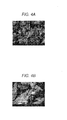
- the positive electrode active material according to Example 1 has, in the particle surface thereof, irregularities as illustrated in Fig. 4A while the particle surface of the positive electrode active material in Fig. 4B is smooth. Accordingly, it is inferred that Example 1 is larger in specific surface area than the conventional example when the particles in the two examples have the same particle diameter. Thus, it can be favorably expected that in Example 1, the reaction area is increased.
- Raw materials are pre-calcinated at a temperature which is equal to or higher than the crystallization temperature and does not exceed the crystallization temperature largely, whereby microcrystals can be precipitated.
- the size of the microcrystals depends on the particle diameter of the raw materials.
- the particle diameter of the raw materials of the positive electrode active material is smaller.
- crystal precipitated when the materials are pre-calcinated coarsens or a different phase is generated.
- it is more desired that the raw materials are more homogeneously mixed with each other.
- the mixing method include a method of using, for example, a bead mill to pulverize the raw materials mechanically to be mixed with each other, and a method of using, for example, an acid, alkali or chelating agent to make the raw materials into a solution state, and then drying the solution to mix the raw materials.
- the mixture that has undergone the solution state is favorable for the precipitation of the microcrystals since the raw materials are mixed with each other at a molecular level.
- a metal source out of the raw materials may be at least one of acetic salts, oxalic salts, citric salts, carbonates, tartaric salts, and other salts.
- the metal corresponds to M (transition metal) in A x MD y O z in the present specification.
- M includes at least one transition element, such as Fe, Mn, Co and Ni.
- One or more typical elements may be further incorporated into M as far as the proportion of the element or each of the elements does not exceed 10%, examples of the elements including Mg, Al, Zn, Sn, and Ca.
- a lithium source to be used is, for example, lithium acetate, lithium carbonate or lithium hydroxide.
- a phosphoric ion source to be used is, for example, lithium dihydrogenphosphate, ammonium dihydrogenphosphate, or diammonium hydrogenphosphate.
- the pre-calcining temperature is desirably the crystallization temperature or higher. If the pre-calcining temperature is lower than the crystallization temperature, crystal growth is not caused so that the resultant pre-calcinated material becomes amorphous. Even when the pre-calcinated material is pulverized and subjected to calcining, seed crystals are not present, so that coarse particles are unfavorably generated. By raising the pre-calcining temperature, the diameter of the synthesized particles is controllable. However, if the pre-calcining temperature is too high, the particles are made coarse. About olivine, the crystallization temperature is at highest about 450°C. The pre-calcining temperature is desirably not higher than the crystallization temperature plus 50°C.
- the crystallization temperature and the growth rate thereof are varied. Accordingly, the range of the pre-calcining temperature is varied in accordance with the species of the active material.
- the crystallization temperature is about 420°C (source: Robert Dominko, Marjan Bele, Jean-Michel Goupil, Miran Gaberscek, Darko Hanzel, Iztok Arcon, and Janez Jamnik ⁇ Wired Porous Cathode Materials: A Novel Concept for Synthesis of LiFePo4', Chemistry of Materials 19 (2007), pp. 2960-2969 ).
- the pre-calcining temperature range is desirably from 440 to 500°C both inclusive.
- the temperature is 440°C or higher, the whole of the sample becomes the crystallization temperature or higher even when the inside of the sample is somewhat uneven in temperature.
- the pre-calcining temperature is 500°C or lower, the resultant pre-calcinated material turns into 100 nm or less in particle diameter.
- the pre-calcinated material can be made higher in crystallinity than in an inert atmosphere or reducing atmosphere.
- the carbon source and the raw materials are mixed with each other in a homogeneous form.
- the calcination in the oxidizing atmosphere is effective for heightening the crystallinity.
- the pre-calcining temperature is desirably 400°C or higher regardless of the above-mentioned crystallization temperature.
- microcrystals produced by performing the pre-calcining in this way are coated with carbon, and subjected to calcining through steps described below. In this way, the microcrystals coated with carbon can be improved in crystallinity.
- the microcrystals (pre-calcinated material) generated by the calcination is low in crystallinity, it is necessary to sinter the microcrystals at a higher temperature to improve the crystallinity.
- the pre-calcinated material is subjected to calcining at a high temperature, the microcrystals are bonded to each other to grow unfavorably.
- the organic substance or carbon is caused to adhere closely to the circumference of the microcrystals to coat the microcrystals with the organic substance or carbon. In this way, the growth of the crystal can be restrained.
- the mesh structure is easily broken by applying a mechanical pressure thereto when the mesh structure has narrow microstructures having a mesh of 500 nm or less.
- the microcrystals can be made finer.
- the manner for attaining the coating and making the microcrystals finer effectively is desirably a manner of using a ball mill or bead mill to apply the mechanical pressure.
- the pre-calcinated material is heated at a temperature higher than that in the pre-calcining step to carbonize the organic substance to improve the resultant sintered material in electroconductivity, and additionally the active material particles are improved in crystallinity or are crystallized.
- the calcining is performed in an inert atmosphere or reducing atmosphere.
- the calcining temperature is desirably 600°C or higher. The calcining is desirably performed at a temperature equal to or lower than the temperature at which the active material is thermally decomposed.
- the range of the calcining temperature is desirably from 600 to 850°C both inclusive.
- the carbon source can be carbonized to give electroconductivity to the resultant.
- the temperature is 850°C or lower, the active material is not decomposed.
- the range is more desirably from 700 to 750°C both inclusive. This temperature range makes it possible to improve the carbon electroconductivity sufficiently and further restrain the generation of impurities which is caused by reaction between carbon and olivine.
- the small-diameter particles coated with carbon can be further improved in crystallinity.
- FIG. 3 illustrates an example of a lithium secondary battery to which the lithium secondary battery according to the invention is applied.
- the lithium secondary battery illustrated in Fig. 3 is in a cylindrical form.
- the present lithium secondary battery has a positive electrode (positive electrode according to the invention for lithium secondary batteries) 10, a negative electrode 6, a separator 7, a positive electrode lead 3, a negative electrode lead 9, a battery lid 1, a gasket 2, insulator plates 4 and 8, and a battery can 5.
- the positive electrode 10 and the negative electrode 6 are wound to interpose the separator 7 therebetween.
- the separator 7 is impregnated with an electrolytic solution in which an electrolyte is dissolved in a solvent.
- the positive electrode according to the present invention for lithium secondary batteries is composed of a positive electrode active material, a binder, and a collector.
- a positive electrode mixture containing the positive electrode active material and the binder is formed on the collector.
- a conducting agent may be added to the positive electrode mixture as required.
- the positive electrode active material according to the present invention is an active material produced by use of the above-mentioned production method (synthesis method).
- the binder is preferably PVDF (polyvinylidene fluoride), polyacrylonitrile, or any other ordinary binder.
- the kind of the binder is not limited as far as the binder has a sufficient binding performance.
- the positive electrode is improved in electroconductivity, and further improved in capacity and rate characteristic.
- the conducting agent used in the positive electrode according to the present invention and the addition amount thereof.
- the conducting agent may be a carbon-based conducting agent, such as acetylene black or graphite powder.
- An olivine Mn-based positive electrode active material is high in specific surface area; thus, in order to form the electroconductive network, it is desired that the conducting agent is large in specific surface area.
- the conducting agent is desirably acetylene black or the like.
- the positive electrode active material may be coated with carbon; however, in this case, the coating carbon may be used as the conducting agent.
- the collector may be a support having electroconductivity, such as an aluminum foil piece.
- an olivine Mn-based positive electrode active material as the positive electrode active material, use an acrylonitrile copolymer as the binder, and use any conducting agent, which may be coating carbon on the active material when the positive electrode active material is coated with carbon.
- the negative electrode of the lithium secondary battery according to the present invention is composed of a negative electrode active material, a conducting agent, a binder, and a collector.
- the negative electrode active material may be any material as far as Li can be reversibly inserted into and eliminated from the material by charging or discharging.
- the active material may be, for example, a carbon material, a metal oxide, a metal sulfide, metallic lithium, or any alloy composed of metallic lithium and any other metal.
- the carbon material may be, for example, graphite, amorphous carbon, cokes, or pyrolytic carbon.
- the conducting agent may be any conducting graphite known in the prior art, and is, for example, a carbon-based conducting graphite such as acetylene black or graphite powder.
- the binder may be any binder known in the prior art. Examples thereof include PVDF (polyvinylidene fluoride), SBR (styrene butadiene rubber), and NBR (nitrile rubber).
- the collector may be any collector known in the prior art, and is, for example, a support having electroconductivity, such as a copper foil piece.
- the separator is not particularly limited, and may be a separator made of a material known in the prior art.
- the separator is, for example, a polyolefin-based porous membrane made of, for example, polypropylene or polyethylene, or a glass fiber sheet.
- the electrolyte may be a lithium salt, examples thereof including LiPF 6 , LiBF 4 , LiCF 3 SO 3 , LiN(SO 2 CF 3 ) 2 , and LiN(SO 2 F) 2 . These salts may be used alone or in a mixture form.
- the solvent in which the lithium salt is dissolved include linear carbonates, cyclic carbonates, cyclic esters, and nitrile compounds. Specific examples thereof include ethylene carbonate, propylene carbonate, diethyl carbonate, dimethoxyethane, ⁇ -butyrolactone, n-methylpyrrolidine, and acetonitrile.
- Other examples of the electrolyte may be polymer gel electrolytes, and solid electrolytes.
- a nonaqueous secondary battery which may be of various forms, such as cylindrical, rectangular, and laminated forms.
- Example 1 a positive electrode active material in which entire metal ions were made of Mn (LiMnPO 4 ) was produced.
- a used metal source was manganese oxalate dihydrate (MnC 2 O 4 ⁇ 2H 2 O).
- LiH 2 PO 4 lithium dihydrogenphosphate
- the raw materials were weighed and mixed with each other by a wet ball mill. After the mixing, the mixture was dried to yield a raw material mixed powder.
- a box-shaped electric furnace was used to calcinate the raw material mixed powder.
- the pre-calcining atmosphere was rendered air.
- the pre-calcining temperature and the pre-calcining period were set to 440°C and 10 hours, respectively.
- sucrose as a carbon source and particle-diameter controller, in a proportion of 7% by mass of the pre-calcinated material.
- a wet ball mill was used to pulverize this mixture and mix the pulverized particles with each other for 2 hours.
- a ring furnace capable of controlling an atmosphere therein was used to sinter the pulverized mixture.
- the calcining atmosphere was rendered an Ar atmosphere.
- the calcining temperature and the calcining time were set to 700°C and 10 hours, respectively.
- LiMnPO 4 was yielded.
- the synthesized active material was used to produce an electrode (positive electrode). Measurements were then made about properties of the electrode, that is, the capacity and the rate characteristic thereof. A description will be made about the method for producing the electrode hereinafter.
- the positive electrode active material, a conducting agent, a binder, and a solvent were mixed with each other on a mortar to prepare slurry.
- the used conducting agent was an acetylene black (DENKA BLACK (registered trademark), manufactured by Denki Kagaku Kogyou Kabushiki Kaisha)
- the used binder was a modified polyacrylonitrile
- the used solvent was N-methyl-2-pyrrolidone (NMP).
- NMP N-methyl-2-pyrrolidone
- the binder was used in the form of a solution in which the binder was dissolved in NMP.
- the composition of the electrode was adjusted in such a manner that the ratio by weight of the positive electrode active material:the conducting agent:the binder would be 82.5:10:7.5.
- a blade having a gap set to 250 ⁇ m was used to paint the prepared slurry onto an aluminum foil piece having a thickness of 20 ⁇ m to give a coating amount of 5 to 6 mg/cm 2 .
- This workpiece was dried at 80°C for 1 hour, and then a punching tool was used to punch out the workpiece into the form of a disc having a diameter of 15 mm.
- a handy press was used to compress the mixture therein.
- the thickness of the mixture was adjusted into the range of 38 to 42 ⁇ m. All the electrodes were each produced in such a manner that the coating amount and the thickness were put into the above-mentioned ranges, respectively. In this way, the respective structures of the electrodes were kept into a constant form.
- the electrodes were dried at 120°C. In order to remove the effect of water, all operations would be made in a dry room.
- the capacity and the rate characteristic were evaluated, using a three-electrode type model cell which was a simple reproduction of a battery.
- the three-electrode type model cell was produced as follows: Any one of the test electrodes punched into the diameter of 15 mm, an aluminum collector, metallic lithium for a counter electrode, and metallic lithium for a reference electrode were stacked onto each other to interpose a separator impregnated with an electrolytic solution between any two of these members.
- the used electrolytic solution was a solution obtained by mixing ethylene carbonate (EC) and ethylmethyl carbonate (EMC) at a ratio (by volume) of 1:2, dissolving LiPF 6 into this mixed solvent to set the concentration of the salt to 1 M, and then adding VC (vinylene carbonate) to the solution to give a concentration of 0.8% by mass.
- EC ethylene carbonate
- EMC ethylmethyl carbonate
- VC vinyl carbonate
- a test for measuring the capacity and the rate characteristic of the cell was made in a glove box in an Ar atmosphere.
- the model cell was charged up to a voltage of 4.5 V at a constant current value of 0.1 mA. After the voltage reached to 4.5 V, the cell was discharged at the constant voltage until the current value reached to 0.03 mA. Thereafter, the cell was discharged down to 2 V at a constant current of 0.1 mA. The discharge capacity at this time was used as the capacity.
- This charge-discharge cycle was repeated 3 times, and then the rate characteristic of the cell was evaluated under the following conditions:
- the model cell subjected to the same constant current charging and constant voltage discharging as in the capacity measurement was discharged at a constant current value of 5 mA.
- the capacity at this time was used as the rate characteristic. All the tests were made at room temperature (25°C).
- Example 2 The same synthesis was performed in the same way as in Example 1 except that the pre-calcining temperature was changed to 600°C, so as to yield LiMnPO 4 .
- the capacity and the rate characteristic were measured in the same way.
- Example 2 The same synthesis was performed in the same way as in Example 1 except that the used metal source was changed to iron oxalate dihydrate (FeC 2 O 4 ⁇ 2H 2 O) and the metal ions were wholly changed to Fe, so as to yield LiFePO 4 .
- the capacity and the rate characteristic were measured in the same way as in Example 1.
- Example 3 The same synthesis was performed in the same way as in Example 3 except that the pre-calcining temperature was changed to 600°C, so as to yield LiFePO 4 .
- the capacity and the rate characteristic were measured in the same way.
- Reference Examples described below are not known examples since the reference examples satisfied the requirement of the present invention that calcination was performed in an oxidizing atmosphere. However, these examples are each described as Reference Example since the pre-calcining temperature was somewhat lower than the crystallization temperature of a target positive electrode active material.
- Example 2 The same synthesis was performed in the same way as in Example 1 except that the pre-calcining temperature was changed to 380°C, so as to yield LiMnPO 4 .
- the capacity and the rate characteristic were measured in the same way.
- Example 3 The same synthesis was performed in the same way as in Example 3 except that the pre-calcining temperature was changed to 380°C, so as to yield LiFePO 4 .
- the capacity and the rate characteristic were measured in the same way.
- iron oxalate dihydrate FeC 2 O 4 ⁇ 2H 2 O
- manganese oxalate dihydrate MnC 2 O 4 ⁇ 2H 2 O
- LiH 2 PO 4 lithium dihydrogenphosphate
- the raw materials were weighed and mixed with each other by a wet ball mill. After the mixing, the mixture was dried to yield a raw material mixed powder.
- a box-shaped electric furnace was used to pre-calcining of the raw material mixed powder.
- the pre-calcining atmosphere was rendered air.
- the pre-calcining temperature and the pre-calcining period were set to 440°C and 10 hours, respectively.
- sucrose as a carbon source and particle-diameter controller, in a proportion of 7% by mass of the pre-calcinated material.
- a wet ball mill was used to pulverize this mixture and mix the pulverized particles with each other for 2 hours.
- a ring furnace capable of controlling an atmosphere therein was used to calcining the pulverized mixture.
- the calcining atmosphere was rendered an Ar atmosphere.
- the calcining temperature and the calcining time were set to 700°C and 10 hours, respectively.
- LiFe 0.2 Mn 0.8 PO 4 was yielded.
- the synthesized active material was used to produce an electrode (positive electrode). Measurements were then made about properties of the electrodes, that is, the capacity and the rate characteristic. The respective measurements of the capacity and the rate characteristic were made in the same way as in Example 1.
- Example 5 The same synthesis was performed in the same way as in Example 5 except that the pre-calcining temperature was changed to 600°C, so as to yield LiFe 0.2 Mn 0.8 PO 4 .
- the capacity and the rate characteristic were measured in the same way as in Example 1.
- Example 5 The same synthesis was performed in the same way as in Example 5 except that the pre-calcining temperature was changed to 380°C, so as to yield LiFe 0.2 Mn 0.8 PO 4 .
- the capacity and the rate characteristic were measured in the same way.
- Example 2 The same synthesis was performed in the same way as in Example 1 except that the used metal sources were changed to iron oxalate dihydrate (FeC 2 O 4 ⁇ 2H 2 O), manganese oxalate dihydrate (MnC 2 O 4 ⁇ 2H 2 O) and magnesium hydroxide (Mg(OH) 2 ), and the ratio of Fe:Mg:Mg was set to a ratio of 2:7.7:0.3, so as to yield LiFe 0.2 Mn 0.77 Mg 0.03 PO 4 .
- the capacity and the rate characteristic were measured in the same way in Example 1.
- Example 2 The same synthesis was performed in the same way as in Example 1 except that the pre-calcining atmosphere was changed to Ar, so as to yield LiMnPO 4 .
- the capacity and the rate characteristic were measured in the same way.
- Example 3 The same synthesis was performed in the same way as in Example 3 except that the pre-calcining atmosphere was changed to Ar, so as to yield LiFePO 4 .
- the capacity and the rate characteristic were measured in the same way.
- Example 5 The same synthesis was performed in the same way as in Example 5 except that the pre-calcining atmosphere was changed to Ar, so as to yield LiFe 0.2 Mn 0.8 PO 4 .
- the capacity and the rate characteristic were measured in the same way.
- Example 7 The same synthesis was performed in the same way as in Example 7 except that the pre-calcining atmosphere was changed to Ar, so as to yield LiFe 0.2 Mn 0.77 Mg 0.03 PO 4 .
- the capacity and the rate characteristic were measured in the same way.
- Figure 4A shows a scanning electron microscopic image of the sample synthesized in Example 5.
- a scanning electron microscope S-4300 manufactured by Hitachi High-Technologies Corp. was used.
- the positive electrode active materials are arranged into groups in each of which some of these materials had the same composition.
- the reason therefor is that it is necessary for understanding the effect and the advantages of the present invention that properties of materials having the same composition, out of the positive electrode active materials, are compared therebetween.
- the pre-calcining atmosphere of Examples 1 to 7 and Reference Examples 1 to 3 was air while that of the Comparative Examples 1, 2, 3 and 4 was argon gas.
- the rate characteristic is slightly lower than in the working example of the invention.
- the pre-calcining temperature is 600°C, so that the rate characteristic may be slightly low.
- the capacity and the energy density at low discharge rates have no practical problem.
- the calcination at 600°C the growth of crystal grains is recognized so that the capacity at high discharge rates is slightly lowered.
- the grown particles can also be used.
- the pre-calcining temperature is preferably 400°C or higher, and lower than 600°C, and is in particular preferably in a range from 400 to 550°C.
- Table 2 shows the capacity, the energy density and the rate characteristic of each of lithium secondary batteries produced using positive electrode active materials produced by pre-calcining LiFe 0.2 Mn 0.8 PO 4 at 400°C, 500°C, and 550°C, respectively.
- the energy density and the capacity are values when the battery is discharged at 0.1 C.
- the pre-calcining temperature is in particular from 400 to 550°C, the capacity, the energy density and the rate characteristic are high values with a good balance.
- Example 7 When a comparison is made between Example 7 and Comparative Example 4, in each of which the positive electrode active material was LiFe 0.2 Mn 0.77 Mg 0.03 PO 4 , the working example is sufficiently higher in rate characteristic.
- Example 1 and Comparative Example 1 Comparisons are made between Example 1 and Comparative Example 1, between Example 2 and Comparative Example 2, between Example 3 and Comparative Example 3, and between Example 4 and Comparative Example 4, respectively.
- the cases in which the pre-calcining atmosphere is air are better in capacity and rate characteristic than the cases in which the pre-calcining atmosphere is argon. From this matter, it is understood that calcination in an oxidizing atmosphere produces an advantageous effect of improving the resultant batteries in properties even when the respective compositions of the batteries are in a broad range.
- the pre-calcining temperature of each of Examples 2, 4 and 6 is at least 100°C higher than the crystallization temperature of the target positive electrode active material.
- the working examples of the invention are not largely affected about capacity, as described above, but may be lowered in rate characteristic. This would be because the particle diameter increases.
- Reference Examples 1, 2 and 3 are poor in both of capacity and rate characteristic, in particular, at temperatures lower than 400°C since the pre-calcining temperature is set to the crystallization temperature or lower. Causes therefor are that no seed crystal is produced by the calcination so that a satisfactory crystal growth may not be attained in the calcining, and further that the organic components contained in the raw materials are taken into the crystal without disappearing, so that the crystallinity is declined.
- 1 battery lid
- 2 gasket
- 3 positive electrode lead
- 4 and 8 insulator plates
- 5 battery can
- 6 negative electrode
- 7 separator
- 9 negative electrode lead
- 10 positive electrode
Landscapes
- Chemical & Material Sciences (AREA)
- Chemical Kinetics & Catalysis (AREA)
- Electrochemistry (AREA)
- General Chemical & Material Sciences (AREA)
- Inorganic Chemistry (AREA)
- Engineering & Computer Science (AREA)
- Materials Engineering (AREA)
- Composite Materials (AREA)
- Crystallography & Structural Chemistry (AREA)
- Organic Chemistry (AREA)
- Manufacturing & Machinery (AREA)
- Battery Electrode And Active Subsutance (AREA)
Applications Claiming Priority (2)
| Application Number | Priority Date | Filing Date | Title |
|---|---|---|---|
| JP2012086308 | 2012-04-05 | ||
| PCT/JP2013/057416 WO2013150877A1 (ja) | 2012-04-05 | 2013-03-15 | 非水二次電池用正極活物質の製造方法、非水二次電池用正極、及び非水二次電池 |
Publications (2)
| Publication Number | Publication Date |
|---|---|
| EP2835849A1 true EP2835849A1 (de) | 2015-02-11 |
| EP2835849A4 EP2835849A4 (de) | 2015-11-25 |
Family
ID=49300371
Family Applications (1)
| Application Number | Title | Priority Date | Filing Date |
|---|---|---|---|
| EP13772289.8A Withdrawn EP2835849A4 (de) | 2012-04-05 | 2013-03-15 | Verfahren zur herstellung eines positivelektroden-aktivmaterials für wasserfreie sekundärbatterien, positivelektrode für wasserfreie sekundärbatterien und wasserfreie sekundärbatterie |
Country Status (6)
| Country | Link |
|---|---|
| US (1) | US20150140431A1 (de) |
| EP (1) | EP2835849A4 (de) |
| JP (1) | JP5915732B2 (de) |
| KR (1) | KR20140148408A (de) |
| CN (1) | CN104272507A (de) |
| WO (1) | WO2013150877A1 (de) |
Families Citing this family (9)
| Publication number | Priority date | Publication date | Assignee | Title |
|---|---|---|---|---|
| CN104743536B (zh) * | 2015-02-10 | 2017-02-01 | 常州普格纳能源材料有限公司 | 一种磷酸盐系正极材料的制备方法 |
| KR101844774B1 (ko) * | 2015-08-12 | 2018-04-04 | 서울대학교산학협력단 | 3차원 리튬 확산이 가능한 올리빈계 양극재 및 이의 제조방법 |
| JP6288341B1 (ja) * | 2017-03-30 | 2018-03-07 | 住友大阪セメント株式会社 | リチウムイオン二次電池用正極材料、及びリチウムイオン二次電池 |
| JP6288342B1 (ja) * | 2017-03-30 | 2018-03-07 | 住友大阪セメント株式会社 | リチウムイオン二次電池用正極材料、及びリチウムイオン二次電池 |
| US10655479B2 (en) | 2018-07-11 | 2020-05-19 | Rolls-Royce Corporation | Turbine wheel assembly with ceramic matrix composite blades |
| KR102565910B1 (ko) | 2019-01-21 | 2023-08-10 | 주식회사 엘지화학 | 이차전지용 양극 활물질의 제조방법 |
| CN110400921A (zh) * | 2019-07-17 | 2019-11-01 | 湖北锂诺新能源科技有限公司 | 一种碳包覆锑掺杂岩盐结构氟氧钒锂正极材料的制备方法 |
| WO2026053090A1 (ja) * | 2024-09-06 | 2026-03-12 | 株式会社半導体エネルギー研究所 | リチウムイオン電池 |
| WO2026083213A1 (ja) * | 2024-10-18 | 2026-04-23 | 株式会社半導体エネルギー研究所 | リチウムイオン電池 |
Family Cites Families (13)
| Publication number | Priority date | Publication date | Assignee | Title |
|---|---|---|---|---|
| CA2270771A1 (fr) | 1999-04-30 | 2000-10-30 | Hydro-Quebec | Nouveaux materiaux d'electrode presentant une conductivite de surface elevee |
| CA2796903C (en) * | 2000-04-25 | 2015-03-31 | Sony Corporation | Positive electrode active material and non-aqueous electrolyte cell |
| US8865349B2 (en) * | 2005-09-21 | 2014-10-21 | Kanto Denka Kogyo Co., Ltd. | Method of producing positive electrode active material and nonaqueous electrolyte battery using the same |
| WO2009003093A1 (en) * | 2007-06-26 | 2008-12-31 | Tiax, Llc | Metal phosphate compounds and batteries containing the same |
| CN101112979B (zh) * | 2007-06-27 | 2010-05-19 | 广州市鹏辉电池有限公司 | 一种高密度类球形磷酸铁锂的固相制备方法 |
| EP2276698A1 (de) * | 2008-04-14 | 2011-01-26 | Dow Global Technologies Inc. | Lithiummetallphosphat/kohlenstoff-nanoverbundwerkstoffe als kathodenaktivmassen für lithium-sekundärbatterien |
| WO2010114104A1 (ja) * | 2009-04-03 | 2010-10-07 | 旭硝子株式会社 | リン酸鉄リチウム粒子の製造方法および二次電池の製造方法 |
| JP5382474B2 (ja) * | 2009-07-31 | 2014-01-08 | トヨタ自動車株式会社 | 正極活物質及びその製造方法 |
| JP2011238594A (ja) * | 2010-04-13 | 2011-11-24 | Nippon Electric Glass Co Ltd | リチウムイオン二次電池正極材料およびその製造方法 |
| US9318741B2 (en) * | 2010-04-28 | 2016-04-19 | Semiconductor Energy Laboratory Co., Ltd. | Positive electrode active material of power storage device, power storage device, electrically propelled vehicle, and method for manufacturing power storage device |
| CN101853936A (zh) * | 2010-05-04 | 2010-10-06 | 苏州大学 | 锂离子电池正极材料磷酸锰锂的制备方法 |
| CN101976734A (zh) * | 2010-11-03 | 2011-02-16 | 江苏方舟新能源股份有限公司 | 高密度锂电池正极材料磷酸亚铁锂的制备方法 |
| JP5736965B2 (ja) * | 2011-05-27 | 2015-06-17 | 日立金属株式会社 | リチウム二次電池用正極活物質とその製造方法、リチウム二次電池用正極、及びリチウム二次電池 |
-
2013
- 2013-03-15 EP EP13772289.8A patent/EP2835849A4/de not_active Withdrawn
- 2013-03-15 KR KR1020147027730A patent/KR20140148408A/ko not_active Ceased
- 2013-03-15 CN CN201380023648.4A patent/CN104272507A/zh active Pending
- 2013-03-15 US US14/390,273 patent/US20150140431A1/en not_active Abandoned
- 2013-03-15 WO PCT/JP2013/057416 patent/WO2013150877A1/ja not_active Ceased
- 2013-03-15 JP JP2014509096A patent/JP5915732B2/ja active Active
Also Published As
| Publication number | Publication date |
|---|---|
| JP5915732B2 (ja) | 2016-05-11 |
| US20150140431A1 (en) | 2015-05-21 |
| WO2013150877A1 (ja) | 2013-10-10 |
| KR20140148408A (ko) | 2014-12-31 |
| EP2835849A4 (de) | 2015-11-25 |
| JPWO2013150877A1 (ja) | 2015-12-17 |
| CN104272507A (zh) | 2015-01-07 |
Similar Documents
| Publication | Publication Date | Title |
|---|---|---|
| JP5736965B2 (ja) | リチウム二次電池用正極活物質とその製造方法、リチウム二次電池用正極、及びリチウム二次電池 | |
| JP5268134B2 (ja) | 正極活物質の製造方法およびそれを用いた非水電解質電池 | |
| US20150140431A1 (en) | Method for producing positive electrode active material for nonaqueous secondary batteries, positive electrode for nonaqueous secondary batteries, and nonaqueous secondary battery | |
| EP2936590B1 (de) | Lmfp-kathodenmaterialien mit verbesserten elektrochemischen eigenschaften | |
| KR101478873B1 (ko) | 양극 활물질, 이의 제조방법 및 이를 이용한 이차전지 | |
| CN103548189B (zh) | 用于可充电锂电池的正极活性物质 | |
| CN102810669B (zh) | 二次电池用正极材料和制造该材料的方法 | |
| JP5928302B2 (ja) | リチウム二次電池用正極活物質の製造方法 | |
| JP5165515B2 (ja) | リチウムイオン二次電池 | |
| CN111697203B (zh) | 一种磷酸锰铁锂复合材料及其制备方法和应用 | |
| EP2546194A1 (de) | Phosphatverbindung, positivelektrode für sekundärbatterie und verfahren zur herstellung einer sekundärbatterie | |
| WO2012133729A1 (ja) | 活物質、電極、リチウムイオン二次電池、及び、活物質の製造方法 | |
| CN1985391B (zh) | 锂二次电池用电极活性材料 | |
| JP2014032803A (ja) | リチウム二次電池用正極活物質、及びリチウム二次電池 | |
| CN119092688A (zh) | 一种高压实磷酸锰铁锂正极材料 | |
| JP5505868B2 (ja) | リチウム二次電池用正極活物質の前駆体とその製造方法 | |
| JP2015056223A (ja) | 非水系二次電池用正極活物質、非水系二次電池用正極活物質の製造方法、非水系二次電池用正極および非水系二次電池 | |
| JP5769140B2 (ja) | リチウム二次電池用正極活物質の製造方法 | |
| WO2024070137A1 (ja) | リチウムイオン二次電池用正極材料及びその製造方法、リチウムイオン二次電池用正極、ならびにリチウムイオン二次電池 | |
| KR101668929B1 (ko) | 2차 전지 및 그 제조 방법 | |
| JP5649069B2 (ja) | リチウムイオン電池用正極活物質及びその製造法 | |
| JP2023047466A (ja) | リチウムイオン二次電池用正極活物質ナノ粒子混合体及びリチウムイオン二次電池の製造方法 | |
| JP2015056222A (ja) | 非水系二次電池用正極活物質、非水系二次電池用正極活物質の製造方法、非水系二次電池用正極および非水系二次電池 | |
| JP5825573B2 (ja) | リチウムイオン電池用正極活物質及びその製造法 | |
| WO2025188876A1 (en) | Process for conversion of stoichiometrically imbalanced materials into useful cathode materials |
Legal Events
| Date | Code | Title | Description |
|---|---|---|---|
| PUAI | Public reference made under article 153(3) epc to a published international application that has entered the european phase |
Free format text: ORIGINAL CODE: 0009012 |
|
| 17P | Request for examination filed |
Effective date: 20141105 |
|
| AK | Designated contracting states |
Kind code of ref document: A1 Designated state(s): AL AT BE BG CH CY CZ DE DK EE ES FI FR GB GR HR HU IE IS IT LI LT LU LV MC MK MT NL NO PL PT RO RS SE SI SK SM TR |
|
| AX | Request for extension of the european patent |
Extension state: BA ME |
|
| DAX | Request for extension of the european patent (deleted) | ||
| RA4 | Supplementary search report drawn up and despatched (corrected) |
Effective date: 20151023 |
|
| RIC1 | Information provided on ipc code assigned before grant |
Ipc: H01M 4/136 20100101ALI20151019BHEP Ipc: H01M 4/58 20100101AFI20151019BHEP Ipc: H01M 4/62 20060101ALI20151019BHEP Ipc: H01M 4/36 20060101ALI20151019BHEP |
|
| STAA | Information on the status of an ep patent application or granted ep patent |
Free format text: STATUS: THE APPLICATION HAS BEEN WITHDRAWN |
|
| 18W | Application withdrawn |
Effective date: 20160211 |