EP2837367A2 - Laser femtoseconde de deuxième passage pour incisions cornéennes au laser incomplètes d'épaisseur totale ou partielle - Google Patents
Laser femtoseconde de deuxième passage pour incisions cornéennes au laser incomplètes d'épaisseur totale ou partielle Download PDFInfo
- Publication number
- EP2837367A2 EP2837367A2 EP20140178969 EP14178969A EP2837367A2 EP 2837367 A2 EP2837367 A2 EP 2837367A2 EP 20140178969 EP20140178969 EP 20140178969 EP 14178969 A EP14178969 A EP 14178969A EP 2837367 A2 EP2837367 A2 EP 2837367A2
- Authority
- EP
- European Patent Office
- Prior art keywords
- path
- laser beam
- pass
- incision
- laser
- Prior art date
- Legal status (The legal status is an assumption and is not a legal conclusion. Google has not performed a legal analysis and makes no representation as to the accuracy of the status listed.)
- Withdrawn
Links
- 210000004087 cornea Anatomy 0.000 claims abstract description 41
- 238000000034 method Methods 0.000 claims abstract description 34
- 239000007788 liquid Substances 0.000 claims description 12
- 230000000149 penetrating effect Effects 0.000 claims description 2
- 210000004045 bowman membrane Anatomy 0.000 description 9
- 210000001519 tissue Anatomy 0.000 description 9
- 230000003287 optical effect Effects 0.000 description 8
- 239000003855 balanced salt solution Substances 0.000 description 6
- 230000015556 catabolic process Effects 0.000 description 6
- 210000001742 aqueous humor Anatomy 0.000 description 4
- 210000002555 descemet membrane Anatomy 0.000 description 4
- 238000005286 illumination Methods 0.000 description 3
- 238000013507 mapping Methods 0.000 description 3
- 230000001404 mediated effect Effects 0.000 description 3
- 210000004379 membrane Anatomy 0.000 description 3
- 239000012528 membrane Substances 0.000 description 3
- 102000008186 Collagen Human genes 0.000 description 2
- 108010035532 Collagen Proteins 0.000 description 2
- 230000015572 biosynthetic process Effects 0.000 description 2
- 229920001436 collagen Polymers 0.000 description 2
- 239000000835 fiber Substances 0.000 description 2
- 210000005036 nerve Anatomy 0.000 description 2
- 230000002040 relaxant effect Effects 0.000 description 2
- 230000001225 therapeutic effect Effects 0.000 description 2
- 230000008016 vaporization Effects 0.000 description 2
- 208000002177 Cataract Diseases 0.000 description 1
- 240000004260 Garcinia hombroniana Species 0.000 description 1
- 201000009310 astigmatism Diseases 0.000 description 1
- 210000004027 cell Anatomy 0.000 description 1
- 238000006243 chemical reaction Methods 0.000 description 1
- 230000002301 combined effect Effects 0.000 description 1
- 230000001419 dependent effect Effects 0.000 description 1
- 238000006073 displacement reaction Methods 0.000 description 1
- 210000002889 endothelial cell Anatomy 0.000 description 1
- 210000003038 endothelium Anatomy 0.000 description 1
- 238000005516 engineering process Methods 0.000 description 1
- 210000000981 epithelium Anatomy 0.000 description 1
- 238000010304 firing Methods 0.000 description 1
- 239000012634 fragment Substances 0.000 description 1
- 239000000463 material Substances 0.000 description 1
- 238000012986 modification Methods 0.000 description 1
- 230000004048 modification Effects 0.000 description 1
- 230000035939 shock Effects 0.000 description 1
- 238000001356 surgical procedure Methods 0.000 description 1
- 238000011144 upstream manufacturing Methods 0.000 description 1
Images

Classifications
-
- A—HUMAN NECESSITIES
- A61—MEDICAL OR VETERINARY SCIENCE; HYGIENE
- A61F—FILTERS IMPLANTABLE INTO BLOOD VESSELS; PROSTHESES; DEVICES PROVIDING PATENCY TO, OR PREVENTING COLLAPSING OF, TUBULAR STRUCTURES OF THE BODY, e.g. STENTS; ORTHOPAEDIC, NURSING OR CONTRACEPTIVE DEVICES; FOMENTATION; TREATMENT OR PROTECTION OF EYES OR EARS; BANDAGES, DRESSINGS OR ABSORBENT PADS; FIRST-AID KITS
- A61F9/00—Methods or devices for treatment of the eyes; Devices for putting in contact-lenses; Devices to correct squinting; Apparatus to guide the blind; Protective devices for the eyes, carried on the body or in the hand
- A61F9/007—Methods or devices for eye surgery
- A61F9/008—Methods or devices for eye surgery using laser
- A61F9/00825—Methods or devices for eye surgery using laser for photodisruption
- A61F9/00836—Flap cutting
-
- A—HUMAN NECESSITIES
- A61—MEDICAL OR VETERINARY SCIENCE; HYGIENE
- A61F—FILTERS IMPLANTABLE INTO BLOOD VESSELS; PROSTHESES; DEVICES PROVIDING PATENCY TO, OR PREVENTING COLLAPSING OF, TUBULAR STRUCTURES OF THE BODY, e.g. STENTS; ORTHOPAEDIC, NURSING OR CONTRACEPTIVE DEVICES; FOMENTATION; TREATMENT OR PROTECTION OF EYES OR EARS; BANDAGES, DRESSINGS OR ABSORBENT PADS; FIRST-AID KITS
- A61F9/00—Methods or devices for treatment of the eyes; Devices for putting in contact-lenses; Devices to correct squinting; Apparatus to guide the blind; Protective devices for the eyes, carried on the body or in the hand
- A61F9/007—Methods or devices for eye surgery
- A61F9/008—Methods or devices for eye surgery using laser
- A61F9/00825—Methods or devices for eye surgery using laser for photodisruption
- A61F9/00827—Refractive correction, e.g. lenticle
-
- A—HUMAN NECESSITIES
- A61—MEDICAL OR VETERINARY SCIENCE; HYGIENE
- A61F—FILTERS IMPLANTABLE INTO BLOOD VESSELS; PROSTHESES; DEVICES PROVIDING PATENCY TO, OR PREVENTING COLLAPSING OF, TUBULAR STRUCTURES OF THE BODY, e.g. STENTS; ORTHOPAEDIC, NURSING OR CONTRACEPTIVE DEVICES; FOMENTATION; TREATMENT OR PROTECTION OF EYES OR EARS; BANDAGES, DRESSINGS OR ABSORBENT PADS; FIRST-AID KITS
- A61F9/00—Methods or devices for treatment of the eyes; Devices for putting in contact-lenses; Devices to correct squinting; Apparatus to guide the blind; Protective devices for the eyes, carried on the body or in the hand
- A61F9/007—Methods or devices for eye surgery
- A61F9/008—Methods or devices for eye surgery using laser
- A61F9/00825—Methods or devices for eye surgery using laser for photodisruption
- A61F9/0084—Laser features or special beam parameters therefor
-
- A—HUMAN NECESSITIES
- A61—MEDICAL OR VETERINARY SCIENCE; HYGIENE
- A61F—FILTERS IMPLANTABLE INTO BLOOD VESSELS; PROSTHESES; DEVICES PROVIDING PATENCY TO, OR PREVENTING COLLAPSING OF, TUBULAR STRUCTURES OF THE BODY, e.g. STENTS; ORTHOPAEDIC, NURSING OR CONTRACEPTIVE DEVICES; FOMENTATION; TREATMENT OR PROTECTION OF EYES OR EARS; BANDAGES, DRESSINGS OR ABSORBENT PADS; FIRST-AID KITS
- A61F9/00—Methods or devices for treatment of the eyes; Devices for putting in contact-lenses; Devices to correct squinting; Apparatus to guide the blind; Protective devices for the eyes, carried on the body or in the hand
- A61F9/007—Methods or devices for eye surgery
- A61F9/008—Methods or devices for eye surgery using laser
- A61F2009/00861—Methods or devices for eye surgery using laser adapted for treatment at a particular location
- A61F2009/00872—Cornea
-
- A—HUMAN NECESSITIES
- A61—MEDICAL OR VETERINARY SCIENCE; HYGIENE
- A61F—FILTERS IMPLANTABLE INTO BLOOD VESSELS; PROSTHESES; DEVICES PROVIDING PATENCY TO, OR PREVENTING COLLAPSING OF, TUBULAR STRUCTURES OF THE BODY, e.g. STENTS; ORTHOPAEDIC, NURSING OR CONTRACEPTIVE DEVICES; FOMENTATION; TREATMENT OR PROTECTION OF EYES OR EARS; BANDAGES, DRESSINGS OR ABSORBENT PADS; FIRST-AID KITS
- A61F9/00—Methods or devices for treatment of the eyes; Devices for putting in contact-lenses; Devices to correct squinting; Apparatus to guide the blind; Protective devices for the eyes, carried on the body or in the hand
- A61F9/007—Methods or devices for eye surgery
- A61F9/008—Methods or devices for eye surgery using laser
- A61F2009/00885—Methods or devices for eye surgery using laser for treating a particular disease
-
- A—HUMAN NECESSITIES
- A61—MEDICAL OR VETERINARY SCIENCE; HYGIENE
- A61F—FILTERS IMPLANTABLE INTO BLOOD VESSELS; PROSTHESES; DEVICES PROVIDING PATENCY TO, OR PREVENTING COLLAPSING OF, TUBULAR STRUCTURES OF THE BODY, e.g. STENTS; ORTHOPAEDIC, NURSING OR CONTRACEPTIVE DEVICES; FOMENTATION; TREATMENT OR PROTECTION OF EYES OR EARS; BANDAGES, DRESSINGS OR ABSORBENT PADS; FIRST-AID KITS
- A61F9/00—Methods or devices for treatment of the eyes; Devices for putting in contact-lenses; Devices to correct squinting; Apparatus to guide the blind; Protective devices for the eyes, carried on the body or in the hand
- A61F9/007—Methods or devices for eye surgery
- A61F9/008—Methods or devices for eye surgery using laser
- A61F2009/00897—Scanning mechanisms or algorithms
Definitions
- the present invention relates to methods and systems for improving surgical procedures for improving incomplete full or partial thickness corneal incisions.
- the point of focus of a femtosecond laser is scanned across a planar or curved surface within the volume of the target tissue to form the incision.
- the beam intensity at the focus is chosen to substantially exceed the laser induced optical breakdown threshold of the tissue.
- a plasma-mediated photo-disruption occurs, vaporizing a miniscule volume of tissue at or near the point of focus.
- a cavitation bubble subsequently forms near the point of focus which helps cleave the damaged region to form the incision.
- laser pulses are placed contiguously in three dimensions across the desired planar or curved surfaces to form the overall incision.
- the combined effect of the pattern of pulses is to cleave the tissue at the targeted plane.
- Arbitrarily complex incisions patterns can be generated with such lasers.
- the femtosecond lasers are believed to make incisions of a more accurate and consistent depth and of a curvature that more accurately matches the desired arcuate form of the incision.
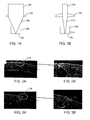
- FIGS. 1A and 1B A comparison between a high numerical aperture laser beam 100 that passes through a liquid patient interface 102 and a low numerical aperture laser beam 104 that pass through a liquid patient interface 102 is shown in FIGS. 1A and 1B .
- a high numerical aperture laser beam 100 passes through a liquid patient interface 102, resulting in a focused high numerical aperture laser beam 106.
- the focused high numerical aperture laser beam 106 is directed into a portion 108 of the anterior corneal surface of the cornea of the eye and the beam 106 reaches the rear portion 110 of the portion 108.
- the formation of the unintended uncut layer 114 is due to the fact that there is a difference at the interface between the optical breakdown thresholds of the epithelium layer of the cornea and the Bowman's membrane of the cornea at the anterior corneal surface of the cornea of the eye.
- an uncut layer at the posterior corneal surface is formed due to the optical breakdown thresholds of the endothelium layer of the cornea and the Descemet's membrane of the cornea at the posterior corneal surface of the cornea of the eye.
- An example of such an unintended uncut layer is shown in FIGS. 2A-B and 3A-B .
- the unintended uncut layer can be generated in a variety of incisions. For example, uncut layers 116, 118 of FIG.
- the presence of the uncut layer results in an incomplete FTI or PTI incision being formed.
- the thickness of the residual uncut layer can vary from approximately 10 ⁇ m to approximately 30 ⁇ m, as a function of the numerical aperture and the output energy of the laser beam.
- the residual uncut layers encompass the Bowman's membrane, for partial thickness corneal incisions, and, Bowman's and Descemet's membranes, for full thickness corneal incision.
- Bowman's and Descemet's membranes are the regions of the eye structure with the stiffest collagen fibers.
- One aspect of the invention regards a method for forming an incision in an eye, the method including performing a first pass of a first laser beam along a path within an eye, wherein after completion of the first pass there exists a residual uncut layer at an anterior surface of a cornea of the eye. The method further including performing a second pass of a second laser beam only along a portion of the path that contains the residual uncut layer, wherein after completion of the second pass, the residual uncut layer is transformed into a full complete through surface incision.
- One or more aspects of the present invention provides for the generation of a full through surface corneal incision in a dependable manner.
- the present invention relates to a method of generating a complete through surface incision of a portion of the eye, such as a complete incision of a full thickness or partial thickness of the cornea of the eye.
- a complete through surface incision of a portion of the eye such as a complete incision of a full thickness or partial thickness of the cornea of the eye.
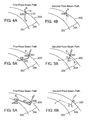
- FIGS. 4 A-B An example of a possible partial thickness corneal incision (PTI) of the anterior corneal surface of an eye is shown in FIGS. 4 A-B .
- Examples of full thickness corneal incisions (FTI) are shown in FIGS. 5-6 .
- FIG. 4A an anterior surface 200 and a posterior surface 202 of a cornea 204 of an eye are shown.
- a first pass of a first femtosecond laser beam is performed in its entirety at a low energy above the photo-disruption threshold.
- the first laser beam has an energy in a range of 3 ⁇ J - 5 ⁇ J and is a low numerical aperture laser beam that passes through a liquid patient interface 201, wherein a low numerical aperture laser beam is used so that the laser focal point will be far enough to reach the lens posterior region and effectively fragment cataractous materials within the eye.
- the first pass of the first laser beam begins at a position A within the cornea 204 and moves linearly toward a position B located past the anterior surface 200 and in a chamber filled with a balanced salt solution (BSS).
- BSS balanced salt solution
- the first pass is along a linear path, wherein a first full cut 206 is formed.
- an uncut region 210 can remain. As shown in FIG.
- a second pass 208 of a second femtosecond laser beam that is a low numerical aperture laser beam is performed at an energy, such as 6 ⁇ J - 14 ⁇ J, which is greater in value than the energy of the first femtosecond laser beam.
- the second pass 208 is performed along a portion of the same linear path as the first pass that is near the anterior surface 200 of the cornea 204.
- the second pass 208 begins at the point C prior to the uncut layer 210 and ends at position B.
- Point C is at a pre-programed distance 209 below the corneal surface S (200), typically 100-300 ⁇ m.
- the second pass 208 includes the uncut layer 210 and extends to the end of the overcut at point B.
- a first pass of a first femtosecond laser beam is performed in its entirety at a low energy above the photo-disruption threshold.
- the first laser beam is a low numerical aperture laser beam that passes through a liquid patient interface 201.
- the first pass begins at a position A in the aqueous humor of the eye, moves linearly toward a position B located in the interior of the cornea 204, and then changes direction and moves linearly to position C past the anterior surface 200 and in a chamber filled with a balanced salt solution.
- the first pass is along an angled path, wherein two linear cuts 300 and 304 are formed. When attempting to cut across the junction between dissimilar media (e.g.
- an uncut layer 306 remains.
- a second uncut layer 308 remains.
- a second pass of a second femtosecond laser beam that is a low numerical aperture laser beam is performed subsequent to the first pass.
- the second pass is performed along a portion of the same linear path as the first pass that is near the anterior surface 200 of the cornea 204.
- the second pass begins at the point D prior to the region of uncut cornea 308 and ends at position C so as to define portion 301.
- the second pass includes the uncut layer 308.
- the laser system of FIG. 7 uses built in biometry scanning to automatically map the anterior and/or posterior cornea surfaces at the incision site and automatically determines beam path for both the first and second passes.
- such automatic mapping and determining would identify the first pass path A ⁇ 7B ⁇ 7C.
- the system traces back along the path S ⁇ B ⁇ A, starting at the surface S, for a predetermined distance, typically 100-300 ⁇ m, to position the second pass start point D.
- the second pass path is also defined as D ⁇ B ⁇ C. Should the programmed length of the second pass be such that D lies on the segment S ⁇ B, then the second pass will be simply defined by the linear path D ⁇ S.
- two-plane full thickness incision is formed, wherein the term “two-plane” regards the fact that the resultant incision forms two planes.
- full thickness regards the fact that the resultant incision intentionally cuts from the posterior to anterior surface of the cornea.
- a first pass of a first femtosecond laser beam is performed in its entirety at a low energy above the photo-disruption threshold.
- the laser beam is a low numerical aperture laser beam that passes through a liquid patient interface 201.
- the first pass begins at a position A in the aqueous humor of the eye, moves linearly toward a position B located in the interior of the cornea 204, and then changes direction and moves linearly to position C.
- the laser beam changes direction and moves linearly past the anterior surface 200 to a position D in a chamber filled with a balanced salt solution.
- the first pass is along a zigzag angled path, wherein linear full cuts 400,402 and 406 are formed.
- an uncut layer 404 remains.
- a second uncut layer 408 remains.
- a three-plane full thickness incision is formed, wherein the term “three-plane” regards the fact that the resultant incision forms three planes.
- full thickness regards the fact that the resultant incision intentionally cuts from the posterior to anterior surface of the cornea.
- the second pass results in increased visibility of the incision entrance for the surgeon.
- the stiffness of the Bowman's membrane is much greater than that of the Descement's membrane and so structural weakness of the Bowman's membrane and residual heat from the air bubbles produced by photodisruption in the balanced salt solution will not be sufficient in themselves to break the uncut layer at the anterior surface of the cornea.
- a second pass of the laser beam is necessary break the uncut layer.
- the present two-pass technique avoids the use of just a single pass of a laser beam to form a full cut at the anterior surface of the cornea.
- Most nerves reside between the endothelial cells and the Bowman's membrane and so a single pass laser technique could induce unwarranted pain to the patient due to the aggravation of the nerves by the laser.
- the presently described two pass technique results in the further softening of the residual uncut layers and so helps to ease the opening of the wound.
- the laser system includes a treatment laser 501 which should provide a beam 504.
- the beam should be of a short pulse width, together with the energy and beam size, to produce photodisruption.
- laser shot or shot refers to a laser beam pulse delivered to a location that results in photodisruption.
- photodisruption essentially refers to the conversion of matter to a gas by the laser, with accompanying shock wave and cavitation bubble.
- photodisruption has also been generally referred to as Laser Induced Optical Breakdown (LIOB).
- LIOB Laser Induced Optical Breakdown
- wavelengths of about 300 nm to 2500 nm may be employed.
- Pulse widths from about 1 femtosecond to 100 picoseconds may be employed.
- Energys from about a 1 nanojoule to 1 millijoule may be employed.
- the pulse rate also referred to as pulse repetition frequency (PRF) and pulses per second measured in Hertz
- PRF pulse repetition frequency
- pulses per second measured in Hertz may be from about 1 KHz to several GHz.
- PRF pulse repetition frequency
- lower pulse rates correspond to higher pulse energy in commercial laser devices.
- a wide variety of laser types may be used to cause photodisruption of ocular tissues, dependent upon pulse width and energy density.
- the optics 502 for delivering the laser beam 504 to the structures of the eye should be capable of providing a series of shots to the natural lens in a precise and predetermined pattern in the x, y and z dimension.
- the z dimension as used herein refers to that dimension which has an axis that corresponds to, or is essentially parallel with the anterior to posterior (AP) axis of the eye.
- the optics should also provide a predetermined beam spot size to cause photodisruption with the laser energy reaching the structure of the eye intended to be cut.
- Optical images of the eye 514 and in particular optical images of the natural lens of the eye 520 are conveyed along a path 513.
- This path 513 follows the same path as the laser beam 504 from the natural lens through the laser patient interface 516, the focusing optics 509, the x-y scanner 508 and the beam combiner 507.
- a laser patient interface 516, a structured light source 517 and a structured light camera 518, including a lens are provided in regular and provisional U.S. patent applications serial number 12/509,021 and serial number 61/228,457 , wherein each was filed on the same day as the present application and wherein the entire disclosures of each of which are incorporated herein by reference.
- the structured light source 517 may be a slit illumination having focusing and structured light projection optics, such as a Schafter+Kirchhoff Laser Macro Line Generator Model 13LTM+90CM, (Type 13LTM-250S-41 + 90CM-M60-780-5-Y03-C-6) or a StockerYale Model SNF-501L-660-20-5, which is also referred to as a slit scanned laser.
- the structured illumination source 517 also includes slit scanning means 519. The operation of using a scanned slit illumination is described in described in U.S. Patent Application Serial No. 12/831,783 .
Landscapes
- Health & Medical Sciences (AREA)
- Ophthalmology & Optometry (AREA)
- Heart & Thoracic Surgery (AREA)
- Vascular Medicine (AREA)
- Optics & Photonics (AREA)
- Surgery (AREA)
- Engineering & Computer Science (AREA)
- Biomedical Technology (AREA)
- Physics & Mathematics (AREA)
- Nuclear Medicine, Radiotherapy & Molecular Imaging (AREA)
- Life Sciences & Earth Sciences (AREA)
- Animal Behavior & Ethology (AREA)
- General Health & Medical Sciences (AREA)
- Public Health (AREA)
- Veterinary Medicine (AREA)
- Laser Surgery Devices (AREA)
Applications Claiming Priority (1)
| Application Number | Priority Date | Filing Date | Title |
|---|---|---|---|
| US201361859737P | 2013-07-29 | 2013-07-29 |
Publications (2)
| Publication Number | Publication Date |
|---|---|
| EP2837367A2 true EP2837367A2 (fr) | 2015-02-18 |
| EP2837367A3 EP2837367A3 (fr) | 2015-06-17 |
Family
ID=51225432
Family Applications (1)
| Application Number | Title | Priority Date | Filing Date |
|---|---|---|---|
| EP14178969.3A Withdrawn EP2837367A3 (fr) | 2013-07-29 | 2014-07-29 | Laser femtoseconde de deuxième passage pour incisions cornéennes au laser incomplètes d'épaisseur totale ou partielle |
Country Status (3)
| Country | Link |
|---|---|
| US (4) | US9844465B2 (fr) |
| EP (1) | EP2837367A3 (fr) |
| CN (1) | CN104337613B (fr) |
Families Citing this family (9)
| Publication number | Priority date | Publication date | Assignee | Title |
|---|---|---|---|---|
| DE102015002729A1 (de) * | 2015-02-27 | 2016-09-01 | Carl Zeiss Meditec Ag | Ophthalmologische Lasertherapievorrichtung und Verfahren zur Erzeugung cornealer Zugangsschnitte |
| CN105044045B (zh) * | 2015-05-21 | 2017-10-03 | 中国科学院光电研究院 | 利用光谱分析检测角膜切削阈值的激光系统及检测方法 |
| CN104873325B (zh) * | 2015-05-21 | 2017-06-09 | 中国科学院光电研究院 | 一种检测角膜激光切削阈值的设备及方法 |
| WO2017070637A1 (fr) | 2015-10-23 | 2017-04-27 | The Trustees Of Columbia University In The City Of New York | Réticulation du collagène induite par laser dans le tissu |
| US11497403B2 (en) | 2016-06-10 | 2022-11-15 | The Trustees Of Columbia University In The City Of New York | Devices, methods, and systems for detection of collagen tissue features |
| US11666481B1 (en) | 2017-12-01 | 2023-06-06 | The Trustees Of Columbia University In The City Of New York | Diagnosis and treatment of collagen-containing tissues |
| WO2019169372A1 (fr) * | 2018-03-02 | 2019-09-06 | Lensar, Inc. | Procédés et systèmes laser pour adresser, atténuer et inverser la presbytie |
| DE102019122166A1 (de) * | 2019-08-19 | 2021-02-25 | Schwind Eye-Tech-Solutions Gmbh | Verfahren zur Steuerung eines augenchirurgischen Lasers und Behandlungsvorrichtung |
| WO2021138640A2 (fr) * | 2020-01-03 | 2021-07-08 | Lensar, Inc. | Procédés et systèmes pour des applications acoustiques et laser combinées pour l'œil |
Citations (2)
| Publication number | Priority date | Publication date | Assignee | Title |
|---|---|---|---|---|
| US20070084694A1 (en) | 2004-09-29 | 2007-04-19 | Means Industries, Inc. | Drum assembly for a coupling arrangement |
| WO2007084627A2 (fr) | 2006-01-20 | 2007-07-26 | Lensar, Inc. | Systeme et procede pour ameliorer l'amplitude d'accommodation et accroitre la puissance de refraction du cristallin humain avec un laser |
Family Cites Families (48)
| Publication number | Priority date | Publication date | Assignee | Title |
|---|---|---|---|---|
| US4538608A (en) | 1984-03-23 | 1985-09-03 | Esperance Jr Francis A L | Method and apparatus for removing cataractous lens tissue by laser radiation |
| US4764930A (en) | 1988-01-27 | 1988-08-16 | Intelligent Surgical Lasers | Multiwavelength laser source |
| US4901718A (en) | 1988-02-02 | 1990-02-20 | Intelligent Surgical Lasers | 3-Dimensional laser beam guidance system |
| US4907586A (en) | 1988-03-31 | 1990-03-13 | Intelligent Surgical Lasers | Method for reshaping the eye |
| US6099522A (en) | 1989-02-06 | 2000-08-08 | Visx Inc. | Automated laser workstation for high precision surgical and industrial interventions |
| US5098426A (en) | 1989-02-06 | 1992-03-24 | Phoenix Laser Systems, Inc. | Method and apparatus for precision laser surgery |
| DE69114790T2 (de) | 1990-08-20 | 1996-04-18 | Sony Corp | Direktsicht-Bildwiedergabeapparat. |
| US20020103478A1 (en) | 1991-10-30 | 2002-08-01 | Gwon Arlene E. | Method of laser photoablation of lenticular tissue for the correction of vision problems |
| US6322556B1 (en) | 1991-10-30 | 2001-11-27 | Arlene E. Gwon | Method of laser photoablation of lenticular tissue for the correction of vision problems |
| US6325792B1 (en) | 1991-11-06 | 2001-12-04 | Casimir A. Swinger | Ophthalmic surgical laser and method |
| US5246435A (en) | 1992-02-25 | 1993-09-21 | Intelligent Surgical Lasers | Method for removing cataractous material |
| US5439462A (en) | 1992-02-25 | 1995-08-08 | Intelligent Surgical Lasers | Apparatus for removing cataractous material |
| DE69528024T2 (de) | 1994-08-18 | 2003-10-09 | Carl Zeiss | Mit optischer Kohärenz-Tomographie gesteuerter chirurgischer Apparat |
| US5480396A (en) | 1994-12-09 | 1996-01-02 | Simon; Gabriel | Laser beam ophthalmological surgery method and apparatus |
| US7655002B2 (en) | 1996-03-21 | 2010-02-02 | Second Sight Laser Technologies, Inc. | Lenticular refractive surgery of presbyopia, other refractive errors, and cataract retardation |
| US6197018B1 (en) | 1996-08-12 | 2001-03-06 | O'donnell, Jr. Francis E. | Laser method for restoring accommodative potential |
| US5772675A (en) | 1996-10-31 | 1998-06-30 | Chiron Vision Corporation | Positioning assembly for retaining and positioning a cornea |
| DE19814095C2 (de) | 1998-03-30 | 2003-08-14 | Zeiss Carl Jena Gmbh | Verfahren und Anordnung zur Kontrolle und Steuerung der Behandlungsparameter an einem ophthalmologischen Behandlungsgerät |
| US8394084B2 (en) | 2005-01-10 | 2013-03-12 | Optimedica Corporation | Apparatus for patterned plasma-mediated laser trephination of the lens capsule and three dimensional phaco-segmentation |
| US8262646B2 (en) | 2006-01-20 | 2012-09-11 | Lensar, Inc. | System and method for providing the shaped structural weakening of the human lens with a laser |
| US10709610B2 (en) | 2006-01-20 | 2020-07-14 | Lensar, Inc. | Laser methods and systems for addressing conditions of the lens |
| US9545338B2 (en) | 2006-01-20 | 2017-01-17 | Lensar, Llc. | System and method for improving the accommodative amplitude and increasing the refractive power of the human lens with a laser |
| US9889043B2 (en) | 2006-01-20 | 2018-02-13 | Lensar, Inc. | System and apparatus for delivering a laser beam to the lens of an eye |
| US10842675B2 (en) | 2006-01-20 | 2020-11-24 | Lensar, Inc. | System and method for treating the structure of the human lens with a laser |
| US11090190B2 (en) | 2013-10-15 | 2021-08-17 | Lensar, Inc. | Iris registration method and system |
| US10213340B2 (en) | 2006-01-20 | 2019-02-26 | Lensar, Inc. | Methods and systems to provide excluded defined zones for increasing accommodative amplitude |
| US8926600B2 (en) * | 2006-11-10 | 2015-01-06 | Amo Manufacturing Usa, Llc | Operator-controlled scanning laser procedure designed for large-area epithelium removal |
| EP2926769A1 (fr) * | 2008-06-27 | 2015-10-07 | AMO Development, LLC | Incrustation intracornéenne, système et procédé |
| US8480659B2 (en) | 2008-07-25 | 2013-07-09 | Lensar, Inc. | Method and system for removal and replacement of lens material from the lens of an eye |
| US8500723B2 (en) | 2008-07-25 | 2013-08-06 | Lensar, Inc. | Liquid filled index matching device for ophthalmic laser procedures |
| CA2769091A1 (fr) | 2009-07-24 | 2011-01-27 | Lensar, Inc. | Dispositif d?interface contenant un liquide pour procedures laser ophtalmiques |
| US8758332B2 (en) | 2009-07-24 | 2014-06-24 | Lensar, Inc. | Laser system and method for performing and sealing corneal incisions in the eye |
| US8382745B2 (en) | 2009-07-24 | 2013-02-26 | Lensar, Inc. | Laser system and method for astigmatic corrections in association with cataract treatment |
| CN102639078B (zh) | 2009-07-24 | 2015-10-21 | 能斯雅有限公司 | 一种为眼睛晶状体实施激光雷达辅助手术的系统和方法 |
| EP2456384B1 (fr) | 2009-07-24 | 2023-09-20 | LENSAR, Inc. | Système pour émettre des motifs de tir laser vers le cristallin |
| US8617146B2 (en) | 2009-07-24 | 2013-12-31 | Lensar, Inc. | Laser system and method for correction of induced astigmatism |
| WO2011088848A1 (fr) * | 2010-01-22 | 2011-07-28 | Wavelight Gmbh | Appareil pour le traitement par découpe de la cornée humaine |
| EP2528563A4 (fr) | 2010-01-29 | 2014-06-18 | Lensar Inc | Dispositif à servocommande d'application de force de maintien destiné à des applications ophtalmiques |
| US8801186B2 (en) | 2010-10-15 | 2014-08-12 | Lensar, Inc. | System and method of scan controlled illumination of structures within an eye |
| JP5898228B2 (ja) * | 2010-12-10 | 2016-04-06 | バーフェリヒト ゲゼルシャフト ミット ベシュレンクテル ハフツング | 集束パルスレーザ照射を用いて人の眼の角膜を切断するための装置および方法 |
| US10463541B2 (en) * | 2011-03-25 | 2019-11-05 | Lensar, Inc. | System and method for correcting astigmatism using multiple paired arcuate laser generated corneal incisions |
| US9044302B2 (en) | 2011-10-21 | 2015-06-02 | Optimedica Corp. | Patient interface for ophthalmologic diagnostic and interventional procedures |
| US20140121654A1 (en) * | 2012-10-29 | 2014-05-01 | James Carlton Loden | Surgical laser setup calculations interface for corneal multi-plane incision |
| CA2904894C (fr) * | 2013-03-13 | 2021-07-27 | Optimedica Corporation | Support en flottement libre pour systeme de chirurgie oculaire au laser |
| US10369053B2 (en) | 2013-04-17 | 2019-08-06 | Optimedica Corporation | Corneal topography measurements and fiducial mark incisions in laser surgical procedures |
| EP3027153B1 (fr) | 2013-07-29 | 2019-08-14 | Lensar, Inc. | Dispositif d'interface patient pour des procédures laser ophtalmiques |
| KR102880020B1 (ko) | 2016-04-07 | 2025-10-31 | 렌사르, 인크. | 레이저 시스템용 환자 인터페이스 장치 |
| WO2018049414A1 (fr) | 2016-09-12 | 2018-03-15 | Lensar, Inc. | Procédés et systèmes utilisant le laser pour l'insertion alignée de dispositifs dans une structure de l'oeil |
-
2014
- 2014-07-28 US US14/444,311 patent/US9844465B2/en active Active
- 2014-07-29 CN CN201410366682.8A patent/CN104337613B/zh active Active
- 2014-07-29 EP EP14178969.3A patent/EP2837367A3/fr not_active Withdrawn
-
2017
- 2017-12-17 US US15/844,603 patent/US10492954B2/en active Active
-
2019
- 2019-12-02 US US16/700,532 patent/US11759360B2/en active Active
-
2023
- 2023-09-18 US US18/369,759 patent/US12239578B2/en active Active
Patent Citations (2)
| Publication number | Priority date | Publication date | Assignee | Title |
|---|---|---|---|---|
| US20070084694A1 (en) | 2004-09-29 | 2007-04-19 | Means Industries, Inc. | Drum assembly for a coupling arrangement |
| WO2007084627A2 (fr) | 2006-01-20 | 2007-07-26 | Lensar, Inc. | Systeme et procede pour ameliorer l'amplitude d'accommodation et accroitre la puissance de refraction du cristallin humain avec un laser |
Non-Patent Citations (1)
| Title |
|---|
| MAXINE LIPNER; EYEWORLD, WHAT'S AHEAD, FEMTOSECOND TECHNOLOGY CHANGING THE CATARACT LANDSCAPE, vol. 8, no. 45, 24 March 2011 (2011-03-24), pages 27 |
Also Published As
| Publication number | Publication date |
|---|---|
| EP2837367A3 (fr) | 2015-06-17 |
| US9844465B2 (en) | 2017-12-19 |
| US20240261151A1 (en) | 2024-08-08 |
| CN104337613B (zh) | 2019-05-03 |
| US20200206034A1 (en) | 2020-07-02 |
| US12239578B2 (en) | 2025-03-04 |
| US10492954B2 (en) | 2019-12-03 |
| US20150032091A1 (en) | 2015-01-29 |
| CN104337613A (zh) | 2015-02-11 |
| US20180104104A1 (en) | 2018-04-19 |
| US11759360B2 (en) | 2023-09-19 |
Similar Documents
| Publication | Publication Date | Title |
|---|---|---|
| US12239578B2 (en) | Second pass femtosecond laser for incomplete laser full or partial thickness corneal incisions | |
| US12440380B2 (en) | Laser system and method for correction of induced astigmatism | |
| EP2456400B1 (fr) | Système laser pour réaliser et sceller des incisions cornéennes dans l il | |
| US8382745B2 (en) | Laser system and method for astigmatic corrections in association with cataract treatment | |
| EP3434235A1 (fr) | Système de chirurgie oculaire au laser | |
| CN103547241A (zh) | 成像控制的激光手术系统 | |
| JP5030785B2 (ja) | 基質内の走査パターン用のシステム及び方法 | |
| EP3102167A1 (fr) | Détection confocale pour réduire au minimum une coupe excessive de capsulotomie tout en passant dynamiquement sur la surface capsulaire | |
| US9351826B2 (en) | Cataract removal using ultra-short pulse lasers | |
| JPH07184951A (ja) | パルスレーザ光線を使用して眼科手術を行う装置 | |
| CN102625684B (zh) | 用于矫正诱导散光以及矫正与白内障治疗相关的散光的激光系统及方法 | |
| EP3316832B1 (fr) | Système de chirurgie de cataracte à laser de sous-nanoseconde |
Legal Events
| Date | Code | Title | Description |
|---|---|---|---|
| 17P | Request for examination filed |
Effective date: 20140729 |
|
| AK | Designated contracting states |
Kind code of ref document: A2 Designated state(s): AL AT BE BG CH CY CZ DE DK EE ES FI FR GB GR HR HU IE IS IT LI LT LU LV MC MK MT NL NO PL PT RO RS SE SI SK SM TR |
|
| AX | Request for extension of the european patent |
Extension state: BA ME |
|
| PUAI | Public reference made under article 153(3) epc to a published international application that has entered the european phase |
Free format text: ORIGINAL CODE: 0009012 |
|
| PUAL | Search report despatched |
Free format text: ORIGINAL CODE: 0009013 |
|
| AK | Designated contracting states |
Kind code of ref document: A3 Designated state(s): AL AT BE BG CH CY CZ DE DK EE ES FI FR GB GR HR HU IE IS IT LI LT LU LV MC MK MT NL NO PL PT RO RS SE SI SK SM TR |
|
| AX | Request for extension of the european patent |
Extension state: BA ME |
|
| RIC1 | Information provided on ipc code assigned before grant |
Ipc: A61F 9/008 20060101AFI20150511BHEP |
|
| STAA | Information on the status of an ep patent application or granted ep patent |
Free format text: STATUS: THE APPLICATION IS DEEMED TO BE WITHDRAWN |
|
| 18D | Application deemed to be withdrawn |
Effective date: 20151218 |