EP2837581A1 - Kunststoff-Aerosolbehälter aus isosorbidhaltigem Copolyester und Aerosolspender mit diesem Kunststoff-Aerosolbehälter - Google Patents
Kunststoff-Aerosolbehälter aus isosorbidhaltigem Copolyester und Aerosolspender mit diesem Kunststoff-Aerosolbehälter Download PDFInfo
- Publication number
- EP2837581A1 EP2837581A1 EP20130180376 EP13180376A EP2837581A1 EP 2837581 A1 EP2837581 A1 EP 2837581A1 EP 20130180376 EP20130180376 EP 20130180376 EP 13180376 A EP13180376 A EP 13180376A EP 2837581 A1 EP2837581 A1 EP 2837581A1
- Authority
- EP
- European Patent Office
- Prior art keywords
- container
- aerosol
- isosorbide
- copolyester
- preform
- Prior art date
- Legal status (The legal status is an assumption and is not a legal conclusion. Google has not performed a legal analysis and makes no representation as to the accuracy of the status listed.)
- Withdrawn
Links
- 239000000443 aerosol Substances 0.000 title claims abstract description 97
- KLDXJTOLSGUMSJ-JGWLITMVSA-N Isosorbide Chemical compound O[C@@H]1CO[C@@H]2[C@@H](O)CO[C@@H]21 KLDXJTOLSGUMSJ-JGWLITMVSA-N 0.000 title claims abstract description 61
- 229960002479 isosorbide Drugs 0.000 title claims abstract description 60
- 229920001634 Copolyester Polymers 0.000 title claims abstract description 51
- 229920003023 plastic Polymers 0.000 title claims abstract description 21
- 239000004033 plastic Substances 0.000 title claims abstract description 21
- 239000004479 aerosol dispenser Substances 0.000 title claims description 10
- 238000002347 injection Methods 0.000 claims abstract description 27
- 239000007924 injection Substances 0.000 claims abstract description 27
- 239000000463 material Substances 0.000 claims abstract description 12
- 229920000139 polyethylene terephthalate Polymers 0.000 claims description 29
- 239000005020 polyethylene terephthalate Substances 0.000 claims description 28
- -1 Polyethylene Terephthalate Polymers 0.000 claims description 12
- 239000002991 molded plastic Substances 0.000 claims description 4
- 238000012360 testing method Methods 0.000 description 44
- 229920000642 polymer Polymers 0.000 description 18
- 238000000034 method Methods 0.000 description 13
- 229920000728 polyester Polymers 0.000 description 12
- 239000003570 air Substances 0.000 description 9
- 239000011347 resin Substances 0.000 description 9
- 229920005989 resin Polymers 0.000 description 9
- 238000005482 strain hardening Methods 0.000 description 9
- 238000006116 polymerization reaction Methods 0.000 description 8
- 238000007664 blowing Methods 0.000 description 7
- 239000002904 solvent Substances 0.000 description 7
- IQVNEKKDSLOHHK-FNCQTZNRSA-N (E,E)-hydramethylnon Chemical compound N1CC(C)(C)CNC1=NN=C(/C=C/C=1C=CC(=CC=1)C(F)(F)F)\C=C\C1=CC=C(C(F)(F)F)C=C1 IQVNEKKDSLOHHK-FNCQTZNRSA-N 0.000 description 6
- 238000000071 blow moulding Methods 0.000 description 6
- MTHSVFCYNBDYFN-UHFFFAOYSA-N diethylene glycol Chemical group OCCOCCO MTHSVFCYNBDYFN-UHFFFAOYSA-N 0.000 description 5
- 238000010348 incorporation Methods 0.000 description 5
- 239000000203 mixture Substances 0.000 description 5
- 239000000047 product Substances 0.000 description 5
- XLYOFNOQVPJJNP-UHFFFAOYSA-N water Substances O XLYOFNOQVPJJNP-UHFFFAOYSA-N 0.000 description 5
- LYCAIKOWRPUZTN-UHFFFAOYSA-N Ethylene glycol Chemical group OCCO LYCAIKOWRPUZTN-UHFFFAOYSA-N 0.000 description 4
- 238000005336 cracking Methods 0.000 description 4
- JXTHNDFMNIQAHM-UHFFFAOYSA-N dichloroacetic acid Chemical group OC(=O)C(Cl)Cl JXTHNDFMNIQAHM-UHFFFAOYSA-N 0.000 description 4
- 150000002009 diols Chemical class 0.000 description 4
- 230000009477 glass transition Effects 0.000 description 4
- 239000002184 metal Substances 0.000 description 4
- 239000000243 solution Substances 0.000 description 4
- HEMHJVSKTPXQMS-UHFFFAOYSA-M Sodium hydroxide Chemical compound [OH-].[Na+] HEMHJVSKTPXQMS-UHFFFAOYSA-M 0.000 description 3
- 238000002474 experimental method Methods 0.000 description 3
- 238000002360 preparation method Methods 0.000 description 3
- 229920002472 Starch Polymers 0.000 description 2
- KKEYFWRCBNTPAC-UHFFFAOYSA-N Terephthalic acid Chemical compound OC(=O)C1=CC=C(C(O)=O)C=C1 KKEYFWRCBNTPAC-UHFFFAOYSA-N 0.000 description 2
- YIMQCDZDWXUDCA-UHFFFAOYSA-N [4-(hydroxymethyl)cyclohexyl]methanol Chemical compound OCC1CCC(CO)CC1 YIMQCDZDWXUDCA-UHFFFAOYSA-N 0.000 description 2
- 239000012080 ambient air Substances 0.000 description 2
- 238000004364 calculation method Methods 0.000 description 2
- 229920001577 copolymer Polymers 0.000 description 2
- 229960005215 dichloroacetic acid Drugs 0.000 description 2
- 238000000113 differential scanning calorimetry Methods 0.000 description 2
- WOZVHXUHUFLZGK-UHFFFAOYSA-N dimethyl terephthalate Chemical compound COC(=O)C1=CC=C(C(=O)OC)C=C1 WOZVHXUHUFLZGK-UHFFFAOYSA-N 0.000 description 2
- 230000009969 flowable effect Effects 0.000 description 2
- 239000006260 foam Substances 0.000 description 2
- 239000007789 gas Substances 0.000 description 2
- 239000000499 gel Substances 0.000 description 2
- 239000003292 glue Substances 0.000 description 2
- 238000010438 heat treatment Methods 0.000 description 2
- 229920001519 homopolymer Polymers 0.000 description 2
- 239000007788 liquid Substances 0.000 description 2
- RLSSMJSEOOYNOY-UHFFFAOYSA-N m-cresol Chemical compound CC1=CC=CC(O)=C1 RLSSMJSEOOYNOY-UHFFFAOYSA-N 0.000 description 2
- 238000004519 manufacturing process Methods 0.000 description 2
- 238000005259 measurement Methods 0.000 description 2
- 239000000178 monomer Substances 0.000 description 2
- 239000007787 solid Substances 0.000 description 2
- 235000019698 starch Nutrition 0.000 description 2
- SSYDTHANSGMJTP-ZXZARUISSA-N (3s,4r)-oxolane-3,4-diol Chemical compound O[C@H]1COC[C@H]1O SSYDTHANSGMJTP-ZXZARUISSA-N 0.000 description 1
- KLDXJTOLSGUMSJ-UHFFFAOYSA-N 2,3,3a,5,6,6a-hexahydrofuro[3,2-b]furan-3,6-diol Chemical compound OC1COC2C(O)COC21 KLDXJTOLSGUMSJ-UHFFFAOYSA-N 0.000 description 1
- DNTHXHASNDRODE-UHFFFAOYSA-N 2-[4-[1-[4-(2-hydroxyethoxy)phenyl]cyclohexyl]phenoxy]ethanol Chemical compound C1=CC(OCCO)=CC=C1C1(C=2C=CC(OCCO)=CC=2)CCCCC1 DNTHXHASNDRODE-UHFFFAOYSA-N 0.000 description 1
- NQXNYVAALXGLQT-UHFFFAOYSA-N 2-[4-[9-[4-(2-hydroxyethoxy)phenyl]fluoren-9-yl]phenoxy]ethanol Chemical compound C1=CC(OCCO)=CC=C1C1(C=2C=CC(OCCO)=CC=2)C2=CC=CC=C2C2=CC=CC=C21 NQXNYVAALXGLQT-UHFFFAOYSA-N 0.000 description 1
- UUAGPGQUHZVJBQ-UHFFFAOYSA-N Bisphenol A bis(2-hydroxyethyl)ether Chemical compound C=1C=C(OCCO)C=CC=1C(C)(C)C1=CC=C(OCCO)C=C1 UUAGPGQUHZVJBQ-UHFFFAOYSA-N 0.000 description 1
- WQZGKKKJIJFFOK-GASJEMHNSA-N Glucose Natural products OC[C@H]1OC(O)[C@H](O)[C@@H](O)[C@@H]1O WQZGKKKJIJFFOK-GASJEMHNSA-N 0.000 description 1
- 240000004713 Pisum sativum Species 0.000 description 1
- 235000010582 Pisum sativum Nutrition 0.000 description 1
- 244000061456 Solanum tuberosum Species 0.000 description 1
- 235000002595 Solanum tuberosum Nutrition 0.000 description 1
- 235000021307 Triticum Nutrition 0.000 description 1
- 241000209140 Triticum Species 0.000 description 1
- 240000008042 Zea mays Species 0.000 description 1
- 235000016383 Zea mays subsp huehuetenangensis Nutrition 0.000 description 1
- 235000002017 Zea mays subsp mays Nutrition 0.000 description 1
- 239000002386 air freshener Substances 0.000 description 1
- 230000002528 anti-freeze Effects 0.000 description 1
- 125000003118 aryl group Chemical group 0.000 description 1
- QVGXLLKOCUKJST-UHFFFAOYSA-N atomic oxygen Chemical compound [O] QVGXLLKOCUKJST-UHFFFAOYSA-N 0.000 description 1
- 230000004323 axial length Effects 0.000 description 1
- 230000005540 biological transmission Effects 0.000 description 1
- 230000009172 bursting Effects 0.000 description 1
- 125000004432 carbon atom Chemical group C* 0.000 description 1
- 230000015556 catabolic process Effects 0.000 description 1
- 239000003518 caustics Substances 0.000 description 1
- 235000019993 champagne Nutrition 0.000 description 1
- 238000004140 cleaning Methods 0.000 description 1
- 239000002537 cosmetic Substances 0.000 description 1
- 238000003869 coulometry Methods 0.000 description 1
- 238000002425 crystallisation Methods 0.000 description 1
- 230000008025 crystallization Effects 0.000 description 1
- 230000007423 decrease Effects 0.000 description 1
- 238000006731 degradation reaction Methods 0.000 description 1
- 230000018044 dehydration Effects 0.000 description 1
- 238000006297 dehydration reaction Methods 0.000 description 1
- 230000000994 depressogenic effect Effects 0.000 description 1
- 230000000694 effects Effects 0.000 description 1
- 238000005516 engineering process Methods 0.000 description 1
- 239000000835 fiber Substances 0.000 description 1
- 238000009472 formulation Methods 0.000 description 1
- 239000008266 hair spray Substances 0.000 description 1
- 231100001261 hazardous Toxicity 0.000 description 1
- 238000005984 hydrogenation reaction Methods 0.000 description 1
- 238000007654 immersion Methods 0.000 description 1
- 239000000077 insect repellent Substances 0.000 description 1
- 239000002917 insecticide Substances 0.000 description 1
- 239000012263 liquid product Substances 0.000 description 1
- 235000009973 maize Nutrition 0.000 description 1
- 239000000155 melt Substances 0.000 description 1
- SLCVBVWXLSEKPL-UHFFFAOYSA-N neopentyl glycol Chemical compound OCC(C)(C)CO SLCVBVWXLSEKPL-UHFFFAOYSA-N 0.000 description 1
- 230000007935 neutral effect Effects 0.000 description 1
- 239000001301 oxygen Substances 0.000 description 1
- 229910052760 oxygen Inorganic materials 0.000 description 1
- 239000012466 permeate Substances 0.000 description 1
- 229920002959 polymer blend Polymers 0.000 description 1
- 235000012015 potatoes Nutrition 0.000 description 1
- 238000010926 purge Methods 0.000 description 1
- 238000003303 reheating Methods 0.000 description 1
- 239000002356 single layer Substances 0.000 description 1
- 239000007921 spray Substances 0.000 description 1
- 239000008107 starch Substances 0.000 description 1
- 238000003860 storage Methods 0.000 description 1
- 235000000346 sugar Nutrition 0.000 description 1
- 150000008163 sugars Chemical class 0.000 description 1
- KKEYFWRCBNTPAC-UHFFFAOYSA-L terephthalate(2-) Chemical compound [O-]C(=O)C1=CC=C(C([O-])=O)C=C1 KKEYFWRCBNTPAC-UHFFFAOYSA-L 0.000 description 1
- 238000010998 test method Methods 0.000 description 1
- 229920001169 thermoplastic Polymers 0.000 description 1
- 239000004416 thermosoftening plastic Substances 0.000 description 1
- 230000007704 transition Effects 0.000 description 1
- ZIBGPFATKBEMQZ-UHFFFAOYSA-N triethylene glycol Chemical compound OCCOCCOCCO ZIBGPFATKBEMQZ-UHFFFAOYSA-N 0.000 description 1
Images

Classifications
-
- B—PERFORMING OPERATIONS; TRANSPORTING
- B65—CONVEYING; PACKING; STORING; HANDLING THIN OR FILAMENTARY MATERIAL
- B65D—CONTAINERS FOR STORAGE OR TRANSPORT OF ARTICLES OR MATERIALS, e.g. BAGS, BARRELS, BOTTLES, BOXES, CANS, CARTONS, CRATES, DRUMS, JARS, TANKS, HOPPERS, FORWARDING CONTAINERS; ACCESSORIES, CLOSURES, OR FITTINGS THEREFOR; PACKAGING ELEMENTS; PACKAGES
- B65D83/00—Containers or packages with special means for dispensing contents
- B65D83/14—Containers for dispensing liquid or semi-liquid contents by internal gaseous pressure, i.e. aerosol containers comprising propellant
- B65D83/38—Details of the container body
-
- B—PERFORMING OPERATIONS; TRANSPORTING
- B65—CONVEYING; PACKING; STORING; HANDLING THIN OR FILAMENTARY MATERIAL
- B65D—CONTAINERS FOR STORAGE OR TRANSPORT OF ARTICLES OR MATERIALS, e.g. BAGS, BARRELS, BOTTLES, BOXES, CANS, CARTONS, CRATES, DRUMS, JARS, TANKS, HOPPERS, FORWARDING CONTAINERS; ACCESSORIES, CLOSURES, OR FITTINGS THEREFOR; PACKAGING ELEMENTS; PACKAGES
- B65D23/00—Details of bottles or jars not otherwise provided for
- B65D23/10—Handles
- B65D23/102—Gripping means formed in the walls, e.g. roughening, cavities, projections
-
- B—PERFORMING OPERATIONS; TRANSPORTING
- B65—CONVEYING; PACKING; STORING; HANDLING THIN OR FILAMENTARY MATERIAL
- B65D—CONTAINERS FOR STORAGE OR TRANSPORT OF ARTICLES OR MATERIALS, e.g. BAGS, BARRELS, BOTTLES, BOXES, CANS, CARTONS, CRATES, DRUMS, JARS, TANKS, HOPPERS, FORWARDING CONTAINERS; ACCESSORIES, CLOSURES, OR FITTINGS THEREFOR; PACKAGING ELEMENTS; PACKAGES
- B65D83/00—Containers or packages with special means for dispensing contents
- B65D83/14—Containers for dispensing liquid or semi-liquid contents by internal gaseous pressure, i.e. aerosol containers comprising propellant
- B65D83/16—Actuating means
- B65D83/20—Actuator caps
- B65D83/206—Actuator caps comprising cantilevered actuating elements, e.g. levers pivoting about living hinges
-
- B—PERFORMING OPERATIONS; TRANSPORTING
- B65—CONVEYING; PACKING; STORING; HANDLING THIN OR FILAMENTARY MATERIAL
- B65D—CONTAINERS FOR STORAGE OR TRANSPORT OF ARTICLES OR MATERIALS, e.g. BAGS, BARRELS, BOTTLES, BOXES, CANS, CARTONS, CRATES, DRUMS, JARS, TANKS, HOPPERS, FORWARDING CONTAINERS; ACCESSORIES, CLOSURES, OR FITTINGS THEREFOR; PACKAGING ELEMENTS; PACKAGES
- B65D83/00—Containers or packages with special means for dispensing contents
- B65D83/14—Containers for dispensing liquid or semi-liquid contents by internal gaseous pressure, i.e. aerosol containers comprising propellant
- B65D83/44—Valves specially adapted for the discharge of contents; Regulating devices
- B65D83/48—Lift valves, e.g. operated by push action
Definitions
- the present invention relates to a novel injection stretch blow molded aerosol container and to a novel plastic preform suitable to be stretch blow molded in order to form an aerosol container.
- the invention also relates to a novel aerosol plastic dispenser for dispensing an aerosol or other comparably pressurized product.
- Aerosol dispensers are well known in the art. More especially, aerosol dispensers comprise an aerosol container that contains an aerosol (or other comparably pressurized product), and that is fitted with a valve dispensing device for dispensing the aerosol. Aerosol dispensers comprising an aerosol container made of plastic are for example disclosed in US patent application US 2004/0149781 and in PCT application WO 2007/140407 .
- aerosol used herein encompasses both aerosol, literally, and also other liquids or flowable products that can be dispensed from pressurized containers in a manner comparable to aerolized products.
- Such other liquids or flowable products include but are not limited to foam or gel preparations or to liquid products delivered from pressurized containers but not necessarily in a pulverized form.
- Examples of typical aerosol compositions can be notably but not exhaustively insecticides, insect repellents, hairsprays, cosmetic sprays, air fresheners, cleaning preparation, shave preparations including foams and gels.
- plastic aerosol dispensers have to fulfill the technical requirements of standard FEA 621 of March 2007 meeting the provisions of the Aerosol Dispensers Directive 75/324/EEC of May 1975 and related to the measurement of internal pressure resistance of empty containers without valves.
- PET Polyethylene Terephthalate
- ISBM Injection Stretched Blow Molded
- polyesters like for example PET homo or copolymers, can advantageously exhibit strain-induced crystallization upon substantial orientation, in a region above the Natural Stretch Ratio (NSR) of the polymer.
- NSR Natural Stretch Ratio
- the NSR of a polymer can be knowingly determined in a free-blowing experiment.
- Free-blowing of thermoplastics, in particular PET and PET copolymers is a well known technique used to obtain empirical data on the stretching behavior of a particular resin formulation.
- the method of free blowing PET preforms is described in " Blow Molding Handbook", edited by Donald V. Rosato, Dominick V. Rosato, Kunststoff 1989 .
- the term"free-blowing" means that a preform is blow-molded without using a mold. Free-blowing a bottle from a preform involves heating the preform to a temperature above its glass transition temperature and then expanding the preform outside of a mold so that it is free to expand without restriction until the onset of strain hardening.
- Strain hardening can be detected in a stress-strain curve as an upswing in stress following the flow plateau. To a large extent the strain hardening is associated with molecular ordering processes in the resin. If the blow pressure and heating of the preform is properly set for a given preform, it will continue to expand until all of the PET is oriented to the point that stretching will stop at about the natural stretch ratio, or slightly beyond.
- Standard ISBM grade PET even in the strain-hardening region, is however generally not suitable for making pressure-resistant ISBM aerosol containers that withstand high internal pressure, and more generally for making pressure-resistant ISBM aerosol containers that would fulfill the technical requirements of standard FEA 621 of March 2007.
- the diol 1,4:3,6-dianhydro-D-sorbitol referred to hereinafter as isosorbide, the structure of which is illustrated below, is readily made from renewable resources, such as sugars and starches, in particular natural starch extracted from maize, wheat, potatoes and peas.
- isosorbide can be made from D-glucose by hydrogenation followed by acid-catalyzed dehydration.
- Isosorbide has been already used as a monomer for incorporation into polyesters such as PET at low levels.
- the incorporation of isosorbide as comonomer in a copolyester knowingly reduces the intrinsic viscosity of the copolyester.
- Isosorbide containing copolyesters and in particular Polyethylene Terephthalate containing Isosorbide (PEIT) polymers, as well as their process of manufacturing by melt polymerization or by solvent polymerization are thus well-known in the art.
- PEIT Polyethylene Terephthalate containing Isosorbide
- Isosorbide containing copolyesters and in particular Polyethylene Terephthalate containing Isosorbide (PEIT) polymers, are used to date in many applications, and for example for making films or containers.
- PEIT Polyethylene Terephthalate containing Isosorbide
- PEIT can be used for making hot-fillable containers that withstand high temperatures.
- Isosorbide containing copolyesters and in particular Polyethylene Terephthalate containing Isosorbide (PEIT) polymers can be used to date in many applications, one cannot find on the market ISBM aerosol containers made form a isosorbide containing copolyesters and in particular made from a PEIT polymer.
- PEIT Polyethylene Terephthalate containing Isosorbide
- ISBM pressure-resistant aerosol containers made from an isosorbide containing copolyester and in particular made from a PEIT polymer.
- a main objective of the invention is thus to propose a novel pressure-resistant aerosol plastic container made from an isosorbide containing copolyester, and in particular (but not only) made from a PEIT polymer.
- a first object of the invention is a plastic preform adapted to be stretch blow molded in order to form an aerosol container or an injection stretch blow molded aerosol container, said preform or aerosol container being made from a polymeric material that comprises a copolyester including at least 1 mole % of isosorbide as comonomer and having an intrinsic viscosity of at least 0.7 dL/g.
- the ISBM aerosol container of the invention exhibit very good mechanical properties, and in particular can advantageously withstand high internal pressure.
- Aerosol containers are generally containers of small volumes, typically not more than 750ml. Consequently, when aerosol containers are made by using ISBM technology, only low stretch ratios can be practiced.
- isosorbide as comonomer in a copolyester has a strong impact on the onset of the strain-hardening region of the copolyester, and more particularly increases the NSR of the copolyester. Otherwise stated, isosorbide containing copolyesters, and in particular Polyethylene Terephthalate containing Isosorbide (PEIT) polymers, require a much higher elongation for reaching the strain-hardening region than a standard PET homopolymer.
- PEIT Polyethylene Terephthalate containing Isosorbide
- the invention removed this prejudice by increasing the intrinsic viscosity of the isosorbide containing copolyester, for example by carrying out a Solid State Polymerization (SSP) of the copolyester for a period sufficient to achieve an IV of at least 0.7dL/g.
- SSP Solid State Polymerization
- This increase of IV advantageously decreases the NSR of the copolyester and enables to obtain a copolyester combining a high level of isosorbide and a lower NSR and suitable for making pressure-resistant ISBM aerosol containers.
- the preform or ISBM aerosol container of the invention can have any one of the following optional characteristics:
- the invention also relates to an aerosol dispenser comprising the aforesaid injection stretch blow molded aerosol container and a valve dispensing device suitable for dispensing an aerosol contained in the aerosol container.
- the aerosol dispenser 2 comprises a pressure resistant aerosol container 20 which is knowingly hermetically closed by a valve dispensing device 21.
- Said valve dispensing device 21 comprises a closure 210 that is covering the top opening 200 of the aerosol container 20, and that is sealingly attached to the neck 201 of the aerosol container 20.
- Said closure 210 includes a valve member 211 having an axially extending valve stem 212 which can be either depressed or tilted to release the aerosol contained within the container 20.
- the structure and functioning of the valve dispensing device 21 are well known in the art and will not be described in details. One skilled in the art can besides refer to the disclosure of US 2004/0149781 .
- the pressure resistant plastic aerosol container 20 is an injection stretch blow molded container.
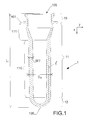
- Figure 1 shows a plastic preform 1 suitable to be stretch blow molded in order to form a pressure-resistant aerosol plastic container
- This preform 1 is made of a substantially tubular body of axial length L 1 , which is closed at its bottom end and has a pouring opening at its upper end. More especially, said preform 1 comprises a neck portion 10 terminated by a pouring opening 100, a so-called gate portion 12 forming a closed bottom end, and a body portion 11 that is extending between said gate portion 12 and said neck portion 10.
- the neck portion 10 comprises a protruding neck support ring 101 of bigger diameter.
- the body portion 11 comprises a main cylindrical portion 110 of substantially constant wall thickness WT and an upper transition portion 111. The inner face of the main portion 110 can be also conical.
- the gate portion 12 is made of a convex portion having substantially a hemi-spherical shape, and terminated by a small central protruding injection point 20.
- the size of this injection point 20 corresponds to the size of the output orifice of the hot runner nozzle that is being used for injecting the plastic material in the mould.
- the shape of the gate portion 12 is not necessarily hemi-spherical, but the gate portion 12 can have any other shape, and in particular can be for example conical.
- this preform 1 is biaxially stretch blow molded in a mould
- the neck portion 10 is used for maintaining the preform in the blowing mould, and is thus not stretched.
- the body portion 11 is biaxially stretched (in a longitudinal direction X and in a radial direction Y) in order to form a container body of higher volume.
- the gate portion 12 is also biaxially stretched in order to form typically the bottom base of the injection stretch blow molded container.
- a "one stage process” or a “two stages process” can be used.
- the stretch-blow moulding step of the preform is performed in line immediately after the first injection step (preform injection).
- the stretch-blow moulding step of the preform is postponed, and a reheating of the preform is performed prior to this stretch-blow molding step.
- the final shape and size of the container will depend of the blow mold that is being used and of the stretch ratios that are practiced.
- the preform 1 can thus be stretch blow molded in order to make the pressure-resistant aerosol container 20 of figure 2 .
- the invention is however not limited to the particular shape or dimensions of the aerosol container 20 of figure 2 .
- the base 202 ( figure 2 ) of the aerosol container 20 is not necessarily spherical like the container depicted on figure 2 , but can be of any shape. More especially, the base 202 of the aerosol container 20 can also be a base including an inwardly-oriented central dome, also commonly called “champagne "base, or can be a "petaloid " base like for example the base of the container of figure 8D of WO 2007/140407 .
- the sidewall of the container comprises a main central portion 203 which is concave and forms a kind of hyperboloid configuration, which provides a very ergonomic structure that can be easily handled by a user.
- the sidewall of the container 2 can have any other shape, including straight wall portion, convex wall portions, etc...
- the polymeric material used for making the preform 1 or container 2 is a copolyester including at least 1 mole % of isosorbide as comonomer and having an intrinsic viscosity of at least 0.7 dL/g, more preferably of at least 0.8 dL/g, and even more preferably of at least 0.9 dL/g.
- the intrinsic viscosity of the Isosorbide containing copolyester has generally to be increased for example by carrying out a Solid State Polymerization (SSP) of the copolyester for a period sufficient to achieve the required minimum IV.
- SSP Solid State Polymerization
- This increase of IV enables advantageously to lower the NSR of the isosorbide containing polyester and to at least partially compensate the increase of the NSR caused by the incorporation of isosorbide in the copolyester.
- the required IV level can however also be obtained directly, i.e. without a SSP post-treatment, by carrying out a suitable polymerization process.
- the isosorbide containing polyester comprises a copolyester that includes at least 5 mole % of isosorbide as comonomer.
- the isosorbide containing polyester comprises a copolyester that includes not more than 15 mole % of isosorbide as comonomer, and even more preferably not more than 8 mole % of isosorbide as comonomer.
- the isosorbide containing copolyester may be formed by any method known in the art.
- the polyester is formed by solvent or melt polymerization.
- the isosorbide containing copolyester is Polyethylene Terephtalate containing Isosorbide (PEIT), although other polyesters are also suitable for practicing the invention.
- PEIT Polyethylene Terephtalate containing Isosorbide
- the isosorbide containing copolyester comprises terephthaloyl moieties; optionally, one or more other aromatic diacid moieties; ethylene glycol moieties; isosorbide moieties; and, optionally one or more other diol moieties.
- terephthaloyl moieties can be derived from terephthalic acid or dimethyl terephthalate.
- isosorbide containing copolyester can further comprise diethylene glycol moieties
- Aforesaid one or more other diol moieties can be derived from aliphatic alkylene glycols or branched aliphatic glycols having from 3-12 carbon atoms and having the empirical formula HO-CnH2n-OH, where n is an integer from 3-12; including branched diols such as 2,2-dimethyl-1,3-propanediol; cis or trans-1, 4-cyclohexanedimethanol and mixtures of the cis and trans isomers; triethylene glycol; 2,2-bis [4- (2- hydroxyethoxy) phenyl] propane; 1,1-bis [4- (2- hydroxyethoxy) phenyl] cyclohexane; 9,9-bis [4- (2hydroxyethoxy) phenyl] fluorene; 1,4: 1,4: 3,6-dianhydromannitol; 1,4: 1,4: 3,6-dianhydroiditol; and 1,4-anhydroeryth
- the number of terephthaloyl moieties in the polymer is in the range of about 25% to about 75 mole % (mole % of the total polymer).
- ethylene glycol monomer units are present in amounts of about 5 mole % to about 49.75 mole %.
- the polymer may also contain diethylene glycol moieties. Depending on the method of manufacture, the amount of diethylene glycol moieties is for example in the range of about 0.0 mole % to about 25 mole %.
- the mold blowing step was performed with an axial stretch ratio S a around 2.4mm.
- the first batch (Ref. A) of ISBM aerosol containers was made from Polyethylene Terephthalate containing Isosorbide (PEIT) [i.e. Poly(etyhylene-co-isosorbide) terephthalate] . More particularly, said PEIT was containing 5.8mole% of Isosorbide (5.8 mole %PEIT). This 5.8 mole% PEIT was obtained in a known way by melt polymerization. This 5.8 mole% PEIT issued from the melt polymerization was subjected to a SSP during a period of time sufficient to raise the IV of the Isosorbide containing copolyester up to about 0.95 dL/g.
- PEIT Polyethylene Terephthalate containing Isosorbide
- the second batch (Ref B) of ISBM aerosol containers was made from a PET resin of standard grade having an intrinsic viscosity of about 0.86 dL/g.
- the third batch (Ref;C) of ISBM aerosol containers was made from a PET resin having an intrinsic viscosity of about 0.95 dL/g.
- Said PET resin was a copolymer PET commercialized by Artenius Tech Polymers under commercial reference "Artenius HOT”.
- the intrinsic viscosity (IV) of the resin before injection was measured pursuant to following method based on the ISO 1628 standard:
- the intrinsic viscosity (IV) of the preforms of the three batches was also measured by carrying out the aforesaid method with m-cresol as solvent. The results showed an IV drop due to a degradation of the polymer during the injection process.
- the IV of the preforms of the first batch (Ref.A) was around 0.8dL/g.
- the IV of the preforms of the second batch (Ref.B) was around 0.73dL/g.
- the IV of the preforms of the third batch (Ref.C) was around 0.78dL/g.
- the glass transition temperature (Tg) of the resins was knowingly measured by Differential Scanning Calorimetry (DSC) with an equipment DSC 821e from Mettler Toledo.
- the Tg of the 5.8 mole% PEIT (Ref.A) was around 89.6°C.
- the Tg of the PET resin of the second batch (Ref.B) was around 79.6C.
- the Tg of the PET resin of the third batch (Ref.C) was around t 79.5°C.
- Test pressure needs to be 50% higher than the internal pressure in the container at 50°C.
- the goal of this test is to evaluate the container when it is dropped from a height of 1.8m to a concrete floor and this at different temperatures. Ensure that the orientation, of the test container at drop is statistically random, but that direct impact on the valve or valve closure is avoided.
- Aerosol containers must be designed that it shall not break or leak.
- the goal of this test is to evaluate the ability of an aerosol container to withstand to a certain internal pressure. Pressure at which the container is bursting needs to be minimum 20% higher than the test pressure.
- the goal of this test is to indicate the temperature where the deformation of the container is induced. Temperature for this test is 7°C lower than Tg with a max. test temperature of 75°C and min temperature of 65°C. It is allowed that the containers deform, but without breakage or leakage creating a hazardous environment.
- the goal of this test is to evaluate the aerosol containers resistance to a vertical load before its first deformation.
- Equipment used for this test is the INSTRON 3366 Top load tester with a load cell of 5000N. The result is the maximum compressive load (in kgf) a container can withstand before it loses 1% of the compressive load applied. Test is done with a speed of 50mm/min.
- the objective of the accelerated stress cracking is to simulate stress experienced by containers during pressure filling, shipping and storage.
- the test is performed as follows :
- the goal of this test is to measure the Oxygen transmission rate of the aerosol container.
- Equipment used to determine the permeation is the MOCON Oxtran 2/20 that uses a Coulometric Sensor (Coulox) to determine the 02 concentration.
- Test method used is derived from the ASTM D 3985 and the ASTM F 1307.
- the Aerosol container is mounted on a metal fixture and flushed with N2 to purge the air out of the bottle. As the outside of the bottle is in contact with ambient air (20.9% O 2 ), O 2 permeates trough the bottle wall and is transported with the N 2 flow to the Coulox Sensor.
- the test is performed as follows :
- Table IIA To load Test- Ref.
- A Average Standard Deviation Min Max Force (Kg) 70.7 4.96 66.0 80.0 Location of failure Finish pushed into the shoulder
- Table IIB To load Test- Ref.
- B Average Standard Deviation Min Max Force (Kg) 74.8 1.05 73.1 76.3 Location of failure Finish pushed into the shoulder
- IIC To load Test- Ref.
- C Average Standard Deviation Min Max Force (Kg) 83.4 3.22 77.6 88.4 Location of failure Finish pushed into the shoulder or deformation of the body
- Table III Permeation- Ref A. Brimfull volume (ml) 333.82 (cm 3 /day) 0.026832 ppm(day) 0.11 ppm/year 41.94
- the invention is not limited to an injection stretch blow molded aerosol container made from a copolyester including at least 1 mole % of isosorbide as comonomer and having an intrinsic viscosity of at least about 0.7 dL/g.
- the invention can be also practiced with a polymer blend comprising said copolyester including at least 1 mole % of isosorbide as comonomer and having an intrinsic viscosity of at least about 0.7 dL/g and another polymer, in particular another polyester.
Landscapes
- Engineering & Computer Science (AREA)
- Mechanical Engineering (AREA)
- Chemical & Material Sciences (AREA)
- Dispersion Chemistry (AREA)
- Containers Having Bodies Formed In One Piece (AREA)
- Blow-Moulding Or Thermoforming Of Plastics Or The Like (AREA)
- Containers And Packaging Bodies Having A Special Means To Remove Contents (AREA)
- Compositions Of Macromolecular Compounds (AREA)
- Polyesters Or Polycarbonates (AREA)
Priority Applications (11)
| Application Number | Priority Date | Filing Date | Title |
|---|---|---|---|
| EP20130180376 EP2837581A1 (de) | 2013-08-14 | 2013-08-14 | Kunststoff-Aerosolbehälter aus isosorbidhaltigem Copolyester und Aerosolspender mit diesem Kunststoff-Aerosolbehälter |
| CN201480050690.XA CN105658539A (zh) | 2013-08-14 | 2014-08-07 | 由包含异山梨醇的共聚酯制成的气溶胶塑料容器和包括所述气溶胶塑料容器的气溶胶分配器 |
| MX2016001991A MX2016001991A (es) | 2013-08-14 | 2014-08-07 | Contenedor de plastico de aerosol hecho de un copoliester que contiene isosorbida y dispensador de aerosol que comprende dicho contenedor de plastico de aerosol. |
| BR112016002884A BR112016002884A2 (pt) | 2013-08-14 | 2014-08-07 | pré-forma plástica, recipiente de aerossol e distribuidor de aerossol |
| AU2014307974A AU2014307974A1 (en) | 2013-08-14 | 2014-08-07 | Aerosol plastic container made from an isosorbide containing copolyester and aerosol dispenser comprising said aerosol plastic container |
| RU2016108984A RU2016108984A (ru) | 2013-08-14 | 2014-08-07 | Пластиковый аэрозольный контейнер, изготовленный из сополиэфира, содержащего изосорбид, и аэрозольный дозатор, содержащий указанный пластиковый аэрозольный контейнер аэрозоля |
| PCT/EP2014/066958 WO2015022254A1 (en) | 2013-08-14 | 2014-08-07 | Aerosol plastic container made from an isosorbide containing copolyester and aerosol dispenser comprising said aerosol plastic container |
| US14/911,540 US20160185510A1 (en) | 2013-08-14 | 2014-08-07 | Aerosol plastic container made from an isosorbide containing copolyester and aerosol dispenser comprising said aerosol plastic container |
| CA2919889A CA2919889A1 (en) | 2013-08-14 | 2014-08-07 | Aerosol plastic container made from an isosorbide containing copolyester and aerosol dispenser comprising said aerosol plastic container |
| JP2016533893A JP2016529171A (ja) | 2013-08-14 | 2014-08-07 | イソソルビド含有コポリエステルから形成されたエアロゾルプラスチック容器及び前記エアロゾルプラスチック容器を含むエアロゾルディスペンサー |
| ZA2016/00794A ZA201600794B (en) | 2013-08-14 | 2016-02-04 | Aerosol plastic container made from an isosorbide containing copolyester and aerosol dispenser comprising said aerosol plastic container |
Applications Claiming Priority (1)
| Application Number | Priority Date | Filing Date | Title |
|---|---|---|---|
| EP20130180376 EP2837581A1 (de) | 2013-08-14 | 2013-08-14 | Kunststoff-Aerosolbehälter aus isosorbidhaltigem Copolyester und Aerosolspender mit diesem Kunststoff-Aerosolbehälter |
Publications (1)
| Publication Number | Publication Date |
|---|---|
| EP2837581A1 true EP2837581A1 (de) | 2015-02-18 |
Family
ID=48985624
Family Applications (1)
| Application Number | Title | Priority Date | Filing Date |
|---|---|---|---|
| EP20130180376 Withdrawn EP2837581A1 (de) | 2013-08-14 | 2013-08-14 | Kunststoff-Aerosolbehälter aus isosorbidhaltigem Copolyester und Aerosolspender mit diesem Kunststoff-Aerosolbehälter |
Country Status (11)
| Country | Link |
|---|---|
| US (1) | US20160185510A1 (de) |
| EP (1) | EP2837581A1 (de) |
| JP (1) | JP2016529171A (de) |
| CN (1) | CN105658539A (de) |
| AU (1) | AU2014307974A1 (de) |
| BR (1) | BR112016002884A2 (de) |
| CA (1) | CA2919889A1 (de) |
| MX (1) | MX2016001991A (de) |
| RU (1) | RU2016108984A (de) |
| WO (1) | WO2015022254A1 (de) |
| ZA (1) | ZA201600794B (de) |
Cited By (3)
| Publication number | Priority date | Publication date | Assignee | Title |
|---|---|---|---|---|
| WO2015155424A1 (fr) * | 2014-04-10 | 2015-10-15 | Fareva | Generateur aerosol en matiere plastique |
| WO2018024995A1 (fr) * | 2016-08-05 | 2018-02-08 | Roquette Freres | Utilisation d'un polyester thermoplastique pour la fabrication de pieces injectees |
| EP3395855A4 (de) * | 2015-12-24 | 2019-07-24 | SK Chemicals Co., Ltd. | Polyesterharz, verfahren zur herstellung davon und daraus geformtes harzformprodukt |
Families Citing this family (7)
| Publication number | Priority date | Publication date | Assignee | Title |
|---|---|---|---|---|
| US20170341849A1 (en) * | 2016-05-27 | 2017-11-30 | S.C. Johnson & Son, Inc. | Plastic bottle and base cup for a pressurized dispensing system |
| FR3054830B1 (fr) * | 2016-08-02 | 2020-12-11 | Roquette Freres | Polyester thermoplastique semi-cristallin pour la fabrication de corps creux bi-etires |
| FR3054831B1 (fr) * | 2016-08-02 | 2020-11-06 | Roquette Freres | Polyester thermoplastique semi-cristallin pour la fabrication de contenant d'aerosol |
| KR102568743B1 (ko) | 2017-05-31 | 2023-08-22 | 에스케이케미칼 주식회사 | 폴리에스테르 수지, 이의 제조 방법 및 이로부터 형성된 수지 성형품 |
| KR102568693B1 (ko) | 2017-06-02 | 2023-08-21 | 에스케이케미칼 주식회사 | 폴리에스테르 섬유, 이의 제조 방법 및 이로부터 형성된 성형체 |
| EP3643734A4 (de) * | 2017-06-22 | 2021-04-07 | SK Chemicals, Co., Ltd. | Polyesterbehälter und herstellungsverfahren dafür |
| KR102684863B1 (ko) | 2017-06-26 | 2024-07-15 | 에스케이케미칼 주식회사 | 폴리에스테르 필름 및 이의 제조 방법 |
Citations (7)
| Publication number | Priority date | Publication date | Assignee | Title |
|---|---|---|---|---|
| WO1999054533A1 (en) * | 1998-04-23 | 1999-10-28 | E.I. Du Pont De Nemours And Company | Polyester container and method for making same |
| US20040149781A1 (en) | 2003-01-31 | 2004-08-05 | Kunesh Edward J. | Pressurized plastic bottle for dispensing an aerosol |
| US20050127022A1 (en) * | 2003-12-16 | 2005-06-16 | Flashinski Stanley J. | Pressurized plastic bottle with reinforced neck and shoulder for dispensing an aerosol |
| JP2006070101A (ja) | 2004-08-31 | 2006-03-16 | Mitsubishi Chemicals Corp | ポリエステル樹脂および樹脂組成物ならびに延伸ブロー成形用プリフォーム及び中空容器 |
| JP2006089629A (ja) * | 2004-09-24 | 2006-04-06 | Mitsubishi Chemicals Corp | ポリエステル樹脂 |
| WO2007140407A2 (en) | 2006-05-31 | 2007-12-06 | The Clorox Company | Ergonomic plastic aerosol container |
| US20130037580A1 (en) | 2011-08-01 | 2013-02-14 | Graham Packaging Company, Lp | Plastic aerosol container and method of manufacture |
Family Cites Families (3)
| Publication number | Priority date | Publication date | Assignee | Title |
|---|---|---|---|---|
| CN2129745Y (zh) * | 1992-04-10 | 1993-04-14 | 天津印铁制罐公司 | 双室气雾容器 |
| WO2003104109A1 (en) * | 2002-06-11 | 2003-12-18 | Iptech Limited | A dispenser |
| KR20110028696A (ko) * | 2009-09-14 | 2011-03-22 | 에스케이케미칼주식회사 | 아이소소바이드와 1,4-사이클로헥산디메탄올이 공중합된 폴리에스테르 수지 및 그 제조방법 |
-
2013
- 2013-08-14 EP EP20130180376 patent/EP2837581A1/de not_active Withdrawn
-
2014
- 2014-08-07 AU AU2014307974A patent/AU2014307974A1/en not_active Abandoned
- 2014-08-07 BR BR112016002884A patent/BR112016002884A2/pt not_active IP Right Cessation
- 2014-08-07 US US14/911,540 patent/US20160185510A1/en not_active Abandoned
- 2014-08-07 JP JP2016533893A patent/JP2016529171A/ja active Pending
- 2014-08-07 WO PCT/EP2014/066958 patent/WO2015022254A1/en not_active Ceased
- 2014-08-07 RU RU2016108984A patent/RU2016108984A/ru not_active Application Discontinuation
- 2014-08-07 MX MX2016001991A patent/MX2016001991A/es unknown
- 2014-08-07 CN CN201480050690.XA patent/CN105658539A/zh active Pending
- 2014-08-07 CA CA2919889A patent/CA2919889A1/en not_active Abandoned
-
2016
- 2016-02-04 ZA ZA2016/00794A patent/ZA201600794B/en unknown
Patent Citations (7)
| Publication number | Priority date | Publication date | Assignee | Title |
|---|---|---|---|---|
| WO1999054533A1 (en) * | 1998-04-23 | 1999-10-28 | E.I. Du Pont De Nemours And Company | Polyester container and method for making same |
| US20040149781A1 (en) | 2003-01-31 | 2004-08-05 | Kunesh Edward J. | Pressurized plastic bottle for dispensing an aerosol |
| US20050127022A1 (en) * | 2003-12-16 | 2005-06-16 | Flashinski Stanley J. | Pressurized plastic bottle with reinforced neck and shoulder for dispensing an aerosol |
| JP2006070101A (ja) | 2004-08-31 | 2006-03-16 | Mitsubishi Chemicals Corp | ポリエステル樹脂および樹脂組成物ならびに延伸ブロー成形用プリフォーム及び中空容器 |
| JP2006089629A (ja) * | 2004-09-24 | 2006-04-06 | Mitsubishi Chemicals Corp | ポリエステル樹脂 |
| WO2007140407A2 (en) | 2006-05-31 | 2007-12-06 | The Clorox Company | Ergonomic plastic aerosol container |
| US20130037580A1 (en) | 2011-08-01 | 2013-02-14 | Graham Packaging Company, Lp | Plastic aerosol container and method of manufacture |
Non-Patent Citations (3)
| Title |
|---|
| "Blow Molding Handbook", 1989 |
| DATABASE WPI Week 200627, Derwent World Patents Index; AN 2006-258070, XP002718169 * |
| RAMESH M. GOHIL: "Properties and Strain Hardening Character of Polyethylene Terephthalate Containing Isosorbide", POLYMERS ENGINEERING AND SCIENCE, 2009, pages 544 - 553 |
Cited By (6)
| Publication number | Priority date | Publication date | Assignee | Title |
|---|---|---|---|---|
| WO2015155424A1 (fr) * | 2014-04-10 | 2015-10-15 | Fareva | Generateur aerosol en matiere plastique |
| EP3395855A4 (de) * | 2015-12-24 | 2019-07-24 | SK Chemicals Co., Ltd. | Polyesterharz, verfahren zur herstellung davon und daraus geformtes harzformprodukt |
| US11279799B2 (en) | 2015-12-24 | 2022-03-22 | Sk Chemicals Co., Ltd. | Polyester resin, preparation method thereof, and resin molded article formed therefrom |
| WO2018024995A1 (fr) * | 2016-08-05 | 2018-02-08 | Roquette Freres | Utilisation d'un polyester thermoplastique pour la fabrication de pieces injectees |
| FR3054804A1 (fr) * | 2016-08-05 | 2018-02-09 | Roquette Freres | Utilisation d'un polyester thermoplastique pour la fabrication de pieces injectees |
| CN109562543A (zh) * | 2016-08-05 | 2019-04-02 | 罗盖特公司 | 热塑性聚酯用于生产注塑部件的用途 |
Also Published As
| Publication number | Publication date |
|---|---|
| JP2016529171A (ja) | 2016-09-23 |
| RU2016108984A (ru) | 2017-09-19 |
| CN105658539A (zh) | 2016-06-08 |
| BR112016002884A2 (pt) | 2017-08-01 |
| WO2015022254A1 (en) | 2015-02-19 |
| AU2014307974A1 (en) | 2016-02-18 |
| ZA201600794B (en) | 2017-04-26 |
| MX2016001991A (es) | 2016-05-18 |
| US20160185510A1 (en) | 2016-06-30 |
| CA2919889A1 (en) | 2015-02-19 |
Similar Documents
| Publication | Publication Date | Title |
|---|---|---|
| EP2837581A1 (de) | Kunststoff-Aerosolbehälter aus isosorbidhaltigem Copolyester und Aerosolspender mit diesem Kunststoff-Aerosolbehälter | |
| EP2029456B1 (de) | Plastik-druckspender | |
| US5780130A (en) | Container and method of making container from polyethylene naphthalate and copolymers thereof | |
| EP1562728B1 (de) | Zusammensetzung aus polyethyleneterephthalatcopolymeren mit verbesserten mechanischen eigenschaften und streckverhältnis, daraus hergestellte artikel und verfahren | |
| EP0734316B2 (de) | Mehrschichtiger vorformling und behälter aus polyäthylennaphtalat (pen) und dessen herstellungsverfahren | |
| EP1885602B9 (de) | Leichter streckblasgeformter pet-copolymerbehälter und vorformling zur herstellung desselben | |
| EP1651527B1 (de) | Zusammensetzung zur herstellung eines verpackungsartikels mit sauerstoffentfernungseigenschaften und geringer trübung | |
| HU225712B1 (en) | Pressurized refill container and method of making | |
| US7572493B2 (en) | Low IV pet based copolymer preform with enhanced mechanical properties and cycle time, container made therewith and methods | |
| JP2016536172A (ja) | フラン酸ポリマーのプリフォーム、容器および加工 | |
| EP2168752A2 (de) | Streckblasformverfahren sowie Behälter | |
| WO2011049640A1 (en) | Biodegradable material and container for fluids | |
| EP2029455B1 (de) | Nicht runder druckspender aus kunststoff | |
| EP3458246B1 (de) | Verfahren zur herstellung einer flasche aus einem polymermaterial und flasche | |
| JP2021133987A (ja) | ポリエステル製容器及びその製造方法 | |
| JPH0524815B2 (de) | ||
| JP2021533222A (ja) | ポリエステル製プリフォーム | |
| EP4149738B1 (de) | Mehrschichtiger vorformling und behälter | |
| CN111465558A (zh) | 瓶、其制造方法以及fdca和二醇单体在该瓶中的用途 | |
| ES3004562T3 (en) | Preform made of polyester |
Legal Events
| Date | Code | Title | Description |
|---|---|---|---|
| 17P | Request for examination filed |
Effective date: 20130814 |
|
| AK | Designated contracting states |
Kind code of ref document: A1 Designated state(s): AL AT BE BG CH CY CZ DE DK EE ES FI FR GB GR HR HU IE IS IT LI LT LU LV MC MK MT NL NO PL PT RO RS SE SI SK SM TR |
|
| AX | Request for extension of the european patent |
Extension state: BA ME |
|
| PUAI | Public reference made under article 153(3) epc to a published international application that has entered the european phase |
Free format text: ORIGINAL CODE: 0009012 |
|
| R17P | Request for examination filed (corrected) |
Effective date: 20150817 |
|
| RAX | Requested extension states of the european patent have changed |
Extension state: ME Payment date: 20150817 Extension state: BA Payment date: 20150817 |
|
| RBV | Designated contracting states (corrected) |
Designated state(s): AL AT BE BG CH CY CZ DE DK EE ES FI FR GB GR HR HU IE IS IT LI LT LU LV MC MK MT NL NO PL PT RO RS SE SI SK SM TR |
|
| RAP1 | Party data changed (applicant data changed or rights of an application transferred) |
Owner name: PLASTIPAK BAWT S.A.R.L. |
|
| TPAC | Observations filed by third parties |
Free format text: ORIGINAL CODE: EPIDOSNTIPA |
|
| STAA | Information on the status of an ep patent application or granted ep patent |
Free format text: STATUS: THE APPLICATION IS DEEMED TO BE WITHDRAWN |
|
| 18D | Application deemed to be withdrawn |
Effective date: 20180301 |