EP2837687B1 - Verfahren zur herstellung von chemikalien durch kontinuierliche fermentation sowie vorrichtung für die durchführung einer kontinuierlichen fermentation - Google Patents
Verfahren zur herstellung von chemikalien durch kontinuierliche fermentation sowie vorrichtung für die durchführung einer kontinuierlichen fermentation Download PDFInfo
- Publication number
- EP2837687B1 EP2837687B1 EP13770154.6A EP13770154A EP2837687B1 EP 2837687 B1 EP2837687 B1 EP 2837687B1 EP 13770154 A EP13770154 A EP 13770154A EP 2837687 B1 EP2837687 B1 EP 2837687B1
- Authority
- EP
- European Patent Office
- Prior art keywords
- gas
- separation membrane
- fermentor
- chemical
- fermentation
- Prior art date
- Legal status (The legal status is an assumption and is not a legal conclusion. Google has not performed a legal analysis and makes no representation as to the accuracy of the status listed.)
- Not-in-force
Links
Images


Classifications
-
- C—CHEMISTRY; METALLURGY
- C12—BIOCHEMISTRY; BEER; SPIRITS; WINE; VINEGAR; MICROBIOLOGY; ENZYMOLOGY; MUTATION OR GENETIC ENGINEERING
- C12P—FERMENTATION OR ENZYME-USING PROCESSES TO SYNTHESISE A DESIRED CHEMICAL COMPOUND OR COMPOSITION OR TO SEPARATE OPTICAL ISOMERS FROM A RACEMIC MIXTURE
- C12P13/00—Preparation of nitrogen-containing organic compounds
- C12P13/04—Alpha- or beta- amino acids
- C12P13/24—Proline; Hydroxyproline; Histidine
-
- C—CHEMISTRY; METALLURGY
- C12—BIOCHEMISTRY; BEER; SPIRITS; WINE; VINEGAR; MICROBIOLOGY; ENZYMOLOGY; MUTATION OR GENETIC ENGINEERING
- C12P—FERMENTATION OR ENZYME-USING PROCESSES TO SYNTHESISE A DESIRED CHEMICAL COMPOUND OR COMPOSITION OR TO SEPARATE OPTICAL ISOMERS FROM A RACEMIC MIXTURE
- C12P7/00—Preparation of oxygen-containing organic compounds
- C12P7/40—Preparation of oxygen-containing organic compounds containing a carboxyl group including Peroxycarboxylic acids
- C12P7/56—Lactic acid
-
- C—CHEMISTRY; METALLURGY
- C12—BIOCHEMISTRY; BEER; SPIRITS; WINE; VINEGAR; MICROBIOLOGY; ENZYMOLOGY; MUTATION OR GENETIC ENGINEERING
- C12M—APPARATUS FOR ENZYMOLOGY OR MICROBIOLOGY; APPARATUS FOR CULTURING MICROORGANISMS FOR PRODUCING BIOMASS, FOR GROWING CELLS OR FOR OBTAINING FERMENTATION OR METABOLIC PRODUCTS, i.e. BIOREACTORS OR FERMENTERS
- C12M29/00—Means for introduction, extraction or recirculation of materials, e.g. pumps
- C12M29/04—Filters; Permeable or porous membranes or plates, e.g. dialysis
-
- C—CHEMISTRY; METALLURGY
- C12—BIOCHEMISTRY; BEER; SPIRITS; WINE; VINEGAR; MICROBIOLOGY; ENZYMOLOGY; MUTATION OR GENETIC ENGINEERING
- C12M—APPARATUS FOR ENZYMOLOGY OR MICROBIOLOGY; APPARATUS FOR CULTURING MICROORGANISMS FOR PRODUCING BIOMASS, FOR GROWING CELLS OR FOR OBTAINING FERMENTATION OR METABOLIC PRODUCTS, i.e. BIOREACTORS OR FERMENTERS
- C12M33/00—Means for introduction, transport, positioning, extraction, harvesting, peeling or sampling of biological material in or from the apparatus
- C12M33/14—Means for introduction, transport, positioning, extraction, harvesting, peeling or sampling of biological material in or from the apparatus with filters, sieves or membranes
-
- C—CHEMISTRY; METALLURGY
- C12—BIOCHEMISTRY; BEER; SPIRITS; WINE; VINEGAR; MICROBIOLOGY; ENZYMOLOGY; MUTATION OR GENETIC ENGINEERING
- C12M—APPARATUS FOR ENZYMOLOGY OR MICROBIOLOGY; APPARATUS FOR CULTURING MICROORGANISMS FOR PRODUCING BIOMASS, FOR GROWING CELLS OR FOR OBTAINING FERMENTATION OR METABOLIC PRODUCTS, i.e. BIOREACTORS OR FERMENTERS
- C12M41/00—Means for regulation, monitoring, measurement or control, e.g. flow regulation
- C12M41/30—Means for regulation, monitoring, measurement or control, e.g. flow regulation of concentration
- C12M41/34—Means for regulation, monitoring, measurement or control, e.g. flow regulation of concentration of gas
-
- C—CHEMISTRY; METALLURGY
- C12—BIOCHEMISTRY; BEER; SPIRITS; WINE; VINEGAR; MICROBIOLOGY; ENZYMOLOGY; MUTATION OR GENETIC ENGINEERING
- C12P—FERMENTATION OR ENZYME-USING PROCESSES TO SYNTHESISE A DESIRED CHEMICAL COMPOUND OR COMPOSITION OR TO SEPARATE OPTICAL ISOMERS FROM A RACEMIC MIXTURE
- C12P13/00—Preparation of nitrogen-containing organic compounds
- C12P13/001—Amines; Imines
-
- C—CHEMISTRY; METALLURGY
- C12—BIOCHEMISTRY; BEER; SPIRITS; WINE; VINEGAR; MICROBIOLOGY; ENZYMOLOGY; MUTATION OR GENETIC ENGINEERING
- C12P—FERMENTATION OR ENZYME-USING PROCESSES TO SYNTHESISE A DESIRED CHEMICAL COMPOUND OR COMPOSITION OR TO SEPARATE OPTICAL ISOMERS FROM A RACEMIC MIXTURE
- C12P13/00—Preparation of nitrogen-containing organic compounds
- C12P13/04—Alpha- or beta- amino acids
-
- C—CHEMISTRY; METALLURGY
- C12—BIOCHEMISTRY; BEER; SPIRITS; WINE; VINEGAR; MICROBIOLOGY; ENZYMOLOGY; MUTATION OR GENETIC ENGINEERING
- C12P—FERMENTATION OR ENZYME-USING PROCESSES TO SYNTHESISE A DESIRED CHEMICAL COMPOUND OR COMPOSITION OR TO SEPARATE OPTICAL ISOMERS FROM A RACEMIC MIXTURE
- C12P13/00—Preparation of nitrogen-containing organic compounds
- C12P13/04—Alpha- or beta- amino acids
- C12P13/06—Alanine; Leucine; Isoleucine; Serine; Homoserine
-
- C—CHEMISTRY; METALLURGY
- C12—BIOCHEMISTRY; BEER; SPIRITS; WINE; VINEGAR; MICROBIOLOGY; ENZYMOLOGY; MUTATION OR GENETIC ENGINEERING
- C12P—FERMENTATION OR ENZYME-USING PROCESSES TO SYNTHESISE A DESIRED CHEMICAL COMPOUND OR COMPOSITION OR TO SEPARATE OPTICAL ISOMERS FROM A RACEMIC MIXTURE
- C12P13/00—Preparation of nitrogen-containing organic compounds
- C12P13/04—Alpha- or beta- amino acids
- C12P13/08—Lysine; Diaminopimelic acid; Threonine; Valine
-
- C—CHEMISTRY; METALLURGY
- C12—BIOCHEMISTRY; BEER; SPIRITS; WINE; VINEGAR; MICROBIOLOGY; ENZYMOLOGY; MUTATION OR GENETIC ENGINEERING
- C12P—FERMENTATION OR ENZYME-USING PROCESSES TO SYNTHESISE A DESIRED CHEMICAL COMPOUND OR COMPOSITION OR TO SEPARATE OPTICAL ISOMERS FROM A RACEMIC MIXTURE
- C12P13/00—Preparation of nitrogen-containing organic compounds
- C12P13/04—Alpha- or beta- amino acids
- C12P13/10—Citrulline; Arginine; Ornithine
-
- C—CHEMISTRY; METALLURGY
- C12—BIOCHEMISTRY; BEER; SPIRITS; WINE; VINEGAR; MICROBIOLOGY; ENZYMOLOGY; MUTATION OR GENETIC ENGINEERING
- C12P—FERMENTATION OR ENZYME-USING PROCESSES TO SYNTHESISE A DESIRED CHEMICAL COMPOUND OR COMPOSITION OR TO SEPARATE OPTICAL ISOMERS FROM A RACEMIC MIXTURE
- C12P13/00—Preparation of nitrogen-containing organic compounds
- C12P13/04—Alpha- or beta- amino acids
- C12P13/12—Methionine; Cysteine; Cystine
-
- C—CHEMISTRY; METALLURGY
- C12—BIOCHEMISTRY; BEER; SPIRITS; WINE; VINEGAR; MICROBIOLOGY; ENZYMOLOGY; MUTATION OR GENETIC ENGINEERING
- C12P—FERMENTATION OR ENZYME-USING PROCESSES TO SYNTHESISE A DESIRED CHEMICAL COMPOUND OR COMPOSITION OR TO SEPARATE OPTICAL ISOMERS FROM A RACEMIC MIXTURE
- C12P13/00—Preparation of nitrogen-containing organic compounds
- C12P13/04—Alpha- or beta- amino acids
- C12P13/14—Glutamic acid; Glutamine
-
- C—CHEMISTRY; METALLURGY
- C12—BIOCHEMISTRY; BEER; SPIRITS; WINE; VINEGAR; MICROBIOLOGY; ENZYMOLOGY; MUTATION OR GENETIC ENGINEERING
- C12P—FERMENTATION OR ENZYME-USING PROCESSES TO SYNTHESISE A DESIRED CHEMICAL COMPOUND OR COMPOSITION OR TO SEPARATE OPTICAL ISOMERS FROM A RACEMIC MIXTURE
- C12P13/00—Preparation of nitrogen-containing organic compounds
- C12P13/04—Alpha- or beta- amino acids
- C12P13/20—Aspartic acid; Asparagine
-
- C—CHEMISTRY; METALLURGY
- C12—BIOCHEMISTRY; BEER; SPIRITS; WINE; VINEGAR; MICROBIOLOGY; ENZYMOLOGY; MUTATION OR GENETIC ENGINEERING
- C12P—FERMENTATION OR ENZYME-USING PROCESSES TO SYNTHESISE A DESIRED CHEMICAL COMPOUND OR COMPOSITION OR TO SEPARATE OPTICAL ISOMERS FROM A RACEMIC MIXTURE
- C12P13/00—Preparation of nitrogen-containing organic compounds
- C12P13/04—Alpha- or beta- amino acids
- C12P13/22—Tryptophan; Tyrosine; Phenylalanine; 3,4-Dihydroxyphenylalanine
- C12P13/222—Phenylalanine
-
- C—CHEMISTRY; METALLURGY
- C12—BIOCHEMISTRY; BEER; SPIRITS; WINE; VINEGAR; MICROBIOLOGY; ENZYMOLOGY; MUTATION OR GENETIC ENGINEERING
- C12P—FERMENTATION OR ENZYME-USING PROCESSES TO SYNTHESISE A DESIRED CHEMICAL COMPOUND OR COMPOSITION OR TO SEPARATE OPTICAL ISOMERS FROM A RACEMIC MIXTURE
- C12P13/00—Preparation of nitrogen-containing organic compounds
- C12P13/04—Alpha- or beta- amino acids
- C12P13/22—Tryptophan; Tyrosine; Phenylalanine; 3,4-Dihydroxyphenylalanine
- C12P13/225—Tyrosine; 3,4-Dihydroxyphenylalanine
-
- C—CHEMISTRY; METALLURGY
- C12—BIOCHEMISTRY; BEER; SPIRITS; WINE; VINEGAR; MICROBIOLOGY; ENZYMOLOGY; MUTATION OR GENETIC ENGINEERING
- C12P—FERMENTATION OR ENZYME-USING PROCESSES TO SYNTHESISE A DESIRED CHEMICAL COMPOUND OR COMPOSITION OR TO SEPARATE OPTICAL ISOMERS FROM A RACEMIC MIXTURE
- C12P13/00—Preparation of nitrogen-containing organic compounds
- C12P13/04—Alpha- or beta- amino acids
- C12P13/22—Tryptophan; Tyrosine; Phenylalanine; 3,4-Dihydroxyphenylalanine
- C12P13/227—Tryptophan
Definitions
- the present invention relates to a method of producing a chemical by continuous fermentation and a continuous fermentation apparatus.
- the present invention relates to a method of producing a chemical by continuous fermentation using a chemical production apparatus that is provided with a circulation system having a fermentor and a plurality of separation membrane units connected to the fermentor while a gas is supplied to the separation membrane units.
- a fermentation method that is a method of producing a substance involving culture of a microorganism or cultured cells can be roughly classified into (1) a batch fermentation method and a fed-batch or semi-batch fermentation method, and (2) a continuous fermentation method.
- the batch fermentation method and the fed-batch or semi-batch fermentation method have such advantages that facilities are simple, culture is completed in a short time, and the possibility of being contaminated with germs other than cultured bacteria in fermentation of a product by pure culture of bacteria is low.
- the concentration of a product in a culture solution increases with time, and the productivity and the yield decrease due to influences such as inhibition by the product and an increase in the osmotic pressure. Therefore, it is difficult to stably maintain high yield and high productivity for a long time.
- the filtration ability of the separation membrane decreases by an SS (suspended solid) and an adsorbate attached to a filtration face, and a necessary amount of filtrate may not be obtained.
- the present invention has been made in view of the above-described circumstances, and provides a method of producing a chemical by a continuous fermentation method in which a washing effect of a separation membrane by a gas is enhanced by a simple operation procedure while high productivity can be stably maintained for a long time.
- the present inventors have intensively investigated to solve the above-mentioned problems, and as a result, found that the washing effect of a separation membrane can be held and simultaneously the fermentation performance can be maintained by setting the supply amount of a gas containing oxygen to be supplied to a continuous fermentation apparatus on the basis of an optimal kLa value for cells to be cultured in the device and sequentially supplying the gas to a plurality of separation membrane units in a circulation system while the supply amount of the gas is changed to different amounts.
- the method of producing a chemical includes: a chemical production step of culturing cells in a culture solution in a fermentor to ferment a feedstock to produce a chemical, optionally including a gas supply step of supplying a gas containing oxygen to the fermentor; a culture solution supply step of supplying the culture solution containing the chemical produced in the chemical production step to a plurality of separation membrane units arranged in parallel; a filtration step of filtering the culture solution supplied in the culture solution supply step to separate a permeate containing the chemical; a reflux step of refluxing a retentate that is not filtered in the filtration step to the fermentor; and a washing step of supplying a gas containing oxygen to the plurality of separation membrane units while a supply amount of said gas is increased in sequence to perform scrubbing, and the flow rate of the gas supplied to the plurality of separation membrane units is changed to two or more levels and the separation membrane units are sequentially switched for supply of said gas with the largest flow rate, wherein the supply amount and supply time
- the filtration properties of a separation membrane can be stabilized for a long time, and at the same time a result of fermentation can be improved. Furthermore, a chemical as a fermentation product can be stably produced at low cost for a long time in various fermentation industries.
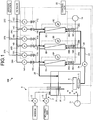
- FIG. 1 is a schematic view of the continuous fermentation apparatus according to the embodiment of the present invention.
- the number of the separation membrane units connected in parallel is not restricted, and is not limited as long as two or more separation membrane units are used.
- a continuous fermentation apparatus 100 includes a fermentor 1, separation membrane units 2A, 2B, and 2C, and pipes 23 and 25 that connect the fermentor 1 to the separation membrane units 2A, 2B, and 2C.
- the fermentor 1 and the separation membrane units 2A, 2B, and 2C are connected to one another through the pipes 23 and 25 to construct a circulation system.
- the fermentor 1 is configured so as to contain a culture solution thereinside.
- the fermentor 1 is made of a material having excellent pressure resistance, heat resistance, and fouling resistance.
- various shapes such as a cylindrical shape and a polygonal cylindrical shape can be used.
- the fermentor 1 needs to have such a shape capable of being charged with a fermentation raw material, cells, and a solid, a liquid, or a gas that is necessary for fermentation, and stirring them, being sterilized if necessary, and being sealed. From the viewpoint of stirring efficiency of the culture solution, it is preferable that the fermentor 1 be cylindrical.
- the inside of the fermentor 1 be maintained in a pressurization state.
- a mechanism such as a fermentor pressure gauge is provided.
- the separation membrane units 2A, 2B, and 2C include a large number of separation membranes such as hollow fiber membranes and flat membranes.
- the separation membrane units 2A, 2B, and 2C will be described below in detail.
- Each of the separation membrane units 2A, 2B, and 2C may include a plurality of separation membrane modules connected in serial.
- the continuous fermentation apparatus 100 includes a controller 22.
- the controller 22 can conduct various types of calculation.
- the controller 22 controls operations of each unit in the continuous fermentation apparatus 100 on the basis of detection results of various sensors, inputs by a user, and various settings.
- the continuous fermentation apparatus 100 includes a fermentor gas supply device 21, a temperature control unit 5, a stirrer 6, a pH control unit 7, and a level control unit 8 as mechanisms mainly involved in a fermentation process.
- the fermentor gas supply device 21 supplies a gas into the fermentor 1.
- the supplied gas may be collected and supplied into the fermentor 1 again by the fermentor gas supply device 21.
- the pressure in the fermentor 1 be kept higher than the outside air pressure.
- the temperature control unit 5 includes a temperature sensor and a temperature adjustment unit.
- the temperature sensor detects the temperature of the culture solution in the fermentor 1.
- the temperature adjustment unit is operated under control by the controller 22 so that a result detected by the temperature sensor falls within a certain range. Thus, a temperature environment suited for fermentation or cell proliferation is maintained by keeping the temperature in the fermentor 1 constant.
- the temperature adjustment unit can have one or both of heating and cooling functions.
- the stirrer 6 stirs the culture solution in the fermentor 1 to maintain a suitable fermentation environment.
- the pH control unit 7 includes a pH sensor 71 and a neutralizer supply pump 13.
- the pH sensor 71 detects the pH of the culture solution in the fermentor 1.
- the neutralizer supply pump 13 is disposed on a pipe that connects a neutralizer tank to the fermentor 1, and adds a neutralizer to the fermentor 1.
- the neutralizer supply pump 13 is operated under control by the controller 22 so that a result detected by the pH sensor 71 falls within a certain range.
- As the neutralizer an acid and/or an alkali are used.
- the level control unit 8 includes a level sensor 81 and a culture medium supply pump 12.
- the culture medium supply pump 12 is disposed on a pipe that connects a culture medium tank to the fermentor 1.
- the culture medium supply pump 12 is operated under control by the controller 22 so as to supply the culture medium to the fermentor 1.
- the operation of the culture medium supply pump 12 is stopped.
- the amount of the culture solution in the fermentor 1 is appropriately maintained.
- the continuous fermentation apparatus 100 has a circulation system for circulating the culture solution between the fermentor 1 and the separation membrane modules 2A, 2B, and 2C.
- the continuous fermentation apparatus 100 includes the pipe 23 that connects the fermentor 1 to the primary sides of the separation membrane units 2A, 2B, and 2C, and the pipe 25 of returning to the fermentor 1 a retentate that has not permeated separation membranes of the separation membrane units 2A, 2B, and 2C.
- the pipe 23 since the pipe 23 is connected to the lower portions of the separation membrane units 2A, 2B, and 2C, the culture solution is supplied from the lower portions of the separation membrane units 2A, 2B, and 2C.
- a circulation pump 24 is disposed on the pipe 23 for supplying the culture solution to the separation membrane units 2A, 2B, and 2C from the fermentor 1.
- the circulation pump 24 is operated so as to deliver the culture solution from the fermentor 1 toward the separation membrane units 2A, 2B, and 2C.
- the continuous fermentation apparatus 100 includes a pipe 26A that is connected to the separation membrane unit 2A and configured to discharge a filtrate (i.e., permeate) out of the apparatus.
- a filtration pump 14A is provided, and a filtration valve 15A is further provided.
- pipes 26B and 26C, filtration valves 15B and 15C, and filtration pumps 14B and 14C are provided for the separation membrane units 2B and 2C, respectively.
- the filtration valve 15A is disposed between the filtration pump 14A and the separation membrane unit 2A.
- the present invention is not limited to this arrangement.
- the continuous fermentation apparatus 100 has a configuration for back pressure washing the separation membrane unit 2A.
- Back pressure washing means that a separation membrane is washed by passing a liquid for washing (hereinafter sometimes referred to as "washing solution") from the secondary side of the separation membrane to the primary side thereof.
- the continuous fermentation apparatus 100 includes a washing solution tank configured to contain a washing solution, a pipe 27A for connecting the washing solution tank to the secondary side of the separation membrane unit 2A, a washing pump 16A disposed on the pipe 27A, and a washing valve 17A.
- a washing solution is delivered toward the separation membrane unit 2A by the washing pump 16A.
- On the pipe 27A a pressure gauge, a flow meter, a device for sterilization, a filter for sterilization, and the like may be provided.
- pipes 27B and 27C each for connecting the washing solution tank to the secondary side of the separation membrane unit, washing pumps 16B and 16C, and washing valves 17B and 17C are provided for the separation membrane units 2B and 2C, respectively.
- the washing valve 17A is disposed between the washing pump 16A and the separation membrane unit 2A.
- the present invention is not limited to this arrangement.
- a differential pressure control unit 9A can detect a transmembrane pressure difference (TPD) of the separation membrane unit 2A. Specifically, a pressure difference between the primary side (side in which a culture solution is supplied) and the secondary side (side in which a permeate, that is, a filtrate is discharged) of the separation membrane unit 2A is detected. Similarly, differential pressure control units 9B and 9C are provided for the separation membrane units 2B and 2C, respectively.
- TPD transmembrane pressure difference
- the continuous fermentation apparatus 100 has a configuration involved in scrubbing.
- Scrubbing is a washing method in which a gas is supplied to the primary sides of the separation membrane units 2A, 2B, and 2C and substances attached to a surface of the separation membranes are removed from the surface of the separation membranes by shaking of a liquid and a gas generated during passing of the gas through the separation membrane units.
- a side to come in contact with a stock solution to be treated is referred to as the primary side
- a side to come in contact with a treated filtrate is referred to as the secondary side.
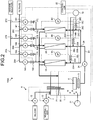
- a gas is supplied, especially to the separation membrane unit 2A through any of the lower portion of modules in the membrane unit and, as shown in FIG. 2 , the middle of a pipe that connects a junction 29 for each membrane unit to the membrane unit.
- a gas supply source, a gas supply port, and a mechanism capable of adjusting the supply rate of a gas from the gas supply source are especially provided.
- the separation membrane unit 2A is provided with a gas supply control valve 18A and a flow meter 20A.
- the separation membrane units 2B and 2C are each provided with a gas supply control valve 18B or 18C and a flow meter 20B or 20C.
- a gas is supplied from a scrubbing gas supply device 19 to the separation membrane units 2A, 2B, and 2C through pipes 28A, 28B, and 28C.
- the scrubbing gas supply device 19 may be provided to each of the separation membrane units 2A, 2B, and 2C.
- the scrubbing gas supply device 19 may be provided to each of the separation membrane modules, or the scrubbing gas supply device 19 may be commonly used for a plurality of units and modules.
- the scrubbing gas supply device 19 is connected to the separation membrane units 2A, 2B, and 2C on the primary side of the separation membranes, that is, on the side in which a culture solution is supplied, through the pipes 28A, 28B, and 28C.
- the pipes 28A, 28B, and 28C are different from the pipe 23 for supplying a culture solution to the separation membrane unit 2.
- the pipes 28A, 28B, and 28C are directly connected to the lower portions of the separation membrane modules in the separation membrane units 2A, 2B, and 2C. As shown in the modification of FIG.
- the pipes 28A, 28B, and 28C may be connected to the middle of pipes 23A, 23B, and 23C that each connect the junction 29 for each of the separation membrane units 2A, 2B, and 2C to each of the separation membrane units 2A, 2B, and 2C.
- the "lower portion” herein may mean a bottom portion of a separation membrane module or a portion within one third of the height from the bottom surface of the separation membrane module.
- the scrubbing gas supply device 19 can send a gas to the separation membrane units 2A, 2B, and 2C through the pipes 28A, 28B, and 28C.
- the gas supply control valves 18A, 18B, and 18C are disposed on the pipes 28A, 28B, and 28C, respectively, and can adjust the amount of a gas to be supplied to the separation membrane units 2A, 2B, and 2C, respectively, by opening and closing.
- a device for sterilization, a filter for sterilization, and the like may be provided in the pipes 28A, 28B, and 28C so as to prevent germs from entering the fermentor 1.
- the gas supply port is a portion from which a gas is released into the culture solution or a liquid. It is preferable that the gas supply port be configured so as to generate bubbles capable of washing a membrane surface. The generated bubbles may be fine bubbles or coarse bubbles. The size of the bubbles is changed by changing the shape of the gas supply port depending on conditions such as the kinds of separation membranes and the amount of diffused gas.
- the gas supply port may be configured so as to provide an air discharge hole on a pipe made of vinyl chloride or stainless steel. Alternatively, an air diffusion pipe made of a porous rubber, ceramic, or membrane may be used. The size of the gas supply port is not limited as long as it can supply a specific amount of a gas and be enough not to cause clogging by a fermentation liquid.
- the gas supply port may be equipped with a filter for sterilization to prevent germs from entering a fermentation system.
- the gas supply port is provided at an end part of both end parts of each of the pipes 28A, 28B, and 28C, on a side near the separation membrane units 2A, 2B, and 2C, that is, in the lower portion of the separation membrane modules.
- the pipes 28A, 28B, and 28C are pipes connecting from the gas supply source to the gas supply port.
- the gas supply port may be provided in the lower portion of the separation membrane modules.
- the gas supply port may be provided in connection portions between the pipes 28A, 28B, and 28C and the pipes 23A, 23B, and 23C.
- flow meters 20A, 20B, and 20C are shown.
- the flow meters 20A, 20B, and 20C are provided on the pipes 28A, 28B, and 28C, respectively, and can measure the flow rate of a gas passing through the pipes 28A, 28B, and 28C.
- the flow meters 20A, 20B, and 20C are utilized for measurement of the linear velocity of a gas supplied to the separation membrane units 2A, 2B, and 2C by the pipe scrubbing gas supply device 19.
- the separation membrane units 2A, 2B, and 2C in the embodiment each represent a unit of separation membrane to which a gas is simultaneously supplied through the same valve, and include one separation membrane module or two or more separation membrane modules connected in series.
- the separation membrane module in the separation membrane units 2A, 2B, and 2C in the embodiment has a separation membrane and a case housing the separation membrane.
- the separation membrane used for the separation membrane module may be an organic membrane or an inorganic membrane.
- the separation membrane is not limited as long as it is a membrane usable for filtration of a culture solution and having durability against washing with a gas.
- Examples of the separation membrane may include membranes made of polyvinylidene fluoride, of polysulfone, of polyethersulfone, of polytetrafluoroethylene, of polyethylene, of polypropylene, and of ceramics.
- a separation membrane made of polyvinylidene fluoride is particularly preferable since fouling due to a fermentation liquid is unlikely to be generated, washing is easy, and durability against washing with a gas is excellent.
- the separation membrane be a porous film having micropores with an average pore diameter of 0.001 ⁇ m or more and less than 10 ⁇ m.
- shape of the separation membrane any shape such as a flat membrane and a hollow fiber membrane can be used.
- a hollow fiber membrane having a larger membrane area relative to the volume of the module is preferable.
- the average pore diameter of a membrane is determined according to a method described in ASTM: F316-86 (another name: half dry method). An average pore diameter determined by this half dry method is the average pore diameter of a layer of a membrane with a minimum pore diameter.
- Standard measurement conditions in measurement of average pore diameter by the half dry method are as follows.
- the outer diameter of an external pressure type hollow fiber membrane is desirably 0.5 mm or more and 3 mm or less.
- resistance of a filtrate flowing in the hollow fiber membrane can be decreased to a relatively low level.
- the hollow fiber membrane can be prevented from being collapsed by the external pressure due to a fermentation liquid or gas.
- the inner diameter of an inner pressure type hollow fiber membrane is desirably 0.5 mm or more and 3 mm or less.
- the inner diameter is 0.5 mm or more, resistance of a fermentation liquid flowing in the hollow fiber membrane can be decreased to a relatively low level.
- the inner diameter is 3 mm or less, a membrane surface area can be ensured, and therefore an increase in the number of modules used can be suppressed.
- the case of the separation membrane module is made of a material having excellent pressure resistance.
- the shape thereof is not limited as long as it enables supply of a fermentation liquid to the primary side of the module, and includes a cylindrical shape and a polygonal columnar shape. In consideration of the flow and handling property of a fermentation liquid, the case is preferably cylindrical.
- the production method of the embodiment is a method of producing a chemical by continuous fermentation including the following steps (a) to (e):
- flow rate of the gas supplied to the plurality of gas separation membrane units is changed to two or more levels and the separation membrane units are sequentially switched for supply of said gas with the largest flow rate.
- the production method is characterized in that the supply amount and time of the gas containing oxygen to be supplied in the washing step and optionally in the fermentor gas supply step are set so that a volumetric oxygen transfer coefficient kLa in the fermentor is optimized to be kept constant for fermentation potency in the chemical production step.
- a volumetric oxygen transfer coefficient kLa in the fermentor is optimized to be kept constant for fermentation potency in the chemical production step.
- the "cells” used herein means a concept including microorganisms and cultured cells, and eukaryotic cells and prokaryotic cells.
- yeast often used in fermentation industry, such as baker's yeast; bacteria such as Escherichia coli, lactic acid bacteria, and coryneform bacteria; filamentous fungi; actinomycetes; or the like are used.
- the cultured cells are cells derived from a multicellular organism and examples thereof may include animal cells and insect cells.
- Cells to be used for the production of a chemical may be those isolated from a natural environment or those having properties partly modified by mutation or gene recombination. Cells are selected depending on a target chemical, a raw material, a culture condition, and the like.
- Eukaryotic cells have a structure called cell nucleus (nucleus) therein and clearly discriminated from a prokaryotic organism having no cell nucleus (hereinafter simply referred to as "nucleus").
- yeast can be preferably used for the production of a chemical.
- yeast suitable for the production of a chemical may include yeast belonging to the genus Saccharomyces. Among them, Saccharomyces cerevisiae is a particularly preferable species.
- Prokaryotic cells do not have a structure called cell nucleus (nucleus) therein and are clearly discriminated from a eukaryotic organism having a cell nucleus (nucleus).
- lactic acid bacteria can be preferably used for the production of a chemical.
- L-amino acid-producing cells may include bacteria often used in the fermentation industry, such as Escherichia coli and coryneform bacteria.
- L-threonine-producing bacteria may include bacteria belonging to the genus Escherichia, the genus Providencia, the genus Corynebacterium, the genus Brevibacterium, and the genus Serratia.
- Escherichia coli, Providencia rettgeri Corynebacterium glutamicum, Brevibacterium flavum, Brevibacterium lactofermentum, and Serratia marcescens are particularly preferable species.
- L-lysine-producing bacteria may include bacteria belonging to the genus Escherichia, the genus Corynebacterium, and the genus Brevibacterium. Among them, Escherichia coli, Corynebacterium glutamicum, Brevibacterium flavum, and Brevibacterium lactofermentum are particularly preferable bacteria.
- L-glutamic acid-producing bacteria be Corynebacterium glutamicum, Brevibacterium flavum, or Brevibacterium lactofermentum.
- L-tryptophan-producing bacteria may include Corynebacterium glutamicum, Brevibacterium flavum, Brevibacterium lactofermentum, Bacillus subtilis, Bacillus amyloliquefaciens, and Escherichia coli.
- L-isoleucine-producing bacteria may include Corynebacterium glutamicum, Brevibacterium flavum, Brevibacterium lactofermentum, and Serratia marcescens.
- L-glutamine-producing bacteria may include Corynebacterium glutamicum, Brevibacterium flavum, Brevibacterium lactofermentum, and Flavobacterium rigense.
- L-arginine-producing bacteria may include Corynebacterium glutamicum, Brevibacterium flavum, Serratia marcescens, Escherichia coli, and Bacillus subtilis.
- L-alanine-producing bacteria may include Brevibacterium flavum and Arthrobacter oxydans.
- L-histidine-producing bacteria may include Corynebacterium glutamicum, Brevibacterium flavum, Brevibacterium ammoniagenes, Serratia marcescens, Escherichia coli, Bacillus subtilis, and Streptomyces coelicolor.
- L-proline-producing bacteria may include Corynebacterium glutamicum, Kurthia catenaforma, Serratia marcescens, and Escherichia coli.
- L-phenylalanine-producing bacteria may include Corynebacterium glutamicum, Brevibacterium flavum, Brevibacterium lactofermentum, and Escherichia coli.
- L-aspartic acid-producing bacteria may include Brevibacterium flavum, Bacillus megatherium, Escherichia coli, and Pseudomonas fluorescens.
- L-tyrosine-producing bacteria may include Corynebacterium glutamicum, Brevibacterium flavum, Brevibacterium lactofermentum, and Escherichia coli.
- L-methionine-producing bacteria may include Escherichia coli and Corynebacterium glutamicum.
- L-serine-producing bacteria may include Escherichia coli, Corynebacterium glutamicum, Brevibacterium flavum, Arthrobacter oxydans, Corynebacterium acetoacidophilum, and Brevibacterium lactofermentum.
- L-valine-producing bacteria may include Brevibacterium lactofermentum, Serratia marcescens, and Klebsiella pneumoniae.
- L-leucine-producing bacteria may include Corynebacterium glutamicum, Brevibacterium lactofermentum, and Serratia marcescens.
- a microorganism having L-amino acid production ability may be one isolated from the natural environment or one having properties partly modified by mutation or gene recombination. Examples thereof may include Providencia rettgeri having improved L-threonine productivity, described in Japanese Laid-open Patent Publication No. 2-219582 and Corynebacterium glutamicum having improved L-alanine productivity, described in Japanese Laid-open Patent Publication No. 3-500486 .
- Separation and purification of L-amino acid contained in a culture solution can be performed using conventionally known methods such as filtration, concentration, distillation, and crystallization in combination.
- D-lactic acid When D-lactic acid is produced, cells of wild-type strain having enhanced enzyme activity of D-lactate dehydrogenase are preferably used.
- a method of enhancing enzyme activity a conventionally known method by chemical mutagenesis can also be employed.
- D-LDH D-lactate dehydrogenase
- the enzyme activity of D-lactate dehydrogenase can be imparted or enhanced. Therefore, recombinant cells are also suitably used for the production of a chemical.
- host cells be Escherichia coli as prokaryotic cells or yeast as eukaryotic cells, and particularly preferably yeast.
- yeast belonging to the genus Saccharomyces is preferable, and Saccharomyces cerevisiae is more preferable.
- yeast showing a yield per sugar of 50% or more is preferable.
- the yield per sugar means a ratio of the production amount of lactic acid to the total amount of sugar consumed.
- D-LDH is not limited to a specific sequence as long as it encodes a protein having activity of converting reduced nicotinamide adenine dinucleotide (NADH) and pyruvic acid into oxidized nicotinamide adenine dinucleotide (NAD+) and D-lactic acid.
- NADH reduced nicotinamide adenine dinucleotide
- NAD+ oxidized nicotinamide adenine dinucleotide
- D-LDH be a gene derived from Lactobacillus plantarum, Pediococcus acidilactici, Bacillus laevolacticus, Limulus polyphemus, Tachypleus tridentatus, Tachypleus gigas, or Tachypleus rotundicauda, and more preferably a gene derived from Bacillus laevolacticus or Limulus polyphemus.
- L-lactic acid When L-lactic acid is produced, cells of wild-type strain having enhanced enzyme activity of L-lactate dehydrogenase are preferably used.
- the conventionally known method by chemical mutagenesis can also be employed.
- Cells to which lactic acid production ability is artificially imparted or artificially enforced can be used.
- L-lactic acid production ability can be imparted or enforced by introducing an L-lactate dehydrogenase gene (hereinafter sometimes referred to as "L-LDH”) into cells. Therefore, recombinant cells are also suitably used.
- L-LDH L-lactate dehydrogenase gene
- the host cells be Escherichia coli as prokaryotic cells or yeast as eukaryotic cells.
- yeast is preferably used.
- yeast belonging to the genus Saccharomyces is preferable, and Saccharomyces cerevisiae is more preferable.
- L-LDH is not limited to a specific sequence as long as it encodes a protein having activity of converting reduced nicotinamide adenine dinucleotide (NADH) and pyruvic acid into oxidized nicotinamide adenine dinucleotide (NAD+) and L-lactic acid.
- NADH reduced nicotinamide adenine dinucleotide
- NAD+ oxidized nicotinamide adenine dinucleotide
- L-LDH a gene derived from lactic acid bacteria having a high yield per sugar, derived from a mammal, or derived from a frog can be used.
- L-LDH derived from Homo sapiens can be suitably used.
- L-LDH derived from a frog belonging to the family Pipidae can be particularly preferably used, and in particular, L-LDH derived from Xenopus laevis, among frogs belonging to the family Pipidae, can be preferably used.
- D-LDH and L-LDH include a genetically polymorphic gene and a mutated gene obtained by mutagenesis or the like.
- the genetically polymorphic gene means a gene having a base sequence partially changed by spontaneous mutation on the gene.
- the mutagenesis means artificial introduction of mutation into a gene.
- the mutagenesis is achieved, for example, by a method using a kit for introducing site-specific mutagenesis (Mutan-K (manufactured by Takara Bio)), a method using a kit for introducing random mutagenesis (BD Diversify PCR Random Mutagenesis (manufactured by CLONTECH)), or the like.
- D-LDH and L-LDH may have a base sequence partially defected or inserted as long as they encode a protein having activity of converting NADH and pyruvic acid into NAD+ and lactic acid.
- pyruvic acid producing cells may include bacteria belonging to the genus Pseudomonas, the genus Corynebacterium, the genus Escherichia, and the genus Acinetobacter. Bacteria such as Pseudomonas fuluorescens, Pseudomonas aeruginosa, and Escherichia coli are more preferable. Further, bacteria having properties partially modified by mutation or genetic recombination may be used. For example, bacteria obtained by mutating or deleting an ATPase gene directly involved in ATP production by oxidative phosphorylation are also preferably used.
- Fungi and yeast are also preferably used.
- fungi and yeast that belong to the genus Saccharomyces, the genus Toluropusis, the genus Candida, or the genus Schizophyllum can be used.
- Fungi and yeast including Saccharomyces cerevisiae, Saccharomyces copsis, Candida glabrata, Candida lipolytica, Toluropusis glabrata, and Schizophyllum ses can be more preferably used to produce pyruvic acid.
- Separation and purification of pyruvic acid contained in a culture solution can be performed by a method using filtration and an anion exchange column.
- a purification method using a weakly basic ion exchanger described in Japanese Laid-open Patent Publication No. 6-345683 can be suitably used.
- fungi or yeast can be preferably used as itaconic acid producing cells.
- Preferable examples thereof may include fungi belonging to the genus Aspergillus and the genus Ustilago and yeast belonging to the genus Candida and the genus Rhodotorula.
- fungi such as Aspergillus terreus, Aspergillus itaconicus, Ustilago maydis, Ustilago cynodontis, and Ustilago rabenhorstina, or Candia antarctica can be preferably used for the production of itaconic acid.
- a microorganism having enhanced enzyme activity of a lysine decarboxylase and/or a lysine-cadaverine antiporter is preferable. More preferable examples thereof may include a recombinant microorganism in which a gene encoding a lysine decarboxylase and/or a lysine-cadaverine antiporter is incorporated. Further preferable examples thereof may include a recombinant microorganism in which one or two or more kinds of genes encoding a lysine decarboxylase are incorporated.
- the recombinant microorganism be Escherichia coli or coryneform bacteria, and more preferably coryneform bacteria having lysine decarboxylase activity and at least one property of homoserine auxotrophy and resistance to S-(2-aminoethyl)-L-cysteine. It is more preferable that the microorganism be deficient in homoserine dehydrogenase activity, and more preferably deficient in homoserine dehydrogenase activity by formation of gene insertion mutation.
- the genus of coryneform bacteria be at least one genus selected from the group consisting of the genus Corynebacuterium and the genus Brevibacterium. Corynebacuterium gulutamicum is more preferable.
- a fermentation raw material (hereinafter simply referred to as "feedstock") is a substance from which a target chemical is obtained by fermentation.
- the feedstock may be changed depending on cells, culture conditions, the target chemical, and the like.
- a culture medium to be used for culture contains a component capable of accelerating growth of cells to well produce a chemical as a target fermentation product, in addition to the feedstock.
- the "culture medium” used herein represents a liquid culture medium unless otherwise specifically indicated.
- the culture medium contains a carbon source, a nitrogen source, an inorganic salt, and if necessary, organic micronutrients such as amino acid and vitamin.
- Examples of the carbon source used may include saccharides such as glucose, sucrose, fructose, galactose, and lactose; starches containing the saccharides, a starch hydrolysate, sweet potato molasses, beet molasses, and cane juice; extracts and concentrated liquid obtained from beet molasses or cane juice; filtrates of beet molasses or cane juice; syrup (high-test molasses); raw material saccharides obtained by purification or crystallization of beet molasses or cane juice; purified saccharides obtained by purification or crystallization of beet molasses or cane juice; organic acids such as acetic acid and fumaric acid; alcohols such as ethanol; and glycerol.
- saccharides such as glucose, sucrose, fructose, galactose, and lactose
- starches containing the saccharides a starch hydrolysate, sweet potato molasses, beet
- the saccharides used herein mean a carbohydrate that is a first oxidation product of polyhydric alcohol, has an aldehyde group or a ketone group, and is classified into aldose that is a saccharide having an aldehyde group and ketose that is a saccharide having a ketone group.
- nitrogen source for example, ammonia gas, aqueous ammonia, ammonium salts, urea, nitrate salts, and other organic nitrogen sources secondarily used are used.
- ammonia gas for example, ammonia gas, aqueous ammonia, ammonium salts, urea, nitrate salts, and other organic nitrogen sources secondarily used are used.
- oil cake, a hydrolyzed soy liquid, a casein decomposition product, another amino acid, vitamin, corn steep liquor, yeast or a yeast extract, a meat extract, peptides such as peptone, various types of fermentation cells, or hydrolysates thereof are used.
- inorganic salts for example, a phosphate, a magnesium salt, a calcium salt, an iron salt, a manganese salt, or the like can be appropriately used.
- a culture solution contains a culture medium and cells to be cultured therein, and may also contain a chemical produced as a result of the culture.
- a filtrate obtained using a separation membrane module does not substantially contain cells, but for the sake of convenience of description, the filtrate may also be called a culture solution.
- continuous culture is performed by extracting a culture solution from the fermentor 1 while the feedstock is supplied to the fermentor 1.
- Batch culture or fed-batch culture is performed at an early stage of culture to increase the cell concentration, and continuous culture may be then initiated. At this time, the cells may be extracted if necessary. Highly concentrated cells are inoculated and continuous culture may be performed along with initiation of culture.
- FIG. 1 when the culture medium supply pump 12 is operated during culture, a culture medium is introduced into the fermentor 1 and as a result, the feedstock is introduced.
- the introduction of the feedstock may be always performed without stop, or the introduction of the feedstock and stop of the introduction may be switched according to the situation.
- the initiation and stop of introduction of a culture medium may be performed on the basis of detection results of the level sensor 81, or may be performed at certain time intervals on the basis of measurement results using a timer, which is not shown. Both automatic and manual introductions of the feedstock are included in the technical scope of the present invention.
- the concentration of cells in a culture solution be maintained high so that the ratio leading to death is not increased by an environment of the culture solution that is inappropriate for proliferation of a microorganism or cultured cells.
- continuous culture can be performed while a culture solution is extracted by a circulation system to collect a chemical and the cell concentration is maintained high. Extraction of a culture solution by the circulation system will be described below in detail.
- a flow channel for extraction may be connected to the fermentor 1, and a culture solution may be extracted through this flow channel for extraction. At this time, not only a liquid portion of the culture solution but also cells may be extracted.
- fresh cells may be introduced into the fermentor 1.
- the cells may be introduced either manually or automatically.
- initiation times of supply of the feedstock and extraction of a culture solution may not be necessarily the same.
- the supply of the feedstock and the extraction of a culture solution may be performed successively or intermittently.
- continuous culture operation be usually performed in a single fermentor 1 for the purpose of control.
- the number of fermentor 1 is not limited as long as a continuous fermentation culture method in which a product is produced under proliferation of cells is used.
- a plurality of fermentors 1 may be used because of the small capacity of the fermentor 1 or other reasons. In this case, high productivity can be achieved even by continuous culture in a plurality of fermentors 1 connected in parallel or in series through pipes.
- a culture solution in the fermentor 1 is stirred by the stirrer 6 and a condition suitable for fermentation is maintained by the temperature control unit 5, the pH control unit 7, and the level control unit 8.
- Culture of cells can be usually performed at pH of 3 or more and 10 or less and a temperature of 15°C or higher and 65°C or lower.
- the pH of the culture solution is adjusted within a predetermined range in the above-mentioned range by an inorganic or organic acid, an alkaline substance, urea, calcium hydroxide, calcium carbonate, ammonia gas, or the like.
- the pH is automatically controlled by the pH control unit 7, and the temperature is automatically controlled by the temperature control unit 5.
- a chemical can be continuously collected from the culture solution and culture can be continued.
- the culture solution is extracted from the fermentor 1 by the circulation pump 24, and then supplied through the pipe 23 to the separation membrane units 2A, 2B, and 2C.
- the culture solution is separated into a retentate and a permeate by the separation membrane units 2A, 2B, and 2C.
- the circulation pump 24 in FIG. 1 corresponds to a crossflow circulation pump and crossflow filtration is performed in the separation membrane units 2A, 2B, and 2C.
- the present invention is not limited to this embodiment, and dead end filtration may be employed as a membrane filtration method.
- dead end filtration may be employed as a membrane filtration method.
- a driving force of filtration may be obtained using a siphon that utilizes a level difference (water head difference) between the fermentor 1 and the separation membrane units 2A, 2B, and 2C, or obtained using a transmembrane pressure difference caused by the crossflow circulation pump.
- a suction pump may be provided on a filtrate side of the separation membrane units 2A, 2B, and 2C.
- the filtration pumps 14A, 14B, and 14C correspond to a suction pump.
- a transmembrane pressure difference can be controlled by the pressure of the suction pump. Further, the transmembrane pressure difference can be controlled by the pressure of a gas or a liquid to be introduced into the primary sides of the separation membrane units 2A, 2B, and 2C. A difference between the pressure on the primary sides of the separation membrane units 2A, 2B, and 2C and the pressure on the filtrate side is detected as the transmembrane pressure difference. Control of the pump, and the like can be performed in accordance with this transmembrane pressure difference.
- the culture solution is supplied from the fermentor 1 to the separation membrane units 2A, 2B, and 2C by the circulation pump 24.
- the operations of the circulation pump 24 and the filtration pumps 14A, 14B, and 14C are controlled in accordance with the transmembrane pressure difference detected by the differential pressure control unit 9A, 9B, and 9C, to appropriately adjust the amount of culture solution to be supplied to the separation membrane units 2A, 2B, and 2C.
- Filtration can be performed either continuously or intermittently. When filtration is performed intermittently, filtration can be stopped for a predetermined time (for example, 0.1 to 10 minutes) whenever filtration is performed continuously, for example, for 5 to 120 minutes. It is more preferable that filtration be stopped for 0.25 to 3 minutes whenever filtration is continued for 5 to 10 minutes. As described below, scrubbing may be performed either during stop of filtration or during filtration.
- the concentration of cells in the fermentor 1 is maintained high and a chemical is continuously separated from the culture system.
- the whole amount of the gas may be supplied to the fermentor 1 through the separation membrane units 2A, 2B, and 2C, or part of the gas may be directly supplied to the fermentor 1.
- the step of supplying a gas to the fermentor 1 can be performed using the fermentor gas supply device 21 and the stirrer 6.
- a gas for scrubbing is supplied to the separation membrane units 2A, 2B, and 2C by the scrubbing gas supply device 19.
- the gas supplied removes fouling from the separation membranes of the separation membrane units 2A, 2B, and 2C.
- the number of scrubbing gas supply devices 19 relative to a plurality of separation membrane units 2A, 2B, and 2C may be one or more.
- the supply of a gas to each of the separation membrane units 2A, 2B, and 2C by one scrubbing gas supply device 19 is switched by gas supply control valves 18A, 18B, and 18C, and the like.
- the gas supply control valves 18A, 18B, and 18C are opened by control of the controller 22, a timer, or the like.
- the gas supply control valves 18A, 18B, and 18C are closed similarly by the control of the controller 22, the timer, or the like.
- a liquid such as a culture solution is also supplied to the separation membrane units 2A, 2B, and 2C.
- a high washing effect can be obtained by combining a washing effect by scrubbing with a washing effect by a liquid flow in the separation membrane units 2A, 2B, and 2C.
- the culture solution is supplied from the fermentor 1 to the separation membrane units 2A, 2B, and 2C during scrubbing.
- the circulation pump 24 is operated.
- the filtration pumps 14A, 14B, and 14C may be stopped and at the same time, the filtration valves 15A, 15B, and 15C may be closed, that is, filtration may be stopped.
- the filtration pumps 14A, 14B, and 14C may be operated, and at the same time, the filtration valves 15A, 15B, and 15C may be opened.
- a liquid supplied to the separation membrane units 2A, 2B, and 2C during supply of a gas is not limited to the culture solution.
- a liquid that does not inhibit fermentation such as a culture medium not containing cells, can be used.
- a compressed gas supplied by a gas cylinder, a blower, a compressor, or a pipe can be used.
- a scrubbing gas supply device 19 a device capable of compressing a gas and supplying the gas at constant pressure, or a tank capable of containing a compressed gas and supplying the gas at constant pressure can be used.
- the gas supplied in accordance with scrubbing be a gas containing oxygen, and it may be pure oxygen.
- concentration of oxygen can be adjusted by mixing a gas not adversely affecting fermentation, such as air, nitrogen, carbon dioxide, methane, and a mixed gas thereof. In order to increase a supply rate of oxygen, the supply amount is simply increased.
- means for keeping the oxygen concentration to 21% or more by adding oxygen to the air, applying a pressure to the culture solution, increasing a stirring rate, or increasing an aeration rate can be used.
- An effect of scrubbing washing is to remove fouling such as cells attached to the surface of the separation membranes.
- a fermentation efficiency can also be improved.
- the gas supplied in accordance with scrubbing comes into contact with the culture solution, and flows while being in contact with a fermentation liquid in the separation membrane units 2A, 2B, and 2C and the pipe 25.
- the gas comes into contact with the separation membranes and shakes the membranes in the separation membrane units 2A, 2B, and 2C, flows from the separation membrane units 2A, 2B, and 2C to the fermentor 1 while being in contact with the fermentation liquid in the pipe 25, and enters the fermentor 1.
- the gas is stirred in the fermentor 1, and then rises to a space above the surface of the fermentation liquid to complete the contact with the fermentation liquid.
- a gas is directly supplied to the fermentor 1, the gas is stirred in the fermentor 1, and immediately rises to a space above the surface of the fermentation liquid to complete the contact with the fermentation liquid.
- a gas is supplied to the separation membrane units 2A, 2B, and 2C. Therefore, the contact of the gas with the fermentation liquid increases as compared with a case where a gas containing oxygen is supplied to the fermentor 1. Thus, a larger amount of oxygen can be dissolved in the fermentation liquid to improve the fermentation efficiency.
- scrubbing conditions that is, a timing of scrubbing, a frequency of scrubbing to the separation membrane units 2A, 2B, and 2C, a frequency of increasing the flow rate for scrubbing, and a time per scrubbing.
- the scrubbing conditions can be changed depending on various conditions such as a kLa value, a transmembrane pressure difference, change in the transmembrane pressure difference, a pressure in the fermentor, the kind of a gas to be supplied, the kind of cells to be cultured, the kind of a chemical to be produced, and the kind of the raw materials, as described below.
- a gas may be supplied to the separation membrane units 2A, 2B, and 2C in sequence to perform scrubbing, or a predetermined amount of the gas is supplied to the whole separation membrane units 2A, 2B, and 2C, and at the same time, the supply amount of the gas may be increased in sequence to perform scrubbing.
- the frequency of scrubbing to each of the separation membrane units 2A, 2B, and 2C (including a frequency of increasing the supply amount of the gas for scrubbing) be made constant as much as possible from the viewpoint of maintaining performance stability of the whole separation membrane units 2A, 2B, and 2C.
- a gas supply time (including a time of increasing the supply amount of the gas) and an interval of scrubbing (including an interval to next increase the supply amount of the gas) are different depending on the operation condition. Therefore, an optimal condition needs to be determined by a small-scale experiment or from experiences.
- a scrubbing time (including a time of increasing the supply amount) for one separation membrane unit among the 10 separation membrane units is set to 1 minute and the separation membrane units are exchanged sequentially to perform scrubbing, a gas is supplied at a frequency of one in 10 minutes per unit to perform appropriate scrubbing washing.
- the frequency of scrubbing to each of the separation membrane units 2A, 2B, and 2C is preferably 0.1 times/hour or more and 360 times/hour or less, and more preferably 12 times/hour or more and 120 times/hour or less.
- the frequency of scrubbing washing of 360 times/hour or less hardly causes problems such as damage to the separation membranes, and an increase in operation cost. Further, when the frequency of scrubbing washing is 0.1 times/hour or more, the washing effect can be sufficiently obtained.
- the scrubbing washing time (including the time of increasing the supply amount of the gas) falls within a range of 5 seconds/time or more and 1 hour/time or less, and more preferably 10 seconds/time or more and 600 seconds/time or less.
- the scrubbing washing time is within 1 hour, occurrence of problems such as damage and drying of the separation membranes and an increase in the operation cost is suppressed. Further, when the scrubbing washing time is 5 seconds or more, the washing effect can be sufficiently obtained.
- the amount of the gas supplied to the separation membrane units 2A, 2B, and 2C can be measured with the flow meters 20A, 20B, and 20C.
- the controller 22 can adjust the separation membrane units for scrubbing (or the gas supply amount) by detecting the gas supply amount measured with the flow meters 20A, 20B, and 20C, and switching opening and closing (or a degree of opening and closing) of the gas supply control valves 18A, 18B, and 18C.
- the flow rate of the gas to the separation membrane units may be changed to two levels or to three or more levels by changing the opening degree of the valves. As described above, when a level at which the flow rate is 0 is included, a supply switch of ON/OFF may be provided.
- An operation of performing scrubbing or sequentially switching to a separation membrane unit for which the supply amount of the gas is to be increased among the separation membrane units 2A, 2B, and 2C may be performed by controlling the opening and closing or the opening degree of the gas supply control valves 18A, 18B, and 18C on a pipe 28 that connects each of the separation membrane units 2A, 2B, and 2C to the scrubbing gas supply device 19 by the controller 22.
- the number of the separation membrane unit for which the supply amount of the gas is to be increased in a unit time among the separation membrane units 2A, 2B, and 2C may be one or two or more.
- the supply amount to the separation membrane units 2A, 2B, and 2C other than the above-described separation membrane units may be 0 or small as long as the kLa value falls within a certain range.
- a time of decreasing the supply amount of the gas to the whole separation membrane units 2A, 2B, and 2C and increasing the amount of the gas directly supplied to the fermentor 1 may be set.
- the controller 22 can control the flow rate of the gas supplied to the separation membrane unit 2A so that it is the largest of those of three separation membrane units (that is, a gas is supplied so that the supply amount of the gas to the separation membrane unit 2A is increased and the supply amount to other separation membrane units is made smaller than the former), then control the flow rate of the gas supplied to the separation membrane unit 2B so that it is the largest, and then control the flow rate of the gas supplied to the separation membrane unit 2C so that it is the largest.
- the controller 22 can sequentially switch to separation membrane units to which the largest flow rate of the gas is supplied.
- the controller 22 may switch a separation membrane unit for which the supply amount of the gas is to be increased to another among a plurality of separation membrane units in a predetermined order (for example, so as to repeat the order of separation membrane units 2A, 2B, and 2C). Further, the controller 22 may control the flow rate of the gas so that the flow rate of a specific separation membrane unit is frequently larger than that of other separation membrane units.
- the largest flow rate of the gas may be supplied to two or more separation membrane units at the same time.
- the supply amounts of the gas to two separation membrane units among the five separation membrane units may be the same, and be larger than those of the other three.
- the method of producing a chemical may further include a step of back pressure washing the separation membranes in the separation membrane units 2A, 2B, and 2C.
- the pipes for washing 27A, 27B, and 27C are connected to the downstream of the separation membrane units 2A, 2B, and 2C. Therefore, a washing solution can be charged in the separation membrane units 2A, 2B, and 2C by the washing pumps 16A, 16B, and 16C.
- filtration is stopped so that the washing solution does not enter a filtrate tank for storing a filtrate.
- the filtration valves 15A, 15B, and 15C are closed and the filtration pumps 14A, 14B, and 14C are stopped.
- the washing valves 17A, 17B, and 17C are opened and the washing pumps 16A, 16B, and 16C are operated, back pressure washing is performed.
- washing valves 17A, 17B, and 17C are closed and the washing pumps 16A, 16B, and 16C are stopped.
- filtration valves 15A, 15B, and 15C are opened and the filtration pumps 14A, 14B, and 14C are operated, filtration is performed.
- the controls can be performed by the controller 22.
- the continuous fermentation apparatus 100 may be equipped with a measuring device such as timer, which is not shown.
- washing solution used in the back pressure washing may include a liquid that does not adversely affect fermentation and can wash the separation membranes, such as water, a filtrate, a fermentation culture medium, a portion of components added to a fermentation culture medium, an aqueous solution of hydrochloric acid, sulfuric acid, sodium hydroxide, calcium hydroxide, or sodium hypochlorite, and a mixed liquid thereof.
- a liquid that does not adversely affect fermentation and can wash the separation membranes such as water, a filtrate, a fermentation culture medium, a portion of components added to a fermentation culture medium, an aqueous solution of hydrochloric acid, sulfuric acid, sodium hydroxide, calcium hydroxide, or sodium hypochlorite, and a mixed liquid thereof.
- the volumetric oxygen transfer coefficient kLa (hereinafter simply abbreviated to kLa) exhibits an ability of transferring oxygen from a gas phase to a liquid phase in a unit time to produce dissolved oxygen during aerated and agitated culture, and can be represented by the below-described equation (1).
- the kLa is used in an equation (2) that is an equation of balance of oxygen in a culture solution, represented by oxygen supplied from the gas phase and oxygen consumed by microorganisms during aerated and agitated culture ( Seibutukogaku jikkensho, The Society for Biotechnology, Japan Ed, BAIFUKAN CO., LTD, p. 310 (1992 )).
- dC / dt kLa ⁇ C * ⁇ C
- a kLa in a culture reaction tank can be measured by a sulfite oxidation method (batch method-continuous method), a gas substitution method (gassing out method (a static method, a dynamic method)), an exhaust gas analysis, or the like (Seibutukogaku jikkensho, supra, p. 311).
- a gas substitution method gassing out method (a static method, a dynamic method)
- an exhaust gas analysis or the like
- the kLa varies depending on various factors. These factors may include, for example, the amount of the culture solution, stirring of the culture solution in the fermentor 1, the aeration amount to the fermentor 1, and the temperature, in addition to the aeration amounts to the fermentor 1 and to the separation membrane units 2A, 2B, and 2C.
- the factors can be comparatively easily controlled during the continuous culture.
- the volumetric oxygen transfer coefficient kLa in the fermentor 1 is optimized to be kept constant and culture is performed, culture in which high fermentation potency is maintained is made possible. For example, suppose the case where the kLa becomes lower than the set value by 30% or more. In this case, the culture is much more anaerobic than an optimal culture condition, the sugar consumption rate decreases, the carbon source is excessively left, and the production rate of target chemical decreases.
- the kLa is made constant, a chemical is obtained at high production rate, that is, extremely efficient production of a chemical is made possible.
- Japanese Patent No. 4806904 is exemplified as a method of producing lactic acid using recombinant yeast with a kLa fixed.
- a kLa in which a chemical production ability of cells to be cultured is maintained high is found by performing this measurement in advance, and the gas supply amount (V) in which the kLa can be maintained during supply of a gas to only one of the separation membrane units 2A, 2B, and 2C is measured.
- V gas supply amount
- the gas supply amount is divided into equal parts (V/3) and then supplied to the separation membrane units 2A, 2B, and 2C to obtain sufficient washing effect, supply of a gas can be dispersed into the separation membrane units 2A, 2B, and 2C or the fermentor 1, or the scrubbing time can be shortened.
- the gas in a supply amount (V) capable of maintaining the kLa is sequentially supplied to the separation membrane modules 2A, 2B, and 2C, or the gas in a supply amount (V) capable of maintaining the kLa is divided into a gas for continuous supply (V 1 ) and a gas for intermittent supply (V 2 ), and the predetermined amount (V 2 ) of the gas is intermittently supplied to the separation membrane modules 2A, 2B, and 2C in order while the predetermined amount (V 1 /3) of the gas is continuously supplied to the separation membrane modules 2A, 2B, and 2C.
- the oxygen content in a gas to be passed can be decreased or the stirring rate in the fermentor 1 can be decreased, whereby the kLa can be set within a certain range.
- a chemical obtained by the production method described herein is a substance produced by cells in a culture solution.
- Examples of the chemical may include substances mass produced in the fermentation industry, such as alcohols, organic acids, diamines, amino acids, and nucleic acids.
- the production method can also be applied to the production of a substance such as enzymes, antibiotics, and recombinant proteins.
- Examples of the alcohols may include ethanol, 1,3-butanediol, 1,4-butanediol, and glycerol.
- Examples of the organic acids may include acetic acid, lactic acid, pyruvic acid, succinic acid, malic acid, itaconic acid, amino acid, and citric acid.
- Examples of the diamines may include cadaverine.
- Examples of the nucleic acids may include inosine, guanosine, and cytidine.
- amino acids may include L-threonine, L-lysine, L-glutamic acid, L-tryptophan, L-isoleucine, L-glutamine, L-arginine, L-alanine, L-histidine, L-proline, L-phenylalanine, L-aspartic acid, L-tyrosine, L-methionine, L-serine, L-valine, and L-leucine.
- L-threonine, L-lysine, and L-glutamic acid are suitable.
- a schematic configuration of a continuous fermentation apparatus used in the following Examples is the same as that shown in FIG. 1 except for the number of separation membrane units.
- D-lactic acid and L-lysine were produced as a chemical by continuous fermentation.
- the concentration of D-lactic acid contained in a culture solution was measured using the following method. It was confirmed by weighing 100 ⁇ L of a culture solution containing D-lactic acid and measuring the amount of lactic acid under the following conditions by HPLC.
- a calibration curve was drawn by performing analysis using D-lactic acid having a known concentration as a standard sample and plotting the concentration of D-lactic acid on the horizontal axis and a detection peak area on the longitudinal axis.
- the concentration of L-lysine contained in a culture solution was measured using the following method. 25 ⁇ L of a culture solution containing L- lysine to be measured was weighed, and to the solution, 400 ⁇ L of NaHCO 3 (75 mM) and 25 ⁇ L of 1,4-butanediol (2 g/L) as an internal standard were added. To the solution, 150 ⁇ L of 0.2 M dinitrofluorobenzene (DNFB) was added to cause a reaction at 37°C for 1 hour.
- DNFB dinitrofluorobenzene
- a calibration curve was drawn by performing analysis using L-lysine having a known concentration as a standard sample and plotting the L-lysine concentration on the horizontal axis and a ratio of an L-lysine area/1,4-butanediol (internal standard) area on the longitudinal axis.
- Glucose Test Wako C (registered trademark) (available from Wako Pure Chemical Industries, Ltd.) was used for measurement of glucose concentration.
- a concentration of cells was determined by measuring absorption of an appropriately diluted fermentation liquid at OD 600 nm.
- the polyvinylidene fluoride hollow fiber membrane thus cut out was housed in a case to produce a separation membrane module.
- a molded article made of a polycarbonate resin was used as the case.
- yeast in which ldh genes derived from Limulus polyphemus were introduced into PDC1, SED1, and TDH3 loci was produced. Specifically, genetic modification was performed by a method described in WO2010/140602 . The resulting strain was called SU042 strain. Using the SU042 strain, continuous fermentation of D-lactic acid was performed as described below.
- a homoserine dehydrogenase (HOM) gene disrupted strain of Corynebacterium glutamicum ATCC13032 (hereinafter abbreviated as ATCC13032 strain) was produced. Specifically, genetic modification was performed by a method described in Japanese Laid-open Patent Publication No. 2008-212138 . The resulting strain is called Corynebacterium glutamicum delta-HOM strain (hereinafter abbreviated as delta-HOM strain). Using the delta-HOM strain, continuous fermentation of L-lysine was performed as described below.
- a SU042 strain scraped off from an agar culture medium was inoculated in a test tube charged with 5 mL of SC culture medium (100 g/L of glucose, 6.7 g/L of yeast nitrogen base, 152 mg/L of 19 standard amino acids other than leucine, 760 mg/L of leucine, 152 mg/L of inositol, 16 mg/L of p-aminobenzoic acid, 40 mg/mL of adenine, and 152 mg/L of uracil).
- SC culture medium 100 g/L of glucose, 6.7 g/L of yeast nitrogen base, 152 mg/L of 19 standard amino acids other than leucine, 760 mg/L of leucine, 152 mg/L of inositol, 16 mg/L of p-aminobenzoic acid, 40 mg/mL of adenine, and 152 mg/L of uracil.
- the whole amount of the pre-preculture solution obtained was inoculated in a 500-mL erlenmeyer flask charged with 50 mL of culture medium shown in Table 1 and precultured at 30°C.
- the preculture solution obtained was inoculated in a continuous fermentation apparatus charged with 1.0 L of D-lactic acid fermentation culture medium and cultured for 24 hours. Subsequently, the D-lactic acid fermentation culture medium was continuously supplied while the supply amount of the culture solution was controlled so as to make the amount of the culture solution in the fermentor constant. Thus, continuous culture was performed to produce D-lactic acid by continuous fermentation.
- the concentration of D-lactic acid produced in the filtrate and the residual glucose concentration were appropriately measured by the methods shown in [A] and [C].
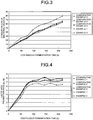
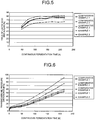
- the yield per sugar and the D-lactic acid production rate are the same as those in Comparative Example 1, while the increasing rate of transmembrane pressure difference changes in low levels. It is confirmed that high membrane washing effect is obtained while the same fermentation efficiency is ensured. Although the increasing rate of transmembrane pressure difference is the same as in Comparative Example 2, higher yield per sugar and D-lactic acid production rate are exhibited. Therefore, improvement of fermentation efficiency is confirmed.
- the yield per sugar and the D-lactic acid production rate are the same as in Comparative Example 3, while the increasing rate of transmembrane pressure difference changes in slightly low levels.
- the membrane area and the aeration amount are the same as in Comparative Example 3, but a plurality of MD are used. Thus, it is confirmed that high membrane washing effect is obtained while the same fermentation efficiency is ensured.
- the yield per sugar and the D-lactic acid production rate are the same as those in Comparative Example 1, while the increasing rate of transmembrane pressure difference changes in low levels. It is confirmed that high membrane washing effect is obtained while the same fermentation efficiency is ensured. Although the increasing rate of transmembrane pressure difference is the same as in Comparative Example 2, higher yield per sugar and D-lactic acid production rate are exhibited. Therefore, improvement of fermentation efficiency is confirmed.
- a delta-HOM strain scraped off from an agar culture medium was inoculated in a test tube charged with 5 mL of BY culture medium (0.5% yeast extract, 0.7% meat extract, 1% peptone, and 0.3% sodium chloride). This strain was subjected to shake culture at 30°C for 24 hours (pre-preculture). The whole amount of the pre-preculture solution obtained was inoculated in a 500-mL erlenmeyer flask charged with 50 mL of culture medium shown in Table 2 and precultured at 30°C. The preculture solution obtained was inoculated in a continuous fermentation apparatus charged with 3 L of L-lysine fermentation culture medium and cultured for 24 hours. Subsequently, an L-lysine fermentation culture medium was continuously supplied while the supply amount of the culture solution was controlled so as to make the amount of the culture solution in the fermentor constant. Thus, continuous fermentation was performed to produce L-lysine by continuous fermentation.
- the yield per sugar and the L-lysine production rate are the same as those in Comparative Example 4, while the increasing rate of transmembrane pressure difference is suppressed and changes in low levels. Therefore, it is confirmed that the same L-lysine production efficiency and high membrane washing effect are obtained.
- a simple method in which the supply amount of a gas containing oxygen to be supplied to the apparatus is set on the basis of an optimal kLa value for cells to be cultured in the continuous fermentation apparatus, and different amounts of the gas are sequentially supplied to the plurality of separation membrane units, so that the kLa value is within a constant range from the optimal kLa value. Since the long-term stability of separation membrane unit operation and the fermentation result can be improved, a chemical that is a fermentation product and is widely used in the fermentation industry can be stably produced at low cost by the simple method.
Landscapes
- Chemical & Material Sciences (AREA)
- Organic Chemistry (AREA)
- Life Sciences & Earth Sciences (AREA)
- Wood Science & Technology (AREA)
- Engineering & Computer Science (AREA)
- Zoology (AREA)
- Health & Medical Sciences (AREA)
- Bioinformatics & Cheminformatics (AREA)
- General Health & Medical Sciences (AREA)
- Microbiology (AREA)
- Biotechnology (AREA)
- Genetics & Genomics (AREA)
- Biochemistry (AREA)
- General Engineering & Computer Science (AREA)
- Chemical Kinetics & Catalysis (AREA)
- General Chemical & Material Sciences (AREA)
- Biomedical Technology (AREA)
- Sustainable Development (AREA)
- Proteomics, Peptides & Aminoacids (AREA)
- Analytical Chemistry (AREA)
- Molecular Biology (AREA)
- Apparatus Associated With Microorganisms And Enzymes (AREA)
- Preparation Of Compounds By Using Micro-Organisms (AREA)
Claims (12)
- Verfahren zum Herstellen einer Chemikalie, umfassend:einen Chemikalienherstellungsschritt zum Kultivieren von Zellen in einer Kulturlösung in einem Fermenter, um ein Ausgangsmaterial zu fermentieren, um eine Chemikalie herzustellen, wobei der Chemikalienherstellungsschritt optional einen Gaszuführungsschritt zum Zuführen von einem Gas, das Sauerstoff enthält, zu dem Fermenter umfasst;einen Kulturlösungszuführungsschritt zum Zuführen von der Kulturlösung, die die Chemikalie, welche in dem Chemikalienherstellungsschritt hergestellt wurde, enthält, zu einer Vielzahl von Trennmembraneinheiten, die parallel angeordnet sind;einen Filtrationsschritt zum Filtern von der Kulturlösung, die in dem Kulturlösungszuführungsschritt zugeführt wurde, um ein Permeat, das die Chemikalie enthält, abzutrennen;einen Refluxschritt zum Refluxieren des Retentats zu dem Fermenter, das in dem Filtrationsschritt nicht filtriert wird; undeinen Waschschritt zum Zuführen von einem Gas, das Sauerstoff enthält, zu der Vielzahl von Trennmembraneinheiten, während eine Zufuhrmenge von dem Gas der Reihe nach erhöht wird, um ein Reinigen durchzuführen,und wobei die Flussrate des Gases, das der Vielzahl von Trennmembraneinheiten zugeführt wird, um zwei oder mehr Niveaus verändert wird und die Trennmembraneinheiten für die Gaszuführung mit der größten Flussrate der Reihe nach durchgewechselt werden, wobei die Zufuhrmenge und die Zufuhrzeit von dem Gas, das Sauerstoff enthält und das in dem Waschschritt und optional in dem Fermentergaszuführungsschritt zugeführt wird, so eingestellt werden, dass ein volumetrischer Sauerstoffübertragungskoeffizient kLa-Wert in dem Fermenter optimiert ist, um für die Fermentationswirksamkeit in dem Chemikalienherstellungsschritt konstant gehalten zu werden.
- Verfahren zum Herstellen von einer Chemikalie nach Anspruch 1, wobei der Filtrationsbetrieb des Filtrationsschritts unterbrochen durchgeführt wird.
- Verfahren zum Herstellen von einer Chemikalie nach Anspruch 1 oder 2, wobei die Zellen Bakterien sind.
- Verfahren zum Herstellen von einer Chemikalie nach Anspruch 3, wobei die Bakterien Bakterien sind, die zu irgendeiner Gattung aus einer Gattung Escherichia, einer Gattung Providencia, einer Gattung Corynebacterium, einer Gattung Brevibacterium und einer Gattung Serratia gehören.
- Verfahren zum Herstellen von einer Chemikalie nach Anspruch 3, wobei die Bakterien irgendwelche aus Escherichia coli, Providencia rettgeri, Corynebacterium glutamicum, Brevibacterium flavum, Brevibacterium lactofermentum und Serratia marcescens sind.
- Verfahren zum Herstellen von einer Chemikalie nach Anspruch 1 oder 2, wobei die Zellen Hefe sind.
- Verfahren zum Herstellen von einer Chemikalie nach einem der Ansprüche 1 bis 6, wobei die Chemikalie eine Aminosäure ist.
- Verfahren zum Herstellen von einer Chemikalie nach Anspruch 7, wobei die Aminosäure L-Threonin, L-Lysin, L-Glutaminsäure, L-Tryptophan, L-Isoleucin, L-Glutamin, L-Arginin, L-Alanin, L-Histidin, L-Prolin, L-Phenylalanin, L-Asparaginsäure, L-Tyrosin, L-Methionin, L-Serin, L-Valin oder L-Leucin ist.
- Verfahren zum Herstellen von einer Chemikalie nach einem der Ansprüche 1 bis 6, wobei die Chemikalie eine organische Säure ist.
- Verfahren zum Herstellen von einer Chemikalie nach Anspruch 9, wobei die Chemikalie Milchsäure ist.
- Verfahren zum Herstellen von einer Chemikalie nach einem der Ansprüche 1 bis 6, wobei die Chemikalie Cadaverin ist.
- Kontinuierlicher Fermentationapparat, umfassend:einen Fermenter (1) zum Kultivieren von einem Fermentationsrohmaterial unter Verwendung von Zellen durch Fermentation, um das Fermentationsrohmaterial in eine Kulturlösung umzuwandeln, die eine Chemikalie enthält;eine Vielzahl von Trennmembraneinheiten (2A; 2B; 2C), die parallel angeordnet sind, zum Trennen von der Chemikalie von der Kulturlösung;Fermentationsflüssigkeitszirkulationsmittel (24) zum Befördern von der Kulturlösung von dem Fermenter zu der Vielzahl von Trennmembraneinheiten;Gaszuführungsmittel (19; 21) zum Zuführen von einem Gas, das Sauerstoff enthält, zu der Vielzahl von Trennmembraneinheiten und optional zum Zuführen von einem Gas, das Sauerstoff enthält, zu dem Fermenter, während das Gaszuführungsmittel konfiguriert ist, eine Zuführungsmenge von dem Gas der Reihe nach zu erhöhen, um ein Reinigungswaschen durchzuführen, und das Gaszuführungsmittel ferner konfiguriert ist, die Flussrate von dem Gas, das der Vielzahl von Trennmembraneinheiten zugeführt wird, auf zwei oder mehr Niveaus zu verändern und der Reihe nach die Trennmembraneinheiten für die Gaszuführung mit der größten Flussrate durchzuwechseln; undRegelungsmittel (22), das konfiguriert ist, die Zufuhrmenge und die Zufuhrzeit von dem Gas, das Sauerstoff enthält, zu der Vielzahl von Trennmembraneinheiten und optional zu dem Fermenter so zu regeln, dass ein volumetrischer Sauerstoffübertragungskoeffizient kLa-Wert in dem Fermenter optimiert ist, um für die Fermentationswirksamkeit in dem Fermenter konstant gehalten zu werden.
Applications Claiming Priority (2)
| Application Number | Priority Date | Filing Date | Title |
|---|---|---|---|
| JP2012082599 | 2012-03-30 | ||
| PCT/JP2013/059086 WO2013146920A1 (ja) | 2012-03-30 | 2013-03-27 | 連続発酵による化学品の製造方法および連続発酵装置 |
Publications (3)
| Publication Number | Publication Date |
|---|---|
| EP2837687A1 EP2837687A1 (de) | 2015-02-18 |
| EP2837687A4 EP2837687A4 (de) | 2015-11-18 |
| EP2837687B1 true EP2837687B1 (de) | 2017-02-22 |
Family
ID=49260169
Family Applications (1)
| Application Number | Title | Priority Date | Filing Date |
|---|---|---|---|
| EP13770154.6A Not-in-force EP2837687B1 (de) | 2012-03-30 | 2013-03-27 | Verfahren zur herstellung von chemikalien durch kontinuierliche fermentation sowie vorrichtung für die durchführung einer kontinuierlichen fermentation |
Country Status (5)
| Country | Link |
|---|---|
| US (1) | US9644221B2 (de) |
| EP (1) | EP2837687B1 (de) |
| JP (1) | JP6201753B2 (de) |
| TW (1) | TW201350583A (de) |
| WO (1) | WO2013146920A1 (de) |
Families Citing this family (34)
| Publication number | Priority date | Publication date | Assignee | Title |
|---|---|---|---|---|
| JP6289053B2 (ja) * | 2013-11-22 | 2018-03-07 | 花王株式会社 | ソフォロリピッドの製造方法 |
| JP6523674B2 (ja) * | 2014-12-17 | 2019-06-05 | 積水化学工業株式会社 | 培養装置及び方法 |
| JP6558767B2 (ja) * | 2015-04-23 | 2019-08-14 | 大阪瓦斯株式会社 | ハロモナス菌を用いたピルビン酸の製造方法 |
| JP5985114B1 (ja) * | 2015-08-19 | 2016-09-06 | 三菱化学エンジニアリング株式会社 | 生物反応装置及びこの生物反応装置を用いた生物反応方法 |
| WO2017029733A1 (ja) * | 2015-08-19 | 2017-02-23 | 三菱化学エンジニアリング株式会社 | 生物反応装置およびこの生物反応装置を用いた生物反応方法 |
| JP6911919B2 (ja) * | 2017-07-03 | 2021-07-28 | 株式会社村田製作所 | 濃縮装置 |
| US10510575B2 (en) | 2017-09-20 | 2019-12-17 | Applied Materials, Inc. | Substrate support with multiple embedded electrodes |
| US10555412B2 (en) | 2018-05-10 | 2020-02-04 | Applied Materials, Inc. | Method of controlling ion energy distribution using a pulse generator with a current-return output stage |
| US11476145B2 (en) | 2018-11-20 | 2022-10-18 | Applied Materials, Inc. | Automatic ESC bias compensation when using pulsed DC bias |
| CN109628516B (zh) * | 2018-12-12 | 2021-09-28 | 新疆阜丰生物科技有限公司 | 一种l-异亮氨酸的生产和提取工艺 |
| CN118315254A (zh) | 2019-01-22 | 2024-07-09 | 应用材料公司 | 用于控制脉冲电压波形的反馈回路 |
| US11508554B2 (en) | 2019-01-24 | 2022-11-22 | Applied Materials, Inc. | High voltage filter assembly |
| US11848176B2 (en) | 2020-07-31 | 2023-12-19 | Applied Materials, Inc. | Plasma processing using pulsed-voltage and radio-frequency power |
| US11901157B2 (en) | 2020-11-16 | 2024-02-13 | Applied Materials, Inc. | Apparatus and methods for controlling ion energy distribution |
| US11798790B2 (en) | 2020-11-16 | 2023-10-24 | Applied Materials, Inc. | Apparatus and methods for controlling ion energy distribution |
| US11495470B1 (en) | 2021-04-16 | 2022-11-08 | Applied Materials, Inc. | Method of enhancing etching selectivity using a pulsed plasma |
| US11948780B2 (en) | 2021-05-12 | 2024-04-02 | Applied Materials, Inc. | Automatic electrostatic chuck bias compensation during plasma processing |
| US11791138B2 (en) | 2021-05-12 | 2023-10-17 | Applied Materials, Inc. | Automatic electrostatic chuck bias compensation during plasma processing |
| US11967483B2 (en) | 2021-06-02 | 2024-04-23 | Applied Materials, Inc. | Plasma excitation with ion energy control |
| US12525441B2 (en) | 2021-06-09 | 2026-01-13 | Applied Materials, Inc. | Plasma chamber and chamber component cleaning methods |
| US20220399186A1 (en) | 2021-06-09 | 2022-12-15 | Applied Materials, Inc. | Method and apparatus to reduce feature charging in plasma processing chamber |
| US12148595B2 (en) | 2021-06-09 | 2024-11-19 | Applied Materials, Inc. | Plasma uniformity control in pulsed DC plasma chamber |
| US11810760B2 (en) | 2021-06-16 | 2023-11-07 | Applied Materials, Inc. | Apparatus and method of ion current compensation |
| US11569066B2 (en) | 2021-06-23 | 2023-01-31 | Applied Materials, Inc. | Pulsed voltage source for plasma processing applications |
| US11776788B2 (en) | 2021-06-28 | 2023-10-03 | Applied Materials, Inc. | Pulsed voltage boost for substrate processing |
| US11476090B1 (en) | 2021-08-24 | 2022-10-18 | Applied Materials, Inc. | Voltage pulse time-domain multiplexing |
| US12106938B2 (en) | 2021-09-14 | 2024-10-01 | Applied Materials, Inc. | Distortion current mitigation in a radio frequency plasma processing chamber |
| EP4183864A1 (de) * | 2021-11-22 | 2023-05-24 | Mycofood US LLC | Verfahren und vorrichtungen zur effizienten partiellen oder vollständigen feststoff-flüssigkeitstrennung unter gasgesteuerten bedingungen |
| US11694876B2 (en) | 2021-12-08 | 2023-07-04 | Applied Materials, Inc. | Apparatus and method for delivering a plurality of waveform signals during plasma processing |
| US11972924B2 (en) | 2022-06-08 | 2024-04-30 | Applied Materials, Inc. | Pulsed voltage source for plasma processing applications |
| US12315732B2 (en) | 2022-06-10 | 2025-05-27 | Applied Materials, Inc. | Method and apparatus for etching a semiconductor substrate in a plasma etch chamber |
| US12586768B2 (en) | 2022-08-10 | 2026-03-24 | Applied Materials, Inc. | Pulsed voltage compensation for plasma processing applications |
| US12272524B2 (en) | 2022-09-19 | 2025-04-08 | Applied Materials, Inc. | Wideband variable impedance load for high volume manufacturing qualification and on-site diagnostics |
| US12111341B2 (en) | 2022-10-05 | 2024-10-08 | Applied Materials, Inc. | In-situ electric field detection method and apparatus |
Family Cites Families (20)
| Publication number | Priority date | Publication date | Assignee | Title |
|---|---|---|---|---|
| JPS61254185A (ja) * | 1985-05-01 | 1986-11-11 | Snow Brand Milk Prod Co Ltd | 高濃度連続培養方法及び装置 |
| JPH0644863B2 (ja) * | 1987-01-29 | 1994-06-15 | 理化学研究所 | 細胞の高密度連続培養の立ち上げ方法 |
| SU1719433A1 (ru) | 1988-04-26 | 1992-03-15 | Научно-Исследовательский Технологический Институт Аминокислот | Способ получени L-аланина |
| JPH0632626B2 (ja) | 1989-02-20 | 1994-05-02 | 東レ株式会社 | 発酵法によるl―スレオニンの製造法 |
| JP3243891B2 (ja) | 1993-06-14 | 2002-01-07 | 東レ株式会社 | ピルビン酸の精製方法 |
| US5503750A (en) | 1993-10-04 | 1996-04-02 | Russo, Jr.; Lawrence J. | Membrane-based process for the recovery of lactic acid by fermentation of carbohydrate substrates containing sugars |
| JP3583202B2 (ja) * | 1995-09-14 | 2004-11-04 | 三菱レイヨン株式会社 | ろ過装置およびろ過運転方法 |
| DE69916479T2 (de) | 1998-10-09 | 2005-03-24 | Zenon Environmental Inc., Oakville | Zyklisch arbeitendes belüftungssystem für tauchmembranmodul |
| JP2004532646A (ja) * | 2001-06-20 | 2004-10-28 | ラバット・ブルウィング・カンパニイ・リミテッド | 組み合わせ連続/バッチ発酵プロセス |
| DE10304855A1 (de) * | 2003-02-06 | 2004-08-26 | Hte Ag The High Throughput Experimentation Company | Vorrichtung und Verfahren zum simultanen Agitieren von Reaktionsmischungen |
| JP4806904B2 (ja) * | 2004-07-09 | 2011-11-02 | トヨタ自動車株式会社 | 乳酸生産方法 |
| JP2006281022A (ja) * | 2005-03-31 | 2006-10-19 | Toray Ind Inc | 分離膜モジュールの洗浄方法および洗浄装置 |
| AU2007218753B2 (en) * | 2006-02-24 | 2012-08-16 | Toray Industries, Inc. | Method of producing chemical product and continuous fermentation apparatus |
| JP4872658B2 (ja) * | 2006-12-27 | 2012-02-08 | 東レ株式会社 | メンブレンバイオリアクターの運転方法 |
| JP5458481B2 (ja) | 2007-02-06 | 2014-04-02 | 東レ株式会社 | 連続発酵によるl−アミノ酸の製造方法 |
| JP2010029108A (ja) * | 2008-07-29 | 2010-02-12 | Toray Ind Inc | 連続発酵による化学品の製造方法 |
| JP5257591B2 (ja) * | 2008-08-07 | 2013-08-07 | 株式会社ウェルシィ | 水処理方法 |
| EP2330209B1 (de) | 2008-09-30 | 2017-07-19 | Toray Industries, Inc. | Verfahren und vorrichtung zur herstellung eines kontinuierlichen chemischen kultursystems |
| SG176263A1 (en) | 2009-06-03 | 2012-01-30 | Toray Industries | Polypeptide having d-lactate dehydrogenase activity, polynucleotide encoding the polypeptide, and process for production of d-lactic acid |
| CN102311912B (zh) | 2010-07-06 | 2013-07-31 | 光明乳业股份有限公司 | 乳酸菌发酵剂的制备工艺及其专用设备 |
-
2013
- 2013-03-27 US US14/388,306 patent/US9644221B2/en not_active Expired - Fee Related
- 2013-03-27 WO PCT/JP2013/059086 patent/WO2013146920A1/ja not_active Ceased
- 2013-03-27 JP JP2013522748A patent/JP6201753B2/ja not_active Expired - Fee Related
- 2013-03-27 EP EP13770154.6A patent/EP2837687B1/de not_active Not-in-force
- 2013-03-29 TW TW102111322A patent/TW201350583A/zh unknown
Non-Patent Citations (1)
| Title |
|---|
| None * |
Also Published As
| Publication number | Publication date |
|---|---|
| US20150056665A1 (en) | 2015-02-26 |
| EP2837687A1 (de) | 2015-02-18 |
| WO2013146920A1 (ja) | 2013-10-03 |
| US9644221B2 (en) | 2017-05-09 |
| TW201350583A (zh) | 2013-12-16 |
| JPWO2013146920A1 (ja) | 2015-12-14 |
| EP2837687A4 (de) | 2015-11-18 |
| JP6201753B2 (ja) | 2017-09-27 |
Similar Documents
| Publication | Publication Date | Title |
|---|---|---|
| EP2837687B1 (de) | Verfahren zur herstellung von chemikalien durch kontinuierliche fermentation sowie vorrichtung für die durchführung einer kontinuierlichen fermentation | |
| JP5978995B2 (ja) | 連続発酵による化学品の製造方法 | |
| EP1988170B1 (de) | Verfahren zur herstellung eines chemischen produkts und vorrichtung zur kontinuierlichen fermentation | |
| RU2513694C2 (ru) | Способ получения химического продукта и аппарат для непрерывной ферментации | |
| Gerigk et al. | Enhanced pilot-scale fed-batch L-phenylalanine production with recombinant Escherichia coli by fully integrated reactive extraction | |
| Taniguchi et al. | Clarification of interactions among microorganisms and development of co-culture system for production of useful substances | |
| JP2013212053A (ja) | 化学品製造装置および連続発酵による化学品の製造方法 | |
| JPWO2013146807A1 (ja) | 連続発酵による化学品の製造方法および連続発酵装置 | |
| JP2011147459A (ja) | 新規な細菌株、これを調製する方法、およびl−リジン産生のための発酵プロセスにおけるそれらの使用 | |
| JP2011188791A (ja) | 連続発酵装置の運転方法 | |
| CA2811319C (en) | Production method for chemicals by continuous fermentation | |
| Schuster et al. | A synthetic medium for continuous culture of the S‐layer carrying Bacillus stearothermophilus PV 72 and studies on the influence of growth conditions on cell wall properties | |
| Ruklisha et al. | Metabolism and lysine biosynthesis control in Brevibacterium flavum: impact of stringent response in bacterial cells | |
| JP5796282B2 (ja) | コリネ型細菌による化学品の製造方法 | |
| Vardanyan et al. | Development of Biotechnological Methods for Intensification of Proline Supersynthesis by Brevibacterium flavum AP-112 Producing Stain |
Legal Events
| Date | Code | Title | Description |
|---|---|---|---|
| PUAI | Public reference made under article 153(3) epc to a published international application that has entered the european phase |
Free format text: ORIGINAL CODE: 0009012 |
|
| 17P | Request for examination filed |
Effective date: 20140925 |
|
| AK | Designated contracting states |
Kind code of ref document: A1 Designated state(s): AL AT BE BG CH CY CZ DE DK EE ES FI FR GB GR HR HU IE IS IT LI LT LU LV MC MK MT NL NO PL PT RO RS SE SI SK SM TR |
|
| AX | Request for extension of the european patent |
Extension state: BA ME |
|
| DAX | Request for extension of the european patent (deleted) | ||
| RA4 | Supplementary search report drawn up and despatched (corrected) |
Effective date: 20151015 |
|
| RIC1 | Information provided on ipc code assigned before grant |
Ipc: C12R 1/15 20060101ALI20151009BHEP Ipc: C12M 1/00 20060101ALI20151009BHEP Ipc: C12P 13/04 20060101AFI20151009BHEP Ipc: C12P 7/56 20060101ALI20151009BHEP Ipc: C12R 1/13 20060101ALI20151009BHEP Ipc: C12P 13/02 20060101ALI20151009BHEP Ipc: C12R 1/19 20060101ALI20151009BHEP Ipc: C12R 1/43 20060101ALI20151009BHEP Ipc: C12R 1/01 20060101ALI20151009BHEP |
|
| REG | Reference to a national code |
Ref country code: DE Ref legal event code: R079 Ref document number: 602013017713 Country of ref document: DE Free format text: PREVIOUS MAIN CLASS: C12P0013040000 Ipc: C12P0013000000 |
|
| GRAP | Despatch of communication of intention to grant a patent |
Free format text: ORIGINAL CODE: EPIDOSNIGR1 |
|
| RIC1 | Information provided on ipc code assigned before grant |
Ipc: C12P 7/56 20060101ALI20160829BHEP Ipc: C12P 13/04 20060101ALI20160829BHEP Ipc: C12R 1/19 20060101ALI20160829BHEP Ipc: C12R 1/13 20060101ALI20160829BHEP Ipc: C12R 1/15 20060101ALI20160829BHEP Ipc: C12P 13/02 20060101ALI20160829BHEP Ipc: C12R 1/43 20060101ALI20160829BHEP Ipc: C12P 13/08 20060101ALI20160829BHEP Ipc: C12M 1/00 20060101ALI20160829BHEP Ipc: C12R 1/01 20060101ALI20160829BHEP Ipc: C12M 1/34 20060101ALI20160829BHEP Ipc: C12M 1/26 20060101ALI20160829BHEP Ipc: C12P 13/00 20060101AFI20160829BHEP |
|
| INTG | Intention to grant announced |
Effective date: 20160913 |
|
| STAA | Information on the status of an ep patent application or granted ep patent |
Free format text: STATUS: GRANT OF PATENT IS INTENDED |
|
| GRAS | Grant fee paid |
Free format text: ORIGINAL CODE: EPIDOSNIGR3 |
|
| GRAA | (expected) grant |
Free format text: ORIGINAL CODE: 0009210 |
|
| STAA | Information on the status of an ep patent application or granted ep patent |
Free format text: STATUS: THE PATENT HAS BEEN GRANTED |
|
| AK | Designated contracting states |
Kind code of ref document: B1 Designated state(s): AL AT BE BG CH CY CZ DE DK EE ES FI FR GB GR HR HU IE IS IT LI LT LU LV MC MK MT NL NO PL PT RO RS SE SI SK SM TR |
|
| REG | Reference to a national code |
Ref country code: GB Ref legal event code: FG4D |
|
| REG | Reference to a national code |
Ref country code: CH Ref legal event code: EP |
|
| REG | Reference to a national code |
Ref country code: AT Ref legal event code: REF Ref document number: 869314 Country of ref document: AT Kind code of ref document: T Effective date: 20170315 |
|
| REG | Reference to a national code |
Ref country code: IE Ref legal event code: FG4D |
|
| REG | Reference to a national code |
Ref country code: FR Ref legal event code: PLFP Year of fee payment: 5 |
|
| REG | Reference to a national code |
Ref country code: DE Ref legal event code: R096 Ref document number: 602013017713 Country of ref document: DE |
|
| REG | Reference to a national code |
Ref country code: LT Ref legal event code: MG4D |
|
| REG | Reference to a national code |
Ref country code: NL Ref legal event code: MP Effective date: 20170222 |
|
| REG | Reference to a national code |
Ref country code: AT Ref legal event code: MK05 Ref document number: 869314 Country of ref document: AT Kind code of ref document: T Effective date: 20170222 |
|
| PG25 | Lapsed in a contracting state [announced via postgrant information from national office to epo] |
Ref country code: NO Free format text: LAPSE BECAUSE OF FAILURE TO SUBMIT A TRANSLATION OF THE DESCRIPTION OR TO PAY THE FEE WITHIN THE PRESCRIBED TIME-LIMIT Effective date: 20170522 Ref country code: GR Free format text: LAPSE BECAUSE OF FAILURE TO SUBMIT A TRANSLATION OF THE DESCRIPTION OR TO PAY THE FEE WITHIN THE PRESCRIBED TIME-LIMIT Effective date: 20170523 Ref country code: HR Free format text: LAPSE BECAUSE OF FAILURE TO SUBMIT A TRANSLATION OF THE DESCRIPTION OR TO PAY THE FEE WITHIN THE PRESCRIBED TIME-LIMIT Effective date: 20170222 Ref country code: LT Free format text: LAPSE BECAUSE OF FAILURE TO SUBMIT A TRANSLATION OF THE DESCRIPTION OR TO PAY THE FEE WITHIN THE PRESCRIBED TIME-LIMIT Effective date: 20170222 |
|
| PG25 | Lapsed in a contracting state [announced via postgrant information from national office to epo] |
Ref country code: BG Free format text: LAPSE BECAUSE OF FAILURE TO SUBMIT A TRANSLATION OF THE DESCRIPTION OR TO PAY THE FEE WITHIN THE PRESCRIBED TIME-LIMIT Effective date: 20170522 Ref country code: SE Free format text: LAPSE BECAUSE OF FAILURE TO SUBMIT A TRANSLATION OF THE DESCRIPTION OR TO PAY THE FEE WITHIN THE PRESCRIBED TIME-LIMIT Effective date: 20170222 Ref country code: PT Free format text: LAPSE BECAUSE OF FAILURE TO SUBMIT A TRANSLATION OF THE DESCRIPTION OR TO PAY THE FEE WITHIN THE PRESCRIBED TIME-LIMIT Effective date: 20170622 Ref country code: RS Free format text: LAPSE BECAUSE OF FAILURE TO SUBMIT A TRANSLATION OF THE DESCRIPTION OR TO PAY THE FEE WITHIN THE PRESCRIBED TIME-LIMIT Effective date: 20170222 Ref country code: AT Free format text: LAPSE BECAUSE OF FAILURE TO SUBMIT A TRANSLATION OF THE DESCRIPTION OR TO PAY THE FEE WITHIN THE PRESCRIBED TIME-LIMIT Effective date: 20170222 Ref country code: NL Free format text: LAPSE BECAUSE OF FAILURE TO SUBMIT A TRANSLATION OF THE DESCRIPTION OR TO PAY THE FEE WITHIN THE PRESCRIBED TIME-LIMIT Effective date: 20170222 Ref country code: ES Free format text: LAPSE BECAUSE OF FAILURE TO SUBMIT A TRANSLATION OF THE DESCRIPTION OR TO PAY THE FEE WITHIN THE PRESCRIBED TIME-LIMIT Effective date: 20170222 Ref country code: LV Free format text: LAPSE BECAUSE OF FAILURE TO SUBMIT A TRANSLATION OF THE DESCRIPTION OR TO PAY THE FEE WITHIN THE PRESCRIBED TIME-LIMIT Effective date: 20170222 |
|
| PG25 | Lapsed in a contracting state [announced via postgrant information from national office to epo] |
Ref country code: SK Free format text: LAPSE BECAUSE OF FAILURE TO SUBMIT A TRANSLATION OF THE DESCRIPTION OR TO PAY THE FEE WITHIN THE PRESCRIBED TIME-LIMIT Effective date: 20170222 Ref country code: RO Free format text: LAPSE BECAUSE OF FAILURE TO SUBMIT A TRANSLATION OF THE DESCRIPTION OR TO PAY THE FEE WITHIN THE PRESCRIBED TIME-LIMIT Effective date: 20170222 Ref country code: EE Free format text: LAPSE BECAUSE OF FAILURE TO SUBMIT A TRANSLATION OF THE DESCRIPTION OR TO PAY THE FEE WITHIN THE PRESCRIBED TIME-LIMIT Effective date: 20170222 Ref country code: CZ Free format text: LAPSE BECAUSE OF FAILURE TO SUBMIT A TRANSLATION OF THE DESCRIPTION OR TO PAY THE FEE WITHIN THE PRESCRIBED TIME-LIMIT Effective date: 20170222 |
|
| REG | Reference to a national code |
Ref country code: CH Ref legal event code: PL |
|
| REG | Reference to a national code |
Ref country code: DE Ref legal event code: R097 Ref document number: 602013017713 Country of ref document: DE |
|
| PG25 | Lapsed in a contracting state [announced via postgrant information from national office to epo] |
Ref country code: DK Free format text: LAPSE BECAUSE OF FAILURE TO SUBMIT A TRANSLATION OF THE DESCRIPTION OR TO PAY THE FEE WITHIN THE PRESCRIBED TIME-LIMIT Effective date: 20170222 Ref country code: PL Free format text: LAPSE BECAUSE OF FAILURE TO SUBMIT A TRANSLATION OF THE DESCRIPTION OR TO PAY THE FEE WITHIN THE PRESCRIBED TIME-LIMIT Effective date: 20170222 Ref country code: SM Free format text: LAPSE BECAUSE OF FAILURE TO SUBMIT A TRANSLATION OF THE DESCRIPTION OR TO PAY THE FEE WITHIN THE PRESCRIBED TIME-LIMIT Effective date: 20170222 Ref country code: MC Free format text: LAPSE BECAUSE OF FAILURE TO SUBMIT A TRANSLATION OF THE DESCRIPTION OR TO PAY THE FEE WITHIN THE PRESCRIBED TIME-LIMIT Effective date: 20170222 |
|
| REG | Reference to a national code |
Ref country code: IE Ref legal event code: MM4A |
|
| PLBE | No opposition filed within time limit |
Free format text: ORIGINAL CODE: 0009261 |
|
| STAA | Information on the status of an ep patent application or granted ep patent |
Free format text: STATUS: NO OPPOSITION FILED WITHIN TIME LIMIT |
|
| GBPC | Gb: european patent ceased through non-payment of renewal fee |
Effective date: 20170522 |
|
| 26N | No opposition filed |
Effective date: 20171123 |
|
| PG25 | Lapsed in a contracting state [announced via postgrant information from national office to epo] |
Ref country code: LU Free format text: LAPSE BECAUSE OF NON-PAYMENT OF DUE FEES Effective date: 20170327 |
|
| PG25 | Lapsed in a contracting state [announced via postgrant information from national office to epo] |
Ref country code: SI Free format text: LAPSE BECAUSE OF FAILURE TO SUBMIT A TRANSLATION OF THE DESCRIPTION OR TO PAY THE FEE WITHIN THE PRESCRIBED TIME-LIMIT Effective date: 20170222 Ref country code: IE Free format text: LAPSE BECAUSE OF NON-PAYMENT OF DUE FEES Effective date: 20170327 Ref country code: CH Free format text: LAPSE BECAUSE OF NON-PAYMENT OF DUE FEES Effective date: 20170331 Ref country code: LI Free format text: LAPSE BECAUSE OF NON-PAYMENT OF DUE FEES Effective date: 20170331 |
|
| REG | Reference to a national code |
Ref country code: BE Ref legal event code: MM Effective date: 20170331 |
|
| REG | Reference to a national code |
Ref country code: FR Ref legal event code: PLFP Year of fee payment: 6 |
|
| PG25 | Lapsed in a contracting state [announced via postgrant information from national office to epo] |
Ref country code: GB Free format text: LAPSE BECAUSE OF NON-PAYMENT OF DUE FEES Effective date: 20170522 |
|
| PG25 | Lapsed in a contracting state [announced via postgrant information from national office to epo] |
Ref country code: BE Free format text: LAPSE BECAUSE OF NON-PAYMENT OF DUE FEES Effective date: 20170331 |
|
| PG25 | Lapsed in a contracting state [announced via postgrant information from national office to epo] |
Ref country code: MT Free format text: LAPSE BECAUSE OF NON-PAYMENT OF DUE FEES Effective date: 20170327 |
|
| PG25 | Lapsed in a contracting state [announced via postgrant information from national office to epo] |
Ref country code: HU Free format text: LAPSE BECAUSE OF FAILURE TO SUBMIT A TRANSLATION OF THE DESCRIPTION OR TO PAY THE FEE WITHIN THE PRESCRIBED TIME-LIMIT; INVALID AB INITIO Effective date: 20130327 |
|
| PG25 | Lapsed in a contracting state [announced via postgrant information from national office to epo] |
Ref country code: CY Free format text: LAPSE BECAUSE OF FAILURE TO SUBMIT A TRANSLATION OF THE DESCRIPTION OR TO PAY THE FEE WITHIN THE PRESCRIBED TIME-LIMIT Effective date: 20170222 |
|
| PG25 | Lapsed in a contracting state [announced via postgrant information from national office to epo] |
Ref country code: MK Free format text: LAPSE BECAUSE OF FAILURE TO SUBMIT A TRANSLATION OF THE DESCRIPTION OR TO PAY THE FEE WITHIN THE PRESCRIBED TIME-LIMIT Effective date: 20170222 |
|
| PG25 | Lapsed in a contracting state [announced via postgrant information from national office to epo] |
Ref country code: TR Free format text: LAPSE BECAUSE OF FAILURE TO SUBMIT A TRANSLATION OF THE DESCRIPTION OR TO PAY THE FEE WITHIN THE PRESCRIBED TIME-LIMIT Effective date: 20170222 |
|
| PG25 | Lapsed in a contracting state [announced via postgrant information from national office to epo] |
Ref country code: AL Free format text: LAPSE BECAUSE OF FAILURE TO SUBMIT A TRANSLATION OF THE DESCRIPTION OR TO PAY THE FEE WITHIN THE PRESCRIBED TIME-LIMIT Effective date: 20170222 Ref country code: IS Free format text: LAPSE BECAUSE OF FAILURE TO SUBMIT A TRANSLATION OF THE DESCRIPTION OR TO PAY THE FEE WITHIN THE PRESCRIBED TIME-LIMIT Effective date: 20170622 |
|
| PGFP | Annual fee paid to national office [announced via postgrant information from national office to epo] |
Ref country code: IT Payment date: 20210211 Year of fee payment: 9 Ref country code: FR Payment date: 20210210 Year of fee payment: 9 Ref country code: FI Payment date: 20210309 Year of fee payment: 9 |
|
| PGFP | Annual fee paid to national office [announced via postgrant information from national office to epo] |
Ref country code: DE Payment date: 20210316 Year of fee payment: 9 |
|
| REG | Reference to a national code |
Ref country code: DE Ref legal event code: R119 Ref document number: 602013017713 Country of ref document: DE |
|
| REG | Reference to a national code |
Ref country code: FI Ref legal event code: MAE |
|
| PG25 | Lapsed in a contracting state [announced via postgrant information from national office to epo] |
Ref country code: FI Free format text: LAPSE BECAUSE OF NON-PAYMENT OF DUE FEES Effective date: 20220327 |
|
| PG25 | Lapsed in a contracting state [announced via postgrant information from national office to epo] |
Ref country code: FR Free format text: LAPSE BECAUSE OF NON-PAYMENT OF DUE FEES Effective date: 20220331 Ref country code: DE Free format text: LAPSE BECAUSE OF NON-PAYMENT OF DUE FEES Effective date: 20221001 |
|
| PG25 | Lapsed in a contracting state [announced via postgrant information from national office to epo] |
Ref country code: IT Free format text: LAPSE BECAUSE OF NON-PAYMENT OF DUE FEES Effective date: 20220327 |