EP2838604B1 - Porte-boucles de serrage pour conducteurs à usage médical et systèmes associés - Google Patents
Porte-boucles de serrage pour conducteurs à usage médical et systèmes associés Download PDFInfo
- Publication number
- EP2838604B1 EP2838604B1 EP13705639.6A EP13705639A EP2838604B1 EP 2838604 B1 EP2838604 B1 EP 2838604B1 EP 13705639 A EP13705639 A EP 13705639A EP 2838604 B1 EP2838604 B1 EP 2838604B1
- Authority
- EP
- European Patent Office
- Prior art keywords
- arm
- strain relief
- passageway
- lead
- medical lead
- Prior art date
- Legal status (The legal status is an assumption and is not a legal conclusion. Google has not performed a legal analysis and makes no representation as to the accuracy of the status listed.)
- Active
Links
- 0 CCCC*1CCC(CC)CC1 Chemical compound CCCC*1CCC(CC)CC1 0.000 description 2
Images







Classifications
-
- A—HUMAN NECESSITIES
- A61—MEDICAL OR VETERINARY SCIENCE; HYGIENE
- A61N—ELECTROTHERAPY; MAGNETOTHERAPY; RADIATION THERAPY; ULTRASOUND THERAPY
- A61N1/00—Electrotherapy; Circuits therefor
- A61N1/02—Details
- A61N1/04—Electrodes
- A61N1/05—Electrodes for implantation or insertion into the body, e.g. heart electrode
- A61N1/056—Transvascular endocardial electrode systems
-
- A—HUMAN NECESSITIES
- A61—MEDICAL OR VETERINARY SCIENCE; HYGIENE
- A61N—ELECTROTHERAPY; MAGNETOTHERAPY; RADIATION THERAPY; ULTRASOUND THERAPY
- A61N1/00—Electrotherapy; Circuits therefor
- A61N1/02—Details
- A61N1/04—Electrodes
- A61N1/05—Electrodes for implantation or insertion into the body, e.g. heart electrode
-
- A—HUMAN NECESSITIES
- A61—MEDICAL OR VETERINARY SCIENCE; HYGIENE
- A61N—ELECTROTHERAPY; MAGNETOTHERAPY; RADIATION THERAPY; ULTRASOUND THERAPY
- A61N1/00—Electrotherapy; Circuits therefor
- A61N1/02—Details
- A61N1/08—Arrangements or circuits for monitoring, protecting, controlling or indicating
- A61N1/086—Magnetic resonance imaging [MRI] compatible leads
-
- A—HUMAN NECESSITIES
- A61—MEDICAL OR VETERINARY SCIENCE; HYGIENE
- A61N—ELECTROTHERAPY; MAGNETOTHERAPY; RADIATION THERAPY; ULTRASOUND THERAPY
- A61N1/00—Electrotherapy; Circuits therefor
- A61N1/02—Details
- A61N1/04—Electrodes
- A61N1/05—Electrodes for implantation or insertion into the body, e.g. heart electrode
- A61N1/056—Transvascular endocardial electrode systems
- A61N1/057—Anchoring means; Means for fixing the head inside the heart
- A61N2001/0582—Suture sleeves
Definitions
- Embodiments are related to strain relief loops for medical leads. More particularly, embodiments are related to strain relief loop holders that establish a strain relief loop for medical leads.
- Medical leads provide electrical stimulation from a medical device to a target site within a body of a patient.
- the medical device is typically implanted or otherwise installed on the body in an accessible area at some distance from the target site, and the medical lead is routed to the target site either through a percutaneous procedure or by surgical implantation depending upon the type and size of the medical lead being implanted.
- the medical lead extends some distance between the medical device and the target site within the body, the medical lead is subject to forces imposed by movements of the patient.
- the medical lead may be subjected to strain.
- the medical lead may be routed by creating a loop that relieves the strain by the loop making available an additional length of the lead.
- Embodiments address issues such as these and others by providing strain relief loop holders for medical leads and systems.
- the embodiments provide a body section that covers the intersection point. Some embodiments provide one or more passageways that the lead passes through when forming the strain relief loop.
- the body section insulates the tissue from the intersection point when constructed of a thermal non-conductor and distributes the heat over a larger amount of tissue to prevent excessive tissue heating when constructed of a thermal conductor.
- the embodiments may further provide features such as arms or a coil extending from the body section to further define passageways that the medical lead passes through to establish and maintain the strain relief loop.
- the embodiments may provide for a body that takes the form of a loop or a capsule.
- Embodiments provide a strain relief loop holder that includes a body segment defining at least one passageway.
- a first arm extends from a first end of the body segment.
- a first arm segment is located at an end of the first arm opposite the body segment, the first arm segment defining a first arm passageway.
- a second arm extends from a second end of the body segment.
- a second arm segment is located at the end of the second arm opposite the body segment, the second arm segment defining a second arm passageway.
- Embodiments provide a medical lead strain relief system that includes a strain relief loop holder.
- the strain relief loop holder includes a body segment defining at least one passageway.
- a first arm extends from a first end of the body segment.
- a first arm segment is located at an end of the first arm opposite the body segment, the first arm segment defining a first arm passageway.
- a second arm extends from a second end of the body segment.
- a second arm segment is located at the end of the second arm opposite the body segment, the second arm segment defining a second arm passageway.
- the medical lead strain relief system further includes a medical lead that passes through the first arm passageway and the second arm passageway, the medical lead forming a loop by passing through and intersecting within the body segment.
- Embodiments provide a medical system that includes a strain relief loop holder.
- the strain relief holder includes a body segment defining at least one passageway.
- a first arm extends from a first end of the body segment.
- a first arm segment is located at an end of the first arm opposite the body segment, the first arm segment defining a first arm passageway.
- a second arm extends from a second end of the body segment.
- a second arm segment is located at the end of the second arm opposite the body segment, the second arm segment defining a second arm passageway.
- the medical system further includes a medical lead that passes through the first arm passageway and the second arm passageway, the medical lead forming a loop by passing through and intersecting within the body segment. Additionally, the medical system includes a medical device with the medical lead being coupled to the medical device.
- Embodiments provide a medical lead strain relief system that includes a strain relief loop holder comprising a body defining at least one passageway, the body defining at least one entry to the at least one passageway.
- the medical lead strain relief system further includes a medical lead that enters and exits the at least one passageway of the body through the at least one entry, the medical lead forming a loop by loosely passing through and intersecting within the body, the at least one passageway being sized larger than the medical lead to allow the medical lead to move unrestricted axially through the at least one lead passageway while being looped loosely through the at least one lead passageway.
- Embodiments provide strain relief holders for medical leads to provide protection from excessive heating during exposure to RF energy while also maintaining the strain relief loop.
- the embodiments include a body section with a passageway that the medical lead passes through and intersects within so that the heating occurs within the body section.
- the body section may be a thermal non-conductor and insulates the tissue from the excessive heating.
- the body section may be a thermal conductor that distributes the heating over a larger surface area and hence a larger amount of tissue to prevent excessive heating.
- FIG. 1 shows a body 112 of a patient who has a medical system 100 implanted for providing stimulation therapy.
- the medical system 100 includes a medical device 102 that provides stimulation signals.
- a medical lead 104 is connected to the medical device 102 to deliver the stimulation signals to a distal end where electrodes are present.
- the medical lead 104 is a surgically implanted lead with a paddle 106 housing the electrodes for stimulation to the spine.
- the medical lead 104 is routed so that a strain relief loop 108 at a location between the proximal end at the medical device 102 and the distal end at the paddle 106.
- the strain relief loop 108 is assisted in this example by an embodiment of a strain relief holder 200.
- the strain relief holder 200 holds the lead in the strain relief loop configuration while also protecting the body 112 from heating generated at the intersection point 110 when exposed to RF energy. By maintaining the strain relief loop, an added benefit is that the excessive heating occurring at the intersection point 110 results in lower heating at the target site where the paddle 106 is located.
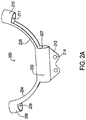
- the strain relief loop holder 200 of this example is shown in FIG. 2A .
- the strain relief loop holder 200 includes a body section 202 that defines an entry to and a corresponding lead passageway 207.
- a first arm 204 extends from the body section 202 on a first end and terminates at a first arm section 208 that defines a lead passageway 209.
- a second arm 206 extends from the body section 202 on a second end and terminates at a second arm section 210 that defines a lead passageway 211.
- the first arm 204 and the second arm 206 form an arc even when the medical lead 104 is not present.
- the first and second arms 204, 206 may be linear when the lead 104 is not installed as shown in FIG. 2C discussed below but upon looping the medical lead 104 through the strain relief holder 200, the first and second arms 204, 206 attain the arc as shown.
- the medical lead 104 passes through the arm segments 208, 210 and then intersects itself within the body section 202. Because the medical lead 104 passes through each arm segment 208, 210 only once but passes through the body section 202 twice to create the intersection point, the lead passageway 207 of the body segment 202 may have a larger diameter than the diameter of the arm segments 208, 210. The diameters may be sized so that the medical lead 104 is able to move axially so that the strain relief function is preserved.
- the strain relief holder 200 may be constructed of various materials.
- the strain relief holder 200 may be constructed of a thermal non-conductor such as a biocompatible polymer, examples including silicone, polyurethane, PEEK, polysulfones, and the like.
- the body section 202 insulates the body tissue from heating occurring at an intersection point of the loop within the body section 202.
- the strain relief holder 200 may instead be constructed of a thermal conductor such as a biocompatible metal, examples including MP35N, titanium, and the like. In that case, the body section 202 distributes the heating throughout the strain relief holder 200, including across all of the body section 202, the arms 204, 206, and the arm sections 208, 210.
- This particular example also includes an integral anchor tab 212.
- the anchor tab 212 provides one or more suture holes 214. These holes 214 allow a surgeon implanting the lead to suture the anchor tab 212, and hence the strain relief loop holder 200 and the medical lead 104 within it, to a particular location within the body 112.
- FIG. 2B shows another example of a medical lead strain relief loop holder 220 that may be used in the system of FIG. 1 .
- This example is similar to that of FIG. 2A except that the arms 224 and 226 are positioned on the side of the loop 108 as opposed to the arms 204 and 206 being on the inside of the loop 108.
- the arm sections 228 and 230 define lead passageways 229 and 221 while the body section 222 defines a lead passageway 227.
- This example also includes the integral anchor 232 with suture holes 234.
- FIG. 2C shows another example of a medical lead strain relief loop holder 240 that may be used in the system of FIG. 1 .
- This example is similar to that of FIG. 2A except that the arms 224 and 226 do not have pre-formed arcs. Instead, the arms 224 and 226 are constructed of an elastic material such as polyurethane or silicone that allows them to achieve an arc upon passing the lead 104 through the lead passageway 247 of the body 242 and through the passageways 241, 249 of the arm sections 248, 250.
- This example also includes the integral anchor 252 with suture holes 254.
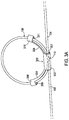
- FIG. 3A shows a medical lead strain relief system including a similar strain relief loop holder 300 as that shown in FIG. 2A that may be used in the system of FIG. 1 .
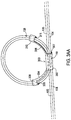
- FIG. 3AA shows the same example but with two medical leads 104, 105 being looped through the holder 300. It will be appreciated that such a system may instead be designed to accommodate any number of leads passing through. However, this example in FIG. 3AA of two leads 104, 105 passing through a same strain relief loop holder 300 is particularly convenient where a single paddle 106 has two medical lead bodies that interconnect the paddle 106 to the medical device 102.
- 3AA can be seen within a body section 302, where the medical leads 104, 105 pass through a lead passageway 307.
- the medical leads 104, 105 pass through a lead passageway 311 of an arm section 310 as well as a lead passageway 309 of an arm section 308.
- the arm sections 308 and 310 are joined to the body section 302 by arms 304 and 306.
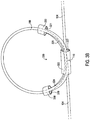
- FIG. 3B shows another example of a medical lead strain relief loop holder 320 that may be used in the system of FIG. 1 .
- This example is similar to that of FIG. 3A except that the arms 324 and 326 are positioned on the side of the loop 108 as in the example of FIG. 2B as opposed to the arms 304 and 306 being on the inside of the loop 108.
- the arm sections 328 and 330 define lead passageways 329 and 321 while the body section 322 defines a lead passageway 327.
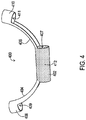
- FIG. 4 shows another example of a strain relief holder 400 that may be used in the system of FIG. 1 .
- the strain relief holder 400 includes a body section 402 defining a passageway 407, arms 404, 406 extending from the body section 402, and arm sections 408, 410 defining lead passageways 409, 411.
- the body section 402 which is constructed of a thermal non-conductor is also doped with a thermally and/or electrically conductive material 412.
- the conductive material 412 may be thermally conductive to facilitate heat dissipation, such as diamond dust where electrical conductivity is not desired.
- the conductive material 412 may additionally or alternatively be electrically conductive to alter the transmission-line characteristics at the intersection point 110.
- Examples of such an electrically conductive dopant material include tantalum or platinum.
- the dopant conductive material 412 may further enhance the ability of the strain relief loop holder 400 to reduce heating at the electrodes on the distal end of the lead 104.
- the dopant conductive material 412 may be included in the remainder of the strain relief holder 400 as well. It will be appreciated that the dopant 412 may be included within all of the various strain relief loop holders disclosed herein.
- FIG. 5 shows another example of a strain relief loop holder 500 that may be used in the system of FIG. 1 .
- the strain relief loop holder 500 includes two adjacent passageways 507, 513 established by a body section 502 that includes an extra barrel 503 defining the extra passageway 513.
- the arm 504 extends from the body segment 502 and more particularly from the lead passageway 507.
- the arm 506 extends from the body segment 502 and more particularly from the extra lead passageway 513 defined by the extra barrel 503 of the body segment 502.
- an arm segment 508 defines a lead passageway 509 that is aligned with the lead passageway 507 while the arm segment 510 defines a lead passageway 511 that is aligned with the lead passageway 513.
- FIG. 6 shows a medical lead strain relief system that may be used in the system of FIG. 1 and that includes the medical lead 104 looping through a strain relief loop holder 600 like that of FIG. 5 .
- the medical lead 104 passes through a lead passageway 613 defined by the extra barrel 603, then loops through a lead passageway 611 of an arm segment 610 of an arm 606 extending from the extra barrel 603.
- the medical lead 104 loops through a lead passageway 609 of an arm section 608 of an arm 604 extending from the body section 602.
- the intersection point 110' differs in that the medical lead 104 does not directly contact itself. Instead, the medical lead 104 is separated from itself at the intersection point 110' passing through separate lead passageways 607, 613 of the body segment 602. This separation may reduce the degree of excessive heating at the intersection point 110'. Meanwhile, in embodiments where the body segment 602 is thermally non-conductive, the body segment 602 continues to isolate the excess heating from the body 112. For embodiments where the body segment 602 is thermally conductive, the body segment 602 continues to distribute the heating of the intersection point 110' over a larger amount of tissue.
- FIG. 7 shows another example of a strain relief loop holder 700 that may be used in the system of FIG. 1 .
- the arms 704, 706 are abbreviated and arm segments are omitted from this figure for purposes of illustration of the perspective view.
- a body section 702 is constructed of a thermal non-conductor such as a polymer.
- a metal insert 712 such as a metal sleeve is embedded within the body section such that the medical lead passes through the metal insert 712 when passing through the passageway 707. This metal insert 712 enhances the benefit from heating at the intersection point within the body section 702 which further reduces the heating at the electrodes on the distal end of the medical lead 104.
- Examples of materials for the metal sleeve 712 include titanium, MP35N, and the like.
- FIG. 8 shows another example of a strain relief loop holder 800 that may be used in the system of FIG. 1 .
- the arms 804, 806 are abbreviated and arm segments are omitted from this figure for purposes of illustration of the perspective view.
- a body section 802 including an extra barrel 803 is constructed of a thermal non-conductor such as a polymer.
- a metal body 812 is embedded within the body section 802 between the two barrels such that the medical lead 104 passes through the lead passageways 807, 813 and the metal body 812 is present between the passes of the medical lead 104 at the intersection point.
- This metal body 812 also enhances the benefit from heating at the intersection point within the body section 802 which further reduces the heating at the electrodes on the distal end of the medical lead 104.
- Examples of materials for the metal body 812 include titanium, MP35N, and the like.
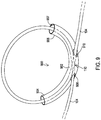
- FIG. 9 shows another example of a strain relief loop holder 900 that may be used in the system of FIG. 1 .
- This strain relief loop holder 900 is a continuous tube with a center section 902 and end sections 904, 906 together defining a lead passageway 907.
- the intersection point of the medical lead 104 occurs within the center section 902 and therefore the center section 902 may have a larger diameter than the end sections 904 906.
- the center section 902 may also define apertures 908 and 910 that provide an entry to allow the medical lead 104 to enter and exit the strain relief loop holder.
- This example may be constructed of thermal non-conductors or thermal conductors.
- a dopant or metal insert may be included as discussed above in relation to FIGS. 4 and 7 .
- FIG. 10 shows another example of a strain relief loop holder 1000 that may be used in the system of FIG. 1 .
- the strain relief loop holder 1000 utilizes continuous conjoined tubes forming center sections 1002 and 1003 and end sections 1004 and 1006 defining lead passageways 1004, 1009, respectively.
- each tube contains a single pass of the medical lead 104 and therefore both the center sections 1002, 1003 and the end sections 1004, 1006 are the same diameter in this example.
- This example may also be constructed of thermal non-conductors or thermal conductors.
- a dopant, metal insert, or metal body may be included as discussed above in relation to FIGS. 4 , 7, and 8 .
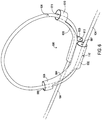
- FIG. 11 shows another example of a strain relief loop holder 1100 that may be used in the system of FIG. 1 and that utilizes a body 1102 with a single tube.
- the tube 1102 defines a lead passageway 1104.
- the lead 104 passes through the lead passageway 1104 loosely to form the strain relief loop 108 and intersection point 110 where the diameter of the lead passageway 1104 is larger than the lead body 104 to allow unrestricted axial movement of the lead 104 through the passageway 1104.
- This example may also be constructed of thermal non-conductors or thermal conductors.
- a dopant, metal insert, or metal body may be included as discussed above in relation to FIGS. 4 , 7, and 8 .
- FIG. 12 shows another example of a strain relief loop holder 1200 that may be used in the system of FIG. 1 and that utilizes a body 1202 that includes an additional tube 1203 to thereby form two adjacent central sections.
- the body 1202 including the additional tube 1203 defines lead passageways 1204 and 1206.
- the lead 104 passes through the lead passageways 1204, 1206 loosely to form the strain relief loop 108 and intersection point 110' where the diameter of the lead passageways 1204, 1206 are larger than the lead body 104 to allow unrestricted axial movement of the lead 104 through the passageways 1204, 1206.
- This example may also be constructed of thermal non-conductors or thermal conductors.
- a dopant, metal insert, or metal body may be included as discussed above in relation to FIGS. 4 , 7, and 8 .
- FIG. 13 shows another example of a strain relief loop holder 1300 that may be used in the system of FIG. 1 and that utilizes a body 1302 with a single tubular central section that defines two lead passageways 1304, 1306.
- the lead 104 passes through the lead passageways 1304, 1306 loosely to form the strain relief loop 108 where the diameter of the lead passageways 1304, 1306 is larger than the lead body 104 to allow unrestricted axial movement of the lead 104 through the passageways 1304, 1306.
- This example may also be constructed of thermal non-conductors or thermal conductors.
- a dopant, metal insert, or metal body may be included as discussed above in relation to FIGS. 4 , 7, and 8 .
- FIG. 14 shows another example of a strain relief loop holder 1400 that may be used in the system of FIG. 1 .
- the strain relief loop holder 1400 utilizes a body 1402 with a single tube to define a lead passageway 1404 at the intersection point 110 but also utilizes a looped coil 1406.
- the lead 104 passes through the lead passageway 1404 loosely to form the strain relief loop 108 where the diameter of the lead passageway 1404 is larger than the lead body 104 to allow unrestricted axial movement of the lead 104 through the passageway 1404.
- the loop 108 is constrained to a particular shape and size by the presence of the looped coil 1406 which is coupled to the body 1402.
- the looped coil 1406 may be constructed of non-conductive materials such as polyurethane, silicone, or conductive materials that have a non-conductive coating such as ETFE coated titanium, titanium molybdenum, or MP35N. This example may also be constructed of thermal non-conductors or thermal conductors. Furthermore, in the case of thermal non-conductor construction, a dopant, metal insert, or metal body may be included as discussed above in relation to FIGS. 4 , 7, and 8 .
- FIG. 15 shows another example of a strain relief loop holder 1500 that may be used in the system of FIG. 1 and that utilizes a body 1502 that provides a single tube.
- the body 1502 defines a lead passageway 1504. Additionally, the body 1502 is also looped.
- the lead 104 passes through the lead passageway 1504 loosely with the lead passageway 1504 to form the strain relief loop 108 where the diameter of the lead passageway 1504 is larger than the lead body 104 to allow unrestricted axial movement of the lead 104 through the passageway 1504.
- the looped shape of the body 1502 constrains the shape and size of the loop 108 of the lead 104.
- This example may also be constructed of thermal non-conductors or thermal conductors.
- a dopant, metal insert, or metal body may be included as discussed above in relation to FIGS. 4 , 7, and 8 .
- FIG. 16 shows another example of a strain relief loop holder 1600 that may be used in the system of FIG. 1 .
- the strain relief loop holder 1600 utilizes a body 1602 that forms a capsule to completely house the loop 108 of the lead 104 such that the passageway for the lead 104 is the entire internal volume of the strain relief loop holder 1600.
- the lead enters and exits the body 1602 through apertures 1604 and 1606 forming an entry to the interior volume of the body 1602.
- This example may also be constructed of thermal non-conductors or thermal conductors.
- a dopant, metal insert, or metal body may be included as discussed above in relation to FIGS. 4 , 7, and 8 .
- the lead body 104 could be affixed to one side of the holder so that the holder and the lead 104 are inseparable.
- the strain relief holder is already present on the lead 104 at the time of implant so that the holder is not inadvertently or intentionally omitted during the implantation procedure.
- the strain relief function is preserved.
- both leads 104, 105 may be affixed to the arm section 310 such as by a bond created by an adhesive or by melding the lead body to the arm section by reflowing the polymers of the two at that point.
Landscapes
- Health & Medical Sciences (AREA)
- Heart & Thoracic Surgery (AREA)
- Animal Behavior & Ethology (AREA)
- Engineering & Computer Science (AREA)
- Biomedical Technology (AREA)
- Nuclear Medicine, Radiotherapy & Molecular Imaging (AREA)
- Radiology & Medical Imaging (AREA)
- Life Sciences & Earth Sciences (AREA)
- General Health & Medical Sciences (AREA)
- Public Health (AREA)
- Veterinary Medicine (AREA)
- Cardiology (AREA)
- Vascular Medicine (AREA)
- Electrotherapy Devices (AREA)
- Neurology (AREA)
Claims (14)
- Porte-boucle de serrage implantable pour un conducteur médical, comprenant :un segment de corps (202) définissant au moins une voie de passage (207) ;un premier bras (204) s'étendant à partir d'une première extrémité du segment de corps (202) ;un premier segment de bras (208) à une extrémité du premier bras (204), opposé au segment de corps (202), le premier segment de bras définissant une première voie de passage de bras (209) ;un second bras (206) s'étendant à partir d'une seconde extrémité du segment de corps (202) ; etun second segment de bras (210) à l'extrémité du second bras (206), opposé au segment de corps (202), le second segment de bras (210) définissant une seconde voie de passage de bras (211).
- Porte-boucle de serrage implantable selon la revendication 1, dans lequel le premier bras (204) et le second bras (206) ont une forme d'arc.
- Porte-boucle de serrage implantable selon la revendication 1 ou 2, dans lequel le segment de corps (202) définit une voie de passage (207) unique et dans lequel à la fois le premier bras (204) et le second bras (206) s'étendent à partir de la voie de passage (207) unique.
- Porte-boucle de serrage implantable selon la revendication 1 ou 2, dans lequel le segment de corps définit une première voie de passage (507) et une seconde voie de passage (513), dans lequel le premier bras (504) s'étend à partir de la première voie de passage (507), et dans lequel le second bras (506) s'étend à partir de la seconde voie de passage (513).
- Porte-boucle de serrage implantable selon la revendication 4, comprenant en outre un corps métallique (812) entre les première et seconde voies de passage (507, 513).
- Porte-boucle de serrage implantable selon l'une quelconque des revendications 1 à 4, dans lequel le segment de corps (202), le premier bras (204) et le second bras (206) sont fabriqués à partir d'un polymère, dans lequel le segment de corps (202) est facultativement dopé avec un matériau conducteur.
- Porte-boucle de serrage implantable selon la revendication 6, comprenant en outre un insert métallique (712) à l'intérieur du segment de corps (702).
- Porte-boucle de serrage implantable selon l'une quelconque des revendications 1 à 4, dans lequel le segment de corps (202), le premier bras (204) et le second bras (206) sont fabriqués à partir d'un métal.
- Porte-boucle de serrage implantable selon l'une quelconque des revendications 1 à 8, comprenant en outre une languette d'ancrage (212) s'étendant à partir du segment de corps (202).
- Porte-boucle de serrage implantable selon l'une quelconque des revendications 1 à 9, dans lequel la au moins une voie de passage de segment de corps (207) a un diamètre supérieur à un diamètre de la première voie de passage de bras (209) et de la seconde voie de passage de bras (211).
- Système de serrage de conducteur médical comprenant :un porte-boucle de serrage implantable selon l'une quelconque des revendications précédentes ; etun conducteur médical (104) qui passe à travers la première voie de passage de bras (209) et la seconde voie de passage de bras (211), le conducteur médical formant une boucle en passant à travers et en formant une intersection à l'intérieur du segment de corps, dans lequel typiquement le conducteur médical est couplé à un dispositif médical.
- Système de serrage de conducteur médical selon la revendication 11, dans lequel le segment de corps définit une voie de passage unique, dans lequel à la fois le premier bras et le second bras s'étendent à partir de la voie de passage unique, et dans lequel le conducteur médical forme une intersection à l'intérieur de la voie de passage unique, ou bien
dans lequel le segment de corps définit une première voie de passage adjacente à une seconde voie de passage, dans lequel le premier bras s'étend à partir de la première voie de passage, et dans lequel le second bras s'étend à partir de la seconde voie de passage, et dans lequel le conducteur médical forme une intersection à l'intérieur du segment de corps en passant à la fois à travers les première et seconde voies de passage. - Système de serrage de conducteur médical selon la revendication 11, comprenant en outre une bobine enroulée (1406) couplée au corps et dans lequel le conducteur médical passe à travers la bobine enroulée.
- Système de serrage de conducteur médical selon l'une quelconque des revendications 11 à 13, dans lequel le corps comprend un élément thermique non conducteur, ou bien
dans lequel le corps comprend un conducteur thermique.
Applications Claiming Priority (2)
| Application Number | Priority Date | Filing Date | Title |
|---|---|---|---|
| US201261635784P | 2012-04-19 | 2012-04-19 | |
| PCT/US2013/023643 WO2013158190A1 (fr) | 2012-04-19 | 2013-01-29 | Porte-boucles de serrage pour conducteurs à usage médical et systèmes associés |
Publications (2)
| Publication Number | Publication Date |
|---|---|
| EP2838604A1 EP2838604A1 (fr) | 2015-02-25 |
| EP2838604B1 true EP2838604B1 (fr) | 2017-04-05 |
Family
ID=47747789
Family Applications (1)
| Application Number | Title | Priority Date | Filing Date |
|---|---|---|---|
| EP13705639.6A Active EP2838604B1 (fr) | 2012-04-19 | 2013-01-29 | Porte-boucles de serrage pour conducteurs à usage médical et systèmes associés |
Country Status (3)
| Country | Link |
|---|---|
| US (2) | US9561364B2 (fr) |
| EP (1) | EP2838604B1 (fr) |
| WO (1) | WO2013158190A1 (fr) |
Families Citing this family (19)
| Publication number | Priority date | Publication date | Assignee | Title |
|---|---|---|---|---|
| US11679262B2 (en) | 2007-03-09 | 2023-06-20 | Mainstay Medical Limited | Systems and methods for restoring muscle function to the lumbar spine |
| US11331488B2 (en) | 2007-03-09 | 2022-05-17 | Mainstay Medical Limited | Systems and methods for enhancing function of spine stabilization muscles associated with a spine surgery intervention |
| US10925637B2 (en) | 2010-03-11 | 2021-02-23 | Mainstay Medical Limited | Methods of implanting electrode leads for use with implantable neuromuscular electrical stimulator |
| US8428728B2 (en) | 2007-03-09 | 2013-04-23 | Mainstay Medical Limited | Muscle stimulator |
| US9072897B2 (en) | 2007-03-09 | 2015-07-07 | Mainstay Medical Limited | Systems and methods for restoring muscle function to the lumbar spine |
| US11679261B2 (en) | 2007-03-09 | 2023-06-20 | Mainstay Medical Limited | Systems and methods for enhancing function of spine stabilization muscles associated with a spine surgery intervention |
| AU2011224323B2 (en) | 2010-03-11 | 2016-06-23 | Mainstay Medical Limited | Modular stimulator for treatment of back pain, implantable RF ablation system and methods of use |
| US12097365B2 (en) | 2010-03-11 | 2024-09-24 | Mainstay Medical Limited | Electrical stimulator for the treatment of back pain and methods of use |
| US11684774B2 (en) | 2010-03-11 | 2023-06-27 | Mainstay Medical Limited | Electrical stimulator for treatment of back pain and methods of use |
| US9950159B2 (en) | 2013-10-23 | 2018-04-24 | Mainstay Medical Limited | Systems and methods for restoring muscle function to the lumbar spine and kits for implanting the same |
| US11786725B2 (en) | 2012-06-13 | 2023-10-17 | Mainstay Medical Limited | Systems and methods for restoring muscle function to the lumbar spine and kits for implanting the same |
| US9999763B2 (en) | 2012-06-13 | 2018-06-19 | Mainstay Medical Limited | Apparatus and methods for anchoring electrode leads adjacent to nervous tissue |
| US9186501B2 (en) | 2012-06-13 | 2015-11-17 | Mainstay Medical Limited | Systems and methods for implanting electrode leads for use with implantable neuromuscular electrical stimulator |
| US10327810B2 (en) | 2016-07-05 | 2019-06-25 | Mainstay Medical Limited | Systems and methods for enhanced implantation of electrode leads between tissue layers |
| US12594096B2 (en) | 2012-06-13 | 2026-04-07 | Mainstay Medical Limited | Systems and methods for enhanced implantation of electrode leads between tissue layers |
| US10195419B2 (en) * | 2012-06-13 | 2019-02-05 | Mainstay Medical Limited | Electrode leads for use with implantable neuromuscular electrical stimulator |
| AU2015217286B2 (en) * | 2014-02-11 | 2016-12-22 | Cardiac Pacemakers, Inc | RF shield for an implantable lead |
| US10471268B2 (en) | 2014-10-16 | 2019-11-12 | Mainstay Medical Limited | Systems and methods for monitoring muscle rehabilitation |
| US12582816B2 (en) | 2022-03-22 | 2026-03-24 | Mainstay Medical Limited | Systems and methods for extracting an electrode lead |
Family Cites Families (11)
| Publication number | Priority date | Publication date | Assignee | Title |
|---|---|---|---|---|
| US5376108A (en) | 1993-05-20 | 1994-12-27 | Telectronics Pacing Systems, Inc. | Electrode lead anchoring apparatus and method employing dual suture collars |
| US6471676B1 (en) * | 2000-03-21 | 2002-10-29 | Novartis Nutrition Ag | Catheter and feeding tube retention device and method of use |
| US7454251B2 (en) | 2003-05-29 | 2008-11-18 | The Cleveland Clinic Foundation | Excess lead retaining and management devices and methods of using same |
| WO2006012050A2 (fr) | 2004-06-30 | 2006-02-02 | Cvrx, Inc. | Structures de connexion pour un corps conducteur a electrodes extravasculaires |
| US7917213B2 (en) | 2005-11-04 | 2011-03-29 | Kenergy, Inc. | MRI compatible implanted electronic medical lead |
| US7769443B2 (en) | 2006-09-06 | 2010-08-03 | Giancarlo Barolat | Implantable reel for coiling an implantable elongated member |
| MY177188A (en) * | 2006-12-11 | 2020-09-09 | Medic Domain M Sdn Bhd | A device for protecting and securing medical device at a venipuncture site |
| US8295948B2 (en) | 2009-07-21 | 2012-10-23 | Boston Scientific Neuromodulation Corporation | Tubular lead anchor and methods and devices using the anchor |
| US20110034983A1 (en) | 2009-08-07 | 2011-02-10 | Pacesetter, Inc. | Implantable medical device lead incorporating a conductive sheath surrounding insulated coils to reduce lead heating during mri |
| US9427552B2 (en) | 2010-06-30 | 2016-08-30 | Bernard Engelhardt | Medical tubing and catheter control |
| US8483845B2 (en) * | 2011-03-11 | 2013-07-09 | Greatbatch Ltd. | Anchor for implantable medical device |
-
2013
- 2013-01-29 WO PCT/US2013/023643 patent/WO2013158190A1/fr not_active Ceased
- 2013-01-29 US US14/395,195 patent/US9561364B2/en active Active
- 2013-01-29 EP EP13705639.6A patent/EP2838604B1/fr active Active
-
2017
- 2017-02-06 US US15/426,051 patent/US10092748B2/en active Active
Non-Patent Citations (1)
| Title |
|---|
| "Bus Drop Cable Supports and Clamps", 1 September 2010 (2010-09-01), XP055231800, Retrieved from the Internet <URL:www.appletonelec.com> [retrieved on 20151126] * |
Also Published As
| Publication number | Publication date |
|---|---|
| WO2013158190A1 (fr) | 2013-10-24 |
| US10092748B2 (en) | 2018-10-09 |
| US20150134035A1 (en) | 2015-05-14 |
| EP2838604A1 (fr) | 2015-02-25 |
| US9561364B2 (en) | 2017-02-07 |
| US20170182313A1 (en) | 2017-06-29 |
Similar Documents
| Publication | Publication Date | Title |
|---|---|---|
| EP2838604B1 (fr) | Porte-boucles de serrage pour conducteurs à usage médical et systèmes associés | |
| JP6953332B2 (ja) | 移植式導線 | |
| CN113747936B (zh) | 用于电刺激来治疗癌症的电极 | |
| CN105056397B (zh) | 植入式神经电刺激电极组件及其应用方法 | |
| JP6454728B2 (ja) | 植え込み型医療装置、システム、及びそれらの構成要素 | |
| US10398890B2 (en) | Introduction of medical lead into patient | |
| AU2007345606B2 (en) | Spiral configurations for intravascular lead stability | |
| US9724126B2 (en) | Introduction of medical lead into patient | |
| US8224456B2 (en) | Directional stimulation lead and orientation system | |
| EP3590575B1 (fr) | Électrode dotée d'une butée d'insertion mobile | |
| US7395120B2 (en) | Telescoping, dual-site pacing lead | |
| US20050004639A1 (en) | Medical lead with resorbable material | |
| US20030069623A1 (en) | Implantable percutaneous stimulation lead with lead carrier | |
| US20070213795A1 (en) | Implantable medical lead | |
| US20090319012A1 (en) | Modular stimulation lead network | |
| CN110975145A (zh) | 用于通过经血管神经刺激辅助呼吸的装置和方法 | |
| US20060036306A1 (en) | Telescoping, dual-site pacing lead | |
| JP2016516554A (ja) | 皮下領域刺激のための多枝刺激電極 | |
| US20140114380A1 (en) | Mr-compatible implantable medical lead | |
| US20250177757A1 (en) | Wirelessly powered intravascular systems | |
| JP5178706B2 (ja) | 非直線型電極アレイ | |
| US11497919B2 (en) | Communication amplification device comprising retention elements for an implantable capsule | |
| US20090281409A1 (en) | Reinforced medical device | |
| US20130158640A1 (en) | Lead anchoring system with limited movement of anchoring device along lead | |
| CN205055188U (zh) | 植入式神经电刺激电极组件及其电极导管 |
Legal Events
| Date | Code | Title | Description |
|---|---|---|---|
| PUAI | Public reference made under article 153(3) epc to a published international application that has entered the european phase |
Free format text: ORIGINAL CODE: 0009012 |
|
| 17P | Request for examination filed |
Effective date: 20141117 |
|
| AK | Designated contracting states |
Kind code of ref document: A1 Designated state(s): AL AT BE BG CH CY CZ DE DK EE ES FI FR GB GR HR HU IE IS IT LI LT LU LV MC MK MT NL NO PL PT RO RS SE SI SK SM TR |
|
| AX | Request for extension of the european patent |
Extension state: BA ME |
|
| DAX | Request for extension of the european patent (deleted) | ||
| 17Q | First examination report despatched |
Effective date: 20151203 |
|
| GRAP | Despatch of communication of intention to grant a patent |
Free format text: ORIGINAL CODE: EPIDOSNIGR1 |
|
| RIC1 | Information provided on ipc code assigned before grant |
Ipc: H01R 13/58 20060101ALI20161107BHEP Ipc: G01K 1/14 20060101ALI20161107BHEP Ipc: A61N 1/08 20060101ALI20161107BHEP Ipc: A61M 25/02 20060101ALI20161107BHEP Ipc: A61N 1/05 20060101AFI20161107BHEP |
|
| INTG | Intention to grant announced |
Effective date: 20161206 |
|
| GRAS | Grant fee paid |
Free format text: ORIGINAL CODE: EPIDOSNIGR3 |
|
| GRAA | (expected) grant |
Free format text: ORIGINAL CODE: 0009210 |
|
| AK | Designated contracting states |
Kind code of ref document: B1 Designated state(s): AL AT BE BG CH CY CZ DE DK EE ES FI FR GB GR HR HU IE IS IT LI LT LU LV MC MK MT NL NO PL PT RO RS SE SI SK SM TR |
|
| REG | Reference to a national code |
Ref country code: GB Ref legal event code: FG4D |
|
| REG | Reference to a national code |
Ref country code: CH Ref legal event code: EP |
|
| REG | Reference to a national code |
Ref country code: AT Ref legal event code: REF Ref document number: 881225 Country of ref document: AT Kind code of ref document: T Effective date: 20170415 |
|
| REG | Reference to a national code |
Ref country code: IE Ref legal event code: FG4D |
|
| REG | Reference to a national code |
Ref country code: DE Ref legal event code: R096 Ref document number: 602013019410 Country of ref document: DE |
|
| REG | Reference to a national code |
Ref country code: NL Ref legal event code: MP Effective date: 20170405 |
|
| REG | Reference to a national code |
Ref country code: LT Ref legal event code: MG4D |
|
| REG | Reference to a national code |
Ref country code: AT Ref legal event code: MK05 Ref document number: 881225 Country of ref document: AT Kind code of ref document: T Effective date: 20170405 |
|
| PG25 | Lapsed in a contracting state [announced via postgrant information from national office to epo] |
Ref country code: NL Free format text: LAPSE BECAUSE OF FAILURE TO SUBMIT A TRANSLATION OF THE DESCRIPTION OR TO PAY THE FEE WITHIN THE PRESCRIBED TIME-LIMIT Effective date: 20170405 |
|
| PG25 | Lapsed in a contracting state [announced via postgrant information from national office to epo] |
Ref country code: NO Free format text: LAPSE BECAUSE OF FAILURE TO SUBMIT A TRANSLATION OF THE DESCRIPTION OR TO PAY THE FEE WITHIN THE PRESCRIBED TIME-LIMIT Effective date: 20170705 Ref country code: AT Free format text: LAPSE BECAUSE OF FAILURE TO SUBMIT A TRANSLATION OF THE DESCRIPTION OR TO PAY THE FEE WITHIN THE PRESCRIBED TIME-LIMIT Effective date: 20170405 Ref country code: LT Free format text: LAPSE BECAUSE OF FAILURE TO SUBMIT A TRANSLATION OF THE DESCRIPTION OR TO PAY THE FEE WITHIN THE PRESCRIBED TIME-LIMIT Effective date: 20170405 Ref country code: HR Free format text: LAPSE BECAUSE OF FAILURE TO SUBMIT A TRANSLATION OF THE DESCRIPTION OR TO PAY THE FEE WITHIN THE PRESCRIBED TIME-LIMIT Effective date: 20170405 Ref country code: ES Free format text: LAPSE BECAUSE OF FAILURE TO SUBMIT A TRANSLATION OF THE DESCRIPTION OR TO PAY THE FEE WITHIN THE PRESCRIBED TIME-LIMIT Effective date: 20170405 Ref country code: GR Free format text: LAPSE BECAUSE OF FAILURE TO SUBMIT A TRANSLATION OF THE DESCRIPTION OR TO PAY THE FEE WITHIN THE PRESCRIBED TIME-LIMIT Effective date: 20170706 Ref country code: FI Free format text: LAPSE BECAUSE OF FAILURE TO SUBMIT A TRANSLATION OF THE DESCRIPTION OR TO PAY THE FEE WITHIN THE PRESCRIBED TIME-LIMIT Effective date: 20170405 |
|
| PG25 | Lapsed in a contracting state [announced via postgrant information from national office to epo] |
Ref country code: SE Free format text: LAPSE BECAUSE OF FAILURE TO SUBMIT A TRANSLATION OF THE DESCRIPTION OR TO PAY THE FEE WITHIN THE PRESCRIBED TIME-LIMIT Effective date: 20170405 Ref country code: PL Free format text: LAPSE BECAUSE OF FAILURE TO SUBMIT A TRANSLATION OF THE DESCRIPTION OR TO PAY THE FEE WITHIN THE PRESCRIBED TIME-LIMIT Effective date: 20170405 Ref country code: IS Free format text: LAPSE BECAUSE OF FAILURE TO SUBMIT A TRANSLATION OF THE DESCRIPTION OR TO PAY THE FEE WITHIN THE PRESCRIBED TIME-LIMIT Effective date: 20170805 Ref country code: RS Free format text: LAPSE BECAUSE OF FAILURE TO SUBMIT A TRANSLATION OF THE DESCRIPTION OR TO PAY THE FEE WITHIN THE PRESCRIBED TIME-LIMIT Effective date: 20170405 Ref country code: LV Free format text: LAPSE BECAUSE OF FAILURE TO SUBMIT A TRANSLATION OF THE DESCRIPTION OR TO PAY THE FEE WITHIN THE PRESCRIBED TIME-LIMIT Effective date: 20170405 Ref country code: BG Free format text: LAPSE BECAUSE OF FAILURE TO SUBMIT A TRANSLATION OF THE DESCRIPTION OR TO PAY THE FEE WITHIN THE PRESCRIBED TIME-LIMIT Effective date: 20170705 |
|
| REG | Reference to a national code |
Ref country code: DE Ref legal event code: R097 Ref document number: 602013019410 Country of ref document: DE |
|
| REG | Reference to a national code |
Ref country code: FR Ref legal event code: PLFP Year of fee payment: 6 |
|
| PG25 | Lapsed in a contracting state [announced via postgrant information from national office to epo] |
Ref country code: RO Free format text: LAPSE BECAUSE OF FAILURE TO SUBMIT A TRANSLATION OF THE DESCRIPTION OR TO PAY THE FEE WITHIN THE PRESCRIBED TIME-LIMIT Effective date: 20170405 Ref country code: DK Free format text: LAPSE BECAUSE OF FAILURE TO SUBMIT A TRANSLATION OF THE DESCRIPTION OR TO PAY THE FEE WITHIN THE PRESCRIBED TIME-LIMIT Effective date: 20170405 Ref country code: SK Free format text: LAPSE BECAUSE OF FAILURE TO SUBMIT A TRANSLATION OF THE DESCRIPTION OR TO PAY THE FEE WITHIN THE PRESCRIBED TIME-LIMIT Effective date: 20170405 Ref country code: EE Free format text: LAPSE BECAUSE OF FAILURE TO SUBMIT A TRANSLATION OF THE DESCRIPTION OR TO PAY THE FEE WITHIN THE PRESCRIBED TIME-LIMIT Effective date: 20170405 Ref country code: CZ Free format text: LAPSE BECAUSE OF FAILURE TO SUBMIT A TRANSLATION OF THE DESCRIPTION OR TO PAY THE FEE WITHIN THE PRESCRIBED TIME-LIMIT Effective date: 20170405 |
|
| PLBE | No opposition filed within time limit |
Free format text: ORIGINAL CODE: 0009261 |
|
| STAA | Information on the status of an ep patent application or granted ep patent |
Free format text: STATUS: NO OPPOSITION FILED WITHIN TIME LIMIT |
|
| PG25 | Lapsed in a contracting state [announced via postgrant information from national office to epo] |
Ref country code: IT Free format text: LAPSE BECAUSE OF FAILURE TO SUBMIT A TRANSLATION OF THE DESCRIPTION OR TO PAY THE FEE WITHIN THE PRESCRIBED TIME-LIMIT Effective date: 20170405 Ref country code: SM Free format text: LAPSE BECAUSE OF FAILURE TO SUBMIT A TRANSLATION OF THE DESCRIPTION OR TO PAY THE FEE WITHIN THE PRESCRIBED TIME-LIMIT Effective date: 20170405 |
|
| 26N | No opposition filed |
Effective date: 20180108 |
|
| PG25 | Lapsed in a contracting state [announced via postgrant information from national office to epo] |
Ref country code: SI Free format text: LAPSE BECAUSE OF FAILURE TO SUBMIT A TRANSLATION OF THE DESCRIPTION OR TO PAY THE FEE WITHIN THE PRESCRIBED TIME-LIMIT Effective date: 20170405 |
|
| REG | Reference to a national code |
Ref country code: CH Ref legal event code: PL |
|
| GBPC | Gb: european patent ceased through non-payment of renewal fee |
Effective date: 20180129 |
|
| PG25 | Lapsed in a contracting state [announced via postgrant information from national office to epo] |
Ref country code: LU Free format text: LAPSE BECAUSE OF NON-PAYMENT OF DUE FEES Effective date: 20180129 |
|
| REG | Reference to a national code |
Ref country code: IE Ref legal event code: MM4A |
|
| REG | Reference to a national code |
Ref country code: BE Ref legal event code: MM Effective date: 20180131 |
|
| PG25 | Lapsed in a contracting state [announced via postgrant information from national office to epo] |
Ref country code: LI Free format text: LAPSE BECAUSE OF NON-PAYMENT OF DUE FEES Effective date: 20180131 Ref country code: BE Free format text: LAPSE BECAUSE OF NON-PAYMENT OF DUE FEES Effective date: 20180131 Ref country code: CH Free format text: LAPSE BECAUSE OF NON-PAYMENT OF DUE FEES Effective date: 20180131 Ref country code: GB Free format text: LAPSE BECAUSE OF NON-PAYMENT OF DUE FEES Effective date: 20180129 |
|
| PG25 | Lapsed in a contracting state [announced via postgrant information from national office to epo] |
Ref country code: IE Free format text: LAPSE BECAUSE OF NON-PAYMENT OF DUE FEES Effective date: 20180129 |
|
| PG25 | Lapsed in a contracting state [announced via postgrant information from national office to epo] |
Ref country code: MC Free format text: LAPSE BECAUSE OF FAILURE TO SUBMIT A TRANSLATION OF THE DESCRIPTION OR TO PAY THE FEE WITHIN THE PRESCRIBED TIME-LIMIT Effective date: 20170405 |
|
| PG25 | Lapsed in a contracting state [announced via postgrant information from national office to epo] |
Ref country code: MT Free format text: LAPSE BECAUSE OF NON-PAYMENT OF DUE FEES Effective date: 20180129 |
|
| PG25 | Lapsed in a contracting state [announced via postgrant information from national office to epo] |
Ref country code: TR Free format text: LAPSE BECAUSE OF FAILURE TO SUBMIT A TRANSLATION OF THE DESCRIPTION OR TO PAY THE FEE WITHIN THE PRESCRIBED TIME-LIMIT Effective date: 20170405 |
|
| PG25 | Lapsed in a contracting state [announced via postgrant information from national office to epo] |
Ref country code: PT Free format text: LAPSE BECAUSE OF FAILURE TO SUBMIT A TRANSLATION OF THE DESCRIPTION OR TO PAY THE FEE WITHIN THE PRESCRIBED TIME-LIMIT Effective date: 20170405 |
|
| PG25 | Lapsed in a contracting state [announced via postgrant information from national office to epo] |
Ref country code: HU Free format text: LAPSE BECAUSE OF FAILURE TO SUBMIT A TRANSLATION OF THE DESCRIPTION OR TO PAY THE FEE WITHIN THE PRESCRIBED TIME-LIMIT; INVALID AB INITIO Effective date: 20130129 Ref country code: MK Free format text: LAPSE BECAUSE OF NON-PAYMENT OF DUE FEES Effective date: 20170405 Ref country code: CY Free format text: LAPSE BECAUSE OF FAILURE TO SUBMIT A TRANSLATION OF THE DESCRIPTION OR TO PAY THE FEE WITHIN THE PRESCRIBED TIME-LIMIT Effective date: 20170405 |
|
| PG25 | Lapsed in a contracting state [announced via postgrant information from national office to epo] |
Ref country code: AL Free format text: LAPSE BECAUSE OF FAILURE TO SUBMIT A TRANSLATION OF THE DESCRIPTION OR TO PAY THE FEE WITHIN THE PRESCRIBED TIME-LIMIT Effective date: 20170405 |
|
| PGFP | Annual fee paid to national office [announced via postgrant information from national office to epo] |
Ref country code: FR Payment date: 20241219 Year of fee payment: 13 |
|
| PGFP | Annual fee paid to national office [announced via postgrant information from national office to epo] |
Ref country code: DE Payment date: 20241218 Year of fee payment: 13 |