EP2839932A1 - Régime de reprise pour perceuses à âme en diamant après une désactivation de température (surchauffe du moteur) - Google Patents
Régime de reprise pour perceuses à âme en diamant après une désactivation de température (surchauffe du moteur) Download PDFInfo
- Publication number
- EP2839932A1 EP2839932A1 EP13180865.1A EP13180865A EP2839932A1 EP 2839932 A1 EP2839932 A1 EP 2839932A1 EP 13180865 A EP13180865 A EP 13180865A EP 2839932 A1 EP2839932 A1 EP 2839932A1
- Authority
- EP
- European Patent Office
- Prior art keywords
- value
- machine tool
- drive
- temperature
- speed
- Prior art date
- Legal status (The legal status is an assumption and is not a legal conclusion. Google has not performed a legal analysis and makes no representation as to the accuracy of the status listed.)
- Withdrawn
Links
- 238000013021 overheating Methods 0.000 title description 2
- 229910003460 diamond Inorganic materials 0.000 title 1
- 239000010432 diamond Substances 0.000 title 1
- 238000005553 drilling Methods 0.000 title 1
- 238000011084 recovery Methods 0.000 title 1
- 238000000034 method Methods 0.000 claims abstract description 13
- 239000000463 material Substances 0.000 claims abstract description 9
- 238000001816 cooling Methods 0.000 description 5
- 230000001419 dependent effect Effects 0.000 description 3
- 230000002950 deficient Effects 0.000 description 2
- 239000004567 concrete Substances 0.000 description 1
- 238000010586 diagram Methods 0.000 description 1
- 230000020169 heat generation Effects 0.000 description 1
- 230000007774 longterm Effects 0.000 description 1
- 238000003754 machining Methods 0.000 description 1
- 239000004575 stone Substances 0.000 description 1
- 230000002459 sustained effect Effects 0.000 description 1
- 239000002023 wood Substances 0.000 description 1
Images

Classifications
-
- B—PERFORMING OPERATIONS; TRANSPORTING
- B23—MACHINE TOOLS; METAL-WORKING NOT OTHERWISE PROVIDED FOR
- B23Q—DETAILS, COMPONENTS, OR ACCESSORIES FOR MACHINE TOOLS, e.g. ARRANGEMENTS FOR COPYING OR CONTROLLING; MACHINE TOOLS IN GENERAL CHARACTERISED BY THE CONSTRUCTION OF PARTICULAR DETAILS OR COMPONENTS; COMBINATIONS OR ASSOCIATIONS OF METAL-WORKING MACHINES, NOT DIRECTED TO A PARTICULAR RESULT
- B23Q11/00—Accessories fitted to machine tools for keeping tools or parts of the machine in good working condition or for cooling work; Safety devices specially combined with or arranged in, or specially adapted for use in connection with, machine tools
- B23Q11/14—Methods or arrangements for maintaining a constant temperature in parts of machine tools
-
- B—PERFORMING OPERATIONS; TRANSPORTING
- B23—MACHINE TOOLS; METAL-WORKING NOT OTHERWISE PROVIDED FOR
- B23Q—DETAILS, COMPONENTS, OR ACCESSORIES FOR MACHINE TOOLS, e.g. ARRANGEMENTS FOR COPYING OR CONTROLLING; MACHINE TOOLS IN GENERAL CHARACTERISED BY THE CONSTRUCTION OF PARTICULAR DETAILS OR COMPONENTS; COMBINATIONS OR ASSOCIATIONS OF METAL-WORKING MACHINES, NOT DIRECTED TO A PARTICULAR RESULT
- B23Q15/00—Automatic control or regulation of feed movement, cutting velocity or position of tool or work
- B23Q15/007—Automatic control or regulation of feed movement, cutting velocity or position of tool or work while the tool acts upon the workpiece
- B23Q15/12—Adaptive control, i.e. adjusting itself to have a performance which is optimum according to a preassigned criterion
-
- B—PERFORMING OPERATIONS; TRANSPORTING
- B25—HAND TOOLS; PORTABLE POWER-DRIVEN TOOLS; MANIPULATORS
- B25F—COMBINATION OR MULTI-PURPOSE TOOLS NOT OTHERWISE PROVIDED FOR; DETAILS OR COMPONENTS OF PORTABLE POWER-DRIVEN TOOLS NOT PARTICULARLY RELATED TO THE OPERATIONS PERFORMED AND NOT OTHERWISE PROVIDED FOR
- B25F5/00—Details or components of portable power-driven tools not particularly related to the operations performed and not otherwise provided for
Definitions
- the present invention relates to a method for controlling a machine tool when processing a material.
- a machine tool such as a hammer drill, a drill, a circular saw or the like
- a long-term use or in an intensive use can lead to a temperature-induced failure of the machine tool.
- the drive of the machine tool which is usually realized in the form of an electric motor, requires a high voltage from the accumulator or (depending on the application) from the power grid. As a result, the electric motor designed as a drive generates a lot of heat.
- a control unit monitors the temperature of the machine tool by means of sensors. In the event that a critical temperature is reached and exceeded inside the machine tool, the control unit is able to turn off the drive of the machine tool, whereby the heat generation of the drive can be counteracted. When switched off, the drive and the machine tool can cool down overall until the temperature has fallen below the critical value again and further work is possible again.
- Such a machine tool is for example in the DE-Offenlegungsschrift 4,238,564 A1 shown.
- the DE 4 238 564 A1 discloses in particular a power tool with a suction device, which is connected to an external vacuum source.
- the vacuum source serves to generate a cooling air flow through the electric motor.
- a disadvantage of this procedure according to the prior art is that the machine tool requires a time indefinable for the user to cool down and as a result of this, working with the machine tool is interrupted for the indefinite period of time.
- a setting of the threshold value depending on the ambient temperature of the machine tool can be provided. This can be prevented, for example, that the threshold is set too low and this is too early or too fast exceeded.
- the data display device can be realized in the form of a display element, a display, at least one lamp or in the form of an acoustic signal generator.
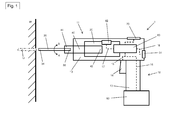
- Fig. 1 1 shows a machine tool 1 which contains a housing 10, a drive 20, a tool 30, a drive shaft 40, a power source 50, a first temperature sensor 62, a second temperature sensor 64, a data display device 70 and a control unit 80.
- the housing 10 consists essentially of a first portion 11, in which the drive 20, the first temperature sensor 62, the second temperature sensor 64 and the control unit 80 is located, and from a second portion 12, a handle 13, a switch 14 and the power source 50 includes.
- the switch 14 is connected to the control unit 80 via a line 15, so that by actuating the switch 14, the control unit 80 takes the drive 20 into operation. By releasing the switch 14, the drive 20 is stopped by the control unit 80.
- the control unit 80 thus serves primarily to control the drive 20.
- the drive 20 is an electric motor and the tool 30 is designed as a drill.
- the energy source 50 is designed as an accumulator. Alternatively, however, the power source 50 may be a power source (outlet) connected to a power cord. Both the power cord and the power source are not shown in the figures.
- the power source 50 supplies the drive 20 via a line 16 with power.
- the drive shaft 40 includes a first end 42 and a second end 44, wherein the first end 42 is connected to the formed as an electric motor drive 20 that a torque generated in the electric motor 20 is transmitted to the configured as a drill tool 30.
- the drill 30 is connected at a first end 32 to the second end 44 of the drive shaft 40.
- a second end 34 of the drill 30 is used to drill a hole Q in a material W.
- a material W for example, concrete, stone, wood or the like may be provided.
- the data display device 70 is positioned on the first portion 11 of the housing 10 and formed in the form of a display. On the display device 70, the user (not shown) of the machine tool 1 can read data, parameters and information related to the machine tool 1.
- the first temperature sensor 62 is connected to the electric motor 20 so that it can constantly measure the temperature of the electric motor 20.
- the first temperature sensor 62 is also connected via the line 17 in connection with the control unit 80 in order to transmit the measured temperature values to the control unit 80.
- the second temperature sensor 64 is connected to the housing 10 of the machine tool 1 so that it can measure the ambient temperature.
- the second temperature sensor 64 is connected via a line 18 to the control unit 80. Measured temperature values can be sent to the control unit 80 via the connection 18.
- Threshold values are stored in the control unit 80, by means of which comparison with the measured temperature values the control unit 80 can determine a critical temperature development in the machine tool 1.
- the determination of the threshold values is dependent on the respective ambient temperature of the machine tool 1, which is measured by the second temperature sensor 64. This means that when the ambient temperature is low, the thresholds are set and set accordingly low. In contrast, at high ambient temperatures, the thresholds are selected and set correspondingly high.
- Fig. 2 shows a flowchart of the method for controlling the machine tool 1 when processing a material W.
- step S1 the speed of the drive 20 is first set to a value of 1.
- the value 1 corresponds to a medium to high working speed.
- step S2 a first temperature value of the drive 20 designed as an electric motor is measured by the first temperature sensor 62.
- step S3 the first temperature value of the drive 20 measured by the first temperature sensor 62 is adjusted to the predetermined threshold value.
- step S4 it is then determined whether or not the first temperature value of the drive 20 has exceeded the threshold value.
- step S2 the process continues with step S2 .
- step S5 follows , in which it is determined whether the threshold has been exceeded for a predetermined first period of time.
- step S2 In the event that the threshold has not been exceeded, the predetermined first period of time, followed by step S2 again.
- step S6 follows , in which the speed of the drive 20 is reduced from the value 1 to a value 2.
- the value 2 corresponds to a low working speed.
- the drive 20 of the machine tool 1 can cool down, since less current is now drawn from the accumulator 50 by the drive 20, and, on the other hand, work with the machine tool 1 can be continued. Although the speed and thus the power output of the drive 20 are reduced accordingly, but the machine tool 1 is not completely switched off, whereby a slower work is still possible.
- the current status of the machine tool 1 is displayed to the user with the aid of the data display device 70 embodied as a display.
- the user learns that the machine tool 1 is currently overheated and the low operating speed is not the result of damage to the machine tool 1, but that the low operating speed for cooling the drive 20 and thus prevents damage.
- the length of the first period of time is dependent on the threshold value and the ambient temperature of the machine tool 1. This means that a long first time period is selected and set when the threshold and the ambient temperature are correspondingly low. On the other hand, a short first time period is selected and set when the threshold and the ambient temperature are correspondingly high. With a long first time period, it can be achieved that (when the threshold and the ambient temperature are low), the speed of the drive 20 is not reduced from the value 1 to a value 2 early, just because a low threshold has been exceeded for a short time. For efficient operation with the machine tool 1 at a high speed, a one-time and short-term exceeding of the threshold value can be tolerated, since usually the short crossing does not result in any damage to the machine tool 1.
- step S7 in which a second temperature value of the drive 20 is measured by the first temperature sensor 62.
- step S8 the second temperature value of the drive 20 measured by the first temperature sensor 62 is adjusted to the predetermined threshold value.
- step S9 it is then determined whether the second temperature value of the drive 20 is still exceeding the threshold value or not.
- step S7 the method is continued with step S7 .
- step S10 it is determined in step S10 whether a predetermined second time duration has been exceeded.
- step S7 If the second temperature value of the drive 20 does not fall below the threshold value at least for the second time duration, the method is also continued with step S7 .
- step S11 the rotational speed of the engine 20 is increased from the lower value 2 (low operating speed) to the higher value 1 (medium to high operating speed).
Landscapes
- Engineering & Computer Science (AREA)
- Mechanical Engineering (AREA)
- Numerical Control (AREA)
- Machine Tool Sensing Apparatuses (AREA)
- Control Of Electric Motors In General (AREA)
- Earth Drilling (AREA)
- Automatic Control Of Machine Tools (AREA)
Priority Applications (5)
| Application Number | Priority Date | Filing Date | Title |
|---|---|---|---|
| EP13180865.1A EP2839932A1 (fr) | 2013-08-19 | 2013-08-19 | Régime de reprise pour perceuses à âme en diamant après une désactivation de température (surchauffe du moteur) |
| RU2016109923A RU2016109923A (ru) | 2013-08-19 | 2014-08-12 | Восстановительная скорость вращения для колонковых алмазных сверлильных устройств после температурного отключения (перегрева мотора) |
| PCT/EP2014/067195 WO2015024809A1 (fr) | 2013-08-19 | 2014-08-12 | Vitesse de récupération pour carotteurs diamantés après un arrêt en fonction de la température (surchauffe du moteur) |
| US14/912,398 US20160184952A1 (en) | 2013-08-19 | 2014-08-12 | Recovery rotational speed for diamond-tipped core drilling devices after a temperature switch-off (overheating of the motor) |
| EP14750470.8A EP3036070A1 (fr) | 2013-08-19 | 2014-08-12 | Vitesse de récupération pour carotteurs diamantés après un arrêt en fonction de la température (surchauffe du moteur) |
Applications Claiming Priority (1)
| Application Number | Priority Date | Filing Date | Title |
|---|---|---|---|
| EP13180865.1A EP2839932A1 (fr) | 2013-08-19 | 2013-08-19 | Régime de reprise pour perceuses à âme en diamant après une désactivation de température (surchauffe du moteur) |
Publications (1)
| Publication Number | Publication Date |
|---|---|
| EP2839932A1 true EP2839932A1 (fr) | 2015-02-25 |
Family
ID=49000836
Family Applications (2)
| Application Number | Title | Priority Date | Filing Date |
|---|---|---|---|
| EP13180865.1A Withdrawn EP2839932A1 (fr) | 2013-08-19 | 2013-08-19 | Régime de reprise pour perceuses à âme en diamant après une désactivation de température (surchauffe du moteur) |
| EP14750470.8A Withdrawn EP3036070A1 (fr) | 2013-08-19 | 2014-08-12 | Vitesse de récupération pour carotteurs diamantés après un arrêt en fonction de la température (surchauffe du moteur) |
Family Applications After (1)
| Application Number | Title | Priority Date | Filing Date |
|---|---|---|---|
| EP14750470.8A Withdrawn EP3036070A1 (fr) | 2013-08-19 | 2014-08-12 | Vitesse de récupération pour carotteurs diamantés après un arrêt en fonction de la température (surchauffe du moteur) |
Country Status (4)
| Country | Link |
|---|---|
| US (1) | US20160184952A1 (fr) |
| EP (2) | EP2839932A1 (fr) |
| RU (1) | RU2016109923A (fr) |
| WO (1) | WO2015024809A1 (fr) |
Cited By (2)
| Publication number | Priority date | Publication date | Assignee | Title |
|---|---|---|---|---|
| WO2017041933A1 (fr) * | 2015-09-07 | 2017-03-16 | Robert Bosch Gmbh | Machine-outil portative |
| EP3653342A3 (fr) * | 2018-10-26 | 2020-12-09 | Max Co., Ltd. | Outil électrique |
Families Citing this family (6)
| Publication number | Priority date | Publication date | Assignee | Title |
|---|---|---|---|---|
| US10131042B2 (en) | 2013-10-21 | 2018-11-20 | Milwaukee Electric Tool Corporation | Adapter for power tool devices |
| JP6453919B2 (ja) * | 2017-01-26 | 2019-01-16 | ファナック株式会社 | 行動情報学習装置、行動情報最適化システム及び行動情報学習プログラム |
| PL3749489T3 (pl) | 2018-06-26 | 2023-07-24 | Lukas Hydraulik Gmbh | Przenośne urządzenie robocze do użytkowania mobilnego |
| JP7249558B2 (ja) * | 2018-09-07 | 2023-03-31 | パナソニックIpマネジメント株式会社 | 電動工具および処理装置 |
| EP3905527A1 (fr) * | 2020-04-29 | 2021-11-03 | Hilti Aktiengesellschaft | Machine-outil guidée à la main |
| US12466047B2 (en) | 2023-03-22 | 2025-11-11 | Milwaukee Electric Tool Corporation | Power tools including a plurality of temperature sensors |
Citations (4)
| Publication number | Priority date | Publication date | Assignee | Title |
|---|---|---|---|---|
| DE4238564A1 (de) | 1992-11-14 | 1994-05-19 | Fein C & E | Elektrowerkzeug mit Absaugung |
| EP1825964A1 (fr) * | 2006-02-23 | 2007-08-29 | Matsushita Electric Works, Ltd. | Outil d'alimentation électrique |
| GB2438877A (en) * | 2006-06-07 | 2007-12-12 | Anglia Polytechnic University | An environment sensing power tool and control system |
| EP2184831A2 (fr) * | 2008-11-10 | 2010-05-12 | Panasonic Electric Works Power Tools Co., Ltd. | Outil électrique rechargeable |
Family Cites Families (2)
| Publication number | Priority date | Publication date | Assignee | Title |
|---|---|---|---|---|
| US7341171B2 (en) * | 2004-02-09 | 2008-03-11 | Illinois Tool Works Inc. | Fan control for combustion-powered fastener-driving tool |
| JP5376392B2 (ja) * | 2008-02-14 | 2013-12-25 | 日立工機株式会社 | 電動工具 |
-
2013
- 2013-08-19 EP EP13180865.1A patent/EP2839932A1/fr not_active Withdrawn
-
2014
- 2014-08-12 US US14/912,398 patent/US20160184952A1/en not_active Abandoned
- 2014-08-12 RU RU2016109923A patent/RU2016109923A/ru not_active Application Discontinuation
- 2014-08-12 EP EP14750470.8A patent/EP3036070A1/fr not_active Withdrawn
- 2014-08-12 WO PCT/EP2014/067195 patent/WO2015024809A1/fr not_active Ceased
Patent Citations (4)
| Publication number | Priority date | Publication date | Assignee | Title |
|---|---|---|---|---|
| DE4238564A1 (de) | 1992-11-14 | 1994-05-19 | Fein C & E | Elektrowerkzeug mit Absaugung |
| EP1825964A1 (fr) * | 2006-02-23 | 2007-08-29 | Matsushita Electric Works, Ltd. | Outil d'alimentation électrique |
| GB2438877A (en) * | 2006-06-07 | 2007-12-12 | Anglia Polytechnic University | An environment sensing power tool and control system |
| EP2184831A2 (fr) * | 2008-11-10 | 2010-05-12 | Panasonic Electric Works Power Tools Co., Ltd. | Outil électrique rechargeable |
Cited By (3)
| Publication number | Priority date | Publication date | Assignee | Title |
|---|---|---|---|---|
| WO2017041933A1 (fr) * | 2015-09-07 | 2017-03-16 | Robert Bosch Gmbh | Machine-outil portative |
| EP3653342A3 (fr) * | 2018-10-26 | 2020-12-09 | Max Co., Ltd. | Outil électrique |
| US11518012B2 (en) | 2018-10-26 | 2022-12-06 | Max Co., Ltd. | Electric tool |
Also Published As
| Publication number | Publication date |
|---|---|
| RU2016109923A (ru) | 2017-09-26 |
| WO2015024809A1 (fr) | 2015-02-26 |
| US20160184952A1 (en) | 2016-06-30 |
| EP3036070A1 (fr) | 2016-06-29 |
Similar Documents
| Publication | Publication Date | Title |
|---|---|---|
| EP2839932A1 (fr) | Régime de reprise pour perceuses à âme en diamant après une désactivation de température (surchauffe du moteur) | |
| EP3113911B1 (fr) | Affichage de puissance adaptatif | |
| EP2146822B1 (fr) | Visseuse électrique | |
| EP3960375B1 (fr) | Procédé de commande d'un moteur électrique d'un outil électrique | |
| EP2139645B1 (fr) | Visseuse électrique | |
| EP3131709A1 (fr) | Procédé pour faire fonctionner une machine-outil à main et machine-outil à main | |
| EP3113910B1 (fr) | Passage de vitesses adaptatif | |
| DE102009000129A1 (de) | Verfahren zum Einstellen einer Elektrowerkzeugmaschine | |
| EP4045233B1 (fr) | Adaptateur | |
| EP3030368B1 (fr) | Fonction adaptative et intuitive de début de perçage | |
| EP3088151A1 (fr) | Mode marche arrière pour systèmes de carotteuse | |
| EP3311958A1 (fr) | Procédé de réglage de la vitesse de rotation d'un moteur électrique d'un outil électrique | |
| DE102013202442B4 (de) | Verfahren zur Steuerung eines Gerätesystems mit einem Werkzeuggerät und einer motorischen Vorschubeinrichtung | |
| DE102017118216A1 (de) | Elektrische Arbeitsmaschine und Verfahren zum Erfassen von Überlastbetrieb davon | |
| EP3087945A1 (fr) | Détection de surface intelligente et début de carottage | |
| DE102012217179A1 (de) | Elektrische Handwerkzeugmaschine und Verfahren zum Betreiben einer elektrischen Handwerkzeugmaschine | |
| EP3454407A1 (fr) | Procédé de commande d'un accumulateur d'une machine-outil | |
| EP3749076A1 (fr) | Procédé de surveillance d'un effet de refroidissement d'un dispositif de refroidissement d'air | |
| WO2013127452A1 (fr) | Procédé d'utilisation d'un ensemble à pompe hydraulique et ensemble à pompe hydraulique | |
| DE202008010458U1 (de) | Vorrichtung zum Betreiben eines elektrischen Antriebs | |
| WO2012079936A2 (fr) | Procédé et dispositif permettant de faire fonctionner un outil à main à moteur électrique | |
| DE102004043059A1 (de) | Verfahren und Schutzschaltung zur Temperaturüberwachung von kältemittelgekühlten Elektromotoren | |
| DE102016212520B4 (de) | Verfahren zum Betreiben eines Elektrowerkzeuges | |
| WO2008000546A1 (fr) | Surveillance de la température d'un moteur sans capteur | |
| EP3539700B1 (fr) | Dispositif de perçage et procédé pour actionner un dispositif de perçage |
Legal Events
| Date | Code | Title | Description |
|---|---|---|---|
| PUAI | Public reference made under article 153(3) epc to a published international application that has entered the european phase |
Free format text: ORIGINAL CODE: 0009012 |
|
| 17P | Request for examination filed |
Effective date: 20130819 |
|
| AK | Designated contracting states |
Kind code of ref document: A1 Designated state(s): AL AT BE BG CH CY CZ DE DK EE ES FI FR GB GR HR HU IE IS IT LI LT LU LV MC MK MT NL NO PL PT RO RS SE SI SK SM TR |
|
| AX | Request for extension of the european patent |
Extension state: BA ME |
|
| STAA | Information on the status of an ep patent application or granted ep patent |
Free format text: STATUS: THE APPLICATION IS DEEMED TO BE WITHDRAWN |
|
| 18D | Application deemed to be withdrawn |
Effective date: 20150826 |