EP2841204B1 - Séparation magnétique de particules comprenant un traitement en une étape d'une pâte - Google Patents
Séparation magnétique de particules comprenant un traitement en une étape d'une pâte Download PDFInfo
- Publication number
- EP2841204B1 EP2841204B1 EP13722697.3A EP13722697A EP2841204B1 EP 2841204 B1 EP2841204 B1 EP 2841204B1 EP 13722697 A EP13722697 A EP 13722697A EP 2841204 B1 EP2841204 B1 EP 2841204B1
- Authority
- EP
- European Patent Office
- Prior art keywords
- mixture
- magnetic
- magnetic particle
- group
- mixtures
- Prior art date
- Legal status (The legal status is an assumption and is not a legal conclusion. Google has not performed a legal analysis and makes no representation as to the accuracy of the status listed.)
- Not-in-force
Links
Images
Classifications
-
- B—PERFORMING OPERATIONS; TRANSPORTING
- B03—SEPARATION OF SOLID MATERIALS USING LIQUIDS OR USING PNEUMATIC TABLES OR JIGS; MAGNETIC OR ELECTROSTATIC SEPARATION OF SOLID MATERIALS FROM SOLID MATERIALS OR FLUIDS; SEPARATION BY HIGH-VOLTAGE ELECTRIC FIELDS
- B03C—MAGNETIC OR ELECTROSTATIC SEPARATION OF SOLID MATERIALS FROM SOLID MATERIALS OR FLUIDS; SEPARATION BY HIGH-VOLTAGE ELECTRIC FIELDS
- B03C1/00—Magnetic separation
- B03C1/005—Pretreatment specially adapted for magnetic separation
- B03C1/01—Pretreatment specially adapted for magnetic separation by addition of magnetic adjuvants
-
- B—PERFORMING OPERATIONS; TRANSPORTING
- B03—SEPARATION OF SOLID MATERIALS USING LIQUIDS OR USING PNEUMATIC TABLES OR JIGS; MAGNETIC OR ELECTROSTATIC SEPARATION OF SOLID MATERIALS FROM SOLID MATERIALS OR FLUIDS; SEPARATION BY HIGH-VOLTAGE ELECTRIC FIELDS
- B03C—MAGNETIC OR ELECTROSTATIC SEPARATION OF SOLID MATERIALS FROM SOLID MATERIALS OR FLUIDS; SEPARATION BY HIGH-VOLTAGE ELECTRIC FIELDS
- B03C2201/00—Details of magnetic or electrostatic separation
- B03C2201/18—Magnetic separation whereby the particles are suspended in a liquid
-
- B—PERFORMING OPERATIONS; TRANSPORTING
- B03—SEPARATION OF SOLID MATERIALS USING LIQUIDS OR USING PNEUMATIC TABLES OR JIGS; MAGNETIC OR ELECTROSTATIC SEPARATION OF SOLID MATERIALS FROM SOLID MATERIALS OR FLUIDS; SEPARATION BY HIGH-VOLTAGE ELECTRIC FIELDS
- B03C—MAGNETIC OR ELECTROSTATIC SEPARATION OF SOLID MATERIALS FROM SOLID MATERIALS OR FLUIDS; SEPARATION BY HIGH-VOLTAGE ELECTRIC FIELDS
- B03C2201/00—Details of magnetic or electrostatic separation
- B03C2201/20—Magnetic separation of bulk or dry particles in mixtures
Definitions
- the present invention relates to a process for separating at least one first material from a mixture comprising this at least one first material and at least one second material by contacting said mixture with at least one magnetic particle and at least one surface-modifying substance at the same time, so that the at least one first material, the at least one surface-modifying substance and the at least one magnetic particle become attached to one another, and by subsequently separating the addition product from the mixture by application of a magnetic field.
- the present invention relates to a process for the enrichment of ores in the presence of the gangue.
- WO 02/0066168 A1 relates to a process for separating ores from mixtures comprising these, in which suspensions or slurries of these mixtures are treated with particles which are magnetic and/or capable of floating in aqueous solutions. After addition of the magnetic particles and/or particles capable of floating, a magnetic field is applied so that the agglomerates are separated off from the mixture.
- a magnetic field is applied so that the agglomerates are separated off from the mixture.
- the extent to which the magnetic particles are bound to the ore and the strength of the bond is not sufficient for the process to be carried out with a satisfactorily high yield and effectiveness.
- US 4,657,666 discloses a process for the enrichment of ores, in which the ore present in the gangue is treated with magnetic particles, as a result of which agglomerates are formed due to the hydrophobic interactions.
- the magnetic particles are hydrophobized on the surface by treatment with hydrophobic compounds, so that attachment to the ore occurs.
- the agglomerates are then separated off from the mixture by means of a magnetic field.
- the cited document also discloses that the ores are treated with a surface-activating solution of 1% sodium ethylxanthogenate before the magnetic particle is added.
- separation of ore and magnetic particle is effected by the destruction of the surface-activating substance which has been applied in the form of the surface-activating solution to the ore. Furthermore, in this process only C 4 -hydrophobising agents are used for the ore.
- US 4,834,898 discloses a process for separating off nonmagnetic materials by bringing them into contact with magnetic reagents which are enveloped by two layers of surface-modifying substances. US 4,834,898 also discloses that the surface charge of the nonmagnetic particles which are to be separated off can be influenced by various types and concentrations of electrolytes reagents. For example, the surface charge is altered by addition of multivalent anions, for example tripolyphosphate ions.
- WO 2007/008322 A1 discloses a magnetic particle which is hydrophobized on the surface for separating impurities from mineral substances by magnetic separation processes. According to WO 2007/008322 A1 , a dispersant selected from among sodium silicate, sodium polyacrylate and sodium hexametaphosphate can be added to the solution or dispersion.
- US 2011/240527 A1 and WO 2011/058039 A1 disclose processes for separating at least one first material from a mixture comprising this at least one first material and at least one second material by contacting said mixture with at least one magnetic particle and at least one surface-modifying substance in consecutive steps, so that the at least one first material, the at least one surface-modifying substance and the at least one magnetic particle become attached to one another, and by subsequently separating the addition product from the mixture by application of a magnetic field.
- WO2009/030669 A1 discloses a process for separating at least one first material from a mixture comprising this at least one first material and at least one second material, in which the first material is firstly brought into contact with a surface-modifying substance to hydrophobize it, this mixture is then brought into contact with at least one magnetic particle so that the magnetic particle and the hydrophobized first material become attached to one another and this agglomerate is separated from the at least one second material by application of a magnetic field.
- the at least one first material is subsequently separated, preferably quantitatively, from the magnetic particle, with the magnetic particle preferably being able to be recirculated to the process.
- This document does not disclose that the addition of magnetic particles prior to a surface-modifying substance or the addition of magnetic particles and a surface-modifying substance at the same time gives rise to certain advantages like accelerated agglomeration.
- a further object of the present invention is to treat the first particles to be separated off in such a way that the addition product of magnetic particle and first material is sufficiently stable to ensure a high yield of the first material in the separation.
- a further object is to provide a process for separating particles from a mixture comprising them and other particles, using magnetic particles to obtain magnetic agglomerates of particles to be separated and magnetic particles, wherein the agglomeration occurs faster and more evenly than in processes of the prior art.
- the process of the invention is employed for separating at least one first, hydrophobic material from a mixture comprising this at least one first, hydrophobic material and at least one second, hydrophilic material.
- hydrophobic means that the corresponding particle can subsequently be hydrophobized by treatment with the at least one surface-modifying substance.
- a particle which is hydrophobic per se prefferably be additionally hydrophobized by treatment with the at least one surface-modifying substance.
- hydrophobic means that the surface of corresponding "hydrophobic substances", and, respectively, of a “hydrophobized substance” has a contact angle with water against air of > 90°.
- hydrophilic means that the surface of corresponding “hydrophilic substance” has a contact angle with water against air of ⁇ 90°.
- the at least one first material is at least one hydrophobic metal compound or coal and the at least one second material is preferably at least one hydrophilic metal compound.
- the at least one hydrophobic metal compound is selected from the group consisting of sulfidic ores, oxidic ores, carbonate-comprising ores, noble metals in elemental form, compounds comprising noble metals and mixtures thereof.
- the present invention therefore relates to the process according to the present invention, wherein the at least one hydrophobic metal compound is selected from the group consisting of sulfidic ores, oxidic ores, carbonate-comprising ores, noble metals in elemental form, compounds comprising noble metals and mixtures thereof.
- the at least one hydrophilic metal compound is selected from the group consisting of oxidic metal compounds, hydroxidic metal compounds and mixtures thereof.
- the present invention therefore relates to the process according to the present invention, wherein the at least one hydrophilic metal compound is selected from the group consisting of oxidic metal compounds, hydroxidic metal compounds and mixtures thereof.
- Examples of the at least one first material to be separated off are preferably metal compounds selected from the group consisting of sufidic ores, oxidic and/or carbonate-comprising ores, for example azurite [Cu 3 (CO 3 ) 2 (OH) 2 ] or malachite [Cu 2 [(OH) 2
- CO 3 ]], rare earth metals comprising ores like bastnaesite (Y, Ce, La)CO 3 F, monazite (RE)PO 4 (RE rare earth metal) or chrysocolla (Cu,Al) 2 H 2 Si 2 O 5 (OH) 4 ⁇ n H 2 O, noble metals in elemental form and their compounds to which a surface-modifying compound can become selectively attached to produce hydrophobic surface properties.
- rare earth metals comprising ores like bastnaesite (Y, Ce
- noble metals that may be present as at least first material are Au, Pt, Pd, Rh, etc., preferably in the native state or as sulphides, phosphides, selenides, tellurides or as alloys with bismuth, antimony and/or other metals.
- sulfidic ores which can be separated according to the invention are, for example, selected from the group of copper ores consisting of covellite CuS, molybdenum(IV) sulfide, chalcopyrite (cupriferous pyrite) CuFeS 2 , bornite Cu 5 FeS 4 , chalcocite (copper glass) Cu 2 S, pendlandite (Fe,Ni) 9 S 8 , and mixtures thereof.
- Suitable oxidic metal compounds which may be present as at least one second material according to the invention are preferably selected from the group consisting of silicon dioxide SiO 2 , silicates, aluminosilicates, for example feldspars, for example albite Na(Si 3 Al)O 8 , mica, for example muscovite KAl 2 [(OH,F) 2 AlSi 3 O 10 ], garnets (Mg, Ca, Fe II ) 3 (Al, Fe III ) 2 (SiO 4 ) 3 and further related minerals and mixtures thereof.
- untreated ore mixtures obtained from mines are preferably used as mixture comprising at least one first material and at least one second material in the process of the invention.
- the mixture comprising at least one first material and at least one second material in step (A) is in the form of particles having a size of from 100 nm to 100 ⁇ m, see for example US 5,051,199 . In a preferred embodiment, this particle size is obtained by milling. Suitable processes and apparatuses are known to those skilled in the art, for example wet milling in a ball mill.
- the mixture comprising at least one first material and at least one second material is therefore milled to particles having a size of from 100 nm to 100 ⁇ m before or during step (A) in a preferred embodiment of the process of the invention.
- Preferred ore mixtures have a content of sulfidic minerals of at least 0.4% by weight, particularly preferably at least 10% by weight.
- sulfidic minerals which are present in the mixtures which can be used according to the invention are those mentioned above.
- sulfide of metals other than copper for example, sulfides of iron, lead, zinc or molybdenum, i.e. FeS, FeS 2 , PbS, ZnS or MoS 2 , can also be present in the mixtures.
- oxidic compounds of metals and semimetals for example silicates or borates or other salts of metals and semimetals, for example phosphates, sulfates or oxides/hydroxides/carbonates, and further salts, for example azurite [Cu 3 (CO 3 ) 2 (OH) 2 ], malachite [Cu 2 [(OH) 2 (CO 3 )]], barite (BaSO 4 ), monazite ((La-Lu)PO 4 ), spinels (Mg, Ca, Fe(II))(Fe(III), Al, Cr) 2 O 4 , can be present in the ore mixtures to be treated according to the invention.
- silicates or borates or other salts of metals and semimetals for example phosphates, sulfates or oxides/hydroxides/carbonates
- further salts for example azurite [Cu 3 (CO 3 ) 2 (OH) 2 ], malachite [Cu 2 [(OH) 2
- a typical ore mixture which can be separated by means of the process of the invention has the following composition: about 30% by weight of SiO 2 as an example of a preferred at least one second material, about 30% by weight of feldspar (e.g. Na(Si 3 Al)O 8 ), about 3% by weight of CuFeS 2 as an example of a preferred at least one first material, about 0,05% by weight of MoS 2 , balance chromium, iron, titanium and magnesium oxides.
- SiO 2 as an example of a preferred at least one second material
- feldspar e.g. Na(Si 3 Al)O 8
- CuFeS 2 as an example of a preferred at least one first material
- MoS 2 balance chromium, iron, titanium and magnesium oxides.
- Step (A) of the process can be conducted according to two alternative embodiments, the first embodiment of which is not covered by the claimed invention.
- step (A) comprises contacting of the mixture comprising at least one first material and at least one second material with at least one magnetic particle, if appropriate in the presence of at least one dispersant.
- step (A) only at least one magnetic particle is added in step (A), and at least one surface-modifying substance is added in step (C) of the process not covered by the claimed invention.
- step (A) comprises contacting of the mixture comprising at least one first material and at least one second material with at least one magnetic particle and at least one surface-modifying substance at the same time, so that the at least one first material, the at least one surface-modifying substance and the at least one magnetic particle become attached to one another, if appropriate in the presence of at least one dispersant.
- both, at least one magnetic particle and at least one surface active substance are added in step (A).
- step (C) of the process according to the present invention is not necessary and is preferably not conducted.
- At least one magnetic particle is added in step (A).
- At least one hydrophobic magnetic particle is added in step (A).
- the at least one magnetic particle is hydrophobized at the surface.
- the at least one magnetic particle is selected from the group consisting of magnetic metals, for example iron, cobalt, nickel and mixtures thereof, ferromagnetic alloys of magnetic metals, for example NdFeB, SmCo and mixtures thereof, magnetic iron oxides, for example magnetite, maghemite, cubic ferrites of the general formula (II) M 2+ x Fe 2+ 1-x Fe 3+ 2 O 4 (II) where
- the at least one magnetic particle is magnetite or cobalt ferrite CO 2+ x Fe 2+ 1-x Fe 3+ 2 O 4 where x ⁇ 1.
- Very preferably magnetite is used as at least one magnetic particle.
- magnetic particles are present in the size of 100 nm to 100 ⁇ m, particularly preferred 1 to 50 ⁇ m.
- the magnetic particles may be brought into the adequate size by processes known to the skilled artisan, for example by milling.
- the particles, obtained from precipitation reaction can be brought to the adequate particle size by setting up the reaction parameters (for example pH, reaction time, temperature).
- the at least one magnetic particle is hydrophobized at the surface by at least one hydrophobic compound.
- the hydrophobic compound is preferably selected from among compounds of the general formula (III) B-Y ( III), where
- B is a linear or branched C 6 -C 18 -alkyl, preferably linear C 8 -C 12 -alkyl, very particularly preferably a linear C 12 -alkyl.
- Heteroatoms which may be present according to the invention are selected from among N, O, P, S and halogens such as F, CI, Br and I.
- Y is selected from the group consisting of -(X) n -SiHal 3 , -(X) n -SiHHal 2 , -(X) n -SiH 2 Hal where Hal is F, CI, Br, I, -(X) n -Si(OR 1 ) 3-n wherein n is 1, 2 or 3 and R 1 is C 1 -C 6 -alkyl, and anionic groups such as -(X) n -SiO 3 3- ,-(X) n -CO 2 - , -(X) n -PO 3 2- , -(X) n -PO 2 S 2- , - (X) n -POS 2 2- , -(X) n -PS 3 2- , -(X) n -PS 2 -, -(X) n -POS - ,-(X) n -PO 2 - ,
- Very preferred hydrophobizing substances of general formula (III) are alkyltri-chlorosilane (alkyl group having 1 to 12 carbon atoms), alkyldialkoxysilane (alkyl group having 1 to 12 carbon atoms and alkoxy group having 1 to 6 carbon atoms), for example alkyldimethoxysilane (alkyl group having 1 to 12 carbon atoms), alkyltrialkoxysilane (alkyl group having 1 to 12 carbon atoms and alkoxy group having 1 to 6 carbon atoms), for example alkyltrimethoxysilane (alkyl group having 6 to 12 carbon atoms), octylphosphonic acid, lauric acid, oleic acid, stearic acid or mixtures thereof.
- alkyltrialkoxysilanes as hydrophobizing substances of general formula (III)
- a polymeric hydrophobic layer is obtained at the surface of the magnetic particle.
- the at least one magnetic particle is in general added in an amount that is high enough to have the complete amount of at least one first material embedded in agglomerates, preferably the at least one magnetic particle is added in excess.
- the at least one magnetic particle is added in an amount of 0.1 to 20% by weight, preferably 0.5 to 5% by weight, in each case based on the amount of the complete mixture to be treated with the process according to the present invention.
- step (A) of the process according to the present invention at least one surface-modifying substance is added.
- all surface-modifying substances can be used according to the present invention that are able to modify the surface of the at least one first material in a way that agglomeration with at least one magnetic particle is possible.
- a "surface-modifying substance” is a substance which is able to modify the surface of the particle to be separated off in the presence of the other particles which are not to be separated off in such a way that attachment of a hydrophobic particle by means of hydrophobic interactions occurs.
- Surface-modifying substances which can be used according to the invention become attached to the at least one first material and thereby produce a suitable hydrophobicity of the first material.
- A is a linear or branched C 2 -C 14 -alkyl, very particularly preferably a linear C 4 - or C 8 -alkyl.
- Heteroatoms which may be present according to the invention are selected from among N, O, P, S and halogens such as F, CI, Br and I.
- A is preferably a branched, C 2 -C 20 -alkyl, particularly preferably a branched C 6 -C 14 -alkyl, wherein preferably the at least one substituent, preferably having 1 to 6 carbon atoms, is attached in 2-position, for example 2-ethylhexyl and/or 2-propylheptyl.
- substituent preferably having 1 to 6 carbon atoms
- Corresponding compounds being substituted in 2-position are, for example, obtained using the Guerbet reaction that is known to the skilled artisan as one reaction step.
- compounds are applied, selected from the group consisting of xanthates A-O-CS 2 - , dialkyldithiophosphates (A-O) 2 -PS 2 - , dialkyldithio-phosphinates (A) 2 -PS 2 - , dialkyldithiocarbamates, alkyltrithiocarbamates, dithiophosphates and mixtures thereof, wherein A independently of one another is a linear or branched, preferably linear, C 6 -C 20 -alkyl, for example n-octyl, or a branched C 6 -C 14 -alkyl, wherein the branch is preferably located in 2-position, for example 2-ethylhexyl and/or 2-propylheptyl.
- these compounds preferably cations selected from the group consisting of hydrogen, NR 4 + with R being independently of one another hydrogen and/or C 1 -C 8 -alkyl, hydroxy-substituted C 1 -C 8 -alkyl or -heteroalkyl, like 2-hydroxy-ethyl HO-CH 2 CH 2 - or 2-hydroxy-ethoxy-ethyl HO-CH 2 CH 2 -O-CH 2 CH 2 -, alkali-or earth alkali metals, preferably sodium or potassium, are present.
- Exceptionally preferred compounds of general formula (I) are selected from the group consisting of sodium- or potassium-n-octylxanthate, sodium- or potassium-butylxanthate, sodium- or potassium-di-n-octyldithiophosphinate, sodium- or potassium-di-n-octyldithiophosphate, sodium- or potassium-di-n-octyldithiocarbamates and mixtures of these compounds.
- particularly preferred surface-modifying substances are monothiols, dithiols and trithiols, or 8-hydroxyquinolines, for example as described in EP 1200408 B1 .
- metal oxides for example FeO(OH), Fe 3 O 4 , ZnO, etc.
- carbonates for example azurite [Cu(CO 3 ) 2 (OH) 21 , malachite [Cu 2 [(OH) 2 CO 3 ]
- particularly preferred surface-modifying substances are octylphosphonic acid (OPS), (EtO) 3 Si-A, (MeO) 3 Si-A, with the abovementioned meanings of A.
- particularly preferred surface-modifying substances are monothiols, dithiols and trithiols, xanthogenates or dithiophosphates.
- Z is -(X) n -CS 2 - , -(X) n -PS 2 - or -(X) n -S - where X is O and n is 0 or 1, and a cation is selected from among hydrogen, sodium, potassium and NH x (CH 2 CH 2 OH) 4-x , wherein x is 0, 1, 2, 3, or 4.
- the at least one surface-modifying substance is generally used in an amount which is sufficient to achieve the desired effect.
- the at least one surface-modifying substance is added in an amount of from 0.001 to 1% by weight, preferably 0.001 to 0.1% by weight in each case based on the total mixture to be treated.
- step (A) of the process which is not covered by the claimed invention
- the contacting of the mixture with at least one magnetic particle in step (A) of the process of the invention can be carried out by all methods known to those skilled in the art, for example in bulk or in dispersion, preferably in suspension.
- a dispersion of the at least one magnetic particle is added to the mixture.
- the at least one magnetic particle is dispersed in a suitable dispersion medium.
- Suitable dispersion media are all dispersion media in which the at least one magnetic particle is not completely soluble.
- Suitable dispersion media are for example selected from the group consisting of water, water-soluble organic compounds, for example alcohols having from 1 to 4 carbon atoms, particularly preferably water.
- the amount of dispersion medium for predispersing the magnetic particles can generally be selected so that a slurry or dispersion which is readily stirrable and/or conveyable is obtained.
- the amount of mixture to be treated based on the total slurry or dispersion is up to 100% by weight, preferably up to 60% by weight, for example 0.5 to 60% by weight, preferably 0.5 to 20% by weight, particularly preferably 0.5 to 10% by weight.
- the present invention preferably relates to the process according to the present invention, wherein the amount of mixture to be treated based on the total slurry or dispersion is up to 60% by weight, for example 20 to 60% by weight.
- the dispersion of the magnetic particles can be produced by all methods known to those skilled in the art.
- the magnetic particles to be dispersed and the appropriate amount of dispersion medium or mixture of dispersion media are combined in a suitable reactor, for example a stirring tank, and stirred by means of devices known to those skilled in the art, for example in a stirring tank by means of a magnetically operated propeller stirrer, for example at a temperature of from 1 to 80°C, preferably at room temperature.
- the contacting of the mixture with at least one magnetic particle and at least one surface-modifying substance at the same time is generally carried out by combining the components by methods known to those skilled in the art.
- this second embodiment of step (A) can be carried out in bulk or in dispersion, preferably in suspension.
- Suitable dispersion media are for example selected from the group consisting of water, water-soluble organic compounds, for example alcohols having from 1 to 4 carbon atoms, and mixtures thereof.
- the dispersion medium is water.
- a dispersion of the at least one magnetic particle and at least one surface-modifying substance is added to the mixture.
- the present invention therefore preferably relates to the process according to the present invention, wherein contacting of the mixture comprising at least one first material and at least one second material with at least one magnetic particle or with at least one magnetic particle and at least one surface-modifying substance at the same time in step (A) is achieved by addition of a mixture, preferably a dispersion, of least one magnetic particle and at least one surface-modifying substance.
- both embodiments of step (A) can be carried out in bulk, i.e. in the absence of a dispersion medium.
- the mixture to be treated and the at least one magnetic particle or at least one magnetic particle and the at least one surface-modifying substance are combined and mixed in the appropriate amounts without a further dispersion medium.
- Suitable mixing apparatuses are known to those skilled in the art, for example mills such as ball mills.
- Step (A) is generally carried out at a temperature of from 1 to 80 °C, preferably from 10 to 30 °C.
- the at least one magnetic particle becomes attached to the at least one first material that is more hydrophobic than the at least one second material by nature and that is further hydrophobized at its surface by the at least one surface-modifying substance.
- the bond between the two components is based on hydrophobic interactions. There is generally no bonding interaction between the at least one magnetic particle and the hydrophilic component of the mixture, so that these components do not become attached to one another.
- addition products of the at least one first, hydrophobic material and the at least one magnetic particle are present alongside the at least one second, hydrophilic material in the mixture after the second embodiment of step (A) of the process according to the present invention.
- the optional step (B) of the process of the invention comprises addition of at least one dispersion medium to the mixture obtained in step (A) to give a dispersion having a suitable concentration.
- step (A) if step (A) is carried out in bulk, the mixture obtained in step (A) comprises at least one first material and at least second material, at least one magnetic particle and optionally at least one surface-modifying substance. If step (A) is carried out in bulk, step (B) of the process of the invention is preferably carried out, i.e. at least one suitable dispersion medium is added to the mixture obtained in step (A) in order to obtain a dispersion.
- step (B) is preferably not carried out. However, in this embodiment, too, it is possible to carry out step (B), i.e. to add further dispersion medium in order to obtain a dispersion having a lower concentration.
- Suitable dispersion media are all dispersion media which have been mentioned above in respect of step (A).
- the dispersion medium in step (B) is water.
- step (B) comprises either converting the mixture present in bulk from step (A) into a dispersion or converting the mixture which is already in dispersion from step (A) into a dispersion of lower concentration by addition of dispersion media.
- the amount of dispersion medium added in step (A) and/or step (B) can generally be selected so that a dispersion is obtained which is readily stirrable and/or conveyable.
- the amount of mixture to be treated based on the total slurry or dispersion is up to 100% by weight, preferably up to 60% by weight, for example 0.5 to 60% by weight, preferably 0.5 to 20% by weight, particularly preferably 0.5 to 10% by weight.
- the present invention preferably relates to the process according to the present invention, wherein the amount of mixture to be treated based on the total slurry or dispersion is up to 60% by weight, for example 20 to 60% by weight.
- step (B) is not carried out but instead step (A) is carried out in aqueous dispersion so that a mixture in aqueous dispersion having the correct concentration for use in step (C) of the process of the invention is obtained directly in step (A).
- step (B) of the process of the invention can, according to the invention, be carried out by all methods known to those skilled in the art.
- Step (C) of the process not covered by the claimed the invention comprises contacting of the mixture from step (A) or (B) with at least one surface active substance, if this has not been done in step (A), so that the at least one first material, the at least one surface-modifying substance and the at least one magnetic particle become attached to one another.
- Step (C) of the process not covered by the claimed invention is conducted, if at least one surface-modifying active substance is not added in step (A) of the process according to the present invention.
- a mixture comprising the at least one first material, the at least one second material, the at least one magnetic particle and optionally at least one dispersion medium, that is obtained in step (A) or (B), is introduced in step (C).
- the at least one surface-modifying substance that is added in step (C) of the process not covered by the claimed invention and preferred embodiments thereof can be selected from the group of compounds of general formula (I) as mentioned in respect of step (A) of the process according to the present invention.
- the at least one surface-modifying substance is generally used in an amount which is sufficient to achieve the desired effect.
- the at least one surface-modifying substance is added in step (C) of the process according to the present invention in an amount of from 0.001 to 1% by weight, preferably 0.001 to 0.1% by weight in each case based on the total mixture to be treated.
- Step (C) of the process not covered by the claimed invention can in general be conducted according to all methods that are known to the skilled artisan.
- the addition according to step (C) of the process according to the present invention can be conducted as mentioned in respect of step (A) of this process.
- Step (D) of the process comprises separation of the addition product from step (A), (B) or (C) from the mixture by application of a magnetic field.
- step (D) is the agglomerate that is obtained in step (A) or (C) containing at least one first material, at least one surface active substance and at least one magnetic particle.
- step (D) can be carried out with any magnetic equipment that is suitable to separate magnetic particles from dispersion, e. g. drum separators, high or low intensity magnetic separators, continuous belt type separators or others.
- Step (D) can be carried out by introducing a permanent magnet into the reactor in which the mixture from step (A), (B) or (C) is present.
- a dividing wall composed of nonmagnetic material for example the wall of the reactor, is present between permanent magnet and mixture to be treated.
- an electromagnet which is only magnetic when an electric current flows is used in step (D). Suitable apparatuses are known to those skilled in the art.
- the magnetic separation equipment allows to wash the magnetic concentrate while the separation with a dispersant, preferably water. This washing preferably allows removing inert material from the magnetic concentrate leading to higher grades of the valuables.
- step (D) is conducted continuously or semi-continuously, wherein preferably the mixture to be treated flows through a separator, preferably in dispersion.
- Flow velocities of the dispersion to be treated are in general adjusted to obtain an advantageous yield of magnetic agglomerates separated.
- flow velocities of the dispersion to be treated are 10 mm/sec. to 1000 mm/sec.
- the pH-value of the dispersion which is treated according to step (D) is in general neutral or weakly basic, being a pH-value of 6 to 13, preferably 8 to 12. In a preferred embodiment, no adjustment of pH-value of the dispersion obtained in step (A) or (B) is necessary.
- Step (D) of the process of the invention can be carried out at any suitable temperature, for example from 10 to 60 °C, preferably at ambient temperature.
- the mixture is preferably mixed by turbulent flow, and is preferably not additionally stirred.
- the magnetic agglomerates can be separated from the magnetic surface and/or the unit wherein magnetic separation is conducted according to the present invention by all methods known to those skilled in the art.
- the magnetic agglomerates are removed by flushing with a suitable dispersion medium.
- Suitable dispersion media have been mentioned above.
- water is used to flush the separated magnetic agglomerates.
- step (D) of the process the agglomerate of at least one first material that is to be separated according to the present invention, at least one surface-modifying substance and at least one magnetic particle is separated from the at least one second material.
- both fractions that are obtained are present as dispersions in at least one dispersion medium, preferably in water.
- Optional step (E) of the process of the invention comprises cleavage of the addition product which has been separated off in step (D) to obtain the at least one first material and the at least one magnetic particle separately.
- the cleavage in step (E) is carried out in a nondestructive manner, i.e. the individual components present in the dispersion are not changed chemically.
- the cleavage according to the invention is preferably not affected by oxidation of the hydrophobizing agent, for example to give the oxidation products or degradation products of the hydrophobizing agent.
- Cleavage can be carried out by all methods known to those skilled in the art which are suitable for cleaving the addition product in such a way that the at least one magnetic particle can be recovered in reusable form.
- the magnetic particle which has been cleaved off is reused in step (A) of the process according to the present invention.
- the cleavage in step (E) of the process of the invention is affected by treatment of the addition product with a substance selected from the group consisting of organic solvents, basic compounds, acidic compounds, oxidants, reducing agents, surface-active compounds and mixtures thereof.
- Examples of basic compounds which can be used according to the invention are aqueous solutions of basic compounds, for example aqueous solutions of alkali metal and/or alkaline earth metal hydroxides, for example KOH, NaOH, lime water, aqueous ammonia solutions, aqueous solutions of organic amines of the general formula R 2 3 N, where the radicals R 2 are selected independently from the group consisting of C 1 -C 8 -alkyl which may optionally be substituted by further functional groups.
- aqueous solutions of basic compounds for example aqueous solutions of alkali metal and/or alkaline earth metal hydroxides, for example KOH, NaOH, lime water, aqueous ammonia solutions, aqueous solutions of organic amines of the general formula R 2 3 N, where the radicals R 2 are selected independently from the group consisting of C 1 -C 8 -alkyl which may optionally be substituted by further functional groups.
- Examples of surface-active compounds which can be used according to the invention are nonionic, anionic, cationic and/or zwitterionic surfactants.
- the cleavage is made by the use of biodegradable, preferably nonionic, surfactants with concentrations in the range of the critical micelle concentrations.
- the addition product of hydrophobic material and magnetic particle is cleaved by means of biodegradable nonionic surfactants, further preferably added in an amount slightly, for example up o 5%, more preferably up to 3%, above the critical micelle concentration of the surfactant.
- the at least one first material and the at least one magnetic particle are, according to the invention, present as dispersion in the abovementioned cleavage reagent, preferably in a mixture of water and surfactant.
- the at least one magnetic particle is separated from the dispersion comprising this at least one magnetic particle and the at least one first material by means of a permanent magnet or electromagnet. Details of the separation are analogous to step (D) of the process of the invention.
- the first material to be separated off preferably the metal compound to be separated off, is preferably separated from the dispersion medium by drying.
- the process according to the present invention comprises steps (A) second embodiment, (B) and (D), wherein particles or agglomerates are obtained comprising at least one magnetic particle and at least one metal.
- these particles or agglomerates are suitable for direct work-up without optional step (E) according to the present invention to obtain the at least one metal in pure form.
- step (F) further processing of the particles or of the agglomerate from step (D) or (E) via smelting, extracting and/or wet chemical refining.
- the magnetic particles or agglomerates obtained in step (D) preferably comprise iron comprising magnetic substances or magnetic particles in addition to at least one first material, being for example at least one precious metal. Because iron is essentially necessary for melting and/or smelting processes to obtain the at least one first material in pure or enriched form, the particles or agglomerates that are obtained in step (D) of the process according to the present invention can directly be treated in a smelting and/or melting process.
- step (F) is conducted according to the present invention after step (E).
- Smelting, extracting and/or wet chemical refining are conducted according to methods that are known to the skilled artisan.
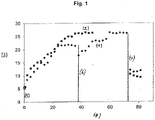
- Figure 1 shows a diagram, wherein a process for separating valuables from the gangue of an ore according to the prior art, wherein surface-modifying substance and magnetite are added in two steps (diamonds, 1) is compared to the process according to the present invention, wherein surface-modifying substance and magnetite are added in one step (square, 2).
- the x-axis (4) shows time in minutes
- the y-axis (3) shows a value that is corresponding to the particle size in ⁇ m.
- the pulp having a solid content of 60 wt% is treated with octyl xanthate (400 g/t) and hydrophobic magnetite (3 wt%) in varying orders.
- Treatment is conducted in a beaker under stirring using an inertly coated paddle mixer.
- the pulp is diluted to a solid content of 15 wt% und is separated magnetically. Results in respect of recovery and grade of copper and molybdenum are shown in table 1. Table 1 Examples No.
Landscapes
- Soft Magnetic Materials (AREA)
- Manufacture And Refinement Of Metals (AREA)
- Compounds Of Iron (AREA)
- Pigments, Carbon Blacks, Or Wood Stains (AREA)
- Hard Magnetic Materials (AREA)
- Drying Of Gases (AREA)
- Paper (AREA)
Claims (7)
- Procédé pour la séparation d'au moins un premier matériau à partir d'un mélange comprenant cet au moins un premier matériau et au moins un deuxième matériau, qui comprend les étapes suivantes :(A) mise en contact du mélange comprenant au moins un premier matériau et au moins un deuxième matériau avec au moins une particule magnétique et au moins une substance de modification de surface en même temps, de sorte que l'au moins un premier matériau, l'au moins une substance de modification de surface et l'au moins une particule magnétique deviennent fixées les unes avec les autres, le cas échéant en la présence d'au moins un dispersant,(B) le cas échéant, addition d'au moins un milieu de dispersion au mélange obtenu dans l'étape (A) pour donner une dispersion possédant une concentration appropriée,(C) séparation du produit d'addition de l'étape (A) ou (B) à partir du mélange par application d'un champ magnétique,(D) le cas échéant, clivage du produit d'addition qui a été séparé dans l'étape (C) pour obtenir l'au moins un premier matériau et l'au moins une particule magnétique séparément,la substance de modification de surface modifiant la surface de l'au moins un premier matériau de manière à ce que l'au moins un premier matériau, l'au moins une substance de modification de surface et l'au moins une particule magnétique deviennent fixées les unes avec les autres,le premier matériau étant un composé métallique hydrophobe ou un charbon et le deuxième matériau étant un composé métallique hydrophile,l'au moins un composé métallique hydrophobe étant choisi dans le groupe constitué par des minerais sulfurés, des minerais oxydiques, des minerais comprenant un carbonate, des métaux nobles sous forme élémentaire, des composés comprenant des métaux nobles et des mélanges correspondants, et l'au moins un composé métallique hydrophile étant choisi dans le groupe constitué par des composés métalliques oxydiques, des composés métalliques hydroxydiques et des mélanges correspondants.
- Procédé selon la revendication 1, la substance de modification de surface étant une substance de la formule générale (I)
A-Z (I)
oùA est choisi parmi C2-C30-alkyle linéaire ou ramifié, C3-C30-hétéroalkyle, C6-C30-aryle éventuellement substitué, C6-C30-hétéroalkyle éventuellement substitué, C6-C30-aralkyle, etZ est un groupe au moyen duquel le composé de la formule générale (I) se lie à l'au moins un matériau hydrophobe. - Procédé selon la revendication 2, Z étant choisi dans le groupe constitué par des groupes anioniques -(X)n-PO3 2-, -(X)n-PO2S2-, -(X)n-POS2 2-,-(X)n-PS3 2-, -(X)n-PS2-, -(X)n-POS-, -(X)n-PO2 -, -(X)n-PO3 2-, -(X)n-CO2-, -(X)n-CS2-, -(X)n-COS-, -(X)n-C(S)NHOH, -(X)n-S-, où X est choisi dans le groupe constitué par O, S, NH, CH2 et n = 0, 1 ou 2, avec, le cas échéant, des cations choisis dans le groupe constitué par hydrogène, NR4 + avec R étant indépendamment les uns des autres hydrogène et/ou C1-C8-alkyle, C1-C8-alkyle substitué par hydroxy ou C1-C8-hétéroalkyle substitué par hydroxy, des métaux alcalins ou alcalino-terreux.
- Procédé selon l'une quelconque des revendications 1 à 3, l'au moins une particule magnétique étant choisie dans le groupe constitué par des métaux magnétiques, par exemple le fer, le cobalt, le nickel et des mélanges correspondants, des alliages ferromagnétiques de métaux magnétiques, par exemple NdFeB, SmCo et des mélanges correspondants, des oxydes de fer magnétiques, par exemple la magnétite, l'hématite magnétique, des ferrites cubiques de la formule générale (II)
M2+ xFe2+ 1-xFe3+ 2O4 (II)
oùM est choisi parmi Co, Ni, Mn, Zn et des mélanges correspondants etx est ≤ 1,des ferrites hexagonales et des mélanges correspondants. - Procédé selon l'une quelconque des revendications 1 à 4, le milieu de dispersion étant l'eau.
- Procédé selon l'une quelconque des revendications 1 à 5, le mélange comprenant au moins un premier matériau et au moins un deuxième matériau étant broyé en particules possédant une taille allant de 100 nm à 100 µm avant ou pendant l'étape (A).
- Procédé selon l'une quelconque des revendications 1 à 6, la mise en contact du mélange comprenant au moins un premier matériau et au moins un deuxième matériau avec au moins une particule magnétique et au moins une substance de modification de surface en même temps dans l'étape (A) étant réalisée par ajout d'un mélange, préférablement d'une dispersion, d'au moins une particule magnétique et d'au moins une substance de modification de surface.
Applications Claiming Priority (2)
| Application Number | Priority Date | Filing Date | Title |
|---|---|---|---|
| EP12165162 | 2012-04-23 | ||
| PCT/EP2013/058245 WO2013160219A1 (fr) | 2012-04-23 | 2013-04-22 | Séparation magnétique de particules comprenant un traitement en une étape d'une pâte |
Publications (2)
| Publication Number | Publication Date |
|---|---|
| EP2841204A1 EP2841204A1 (fr) | 2015-03-04 |
| EP2841204B1 true EP2841204B1 (fr) | 2022-04-13 |
Family
ID=48444331
Family Applications (1)
| Application Number | Title | Priority Date | Filing Date |
|---|---|---|---|
| EP13722697.3A Not-in-force EP2841204B1 (fr) | 2012-04-23 | 2013-04-22 | Séparation magnétique de particules comprenant un traitement en une étape d'une pâte |
Country Status (9)
| Country | Link |
|---|---|
| EP (1) | EP2841204B1 (fr) |
| CN (1) | CN104271247B (fr) |
| AP (1) | AP2014008061A0 (fr) |
| AU (1) | AU2013254846B2 (fr) |
| CA (1) | CA2869226C (fr) |
| CL (1) | CL2014002864A1 (fr) |
| EA (1) | EA201491892A1 (fr) |
| PE (1) | PE20142381A1 (fr) |
| WO (1) | WO2013160219A1 (fr) |
Family Cites Families (10)
| Publication number | Priority date | Publication date | Assignee | Title |
|---|---|---|---|---|
| US4657666A (en) | 1981-10-26 | 1987-04-14 | W.S.R. Pty. Ltd. | Magnetic flotation |
| GB8726857D0 (en) | 1987-11-17 | 1987-12-23 | Fospur Ltd | Froth floatation of mineral fines |
| US4834898A (en) | 1988-03-14 | 1989-05-30 | Board Of Control Of Michigan Technological University | Reagents for magnetizing nonmagnetic materials |
| DE19936472A1 (de) | 1999-08-03 | 2001-02-15 | Stn Atlas Elektronik Gmbh | Haftvermittler |
| NO312373B1 (no) | 2000-06-29 | 2002-04-29 | Kjell Birkeland | Veggkonstruksjon, s¶rlig for en oppbevaringsboks til verdisaker, samt anvendelse av en slik veggkonstruksjon somsidevegger i en oppbevaringsboks |
| US7930013B2 (en) | 2005-06-29 | 2011-04-19 | Compumedics Limited | Sensor assembly with conductive bridge |
| AU2008294826B2 (en) * | 2007-09-03 | 2013-02-07 | Basf Se | Processing rich ores using magnetic particles |
| AU2009324379A1 (en) * | 2008-12-11 | 2011-07-28 | Basf Se | Enrichment of valuable ores from mine waste (tailings) |
| CN102725067B (zh) * | 2009-11-11 | 2015-06-03 | 巴斯夫欧洲公司 | 借助疏水磁性颗粒通过靶向输入机械能提高矿石分离过程效率的方法 |
| CA2814729A1 (fr) * | 2010-11-29 | 2012-06-07 | Basf Se | Recuperation magnetique de materiaux de valeur a partir de scories |
-
2013
- 2013-04-22 PE PE2014001784A patent/PE20142381A1/es active IP Right Grant
- 2013-04-22 CN CN201380021534.6A patent/CN104271247B/zh not_active Expired - Fee Related
- 2013-04-22 CA CA2869226A patent/CA2869226C/fr active Active
- 2013-04-22 EP EP13722697.3A patent/EP2841204B1/fr not_active Not-in-force
- 2013-04-22 AU AU2013254846A patent/AU2013254846B2/en not_active Ceased
- 2013-04-22 AP AP2014008061A patent/AP2014008061A0/xx unknown
- 2013-04-22 EA EA201491892A patent/EA201491892A1/ru unknown
- 2013-04-22 WO PCT/EP2013/058245 patent/WO2013160219A1/fr not_active Ceased
-
2014
- 2014-10-23 CL CL2014002864A patent/CL2014002864A1/es unknown
Also Published As
| Publication number | Publication date |
|---|---|
| WO2013160219A1 (fr) | 2013-10-31 |
| CN104271247A (zh) | 2015-01-07 |
| CN104271247B (zh) | 2017-10-27 |
| PE20142381A1 (es) | 2015-01-30 |
| EP2841204A1 (fr) | 2015-03-04 |
| AU2013254846A1 (en) | 2014-10-23 |
| CL2014002864A1 (es) | 2014-12-19 |
| AU2013254846B2 (en) | 2017-12-07 |
| EA201491892A1 (ru) | 2015-04-30 |
| AP2014008061A0 (en) | 2014-11-30 |
| CA2869226A1 (fr) | 2013-10-31 |
| CA2869226C (fr) | 2020-03-10 |
Similar Documents
| Publication | Publication Date | Title |
|---|---|---|
| US8318025B2 (en) | Processing rich ores using magnetic particles | |
| CN102271817B (zh) | 从尾矿中富集有价值矿石的方法 | |
| EP2519356B1 (fr) | Procédé modifié de séparation magnétique à haute intensité (hims) | |
| US10807100B2 (en) | Concentrate quality | |
| US8372290B2 (en) | Magnetic separation of nonferrous metal ores by means of multi-stage conditioning | |
| EA020958B1 (ru) | Магнитные гидрофобные агломераты и способ их получения | |
| EP2646161A1 (fr) | Récupération magnétique de matériaux de valeur à partir de scories | |
| US9387485B2 (en) | Magnetic separation of particles including one-step-conditioning of a pulp | |
| WO2015104324A1 (fr) | Procédé pour réduire par élutriation le débit volumique d'un flux comprenant des agglomérats magnétiques | |
| EP2841204B1 (fr) | Séparation magnétique de particules comprenant un traitement en une étape d'une pâte |
Legal Events
| Date | Code | Title | Description |
|---|---|---|---|
| PUAI | Public reference made under article 153(3) epc to a published international application that has entered the european phase |
Free format text: ORIGINAL CODE: 0009012 |
|
| 17P | Request for examination filed |
Effective date: 20141124 |
|
| AK | Designated contracting states |
Kind code of ref document: A1 Designated state(s): AL AT BE BG CH CY CZ DE DK EE ES FI FR GB GR HR HU IE IS IT LI LT LU LV MC MK MT NL NO PL PT RO RS SE SI SK SM TR |
|
| AX | Request for extension of the european patent |
Extension state: BA ME |
|
| DAX | Request for extension of the european patent (deleted) | ||
| STAA | Information on the status of an ep patent application or granted ep patent |
Free format text: STATUS: EXAMINATION IS IN PROGRESS |
|
| 17Q | First examination report despatched |
Effective date: 20190426 |
|
| GRAP | Despatch of communication of intention to grant a patent |
Free format text: ORIGINAL CODE: EPIDOSNIGR1 |
|
| STAA | Information on the status of an ep patent application or granted ep patent |
Free format text: STATUS: GRANT OF PATENT IS INTENDED |
|
| INTG | Intention to grant announced |
Effective date: 20211126 |
|
| RAP3 | Party data changed (applicant data changed or rights of an application transferred) |
Owner name: BASF SE |
|
| GRAS | Grant fee paid |
Free format text: ORIGINAL CODE: EPIDOSNIGR3 |
|
| GRAA | (expected) grant |
Free format text: ORIGINAL CODE: 0009210 |
|
| STAA | Information on the status of an ep patent application or granted ep patent |
Free format text: STATUS: THE PATENT HAS BEEN GRANTED |
|
| AK | Designated contracting states |
Kind code of ref document: B1 Designated state(s): AL AT BE BG CH CY CZ DE DK EE ES FI FR GB GR HR HU IE IS IT LI LT LU LV MC MK MT NL NO PL PT RO RS SE SI SK SM TR |
|
| REG | Reference to a national code |
Ref country code: GB Ref legal event code: FG4D |
|
| RIN1 | Information on inventor provided before grant (corrected) |
Inventor name: MORBIDELLI, MASSIMO Inventor name: ZHANG, XINYA Inventor name: WU, HUA Inventor name: SHISHKOV, IGOR Inventor name: DOMKE, IMME Inventor name: RIEGER, REINHOLD Inventor name: CHAROENSIRISOMBOON, PIYADA Inventor name: MICHAILOVSKI, ALEXEJ |
|
| REG | Reference to a national code |
Ref country code: CH Ref legal event code: EP |
|
| REG | Reference to a national code |
Ref country code: DE Ref legal event code: R096 Ref document number: 602013081386 Country of ref document: DE |
|
| REG | Reference to a national code |
Ref country code: IE Ref legal event code: FG4D |
|
| REG | Reference to a national code |
Ref country code: AT Ref legal event code: REF Ref document number: 1482979 Country of ref document: AT Kind code of ref document: T Effective date: 20220515 |
|
| PGFP | Annual fee paid to national office [announced via postgrant information from national office to epo] |
Ref country code: DE Payment date: 20220428 Year of fee payment: 10 |
|
| REG | Reference to a national code |
Ref country code: LT Ref legal event code: MG9D |
|
| REG | Reference to a national code |
Ref country code: NL Ref legal event code: MP Effective date: 20220413 |
|
| REG | Reference to a national code |
Ref country code: AT Ref legal event code: MK05 Ref document number: 1482979 Country of ref document: AT Kind code of ref document: T Effective date: 20220413 |
|
| PG25 | Lapsed in a contracting state [announced via postgrant information from national office to epo] |
Ref country code: NL Free format text: LAPSE BECAUSE OF FAILURE TO SUBMIT A TRANSLATION OF THE DESCRIPTION OR TO PAY THE FEE WITHIN THE PRESCRIBED TIME-LIMIT Effective date: 20220413 |
|
| PG25 | Lapsed in a contracting state [announced via postgrant information from national office to epo] |
Ref country code: SE Free format text: LAPSE BECAUSE OF FAILURE TO SUBMIT A TRANSLATION OF THE DESCRIPTION OR TO PAY THE FEE WITHIN THE PRESCRIBED TIME-LIMIT Effective date: 20220413 Ref country code: PT Free format text: LAPSE BECAUSE OF FAILURE TO SUBMIT A TRANSLATION OF THE DESCRIPTION OR TO PAY THE FEE WITHIN THE PRESCRIBED TIME-LIMIT Effective date: 20220816 Ref country code: NO Free format text: LAPSE BECAUSE OF FAILURE TO SUBMIT A TRANSLATION OF THE DESCRIPTION OR TO PAY THE FEE WITHIN THE PRESCRIBED TIME-LIMIT Effective date: 20220713 Ref country code: LT Free format text: LAPSE BECAUSE OF FAILURE TO SUBMIT A TRANSLATION OF THE DESCRIPTION OR TO PAY THE FEE WITHIN THE PRESCRIBED TIME-LIMIT Effective date: 20220413 Ref country code: HR Free format text: LAPSE BECAUSE OF FAILURE TO SUBMIT A TRANSLATION OF THE DESCRIPTION OR TO PAY THE FEE WITHIN THE PRESCRIBED TIME-LIMIT Effective date: 20220413 Ref country code: GR Free format text: LAPSE BECAUSE OF FAILURE TO SUBMIT A TRANSLATION OF THE DESCRIPTION OR TO PAY THE FEE WITHIN THE PRESCRIBED TIME-LIMIT Effective date: 20220714 Ref country code: FI Free format text: LAPSE BECAUSE OF FAILURE TO SUBMIT A TRANSLATION OF THE DESCRIPTION OR TO PAY THE FEE WITHIN THE PRESCRIBED TIME-LIMIT Effective date: 20220413 Ref country code: ES Free format text: LAPSE BECAUSE OF FAILURE TO SUBMIT A TRANSLATION OF THE DESCRIPTION OR TO PAY THE FEE WITHIN THE PRESCRIBED TIME-LIMIT Effective date: 20220413 Ref country code: BG Free format text: LAPSE BECAUSE OF FAILURE TO SUBMIT A TRANSLATION OF THE DESCRIPTION OR TO PAY THE FEE WITHIN THE PRESCRIBED TIME-LIMIT Effective date: 20220713 Ref country code: AT Free format text: LAPSE BECAUSE OF FAILURE TO SUBMIT A TRANSLATION OF THE DESCRIPTION OR TO PAY THE FEE WITHIN THE PRESCRIBED TIME-LIMIT Effective date: 20220413 |
|
| PG25 | Lapsed in a contracting state [announced via postgrant information from national office to epo] |
Ref country code: RS Free format text: LAPSE BECAUSE OF FAILURE TO SUBMIT A TRANSLATION OF THE DESCRIPTION OR TO PAY THE FEE WITHIN THE PRESCRIBED TIME-LIMIT Effective date: 20220413 Ref country code: PL Free format text: LAPSE BECAUSE OF FAILURE TO SUBMIT A TRANSLATION OF THE DESCRIPTION OR TO PAY THE FEE WITHIN THE PRESCRIBED TIME-LIMIT Effective date: 20220413 Ref country code: LV Free format text: LAPSE BECAUSE OF FAILURE TO SUBMIT A TRANSLATION OF THE DESCRIPTION OR TO PAY THE FEE WITHIN THE PRESCRIBED TIME-LIMIT Effective date: 20220413 Ref country code: IS Free format text: LAPSE BECAUSE OF FAILURE TO SUBMIT A TRANSLATION OF THE DESCRIPTION OR TO PAY THE FEE WITHIN THE PRESCRIBED TIME-LIMIT Effective date: 20220813 |
|
| REG | Reference to a national code |
Ref country code: CH Ref legal event code: PL |
|
| REG | Reference to a national code |
Ref country code: BE Ref legal event code: MM Effective date: 20220430 |
|
| REG | Reference to a national code |
Ref country code: DE Ref legal event code: R097 Ref document number: 602013081386 Country of ref document: DE |
|
| PG25 | Lapsed in a contracting state [announced via postgrant information from national office to epo] |
Ref country code: SM Free format text: LAPSE BECAUSE OF FAILURE TO SUBMIT A TRANSLATION OF THE DESCRIPTION OR TO PAY THE FEE WITHIN THE PRESCRIBED TIME-LIMIT Effective date: 20220413 Ref country code: SK Free format text: LAPSE BECAUSE OF FAILURE TO SUBMIT A TRANSLATION OF THE DESCRIPTION OR TO PAY THE FEE WITHIN THE PRESCRIBED TIME-LIMIT Effective date: 20220413 Ref country code: RO Free format text: LAPSE BECAUSE OF FAILURE TO SUBMIT A TRANSLATION OF THE DESCRIPTION OR TO PAY THE FEE WITHIN THE PRESCRIBED TIME-LIMIT Effective date: 20220413 Ref country code: MC Free format text: LAPSE BECAUSE OF FAILURE TO SUBMIT A TRANSLATION OF THE DESCRIPTION OR TO PAY THE FEE WITHIN THE PRESCRIBED TIME-LIMIT Effective date: 20220413 Ref country code: LU Free format text: LAPSE BECAUSE OF NON-PAYMENT OF DUE FEES Effective date: 20220422 Ref country code: LI Free format text: LAPSE BECAUSE OF NON-PAYMENT OF DUE FEES Effective date: 20220430 Ref country code: EE Free format text: LAPSE BECAUSE OF FAILURE TO SUBMIT A TRANSLATION OF THE DESCRIPTION OR TO PAY THE FEE WITHIN THE PRESCRIBED TIME-LIMIT Effective date: 20220413 Ref country code: DK Free format text: LAPSE BECAUSE OF FAILURE TO SUBMIT A TRANSLATION OF THE DESCRIPTION OR TO PAY THE FEE WITHIN THE PRESCRIBED TIME-LIMIT Effective date: 20220413 Ref country code: CZ Free format text: LAPSE BECAUSE OF FAILURE TO SUBMIT A TRANSLATION OF THE DESCRIPTION OR TO PAY THE FEE WITHIN THE PRESCRIBED TIME-LIMIT Effective date: 20220413 Ref country code: CH Free format text: LAPSE BECAUSE OF NON-PAYMENT OF DUE FEES Effective date: 20220430 |
|
| PLBE | No opposition filed within time limit |
Free format text: ORIGINAL CODE: 0009261 |
|
| STAA | Information on the status of an ep patent application or granted ep patent |
Free format text: STATUS: NO OPPOSITION FILED WITHIN TIME LIMIT |
|
| PG25 | Lapsed in a contracting state [announced via postgrant information from national office to epo] |
Ref country code: BE Free format text: LAPSE BECAUSE OF NON-PAYMENT OF DUE FEES Effective date: 20220430 |
|
| 26N | No opposition filed |
Effective date: 20230116 |
|
| GBPC | Gb: european patent ceased through non-payment of renewal fee |
Effective date: 20220713 |
|
| PG25 | Lapsed in a contracting state [announced via postgrant information from national office to epo] |
Ref country code: AL Free format text: LAPSE BECAUSE OF FAILURE TO SUBMIT A TRANSLATION OF THE DESCRIPTION OR TO PAY THE FEE WITHIN THE PRESCRIBED TIME-LIMIT Effective date: 20220413 |
|
| PG25 | Lapsed in a contracting state [announced via postgrant information from national office to epo] |
Ref country code: IE Free format text: LAPSE BECAUSE OF NON-PAYMENT OF DUE FEES Effective date: 20220422 Ref country code: FR Free format text: LAPSE BECAUSE OF NON-PAYMENT OF DUE FEES Effective date: 20220613 |
|
| PG25 | Lapsed in a contracting state [announced via postgrant information from national office to epo] |
Ref country code: SI Free format text: LAPSE BECAUSE OF FAILURE TO SUBMIT A TRANSLATION OF THE DESCRIPTION OR TO PAY THE FEE WITHIN THE PRESCRIBED TIME-LIMIT Effective date: 20220413 Ref country code: GB Free format text: LAPSE BECAUSE OF NON-PAYMENT OF DUE FEES Effective date: 20220713 |
|
| REG | Reference to a national code |
Ref country code: DE Ref legal event code: R119 Ref document number: 602013081386 Country of ref document: DE |
|
| PG25 | Lapsed in a contracting state [announced via postgrant information from national office to epo] |
Ref country code: IT Free format text: LAPSE BECAUSE OF FAILURE TO SUBMIT A TRANSLATION OF THE DESCRIPTION OR TO PAY THE FEE WITHIN THE PRESCRIBED TIME-LIMIT Effective date: 20220413 Ref country code: DE Free format text: LAPSE BECAUSE OF NON-PAYMENT OF DUE FEES Effective date: 20231103 |
|
| PG25 | Lapsed in a contracting state [announced via postgrant information from national office to epo] |
Ref country code: HU Free format text: LAPSE BECAUSE OF FAILURE TO SUBMIT A TRANSLATION OF THE DESCRIPTION OR TO PAY THE FEE WITHIN THE PRESCRIBED TIME-LIMIT; INVALID AB INITIO Effective date: 20130422 |
|
| PG25 | Lapsed in a contracting state [announced via postgrant information from national office to epo] |
Ref country code: MK Free format text: LAPSE BECAUSE OF FAILURE TO SUBMIT A TRANSLATION OF THE DESCRIPTION OR TO PAY THE FEE WITHIN THE PRESCRIBED TIME-LIMIT Effective date: 20220413 Ref country code: CY Free format text: LAPSE BECAUSE OF FAILURE TO SUBMIT A TRANSLATION OF THE DESCRIPTION OR TO PAY THE FEE WITHIN THE PRESCRIBED TIME-LIMIT Effective date: 20220413 |
|
| PG25 | Lapsed in a contracting state [announced via postgrant information from national office to epo] |
Ref country code: MT Free format text: LAPSE BECAUSE OF FAILURE TO SUBMIT A TRANSLATION OF THE DESCRIPTION OR TO PAY THE FEE WITHIN THE PRESCRIBED TIME-LIMIT Effective date: 20220413 |
|
| PG25 | Lapsed in a contracting state [announced via postgrant information from national office to epo] |
Ref country code: BG Free format text: LAPSE BECAUSE OF FAILURE TO SUBMIT A TRANSLATION OF THE DESCRIPTION OR TO PAY THE FEE WITHIN THE PRESCRIBED TIME-LIMIT Effective date: 20220413 |
|
| PG25 | Lapsed in a contracting state [announced via postgrant information from national office to epo] |
Ref country code: BG Free format text: LAPSE BECAUSE OF FAILURE TO SUBMIT A TRANSLATION OF THE DESCRIPTION OR TO PAY THE FEE WITHIN THE PRESCRIBED TIME-LIMIT Effective date: 20220413 |
|
| PG25 | Lapsed in a contracting state [announced via postgrant information from national office to epo] |
Ref country code: TR Free format text: LAPSE BECAUSE OF FAILURE TO SUBMIT A TRANSLATION OF THE DESCRIPTION OR TO PAY THE FEE WITHIN THE PRESCRIBED TIME-LIMIT Effective date: 20220413 |