EP2842976B1 - Gel mit selbstwiederherstellbarkeits- und formgedächtniseigenschaften und verfahren zur herstellung davon - Google Patents
Gel mit selbstwiederherstellbarkeits- und formgedächtniseigenschaften und verfahren zur herstellung davon Download PDFInfo
- Publication number
- EP2842976B1 EP2842976B1 EP13781751.6A EP13781751A EP2842976B1 EP 2842976 B1 EP2842976 B1 EP 2842976B1 EP 13781751 A EP13781751 A EP 13781751A EP 2842976 B1 EP2842976 B1 EP 2842976B1
- Authority
- EP
- European Patent Office
- Prior art keywords
- group
- groups
- gel
- optionally substituted
- monomer
- Prior art date
- Legal status (The legal status is an assumption and is not a legal conclusion. Google has not performed a legal analysis and makes no representation as to the accuracy of the status listed.)
- Active
Links
Images




Classifications
-
- C—CHEMISTRY; METALLURGY
- C08—ORGANIC MACROMOLECULAR COMPOUNDS; THEIR PREPARATION OR CHEMICAL WORKING-UP; COMPOSITIONS BASED THEREON
- C08F—MACROMOLECULAR COMPOUNDS OBTAINED BY REACTIONS ONLY INVOLVING CARBON-TO-CARBON UNSATURATED BONDS
- C08F2/00—Processes of polymerisation
- C08F2/04—Polymerisation in solution
- C08F2/10—Aqueous solvent
-
- C—CHEMISTRY; METALLURGY
- C08—ORGANIC MACROMOLECULAR COMPOUNDS; THEIR PREPARATION OR CHEMICAL WORKING-UP; COMPOSITIONS BASED THEREON
- C08F—MACROMOLECULAR COMPOUNDS OBTAINED BY REACTIONS ONLY INVOLVING CARBON-TO-CARBON UNSATURATED BONDS
- C08F220/00—Copolymers of compounds having one or more unsaturated aliphatic radicals, each having only one carbon-to-carbon double bond, and only one being terminated by only one carboxyl radical or a salt, anhydride ester, amide, imide or nitrile thereof
- C08F220/02—Monocarboxylic acids having less than ten carbon atoms; Derivatives thereof
- C08F220/04—Acids; Metal salts or ammonium salts thereof
- C08F220/06—Acrylic acid; Methacrylic acid; Metal salts or ammonium salts thereof
-
- C—CHEMISTRY; METALLURGY
- C08—ORGANIC MACROMOLECULAR COMPOUNDS; THEIR PREPARATION OR CHEMICAL WORKING-UP; COMPOSITIONS BASED THEREON
- C08F—MACROMOLECULAR COMPOUNDS OBTAINED BY REACTIONS ONLY INVOLVING CARBON-TO-CARBON UNSATURATED BONDS
- C08F220/00—Copolymers of compounds having one or more unsaturated aliphatic radicals, each having only one carbon-to-carbon double bond, and only one being terminated by only one carboxyl radical or a salt, anhydride ester, amide, imide or nitrile thereof
- C08F220/02—Monocarboxylic acids having less than ten carbon atoms; Derivatives thereof
- C08F220/10—Esters
- C08F220/12—Esters of monohydric alcohols or phenols
- C08F220/14—Methyl esters, e.g. methyl (meth)acrylate
-
- C—CHEMISTRY; METALLURGY
- C08—ORGANIC MACROMOLECULAR COMPOUNDS; THEIR PREPARATION OR CHEMICAL WORKING-UP; COMPOSITIONS BASED THEREON
- C08F—MACROMOLECULAR COMPOUNDS OBTAINED BY REACTIONS ONLY INVOLVING CARBON-TO-CARBON UNSATURATED BONDS
- C08F220/00—Copolymers of compounds having one or more unsaturated aliphatic radicals, each having only one carbon-to-carbon double bond, and only one being terminated by only one carboxyl radical or a salt, anhydride ester, amide, imide or nitrile thereof
- C08F220/02—Monocarboxylic acids having less than ten carbon atoms; Derivatives thereof
- C08F220/10—Esters
- C08F220/12—Esters of monohydric alcohols or phenols
- C08F220/16—Esters of monohydric alcohols or phenols of phenols or of alcohols containing two or more carbon atoms
- C08F220/18—Esters of monohydric alcohols or phenols of phenols or of alcohols containing two or more carbon atoms with acrylic or methacrylic acids
- C08F220/1804—C4-(meth)acrylate, e.g. butyl (meth)acrylate, isobutyl (meth)acrylate or tert-butyl (meth)acrylate
-
- C—CHEMISTRY; METALLURGY
- C08—ORGANIC MACROMOLECULAR COMPOUNDS; THEIR PREPARATION OR CHEMICAL WORKING-UP; COMPOSITIONS BASED THEREON
- C08F—MACROMOLECULAR COMPOUNDS OBTAINED BY REACTIONS ONLY INVOLVING CARBON-TO-CARBON UNSATURATED BONDS
- C08F220/00—Copolymers of compounds having one or more unsaturated aliphatic radicals, each having only one carbon-to-carbon double bond, and only one being terminated by only one carboxyl radical or a salt, anhydride ester, amide, imide or nitrile thereof
- C08F220/02—Monocarboxylic acids having less than ten carbon atoms; Derivatives thereof
- C08F220/10—Esters
- C08F220/20—Esters of polyhydric alcohols or phenols, e.g. 2-hydroxyethyl (meth)acrylate or glycerol mono-(meth)acrylate
-
- C—CHEMISTRY; METALLURGY
- C08—ORGANIC MACROMOLECULAR COMPOUNDS; THEIR PREPARATION OR CHEMICAL WORKING-UP; COMPOSITIONS BASED THEREON
- C08F—MACROMOLECULAR COMPOUNDS OBTAINED BY REACTIONS ONLY INVOLVING CARBON-TO-CARBON UNSATURATED BONDS
- C08F220/00—Copolymers of compounds having one or more unsaturated aliphatic radicals, each having only one carbon-to-carbon double bond, and only one being terminated by only one carboxyl radical or a salt, anhydride ester, amide, imide or nitrile thereof
- C08F220/02—Monocarboxylic acids having less than ten carbon atoms; Derivatives thereof
- C08F220/52—Amides or imides
- C08F220/54—Amides, e.g. N,N-dimethylacrylamide or N-isopropylacrylamide
- C08F220/56—Acrylamide; Methacrylamide
Definitions
- the present invention relates to a process for producing an aqueous solvent solution containing a host group-containing monomer, a guest group-containing monomer and an acrylic type monomer, and a process for producing a gel from said aqueous solvent solution.
- Patent Literature (PTL) 2 discloses two separate polymeric gels, one comprising a host molecule and one comprising a guest molecule, which when brought into contact with one another can self-assembly and self-adhere via host-guest interactions. Patent Literature 2, however, does not disclose self-healing materials comprising both a host and a guest molecule.
- Patent Literature documents (PTL) 3 and 4 disclose polymers comprising host molecules, which may interact with external guest molecules. Neither PTL 3 nor PTL 4 disclose self-healing materials comprising both a host molecule and a guest molecule.
- An object of the present invention is to provide a process for producing an aqueous solvent solution containing a host group-containing monomer, a guest group-containing monomer and an acrylic type monomer which may then be used to prepare a gel formed by a host-guest interaction and having self-healing and shape-memory properties.
- the present inventors conducted intensive studies in view of the above problem, and found that when a monomer containing a host group, a monomer containing a guest group, and an acrylic type monomer are dissolved in an aqueous solvent, and these monomers are subsequently copolymerized, a gel obtained from these monomers can be produced.
- the present invention was completed after further studies based on this finding.
- the present invention provides a process for producing an aqueous solvent solution containing a host group-containing monomer, a guest group-containing monomer and an acrylic type monomer which may then be used to prepare a gel having self-healing and shape-memory properties; and a process for producing the gel.
- host and guest groups in monomers can form an inclusion complex in an aqueous solvent.
- a gel having self-healing and shape-memory properties can then be formed by a host-guest interaction.
- the production process of the present invention is simple, is highly safe, and uses inexpensive renewable resources. Therefore, this production process is useful and suitable for a recycling-oriented society.
- the portion crosslinked by a host-guest interaction is dissociated and cut. Self-healing occurs by rebinding through the host-guest interaction; therefore, the gel can recover to the original material strength after healing.
- the gel thus selectively heals itself on the rupture surfaces through a host-guest interaction.
- the gel is highly self-supporting and highly tensile because the gel is formed through non-covalent bonding between a host group and a guest group. Furthermore, the gel has shape-memory properties such that the gel quickly returns to its original shape after stretching.
- the process of the present invention comprises a method of obtaining an aqueous solvent solution by dissolving a host group-containing monomer, a guest group-containing monomer, and an acrylic type monomer in an aqueous solvent; and a method of producing a gel obtained from the host group-containing monomer, the guest group-containing monomer, and the acrylic type monomer by copolymerizing the dissolved monomers, wherein the guest group-containing monomer is a monomer represented by formula (2)
- the host group-containing monomer of the present invention is a vinyl monomer containing at least one host group (preferably one host group).
- Examples of the host group include artificial host molecules, such as derivatives of cyclodextrin (CD), calixarene, crown ether, cyclophane, and cucurbituril.
- specific examples include ⁇ -cyclodextrin, ⁇ -cyclodextrin, ⁇ -cyclodextrin, calix[6]arene sulfonate, calix[8]arene sulfonate, 12-crown-4,18-crown-6,[6]paracyclophane, [2,2]paracyclophane, cucurbit[6]uril, and cucurbit[8]uril.
- ⁇ -cyclodextrin, ⁇ -cyclodextrin, and ⁇ -cyclodextrin are preferred.
- Examples of the host group-containing monomer include a monomer represented by the following formula (1): (wherein Q is O or NH, CD is ⁇ -cyclodextrin, ⁇ -cyclodextrin, or ⁇ -cyclodextrin, and R a is a hydrogen atom or a methyl group).
- Q is preferably NH.
- Examples of the monomers represented by formula (1) include 6-acrylamide- ⁇ -cyclodextrin and 6-acrylamide- ⁇ -cyclodextrin.
- the monomer represented by formula (1) can be produced by reacting acryloyl chloride with 6-aminocyclodextrin or cyclodextrin. Typically, acryloyl chloride is mixed with 6-aminocyclodextrin or cyclodextrin and stirred in a solvent.
- the reaction may be performed either solvent-free, or with a solvent (an organic solvent or an aqueous solvent) commonly used in organic synthesis reactions.
- a solvent an organic solvent or an aqueous solvent commonly used in organic synthesis reactions.
- the organic solvent include dimethylsulfoxide (DMSO) and dimethylformamide (DMF).
- the aqueous solvent include water, and buffers that contain salts such as sodium phosphate and sodium carbonate as required. When a solvent is used, the amount of the solvent may be appropriately adjusted.
- the monomer represented by formula (1) wherein Q is NH can be produced by using a method in which 1,1'-carbonyldiimidazole (CDI) or 1-ethyl-3-(3-dimethylaminopropyl)carbodiimide hydrochloride (EDC) is added to acrylic acid under ice-cooled conditions, and aminocyclodextrin is added to the mixture and stirred overnight to form an amide bond.
- the monomer of formula (1) can also be produced by obtaining an amide compound from acrylic acid via an active ester, using dicyclohexylcarbodiimide (DCC) and 1-hydroxybenzotriazole (HOBt) or N-hydroxysuccinimide (HOSu) as condensing agents.
- the monomer represented by formula (1) wherein Q is O can be produced by using a method in which N,N-dimethyl-4-aminopyridine is added to acrylic acid under ice-cooled conditions, and cyclodextrin is then added to the mixture and stirred overnight to form an ester bond.
- the monomer of formula (1) can also be produced by obtaining an ester compound from acrylic acid via an active ester using dicyclohexylcarbodiimide (DCC) and either 1-hydroxybenzotriazole (HOBt) or N-hydroxysuccinimide (HOSu) as condensing agents.
- DCC dicyclohexylcarbodiimide
- HOBt 1-hydroxybenzotriazole
- HOSu N-hydroxysuccinimide
- a compound containing two or more host groups may be used.
- Examples of the host groups may be the same as those mentioned above as examples of the host group of the host group-containing monomer mentioned above.
- Examples of the compound containing two or more host groups include dicyclodextrinpoly(allylamine)dendrimer (generation 0) monoacrylamide, dicyclodextrinpoly(allylamine)dendrimer (generation 0) diacrylamide, dicyclodextrinpoly(allylamine)dendrimer (generation 0) monoacrylate, dicyclodextrinpoly (allylamine)dendrimer (generation 0) diacrylate, tricyclodextrinpoly(allylamine)dendrimer (generation 0) monoacrylamide, and tricyclodextrinpoly(allylamine)dendrimer (generation 0) monoacrylamide.
- the guest group-containing monomer of the present invention is a vinyl monomer having at least one guest group (preferably one guest group).
- the guest group-containing monomer is a monomer represented by the following formula (2): (wherein A is an optionally substituted aryl group, C(O)OR 1 , or C(O)NHR 1 , R 1 is an optionally substituted alkyl group, an optionally substituted aryl group, or an optionally substituted arylalkyl group, and R b is a hydrogen atom or a methyl group).
- alkyl group of the optionally substituted alkyl group represented by R 1 in formula (2) examples include linear, branched, or cyclic alkyl groups of C 1 to C 18 . Specific examples include alkyl groups such as methyl, ethyl, n -propyl, isopropyl, n -butyl, isobutyl, sec -butyl, tert -butyl, pentyl, cyclopentyl, hexyl, cyclohexyl, isohexyl, dodecyl, octadecyl, and adamantyl.
- alkyl groups such as methyl, ethyl, n -propyl, isopropyl, n -butyl, isobutyl, sec -butyl, tert -butyl, pentyl, cyclopentyl, hexyl, cyclohexyl, isohe
- the alkyl group may have 1 to 3 substituents, for example, such as halogen atoms (for example, such as fluorine, chlorine, and bromine), carboxyl groups, ester groups, amide groups, and hydroxyl groups that may be protected. Further, the alkyl group may be one in which the organometallic complex ferrocene is attached as a substituent.
- Examples of the aryl group of the optionally substituted aryl group represented by A and R 1 in formula (2) include monocyclic aryl groups, and aryl groups with two or more rings. Specific examples include phenyl, toluyl, xylyl, naphthyl, anthryl, and phenanthryl. Of these, phenyl is preferred.
- the aryl group may have 1 to 3 substituents, for example, such as alkyl groups (for example, such as C 1 to C 18 alkyl groups), halogen atoms (for example, such as fluorine, chlorine, and bromine), carboxyl groups, ester groups, amide groups, azo groups having aryl groups, and hydroxyl groups that may be protected.
- Examples of the arylalkyl group of the optionally substituted arylalkyl group represented by R 1 in formula (2) include branched or linear C 1 to C 3 lower alkyl groups substituted with monocyclic aryl groups or aryl groups with two or more rings. Specific examples include benzyl, naphthylmethyl, anthracenemethyl, and pyrenemethyl. Benzyl and naphthylmethyl are preferred.
- the aryl group may have 1 to 3 substituents, for example, such as alkyl groups (for example, such as C 1 to C 18 alkyl groups), halogen atoms (for example, such as fluorine, chlorine, and bromine), carboxyl groups, ester groups, amide groups, azo groups having aryl groups, and hydroxyl groups that may be protected.
- substituents for example, such as alkyl groups (for example, such as C 1 to C 18 alkyl groups), halogen atoms (for example, such as fluorine, chlorine, and bromine), carboxyl groups, ester groups, amide groups, azo groups having aryl groups, and hydroxyl groups that may be protected.
- substituents for example, such as alkyl groups (for example, such as C 1 to C 18 alkyl groups), halogen atoms (for example, such as fluorine, chlorine, and bromine), carboxyl groups, ester groups, amide groups, azo groups having aryl groups, and hydroxy
- Examples of preferable monomers represented by formula (2) include n -butyl acrylate, t -butyl acrylate, N -(1-adamanthyl)acrylamide, N -benzylacrylamide, N -1-naphthylmethylacrylamide, and styrene.
- A is an optionally substituted aryl group
- a commercially available monomer such as styrene
- the monomer represented by formula (2) wherein A is C(O)OR 1 or C(O)NHR 1 is produced by reacting acryloyl chloride with an alkyl amine or an aryl amine that provides an alkyl or an aryl for the substituent R 1 .
- acryloyl chloride is mixed and stirred in a solvent with an alkyl amine or an aryl amine that provides an alkyl or an aryl for the substituent R 1 .
- the same solvent as used for the production of the monomer represented by formula (1) can be used in the reaction.
- the amount of the solvent may be appropriately adjusted.
- the monomer represented by formula (2) wherein A is C(O)NHR 1 can be produced by using a method in which 1,1'-carbonyldiimidazole (CDI) or 1-ethyl-3-(3-dimethylaminopropyl)carbodiimide hydrochloride (EDC) is added to acrylic acid under ice-cooled conditions, and aminocyclodextrin is added to the mixture and stirred overnight to form an amide bond.
- CDI 1,1'-carbonyldiimidazole
- EDC 1-ethyl-3-(3-dimethylaminopropyl)carbodiimide hydrochloride
- the monomer of formula (2) can also be produced by obtaining an amide compound from acrylic acid via an active ester using dicyclohexylcarbodiimide (DCC) and 1-hydroxybenzotriazole (HOBt) or N-hydroxysuccinimide (HOSu) as condensing agents.
- DCC dicyclohexylcarbodiimide
- HOBt 1-hydroxybenzotriazole
- HSu N-hydroxysuccinimide
- the monomer represented by formula (2) wherein A is C(O)OR 1 can be produced by using a method in which N,N -dimethyl-4-aminopyridine is added to acrylic acid under ice-cooled conditions, and cyclodextrin is added to the mixture and stirred overnight to form an ester bond.
- the monomer of formula (2) can also be produced by obtaining an ester compound from acrylic acid via an active ester using dicyclohexylcarbodiimide (DCC) and 1-hydroxybenzotriazole (HOBt) or N-hydroxysuccinimide (HOSu) as condensing agents.
- a compound containing two or more guest groups may be used.
- Examples of the guest groups may be the same as those mentioned above as examples of the guest group of the guest-containing monomer.
- Examples of the compound containing two or more guest groups include di(1-adamanthylmethylketone)-4,4-dipyridine, di(1-butylmethylketone)-4,4-dipyridine, di(1-azobenzenemethylketone)-4,4-dipyridine, di(1-ferrocenemethylketone)-4,4-dipyridine, di(1-adamanthylmethylketone)-1,2-bis(4-pyridyl)ethylene, di(1-butylmethylketone)-1,2-bis(4-pyridyl)ethylene, di(1-azobenzenemethylketone)-1,2-bis(4-pyridyl)ethylene, di(1-ferrocenemethylketone)-1,2-bis(4-pyridyl)ethylene, diadamanthyl-polyethylene glycol, diadamanthyl-polypropylene glycol, tetraadamanthyl-poly
- the acrylic type monomer of the present invention refers to acrylic acid or methacrylic acid, and derivatives (e.g., esters and amides) thereof.
- acrylic type monomer of the present invention examples include monomers represented by the following formula (3) : (wherein X is OR 2 or NH 2 , R 2 is a hydrogen atom, an optionally substituted alkyl group, or an optionally substituted aryl group, and R c is a hydrogen atom or a methyl group).
- Examples of the alkyl group of the optionally substituted alkyl group represented by R 2 in formula (3) may be the same as those mentioned above as examples of the alkyl group of the optionally substituted alkyl group represented by R 1 in formula (2).
- Examples of the aryl group of the optionally substituted aryl group represented by R 2 in formula (3) are the same as those mentioned above as examples of the alkyl group of the optionally substituted aryl group represented by R 1 in formula (2) .
- acrylic type monomers can be used as the acrylic type monomer represented by formula (3). Such acrylic type monomers may be used singly, or in a combination of two or more. Acrylamide, acrylic acid, methyl acrylate, and 2-hydroxyethyl methacrylate are preferred.
- the host group-containing monomer, guest group-containing monomer, and acrylic type monomer are mixed in an aqueous solvent and dissolved to produce an aqueous solvent solution.
- An inclusion complex of the host and guest groups is formed by dissolving the monomers in an aqueous solvent.
- the aqueous solvent may be, for example, water, or a mixed solvent of water and an organic solvent compatible with water. Water is preferred.
- organic solvent compatible with water examples include N,N- dimethylformamide (DMF), tetrahydrofuran (THF), and dimethyl sulfoxide (DMSO). These organic solvents can be used singly, or in a combination of two or more.
- the mixing ratio (volume ratio) of water to the organic solvent in the mixed solvent is preferably in the range of 9:1 to 5:5, and particularly preferably 9:1 to 8:2.
- the dissolution of the monomers in the aqueous solvent is performed by mixing the host group-containing monomer, guest group-containing monomer, and acrylic type monomer in the aqueous solvent, followed by stirring and heating.
- stirring means is not particularly limited, examples of usable methods include methods using magnetic stirrers and stirrer tips, methods using shakers, and methods using stirrers.
- the stirring temperature and time vary depending on the types and concentrations of the host group-containing monomer and guest group-containing monomer used.
- the stirring can be performed at room temperature (20 to 25°C) for 8 hours to 3 days, and preferably performed at 25°C for one day.
- the heating method is also not particularly limited, examples include methods using a hot stirrer, and methods using a thermostat bath.
- the heating temperature and time vary depending on the types and concentrations of host group-containing monomer and guest group-containing monomer used.
- the heating can be performed at 40 to 80°C for 1 hour to two days, and preferably at 50 to 80°C for 2 to 6 hours, whereby the above monomers can be substantially evenly dissolved in an aqueous solvent.
- the dissolution of the monomers in the aqueous solvent can be performed by heating after completion of the stirring, or by heating with continuous stirring after stirring for the aforementioned specific period of time.
- the proportions of the monomers dissolved in the aqueous solvent may be, for example, 30 to 0.5 mol% of a host group-containing monomer, 30 to 0.5 mol% of a guest group-containing monomer, and 40 to 99 mol% of an acrylic type monomer.
- the proportions are preferably 20 to 5 mol% of a host group-containing monomer, 20 to 5 mol% of a guest group-containing monomer, and 60 to 90 mol% of an acrylic type monomer.
- the proportions (mol%) of the host group-containing monomer and guest group-containing monomer used may be, for example, such that the ratio of the host group-containing monomer to the guest group-containing monomer is in the range of 30:0.5 to 0.5:30.
- the proportions are preferably such that the ratio of the host group-containing monomer to the guest group-containing monomer is 1:1, such as 0.5:0.5 and 30:30.
- the monomers are dissolved in an aqueous solvent, and these monomers are then copolymerized to produce a gel obtained from the monomers.
- the copolymerization reaction is performed by adding a polymerization initiator and optionally a polymerization promoter to the aqueous solvent in which the monomers are dissolved.
- polymerization initiator examples include ammonium persulfate (hereinafter sometimes referred to as APS), azobisisobutyronitrile (hereinafter sometimes referred to as AIBN), 2,2'-azobis[2-(2-imidazolin-2-yl)propane]dihydrochloride (hereinafter sometimes referred to as VA-044), 1,1'-azobis(cyclohexanecarbonitrile), di-tert-butylperoxide, tert-butylhydroperoxide, benzoyl peroxide, photopolymerization initiators (Irgacure (registered trademark) series). APS, AIBN, and VA-044 are preferred.
- the concentration of the polymerization initiator is preferably 0.5 to 5 mol%, based on the total amount of the monomers.
- polymerization promoter examples include [2-(dimethylamino)ethyl]dimethylamine (hereinafter sometimes referred to as TEMED). TEMED is preferred.
- the copolymerization reaction can be performed at 0 to 100°C, and preferably 20 to 25°C.
- the copolymerization time is 1 to 24 hours, and preferably 12 to 24 hours.
- the gel is obtained by dissolving a host group-containing monomer, a guest group-containing monomer, and an acrylic type monomer in an aqueous solvent, and then copolymerizing these monomers.
- An inclusion complex of the host and guest groups is formed by dissolving monomers beforehand in an aqueous solvent.
- a gel is obtained by subsequently copolymerizing these monomers without adding a chemical crosslinking agent.
- a preferable combination of the host and guest groups that form an inclusion complex is, for example, that when ⁇ -cyclodextrin (cavity size: 4.7 to 5.2 ⁇ ) is used as the host group, examples of the guest group include alkyl compounds of 4 to 18 carbon atoms, alcohol derivatives thereof, carboxylic acid derivatives, amino derivatives, azobenzene derivatives having a cyclic alkyl group or a phenyl group, and cinnamic acid derivatives.
- alkyl compounds (groups) of 4 to 18 carbon atoms examples include n-butyl, pentyl, hexyl, heptyl, octyl, nonyl, decyl, undecyl, dodecyl, tridecyl, tetradecyl, pentadecyl, hexadecyl, heptadecyl, and octadecyl.
- ⁇ -cyclodextrin (cavity size: 6.0 to 6.5 ⁇ )
- examples of the guest group include t-butyl, adamantyl, aromatic compounds and alcohol derivatives thereof, carboxylic acid derivatives, amino derivatives, ferrocene derivatives, azobenzene, naphthalene derivatives, and dansyl.
- examples of the guest group include alkyls of up to 18 carbon atoms, alcohol derivatives thereof, carboxylic acid derivatives, amino derivatives, adamantyl, clusters of carbon atoms such as fullerene, aromatic dansyl, ferrocene derivatives, and anthracene derivatives.
- the gel is formed via a non-covalent bond between a host group and a guest group.
- the portion crosslinked by non-covalent host-guest interaction is mainly dissociated and cut off. Therefore, when the gel is merely allowed to stand with the rupture surfaces(cut surfaces) being in close contact with each other, the crosslinking is restored and the rupture surfaces are adhered.
- the gel n has self-healing properties.
- the gel has healing surface selectivity in self-healing.
- the gel after re-adhesion tends to return to the original gel strength.
- the gel is formed through non-covalent bonding between a host group and a guest group, the gel is highly self-supporting and highly tensile. Further, the gel has shape-memory properties such that after stretching, the gel quickly returns to the original state.
- the gel preferably comprises 20 to 0.1 mol% of units derived from a host group-containing monomer, 20 to 0.1 mol% of units derived from a guest group-containing monomer, and 60 to 99.8 mol% of units derived from an acrylic type monomer. More preferably, the gel comprises 13 to 0.3 mol% of units derived from a host group-containing monomer, 13 to 0.3 mol% of units derived from a guest group-containing monomer, and 74 to 99.4 mol% of units derived from an acrylic type monomer.
- the strength of the gel increases as the content of the inclusion complex formed of the host and guest groups increases. The gel is self-supporting, even when the inclusion complex content is 1 mol% or less.
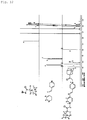
- Fig. 11 shows 1 HNMR (500 MHz, DMSO-d 6 , 30°C) of the obtained compound.
- composition ratio of the host and guest groups
- Test Example 5 (Changes in gel strength depending on the composition ratio of the host and guest groups)
- Example 4 6-acrylamide- ⁇ -cyclodextrin and N -(1-adamantyl)acrylamide were used at ratios of 6-acrylamide- ⁇ -cyclodextrin to N -(1-adamantyl)acrylamide of 6 mg (0.005 mmol):1 mg (0.005 mmol), 29 mg (0.026 mmol):6 mg (0.026 mmol), 45 mg (0.038 mmol):8 mg (0.038 mmol), and 59 mg (0.050 mmol):10 mg (0.050 mmol) to obtain gels comprising 6-acrylamide- ⁇ -cyclodextrin-derived units and N -(1-adamantyl)acrylamide-derived units at 6-acrylamide- ⁇ -cyclodextrin-derived unit: N -(1-adamantyl)acrylamide-derived unit ratios of 0.1:0.1, 0.3:0.4, 1.0:1.4, and 1.6:1.9 (molar composition ratios).
- the obtained gels were cut into 5 mm x 5 mm x 10 mm cuboids.
- the rupture strength of the gel cuboids was measured at a pulling rate of 5 mm/sec using a creep meter (RE2-33005B, produced by Yamaden, Co., Ltd.). As the composition ratio of the host and guest groups increases, the rupture strength (break strength) increases.
- the gels having four types of compositions prepared in Test Example 5 were immersed in 10 mM aqueous solutions of competitor molecules ( ⁇ -cyclodextrin, ⁇ -cyclodextrin, ⁇ -cyclodextrin, and 1-adamantanecarboxylic acid sodium salt) for 1 hour. Subsequently, the rupture strength of each gel was measured in the same manner as in Test Example 6. Immersion of the gels in the solutions of ⁇ -cyclodextrin and 1-adamantanecarboxylic acid sodium salt resulted in a lower rupture strength.
- competitor molecules ⁇ -cyclodextrin, ⁇ -cyclodextrin, ⁇ -cyclodextrin, and 1-adamantanecarboxylic acid sodium salt
- the gel comprising 6-acrylamide- ⁇ -cyclodextrin-derived units and N -(1-adamantyl)acrylamide-derived units at a ratio of the 6-acrylamide- ⁇ -cyclodextrin-derived units to the N -(1-adamantyl)acrylamide-derived units of 0.3:0.4 (10 mm x 10 mm X 5 mm) was pulled with a tensile stress of 0.1N to 1N, and then retained at no stress. The strain at no stress after pulling was measured to evaluate the shape recovery of the gel. When the gel was stretched to 180% at 0.1N and then retained at no stress, a strain of 0% was observed after 200 seconds.
- Example 4 The gel obtained in Example 4 was cut into 5 mm x 5 mm x 10 mm cuboids. Each gel cuboid was ruptured into two pieces at the center using a wedge-type jig (P-28; produced by Yamaden), and allowed to stand in water at 25°C for 1 hour, 3 hours, 6 hours, 12 hours, 15 hours, 18 hours, and 24 hours. After lapse of each time, the rupture surfaces were brought into face-to-face contact, and the gel was allowed to stand in water for 24 hours.
- P-28 wedge-type jig
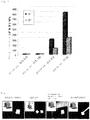
- the stress at rupture of the re-adhered gel was measured with a creep meter (RE2-33005B, produced by Yamaden, Co., Ltd.) Calculation was made to determine to what extent the rupture stress was recovered relative to the rupture stress of the gel before rupturing. The stress of the gel was recovered regardless of the lapse of time after rupture. Fig. 13 shows the results.
- the gel comprising 6-acrylamide- ⁇ -cyclodextrin-derived units and N -(1-adamantyl) acrylamide-derived units at a ratio of the 6-acrylamide- ⁇ -cyclodextrin-derived units to the N -(1-adamantyl) acrylamide-derived units of 0.3:0.4 (10 mm x 10 mm x 3 mm), which was prepared in Test Example 5, was sandwiched between two sheets of slide glass, and a pressure of 150 g was applied in water for one day, followed by drying at 25°C at a humidity of 42% for one day.
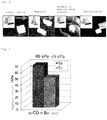
- Fig. 14 shows a photograph after the compression in water and a photograph after the drying.
- the gel prepared by the process of the present invention can be used, for example, for paint resins, coating films, shock absorbers, plastic containers, vascular embolization materials for medical use (e.g., hydrogel beads), and detachable adhesives.
Landscapes
- Chemical & Material Sciences (AREA)
- Health & Medical Sciences (AREA)
- Chemical Kinetics & Catalysis (AREA)
- Medicinal Chemistry (AREA)
- Polymers & Plastics (AREA)
- Organic Chemistry (AREA)
- Addition Polymer Or Copolymer, Post-Treatments, Or Chemical Modifications (AREA)
- Polymerisation Methods In General (AREA)
- Pyridine Compounds (AREA)
- Polysaccharides And Polysaccharide Derivatives (AREA)
- Processes Of Treating Macromolecular Substances (AREA)
- Compositions Of Macromolecular Compounds (AREA)
Claims (9)
- Verfahren zur Herstellung einer Lösung in einem wässrigen Lösungsmittel, die ein eine Wirtsgruppe enthaltendes Monomer, ein eine Gastgruppe enthaltendes Monomer und ein Monomer vom Acrylat-Typ enthält, wobei das Verfahren die Schritte des Vermischens des eine Wirtsgruppe enthaltenden Monomers, des eine Gastgruppe enthaltenden Monomers und des Monomers vom Acrylat-Typ in einem wässrigen Lösungsmittel sowie das Erhitzen des im obigen Schritt erhaltenen Gemischs auf 40 °C bis 80 °C umfasst, um eine Lösung der Monomere im wässrigen Lösungsmittel zu erhalten,
wobei das eine Gastgruppe enthaltende Monomer ein durch Formel (2) dargestelltes Monomer ist: worin A eine gegebenenfalls substituierte Arylgruppe, C(O)OR1 oder C(O)NHR1 ist, R1 eine gegebenenfalls substituierte Alkylgruppe, eine gegebenenfalls substituierte Arylgruppe oder eine gegebenenfalls substituierte Arylalkylgruppe ist und Rb ein Wasserstoffatom oder eine Methylgruppe ist; wobeidie gegebenenfalls substituierte Alkylgruppe 1 bis 3 Substituenten aufweisen kann, die aus Halogenatomen, Carboxylgruppen, Estergruppen, Amidgruppen und Hydroxylgruppen ausgewählt sind, die gegebenenfalls geschützt sind, oder wobei die gegebenenfalls substituierte Alkylgruppe ein daran gebundenes Ferrocen als Substituenten aufweist;die gegebenenfalls substituierte Arylgruppe 1 bis 3 Substituenten aufweisen kann, die aus C1-18-Alkylgruppen, Halogenatomen, Carboxylgruppen, Estergruppen, Amidgruppen, Azo-Gruppen, die Arylgruppen aufweisen, und Hydroxylgruppen, die gegebenenfalls geschützt sind, ausgewählt sind; unddie Arylgruppe der gegebenenfalls substituierten Arylalkylgruppe 1 bis 3 Substituenten aufweisen kann, die aus C1-18-Alkylgruppen, Halogenatomen, Carboxylgruppen, Estergruppen, Amidgruppen, Azo-Gruppen, die Arylgruppen aufweisen, und Hydroxylgruppen, die gegebenenfalls geschützt sind, ausgewählt sind.
 - Verfahren nach Anspruch 1, wobei das eine Wirtsgruppe enthaltende Monomer ein durch Formel (1) dargestelltes Monomer ist:

- Verfahren nach einem der Ansprüche 1 bis 2, wobei das Monomer vom Acrylat-Typ ein durch Formel (3) dargestelltes Monomer ist:

- Verfahren nach Anspruch 3, wobei die gegebenenfalls substituierte Alkylgruppe 1 bis 3 Substituenten aufweisen kann, die aus Halogenatomen, Carboxylgruppen, Estergruppen, Amidgruppen und Hydroxylgruppen, die gegebenenfalls geschützt sind, ausgewählt sind, oder die gegebenenfalls substituierte Alkylgruppe ein daran gebundenes Ferrocen als Substituenten aufweist; und
die gegebenenfalls substituierte Arylgruppe 1 bis 3 Substituenten aufweisen kann, die aus C1-18-Alkylgruppen, Halogenatomen, Carboxylgruppen, Estergruppen, Amidgruppen, Azo-Gruppen, die Arylgruppen aufweisen, und Hydroxylgruppen, die gegebenenfalls geschützt sind, ausgewählt sind. - Verfahren nach einem der Ansprüche 1 bis 4, wobei das eine Wirtsgruppe enthaltende Monomer in einer Menge von 30 bis 0,5 Mol-% eingesetzt wird, das eine Gastgruppe enthaltende Monomer in einer Menge von 30 bis 0,5 Mol-% eingesetzt wird und das Monomer vom Acrylat-Typ in einer Menge von 40 bis 99 Mol-% eingesetzt wird.
- Verfahren nach einem der Ansprüche 1 bis 5, wobei das Molverhältnis zwischen dem eine Wirtsgruppe enthaltenden Monomer und dem eine Gastgruppe enthaltenden Monomer 1:1 beträgt.
- Verfahren nach einem der Ansprüche 1 bis 6, wobei das wässrige Lösungsmittel Wasser oder ein Lösungsmittelgemisch aus Wasser und einem mit Wasser verträglichen organischen Lösungsmittel ist.
- Verfahren zur Herstellung eines Gels, welches das Copolymerisieren der Monomere in einer in Anspruch 1 erhaltenen Lösung in einem wässrigen Lösungsmittel umfasst, um ein aus dem eine Wirtsgruppe enthaltenden Monomer, dem eine Gastgruppe enthaltenden Monomer und dem Monomer vom Acrylat-Typ erhältliches Gel zu erzeugen.
- Verfahren nach Anspruch 8, wobei die Copolymerisation bei 0 °C bis 100 °C durchgeführt wird.
Applications Claiming Priority (2)
| Application Number | Priority Date | Filing Date | Title |
|---|---|---|---|
| JP2012103460 | 2012-04-27 | ||
| PCT/JP2013/062461 WO2013162019A1 (ja) | 2012-04-27 | 2013-04-26 | 自己修復性及び形状記憶性を有するゲル、及びその製造方法 |
Publications (3)
| Publication Number | Publication Date |
|---|---|
| EP2842976A1 EP2842976A1 (de) | 2015-03-04 |
| EP2842976A4 EP2842976A4 (de) | 2016-04-20 |
| EP2842976B1 true EP2842976B1 (de) | 2021-08-25 |
Family
ID=49483315
Family Applications (1)
| Application Number | Title | Priority Date | Filing Date |
|---|---|---|---|
| EP13781751.6A Active EP2842976B1 (de) | 2012-04-27 | 2013-04-26 | Gel mit selbstwiederherstellbarkeits- und formgedächtniseigenschaften und verfahren zur herstellung davon |
Country Status (4)
| Country | Link |
|---|---|
| US (2) | US10106628B2 (de) |
| EP (1) | EP2842976B1 (de) |
| JP (2) | JP5951758B2 (de) |
| WO (1) | WO2013162019A1 (de) |
Families Citing this family (54)
| Publication number | Priority date | Publication date | Assignee | Title |
|---|---|---|---|---|
| EP2842976B1 (de) * | 2012-04-27 | 2021-08-25 | Osaka University | Gel mit selbstwiederherstellbarkeits- und formgedächtniseigenschaften und verfahren zur herstellung davon |
| WO2015030079A1 (ja) | 2013-08-27 | 2015-03-05 | 国立大学法人大阪大学 | 材料界面での化学的結合により接合した接合体及びその接合方法 |
| JP6300926B2 (ja) | 2014-07-08 | 2018-03-28 | 国立大学法人大阪大学 | 自己修復性を有する高分子材料及びその製造方法 |
| CN106663787A (zh) * | 2014-09-08 | 2017-05-10 | 日立麦克赛尔株式会社 | 非水电解液电池、其制造方法以及非水电解液电池系统 |
| EP3281960B1 (de) * | 2015-04-10 | 2019-12-25 | Osaka University | Selbstreparierendes material und herstellungsverfahren dafür |
| WO2017002955A1 (ja) * | 2015-07-02 | 2017-01-05 | 日産化学工業株式会社 | シクロデキストリン誘導体の製造方法、及びその重合体 |
| JP6749750B2 (ja) * | 2015-10-08 | 2020-09-02 | 国立大学法人大阪大学 | 自己修復材料及びその製造方法 |
| US11535691B2 (en) | 2016-03-18 | 2022-12-27 | Osaka University | Macromolecular material, method for producing same, and polymerizable monomer composition |
| JP6975427B2 (ja) | 2016-07-28 | 2021-12-01 | 国立大学法人大阪大学 | 培地用高分子ゲル、培地、細胞の培養方法及びキット |
| WO2018038186A1 (ja) * | 2016-08-23 | 2018-03-01 | ダイキン工業株式会社 | 高分子材料 |
| JP2018111788A (ja) * | 2017-01-13 | 2018-07-19 | 国立大学法人大阪大学 | 接着構造体及びその製造方法 |
| JP2018118743A (ja) * | 2017-01-23 | 2018-08-02 | ダイセン・メンブレン・システムズ株式会社 | インジェクションキャップとそれを使用した液体サンプリング装置 |
| KR101947594B1 (ko) * | 2017-04-13 | 2019-02-14 | 주식회사 쎄코 | 자가치유 기능 폴리비닐계 화합물 및 이의 제조방법 |
| JP6841530B2 (ja) * | 2017-05-11 | 2021-03-10 | 国立大学法人大阪大学 | 重合用組成物及びその重合体並びに重合体の製造方法 |
| JPWO2019044848A1 (ja) * | 2017-08-29 | 2020-10-29 | ユシロ化学工業株式会社 | 3次元外科治療研修モデル用組成物及びその製造方法 |
| CN109232789B (zh) * | 2018-07-18 | 2020-06-12 | 四川大学 | 基于两性聚电解质的高性能自修复橡胶及其制备方法 |
| KR102141826B1 (ko) * | 2018-10-05 | 2020-08-07 | 건국대학교 산학협력단 | 양이온성 베타 시클로덱스트린 올리고머를 이용한 외부 pH 자극 반응형 자가치유성 하이드로젤 |
| CN109705371B (zh) * | 2018-12-29 | 2021-05-11 | 广东工业大学 | 超分子材料、六臂星型交联的水凝胶及其制备方法 |
| US11667609B2 (en) | 2019-02-28 | 2023-06-06 | Adeka Corporation | Compound, composition containing said compound, self-healing material, surface coating agent, paint, adhesive, material for battery and cured product |
| JP6733897B1 (ja) | 2019-03-04 | 2020-08-05 | 国立大学法人大阪大学 | 電気化学デバイス用結着剤、電極合剤、電極、電気化学デバイス及び二次電池 |
| CN112225854B (zh) * | 2019-07-15 | 2023-06-06 | 中国科学院宁波材料技术与工程研究所 | 一种水凝胶组装体、其制备方法和应用 |
| JP7337377B2 (ja) * | 2019-10-31 | 2023-09-04 | 国立大学法人大阪大学 | 高分子複合材料、重合性単量体組成物及び高分子複合材料の製造方法 |
| WO2021131409A1 (ja) | 2019-12-27 | 2021-07-01 | 国立大学法人大阪大学 | 樹脂組成物、重合体、重合体の製造方法、電気化学デバイス用結着剤、電極合剤、電極、電気化学デバイス及び二次電池 |
| US20230100274A1 (en) | 2020-02-25 | 2023-03-30 | Shiseido Company, Ltd. | Resin material including siloxane-bond-containing polymer having host group and/or guest group |
| EP4180464B1 (de) * | 2020-07-29 | 2024-12-18 | Kyoeisha Chemical Co., Ltd. | Cyclodextrinderivat mit polymerisierbarer ungesättigter gruppe |
| JP7570629B2 (ja) * | 2020-12-14 | 2024-10-22 | シヤチハタ株式会社 | 放射線治療用ボーラス材 |
| JPWO2022230745A1 (de) | 2021-04-27 | 2022-11-03 | ||
| WO2023012947A1 (ja) * | 2021-08-04 | 2023-02-09 | リンテック株式会社 | 粘着シートおよび粘着シートの製造方法 |
| JP2023036088A (ja) | 2021-09-02 | 2023-03-14 | Tdk株式会社 | リチウムイオン二次電池 |
| WO2023195514A1 (ja) * | 2022-04-08 | 2023-10-12 | 国立大学法人大阪大学 | 重合体、樹脂組成物及び医療用材料 |
| CN114957550B (zh) * | 2022-06-14 | 2023-08-18 | 中国石油大学(华东) | 一种深部调剖再粘接超分子凝胶颗粒及其制备方法 |
| US11732159B1 (en) | 2022-06-30 | 2023-08-22 | CreateMe Technologies LLC | Methods of disassembling apparel products having boronate adhesives |
| US11713405B1 (en) | 2022-06-30 | 2023-08-01 | CreateMe Technologies LLC | Methods of disassembling apparel products having thioester adhesives |
| US11857013B1 (en) | 2022-06-30 | 2024-01-02 | Createme Technologies Inc. | Methods of assembling apparel products having shape memory adhesives |
| US11752234B1 (en) | 2022-06-30 | 2023-09-12 | CreateMe Technologies LLC | Shape memory adhesives for apparel products |
| US11542413B1 (en) | 2022-06-30 | 2023-01-03 | CreateMe Technologies LLC | Methods of disassembling apparel products having imine adhesives |
| US11542412B1 (en) | 2022-06-30 | 2023-01-03 | CreateMe Technologies LLC | Methods of disassembling apparel products having cyclodextrin-azobenzene adhesives |
| US11530336B1 (en) * | 2022-06-30 | 2022-12-20 | CreateMe Technologies LLC | Methods of assembling apparel products having cyclodextrin-azobenzene adhesives |
| US11730217B1 (en) | 2022-06-30 | 2023-08-22 | CreateMe Technologies LLC | Methods of disassembling apparel products having cycloalkene adhesives |
| US11530340B1 (en) | 2022-06-30 | 2022-12-20 | CreateMe Technologies LLC | Cyclodextrin-azobenzene adhesives for apparel products |
| US11653709B1 (en) | 2022-06-30 | 2023-05-23 | CreateMe Technologies LLC | Methods of disassembling apparel products having disulfide adhesives |
| US11632995B1 (en) | 2022-06-30 | 2023-04-25 | CreateMe Technologies LLC | Methods of assembling apparel products having disulfide adhesives |
| US11712873B1 (en) | 2022-06-30 | 2023-08-01 | CreateMe Technologies LLC | Boronate adhesives for apparel products |
| US11849791B1 (en) | 2022-06-30 | 2023-12-26 | Createme Technologies Inc. | Methods of assembling apparel products having imine adhesives |
| US11629272B1 (en) | 2022-06-30 | 2023-04-18 | CreateMe Technologies LLC | Methods of assembling apparel products having thioester adhesives |
| US11730215B1 (en) | 2022-06-30 | 2023-08-22 | CreateMe Technologies LLC | Thioester adhesives for apparel products |
| US11692111B1 (en) | 2022-06-30 | 2023-07-04 | CreateMe Technologies LLC | Methods of disassembling apparel products having shape memory adhesives |
| US11655397B1 (en) | 2022-06-30 | 2023-05-23 | CreateMe Technologies LLC | Methods of assembling apparel products having cycloalkene adhesives |
| US11634616B1 (en) | 2022-06-30 | 2023-04-25 | CreateMe Technologies LLC | Methods of assembling apparel products having boronate adhesives |
| US11905440B1 (en) | 2022-06-30 | 2024-02-20 | Createme Technologies Inc. | Disulfide adhesives for apparel products |
| JPWO2024101407A1 (de) | 2022-11-10 | 2024-05-16 | ||
| JPWO2024202546A1 (de) | 2023-03-28 | 2024-10-03 | ||
| CN119954997B (zh) * | 2025-01-03 | 2025-10-14 | 华中科技大学 | 一种有机发光材料及相应得到的能够遇水发光的固体水凝胶、喷墨打印用纸张 |
| CN121513235A (zh) * | 2026-01-15 | 2026-02-13 | 吉林大学第一医院 | 一种医用无菌凝胶耦合剂的制备方法和应用 |
Family Cites Families (28)
| Publication number | Priority date | Publication date | Assignee | Title |
|---|---|---|---|---|
| US4708981A (en) * | 1985-12-11 | 1987-11-24 | Uop Inc. | Water insoluble proton conducting polymers |
| DE4009825A1 (de) * | 1990-03-27 | 1991-10-02 | Consortium Elektrochem Ind | Wasserunloesliche cyclodextrin-polymerisate und verfahren zu deren herstellung |
| US5898004A (en) * | 1996-11-06 | 1999-04-27 | University Of Pittsburgh Of The Commonwealth System Of Higher Education | Polymerized crystalline colloidal array sensors |
| JP2002239358A (ja) * | 2001-02-15 | 2002-08-27 | Takehisa Yamaguchi | 環境応答性分子認識材料 |
| US20050032995A1 (en) * | 2003-08-08 | 2005-02-10 | Kulkarni Mohan Gopalkrishna | Inclusion complexes of cyclic macromolecular organic compounds and polymerization thereof |
| US20050096443A1 (en) * | 2003-11-05 | 2005-05-05 | Kulkarni Mohan G. | Soluble polymers comprising unsaturation and process for preparation thereof |
| JP4547558B2 (ja) * | 2004-03-31 | 2010-09-22 | 学校法人 芝浦工業大学 | 形状記憶素子 |
| US7560522B2 (en) * | 2004-06-28 | 2009-07-14 | Council Of Scientific And Industrial Research | Inclusion complexes of unsaturated monomers, their polymers and process for preparation thereof |
| US20060094844A1 (en) * | 2004-10-29 | 2006-05-04 | Council Of Scientific And Industrial Research | Inclusion complexes of unsaturated monomers, their polymers and process for preparation thereof |
| EP1828255A1 (de) * | 2004-10-29 | 2007-09-05 | Council Of Scientific And Industrial Research | Wasserlösliche polymere mit vinylungesättigtheit, ihre vernetzung und verfahren zu ihrer herstellung |
| JP2006299170A (ja) * | 2005-04-25 | 2006-11-02 | Kaneka Corp | シクロデキストリン含有アクリル系重合体の製造方法 |
| TW200728324A (en) * | 2005-12-22 | 2007-08-01 | Nippon Catalytic Chem Ind | Production method of hydrophilic polymer |
| DE602007010256D1 (de) * | 2006-03-28 | 2010-12-16 | Council Scient Ind Res | Wasserlösliche makromonomere mit ungesättigtem abschluss und verfahren zur herstellung davon |
| DE602006007679D1 (de) * | 2006-03-31 | 2009-08-20 | Sony Deutschland Gmbh | Verfahren zur Herstellung eines vernetzten Polymer-Gels |
| JP2008239722A (ja) | 2007-03-27 | 2008-10-09 | Japan Advanced Institute Of Science & Technology Hokuriku | 自己修復材料 |
| US8586372B2 (en) * | 2007-05-07 | 2013-11-19 | A School Corporation Kansai University | Molecule-responsive gel particles, method of production of the same, and use thereof |
| ES2335958B2 (es) * | 2008-08-06 | 2010-11-02 | Universidad De Santiago De Compostela | Hidrogeles acrilicos con ciclodextrinas colgantes, su preparacion y su aplicacion como sistemas de liberacion y componentes de lentes de contacto. |
| JP5329241B2 (ja) | 2009-01-08 | 2013-10-30 | リンテック株式会社 | 高分子架橋体および高分子架橋体の製造方法 |
| US8569451B2 (en) * | 2009-04-15 | 2013-10-29 | Biotage Ab | Affinity material |
| JP5615373B2 (ja) * | 2010-09-14 | 2014-10-29 | 国立大学法人大阪大学 | 分子認識に基づいた物質材料の選択的接着法および自己組織化法 |
| JP5871223B2 (ja) | 2011-04-15 | 2016-03-01 | 株式会社ブリヂストン | ロタキサン、架橋剤、架橋方法、架橋ポリマー及び架橋ポリマーの分解方法 |
| EP2842976B1 (de) * | 2012-04-27 | 2021-08-25 | Osaka University | Gel mit selbstwiederherstellbarkeits- und formgedächtniseigenschaften und verfahren zur herstellung davon |
| WO2014004651A1 (en) * | 2012-06-26 | 2014-01-03 | The Johns Hopkins University | Multifunctional tunable biomaterials for tissue engineering |
| JP6300926B2 (ja) * | 2014-07-08 | 2018-03-28 | 国立大学法人大阪大学 | 自己修復性を有する高分子材料及びその製造方法 |
| US9889086B2 (en) * | 2015-02-12 | 2018-02-13 | The Chinese University Of Hong Kong | Bioadhesive and injectable hydrogel |
| EP3281960B1 (de) * | 2015-04-10 | 2019-12-25 | Osaka University | Selbstreparierendes material und herstellungsverfahren dafür |
| EP3450463A4 (de) * | 2016-04-27 | 2019-12-25 | Osaka University | Verfahren zur herstellung von polyrotaxan |
| WO2018038186A1 (ja) * | 2016-08-23 | 2018-03-01 | ダイキン工業株式会社 | 高分子材料 |
-
2013
- 2013-04-26 EP EP13781751.6A patent/EP2842976B1/de active Active
- 2013-04-26 JP JP2014512721A patent/JP5951758B2/ja active Active
- 2013-04-26 US US14/395,638 patent/US10106628B2/en active Active
- 2013-04-26 WO PCT/JP2013/062461 patent/WO2013162019A1/ja not_active Ceased
-
2016
- 2016-06-08 JP JP2016114770A patent/JP6239043B2/ja active Active
-
2018
- 2018-10-12 US US16/158,693 patent/US20190092880A1/en not_active Abandoned
Non-Patent Citations (1)
| Title |
|---|
| None * |
Also Published As
| Publication number | Publication date |
|---|---|
| JP5951758B2 (ja) | 2016-07-13 |
| US20190092880A1 (en) | 2019-03-28 |
| US10106628B2 (en) | 2018-10-23 |
| EP2842976A1 (de) | 2015-03-04 |
| EP2842976A4 (de) | 2016-04-20 |
| JP6239043B2 (ja) | 2017-11-29 |
| US20150073091A1 (en) | 2015-03-12 |
| JP2016216724A (ja) | 2016-12-22 |
| JPWO2013162019A1 (ja) | 2015-12-24 |
| WO2013162019A1 (ja) | 2013-10-31 |
Similar Documents
| Publication | Publication Date | Title |
|---|---|---|
| EP2842976B1 (de) | Gel mit selbstwiederherstellbarkeits- und formgedächtniseigenschaften und verfahren zur herstellung davon | |
| EP3281960B1 (de) | Selbstreparierendes material und herstellungsverfahren dafür | |
| JP7054244B2 (ja) | 高分子材料及びその製造方法、並びに重合性単量体組成物 | |
| EP2617777B1 (de) | Verfahren zur selbstanordnung eines materials und selektives haftverfahren auf basis molekularen erkennung | |
| EP3590972A1 (de) | Host-gruppenhaltiges polymerisierbares monomer, polymermaterial, verfahren zur herstellung davon und clathratverbindung und verfahren zur herstellung davon | |
| JP6841530B2 (ja) | 重合用組成物及びその重合体並びに重合体の製造方法 | |
| JP6257633B2 (ja) | 材料界面での化学的結合により接合した接合体及びその接合方法 | |
| JP2021175779A (ja) | ホスト基含有重合性単量体及びその製造方法、高分子材料並びに高分子材料形成用前駆体 | |
| ES2975000T3 (es) | Método para producir adhesivos sensibles a la presión (PSA) retirables usando materiales de partida de origen biológico | |
| JP6404939B2 (ja) | 水性接着剤組成物 | |
| JP6404940B2 (ja) | 水性接着剤組成物 | |
| JP2023124226A (ja) | ロタキサン及びその製造方法、並びに、架橋ポリマー、高分子微粒子及び高分子樹脂部材 | |
| Hefczyc | Radical initiators and their influence on the viscosity and molecular weight of acrylic polymers applied in pressure-sensitive adhesives |
Legal Events
| Date | Code | Title | Description |
|---|---|---|---|
| PUAI | Public reference made under article 153(3) epc to a published international application that has entered the european phase |
Free format text: ORIGINAL CODE: 0009012 |
|
| 17P | Request for examination filed |
Effective date: 20141104 |
|
| AK | Designated contracting states |
Kind code of ref document: A1 Designated state(s): AL AT BE BG CH CY CZ DE DK EE ES FI FR GB GR HR HU IE IS IT LI LT LU LV MC MK MT NL NO PL PT RO RS SE SI SK SM TR |
|
| AX | Request for extension of the european patent |
Extension state: BA ME |
|
| DAX | Request for extension of the european patent (deleted) | ||
| RIC1 | Information provided on ipc code assigned before grant |
Ipc: C08F 2/10 20060101ALI20151106BHEP Ipc: C08F 220/10 20060101AFI20151106BHEP Ipc: C08F 220/54 20060101ALI20151106BHEP |
|
| RA4 | Supplementary search report drawn up and despatched (corrected) |
Effective date: 20160321 |
|
| RIC1 | Information provided on ipc code assigned before grant |
Ipc: C08F 220/54 20060101ALI20160315BHEP Ipc: C08F 220/10 20060101AFI20160315BHEP Ipc: C08F 2/10 20060101ALI20160315BHEP |
|
| STAA | Information on the status of an ep patent application or granted ep patent |
Free format text: STATUS: EXAMINATION IS IN PROGRESS |
|
| 17Q | First examination report despatched |
Effective date: 20170424 |
|
| GRAP | Despatch of communication of intention to grant a patent |
Free format text: ORIGINAL CODE: EPIDOSNIGR1 |
|
| STAA | Information on the status of an ep patent application or granted ep patent |
Free format text: STATUS: GRANT OF PATENT IS INTENDED |
|
| INTG | Intention to grant announced |
Effective date: 20210329 |
|
| GRAS | Grant fee paid |
Free format text: ORIGINAL CODE: EPIDOSNIGR3 |
|
| GRAA | (expected) grant |
Free format text: ORIGINAL CODE: 0009210 |
|
| STAA | Information on the status of an ep patent application or granted ep patent |
Free format text: STATUS: THE PATENT HAS BEEN GRANTED |
|
| AK | Designated contracting states |
Kind code of ref document: B1 Designated state(s): AL AT BE BG CH CY CZ DE DK EE ES FI FR GB GR HR HU IE IS IT LI LT LU LV MC MK MT NL NO PL PT RO RS SE SI SK SM TR |
|
| REG | Reference to a national code |
Ref country code: GB Ref legal event code: FG4D |
|
| REG | Reference to a national code |
Ref country code: CH Ref legal event code: EP |
|
| REG | Reference to a national code |
Ref country code: DE Ref legal event code: R096 Ref document number: 602013078971 Country of ref document: DE |
|
| REG | Reference to a national code |
Ref country code: IE Ref legal event code: FG4D Ref country code: AT Ref legal event code: REF Ref document number: 1423744 Country of ref document: AT Kind code of ref document: T Effective date: 20210915 |
|
| REG | Reference to a national code |
Ref country code: LT Ref legal event code: MG9D |
|
| REG | Reference to a national code |
Ref country code: AT Ref legal event code: MK05 Ref document number: 1423744 Country of ref document: AT Kind code of ref document: T Effective date: 20210825 |
|
| PG25 | Lapsed in a contracting state [announced via postgrant information from national office to epo] |
Ref country code: ES Free format text: LAPSE BECAUSE OF FAILURE TO SUBMIT A TRANSLATION OF THE DESCRIPTION OR TO PAY THE FEE WITHIN THE PRESCRIBED TIME-LIMIT Effective date: 20210825 Ref country code: FI Free format text: LAPSE BECAUSE OF FAILURE TO SUBMIT A TRANSLATION OF THE DESCRIPTION OR TO PAY THE FEE WITHIN THE PRESCRIBED TIME-LIMIT Effective date: 20210825 Ref country code: PT Free format text: LAPSE BECAUSE OF FAILURE TO SUBMIT A TRANSLATION OF THE DESCRIPTION OR TO PAY THE FEE WITHIN THE PRESCRIBED TIME-LIMIT Effective date: 20211227 Ref country code: NO Free format text: LAPSE BECAUSE OF FAILURE TO SUBMIT A TRANSLATION OF THE DESCRIPTION OR TO PAY THE FEE WITHIN THE PRESCRIBED TIME-LIMIT Effective date: 20211125 Ref country code: RS Free format text: LAPSE BECAUSE OF FAILURE TO SUBMIT A TRANSLATION OF THE DESCRIPTION OR TO PAY THE FEE WITHIN THE PRESCRIBED TIME-LIMIT Effective date: 20210825 Ref country code: LT Free format text: LAPSE BECAUSE OF FAILURE TO SUBMIT A TRANSLATION OF THE DESCRIPTION OR TO PAY THE FEE WITHIN THE PRESCRIBED TIME-LIMIT Effective date: 20210825 Ref country code: BG Free format text: LAPSE BECAUSE OF FAILURE TO SUBMIT A TRANSLATION OF THE DESCRIPTION OR TO PAY THE FEE WITHIN THE PRESCRIBED TIME-LIMIT Effective date: 20211125 Ref country code: AT Free format text: LAPSE BECAUSE OF FAILURE TO SUBMIT A TRANSLATION OF THE DESCRIPTION OR TO PAY THE FEE WITHIN THE PRESCRIBED TIME-LIMIT Effective date: 20210825 Ref country code: HR Free format text: LAPSE BECAUSE OF FAILURE TO SUBMIT A TRANSLATION OF THE DESCRIPTION OR TO PAY THE FEE WITHIN THE PRESCRIBED TIME-LIMIT Effective date: 20210825 Ref country code: SE Free format text: LAPSE BECAUSE OF FAILURE TO SUBMIT A TRANSLATION OF THE DESCRIPTION OR TO PAY THE FEE WITHIN THE PRESCRIBED TIME-LIMIT Effective date: 20210825 |
|
| PG25 | Lapsed in a contracting state [announced via postgrant information from national office to epo] |
Ref country code: PL Free format text: LAPSE BECAUSE OF FAILURE TO SUBMIT A TRANSLATION OF THE DESCRIPTION OR TO PAY THE FEE WITHIN THE PRESCRIBED TIME-LIMIT Effective date: 20210825 Ref country code: LV Free format text: LAPSE BECAUSE OF FAILURE TO SUBMIT A TRANSLATION OF THE DESCRIPTION OR TO PAY THE FEE WITHIN THE PRESCRIBED TIME-LIMIT Effective date: 20210825 Ref country code: GR Free format text: LAPSE BECAUSE OF FAILURE TO SUBMIT A TRANSLATION OF THE DESCRIPTION OR TO PAY THE FEE WITHIN THE PRESCRIBED TIME-LIMIT Effective date: 20211126 |
|
| PG25 | Lapsed in a contracting state [announced via postgrant information from national office to epo] |
Ref country code: NL Free format text: LAPSE BECAUSE OF FAILURE TO SUBMIT A TRANSLATION OF THE DESCRIPTION OR TO PAY THE FEE WITHIN THE PRESCRIBED TIME-LIMIT Effective date: 20210825 |
|
| PG25 | Lapsed in a contracting state [announced via postgrant information from national office to epo] |
Ref country code: DK Free format text: LAPSE BECAUSE OF FAILURE TO SUBMIT A TRANSLATION OF THE DESCRIPTION OR TO PAY THE FEE WITHIN THE PRESCRIBED TIME-LIMIT Effective date: 20210825 |
|
| REG | Reference to a national code |
Ref country code: DE Ref legal event code: R097 Ref document number: 602013078971 Country of ref document: DE |
|
| PG25 | Lapsed in a contracting state [announced via postgrant information from national office to epo] |
Ref country code: SM Free format text: LAPSE BECAUSE OF FAILURE TO SUBMIT A TRANSLATION OF THE DESCRIPTION OR TO PAY THE FEE WITHIN THE PRESCRIBED TIME-LIMIT Effective date: 20210825 Ref country code: SK Free format text: LAPSE BECAUSE OF FAILURE TO SUBMIT A TRANSLATION OF THE DESCRIPTION OR TO PAY THE FEE WITHIN THE PRESCRIBED TIME-LIMIT Effective date: 20210825 Ref country code: RO Free format text: LAPSE BECAUSE OF FAILURE TO SUBMIT A TRANSLATION OF THE DESCRIPTION OR TO PAY THE FEE WITHIN THE PRESCRIBED TIME-LIMIT Effective date: 20210825 Ref country code: EE Free format text: LAPSE BECAUSE OF FAILURE TO SUBMIT A TRANSLATION OF THE DESCRIPTION OR TO PAY THE FEE WITHIN THE PRESCRIBED TIME-LIMIT Effective date: 20210825 Ref country code: CZ Free format text: LAPSE BECAUSE OF FAILURE TO SUBMIT A TRANSLATION OF THE DESCRIPTION OR TO PAY THE FEE WITHIN THE PRESCRIBED TIME-LIMIT Effective date: 20210825 Ref country code: AL Free format text: LAPSE BECAUSE OF FAILURE TO SUBMIT A TRANSLATION OF THE DESCRIPTION OR TO PAY THE FEE WITHIN THE PRESCRIBED TIME-LIMIT Effective date: 20210825 |
|
| PLBE | No opposition filed within time limit |
Free format text: ORIGINAL CODE: 0009261 |
|
| STAA | Information on the status of an ep patent application or granted ep patent |
Free format text: STATUS: NO OPPOSITION FILED WITHIN TIME LIMIT |
|
| PG25 | Lapsed in a contracting state [announced via postgrant information from national office to epo] |
Ref country code: IT Free format text: LAPSE BECAUSE OF FAILURE TO SUBMIT A TRANSLATION OF THE DESCRIPTION OR TO PAY THE FEE WITHIN THE PRESCRIBED TIME-LIMIT Effective date: 20210825 |
|
| 26N | No opposition filed |
Effective date: 20220527 |
|
| PG25 | Lapsed in a contracting state [announced via postgrant information from national office to epo] |
Ref country code: SI Free format text: LAPSE BECAUSE OF FAILURE TO SUBMIT A TRANSLATION OF THE DESCRIPTION OR TO PAY THE FEE WITHIN THE PRESCRIBED TIME-LIMIT Effective date: 20210825 |
|
| REG | Reference to a national code |
Ref country code: CH Ref legal event code: PL |
|
| REG | Reference to a national code |
Ref country code: BE Ref legal event code: MM Effective date: 20220430 |
|
| PG25 | Lapsed in a contracting state [announced via postgrant information from national office to epo] |
Ref country code: MC Free format text: LAPSE BECAUSE OF FAILURE TO SUBMIT A TRANSLATION OF THE DESCRIPTION OR TO PAY THE FEE WITHIN THE PRESCRIBED TIME-LIMIT Effective date: 20210825 Ref country code: LU Free format text: LAPSE BECAUSE OF NON-PAYMENT OF DUE FEES Effective date: 20220426 Ref country code: LI Free format text: LAPSE BECAUSE OF NON-PAYMENT OF DUE FEES Effective date: 20220430 Ref country code: FR Free format text: LAPSE BECAUSE OF NON-PAYMENT OF DUE FEES Effective date: 20220430 Ref country code: CH Free format text: LAPSE BECAUSE OF NON-PAYMENT OF DUE FEES Effective date: 20220430 |
|
| PG25 | Lapsed in a contracting state [announced via postgrant information from national office to epo] |
Ref country code: BE Free format text: LAPSE BECAUSE OF NON-PAYMENT OF DUE FEES Effective date: 20220430 |
|
| PG25 | Lapsed in a contracting state [announced via postgrant information from national office to epo] |
Ref country code: IE Free format text: LAPSE BECAUSE OF NON-PAYMENT OF DUE FEES Effective date: 20220426 |
|
| PG25 | Lapsed in a contracting state [announced via postgrant information from national office to epo] |
Ref country code: HU Free format text: LAPSE BECAUSE OF FAILURE TO SUBMIT A TRANSLATION OF THE DESCRIPTION OR TO PAY THE FEE WITHIN THE PRESCRIBED TIME-LIMIT; INVALID AB INITIO Effective date: 20130426 |
|
| PG25 | Lapsed in a contracting state [announced via postgrant information from national office to epo] |
Ref country code: MK Free format text: LAPSE BECAUSE OF FAILURE TO SUBMIT A TRANSLATION OF THE DESCRIPTION OR TO PAY THE FEE WITHIN THE PRESCRIBED TIME-LIMIT Effective date: 20210825 Ref country code: CY Free format text: LAPSE BECAUSE OF FAILURE TO SUBMIT A TRANSLATION OF THE DESCRIPTION OR TO PAY THE FEE WITHIN THE PRESCRIBED TIME-LIMIT Effective date: 20210825 |
|
| PGFP | Annual fee paid to national office [announced via postgrant information from national office to epo] |
Ref country code: GB Payment date: 20240307 Year of fee payment: 12 |
|
| PG25 | Lapsed in a contracting state [announced via postgrant information from national office to epo] |
Ref country code: TR Free format text: LAPSE BECAUSE OF FAILURE TO SUBMIT A TRANSLATION OF THE DESCRIPTION OR TO PAY THE FEE WITHIN THE PRESCRIBED TIME-LIMIT Effective date: 20210825 |
|
| PGFP | Annual fee paid to national office [announced via postgrant information from national office to epo] |
Ref country code: DE Payment date: 20240306 Year of fee payment: 12 |
|
| PG25 | Lapsed in a contracting state [announced via postgrant information from national office to epo] |
Ref country code: MT Free format text: LAPSE BECAUSE OF FAILURE TO SUBMIT A TRANSLATION OF THE DESCRIPTION OR TO PAY THE FEE WITHIN THE PRESCRIBED TIME-LIMIT Effective date: 20210825 |
|
| REG | Reference to a national code |
Ref country code: DE Ref legal event code: R119 Ref document number: 602013078971 Country of ref document: DE |
|
| GBPC | Gb: european patent ceased through non-payment of renewal fee |
Effective date: 20250426 |
|
| PG25 | Lapsed in a contracting state [announced via postgrant information from national office to epo] |
Ref country code: DE Free format text: LAPSE BECAUSE OF NON-PAYMENT OF DUE FEES Effective date: 20251104 |
|
| PG25 | Lapsed in a contracting state [announced via postgrant information from national office to epo] |
Ref country code: GB Free format text: LAPSE BECAUSE OF NON-PAYMENT OF DUE FEES Effective date: 20250426 |