EP2843553A2 - Terminal de traitement d'informations, son procédé de commande et programme - Google Patents
Terminal de traitement d'informations, son procédé de commande et programme Download PDFInfo
- Publication number
- EP2843553A2 EP2843553A2 EP14181420.2A EP14181420A EP2843553A2 EP 2843553 A2 EP2843553 A2 EP 2843553A2 EP 14181420 A EP14181420 A EP 14181420A EP 2843553 A2 EP2843553 A2 EP 2843553A2
- Authority
- EP
- European Patent Office
- Prior art keywords
- function
- information
- service
- classification information
- terminal according
- Prior art date
- Legal status (The legal status is an assumption and is not a legal conclusion. Google has not performed a legal analysis and makes no representation as to the accuracy of the status listed.)
- Withdrawn
Links
Images








Classifications
-
- G—PHYSICS
- G06—COMPUTING OR CALCULATING; COUNTING
- G06F—ELECTRIC DIGITAL DATA PROCESSING
- G06F15/00—Digital computers in general; Data processing equipment in general
- G06F15/16—Combinations of two or more digital computers each having at least an arithmetic unit, a program unit and a register, e.g. for a simultaneous processing of several programs
-
- G—PHYSICS
- G06—COMPUTING OR CALCULATING; COUNTING
- G06F—ELECTRIC DIGITAL DATA PROCESSING
- G06F9/00—Arrangements for program control, e.g. control units
- G06F9/06—Arrangements for program control, e.g. control units using stored programs, i.e. using an internal store of processing equipment to receive or retain programs
- G06F9/46—Multiprogramming arrangements
- G06F9/54—Interprogram communication
- G06F9/547—Remote procedure calls [RPC]; Web services
-
- G—PHYSICS
- G06—COMPUTING OR CALCULATING; COUNTING
- G06F—ELECTRIC DIGITAL DATA PROCESSING
- G06F16/00—Information retrieval; Database structures therefor; File system structures therefor
- G06F16/90—Details of database functions independent of the retrieved data types
- G06F16/95—Retrieval from the web
-
- G—PHYSICS
- G06—COMPUTING OR CALCULATING; COUNTING
- G06F—ELECTRIC DIGITAL DATA PROCESSING
- G06F3/00—Input arrangements for transferring data to be processed into a form capable of being handled by the computer; Output arrangements for transferring data from processing unit to output unit, e.g. interface arrangements
- G06F3/14—Digital output to display device ; Cooperation and interconnection of the display device with other functional units
-
- G—PHYSICS
- G06—COMPUTING OR CALCULATING; COUNTING
- G06F—ELECTRIC DIGITAL DATA PROCESSING
- G06F2209/00—Indexing scheme relating to G06F9/00
- G06F2209/50—Indexing scheme relating to G06F9/50
- G06F2209/5015—Service provider selection
Definitions
- the present invention relates to an information processing terminal and a control method therefor, and a program and, more particularly, to a technique of providing a service using a mechanism such as Web Intents.
- a function calling side when transferring processing between Web sites, a function calling side needs to know the API (Application Programming Interface) of a function providing side, and a method of calling a function such as a REST interface. To implement cooperation with a different Web site, therefore, the function calling side needs to perform processing on the calling side according to calling protocols.
- authentication on the function providing side is often required. Therefore, the function calling side needs to hold authentication information of the function providing side, and use authentication infrastructure such as SAML (Security Assertion Markup Language). Note that if authentication information is held, it is required to correctly, appropriately manage the authentication information.
- SAML Secure Assertion Markup Language
- Japanese Patent-Laid Open No. 2011-123607 relates to the detail page of Device Stage, which is generated when a device driver is manually installed in an information processing apparatus such as a PC.
- the detail page of Device Stage serving as a peripheral device management function may be provided for each device driver corresponding to each service.
- device detail pages are integrated into one page.
- Japanese Patent Laid-Open No. 2011-123607 makes it possible to prepare a detail page for each service, and integrate the detail pages into one page, as needed, but does not consider any new cooperation mechanism such as Web Intents.
- the present invention provides a method of flexibly and reliably implementing cooperation between a Web client and a Web service even if service contents provided by the Web service are particularized. Furthermore, the present invention provides a method of readily managing web services even if the number of managed web services increases along with particularization of services.
- the present invention in its first aspect provides an information processing terminal as specified in claims 1 to 14.
- the present invention in its second aspect provides a control method as specified in claim 15.
- the present invention in its third aspect provides a program as specified in claim 16.
- Fig. 1A is a view showing an overall arrangement for implementing Web Intents as an example of a mechanism of cooperating with an arbitrary Web service (or Web application) without using a dedicated API.
- a Web Intents service (to be referred to as a service hereinafter) 103 provides a service or function using the Intents technique.
- a Web Intents client (to be referred to as a client hereinafter) 101 uses a service.
- a UA (User Agent) 106 functions to transfer a request from the client 101 to the service 103, and transfer a result from the service to the client. For this function, assume that the UA 106 has a relay function of exchanging data between the client 101 and the service 103. Furthermore, Web Intents as pieces of function information for calling the provision functions of the service 103 are registered in the UA 106.
- the client 101 manages data, and is a Web site in which a button for calling the service 103 and the like are arranged.
- the UA 106 is a Web browser for displaying a Web site.
- the service 103 is the Web site of the cooperation destination of the client 101, which accepts, via the UA 106, the data managed by the client 101, and processes the data. If, for example, this mechanism is applied to a SNS (Social Networking Service), the service 103 serves as a submission destination service for accepting submission of photos and comments managed by the client 101 to form a browsing site.
- SNS Social Networking Service
- the UA 106 can implement the UA 106 by an operating system (OS) or an arbitrary application operating on an information processing terminal, instead of the browser.
- OS operating system
- the information processing terminal are a personal computer, smartphone, tablet device, and car navigation device.
- a device such as a camera, image forming apparatus, or scanner incorporated in an information processing terminal can serve as a service provider, instead of the service provider on the Internet, such as the above-described submission destination service.
- a peripheral device such as an image forming apparatus, scanner, or network camera connected via a network, or a Web service provided by a home appliance such as a refrigerator or television set can serve as a service provider.
- An arbitrary combination of the client 101, UA 106, and service 103 may operate within the same system. More specifically, a document editing application having the same function as that of the web browser or the like may operate as an arrangement including the client 101 and UA 106.
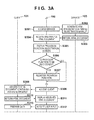
- Figs. 3A and 3B are sequence charts for explaining a basic operation associated with providing a service using Web Intents.
- This sequence chart includes service provision function registration processing in steps S301 to S307 and service provision function execution processing in steps S308 to S322. Note that a broken arrow in the sequence chart described herein indicates the flow (transmission and reception) of data between the main bodies of processing.
- step S301 the UA 106 accesses the service 103 based on a user operation.
- step S302 the service 103 generates an HTML (Hyper Text Markup Language) response containing registration markup for registering a function provided by itself in the UA 106.
- step S303 the service 103 returns the generated HTML response to the UA 106.
- HTML Hyper Text Markup Language
- An intent tag information for specifying a provision function is described.
- An action attribute indicates the category of the provision function, and a type attribute indicates the type of data or the like processable by the provision function.
- An href attribute indicates the connection destination (URL: Uniform Resource Locator) of the provision function, and a title attribute indicates the title of the provision function.
- a disposition attribute indicates how the called provision function is displayed.
- the respective attributes and their values in the intent tag are commonly defined by, for example, the Web Intents specifications. For example, for the action attribute, values such as "edit”, “share”, “pick”, “view”, “subscribe”, and “save” are defined.
- the category of the provision function is "share (sharing)", the type of processable data or the like is “image/* (image data of any format (*))”, and the connection destination is "share.html”. Furthermore, the title is "Share image using e-mail”, and it is indicated that this function is displayed in another window via the UA 106.
- step S305 the UA 106 confirms with the user whether to register the provision function of the service 103 in the UA 106. If, for example, the UA 106 is a Web browser, a popup window is displayed to prompt the user to make a selection. If the user selects to register the provision function as a Web Intent (YES in step S306), in step S307 the UA 106 stores the information received in step S304 in an internal storage unit or the like. More specifically, the information about the provision function is stored in the storage area of the information processing terminal on which the UA 106 operates, and registered as a Web Intent in the UA 106.
- step S308 the UA 106 accesses the client 101 in response to a user operation.
- step S309 the client 101 generates an HTML document in which information indicating that the provision function (Web Intent) of the service 103 is to be used is described.
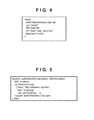
- step S310 the client 101 returns the generated HTML document to the UA 106. If, for example, an image and a "sharing" button are displayed on the Web site as the client 101, the Web site returns an HTML document containing an ECMAScript shown in Fig. 5 to the UA 106.
- the ECMAScript shown in Fig. 5 is contained in the returned HTML document, and indicates that a designated anonymous function (function()) is executed when a button (not shown) corresponding to an ID "share-photo" in the HTML document is clicked.
- the anonymous function shown in Fig. 5 generates a new Intent object, and calls a function startActivity() by setting the generated Intent object as an argument.
- the UA 106 extracts those Web Intents registered in itself, whose action and type attributes match those of the designated Intent object, and displays a list of the extracted Web Intents, thereby requesting the user to make a selection.
- a function getImageFrom() called in the anonymous function, image data held by the client 101 are acquired.
- step S311 the UA 106 receives the HTML document from the client 101, and displays it.
- step S312 upon detecting that the user presses the "sharing" button on the display screen, the UA 106 executes the ECMAScript for activation of Web Intents, and issues an image data acquisition request to the client 101.
- the client 101 Upon receiving the image data acquisition request issued in step S312, the client 101 prepares image data in step S313. In step S314, the client 101 returns the prepared image data to the UA 106.
- the UA 106 receives the image data held by the client 101. Upon pressing of the "sharing" button in step S312, the UA 106 displays the list of the Web Intents registered in itself (YES in step S315, and step S316). Note that if no provision function is registered in the list of the Web Intents (NO in step S315), the process advances to step S321, and the UA 106 returns, to the client 101, information indicating that the processing has failed.
- step S317 Upon detecting user selection of a Web Intent indicating the provision function of the service 103 from the list of the Web Intents, in step S317 the UA 106 transmits an HTTP request to the selected service 103. At this time, the UA 106 includes contents of the Intent object generated by the ECMAScript of Fig. 5 in transmission data.
- step S318 the service 103 extracts the Intent object from the HTTP request, and implements the use of the selected provision function (in this example, "sharing" of the image data of the client 101) while interacting with the user via the UA 106.
- the selected provision function in this example, "sharing" of the image data of the client 101
- step S319 the service 103 returns a response containing an ECMAScript for notifying the client 101 of a processing result.
- the UA 106 executes the ECMAScript contained in the response from the service 103, and calls a callback function onSuccess() designated by an argument of the function startActivity() in step S311.
- step S321 the UA 106 returns the processing result to the client 101 using the callback function onSuccess().
- step S322 the client 101 receives the processing result from the UA 106.
- a Web mail function is used will be described with reference to the sequence shown in Figs. 3A and 3B .
- the user accesses a site where a button for calling Web Intents in a Web storage (the client 101) for managing photo data is prepared by using a Web browser (UA).
- the Web browser (UA) displays a popup window including a list of registered services. If the user selects the Web mail function, a site for providing the function is displayed on another window, and a new mail attached with photo data is generated as a processing result on the window.
- the above processing enables the client 101 to call, via the UA 106, the function (in this example, "sharing" of images) of Web Intents provided by the service 103.
- Fig. 1B is a view showing an example of the configuration of a network system to which the Web Intents mechanism implementing the present invention is applied.
- a Web browser functioning as a Web Intents user agent (UA) operates on an information processing terminal 102.
- a Web Intents client operates on a server 104
- a Web Intents service operates on a server 105.
- the information processing terminal 102 and servers 104 and 105 are mutually communicable via a network 107.
- a LAN, the Internet, or a combination thereof is assumed as the network 107.
- a connection form may be wired or wireless connection.
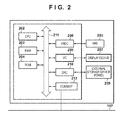
- Fig. 2 is a block diagram showing an example of the hardware arrangement of the information processing terminal on which a program (Web browser, an OS, or the like) functioning as the UA 106 is executed. Also, the servers on which programs (Web sites or the like) functioning as the client 101 and service 103 operate can adopt the same hardware arrangement.
- the information processing terminal includes a CPU 202, a RAM 203, a ROM 204, and an external storage device 209.
- the CPU 202 executes programs stored in the ROM 204 and external storage device 209, or programs downloaded from the network 107 such as a LAN, thereby comprehensively controlling respective devices connected to a system bus 211.
- the RAM 203 functions as a main memory, a work memory, or the like for the CPU 202.
- the external storage device 209 includes a hard disk (HD) and floppy® disk (FD).
- the external storage device 209 stores various applications including a boot program, OS, authentication server, and authentication client, database data, user files, and the like.
- a keyboard controller (KBDC) 206 sends input information from a keyboard (KBD) 205 or a pointing device (not shown) to the CPU 202.
- a video controller (VC) 208 controls display of a display device 207 formed by a CRT, an LCD, or the like.
- a disk controller (DKC) 210 controls access to the external storage device 209.
- a communication controller (COMM I/F) 212 and respective processing units exist as files saved in the external storage device 209 of the server 104. Each of these files is a program module that is loaded into the RAM 203 and executed by another processing unit which uses the OS or the processing unit at the time of execution.
- the client 101 is an application for providing a storage service such as storage of, for example, image data and document data.
- the client 101 is implemented as a program for executing processing in response to an HTTP request.
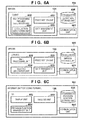
- An example of the arrangement of the software modules of the client 101 will be described with reference to Fig. 6A .
- the client 101 includes an Intent processing request generation unit 602, a presentation unit 603, a detail action generation unit 604, and a data management unit 605.
- the Intent processing request generation unit 602 generates an ECMAScript as an Intent processing request.
- the presentation unit 603 In response to, for example, a page acquisition request received via a communication unit 601, the presentation unit 603 generates an HTML document.
- the detail action generation unit 604 designates an action in detail when the client 101 generates a processing request to a Web Intents service.
- the data management unit 605 acquires and stores data such as an image from and in a client data storage unit 606.
- the client data storage unit 606 manages data, and stores and reads out data in response to a request from another processing unit.
- the communication unit 601 receives an HTTP request message from an external device, and notifies the presentation unit 603 of contents of the request.
- the communication unit 601 receives a request from the presentation unit 603, and transmits an HTTP response message to an external device.
- the client data storage unit 606 may exist on a device different from the server 104.
- Fig. 6B is a view showing an example of the arrangement of the software modules of the server 105.
- the service 103 and respective processing units exist as files saved in the external storage device 209 of the server 105.
- Each of these files is a program module loaded into the RAM 203 and executed by another processing unit which uses the OS or the processing unit at the time of execution.
- the service 103 provides a saving function and editing function of image data and document data. Furthermore, the server 105 has a function of a Web Intents service for providing a service using the Intents technique.
- the service 103 is implemented as a program for executing processing in response to an HTTP request.
- the service 103 includes an Intent processing unit 632, a presentation unit 633, an intent tag generation unit 634, and a data management unit 635.
- the Intent processing unit 632 analyzes and processes an Intent object.
- the presentation unit 633 In response to a page acquisition request or the like received via a communication unit 631, the presentation unit 633 generates an HTML document.
- the intent tag generation unit 634 generates an intent tag for notifying the UA of information of a provision function stored in a service data storage unit 636.
- the data management unit 635 acquires and stores data such as an image from and in the service data storage unit 636.
- the service data storage unit 636 manages data, and reads out and stores data in response to a request from the intent tag generation unit 634 or data management unit 635.
- the communication unit 631 receives an HTTP request message from an external device, and notifies the presentation unit 633 of contents of the request.
- the communication unit 631 receives a request from the presentation unit 633, and transmits an HTTP response message to an external device.
- the service data storage unit 636 may exist on a device different from the server 105.
- Fig. 6C is a view showing an example of the arrangement of the software modules of the information processing terminal 102.
- the UA 106 represented by the Web browser and respective processing units exist as files saved in the external storage device 209 of the information processing terminal 102.
- Each of these files is a program module loaded into the RAM 203 and executed by another processing unit which uses the OS or the processing unit at the time of execution.
- the UA 106 includes a display unit 652, an analysis unit 653, and a provision function management unit 654.
- the display unit 652 renders an HTML document. Furthermore, in response to a request from another processing unit, the display unit 652 displays a screen for accepting selection of a provision function.
- the analysis unit 653 analyzes an HTML document. The analysis unit 653 also analyzes an ECMAScript as an Intent processing request.
- the provision function management unit 654 acquires and stores information for specifying a registered provision function from and in a provision function storage unit 655 (to be described later).
- the provision function storage unit 655 manages a list of Web Intents services including the provision functions of the service 103, and stores and reads out data in response to a request from the provision function management unit 654.
- a communication unit 651 receives a request from another processing unit, and transmits an HTTP request message to an external device. Furthermore, the communication unit 651 receives an HTTP response message from an external device, and notifies the analysis unit 653 of contents of the response.
- the provision function storage unit 655 may exist on a device different from the information processing terminal 102.
- Fig. 7A shows an example of the structure of a table managed by the client data storage unit 606 of the server 104. Note that the table structure shown in Fig. 7A is an example, and a table structure different from that shown in Fig. 7A may be used.
- a data management table 701 is a table for managing various data processed by the client 101.
- Pieces of information managed by the data management table 701 are "ID” and "File".
- the information "ID” indicates an identifier for uniquely identifying each of the various data in the client 101, and the information "File” represents the file name of each of the various data. That is, in the example of the data management table 701, two data files “image001.jpg” and “doc002.pdf" are managed.
- Fig. 7B shows an example of the structure of a table managed by the service data storage unit 636 of the server 105. Note that the table structure shown in Fig. 7B is an example, and a table structure different from that in this example may be used.
- the service data storage unit 636 manages a function management table 702 and a data management table 703.
- the function management table 702 is a table for managing information about the provision functions of the service 103. Assume that information is registered in advance in the function management table 702. For example, when the service 103 is installed in the server 105, it may register information of the provision functions in the function management table 702. Furthermore, when the version of the service 103 is upgraded, the function management table 702 may be updated.
- Pieces of information managed by the function management table 702 are “ID”, “action”, “type”, “href”, “title”, and “disposition”. These pieces of information are almost the same as those indicated by the intent tag described with reference to Fig. 4 .
- the information “ID” indicates an identifier for uniquely identifying a provision function in the service 103.
- the information “action” indicates the category of the provision function, and the information “type” indicates the type of data or the like processable by the provision function.
- the information “href” indicates the connection destination (URL) of the provision function, and the information “title” indicates the title of the provision function.
- the information “disposition” indicates how the called provision function is displayed.
- the data management table 703 is a table for managing various data processed by the service 103.
- Pieces of information managed by the data management table 703 are "ID” and "File".
- the information "ID” indicates an identifier for uniquely identifying each of the various data in the service 103.
- the information "File” represents the file name of each of the various data. That is, in the example of the data management table 703, two data files “image011.jpg” and "doc012.pdf" are managed.
- Fig. 7C shows an example of the structure of a table managed by the provision function storage unit 655 of the information processing terminal 102. Note that the table structure shown in Fig. 7C is an example, and a table structure different from that shown in Fig. 7C may be used.
- a provision function management table 704 is a table for managing information about the provision functions of a Web Intents service which can be provided via the UA 106.
- Pieces of information managed by the provision function management table 704 are "ID”, "act-main”, “act-detail”, “type”, “href”, “title”, and “disposition”.
- the pieces of information are almost the same as those indicated by intent tag described with reference to Fig. 4 , except for “act-main” and “act-detail”.
- the information "ID” indicates an identifier for uniquely identifying a provision function in the service 103.
- the pieces of information “act-main” and “act-detail” are obtained by dividing the action attribute of the intent tag described with reference to Fig. 4 into a main part and a detail part.
- the information "act-main” indicates the category of the provision function, and the information "act-detail” indicates details of the category.
- the information "type” indicates the type of data or the like processable by the provision function.
- the information “href” indicates the connection destination (URL) of the provision function, and the information “title” indicates the title of the provision function.
- the information “disposition” indicates how the called provision function is displayed.
- the action attribute is formed by the main part and the detail part.
- the main part of the action attribute is information defined by the Web Intents specifications, and has a value such as "edit”, “share”, “pick”, “view”, “subscribe”, or “save”.
- the information of the action attribute will also be referred to as the "first classification information”.
- information such as "image” or "pdf” is defined in the detail part of the action attribute, which is unique to this embodiment, and will be referred to as the "second classification information”.
- step S801 the UA 106 accesses the service 103.
- step S802 the intent tag generation unit 634 of the service 103 generates an intent tag from the function management table 702, and the presentation unit 633 generates an HTML response. In this case, intent tags representing three services registered in the function management table 702 are generated.
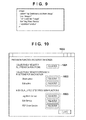
- Fig. 9 shows an example of the intent tag generated by the intent tag generation unit 634 in step S802.
- Information of a record whose "ID" is "1" in the function management table 702 is exemplified.
- the difference from the intent tag shown in Fig. 4 is that "share image" obtained by particularizing "share” is designated in the action attribute. That is, information formed by a main part and a detail part is described in the action attribute.
- step S803 the communication unit 631 of the server 105 returns the generated HTML response to the UA 106.
- step S804 the communication unit 651 of the information processing terminal 102 receives the HTML response transmitted by the server 105.
- the analysis unit 653 determines whether it is possible to segmentalize the action attribute of the intent tag detected from the received HTML response. Whether it is possible to segmentalize the action attribute can be determined depending on whether a character string designated in the action attribute includes a separator. In this embodiment, assume that a predetermined character (or character string) serving as a separator of the action attribute is a space (" "). In the example shown in Fig. 9 , since there is a space between "share" and "image" of the character string, the analysis unit 653 determines that it is possible to segmentalize the action attribute. If it is possible to segmentalize the action attribute (YES in step S805), the process advances to step S806; otherwise (NO in step S805), the process advances to step S808.
- step S806 the analysis unit 653 divides the action attribute into the main part and the detail part with respect to the separator.
- “share” serves as the main part
- “image” serves as the detail part.
- step S807 the UA 106 groups intent tags having the identical main parts of the action attributes.
- the intent tag of a record whose "ID" is "1" in the function management table 702 includes the same main part ("share") of the action attribute as that of the intent tag of a record whose "ID” is "3”, these records are grouped.
- step S808 the display unit 652 displays a provision function registration screen on the UA 106.
- Fig. 10 shows an example of a provision function registration screen 1000 displayed in step S808.
- a button 1001 is used to register, in the UA 106, all the provision functions of the service 103 represented by the intent tags contained in the HTML response received in step S804.
- Buttons 1002 are used to register, in the UA 106, the provision functions for each set of intent tags grouped in step S807.
- Buttons 1003 are used to individually register the provision functions in the UA 106.
- step S809 the display unit 652 detects whether a provision function has been selected.
- a provision function is selected when the user presses one of the buttons 1001 to 1003 on the provision function registration screen 1000. If a provision function has been selected (YES in step S809), the process advances to step S810; otherwise (NO in step S809), the sequence is terminated.
- step S810 the provision function management unit 654 registers the information of the selected provision function in the provision function management table 704.
- the main part of the action attribute which has been divided in step S806 is registered in an act-main field, and the detail part of the action attribute is registered in an act-detail field. The sequence is then terminated.
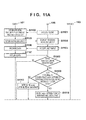
- step S1102 the client 101 generates an HTML response containing the action attribute which can be segmentalized, as exemplified in Fig. 12.
- Fig. 12 shows an example of contents of the HTML response generated in step S1102 according to this embodiment. The difference from the example shown in Fig. 5 is that the action attribute designated when generating a new Intent object can be segmentalized.
- step S1108 the provision function management unit 654 determines whether a list of Web Intents has been registered in the provision function storage unit 655. More specifically, the provision function management unit 654 determines whether one or more entries exist in the provision function management table 704. If the list has been registered (YES in step S1108), the process advances to step S1109; otherwise (NO in step S1108), the process advances to step S1120.
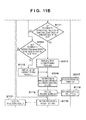
- step S1109 the analysis unit 653 determines whether it is possible to segmentalize the value of the action attribute of an ECMAScript contained in an HTML document received in step S1104. The determination of whether it is possible to segmentalize the value is the same as that in step S805 of Fig. 8 and a description thereof will be omitted. If the analysis unit 653 determines that it is possible to segmentalize the value (YES in step S1109), the process advances to step S1110; otherwise (NO in step S1109), the process advances to step S1113.
- step S1110 the analysis unit 653 divides the action attribute of the ECMAScript into a main part and a detail part with respect to a separator.
- “share” serves as the main part
- “image” serves as the detail part.
- step S1111 the provision function management unit 654 determines whether it is possible to extract, from the entries in the provision function management table 704, an entry having the same values as those of the main part and the detail part which have been segmentalized in step S1110. If it is possible to extract such an entry (YES in step S1111), the process advances to step S1112; otherwise (NO in step S1111), the process advances to step S1114.
- step S1112 the display unit 652 displays, in a list format, the entry extracted in step S1111 on the UA 106.
- Fig. 13 shows an example of a provision function selection screen 1300 displayed in step S1112. Referring to Fig. 13 , a button 1301 is used to select a provision function for which the title of the entry extracted in step S1111 is displayed. Note that if a plurality of entries are extracted in step S1111, a plurality of buttons are displayed on the provision function selection screen 1300.
- step S1113 the analysis unit 653 determines the value of the action attribute of the ECMAScript as a main part.
- step S1114 the provision function management unit 654 determines whether it is possible to extract, from the entries in the provision function management table 704, an entry having the same value as that determined as the main part in step S1110 or S1113. If it is possible to extract such an entry (YES in step S1114), the process advances to step S1115; otherwise (NO in step S1114), the process advances to step S1120.
- step S1115 the display unit 652 displays, in a list format, the entry extracted in step S1114 on the UA 106.
- An example of a screen displayed in step S1115 is the same as that shown in Fig. 13 and a description thereof will be omitted.
- Processes in steps S1116 to S1121 are the same as those in steps S317 to S322 of Fig. 3B and a description thereof will be omitted.
- the provision functions may be grouped by introducing a new attribute irrelevant to the action attribute.
- a field corresponding to the new attribute is added to each of the function management table 702 and provision function management table 704.
- intent tags whose new attributes coincide with each other are grouped.
- the new attribute are a vendor attribute representing a vendor for providing a service, and a keyword attribute for freely setting a keyword.
- the new attribute is not limited to them.
- the new attribute is unique to the present invention, and can thus be regarded as the second classification information. The same grouping method is also used in embodiments to be described below.
- the provision function registration screen may be displayed, for example, at the start or end of the UA 106.
- the user may issue an instruction through the menu of the UA 106 at an arbitrary timing.
- the UA 106 accesses the service 103, it temporarily holds information to be displayed on the provision function registration screen in the RAM 203 or external storage device 209.
- the UA 106 uses, as a trigger, the launching or quitting of the UA 106 or a user instruction to read out the information temporarily held in the RAM 203 or external storage device 209, thereby displaying the information on the provision function registration screen.
- the action attribute is divided into the main part and the detail part has been explained.
- the type attribute is extended will be described. That is, in this embodiment, the information of the action attribute defined by the Web Intents specifications serves as the "first classification information”.
- the information of the type attribute having a structure unique to this embodiment serves as the "second classification information”.
- Fig. 14 shows an example of an intent tag generated by an intent tag generation unit 634 of a service 103 according to this embodiment.
- the difference from the intent tag shown in Fig. 4 is that a plurality of types of data are designated in the type attribute.
- a function management table 1501 shown in Fig. 15A shows an example of the structure of a table managed by a service data storage unit 636 of a server 105 according to this embodiment, and is similar to the function management table 702 shown in Fig. 7B .
- the table structure shown in Fig. 15A is an example, and a table structure different from that in this example may be used.
- a provision function management table 1502 shown in Fig. 15B shows an example of the structure of a table managed by a provision function storage unit 655 of an information processing terminal 102 according to this embodiment, and is similar to the provision function management table 704 shown in Fig. 7C .
- the table structure shown in Fig. 15B is an example, and a table structure different from that in this example may be used.
- the act-main field and the act-detail field are provided to store the information of the particularized action attribute.
- the provision function management table 1502 according to this embodiment is configured to store information of a plurality of data types in the type field so as to cope with a case in which a plurality of data types are designated in the type attribute of an intent tag.
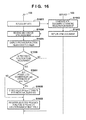
- step S1601 to S1606 are the same as those in steps S301 to S306 of Fig. 3A and a description thereof will be omitted.
- an analysis unit 653 determines whether it is possible to segmentalize the type attribute of an intent tag corresponding to a provision function selected by the user in step S1606. Whether it is possible to segmentalize the type attribute can be determined depending on whether a character string designated in the type attribute includes a separator. In this embodiment, assume that a predetermined character (or character string) serving as a separator of the type attribute is a space (" "). In the example shown in Fig. 14 , since there is a space between "image/*" and "application/pdf", it is determined that it is possible to segmentalize the type attribute.
- step S1608 the analysis unit 653 divides the type attribute into individual elements with respect to the separator.
- a provision function management unit 654 registers the information of the selected provision function in the provision function management table 1502.
- the individual elements of the type attribute divided in step S1608 are registered in the type field.
- the service provision function registration processing according to this embodiment then ends.
- Service provision function execution processing is the same as that shown in Figs. 3A and 3B described in the first embodiment except for a step corresponding to step S315, and a description thereof will be omitted.
- the provision function management unit 654 determines whether it is possible to extract, from the provision function management table 1502, an entry having values which respectively match a value in the action field and one of the elements registered in the type field.
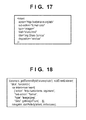
- Fig. 17 shows an example of an intent tag generated by an intent tag generation unit 634 of a service 103 according to this embodiment.
- the difference from the intent tag shown in Fig. 4 is that the sub-action attribute for complementing the action attribute is newly added.
- a plurality of values may be designated in the sub-action attribute by separating those using a separator.
- "edit” meaning “editing”
- "format” meaning “format conversion”
- color meaning “color conversion”
- setting values may be defined according to processing and the attributes of data to be processed.
- Fig. 18 shows an example of an ECMAScript contained in an HTML response returned from a client 101 to a UA 106 according to this embodiment.
- the difference from the ECMAScript shown in Fig. 5 is that the sub-action attribute for complementing the action attribute is added. Note that a plurality of values may be designated in the sub-action attribute by separating those using a separator.
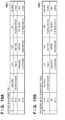
- a function management table 1901 shown in Fig. 19A shows an example of the structure of a table managed by a service data storage unit 636 of a server 105 according to this embodiment, and is similar to the function management table 702 shown in Fig. 7B .
- the table structure shown in Fig. 19A is an example, and a table structure different from that shown in Fig. 19A may be used.
- a provision function management table 1902 shown in Fig. 19B shows an example of the structure of a table managed by a provision function storage unit 655 of an information processing terminal 102 according to this embodiment, and is similar to the provision function management table 704 shown in Fig. 7C .
- the table structure shown in Fig. 19B is an example, and a table structure different from that shown in Fig. 19B may be used.
- a sub-action field for holding the values of the sub-action attribute, which does not exist in the provision function management table 704, is added to the provision function management table 1902.
- FIG. 20 An operation (corresponding to the service provision function registration processing shown in Figs. 3A and 3B ) in which the information processing terminal 102 accesses the service 103 of the server 105, and registers the provision functions of the service 103 in the UA 106 will be described with reference to a sequence chart shown in Fig. 20 .
- the sequence shown in Fig. 20 is almost the same as that shown in Fig. 16 described in the second embodiment. Only steps different from those of Fig. 16 will be explained. Processes in step S2001 to S2006 are the same as those in steps S1601 to S1606 and a description thereof will be omitted.
- Step S2007 corresponds to step S1607 of Fig. 16 .
- an attribute for which it is determined whether the attribute can be segmentalized is the sub-action attribute.
- Step S2008 corresponds to step S1608 of Fig. 16 .
- an attribute to be divided into individual elements is the sub-action attribute.
- Step S2009 corresponds to step S1609 of Fig. 16 .
- the registration destination of the information of a provision function is the provision function management table 1902, and the individual elements divided in step S2008 are registered in the sub-action field.
- FIG. 21 An operation (corresponding to the service provision function execution processing shown in Figs. 3A and 3B ) in which the information processing terminal 102 accesses the client 101 of a server 104, and mediates an Intent processing request to the service 103 of the server 105 will be described with reference to a sequence chart shown in Fig. 21 .
- the sequence shown in Fig. 21 is similar to that shown in Figs. 11A and 11B described in the first embodiment, and only steps different from those of Figs. 11A and 11B will be explained. Processes in steps S2101 to S2108 are the same as those in steps S1101 to S1108 and a description thereof will be omitted.
- an analysis unit 653 determines whether an HTML document received in step S2104 contains the sub-action attribute. If the sub-action attribute is contained (YES in step S2109), the analysis unit 653 divides the value of the sub-action attribute into individual elements with respect to a separator such as a space (" ").
- a provision function management unit 654 determines whether it is possible to extract, from entries in the provision function management table 1902, an entry having the same values as those of all the elements of the sub-action attribute. Note that if there is no entry having the same values as those of all the elements, the provision function management unit 654 determines whether it is possible to extract an entry having the same values as those of some elements. If it is possible to extract such an entry (YES in step S2109), the process advances to step S2110; otherwise (NO in step S2109), the process advances to step S2111.
- step S2110 a display unit 652 displays, in a list format, the entry extracted in step S2109 on the UA 106.
- An example of a screen displayed in step S2110 is the same as that shown in Fig. 13 described in the first embodiment and a description thereof will be omitted.
- step S2111 the provision function management unit 654 determines whether it is possible to extract, from the entries in the provision function management table 1902, an entry having the same value as that of the action attribute. If it is possible to extract such an entry (YES in step S2111), the process advances to step S2112; otherwise (NO in step S2111), the process advances to step S2117.
- step S2112 the display unit 652 displays, in a list format, the entry extracted in step S2111 on the UA 106.
- An example of a screen displayed in step S2112 is the same as that shown in Fig. 13 and a description thereof will be omitted.
- Processes in steps S2113 to S2118 are the same as those in steps S1116 to S1121 and a description thereof will be omitted.
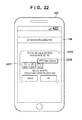
- the provision function registration screen 1000 exemplified in Fig. 10 in the first embodiment is displayed on an information processing terminal having a small display area, such as a smartphone or table device.
- Fig. 22 shows an example of a provision function registration screen 2200 according to this embodiment.
- an information processing terminal 102 is an information processing terminal such as a smartphone or tablet device
- a UA 106 is a UA such as a browser.
- the provision function registration screen 2200 is a provision function registration screen displayed on the UA 106.
- Icons 2201 represent provision functions, and are transferred from a service 103 to the UA 106 when returning an HTML document (step S303/S803/S1603/S2003).
- the icons 2201 one icon may be provided for each service or each provision function. These icons are registered in advance. If one icon is provided for each service, when a link tag of a head tag in the returned HTML document is described as follows, the UA 106 can acquire icon files.
- ⁇ link rel "icon”
- the UA 106 can acquire the icon file.
- Information of the acquired icon can be managed by adding an icon field to a provision function management table 704, 1502, or 1902.
- a tooltip 2202 is the tooltip of an icon, on which information stored in the title field of the provision function management table 704, 1502, or 1902 is displayed.
- Embodiments of the present invention can also be realized by a computer of a system or apparatus that reads out and executes computer executable instructions recorded on a storage medium (e.g., non-transitory computer-readable storage medium) to perform the functions of one or more of the above-described embodiment(s) of the present invention, and by a method performed by the computer of the system or apparatus by, for example, reading out and executing the computer executable instructions from the storage medium to perform the functions of one or more of the above-described embodiment(s).
- the computer may comprise one or more of a central processing unit (CPU), micro processing unit (MPU), or other circuitry, and may include a network of separate computers or separate computer processors.
- the computer executable instructions may be provided to the computer, for example, from a network or the storage medium.
- the storage medium may include, for example, one or more of a hard disk, a random-access memory (RAM), a read only memory (ROM), a storage of distributed computing systems, an optical disk (such as a compact disc (CD), digital versatile disc (DVD), or Blu-ray Disc (BD)TM), a flash memory device, a memory card, and the like.
Landscapes
- Engineering & Computer Science (AREA)
- Theoretical Computer Science (AREA)
- Software Systems (AREA)
- Physics & Mathematics (AREA)
- General Engineering & Computer Science (AREA)
- General Physics & Mathematics (AREA)
- Databases & Information Systems (AREA)
- Computer Hardware Design (AREA)
- Data Mining & Analysis (AREA)
- Human Computer Interaction (AREA)
- Information Transfer Between Computers (AREA)
- Computer Networks & Wireless Communication (AREA)
- Signal Processing (AREA)
- Data Exchanges In Wide-Area Networks (AREA)
Applications Claiming Priority (1)
| Application Number | Priority Date | Filing Date | Title |
|---|---|---|---|
| JP2013180356A JP6271916B2 (ja) | 2013-08-30 | 2013-08-30 | 情報処理装置およびその制御方法、並びにプログラム |
Publications (2)
| Publication Number | Publication Date |
|---|---|
| EP2843553A2 true EP2843553A2 (fr) | 2015-03-04 |
| EP2843553A3 EP2843553A3 (fr) | 2016-04-13 |
Family
ID=51392083
Family Applications (1)
| Application Number | Title | Priority Date | Filing Date |
|---|---|---|---|
| EP14181420.2A Withdrawn EP2843553A3 (fr) | 2013-08-30 | 2014-08-19 | Terminal de traitement d'informations, son procédé de commande et programme |
Country Status (5)
| Country | Link |
|---|---|
| US (1) | US20150067173A1 (fr) |
| EP (1) | EP2843553A3 (fr) |
| JP (1) | JP6271916B2 (fr) |
| KR (1) | KR101719593B1 (fr) |
| CN (1) | CN104519118B (fr) |
Families Citing this family (4)
| Publication number | Priority date | Publication date | Assignee | Title |
|---|---|---|---|---|
| GB2540957B (en) * | 2015-07-31 | 2019-12-25 | Arm Ip Ltd | Managing interaction constraints |
| JP2018041146A (ja) | 2016-09-05 | 2018-03-15 | キヤノン株式会社 | 管理装置、制御方法、プログラム |
| JP6766793B2 (ja) * | 2017-10-26 | 2020-10-14 | 京セラドキュメントソリューションズ株式会社 | 情報処理装置、画像形成装置、情報処理システム、及び情報処理方法 |
| US11038966B1 (en) | 2020-04-28 | 2021-06-15 | Arm Ip Limited | Remote device operation |
Citations (1)
| Publication number | Priority date | Publication date | Assignee | Title |
|---|---|---|---|---|
| JP2011123607A (ja) | 2009-12-09 | 2011-06-23 | Canon Inc | 情報処理装置、情報処理方法及びプログラム |
Family Cites Families (11)
| Publication number | Priority date | Publication date | Assignee | Title |
|---|---|---|---|---|
| JP2012048457A (ja) * | 2010-08-26 | 2012-03-08 | Canon Inc | 印刷サーバ装置、印刷装置、情報処理方法及びプログラム |
| US8769037B2 (en) * | 2010-11-30 | 2014-07-01 | International Business Machines Corporation | Managing tag clouds |
| JP5309121B2 (ja) * | 2010-12-21 | 2013-10-09 | ヤフー株式会社 | 情報処理方法、プログラム、情報処理システム |
| JP5360106B2 (ja) * | 2011-03-25 | 2013-12-04 | ブラザー工業株式会社 | 情報処理プログラム、情報処理装置、および情報処理方法 |
| US9124590B2 (en) * | 2011-07-19 | 2015-09-01 | Sk Planet Co., Ltd. | Intelligent information providing system and method |
| JP2013196356A (ja) * | 2012-03-19 | 2013-09-30 | Sony Corp | 情報処理装置および方法、並びにプログラム |
| US20130297413A1 (en) * | 2012-05-03 | 2013-11-07 | Google Inc. | Using actions to select advertisements |
| US20140026067A1 (en) * | 2012-07-23 | 2014-01-23 | Korea Advanced Institute Of Science And Technology | Method and apparatus for processing movement of web object based on intent |
| US8589911B1 (en) * | 2012-07-26 | 2013-11-19 | Google Inc. | Intent fulfillment |
| KR102038962B1 (ko) * | 2012-08-13 | 2019-10-31 | 삼성전자주식회사 | 클라우드 서버를 이용하여 단말 장치에서 웹 인텐트 메시지 및 이벤트를 처리하는 방법 및 장치 |
| US9195519B2 (en) * | 2012-09-06 | 2015-11-24 | Box, Inc. | Disabling the self-referential appearance of a mobile application in an intent via a background registration |
-
2013
- 2013-08-30 JP JP2013180356A patent/JP6271916B2/ja not_active Expired - Fee Related
-
2014
- 2014-08-19 EP EP14181420.2A patent/EP2843553A3/fr not_active Withdrawn
- 2014-08-25 US US14/467,109 patent/US20150067173A1/en not_active Abandoned
- 2014-08-29 CN CN201410436674.6A patent/CN104519118B/zh active Active
- 2014-09-01 KR KR1020140115186A patent/KR101719593B1/ko not_active Expired - Fee Related
Patent Citations (1)
| Publication number | Priority date | Publication date | Assignee | Title |
|---|---|---|---|---|
| JP2011123607A (ja) | 2009-12-09 | 2011-06-23 | Canon Inc | 情報処理装置、情報処理方法及びプログラム |
Non-Patent Citations (1)
| Title |
|---|
| ROGER L. COSTELLO: "Designing Schemas for Backward and Forward Compatibility", 15 May 2009 (2009-05-15), XP055471403, Retrieved from the Internet <URL:http://web.archive.org/web/20090515143733/http://www.xfront.com/backward-forward-compatibility/index.html> [retrieved on 20180430] * |
Also Published As
| Publication number | Publication date |
|---|---|
| JP2015049658A (ja) | 2015-03-16 |
| US20150067173A1 (en) | 2015-03-05 |
| KR20150026985A (ko) | 2015-03-11 |
| CN104519118A (zh) | 2015-04-15 |
| JP6271916B2 (ja) | 2018-01-31 |
| CN104519118B (zh) | 2019-05-28 |
| KR101719593B1 (ko) | 2017-03-24 |
| EP2843553A3 (fr) | 2016-04-13 |
Similar Documents
| Publication | Publication Date | Title |
|---|---|---|
| US10049161B2 (en) | Information processing apparatus, method of controlling the same, and storage medium | |
| KR101850582B1 (ko) | 정보 처리 단말, 정보 처리 단말의 제어 방법, 및 컴퓨터 판독가능 기억 매체 | |
| US9282211B2 (en) | Image forming apparatus, control method, and storage medium in which data is shared between applications | |
| EP2942911B1 (fr) | Appareil de traitement d'informations, système et procédé de traitement d'informations | |
| CN104427169A (zh) | 远程支持装置、电子装置及远程支持方法 | |
| WO2015141815A1 (fr) | Système de traitement d'informations, procédé de commande, programme, et support d'enregistrement | |
| JP2016177761A (ja) | 情報処理装置、制御方法、及びプログラム | |
| EP2843553A2 (fr) | Terminal de traitement d'informations, son procédé de commande et programme | |
| US20150207867A1 (en) | Information processing terminal and control method | |
| US20140344756A1 (en) | Information processing apparatus, and control method therefor | |
| US9769246B2 (en) | Information processing terminal and control method | |
| JP2015176308A (ja) | 情報処理装置、機器、情報処理システム、情報処理方法、プログラム、及びインストール方法 | |
| JP2006260522A (ja) | 情報処理装置、情報管理装置、情報管理システム、情報処理方法、情報管理方法、情報処理プログラム、情報管理プログラム及び記録媒体 | |
| JP5057460B2 (ja) | 文書管理システム、文書管理装装置、文書管理方法、およびプログラム | |
| WO2017213454A1 (fr) | Système et procédé de contrôle de fichier utilisant un serveur d'utilisateur | |
| US10044814B2 (en) | Information processing terminal and control method for processing both service searched on network and service provided via site | |
| US10165057B2 (en) | Information processing terminal, and controlling method thereof | |
| JP6053484B2 (ja) | 情報処理装置、その制御方法及びプログラム | |
| EP2804104A2 (fr) | Terminal de traitement d'informations, procédé correspondant et programme | |
| US9800674B2 (en) | Information processing terminal, control method therefor, and non-transitory computer-readable medium | |
| JP5136203B2 (ja) | 画像形成システム | |
| JP2016119029A (ja) | 情報処理装置、機器、情報処理システム、情報処理方法、プログラム、及びインストール方法 |
Legal Events
| Date | Code | Title | Description |
|---|---|---|---|
| 17P | Request for examination filed |
Effective date: 20140819 |
|
| AK | Designated contracting states |
Kind code of ref document: A2 Designated state(s): AL AT BE BG CH CY CZ DE DK EE ES FI FR GB GR HR HU IE IS IT LI LT LU LV MC MK MT NL NO PL PT RO RS SE SI SK SM TR |
|
| AX | Request for extension of the european patent |
Extension state: BA ME |
|
| PUAI | Public reference made under article 153(3) epc to a published international application that has entered the european phase |
Free format text: ORIGINAL CODE: 0009012 |
|
| PUAL | Search report despatched |
Free format text: ORIGINAL CODE: 0009013 |
|
| AK | Designated contracting states |
Kind code of ref document: A3 Designated state(s): AL AT BE BG CH CY CZ DE DK EE ES FI FR GB GR HR HU IE IS IT LI LT LU LV MC MK MT NL NO PL PT RO RS SE SI SK SM TR |
|
| AX | Request for extension of the european patent |
Extension state: BA ME |
|
| RIC1 | Information provided on ipc code assigned before grant |
Ipc: G06F 9/54 20060101AFI20160308BHEP |
|
| R17P | Request for examination filed (corrected) |
Effective date: 20161013 |
|
| RBV | Designated contracting states (corrected) |
Designated state(s): AL AT BE BG CH CY CZ DE DK EE ES FI FR GB GR HR HU IE IS IT LI LT LU LV MC MK MT NL NO PL PT RO RS SE SI SK SM TR |
|
| 17Q | First examination report despatched |
Effective date: 20171130 |
|
| STAA | Information on the status of an ep patent application or granted ep patent |
Free format text: STATUS: THE APPLICATION HAS BEEN WITHDRAWN |
|
| 18W | Application withdrawn |
Effective date: 20180904 |