EP2846135A2 - Dispositif électronique portable avec capteur environnemental - Google Patents
Dispositif électronique portable avec capteur environnemental Download PDFInfo
- Publication number
- EP2846135A2 EP2846135A2 EP14003126.1A EP14003126A EP2846135A2 EP 2846135 A2 EP2846135 A2 EP 2846135A2 EP 14003126 A EP14003126 A EP 14003126A EP 2846135 A2 EP2846135 A2 EP 2846135A2
- Authority
- EP
- European Patent Office
- Prior art keywords
- compensator
- sensor
- context
- sensors
- input
- Prior art date
- Legal status (The legal status is an assumption and is not a legal conclusion. Google has not performed a legal analysis and makes no representation as to the accuracy of the status listed.)
- Granted
Links
Images


Classifications
-
- G—PHYSICS
- G01—MEASURING; TESTING
- G01D—MEASURING NOT SPECIALLY ADAPTED FOR A SPECIFIC VARIABLE; ARRANGEMENTS FOR MEASURING TWO OR MORE VARIABLES NOT COVERED IN A SINGLE OTHER SUBCLASS; TARIFF METERING APPARATUS; MEASURING OR TESTING NOT OTHERWISE PROVIDED FOR
- G01D3/00—Indicating or recording apparatus with provision for the special purposes referred to in the subgroups
- G01D3/028—Indicating or recording apparatus with provision for the special purposes referred to in the subgroups mitigating undesired influences, e.g. temperature, pressure
- G01D3/032—Indicating or recording apparatus with provision for the special purposes referred to in the subgroups mitigating undesired influences, e.g. temperature, pressure affecting incoming signal, e.g. by averaging; gating undesired signals
-
- G—PHYSICS
- G01—MEASURING; TESTING
- G01N—INVESTIGATING OR ANALYSING MATERIALS BY DETERMINING THEIR CHEMICAL OR PHYSICAL PROPERTIES
- G01N33/00—Investigating or analysing materials by specific methods not covered by groups G01N1/00 - G01N31/00
-
- G—PHYSICS
- G01—MEASURING; TESTING
- G01B—MEASURING LENGTH, THICKNESS OR SIMILAR LINEAR DIMENSIONS; MEASURING ANGLES; MEASURING AREAS; MEASURING IRREGULARITIES OF SURFACES OR CONTOURS
- G01B11/00—Measuring arrangements characterised by the use of optical techniques
- G01B11/14—Measuring arrangements characterised by the use of optical techniques for measuring distance or clearance between spaced objects or spaced apertures
-
- G—PHYSICS
- G01—MEASURING; TESTING
- G01N—INVESTIGATING OR ANALYSING MATERIALS BY DETERMINING THEIR CHEMICAL OR PHYSICAL PROPERTIES
- G01N33/00—Investigating or analysing materials by specific methods not covered by groups G01N1/00 - G01N31/00
- G01N33/0004—Gaseous mixtures, e.g. polluted air
- G01N33/0009—General constructional details of gas analysers, e.g. portable test equipment
- G01N33/0073—Control unit therefor
-
- H—ELECTRICITY
- H04—ELECTRIC COMMUNICATION TECHNIQUE
- H04M—TELEPHONIC COMMUNICATION
- H04M1/00—Substation equipment, e.g. for use by subscribers
- H04M1/72—Mobile telephones; Cordless telephones, i.e. devices for establishing wireless links to base stations without route selection
- H04M1/725—Cordless telephones
Definitions
- the present invention relates to a portable electronic device including one or more environmental sensors and a method for measuring an environmental parameter using such a device.
- Portable electronic devices for measuring specific environmental parameters such as temperature, pressure, humidity, gas concentrations in the ambient air etc. are well known. With the emergence of smart phones, however, a new class of devices has been more prevalent, which herein is referred to. These devices are characterized in that the measurement of an environmental parameter is not the sole purpose of the device and usually considered an additional or auxiliary task to a main function.
- the main function is typically a telecommunication function including the capability of communicating with public and private communication networks.
- an environmental sensor When an environmental sensor is thus integrated in such a general purpose portable device, its operation is subject to constraints very different from the operation of a specialist device for a measurement of the same parameter.
- the general purpose device may have to deliver a measurement of the environmental parameter, while positioned or handled in a way often not properly adapted or even detrimental to such a measurement.
- a typical example is the use of a mobile phone for the measurement of the ambient temperature, which without compensation can give different results depending on whether the phone is placed on a table, held in a hand or placed in a pocket. As during the usage these conditions can rapidly change, an environmental sensor is required to respond rapidly to the changing operational conditions.
- a portable electronic device with one or more integrated environmental sensors for measuring an environmental or ambient parameter, a compensator generating a time sequence of values used as input to the compensator in a following time step for reducing the difference between the environmental sensor output and the actual value of the environmental parameter, and a context evaluator for determining a context of the device and a re-initializator reinitializing the compensator by changing the input from the calculated value to a value depending on a context of the device as determined by the context evaluator.
- the value depending on the context can be a value as calculated at a time prior to a change in context or it can be an adapted value or a newly generated value.
- the changed input is derived in accordance with the result of the evaluation of the context evaluator.
- the re-initialization can be seen changing an input value for the compensator from a value as calculated in the normal operation of the compensator to a value as adapted or changed depending on a context of the device as determined by the context evaluator.
- the changed value of the environmental parameter can be displayed faster than using the compensator with its normal unchanged input value.
- the environmental sensor can be a temperature, a humidity, a chemical, gas, or pressure sensor. It is generally designed to measure an ambient parameter relating to a condition exterior of the housing of the device. Most of these sensors require an opening or duct in the housing to allow for the exchange of air or other fluids between the exterior and the sensing elements of the sensor. The opening can be covered with a proactive mesh, grill or membrane.
- the compensator can include a dynamic compensator used to apply a correction based on a model of the response function of the sensor during a change in the environmental parameter in order to accelerate the read-out during such a change or a heat compensator used to apply a correction based on a model of the thermal propagation from heat sources in order to compensate for internal and external heat sources. More preferably the compensator operates under normal operating conditions recursively using state vectors generated at each time step as input for the next time step.
- the changes in the environment and/or handling are generally caused by a corresponding change in the external or environmental conditions, also referred to as context conditions, under which the device is operated.
- Such changes can include a change of location such as a change from indoors (car, building) to outdoors (street), or between two locations with different ambient conditions (such as cellar vs. bathroom) or for example the exposure of the device to sun light, wind and other changing ambient conditions.
- the change can also be caused by the way the device is handled by a user such as a change from being held to being placed in a pocket or bag.
- the change in the context condition is detected by the context evaluator, which typically resides as a programmed routine in part of general purpose computing units. However it can also include either parts of sensor processing units and via a communication links computing units at remote locations.
- the evaluator can be programmed to a varying degree of complexity or scenarios reflecting the diverse ways in which a portable device is typically used.
- the complexity can range from simple binary decisions based for example on whether a device is located within a building or outside (which in turn can be derived from a position measurement) to more complex model-based, or statistical evaluation of motion sensors, use pattern and the like to determine whether the device has been placed inside a pocket or bag.
- Other scenarios can be based on the current physical location (latitude, longitude) and/or semantical location (at home, at workplace) or depend for example on the current use (in communication, or play or video/music replay mode) of the device.
- the context evaluator is therefore best linked to the output of sensors integrated into the device.
- sensors can include the environmental sensor itself. It can however also include at least one further sensor integrated into the device.
- the change in environmental conditions can in principle also be detected by sensors external to the device and communicated to the device, such as prevalent wind strength and directions, cloud coverage and the like.
- the further sensors within the meaning of the present invention can be selected from a group including picture or video cameras, IR sensors, acoustic microphones, location sensors and providers (GPS, Location fingerprinting (WiFi, GSM, network-based)), brightness sensors, ultrasound sensors, proximity sensors, acceleration sensors, Bluetooth receivers, EM wave antennae and orientation sensors, whereby these sensors are preferably integrated into the same housing as the environmental sensor or, alternatively or in addition, sensors which can communicate directly or indirectly, i.e. over a common server, with the portable device, such as external sensors in close proximity, in other mobile devices, consumer electronics and appliances, network connected sources such as internet based weather information, server based information or, alternatively or in addition, be indicators of the state of the device (stand-by, calling, gaming). Sensors to detect the handling can include a touch sensitive surface or screen of the portable device.
- the portable electronic device can preferably be a mobile phone, a handheld computer, an electronic reader, a tablet computer, a game controller, a pointing device, a photo or a video camera, a digital music player, a wrist watch, a key fob, a head set, a digital photo frame and a computer peripheral, glasses, a wristband.
- a further aspect of the present invention includes a method of determining a context representing the mobile device being in a pocket.
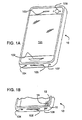
- the device of FIG. 1A is a portable electronic device such as a mobile phone.
- a housing 10 of the mobile phone includes a front side with a screen 101 and elements like buttons 102 to let a user interact with the phone.
- Also shown on the front side is an opening 103 for a loudspeaker.
- Further openings 104, 105 are located at a lower side wall of the housing 10. It is well known to mount components like microphones and loudspeakers behind such openings.
- the phone includes one or two cameras 106, and internally additional sensors (not shown) such as location sensors or GPS, or acceleration or orientation sensors in a manner well known.
- Another opening 107 is located at the lower side wall. As shown in FIG. 1B the opening 107 is linked to a tubular duct 11 passing through the interior of the housing. A temperature sensor 12 and a humidity sensor 13 are both mounted along the duct 11 such that the sensitive areas of both sensors are exposed to the ambient air through the opening 107. Suitable sensors are commercially available for example from SensirionTM AG. under the tradenames SHTC1 or STS21 (as temperature only sensor).
- M. Afridi et, al. MEMS-based embedded sensor virtual components for system-on-a-chip (SoC)" Solid-State Electronics 48 (2004) 1777-1781 , and can be mounted within the housing 10.
- SoC system-on-a-chip
- the actual size and shape of the duct 11 depends on the volume available and the nature of the temperature sensor 12 and the humidity sensor 13 can vary, but given the physical constraints of portable mobile devices the area of the opening is typically in the range of less than 10 square millimeters and in the present example actually about less than 3.1 square millimeters.
- the temperature or other environmental sensors can also be mounted flush with the housing of the phone or even without connection to the exterior.
- Fig. 2 shows a block diagram with the most important components of the portable device.
- the device includes a temperature sensor 21 integrated as part of a CMOS substrate 211 which has CMOS circuitry to control the basic functions and the basic readout of the sensor.
- the CMOS circuit can include for example the driver to switch the sensor and his heater on or off as well as A/D converters and amplifiers and an I2C bus controller to exchange data on an I2C bus 22.
- the I2C bus connects the sensors with a sensor hub 23.
- a further humidity sensor 24 is also linked to the I2C bus 22.
- the sensor hub 23 provides a control and processing unit for .more complex control and read-out functions of the temperature sensor 21 based on signals sent to or extracted from, respectively, the on-chip CMOS circuitry.
- the sensor hub 23 also controls other auxiliary sensors such as GPS, magnetometers, accelerometers and the like.
- a central processing unit (CPU) 25 of the portable device which in turn has read/write access to a memory 26, which can include static or volatile memory or both as known in the art.
- the memory 26 typically stores the operating system of the device and can also be used to store application programs specific to the operation of the sensors of the portable device.
- the functions performed by the sensor hub 23 and the sensor specific programs and program libraries as stored and executed by the CPU 25 form a temperature processing unit capable of transforming the measurements of the sensor into a result which can be displayed or otherwise communicated to the user of the portable device.
- the components and executable code required to perform a dynamic compensation as described for example in the above cited '208 application can reside in the memory 26 and be executed by the CPU 25.
- the memory 26 and the CPU 25 can also be used to store and run executable code for a heat compensator applied to the sensor signals to correct the temperature as directly measured to compensate for effects of the surrounding of the sensor inside the portable device or external to it.
- Such a compensator includes typically a representation of a model which takes into account heat sources, heat capacities and heat conduction of elements inside the device, its housing and other factors. Based on this model and measurements relating to a present status of the elements, the measured temperature value is corrected before being displayed.
- the CPU 25 and the memory 26 further include and execute a system to determine whether a change in temperature is influenced by a change in the environment or handling of the mobile device. Functions of such a system are described in more detail below while making reference to FIGs. 3 to 4 .
- the CPU is also connected to one or more sensors, for example a camera 271 or a microphone 272 also shown as the camera 106 and the microphone 104 of FIG. 1 .
- Other sensors 273 such as location, acceleration and orientation sensors can be controlled by the sensor hub 23 as shown in the example.
- the sensors 271, 272 communicate with the CPU 25 using their own interface units 274, 275, respectively, which operate typically in complete independence of the temperature sensor 21.
- the device includes further well known input/output units 281 such as a touch sensitive display, virtual or physical keyboards and gesture tracking devices etc.
- the portable device as shown has a telecommunication circuit 282 comprising an antenna, driver circuits and encoding and decoding units as are well known in the art. Using such a telecommunication circuit, the device can connect to a public voice and date network and remote locations 29 as shown.
- FIGs. 3 and 4 illustrate elements of the system used to enhance the dynamic or heat compensation through the use of contextual evaluation. Whilst realized in form of executable code in the present example, the functional elements of the context evaluation system can be implemented in other known forms of software, firmware or hardware. It should further be noted that some or all of the elements and their respective implementation can be also realized as dedicated microprocessor programmed accordingly.
- the block diagram of FIG. 3 shows several sensors 371, 372, 373 as already referred to in FIG. 2 .
- These sensors can for example be the touch sensitive screen, one or more microphones, a brightness or IR sensor, etc.
- the temperature sensor 31 itself can provide a measurement or at least a supporting measurement used with other measurements when attempting to interpret the context in which the mobile device is used.
- the compensation unit 35 as described in the following example performs a dynamic and heat compensation based on a model of the response function of the temperature sensor 31 and thermal propagation from heat sources to the sensor 31. It can be described as a program residing in the memory 26 and using the processing unit 25 of the device.
- A is an n -by- n matrix
- B an n -by- m matrix
- C an 1 -by- n matrix
- D an 1-by- m matrix
- n is the number of states that depends on the complexity of the underlying model of the response function and m the number of inputs.
- the system takes as input the current sensor reading Ts or u(k) and the internal state vector generated in the previous iteration.
- the compensator Based on the model as represented by the matrix elements A - D the compensator generates at each time step a representation of an estimate of the ambient temperature Ta or y(k) and a new internal state vector x(k+1) which in turn is used as an input for the compensator 35 at the next time step.
- the compensator generates a time sequence of internal state vectors x(k+1), represented in FIG. 3 as register with (x(0)) to x(n-5) of the last five. values.
- a context evaluator 36 monitors both the context in which the portable device is handled and this sequence of internal state vectors. Based on a relevant change in the context to be described in several examples below, the context evaluator 36 selects or flags an internal state vector effectively resetting the selected state vector to x(k+1), i.e., the input to the compensator.
- a re-initializator 37 selects a state vector or recalculates a state vector based on the selected state vector and input signal (371, 372 and 373).
- the changed state vector is used as input vector x(k+1) (replacing the actual vector as generated by the compensator 35 in the time step) in the following time step.
- This operation can be regarded effectively as a re-initialization of the compensator 36 with the state vector as determined during the normal operation of the compensator replaced by a changed state vector.
- This operation of the context evaluator 36 and the re-initializator 37 and the resulting acceleration of the dynamic compensation is described in the following using several examples.
- the context evaluator can be based on the past and/or current behaviour of the environmental sensor it controls. By tracking the changes and applying threshold or gradient tests, the context evaluator can select a state vector after registering a significant or steep change in the reading of the environmental sensor.
- the state vector selected form the stored state vectors can for example be a state vector prior to the occurrence of the change.
- the selected state vector can be used in the compensation as described above.
- This self-referential control of the environmental sensor can work for changes between indoors and outdoor and the change in for example temperature, humidity, and air composition which can go along with stepping from an indoor location onto a street or into or out of an automobile.
- FIG. 4A there is shown an example on the operation of a device assuming a temperature difference between an outdoor temperature T(out) of 35°C slowly rising to 36°C as shown and an indoor temperature T(in) of 25)C. Due to its response function the readings of the temperature sensor follows the curve Ts. The compensator reshapes the signal of the temperature sensor to accelerate the reading resulting in a displayed temperature which follows the curve Ta.
- the context evaluator 36 can receive inputs from other sensors 371, 372, 373 or other components of the portable device, for example CPU usage or telecommunication activity. Taking for example the change from indoor and outdoor, a GPS or a network enhanced location signal can be used by a suitable indoor/outdoor test of the context evaluator to anticipate a change in the environmental parameter measured and trigger the selection of the state vector valid prior to the change in location. When the location sensor triggers a return to initial location the compensator 35 is reset to the selected state vector.
- the context evaluator can test conditions based on a multitude of sensor readings and activity indicator.
- a combination of proximity sensors, motion sensors, CPU activity, brightness detection, temperature and touch input can be combined in a statistical model predicting whether or not this scenario is true.
- the proximity sensor can be used to check on a barrier in the immediate proximity of the phone, the light or brightness sensor can be checked for reduced brightness or darkness, the display can be tested for being switched off and a temperature sensor reading can be tested for resulting in a reading close to the surface temperature of the skin (28°C -40°C).
- the upper limit of the temperature takes heating from other (internal and external) sources into account. More specifically a context evaluation as to whether a device is inside or outside a user's pocket can include the following conditions:
- Such basic conditions can be additionally accompanied by a further test to render the pocket recognition more robust.
- Such further test can include a temperature measurement or a test on whether the display is switched off.
- the temperature measurement can use the uncompensated temperature as measured by a temperature sensor in the device and a test on whether this raw temperature is between 28°C and 40°C and whether it is rising or at least stable. If these conditions are found to hold, the device is assumed to be in an "in-pocket" mode and the context evaluator initiates the adaptations to the compensator as associated with such a mode.
- a start value can be selected representing the state vector or initial condition of the compensator for the environmental sensor at a time t(-5) when the portable device was still in the open.
- the initial conditions at time t(-5) are then applied at t(0) to accelerate the correct temperature display Ta'.
- the time step notation of -5 and 0 are completely arbitrary.
- the state vector or initial condition to reset the compensator can be derived synthetically. i.e., without reference to previous values of the state vector or initial condition as used by the compensator or by using an adapted or modified version of the stored value.
- the context evaluator can be programmed to request such information and together with the re-initializator generate a corresponding state vector or initial condition for the compensator.
Landscapes
- Chemical & Material Sciences (AREA)
- Engineering & Computer Science (AREA)
- Physics & Mathematics (AREA)
- General Physics & Mathematics (AREA)
- Health & Medical Sciences (AREA)
- Life Sciences & Earth Sciences (AREA)
- Analytical Chemistry (AREA)
- Medicinal Chemistry (AREA)
- Food Science & Technology (AREA)
- Biochemistry (AREA)
- General Health & Medical Sciences (AREA)
- Immunology (AREA)
- Pathology (AREA)
- Combustion & Propulsion (AREA)
- Computer Networks & Wireless Communication (AREA)
- Signal Processing (AREA)
- Telephone Function (AREA)
- Indication And Recording Devices For Special Purposes And Tariff Metering Devices (AREA)
Applications Claiming Priority (1)
| Application Number | Priority Date | Filing Date | Title |
|---|---|---|---|
| CH15642013 | 2013-09-10 |
Publications (3)
| Publication Number | Publication Date |
|---|---|
| EP2846135A2 true EP2846135A2 (fr) | 2015-03-11 |
| EP2846135A3 EP2846135A3 (fr) | 2018-03-21 |
| EP2846135B1 EP2846135B1 (fr) | 2020-04-29 |
Family
ID=51542124
Family Applications (1)
| Application Number | Title | Priority Date | Filing Date |
|---|---|---|---|
| EP14003126.1A Active EP2846135B1 (fr) | 2013-09-10 | 2014-09-10 | Dispositif électronique portable avec capteur environnemental |
Country Status (2)
| Country | Link |
|---|---|
| US (1) | US20150073741A1 (fr) |
| EP (1) | EP2846135B1 (fr) |
Cited By (2)
| Publication number | Priority date | Publication date | Assignee | Title |
|---|---|---|---|---|
| EP3723020A1 (fr) * | 2019-04-09 | 2020-10-14 | Samsung Electronics Co., Ltd. | Appareil portable pour mesurer la qualité de l'air et procédé pour afficher des informations sur la qualité de l'air |
| GB2586209A (en) * | 2019-07-23 | 2021-02-17 | Ian Brough Darron | An environment sensing apparatus |
Families Citing this family (13)
| Publication number | Priority date | Publication date | Assignee | Title |
|---|---|---|---|---|
| EP2682715B1 (fr) | 2012-07-02 | 2015-03-11 | Sensirion AG | Dispositif électronique portable |
| EP2808652B1 (fr) | 2013-05-31 | 2016-11-16 | Sensirion AG | Dispositif électronique portable avec capteur de température intégré compensée par des donnes d'autre senseurs |
| KR20150051070A (ko) * | 2013-11-01 | 2015-05-11 | 삼성전자주식회사 | 데이터 처리 방법 및 그 전자 장치 |
| CN105072627A (zh) * | 2015-08-03 | 2015-11-18 | 广东南方电信规划咨询设计院有限公司 | 一种lte室内无线信号参数分布数据的测试方法 |
| US10692024B2 (en) | 2016-03-16 | 2020-06-23 | Triax Technologies, Inc. | Wireless mesh network system for monitoring worksite events including detecting false events |
| US11810032B2 (en) | 2016-03-16 | 2023-11-07 | Triax Technologies, Inc. | Systems and methods for low-energy wireless applications using networked wearable sensors |
| US10769562B2 (en) | 2016-03-16 | 2020-09-08 | Triax Technologies, Inc. | Sensor based system and method for authorizing operation of worksite equipment using a locally stored access control list |
| US11170616B2 (en) | 2016-03-16 | 2021-11-09 | Triax Technologies, Inc. | System and interfaces for managing workplace events |
| US10295612B2 (en) | 2016-04-05 | 2019-05-21 | Apple Inc. | Electronic device with resistive sensor array |
| US10506372B2 (en) | 2016-06-17 | 2019-12-10 | T-Mobile Usa, Inc. | Indoor/outdoor coverage detection based on sensor inputs |
| US11280774B2 (en) * | 2017-08-30 | 2022-03-22 | Apple Inc. | Enhanced location detection using sensors integrated in electronic devices |
| US20210278359A1 (en) * | 2020-03-05 | 2021-09-09 | Soiltech Wireless Inc | Environmental sensing device and application method thereof |
| IT202100015680A1 (it) * | 2021-06-16 | 2022-12-16 | Alessandro Scardovi | Dispositivo per il monitoraggio eco-ambientale |
Citations (1)
| Publication number | Priority date | Publication date | Assignee | Title |
|---|---|---|---|---|
| US20110307208A1 (en) | 2010-06-04 | 2011-12-15 | Markus Graf | Sensor system |
Family Cites Families (23)
| Publication number | Priority date | Publication date | Assignee | Title |
|---|---|---|---|---|
| US6088658A (en) * | 1997-04-11 | 2000-07-11 | General Electric Company | Statistical pattern analysis methods of partial discharge measurements in high voltage insulation |
| FI107083B (fi) * | 1999-10-19 | 2001-05-31 | Abb Substation Automation Oy | Menetelmä ja järjestelmä osittaispurkauksen aiheuttajan tunnistamiseksi |
| KR100423886B1 (ko) * | 2000-05-12 | 2004-03-24 | 휴먼엘텍 주식회사 | 아크 결함 보호용 차단기 및 이를 구비하는 회로 차단기 |
| US6859042B2 (en) * | 2002-06-07 | 2005-02-22 | Hendry Mechanical Works | Arc detection by non-causal signal correlation |
| US6860023B2 (en) * | 2002-12-30 | 2005-03-01 | Honeywell International Inc. | Methods and apparatus for automatic magnetic compensation |
| US7327245B2 (en) * | 2004-11-22 | 2008-02-05 | Microsoft Corporation | Sensing and analysis of ambient contextual signals for discriminating between indoor and outdoor locations |
| US7787575B2 (en) * | 2005-03-24 | 2010-08-31 | Dawson Francis P | Method and system for wide-range synchronization to alternating current power signals |
| US7633076B2 (en) * | 2005-09-30 | 2009-12-15 | Apple Inc. | Automated response to and sensing of user activity in portable devices |
| TWI435591B (zh) * | 2006-10-17 | 2014-04-21 | Marvell World Trade Ltd | 用於蜂巢電話之顯示控制 |
| US8698727B2 (en) * | 2007-01-05 | 2014-04-15 | Apple Inc. | Backlight and ambient light sensor system |
| WO2010040090A2 (fr) * | 2008-10-03 | 2010-04-08 | Bayer Healthcare Llc | Système et procédé permettant la prédiction de la température ambiante dans un dispositif de mesure d'analytes fluides |
| US8539382B2 (en) * | 2009-04-03 | 2013-09-17 | Palm, Inc. | Preventing unintentional activation and/or input in an electronic device |
| US20110119018A1 (en) * | 2009-11-19 | 2011-05-19 | Sony Ericsson Mobile Communications Ab | Estimation of ambient temperature |
| US8963845B2 (en) * | 2010-05-05 | 2015-02-24 | Google Technology Holdings LLC | Mobile device with temperature sensing capability and method of operating same |
| JP2012029217A (ja) * | 2010-07-27 | 2012-02-09 | Kyocera Corp | 携帯端末装置 |
| US9578159B2 (en) * | 2011-06-20 | 2017-02-21 | Prasad Muthukumar | Fisheye lens based proactive user interface for mobile devices |
| JP2014011765A (ja) * | 2012-07-03 | 2014-01-20 | Nec Saitama Ltd | 携帯端末、携帯端末の制御方法及び携帯端末の制御プログラム |
| EP2793450B1 (fr) * | 2013-04-18 | 2017-03-15 | Sensirion AG | Système et procédé permettant de déterminer la précision du capteur d'un dispositif électronique portable |
| EP2796841B1 (fr) * | 2013-04-25 | 2017-02-01 | Sensirion AG | compensation dynamique d'un sensor dans un terminal mobile |
| EP2797000A1 (fr) * | 2013-04-25 | 2014-10-29 | Sensirion AG | Dispositif électronique portable |
| EP2808651A1 (fr) * | 2013-05-31 | 2014-12-03 | Sensirion AG | Dispositif électronique portable avec capteur de température intégré compensée par des donnes d'autre senseurs |
| EP2808650B1 (fr) * | 2013-05-31 | 2017-03-22 | Sensirion AG | Dispositif électronique portable |
| EP2808652B1 (fr) * | 2013-05-31 | 2016-11-16 | Sensirion AG | Dispositif électronique portable avec capteur de température intégré compensée par des donnes d'autre senseurs |
-
2014
- 2014-09-10 EP EP14003126.1A patent/EP2846135B1/fr active Active
- 2014-09-10 US US14/482,643 patent/US20150073741A1/en not_active Abandoned
Patent Citations (1)
| Publication number | Priority date | Publication date | Assignee | Title |
|---|---|---|---|---|
| US20110307208A1 (en) | 2010-06-04 | 2011-12-15 | Markus Graf | Sensor system |
Non-Patent Citations (1)
| Title |
|---|
| M. AFRIDI: "MEMS-based embedded sensor virtual components for system-on-a-chip (SoC", SOLID-STATE ELECTRONICS, vol. 48, 2004, pages 1777 - 1781, XP004591617, DOI: doi:10.1016/j.sse.2004.05.012 |
Cited By (4)
| Publication number | Priority date | Publication date | Assignee | Title |
|---|---|---|---|---|
| EP3723020A1 (fr) * | 2019-04-09 | 2020-10-14 | Samsung Electronics Co., Ltd. | Appareil portable pour mesurer la qualité de l'air et procédé pour afficher des informations sur la qualité de l'air |
| US11467146B2 (en) | 2019-04-09 | 2022-10-11 | Samsung Electronics Co., Ltd. | Portable apparatus for measuring air quality and method for displaying information about air quality |
| GB2586209A (en) * | 2019-07-23 | 2021-02-17 | Ian Brough Darron | An environment sensing apparatus |
| GB2586209B (en) * | 2019-07-23 | 2022-06-15 | Ian Brough Darron | An environment sensing apparatus |
Also Published As
| Publication number | Publication date |
|---|---|
| EP2846135B1 (fr) | 2020-04-29 |
| US20150073741A1 (en) | 2015-03-12 |
| EP2846135A3 (fr) | 2018-03-21 |
Similar Documents
| Publication | Publication Date | Title |
|---|---|---|
| EP2846135B1 (fr) | Dispositif électronique portable avec capteur environnemental | |
| EP2796841B1 (fr) | compensation dynamique d'un sensor dans un terminal mobile | |
| US9671296B2 (en) | Portable electronic device with integrated temperature sensor | |
| EP2793450B1 (fr) | Système et procédé permettant de déterminer la précision du capteur d'un dispositif électronique portable | |
| JP5539443B2 (ja) | センサーインタフェース並びにセンサーインタフェースに関連する方法および装置 | |
| US9329661B2 (en) | Information processing method and electronic device | |
| CN105783900B (zh) | 一种传感器数据的校准方法及装置 | |
| CN109753425B (zh) | 弹窗处理方法及装置 | |
| CN105866781B (zh) | 一种数据处理方法和电子设备 | |
| CN109542279B (zh) | 一种终端设备控制方法及终端设备 | |
| CN109901761A (zh) | 一种内容显示方法及移动终端 | |
| EP2808650A1 (fr) | Dispositif électronique portable | |
| EP2808651A1 (fr) | Dispositif électronique portable avec capteur de température intégré compensée par des donnes d'autre senseurs | |
| CN108650041B (zh) | 一种信号质量显示方法及移动终端 | |
| CN114879045A (zh) | 一种验证充电剩余时间测试方法、装置、终端及存储介质 | |
| KR20210014992A (ko) | 불량을 예측하는 전자 장치 및 그 전자 장치의 제어 방법 | |
| CN112463603B (zh) | 内存泄漏的检测方法、装置、终端及存储介质 | |
| CN116337073A (zh) | 姿态参数确定方法和电子设备 | |
| CN107930126A (zh) | 游戏预约数据处理方法、装置以及移动终端 | |
| CN108965577B (zh) | 一种界面显示方法及终端设备 | |
| JP6543204B2 (ja) | 携帯端末 | |
| CN110928769A (zh) | 基于小程序模拟定位的方法、装置、电子设备及存储介质 | |
| CN119740410B (zh) | 塔机健康监测模型的训练方法、装置、设备及存储介质 | |
| CN111866785A (zh) | 终端、参数测量方法、装置及存储介质 | |
| US20240255309A1 (en) | Calibration control method for speaker, apparatus, device, and readable storage medium |
Legal Events
| Date | Code | Title | Description |
|---|---|---|---|
| 17P | Request for examination filed |
Effective date: 20140910 |
|
| AK | Designated contracting states |
Kind code of ref document: A2 Designated state(s): AL AT BE BG CH CY CZ DE DK EE ES FI FR GB GR HR HU IE IS IT LI LT LU LV MC MK MT NL NO PL PT RO RS SE SI SK SM TR |
|
| AX | Request for extension of the european patent |
Extension state: BA ME |
|
| PUAI | Public reference made under article 153(3) epc to a published international application that has entered the european phase |
Free format text: ORIGINAL CODE: 0009012 |
|
| PUAL | Search report despatched |
Free format text: ORIGINAL CODE: 0009013 |
|
| RIC1 | Information provided on ipc code assigned before grant |
Ipc: G01D 3/032 20060101AFI20150528BHEP |
|
| AK | Designated contracting states |
Kind code of ref document: A3 Designated state(s): AL AT BE BG CH CY CZ DE DK EE ES FI FR GB GR HR HU IE IS IT LI LT LU LV MC MK MT NL NO PL PT RO RS SE SI SK SM TR |
|
| AX | Request for extension of the european patent |
Extension state: BA ME |
|
| RIC1 | Information provided on ipc code assigned before grant |
Ipc: G01D 3/032 20060101AFI20150529BHEP |
|
| R17P | Request for examination filed (corrected) |
Effective date: 20160108 |
|
| RBV | Designated contracting states (corrected) |
Designated state(s): AL AT BE BG CH CY CZ DE DK EE ES FI FR GB GR HR HU IE IS IT LI LT LU LV MC MK MT NL NO PL PT RO RS SE SI SK SM TR |
|
| PUAF | Information related to the publication of a search report (a3 document) modified or deleted |
Free format text: ORIGINAL CODE: 0009199SEPU |
|
| PUAL | Search report despatched |
Free format text: ORIGINAL CODE: 0009013 |
|
| D17D | Deferred search report published (deleted) | ||
| RIC1 | Information provided on ipc code assigned before grant |
Ipc: G01N 33/00 20060101ALI20180207BHEP Ipc: H04M 1/725 20060101ALI20180207BHEP Ipc: G01B 11/14 20060101ALI20180207BHEP Ipc: G01D 3/032 20060101AFI20180207BHEP |
|
| AK | Designated contracting states |
Kind code of ref document: A3 Designated state(s): AL AT BE BG CH CY CZ DE DK EE ES FI FR GB GR HR HU IE IS IT LI LT LU LV MC MK MT NL NO PL PT RO RS SE SI SK SM TR |
|
| STAA | Information on the status of an ep patent application or granted ep patent |
Free format text: STATUS: EXAMINATION IS IN PROGRESS |
|
| 17Q | First examination report despatched |
Effective date: 20190426 |
|
| GRAP | Despatch of communication of intention to grant a patent |
Free format text: ORIGINAL CODE: EPIDOSNIGR1 |
|
| STAA | Information on the status of an ep patent application or granted ep patent |
Free format text: STATUS: GRANT OF PATENT IS INTENDED |
|
| INTG | Intention to grant announced |
Effective date: 20200129 |
|
| GRAS | Grant fee paid |
Free format text: ORIGINAL CODE: EPIDOSNIGR3 |
|
| GRAA | (expected) grant |
Free format text: ORIGINAL CODE: 0009210 |
|
| STAA | Information on the status of an ep patent application or granted ep patent |
Free format text: STATUS: THE PATENT HAS BEEN GRANTED |
|
| AK | Designated contracting states |
Kind code of ref document: B1 Designated state(s): AL AT BE BG CH CY CZ DE DK EE ES FI FR GB GR HR HU IE IS IT LI LT LU LV MC MK MT NL NO PL PT RO RS SE SI SK SM TR |
|
| REG | Reference to a national code |
Ref country code: GB Ref legal event code: FG4D |
|
| REG | Reference to a national code |
Ref country code: CH Ref legal event code: EP |
|
| REG | Reference to a national code |
Ref country code: AT Ref legal event code: REF Ref document number: 1263986 Country of ref document: AT Kind code of ref document: T Effective date: 20200515 |
|
| REG | Reference to a national code |
Ref country code: DE Ref legal event code: R096 Ref document number: 602014064388 Country of ref document: DE |
|
| REG | Reference to a national code |
Ref country code: IE Ref legal event code: FG4D |
|
| REG | Reference to a national code |
Ref country code: NL Ref legal event code: MP Effective date: 20200429 |
|
| REG | Reference to a national code |
Ref country code: LT Ref legal event code: MG4D |
|
| PG25 | Lapsed in a contracting state [announced via postgrant information from national office to epo] |
Ref country code: FI Free format text: LAPSE BECAUSE OF FAILURE TO SUBMIT A TRANSLATION OF THE DESCRIPTION OR TO PAY THE FEE WITHIN THE PRESCRIBED TIME-LIMIT Effective date: 20200429 Ref country code: LT Free format text: LAPSE BECAUSE OF FAILURE TO SUBMIT A TRANSLATION OF THE DESCRIPTION OR TO PAY THE FEE WITHIN THE PRESCRIBED TIME-LIMIT Effective date: 20200429 Ref country code: GR Free format text: LAPSE BECAUSE OF FAILURE TO SUBMIT A TRANSLATION OF THE DESCRIPTION OR TO PAY THE FEE WITHIN THE PRESCRIBED TIME-LIMIT Effective date: 20200730 Ref country code: SE Free format text: LAPSE BECAUSE OF FAILURE TO SUBMIT A TRANSLATION OF THE DESCRIPTION OR TO PAY THE FEE WITHIN THE PRESCRIBED TIME-LIMIT Effective date: 20200429 Ref country code: IS Free format text: LAPSE BECAUSE OF FAILURE TO SUBMIT A TRANSLATION OF THE DESCRIPTION OR TO PAY THE FEE WITHIN THE PRESCRIBED TIME-LIMIT Effective date: 20200829 Ref country code: NO Free format text: LAPSE BECAUSE OF FAILURE TO SUBMIT A TRANSLATION OF THE DESCRIPTION OR TO PAY THE FEE WITHIN THE PRESCRIBED TIME-LIMIT Effective date: 20200729 Ref country code: PT Free format text: LAPSE BECAUSE OF FAILURE TO SUBMIT A TRANSLATION OF THE DESCRIPTION OR TO PAY THE FEE WITHIN THE PRESCRIBED TIME-LIMIT Effective date: 20200831 |
|
| REG | Reference to a national code |
Ref country code: AT Ref legal event code: MK05 Ref document number: 1263986 Country of ref document: AT Kind code of ref document: T Effective date: 20200429 |
|
| PG25 | Lapsed in a contracting state [announced via postgrant information from national office to epo] |
Ref country code: RS Free format text: LAPSE BECAUSE OF FAILURE TO SUBMIT A TRANSLATION OF THE DESCRIPTION OR TO PAY THE FEE WITHIN THE PRESCRIBED TIME-LIMIT Effective date: 20200429 Ref country code: HR Free format text: LAPSE BECAUSE OF FAILURE TO SUBMIT A TRANSLATION OF THE DESCRIPTION OR TO PAY THE FEE WITHIN THE PRESCRIBED TIME-LIMIT Effective date: 20200429 Ref country code: BG Free format text: LAPSE BECAUSE OF FAILURE TO SUBMIT A TRANSLATION OF THE DESCRIPTION OR TO PAY THE FEE WITHIN THE PRESCRIBED TIME-LIMIT Effective date: 20200729 Ref country code: LV Free format text: LAPSE BECAUSE OF FAILURE TO SUBMIT A TRANSLATION OF THE DESCRIPTION OR TO PAY THE FEE WITHIN THE PRESCRIBED TIME-LIMIT Effective date: 20200429 |
|
| PG25 | Lapsed in a contracting state [announced via postgrant information from national office to epo] |
Ref country code: AL Free format text: LAPSE BECAUSE OF FAILURE TO SUBMIT A TRANSLATION OF THE DESCRIPTION OR TO PAY THE FEE WITHIN THE PRESCRIBED TIME-LIMIT Effective date: 20200429 Ref country code: NL Free format text: LAPSE BECAUSE OF FAILURE TO SUBMIT A TRANSLATION OF THE DESCRIPTION OR TO PAY THE FEE WITHIN THE PRESCRIBED TIME-LIMIT Effective date: 20200429 |
|
| PG25 | Lapsed in a contracting state [announced via postgrant information from national office to epo] |
Ref country code: ES Free format text: LAPSE BECAUSE OF FAILURE TO SUBMIT A TRANSLATION OF THE DESCRIPTION OR TO PAY THE FEE WITHIN THE PRESCRIBED TIME-LIMIT Effective date: 20200429 Ref country code: RO Free format text: LAPSE BECAUSE OF FAILURE TO SUBMIT A TRANSLATION OF THE DESCRIPTION OR TO PAY THE FEE WITHIN THE PRESCRIBED TIME-LIMIT Effective date: 20200429 Ref country code: IT Free format text: LAPSE BECAUSE OF FAILURE TO SUBMIT A TRANSLATION OF THE DESCRIPTION OR TO PAY THE FEE WITHIN THE PRESCRIBED TIME-LIMIT Effective date: 20200429 Ref country code: AT Free format text: LAPSE BECAUSE OF FAILURE TO SUBMIT A TRANSLATION OF THE DESCRIPTION OR TO PAY THE FEE WITHIN THE PRESCRIBED TIME-LIMIT Effective date: 20200429 Ref country code: CZ Free format text: LAPSE BECAUSE OF FAILURE TO SUBMIT A TRANSLATION OF THE DESCRIPTION OR TO PAY THE FEE WITHIN THE PRESCRIBED TIME-LIMIT Effective date: 20200429 Ref country code: SM Free format text: LAPSE BECAUSE OF FAILURE TO SUBMIT A TRANSLATION OF THE DESCRIPTION OR TO PAY THE FEE WITHIN THE PRESCRIBED TIME-LIMIT Effective date: 20200429 Ref country code: EE Free format text: LAPSE BECAUSE OF FAILURE TO SUBMIT A TRANSLATION OF THE DESCRIPTION OR TO PAY THE FEE WITHIN THE PRESCRIBED TIME-LIMIT Effective date: 20200429 Ref country code: DK Free format text: LAPSE BECAUSE OF FAILURE TO SUBMIT A TRANSLATION OF THE DESCRIPTION OR TO PAY THE FEE WITHIN THE PRESCRIBED TIME-LIMIT Effective date: 20200429 |
|
| REG | Reference to a national code |
Ref country code: DE Ref legal event code: R097 Ref document number: 602014064388 Country of ref document: DE |
|
| PG25 | Lapsed in a contracting state [announced via postgrant information from national office to epo] |
Ref country code: SK Free format text: LAPSE BECAUSE OF FAILURE TO SUBMIT A TRANSLATION OF THE DESCRIPTION OR TO PAY THE FEE WITHIN THE PRESCRIBED TIME-LIMIT Effective date: 20200429 Ref country code: PL Free format text: LAPSE BECAUSE OF FAILURE TO SUBMIT A TRANSLATION OF THE DESCRIPTION OR TO PAY THE FEE WITHIN THE PRESCRIBED TIME-LIMIT Effective date: 20200429 |
|
| PLBE | No opposition filed within time limit |
Free format text: ORIGINAL CODE: 0009261 |
|
| STAA | Information on the status of an ep patent application or granted ep patent |
Free format text: STATUS: NO OPPOSITION FILED WITHIN TIME LIMIT |
|
| 26N | No opposition filed |
Effective date: 20210201 |
|
| PG25 | Lapsed in a contracting state [announced via postgrant information from national office to epo] |
Ref country code: MC Free format text: LAPSE BECAUSE OF FAILURE TO SUBMIT A TRANSLATION OF THE DESCRIPTION OR TO PAY THE FEE WITHIN THE PRESCRIBED TIME-LIMIT Effective date: 20200429 |
|
| GBPC | Gb: european patent ceased through non-payment of renewal fee |
Effective date: 20200910 |
|
| PG25 | Lapsed in a contracting state [announced via postgrant information from national office to epo] |
Ref country code: SI Free format text: LAPSE BECAUSE OF FAILURE TO SUBMIT A TRANSLATION OF THE DESCRIPTION OR TO PAY THE FEE WITHIN THE PRESCRIBED TIME-LIMIT Effective date: 20200429 |
|
| REG | Reference to a national code |
Ref country code: BE Ref legal event code: MM Effective date: 20200930 |
|
| PG25 | Lapsed in a contracting state [announced via postgrant information from national office to epo] |
Ref country code: LU Free format text: LAPSE BECAUSE OF NON-PAYMENT OF DUE FEES Effective date: 20200910 |
|
| PG25 | Lapsed in a contracting state [announced via postgrant information from national office to epo] |
Ref country code: FR Free format text: LAPSE BECAUSE OF NON-PAYMENT OF DUE FEES Effective date: 20200930 |
|
| PG25 | Lapsed in a contracting state [announced via postgrant information from national office to epo] |
Ref country code: BE Free format text: LAPSE BECAUSE OF NON-PAYMENT OF DUE FEES Effective date: 20200930 Ref country code: GB Free format text: LAPSE BECAUSE OF NON-PAYMENT OF DUE FEES Effective date: 20200910 Ref country code: IE Free format text: LAPSE BECAUSE OF NON-PAYMENT OF DUE FEES Effective date: 20200910 |
|
| PG25 | Lapsed in a contracting state [announced via postgrant information from national office to epo] |
Ref country code: TR Free format text: LAPSE BECAUSE OF FAILURE TO SUBMIT A TRANSLATION OF THE DESCRIPTION OR TO PAY THE FEE WITHIN THE PRESCRIBED TIME-LIMIT Effective date: 20200429 Ref country code: MT Free format text: LAPSE BECAUSE OF FAILURE TO SUBMIT A TRANSLATION OF THE DESCRIPTION OR TO PAY THE FEE WITHIN THE PRESCRIBED TIME-LIMIT Effective date: 20200429 Ref country code: CY Free format text: LAPSE BECAUSE OF FAILURE TO SUBMIT A TRANSLATION OF THE DESCRIPTION OR TO PAY THE FEE WITHIN THE PRESCRIBED TIME-LIMIT Effective date: 20200429 |
|
| PG25 | Lapsed in a contracting state [announced via postgrant information from national office to epo] |
Ref country code: MK Free format text: LAPSE BECAUSE OF FAILURE TO SUBMIT A TRANSLATION OF THE DESCRIPTION OR TO PAY THE FEE WITHIN THE PRESCRIBED TIME-LIMIT Effective date: 20200429 |
|
| P01 | Opt-out of the competence of the unified patent court (upc) registered |
Effective date: 20230602 |
|
| PGFP | Annual fee paid to national office [announced via postgrant information from national office to epo] |
Ref country code: DE Payment date: 20240919 Year of fee payment: 11 |
|
| PGFP | Annual fee paid to national office [announced via postgrant information from national office to epo] |
Ref country code: CH Payment date: 20241001 Year of fee payment: 11 |
|
| REG | Reference to a national code |
Ref country code: CH Ref legal event code: H13 Free format text: ST27 STATUS EVENT CODE: U-0-0-H10-H13 (AS PROVIDED BY THE NATIONAL OFFICE) Effective date: 20260504 |