EP2847154B1 - Radiotracer, insbesondere für krebs - Google Patents
Radiotracer, insbesondere für krebs Download PDFInfo
- Publication number
- EP2847154B1 EP2847154B1 EP13714296.4A EP13714296A EP2847154B1 EP 2847154 B1 EP2847154 B1 EP 2847154B1 EP 13714296 A EP13714296 A EP 13714296A EP 2847154 B1 EP2847154 B1 EP 2847154B1
- Authority
- EP
- European Patent Office
- Prior art keywords
- compound
- carbon atoms
- chain
- formula
- group
- Prior art date
- Legal status (The legal status is an assumption and is not a legal conclusion. Google has not performed a legal analysis and makes no representation as to the accuracy of the status listed.)
- Not-in-force
Links
- 239000000700 radioactive tracer Substances 0.000 title claims description 11
- 206010028980 Neoplasm Diseases 0.000 title claims description 9
- 201000011510 cancer Diseases 0.000 title 1
- 150000001875 compounds Chemical class 0.000 claims description 145
- 125000004432 carbon atom Chemical group C* 0.000 claims description 119
- 229910052731 fluorine Inorganic materials 0.000 claims description 92
- 125000000217 alkyl group Chemical group 0.000 claims description 54
- 125000002887 hydroxy group Chemical group [H]O* 0.000 claims description 48
- -1 alkenyl bromide Chemical compound 0.000 claims description 44
- 229910052799 carbon Inorganic materials 0.000 claims description 43
- 125000006239 protecting group Chemical group 0.000 claims description 40
- 125000004435 hydrogen atom Chemical group [H]* 0.000 claims description 35
- 230000002285 radioactive effect Effects 0.000 claims description 34
- 238000000034 method Methods 0.000 claims description 31
- 239000011737 fluorine Substances 0.000 claims description 21
- 238000006243 chemical reaction Methods 0.000 claims description 20
- QVGXLLKOCUKJST-UHFFFAOYSA-N atomic oxygen Chemical compound [O] QVGXLLKOCUKJST-UHFFFAOYSA-N 0.000 claims description 17
- 239000001301 oxygen Substances 0.000 claims description 17
- 229910052760 oxygen Inorganic materials 0.000 claims description 17
- 229910052736 halogen Inorganic materials 0.000 claims description 16
- 150000002367 halogens Chemical class 0.000 claims description 16
- 238000010511 deprotection reaction Methods 0.000 claims description 14
- 125000003342 alkenyl group Chemical group 0.000 claims description 10
- 125000006682 monohaloalkyl group Chemical group 0.000 claims description 10
- 125000002088 tosyl group Chemical group [H]C1=C([H])C(=C([H])C([H])=C1C([H])([H])[H])S(*)(=O)=O 0.000 claims description 9
- WKBOTKDWSSQWDR-UHFFFAOYSA-N Bromine atom Chemical compound [Br] WKBOTKDWSSQWDR-UHFFFAOYSA-N 0.000 claims description 8
- 125000003709 fluoroalkyl group Chemical group 0.000 claims description 8
- GDTBXPJZTBHREO-UHFFFAOYSA-N bromine Substances BrBr GDTBXPJZTBHREO-UHFFFAOYSA-N 0.000 claims description 7
- 238000003682 fluorination reaction Methods 0.000 claims description 7
- 125000001153 fluoro group Chemical group F* 0.000 claims description 7
- 230000002194 synthesizing effect Effects 0.000 claims description 7
- 125000001797 benzyl group Chemical group [H]C1=C([H])C([H])=C(C([H])=C1[H])C([H])([H])* 0.000 claims description 6
- 229910052794 bromium Inorganic materials 0.000 claims description 6
- 125000000325 methylidene group Chemical group [H]C([H])=* 0.000 claims description 6
- 125000004216 fluoromethyl group Chemical group [H]C([H])(F)* 0.000 claims description 5
- 125000001188 haloalkyl group Chemical group 0.000 claims description 5
- 125000002768 hydroxyalkyl group Chemical group 0.000 claims description 5
- 238000005805 hydroxylation reaction Methods 0.000 claims description 5
- 239000003814 drug Substances 0.000 claims description 4
- 230000033444 hydroxylation Effects 0.000 claims description 4
- 125000002947 alkylene group Chemical group 0.000 claims description 3
- 125000002734 organomagnesium group Chemical group 0.000 claims description 2
- PXGOKWXKJXAPGV-UHFFFAOYSA-N Fluorine Chemical compound FF PXGOKWXKJXAPGV-UHFFFAOYSA-N 0.000 claims 6
- 125000004430 oxygen atom Chemical group O* 0.000 claims 2
- 238000005481 NMR spectroscopy Methods 0.000 description 152
- 239000011734 sodium Substances 0.000 description 118
- 239000007787 solid Substances 0.000 description 108
- XEKOWRVHYACXOJ-UHFFFAOYSA-N Ethyl acetate Chemical compound CCOC(C)=O XEKOWRVHYACXOJ-UHFFFAOYSA-N 0.000 description 102
- CDAISMWEOUEBRE-UHFFFAOYSA-N scyllo-inosotol Natural products OC1C(O)C(O)C(O)C(O)C1O CDAISMWEOUEBRE-UHFFFAOYSA-N 0.000 description 100
- 229960000367 inositol Drugs 0.000 description 93
- 125000004429 atom Chemical group 0.000 description 88
- 239000000243 solution Substances 0.000 description 75
- 238000002329 infrared spectrum Methods 0.000 description 73
- 239000010408 film Substances 0.000 description 63
- 238000002360 preparation method Methods 0.000 description 59
- 229910052739 hydrogen Inorganic materials 0.000 description 49
- VYPSYNLAJGMNEJ-UHFFFAOYSA-N Silicium dioxide Chemical compound O=[Si]=O VYPSYNLAJGMNEJ-UHFFFAOYSA-N 0.000 description 41
- XLYOFNOQVPJJNP-UHFFFAOYSA-N water Substances O XLYOFNOQVPJJNP-UHFFFAOYSA-N 0.000 description 36
- 239000002904 solvent Substances 0.000 description 31
- OKKJLVBELUTLKV-UHFFFAOYSA-N Methanol Chemical compound OC OKKJLVBELUTLKV-UHFFFAOYSA-N 0.000 description 27
- 239000000460 chlorine Substances 0.000 description 27
- 239000000741 silica gel Substances 0.000 description 26
- 229910002027 silica gel Inorganic materials 0.000 description 26
- 239000011541 reaction mixture Substances 0.000 description 25
- YCKRFDGAMUMZLT-UHFFFAOYSA-N Fluorine atom Chemical compound [F] YCKRFDGAMUMZLT-UHFFFAOYSA-N 0.000 description 24
- WYURNTSHIVDZCO-UHFFFAOYSA-N Tetrahydrofuran Chemical group C1CCOC1 WYURNTSHIVDZCO-UHFFFAOYSA-N 0.000 description 22
- HEMHJVSKTPXQMS-UHFFFAOYSA-M Sodium hydroxide Chemical compound [OH-].[Na+] HEMHJVSKTPXQMS-UHFFFAOYSA-M 0.000 description 21
- IAZDPXIOMUYVGZ-UHFFFAOYSA-N Dimethylsulphoxide Chemical compound CS(C)=O IAZDPXIOMUYVGZ-UHFFFAOYSA-N 0.000 description 18
- ZMANZCXQSJIPKH-UHFFFAOYSA-N Triethylamine Chemical compound CCN(CC)CC ZMANZCXQSJIPKH-UHFFFAOYSA-N 0.000 description 18
- YYROPELSRYBVMQ-UHFFFAOYSA-N 4-toluenesulfonyl chloride Chemical compound CC1=CC=C(S(Cl)(=O)=O)C=C1 YYROPELSRYBVMQ-UHFFFAOYSA-N 0.000 description 16
- WFDIJRYMOXRFFG-UHFFFAOYSA-N Acetic anhydride Chemical compound CC(=O)OC(C)=O WFDIJRYMOXRFFG-UHFFFAOYSA-N 0.000 description 15
- YMWUJEATGCHHMB-UHFFFAOYSA-N Dichloromethane Chemical compound ClCCl YMWUJEATGCHHMB-UHFFFAOYSA-N 0.000 description 15
- 239000012043 crude product Substances 0.000 description 15
- UFHFLCQGNIYNRP-UHFFFAOYSA-N Hydrogen Chemical compound [H][H] UFHFLCQGNIYNRP-UHFFFAOYSA-N 0.000 description 13
- 238000004440 column chromatography Methods 0.000 description 13
- 150000002222 fluorine compounds Chemical class 0.000 description 13
- WEVYAHXRMPXWCK-UHFFFAOYSA-N Acetonitrile Chemical compound CC#N WEVYAHXRMPXWCK-UHFFFAOYSA-N 0.000 description 12
- XKRFYHLGVUSROY-UHFFFAOYSA-N Argon Chemical compound [Ar] XKRFYHLGVUSROY-UHFFFAOYSA-N 0.000 description 12
- 239000001257 hydrogen Substances 0.000 description 12
- 238000001819 mass spectrum Methods 0.000 description 12
- 239000012074 organic phase Substances 0.000 description 12
- YLQBMQCUIZJEEH-UHFFFAOYSA-N tetrahydrofuran Natural products C=1C=COC=1 YLQBMQCUIZJEEH-UHFFFAOYSA-N 0.000 description 11
- GAWIXWVDTYZWAW-UHFFFAOYSA-N C[CH]O Chemical group C[CH]O GAWIXWVDTYZWAW-UHFFFAOYSA-N 0.000 description 10
- JUJWROOIHBZHMG-UHFFFAOYSA-N Pyridine Chemical compound C1=CC=NC=C1 JUJWROOIHBZHMG-UHFFFAOYSA-N 0.000 description 10
- 125000005816 fluoropropyl group Chemical group [H]C([H])(F)C([H])([H])C([H])([H])* 0.000 description 10
- CDAISMWEOUEBRE-GPIVLXJGSA-N inositol Chemical compound O[C@H]1[C@H](O)[C@@H](O)[C@H](O)[C@H](O)[C@@H]1O CDAISMWEOUEBRE-GPIVLXJGSA-N 0.000 description 10
- OKTJSMMVPCPJKN-UHFFFAOYSA-N Carbon Chemical compound [C] OKTJSMMVPCPJKN-UHFFFAOYSA-N 0.000 description 9
- 230000003197 catalytic effect Effects 0.000 description 9
- 229940082150 encore Drugs 0.000 description 9
- 238000002347 injection Methods 0.000 description 9
- 239000007924 injection Substances 0.000 description 9
- 239000000203 mixture Substances 0.000 description 9
- 239000002243 precursor Substances 0.000 description 9
- RTZKZFJDLAIYFH-UHFFFAOYSA-N Diethyl ether Chemical compound CCOCC RTZKZFJDLAIYFH-UHFFFAOYSA-N 0.000 description 8
- HETCEOQFVDFGSY-UHFFFAOYSA-N Isopropenyl acetate Chemical compound CC(=C)OC(C)=O HETCEOQFVDFGSY-UHFFFAOYSA-N 0.000 description 8
- 125000002777 acetyl group Chemical group [H]C([H])([H])C(*)=O 0.000 description 8
- 235000019439 ethyl acetate Nutrition 0.000 description 8
- 238000004809 thin layer chromatography Methods 0.000 description 8
- QBWKPGNFQQJGFY-QLFBSQMISA-N 3-[(1r)-1-[(2r,6s)-2,6-dimethylmorpholin-4-yl]ethyl]-n-[6-methyl-3-(1h-pyrazol-4-yl)imidazo[1,2-a]pyrazin-8-yl]-1,2-thiazol-5-amine Chemical compound N1([C@H](C)C2=NSC(NC=3C4=NC=C(N4C=C(C)N=3)C3=CNN=C3)=C2)C[C@H](C)O[C@H](C)C1 QBWKPGNFQQJGFY-QLFBSQMISA-N 0.000 description 7
- QTBSBXVTEAMEQO-UHFFFAOYSA-M Acetate Chemical compound CC([O-])=O QTBSBXVTEAMEQO-UHFFFAOYSA-M 0.000 description 7
- QTBSBXVTEAMEQO-UHFFFAOYSA-N Acetic acid Chemical group CC(O)=O QTBSBXVTEAMEQO-UHFFFAOYSA-N 0.000 description 7
- 230000015572 biosynthetic process Effects 0.000 description 7
- 229940125846 compound 25 Drugs 0.000 description 7
- 238000003818 flash chromatography Methods 0.000 description 7
- 239000003960 organic solvent Substances 0.000 description 7
- 239000000047 product Substances 0.000 description 7
- 238000003786 synthesis reaction Methods 0.000 description 7
- KQZLRWGGWXJPOS-NLFPWZOASA-N 1-[(1R)-1-(2,4-dichlorophenyl)ethyl]-6-[(4S,5R)-4-[(2S)-2-(hydroxymethyl)pyrrolidin-1-yl]-5-methylcyclohexen-1-yl]pyrazolo[3,4-b]pyrazine-3-carbonitrile Chemical compound ClC1=C(C=CC(=C1)Cl)[C@@H](C)N1N=C(C=2C1=NC(=CN=2)C1=CC[C@@H]([C@@H](C1)C)N1[C@@H](CCC1)CO)C#N KQZLRWGGWXJPOS-NLFPWZOASA-N 0.000 description 6
- 208000024827 Alzheimer disease Diseases 0.000 description 6
- 0 CCCCCCCC1(CCCCCCC)C(CCCCCC)C(CCCC2=CC2)C(CCC=CCC2C(CCCC)C*C2)C(CCCCCC)C1CCC Chemical compound CCCCCCCC1(CCCCCCC)C(CCCCCC)C(CCCC2=CC2)C(CCC=CCC2C(CCCC)C*C2)C(CCCCCC)C1CCC 0.000 description 6
- 239000007864 aqueous solution Substances 0.000 description 6
- 229910052786 argon Inorganic materials 0.000 description 6
- GUTLYIVDDKVIGB-UHFFFAOYSA-N cobalt atom Chemical compound [Co] GUTLYIVDDKVIGB-UHFFFAOYSA-N 0.000 description 6
- 229940125877 compound 31 Drugs 0.000 description 6
- OKDQKPLMQBXTNH-UHFFFAOYSA-N n,n-dimethyl-2h-pyridin-1-amine Chemical compound CN(C)N1CC=CC=C1 OKDQKPLMQBXTNH-UHFFFAOYSA-N 0.000 description 6
- VLKZOEOYAKHREP-UHFFFAOYSA-N n-Hexane Chemical compound CCCCCC VLKZOEOYAKHREP-UHFFFAOYSA-N 0.000 description 6
- 230000008569 process Effects 0.000 description 6
- ASGMFNBUXDJWJJ-JLCFBVMHSA-N (1R,3R)-3-[[3-bromo-1-[4-(5-methyl-1,3,4-thiadiazol-2-yl)phenyl]pyrazolo[3,4-d]pyrimidin-6-yl]amino]-N,1-dimethylcyclopentane-1-carboxamide Chemical compound BrC1=NN(C2=NC(=NC=C21)N[C@H]1C[C@@](CC1)(C(=O)NC)C)C1=CC=C(C=C1)C=1SC(=NN=1)C ASGMFNBUXDJWJJ-JLCFBVMHSA-N 0.000 description 5
- 229940127007 Compound 39 Drugs 0.000 description 5
- LFQSCWFLJHTTHZ-UHFFFAOYSA-N Ethanol Chemical compound CCO LFQSCWFLJHTTHZ-UHFFFAOYSA-N 0.000 description 5
- KDLHZDBZIXYQEI-UHFFFAOYSA-N Palladium Chemical compound [Pd] KDLHZDBZIXYQEI-UHFFFAOYSA-N 0.000 description 5
- 150000004001 inositols Chemical class 0.000 description 5
- 230000014759 maintenance of location Effects 0.000 description 5
- 238000002600 positron emission tomography Methods 0.000 description 5
- UMJSCPRVCHMLSP-UHFFFAOYSA-N pyridine Natural products COC1=CC=CN=C1 UMJSCPRVCHMLSP-UHFFFAOYSA-N 0.000 description 5
- 239000000377 silicon dioxide Substances 0.000 description 5
- 238000001228 spectrum Methods 0.000 description 5
- IUSARDYWEPUTPN-OZBXUNDUSA-N (2r)-n-[(2s,3r)-4-[[(4s)-6-(2,2-dimethylpropyl)spiro[3,4-dihydropyrano[2,3-b]pyridine-2,1'-cyclobutane]-4-yl]amino]-3-hydroxy-1-[3-(1,3-thiazol-2-yl)phenyl]butan-2-yl]-2-methoxypropanamide Chemical compound C([C@H](NC(=O)[C@@H](C)OC)[C@H](O)CN[C@@H]1C2=CC(CC(C)(C)C)=CN=C2OC2(CCC2)C1)C(C=1)=CC=CC=1C1=NC=CS1 IUSARDYWEPUTPN-OZBXUNDUSA-N 0.000 description 4
- ZCYVEMRRCGMTRW-UHFFFAOYSA-N 7553-56-2 Chemical group [I] ZCYVEMRRCGMTRW-UHFFFAOYSA-N 0.000 description 4
- QGZKDVFQNNGYKY-UHFFFAOYSA-N Ammonia Chemical compound N QGZKDVFQNNGYKY-UHFFFAOYSA-N 0.000 description 4
- IJGRMHOSHXDMSA-UHFFFAOYSA-N Atomic nitrogen Chemical compound N#N IJGRMHOSHXDMSA-UHFFFAOYSA-N 0.000 description 4
- KRHYYFGTRYWZRS-BJUDXGSMSA-N ac1l2y5h Chemical compound [18FH] KRHYYFGTRYWZRS-BJUDXGSMSA-N 0.000 description 4
- QGZKDVFQNNGYKY-UHFFFAOYSA-O ammonium group Chemical group [NH4+] QGZKDVFQNNGYKY-UHFFFAOYSA-O 0.000 description 4
- 229940125807 compound 37 Drugs 0.000 description 4
- 238000010828 elution Methods 0.000 description 4
- 238000010348 incorporation Methods 0.000 description 4
- 229910052740 iodine Inorganic materials 0.000 description 4
- 238000000163 radioactive labelling Methods 0.000 description 4
- CDAISMWEOUEBRE-CDRYSYESSA-N scyllo-inositol Chemical compound O[C@H]1[C@H](O)[C@@H](O)[C@H](O)[C@@H](O)[C@@H]1O CDAISMWEOUEBRE-CDRYSYESSA-N 0.000 description 4
- 239000000126 substance Substances 0.000 description 4
- 125000002221 trityl group Chemical group [H]C1=C([H])C([H])=C([H])C([H])=C1C([*])(C1=C(C(=C(C(=C1[H])[H])[H])[H])[H])C1=C([H])C([H])=C([H])C([H])=C1[H] 0.000 description 4
- 239000003643 water by type Substances 0.000 description 4
- AOSZTAHDEDLTLQ-AZKQZHLXSA-N (1S,2S,4R,8S,9S,11S,12R,13S,19S)-6-[(3-chlorophenyl)methyl]-12,19-difluoro-11-hydroxy-8-(2-hydroxyacetyl)-9,13-dimethyl-6-azapentacyclo[10.8.0.02,9.04,8.013,18]icosa-14,17-dien-16-one Chemical compound C([C@@H]1C[C@H]2[C@H]3[C@]([C@]4(C=CC(=O)C=C4[C@@H](F)C3)C)(F)[C@@H](O)C[C@@]2([C@@]1(C1)C(=O)CO)C)N1CC1=CC=CC(Cl)=C1 AOSZTAHDEDLTLQ-AZKQZHLXSA-N 0.000 description 3
- CSCPPACGZOOCGX-UHFFFAOYSA-N Acetone Chemical compound CC(C)=O CSCPPACGZOOCGX-UHFFFAOYSA-N 0.000 description 3
- 206010006187 Breast cancer Diseases 0.000 description 3
- 208000026310 Breast neoplasm Diseases 0.000 description 3
- 229940126657 Compound 17 Drugs 0.000 description 3
- KRHYYFGTRYWZRS-UHFFFAOYSA-M Fluoride anion Chemical compound [F-] KRHYYFGTRYWZRS-UHFFFAOYSA-M 0.000 description 3
- SQUHHTBVTRBESD-UHFFFAOYSA-N Hexa-Ac-myo-Inositol Natural products CC(=O)OC1C(OC(C)=O)C(OC(C)=O)C(OC(C)=O)C(OC(C)=O)C1OC(C)=O SQUHHTBVTRBESD-UHFFFAOYSA-N 0.000 description 3
- YXFVVABEGXRONW-UHFFFAOYSA-N Toluene Chemical compound CC1=CC=CC=C1 YXFVVABEGXRONW-UHFFFAOYSA-N 0.000 description 3
- SPXSEZMVRJLHQG-XMMPIXPASA-N [(2R)-1-[[4-[(3-phenylmethoxyphenoxy)methyl]phenyl]methyl]pyrrolidin-2-yl]methanol Chemical compound C(C1=CC=CC=C1)OC=1C=C(OCC2=CC=C(CN3[C@H](CCC3)CO)C=C2)C=CC=1 SPXSEZMVRJLHQG-XMMPIXPASA-N 0.000 description 3
- 230000021736 acetylation Effects 0.000 description 3
- 238000006640 acetylation reaction Methods 0.000 description 3
- 239000008346 aqueous phase Substances 0.000 description 3
- 230000005540 biological transmission Effects 0.000 description 3
- 230000008499 blood brain barrier function Effects 0.000 description 3
- 210000001218 blood-brain barrier Anatomy 0.000 description 3
- 150000001721 carbon Chemical group 0.000 description 3
- 229940127271 compound 49 Drugs 0.000 description 3
- 238000006642 detritylation reaction Methods 0.000 description 3
- 230000000694 effects Effects 0.000 description 3
- 239000000706 filtrate Substances 0.000 description 3
- 125000003784 fluoroethyl group Chemical group [H]C([H])(F)C([H])([H])* 0.000 description 3
- 238000004128 high performance liquid chromatography Methods 0.000 description 3
- 239000011630 iodine Substances 0.000 description 3
- 238000000746 purification Methods 0.000 description 3
- 229920006395 saturated elastomer Polymers 0.000 description 3
- 238000000926 separation method Methods 0.000 description 3
- 229910000104 sodium hydride Inorganic materials 0.000 description 3
- 125000001424 substituent group Chemical group 0.000 description 3
- JBWKIWSBJXDJDT-UHFFFAOYSA-N triphenylmethyl chloride Chemical compound C=1C=CC=CC=1C(C=1C=CC=CC=1)(Cl)C1=CC=CC=C1 JBWKIWSBJXDJDT-UHFFFAOYSA-N 0.000 description 3
- 238000005866 tritylation reaction Methods 0.000 description 3
- XFJBGINZIMNZBW-CRAIPNDOSA-N 5-chloro-2-[4-[(1r,2s)-2-[2-(5-methylsulfonylpyridin-2-yl)oxyethyl]cyclopropyl]piperidin-1-yl]pyrimidine Chemical compound N1=CC(S(=O)(=O)C)=CC=C1OCC[C@H]1[C@@H](C2CCN(CC2)C=2N=CC(Cl)=CN=2)C1 XFJBGINZIMNZBW-CRAIPNDOSA-N 0.000 description 2
- 102000013455 Amyloid beta-Peptides Human genes 0.000 description 2
- 108010090849 Amyloid beta-Peptides Proteins 0.000 description 2
- NDYWSWDCOWRLOQ-UHFFFAOYSA-N CCN(CC)SN(CC)CC.F.F.F Chemical compound CCN(CC)SN(CC)CC.F.F.F NDYWSWDCOWRLOQ-UHFFFAOYSA-N 0.000 description 2
- 241000282326 Felis catus Species 0.000 description 2
- DGAQECJNVWCQMB-PUAWFVPOSA-M Ilexoside XXIX Chemical compound C[C@@H]1CC[C@@]2(CC[C@@]3(C(=CC[C@H]4[C@]3(CC[C@@H]5[C@@]4(CC[C@@H](C5(C)C)OS(=O)(=O)[O-])C)C)[C@@H]2[C@]1(C)O)C)C(=O)O[C@H]6[C@@H]([C@H]([C@@H]([C@H](O6)CO)O)O)O.[Na+] DGAQECJNVWCQMB-PUAWFVPOSA-M 0.000 description 2
- MZRVEZGGRBJDDB-UHFFFAOYSA-N N-Butyllithium Chemical compound [Li]CCCC MZRVEZGGRBJDDB-UHFFFAOYSA-N 0.000 description 2
- UIIMBOGNXHQVGW-UHFFFAOYSA-M Sodium bicarbonate Chemical compound [Na+].OC([O-])=O UIIMBOGNXHQVGW-UHFFFAOYSA-M 0.000 description 2
- FAPWRFPIFSIZLT-UHFFFAOYSA-M Sodium chloride Chemical compound [Na+].[Cl-] FAPWRFPIFSIZLT-UHFFFAOYSA-M 0.000 description 2
- QAOWNCQODCNURD-UHFFFAOYSA-N Sulfuric acid Chemical compound OS(O)(=O)=O QAOWNCQODCNURD-UHFFFAOYSA-N 0.000 description 2
- 230000002159 abnormal effect Effects 0.000 description 2
- 230000035508 accumulation Effects 0.000 description 2
- 238000009825 accumulation Methods 0.000 description 2
- 125000000304 alkynyl group Chemical group 0.000 description 2
- BHELZAPQIKSEDF-UHFFFAOYSA-N allyl bromide Chemical compound BrCC=C BHELZAPQIKSEDF-UHFFFAOYSA-N 0.000 description 2
- 229910021529 ammonia Inorganic materials 0.000 description 2
- UORVGPXVDQYIDP-UHFFFAOYSA-N borane Chemical compound B UORVGPXVDQYIDP-UHFFFAOYSA-N 0.000 description 2
- 239000012267 brine Substances 0.000 description 2
- 239000003054 catalyst Substances 0.000 description 2
- 238000002059 diagnostic imaging Methods 0.000 description 2
- 201000010099 disease Diseases 0.000 description 2
- 208000037265 diseases, disorders, signs and symptoms Diseases 0.000 description 2
- 229920001971 elastomer Polymers 0.000 description 2
- 239000003480 eluent Substances 0.000 description 2
- 125000000524 functional group Chemical group 0.000 description 2
- 238000002695 general anesthesia Methods 0.000 description 2
- 125000004029 hydroxymethyl group Chemical group [H]OC([H])([H])* 0.000 description 2
- 238000011065 in-situ storage Methods 0.000 description 2
- 150000002500 ions Chemical class 0.000 description 2
- 230000002045 lasting effect Effects 0.000 description 2
- 208000015122 neurodegenerative disease Diseases 0.000 description 2
- 229910052757 nitrogen Inorganic materials 0.000 description 2
- 150000007530 organic bases Chemical class 0.000 description 2
- 239000008188 pellet Substances 0.000 description 2
- 229910052698 phosphorus Inorganic materials 0.000 description 2
- 229920000642 polymer Polymers 0.000 description 2
- BWHMMNNQKKPAPP-UHFFFAOYSA-L potassium carbonate Chemical compound [K+].[K+].[O-]C([O-])=O BWHMMNNQKKPAPP-UHFFFAOYSA-L 0.000 description 2
- NROKBHXJSPEDAR-UHFFFAOYSA-M potassium fluoride Chemical compound [F-].[K+] NROKBHXJSPEDAR-UHFFFAOYSA-M 0.000 description 2
- 239000011698 potassium fluoride Substances 0.000 description 2
- 125000002924 primary amino group Chemical group [H]N([H])* 0.000 description 2
- 230000009257 reactivity Effects 0.000 description 2
- 229910052708 sodium Inorganic materials 0.000 description 2
- HPALAKNZSZLMCH-UHFFFAOYSA-M sodium;chloride;hydrate Chemical compound O.[Na+].[Cl-] HPALAKNZSZLMCH-UHFFFAOYSA-M 0.000 description 2
- 230000003068 static effect Effects 0.000 description 2
- 239000010409 thin film Substances 0.000 description 2
- JOXIMZWYDAKGHI-UHFFFAOYSA-N toluene-4-sulfonic acid Chemical compound CC1=CC=C(S(O)(=O)=O)C=C1 JOXIMZWYDAKGHI-UHFFFAOYSA-N 0.000 description 2
- GCTFTMWXZFLTRR-GFCCVEGCSA-N (2r)-2-amino-n-[3-(difluoromethoxy)-4-(1,3-oxazol-5-yl)phenyl]-4-methylpentanamide Chemical compound FC(F)OC1=CC(NC(=O)[C@H](N)CC(C)C)=CC=C1C1=CN=CO1 GCTFTMWXZFLTRR-GFCCVEGCSA-N 0.000 description 1
- VUEGYUOUAAVYAS-JGGQBBKZSA-N (6ar,9s,10ar)-9-(dimethylsulfamoylamino)-7-methyl-6,6a,8,9,10,10a-hexahydro-4h-indolo[4,3-fg]quinoline Chemical compound C1=CC([C@H]2C[C@@H](CN(C)[C@@H]2C2)NS(=O)(=O)N(C)C)=C3C2=CNC3=C1 VUEGYUOUAAVYAS-JGGQBBKZSA-N 0.000 description 1
- DEVSOMFAQLZNKR-RJRFIUFISA-N (z)-3-[3-[3,5-bis(trifluoromethyl)phenyl]-1,2,4-triazol-1-yl]-n'-pyrazin-2-ylprop-2-enehydrazide Chemical compound FC(F)(F)C1=CC(C(F)(F)F)=CC(C2=NN(\C=C/C(=O)NNC=3N=CC=NC=3)C=N2)=C1 DEVSOMFAQLZNKR-RJRFIUFISA-N 0.000 description 1
- UNILWMWFPHPYOR-KXEYIPSPSA-M 1-[6-[2-[3-[3-[3-[2-[2-[3-[[2-[2-[[(2r)-1-[[2-[[(2r)-1-[3-[2-[2-[3-[[2-(2-amino-2-oxoethoxy)acetyl]amino]propoxy]ethoxy]ethoxy]propylamino]-3-hydroxy-1-oxopropan-2-yl]amino]-2-oxoethyl]amino]-3-[(2r)-2,3-di(hexadecanoyloxy)propyl]sulfanyl-1-oxopropan-2-yl Chemical compound O=C1C(SCCC(=O)NCCCOCCOCCOCCCNC(=O)COCC(=O)N[C@@H](CSC[C@@H](COC(=O)CCCCCCCCCCCCCCC)OC(=O)CCCCCCCCCCCCCCC)C(=O)NCC(=O)N[C@H](CO)C(=O)NCCCOCCOCCOCCCNC(=O)COCC(N)=O)CC(=O)N1CCNC(=O)CCCCCN\1C2=CC=C(S([O-])(=O)=O)C=C2CC/1=C/C=C/C=C/C1=[N+](CC)C2=CC=C(S([O-])(=O)=O)C=C2C1 UNILWMWFPHPYOR-KXEYIPSPSA-M 0.000 description 1
- CDAISMWEOUEBRE-LKPKBOIGSA-N 1D-chiro-inositol Chemical compound O[C@H]1[C@@H](O)[C@H](O)[C@H](O)[C@@H](O)[C@@H]1O CDAISMWEOUEBRE-LKPKBOIGSA-N 0.000 description 1
- SXIFAEWFOJETOA-UHFFFAOYSA-N 4-hydroxy-butyl Chemical group [CH2]CCCO SXIFAEWFOJETOA-UHFFFAOYSA-N 0.000 description 1
- 208000037259 Amyloid Plaque Diseases 0.000 description 1
- 208000003174 Brain Neoplasms Diseases 0.000 description 1
- CPELXLSAUQHCOX-UHFFFAOYSA-M Bromide Chemical compound [Br-] CPELXLSAUQHCOX-UHFFFAOYSA-M 0.000 description 1
- YIHHFKCJNYCEPQ-UHFFFAOYSA-N CC(OC(CC=C)(C(C(C(C1OCc2ccccc2)OCc2ccccc2)OCc2ccccc2)OCc2ccccc2)C1OCc1ccccc1)=O Chemical compound CC(OC(CC=C)(C(C(C(C1OCc2ccccc2)OCc2ccccc2)OCc2ccccc2)OCc2ccccc2)C1OCc1ccccc1)=O YIHHFKCJNYCEPQ-UHFFFAOYSA-N 0.000 description 1
- XNIBGVYGCBVHNO-DTCMRFGUSA-N CC(OCC[C@](C(C([C@H](C1OC(C)=O)OC(C)=O)OC(C)=O)OC(C)=O)(C1OC(C)=O)O)=O Chemical compound CC(OCC[C@](C(C([C@H](C1OC(C)=O)OC(C)=O)OC(C)=O)OC(C)=O)(C1OC(C)=O)O)=O XNIBGVYGCBVHNO-DTCMRFGUSA-N 0.000 description 1
- NHFYFUYDEOWZJC-ABWNELRJSA-N CC(O[C@H](C(C([C@](CO)(C1OC(C)=O)O)OC(C)=O)OC(C)=O)C1OC(C)=O)=O Chemical compound CC(O[C@H](C(C([C@](CO)(C1OC(C)=O)O)OC(C)=O)OC(C)=O)C1OC(C)=O)=O NHFYFUYDEOWZJC-ABWNELRJSA-N 0.000 description 1
- KZBUYRJDOAKODT-UHFFFAOYSA-N Chlorine Chemical compound ClCl KZBUYRJDOAKODT-UHFFFAOYSA-N 0.000 description 1
- 206010011985 Decubitus ulcer Diseases 0.000 description 1
- WQZGKKKJIJFFOK-GASJEMHNSA-N Glucose Natural products OC[C@H]1OC(O)[C@H](O)[C@@H](O)[C@@H]1O WQZGKKKJIJFFOK-GASJEMHNSA-N 0.000 description 1
- KFZMGEQAYNKOFK-UHFFFAOYSA-N Isopropanol Chemical compound CC(C)O KFZMGEQAYNKOFK-UHFFFAOYSA-N 0.000 description 1
- FYYHWMGAXLPEAU-UHFFFAOYSA-N Magnesium Chemical compound [Mg] FYYHWMGAXLPEAU-UHFFFAOYSA-N 0.000 description 1
- 241001465754 Metazoa Species 0.000 description 1
- LVDRREOUMKACNJ-BKMJKUGQSA-N N-[(2R,3S)-2-(4-chlorophenyl)-1-(1,4-dimethyl-2-oxoquinolin-7-yl)-6-oxopiperidin-3-yl]-2-methylpropane-1-sulfonamide Chemical compound CC(C)CS(=O)(=O)N[C@H]1CCC(=O)N([C@@H]1c1ccc(Cl)cc1)c1ccc2c(C)cc(=O)n(C)c2c1 LVDRREOUMKACNJ-BKMJKUGQSA-N 0.000 description 1
- JZAMTIRFNQKARE-FAKRKZFDSA-N OCCCO[C@H](C(C([C@@H](C1OCc2ccccc2)OCc2ccccc2)OCc2ccccc2)OCc2ccccc2)C1OCc1ccccc1 Chemical compound OCCCO[C@H](C(C([C@@H](C1OCc2ccccc2)OCc2ccccc2)OCc2ccccc2)OCc2ccccc2)C1OCc1ccccc1 JZAMTIRFNQKARE-FAKRKZFDSA-N 0.000 description 1
- RHDVEEKQNVQJOR-BNKOYQQWSA-N OCC[C@](C(C([C@H](C1O)O)O)O)(C1O)O Chemical compound OCC[C@](C(C([C@H](C1O)O)O)O)(C1O)O RHDVEEKQNVQJOR-BNKOYQQWSA-N 0.000 description 1
- YYECRSGHDLSIIG-HCSYOYMXSA-N O[C@H](C(C([C@H](C1O)OCCCF)O)O)C1O Chemical compound O[C@H](C(C([C@H](C1O)OCCCF)O)O)C1O YYECRSGHDLSIIG-HCSYOYMXSA-N 0.000 description 1
- PLKAJAVHVAUNLR-SLPUVBIHSA-N O[C@H](C(C([C@H](C1OCc2ccccc2)OCc2ccccc2)OCc2ccccc2)OCc2ccccc2)C1OCc1ccccc1 Chemical compound O[C@H](C(C([C@H](C1OCc2ccccc2)OCc2ccccc2)OCc2ccccc2)OCc2ccccc2)C1OCc1ccccc1 PLKAJAVHVAUNLR-SLPUVBIHSA-N 0.000 description 1
- IMPKVMRTXBRHRB-JDCCYXBGSA-N O[C@H](C[C@@H]([C@H]([C@@H]1O)O)O)[C@@H]1O Chemical compound O[C@H](C[C@@H]([C@H]([C@@H]1O)O)O)[C@@H]1O IMPKVMRTXBRHRB-JDCCYXBGSA-N 0.000 description 1
- 238000012879 PET imaging Methods 0.000 description 1
- ZLMJMSJWJFRBEC-UHFFFAOYSA-N Potassium Chemical compound [K] ZLMJMSJWJFRBEC-UHFFFAOYSA-N 0.000 description 1
- QQONPFPTGQHPMA-UHFFFAOYSA-N Propene Chemical compound CC=C QQONPFPTGQHPMA-UHFFFAOYSA-N 0.000 description 1
- BQCADISMDOOEFD-UHFFFAOYSA-N Silver Chemical compound [Ag] BQCADISMDOOEFD-UHFFFAOYSA-N 0.000 description 1
- KEAYESYHFKHZAL-UHFFFAOYSA-N Sodium Chemical compound [Na] KEAYESYHFKHZAL-UHFFFAOYSA-N 0.000 description 1
- WQDUMFSSJAZKTM-UHFFFAOYSA-N Sodium methoxide Chemical compound [Na+].[O-]C WQDUMFSSJAZKTM-UHFFFAOYSA-N 0.000 description 1
- 239000004809 Teflon Substances 0.000 description 1
- 229920006362 Teflon® Polymers 0.000 description 1
- 238000006959 Williamson synthesis reaction Methods 0.000 description 1
- 238000010521 absorption reaction Methods 0.000 description 1
- 239000002253 acid Substances 0.000 description 1
- 230000004913 activation Effects 0.000 description 1
- 238000004458 analytical method Methods 0.000 description 1
- 238000000149 argon plasma sintering Methods 0.000 description 1
- 125000002619 bicyclic group Chemical group 0.000 description 1
- 239000008280 blood Substances 0.000 description 1
- 210000004369 blood Anatomy 0.000 description 1
- 229910000085 borane Inorganic materials 0.000 description 1
- 210000004556 brain Anatomy 0.000 description 1
- 150000001733 carboxylic acid esters Chemical class 0.000 description 1
- 229920001429 chelating resin Polymers 0.000 description 1
- 229910052801 chlorine Inorganic materials 0.000 description 1
- CDAISMWEOUEBRE-JMVOWJSSSA-N cis-inositol Chemical compound O[C@@H]1[C@H](O)[C@H](O)[C@H](O)[C@H](O)[C@@H]1O CDAISMWEOUEBRE-JMVOWJSSSA-N 0.000 description 1
- GUTLYIVDDKVIGB-YPZZEJLDSA-N cobalt-57 Chemical compound [57Co] GUTLYIVDDKVIGB-YPZZEJLDSA-N 0.000 description 1
- 229940125900 compound 59 Drugs 0.000 description 1
- 229920001577 copolymer Polymers 0.000 description 1
- 230000008878 coupling Effects 0.000 description 1
- 238000010168 coupling process Methods 0.000 description 1
- 238000005859 coupling reaction Methods 0.000 description 1
- 150000003983 crown ethers Chemical class 0.000 description 1
- 238000005520 cutting process Methods 0.000 description 1
- 230000008021 deposition Effects 0.000 description 1
- 238000000151 deposition Methods 0.000 description 1
- 238000003745 diagnosis Methods 0.000 description 1
- MHDVGSVTJDSBDK-UHFFFAOYSA-N dibenzyl ether Chemical class C=1C=CC=CC=1COCC1=CC=CC=C1 MHDVGSVTJDSBDK-UHFFFAOYSA-N 0.000 description 1
- 238000009792 diffusion process Methods 0.000 description 1
- AASUFOVSZUIILF-UHFFFAOYSA-N diphenylmethanone;sodium Chemical compound [Na].C=1C=CC=CC=1C(=O)C1=CC=CC=C1 AASUFOVSZUIILF-UHFFFAOYSA-N 0.000 description 1
- XJWSAJYUBXQQDR-UHFFFAOYSA-M dodecyltrimethylammonium bromide Chemical compound [Br-].CCCCCCCCCCCC[N+](C)(C)C XJWSAJYUBXQQDR-UHFFFAOYSA-M 0.000 description 1
- 238000001035 drying Methods 0.000 description 1
- 238000000132 electrospray ionisation Methods 0.000 description 1
- CDAISMWEOUEBRE-NIPYSYMMSA-N epi-inositol Chemical compound O[C@H]1[C@H](O)[C@@H](O)[C@@H](O)[C@@H](O)[C@H]1O CDAISMWEOUEBRE-NIPYSYMMSA-N 0.000 description 1
- 150000002118 epoxides Chemical class 0.000 description 1
- 238000001704 evaporation Methods 0.000 description 1
- 230000008020 evaporation Effects 0.000 description 1
- 238000000105 evaporative light scattering detection Methods 0.000 description 1
- 238000000605 extraction Methods 0.000 description 1
- 239000012025 fluorinating agent Substances 0.000 description 1
- KRHYYFGTRYWZRS-BJUDXGSMSA-M fluorine-18(1-) Chemical compound [18F-] KRHYYFGTRYWZRS-BJUDXGSMSA-M 0.000 description 1
- 238000005755 formation reaction Methods 0.000 description 1
- 239000011521 glass Substances 0.000 description 1
- 239000008103 glucose Substances 0.000 description 1
- 159000000011 group IA salts Chemical class 0.000 description 1
- 238000010438 heat treatment Methods 0.000 description 1
- 238000003929 heteronuclear multiple quantum coherence Methods 0.000 description 1
- 238000006197 hydroboration reaction Methods 0.000 description 1
- 230000007062 hydrolysis Effects 0.000 description 1
- 238000006460 hydrolysis reaction Methods 0.000 description 1
- 239000005457 ice water Substances 0.000 description 1
- 238000001727 in vivo Methods 0.000 description 1
- 238000003780 insertion Methods 0.000 description 1
- 230000037431 insertion Effects 0.000 description 1
- PNDPGZBMCMUPRI-UHFFFAOYSA-N iodine Chemical compound II PNDPGZBMCMUPRI-UHFFFAOYSA-N 0.000 description 1
- 238000002372 labelling Methods 0.000 description 1
- 239000011777 magnesium Substances 0.000 description 1
- 229910052749 magnesium Inorganic materials 0.000 description 1
- RMGJCSHZTFKPNO-UHFFFAOYSA-M magnesium;ethene;bromide Chemical compound [Mg+2].[Br-].[CH-]=C RMGJCSHZTFKPNO-UHFFFAOYSA-M 0.000 description 1
- DQEUYIQDSMINEY-UHFFFAOYSA-M magnesium;prop-1-ene;bromide Chemical compound [Mg+2].[Br-].[CH2-]C=C DQEUYIQDSMINEY-UHFFFAOYSA-M 0.000 description 1
- 238000004519 manufacturing process Methods 0.000 description 1
- 239000011159 matrix material Substances 0.000 description 1
- 238000005259 measurement Methods 0.000 description 1
- 230000008018 melting Effects 0.000 description 1
- 238000002844 melting Methods 0.000 description 1
- LSEFCHWGJNHZNT-UHFFFAOYSA-M methyl(triphenyl)phosphanium;bromide Chemical compound [Br-].C=1C=CC=CC=1[P+](C=1C=CC=CC=1)(C)C1=CC=CC=C1 LSEFCHWGJNHZNT-UHFFFAOYSA-M 0.000 description 1
- 125000004170 methylsulfonyl group Chemical group [H]C([H])([H])S(*)(=O)=O 0.000 description 1
- CDAISMWEOUEBRE-GNIYUCBRSA-N muco-inositol Chemical compound O[C@H]1[C@H](O)[C@@H](O)[C@@H](O)[C@H](O)[C@H]1O CDAISMWEOUEBRE-GNIYUCBRSA-N 0.000 description 1
- 238000000655 nuclear magnetic resonance spectrum Methods 0.000 description 1
- 238000005949 ozonolysis reaction Methods 0.000 description 1
- 229910052763 palladium Inorganic materials 0.000 description 1
- 230000002688 persistence Effects 0.000 description 1
- 239000011591 potassium Substances 0.000 description 1
- 229910052700 potassium Inorganic materials 0.000 description 1
- 229910000027 potassium carbonate Inorganic materials 0.000 description 1
- 235000003270 potassium fluoride Nutrition 0.000 description 1
- 102000004196 processed proteins & peptides Human genes 0.000 description 1
- 108090000765 processed proteins & peptides Proteins 0.000 description 1
- 230000000750 progressive effect Effects 0.000 description 1
- 230000001681 protective effect Effects 0.000 description 1
- 230000004845 protein aggregation Effects 0.000 description 1
- 230000012846 protein folding Effects 0.000 description 1
- 238000005086 pumping Methods 0.000 description 1
- 239000012429 reaction media Substances 0.000 description 1
- 238000010992 reflux Methods 0.000 description 1
- 238000011160 research Methods 0.000 description 1
- 229910052709 silver Inorganic materials 0.000 description 1
- 239000004332 silver Substances 0.000 description 1
- 238000002603 single-photon emission computed tomography Methods 0.000 description 1
- 235000017557 sodium bicarbonate Nutrition 0.000 description 1
- 229910000030 sodium bicarbonate Inorganic materials 0.000 description 1
- 239000011780 sodium chloride Substances 0.000 description 1
- 239000012312 sodium hydride Substances 0.000 description 1
- AKHNMLFCWUSKQB-UHFFFAOYSA-L sodium thiosulfate Chemical compound [Na+].[Na+].[O-]S([O-])(=O)=S AKHNMLFCWUSKQB-UHFFFAOYSA-L 0.000 description 1
- 235000019345 sodium thiosulphate Nutrition 0.000 description 1
- 239000002594 sorbent Substances 0.000 description 1
- 125000006850 spacer group Chemical group 0.000 description 1
- 238000005507 spraying Methods 0.000 description 1
- 238000006467 substitution reaction Methods 0.000 description 1
- 238000007070 tosylation reaction Methods 0.000 description 1
- 230000014616 translation Effects 0.000 description 1
- 210000003462 vein Anatomy 0.000 description 1
- 229920002554 vinyl polymer Polymers 0.000 description 1
- 238000012800 visualization Methods 0.000 description 1
Images

Classifications
-
- C—CHEMISTRY; METALLURGY
- C07—ORGANIC CHEMISTRY
- C07C—ACYCLIC OR CARBOCYCLIC COMPOUNDS
- C07C41/00—Preparation of ethers; Preparation of compounds having groups, groups or groups
- C07C41/01—Preparation of ethers
- C07C41/18—Preparation of ethers by reactions not forming ether-oxygen bonds
- C07C41/30—Preparation of ethers by reactions not forming ether-oxygen bonds by increasing the number of carbon atoms, e.g. by oligomerisation
-
- A—HUMAN NECESSITIES
- A61—MEDICAL OR VETERINARY SCIENCE; HYGIENE
- A61K—PREPARATIONS FOR MEDICAL, DENTAL OR TOILETRY PURPOSES
- A61K31/00—Medicinal preparations containing organic active ingredients
- A61K31/045—Hydroxy compounds, e.g. alcohols; Salts thereof, e.g. alcoholates
- A61K31/047—Hydroxy compounds, e.g. alcohols; Salts thereof, e.g. alcoholates having two or more hydroxy groups, e.g. sorbitol
-
- A—HUMAN NECESSITIES
- A61—MEDICAL OR VETERINARY SCIENCE; HYGIENE
- A61K—PREPARATIONS FOR MEDICAL, DENTAL OR TOILETRY PURPOSES
- A61K51/00—Preparations containing radioactive substances for use in therapy or testing in vivo
- A61K51/02—Preparations containing radioactive substances for use in therapy or testing in vivo characterised by the carrier, i.e. characterised by the agent or material covalently linked or complexing the radioactive nucleus
- A61K51/04—Organic compounds
-
- A—HUMAN NECESSITIES
- A61—MEDICAL OR VETERINARY SCIENCE; HYGIENE
- A61P—SPECIFIC THERAPEUTIC ACTIVITY OF CHEMICAL COMPOUNDS OR MEDICINAL PREPARATIONS
- A61P25/00—Drugs for disorders of the nervous system
- A61P25/28—Drugs for disorders of the nervous system for treating neurodegenerative disorders of the central nervous system, e.g. nootropic agents, cognition enhancers, drugs for treating Alzheimer's disease or other forms of dementia
-
- A—HUMAN NECESSITIES
- A61—MEDICAL OR VETERINARY SCIENCE; HYGIENE
- A61P—SPECIFIC THERAPEUTIC ACTIVITY OF CHEMICAL COMPOUNDS OR MEDICINAL PREPARATIONS
- A61P35/00—Antineoplastic agents
-
- C—CHEMISTRY; METALLURGY
- C07—ORGANIC CHEMISTRY
- C07B—GENERAL METHODS OF ORGANIC CHEMISTRY; APPARATUS THEREFOR
- C07B59/00—Introduction of isotopes of elements into organic compounds ; Labelled organic compounds per se
- C07B59/005—Sugars; Derivatives thereof; Nucleosides; Nucleotides; Nucleic acids
-
- C—CHEMISTRY; METALLURGY
- C07—ORGANIC CHEMISTRY
- C07C—ACYCLIC OR CARBOCYCLIC COMPOUNDS
- C07C29/00—Preparation of compounds having hydroxy or O-metal groups bound to a carbon atom not belonging to a six-membered aromatic ring
-
- C—CHEMISTRY; METALLURGY
- C07—ORGANIC CHEMISTRY
- C07C—ACYCLIC OR CARBOCYCLIC COMPOUNDS
- C07C29/00—Preparation of compounds having hydroxy or O-metal groups bound to a carbon atom not belonging to a six-membered aromatic ring
- C07C29/09—Preparation of compounds having hydroxy or O-metal groups bound to a carbon atom not belonging to a six-membered aromatic ring by hydrolysis
- C07C29/095—Preparation of compounds having hydroxy or O-metal groups bound to a carbon atom not belonging to a six-membered aromatic ring by hydrolysis of esters of organic acids
-
- C—CHEMISTRY; METALLURGY
- C07—ORGANIC CHEMISTRY
- C07C—ACYCLIC OR CARBOCYCLIC COMPOUNDS
- C07C29/00—Preparation of compounds having hydroxy or O-metal groups bound to a carbon atom not belonging to a six-membered aromatic ring
- C07C29/128—Preparation of compounds having hydroxy or O-metal groups bound to a carbon atom not belonging to a six-membered aromatic ring by alcoholysis
- C07C29/1285—Preparation of compounds having hydroxy or O-metal groups bound to a carbon atom not belonging to a six-membered aromatic ring by alcoholysis of esters of organic acids
-
- C—CHEMISTRY; METALLURGY
- C07—ORGANIC CHEMISTRY
- C07C—ACYCLIC OR CARBOCYCLIC COMPOUNDS
- C07C309/00—Sulfonic acids; Halides, esters, or anhydrides thereof
- C07C309/63—Esters of sulfonic acids
- C07C309/72—Esters of sulfonic acids having sulfur atoms of esterified sulfo groups bound to carbon atoms of six-membered aromatic rings of a carbon skeleton
- C07C309/73—Esters of sulfonic acids having sulfur atoms of esterified sulfo groups bound to carbon atoms of six-membered aromatic rings of a carbon skeleton to carbon atoms of non-condensed six-membered aromatic rings
-
- C—CHEMISTRY; METALLURGY
- C07—ORGANIC CHEMISTRY
- C07C—ACYCLIC OR CARBOCYCLIC COMPOUNDS
- C07C41/00—Preparation of ethers; Preparation of compounds having groups, groups or groups
- C07C41/01—Preparation of ethers
- C07C41/16—Preparation of ethers by reaction of esters of mineral or organic acids with hydroxy or O-metal groups
-
- C—CHEMISTRY; METALLURGY
- C07—ORGANIC CHEMISTRY
- C07C—ACYCLIC OR CARBOCYCLIC COMPOUNDS
- C07C41/00—Preparation of ethers; Preparation of compounds having groups, groups or groups
- C07C41/01—Preparation of ethers
- C07C41/18—Preparation of ethers by reactions not forming ether-oxygen bonds
- C07C41/26—Preparation of ethers by reactions not forming ether-oxygen bonds by introduction of hydroxy or O-metal groups
-
- C—CHEMISTRY; METALLURGY
- C07—ORGANIC CHEMISTRY
- C07C—ACYCLIC OR CARBOCYCLIC COMPOUNDS
- C07C43/00—Ethers; Compounds having groups, groups or groups
- C07C43/02—Ethers
- C07C43/18—Ethers having an ether-oxygen atom bound to a carbon atom of a ring other than a six-membered aromatic ring
- C07C43/188—Unsaturated ethers
-
- C—CHEMISTRY; METALLURGY
- C07—ORGANIC CHEMISTRY
- C07C—ACYCLIC OR CARBOCYCLIC COMPOUNDS
- C07C43/00—Ethers; Compounds having groups, groups or groups
- C07C43/02—Ethers
- C07C43/18—Ethers having an ether-oxygen atom bound to a carbon atom of a ring other than a six-membered aromatic ring
- C07C43/196—Ethers having an ether-oxygen atom bound to a carbon atom of a ring other than a six-membered aromatic ring containing hydroxy or O-metal groups
-
- C—CHEMISTRY; METALLURGY
- C07—ORGANIC CHEMISTRY
- C07C—ACYCLIC OR CARBOCYCLIC COMPOUNDS
- C07C67/00—Preparation of carboxylic acid esters
- C07C67/03—Preparation of carboxylic acid esters by reacting an ester group with a hydroxy group
-
- C—CHEMISTRY; METALLURGY
- C07—ORGANIC CHEMISTRY
- C07C—ACYCLIC OR CARBOCYCLIC COMPOUNDS
- C07C67/00—Preparation of carboxylic acid esters
- C07C67/08—Preparation of carboxylic acid esters by reacting carboxylic acids or symmetrical anhydrides with the hydroxy or O-metal group of organic compounds
-
- C—CHEMISTRY; METALLURGY
- C07—ORGANIC CHEMISTRY
- C07C—ACYCLIC OR CARBOCYCLIC COMPOUNDS
- C07C67/00—Preparation of carboxylic acid esters
- C07C67/28—Preparation of carboxylic acid esters by modifying the hydroxylic moiety of the ester, such modification not being an introduction of an ester group
- C07C67/287—Preparation of carboxylic acid esters by modifying the hydroxylic moiety of the ester, such modification not being an introduction of an ester group by introduction of halogen; by substitution of halogen atoms by other halogen atoms
-
- C—CHEMISTRY; METALLURGY
- C07—ORGANIC CHEMISTRY
- C07C—ACYCLIC OR CARBOCYCLIC COMPOUNDS
- C07C67/00—Preparation of carboxylic acid esters
- C07C67/28—Preparation of carboxylic acid esters by modifying the hydroxylic moiety of the ester, such modification not being an introduction of an ester group
- C07C67/29—Preparation of carboxylic acid esters by modifying the hydroxylic moiety of the ester, such modification not being an introduction of an ester group by introduction of oxygen-containing functional groups
-
- C—CHEMISTRY; METALLURGY
- C07—ORGANIC CHEMISTRY
- C07C—ACYCLIC OR CARBOCYCLIC COMPOUNDS
- C07C67/00—Preparation of carboxylic acid esters
- C07C67/28—Preparation of carboxylic acid esters by modifying the hydroxylic moiety of the ester, such modification not being an introduction of an ester group
- C07C67/297—Preparation of carboxylic acid esters by modifying the hydroxylic moiety of the ester, such modification not being an introduction of an ester group by splitting-off hydrogen or functional groups; by hydrogenolysis of functional groups
-
- C—CHEMISTRY; METALLURGY
- C07—ORGANIC CHEMISTRY
- C07C—ACYCLIC OR CARBOCYCLIC COMPOUNDS
- C07C69/00—Esters of carboxylic acids; Esters of carbonic or haloformic acids
- C07C69/02—Esters of acyclic saturated monocarboxylic acids having the carboxyl group bound to an acyclic carbon atom or to hydrogen
- C07C69/12—Acetic acid esters
- C07C69/16—Acetic acid esters of dihydroxylic compounds
-
- C—CHEMISTRY; METALLURGY
- C07—ORGANIC CHEMISTRY
- C07C—ACYCLIC OR CARBOCYCLIC COMPOUNDS
- C07C69/00—Esters of carboxylic acids; Esters of carbonic or haloformic acids
- C07C69/02—Esters of acyclic saturated monocarboxylic acids having the carboxyl group bound to an acyclic carbon atom or to hydrogen
- C07C69/22—Esters of acyclic saturated monocarboxylic acids having the carboxyl group bound to an acyclic carbon atom or to hydrogen having three or more carbon atoms in the acid moiety
- C07C69/33—Esters of acyclic saturated monocarboxylic acids having the carboxyl group bound to an acyclic carbon atom or to hydrogen having three or more carbon atoms in the acid moiety esterified with hydroxy compounds having more than three hydroxy groups
-
- C—CHEMISTRY; METALLURGY
- C07—ORGANIC CHEMISTRY
- C07B—GENERAL METHODS OF ORGANIC CHEMISTRY; APPARATUS THEREFOR
- C07B2200/00—Indexing scheme relating to specific properties of organic compounds
- C07B2200/05—Isotopically modified compounds, e.g. labelled
-
- C—CHEMISTRY; METALLURGY
- C07—ORGANIC CHEMISTRY
- C07C—ACYCLIC OR CARBOCYCLIC COMPOUNDS
- C07C2601/00—Systems containing only non-condensed rings
- C07C2601/12—Systems containing only non-condensed rings with a six-membered ring
- C07C2601/14—The ring being saturated
-
- Y—GENERAL TAGGING OF NEW TECHNOLOGICAL DEVELOPMENTS; GENERAL TAGGING OF CROSS-SECTIONAL TECHNOLOGIES SPANNING OVER SEVERAL SECTIONS OF THE IPC; TECHNICAL SUBJECTS COVERED BY FORMER USPC CROSS-REFERENCE ART COLLECTIONS [XRACs] AND DIGESTS
- Y02—TECHNOLOGIES OR APPLICATIONS FOR MITIGATION OR ADAPTATION AGAINST CLIMATE CHANGE
- Y02P—CLIMATE CHANGE MITIGATION TECHNOLOGIES IN THE PRODUCTION OR PROCESSING OF GOODS
- Y02P20/00—Technologies relating to chemical industry
- Y02P20/50—Improvements relating to the production of bulk chemicals
- Y02P20/55—Design of synthesis routes, e.g. reducing the use of auxiliary or protecting groups
Definitions
- the present invention relates to novel radiotracers, in particular for Alzheimer's disease or for cancers.
- radiotracer is meant a molecule carrying a radioactive atom transmitter positions. More particularly, it is a molecule carrying a radioactive fluorine atom.
- Alzheimer's disease is a progressive neurodegenerative disorder characterized by an abnormal accumulation of plaques in the brain, these being composed in part of ⁇ -amyioid peptides that are characteristic of this disease.
- PET Positron Emission Tomography
- PET is a non-invasive medical imaging technique that allows, thanks to a specific camera, to follow the in vivo fate of a molecule previously labeled with a radioisotope, injected into a patient.
- PET Positron Emission Tomography
- several radiotracers are being developed to diagnose Alzheimer's disease by PET.
- WO 2009/014203 describes the use of 1-deoxy-1-fluoro-scyllo-inositol and some of its fluorinated derivatives as potential radiotracers of Alzheimer's disease. These compounds are labeled with fluorine-18. However, recent studies have shown that these compounds hardly cross the blood-brain barrier. They are therefore difficult to use.
- Effective radiotracers are also needed to diagnose cancers by PET.
- the present invention also relates to the use of this compound as a medicament.
- the radiotracers according to the invention carry a spacer arm of the alkyl or ether type of variable length, preferably from three to four or five atoms, fluorinated at the end. They are obtained by substitution of fluorine-18 tosylated marking precursors. The introduction of this arm increases the lipophilic character of the compounds and allows easier crossing of the blood-brain barrier.
- the selected derivatives are esterified or carry free hydroxyls in order to modulate their solubility.
- the synthesized compounds are therefore inositol derivatives. Preferably they are myo-inositol or scyllo configuration. These two diastereoisomers differ in the relative configuration of a single hydroxyl. When it is in the axial position, it is called myo -inositol configuration and the carbon carrying this hydroxyl is carbon # 2. When the latter is in the equatorial position, one speaks of scyllo -inositol configuration and the carbon bearing this hydroxy is carbon # 1.
- the compounds penta-acetyl-iodo-isomytilite, penta-acetyl-bromo-isomytilite, chloromethyl-C (2) -myo-inositol, bromomethyl-C (2) -myo-inositol, are excluded from the invention.
- ethyl-C (2) myo-inositol and its hexa-acetylated derivative, hepta-O-acetyl-hydroxyethyl C (2) -myo-inositol, hepta-O-acetyl-hydroxypropyl C (2) -myo -inositol, hepta-O-acetyl-hydroxy-n-butyl-C (2) -myo-inositol, hepta-O-acetyl-hydroxyethyl C (2) -cyylo-inositol, hepta-O- actetyl-hydroxypropyl C (2) -skyllo-inositol, hepta-O-acetyl-hydroxy-n-butyl-C (2) -skyllo-inositol, DL -2,5-di-O-benzyl-3-O - (2-Benzyloxyethyl)
- the compound of formula (I) is preferably an inositol derivative selected from the group consisting myo -inositol, a scyllo -inositol, a neo-inositol, D-chiro-inositol, L- chiro -inositol, a epi -inositol, a muco -inositol, an allo -inositol and a cis -inositol.
- a "protected” function means a reactive chemical function for which all or part of its reactivity is masked by a “protective” functional group.
- a “protecting” group is therefore a functional group introduced into a molecule from a reactive chemical function to mask all or part of its reactivity.
- a protecting group is chosen for example from the group comprising carboxylic acid esters, alkyl or benzyl ethers.
- a leaving group or nucleofuge is a substituent that has the ability to detach from a molecule.
- a leaving group is chosen for example from the group comprising tosyl, mesyl groups, a chlorine, bromine and iodine atom.
- the group OP 1 is a hydroxyl, an acetate or an o-benzyl.
- the halogen or hydroxyl function of R 1 is terminal.
- the compound according to the invention is of formula (II): wherein n, R 1, P 1 and Y 1 are as defined above.
- This compound of formula (II) corresponds to a type derived myo -inositol or scyllo.
- the R 1 group of the compound of formula (I) or (II) is a fluoroalkyl chain, the fluorine being in the terminal position on the alkyl and non-radioactive chain.
- the alkyl chain comprises 1 to 3 carbon atoms, or 2 to 6 carbon atoms, preferably 2 to 5 carbon atoms, more preferably 2 to 4 carbon atoms, and even more preferably 2 to 3 carbon atoms. carbon atoms.
- iodoalkyl chain having the same definitions may also be used. More generally, for all the compounds described in the present application comprising radioactive fluorine or not, the fluorine may be replaced by radioactive iodine or not.
- the use of iodine allows the tracking of the radiotracer by a gamma camera (SPECT).
- SPECT gamma camera
- the compounds according to the first aspect correspond to the compounds obtained in so-called "cold” synthesis (without radiolabeling).
- the R 1 group of the compound of formula (I) or (II) is a fluoroalkyl chain, the fluorine being in the terminal position on the alkyl and radioactive chain.
- the alkyl chain comprises 1 to 3 carbon atoms or 2 to 6 carbon atoms, preferably 2 to 5 carbon atoms, more preferably 2 to 4 carbon atoms, and even more preferably 2 to 3 carbon atoms. of carbon.
- An iodoalkyl chain having the same definitions may also be used.
- the compounds according to the second aspect correspond to radiotracers obtained in so-called “hot” synthesis (with radiolabelling).
- P 1 is a hydrogen
- the group R 1 of the compound of formula (I) or (II) is a monohydroxyalkyl chain of 1 to 6 carbons, preferably 2 to 6 carbon atoms, preferably 2 to 5 atoms. carbon, more preferably from 2 to 4 carbon atoms, and even more preferably from 2 to 3 carbon atoms, wherein the hydroxyl function is terminal and the oxygen of this function is substituted to form a leaving group.
- the compounds according to the third aspect correspond to the precursors of the radiotracers before the radiolabeling step.
- the leaving group is a tosylate and P 1 is a protective group, for example acetyl.
- the compound according to the invention comprises a group (O) n -R 1 in the axial position.
- the (O) n -R1 group is in the equatorial position.
- Preferred compounds according to the invention are 2-O- (fluoropropyl) - myo -inositol (compound 70) or 1-O- (fluoropropyl) - scyllo -inositol (compound 71), as well as the corresponding compounds wherein the fluorine is radiolabeled 18F.
- the leaving group OP ' is a trityl or tosyl group.
- OP ' is a trityl group and when the alkyl chain R has 2 carbon atoms, OP' is a tosyl group.
- the protected compound is the compound of formula (IV): in which R, P 'and P are as defined above.
- the solvent used in this process is isopropenyl acetate with a catalytic amount of para-toluene sulfonic acid (ApTS).
- ApTS para-toluene sulfonic acid
- the reaction is advantageously carried out under reflux for 1 to 5 hours, preferably about 2 hours.
- the process allows the synthesis of a compound of formula (VII): from a compound of formula (VIII) in which R, n, Y, Ac and Tr are as defined above.
- the tritylation is carried out using trityl chloride, in an organic solvent with a catalyst, for example pyridine and a catalytic amount of 4-N, N-dimethylaminopyridine (DMAP), and then the acetylation is carried out with acetic anhydride.
- a catalyst for example pyridine and a catalytic amount of 4-N, N-dimethylaminopyridine (DMAP)
- DMAP 4-N, N-dimethylaminopyridine
- this deprotection method allows the synthesis of a compound of formula (VIII), from a compound of formula (X): in which R, n, Y and P are as defined above.
- the deprotection is carried out by reaction with dihydrogen H 2 , in the presence of a palladium catalyst, such as Pd (OH) 2 , in a solvent.
- a palladium catalyst such as Pd (OH) 2
- the solvent is a mixture of dichloromethane, methanol and water.
- the reaction is carried out under a pressure of 2 to 5 bar, preferably about 3 bar.
- the compound of formula (XIII) is synthesized by hydroxylation of a compound of formula (XIV) in which n, Y, R ', p and P are as defined above.
- the hydroxylation is preferably carried out by hydroboration, in the presence of borane such as diborane, H 2 O 2 , and a strong base such as NaOH.
- the solvent is tetrahydrofuran (THF).
- the hydroxylation reaction may also be carried out by ozonolysis and in this case it is accompanied by a reducing step (removal of a carbon atom in the alkyl chain).
- This reaction is carried out with the compound (XV) respectively (XVI), preferably in an anhydrous organic solvent such as anhydrous THF, at room temperature.
- This reaction is carried out with the compound (XV ') respectively (XVI'), preferably according to the Williamson reaction in the presence of sodium hydride.
- the compound of formula (XIX): is prepared by detritylation of a compound of formula (XX):
- the detritylation is carried out in the presence of FeCl 3 in an organic solvent such as dichloromethane.
- reaction is carried out in the presence of tosyl chloride and triethylamine (Et 3 N) in an organic solvent such as dichloromethane.
- the radiolabels were previously prepared in cold synthesis.
- Y ' is preferably OH or OAc
- Z is a tosyl group.
- the fluorination reaction is then preferably carried out with potassium fluoride in the presence of 18C6 crown ether in an organic solvent such as acetonitrile. Preferably, this reaction is carried out at room temperature for 2 hours.
- OAc acetate
- Z H.
- DAST method see Example 57.
- DAST Diethylaminosulfide trifluoride
- the fluorination can be carried out by the method of organic bases, ammoniums, or by Kryptofix® (see Example 60).
- the method used is the organic bases method.
- ammonium method is described in the following document: A publication by Aerts, J et al. Tetrahedron Lett. 2010 , 51 , 64.
- Another method is to trap the fluorides on a QMA cartridge previously modified with a long-chain ammonium. This makes it possible to form in the cartridge an ion pair which is soluble in the organic phase. This ion pair is then eluted with an organic solvent which may be of different types (DMSO, ACN, DMF). About 90% of the activity is thus recovered in about 1 ml of solvent.
- organic solvent which may be of different types (DMSO, ACN, DMF).
- This method consists in eluting the fluorides trapped on a QMA with a strong base in an organic solvent. The best elution results being obtained with P 2 ET in acetonitrile at 5500 ppm. Using this technique the elution is close to 100% with only 1mL of ACN solution containing 15 ⁇ L of P 2 Et.
- the Kryptofix® method is described in the publication of Nickles, RJ; Gatley, SJ; Votaw, JR; Kornguth, ML Int. J. Radiat. Appl. Instrum., Part A 1986, 37, 649 .
- the compounds according to the invention are deprotected.
- the deprotection may be carried out in the presence of a strong base or a strong acid, in particular NaOH or HCl.
- this deprotection is carried out in the presence of a strong base in a solvent, in particular NaOH in water.
- cancers is preferably meant breast cancer or brain cancer such as glyoma.
- silica column chromatographies were carried out on silica gel SI 60 with DAVISIL LC60 silica (70-200 ⁇ M) GRACE Davison for the open columns. Some separations were made by flash chromatography on a robotic system using either glass columns 2.5 cm in diameter and 30 cm or 23 cm in length Kontes Chromaflex filled with 60 M silica (40-63 ⁇ M) or pre-filled columns.
- the gradient system is generated by 2 Gilson Model 306 pumps. This device is coupled to a fraction collector and is piloted by Gilson 712 HPLC software with 60M silica.
- the melting points (Pf) were measured in capillary tube using a Tottoli apparatus and are not corrected.
- the elemental analyzes were carried out by the analysis department of the UMR 7565 on a Thermofinnigan FlashEA 1112 device.
- Infrared spectra were recorded on Perkin-Elmer Spectrum 100 spectrometer either NaCl pellet film or KBr pellet. The frequencies indicated correspond to absorption maxima and are expressed in cm -1 .
- Nuclear Magnetic Resonance (NMR) spectra were recorded either on a 250 MHz Bruker DPX proton (1H) instrument at 62.9 MHz for carbon ( 13 C) and at 235 MHz for 19 F, or on a Bruker device DRX 400 MHz for 1 H and 100.6 MHz for 13 C.
- the coupling constants are given in Hertz (Hz).
- the multiplicity of signals is denoted by the designations: s (singlet), brs (broad singlet), brd (broad doublet), brt (broad triplet), brq (broad quadruplet), d (doublet), dd (doublet of doublet) , ddt (doublet of triplet doublet), dt (doublet of triplet), t (triplet), tt (triplet of triplet), q (quadruplet), qt (quintuplet), m (multiplet) and app (apparent signal).
- the assignment of protons and carbons of certain compounds was determined by two-dimensional spectra (COZY, HMQC, NOESY).
- MS mass spectra
- enriched water [ 18 O] is purchased from Cambridge Isotope Laboratories.
- a Bioscan CCM scanner (model AR2000) is used to analyze compounds labeled with fluorine-18. :
- Example 5 Preparation of 1 - C - (2 - propen - 1 - yl) -1,3,4,5,6 - penta - O - benzylloscyllosositol and 2 - C - (2 - propen - 1) -yl) -1,3,4,5,6-penta- O -benzyl- myo -inositol 6
- Example 8 Preparation of 2-C- (hydroxyethyl) -1,3,4,5,6-penta-O-benzyl-myo-inositol 10, 1-C- (hydroxypropyl) -1,3,4,5 , 6-penta-O-benzyl-scyllo -inositol 11 and the 2-C- (hydroxypropyl) -1,3,4,5,6-penta-O-benzyl- myo -inositol 12
- Example 10 Preparation of 2-C- (hydroxyethyl) -myo-inositol 14, 1-C- (hydroxypropyl) - scyllo -inositol 15 and the 2-C- (hydroxypropyl) -myo-inositol 16
- This compound was prepared as compound 17 but starting from a solution of 14 (680mg, 2,9mmol) to give 19 (1.45 g, 74% yld) as a white solid and 20 (275mg, 20 % rdt) in the form of a white solid.
- This compound was prepared as compound 17 but starting from a solution of 15 (700mg, 2,9mmol) to give 21 (1.4 g, 70% yld) as a white solid and 22 (350mg, 25 % rdt) in the form of a white solid.
- This compound is prepared as compound 17 but from a solution of 16 (700mg, 2.9mmol) to give 23 (1.3g, 67% rdt) as a white solid and 24 (430mg, 30mg). % rdt) in the form of a white solid.
- This compound is prepared in a manner similar to compound 25 but from a solution of 19 (100mg, 0.15mmol) and FeCl 3 (200mg, 1.5mmol) in anhydrous CH 2 Cl 2 (5mL) to give 26 (29mg, 45% yield) as a white solid, 27 as a white solid (5mg, 10% rdt) and 28 as a white solid.
- Example 17 Preparation of 1- C - (hydroxypropyl) -2,3,4,5,6-penta-O -acétyl- scyllo -inositol 29
- This compound is prepared in a manner similar to compound 25 but from a solution of 21 (100mg, 0.22mmol) and FeCl 3 (325mg, 2.2mmol) in anhydrous CH 2 Cl 2 (5mL) to give 29 (78mg, 78% yield) as a white solid.
- This compound is prepared in a manner similar to compound 25 but from a solution of 23 (100mg, 0.22mmol) and FeCl 3 (325mg, 2.2mmol) in anhydrous CH 2 Cl 2 (5mL) to give 30 (80 mg, 81% yield) as a white solid.
- This compound is prepared in a manner similar to compound 31 but from a solution of 26 (100mg, 0.21mmol), tosyl chloride (107mg, 0.63mmol) to give 32 (86mg, 70% rdt). ) as a white solid.
- This compound is prepared in a manner identical to compound 31 but from a solution of 30 (92mg, 0.19mmol) to give 33 (80mg, 66% yield) as a white solid.
- Example 26 Preparation of 1- C - (acetoxyethyl) -1,2,3,4,5,6-hexa- O -acétyl- scyllo -inositol 40
- This compound is prepared in a manner similar to compound 39 but from a solution of 17 (1.0 g, 1.45 mmol) in isopropenyl acetate (200 ml) is added the ApTS (200 mg, 1.16mmol) to give 40 (190mg, 25% yield) as a white solid and 18 (345mg, 50% rdt).
- This compound is prepared in a manner similar to compound 39 but from a solution of 21 (1.0 g, 1.45 mmol) in isopropenyl acetate (200 ml) is added ApTS (200 mg, 1.16 mmol) to give 41 (550 mg, 52% yield) as a white solid and 22 (285 mg, 40% yield).
- This compound is prepared in a manner similar to compound 39 but from a solution of 23 (1.0 g, 1.45 mmol) in isopropenyl acetate (200 ml) is added ApTS (200 mg, 1.16mmol) to give 42 (595mg, 56% yield) as a white solid and 24 (255mg, 36% rdt).
- This compound is prepared in a manner similar to compound 25 but from a solution of 41 (500mg, 0.68mmol) and FeCl 3 (1.01g, 6.8mmol) in anhydrous CH 2 Cl 2 (10mL). to give 43 (233mg, 70% yield) as a white solid.
- This compound is prepared in a manner similar to compound 25 but from a solution of 42 (500mg, 0.68mmol) and FeCl 3 (1.01g, 6.8mmol) in anhydrous CH 2 Cl 2 (10mL). to give 44 (210mg, 63% yield) as a white solid.
- This compound is prepared in a manner similar to compound 31 but from a solution of 43 (50mg, 0.10mmol), tosyl chloride (60mg, 0.30mmol) and triethylamine (0.1mL, 0.05mmol). ) to give 45 (46mg, 73% rdt) as a white solid.
- This compound is prepared in a manner similar to compound 31 but from a solution of 44 (50mg, 0.10mmol), tosyl chloride (60mg, 0.30mmol) and triethylamine (0.1mL, 0.05mmol) to give 46 (46mg, 70% rdt) as a white solid.
- Example 33 Preparation of 1- C - (tosyloxypropyl) -1,2,3,4,5,6-hexa- O -acétyl- scyllo -inositol 47
- This compound is prepared in a manner similar to compound 39 but from a solution of 31 (200 mg, 0.34 mmol) in isopropenyl acetate (100 ml) is added the ApTS (100 mg, 0, 34mmol) to give 47 (210mg, quantitative) as a white solid.
- This compound is prepared in a manner similar to compound 39 but from a solution of 32 (200 mg, 0.34 mmol) in isopropenyl acetate (100 ml) is added the ApTS (100 mg, 0, 34mmol) to give 48 (170mg, 78% yield) as a white solid.
- Example 36 Preparation of 2- C - (fluoropropyl) -1,2,3,4,5,6-hexa- O -acétyl- myoinositol 50
- This compound is prepared in a manner similar to compound 49 but from a solution of 44 (50 mg, 0.1 mmol) in anhydrous CH 2 Cl 2 (8 mL) is added DAST (0.03 mL, 0.24 mmol). ) to give 50 (48mg, 95% rdt) as a white solid.
- This compound is prepared in a manner similar to compound 37 but from a solution of 45 (48mg, 0.097mmol) to give 51 (23mg, quantitative) as an oil.
- IR KBr (v, cm -1 ): 3436, 2924, 1384, 1124.
- This compound is prepared in a manner similar to compound 37 but from a solution of 49 (100mg, 0.097mmol) to give 52 (50mg, quantitative) as an oil.
- Oil Formula: C 9 H 17 FO 6 M. Mol .: 240.22 g / mol R f 0.42 (CH 3 CN / H 2 O: 90/10)
- HRMS ( m / z, ESI): calcd for C 9 H 17 FO 6 Na, [M + Na] + 263.0901. Found: 263.0905.
- the reaction mixture is stirred at ambient temperature for 2 h and then hydrolysed by adding water and diluted in CH 2 Cl 2 (500 mL). The solution is washed with water, dried over MgSO 4 and filtered. The solvents are evaporated under reduced pressure.
- the crude product is purified by column chromatography (silica gel, Hex / AcOEt: 80/20) to give 53 (2.8 g, 30% rdt) as a white solid and 1,3,4,5,6-penta- O- benzyl- myo -inositol (5.5 g, 55%). % rdt).
- White solid Formula C 41 H 42 O 6 M.
- This compound is prepared in a similar manner to compound 56 but from a solution of 55 (10g, 15mmol) to give 57 (7.7g, 75% rdt) as a white solid.
- This compound is prepared in a manner similar to compound 60 but from a solution of 59 (190mg, 0.8mmol) to give 62 (418mg, 76% rdt) as a white solid and 63 (78mg). 20% rdt) as a white solid.
- This compound is prepared in a manner similar to compound 25 but from a solution of 60 (1g, 1.45mmol) and FeCl 3 (1.01g, 6.8mmol) in anhydrous CH 2 Cl 2 (10mL). to give 64 (455mg, 70% rdt) as a white solid.
- This compound is prepared in a manner similar to compound 25 but from a solution of 62 (1g, 1.45mmol) and FeCl 3 (1.01g, 6.8mmol) in anhydrous CH 2 Cl 2 (10mL). to give 65 (474mg, 73% yield) as a white solid.
- This compound is prepared in a manner similar to compound 31 but from a solution of 64 (100mg, 0.21mmol), tosyl chloride (110mg, 0.56mmol) and triethylamine (0.2mL, 0.4mmol). ) to give 66 (103mg, 77% yield) as a white solid.
- Example 51 Preparation of 1-O- (tosyloxypropyl) -2,3,4,5,6-penta-O-acetyl-scyllo-inositol 67
- This compound is prepared in a manner similar to compound 31 but from a solution of 65 (100mg, 0.21mmol), tosyl chloride (110mg, 0.56mmol) and triethylamine (0.2mL, 0.4mmol) to give 67 (98mg, 73% rdt) as a white solid.
- This compound is prepared in a manner similar to compound 49 but from a solution of 64 (50 mg, 0.1 mmol) in anhydrous CH 2 Cl 2 (8 mL) is added DAST (0.2 mL) to give 68 (48mg, 95% yield) as a white solid.
- This compound is prepared in a manner similar to compound 49 but from a solution of 65 (50 mg, 0.1 mmol) in anhydrous CH 2 Cl 2 (8 mL) is added DAST (0.2 mL) to give 69 (46mg, 92% yield) as a white solid.
- This compound is prepared in a manner similar to compound 37 but from a solution of 68 (100mg, 0.22mmol) to give 70 (50mg, quantitative) as an oil.
- oil Formula: C 9 H 17 FO 6 M. Mol .: 240.23 g / mol R f 0.43 (CH 3 CN / H 2 O: 90/10) IR film (v, cm -1 ): 3400, 2924, 999.
- HRMS ( m / z, ESI): calcd for C 9 H 17 FO 6 Na, [M + Na] + 263.0901. Found: 263.0913.
- This compound is prepared in a manner similar to compound 37 but from a solution of 69 (100mg, 0.22mmol) to give 71 (50mg, quantitative) as an oil.
- Oil Formula: C 9 H 17 FO 6 M. Mol .: 240.23 g / mol R f 0.43 (CH 3 CN / H 2 O: 90/10) IR film (v, cm -1 ): 3410, 2923.1002.
- [ 18 F] Fluorides are produced by proton bombardment on 18 O-water (> 95%) enriched water via the 18 O (p, n) 18 F nuclear reaction.
- the silver target was filled with 2.5mL of water and was irradiated for a few minutes (11 ⁇ A.h at 40 ⁇ A) with 18MeV proton.
- the [ 18 F] fluorides in the water are transferred by a 50 m Teflon tube to the research laboratory.
- the radioactivity is eluted from the cartridge with 2 mL of DMSO to obtain the [n-DDTMA + ] [ 18 F] F - / DMSO solution (approximately 85% of the entrapped activity eluted).
- the [ 18 F] fluorides in water are trapped on a Sep Pak QMA cartridge. After drying with anhydrous CH 3 CN, the 18 F-fluorides are eluted from the support with 1 ml of a solution of CH 3 CN containing 5500 ppm of water and 15 ⁇ l of P 2 Et. In this case 99% of the activity is eluted in about 0.6 mL of the solution.
- a 5,4mg precursor 4 (0,013mmol) dissolved in 300 ⁇ L of DMF is added 200 .mu.l of [n-DDTMA +] [18 F] F - / DMSO (4,85mCi).
- the reaction mixture is heated at 150 ° C for 10min.
- the incorporation of [ 18 F] F - is verified by radio-TLC (silica gel, ACN / H 2 O 90/10, Rf: [ 18 F] fluoride: 0, [ 18 F] 4 ' : 0, 95, radiochemical purity: 28%).
- the mixture is diluted with 20 mL of water and passed through a C18 cartridge.
- the 18 F product is fixed on the cartridge and the hydrolysis with 2N NaOH is carried out for 5 min, the product is then eluted with water.
- the effectiveness of the deprotection is verified by radio-TLC (silica gel, ACN / H 2 O 90/10, Rf: [ 18 F] fluorides: 0, [ 18 F] 4 " : 0.50, radiochemical purity: 26%)
- the deprotection efficiency is 32% and the total radiochemical yield corrected for decay is 9%.
- the reaction mixture is heated at 120 ° C for 10min.
- the incorporation of [ 18 F] F - is verified by a radio-TLC (silica gel, Hex / AcOEt 50/50; Rf: [ 18 F] fluorides: 0; [ 18 F] 49 : 0.4; purity radiochemical: 45%).
- the corrected radiochemical yield of the decay is 39%.
- the mixture is diluted with 5 mL of water and passed through a C18 cartridge.
- the product [ 18 F] 49 is not attached to the cartridge because it has been deprotected in situ in [ 18 F] 52 .
- the effectiveness of the deprotection is verified by radio-TLC (silica gel, ACN / H 2 O: 90/10, Rf: [ 18 F] fluorides: 0, [ 18 F] 52 : 0.48, radiochemical purity: 26%).
- the deprotection efficiency is 68% and the total radiochemical yield of [ 18 F] 52 corrected for decay is 26%.
- the reaction mixture is heated at 120 ° C for 5 minutes.
- the incorporation of [ 18 F] F - is checked by radio-TLC (silica gel, Hex / AcOEt 50/50, Rf: [ 18 F] fluorides: 0, [ 18 F] 50 : 0.50, radiochemical purity: 66%).
- the corrected radiochemical yield of the decay is 50%.
- the mixture is diluted with 20 mL of water and passed through a C18 cartridge.
- the product [ 18 F] 50 is fixed on the cartridge and then hydrolyzed with 2N NaOH is carried out for 5min, the product is then eluted with water.
- the effectiveness of the deprotection is verified by radio-TLC (silica gel, ACN / H 2 O 90/10, Rf: [ 18 F] fluorides: 0, [ 18 F] 51 : 0.32).
- the deprotection efficiency is 36.5% and the total radiochemical yield of [ 18 F] 51 corrected for decay is 18.5%.
- the retention times were determined using an ELSD detector, these molecules not absorbing UV. The best results were obtained on amino columns.
- the elution conditions were optimized in isochratic elution to allow the best possible separation with retention times compatible with radiochemistry ( ⁇ 20 min).
- inositol derivatives (which are created or can be created during radiosyntisis) were injected into the 70/30 ACN / H 2 O eluent at a flow rate of 1 mL per minute. They have the following retention times:
- Example 58 Radiosynthesis on PLC and obtaining PET images
- the radiosynthesis of the radiotracer is done with an All-In-One (Trasis) automaton.
- the [18F] F - is trapped on a Sep Pak QMA cartridge, which is then eluted with 1mL of a CH 3 CN / H 2 O solution containing K 222 and K 2 CO 3 .
- the solution is evaporated under a stream of nitrogen, the fluorine is thus dried.
- the precursor is then added to dry acetonitrile and the solution is heated at 95 ° C for 900 seconds.
- the product is then deprotected with a strong base (MeONa) and the solution is then neutralized with dilute HCl solution.
- the solution is then purified on HPLC (amino column) with a H 2 O / EtOH 80/20 eluent.
- the final radiochemical yield is 11%.
- a transmission acquisition lasting 6 minutes is carried out using two sources of cobalt-57 included in the apparatus of the microPET.
- the reconstruction of the acquired images is performed from the images obtained during the static transmission acquisition and the transmission acquisition, and is carried out according to the following parameters: matrix 128 * 128, zoom 2, cutting thickness 0, 8 mm, resulting in voxels of size 0.4x0, 4x0, 8 mm and a spatial resolution close to 1 mm.
- FIGS. 1 and 2 represent an image, respectively axial and in the sagital plane, acquired with MicroTep after injection of the compound [ 18 F] 69 in a Balbc mouse carrying a 28-day breast cancer. Arrows A and B show tumor fixation two hours after tracer injection.
Landscapes
- Chemical & Material Sciences (AREA)
- Organic Chemistry (AREA)
- Health & Medical Sciences (AREA)
- Life Sciences & Earth Sciences (AREA)
- Chemical Kinetics & Catalysis (AREA)
- General Health & Medical Sciences (AREA)
- Veterinary Medicine (AREA)
- Public Health (AREA)
- Pharmacology & Pharmacy (AREA)
- Animal Behavior & Ethology (AREA)
- Medicinal Chemistry (AREA)
- Neurology (AREA)
- Neurosurgery (AREA)
- Engineering & Computer Science (AREA)
- Bioinformatics & Cheminformatics (AREA)
- Biomedical Technology (AREA)
- Epidemiology (AREA)
- Nuclear Medicine, Radiotherapy & Molecular Imaging (AREA)
- General Chemical & Material Sciences (AREA)
- Psychiatry (AREA)
- Biochemistry (AREA)
- Molecular Biology (AREA)
- Hospice & Palliative Care (AREA)
- Proteomics, Peptides & Aminoacids (AREA)
- Physics & Mathematics (AREA)
- Optics & Photonics (AREA)
- Organic Low-Molecular-Weight Compounds And Preparation Thereof (AREA)
Claims (15)
- Verbindung der Formel (I):
 - n eine Ganzzahl gleich 0 oder 1 ist,- R1 darstellt:∘ wenn n = 0, eine vorzugsweise lineare Alkylgruppe mit 3 - 6 Kohlenstoffatomen, eine Alkenyl-, Alkylen- oder lineare Hydroxyalkylgruppe mit 2 - 6 Kohlenstoffatomen, wobei der Hydroxylanteil ggf. geschützt ist oder der Sauerstoff dieses Anteils derart substituiert ist, dass sich eine Abgangsgruppe, eine Halogenoalkylgruppe mit 2 - 6 Kohlenstoffatomen, wobei das Halogen radioaktiv ist oder nicht, oder eine Fluormethylgruppe darstellt, wobei der Fluor radioaktiv ist oder nicht;∘ wenn n = 1, eine Monohydroxyalkylgruppe mit 1 - 6 Kohlenstoffatomen, wobei der Hydroxylanteil in terminaler Position ggf. geschützt ist oder der Sauerstoff dieses Anteils derart substituiert ist, dass sich eine Abgangsgruppe bildet, oder eine Monohalogenoalkylgruppe mit 1 - 6 Kohlenstoffatomen, wobei das Halogen in terminaler Position radioaktiv ist oder nicht, wobei sich das Halogen vom dargestellten Brom Pi unterscheidet;∘ wenn n = 0 : 2. jeweils einen Wasserstoff oder jeweils eine identische Schutzgruppe des Hydroxylanteils∘ wenn n = 1 und R1 eine Monohydroxyalkylgruppe ist: jeweils einen Wasserstoff oder jeweils eine identische Schutzgruppe des Hydroxylanteils∘ wenn n = 1 und R1 eine Monohalogenoalkylgruppe ist: jeweils einen Wasserstoff oder jeweils eine identische Schutzgruppe des Hydroxylanteils- Y1 darstellt:mit Ausnahme der nicht radioaktiv markierten 2-FluormethylmyoinositolVerbindungen, bei denen P1 identisch oder unterschiedlich ist und ein Wasserstoffatom oder eine Benzylschutzgruppe darstellt.∘ wenn n = 0, eine OP15-Gruppe, wie sie oben definiert wird, oder∘ wenn n = 1, ein Wasserstoffatom,
 - Verbindung der Formel (II) nach Anspruch 1,

- Verbindung nach Anspruch 1 oder 2, wobei R1 eine Fluoralkylgruppe, vorzugsweise mit 2 - 6 Kohlenstoffatomen, ist, wobei sich der Fluor in der terminalen Position an der Alkylgruppe befindet und nicht radioaktiv ist.
- Verbindung nach Anspruch 1 oder 2, wobei R1 eine Fluoralkylgruppe, vorzugsweise mit 2 - 6 Kohlenstoffatomen, ist, wobei sich der Fluor in der terminalen Position an der Alkylgruppe befindet und radioaktiv ist.
- Verbindung nach einem der Ansprüche 1 - 4, wobei P ein Wasserstoff ist.
- Verbindung nach Anspruch 1 oder 2, wobei R1 eine Monohydroxyalkylgruppe mit 1 - 6 Kohlenstoffatomen, wobei der Hydroxylanteil terminal ist und der Sauerstoff dieses Anteils derart substituiert ist, dass sich eine Abgangsgruppe ergibt.
- Verbindung nach einem der Ansprüche 2 - 6, wobei die Gruppe (O)n-R1 sich in der axialen Position befindet.
- Verbindung nach einem der Ansprüche 2 - 6, wobei die Gruppe (O)n-R1 sich in der äquatorialen Position befindet.
- Verfahren zur Synthese einer Verbindung der Formel (XI):
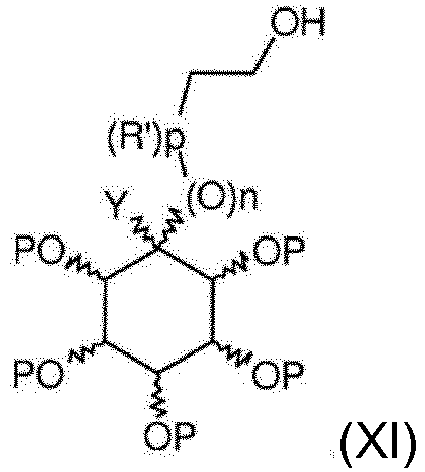
 - n eine Ganzzahl gleich 0 oder 1 ist,- Y darstellt:∘ wenn n = 0, eine OH-Gruppe oder,∘ wenn n = 1, ein Wasserstoffatom,- R1 eine Alkylgruppe mit 1 Kohlenstoffatom darstellt,- p eine Ganzzahl zwischen 0 und 1 ist und- P eine Schutzgruppe darstellt.
 - Verfahren zur Synthese einer Verbindung der Formel (XII):
 - n = 0, Y eine OH-Gruppe ist,- R' eine Alkylgruppe mit 1 Kohlenstoffatom ist,- p eine Ganzzahl zwischen 0 und 1 ist und- P eine Schutzgruppe darstellt, durch Umsetzen einer Verbindung der Formel (XV) oder (XV'):wobei P der obigen Beschreibung entspricht, mit einem Organomagnesium der Formel CH2=CH-(R')p-MgBr für die Verbindung (XV), oder mit einem Alkenylbromid der Formel CH2=CH-(R')p-Br für die Verbindung (XV').
- Verfahren zur Synthese einer Verbindung der Formel (XXIII):

 - n eine Ganzzahl gleich 0 oder 1 ist,- Y' darstellt:∘ wenn n = 0, einen Sauerstoff mit einer Schutzgruppe oder,∘ wenn n = 1, ein Wasserstoffatom,- R eine Alkylgruppe mit 1 - 6 Kohlenstoffatomen darstellt,- F ein nicht radioaktives Fluoratom ist,- P eine Schutzgruppe darstellt und- Z eine Tosylgruppe oder ein Wasserstoffatom darstellt.
 - Verfahren zur Synthese einer Verbindung der Formel (XXVII):

 - n eine Ganzzahl gleich 0 oder 1 ist,- Y" darstellt:∘ wenn n = 0, eine OP-Gruppe oder,∘ wenn n = 1, ein Wasserstoffatom,- R eine Alkylgruppe mit 1 - 6 Kohlenstoffatomen darstellt,- F ein radioaktives Fluoratom ist,- P eine Schutzgruppe darstellt und- Ts eine Tosylgruppe darstellt.
 - Verfahren zur Herstellung einer Verbindung der Formel (XXXI) mit Ausnahme der nicht radioaktiv markierten 2- Fluormethylmyoinositolverbindungen bei denen P1 identisch ist und ein Wasserstoffatom darstellt:


 - n eine Ganzzahl gleich 0 oder 1 ist,- Y' darstellt:∘ wenn n = 0, einen Sauerstoff mit einer Schutzgruppe oder,∘ wenn n = 1, ein Wasserstoffatom,- Y" darstellt:∘ wenn n = 0, eine OP-Gruppe oder,∘ wenn n = 1, ein Wasserstoffatom,- R eine Alkylgruppe mit 1 - 6 Kohlenstoffatomen darstellt,- F ein radioaktives oder nicht radioaktives Fluoratom und- P eine Schutzgruppe darstellt.
 - Verbindung der Formel (I):
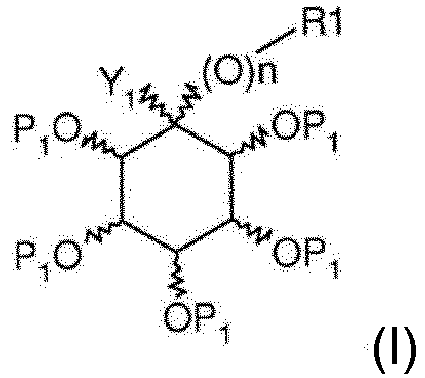 - n eine Ganzzahl gleich 0 oder 1 ist,- R1 darstellt:∘ wenn n = 0, eine vorzugsweise lineare Alkylgruppe mit 3 - 6 Kohlenstoffatomen, eine Alkenyl-, Alkylen- oder lineare Hydroxyalkylgruppe mit 2 - 6 Kohlenstoffatomen, wobei der Hydroxylanteil ggf. geschützt ist oder der Sauerstoff dieses Anteils derart substituiert ist, dass sich eine Abgangsgruppe, eine Halogenoalkylgruppe mit 2 - 6 Kohlenstoffatomen, wobei das Halogen radioaktiv ist oder nicht, oder eine Fluormethylgruppe darstellt, wobei der Fluor radioaktiv ist oder nicht;∘ wenn n = 1, eine Monohydroxyalkylgruppe mit 1 - 6 Kohlenstoffatomen, wobei der Hydroxylanteil ggf. geschützt ist oder der Sauerstoff dieses Anteils derart substituiert ist, dass sich eine Abgangsgruppe bildet, oder eine Monohalogenoalkylgruppe mit 1 - 6 Kohlenstoffatomen, wobei das Halogen radioaktiv ist oder nicht, wobei sich das Halogen vom dargestellten Brom unterscheidet;- P1 darstellt∘ wenn n = 0: jeweils einen Wasserstoff oder jeweils eine identische Schutzgruppe des Hydroxylanteils∘ wenn n = 1 und R1 eine Monohydroxyalkylgruppe ist: jeweils einen Wasserstoff oder jeweils eine identische Schutzgruppe des Hydroxylanteils∘ wenn n = 1 und R1 eine Monohalogenoalkylgruppe ist: jeweils einen Wasserstoff oder jeweils eine identische Schutzgruppe des Hydroxylanteils- Y1 darstellt:∘ wenn n = 0, eine OP1-Gruppe darstellt oder P1 der obigen Definition entspricht oder,∘ wenn n = 1, ein Wasserstoffatom zur Verwendung als Arzneimittel.
 - Verbindung der Formel (I):
 - n eine Ganzzahl gleich 0 oder 1 ist,- R1 darstellt:∘ wenn n = 0, eine Fluoralkylgruppe mit 1 - 6 Kohlenstoffatomen, wobei der Fluor sich in der terminalen Position an der Alkylgruppe befindet und radioaktiv ist,∘ wenn n = 1, eine Fluoralkylgruppe mit 1 - 6 Kohlenstoffatomen, wobei der Fluor sich in der terminalen Position an der Alkylgruppe befindet und radioaktiv ist- und P1 eine Schutzgruppe darstellt,- Y1 darstellt:zur Verwendung als Radionuklid zur Diagnose insbesondere von Krebserkrankungen.∘ wenn n = 0, eine OH-Gruppe oder,∘ wenn n = 1, ein Wasserstoffatom,
Applications Claiming Priority (2)
| Application Number | Priority Date | Filing Date | Title |
|---|---|---|---|
| FR1253109A FR2989088B1 (fr) | 2012-04-04 | 2012-04-04 | Radiotraceur pour la maladie d'alzheimer |
| PCT/EP2013/057143 WO2013150117A1 (fr) | 2012-04-04 | 2013-04-04 | Radiotraceur notamment pour la maladie d'alzheimer |
Publications (2)
| Publication Number | Publication Date |
|---|---|
| EP2847154A1 EP2847154A1 (de) | 2015-03-18 |
| EP2847154B1 true EP2847154B1 (de) | 2018-05-30 |
Family
ID=48048050
Family Applications (1)
| Application Number | Title | Priority Date | Filing Date |
|---|---|---|---|
| EP13714296.4A Not-in-force EP2847154B1 (de) | 2012-04-04 | 2013-04-04 | Radiotracer, insbesondere für krebs |
Country Status (3)
| Country | Link |
|---|---|
| EP (1) | EP2847154B1 (de) |
| FR (1) | FR2989088B1 (de) |
| WO (1) | WO2013150117A1 (de) |
Family Cites Families (3)
| Publication number | Priority date | Publication date | Assignee | Title |
|---|---|---|---|---|
| DE19624705A1 (de) * | 1996-06-20 | 1998-01-08 | Deutsches Krebsforsch | Dendrimere auf Saccharid-Basis |
| WO2007119108A2 (en) * | 2005-10-13 | 2007-10-25 | Waratah Pharmaceuticals Inc. | Inositol derivatives and their uses in the treatment of diseases characterized by abnormal protein folding or aggregation or amyloid formation, deposition, accumulation or persistence |
| WO2009014203A1 (ja) * | 2007-07-26 | 2009-01-29 | Hokko Chemical Industry Co., Ltd. | (1,3,5/2,4,6)-1-フルオロ-2,3,4,5,6-シクロヘキサンペントールの製造方法 |
-
2012
- 2012-04-04 FR FR1253109A patent/FR2989088B1/fr not_active Expired - Fee Related
-
2013
- 2013-04-04 EP EP13714296.4A patent/EP2847154B1/de not_active Not-in-force
- 2013-04-04 WO PCT/EP2013/057143 patent/WO2013150117A1/fr not_active Ceased
Non-Patent Citations (1)
| Title |
|---|
| None * |
Also Published As
| Publication number | Publication date |
|---|---|
| FR2989088B1 (fr) | 2014-08-29 |
| FR2989088A1 (fr) | 2013-10-11 |
| EP2847154A1 (de) | 2015-03-18 |
| WO2013150117A1 (fr) | 2013-10-10 |
Similar Documents
| Publication | Publication Date | Title |
|---|---|---|
| JP5684333B2 (ja) | 放射性ハロゲン標識有機化合物の製造方法 | |
| EP3394063B1 (de) | Makrocyclische liganden mit picolinatgruppe(n), komplexe davon und medizinische verwendungen davon | |
| WO2007132689A1 (ja) | 放射性フッ素標識有機化合物の製造方法 | |
| EP2238139B1 (de) | Verfahren zur herstellung eines markierten purinderivats, dieses derivat und anwendungen davon | |
| KR20120089846A (ko) | 4-플루오로글루타민의 단일 부분입체이성질체, 및 그의 제조 및 사용 방법 | |
| US7910745B2 (en) | Organic compound and method for producing radioactive halogen-labeled organic compound using the same | |
| FR3068695B1 (fr) | Composes utiles comme agent d'imagerie de l'hypoxie | |
| EP2847154A1 (de) | Radiotracer, insbesondere für morbus alzheimer | |
| EP3655397B1 (de) | Lipophile makrocyclische liganden, komplexe davon und verwendungen davon | |
| Jarkas et al. | (R, S)-Anti-1-amino-2-[18F] fluorocyclopentyl-1-carboxylic acid: synthesis from racemic 2-benzyloxycyclopentanone and biological evaluation for brain tumor imaging with positron emission tomography | |
| WO2020017620A1 (ja) | 陽電子放出核種で標識された脂肪酸誘導体 | |
| JP5680418B2 (ja) | L−3,4−ジヒドロキシ−6−[18F]フルオロ−フェニルアラニン及び2−[18F]フルオロ−L−チロシン及びそれらのα−メチル化誘導体の前駆体の製造方法、前駆体、この前駆体からのL−3,4−ジヒドロキシ−6−[18F]フルオロ−フェニルアラニン及び2−[18F]フルオロ−L−チロシン及びそれらのα−メチル化誘導体の製造方法 | |
| EP4377316B1 (de) | Makrozyklische liganden mit picolinatgruppe(n), ihre komplexverbindungen und medizinische verwendungen | |
| Moon et al. | Synthesis of O-(3-[18F] fluoropropyl)-L-tyrosine (L-[18F] FPT) and its biological evaluation in 9L tumor bearing rat | |
| CN113301926B (zh) | 靶向去甲肾上腺素转运蛋白的化合物 | |
| EP0767778B1 (de) | 1-phenoxy-3-n-alkylaminopropan-2-ol halogenierte derivate als marker für beta-adrenerge herzmuskelrezeptoren sowie als betablocker | |
| FR3116433A1 (fr) | Composés radiomarqués pour le diagnostic de maladies neurodégénératives cholinergiques | |
| US20130190529A1 (en) | Fluorine Radiolabelling Process | |
| BE1024388B1 (fr) | Procede pour la preparation d'analogues de nitroimidazole a base de nucleoside radiomarques | |
| WO2014006022A1 (fr) | Derives de glycosides, leur preparation et leur utilisation comme groupes prosthetiques | |
| JP2015193545A (ja) | 2−(3−ピリジニル)−1h−ベンズイミダゾール誘導体化合物、これを含む放射性医薬 |
Legal Events
| Date | Code | Title | Description |
|---|---|---|---|
| PUAI | Public reference made under article 153(3) epc to a published international application that has entered the european phase |
Free format text: ORIGINAL CODE: 0009012 |
|
| 17P | Request for examination filed |
Effective date: 20141031 |
|
| AK | Designated contracting states |
Kind code of ref document: A1 Designated state(s): AL AT BE BG CH CY CZ DE DK EE ES FI FR GB GR HR HU IE IS IT LI LT LU LV MC MK MT NL NO PL PT RO RS SE SI SK SM TR |
|
| AX | Request for extension of the european patent |
Extension state: BA ME |
|
| DAX | Request for extension of the european patent (deleted) | ||
| STAA | Information on the status of an ep patent application or granted ep patent |
Free format text: STATUS: EXAMINATION IS IN PROGRESS |
|
| 17Q | First examination report despatched |
Effective date: 20170628 |
|
| REG | Reference to a national code |
Ref country code: DE Ref legal event code: R079 Ref document number: 602013038121 Country of ref document: DE Free format text: PREVIOUS MAIN CLASS: C07C0035160000 Ipc: A61K0051040000 |
|
| GRAJ | Information related to disapproval of communication of intention to grant by the applicant or resumption of examination proceedings by the epo deleted |
Free format text: ORIGINAL CODE: EPIDOSDIGR1 |
|
| GRAP | Despatch of communication of intention to grant a patent |
Free format text: ORIGINAL CODE: EPIDOSNIGR1 |
|
| RIC1 | Information provided on ipc code assigned before grant |
Ipc: A61K 51/04 20060101AFI20171031BHEP Ipc: C07C 67/03 20060101ALI20171031BHEP |
|
| GRAP | Despatch of communication of intention to grant a patent |
Free format text: ORIGINAL CODE: EPIDOSNIGR1 |
|
| STAA | Information on the status of an ep patent application or granted ep patent |
Free format text: STATUS: GRANT OF PATENT IS INTENDED |
|
| INTG | Intention to grant announced |
Effective date: 20171208 |
|
| RAP1 | Party data changed (applicant data changed or rights of an application transferred) |
Owner name: UNIVERSITE DE LORRAINE Owner name: CENTRE NATIONAL DE LA RECHERCHE SCIENTIFIQUE (CNRS |
|
| GRAS | Grant fee paid |
Free format text: ORIGINAL CODE: EPIDOSNIGR3 |
|
| GRAA | (expected) grant |
Free format text: ORIGINAL CODE: 0009210 |
|
| STAA | Information on the status of an ep patent application or granted ep patent |
Free format text: STATUS: THE PATENT HAS BEEN GRANTED |
|
| AK | Designated contracting states |
Kind code of ref document: B1 Designated state(s): AL AT BE BG CH CY CZ DE DK EE ES FI FR GB GR HR HU IE IS IT LI LT LU LV MC MK MT NL NO PL PT RO RS SE SI SK SM TR |
|
| REG | Reference to a national code |
Ref country code: GB Ref legal event code: FG4D Free format text: NOT ENGLISH |
|
| REG | Reference to a national code |
Ref country code: CH Ref legal event code: EP |
|
| REG | Reference to a national code |
Ref country code: AT Ref legal event code: REF Ref document number: 1002929 Country of ref document: AT Kind code of ref document: T Effective date: 20180615 |
|
| REG | Reference to a national code |
Ref country code: IE Ref legal event code: FG4D Free format text: LANGUAGE OF EP DOCUMENT: FRENCH |
|
| REG | Reference to a national code |
Ref country code: DE Ref legal event code: R096 Ref document number: 602013038121 Country of ref document: DE |
|
| REG | Reference to a national code |
Ref country code: NL Ref legal event code: MP Effective date: 20180530 |
|
| REG | Reference to a national code |
Ref country code: LT Ref legal event code: MG4D |
|
| PG25 | Lapsed in a contracting state [announced via postgrant information from national office to epo] |
Ref country code: ES Free format text: LAPSE BECAUSE OF FAILURE TO SUBMIT A TRANSLATION OF THE DESCRIPTION OR TO PAY THE FEE WITHIN THE PRESCRIBED TIME-LIMIT Effective date: 20180530 Ref country code: SE Free format text: LAPSE BECAUSE OF FAILURE TO SUBMIT A TRANSLATION OF THE DESCRIPTION OR TO PAY THE FEE WITHIN THE PRESCRIBED TIME-LIMIT Effective date: 20180530 Ref country code: NO Free format text: LAPSE BECAUSE OF FAILURE TO SUBMIT A TRANSLATION OF THE DESCRIPTION OR TO PAY THE FEE WITHIN THE PRESCRIBED TIME-LIMIT Effective date: 20180830 Ref country code: FI Free format text: LAPSE BECAUSE OF FAILURE TO SUBMIT A TRANSLATION OF THE DESCRIPTION OR TO PAY THE FEE WITHIN THE PRESCRIBED TIME-LIMIT Effective date: 20180530 Ref country code: LT Free format text: LAPSE BECAUSE OF FAILURE TO SUBMIT A TRANSLATION OF THE DESCRIPTION OR TO PAY THE FEE WITHIN THE PRESCRIBED TIME-LIMIT Effective date: 20180530 Ref country code: BG Free format text: LAPSE BECAUSE OF FAILURE TO SUBMIT A TRANSLATION OF THE DESCRIPTION OR TO PAY THE FEE WITHIN THE PRESCRIBED TIME-LIMIT Effective date: 20180830 Ref country code: CY Free format text: LAPSE BECAUSE OF FAILURE TO SUBMIT A TRANSLATION OF THE DESCRIPTION OR TO PAY THE FEE WITHIN THE PRESCRIBED TIME-LIMIT Effective date: 20180530 |
|
| PG25 | Lapsed in a contracting state [announced via postgrant information from national office to epo] |
Ref country code: GR Free format text: LAPSE BECAUSE OF FAILURE TO SUBMIT A TRANSLATION OF THE DESCRIPTION OR TO PAY THE FEE WITHIN THE PRESCRIBED TIME-LIMIT Effective date: 20180831 Ref country code: RS Free format text: LAPSE BECAUSE OF FAILURE TO SUBMIT A TRANSLATION OF THE DESCRIPTION OR TO PAY THE FEE WITHIN THE PRESCRIBED TIME-LIMIT Effective date: 20180530 Ref country code: HR Free format text: LAPSE BECAUSE OF FAILURE TO SUBMIT A TRANSLATION OF THE DESCRIPTION OR TO PAY THE FEE WITHIN THE PRESCRIBED TIME-LIMIT Effective date: 20180530 Ref country code: LV Free format text: LAPSE BECAUSE OF FAILURE TO SUBMIT A TRANSLATION OF THE DESCRIPTION OR TO PAY THE FEE WITHIN THE PRESCRIBED TIME-LIMIT Effective date: 20180530 |
|
| REG | Reference to a national code |
Ref country code: AT Ref legal event code: MK05 Ref document number: 1002929 Country of ref document: AT Kind code of ref document: T Effective date: 20180530 |
|
| PG25 | Lapsed in a contracting state [announced via postgrant information from national office to epo] |
Ref country code: NL Free format text: LAPSE BECAUSE OF FAILURE TO SUBMIT A TRANSLATION OF THE DESCRIPTION OR TO PAY THE FEE WITHIN THE PRESCRIBED TIME-LIMIT Effective date: 20180530 |
|
| PG25 | Lapsed in a contracting state [announced via postgrant information from national office to epo] |
Ref country code: SK Free format text: LAPSE BECAUSE OF FAILURE TO SUBMIT A TRANSLATION OF THE DESCRIPTION OR TO PAY THE FEE WITHIN THE PRESCRIBED TIME-LIMIT Effective date: 20180530 Ref country code: CZ Free format text: LAPSE BECAUSE OF FAILURE TO SUBMIT A TRANSLATION OF THE DESCRIPTION OR TO PAY THE FEE WITHIN THE PRESCRIBED TIME-LIMIT Effective date: 20180530 Ref country code: RO Free format text: LAPSE BECAUSE OF FAILURE TO SUBMIT A TRANSLATION OF THE DESCRIPTION OR TO PAY THE FEE WITHIN THE PRESCRIBED TIME-LIMIT Effective date: 20180530 Ref country code: EE Free format text: LAPSE BECAUSE OF FAILURE TO SUBMIT A TRANSLATION OF THE DESCRIPTION OR TO PAY THE FEE WITHIN THE PRESCRIBED TIME-LIMIT Effective date: 20180530 Ref country code: DK Free format text: LAPSE BECAUSE OF FAILURE TO SUBMIT A TRANSLATION OF THE DESCRIPTION OR TO PAY THE FEE WITHIN THE PRESCRIBED TIME-LIMIT Effective date: 20180530 Ref country code: AT Free format text: LAPSE BECAUSE OF FAILURE TO SUBMIT A TRANSLATION OF THE DESCRIPTION OR TO PAY THE FEE WITHIN THE PRESCRIBED TIME-LIMIT Effective date: 20180530 Ref country code: PL Free format text: LAPSE BECAUSE OF FAILURE TO SUBMIT A TRANSLATION OF THE DESCRIPTION OR TO PAY THE FEE WITHIN THE PRESCRIBED TIME-LIMIT Effective date: 20180530 |
|
| PG25 | Lapsed in a contracting state [announced via postgrant information from national office to epo] |
Ref country code: IT Free format text: LAPSE BECAUSE OF FAILURE TO SUBMIT A TRANSLATION OF THE DESCRIPTION OR TO PAY THE FEE WITHIN THE PRESCRIBED TIME-LIMIT Effective date: 20180530 Ref country code: SM Free format text: LAPSE BECAUSE OF FAILURE TO SUBMIT A TRANSLATION OF THE DESCRIPTION OR TO PAY THE FEE WITHIN THE PRESCRIBED TIME-LIMIT Effective date: 20180530 |
|
| REG | Reference to a national code |
Ref country code: DE Ref legal event code: R097 Ref document number: 602013038121 Country of ref document: DE |
|
| PLBE | No opposition filed within time limit |
Free format text: ORIGINAL CODE: 0009261 |
|
| STAA | Information on the status of an ep patent application or granted ep patent |
Free format text: STATUS: NO OPPOSITION FILED WITHIN TIME LIMIT |
|
| 26N | No opposition filed |
Effective date: 20190301 |
|
| PG25 | Lapsed in a contracting state [announced via postgrant information from national office to epo] |
Ref country code: SI Free format text: LAPSE BECAUSE OF FAILURE TO SUBMIT A TRANSLATION OF THE DESCRIPTION OR TO PAY THE FEE WITHIN THE PRESCRIBED TIME-LIMIT Effective date: 20180530 |
|
| PGFP | Annual fee paid to national office [announced via postgrant information from national office to epo] |
Ref country code: FR Payment date: 20190430 Year of fee payment: 7 |
|
| REG | Reference to a national code |
Ref country code: DE Ref legal event code: R119 Ref document number: 602013038121 Country of ref document: DE |
|
| PG25 | Lapsed in a contracting state [announced via postgrant information from national office to epo] |
Ref country code: AL Free format text: LAPSE BECAUSE OF FAILURE TO SUBMIT A TRANSLATION OF THE DESCRIPTION OR TO PAY THE FEE WITHIN THE PRESCRIBED TIME-LIMIT Effective date: 20180530 |
|
| REG | Reference to a national code |
Ref country code: CH Ref legal event code: PL |
|
| REG | Reference to a national code |
Ref country code: BE Ref legal event code: MM Effective date: 20190430 |
|
| GBPC | Gb: european patent ceased through non-payment of renewal fee |
Effective date: 20190404 |
|
| PG25 | Lapsed in a contracting state [announced via postgrant information from national office to epo] |
Ref country code: LU Free format text: LAPSE BECAUSE OF NON-PAYMENT OF DUE FEES Effective date: 20190404 Ref country code: MC Free format text: LAPSE BECAUSE OF FAILURE TO SUBMIT A TRANSLATION OF THE DESCRIPTION OR TO PAY THE FEE WITHIN THE PRESCRIBED TIME-LIMIT Effective date: 20180530 |
|
| PG25 | Lapsed in a contracting state [announced via postgrant information from national office to epo] |
Ref country code: GB Free format text: LAPSE BECAUSE OF NON-PAYMENT OF DUE FEES Effective date: 20190404 Ref country code: CH Free format text: LAPSE BECAUSE OF NON-PAYMENT OF DUE FEES Effective date: 20190430 Ref country code: LI Free format text: LAPSE BECAUSE OF NON-PAYMENT OF DUE FEES Effective date: 20190430 Ref country code: DE Free format text: LAPSE BECAUSE OF NON-PAYMENT OF DUE FEES Effective date: 20191101 |
|
| PG25 | Lapsed in a contracting state [announced via postgrant information from national office to epo] |
Ref country code: BE Free format text: LAPSE BECAUSE OF NON-PAYMENT OF DUE FEES Effective date: 20190430 |
|
| PG25 | Lapsed in a contracting state [announced via postgrant information from national office to epo] |
Ref country code: TR Free format text: LAPSE BECAUSE OF FAILURE TO SUBMIT A TRANSLATION OF THE DESCRIPTION OR TO PAY THE FEE WITHIN THE PRESCRIBED TIME-LIMIT Effective date: 20180530 |
|
| PG25 | Lapsed in a contracting state [announced via postgrant information from national office to epo] |
Ref country code: IE Free format text: LAPSE BECAUSE OF NON-PAYMENT OF DUE FEES Effective date: 20190404 |
|
| PG25 | Lapsed in a contracting state [announced via postgrant information from national office to epo] |
Ref country code: PT Free format text: LAPSE BECAUSE OF FAILURE TO SUBMIT A TRANSLATION OF THE DESCRIPTION OR TO PAY THE FEE WITHIN THE PRESCRIBED TIME-LIMIT Effective date: 20181001 |
|
| PG25 | Lapsed in a contracting state [announced via postgrant information from national office to epo] |
Ref country code: FR Free format text: LAPSE BECAUSE OF NON-PAYMENT OF DUE FEES Effective date: 20200430 |
|
| PG25 | Lapsed in a contracting state [announced via postgrant information from national office to epo] |
Ref country code: IS Free format text: LAPSE BECAUSE OF FAILURE TO SUBMIT A TRANSLATION OF THE DESCRIPTION OR TO PAY THE FEE WITHIN THE PRESCRIBED TIME-LIMIT Effective date: 20180930 |
|
| PG25 | Lapsed in a contracting state [announced via postgrant information from national office to epo] |
Ref country code: MT Free format text: LAPSE BECAUSE OF FAILURE TO SUBMIT A TRANSLATION OF THE DESCRIPTION OR TO PAY THE FEE WITHIN THE PRESCRIBED TIME-LIMIT Effective date: 20180530 Ref country code: HU Free format text: LAPSE BECAUSE OF FAILURE TO SUBMIT A TRANSLATION OF THE DESCRIPTION OR TO PAY THE FEE WITHIN THE PRESCRIBED TIME-LIMIT; INVALID AB INITIO Effective date: 20130404 |
|
| PG25 | Lapsed in a contracting state [announced via postgrant information from national office to epo] |
Ref country code: MK Free format text: LAPSE BECAUSE OF FAILURE TO SUBMIT A TRANSLATION OF THE DESCRIPTION OR TO PAY THE FEE WITHIN THE PRESCRIBED TIME-LIMIT Effective date: 20180530 |