EP2848709A1 - Verfahren zum Herstellen eines mit einem metallischen, vor Korrosion schützenden Überzug versehenen Stahlbauteils und Stahlbauteil - Google Patents
Verfahren zum Herstellen eines mit einem metallischen, vor Korrosion schützenden Überzug versehenen Stahlbauteils und Stahlbauteil Download PDFInfo
- Publication number
- EP2848709A1 EP2848709A1 EP20130184274 EP13184274A EP2848709A1 EP 2848709 A1 EP2848709 A1 EP 2848709A1 EP 20130184274 EP20130184274 EP 20130184274 EP 13184274 A EP13184274 A EP 13184274A EP 2848709 A1 EP2848709 A1 EP 2848709A1
- Authority
- EP
- European Patent Office
- Prior art keywords
- steel
- coating
- aluminum
- steel component
- component
- Prior art date
- Legal status (The legal status is an assumption and is not a legal conclusion. Google has not performed a legal analysis and makes no representation as to the accuracy of the status listed.)
- Granted
Links
Images

Classifications
-
- C—CHEMISTRY; METALLURGY
- C21—METALLURGY OF IRON
- C21D—MODIFYING THE PHYSICAL STRUCTURE OF FERROUS METALS; GENERAL DEVICES FOR HEAT TREATMENT OF FERROUS OR NON-FERROUS METALS OR ALLOYS; MAKING METAL MALLEABLE, e.g. BY DECARBURISATION OR TEMPERING
- C21D9/00—Heat treatment, e.g. annealing, hardening, quenching or tempering, adapted for particular articles; Furnaces therefor
- C21D9/0068—Heat treatment, e.g. annealing, hardening, quenching or tempering, adapted for particular articles; Furnaces therefor for particular articles not mentioned below
-
- C—CHEMISTRY; METALLURGY
- C21—METALLURGY OF IRON
- C21D—MODIFYING THE PHYSICAL STRUCTURE OF FERROUS METALS; GENERAL DEVICES FOR HEAT TREATMENT OF FERROUS OR NON-FERROUS METALS OR ALLOYS; MAKING METAL MALLEABLE, e.g. BY DECARBURISATION OR TEMPERING
- C21D8/00—Modifying the physical properties of ferrous metals or ferrous alloys by deformation combined with, or followed by, heat treatment
- C21D8/02—Modifying the physical properties of ferrous metals or ferrous alloys by deformation combined with, or followed by, heat treatment during manufacturing of plates or strips
- C21D8/0247—Modifying the physical properties of ferrous metals or ferrous alloys by deformation combined with, or followed by, heat treatment during manufacturing of plates or strips characterised by the heat treatment
-
- B—PERFORMING OPERATIONS; TRANSPORTING
- B32—LAYERED PRODUCTS
- B32B—LAYERED PRODUCTS, i.e. PRODUCTS BUILT-UP OF STRATA OF FLAT OR NON-FLAT, e.g. CELLULAR OR HONEYCOMB, FORM
- B32B15/00—Layered products comprising a layer of metal
- B32B15/01—Layered products comprising a layer of metal all layers being exclusively metallic
- B32B15/012—Layered products comprising a layer of metal all layers being exclusively metallic one layer being formed of an iron alloy or steel, another layer being formed of aluminium or an aluminium alloy
-
- B—PERFORMING OPERATIONS; TRANSPORTING
- B32—LAYERED PRODUCTS
- B32B—LAYERED PRODUCTS, i.e. PRODUCTS BUILT-UP OF STRATA OF FLAT OR NON-FLAT, e.g. CELLULAR OR HONEYCOMB, FORM
- B32B15/00—Layered products comprising a layer of metal
- B32B15/01—Layered products comprising a layer of metal all layers being exclusively metallic
- B32B15/013—Layered products comprising a layer of metal all layers being exclusively metallic one layer being formed of an iron alloy or steel, another layer being formed of a metal other than iron or aluminium
-
- B—PERFORMING OPERATIONS; TRANSPORTING
- B32—LAYERED PRODUCTS
- B32B—LAYERED PRODUCTS, i.e. PRODUCTS BUILT-UP OF STRATA OF FLAT OR NON-FLAT, e.g. CELLULAR OR HONEYCOMB, FORM
- B32B15/00—Layered products comprising a layer of metal
- B32B15/04—Layered products comprising a layer of metal comprising metal as the main or only constituent of a layer, which is next to another layer of the same or of a different material
-
- B—PERFORMING OPERATIONS; TRANSPORTING
- B32—LAYERED PRODUCTS
- B32B—LAYERED PRODUCTS, i.e. PRODUCTS BUILT-UP OF STRATA OF FLAT OR NON-FLAT, e.g. CELLULAR OR HONEYCOMB, FORM
- B32B15/00—Layered products comprising a layer of metal
- B32B15/04—Layered products comprising a layer of metal comprising metal as the main or only constituent of a layer, which is next to another layer of the same or of a different material
- B32B15/043—Layered products comprising a layer of metal comprising metal as the main or only constituent of a layer, which is next to another layer of the same or of a different material of metal
-
- B—PERFORMING OPERATIONS; TRANSPORTING
- B32—LAYERED PRODUCTS
- B32B—LAYERED PRODUCTS, i.e. PRODUCTS BUILT-UP OF STRATA OF FLAT OR NON-FLAT, e.g. CELLULAR OR HONEYCOMB, FORM
- B32B15/00—Layered products comprising a layer of metal
- B32B15/18—Layered products comprising a layer of metal comprising iron or steel
-
- B—PERFORMING OPERATIONS; TRANSPORTING
- B32—LAYERED PRODUCTS
- B32B—LAYERED PRODUCTS, i.e. PRODUCTS BUILT-UP OF STRATA OF FLAT OR NON-FLAT, e.g. CELLULAR OR HONEYCOMB, FORM
- B32B15/00—Layered products comprising a layer of metal
- B32B15/20—Layered products comprising a layer of metal comprising aluminium or copper
-
- C—CHEMISTRY; METALLURGY
- C21—METALLURGY OF IRON
- C21D—MODIFYING THE PHYSICAL STRUCTURE OF FERROUS METALS; GENERAL DEVICES FOR HEAT TREATMENT OF FERROUS OR NON-FERROUS METALS OR ALLOYS; MAKING METAL MALLEABLE, e.g. BY DECARBURISATION OR TEMPERING
- C21D1/00—General methods or devices for heat treatment, e.g. annealing, hardening, quenching or tempering
- C21D1/18—Hardening; Quenching with or without subsequent tempering
-
- C—CHEMISTRY; METALLURGY
- C21—METALLURGY OF IRON
- C21D—MODIFYING THE PHYSICAL STRUCTURE OF FERROUS METALS; GENERAL DEVICES FOR HEAT TREATMENT OF FERROUS OR NON-FERROUS METALS OR ALLOYS; MAKING METAL MALLEABLE, e.g. BY DECARBURISATION OR TEMPERING
- C21D6/00—Heat treatment of ferrous alloys
- C21D6/002—Heat treatment of ferrous alloys containing Cr
-
- C—CHEMISTRY; METALLURGY
- C21—METALLURGY OF IRON
- C21D—MODIFYING THE PHYSICAL STRUCTURE OF FERROUS METALS; GENERAL DEVICES FOR HEAT TREATMENT OF FERROUS OR NON-FERROUS METALS OR ALLOYS; MAKING METAL MALLEABLE, e.g. BY DECARBURISATION OR TEMPERING
- C21D6/00—Heat treatment of ferrous alloys
- C21D6/005—Heat treatment of ferrous alloys containing Mn
-
- C—CHEMISTRY; METALLURGY
- C21—METALLURGY OF IRON
- C21D—MODIFYING THE PHYSICAL STRUCTURE OF FERROUS METALS; GENERAL DEVICES FOR HEAT TREATMENT OF FERROUS OR NON-FERROUS METALS OR ALLOYS; MAKING METAL MALLEABLE, e.g. BY DECARBURISATION OR TEMPERING
- C21D6/00—Heat treatment of ferrous alloys
- C21D6/008—Heat treatment of ferrous alloys containing Si
-
- C—CHEMISTRY; METALLURGY
- C21—METALLURGY OF IRON
- C21D—MODIFYING THE PHYSICAL STRUCTURE OF FERROUS METALS; GENERAL DEVICES FOR HEAT TREATMENT OF FERROUS OR NON-FERROUS METALS OR ALLOYS; MAKING METAL MALLEABLE, e.g. BY DECARBURISATION OR TEMPERING
- C21D8/00—Modifying the physical properties of ferrous metals or ferrous alloys by deformation combined with, or followed by, heat treatment
-
- C—CHEMISTRY; METALLURGY
- C21—METALLURGY OF IRON
- C21D—MODIFYING THE PHYSICAL STRUCTURE OF FERROUS METALS; GENERAL DEVICES FOR HEAT TREATMENT OF FERROUS OR NON-FERROUS METALS OR ALLOYS; MAKING METAL MALLEABLE, e.g. BY DECARBURISATION OR TEMPERING
- C21D9/00—Heat treatment, e.g. annealing, hardening, quenching or tempering, adapted for particular articles; Furnaces therefor
- C21D9/46—Heat treatment, e.g. annealing, hardening, quenching or tempering, adapted for particular articles; Furnaces therefor for sheet metals
-
- C—CHEMISTRY; METALLURGY
- C22—METALLURGY; FERROUS OR NON-FERROUS ALLOYS; TREATMENT OF ALLOYS OR NON-FERROUS METALS
- C22C—ALLOYS
- C22C18/00—Alloys based on zinc
-
- C—CHEMISTRY; METALLURGY
- C22—METALLURGY; FERROUS OR NON-FERROUS ALLOYS; TREATMENT OF ALLOYS OR NON-FERROUS METALS
- C22C—ALLOYS
- C22C18/00—Alloys based on zinc
- C22C18/04—Alloys based on zinc with aluminium as the next major constituent
-
- C—CHEMISTRY; METALLURGY
- C22—METALLURGY; FERROUS OR NON-FERROUS ALLOYS; TREATMENT OF ALLOYS OR NON-FERROUS METALS
- C22C—ALLOYS
- C22C21/00—Alloys based on aluminium
-
- C—CHEMISTRY; METALLURGY
- C22—METALLURGY; FERROUS OR NON-FERROUS ALLOYS; TREATMENT OF ALLOYS OR NON-FERROUS METALS
- C22C—ALLOYS
- C22C21/00—Alloys based on aluminium
- C22C21/10—Alloys based on aluminium with zinc as the next major constituent
-
- C—CHEMISTRY; METALLURGY
- C22—METALLURGY; FERROUS OR NON-FERROUS ALLOYS; TREATMENT OF ALLOYS OR NON-FERROUS METALS
- C22C—ALLOYS
- C22C30/00—Alloys containing less than 50% by weight of each constituent
- C22C30/06—Alloys containing less than 50% by weight of each constituent containing zinc
-
- C—CHEMISTRY; METALLURGY
- C22—METALLURGY; FERROUS OR NON-FERROUS ALLOYS; TREATMENT OF ALLOYS OR NON-FERROUS METALS
- C22C—ALLOYS
- C22C38/00—Ferrous alloys, e.g. steel alloys
- C22C38/002—Ferrous alloys, e.g. steel alloys containing In, Mg, or other elements not provided for in one single group C22C38/001 - C22C38/60
-
- C—CHEMISTRY; METALLURGY
- C22—METALLURGY; FERROUS OR NON-FERROUS ALLOYS; TREATMENT OF ALLOYS OR NON-FERROUS METALS
- C22C—ALLOYS
- C22C38/00—Ferrous alloys, e.g. steel alloys
- C22C38/02—Ferrous alloys, e.g. steel alloys containing silicon
-
- C—CHEMISTRY; METALLURGY
- C22—METALLURGY; FERROUS OR NON-FERROUS ALLOYS; TREATMENT OF ALLOYS OR NON-FERROUS METALS
- C22C—ALLOYS
- C22C38/00—Ferrous alloys, e.g. steel alloys
- C22C38/04—Ferrous alloys, e.g. steel alloys containing manganese
-
- C—CHEMISTRY; METALLURGY
- C22—METALLURGY; FERROUS OR NON-FERROUS ALLOYS; TREATMENT OF ALLOYS OR NON-FERROUS METALS
- C22C—ALLOYS
- C22C38/00—Ferrous alloys, e.g. steel alloys
- C22C38/06—Ferrous alloys, e.g. steel alloys containing aluminium
-
- C—CHEMISTRY; METALLURGY
- C22—METALLURGY; FERROUS OR NON-FERROUS ALLOYS; TREATMENT OF ALLOYS OR NON-FERROUS METALS
- C22C—ALLOYS
- C22C38/00—Ferrous alloys, e.g. steel alloys
- C22C38/14—Ferrous alloys, e.g. steel alloys containing titanium or zirconium
-
- C—CHEMISTRY; METALLURGY
- C22—METALLURGY; FERROUS OR NON-FERROUS ALLOYS; TREATMENT OF ALLOYS OR NON-FERROUS METALS
- C22C—ALLOYS
- C22C38/00—Ferrous alloys, e.g. steel alloys
- C22C38/18—Ferrous alloys, e.g. steel alloys containing chromium
-
- C—CHEMISTRY; METALLURGY
- C22—METALLURGY; FERROUS OR NON-FERROUS ALLOYS; TREATMENT OF ALLOYS OR NON-FERROUS METALS
- C22C—ALLOYS
- C22C38/00—Ferrous alloys, e.g. steel alloys
- C22C38/18—Ferrous alloys, e.g. steel alloys containing chromium
- C22C38/28—Ferrous alloys, e.g. steel alloys containing chromium with titanium or zirconium
-
- C—CHEMISTRY; METALLURGY
- C22—METALLURGY; FERROUS OR NON-FERROUS ALLOYS; TREATMENT OF ALLOYS OR NON-FERROUS METALS
- C22C—ALLOYS
- C22C38/00—Ferrous alloys, e.g. steel alloys
- C22C38/18—Ferrous alloys, e.g. steel alloys containing chromium
- C22C38/32—Ferrous alloys, e.g. steel alloys containing chromium with boron
-
- C—CHEMISTRY; METALLURGY
- C22—METALLURGY; FERROUS OR NON-FERROUS ALLOYS; TREATMENT OF ALLOYS OR NON-FERROUS METALS
- C22C—ALLOYS
- C22C38/00—Ferrous alloys, e.g. steel alloys
- C22C38/18—Ferrous alloys, e.g. steel alloys containing chromium
- C22C38/38—Ferrous alloys, e.g. steel alloys containing chromium with more than 1.5% by weight of manganese
-
- C—CHEMISTRY; METALLURGY
- C23—COATING METALLIC MATERIAL; COATING MATERIAL WITH METALLIC MATERIAL; CHEMICAL SURFACE TREATMENT; DIFFUSION TREATMENT OF METALLIC MATERIAL; COATING BY VACUUM EVAPORATION, BY SPUTTERING, BY ION IMPLANTATION OR BY CHEMICAL VAPOUR DEPOSITION, IN GENERAL; INHIBITING CORROSION OF METALLIC MATERIAL OR INCRUSTATION IN GENERAL
- C23C—COATING METALLIC MATERIAL; COATING MATERIAL WITH METALLIC MATERIAL; SURFACE TREATMENT OF METALLIC MATERIAL BY DIFFUSION INTO THE SURFACE, BY CHEMICAL CONVERSION OR SUBSTITUTION; COATING BY VACUUM EVAPORATION, BY SPUTTERING, BY ION IMPLANTATION OR BY CHEMICAL VAPOUR DEPOSITION, IN GENERAL
- C23C2/00—Hot-dipping or immersion processes for applying the coating material in the molten state without affecting the shape; Apparatus therefor
- C23C2/04—Hot-dipping or immersion processes for applying the coating material in the molten state without affecting the shape; Apparatus therefor characterised by the coating material
- C23C2/06—Zinc or cadmium or alloys based thereon
-
- C—CHEMISTRY; METALLURGY
- C23—COATING METALLIC MATERIAL; COATING MATERIAL WITH METALLIC MATERIAL; CHEMICAL SURFACE TREATMENT; DIFFUSION TREATMENT OF METALLIC MATERIAL; COATING BY VACUUM EVAPORATION, BY SPUTTERING, BY ION IMPLANTATION OR BY CHEMICAL VAPOUR DEPOSITION, IN GENERAL; INHIBITING CORROSION OF METALLIC MATERIAL OR INCRUSTATION IN GENERAL
- C23C—COATING METALLIC MATERIAL; COATING MATERIAL WITH METALLIC MATERIAL; SURFACE TREATMENT OF METALLIC MATERIAL BY DIFFUSION INTO THE SURFACE, BY CHEMICAL CONVERSION OR SUBSTITUTION; COATING BY VACUUM EVAPORATION, BY SPUTTERING, BY ION IMPLANTATION OR BY CHEMICAL VAPOUR DEPOSITION, IN GENERAL
- C23C2/00—Hot-dipping or immersion processes for applying the coating material in the molten state without affecting the shape; Apparatus therefor
- C23C2/04—Hot-dipping or immersion processes for applying the coating material in the molten state without affecting the shape; Apparatus therefor characterised by the coating material
- C23C2/12—Aluminium or alloys based thereon
-
- C—CHEMISTRY; METALLURGY
- C23—COATING METALLIC MATERIAL; COATING MATERIAL WITH METALLIC MATERIAL; CHEMICAL SURFACE TREATMENT; DIFFUSION TREATMENT OF METALLIC MATERIAL; COATING BY VACUUM EVAPORATION, BY SPUTTERING, BY ION IMPLANTATION OR BY CHEMICAL VAPOUR DEPOSITION, IN GENERAL; INHIBITING CORROSION OF METALLIC MATERIAL OR INCRUSTATION IN GENERAL
- C23C—COATING METALLIC MATERIAL; COATING MATERIAL WITH METALLIC MATERIAL; SURFACE TREATMENT OF METALLIC MATERIAL BY DIFFUSION INTO THE SURFACE, BY CHEMICAL CONVERSION OR SUBSTITUTION; COATING BY VACUUM EVAPORATION, BY SPUTTERING, BY ION IMPLANTATION OR BY CHEMICAL VAPOUR DEPOSITION, IN GENERAL
- C23C2/00—Hot-dipping or immersion processes for applying the coating material in the molten state without affecting the shape; Apparatus therefor
- C23C2/26—After-treatment
-
- C—CHEMISTRY; METALLURGY
- C23—COATING METALLIC MATERIAL; COATING MATERIAL WITH METALLIC MATERIAL; CHEMICAL SURFACE TREATMENT; DIFFUSION TREATMENT OF METALLIC MATERIAL; COATING BY VACUUM EVAPORATION, BY SPUTTERING, BY ION IMPLANTATION OR BY CHEMICAL VAPOUR DEPOSITION, IN GENERAL; INHIBITING CORROSION OF METALLIC MATERIAL OR INCRUSTATION IN GENERAL
- C23C—COATING METALLIC MATERIAL; COATING MATERIAL WITH METALLIC MATERIAL; SURFACE TREATMENT OF METALLIC MATERIAL BY DIFFUSION INTO THE SURFACE, BY CHEMICAL CONVERSION OR SUBSTITUTION; COATING BY VACUUM EVAPORATION, BY SPUTTERING, BY ION IMPLANTATION OR BY CHEMICAL VAPOUR DEPOSITION, IN GENERAL
- C23C2/00—Hot-dipping or immersion processes for applying the coating material in the molten state without affecting the shape; Apparatus therefor
- C23C2/26—After-treatment
- C23C2/28—Thermal after-treatment, e.g. treatment in oil bath
-
- C—CHEMISTRY; METALLURGY
- C23—COATING METALLIC MATERIAL; COATING MATERIAL WITH METALLIC MATERIAL; CHEMICAL SURFACE TREATMENT; DIFFUSION TREATMENT OF METALLIC MATERIAL; COATING BY VACUUM EVAPORATION, BY SPUTTERING, BY ION IMPLANTATION OR BY CHEMICAL VAPOUR DEPOSITION, IN GENERAL; INHIBITING CORROSION OF METALLIC MATERIAL OR INCRUSTATION IN GENERAL
- C23C—COATING METALLIC MATERIAL; COATING MATERIAL WITH METALLIC MATERIAL; SURFACE TREATMENT OF METALLIC MATERIAL BY DIFFUSION INTO THE SURFACE, BY CHEMICAL CONVERSION OR SUBSTITUTION; COATING BY VACUUM EVAPORATION, BY SPUTTERING, BY ION IMPLANTATION OR BY CHEMICAL VAPOUR DEPOSITION, IN GENERAL
- C23C2/00—Hot-dipping or immersion processes for applying the coating material in the molten state without affecting the shape; Apparatus therefor
- C23C2/26—After-treatment
- C23C2/28—Thermal after-treatment, e.g. treatment in oil bath
- C23C2/29—Cooling or quenching
-
- C—CHEMISTRY; METALLURGY
- C23—COATING METALLIC MATERIAL; COATING MATERIAL WITH METALLIC MATERIAL; CHEMICAL SURFACE TREATMENT; DIFFUSION TREATMENT OF METALLIC MATERIAL; COATING BY VACUUM EVAPORATION, BY SPUTTERING, BY ION IMPLANTATION OR BY CHEMICAL VAPOUR DEPOSITION, IN GENERAL; INHIBITING CORROSION OF METALLIC MATERIAL OR INCRUSTATION IN GENERAL
- C23C—COATING METALLIC MATERIAL; COATING MATERIAL WITH METALLIC MATERIAL; SURFACE TREATMENT OF METALLIC MATERIAL BY DIFFUSION INTO THE SURFACE, BY CHEMICAL CONVERSION OR SUBSTITUTION; COATING BY VACUUM EVAPORATION, BY SPUTTERING, BY ION IMPLANTATION OR BY CHEMICAL VAPOUR DEPOSITION, IN GENERAL
- C23C2/00—Hot-dipping or immersion processes for applying the coating material in the molten state without affecting the shape; Apparatus therefor
- C23C2/34—Hot-dipping or immersion processes for applying the coating material in the molten state without affecting the shape; Apparatus therefor characterised by the shape of the material to be treated
- C23C2/36—Elongated material
- C23C2/40—Plates; Strips
-
- C—CHEMISTRY; METALLURGY
- C23—COATING METALLIC MATERIAL; COATING MATERIAL WITH METALLIC MATERIAL; CHEMICAL SURFACE TREATMENT; DIFFUSION TREATMENT OF METALLIC MATERIAL; COATING BY VACUUM EVAPORATION, BY SPUTTERING, BY ION IMPLANTATION OR BY CHEMICAL VAPOUR DEPOSITION, IN GENERAL; INHIBITING CORROSION OF METALLIC MATERIAL OR INCRUSTATION IN GENERAL
- C23C—COATING METALLIC MATERIAL; COATING MATERIAL WITH METALLIC MATERIAL; SURFACE TREATMENT OF METALLIC MATERIAL BY DIFFUSION INTO THE SURFACE, BY CHEMICAL CONVERSION OR SUBSTITUTION; COATING BY VACUUM EVAPORATION, BY SPUTTERING, BY ION IMPLANTATION OR BY CHEMICAL VAPOUR DEPOSITION, IN GENERAL
- C23C2/00—Hot-dipping or immersion processes for applying the coating material in the molten state without affecting the shape; Apparatus therefor
- C23C2/50—Controlling or regulating the coating processes
- C23C2/52—Controlling or regulating the coating processes with means for measuring or sensing
- C23C2/522—Temperature of the bath
-
- C—CHEMISTRY; METALLURGY
- C23—COATING METALLIC MATERIAL; COATING MATERIAL WITH METALLIC MATERIAL; CHEMICAL SURFACE TREATMENT; DIFFUSION TREATMENT OF METALLIC MATERIAL; COATING BY VACUUM EVAPORATION, BY SPUTTERING, BY ION IMPLANTATION OR BY CHEMICAL VAPOUR DEPOSITION, IN GENERAL; INHIBITING CORROSION OF METALLIC MATERIAL OR INCRUSTATION IN GENERAL
- C23C—COATING METALLIC MATERIAL; COATING MATERIAL WITH METALLIC MATERIAL; SURFACE TREATMENT OF METALLIC MATERIAL BY DIFFUSION INTO THE SURFACE, BY CHEMICAL CONVERSION OR SUBSTITUTION; COATING BY VACUUM EVAPORATION, BY SPUTTERING, BY ION IMPLANTATION OR BY CHEMICAL VAPOUR DEPOSITION, IN GENERAL
- C23C28/00—Coating for obtaining at least two superposed coatings either by methods not provided for in a single one of groups C23C2/00 - C23C26/00 or by combinations of methods provided for in subclasses C23C and C25C or C25D
- C23C28/02—Coating for obtaining at least two superposed coatings either by methods not provided for in a single one of groups C23C2/00 - C23C26/00 or by combinations of methods provided for in subclasses C23C and C25C or C25D only coatings only including layers of metallic material
-
- C—CHEMISTRY; METALLURGY
- C23—COATING METALLIC MATERIAL; COATING MATERIAL WITH METALLIC MATERIAL; CHEMICAL SURFACE TREATMENT; DIFFUSION TREATMENT OF METALLIC MATERIAL; COATING BY VACUUM EVAPORATION, BY SPUTTERING, BY ION IMPLANTATION OR BY CHEMICAL VAPOUR DEPOSITION, IN GENERAL; INHIBITING CORROSION OF METALLIC MATERIAL OR INCRUSTATION IN GENERAL
- C23C—COATING METALLIC MATERIAL; COATING MATERIAL WITH METALLIC MATERIAL; SURFACE TREATMENT OF METALLIC MATERIAL BY DIFFUSION INTO THE SURFACE, BY CHEMICAL CONVERSION OR SUBSTITUTION; COATING BY VACUUM EVAPORATION, BY SPUTTERING, BY ION IMPLANTATION OR BY CHEMICAL VAPOUR DEPOSITION, IN GENERAL
- C23C28/00—Coating for obtaining at least two superposed coatings either by methods not provided for in a single one of groups C23C2/00 - C23C26/00 or by combinations of methods provided for in subclasses C23C and C25C or C25D
- C23C28/02—Coating for obtaining at least two superposed coatings either by methods not provided for in a single one of groups C23C2/00 - C23C26/00 or by combinations of methods provided for in subclasses C23C and C25C or C25D only coatings only including layers of metallic material
- C23C28/021—Coating for obtaining at least two superposed coatings either by methods not provided for in a single one of groups C23C2/00 - C23C26/00 or by combinations of methods provided for in subclasses C23C and C25C or C25D only coatings only including layers of metallic material including at least one metal alloy layer
-
- C—CHEMISTRY; METALLURGY
- C23—COATING METALLIC MATERIAL; COATING MATERIAL WITH METALLIC MATERIAL; CHEMICAL SURFACE TREATMENT; DIFFUSION TREATMENT OF METALLIC MATERIAL; COATING BY VACUUM EVAPORATION, BY SPUTTERING, BY ION IMPLANTATION OR BY CHEMICAL VAPOUR DEPOSITION, IN GENERAL; INHIBITING CORROSION OF METALLIC MATERIAL OR INCRUSTATION IN GENERAL
- C23C—COATING METALLIC MATERIAL; COATING MATERIAL WITH METALLIC MATERIAL; SURFACE TREATMENT OF METALLIC MATERIAL BY DIFFUSION INTO THE SURFACE, BY CHEMICAL CONVERSION OR SUBSTITUTION; COATING BY VACUUM EVAPORATION, BY SPUTTERING, BY ION IMPLANTATION OR BY CHEMICAL VAPOUR DEPOSITION, IN GENERAL
- C23C28/00—Coating for obtaining at least two superposed coatings either by methods not provided for in a single one of groups C23C2/00 - C23C26/00 or by combinations of methods provided for in subclasses C23C and C25C or C25D
- C23C28/02—Coating for obtaining at least two superposed coatings either by methods not provided for in a single one of groups C23C2/00 - C23C26/00 or by combinations of methods provided for in subclasses C23C and C25C or C25D only coatings only including layers of metallic material
- C23C28/023—Coating for obtaining at least two superposed coatings either by methods not provided for in a single one of groups C23C2/00 - C23C26/00 or by combinations of methods provided for in subclasses C23C and C25C or C25D only coatings only including layers of metallic material only coatings of metal elements only
- C23C28/025—Coating for obtaining at least two superposed coatings either by methods not provided for in a single one of groups C23C2/00 - C23C26/00 or by combinations of methods provided for in subclasses C23C and C25C or C25D only coatings only including layers of metallic material only coatings of metal elements only with at least one zinc-based layer
-
- C—CHEMISTRY; METALLURGY
- C23—COATING METALLIC MATERIAL; COATING MATERIAL WITH METALLIC MATERIAL; CHEMICAL SURFACE TREATMENT; DIFFUSION TREATMENT OF METALLIC MATERIAL; COATING BY VACUUM EVAPORATION, BY SPUTTERING, BY ION IMPLANTATION OR BY CHEMICAL VAPOUR DEPOSITION, IN GENERAL; INHIBITING CORROSION OF METALLIC MATERIAL OR INCRUSTATION IN GENERAL
- C23C—COATING METALLIC MATERIAL; COATING MATERIAL WITH METALLIC MATERIAL; SURFACE TREATMENT OF METALLIC MATERIAL BY DIFFUSION INTO THE SURFACE, BY CHEMICAL CONVERSION OR SUBSTITUTION; COATING BY VACUUM EVAPORATION, BY SPUTTERING, BY ION IMPLANTATION OR BY CHEMICAL VAPOUR DEPOSITION, IN GENERAL
- C23C28/00—Coating for obtaining at least two superposed coatings either by methods not provided for in a single one of groups C23C2/00 - C23C26/00 or by combinations of methods provided for in subclasses C23C and C25C or C25D
- C23C28/30—Coatings combining at least one metallic layer and at least one inorganic non-metallic layer
- C23C28/32—Coatings combining at least one metallic layer and at least one inorganic non-metallic layer including at least one pure metallic layer
- C23C28/321—Coatings combining at least one metallic layer and at least one inorganic non-metallic layer including at least one pure metallic layer with at least one metal alloy layer
-
- C—CHEMISTRY; METALLURGY
- C23—COATING METALLIC MATERIAL; COATING MATERIAL WITH METALLIC MATERIAL; CHEMICAL SURFACE TREATMENT; DIFFUSION TREATMENT OF METALLIC MATERIAL; COATING BY VACUUM EVAPORATION, BY SPUTTERING, BY ION IMPLANTATION OR BY CHEMICAL VAPOUR DEPOSITION, IN GENERAL; INHIBITING CORROSION OF METALLIC MATERIAL OR INCRUSTATION IN GENERAL
- C23C—COATING METALLIC MATERIAL; COATING MATERIAL WITH METALLIC MATERIAL; SURFACE TREATMENT OF METALLIC MATERIAL BY DIFFUSION INTO THE SURFACE, BY CHEMICAL CONVERSION OR SUBSTITUTION; COATING BY VACUUM EVAPORATION, BY SPUTTERING, BY ION IMPLANTATION OR BY CHEMICAL VAPOUR DEPOSITION, IN GENERAL
- C23C30/00—Coating with metallic material characterised only by the composition of the metallic material, i.e. not characterised by the coating process
-
- C—CHEMISTRY; METALLURGY
- C23—COATING METALLIC MATERIAL; COATING MATERIAL WITH METALLIC MATERIAL; CHEMICAL SURFACE TREATMENT; DIFFUSION TREATMENT OF METALLIC MATERIAL; COATING BY VACUUM EVAPORATION, BY SPUTTERING, BY ION IMPLANTATION OR BY CHEMICAL VAPOUR DEPOSITION, IN GENERAL; INHIBITING CORROSION OF METALLIC MATERIAL OR INCRUSTATION IN GENERAL
- C23C—COATING METALLIC MATERIAL; COATING MATERIAL WITH METALLIC MATERIAL; SURFACE TREATMENT OF METALLIC MATERIAL BY DIFFUSION INTO THE SURFACE, BY CHEMICAL CONVERSION OR SUBSTITUTION; COATING BY VACUUM EVAPORATION, BY SPUTTERING, BY ION IMPLANTATION OR BY CHEMICAL VAPOUR DEPOSITION, IN GENERAL
- C23C30/00—Coating with metallic material characterised only by the composition of the metallic material, i.e. not characterised by the coating process
- C23C30/005—Coating with metallic material characterised only by the composition of the metallic material, i.e. not characterised by the coating process on hard metal substrates
-
- Y—GENERAL TAGGING OF NEW TECHNOLOGICAL DEVELOPMENTS; GENERAL TAGGING OF CROSS-SECTIONAL TECHNOLOGIES SPANNING OVER SEVERAL SECTIONS OF THE IPC; TECHNICAL SUBJECTS COVERED BY FORMER USPC CROSS-REFERENCE ART COLLECTIONS [XRACs] AND DIGESTS
- Y10—TECHNICAL SUBJECTS COVERED BY FORMER USPC
- Y10T—TECHNICAL SUBJECTS COVERED BY FORMER US CLASSIFICATION
- Y10T428/00—Stock material or miscellaneous articles
- Y10T428/12—All metal or with adjacent metals
- Y10T428/12493—Composite; i.e., plural, adjacent, spatially distinct metal components [e.g., layers, joint, etc.]
- Y10T428/12736—Al-base component
- Y10T428/1275—Next to Group VIII or IB metal-base component
- Y10T428/12757—Fe
-
- Y—GENERAL TAGGING OF NEW TECHNOLOGICAL DEVELOPMENTS; GENERAL TAGGING OF CROSS-SECTIONAL TECHNOLOGIES SPANNING OVER SEVERAL SECTIONS OF THE IPC; TECHNICAL SUBJECTS COVERED BY FORMER USPC CROSS-REFERENCE ART COLLECTIONS [XRACs] AND DIGESTS
- Y10—TECHNICAL SUBJECTS COVERED BY FORMER USPC
- Y10T—TECHNICAL SUBJECTS COVERED BY FORMER US CLASSIFICATION
- Y10T428/00—Stock material or miscellaneous articles
- Y10T428/12—All metal or with adjacent metals
- Y10T428/12493—Composite; i.e., plural, adjacent, spatially distinct metal components [e.g., layers, joint, etc.]
- Y10T428/12771—Transition metal-base component
- Y10T428/12785—Group IIB metal-base component
- Y10T428/12792—Zn-base component
- Y10T428/12799—Next to Fe-base component [e.g., galvanized]
-
- Y—GENERAL TAGGING OF NEW TECHNOLOGICAL DEVELOPMENTS; GENERAL TAGGING OF CROSS-SECTIONAL TECHNOLOGIES SPANNING OVER SEVERAL SECTIONS OF THE IPC; TECHNICAL SUBJECTS COVERED BY FORMER USPC CROSS-REFERENCE ART COLLECTIONS [XRACs] AND DIGESTS
- Y10—TECHNICAL SUBJECTS COVERED BY FORMER USPC
- Y10T—TECHNICAL SUBJECTS COVERED BY FORMER US CLASSIFICATION
- Y10T428/00—Stock material or miscellaneous articles
- Y10T428/12—All metal or with adjacent metals
- Y10T428/12493—Composite; i.e., plural, adjacent, spatially distinct metal components [e.g., layers, joint, etc.]
- Y10T428/12771—Transition metal-base component
- Y10T428/12861—Group VIII or IB metal-base component
- Y10T428/12937—Co- or Ni-base component next to Fe-base component
-
- Y—GENERAL TAGGING OF NEW TECHNOLOGICAL DEVELOPMENTS; GENERAL TAGGING OF CROSS-SECTIONAL TECHNOLOGIES SPANNING OVER SEVERAL SECTIONS OF THE IPC; TECHNICAL SUBJECTS COVERED BY FORMER USPC CROSS-REFERENCE ART COLLECTIONS [XRACs] AND DIGESTS
- Y10—TECHNICAL SUBJECTS COVERED BY FORMER USPC
- Y10T—TECHNICAL SUBJECTS COVERED BY FORMER US CLASSIFICATION
- Y10T428/00—Stock material or miscellaneous articles
- Y10T428/12—All metal or with adjacent metals
- Y10T428/12493—Composite; i.e., plural, adjacent, spatially distinct metal components [e.g., layers, joint, etc.]
- Y10T428/12771—Transition metal-base component
- Y10T428/12861—Group VIII or IB metal-base component
- Y10T428/12944—Ni-base component
-
- Y—GENERAL TAGGING OF NEW TECHNOLOGICAL DEVELOPMENTS; GENERAL TAGGING OF CROSS-SECTIONAL TECHNOLOGIES SPANNING OVER SEVERAL SECTIONS OF THE IPC; TECHNICAL SUBJECTS COVERED BY FORMER USPC CROSS-REFERENCE ART COLLECTIONS [XRACs] AND DIGESTS
- Y10—TECHNICAL SUBJECTS COVERED BY FORMER USPC
- Y10T—TECHNICAL SUBJECTS COVERED BY FORMER US CLASSIFICATION
- Y10T428/00—Stock material or miscellaneous articles
- Y10T428/12—All metal or with adjacent metals
- Y10T428/12493—Composite; i.e., plural, adjacent, spatially distinct metal components [e.g., layers, joint, etc.]
- Y10T428/12771—Transition metal-base component
- Y10T428/12861—Group VIII or IB metal-base component
- Y10T428/12951—Fe-base component
-
- Y—GENERAL TAGGING OF NEW TECHNOLOGICAL DEVELOPMENTS; GENERAL TAGGING OF CROSS-SECTIONAL TECHNOLOGIES SPANNING OVER SEVERAL SECTIONS OF THE IPC; TECHNICAL SUBJECTS COVERED BY FORMER USPC CROSS-REFERENCE ART COLLECTIONS [XRACs] AND DIGESTS
- Y10—TECHNICAL SUBJECTS COVERED BY FORMER USPC
- Y10T—TECHNICAL SUBJECTS COVERED BY FORMER US CLASSIFICATION
- Y10T428/00—Stock material or miscellaneous articles
- Y10T428/12—All metal or with adjacent metals
- Y10T428/12493—Composite; i.e., plural, adjacent, spatially distinct metal components [e.g., layers, joint, etc.]
- Y10T428/12771—Transition metal-base component
- Y10T428/12861—Group VIII or IB metal-base component
- Y10T428/12951—Fe-base component
- Y10T428/12958—Next to Fe-base component
-
- Y—GENERAL TAGGING OF NEW TECHNOLOGICAL DEVELOPMENTS; GENERAL TAGGING OF CROSS-SECTIONAL TECHNOLOGIES SPANNING OVER SEVERAL SECTIONS OF THE IPC; TECHNICAL SUBJECTS COVERED BY FORMER USPC CROSS-REFERENCE ART COLLECTIONS [XRACs] AND DIGESTS
- Y10—TECHNICAL SUBJECTS COVERED BY FORMER USPC
- Y10T—TECHNICAL SUBJECTS COVERED BY FORMER US CLASSIFICATION
- Y10T428/00—Stock material or miscellaneous articles
- Y10T428/12—All metal or with adjacent metals
- Y10T428/12493—Composite; i.e., plural, adjacent, spatially distinct metal components [e.g., layers, joint, etc.]
- Y10T428/12771—Transition metal-base component
- Y10T428/12861—Group VIII or IB metal-base component
- Y10T428/12951—Fe-base component
- Y10T428/12972—Containing 0.01-1.7% carbon [i.e., steel]
-
- Y—GENERAL TAGGING OF NEW TECHNOLOGICAL DEVELOPMENTS; GENERAL TAGGING OF CROSS-SECTIONAL TECHNOLOGIES SPANNING OVER SEVERAL SECTIONS OF THE IPC; TECHNICAL SUBJECTS COVERED BY FORMER USPC CROSS-REFERENCE ART COLLECTIONS [XRACs] AND DIGESTS
- Y10—TECHNICAL SUBJECTS COVERED BY FORMER USPC
- Y10T—TECHNICAL SUBJECTS COVERED BY FORMER US CLASSIFICATION
- Y10T428/00—Stock material or miscellaneous articles
- Y10T428/12—All metal or with adjacent metals
- Y10T428/12493—Composite; i.e., plural, adjacent, spatially distinct metal components [e.g., layers, joint, etc.]
- Y10T428/12771—Transition metal-base component
- Y10T428/12861—Group VIII or IB metal-base component
- Y10T428/12951—Fe-base component
- Y10T428/12972—Containing 0.01-1.7% carbon [i.e., steel]
- Y10T428/12979—Containing more than 10% nonferrous elements [e.g., high alloy, stainless]
-
- Y—GENERAL TAGGING OF NEW TECHNOLOGICAL DEVELOPMENTS; GENERAL TAGGING OF CROSS-SECTIONAL TECHNOLOGIES SPANNING OVER SEVERAL SECTIONS OF THE IPC; TECHNICAL SUBJECTS COVERED BY FORMER USPC CROSS-REFERENCE ART COLLECTIONS [XRACs] AND DIGESTS
- Y10—TECHNICAL SUBJECTS COVERED BY FORMER USPC
- Y10T—TECHNICAL SUBJECTS COVERED BY FORMER US CLASSIFICATION
- Y10T428/00—Stock material or miscellaneous articles
- Y10T428/24—Structurally defined web or sheet [e.g., overall dimension, etc.]
- Y10T428/24942—Structurally defined web or sheet [e.g., overall dimension, etc.] including components having same physical characteristic in differing degree
- Y10T428/2495—Thickness [relative or absolute]
- Y10T428/24967—Absolute thicknesses specified
-
- Y—GENERAL TAGGING OF NEW TECHNOLOGICAL DEVELOPMENTS; GENERAL TAGGING OF CROSS-SECTIONAL TECHNOLOGIES SPANNING OVER SEVERAL SECTIONS OF THE IPC; TECHNICAL SUBJECTS COVERED BY FORMER USPC CROSS-REFERENCE ART COLLECTIONS [XRACs] AND DIGESTS
- Y10—TECHNICAL SUBJECTS COVERED BY FORMER USPC
- Y10T—TECHNICAL SUBJECTS COVERED BY FORMER US CLASSIFICATION
- Y10T428/00—Stock material or miscellaneous articles
- Y10T428/24—Structurally defined web or sheet [e.g., overall dimension, etc.]
- Y10T428/24942—Structurally defined web or sheet [e.g., overall dimension, etc.] including components having same physical characteristic in differing degree
- Y10T428/2495—Thickness [relative or absolute]
- Y10T428/24967—Absolute thicknesses specified
- Y10T428/24975—No layer or component greater than 5 mils thick
-
- Y—GENERAL TAGGING OF NEW TECHNOLOGICAL DEVELOPMENTS; GENERAL TAGGING OF CROSS-SECTIONAL TECHNOLOGIES SPANNING OVER SEVERAL SECTIONS OF THE IPC; TECHNICAL SUBJECTS COVERED BY FORMER USPC CROSS-REFERENCE ART COLLECTIONS [XRACs] AND DIGESTS
- Y10—TECHNICAL SUBJECTS COVERED BY FORMER USPC
- Y10T—TECHNICAL SUBJECTS COVERED BY FORMER US CLASSIFICATION
- Y10T428/00—Stock material or miscellaneous articles
- Y10T428/26—Web or sheet containing structurally defined element or component, the element or component having a specified physical dimension
- Y10T428/263—Coating layer not in excess of 5 mils thick or equivalent
-
- Y—GENERAL TAGGING OF NEW TECHNOLOGICAL DEVELOPMENTS; GENERAL TAGGING OF CROSS-SECTIONAL TECHNOLOGIES SPANNING OVER SEVERAL SECTIONS OF THE IPC; TECHNICAL SUBJECTS COVERED BY FORMER USPC CROSS-REFERENCE ART COLLECTIONS [XRACs] AND DIGESTS
- Y10—TECHNICAL SUBJECTS COVERED BY FORMER USPC
- Y10T—TECHNICAL SUBJECTS COVERED BY FORMER US CLASSIFICATION
- Y10T428/00—Stock material or miscellaneous articles
- Y10T428/26—Web or sheet containing structurally defined element or component, the element or component having a specified physical dimension
- Y10T428/263—Coating layer not in excess of 5 mils thick or equivalent
- Y10T428/264—Up to 3 mils
-
- Y—GENERAL TAGGING OF NEW TECHNOLOGICAL DEVELOPMENTS; GENERAL TAGGING OF CROSS-SECTIONAL TECHNOLOGIES SPANNING OVER SEVERAL SECTIONS OF THE IPC; TECHNICAL SUBJECTS COVERED BY FORMER USPC CROSS-REFERENCE ART COLLECTIONS [XRACs] AND DIGESTS
- Y10—TECHNICAL SUBJECTS COVERED BY FORMER USPC
- Y10T—TECHNICAL SUBJECTS COVERED BY FORMER US CLASSIFICATION
- Y10T428/00—Stock material or miscellaneous articles
- Y10T428/26—Web or sheet containing structurally defined element or component, the element or component having a specified physical dimension
- Y10T428/263—Coating layer not in excess of 5 mils thick or equivalent
- Y10T428/264—Up to 3 mils
- Y10T428/265—1 mil or less
Definitions
- the invention relates to a method of producing a steel component provided with a metallic corrosion protective coating by forming a mild steel Mn steel product which is provided with an aluminum-zinc alloy coating prior to forming the steel component.
- hot press hardening also called hot forming
- steel blanks separated from cold or hot rolled steel strip are heated to a forming temperature generally above the austenitizing temperature of the respective steel and placed in the mold of a forming press in the heated state.
- the sheet metal blank or the component formed from it undergoes rapid cooling due to the contact with the cool tool.
- the cooling rates are set so that results in the component hardness structure.
- a typical example of a steel suitable for hot press hardening is known as "22MnB5" and found in steel key 2004 under material number 1.5528.
- manganese-containing steels are generally not resistant to wet corrosion and are difficult to passivate.
- This compared to lower alloyed steels when exposed to elevated chloride ion concentrations strong tendency to local although limited, but intense corrosion makes the use of belonging to the material group of high-alloy steel sheets steels straight in the body shop difficult.
- manganese-containing steels tend to surface corrosion, which also limits the spectrum of their usability.
- Active corrosion protection systems are usually produced by continuous application of a zinc-containing corrosion protection coating.
- passive corrosion protection systems are typically made by applying an aluminum-based coating that provides good barrier to corrosive attack.
- Steel boards with zinc-based corrosion protection coatings which have a high zinc content in the range of at least 85 wt .-% and at most 98 wt .-% and are applied by means of fire-coating equipment on a steel strip to be coated, can be processed only in cost-intensive indirect hot forming process.
- the weldable areas according to SEP 1245 which can be achieved in steel components with such zinc-based anticorrosive coatings, for resistance spot welding after hot forming are at a very low level. Due to the relatively low melting temperature of this coating material low bath temperatures are driven, which reduces the manufacturing cost of the zinc-based coating compared to those of an AlSi coating or makes relatively cheap.
- the zinc coating of a steel strip is converted by an additional annealing step into a zinc-iron alloy layer in order to increase the iron concentration in the coating to more than 40% by weight.
- zinc coatings enriched with iron for direct hot forming have active corrosion protection only over a small time window in hot forming. Components that have been heated for too long no longer offer active corrosion protection. If the process times are too short, as with other zinc-based corrosion protection coatings, zinc-infiltrated cracking can again occur. Further, the evaporation behavior positive oxide phases (typically aluminum oxide) are typically removed on the surface after press-hardening also in the galvannealing process. Thus, there is usually a substantially pure zinc-iron coating on the press-hardened component.
- the hydrogen input into the steel material must be taken into account, which may make it necessary to use dew point control on the continuous furnace for the press hardening process in the case of unfavorable process conditions.
- the energy consumption associated with dew point control adds to the cost of component manufacturing.
- the invention was based on the object of specifying a method which is easy to carry out in practice, which makes it possible to produce a steel component with comparatively little effort, which is provided with a metallic coating which adheres well and reliably protects against corrosion.
- a corresponding procured steel component should be specified.
- this object is achieved according to a first variant of the invention in that in the production of a steel component, the method steps indicated in claim 1 are passed.
- the first variant of the method according to the invention relates to the shaping of the steel component by so-called “direct hot forming” (direct press hardening), while the second method variant relates to the shaping of the steel component in the so-called “indirect method” (indirect press hardening), in which a steel plate coated in accordance with the invention is initially cold-worked , then heated to Austenitmaschinestemperatur and then transferred by rapid cooling in the temper or hardened state.
- the solution according to the invention of the abovementioned object is that such a component has the features specified in claim 13.
- Advantageous variants of the steel component according to the invention are specified in the claims related back to claim 13 and explained below.
- a flat steel product ie. H. a steel strip or steel sheet, made from hot work forming process by quenching hardenable steel material.
- This has a yield strength of 150 to 1100 MPa and a tensile strength of 300 to 1200 MPa.
- this steel material may be a high strength manganese-boron steel in a per se known composition. Accordingly, in addition to iron and unavoidable impurities (in% by weight), the steel processed according to the invention may contain 0.2-0.5% C, 0.5-3.0% Mn, 0.002-0.004% B, and optionally one or more elements of Group "Si, Cr, Al, Ti" contained in the following contents: 0.1-0.3% Si, 0.1-0.5% Cr, 0.02-0.05% Al, 0.025-0.04 % Ti.
- the inventive method is suitable for the production of steel components both from conventionally only hot rolled hot strip or sheet as well as from conventionally cold rolled steel strip or sheet.
- this coating is formed from an aluminum-zinc alloy containing 35-70% by weight of aluminum, 35-60% by weight of zinc, 0.1-10 Wt .-% Si and up to 5 wt .-% Fe contains.
- this aluminum-zinc alloy may preferably contain up to 15 wt .-% of other oxygen-related elements, such as magnesium, calcium, nickel and / or manganese.
- the aluminum-zinc alloy used according to the invention offers active corrosion protection and, at the same time, a passive corrosion protection on account of the aluminum content.
- alloying elements such as magnesium and / or calcium
- Magnesium forms zinc-magnesium-rich phases in the coating produced according to the invention, which provide corrosion protection by cathodic sacrificial action as in zinc coatings, but allow corrosion products more stable with essentially pure zinc coatings and therefore a passivation.
- the electrochemical voltage potential of magnesium is smaller than that of pure zinc, so that the sacrificial effect of magnesium is even improved compared to zinc.
- the magnesium content of the aluminum-zinc alloy used in the invention is preferably in the range of 0.1 to 10 wt .-%.
- the melting temperature of the coating material and thus the energy required to maintain the molten metal is increased compared to almost pure zinc coatings or zinc melts, but on the other hand, the risk of zinc infiltrated cracking in the hot forming significantly reduced.
- the strip or melt bath temperatures in the implementation of the method according to the invention between those of a hot dip galvanizing with a minimum of 85 wt .-% zinc content and those of a fire aluminization (AlSi coating) are.
- the strip or melt bath temperatures in carrying out the process according to the invention in the range of 550 ° C to 650 ° C.
- the cold workability of the manganese-boron steel strips or sheets coated therewith is improved in comparison with corresponding steel substrates having an AlSi coating, whereby more complex component geometries without cracking can be realized.
- Nickel causes an increase in the melting temperature of the coating, so that it is not too soft during hot forming of the corresponding coated flat steel product or even melts.
- nickel like other elements in the coating, provides improved coating coatability.
- the nickel content of the aluminum-zinc alloy used in the invention is preferably in the range of 0.2 to 10 wt .-%.
- an application of nickel prior to the actual hot dipping refinement (fire coating) for improving the coatability of the flat steel product or in the case of steel materials with difficult wetting is within the scope of the present invention.
- the application of nickel can preferably be effected by means of electrolytic coating. In this way, very thin nickel layers can be deposited on the flat steel product.
- the thickness of the electrolytically applied nickel layer is at least 2 ⁇ m.
- the addition of manganese in the production of the metallic corrosion protection coating gives advantages in the hot working of the corresponding coated flat steel product.
- manganese improves the wettability of the coating on the steel substrate.
- the manganese content of the aluminum-zinc alloy used in the present invention is preferably in the range of 0.1 to 10% by weight.
- Silicon is merely an optional element of the aluminum-zinc alloy according to the invention. It acts as a diffusion blocker and serves to calm the melt bath when applying the coating formed from the aluminum-zinc alloy by means of fire coating.
- the silicon content of the aluminum-zinc alloy used in the present invention may be in the range of 0.1 to 10 wt%.
- An essential advantage of the anticorrosive coating according to the invention is that it allows only a slight formation of red rust due to its aluminum content.
- a low proportion of rust is generated in comparison to previously known metallic corrosion protection coatings.
- the further optionally contained in the aluminum-zinc alloy further elements, such as magnesium, calcium, nickel and / or manganese, which behave passively under corrosive loads, improve the properties of the coating or coated according to the invention flat product, as above specified, continue. Due to stable zinc-rich phases that are present within the coating according to the invention after hot working, this also provides an active Corrosion protection.
- the coating according to the invention has a high aluminum content over the entire layer thickness in comparison to previous zinc-based anticorrosion coatings, which sometimes have a thin aluminum oxide skin on their surface. As a result, the mentioned barrier effect is achieved. In addition, there is a positive hardness profile within the coating.
- the corrosion protection can be set variably when carrying out the method according to the invention.
- the total layer thickness can be in the range of 5 microns to 50 microns before hot working.
- the total layer thickness of the coating according to the invention is preferably in the range from 10 ⁇ m to 25 ⁇ m.
- the steel flat product is subjected to a heat treatment after coating with the anticorrosion coating and before forming the steel component, wherein the flat steel product or the board to a temperature in the range between 300 ° C and 700 ° C, preferably between 350 ° C and 600 ° C is heated, so that there is an iron accumulation in the coating.
- a so-called pre-alloying process > 300 ° C.
- the Fe concentration in the coating should preferably be more than 10% by weight. An Fe concentration of at most 85% by weight should not be exceeded.
- a further advantageous embodiment of the method according to the invention consists in subjecting the flat steel product to a heat treatment after being coated with the anticorrosion coating and before the steel component is formed from the blank, the flat steel product or the blank being heated to a temperature in the range of 50.degree. C. to 300.degree ° C is heated.
- aging process artificial aging
- This can be done, for example, in a continuous furnace or hood furnace by heating to a temperature in the range of 50 ° C to 300 ° C.
- This stimulates diffusion processes within the system formed of the steel substrate and the metallic coating, with only a slight increase in the iron content in the coating.
- the benefit of this measure is, for example, the formation of a suitable oxide layer on the surface or the general homogenization of the coating.
- a further advantageous embodiment of the inventive method provides that the heating of the board or the steel component is carried out in a furnace atmosphere containing between 5 vol .-% and 25 vol .-% oxygen.
- a further optimization for reducing the uptake of hydrogen results when, according to a further embodiment of the method according to the invention, the heating of the blank or of the steel component is carried out in a furnace atmosphere containing dried air. As a result, the furnace atmosphere is artificially led to a low dew point.
- An annealed cold strip of 0.3 - 3 wt .-% manganese-containing steel material having a yield strength of 150 - 1100 MPa and a tensile strength of 300 - 1200 MPa is alkaline degreased and degreased electrolytically.
- the degreasing bath contains, at a concentration of about 15 g / l, a commercially available cleaner containing more than 25% sodium hydroxide, 1-5% of a fatty alcohol ether and 5-10% of an ethoxylated, propoxylated and methylated C12-18 alcohol.
- the bath temperature is about 65 ° C.
- the residence time in the spray degreasing is 5 s. This is followed by a brush cleaning.
- the metallic melt is formed from an aluminum-zinc alloy containing 35-70% by weight of aluminum, 35-60% by weight of zinc, 0.1-10% by weight of magnesium, 0.1 up to 10% by weight % Si and up to 5 wt% Fe.
- the aluminum-zinc alloy preferably contains manganese and / or nickel in a total proportion of max. 15 wt .-%, wherein the manganese content may be up to 0.02 wt .-%.
- the total layer thickness of the coating formed from the aluminum-zinc alloy is adjusted to a thickness in the range from 5 to 50 ⁇ m, preferably 10 to 25 ⁇ m, by a stripping device, for example stripping nozzles.
- the thus coated strip is then wound into a coil or cut to length in boards of certain lengths, and after an optional intermediate storage of a forming press for the production of three-dimensionally shaped, press-hardened Steel components supplied.
- the forming press is preceded by a cutting device by means of which blanks adapted from the unwound coil or the precut, typically rectangular blanks, are cut to the contour of the steel component to be produced.
- the cut blanks are then heated to a deformation temperature above the austenitizing temperature of the steel substrate and, in the heated state, placed in the tool of the forming press.
- the cooling rates are adjusted so that the component results in a tempering or hardening structure.
- Hot strip (pickled) of grade 22MnB5 (1.5528) is alkaline degreased and degreased electrolytically.
- the tape undergoes a brush cleaning in alkaline spray degreasing.
- the degreasing bath contains in a concentration of about 20 g / l a commercially available cleaner containing 5 -10% sodium hydroxide and 10 - 20% potassium hydroxide.
- the bath temperature is about 75 ° C.
- a hot dip coating fire coating
- the metallic melt is formed from an aluminum-zinc alloy containing 35-70% by weight of aluminum, 35-60% by weight of zinc, 0.1-10% by weight of magnesium, 0.1 up to 10% by weight % Si and up to 5 wt% Fe.
- the aluminum-zinc alloy preferably contains manganese and / or nickel in a total proportion of max. 15 wt .-%, wherein the manganese content may be up to 0.02 wt .-%.
- the total layer thickness of the metallic coating is set by means of a stripping device, for example by means of compressed air or inert gas, to a thickness in the range of 5 to 50 microns, preferably 10 to 25 microns.
- the coated tape is then wound into a coil or cut to length into boards of certain lengths, and, after optional interim storage, fed to a forming press to produce press-hardened steel components.
- the forming press is preceded by a cutting device, by means of which the unwound coil or the precut, typically rectangular boards are tailored to the contour of the steel component to be manufactured boards.
- the cut blanks are then formed at room temperature in the form or a preform of the steel component to be produced (cold forming).
- the (preformed) component is heated to a component temperature above the austenitizing temperature of the steel and placed in the heated state in a cooled mold of the forming press. If necessary, the component is shaped in the cooled tool. As a result of the contact with the cooled tool, the component undergoes rapid cooling, so that a tempering or hardening structure is established in the component.
- the flat steel product or the board is heated to a temperature in the range between 300 ° C and 650 ° C, preferably between 350 ° C and 600 ° C, so that results in the corrosion protection coating by diffusion processes an iron enrichment.
- the flat steel product or the board is heated in a continuous annealing furnace or a hood furnace to a temperature in the range of 50 ° C to 300 ° C.
- a nickel-containing coating is applied to the flat steel product.
- the nickel layer improves the coatability of the steel substrate.
- the application of the nickel coating (base layer) is preferably carried out electrolytically.
- the layer thickness of the nickel coating is set, for example, to a thickness in the range of 1 .mu.m to 3 .mu.m.
- the heating to the board or component temperature can be done in a conventional manner in a continuous flow in a continuous furnace. Typical annealing times are in the range of 3 to 15 minutes. Alternatively, however, it is also possible to carry out the heating by means of an inductively or conductively operating heating device. This allows rapid heating to the respective predetermined temperature.
- the furnace atmosphere should contain between 17% and 23% oxygen. Further optimization for reducing the hydrogen uptake of the steel substrate coated according to the invention can be carried out by introducing dried air. As a result, the furnace atmosphere is artificially led to a low dew point.
Landscapes
- Chemical & Material Sciences (AREA)
- Engineering & Computer Science (AREA)
- Organic Chemistry (AREA)
- Materials Engineering (AREA)
- Mechanical Engineering (AREA)
- Metallurgy (AREA)
- Chemical Kinetics & Catalysis (AREA)
- Physics & Mathematics (AREA)
- Thermal Sciences (AREA)
- Crystallography & Structural Chemistry (AREA)
- Oil, Petroleum & Natural Gas (AREA)
- Inorganic Chemistry (AREA)
- Coating With Molten Metal (AREA)
- Other Surface Treatments For Metallic Materials (AREA)
- Heat Treatment Of Articles (AREA)
Abstract
Description
- Die Erfindung betrifft ein Verfahren zum Herstellen eines mit einem metallischen, vor Korrosion schützenden Überzug versehenen Stahlbauteils durch Formen eines aus einem Mn-Stahl bestehenden Stahlflachproduktes, das vor dem Formen des Stahlbauteils mit einem Aluminium-Zink-Legierungsüberzug versehen wird.
- Wenn hier von "Stahlflachprodukten" die Rede ist, so sind damit Stahlbänder, Stahlbleche oder daraus gewonnene Platinen und desgleichen gemeint.
- Um die im modernen Karosseriebau geforderte Kombination aus geringem Gewicht, maximaler Festigkeit und Schutzwirkung zu bieten, werden heutzutage in solchen Bereichen der Karosserie, die im Fall eines Crashs besonders hohen Belastungen ausgesetzt sein können, aus hochfesten Stählen warmpressgeformte Bauteile eingesetzt.
- Beim Warmpresshärten, auch Warmumformen genannt, werden Stahlplatinen, die von kalt- oder warmgewalztem Stahlband abgeteilt sind, auf eine in der Regel oberhalb der Austenitisierungstemperatur des jeweiligen Stahls liegende Verformungstemperatur erwärmt und im erwärmten Zustand in das Werkzeug einer Umformpresse gelegt. Im Zuge der anschließend durchgeführten Umformung erfährt der Blechzuschnitt bzw. das aus ihm geformte Bauteil durch den Kontakt mit dem kühlen Werkzeug eine schnelle Abkühlung. Die Abkühlraten sind dabei so eingestellt, dass sich im Bauteil Härtegefüge ergibt.
- Ein typisches Beispiel für einen für das Warmpresshärten geeigneten Stahl ist unter der Bezeichnung "22MnB5" bekannt und im Stahlschlüssel 2004 unter der Werkstoffnummer 1.5528 zu finden.
- Den Vorteilen der bekannten für das Warmpresshärten besonders geeigneten Mangan-Bor-Stähle steht in der Praxis der Nachteil gegenüber, dass manganhaltige Stähle im Allgemeinen unbeständig gegen Nasskorrosion und nur schwer zu passivieren sind. Diese im Vergleich zu niedriger legierten Stählen bei Einwirken erhöhter Chloridionen-Konzentrationen starke Neigung zu lokal zwar begrenzter, jedoch intensiver Korrosion macht die Verwendung von zur Werkstoffgruppe der hochlegierten Stahlbleche gehörenden Stählen gerade im Karosseriebau schwierig. Zudem neigen manganhaltige Stähle zu Flächenkorrosion, wodurch das Spektrum ihrer Verwendbarkeit ebenfalls eingeschränkt wird.
- Ferner ist aus Untersuchungen bekannt, dass bei Mn-B-Vergütungsstählen für komplexe crashrelevante Strukturbauteile in Fahrzeugkarosserien unter ungünstigen Bedingungen, z.B. bei erhöhtem Wasserstoffeintrag und bei Vorliegen erhöhter Zugspannungen, während der Fertigung oder der weiteren Verarbeitung dieser Stähle potentiell das Risiko einer Wasserstoffversprödung bzw. die Gefahr des Auftretens einer wasserstoffunterstützten verzögerten Rissbildung besteht. Der Wasserstoffeintrag wird durch die höhere Aufnahmefähigkeit des Stahlsubstrats im austenitischen Gefügezustand während der Glühbehandlung begünstigt.
- Im Stand der Technik existieren verschiedene Vorschläge, die darauf abzielen, die Wasserstoffaufnahme von manganhaltigen Stählen während des temperierten Zustandes zu reduzieren bzw. auch solche Stähle mit einem metallischen Überzug zu versehen, der den Stahl vor korrosivem Angriff schützt. Dabei werden aktive und passive Korrosionsschutzsysteme unterschieden.
- Aktive Korrosionsschutzsysteme werden üblicherweise durch kontinuierliches Aufbringen eines zinkhaltigen Korrosionsschutzüberzuges hergestellt. Passive Korrosionsschutzsysteme werden dagegen typischerweise durch Aufbringen eines aluminiumbasierten Überzuges, der eine gute Barrierewirkung bezüglich korrosiver Angriffe bietet, hergestellt.
- Bei bekannten metallischen, zinkhaltigen Korrosionsschutzbeschichtungen gibt es negative und positive Aspekte.
- Bei einem aus der
EP 2 290 133 A1 bekannten Verfahren zum Herstellen eines mit einem metallischen Korrosionsschutz versehenen Stahlbauteils wird ein Zink-Nickel-Legierungsüberzug elektrolytisch auf einem Stahlband abgeschieden. Aufgrund des elektrolytischen Beschichtungsprozesses können nur geringe Bandgeschwindigkeiten erzielt werden, was die Herstellkosten anhebt. Durch eingelagerte Zinkphasen wird allerdings ein aktiver Korrosionsschutz nach der Warmumformung (Warmpresshärtung) sichergestellt. Im Vergleich zu mittels Feuerbeschichtung hergestellten zinkhaltigen Korrosionsschutzüberzügen existiert nach Standardparametern der SEP 1245 für das Widerstandspunktschweißen ein größerer Schweißbereich. - Stahlplatinen mit zinkbasierten Korrosionsschutzüberzügen, die einen hohen Zinkanteil im Bereich von mindestens 85 Gew.-% und maximal 98 Gew.-% aufweisen und mittels Feuerbeschichtungsanlagen auf ein zu beschichtendes Stahlband aufgebracht werden, lassen sich nur im kostenintensiven indirekten Warmumformprozess verarbeiten. Die bei Stahlbauteilen mit solchen zinkbasierten Korrosionsschutzüberzügen erzielbaren Schweißbereiche nach SEP 1245 für das Widerstandspunktschweißen nach Warmumformung liegen auf einem sehr geringen Niveau. Bedingt durch die relativ niedrige Schmelztemperatur dieses Beschichtungsmaterials werden geringe Badtemperaturen gefahren, was die Herstellkosten der zinkbasierten Beschichtung im Vergleich zu denjenigen einer AlSi-Beschichtung senkt bzw. relativ günstig macht. Jedoch besteht bei solchen zinkbasierten Beschichtungen aufgrund ihrer niedrigen Schmelztemperatur ein hohes Risiko einer zinkinfiltrierten Rissbildung (Flüssigphasenversprödung). Darüber hinaus werden die für das Verdampfungsverhalten positiven Oxidphasen (in der Regel Aluminiumoxid) typischerweise an der Oberfläche nach dem Presshärten gezielt entfernt. Hierdurch liegt in der Regel ein im Wesentlichen reiner Zink-Eisen-Überzug an dem pressgehärteten Bauteil vor.
- Beim ebenfalls bekannten Galvannealing-Prozess wird der Zinküberzug eines Stahlbandes durch einen zusätzlichen Glühschritt in eine Zink-Eisen-Legierungschicht umgewandelt, um die Eisenkonzentration im Überzug auf mehr als 40 Gew.-% zu erhöhen. Solche für die direkte Warmumformung mit Eisen angereicherten Zinküberzüge haben jedoch nur über ein kleines zeitliches Verarbeitungsfenster in der Warmumformung einen aktiven Korrosionsschutz. Bauteile, die zu lange erwärmt worden sind, bieten keinen aktiven Korrosionsschutz mehr. Bei zu kurzen Prozesszeiten kann es, wie auch bei anderen zinkbasierten Korrosionsschutzüberzügen, wiederum zu einer zinkinfiltrierten Rissbildung kommen. Ferner werden die für das Verdampfungsverhalten positiven Oxidphasen (in der Regel Aluminiumoxid) an der Oberfläche nach dem Presshärten auch beim Galvannealing-Prozess typischerweise entfernt. Somit liegt in der Regel ein im Wesentlichen reiner Zink-Eisen-Überzug an dem pressgehärteten Bauteil vor.
- Auch bei bisherigen aluminiumbasierten Korrosionsschutzüberzügen gibt es mehrere negative Aspekte. So ist der Energieverbrauch einer Feuerbeschichtungsanlage zur Herstellung von AlSi-Beschichtungen aufgrund der hohen Schmelztemperatur des Beschichtungsmaterials relativ groß. Darüber hinaus können diese Beschichtungen auf Mangan-Bor-Stählen nur im gewissen Umfang kalt umgeformt werden. Aufgrund einer harten intermetallischen Fe-Al-Si-Phase kommt es bei Kaltumformprozess zu Abplatzungen der Beschichtung. Hierdurch werden Umformgrade eingeschränkt. Die AlSi-Beschichtungen erfordern daher regelmäßig eine direkte Warmumformung. In Kombination mit einer kathodischen Tauchlackierung, die eine gute Haftung der Lackschicht auf der Oberfläche der AlSi-Beschichtung ermöglicht, lässt sich eine gute Barrierewirkung bezüglich korrosiver Angriffe erzielen. Des Weiteren ist bei dieser Beschichtungsvariante der Wasserstoffeintrag in den Stahlwerkstoff zu berücksichtigen, der bei ungünstigen Prozessbedingungen die Nutzung einer Taupunktregelung am Durchlaufofen für den Presshärteprozess erforderlich machen kann. Der mit der Taupunktregelung verbundene Energieverbrauch verursacht zusätzliche Kosten in der Bauteilherstellung.
- Davon ausgehend lag der Erfindung die Aufgabe zugrunde, ein in der Praxis einfach durchzuführendes Verfahren anzugeben, das es erlaubt, mit vergleichsweise geringem Aufwand ein Stahlbauteil herzustellen, welches mit einem gut haftenden und zuverlässig vor Korrosion schützenden metallischen Überzug versehen ist. Darüber hinaus sollte ein entsprechend beschaffenes Stahlbauteil angegeben werden.
- In Bezug auf das Verfahren ist diese Aufgabe gemäß einer ersten Variante der Erfindung dadurch gelöst, dass bei der Herstellung eines Stahlbauteils die in Anspruch 1 angegebenen Verfahrensschritte durchlaufen werden.
- Eine alternative, die oben genannte Aufgabe ebenfalls lösende Variante des erfindungsgemäßen Verfahrens ist in Anspruch 2 angegeben.
- Die erste Variante des erfindungsgemäßen Verfahrens betrifft das Formen des Stahlbauteils durch sogenanntes "direktes Warmumformen" (direktes Presshärten), während die zweite Verfahrensvariante das Formen des Stahlbauteils im sogenannten "indirekten Verfahren" (indirektes Presshärten) betrifft, bei dem eine erfindungsgemäß beschichtete Stahlplatine zunächst kaltumgeformt, dann auf Austenitisierungstemperatur erwärmt und anschließend durch rasches Abkühlen in den Vergütungs-oder Härtegefügezustand überführt wird.
- Vorteilhafte Ausgestaltungen der erfindungsgemäßen Verfahrensvarianten sind in den auf Anspruch 1 oder 2 rückbezogenen Ansprüchen angegeben und nachfolgend erläutert.
- In Bezug auf das Stahlbauteil besteht die erfindungsgemäße Lösung der oben genannten Aufgabe darin, dass ein solches Bauteil die in Anspruch 13 angegebenen Merkmale aufweist. Vorteilhafte Varianten des erfindungsgemäßen Stahlbauteils sind in den auf Anspruch 13 rückbezogenen Ansprüchen angeben und nachfolgend erläutert.
- Bei einem erfindungsgemäßen Verfahren zum Herstellen eines mit einem metallischen, vor Korrosion schützenden Überzug versehenen Stahlbauteils, wird zunächst ein Stahlflachprodukt, d. h. ein Stahlband oder Stahlblech, zur Verfügung gestellt, das aus im Warmumformprozess durch Abschrecken härtbarem Stahlwerkstoff erzeugt ist. Dieser weist eine Streckgrenze von 150 bis 1100 MPa und eine Zugfestigkeit von 300 bis 1200 MPa auf.
- Typischerweise kann es sich bei diesem Stahlwerkstoff um einen hochfesten Mangan-Bor-Stahl in an sich bekannter Zusammensetzung handeln. Dementsprechend kann der erfindungsgemäß verarbeitete Stahl neben Eisen und unvermeidbaren Verunreinigungen (in Gew.-%) 0,2 - 0,5 % C, 0,5 - 3,0 % Mn, 0,002-0,004 % B sowie optional eines oder mehrere Elemente der Gruppe "Si, Cr, Al, Ti" in folgenden Gehalten enthalten: 0,1-0,3 % Si, 0,1-0,5 % Cr, 0,02-0,05 % Al, 0,025-0,04 % Ti.
- Das erfindungsgemäße Verfahren eignet sich zum Herstellen von Stahlbauteilen sowohl aus in konventioneller Weise nur warmgewalzten Warmband oder -blech als auch aus in konventioneller Weise kaltgewalztem Stahlband oder -blech.
- Das entsprechend beschaffene und bereitgestellte Stahlflachprodukt wird mit einem Korrosionsschutzüberzug beschichtet, wobei dieser Überzug erfindungsgemäß aus einer Aluminium-Zink-Legierung gebildet ist, die 35 - 70 Gew.-% Aluminium, 35 - 60 Gew.-% Zink, 0,1 - 10 Gew.-% Si und bis zu 5 Gew.-% Fe enthält. Zudem kann diese Aluminium-Zink-Legierung vorzugsweise bis zu 15 Gew.-% weitere sauerstoffaffine Elemente, wie zum Beispiel Magnesium, Calcium, Nickel und/oder Mangan enthalten.
- Die erfindungsgemäß verwendete Aluminium-Zink-Legierung kann mittels eines Feuerbeschichtungsprozesses, elektrolytisch oder mittels eines Stückbeschichtungsprozesses auf das bereitgestellte Stahlflachprodukt aufgebracht werden. Vorzugsweise erfolgt das Aufbringen der Aluminium-Zink-Legierung jedoch mittels eines kontinuierlichen Feuerbeschichtungsprozesses. Der metallische Überzug kann sowohl auf warm- als auch auf kaltgewalzten Stahlflachprodukten aufgebracht werden. Analysen von erfindungsgemäß hergestellten Stahlflachprodukten sowie daraus durch Warmumformen (Presshärten) erzeugten Stahlbauteilen ergaben für deren metallischen Überzug nach einer Temperaturbehandlung bei 900°C folgende Schichtzusammensetzung (Schichtenfolge):
- 1. Außenschicht aus Aluminium-Eisen-Phasen mit zinkreichen Phasen,
- 2. Zwischenschicht aus einer aluminiumreichen Aluminium-Eisen-Verbindung,
- 3. Diffusionsschicht (Al-reicher Fe-Mischkristall), und
- 4. Stahlsubstrat (Mn- bzw. Mn-B-Stahl)
- Der erfindungsgemäß verwendete Aluminium-Zink-Legierung bietet aufgrund des Zinkanteils einen aktiven Korrosionsschutz und gleichzeitig aufgrund des Aluminiumanteils einen passiven Korrosionsschutz.
- Durch das Zulegieren von Elementen wie Magnesium und/oder Calcium lässt sich eine Reduzierung des Wasserstoffgehaltes infolge des Abbindens durch diese Elemente erreichen. Somit ist auch bei relativ hoher Ofenfeuchte eine sichere Fertigung, insbesondere Umformung, ohne die Gefahr einer verzögerten Rissbildung gewährleistet. Neben der positiven Eigenschaftsveränderung hinsichtlich einer Wasserstoffaufnahme im Vergleich zu bekannten Beschichtungskonzepten für die Warmumformung, ist es bei dem erfindungsgemäßen Verfahren bzw. dem erfindungsgemäßen Stahlbauteil ausdrücklich erwünscht, dass zumindest Teile der genannten Legierungselemente in dem Korrosionsschutzüberzug des Stahlbauteils beibehalten werden.
- Magnesium bildet in dem erfindungsgemäß hergestellten Überzug zink-magnesiumreiche Phasen, welche einen Korrosionsschutz durch kathodische Opferwirkung wie bei Zinkbeschichtungen bereitstellen, wobei jedoch Korrosionsprodukte stabiler bei im Wesentlichen reinen Zinkbeschichtungen und daher eine Passivierung ermöglichen. Diesbezüglich ist anzumerken, dass das elektrochemische Spannungspotential von Magnesium kleiner ist als bei reinem Zink, so dass die Opferwirkung des Magnesiums im Vergleich zu Zink sogar verbessert ist. Der Magnesiumgehalt der erfindungsgemäß verwendeten Aluminium-Zink-Legierung liegt vorzugsweise im Bereich von 0,1 bis 10 Gew.-%.
- Durch die Verwendung der oben definierten Aluminium-Zinklegierung in dem erfindungsgemäßen Verfahren wird zwar im Vergleich zu nahezu reinen Zink-überzügen bzw. Zinkschmelzen die Schmelztemperatur des Beschichtungsmaterials und damit der zum Aufrechterhalten der Metallschmelze erforderliche Energiebedarf angehoben, andererseits wird jedoch die Gefahr der zinkinfiltrierten Rissbildung in der Warmumformung erheblich reduziert. Die Band- bzw. Schmelzenbadtemperaturen werden bei der Durchführung des erfindungsgemäßen Verfahrens zwischen denen einer Feuerverzinkung mit minimal 85 Gew.-% Zinkanteil und denen einer Feueraluminisierung (AlSi-Beschichtung) liegen. Vorzugsweise liegen die Band- bzw. Schmelzenbadtemperaturen bei der Durchführung des erfindungsgemäßen Verfahrens im Bereich von 550°C bis 650°C.
- Aufgrund der Herstellung des Korrosionsschutzüberzuges aus der oben definierten Aluminium-Zinklegierung wird die Kaltumformbarkeit der damit beschichteten Bänder bzw. Bleche aus Mangan-Bor-Stahl im Vergleich zu entsprechenden, eine AlSi-Beschichtung aufweisenden Stahlsubstraten verbessert, wodurch sich komplexere Bauteilgeometrien ohne Rissbildung verwirklichen lassen.
- Nickel bewirkt eine Erhöhung der Schmelztemperatur des Überzuges, so dass dieser bei der Warmumformung des entsprechend beschichteten Stahlflachproduktes nicht zu weich wird oder sogar schmilzt. Darüber hinaus bewirkt Nickel, wie auch andere Elemente in dem Überzug, eine verbesserte Beschichtbarkeit des Überzuges. Der Nickelgehalt der erfindungsgemäß verwendeten Aluminium-Zink-Legierung liegt vorzugsweise im Bereich von 0,2 bis 10 Gew.-%.
- Des Weiteren liegt eine Aufbringung von Nickel vor der eigentlichen Schmelztauchveredelung (Feuerbeschichtung) zur Verbesserung der Beschichtbarkeit des Flachstahlproduktes bzw. bei Stahlwerkstoffen mit schwieriger Benetzung im Rahmen der vorliegenden Erfindung. Das Aufbringen von Nickel kann dabei vorzugsweise mittels elektrolytischer Beschichtung erfolgen. Auf diese Weise lassen sich sehr dünne Nickelschichten auf dem Flachstahlprodukt abscheiden. Beispielsweise beträgt die Dicke der elektrolytisch aufgebrachten Nickelschicht mindestens 2 µm.
- Die Zugabe von Mangan in die zur Herstellung des metallischen Korrosionsschutzüberzuges ergibt Vorteile bei der Warmumformung des entsprechend beschichteten Stahlflachproduktes. Zudem wird durch Mangan die Benetzbarkeit des Überzuges auf dem Stahlsubstrat verbessert. Der Mangangehalt der erfindungsgemäß verwendeten Aluminium-Zink-Legierung liegt vorzugsweise im Bereich von 0,1 bis 10 Gew.-%.
- Silizium ist lediglich ein optionales Element der erfindungemäßen Aluminium-Zink-Legierung. Es wirkt als Diffusionsblocker und dient der Beruhigung des Schmelzenbades beim Aufbringen des aus der Aluminium-Zink-Legierung gebildeten Überzuges mittels Feuerbeschichtung. Der Siliziumgehalt der erfindungsgemäß verwendeten Aluminium-Zink-Legierung kann im Bereich von 0,1 bis 10 Gew.-% liegen.
- Ein wesentlicher Vorteil des erfindungsgemäßen Korrosionsschutzüberzuges besteht darin, dass er aufgrund seines Aluminiumanteils lediglich eine geringe Rotrostbildung zulässt. Bei erfindungsgemäßer Einstellung der genannten Legierungselemente des erfindungsgemäßen Überzuges wird im Vergleich zu bislang bekannten metallischen Korrosionsschutzüberzügen ein geringer Rostanteil generiert. Die darüber hinaus optional in der Aluminium-Zink-Legierung enthaltenen weiteren Elemente, wie zum Beispiel Magnesium, Calcium, Nickel und/oder Mangan, die sich unter korrosiven Belastungen passiv verhalten, verbessern die Eigenschaften des Überzuges bzw. des erfindungsgemäß beschichteten Stahlflachprodukts, wie oben angegeben, weiter. Aufgrund stabiler zinkreicher Phasen, die innerhalb des erfindungsgemäßen Überzuges nach Warmumformung vorliegen, bietet dieser auch einen aktiven Korrosionsschutz. Wie oben beschrieben, hat der erfindungsgemäße Überzug im Vergleich zu bisherigen Korrosionsschutzüberzügen auf Zinkbasis, die mitunter an ihrer Oberfläche eine dünne Aluminiumoxidhaut aufweisen, einen hohen Aluminiumanteil über die gesamte Schichtdicke. Hierdurch wird die erwähnte Barrierewirkung erreicht. Darüber hinaus ergibt sich ein positiver Härteverlauf innerhalb des Überzuges.
- Durch Anpassung der Schichtdickenauflage kann der Korrosionsschutz bei der Durchführung des erfindungsgemäßen Verfahrens variabel eingestellt werden. Dabei kann die Gesamtschichtdicke vor der Warmumformung im Bereich von 5 µm bis 50 µm liegen. Vorzugsweise liegt die Gesamtschichtdicke des erfindungsgemäßen Überzuges im Bereich von 10 µm bis 25 µm.
- Nach einer weiteren vorteilhaften Ausgestaltung des erfindungsgemäßen Verfahrens wird das Stahlflachprodukt nach dem Beschichten mit dem Korrosionsschutzüberzug und vor dem Formen des Stahlbauteils einer Wärmebehandlung unterzogen, wobei das Stahlflachprodukt oder die Platine auf eine Temperatur im Bereich zwischen 300°C und 700°C, vorzugsweise zwischen 350°C und 600°C erwärmt wird, so dass sich eine Eisenanreicherung in dem Überzug ergibt. Durch einen solchen sogenannten Vorlegierungsprozess (> 300°C) wird bei der nachfolgenden Warmumformung die Verarbeitungszeit aufgrund der hohen Eisenanreicherung gesenkt. Nach dieser Wärmebehandlung (Vorlegierungsprozess) sollte die Fe-Konzentration in dem Überzug vorzugsweise mehr als 10 Gew.-% betragen. Eine Fe-Konzentration von maximal 85 Gew.-% sollte nicht überschritten werden.
- Eine weitere vorteilhafte Ausgestaltung des erfindungsgemäßen Verfahrens besteht darin, dass das Stahlflachprodukt nach dem Beschichten mit dem Korrosionsschutzüberzug und vor dem Formen des Stahlbauteils aus der Platine einer Wärmebehandlung unterzogen wird, wobei das Stahlflachprodukt oder die Platine auf eine Temperatur im Bereich von 50°C bis 300°C erwärmt wird. Durch diese Maßnahme wird vor der eigentlichen Warmumformung ein sogenannter Alterungsprozess (künstliche Alterung) durchgeführt. Dies kann zum Beispiel in einem Durchlaufofen oder Haubenofen durch Erwärmung auf eine Temperatur in dem genannten Bereich von 50°C bis 300°C erfolgen. Hierdurch werden Diffusionsprozesse innerhalb des aus dem Stahlsubstrat und dem metallischen Überzug gebildeten Systems angeregt, wobei der Eisengehalt in dem Überzug nur geringfügig zunimmt. Der Nutzen dieser Maßnahme liegt zum Beispiel in der Ausbildung einer geeigneten Oxidschicht an der Oberfläche oder der allgemeinen Homogenisierung des Überzuges.
- Eine weitere vorteilhafte Ausgestaltung des erfindungsgemäßen Verfahrens sieht vor, dass das Erwärmen der Platine oder des Stahlbauteils in einer Ofenatmosphäre durchgeführt wird, die zwischen 5 Vol.-% und 25 Vol.-% Sauerstoff enthält. Eine weitere Optimierung zur Reduzierung der Wasserstoffaufnahme ergibt sich, wenn gemäß einer weiteren Ausgestaltung des erfindungsgemäßen Verfahrens das Erwärmen der Platine oder des Stahlbauteils in einer getrocknete Luft enthaltenden Ofenatmosphäre durchgeführt wird. Hierdurch wird die Ofenatmosphäre künstlich zu einem niedrigen Taupunkt geführt.
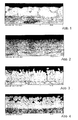
- Nachfolgend wird die Erfindung anhand von Abbildungen und Beispielen weiter offenbart. Es zeigen:
- Abb. 1
- einen Querschliff einer Probe eines erfindungsgemäß beschichteten Stahlsubstrats (Mn-B-Stahlsubstrats), wobei die Probe dem Ausgangs-zustand des beschichteten Stahlsubstrats entspricht;
- Abb. 2 - Abb. 4
- jeweils einen Querschliff einer Probe eines erfindungsgemäß beschichteten Stahlsubstrats nach einer Erwärmung auf eine Temperatur von 700°C, 800°C bzw. 900°C und einer Liegezeit von jeweils 5 min; und
- Abb. 5
- eine Probe eines erfindungsgemäß beschichteten Stahlsubstrats im Salzsprühtest nach einer Warmumformung mit 900°C und einer Liegezeit von 5 min, nach 48 h, 120 h, 192 h und 600 h, zur Veranschaulichung der Rotrostbildung.
- Die in der
Abb. 4 im oberen Bereich des Überzuges zu erkennenden "dunklen Löcher" entstehen durch das Anätzen der Querschliffe. Ohne ein solches Anätzen würden an diesen Stellen zinkreiche Phasen vorliegen, wie derAbb. 5 entnommen werden kann. Die zinkreichen Phasen stellen den aktiven Korrosionsschutz über das Prozesszeitfenster (Verarbeitungszeitfenster) sicher. - Ein geglühtes Kaltband aus 0,3 - 3 Gew.-% Mangan enthaltenden Stahlwerkstoff, der eine Streckgrenze von 150 - 1100 MPa und eine Zugfestigkeit von 300 - 1200 MPa aufweist, wird alkalisch spritzentfettet und elektrolytisch entfettet. Das Entfettungsbad enthält in einer Konzentration von ca. 15 g/l einen handelsüblichen Reiniger, der mehr als 25% Natriumhydroxid, 1 - 5 % eines Fettalkoholethers und 5 - 10% eines ethoxylierten, propoxylierten und methylierten C12-18 Alkohols aufweist. Die Badtemperatur beträgt ca. 65°C. Die Verweildauer in der Spritzentfettung beträgt 5 s. Daran schließt sich eine Bürstreinigung an. Im weiteren Verlauf wird das Band einer Schmelztauchbeschichtung (Feuerbeschichtung) unterworfen. Die metallische Schmelze ist aus einer Aluminium-Zink-Legierung gebildet, die 35 - 70 Gew.-% Aluminium, 35 - 60 Gew.-% Zink, 0,1- 10 Gew.-% Magnesium, 0,1 bis zu 10 Gew.-% Si und bis zu 5 Gew.-% Fe enthält. Zudem enthält die Aluminium-Zink-Legierung vorzugsweise Mangan und/oder Nickel in einem Gesamtanteil von max. 15 Gew.-%, wobei der Mangananteil bis zu 0,02 Gew.-% betragen kann. Die Gesamtschichtdicke des aus der Aluminium-Zink-Legierung gebildeten Überzuges wird durch eine Abstreifeinrichtung, beispielsweise Abstreifdüsen, auf eine Dicke im Bereich von 5 bis 50 µm, bevorzugt 10 bis 25 µm eingestellt. Das so beschichtete Band wird dann zu einem Coil aufgewickelt oder in Platinen bestimmter Länge abgelängt, und nach einer optionalen Zwischenlagerung einer Umformpresse zur Herstellung dreidimensional geformter, pressgehärteter Stahlbauteile zugeführt. Der Umformpresse ist eine Zuschneideeinrichtung vorgeschaltet, mittels der aus dem abgewickelten Coil bzw. den vorgeschnittenen, typischerweise rechteckigen Platinen an die Kontur des herzustellenden Stahlbauteils angepasste Platinen zugeschnitten werden. Die zugeschnittenen Platinen werden sodann auf eine oberhalb der Austenitisierungstemperatur des Stahlsubstrats liegende Verformungstemperatur erwärmt und im erwärmten Zustand in das Werkzeug der Umformpresse gelegt. Im Zuge der Umformung erfährt der Blechzuschnitt bzw. das aus ihm geformte Bauteil durch den Kontakt mit dem gekühlten Werkzeug eine schnelle Abkühlung. Die Abkühlraten sind dabei so eingestellt, dass sich im Bauteil ein Vergütungs- oder Härtegefüge ergibt.
- Warmband (gebeizt) der Güte 22MnB5 (1.5528) wird alkalisch spritzentfettet und elektrolytisch entfettet. Zusätzlich erfährt das Band in der alkalischen Spritzentfettung eine Bürstreinigung. Das Entfettungsbad enthält in einer Konzentration von ca. 20 g/l einen handelüblichen Reiniger, der 5 -10 % Natriumhydroxid und 10 - 20 % Kaliumhydroxid enthält. Die Badtemperatur beträgt ca. 75°C. Im weiteren Verlauf wird das Band einer Schmelztauchbeschichtung (Feuerbeschichtung) unterworfen. Die metallische Schmelze ist aus einer Aluminium-Zink-Legierung gebildet, die 35 - 70 Gew.-% Aluminium, 35 - 60 Gew.-% Zink, 0,1- 10 Gew.-% Magnesium, 0,1 bis zu 10 Gew.-% Si und bis zu 5 Gew.-% Fe enthält. Zudem enthält die Aluminium-Zink-Legierung vorzugsweise Mangan und/oder Nickel in einem Gesamtanteil von max. 15 Gew.-%, wobei der Mangananteil bis zu 0,02 Gew.-% betragen kann. Die Gesamtschichtdicke des metallischen Überzuges wird mittels einer Abstreifeinrichtung, z.B. mittels Druckluft- oder Inertgasdüsen, auf eine Dicke im Bereich von 5 bis 50 µm, vorzugsweise 10 bis 25 µm eingestellt. Das beschichtete Band wird dann zu einem Coil aufgewickelt oder in Platinen bestimmter Länge abgelängt, und nach einer optionalen Zwischenlagerung einer Umformpresse zur Herstellung pressgehärteter Stahlbauteile zugeführt. Der Umformpresse ist eine Zuschneideeinrichtung vorgeschaltet, mittels der aus dem abgewickelten Coil bzw. den vorgeschnittenen, typischerweise rechteckigen Platinen an die Kontur des herzustellenden Stahlbauteils angepasste Platinen zugeschnitten werden. Die zugeschnittenen Platinen werden dann bei Raumtemperatur in die Form oder eine Vorform des herzustellenden Stahlbauteils umgeformt (Kaltumformung). Anschließend wird das (vorgeformte) Bauteil auf eine oberhalb der Austenitisierungstemperatur des Stahls liegende Bauteiltemperatur erwärmt und im erwärmten Zustand in ein gekühltes Formwerkzeug der Umformpresse gelegt. In dem gekühlten Werkzeug wird das Bauteil gegebenenfalls fertigt geformt. Durch den Kontakt mit dem gekühlten Werkzeug erfährt das Bauteil eine rasche Abkühlung, so dass sich im Bauteil ein Vergütungs- oder Härtegefüge einstellt.
- Wie Beispiel 1 oder 2, jedoch mit dem Unterschied, dass nach der Beschichtung und vor der Umformung (Presshärtung) ein sogenannter Vorlegierungsprozess durchgeführt wird. Hierzu wird das Stahlflachprodukt oder die Platine auf eine Temperatur im Bereich zwischen 300°C und 650°C, vorzugsweise zwischen 350°C und 600°C erwärmt, so dass sich in dem Korrosionsschutzüberzug durch Diffusionsprozesse eine Eisenanreicherung ergibt.
- Wie Beispiel 1 oder 2, jedoch mit dem Unterschied, dass nach der Beschichtung und vor der Umformung (Presshärtung) ein sogenannter Alterungsprozess durchgeführt wird. Hierzu wird das Stahlflachprodukt oder die Platine in einem Durchlaufglühofen oder einem Haubenofen auf eine Temperatur im Bereich von 50°C bis 300°C erwärmt.
- Wie Beispiel 1, 2, 3 oder 4, jedoch mit dem Unterschied, dass vor dem Beschichten des Stahlflachprodukts mit dem aus der Aluminium-Zink-Legierung gebildeten Überzug zunächst ein Nickel enthaltende Beschichtung auf das Stahlflachprodukt aufgebracht wird. Die Nickelschicht verbessert die Beschichtbarkeit des Stahlsubstrats. Das Aufbringen des Nickelüberzuges (Basisschicht) erfolgt vorzugsweise elektrolytisch. Die Schichtdicke des Nickelüberzuges wird beispielsweise auf eine Dicke im Bereich von 1 µm bis 3 µm eingestellt.
- Optimale Arbeitsergebnisse ergeben sich bei den oben genannten Beispielen, wenn die Platinen- bzw. Bauteiltemperatur in an sich bekannter Weise maximal 940 °C, insbesondere 830 - 905 °C, beträgt. Dies gilt insbesondere dann, wenn das Formen des Stahlbauteils als Warmumformung im Anschluss an die Erwärmung auf die Platinen- bzw. Bauteiltemperatur so durchgeführt wird, dass die erwärmte Platine ("direktes" Verfahren) bzw. das erwärmte Stahlbauteil ("indirektes" Verfahren) unter Inkaufnahme eines gewissen Temperaturverlustes in das jeweils anschließend genutzte Formwerkzeug gelegt wird. Besonders betriebssicher lässt sich die jeweils abschließende Warmumformung dann durchführen, wenn die Platinen- bzw. Bauteiltemperatur 850 - 880 °C beträgt.
- Die Erwärmung auf die Platinen- bzw. Bauteiltemperatur kann in an sich bekannter Weise im Durchlauf in einem Durchlaufofen erfolgen. Typische Glühzeiten liegen dabei im Bereich von 3 - 15 min. Alternativ ist es jedoch auch möglich, die Erwärmung mittels einer induktiv oder konduktiv arbeitenden Erwärmungseinrichtung vorzunehmen. Dies erlaubt eine schnelle Erwärmung auf die jeweils vorgegebene Temperatur.
- Während der Erwärmung sollte die Ofenatmosphäre zwischen 17% und 23% Sauerstoff enthalten. Eine weitere Optimierung zur Reduzierung der Wasserstoffaufnahme des erfindungsgemäß beschichteten Stahlsubstrats kann durch Einleitung von getrockneter Luft erfolgen. Hierdurch wird die Ofenatmosphäre künstlich zu einem niedrigen Taupunkt geführt.
Claims (16)
- Verfahren zum Herstellen eines mit einem metallischen, vor Korrosion schützenden Überzug versehenen Stahlbauteils, umfassend folgende Arbeitsschritte:a) Zurverfügungstellen eines Stahlflachprodukts, das aus einem Stahlwerkstoff erzeugt ist, der eine Streckgrenze von 150 - 1100 MPa und eine Zugfestigkeit von 300 - 1200 MPa aufweist;b) Beschichten des Stahlflachprodukts mit einem
Korrosionsschutzüberzug, der aus einer Aluminium-Zink-Legierung gebildet ist, die 35 - 70 Gew.-% Aluminium, 35 - 60 Gew.-% Zink, 0,1 - 10 Gew.-% Mg, bis zu 10 Gew.-% Si und bis zu 5 Gew.-% Fe enthält;c) Erwärmen einer aus dem beschichteten Stahlflachprodukt gebildeten Platine auf eine mindestens 800°C betragende Platinentemperatur;d) Formen des Stahlbauteils aus der Platine in einem Formwerkzeug, unde) Härten des Stahlbauteils durch Abkühlen von einer Temperatur, bei der sich das Stahlbauteil in einem für die Ausbildung von Vergütungs- oder Härtegefüge geeigneten Zustand befindet, mit einer Abkühlrate, die zur Ausbildung des Vergütungs- oder Härtegefüges ausreicht. - Verfahren zum Herstellen eines mit einem metallischen, vor Korrosion schützenden Überzug versehenen Stahlbauteils, umfassend folgende Arbeitsschritte:a) Zurverfügungstellen eines Stahlflachprodukts, das aus einem Stahlwerkstoff erzeugt ist, der eine Streckgrenze von 150 - 1100 MPa und eine Zugfestigkeit von 300 - 1200 MPa aufweist;b) Beschichten des Stahlflachprodukts mit einem
Korrosionsschutzüberzug, der aus einer Aluminium-Zink-Legierung gebildet ist, die 35 - 70 Gew.-% Aluminium, 35 - 60 Gew.-% Zink, 0,1 - 10 Gew.-% Mg, bis zu 10 Gew.-% Si und bis zu 5 Gew.-% Fe enthält;c) Formen des Stahlbauteils aus einer aus dem Stahlflachprodukt gebildeten Platine in einem Formwerkzeug,d) Erwärmen des Stahlbauteils auf eine mindestens 800°C betragende Bauteiltemperatur; unde) Härten des Stahlbauteils durch Abkühlen von einer Temperatur, bei der sich das Stahlbauteil in einem für die Ausbildung von Vergütungs- oder Härtegefüge geeigneten Zustand befindet, mit einer Abkühlrate, die zur Ausbildung des Vergütungs- oder Härtegefüges ausreicht. - Verfahren nach Anspruch 2, dadurch gekennzeichnet, dass das Formen des Stahlbauteils (Arbeitsschritt c)) als Vorformen ausgeführt wird und dass das Stahlbauteil nach dem Erwärmen (Arbeitsschritt d)) fertig geformt wird.
- Verfahren nach einem der voranstehenden Ansprüche, dadurch gekennzeichnet, dass die zur Bildung des Korrosionsschutzüberzug verwendete Aluminium-Zink-Legierung bis zu 15 Gew.-% Elemente aus der Calcium, Nickel, Mangan und/oder andere Erdalkalimetalle umfassenden Gruppe enthält.
- Verfahren nach einem der voranstehenden Ansprüche, dadurch gekennzeichnet, dass vor dem Beschichten des Stahlflachprodukts mit dem Korrosionsschutzüberzug, der aus einer Aluminium-Zink-Legierung gebildet ist (Arbeitsschritt b)), zunächst ein Nickel enthaltender Überzug auf dem Stahlflachprodukt aufgebracht wird.
- Verfahren nach einem der voranstehenden Ansprüche, dadurch gekennzeichnet, dass das Stahlflachprodukt nach dem Beschichten mit dem Korrosionsschutzüberzug, der aus einer Aluminium-Zink-Legierung gebildet ist (Arbeitsschritt b)), und vor dem Formen des Stahlbauteils aus der Platine einer Wärmebehandlung unterzogen wird, wobei das Stahlflachprodukt oder die Platine auf eine Temperatur im Bereich zwischen 300°C und 700°C, vorzugsweise zwischen 350°C und 600°C erwärmt wird, so dass sich eine Eisenanreicherung im Korrosionsschutzüberzug ergibt.
- Verfahren nach einem der voranstehenden Ansprüche, dadurch gekennzeichnet, dass das Stahlflachprodukt nach dem Beschichten mit dem Korrosionsschutzüberzug, der aus einer Aluminium-Zink-Legierung gebildet ist (Arbeitsschritt b)), und vor dem Formen des Stahlbauteils aus der Platine einer Wärmebehandlung unterzogen wird, wobei das Stahlflachprodukt oder die Platine auf eine Temperatur im Bereich von 50°C bis 300°C erwärmt wird.
- Verfahren nach einem der voranstehenden Ansprüche, dadurch gekennzeichnet, dass der Korrosionsschutzüberzug nach einer Temperaturbehandlung im Bereich von 830 - 940°C von seiner Außenseite in Richtung des Stahlflachprodukts folgende Schichtenfolge aufweist:• Außenschicht aus Aluminium-Eisen-Phasen mit zinkreichen Phasen,• Zwischenschicht aus einer aluminiumreichen Aluminium-Eisen-Verbindung, und• Diffusionsschicht aus einem aluminiumreichen Eisenmischkristall.
- Verfahren nach einem der voranstehenden Ansprüche, dadurch gekennzeichnet, dass die Gesamtschichtdicke des Korrosionsschutzüberzuges so eingestellt wird, dass diese vor dem Erwärmen auf eine mindestens 800°C betragende Platinen-oder Bauteiltemperatur im Bereich von 5 µm bis 50 µm, vorzugsweise im Bereich von 10 µm bis 25 µm liegt.
- Verfahren nach einem der voranstehenden Ansprüche, dadurch gekennzeichnet, dass das Erwärmen der Platine oder des Stahlbauteils in einer Ofenatmosphäre durchgeführt wird, die zwischen 5 Vol.-% und 25 Vol.-% Sauerstoff enthält.
- Verfahren nach einem der voranstehenden Ansprüche, dadurch gekennzeichnet, dass das Erwärmen der Platine oder des Stahlbauteils in einer getrocknete Luft enthaltenden Ofenatmosphäre durchgeführt wird.
- Verfahren nach einem der voranstehenden Ansprüche, dadurch gekennzeichnet, dass der aus einer Aluminium-Zink-Legierung gebildete Korrosionsschutzüberzug mittels Feuerbeschichtung auf das Stahlflachprodukt aufgebracht wird.
- Stahlbauteil mit einem Stahlsubstrat aus Stahlwerkstoff, der eine Streckgrenze von 150 - 1100 MPa und eine Zugfestigkeit von 300 - 1200 MPa aufweist, und einem auf dem Stahlsubstrat aufgebrachten Korrosionsschutzüberzug, der aus einer Aluminium-Zink-Legierung gebildet ist, die 35 - 70 Gew.-% Aluminium, 35 - 60 Gew.-% Zink, 0,1- 10 Gew.-% Mg, bis zu 10 Gew.-% Si und bis zu 5 Gew.-% Fe enthält, wobei der Korrosionsschutzüberzug von seiner Außenseite in Richtung des Stahlsubstrats folgende Schichtenfolge aufweist:• Außenschicht aus Aluminium-Eisen-Phasen und zinkreichen Phasen,• Zwischenschicht aus einer aluminiumreichen Aluminium-Eisen-Verbindung, und• Diffusionsschicht aus einem aluminiumreichen Eisenmischkristall.
- Stahlbauteil nach Anspruch 13, dadurch gekennzeichnet, dass der Korrosionsschutzüberzug mehr als 5 µm, vorzugsweise mehr als 10 µm dick ist.
- Stahlbauteil nach Anspruch 13 oder 14, dadurch gekennzeichnet, dass der Korrosionsschutzüberzug Calcium, Nickel, Mangan und/oder andere Erdalkalimetalle enthält.
- Stahlbauteil nach einem der Ansprüche 13 bis 15, dadurch gekennzeichnet, dass zwischen der Innenschicht und dem Stahlsubstrat eine Nickel enthaltende Basisschicht angeordnet ist.
Priority Applications (7)
| Application Number | Priority Date | Filing Date | Title |
|---|---|---|---|
| EP13184274.2A EP2848709B1 (de) | 2013-09-13 | 2013-09-13 | Verfahren zum Herstellen eines mit einem metallischen, vor Korrosion schützenden Überzug versehenen Stahlbauteils und Stahlbauteil |
| KR1020167009413A KR102301116B1 (ko) | 2013-09-13 | 2014-07-15 | 부식에 대한 보호를 제공하는 금속성 코팅이 제공된 강 부품의 제조 방법, 및 강 부품 |
| MX2016003166A MX382974B (es) | 2013-09-13 | 2014-07-15 | Componente de acero provisto de un revestimiento metálico anticorrosión, y procedimiento de producción del mismo. |
| JP2016541852A JP6640090B2 (ja) | 2013-09-13 | 2014-07-15 | 防食コーティングを具えた鋼部品およびその製造方法 |
| US14/917,899 US10287647B2 (en) | 2013-09-13 | 2014-07-15 | Method for producing a steel component having a metal coating protecting it against corrosion, and steel component |
| CN201480050585.6A CN105531385B (zh) | 2013-09-13 | 2014-07-15 | 制造设有金属防腐蚀保护层的钢构件的方法以及钢构件 |
| PCT/EP2014/065141 WO2015036151A1 (de) | 2013-09-13 | 2014-07-15 | Verfahren zum herstellen eines mit einem metallischen, vor korrosion schützenden überzug versehenen stahlbauteils und stahlbauteil |
Applications Claiming Priority (1)
| Application Number | Priority Date | Filing Date | Title |
|---|---|---|---|
| EP13184274.2A EP2848709B1 (de) | 2013-09-13 | 2013-09-13 | Verfahren zum Herstellen eines mit einem metallischen, vor Korrosion schützenden Überzug versehenen Stahlbauteils und Stahlbauteil |
Publications (2)
| Publication Number | Publication Date |
|---|---|
| EP2848709A1 true EP2848709A1 (de) | 2015-03-18 |
| EP2848709B1 EP2848709B1 (de) | 2020-03-04 |
Family
ID=49212595
Family Applications (1)
| Application Number | Title | Priority Date | Filing Date |
|---|---|---|---|
| EP13184274.2A Active EP2848709B1 (de) | 2013-09-13 | 2013-09-13 | Verfahren zum Herstellen eines mit einem metallischen, vor Korrosion schützenden Überzug versehenen Stahlbauteils und Stahlbauteil |
Country Status (7)
| Country | Link |
|---|---|
| US (1) | US10287647B2 (de) |
| EP (1) | EP2848709B1 (de) |
| JP (1) | JP6640090B2 (de) |
| KR (1) | KR102301116B1 (de) |
| CN (1) | CN105531385B (de) |
| MX (1) | MX382974B (de) |
| WO (1) | WO2015036151A1 (de) |
Cited By (9)
| Publication number | Priority date | Publication date | Assignee | Title |
|---|---|---|---|---|
| WO2016198186A1 (de) * | 2015-06-08 | 2016-12-15 | Volkswagen Aktiengesellschaft | Verfahren zur warmumformung eines stahlbauteils |
| WO2019016041A1 (de) | 2017-07-21 | 2019-01-24 | Thyssenkrupp Steel Europe Ag | Stahlflachprodukt mit guter alterungsbeständigkeit und verfahren zu seiner herstellung |
| DE102017214561B4 (de) | 2016-08-29 | 2019-05-16 | Magna Powertrain Inc. | Verfahren zum Bilden einer Keilverzahnung in einer Komponente unter Verwendung von ultrahochfestem Stahl |
| WO2020094285A1 (de) * | 2018-11-09 | 2020-05-14 | Thyssenkrupp Steel Europe Ag | Gehärtetes bauteil umfassend ein stahlsubstrat und eine korrosionsschutzbeschichtung, entsprechendes bauteil zur herstellung des gehärteten bauteils sowie herstellverfahren und verwendung |
| EP3712292A2 (de) | 2019-03-19 | 2020-09-23 | ThyssenKrupp Steel Europe AG | Bauteil umfassend ein stahlsubstrat, eine zwischenschicht und eine korrosionsschutzbeschichtung, entsprechendes gehärtetes bauteil sowie entsprechende verfahren und verwendungen |
| EP3604603A4 (de) * | 2017-03-31 | 2020-10-07 | Nippon Steel Corporation | Oberflächenbehandeltes stahlblech |
| US10837072B2 (en) | 2016-08-29 | 2020-11-17 | Magna Powertrain Inc. | Splined power transmission components made using heat-assisted calibration process and method of forming such splined power transmission components |
| WO2021254610A1 (de) | 2020-06-17 | 2021-12-23 | Thyssenkrupp Steel Europe Ag | Verfahren zum herstellen eines stahlflachprodukts, stahlflachprodukt und verwendung eines solchen stahlflachprodukts |
| US20220052410A1 (en) * | 2018-12-13 | 2022-02-17 | Thyssenkrupp Steel Europe Ag | Battery housing and use thereof |
Families Citing this family (36)
| Publication number | Priority date | Publication date | Assignee | Title |
|---|---|---|---|---|
| DE102015209660B4 (de) * | 2015-05-27 | 2018-01-04 | Volkswagen Aktiengesellschaft | Verfahren zur Herstellung eines Blechumformteils |
| WO2017017484A1 (en) | 2015-07-30 | 2017-02-02 | Arcelormittal | Method for the manufacture of a hardened part which does not have lme issues |
| WO2017017483A1 (en) | 2015-07-30 | 2017-02-02 | Arcelormittal | Steel sheet coated with a metallic coating based on aluminum |
| DE102016121902A1 (de) * | 2016-11-15 | 2018-05-17 | Salzgitter Flachstahl Gmbh | Verfahren zur Herstellung von Fahrwerksteilen aus mikrolegiertem Stahl mit verbesserter Kaltumformbarkeit |
| CN110088349B (zh) * | 2016-12-21 | 2022-04-01 | Posco公司 | 牺牲腐蚀保护性及镀覆性优异的高锰热浸镀铝钢板及其制造方法 |
| DE102017208727A1 (de) | 2017-05-23 | 2018-11-29 | Thyssenkrupp Ag | Verbesserung der Kaltumformeignung aluminiumbasierter Beschichtung durch Zulegieren von Erdalkalimetallen |
| DE102017210201A1 (de) | 2017-06-19 | 2018-12-20 | Thyssenkrupp Ag | Verfahren zur Herstellung eines mit einem metallischen, vor Korrosion schützenden Überzug versehenen Stahlbauteils |
| DE102017211753A1 (de) | 2017-07-10 | 2019-01-10 | Thyssenkrupp Ag | Verfahren zur Herstellung eines pressgehärteten Bauteils |
| DE102017218704A1 (de) | 2017-10-19 | 2019-04-25 | Thyssenkrupp Ag | Verfahren zur Herstellung eines mit einem metallischen, vor Korrosion schützenden Überzug versehenen Stahlbauteils |
| KR102043522B1 (ko) * | 2017-12-22 | 2019-11-12 | 주식회사 포스코 | 용접 액화 취성에 대한 저항성 및 도금 밀착성이 우수한 알루미늄 합금 도금강판 |
| KR102153164B1 (ko) | 2017-12-26 | 2020-09-07 | 주식회사 포스코 | 열간 프레스 성형용 도금강판 및 이를 이용한 성형부재 |
| US11168379B2 (en) * | 2018-02-12 | 2021-11-09 | Ford Motor Company | Pre-conditioned AlSiFe coating of boron steel used in hot stamping |
| WO2019171157A1 (en) * | 2018-03-09 | 2019-09-12 | Arcelormittal | A manufacturing process of press hardened parts with high productivity |
| US11338550B2 (en) * | 2018-03-20 | 2022-05-24 | Nippon Steel Corporation | Hot-stamped body |
| MX2020009562A (es) * | 2018-03-20 | 2020-10-05 | Nippon Steel Corp | Cuerpo estampado en caliente. |
| EP3775299B1 (de) * | 2018-04-05 | 2024-09-18 | ThyssenKrupp Steel Europe AG | Verfahren zum herstellen eines mit einem überzug versehenen stahlbauteils aus einem stahlflachprodukt |
| KR102153172B1 (ko) | 2018-08-30 | 2020-09-07 | 주식회사 포스코 | 열간 성형성 및 내식성이 우수한 알루미늄-아연 합금 도금강판 및 그 제조방법 |
| WO2020070545A1 (en) * | 2018-10-04 | 2020-04-09 | Arcelormittal | A press hardening method |
| DE102019100140A1 (de) * | 2019-01-04 | 2020-07-09 | Salzgitter Flachstahl Gmbh | Aluminiumbasierte Beschichtung für Stahlflachprodukte zur Pressformhärtung von Bauteilen und Verfahren zur Herstellung hierzu |
| EP3922738A4 (de) * | 2019-02-05 | 2022-03-23 | Nippon Steel Corporation | Stahlelement, beschichtetes stahlblech und verfahren zu seiner herstellung |
| EP4092142A1 (de) | 2019-06-03 | 2022-11-23 | ThyssenKrupp Steel Europe AG | Verfahren zum herstellen eines blechbauteils aus einem mit einer korrosionsschutzbeschichtung versehenen stahlflachprodukt |
| WO2021084305A1 (en) | 2019-10-30 | 2021-05-06 | Arcelormittal | A press hardening method |
| WO2021084303A1 (en) * | 2019-10-30 | 2021-05-06 | Arcelormittal | A press hardening method |
| WO2021084302A1 (en) * | 2019-10-30 | 2021-05-06 | Arcelormittal | A press hardening method |
| US11401758B2 (en) * | 2020-01-10 | 2022-08-02 | William Thomas Phillips, Inc. | System and apparatus comprising a guide for a gripping tool and method of using same |
| US11753882B2 (en) * | 2020-01-10 | 2023-09-12 | William Thomas Phillips, Inc. | System and apparatus comprising a guide for a gripping tool |
| USD935491S1 (en) | 2020-01-10 | 2021-11-09 | William Thomas Phillips, Inc. | Nubbin having a guide for a gripping tool |
| US12043902B2 (en) | 2020-01-24 | 2024-07-23 | Thyssenkrupp Steel Europe Ag | Steel component comprising an anti-corrosion layer containing manganese |
| KR102888145B1 (ko) * | 2021-01-14 | 2025-11-19 | 닛폰세이테츠 가부시키가이샤 | 핫 스탬프 부재 |
| DE102021107330A1 (de) * | 2021-03-24 | 2022-09-29 | Thyssenkrupp Steel Europe Ag | Beschichtetes Stahlflachprodukt und Verfahren zu seiner Herstellung |
| KR20220158157A (ko) * | 2021-05-21 | 2022-11-30 | 주식회사 포스코 | 내수소취성이 우수한 열간성형용 도금강판, 열간성형 부재 및 이들의 제조방법 |
| JP7537376B2 (ja) * | 2021-06-18 | 2024-08-21 | Jfeスチール株式会社 | 熱間プレス部材、その製造方法および熱間プレス用鋼板 |
| EP4283003A1 (de) | 2022-05-24 | 2023-11-29 | ThyssenKrupp Steel Europe AG | Verfahren zum herstellen eines blechformteils |
| EP4339324A1 (de) | 2022-09-19 | 2024-03-20 | ThyssenKrupp Steel Europe AG | Stahlflachprodukt mit einer aktivierungsschicht für die warmumformung |
| EP4438757A1 (de) | 2023-03-28 | 2024-10-02 | ThyssenKrupp Steel Europe AG | Schmelztauchbeschichtetes und phosphatiertes stahlflachprodukt für die warmumformung |
| DE102023133565A1 (de) | 2023-11-30 | 2025-06-05 | Fraunhofer-Gesellschaft zur Förderung der angewandten Forschung eingetragener Verein | Verfahren zur Herstellung einer Blecheinheit sowie eine Blecheinheit |
Citations (7)
| Publication number | Priority date | Publication date | Assignee | Title |
|---|---|---|---|---|
| EP0480122A2 (de) * | 1990-10-09 | 1992-04-15 | Nippon Steel Corporation | Verfahren zur Herstellung galvanisierter Stahlbleche durch Vorbeschichtung mit einer Nickelschicht |
| EP1225246A1 (de) * | 1999-08-09 | 2002-07-24 | Nippon Steel Corporation | Zn-Al-Mg-Si-LEGIERTES UND GEPLÄTTETES STAHLPRODUKT MIT EXZELLENTEN ANTI-KORROSIONS-EIGENSCHAFTEN UND VERFAHREN ZUR HERSTELLUNG DESSELBEN |
| WO2008025066A1 (en) * | 2006-08-29 | 2008-03-06 | Bluescope Steel Limited | Metal-coated steel strip |
| DE102009007909A1 (de) * | 2009-02-06 | 2010-08-12 | Thyssenkrupp Steel Europe Ag | Verfahren zum Herstellen eines Stahlbauteils durch Warmformen und durch Warmformen hergestelltes Stahlbauteil |
| EP2290133A1 (de) | 2009-08-25 | 2011-03-02 | ThyssenKrupp Steel Europe AG | Verfahren zum Herstellen eines mit einem metallischen, vor Korrosion schützenden Überzug versehenen Stahlbauteils und Stahlbauteil |
| DE102010017354A1 (de) * | 2010-06-14 | 2011-12-15 | Thyssenkrupp Steel Europe Ag | Verfahren zum Herstellen eines warmgeformten und gehärteten, mit einer metallischen Korrosionsschutzbeschichtung überzogenen Stahlbauteils aus einem Stahlflachprodukt |
| DE102010030465A1 (de) * | 2010-06-24 | 2011-12-29 | Bayerische Motoren Werke Aktiengesellschaft | Verfahren zum Herstellen eines Blechformteils aus einem höherfesten Stahlblechmaterial mit einer elektrolytisch aufgebrachten Zink-Nickel-Beschichtung |
Family Cites Families (9)
| Publication number | Priority date | Publication date | Assignee | Title |
|---|---|---|---|---|
| JP2002129300A (ja) * | 2000-10-24 | 2002-05-09 | Nippon Steel Corp | 耐食性と加工性に優れた表面処理鋼板とその製造法 |
| JP3694480B2 (ja) * | 2001-12-17 | 2005-09-14 | 新日本製鐵株式会社 | 高張力溶融Zn−Mg−Alめっき鋼板の製造方法 |
| NZ562141A (en) * | 2005-04-05 | 2009-10-30 | Bluescope Steel Ltd | Metal-coated steel strip comprising a coating of an aluminium-zic-silicon alloy that contains magnesium |
| ATE535631T1 (de) * | 2007-10-02 | 2011-12-15 | Thyssenkrupp Steel Europe Ag | Verfahren zum herstellen eines stahlbauteils durch warmformen und durch warmformen hergestelltes stahlbauteil |
| KR20100108543A (ko) * | 2008-02-07 | 2010-10-07 | 블루스코프 스틸 리미티드 | 금속 코팅된 강철 스트립 |
| AU2009225258B9 (en) * | 2008-03-13 | 2020-05-07 | Bluescope Steel Limited | Metal-coated steel strip |
| KR101707984B1 (ko) * | 2010-11-26 | 2017-02-17 | 제이에프이 스틸 가부시키가이샤 | 용융 Al-Zn계 도금 강판 |
| KR101636443B1 (ko) * | 2010-11-26 | 2016-07-05 | 제이에프이 스틸 가부시키가이샤 | 용융 Al-Zn계 도금 강판 및 그의 제조 방법 |
| DE102011001140A1 (de) * | 2011-03-08 | 2012-09-13 | Thyssenkrupp Steel Europe Ag | Stahlflachprodukt, Verfahren zum Herstellen eines Stahlflachprodukts und Verfahren zum Herstellen eines Bauteils |
-
2013
- 2013-09-13 EP EP13184274.2A patent/EP2848709B1/de active Active
-
2014
- 2014-07-15 US US14/917,899 patent/US10287647B2/en active Active
- 2014-07-15 CN CN201480050585.6A patent/CN105531385B/zh active Active
- 2014-07-15 KR KR1020167009413A patent/KR102301116B1/ko active Active
- 2014-07-15 MX MX2016003166A patent/MX382974B/es unknown
- 2014-07-15 WO PCT/EP2014/065141 patent/WO2015036151A1/de not_active Ceased
- 2014-07-15 JP JP2016541852A patent/JP6640090B2/ja active Active
Patent Citations (7)
| Publication number | Priority date | Publication date | Assignee | Title |
|---|---|---|---|---|
| EP0480122A2 (de) * | 1990-10-09 | 1992-04-15 | Nippon Steel Corporation | Verfahren zur Herstellung galvanisierter Stahlbleche durch Vorbeschichtung mit einer Nickelschicht |
| EP1225246A1 (de) * | 1999-08-09 | 2002-07-24 | Nippon Steel Corporation | Zn-Al-Mg-Si-LEGIERTES UND GEPLÄTTETES STAHLPRODUKT MIT EXZELLENTEN ANTI-KORROSIONS-EIGENSCHAFTEN UND VERFAHREN ZUR HERSTELLUNG DESSELBEN |
| WO2008025066A1 (en) * | 2006-08-29 | 2008-03-06 | Bluescope Steel Limited | Metal-coated steel strip |
| DE102009007909A1 (de) * | 2009-02-06 | 2010-08-12 | Thyssenkrupp Steel Europe Ag | Verfahren zum Herstellen eines Stahlbauteils durch Warmformen und durch Warmformen hergestelltes Stahlbauteil |
| EP2290133A1 (de) | 2009-08-25 | 2011-03-02 | ThyssenKrupp Steel Europe AG | Verfahren zum Herstellen eines mit einem metallischen, vor Korrosion schützenden Überzug versehenen Stahlbauteils und Stahlbauteil |
| DE102010017354A1 (de) * | 2010-06-14 | 2011-12-15 | Thyssenkrupp Steel Europe Ag | Verfahren zum Herstellen eines warmgeformten und gehärteten, mit einer metallischen Korrosionsschutzbeschichtung überzogenen Stahlbauteils aus einem Stahlflachprodukt |
| DE102010030465A1 (de) * | 2010-06-24 | 2011-12-29 | Bayerische Motoren Werke Aktiengesellschaft | Verfahren zum Herstellen eines Blechformteils aus einem höherfesten Stahlblechmaterial mit einer elektrolytisch aufgebrachten Zink-Nickel-Beschichtung |
Non-Patent Citations (1)
| Title |
|---|
| DRILLET P ET AL: "Study of cracks propagation inside the steel on press hardened steel zinc based coatings", METALLURGIA ITALIANA, ASSOCIAZIONE ITALIANA DI METALLURGIA, MILAN, IT, vol. 104, no. 1, 1 January 2012 (2012-01-01), pages 3 - 8, XP009176187, ISSN: 0026-0843 * |
Cited By (14)
| Publication number | Priority date | Publication date | Assignee | Title |
|---|---|---|---|---|
| WO2016198186A1 (de) * | 2015-06-08 | 2016-12-15 | Volkswagen Aktiengesellschaft | Verfahren zur warmumformung eines stahlbauteils |
| DE102015210459B4 (de) * | 2015-06-08 | 2021-03-04 | Volkswagen Aktiengesellschaft | Verfahren zur Warmumformung eines Stahlbauteils |
| US10900110B2 (en) | 2015-06-08 | 2021-01-26 | Volkswagen Aktiengesellschaft | Method for the hot forming of a steel component |
| DE102017214561B4 (de) | 2016-08-29 | 2019-05-16 | Magna Powertrain Inc. | Verfahren zum Bilden einer Keilverzahnung in einer Komponente unter Verwendung von ultrahochfestem Stahl |
| US10837072B2 (en) | 2016-08-29 | 2020-11-17 | Magna Powertrain Inc. | Splined power transmission components made using heat-assisted calibration process and method of forming such splined power transmission components |
| EP3604603A4 (de) * | 2017-03-31 | 2020-10-07 | Nippon Steel Corporation | Oberflächenbehandeltes stahlblech |
| WO2019016041A1 (de) | 2017-07-21 | 2019-01-24 | Thyssenkrupp Steel Europe Ag | Stahlflachprodukt mit guter alterungsbeständigkeit und verfahren zu seiner herstellung |
| EP3974554A1 (de) | 2017-07-21 | 2022-03-30 | ThyssenKrupp Steel Europe AG | Stahlflachprodukt mit guter alterungsbeständigkeit und verfahren zu seiner herstellung |
| WO2020094285A1 (de) * | 2018-11-09 | 2020-05-14 | Thyssenkrupp Steel Europe Ag | Gehärtetes bauteil umfassend ein stahlsubstrat und eine korrosionsschutzbeschichtung, entsprechendes bauteil zur herstellung des gehärteten bauteils sowie herstellverfahren und verwendung |
| US20220052410A1 (en) * | 2018-12-13 | 2022-02-17 | Thyssenkrupp Steel Europe Ag | Battery housing and use thereof |
| WO2020187929A1 (de) | 2019-03-19 | 2020-09-24 | Thyssenkrupp Steel Europe Ag | Bauteil umfassend ein stahlsubstrat, eine zwischenschicht und eine korrosionsschutzbeschichtung, entsprechendes gehärtetes bauteil sowie entsprechende verfahren und verwendungen |
| EP3712292A2 (de) | 2019-03-19 | 2020-09-23 | ThyssenKrupp Steel Europe AG | Bauteil umfassend ein stahlsubstrat, eine zwischenschicht und eine korrosionsschutzbeschichtung, entsprechendes gehärtetes bauteil sowie entsprechende verfahren und verwendungen |
| US12421610B2 (en) | 2019-03-19 | 2025-09-23 | Thyssenkrupp Steel Europe Ag | Component comprising a steel substrate, an intermediate layer and an anticorrosion coating, corresponding hardened component and corresponding methods and uses |
| WO2021254610A1 (de) | 2020-06-17 | 2021-12-23 | Thyssenkrupp Steel Europe Ag | Verfahren zum herstellen eines stahlflachprodukts, stahlflachprodukt und verwendung eines solchen stahlflachprodukts |
Also Published As
| Publication number | Publication date |
|---|---|
| US20160222484A1 (en) | 2016-08-04 |
| MX382974B (es) | 2025-03-12 |
| JP2016539249A (ja) | 2016-12-15 |
| KR102301116B1 (ko) | 2021-09-10 |
| EP2848709B1 (de) | 2020-03-04 |
| KR20160057418A (ko) | 2016-05-23 |
| JP6640090B2 (ja) | 2020-02-05 |
| US10287647B2 (en) | 2019-05-14 |
| MX2016003166A (es) | 2016-06-24 |
| CN105531385B (zh) | 2018-01-30 |
| WO2015036151A1 (de) | 2015-03-19 |
| CN105531385A (zh) | 2016-04-27 |
Similar Documents
| Publication | Publication Date | Title |
|---|---|---|
| EP2848709B1 (de) | Verfahren zum Herstellen eines mit einem metallischen, vor Korrosion schützenden Überzug versehenen Stahlbauteils und Stahlbauteil | |
| EP2393953B1 (de) | Verfahren zum herstellen eines beschichteten stahlbauteils durch warmformen und durch warmformen hergestelltes stahlbauteil | |
| EP1660693B1 (de) | Verfahren zum herstellen eines gehärteten profilbauteils | |
| EP2656187B1 (de) | Verfahren zum erzeugen gehärteter bauteile | |
| EP2848715B1 (de) | Verfahren zum herstellen eines mit einem metallischen, vor korrosion schützenden überzug versehenen stahlbauteils | |
| EP2045360B1 (de) | Verfahren zum Herstellen eines Stahlbauteils durch Warmformen und durch Warmformen hergestelltes Stahlbauteil | |
| DE60119826T2 (de) | Verfahren zum Herstellen eines Bauteils mit sehr guten mechanischen Eigenschaften, Umformung durch Tiefziehen, aus gewalztem insbesondere warmgewalztem und beschichtetem Stahlblech | |
| EP2553133B1 (de) | Stahl, stahlflachprodukt, stahlbauteil und verfahren zur herstellung eines stahlbauteils | |
| EP3041969B1 (de) | Zinkbasierte korrosionsschutzbeschichtung für stahlbleche zur herstellung eines bauteils bei erhöhter temperatur durch presshärten | |
| EP3215656B1 (de) | Verfahren zum herstellen einer korrosionsschutzbeschichtung für härtbare stahlbleche und korrosionsschutzschicht für härtbare stahlbleche | |
| DE102009044861B3 (de) | Verfahren zum Herstellen eines gut umformbaren Stahlflachprodukts, Stahlflachprodukt und Verfahren zur Herstellung eines Bauteils aus einem solchen Stahlflachprodukt | |
| EP3250727B2 (de) | Verfahren zur herstellung eines bauteils aus pressformgehärtetem, auf basis von aluminium beschichtetem stahlblech | |
| EP3728654A1 (de) | Kaltgewalztes stahlflachprodukt mit metallischer korrosionsschutzschicht und verfahren zur herstellung eines solchen | |
| DE102010056265C5 (de) | Verfahren zum Erzeugen gehärteter Bauteile | |
| DE102015202642A1 (de) | Verfahren zum Herstellen eines Erzeugnisses aus gewalztem Bandmaterial | |
| WO2016026885A1 (de) | Oberflächenveredeltes stahlblech und verfahren zu dessen herstellung | |
| EP3658307A1 (de) | Blechbauteil, hergestellt durch warmumformen eines stahlflachprodukts und verfahren zu dessen herstellung | |
| EP2944710B1 (de) | Verfahren zur Herstellung eines mit einer metallischen, korrosionsschützenden Beschichtung versehenen warmumgeformten Stahlbauteils aus presshärtbarem Stahl | |
| EP3877564A1 (de) | Gehärtetes bauteil umfassend ein stahlsubstrat und eine korrosionsschutzbeschichtung, entsprechendes bauteil zur herstellung des gehärteten bauteils sowie herstellverfahren und verwendung | |
| WO2007141152A1 (de) | Mangan-bor-stahl, aus einem solchen stahl hergestelltes flachprodukt und verfahren zu dessen herstellung | |
| DE69701070T2 (de) | Feuerverzinktes Stahlblech und Herstellungsverfahren dafür | |
| DE69408739T2 (de) | Oberflächenbehandeltes Stahlblech und Methode zur Herstellung desselben | |
| EP4093896A1 (de) | Stahlbauteil mit einer manganhaltigen korrosionsschutzschicht |
Legal Events
| Date | Code | Title | Description |
|---|---|---|---|
| PUAI | Public reference made under article 153(3) epc to a published international application that has entered the european phase |
Free format text: ORIGINAL CODE: 0009012 |
|
| 17P | Request for examination filed |
Effective date: 20130913 |
|
| AK | Designated contracting states |
Kind code of ref document: A1 Designated state(s): AL AT BE BG CH CY CZ DE DK EE ES FI FR GB GR HR HU IE IS IT LI LT LU LV MC MK MT NL NO PL PT RO RS SE SI SK SM TR |
|
| AX | Request for extension of the european patent |
Extension state: BA ME |
|
| R17P | Request for examination filed (corrected) |
Effective date: 20150903 |
|
| RBV | Designated contracting states (corrected) |
Designated state(s): AL AT BE BG CH CY CZ DE DK EE ES FI FR GB GR HR HU IE IS IT LI LT LU LV MC MK MT NL NO PL PT RO RS SE SI SK SM TR |
|
| STAA | Information on the status of an ep patent application or granted ep patent |
Free format text: STATUS: EXAMINATION IS IN PROGRESS |
|
| 17Q | First examination report despatched |
Effective date: 20170706 |
|
| GRAP | Despatch of communication of intention to grant a patent |
Free format text: ORIGINAL CODE: EPIDOSNIGR1 |
|
| STAA | Information on the status of an ep patent application or granted ep patent |
Free format text: STATUS: GRANT OF PATENT IS INTENDED |
|
| INTG | Intention to grant announced |
Effective date: 20191016 |
|
| GRAS | Grant fee paid |
Free format text: ORIGINAL CODE: EPIDOSNIGR3 |
|
| GRAA | (expected) grant |
Free format text: ORIGINAL CODE: 0009210 |
|
| STAA | Information on the status of an ep patent application or granted ep patent |
Free format text: STATUS: THE PATENT HAS BEEN GRANTED |
|
| AK | Designated contracting states |
Kind code of ref document: B1 Designated state(s): AL AT BE BG CH CY CZ DE DK EE ES FI FR GB GR HR HU IE IS IT LI LT LU LV MC MK MT NL NO PL PT RO RS SE SI SK SM TR |
|
| REG | Reference to a national code |
Ref country code: GB Ref legal event code: FG4D Free format text: NOT ENGLISH |
|
| REG | Reference to a national code |
Ref country code: CH Ref legal event code: EP |
|
| REG | Reference to a national code |
Ref country code: AT Ref legal event code: REF Ref document number: 1240423 Country of ref document: AT Kind code of ref document: T Effective date: 20200315 |
|
| REG | Reference to a national code |
Ref country code: DE Ref legal event code: R096 Ref document number: 502013014376 Country of ref document: DE |
|
| REG | Reference to a national code |
Ref country code: IE Ref legal event code: FG4D Free format text: LANGUAGE OF EP DOCUMENT: GERMAN |
|
| REG | Reference to a national code |
Ref country code: NL Ref legal event code: FP |
|
| PG25 | Lapsed in a contracting state [announced via postgrant information from national office to epo] |
Ref country code: RS Free format text: LAPSE BECAUSE OF FAILURE TO SUBMIT A TRANSLATION OF THE DESCRIPTION OR TO PAY THE FEE WITHIN THE PRESCRIBED TIME-LIMIT Effective date: 20200304 Ref country code: NO Free format text: LAPSE BECAUSE OF FAILURE TO SUBMIT A TRANSLATION OF THE DESCRIPTION OR TO PAY THE FEE WITHIN THE PRESCRIBED TIME-LIMIT Effective date: 20200604 Ref country code: FI Free format text: LAPSE BECAUSE OF FAILURE TO SUBMIT A TRANSLATION OF THE DESCRIPTION OR TO PAY THE FEE WITHIN THE PRESCRIBED TIME-LIMIT Effective date: 20200304 |
|
| PG25 | Lapsed in a contracting state [announced via postgrant information from national office to epo] |
Ref country code: LV Free format text: LAPSE BECAUSE OF FAILURE TO SUBMIT A TRANSLATION OF THE DESCRIPTION OR TO PAY THE FEE WITHIN THE PRESCRIBED TIME-LIMIT Effective date: 20200304 Ref country code: GR Free format text: LAPSE BECAUSE OF FAILURE TO SUBMIT A TRANSLATION OF THE DESCRIPTION OR TO PAY THE FEE WITHIN THE PRESCRIBED TIME-LIMIT Effective date: 20200605 Ref country code: SE Free format text: LAPSE BECAUSE OF FAILURE TO SUBMIT A TRANSLATION OF THE DESCRIPTION OR TO PAY THE FEE WITHIN THE PRESCRIBED TIME-LIMIT Effective date: 20200304 Ref country code: HR Free format text: LAPSE BECAUSE OF FAILURE TO SUBMIT A TRANSLATION OF THE DESCRIPTION OR TO PAY THE FEE WITHIN THE PRESCRIBED TIME-LIMIT Effective date: 20200304 Ref country code: BG Free format text: LAPSE BECAUSE OF FAILURE TO SUBMIT A TRANSLATION OF THE DESCRIPTION OR TO PAY THE FEE WITHIN THE PRESCRIBED TIME-LIMIT Effective date: 20200604 |
|
| REG | Reference to a national code |
Ref country code: LT Ref legal event code: MG4D |
|
| PG25 | Lapsed in a contracting state [announced via postgrant information from national office to epo] |
Ref country code: LT Free format text: LAPSE BECAUSE OF FAILURE TO SUBMIT A TRANSLATION OF THE DESCRIPTION OR TO PAY THE FEE WITHIN THE PRESCRIBED TIME-LIMIT Effective date: 20200304 Ref country code: SK Free format text: LAPSE BECAUSE OF FAILURE TO SUBMIT A TRANSLATION OF THE DESCRIPTION OR TO PAY THE FEE WITHIN THE PRESCRIBED TIME-LIMIT Effective date: 20200304 Ref country code: ES Free format text: LAPSE BECAUSE OF FAILURE TO SUBMIT A TRANSLATION OF THE DESCRIPTION OR TO PAY THE FEE WITHIN THE PRESCRIBED TIME-LIMIT Effective date: 20200304 Ref country code: IS Free format text: LAPSE BECAUSE OF FAILURE TO SUBMIT A TRANSLATION OF THE DESCRIPTION OR TO PAY THE FEE WITHIN THE PRESCRIBED TIME-LIMIT Effective date: 20200704 Ref country code: CZ Free format text: LAPSE BECAUSE OF FAILURE TO SUBMIT A TRANSLATION OF THE DESCRIPTION OR TO PAY THE FEE WITHIN THE PRESCRIBED TIME-LIMIT Effective date: 20200304 Ref country code: RO Free format text: LAPSE BECAUSE OF FAILURE TO SUBMIT A TRANSLATION OF THE DESCRIPTION OR TO PAY THE FEE WITHIN THE PRESCRIBED TIME-LIMIT Effective date: 20200304 Ref country code: PT Free format text: LAPSE BECAUSE OF FAILURE TO SUBMIT A TRANSLATION OF THE DESCRIPTION OR TO PAY THE FEE WITHIN THE PRESCRIBED TIME-LIMIT Effective date: 20200729 Ref country code: EE Free format text: LAPSE BECAUSE OF FAILURE TO SUBMIT A TRANSLATION OF THE DESCRIPTION OR TO PAY THE FEE WITHIN THE PRESCRIBED TIME-LIMIT Effective date: 20200304 Ref country code: SM Free format text: LAPSE BECAUSE OF FAILURE TO SUBMIT A TRANSLATION OF THE DESCRIPTION OR TO PAY THE FEE WITHIN THE PRESCRIBED TIME-LIMIT Effective date: 20200304 |
|
| PGFP | Annual fee paid to national office [announced via postgrant information from national office to epo] |
Ref country code: AT Payment date: 20200921 Year of fee payment: 8 |
|
| REG | Reference to a national code |
Ref country code: DE Ref legal event code: R097 Ref document number: 502013014376 Country of ref document: DE |
|
| PLBE | No opposition filed within time limit |
Free format text: ORIGINAL CODE: 0009261 |
|
| STAA | Information on the status of an ep patent application or granted ep patent |
Free format text: STATUS: NO OPPOSITION FILED WITHIN TIME LIMIT |
|
| PG25 | Lapsed in a contracting state [announced via postgrant information from national office to epo] |
Ref country code: DK Free format text: LAPSE BECAUSE OF FAILURE TO SUBMIT A TRANSLATION OF THE DESCRIPTION OR TO PAY THE FEE WITHIN THE PRESCRIBED TIME-LIMIT Effective date: 20200304 Ref country code: IT Free format text: LAPSE BECAUSE OF FAILURE TO SUBMIT A TRANSLATION OF THE DESCRIPTION OR TO PAY THE FEE WITHIN THE PRESCRIBED TIME-LIMIT Effective date: 20200304 |
|
| 26N | No opposition filed |
Effective date: 20201207 |
|
| PG25 | Lapsed in a contracting state [announced via postgrant information from national office to epo] |
Ref country code: SI Free format text: LAPSE BECAUSE OF FAILURE TO SUBMIT A TRANSLATION OF THE DESCRIPTION OR TO PAY THE FEE WITHIN THE PRESCRIBED TIME-LIMIT Effective date: 20200304 Ref country code: PL Free format text: LAPSE BECAUSE OF FAILURE TO SUBMIT A TRANSLATION OF THE DESCRIPTION OR TO PAY THE FEE WITHIN THE PRESCRIBED TIME-LIMIT Effective date: 20200304 |
|
| PG25 | Lapsed in a contracting state [announced via postgrant information from national office to epo] |
Ref country code: MC Free format text: LAPSE BECAUSE OF FAILURE TO SUBMIT A TRANSLATION OF THE DESCRIPTION OR TO PAY THE FEE WITHIN THE PRESCRIBED TIME-LIMIT Effective date: 20200304 |
|
| REG | Reference to a national code |
Ref country code: CH Ref legal event code: PL |
|
| GBPC | Gb: european patent ceased through non-payment of renewal fee |
Effective date: 20200913 |
|
| REG | Reference to a national code |
Ref country code: BE Ref legal event code: MM Effective date: 20200930 |
|
| PG25 | Lapsed in a contracting state [announced via postgrant information from national office to epo] |
Ref country code: LU Free format text: LAPSE BECAUSE OF NON-PAYMENT OF DUE FEES Effective date: 20200913 |
|
| PG25 | Lapsed in a contracting state [announced via postgrant information from national office to epo] |
Ref country code: BE Free format text: LAPSE BECAUSE OF NON-PAYMENT OF DUE FEES Effective date: 20200930 Ref country code: CH Free format text: LAPSE BECAUSE OF NON-PAYMENT OF DUE FEES Effective date: 20200930 Ref country code: GB Free format text: LAPSE BECAUSE OF NON-PAYMENT OF DUE FEES Effective date: 20200913 Ref country code: IE Free format text: LAPSE BECAUSE OF NON-PAYMENT OF DUE FEES Effective date: 20200913 Ref country code: LI Free format text: LAPSE BECAUSE OF NON-PAYMENT OF DUE FEES Effective date: 20200930 |
|
| REG | Reference to a national code |
Ref country code: AT Ref legal event code: MM01 Ref document number: 1240423 Country of ref document: AT Kind code of ref document: T Effective date: 20210913 |
|
| PG25 | Lapsed in a contracting state [announced via postgrant information from national office to epo] |
Ref country code: TR Free format text: LAPSE BECAUSE OF FAILURE TO SUBMIT A TRANSLATION OF THE DESCRIPTION OR TO PAY THE FEE WITHIN THE PRESCRIBED TIME-LIMIT Effective date: 20200304 Ref country code: MT Free format text: LAPSE BECAUSE OF FAILURE TO SUBMIT A TRANSLATION OF THE DESCRIPTION OR TO PAY THE FEE WITHIN THE PRESCRIBED TIME-LIMIT Effective date: 20200304 Ref country code: CY Free format text: LAPSE BECAUSE OF FAILURE TO SUBMIT A TRANSLATION OF THE DESCRIPTION OR TO PAY THE FEE WITHIN THE PRESCRIBED TIME-LIMIT Effective date: 20200304 |
|
| PG25 | Lapsed in a contracting state [announced via postgrant information from national office to epo] |
Ref country code: MK Free format text: LAPSE BECAUSE OF FAILURE TO SUBMIT A TRANSLATION OF THE DESCRIPTION OR TO PAY THE FEE WITHIN THE PRESCRIBED TIME-LIMIT Effective date: 20200304 Ref country code: AL Free format text: LAPSE BECAUSE OF FAILURE TO SUBMIT A TRANSLATION OF THE DESCRIPTION OR TO PAY THE FEE WITHIN THE PRESCRIBED TIME-LIMIT Effective date: 20200304 |
|
| PG25 | Lapsed in a contracting state [announced via postgrant information from national office to epo] |
Ref country code: AT Free format text: LAPSE BECAUSE OF NON-PAYMENT OF DUE FEES Effective date: 20210913 |
|
| PGFP | Annual fee paid to national office [announced via postgrant information from national office to epo] |
Ref country code: NL Payment date: 20240918 Year of fee payment: 12 |
|
| PGFP | Annual fee paid to national office [announced via postgrant information from national office to epo] |
Ref country code: DE Payment date: 20250919 Year of fee payment: 13 |
|
| PGFP | Annual fee paid to national office [announced via postgrant information from national office to epo] |
Ref country code: FR Payment date: 20250922 Year of fee payment: 13 |