EP0480122A2 - Verfahren zur Herstellung galvanisierter Stahlbleche durch Vorbeschichtung mit einer Nickelschicht - Google Patents
Verfahren zur Herstellung galvanisierter Stahlbleche durch Vorbeschichtung mit einer Nickelschicht Download PDFInfo
- Publication number
- EP0480122A2 EP0480122A2 EP91107845A EP91107845A EP0480122A2 EP 0480122 A2 EP0480122 A2 EP 0480122A2 EP 91107845 A EP91107845 A EP 91107845A EP 91107845 A EP91107845 A EP 91107845A EP 0480122 A2 EP0480122 A2 EP 0480122A2
- Authority
- EP
- European Patent Office
- Prior art keywords
- steel sheet
- heating
- coating
- nickel
- temperature
- Prior art date
- Legal status (The legal status is an assumption and is not a legal conclusion. Google has not performed a legal analysis and makes no representation as to the accuracy of the status listed.)
- Granted
Links
Images



Classifications
-
- C—CHEMISTRY; METALLURGY
- C23—COATING METALLIC MATERIAL; COATING MATERIAL WITH METALLIC MATERIAL; CHEMICAL SURFACE TREATMENT; DIFFUSION TREATMENT OF METALLIC MATERIAL; COATING BY VACUUM EVAPORATION, BY SPUTTERING, BY ION IMPLANTATION OR BY CHEMICAL VAPOUR DEPOSITION, IN GENERAL; INHIBITING CORROSION OF METALLIC MATERIAL OR INCRUSTATION IN GENERAL
- C23C—COATING METALLIC MATERIAL; COATING MATERIAL WITH METALLIC MATERIAL; SURFACE TREATMENT OF METALLIC MATERIAL BY DIFFUSION INTO THE SURFACE, BY CHEMICAL CONVERSION OR SUBSTITUTION; COATING BY VACUUM EVAPORATION, BY SPUTTERING, BY ION IMPLANTATION OR BY CHEMICAL VAPOUR DEPOSITION, IN GENERAL
- C23C2/00—Hot-dipping or immersion processes for applying the coating material in the molten state without affecting the shape; Apparatus therefor
- C23C2/003—Apparatus
- C23C2/0034—Details related to elements immersed in bath
- C23C2/00342—Moving elements, e.g. pumps or mixers
- C23C2/00344—Means for moving substrates, e.g. immersed rollers or immersed bearings
-
- C—CHEMISTRY; METALLURGY
- C23—COATING METALLIC MATERIAL; COATING MATERIAL WITH METALLIC MATERIAL; CHEMICAL SURFACE TREATMENT; DIFFUSION TREATMENT OF METALLIC MATERIAL; COATING BY VACUUM EVAPORATION, BY SPUTTERING, BY ION IMPLANTATION OR BY CHEMICAL VAPOUR DEPOSITION, IN GENERAL; INHIBITING CORROSION OF METALLIC MATERIAL OR INCRUSTATION IN GENERAL
- C23C—COATING METALLIC MATERIAL; COATING MATERIAL WITH METALLIC MATERIAL; SURFACE TREATMENT OF METALLIC MATERIAL BY DIFFUSION INTO THE SURFACE, BY CHEMICAL CONVERSION OR SUBSTITUTION; COATING BY VACUUM EVAPORATION, BY SPUTTERING, BY ION IMPLANTATION OR BY CHEMICAL VAPOUR DEPOSITION, IN GENERAL
- C23C2/00—Hot-dipping or immersion processes for applying the coating material in the molten state without affecting the shape; Apparatus therefor
- C23C2/003—Apparatus
- C23C2/0035—Means for continuously moving substrate through, into or out of the bath
-
- C—CHEMISTRY; METALLURGY
- C23—COATING METALLIC MATERIAL; COATING MATERIAL WITH METALLIC MATERIAL; CHEMICAL SURFACE TREATMENT; DIFFUSION TREATMENT OF METALLIC MATERIAL; COATING BY VACUUM EVAPORATION, BY SPUTTERING, BY ION IMPLANTATION OR BY CHEMICAL VAPOUR DEPOSITION, IN GENERAL; INHIBITING CORROSION OF METALLIC MATERIAL OR INCRUSTATION IN GENERAL
- C23C—COATING METALLIC MATERIAL; COATING MATERIAL WITH METALLIC MATERIAL; SURFACE TREATMENT OF METALLIC MATERIAL BY DIFFUSION INTO THE SURFACE, BY CHEMICAL CONVERSION OR SUBSTITUTION; COATING BY VACUUM EVAPORATION, BY SPUTTERING, BY ION IMPLANTATION OR BY CHEMICAL VAPOUR DEPOSITION, IN GENERAL
- C23C2/00—Hot-dipping or immersion processes for applying the coating material in the molten state without affecting the shape; Apparatus therefor
- C23C2/003—Apparatus
- C23C2/0038—Apparatus characterised by the pre-treatment chambers located immediately upstream of the bath or occurring locally before the dipping process
-
- C—CHEMISTRY; METALLURGY
- C23—COATING METALLIC MATERIAL; COATING MATERIAL WITH METALLIC MATERIAL; CHEMICAL SURFACE TREATMENT; DIFFUSION TREATMENT OF METALLIC MATERIAL; COATING BY VACUUM EVAPORATION, BY SPUTTERING, BY ION IMPLANTATION OR BY CHEMICAL VAPOUR DEPOSITION, IN GENERAL; INHIBITING CORROSION OF METALLIC MATERIAL OR INCRUSTATION IN GENERAL
- C23C—COATING METALLIC MATERIAL; COATING MATERIAL WITH METALLIC MATERIAL; SURFACE TREATMENT OF METALLIC MATERIAL BY DIFFUSION INTO THE SURFACE, BY CHEMICAL CONVERSION OR SUBSTITUTION; COATING BY VACUUM EVAPORATION, BY SPUTTERING, BY ION IMPLANTATION OR BY CHEMICAL VAPOUR DEPOSITION, IN GENERAL
- C23C2/00—Hot-dipping or immersion processes for applying the coating material in the molten state without affecting the shape; Apparatus therefor
- C23C2/003—Apparatus
- C23C2/0038—Apparatus characterised by the pre-treatment chambers located immediately upstream of the bath or occurring locally before the dipping process
- C23C2/004—Snouts
-
- C—CHEMISTRY; METALLURGY
- C23—COATING METALLIC MATERIAL; COATING MATERIAL WITH METALLIC MATERIAL; CHEMICAL SURFACE TREATMENT; DIFFUSION TREATMENT OF METALLIC MATERIAL; COATING BY VACUUM EVAPORATION, BY SPUTTERING, BY ION IMPLANTATION OR BY CHEMICAL VAPOUR DEPOSITION, IN GENERAL; INHIBITING CORROSION OF METALLIC MATERIAL OR INCRUSTATION IN GENERAL
- C23C—COATING METALLIC MATERIAL; COATING MATERIAL WITH METALLIC MATERIAL; SURFACE TREATMENT OF METALLIC MATERIAL BY DIFFUSION INTO THE SURFACE, BY CHEMICAL CONVERSION OR SUBSTITUTION; COATING BY VACUUM EVAPORATION, BY SPUTTERING, BY ION IMPLANTATION OR BY CHEMICAL VAPOUR DEPOSITION, IN GENERAL
- C23C2/00—Hot-dipping or immersion processes for applying the coating material in the molten state without affecting the shape; Apparatus therefor
- C23C2/02—Pretreatment of the material to be coated, e.g. for coating on selected surface areas
- C23C2/022—Pretreatment of the material to be coated, e.g. for coating on selected surface areas by heating
-
- C—CHEMISTRY; METALLURGY
- C23—COATING METALLIC MATERIAL; COATING MATERIAL WITH METALLIC MATERIAL; CHEMICAL SURFACE TREATMENT; DIFFUSION TREATMENT OF METALLIC MATERIAL; COATING BY VACUUM EVAPORATION, BY SPUTTERING, BY ION IMPLANTATION OR BY CHEMICAL VAPOUR DEPOSITION, IN GENERAL; INHIBITING CORROSION OF METALLIC MATERIAL OR INCRUSTATION IN GENERAL
- C23C—COATING METALLIC MATERIAL; COATING MATERIAL WITH METALLIC MATERIAL; SURFACE TREATMENT OF METALLIC MATERIAL BY DIFFUSION INTO THE SURFACE, BY CHEMICAL CONVERSION OR SUBSTITUTION; COATING BY VACUUM EVAPORATION, BY SPUTTERING, BY ION IMPLANTATION OR BY CHEMICAL VAPOUR DEPOSITION, IN GENERAL
- C23C2/00—Hot-dipping or immersion processes for applying the coating material in the molten state without affecting the shape; Apparatus therefor
- C23C2/02—Pretreatment of the material to be coated, e.g. for coating on selected surface areas
- C23C2/024—Pretreatment of the material to be coated, e.g. for coating on selected surface areas by cleaning or etching
-
- C—CHEMISTRY; METALLURGY
- C23—COATING METALLIC MATERIAL; COATING MATERIAL WITH METALLIC MATERIAL; CHEMICAL SURFACE TREATMENT; DIFFUSION TREATMENT OF METALLIC MATERIAL; COATING BY VACUUM EVAPORATION, BY SPUTTERING, BY ION IMPLANTATION OR BY CHEMICAL VAPOUR DEPOSITION, IN GENERAL; INHIBITING CORROSION OF METALLIC MATERIAL OR INCRUSTATION IN GENERAL
- C23C—COATING METALLIC MATERIAL; COATING MATERIAL WITH METALLIC MATERIAL; SURFACE TREATMENT OF METALLIC MATERIAL BY DIFFUSION INTO THE SURFACE, BY CHEMICAL CONVERSION OR SUBSTITUTION; COATING BY VACUUM EVAPORATION, BY SPUTTERING, BY ION IMPLANTATION OR BY CHEMICAL VAPOUR DEPOSITION, IN GENERAL
- C23C2/00—Hot-dipping or immersion processes for applying the coating material in the molten state without affecting the shape; Apparatus therefor
- C23C2/02—Pretreatment of the material to be coated, e.g. for coating on selected surface areas
- C23C2/026—Deposition of sublayers, e.g. adhesion layers or pre-applied alloying elements or corrosion protection
Definitions
- the present invention relates to a process for manufacturing a hot-dip galvanized steel sheet by a nickel pre-coating method.
- galvanized steel sheets when used for building materials, household electric appliances, automobiles, and the like, are required to give superior surface appearance and superior coating adherence as important properties irrespective of their thickness, or whether they are made from hot-rolled sheets or cold-rolled sheets.
- the galvanized steel sheets manufactured by a nickel pre-coating method as disclosed in the aforementioned Japanese Patent Publication Nos. 46-19282 and 63-48923 give better external appearance and better coating adherence than those manufactured by other conventional galvanizing processes without nickel pre-coating such as a Sendzimir method or a non-oxidative furnace method.
- the nickel pre-coated galvanized steel sheets disclosed by the prior art due to unsatisfactory heating conditions such as heating temperature and heating time after the nickel coating are not optimal for securing surface appearance and coating adherence of building materials and household electric appliances, and coating adherence (or anti-powdering property) and corrosion resistance of severely worked portion of automobile application, especially when they are made from thick hot-rolled acid-pickled sheets. Therefore, galvanized steel sheets are desired to be improved further.
- the inventors of the present invention studied the manufacturing process of the zinc-coated steel sheets by a galvanizing process employing a nickel pre-coating method to improve greatly the external appearance and the coating adherence, and further the coating adherence and the corrosion resistance of severely worked portion thereof. Consequently, the inventors have found that the external appearance and the coating adherence, and further the coating adherence and the corrosion resistance of severely worked portion are greatly improved by conducting the galvanizing treatment under a specific heating condition after nickel pre-coating in comparison with conventional galvanizing processes employing a nickel coating method.
- a zinc-coating layer was prepared according to a conventional method of manufacturing a zinc-coated steel sheet employing a nickel pre-coating method as described in Japanese Patent Publication No. 46-19282, and the structure of the layer was investigated.
- the nickel pre-coated steel sheet was heated for 8 seconds at 200°C which is the lowest heating temperature after nickel pre-coating as disclosed in the examples of the above-described patent publication.
- non-coating of zinc was caused and coating adherence was insufficient. Therefore, a more suitable heating temperature and a more suitable heating time were expected to be found for the heating treatment after the nickel pre-coating.
- the heating temperature range and the heating time after the nickel pre-coating are regarded as being important factors. Hence, investigation was made comprehensively regarding the heating conditions. Consequently, it was found that the surface appearance and the coating adherence of the zinc coating are greatly improved if nickel is coated in an amount of 0.2 to 2.0 g/m2, and the steel sheet is heated, before entering into a zinc bath containing aluminum at a concentration of from 0.1 to 1.0%, to a temperature within the range of from the melting temperature of the bath to 500°C, and further the steel sheet is kept at a temperature of 350°C or higher for the time of not longer than 15 seconds before reaching the entering temperature for dipping the steel sheet into the molten zinc bath.
- the resulting zinc coating layer was found to have a layer structure composed of a reaction layer, which consists of a quaternary alloy layer of Fe-Al-Zn-Ni, formed at the interface of the base steel, and a zinc coating layer formed thereon containing a minute amount of aluminum. Further, the Zn-Fe alloy layer on the base steel interface was found to be extremely thin.
- the beforementioned Japanese Patent Publication No. 46-19282 does not discloses specifically the constitution of the heating apparatus.
- the beforementioned Japanese Patent Publication No. 63-48923 discloses a heating method employing an indirect heating furnace.
- the indirect heating furnace is based on radiation heating, employing a refractory-lined furnace body, which is not suitable for rapid heating and requires a long length of the furnace, resulting in a disadvantageous large-scale and expensive heating apparatus.
- the inventors of the present invention investigated mainly the heating method, and have found a method for realizing an inexpensive and compact installation and conditions for producing a hot-dip galvanized steel sheet by employing direct resistance heating.
- the present invention intends to provide a process for manufacturing a galvanized steel sheet having superior surface appearance and coating adherence, and further giving coating adherence and corrosion resistance of a severely worked portion thereof.
- the present invention further intends to provide a continuous process for manufacturing a hot-dip galvanized steel sheet which is practicable with a compact apparatus at low cost.
- the present invention provides a process for manufacturing a galvanized steel sheet, comprising steps of coating a steel sheet with nickel in an amount of from 0.2 to 2 g/m2, heating the steel sheet thus coated to a temperature within the range of from 420°C to 500°C in a non-oxidative atmosphere, and dipping the nickel coated steel sheet into a molten zinc bath containing aluminum at a content of from 0.1 to 1 % without contact with air, wherein the nickel coated steel sheet is dipped into the molten zinc bath within 15 seconds after the temperature of the steel sheet exceeds 350°C in the heating step.
- the present invention also provides a process for manufacturing a galvanized steel sheet, comprising steps of coating a steel sheet with nickel in an amount of from 0.2 to 2 g/m2, heating rapidly the steel sheet at a heating rate of 30°C/s to a temperature within the range of from 430°C to 500°C in a non-oxidative atmosphere, and dipping the steel sheet into a molten zinc bath containing aluminum at a content of from 0.1 to 1 % without contact with air.
- the present invention further provides a continuous hot-dip galvanization installation for galvanization of a nickel pre-coated steel sheet: comprising a nickel electroplating apparatus, a non-oxidative atmosphere-heating apparatus, and a galvanizing apparatus equipped with molten zinc adhering amount-controlling device at the outlet side, arranged sequentially in the steel sheet delivery direction; said non-oxidative atmosphere-heating apparatus comprising a ring transformer having a space for steel sheet delivery, a conductor roll provided at the inlet side of the ring transformer and being connected by use of an electroconductive member to a molten zinc bath of the galvanizing installation, thus a secondary coil of the transformer being formed from the conductor roll, the electroconductive member and the delivered steel sheet between the entering point in the molten zinc bath and the conductor roll contact point, where the resistance R1 of the steel sheet and the resistance R2 of the electroconductive member is in the relation of R1 » R2; an atmospheric chamber enclosing the steel sheet within the range from the inlet side or the backside of
- Fig. 1 illustrates the dependence of the zinc coating quality on the heating temperature of the steel sheet after nickel pre-coating.
- Fig. 2 illustrates the dependence of the amount of diffusion of pre-coated nickel layer into the base steel on the heating temperature.
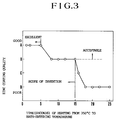
- Fig. 3 illustrates the dependence of the zinc coating quality on the time for heating the steel sheet from 350°C to the bath-entering temperature.
- Fig. 4 illustrates the dependence of zinc coating adherence of a worked portion on the temperature rising rate on heating.
- Fig. 5 illustrates the dependence of corrosion resistance of a worked portion on the temperature rising rate on heating.
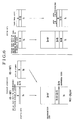
- Fig. 6 illustrates schematically the constitution of the galvanized zinc layer formed by the manufacturing process of the present invention, and the state of the pre-coated nickel layer at the pre-heating step, in comparison with that of a conventional manufacturing process.
- Fig. 7 illustrates outline of an installation of the present invention.
- Fig. 8 is a detailed illustration of an atmosphere-heating device.
- Fig. 9 is a cross-sectional view at the line of the line A-A in Fig. 8.
- Fig. 10 is an electric circuit diagram of the atmosphere-heating apparatus.
- non-oxidative atmosphere in the present invention includes a non-oxidizing atmosphere (e.g., H2 0.1 - 3% + N2, O2: several ten ppm) and a reducing atmosphere (e.g., H2 15% + N2 atmosphere).
- a non-oxidizing atmosphere e.g., H2 0.1 - 3% + N2, O2: several ten ppm
- a reducing atmosphere e.g., H2 15% + N2 atmosphere
- Fig. 1 illustrates dependence of the zinc coating quality on the heating temperature of the steel sheet after nickel pre-coating.
- a pre-coated nickel layer was formed in an amount of 0.5 g/m2 by electroplating. Then the pre-coated sheet was heated by direct resistance heating in a nitrogen atmosphere containing 60 ppm oxygen and 3% hydrogen to a temperature within the range of from 200°C to 550°C, and immediately coated in a galvanizing bath containing 0.2% aluminum for 3 seconds. The time of heating the sheet from 350°C to a bath-entering temperature was fixed at 10 seconds. The coating amount was 135 g/m2. The coating quality was evaluated in consideration of the external appearance of the coating (or degree of non-coating) and the coating adherence (or ball impact test: B.I.) combinedly.
- the coating appearance and the coating adherence were excellent in the case where the temperature of the heated sheet before the galvanization was in the range of from 420°C to 500°C which is the temperature range specified in the present invention.
- the coating appearance and the coating adherence tended to deteriorate.
- the temperature of 200°C which is described in Example of Japanese Patent Publication No. 46-19282
- non-coating was highly liable to occur.
- the temperature of the heated sheet of above 500°C the coating adherence and the corrosion-resistance deteriorated.
- 550°C which is described in Example of Japanese Patent Publication No. 63-48923, neither satisfactory coating appearance nor satisfactory coating adherence could be attained.
- Fig. 2 illustrates the dependence of the amount of diffusion of the pre-coated nickel layer into the base steel on the heating temperature.
- a nickel pre-coating layer was formed by electroplating in an amount of 0.2 g/m2.
- the sheet pre-coated with nickel was heated for 5 seconds by direct resistance heating in a nitrogen atmosphere containing 60 ppm oxygen and 3% hydrogen. Then the remaining ratio of the nickel coating layer was measured by the depth-direction analysis of Auger (AES).
- AES depth-direction analysis of Auger
- Fig 3 illustrates the dependence of the coating quality on the time elapsed in heating the sheet from 350°C to the bath-entering temperature.
- nickel begins to diffuse.
- a pre-coated nickel layer was formed in a coating amount of 0.5 g/m2 by electroplating.
- the sheet pre-coated with nickel was heated by direct resistance heating in a nitrogen atmosphere containing 60 ppm oxygen and 3% hydrogen.
- the sheet was immediately dipped in a zinc coating bath kept at 450°C and containing 0.2% aluminum and galvanized for 3 seconds.
- the amount of coating was adjusted to 135 g/m2.
- the coating quality is satisfactory obviously in the cases where the time for heating the pre-coated sheet from 350°C to the bath-entering temperature is not longer than 15 seconds.
- Fig. 4 and Fig. 5 show respectively the dependence of coating adherence and the dependence of corrosion resistance of the worked portion on the temperature rising rate after the nickel pre-coating treatment.
- a hot-rolled aluminum-killed steel sheet (1.6mm thick) was pre-coated with nickel by electroplating in an amount of 0.5 g/m2, and heated at various rates of temperature rising up to 450°C by direct resistance heating in an nitrogen atmosphere containing 60 ppm oxygen and 3% hydrogen, and thereafter the heated steel sheet was subjected to coating in a hot-dip galvanizing bath containing 0.2% aluminum for 3 seconds. The coating amount was adjusted to 135 g/m2. To reproduce a severely worked portion, the galvanized steel sheet was subjected to deep drawing to give a cup having a 25mm overhang.
- the coating quality was evaluated according to a tape peeling test for powdering resistance, the evaluation being made by blackening degree of the tape.
- the corrosion resistance after working was evaluated in such a manner that a test specimen of the cup formed by drawing was subjected to a corrosion cycle test (CCT) for one week and the rust development ratio at the worked portion was observed.
- CCT corrosion cycle test
- the coating adherence at the worked portion and the corrosion resistance at the worked portion were rated respectively on five grades. The grades of 3 and higher are particularly satisfactory in both the coating adherence and corrosion resistance at severe working.
- the criteria of the evaluation are as below.
- Grade Coating adherence Corrosion resistance at worked portion Tape blackening ratio Rust occurrence ratio 5 Below 1% Below 5% 4 1% or more, below 5% 5% or more, below 10% 3 5% of more, below 10% 10% or more, below 20% 2 10% or more, below 20% 20% or more, below 30% 1 20% or more 30% or more
- the coating adherence and the corrosion resistance at the severely worked portion are particularly satisfactory in the cases where the temperature rising rate after the nickel pre-coating is not less than 30°C/s.
- the preferable temperature of the heated steel sheet was in the range of from 430°C to 500°C in view of the coating adherence of a severely worked portion.
- the important point for manufacturing galvanized steel sheets in a superior coating quality is that the heating temperature after the pre-coating is within a specific range and the time of heating from 350°C to the bath-entering temperature is not longer than 15 seconds.
- One more important point for manufacturing a galvanized steel sheet with superior high coating adherence and superior corrosion resistance at a severely worked portion is that the steel sheet after nickel pre-coating is heated at a heating rate of not less than 30°C/s.
- the nickel is pre-coated in an amount of not less than 0.2 g/m2, because non-coating of zinc can be avoided thereby and the coating adherence is improved by formation of Fe-Al-Zn-Ni quaternary alloy layer to inhibit undesired development of an Fe-Zn alloy layer.
- the nickel coating in an amount of less than 0.2 g/m2, non-coating of zinc is liable to occur and coating adherence is liable to deteriorate.
- the nickel pre-coating amount is limited to not more than 2.0 g/m2 because the coating adherence becomes inferior at the coating amount exceeding 2.0 g/m2.
- Ni-Al-Zn type alloy layer develops more at the interface of the base steel, retarding the formation of the barrier layer for preventing the alloying of zinc with base steel, namely an Fe-Al-Zn-Ni type quaternary alloy layer, thus promoting alloying of zinc with base steel.
- the aluminum content in the bath of less than 0.1% causes unsatisfactory coating adherence.
- an alloy layer of Fe-Al-Zn-Ni type is formed only little, a Zn-Fe alloy layer grows thicker at the interface of the base steel, and in particular a ⁇ phase (Fe5Zn21) allowing a brittle interface to develop, which causes cracks in working, resulting in exfoliation of the coating from the ⁇ phase.
- the aluminum content in the bath is limited to 1% or less. This is because at a higher content thereof the surface appearance becomes whitish, and if aluminum distributes non-uniformly in the galvanized layer, it forms a local electric cell in the galvanized layer to cause elution of zinc to deteriorate the corrosion resistance.
- the amount of the zinc coating is preferably not less than 10 g/m2 in view of corrosion resistance, and is not more than 350 g/m2 in view of workability, although the amount is not particularly limited thereto.
- the bath temperature is as usual in the range of from 430°C to 500°C whether with the zinc bath or with a zinc bath containing a minor amount of an additional alloy element.
- the base steel sheet includes hot-rolled steel sheets, cold-rolled steel sheets, or other various steel sheets such as aluminum-killed steel sheets, Al-Si-killed steel sheets, Ti-Sulc, P-TiSulc low carbon steel sheets, high tensile steel sheets, and the like.
- the manufacturing installation should satisfy the requirements of the process according to the present invention, and the installation according to the present invention is preferably of such a structure that the heating rate can readily and rapidly be set and the installation can be made compact for a wide range of sheets from thin sheets to thick sheets of 3 mm thick or more.
- Fig. 7 illustrates the outline of the installation of the present invention.
- a nickel electroplating apparatus 1, a rinsing apparatus 2, a drying apparatus 3, a non-oxidative atmosphere-heating apparatus 4, and a galvanizing apparatus 5 equipped with a molten zinc coating amount-adjusting device 5 at the outlet side are arranged sequentially in the delivery direction of the steel sheet.
- a steel sheet S having a cleaned surface is coated with nickel by the nickel electroplating apparatus 1 by heating at a low temperature in a coating amount of from 0.2 to 2.0 g/m2 to strengthen the adherence between the steel sheet S and the molten zinc, washed with water by the rinsing apparatus 2, dried by the drying apparatus 3, heated to a predetermined bath-entering temperature by the non-oxidative atmosphere-heating apparatus 4 by preventing oxidation of the nickel-coated steel sheet, and then passed through the molten zinc bath of the galvanizing apparatus 5, to be galvanized without contact to the air.
- Fig. 8 is a detailed illustration of a non-oxidative atmosphere-heating device.
- Fig. 9 is a cross-sectional view at the line A-A in Fig. 8.
- a turn-down roll 7 and a sink roll 8 in a molten zinc bath 10 in a galvanizing pot 9 constitute a pass line of the steel sheet S.
- the steel sheet S is delivered horizontally to the turn-down roll 7 and therefrom delivered obliquely to the sink roll 8, and then delivered upward.
- a ring transformer 11 is arranged at the inlet side of the turn-down roll 7 so as to allow the delivery of the steel sheet S through the space of the ring-transformer.
- the ring-transformer 11 has an iron core 12 and a primary coil 13. The both ends of the primary coil are connected to an alternating current power source not shown in the drawing.
- Seal rolls 14 are equipped at the inlet of the ring-transformer 11.
- An atmospheric chamber 15 is provided to enclose the delivered steel sheet S from immediately after the seal rolls 14 to immediately below the surface of the molten zinc bath 10, and the turn-down roll 7.
- the portion 17, just above and just below the bath surface, of the enclosure 16 constituting the atmosphere chamber 15 is formed from an electroconductive body such as stainless steel, and the other portion 18 of the enclosure is formed from a non-magnetic body such as stainless steel.
- the electroconductive enclosure 17 and the non-magnetic enclosure 18 are linked together by means of an electric insulating material 19 such as asbestos.
- An atmospheric gas-supplying device 20 which is constituted of a supplying tube 21 connected to the non-magnetic enclosure 18, and a gas source 22 connected to the supplying tube 21, supplies a non-oxidative gas to the atmosphere chamber 15.
- the atmospheric gas supplied by the atmospheric gas-supplying device 20 fills the atmospheric chamber 15 and flows out from the opposing gap between the seal rolls 14 and the non-magnetic enclosure 18.
- a conductor roll 23 is provided at the inlet side of the seal rolls 14.
- a busbar 25 connects the conductor roll 23 and the electroconductive enclosure 17.
- a secondary coil of the aforementioned ring-transformer 11 are formed from the electroconductive member constituted of the busbar 25 and the electroconductive enclosure 17, the steel sheet S delivered between the entering position to the molten zinc bath and the contact position with the conductor roll, and the molten zinc bath 10.
- Fig. 10 is an electric circuit diagram of the above heating apparatus.
- the primary side of a transformer 11 is connected through terminals 26 and 27 to an alternating current power source not shown in the drawing.
- a closed secondary circuit of the transformer 11 is formed from the conductor roll 23, the molten zinc bath 10, the resistance R1 representing the steel sheet S between the conductor contact point and the molten zinc bath-entering point, and the resistance R2 representing the electroconductive member constituted of the busbar 25 and the electroconductive enclosure 17.
- R1 on the closed secondary circuit represents the equivalent resistance of the steel sheet S
- R2 represents the equivalent resistance of the electroconductive member constituted of the busbar 25 and the electroconductive enclosure 17.
- the steel sheet S has relatively high electrical resistance, and the electroconductive member constituted of the busbar 25 and the electroconductive enclosure 17 can be set so as to have any desired dimensions of such as a cross-sectional area. Accordingly, the relation of the resistance R1 of the steel sheet S can readily be made much larger than the resistance R2 constituted of the busbar 25 and the electroconductive enclosure 17. Since the closed circuit contains the electroconductive member of low resistance constituted of the busbar 25 and the electroconductive enclosure 17 as the return wire, the steel sheet S having much higher electric resistance than the electroconductive member can be heated in high efficiency by the current flowing therein.
- the transformer 11 is placed between the conductor roll 23 and the molten zinc bath 10, and the steel sheet S of sufficiently high resistance is placed in the secondary side of the transformer. Therefore almost all of the applied voltage is utilized as a load current to heat the steel sheet S between the conductor roll 23 and the molten zinc bath 10, so that the no-load current is negligible and little leakage is caused.
- the higher the temperature of the steel sheet smaller is the current which can be passed without producing spark (namely, an allowable current). Therefore, if the current is passed by use of a conductor roll at the high temperature side of the steel sheet, the current cannot exceed the allowable current for the high-temperature conductor roll, which is weaker than the allowable current for the conductor roll employed at the low temperature side of the steel sheet.
- the current passage to the steel sheet at the high temperature side is conducted by molten zinc which causes no spark, so that the current can be increased to the allowable maximum current of the conductor roll of the low temperature side, which enables increase of the heating rate advantageously.
- the allowable current density (total current/strip width) is 100 A/mm at steel sheet temperature of 50°C, and 15 A/mm at 500°C. Therefore, in the above-mentioned heating apparatus, in which the current passage to the high-temperature steel sheet is conducted by molten zinc, the heating zone length for heating the steel sheet S of 6.0 mm x 950 mm from 50°C to 500°C at a rate of 40 mpm (the length of the steel sheet between the conductor roll 23 and the molten zinc bath 10) can be as short as 16 m.
- the necessary heating length for heating the steel sheet S under the same conditions as above is as long as 90 m at the furnace temperature of 1000°C.
- the furnace body is required to be lined with refractory material in order to maintain the furnace temperature at 1000°C.
- the steel sheet is heated by the current passing therein, so that the enclosure constituting the atmosphere-heating chamber for heating the steel sheet need not be lined with the aforementioned refractory material to maintain the high temperature of the furnace.
- the atmosphere-heating apparatus of the present invention is capable of heating a steel sheet to the molten zinc bath-entering temperature at high efficiency with safety at a temperature rising rate much higher than a conventional indirect heating furnace, so that the heating length is greatly decreased than that of the indirect heating furnace.
- the enclosure constituting the atmosphere-heating chamber does not require refractory lining which is indispensable for a conventional indirect heating furnace, and the apparatus can be inexpensive because of the short heating zone length and needlessness of the refractory lining resistant to high temperature.
- the seal rolls 14 may be placed either in the inlet side of the conductor roll 23 or immediately behind the conductor roll 23 so as to form the atmosphere chamber 15 to cover the space of from the inlet side of or immediately behind the conductor roll 23 to the molten zinc bath. Otherwise, the conductor roll 23 and the back-up roll 24 are utilized to serve as the seal rolls 14, thereby the seal rolls 14 being omitted.
- a part of the enclosure 16 and electroconductive enclosure 17 is utilized as a part of the electroconductive member for connecting the conductor roll 23 with the molten zinc bath 10.
- the electroconductive member is formed only from the busbar 25 such that the one end of the busbar 25 other than the end connected to the conductor roll 23 is connected directly to the molten zinc bath 10.
- Fig. 6 illustrates schematically the results of analysis of the constitution of the coated layers prepared according to the present invention and, a conventional nickel pre-coating method.
- the sheet is heated to a temperature in the range of from 420°C to 500°C and the time for the heating the sheet from 350°C to the bath-entering temperature is not longer than 15 seconds.
- the pre-coated nickel layer diffuses less into the base steel and is mostly kept remaining. Further at the temperature rising rate of 30°C/s or higher after the nickel coating, the nickel almost entirely remains in a coated state, and little diffusion into the base steel is observed.
- This difference of the states of the nickel at the heating is considered to give rise to the difference of the galvanized layer constitutions in the later galvanization treatment.
- the pre-coated nickel layer remaining largely on the interface of the base steel will form an Fe-Al-Zn-Ni quaternary alloy layer (a barrier layer) around the interface of the base steel, and the Zn-Fe alloy layer is kept thin without growth thereof.
- An aluminum-containing zinc layer is formed further thereon.
- the pre-coated nickel layer almost disappears in the heating step, so that a thick Zn-Fe layer is formed on the Fe-Ni layer formed by the heating, and a zinc layer containing aluminum is formed further thereon during the galvanization, without formation of Fe-Al-Zn-Ni type alloy layer of the present invention.
- the great improvement of the coating adherence in the present invention is assumed to be due to the fact that the quaternary alloy layer at the interface of the base steel serves as a binder and further exhibits a barrier effect of inhibiting the growth of the Zn-Fe alloy layer.
- Table 1 shows the examples of the manufacturing conditions of galvanized steel sheet, and the evaluation results thereof.
- the mark * denotes the comparative material prepared by a method other than the method of the present invention.
- Hot-rolled and acid-pickled steel sheets SGHC (3.2 mm thick and 1.6 mm thick) were employed as the substrate sheet. These substrates were pre-coated with nickel according to electroplating in a sulfuric acidic nickel bath. The pre-treatment heating was conducted by direct resistance heating in an nitrogen atmosphere containing 60 ppm oxygen and 3% hydrogen under various heating conditions. The galvanization was conducted at 450°C for 3 seconds in the galvanizing bath in which the aluminum content was varied. The amount of coating was adjusted to 135 g/m2 by nitrogen wiping. The coating quality was evaluated based on the criteria mentioned above.
- the galvanized steel sheets prepared under the conditions of the present invention namely the nickel pre-coating of 0.2 - 2.0 g/m2, the temperature of the heated sheet of 420 to 500°C, and the time of heating from 350°C to a galvanizing-bath-entering temperature of not more than 15 seconds, does not cause non-coating of zinc, and is satisfactory in coating adherence, having clearly excellent coating quality, as shown by the samples of No.1 to No. 20.
- the manufacturing installation could be made compact by practicing the method as shown in Fig. 7 and Fig. 8, whereby the construction cost of the installation could greatly be reduced in comparison with the conventional method.
- the present invention provides a process for producing a galvanized steel sheet which has an excellent coating quality, or gives coating adherence and corrosion resistance of a worked portion of a zinc coated steel sheet, which has never been met hitherto.
- the galvanized steel sheets are useful as structural materials such as building materials, household electrical appliances, and automobiles, and are producible with a compact installation at a low cost, so that the present invention is highly important industrially.
Landscapes
- Chemical & Material Sciences (AREA)
- Chemical Kinetics & Catalysis (AREA)
- Engineering & Computer Science (AREA)
- Materials Engineering (AREA)
- Mechanical Engineering (AREA)
- Metallurgy (AREA)
- Organic Chemistry (AREA)
- Coating With Molten Metal (AREA)
- Heat Treatment Of Sheet Steel (AREA)
Applications Claiming Priority (2)
| Application Number | Priority Date | Filing Date | Title |
|---|---|---|---|
| JP2271957A JP2517169B2 (ja) | 1990-10-09 | 1990-10-09 | 溶融亜鉛めっき鋼板の製造方法 |
| JP271957/90 | 1990-10-09 |
Publications (3)
| Publication Number | Publication Date |
|---|---|
| EP0480122A2 true EP0480122A2 (de) | 1992-04-15 |
| EP0480122A3 EP0480122A3 (en) | 1992-07-29 |
| EP0480122B1 EP0480122B1 (de) | 1996-01-03 |
Family
ID=17507169
Family Applications (1)
| Application Number | Title | Priority Date | Filing Date |
|---|---|---|---|
| EP91107845A Expired - Lifetime EP0480122B1 (de) | 1990-10-09 | 1991-05-15 | Verfahren zur Herstellung galvanisierter Stahlbleche durch Vorbeschichtung mit einer Nickelschicht |
Country Status (4)
| Country | Link |
|---|---|
| US (2) | US5203985A (de) |
| EP (1) | EP0480122B1 (de) |
| JP (1) | JP2517169B2 (de) |
| DE (1) | DE69116068T2 (de) |
Cited By (10)
| Publication number | Priority date | Publication date | Assignee | Title |
|---|---|---|---|---|
| FR2714677A1 (fr) * | 1993-12-30 | 1995-07-07 | Berkman Cy Louis | Revêtement de matériau architectural. |
| US5455122A (en) * | 1993-04-05 | 1995-10-03 | The Louis Berkman Company | Environmental gasoline tank |
| US5489490A (en) * | 1993-04-05 | 1996-02-06 | The Louis Berkman Company | Coated metal strip |
| US5491036A (en) * | 1992-03-27 | 1996-02-13 | The Louis Berkman Company | Coated strip |
| US5491035A (en) * | 1992-03-27 | 1996-02-13 | The Louis Berkman Company | Coated metal strip |
| US5492772A (en) * | 1993-04-05 | 1996-02-20 | The Louis Berkman Company | Building material coating |
| US5597656A (en) * | 1993-04-05 | 1997-01-28 | The Louis Berkman Company | Coated metal strip |
| WO2005075697A1 (en) * | 2004-02-04 | 2005-08-18 | Nv Bekaert Sa | High-carbon steel wire with nickel sub coating |
| EP2848709A1 (de) * | 2013-09-13 | 2015-03-18 | ThyssenKrupp Steel Europe AG | Verfahren zum Herstellen eines mit einem metallischen, vor Korrosion schützenden Überzug versehenen Stahlbauteils und Stahlbauteil |
| WO2024256062A1 (de) * | 2023-06-12 | 2024-12-19 | Sms Group Gmbh | Verfahren zum herstellen eines beschichteten stahlbands |
Families Citing this family (20)
| Publication number | Priority date | Publication date | Assignee | Title |
|---|---|---|---|---|
| US6861159B2 (en) * | 1992-03-27 | 2005-03-01 | The Louis Berkman Company | Corrosion-resistant coated copper and method for making the same |
| US6652990B2 (en) | 1992-03-27 | 2003-11-25 | The Louis Berkman Company | Corrosion-resistant coated metal and method for making the same |
| US6080497A (en) * | 1992-03-27 | 2000-06-27 | The Louis Berkman Company | Corrosion-resistant coated copper metal and method for making the same |
| US6794060B2 (en) | 1992-03-27 | 2004-09-21 | The Louis Berkman Company | Corrosion-resistant coated metal and method for making the same |
| US5500290A (en) * | 1993-06-29 | 1996-03-19 | Nkk Corporation | Surface treated steel sheet |
| US5849408A (en) * | 1993-12-27 | 1998-12-15 | Nippon Mining & Metals Co., Ltd. | Hot-dip zinc plating product |
| JP3379041B2 (ja) | 1997-03-27 | 2003-02-17 | 大洋製鋼株式会社 | メッキ浴中機材及び製造法 |
| US6284122B1 (en) * | 1998-06-09 | 2001-09-04 | International Lead Zinc Research Organization, Inc. | Production of a zinc-aluminum alloy coating by immersion into molten metal baths |
| MXPA00012310A (es) * | 1998-06-09 | 2002-10-23 | Int Lead Zinc Res | Proceso para la fabricacion de galvanizacion no continua con aleaciones de zinc y aluminio sobre productos metalicos fabricados. |
| KR20020045215A (ko) * | 2000-12-08 | 2002-06-19 | 이구택 | 도금 밀착성이 우수한 고장력 용융아연 도금강판의 제조방법 |
| US7824533B2 (en) * | 2004-10-25 | 2010-11-02 | Industrial Door Co., Inc. | Tempered plated wire and methods of manufacture |
| US20060222880A1 (en) * | 2005-04-04 | 2006-10-05 | United Technologies Corporation | Nickel coating |
| JP4533223B2 (ja) * | 2005-04-18 | 2010-09-01 | 新日本製鐵株式会社 | 同一浴にて溶融亜鉛メッキ鋼板と合金化溶融亜鉛メッキ鋼板を造り分ける方法 |
| JP4582707B2 (ja) | 2005-04-20 | 2010-11-17 | 新日本製鐵株式会社 | 不メッキ欠陥発生のない溶融亜鉛メッキ方法 |
| JP4975406B2 (ja) * | 2006-10-02 | 2012-07-11 | 住友金属工業株式会社 | 高張力合金化溶融亜鉛めっき鋼板およびその製造方法 |
| JP4855290B2 (ja) * | 2007-02-09 | 2012-01-18 | 新日本製鐵株式会社 | 溶融亜鉛メッキ鋼板および合金化溶融亜鉛メッキ鋼板の製造方法 |
| KR20100099234A (ko) * | 2007-12-11 | 2010-09-10 | 블루스코프 스틸 리미티드 | 금속 코팅 방법 및 그에 의해 형성된 코팅 |
| US9068255B2 (en) | 2009-12-29 | 2015-06-30 | Posco | Zinc-plated steel sheet for hot pressing having outstanding surface characteristics, hot-pressed moulded parts obtained using the same, and a production method for the same |
| CN111492075B (zh) * | 2017-12-15 | 2021-10-12 | 日本制铁株式会社 | 钢板、热浸镀锌钢板和合金化热浸镀锌钢板 |
| CN119824190B (zh) * | 2025-01-23 | 2025-12-19 | 首钢集团有限公司 | 一种薄规格高扩孔率热轧镀锌钢板的制备方法 |
Family Cites Families (16)
| Publication number | Priority date | Publication date | Assignee | Title |
|---|---|---|---|---|
| GB676883A (en) * | 1949-07-13 | 1952-08-06 | Fairchild Engine & Airplane | Improvements relating to coating metal articles with compatible dissimilar metal |
| US3620805A (en) * | 1969-03-17 | 1971-11-16 | Carl Martin | Method for the continuous hot galvanizing of continuously formed elements |
| AU543013B2 (en) * | 1980-08-19 | 1985-03-28 | Lysaght, J. (Australia) Ltd. | Hot-dip coating of ferrous strands |
| JPS57120771A (en) * | 1981-01-20 | 1982-07-27 | Hitachi Ltd | Check valve |
| GB2093486B (en) * | 1981-02-24 | 1985-06-26 | Kloeckner Werke Ag | Plant for the continuous treatment of thin plate or strip |
| DE3201475A1 (de) * | 1981-05-22 | 1982-12-09 | Hermann Huster GmbH & Co, 5800 Hagen | Verfahren zum feuerverzinken metallischer werkstuecke |
| US4408561A (en) * | 1981-08-24 | 1983-10-11 | Nippon Steel Corporation | Dual-purpose plant for producing cold rolled steel sheet and hot-dip galvanized steel sheet |
| JPS58120771A (ja) * | 1982-01-09 | 1983-07-18 | Kawasaki Steel Corp | 合金化亜鉛めつき鋼板の製造方法 |
| US4478892A (en) * | 1983-03-16 | 1984-10-23 | National Steel Corporation | Method of and apparatus for hot dip coating of steel strip |
| FR2544336B1 (fr) * | 1983-04-13 | 1985-08-09 | Ziegler Sa | Installation pour le revetement en continu de bande, notamment pour la galvanisation de tole d'acier |
| JPS61213650A (ja) * | 1985-03-19 | 1986-09-22 | Chino Works Ltd | 光学的測定装置 |
| LU85886A1 (fr) * | 1985-05-07 | 1986-12-05 | Centre Rech Metallurgique | Procede de depot en continu d'un revetement de zinc-aluminium sur un produit ferreux,par immersion dans un bain de metal fondu |
| US4761530A (en) * | 1987-04-03 | 1988-08-02 | National Steel Corporation | Electric induction heat treating furnace |
| JPH0254145A (ja) * | 1988-08-17 | 1990-02-23 | Sumitomo Metal Ind Ltd | コークス製造用石炭の粘結性調整方法 |
| JP2561331B2 (ja) * | 1988-11-07 | 1996-12-04 | 川崎製鉄株式会社 | 溶融ZnめっきCr含有鋼帯の製造方法 |
| JPH0635648B2 (ja) * | 1989-03-10 | 1994-05-11 | 新日本製鐵株式会社 | 低温加熱、還元省略型の亜鉛又は亜鉛系合金の溶融めっき方法 |
-
1990
- 1990-10-09 JP JP2271957A patent/JP2517169B2/ja not_active Expired - Lifetime
-
1991
- 1991-05-15 US US07/700,457 patent/US5203985A/en not_active Expired - Lifetime
- 1991-05-15 EP EP91107845A patent/EP0480122B1/de not_active Expired - Lifetime
- 1991-05-15 DE DE69116068T patent/DE69116068T2/de not_active Expired - Lifetime
-
1992
- 1992-12-16 US US07/991,409 patent/US5312531A/en not_active Expired - Lifetime
Cited By (18)
| Publication number | Priority date | Publication date | Assignee | Title |
|---|---|---|---|---|
| US5616424A (en) * | 1992-03-27 | 1997-04-01 | The Louis Berkman Company | Corrosion-resistant coated metal strip |
| US5491036A (en) * | 1992-03-27 | 1996-02-13 | The Louis Berkman Company | Coated strip |
| US5667849A (en) * | 1992-03-27 | 1997-09-16 | The Louis Berkman Company | Method for coating a metal strip |
| US5491035A (en) * | 1992-03-27 | 1996-02-13 | The Louis Berkman Company | Coated metal strip |
| US5695822A (en) * | 1993-04-05 | 1997-12-09 | The Louis Berkman Company | Method for coating a metal strip |
| US5489490A (en) * | 1993-04-05 | 1996-02-06 | The Louis Berkman Company | Coated metal strip |
| US5492772A (en) * | 1993-04-05 | 1996-02-20 | The Louis Berkman Company | Building material coating |
| US5597656A (en) * | 1993-04-05 | 1997-01-28 | The Louis Berkman Company | Coated metal strip |
| US5455122A (en) * | 1993-04-05 | 1995-10-03 | The Louis Berkman Company | Environmental gasoline tank |
| US5470667A (en) * | 1993-04-05 | 1995-11-28 | The Louis Berkman Company | Coated metal strip |
| FR2714677A1 (fr) * | 1993-12-30 | 1995-07-07 | Berkman Cy Louis | Revêtement de matériau architectural. |
| WO2005075697A1 (en) * | 2004-02-04 | 2005-08-18 | Nv Bekaert Sa | High-carbon steel wire with nickel sub coating |
| WO2005075696A3 (en) * | 2004-02-04 | 2005-10-06 | Bekaert Sa Nv | Low-carbon steel wire with nickel sub coating |
| US7300706B2 (en) | 2004-02-04 | 2007-11-27 | Nv Bekaert Sa | High-carbon steel wire with nickel sub coating |
| EP2848709A1 (de) * | 2013-09-13 | 2015-03-18 | ThyssenKrupp Steel Europe AG | Verfahren zum Herstellen eines mit einem metallischen, vor Korrosion schützenden Überzug versehenen Stahlbauteils und Stahlbauteil |
| WO2015036151A1 (de) * | 2013-09-13 | 2015-03-19 | Thyssenkrupp Steel Europe Ag | Verfahren zum herstellen eines mit einem metallischen, vor korrosion schützenden überzug versehenen stahlbauteils und stahlbauteil |
| US10287647B2 (en) | 2013-09-13 | 2019-05-14 | Thyssenkrupp Steel Europe Ag | Method for producing a steel component having a metal coating protecting it against corrosion, and steel component |
| WO2024256062A1 (de) * | 2023-06-12 | 2024-12-19 | Sms Group Gmbh | Verfahren zum herstellen eines beschichteten stahlbands |
Also Published As
| Publication number | Publication date |
|---|---|
| JPH04147954A (ja) | 1992-05-21 |
| US5203985A (en) | 1993-04-20 |
| EP0480122B1 (de) | 1996-01-03 |
| DE69116068T2 (de) | 1996-09-05 |
| US5312531A (en) | 1994-05-17 |
| JP2517169B2 (ja) | 1996-07-24 |
| DE69116068D1 (de) | 1996-02-15 |
| EP0480122A3 (en) | 1992-07-29 |
Similar Documents
| Publication | Publication Date | Title |
|---|---|---|
| EP0480122B1 (de) | Verfahren zur Herstellung galvanisierter Stahlbleche durch Vorbeschichtung mit einer Nickelschicht | |
| WO2012053694A1 (ko) | 도금성, 도금 밀착성 및 스폿 용접성이 우수한 용융아연도금강판 및 그 제조방법 | |
| KR20090007501A (ko) | 표면 처리 강판 및 그 제조 방법 | |
| KR102602054B1 (ko) | 용융 도금의 결합이 개선된 강 스트립을 제조하는 방법 | |
| JP2783453B2 (ja) | 溶融Zn−Mg−Alめっき鋼板及びその製造方法 | |
| JP2513532B2 (ja) | 高Si含有鋼の高張力溶融亜鉛めっき鋼板の製造方法 | |
| JPS6043476A (ja) | 連続溶融アルミメツキ法 | |
| JPH0688187A (ja) | 合金化溶融亜鉛めっき鋼板の製造方法 | |
| JPH0355544B2 (de) | ||
| EP0571636B1 (de) | Verfahren zur herstellung von stahlplatten beschichtet mit flüssigem zink mit unbeschichteten stellen | |
| JP2002173753A (ja) | 耐黒変性に優れた溶融Zn−Al合金めっき鋼板とその製造方法 | |
| JPH11140587A (ja) | めっき密着性に優れた合金化溶融亜鉛めっき鋼板 | |
| JP2562747B2 (ja) | プレNi合金めっき法による溶融Znめっき鋼板および合金化溶融Znめっき鋼板の製造方法 | |
| JP3569487B2 (ja) | スポット溶接性に優れた合金化溶融亜鉛めっき鋼板及びその製造方法 | |
| JP2993404B2 (ja) | 皮膜密着性に優れた合金化溶融亜鉛めっき鋼板及びその製造方法 | |
| JPH08170160A (ja) | Si含有高張力(合金化)溶融亜鉛めっき鋼板の製造方法 | |
| JPH04333551A (ja) | 溶融Znめっき鋼板及びその製造方法 | |
| JP2783457B2 (ja) | 溶融Zn―Alめっき鋼板の製造方法 | |
| JPH0551714A (ja) | Si含有鋼板の溶融亜鉛めつき方法 | |
| JPH0971851A (ja) | 亜鉛−錫合金めっき鋼板の製造法 | |
| JP2700516B2 (ja) | めっき密着性の良好な高Si含有強度合金化溶融亜鉛めっき鋼板の製造方法 | |
| JP3205292B2 (ja) | 耐食性およびめっき密着性に優れた溶融亜鉛めっき鋼板の製造方法 | |
| KR100478725B1 (ko) | 도금부착성및합금화처리성이우수한고강도합금화용융아연도금강판의제조방법 | |
| JP3838277B2 (ja) | 耐パウダリング性にすぐれた合金化溶融亜鉛めっき鋼板 | |
| JPH05263210A (ja) | スポット溶接性に優れた溶融亜鉛・アルミニウム合金 めっき鋼板の製造方法 |
Legal Events
| Date | Code | Title | Description |
|---|---|---|---|
| PUAI | Public reference made under article 153(3) epc to a published international application that has entered the european phase |
Free format text: ORIGINAL CODE: 0009012 |
|
| AK | Designated contracting states |
Kind code of ref document: A2 Designated state(s): DE FR GB |
|
| PUAL | Search report despatched |
Free format text: ORIGINAL CODE: 0009013 |
|
| AK | Designated contracting states |
Kind code of ref document: A3 Designated state(s): DE FR GB |
|
| 17P | Request for examination filed |
Effective date: 19920904 |
|
| 17Q | First examination report despatched |
Effective date: 19940121 |
|
| GRAA | (expected) grant |
Free format text: ORIGINAL CODE: 0009210 |
|
| AK | Designated contracting states |
Kind code of ref document: B1 Designated state(s): DE FR GB |
|
| REF | Corresponds to: |
Ref document number: 69116068 Country of ref document: DE Date of ref document: 19960215 |
|
| ET | Fr: translation filed | ||
| PLBE | No opposition filed within time limit |
Free format text: ORIGINAL CODE: 0009261 |
|
| STAA | Information on the status of an ep patent application or granted ep patent |
Free format text: STATUS: NO OPPOSITION FILED WITHIN TIME LIMIT |
|
| 26N | No opposition filed | ||
| REG | Reference to a national code |
Ref country code: GB Ref legal event code: IF02 |
|
| PGFP | Annual fee paid to national office [announced via postgrant information from national office to epo] |
Ref country code: GB Payment date: 20100329 Year of fee payment: 20 |
|
| PGFP | Annual fee paid to national office [announced via postgrant information from national office to epo] |
Ref country code: FR Payment date: 20100525 Year of fee payment: 20 |
|
| PGFP | Annual fee paid to national office [announced via postgrant information from national office to epo] |
Ref country code: DE Payment date: 20100512 Year of fee payment: 20 |
|
| REG | Reference to a national code |
Ref country code: DE Ref legal event code: R071 Ref document number: 69116068 Country of ref document: DE |
|
| REG | Reference to a national code |
Ref country code: GB Ref legal event code: PE20 Expiry date: 20110514 |
|
| PG25 | Lapsed in a contracting state [announced via postgrant information from national office to epo] |
Ref country code: GB Free format text: LAPSE BECAUSE OF EXPIRATION OF PROTECTION Effective date: 20110514 |
|
| PG25 | Lapsed in a contracting state [announced via postgrant information from national office to epo] |
Ref country code: DE Free format text: LAPSE BECAUSE OF EXPIRATION OF PROTECTION Effective date: 20110515 |