EP2849151A1 - Procédé d'analyse de files d'attente libres - Google Patents
Procédé d'analyse de files d'attente libres Download PDFInfo
- Publication number
- EP2849151A1 EP2849151A1 EP13405111.9A EP13405111A EP2849151A1 EP 2849151 A1 EP2849151 A1 EP 2849151A1 EP 13405111 A EP13405111 A EP 13405111A EP 2849151 A1 EP2849151 A1 EP 2849151A1
- Authority
- EP
- European Patent Office
- Prior art keywords
- objects
- der
- queue
- die
- positions
- Prior art date
- Legal status (The legal status is an assumption and is not a legal conclusion. Google has not performed a legal analysis and makes no representation as to the accuracy of the status listed.)
- Withdrawn
Links
Images


Classifications
-
- G—PHYSICS
- G06—COMPUTING OR CALCULATING; COUNTING
- G06V—IMAGE OR VIDEO RECOGNITION OR UNDERSTANDING
- G06V20/00—Scenes; Scene-specific elements
- G06V20/50—Context or environment of the image
- G06V20/52—Surveillance or monitoring of activities, e.g. for recognising suspicious objects
- G06V20/53—Recognition of crowd images, e.g. recognition of crowd congestion
-
- G—PHYSICS
- G06—COMPUTING OR CALCULATING; COUNTING
- G06T—IMAGE DATA PROCESSING OR GENERATION, IN GENERAL
- G06T7/00—Image analysis
- G06T7/20—Analysis of motion
-
- G—PHYSICS
- G06—COMPUTING OR CALCULATING; COUNTING
- G06T—IMAGE DATA PROCESSING OR GENERATION, IN GENERAL
- G06T7/00—Image analysis
- G06T7/70—Determining position or orientation of objects or cameras
-
- G—PHYSICS
- G06—COMPUTING OR CALCULATING; COUNTING
- G06T—IMAGE DATA PROCESSING OR GENERATION, IN GENERAL
- G06T2207/00—Indexing scheme for image analysis or image enhancement
- G06T2207/30—Subject of image; Context of image processing
- G06T2207/30242—Counting objects in image
Definitions
- the invention relates to a method for analyzing the distribution of objects in a free queue and for determining the spatial extent of a free queue, based on position information.
- Queues often form spontaneously.
- the form of a queue can be specified by a so-called lining, which channels the waiting persons and thereby defines a fixed area for the waiting ones.
- lining which channels the waiting persons and thereby defines a fixed area for the waiting ones.
- the shape of the queue forms in an unpredictable way.
- the queuing in front of a ticket vending machine is mentioned: In places where until recently people went through, suddenly a queue can form, so that the passing people have to take another route. As the queue becomes longer, its shape may change spontaneously due to, for example, structural obstacles (walls, columns, roads, etc.).
- free queues This is understood herein to mean a queue whose members are in a substantially contiguous area and whose end position (location of a switch, machine, gate, etc.) is known, but not the position of the start of the queue and the shape of the queue within a truly two-dimensional area.
- the US 5,953,055 (NCR Corp.) describes a system and method for detecting, collecting information and analyzing a queue based on a sequence of video images. In particular, movement patterns, the number of people in the queue and the average waiting time are determined.
- Two different algorithms are proposed for "structured" and "unstructured”queues; structured queues are those that are substantially straight and positioned at a predetermined location, unstructured queues form when customers are called to a switch and as long as e.g. B. sitting wait. In both algorithms, a difference between successive video images is first determined in order to delimit objects from the background by virtue of their movement. Pixels in which objects are located are assigned the value 1.
- the number of people in the queue is then determined by dividing the area of the queue into vertical slots, each about the size of a waiting person.
- the second, segment-based algorithm adjacent pixels corresponding to the same object are identified and the object assigned. From this, the number of people in a queue can be determined.
- the waiting time in a queue is determined by recorded events, namely the entrance or exit of the queue,
- the pixel-based method only works for ordered queues.
- the segment-based method is basically also applicable to free queues, creating a binary mask that matches the locations of people.
- the segment-based method does not take into account the specific properties of free queues. Since it is primarily designed for the analysis of "unstructured" queues and, in particular, detects cases in which the members of the queue are waiting to sit, the method can not assume that the waiting parties are in a substantially contiguous area. Accordingly, knowledge about the dynamics in such queues can not be used for the waiting time determination, and corresponding information can not be generated. This prevents a complete analysis of a free queue and the exact determination of a waiting time.
- the US 8,131,010 B2 (IBM) is focused on measuring properties of a queue. To do this, several images of the queue are taken, properties are extracted from the images, and properties of a plurality of consecutive images are analyzed to detect matches. How to identify the queue and objects in it is not detailed, these steps can be done manually, among other things.
- the waiting time can be determined, among other things, by tracking individual objects and determining their waiting time; how this pursuit takes place is also not explained in detail, one possibility is a successive training with more and more trajectories.
- the WO 2011/020641 A1 (Robert Bosch GmbH) is directed to a device for detecting a queue of objects in a surveillance area.
- the objects are detected based on a surveillance image.
- this module includes a variety of queuing models that cover different versions of queues.
- a motion analysis module may be present, which z. B. can detect the direction of movement of the detected objects.
- an evaluation module may be present, with which z. B. the average waiting time or the number of objects in the queue can be determined.
- This system basically also allows the analysis of free queues. However, it requires complex calculations, and depending on the dynamics of the object movements in the free queue difficulties in the evaluation arise.
- the method is particularly suitable for the analysis of queues formed by persons. Basically, it is also suitable for free accumulation of other "waiting" objects, eg.
- the method is also suitable for the analysis of queues, the course of which is predetermined by a lining wholly or partially, but in which the arrangement of the Linings is not fixed, but changed over during operation. With the aid of the method according to the invention, such queues can be readily taken into account without any need for changes to the lining to be explicitly included in the evaluation. Because the placement of the linings need not be known and the entire possible waiting area is monitored, such variable-lining queues may also be considered and treated as "free queues" within the meaning of the invention.
- the position information is in particular image information.
- the image information will be in rasterized form, ie as a certain number of pixels with a certain brightness and / or color value.
- position as used herein always refers to a certain area of physical space, that is to say an area in the two-dimensional analysis of a queue or a space area in the three-dimensional analysis of a queue.
- the area may correspond to a certain number of pixels of the image information (eg 1 pixel each, 2x2 pixels, etc.), although not all areas need to be the same size.
- an object is "located” at a particular position when the object covers the area or fills the space area. An object can therefore always be located at several (neighboring) positions at the same time.
- the waiting time does not necessarily have to be tracked for all objects of the free queue.
- a binning of the waiting times is carried out, d.
- waiting times of a plurality of persons located at a certain position during a monitoring period are averaged before the positions are divided into classes. This results in stable and homogeneous results.
- averaging may be z. For example, the formation of an average (arithmetic, geometric mean, etc.) or median value.
- the waiting times can be weighted into the averaging, z. For example, values that are closer in time may be weighted higher than previous, more distant values.
- the waiting times of those persons can be taken into account, which have been at a certain position for a predeterminable period of time before an evaluation time.
- the waiting times of a predeterminable number of persons for the averaging can be taken into account, which were last located at the specific position.
- the criteria are particularly preferably combined, ie the waiting times of a predefined maximum number of persons are included, but only those persons are considered who have not been in the corresponding position for longer than a predetermined maximum period of time. This ensures that the average waiting times represent the current status.
- positions of a non-empty class, which is assigned the smallest waiting time are defined as the beginning of the free queue. In this way, based on the neighborhood information determined by the binning, a person entering the queue can be assigned a representative waiting time.
- the data collected for these objects before this determination is not lost, but added (retrospectively) to the data of the other validated objects after validation.
- the addition may be limited to a part of the data, in particular data from a predetermined time interval before the addition time.
- This method is also particularly suitable for the analysis of queues formed by persons. Basically, it is also suitable for free accumulation of other "waiting" objects, eg. Of animals in front of an inlet, articles in a funnel area before passage, etc.
- image information is processed which is present in rasterized form, ie as a certain number of picture elements (pixels) with a certain brightness and / or color value.
- position as used herein always refers to a certain area of physical space, that is to say an area in the two-dimensional analysis of a queue or a space area in the three-dimensional analysis of a queue.
- the region can correspond to a certain number of pixels of the image information (for example, 1 pixel each, 2x2 Pixels, etc.), although not all areas must be the same size.
- an object is "located” at a particular position when the object covers the area or fills the space area. An object can therefore always be located at several (neighboring) positions at the same time.
- the determination of the average speed of an object is based on the time course of the object position. In the simplest case, the last two stored object positions are used and the spatial distance is divided by the time interval of the recording of the corresponding position information. The robustness of the result obtained can be improved if additional object positions are used.
- the speed can then be represented, for example, by an averaged value, whereby the individual object positions can also be weighted to different degrees (eg earlier positions with a lower weight than recently determined).
- the first map is an association between areas or areas and the probabilities of residence there.
- the criterion may be represented by a threshold, taking objects into account as a member of the queue only if their speed does not exceed the threshold.
- the average speed can be a scalar quantity; If the average velocity is determined vectorially, ie with directional information, the direction can also be used as a criterion for the creation of the first map.
- objects that are essentially in or opposite the main direction of movement in the queue should also not be in the queue. Accordingly, for example, only objects may be considered whose direction lies in a certain angular range relative to a main movement direction of the queue or whose speed amount does not exceed a certain minimum value (ie substantially stationary persons).
- the resolution of the first map may correspond to that of the positions, i. H. Each position considered is assigned a field in the first map.
- the schw.kann but also have another, especially a coarser, resolution. For example, it is possible to assign several items to the same field in the first card.
- the exit area is one or more positions or one or more fields in the first map that represent the destination of the waiting persons, i. H. a switch, an automaton, a passage, etc.
- the exit area can be defined, for example, by a crossing line.
- Floodfill methods are basically known from digital image processing. Starting from a pixel (in the present case of a field in the first map), the respectively adjacent pixels or fields are tested for whether they fulfill a specific criterion (in the present case, whether the field has a certain occurrence density). If so, these fields are added to the filled set. Depending on the geometry of the fields, a different number of neighbors can be taken into account, for square fields in the plane z. B. four neighbors or eight neighbors (including diagonally adjacent fields).
- the inventive method allows a simple and efficient detection of the extent of the free queue as a "filled area".
- objects at an average speed outside a given range are not taken into account when creating the first map.
- objects whose speed is higher than a certain limit in the order of the speed of travel in the queue should not form part of the queue, but move past or through it. They should therefore not be taken into account in the analysis of the queue so as not to distort it.
- the limit may be fixed based on empirical values, or it may be determined dynamically based on the average speeds determined, for example by multiplying the average or median speed by a factor.
- the inclusion of the direction of movement allows for a refined analysis of the free queue.
- the fields of the second card may correspond to the positions of the first card. However, this is not mandatory, the resolution and / or division of the monitoring area may be different in the second card than in the first card. For example, a trajectory is recognized as being frequent if, in a given number of fields, the determined average directional vectors do not deviate from each other by more than a predetermined angular distance. Fields that correspond to positions with a low average speed below a lower limit may be excluded from the analysis so that direction vectors obtained from random moves do not distort the result.
- a stop mask is generated which includes positions of no activity, and the stop mask is used for the validity check of the flood fill method.
- dormant objects eg. B. objects, which are in the surveillance area are excluded from the analysis.
- the analysis is simplified and distortions are prevented.
- the first card is smoothed before performing the flood fill method, in particular by Gaussian filtering.
- Artifacts of image acquisition and processing can be eliminated in a simple way.
- the smoothing prevents artificial formation of "islands" only due to artifacts.
- the smoothing does not necessarily have to be performed, in particular not when the grid underlying the first card has a certain screen ruling, so that small-scale fluctuations are already largely averaged out during the creation of the first card.
- the floodfill method is performed for all positions of the output area so that a plurality of contiguous areas can be generated, and an area of greatest area is selected as the extent of the free queue. This ensures that the free queue is fully captured, no matter where the queue's destination is.
- positions of the output range obtained from a previously completed floodfill process may be omitted as starting points for further floodfill procedures, as these can not provide new or different ranges.
- a code for a movement in the free queue is preferably generated. If this measure indicates a slight movement, the determined contiguous area is combined with a contiguous area determined at an earlier time. If there is little movement, gaps in the first card are likely, and the floodfill process would only deliver a fraction of the queue. The combination with the previously determined area ensures that even in such cases the entire extent is covered.
- Steps 1 and 2 are summed over a period. At the end of the period, the code is then formed as the ratio between the second counter and the first counter. A high value thus indicates a strong movement within the queue.
- the combination with previously determined areas can also be based on other criteria and z. B. in a sudden reduction of the area of the contiguous area. (Here, however, it should be noted that such a sudden reduction in practice can take place, for. B. when a new exit area is created, for. B. by opening an additional switch or passage.)
- the described method for determining the spatial extent of a free queue can be used, in particular, as part of the inventive method described at the outset for analyzing the distribution of objects in a free queue based on classified waiting times, namely as a first step before the analysis is performed. However, it can also be used independently of or in combination with other methods for analyzing the objects in the queue.
- FIG. 1 is a symbolic representation of a distribution of people in a surveillance area.
- the monitoring area 1 in the illustrated simplified example has a rectangular shape and has an exit area 2, z.
- the surveillance area 1 there are a number of persons 3, including those who are waiting in front of the exit area 2 and others who are in the surveillance area 1 for other reasons.
- the pending persons form a queue 4. Since there are no marks or boundaries which would define the shape of the queue 4, their shape has formed in a basically unpredictable manner. However, the members of queue 4 are in a substantially contiguous area, and the end position of the queue, i. H. the destination of the waiting is known (namely the exit area 2). Such a queue is, as already explained above, referred to as a "free queue”.
- the in the FIG. 1 illustrated situation is first detected by an image sensor, z. B. by a camera or more above the surveillance area arranged cameras, by ultrasonic or infrared sensors or other sensors that can detect persons positions.
- the image acquisition takes place periodically, new frames 10 are generated continuously, which each map the current situation.
- the image information corresponding to the frames is preprocessed in the image sensor and then fed to a processing device.
- the pre-processing or the first processing in the processing device comprise, in a manner known per se, the step of recognizing individual objects (persons) and the assignment of a unique identifier so that the persons in the sequence can be tracked individually.
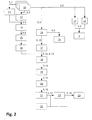
- the free queue can be analyzed.
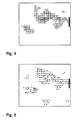
- a map is created that covers the ROI and represents a binning of the average waiting time per field in the past period, that is, how long people on average already waited for who were in a particular field. Binning in bins of, for example, 10 seconds in size results in a map that includes areas that sequentially line up along the queue. This is useful for defining the neighborhood within the queue and setting the queue start.
- analyzes can now be performed.
- determining the latency of persons re-entering the queue it is taken into account whether the person has regularly joined the queue or whether he has emerged (eg due to a detection error) directly within the queue.
- the entry of the person is crucial (regular at the start of the queue or somewhere along the queue).
- the bin identification number of the entry location is stored. In addition, it is recorded for each person whether the place of their first appearance already belonged to the queue or was outside.
- the invention provides methods for analyzing the distribution of objects in a free queue and for determining the free-space spatial extent which enable efficient free-queue analysis and provide accurate results.
Landscapes
- Engineering & Computer Science (AREA)
- Physics & Mathematics (AREA)
- General Physics & Mathematics (AREA)
- Theoretical Computer Science (AREA)
- Computer Vision & Pattern Recognition (AREA)
- Multimedia (AREA)
- Image Analysis (AREA)
- Image Processing (AREA)
Priority Applications (7)
| Application Number | Priority Date | Filing Date | Title |
|---|---|---|---|
| EP13405111.9A EP2849151A1 (fr) | 2013-09-13 | 2013-09-13 | Procédé d'analyse de files d'attente libres |
| PCT/CH2014/000129 WO2015035525A1 (fr) | 2013-09-13 | 2014-09-11 | Procédé d'analyse de la distribution d'objets dans des files d'attente libres |
| US15/021,320 US10515277B2 (en) | 2013-09-13 | 2014-09-11 | Method for analyzing the distribution of objects in free queues |
| EP14772053.6A EP3044760B1 (fr) | 2013-09-13 | 2014-09-11 | Procédé d'analyse de la distribution d'objets dans des files d'attente libres |
| EP14772052.8A EP3044759B1 (fr) | 2013-09-13 | 2014-09-11 | Procédé d'analyse de l'expansion spatiale de files d'attente libres |
| US15/021,551 US10423838B2 (en) | 2013-09-13 | 2014-09-11 | Method for analysing the spatial extent of free queues |
| PCT/CH2014/000128 WO2015035524A1 (fr) | 2013-09-13 | 2014-09-11 | Procédé d'analyse de l'extension spatiale de files d'attente libres |
Applications Claiming Priority (1)
| Application Number | Priority Date | Filing Date | Title |
|---|---|---|---|
| EP13405111.9A EP2849151A1 (fr) | 2013-09-13 | 2013-09-13 | Procédé d'analyse de files d'attente libres |
Publications (1)
| Publication Number | Publication Date |
|---|---|
| EP2849151A1 true EP2849151A1 (fr) | 2015-03-18 |
Family
ID=49322312
Family Applications (3)
| Application Number | Title | Priority Date | Filing Date |
|---|---|---|---|
| EP13405111.9A Withdrawn EP2849151A1 (fr) | 2013-09-13 | 2013-09-13 | Procédé d'analyse de files d'attente libres |
| EP14772053.6A Active EP3044760B1 (fr) | 2013-09-13 | 2014-09-11 | Procédé d'analyse de la distribution d'objets dans des files d'attente libres |
| EP14772052.8A Active EP3044759B1 (fr) | 2013-09-13 | 2014-09-11 | Procédé d'analyse de l'expansion spatiale de files d'attente libres |
Family Applications After (2)
| Application Number | Title | Priority Date | Filing Date |
|---|---|---|---|
| EP14772053.6A Active EP3044760B1 (fr) | 2013-09-13 | 2014-09-11 | Procédé d'analyse de la distribution d'objets dans des files d'attente libres |
| EP14772052.8A Active EP3044759B1 (fr) | 2013-09-13 | 2014-09-11 | Procédé d'analyse de l'expansion spatiale de files d'attente libres |
Country Status (3)
| Country | Link |
|---|---|
| US (2) | US10423838B2 (fr) |
| EP (3) | EP2849151A1 (fr) |
| WO (2) | WO2015035524A1 (fr) |
Families Citing this family (21)
| Publication number | Priority date | Publication date | Assignee | Title |
|---|---|---|---|---|
| EP2849151A1 (fr) * | 2013-09-13 | 2015-03-18 | Xovis AG | Procédé d'analyse de files d'attente libres |
| US9965684B2 (en) * | 2014-12-18 | 2018-05-08 | Sensormatic Electronics, LLC | Method and system for queue length analysis |
| WO2016147581A1 (fr) | 2015-03-17 | 2016-09-22 | 日本電気株式会社 | Dispositif de surveillance, procédé de surveillance, programme de surveillance, et système de surveillance |
| KR101608889B1 (ko) * | 2015-04-06 | 2016-04-04 | (주)유디피 | 대기열 모니터링 장치 및 방법 |
| US10997428B2 (en) * | 2015-06-01 | 2021-05-04 | Placemeter Inc. | Automated detection of building entrances |
| WO2017004171A1 (fr) * | 2015-06-30 | 2017-01-05 | Lawrence Douglas | Systèmes et procédés de gestion de trajet automatique |
| JP6701736B2 (ja) * | 2016-01-06 | 2020-05-27 | 富士通株式会社 | 情報処理システム、情報処理プログラム、及び情報処理方法 |
| JP6843557B2 (ja) * | 2016-08-30 | 2021-03-17 | キヤノン株式会社 | システム、情報処理装置、情報処理方法及びプログラム |
| JP6469139B2 (ja) * | 2017-01-17 | 2019-02-13 | キヤノン株式会社 | 情報処理装置、情報処理方法及びプログラム |
| CN108573189B (zh) * | 2017-03-07 | 2020-01-10 | 杭州海康威视数字技术股份有限公司 | 一种获取排队信息的方法及装置 |
| WO2018181484A1 (fr) * | 2017-03-31 | 2018-10-04 | 日本電気株式会社 | Dispositif de traitement d'informations, procédé de commande, et programme |
| JP7060786B2 (ja) * | 2017-12-26 | 2022-04-27 | キヤノンマーケティングジャパン株式会社 | 情報処理装置、及びその制御方法、プログラム |
| US11704782B2 (en) * | 2018-10-03 | 2023-07-18 | The Toronto-Dominion Bank | Computerized image analysis for automatically determining wait times for a queue area |
| CN109840982B (zh) * | 2019-01-02 | 2020-07-14 | 京东方科技集团股份有限公司 | 排队推荐方法及装置、计算机可读存储介质 |
| US10943204B2 (en) | 2019-01-16 | 2021-03-09 | International Business Machines Corporation | Realtime video monitoring applied to reduce customer wait times |
| JP7199341B2 (ja) * | 2019-12-26 | 2023-01-05 | 株式会社日立製作所 | 建築モデルデータ支援システムおよび建築モデルデータ支援方法 |
| US11144899B2 (en) * | 2020-01-30 | 2021-10-12 | Ncr Corporation | Terminal access and load management |
| JP7416208B2 (ja) * | 2020-03-18 | 2024-01-17 | 日本電気株式会社 | 待ち時間推定装置、待ち時間報知システム、待ち時間推定方法およびコンピュータプログラム |
| US11218669B1 (en) * | 2020-06-12 | 2022-01-04 | William J. Benman | System and method for extracting and transplanting live video avatar images |
| US11594059B2 (en) * | 2021-03-15 | 2023-02-28 | International Business Machines Corporation | Identifying last person in queue |
| US12374152B2 (en) * | 2021-11-12 | 2025-07-29 | Microsoft Technology Licensing, Llc | Machine-vision person tracking in service environment |
Citations (6)
| Publication number | Priority date | Publication date | Assignee | Title |
|---|---|---|---|---|
| US5953055A (en) | 1996-08-08 | 1999-09-14 | Ncr Corporation | System and method for detecting and analyzing a queue |
| US20030107649A1 (en) * | 2001-12-07 | 2003-06-12 | Flickner Myron D. | Method of detecting and tracking groups of people |
| WO2005055692A2 (fr) | 2003-12-01 | 2005-06-23 | Brickstream Corporation | Systemes et procedes permettant de determiner si des objets sont en file |
| US20090034846A1 (en) * | 2007-07-30 | 2009-02-05 | Senior Andrew W | High density queue estimation and line management |
| US20090222388A1 (en) * | 2007-11-16 | 2009-09-03 | Wei Hua | Method of and system for hierarchical human/crowd behavior detection |
| WO2011020641A1 (fr) | 2009-08-18 | 2011-02-24 | Robert Bosch Gmbh | Dispositif pour détecter une file d'objets, procédé et programme informatique associés |
Family Cites Families (12)
| Publication number | Priority date | Publication date | Assignee | Title |
|---|---|---|---|---|
| US5097328A (en) * | 1990-10-16 | 1992-03-17 | Boyette Robert B | Apparatus and a method for sensing events from a remote location |
| JP2001205437A (ja) * | 2000-01-18 | 2001-07-31 | Yaskawa Electric Corp | 溶接部のビード形状計算方法 |
| NZ508429A (en) * | 2000-11-24 | 2003-05-30 | Compudigm Int Ltd | Queue management using a data visualisation system |
| US20030036936A1 (en) * | 2001-08-17 | 2003-02-20 | Steichen Jennifer L. | Computer method and apparatus to estimate customer arrival times using transactional data |
| US7574029B2 (en) * | 2005-11-23 | 2009-08-11 | Vital Images, Inc. | Characteristic path-based colon segmentation |
| EP2008458A4 (fr) * | 2006-04-18 | 2009-05-06 | Sorensen Associates Inc | Système et procédé d'analyse d'une file d'attente au moyen d'images fixes |
| US8069240B1 (en) * | 2007-09-25 | 2011-11-29 | United Services Automobile Association (Usaa) | Performance tuning of IT services |
| US20130027561A1 (en) * | 2011-07-29 | 2013-01-31 | Panasonic Corporation | System and method for improving site operations by detecting abnormalities |
| US8924868B2 (en) * | 2011-11-03 | 2014-12-30 | International Business Machines Corporation | Moving an activity along terminals associated with a physical queue |
| US9317842B2 (en) * | 2012-04-10 | 2016-04-19 | Bank Of America Corporation | Dynamic allocation of video resources |
| EP2677460B1 (fr) * | 2012-06-20 | 2015-07-08 | Xovis AG | Procédé de détermination de la longueur d'une file d'attente |
| EP2849151A1 (fr) * | 2013-09-13 | 2015-03-18 | Xovis AG | Procédé d'analyse de files d'attente libres |
-
2013
- 2013-09-13 EP EP13405111.9A patent/EP2849151A1/fr not_active Withdrawn
-
2014
- 2014-09-11 WO PCT/CH2014/000128 patent/WO2015035524A1/fr not_active Ceased
- 2014-09-11 EP EP14772053.6A patent/EP3044760B1/fr active Active
- 2014-09-11 WO PCT/CH2014/000129 patent/WO2015035525A1/fr not_active Ceased
- 2014-09-11 US US15/021,551 patent/US10423838B2/en active Active
- 2014-09-11 US US15/021,320 patent/US10515277B2/en active Active
- 2014-09-11 EP EP14772052.8A patent/EP3044759B1/fr active Active
Patent Citations (7)
| Publication number | Priority date | Publication date | Assignee | Title |
|---|---|---|---|---|
| US5953055A (en) | 1996-08-08 | 1999-09-14 | Ncr Corporation | System and method for detecting and analyzing a queue |
| US20030107649A1 (en) * | 2001-12-07 | 2003-06-12 | Flickner Myron D. | Method of detecting and tracking groups of people |
| WO2005055692A2 (fr) | 2003-12-01 | 2005-06-23 | Brickstream Corporation | Systemes et procedes permettant de determiner si des objets sont en file |
| US20090034846A1 (en) * | 2007-07-30 | 2009-02-05 | Senior Andrew W | High density queue estimation and line management |
| US8131010B2 (en) | 2007-07-30 | 2012-03-06 | International Business Machines Corporation | High density queue estimation and line management |
| US20090222388A1 (en) * | 2007-11-16 | 2009-09-03 | Wei Hua | Method of and system for hierarchical human/crowd behavior detection |
| WO2011020641A1 (fr) | 2009-08-18 | 2011-02-24 | Robert Bosch Gmbh | Dispositif pour détecter une file d'objets, procédé et programme informatique associés |
Non-Patent Citations (4)
| Title |
|---|
| "Video Analytics for Business Intelligence", vol. 409, 1 January 2012, SPRINGER BERLIN HEIDELBERG, Berlin, Heidelberg, ISBN: 978-3-64-228598-1, ISSN: 1860-949X, article VASU PARAMESWARAN ET AL: "Design and Validation of a System for People Queue Statistics Estimation", pages: 355 - 373, XP055094775, DOI: 10.1007/978-3-642-28598-1_11 * |
| CHERIYADAT A M ET AL: "Detecting Dominant Motions in Dense Crowds", IEEE JOURNAL OF SELECTED TOPICS IN SIGNAL PROCESSING, IEEE, US, vol. 2, no. 4, 1 August 2008 (2008-08-01), pages 568 - 581, XP011235068, ISSN: 1932-4553, DOI: 10.1109/JSTSP.2008.2001306 * |
| HARITAOGLU I ET AL: "Detection and tracking of shopping groups in stores", PROCEEDINGS 2001 IEEE CONFERENCE ON COMPUTER VISION AND PATTERN RECOGNITION. CVPR 2001. KAUAI, HAWAII, DEC. 8 - 14, 2001; [PROCEEDINGS OF THE IEEE COMPUTER CONFERENCE ON COMPUTER VISION AND PATTERN RECOGNITION], LOS ALAMITOS, CA, IEEE COMP. SOC, US, vol. 1, 8 December 2001 (2001-12-08), pages 431 - 438, XP010583777, ISBN: 978-0-7695-1272-3 * |
| YUNYOUNG NAM: "Crowd flux analysis and abnormal event detection in unstructured and structured scenes", MULTIMEDIA TOOLS AND APPLICATIONS, 17 July 2013 (2013-07-17), XP055094739, ISSN: 1380-7501, DOI: 10.1007/s11042-013-1593-7 * |
Also Published As
| Publication number | Publication date |
|---|---|
| US10515277B2 (en) | 2019-12-24 |
| EP3044760B1 (fr) | 2020-09-30 |
| US20160224844A1 (en) | 2016-08-04 |
| US10423838B2 (en) | 2019-09-24 |
| EP3044760A1 (fr) | 2016-07-20 |
| WO2015035524A1 (fr) | 2015-03-19 |
| EP3044759B1 (fr) | 2020-09-30 |
| EP3044759A1 (fr) | 2016-07-20 |
| WO2015035525A1 (fr) | 2015-03-19 |
| US20160224845A1 (en) | 2016-08-04 |
Similar Documents
| Publication | Publication Date | Title |
|---|---|---|
| EP3044760B1 (fr) | Procédé d'analyse de la distribution d'objets dans des files d'attente libres | |
| WO2019063416A1 (fr) | Procédé et équipement destinés à commander un système d'assistance à la conduite et système d'assistance à la conduite et véhicule automobile | |
| DE19732153B4 (de) | Vorrichtung zum Messen der Anzahl passierender Personen | |
| EP3466239A1 (fr) | Procédé de fonctionnement d'un engin agricole automatique | |
| EP2467801A1 (fr) | Dispositif pour détecter une file d'objets, procédé et programme informatique associés | |
| DE102013223803A1 (de) | Verfahren und Vorrichtung zur Segmentierung eines Belegungsgitters für ein Umfeldmodell eines Fahrerassistenzsystems für ein Fahrzeug | |
| DE19831413A1 (de) | Bildverarbeitungsverfahren und Vorrichtungen zur Erkennung von Objekten im Verkehr | |
| EP2005361A1 (fr) | Detecteur d'objets multi-sensoriel reposant sur des hypotheses et dispositif de suivi d'objets | |
| WO2014139997A1 (fr) | Analyse de flux vidéo | |
| WO2012110632A1 (fr) | Procédé et système de détermination d'un certain nombre d'objets intermédiaires | |
| DE102018123393A1 (de) | Erkennung von Parkflächen | |
| DE102015211871A1 (de) | Objekterkennungsvorrichtung | |
| EP2483834B1 (fr) | Methode et appareil pour la reconnaissance d'une detection fausse d'un objet dans un image | |
| DE102007041333B4 (de) | Berührungslos arbeitendes Zählsystem | |
| DE102019211100A1 (de) | Verfahren, Vorrichtung und Computerprogramm zum Aufbereiten von Daten über eine Ampelanlage | |
| DE112022002520T5 (de) | Verfahren zur automatischen Kalibrierung von Kameras und Erstellung von Karten | |
| EP2359308B1 (fr) | Dispositif de production et/ou de traitement d'une signature d'objet, dispositif de contrôle, procédé et produit-programme | |
| EP1026632B1 (fr) | Systeme et procede d'evaluation d'image | |
| EP2254104A2 (fr) | Procédé de reconnaissance automatique d'une modification de situation | |
| DE102024202336A1 (de) | Verfahren und Steuergerät zum Verarbeiten von Sensordaten | |
| EP3839855B1 (fr) | Terminal d'enregistrement libre-service et procédé | |
| WO1998027511A1 (fr) | Procede et dispositif pour detecter des caracteristiques a partir d'une image, independamment de la situation et de la taille | |
| EP4296970A1 (fr) | Procédé mis en uvre par ordinateur et système permettant de générer un environnement virtuel de véhicule | |
| EP0779993B1 (fr) | Procede et dispositif permettant de detecter des objets | |
| WO2015078612A1 (fr) | Procédé de vidéosurveillance |
Legal Events
| Date | Code | Title | Description |
|---|---|---|---|
| PUAI | Public reference made under article 153(3) epc to a published international application that has entered the european phase |
Free format text: ORIGINAL CODE: 0009012 |
|
| 17P | Request for examination filed |
Effective date: 20130913 |
|
| AK | Designated contracting states |
Kind code of ref document: A1 Designated state(s): AL AT BE BG CH CY CZ DE DK EE ES FI FR GB GR HR HU IE IS IT LI LT LU LV MC MK MT NL NO PL PT RO RS SE SI SK SM TR |
|
| AX | Request for extension of the european patent |
Extension state: BA ME |
|
| STAA | Information on the status of an ep patent application or granted ep patent |
Free format text: STATUS: THE APPLICATION IS DEEMED TO BE WITHDRAWN |
|
| 18D | Application deemed to be withdrawn |
Effective date: 20150919 |