EP2849838B1 - Stimulierung eines hypoglossalen nervs zur steuerung der zungenposition eines patienten - Google Patents
Stimulierung eines hypoglossalen nervs zur steuerung der zungenposition eines patienten Download PDFInfo
- Publication number
- EP2849838B1 EP2849838B1 EP13791144.2A EP13791144A EP2849838B1 EP 2849838 B1 EP2849838 B1 EP 2849838B1 EP 13791144 A EP13791144 A EP 13791144A EP 2849838 B1 EP2849838 B1 EP 2849838B1
- Authority
- EP
- European Patent Office
- Prior art keywords
- electric signal
- patient
- stimulation
- treatment
- pulse generator
- Prior art date
- Legal status (The legal status is an assumption and is not a legal conclusion. Google has not performed a legal analysis and makes no representation as to the accuracy of the status listed.)
- Active
Links
Images


Classifications
-
- A—HUMAN NECESSITIES
- A61—MEDICAL OR VETERINARY SCIENCE; HYGIENE
- A61N—ELECTROTHERAPY; MAGNETOTHERAPY; RADIATION THERAPY; ULTRASOUND THERAPY
- A61N1/00—Electrotherapy; Circuits therefor
- A61N1/18—Applying electric currents by contact electrodes
- A61N1/32—Applying electric currents by contact electrodes alternating or intermittent currents
- A61N1/36—Applying electric currents by contact electrodes alternating or intermittent currents for stimulation
- A61N1/3605—Implantable neurostimulators for stimulating central or peripheral nerve system
- A61N1/3606—Implantable neurostimulators for stimulating central or peripheral nerve system adapted for a particular treatment
- A61N1/3611—Respiration control
-
- A—HUMAN NECESSITIES
- A61—MEDICAL OR VETERINARY SCIENCE; HYGIENE
- A61N—ELECTROTHERAPY; MAGNETOTHERAPY; RADIATION THERAPY; ULTRASOUND THERAPY
- A61N1/00—Electrotherapy; Circuits therefor
- A61N1/02—Details
- A61N1/04—Electrodes
- A61N1/05—Electrodes for implantation or insertion into the body, e.g. heart electrode
- A61N1/0551—Spinal or peripheral nerve electrodes
-
- A—HUMAN NECESSITIES
- A61—MEDICAL OR VETERINARY SCIENCE; HYGIENE
- A61N—ELECTROTHERAPY; MAGNETOTHERAPY; RADIATION THERAPY; ULTRASOUND THERAPY
- A61N1/00—Electrotherapy; Circuits therefor
- A61N1/18—Applying electric currents by contact electrodes
- A61N1/32—Applying electric currents by contact electrodes alternating or intermittent currents
- A61N1/36—Applying electric currents by contact electrodes alternating or intermittent currents for stimulation
- A61N1/3605—Implantable neurostimulators for stimulating central or peripheral nerve system
- A61N1/36128—Control systems
- A61N1/36135—Control systems using physiological parameters
- A61N1/36139—Control systems using physiological parameters with automatic adjustment
-
- A—HUMAN NECESSITIES
- A61—MEDICAL OR VETERINARY SCIENCE; HYGIENE
- A61N—ELECTROTHERAPY; MAGNETOTHERAPY; RADIATION THERAPY; ULTRASOUND THERAPY
- A61N1/00—Electrotherapy; Circuits therefor
- A61N1/18—Applying electric currents by contact electrodes
- A61N1/32—Applying electric currents by contact electrodes alternating or intermittent currents
- A61N1/36—Applying electric currents by contact electrodes alternating or intermittent currents for stimulation
- A61N1/3605—Implantable neurostimulators for stimulating central or peripheral nerve system
- A61N1/36128—Control systems
- A61N1/36146—Control systems specified by the stimulation parameters
- A61N1/36167—Timing, e.g. stimulation onset
-
- A—HUMAN NECESSITIES
- A61—MEDICAL OR VETERINARY SCIENCE; HYGIENE
- A61N—ELECTROTHERAPY; MAGNETOTHERAPY; RADIATION THERAPY; ULTRASOUND THERAPY
- A61N1/00—Electrotherapy; Circuits therefor
- A61N1/18—Applying electric currents by contact electrodes
- A61N1/32—Applying electric currents by contact electrodes alternating or intermittent currents
- A61N1/36—Applying electric currents by contact electrodes alternating or intermittent currents for stimulation
- A61N1/372—Arrangements in connection with the implantation of stimulators
- A61N1/378—Electrical supply
- A61N1/3787—Electrical supply from an external energy source
-
- A—HUMAN NECESSITIES
- A61—MEDICAL OR VETERINARY SCIENCE; HYGIENE
- A61N—ELECTROTHERAPY; MAGNETOTHERAPY; RADIATION THERAPY; ULTRASOUND THERAPY
- A61N1/00—Electrotherapy; Circuits therefor
- A61N1/02—Details
- A61N1/04—Electrodes
- A61N1/05—Electrodes for implantation or insertion into the body, e.g. heart electrode
- A61N1/0551—Spinal or peripheral nerve electrodes
- A61N1/0556—Cuff electrodes
Definitions
- the present invention generally relates to stimulation of a hypoglossal nerve for controlling the position of a patient's tongue.
- the hypoglossal nerve is stimulated to prevent obstructive sleep apnea.
- Sleep apnea is a sleep disorder characterized by pauses in breathing during sleep. Those affected by sleep apnea stop breathing during sleep numerous times during the night. There are two types of sleep apnea, central and obstructive sleep apnea. Central sleep apnea is a failure of the nervous system to produce proper signals for excitation of the muscles involved with respiration. Obstructive sleep apnea (“OSA”) is caused by episodes of physical obstruction of the upper airway channel (“UAW”) during sleep. Referring to Figs. 1, 2A and 2B , the physical obstruction is often caused by changes in the position of the tongue 110 during sleep that results in the closure of the soft tissues at the rear of the throat or pharynx.
- OSA Obstructive sleep apnea
- OSA is characterized by the obstruction of the airway causing breathing to cease completely (Apnea) or partially (Hypopnea).
- the human airway (at the level of the thorax) is lined by soft tissue, any collapse of its walls results in the closure of the airway which leads to insufficient oxygen intake, thereby interrupting one's sleep (episodes or micro-arousals).
- the tongue muscles relax. In this relaxed state, the tongue may lack sufficient muscle tone to prevent the tongue from changing its normal tonic shape and position.
- the upper airway channel may become blocked, causing an apnea event (see Fig. 2B ). Blockage of the upper airway prevents air from flowing into the lungs, creating a decrease in blood oxygen level, which in turn increases blood pressure and heart dilation. This causes a reflexive forced opening of the upper airway channel until normal patency is regained, followed by normal respiration until the next apneaic event. These reflexive forced openings briefly arouse the patient from sleep.
- the severity of OSA is determined by dividing the number of episodes of apneas and hypopneas lasting ten seconds or more by the number of hours of sleep. The resulting number is called the Apnea-Hypopnea Index, or AHL The higher the index the more serious the condition. An index between 5 and 10 is low, between 10 and 15 is mild to moderate, over 15 is moderately severe, and anything over 30 indicates severe sleep apnea. Other indices may also be used to classify the severity of OSA.
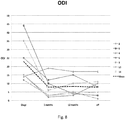
- Oxygen Desaturation Index is calculated by dividing the total number of oxygen desaturations (4% decrease in Sa0 2 (at nadir) with an increase to within 1% of the prehypopnea baseline value) by the number of hours of sleep.
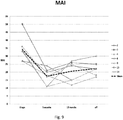
- Micro Arousal Index is defined as the total number of short duration arousals divided by the number of hours of sleep.
- CPAP Continuous Positive Airway Pressure
- OSA treatments are intended to be used by the patient every sleep session.
- FIG. 3 illustrates the data from ambulatory pulse-oximetry and CPAP machine download showing the mean (+/- SE) nightly apnea-hypopnea index (AHI) (top graph) and oxygen desaturation index (ODI) (bottom graph) of patients withdrawn from CPAP (Placebo-CPAP, solid circles) and of patients continuing CPAP (open circles).
- AHI nightly apnea-hypopnea index
- ODI oxygen desaturation index
- US6587725 discusses a fully implanted functional electrical stimulator apparatus, a method for treatment of obstructive sleep apnea that provides for both reliable detection/prediction or airway occlusion that relieves, and/or prevents same by selective, direct electrical stimulation of the hypoglossal nerve.
- US2011/0230702 discusses treatment of apnea via direct or indirect stimulation of muscles.
- a mask is used to position electrodes on a user so current traveling between the electrodes can stimulate nerves that control the geometry of the mask user's airway (e.g., pharynx, neck, throat, mouth, trachea, and the like).
- a collar is used to position electrodes on a user so current travelling between the electrodes can stimulate nerves that control the geometry of the collar user's airway.
- US7809442 discusses devices, systems and methods for nerve stimulation for OSA therapy.
- the systems disclosed herein provide not only a treatment for obstructive sleep apnea ("OSA”), but also a disease modifying therapy.
- OSA obstructive sleep apnea
- HGN hypoglossal nerve
- an electric signal is applied through the electrode to the hypoglossal nerve to stimulate at least one muscle of the tongue at least until the number of obstructive sleep apnea occurrences are reduced from an initial level to a treatment level and then the application of the electric signal is reduced while the number of obstructive sleep apnea occurrences remain generally at or below the treatment level.
- Inter-Session Periodicity or Intermittency means the reduced or temporary ceased stimulation within a single sleep session and "Inter-Session Perodicity or Intermittency” means the reduced or temporary ceased stimulation of sleep sessions as a whole.
- Reduction of stimulation may include reducing the level (e.g., frequency or amplitude) of the stimulation from a treatment level.
- the system may be preprogrammed to deliver the treatment schedules to the patient.
- the patient can input into the system (e.g., using a remote control or bed side monitor) when they are about to go to sleep and the stimulation program begins after a predetermined time (e.g., 30 minutes) to allow the patient to fall asleep.
- the system may be programmed to turn off at a predetermined time or when the patient turns the system Off when they get up for the day.
- the system is turned On and Off based on movement of the patient such as the patient's proximity to a bedside device (e.g. they sit up or walk closer to the bedside device).
- the application of the electric signal may be reduced to a second stimulation treatment schedule or therapy session while the efficacy of the treatment achieved during the first stimulation treatment schedule is at least generally retained during the second stimulation treatment schedule.
- Reducing the level and/or schedule of stimulation after a period of time, while the treatment level of OSA occurrences is at least generally retained, may lengthen the life of the implanted device (e.g., doubling or tripling the life of the implant) due to reduced use of the implant which in turn lowers surgical risks to patients. Reducing the stimulation while maintaining efficacy of treatment may also increase comfort (e.g., the patient is less likely to be awakened by the device) and ease of compliance (e.g., the patient may not need to have the device turned On every night).
- an electrode 764 is implanted around the hypoglossal nerve 322 at or near an approximately 1 cm length of 2.5 to 4.5 mm diameter nerve bundles. This is typically at the rear of and below the mandible, just underneath the sub-mandibular gland, proximal to the Styloglossus/Hyoglossus branches and distal to the ansa cervicalis branch. At this point, the major branches to the various tongue muscles are distal to the electrode site.
- the systems described in U.S. Patent Application Publication Nos. 2010/0094379 and 2011/0112601 may be adapted for use with the systems and methods disclosed herein.
- the present invention is directed to a system configured to perform a method of treating, controlling, or preventing a neurological disorder by attaching at least one programmable electrode 764a, 764b, 764c, 764d to a patient's hypoglossal nerve proper 322; and periodically applying electric signals to motor efferents located within the hypoglossal nerve proper 322 through the programmable electrode 764 to selectively stimulate at least one muscle.
- the electric signals are modulating.
- the method of treating, controlling, or preventing a neurological disorder consists essentially of the recruitment of retrusor motor efferents.
- the method comprises the recruitment of protrusor motor efferents.
- the method comprises the recruitment of a ratio of retrusor to protrusor motor efferents such as the ratios described above to treat a neurological disorder.
- the neurological disorder suitable for treatment, control, or prevention by the present invention is selected from the group consisting of, but not limited to oral myofunctional disorders, atrophies, weakness, tremors, fasciculations, and myositis.
- the neurological disorder is obstructive sleep apnea.
- Other potential applications of this method, in addition to treatment of obstructive sleep apnea include, for example, supplemental nerve stimulation to keep the airway open for treatment of snoring, hypopnea, or countering motor activation of the tongue during a seizure.
- Other health problems related to the patency of a patient's airway may also be treated using methods provided by the present invention.
- Specific hypoglossal nerve efferents may be selectively stimulated by one or more electric signals.
- the electric signals may be emitted from at least one programmable electrode contact.
- the targeted selective stimulation of hypoglossal nerve efferents occurs via two or more electrode contacts.
- the targeted selective stimulation of hypoglossal nerve efferents is driven by multiple current sources. In one embodiment, the multiple electrode contacts are each driven by their own independent current source.
- the method includes activating the ipsilateral Geniohyoid muscle. In one embodiment, the method includes activating rostral or caudal or both compartments of the ipsilateral Geniohyoid muscle. In one embodiment, the method includes activating at least one compartment or both compartments of ipsilateral or with the rostral compartment of the contralateral Geniohyoid muscles increasing the dilation (of the pharyngeal airway) and the patency of the airway channel.
- the targeted selective stimulation of hypoglossal nerve efferents activates at least one lingual muscle.
- the targeted selective stimulation of hypoglossal nerve efferents activates at least one upper airway channel dilator muscle.
- At least one protrusor muscle is activated.
- At least one protrusor muscle and at least one retrusor muscle are alternately activated.
- At least one protrusor muscle and at least one retrusor muscle are co-activated.
- the at least one protrusor muscle activated is the genioglossus muscle.
- At least one beneficial muscle group is activated. At least two beneficial muscle groups are activated.
- the modulating electric signals may have a frequency sufficient for a smooth tetanic contraction.
- the modulating electric signals have a stimulation frequency, at least during the treatment schedule, of about 10 to about 40 pps.
- the modulating electric signals may be of an intensity, at least during the treatment schedule, from about 10 to about 3000 microamps ( ⁇ A).
- the modulating electric signals have a stimulation pulse width, at least during the treatment schedule, of about 10 to about 1000 microseconds ( ⁇ ).
- an electric signal may be applied through the electrode to the hypoglossal nerve to stimulate at least one muscle of the tongue.
- the electric signal may be applied at least until the number of obstructive sleep apnea occurrences are reduced from an initial level to a treatment level. In one embodiment, the application of the electric signal is reduced while the number of obstructive sleep apnea occurrences is generally retained at or below the treatment level.
- An acceptable level of obstructive sleep apnea occurrences may be determined and a treatment schedule and/or level of stimulation may be determined to maintain this level.
- an Apnea-Hypopnea Index, an Oxygen Desaturation Index and/or a Micro Arousal Index of the patient as a result of the treatment is less than approximately 50% of the Apnea- Hypopnea Index, an Oxygen Desaturation Index and/or a Micro Arousal Index prior to treatment.
- an Apnea-Hypopnea Index, an Oxygen Desaturation Index and/or a Micro Arousal Index of the patient as a result of the treatment is less than approximately 45% of the Apnea-Hypopnea Index, an Oxygen Desaturation Index and/or a Micro Arousal Index prior to treatment. In one embodiment, an Apnea-Hypopnea Index, an Oxygen Desaturation Index and/or a Micro Arousal Index of the patient as a result of the treatment is less than approximately 40% of the Apnea-Hypopnea Index, an Oxygen Desaturation Index and/or a Micro Arousal Index prior to treatment.
- an Apnea-Hypopnea Index, an Oxygen Desaturation Index and/or a Micro Arousal Index of the patient as a result of the treatment is less than approximately 35% of the Apnea-Hypopnea Index, an Oxygen Desaturation Index and/or a Micro Arousal Index prior to treatment. In one embodiment, an Apnea-Hypopnea Index, an Oxygen Desaturation Index and/or a Micro Arousal Index of the patient as a result of the treatment is less than approximately 30% of the Apnea-Hypopnea Index, an Oxygen Desaturation Index and/or a Micro Arousal Index prior to treatment.
- an Apnea-Hypopnea Index, an Oxygen Desaturation Index and/or a Micro Arousal Index of the patient as a result of the treatment is less than approximately 25% of the Apnea- Hypopnea Index, an Oxygen Desaturation Index and/or a Micro Arousal Index prior to treatment. In one embodiment, an Apnea-Hypopnea Index, an Oxygen Desaturation Index and/or a Micro Arousal Index of the patient as a result of the treatment is less than approximately 20% of the Apnea-Hypopnea Index, an Oxygen Desaturation Index and/or a Micro Arousal Index prior to treatment.
- an Apnea-Hypopnea Index, an Oxygen Desaturation Index and/or a Micro Arousal Index of the patient as a result of the treatment is less than approximately 15% of the Apnea-Hypopnea Index, an Oxygen Desaturation Index and/or a Micro Arousal Index prior to treatment. In one embodiment, an Apnea-Hypopnea Index, an Oxygen Desaturation Index and/or a Micro Arousal Index of the patient as a result of the treatment is less than approximately 10% of the Apnea-Hypopnea Index, an Oxygen Desaturation Index and/or a Micro Arousal Index prior to treatment.
- an Apnea-Hypopnea Index, an Oxygen Desaturation Index and/or a Micro Arousal Index of the patient as a result of the treatment is less than approximately 5% of the Apnea-Hypopnea Index, an Oxygen Desaturation Index and/or a Micro Arousal Index prior to treatment.
- the duration that the electric signal is applied is reduced after an initial treatment period while the number of obstructive sleep apnea occurrences is retained generally at or below a treatment level.
- the frequency that the electric signal is applied is reduced after an initial treatment while the number of obstructive sleep apnea occurrences remain generally at or below the treatment level.
- the amplitude that the electric signal is applied is reduced after an initial treatment while the number of obstructive sleep apnea occurrences remain generally at or below the treatment level.
- the initial treatment period may be considered to be periodic (e.g., the system is On while the patient is sleeping and turned Off when the patient is awake).
- the reduced treatment schedule may be less frequent than the initial treatment schedule (e.g., therapy is not delivered every night).
- the initial treatment period may be any desired period (e.g., from 1 month to 12 months in duration) and thereafter intermittent treatment ensues.
- the initial treatment period is more than 1 year.
- the initial treatment period is more than 11 months.
- the initial treatment period is more than 10 months.
- the initial treatment period is more than 9 months. In one embodiment, the initial treatment period is more than 8 months.
- the initial treatment period is more than 7 months.
- the initial treatment period is more than 6 months.
- the initial treatment period is more than 5 months
- the initial treatment period is more than 4 months.
- the initial treatment period is more than 3 months.
- the initial treatment period is more than 2 month; The initial treatment period is more than 1 month.
- the initial treatment period is more than 1 week.
- the electric signal may no longer be applied for a period of time but the number of obstructive sleep apnea occurrences may remain generally at or below the treatment level.
- the electric signal is not applied for 24 hours or longer after an initial treatment while the number of obstructive sleep apnea occurrences remain generally at or below the treatment level.
- the electric signal is not applied for 48 hours or longer after an initial treatment while the number of obstructive sleep apnea occurrences remain generally at or below the treatment level.
- the electric signal is not applied for 72 hours or longer after an initial treatment while the number of obstructive sleep apnea occurrences remain generally at or below the treatment level.
- the electric signal is not applied for 1 month or longer after an initial treatment while the number of obstructive sleep apnea occurrences remain generally at or below the treatment leve.
- the electric signal is not applied for 6 months or longer after an initial treatment while the number of obstructive sleep apnea occurrences remain generally at or below the treatment level.
- the electric signal is reapplied after a period of not applying the electric signal.
- the electric signal is applied at a first predetermined treatment schedule and then a second predetermined treatment schedule.
- the patient may be reevaluated after one or more treatment schedules to determine the minimum stimulation required to maintain the number of obstructive sleep apnea occurrence generally at the treatment level.
- the system may then be reprogrammed.
- the system may be initially programmed to automatically switch from the first treatment schedule to the second treatment schedule after a predetermined amount of time (e.g., after 12 months).
- the second treatment schedule may be reduced in the number of consecutive sessions (e.g., from delivering one or more electrical signals every night to delivering one or more electrical signals only on weeknights) and/or reducing the frequency, duration, and/or amplitude of the electrical signal during each sleep session.
- a first treatment schedule may be followed by one or more reduced treatment schedules.
- a first treatment schedule includes applying electric signals every night and a second treatment schedule includes not applying an electric signal for one or more nights.
- the treatment schedule may be further reduced from the initial schedule such that the reduction is a gradual decrease (e.g., from 360 consecutive nights of applying an electrical signal to 20 consecutive nights of applying an electrical signal to 10 consecutive nights of applying an electrical signal to 5 consecutive nights of applying an electrical signal to a schedule of applying an electrical signal every other night to a schedule of applying an electrical signal every third night).
- a second treatment schedule may include reducing the number of hours an electric signal is applied each night.
- a second treatment schedule may include pausing the electric signal one or more times each night.
- a second treatment schedule may include increasing the delay before therapy begins after the system is turned On.
- the system may be reprogrammed to increase the level and/or amount of electrical signals until the number of obstructive sleep apnea occurrences are below a certain level.
- the patient can select or at least partially schedule the reduced treatment schedule. For example, during the reduced treatment schedule the patient may be permitted two nights a week to forgo stimulation. The patient may input predetermined nights in which no therapy will be delivered (e.g., Friday and Saturday nights) or a monitor can indicate if a night could be skipped (e.g., the system was used for 6 consecutive nights so a light or message my indicate that the patient can skip a night).
- the patient can program nights they would rather not have therapy delivered and the system will set a treatment schedule (e.g., if the patient plans on being on vacation for three days at the end of the month, the system may change the treatment schedule to deliver therapy every night leading up to the vacation to help prevent OSA occurrences from happening during the vacation).
- a treatment schedule e.g., if the patient plans on being on vacation for three days at the end of the month, the system may change the treatment schedule to deliver therapy every night leading up to the vacation to help prevent OSA occurrences from happening during the vacation).
- the schedule of delivering electrical signals may be automatically adjusted to account for a missed night that was not part of the scheduled program. For example, if a scheduled Off night is programmed for Wednesday but the patient travels on Tuesday without bringing the external elements described below such that no signal is applied that night, the system may shift the program ahead one night so that Tuesday is treated as the scheduled Off night and the electrical signals are applied on Wednesday.
- Periodic monitoring of the patient may be used to determine the appropriate stimulation level needed to keep the number of obstructive sleep apnea occurrences at the treatment level. If the patient or doctor determines that the number of obstructive sleep apnea occurrences increases after reducing the amount of electrical signals, then the system may be reprogrammed to increase the level and/or amount of electrical signals until the number of obstructive sleep apnea occurrences are below a certain level.
- the patient may elect to apply the electric signal while he or she is awake in order to exercise or train his or her tongue to stay out of his or her airway in addition to or in place of the stimulation schedules discussed above. For example, if the level of electrical stimulation needed to reduce the obstructive sleep apnea occurrences causes the patient to wake up, the patient may chose to have a desired amount of electrical stimulation applied to his or her HGN while he or she is awake in place of or to supplement the stimulation applied to his or her HGN while he or she is asleep.
- the patient may elect to have the electrical stimulation applied for an hour right before he or she goes to sleep such that no stimulation is needed while he or she sleeps or at least the level of electrical stimulation required while he or she sleeps can be reduced and the number of obstructive sleep apnea occurrences remain below a desired level.
- the patient initiates all sleep sessions through a remote control.
- the patient may voluntarily control when and how often therapy is applied, or the therapy could be initiated by the patient every night but the controller could implement the agreed upon schedule, or the system could be programmed using a real time clock to implement the therapy at pre-determined times and at pre-determined schedules.
- Inter-Session Perodicity or Intermittency may include:
- Exemplary methods of Intra-Session Periodicity or Intermittency may include:
- An exemplary progression of treatment for a patient includes:
- TBN Targeted Hypoglossal Neurostimulation
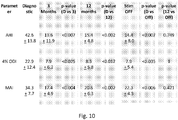
- “Off refers to the night without stimulation. Patients 2, 3 and 9 were off stimulation on the first night. Patients 4, 6 13 and 14 on the second night. There was no significant difference between the nights with and without stimulation after 12 months therapy. The nights without therapy after 1 year of therapy differed from the diagnostic nights as much as the nights with therapy after 1 year of therapy. After one year of nightly compliant use of TFiN, a significant statistical and clinical improvement was obtained in patients with moderate to mostly severe OSA, unable to use or comply with CPAP. Withdrawal of TFiN for one night after the initial therapy did not reduce the accumulated improvements in the symptoms of OSA. The improvement obtained during TFIN remained unchanged for the Apnea-Hypopnea, the 4% Desaturation and the Micro-arousal Indices.
- the muscle fibers type and the fat content of the tongue may have changed.
- the hypoglossal nucleus may have modified firing properties of the HGN, perhaps mediated by the feedback loops via the afferent fibers (4 to 5%) of the HGN and/or other associated nerves.
- a new neural pathway in the HGN, established by the TUN therapy may have favorably influenced the coordination between extrinsic and intrinsic muscles in the tongue Hydrostat.
- reducing the stimulation therapy after an initial stimulation therapy may be an effective treatment of OSA e.g., by turning the stimulation "OFF" in intervals of one or two nights following an initial treatment and still get the full benefit of the treatment as if continuing to use it every night.
- the OSA system is comprised of implanted and external elements which together act to provide stimulation of the HGN 322.
- the implanted elements may include an implantable pulse generator (“IPG") and a cuff electrode 764.
- the external elements may include a remote control and charger (“RCC”), a charger coil and cable (“CC”), a docking station and a power supply for the patient, and a notebook computer and the aura clinical manager (“aCM”) clinician's software programming system.
- the IPG may be responsible for generating the pulses that activate the desired neurons within the HGN 322, and is implanted in the anterior chest region of the patient.
- the cuff electrode 764 may attach to the IPG via an inline connector, and runs from the chest location of the IPG to the sub-mandibular region where it is wrapped around the HGN 322.
- the IPG may contain a plurality, such as six, independent current sources, each capacitively coupled via feedthroughs in its enclosure to the inline connector.
- the inline connector may have six torroidal spring contacts that mate with ring contacts of the cuff electrode 764 proximal connector. Each ring contact of the cuff electrode 764 may be connected by a wire in the cuff electrode 764 assembly to a contact within the self-sizing cuff.
- Each contact may be shaped to match the curvature of the nerve bundle of the HGN 322, and the six contacts are located within the cuff so that six sectors of the nerve circumference are in intimate contact with the cuff contacts.
- the IPG may be directed by the RCC to start and stop a sleep therapy treatment session, to provide information on the status of the IPG and the cuff electrode 764, and is used in conjunction with the CC to replenish the energy within the IPG battery.
- the aCM may be used by a clinical engineer or clinician to program the OSA system for use in providing therapy to the patient.
- the system may include one or more computers having one or more processors and memory (e.g., one or more nonvolatile storage devices).
- Memory or computer readable storage medium of memory stores programs, modules and data structures, or a subset thereof for a processor to control and run the various systems and methods disclosed herein.
- a computer readable storage medium having stored thereon computer-executable instructions which, when executed by a processor, perform one or more of the methods disclosed herein.
Landscapes
- Health & Medical Sciences (AREA)
- Life Sciences & Earth Sciences (AREA)
- Engineering & Computer Science (AREA)
- Public Health (AREA)
- Veterinary Medicine (AREA)
- Biomedical Technology (AREA)
- Nuclear Medicine, Radiotherapy & Molecular Imaging (AREA)
- Radiology & Medical Imaging (AREA)
- General Health & Medical Sciences (AREA)
- Animal Behavior & Ethology (AREA)
- Neurosurgery (AREA)
- Neurology (AREA)
- Pulmonology (AREA)
- Orthopedic Medicine & Surgery (AREA)
- Cardiology (AREA)
- Heart & Thoracic Surgery (AREA)
- Biophysics (AREA)
- Physiology (AREA)
- Electrotherapy Devices (AREA)
Claims (14)
- System zum Kontrollieren einer Position der Zunge eines Patienten, wobei das System Folgendes umfasst:zumindest eine Elektrode zum Anbringen an den Zungenmuskelnerv des Patienten; undeinen implantierbaren Impulsgenerator, der zum Anwenden eines elektrischen Signals durch die zumindest eine Elektrode auf den Zungenmuskelnerv konfiguriert ist, um zumindest einen Muskel der Zunge zu stimulieren;dadurch gekennzeichnet, dass:das System adaptiert ist, zum Anwenden des elektrischen Signals bei einem anfänglichen Pegel der Stimulation programmiert zu werden,wobei der anfängliche Pegel der Stimulation bestimmt ist, um einen definierten Behandlungspegel für Episoden von obstruktiver Schlafapnoe aufrecht zu erhalten; unddas System adaptiert ist, zum Anwenden des elektrischen Signals bei einem reduzierten Pegel der Stimulation umprogrammiert zu werden, in Antwort auf eine Bestimmung, dass eine Anzahl von Episoden obstruktiver Schlafapnoe bei oder unter dem Behandlungspegel liegt.
- System nach Anspruch 1, wobei der Pegel von Episoden von obstruktiver Schlafapnoe ein Apnoe-Hypopnoe-Index, ein Sauerstoff-Entsättigungsindex und/oder ein Mikro-Arousal-Index des Patienten ist.
- System nach Anspruch 2, wobei der Behandlungspegel der Episoden von obstruktiver Schlafapnoe als ein Wert von 5%, 10%, 15%, 20%, 25%, 30%, 35%, 40%, 45% und 50% für den Apnoe-Hypopnoe-Index, einen Sauerstoff-Entsättigungsindex und/oder einen Mikro-Arousal-Index vor der Behandlung definiert ist.
- System nach Anspruch 1, wobei der implantierbare Impulsgenerator konfiguriert ist, die Anwendung des elektrischen Signals durch Anwenden des elektrischen Signals mit einer Intra-Session-Periodizität zu reduzieren.
- System nach Anspruch 1, wobei der implantierbare Impulsgenerator konfiguriert ist, die Anwendung des elektrischen Signals durch Anwenden des elektrischen Signals mit einer Inter-Session-Periodizität zu reduzieren.
- System nach Anspruch 1, wobei der implantierbare Impulsgenerator konfiguriert ist, die Anwendung des elektrischen Signals durch Reduzieren einer Dauer, für die das elektrische Signal angewendet wird, zu reduzieren.
- System nach Anspruch 1, wobei der implantierbare Impulsgenerator konfiguriert ist, die Anwendung des elektrischen Signals durch Beenden der Anwendung des elektrischen Signals zu reduzieren.
- System nach Anspruch 1, wobei der implantierbare Impulsgenerator konfiguriert ist, die Anwendung des elektrischen Signals durch Reduzieren einer Frequenz, mit der das elektrische Signal angewendet wird, zu reduzieren.
- System nach Anspruch 1, wobei der implantierbare Impulsgenerator konfiguriert ist, die Anwendung des elektrischen Signals durch Reduzieren einer Amplitude, mit der das elektrische Signal angewendet wird, zu reduzieren.
- System nach Anspruch 1, wobei der implantierbare Impulsgenerator ferner konfiguriert ist, ein anfängliches elektrisches Signal anzuwenden, das allmählich über die Zeit zunimmt und dann abflacht.
- System nach Anspruch 1, wobei der implantierbare Impulsgenerator ferner konfiguriert ist, das elektrische Signal auf zumindest eine als Ziel gewählte motorische Efferenz des Zungenmuskelnervs anzuwenden.
- System nach Anspruch 1, wobei der implantierbare Impulsgenerator ferner konfiguriert ist, das elektrische Signal in Antwort auf eine Benutzereingabe durch den Patienten anzuwenden, bevor der Patient schlafengeht.
- System nach Anspruch 1, wobei der implantierbare Impulsgenerator ferner konfiguriert ist, das elektrische Signal in Antwort auf eine Benutzereingabe durch den Patienten anzuwenden, nachdem der Patient aufgewacht ist.
- Computerlesbares Speichermedium mit darauf gespeicherten computer-ausführbaren Instruktionen, die beim Ausführen durch ein System gemäß eines der Ansprüche 1-13 einschließlich eines oder mehrerer Prozessoren, eines implantierbaren Impulsgenerators und zumindest einer Elektrode den Prozessor veranlassen, zu folgendem Zweck betriebsfähig zu werden:Anwenden des elektrischen Signals bei einem anfänglichen Pegel der Stimulation, wobei der anfängliche Pegel der Stimulation bestimmt ist, um einen definierten Behandlungspegel für Episoden von obstruktiver Schlafapnoe aufrecht zu erhalten; undAnwenden des elektrischen Signals bei einem reduzierten Pegel der Stimulation in Antwort auf eine Bestimmung, dass eine Anzahl von Episoden obstruktiver Schlafapnoe bei oder unter dem Behandlungspegel liegt.
Applications Claiming Priority (2)
| Application Number | Priority Date | Filing Date | Title |
|---|---|---|---|
| US201261647122P | 2012-05-15 | 2012-05-15 | |
| PCT/US2013/040728 WO2013173214A1 (en) | 2012-05-15 | 2013-05-13 | Stimulation of a hypoglossal nerve for controlling the position of a patient's tongue |
Publications (3)
| Publication Number | Publication Date |
|---|---|
| EP2849838A1 EP2849838A1 (de) | 2015-03-25 |
| EP2849838A4 EP2849838A4 (de) | 2016-02-24 |
| EP2849838B1 true EP2849838B1 (de) | 2021-11-17 |
Family
ID=49584183
Family Applications (1)
| Application Number | Title | Priority Date | Filing Date |
|---|---|---|---|
| EP13791144.2A Active EP2849838B1 (de) | 2012-05-15 | 2013-05-13 | Stimulierung eines hypoglossalen nervs zur steuerung der zungenposition eines patienten |
Country Status (5)
| Country | Link |
|---|---|
| US (4) | US9308370B2 (de) |
| EP (1) | EP2849838B1 (de) |
| AU (2) | AU2013263068B2 (de) |
| HK (1) | HK1203429A1 (de) |
| WO (1) | WO2013173214A1 (de) |
Families Citing this family (29)
| Publication number | Priority date | Publication date | Assignee | Title |
|---|---|---|---|---|
| US8255057B2 (en) | 2009-01-29 | 2012-08-28 | Nevro Corporation | Systems and methods for producing asynchronous neural responses to treat pain and/or other patient conditions |
| EP2421600B1 (de) | 2009-04-22 | 2014-03-05 | Nevro Corporation | Rückenmarksmodulationssyteme zur induzierung von parästhetischen und anästhetischen effekten |
| US10716940B2 (en) | 2009-10-20 | 2020-07-21 | Nyxoah SA | Implant unit for modulation of small diameter nerves |
| US9409013B2 (en) | 2009-10-20 | 2016-08-09 | Nyxoah SA | Method for controlling energy delivery as a function of degree of coupling |
| US10751537B2 (en) | 2009-10-20 | 2020-08-25 | Nyxoah SA | Arced implant unit for modulation of nerves |
| AU2012304370B2 (en) | 2011-09-08 | 2016-01-28 | Nevro Corporation | Selective high frequency spinal cord modulation for inhibiting pain, including cephalic and/or total body pain with reduced side effects, and associated systems and methods |
| AU2013263068B2 (en) | 2012-05-15 | 2016-09-29 | Imthera Medical, Inc. | Stimulation of a hypoglossal nerve for controlling the position of a patient's tongue |
| US9907967B2 (en) | 2012-07-26 | 2018-03-06 | Adi Mashiach | Transcutaneous power conveyance device |
| CA2879940C (en) | 2012-07-26 | 2021-08-10 | Adi Mashiach | Electrical contacts on a medical device patch |
| US11253712B2 (en) | 2012-07-26 | 2022-02-22 | Nyxoah SA | Sleep disordered breathing treatment apparatus |
| US10052097B2 (en) | 2012-07-26 | 2018-08-21 | Nyxoah SA | Implant unit delivery tool |
| US9895539B1 (en) | 2013-06-10 | 2018-02-20 | Nevro Corp. | Methods and systems for disease treatment using electrical stimulation |
| CN105873637B (zh) | 2013-06-17 | 2020-03-03 | 尼科索亚股份有限公司 | 在整个治疗周期上进行调节的动态修改 |
| US10149978B1 (en) | 2013-11-07 | 2018-12-11 | Nevro Corp. | Spinal cord modulation for inhibiting pain via short pulse width waveforms, and associated systems and methods |
| WO2015077283A1 (en) | 2013-11-19 | 2015-05-28 | The Cleveland Clinic Foundation | System for treating obstructive sleep apnea |
| WO2016014391A1 (en) | 2014-07-22 | 2016-01-28 | Imthera Medical, Inc. | Method for adjusting a system for stimulating a hypoglossal nerve |
| US11318310B1 (en) | 2015-10-26 | 2022-05-03 | Nevro Corp. | Neuromodulation for altering autonomic functions, and associated systems and methods |
| AU2017211121B2 (en) | 2016-01-25 | 2022-02-24 | Nevro Corp. | Treatment of congestive heart failure with electrical stimulation, and associated systems and methods |
| US10918871B2 (en) * | 2016-02-23 | 2021-02-16 | Verily Life Sciences Llc | Systems and methods for peripheral nervous stimulation for metabolic and endocrine function |
| US11559683B2 (en) | 2018-06-01 | 2023-01-24 | Zennea Technologies Inc. | Method and device for treating sleep related breathing disorders |
| US11590352B2 (en) | 2019-01-29 | 2023-02-28 | Nevro Corp. | Ramped therapeutic signals for modulating inhibitory interneurons, and associated systems and methods |
| WO2020223723A1 (en) | 2019-05-02 | 2020-11-05 | Enhale Medical, Inc. | Implantable stimulation power receiver, systems and methods |
| US11351377B2 (en) | 2019-05-03 | 2022-06-07 | The Cleveland Clinic Foundation | Intra-oral appliances and systems |
| WO2021076188A1 (en) | 2019-10-15 | 2021-04-22 | Enhale Medical, Inc. | Biased neuromodulation lead and method of using same |
| US11839767B2 (en) | 2020-01-10 | 2023-12-12 | Nuxcel2, L.L.C. | Systems and methods for stimulation of cranial nerves |
| US12414704B2 (en) | 2020-05-23 | 2025-09-16 | Inspire Medical Systems, Inc. | Single or multiple nerve stimulation to treat sleep disordered breathing |
| US11691010B2 (en) | 2021-01-13 | 2023-07-04 | Xii Medical, Inc. | Systems and methods for improving sleep disordered breathing |
| EP4347001B1 (de) | 2021-05-25 | 2026-03-25 | Nevro Corp. | Modifizierte hochfrequenz-neuromodulationssignale sowie zugehörige systeme |
| US12558549B2 (en) | 2022-10-28 | 2026-02-24 | Medtronic, Inc. | Lead based measurements for tongue movement determination |
Family Cites Families (10)
| Publication number | Priority date | Publication date | Assignee | Title |
|---|---|---|---|---|
| AU5130199A (en) | 1998-07-27 | 2000-02-21 | Case Western Reserve University | Method and apparatus for closed-loop stimulation of the hypoglossal nerve in human patients to treat obstructive sleep apnea |
| US20050075680A1 (en) | 2003-04-18 | 2005-04-07 | Lowry David Warren | Methods and systems for intracranial neurostimulation and/or sensing |
| US20050085874A1 (en) * | 2003-10-17 | 2005-04-21 | Ross Davis | Method and system for treating sleep apnea |
| EP3527255B1 (de) * | 2006-10-13 | 2020-08-05 | Cyberonics, Inc. | Vorrichtungen und systeme zur behandlung von obstruktiver schlafapnoe |
| EP2349139B1 (de) * | 2008-10-09 | 2017-05-31 | Imthera Medical, Inc. | Stimulierung eines hypoglossalen nervs zur steuerung der zungenposition bei einem patienten |
| US10806926B2 (en) * | 2009-10-20 | 2020-10-20 | Man & Science Sa | Implantable electrical stimulator |
| US9409013B2 (en) * | 2009-10-20 | 2016-08-09 | Nyxoah SA | Method for controlling energy delivery as a function of degree of coupling |
| KR20120101650A (ko) | 2009-11-10 | 2012-09-14 | 임테라 메디칼, 인코포레이티드 | 환자 혀의 위치를 제어하기 위한 혀밑 신경 자극용 시스템 |
| US20110230702A1 (en) * | 2010-03-16 | 2011-09-22 | Kirk Honour | Device, System, And Method For Treating Sleep Apnea |
| AU2013263068B2 (en) | 2012-05-15 | 2016-09-29 | Imthera Medical, Inc. | Stimulation of a hypoglossal nerve for controlling the position of a patient's tongue |
-
2013
- 2013-05-13 AU AU2013263068A patent/AU2013263068B2/en active Active
- 2013-05-13 HK HK15104286.8A patent/HK1203429A1/xx unknown
- 2013-05-13 WO PCT/US2013/040728 patent/WO2013173214A1/en not_active Ceased
- 2013-05-13 US US14/400,733 patent/US9308370B2/en active Active
- 2013-05-13 EP EP13791144.2A patent/EP2849838B1/de active Active
-
2016
- 2016-03-02 US US15/058,722 patent/US9662496B2/en active Active
- 2016-11-08 AU AU2016256683A patent/AU2016256683B2/en active Active
-
2017
- 2017-04-27 US US15/499,511 patent/US9987491B2/en active Active
-
2018
- 2018-05-02 US US15/969,418 patent/US10751538B2/en active Active
Non-Patent Citations (1)
| Title |
|---|
| None * |
Also Published As
| Publication number | Publication date |
|---|---|
| HK1203429A1 (en) | 2015-10-30 |
| EP2849838A4 (de) | 2016-02-24 |
| US20160175587A1 (en) | 2016-06-23 |
| AU2016256683A1 (en) | 2016-11-24 |
| EP2849838A1 (de) | 2015-03-25 |
| AU2013263068A1 (en) | 2014-11-27 |
| WO2013173214A1 (en) | 2013-11-21 |
| AU2013263068B2 (en) | 2016-09-29 |
| US20180250509A1 (en) | 2018-09-06 |
| AU2016256683B2 (en) | 2018-05-17 |
| US9308370B2 (en) | 2016-04-12 |
| US10751538B2 (en) | 2020-08-25 |
| US20170224988A1 (en) | 2017-08-10 |
| US20150148860A1 (en) | 2015-05-28 |
| US9662496B2 (en) | 2017-05-30 |
| US9987491B2 (en) | 2018-06-05 |
Similar Documents
| Publication | Publication Date | Title |
|---|---|---|
| US10751538B2 (en) | Stimulation of a hypoglossal nerve for controlling the position of a patient's tongue | |
| US12478322B2 (en) | Method for adjusting a system for stimulating a hypoglossal nerve | |
| US10279185B2 (en) | Method of stimulating a hypoglossal nerve for controlling the position of a patient's tongue | |
| AU2017202779B2 (en) | Method of stimulating a hypoglossal nerve for controlling the position of a patient's tongue | |
| HK1161067A (en) | Stimulation of a hypoglossal nerve for controlling the position of a patient's tongue | |
| HK1161067B (en) | Stimulation of a hypoglossal nerve for controlling the position of a patient's tongue |
Legal Events
| Date | Code | Title | Description |
|---|---|---|---|
| PUAI | Public reference made under article 153(3) epc to a published international application that has entered the european phase |
Free format text: ORIGINAL CODE: 0009012 |
|
| 17P | Request for examination filed |
Effective date: 20141112 |
|
| AK | Designated contracting states |
Kind code of ref document: A1 Designated state(s): AL AT BE BG CH CY CZ DE DK EE ES FI FR GB GR HR HU IE IS IT LI LT LU LV MC MK MT NL NO PL PT RO RS SE SI SK SM TR |
|
| AX | Request for extension of the european patent |
Extension state: BA ME |
|
| DAX | Request for extension of the european patent (deleted) | ||
| REG | Reference to a national code |
Ref country code: HK Ref legal event code: DE Ref document number: 1203429 Country of ref document: HK |
|
| RA4 | Supplementary search report drawn up and despatched (corrected) |
Effective date: 20160125 |
|
| RIC1 | Information provided on ipc code assigned before grant |
Ipc: A61N 1/05 20060101AFI20160119BHEP Ipc: A61N 1/36 20060101ALI20160119BHEP Ipc: A61N 1/18 20060101ALI20160119BHEP |
|
| R17P | Request for examination filed (corrected) |
Effective date: 20141112 |
|
| STAA | Information on the status of an ep patent application or granted ep patent |
Free format text: STATUS: EXAMINATION IS IN PROGRESS |
|
| 17Q | First examination report despatched |
Effective date: 20200518 |
|
| GRAP | Despatch of communication of intention to grant a patent |
Free format text: ORIGINAL CODE: EPIDOSNIGR1 |
|
| STAA | Information on the status of an ep patent application or granted ep patent |
Free format text: STATUS: GRANT OF PATENT IS INTENDED |
|
| INTG | Intention to grant announced |
Effective date: 20210527 |
|
| GRAS | Grant fee paid |
Free format text: ORIGINAL CODE: EPIDOSNIGR3 |
|
| GRAA | (expected) grant |
Free format text: ORIGINAL CODE: 0009210 |
|
| STAA | Information on the status of an ep patent application or granted ep patent |
Free format text: STATUS: THE PATENT HAS BEEN GRANTED |
|
| AK | Designated contracting states |
Kind code of ref document: B1 Designated state(s): AL AT BE BG CH CY CZ DE DK EE ES FI FR GB GR HR HU IE IS IT LI LT LU LV MC MK MT NL NO PL PT RO RS SE SI SK SM TR |
|
| REG | Reference to a national code |
Ref country code: GB Ref legal event code: FG4D |
|
| REG | Reference to a national code |
Ref country code: DE Ref legal event code: R096 Ref document number: 602013080105 Country of ref document: DE |
|
| REG | Reference to a national code |
Ref country code: IE Ref legal event code: FG4D |
|
| REG | Reference to a national code |
Ref country code: AT Ref legal event code: REF Ref document number: 1447550 Country of ref document: AT Kind code of ref document: T Effective date: 20211215 |
|
| REG | Reference to a national code |
Ref country code: LT Ref legal event code: MG9D |
|
| REG | Reference to a national code |
Ref country code: NL Ref legal event code: MP Effective date: 20211117 |
|
| REG | Reference to a national code |
Ref country code: AT Ref legal event code: MK05 Ref document number: 1447550 Country of ref document: AT Kind code of ref document: T Effective date: 20211117 |
|
| PG25 | Lapsed in a contracting state [announced via postgrant information from national office to epo] |
Ref country code: RS Free format text: LAPSE BECAUSE OF FAILURE TO SUBMIT A TRANSLATION OF THE DESCRIPTION OR TO PAY THE FEE WITHIN THE PRESCRIBED TIME-LIMIT Effective date: 20211117 Ref country code: LT Free format text: LAPSE BECAUSE OF FAILURE TO SUBMIT A TRANSLATION OF THE DESCRIPTION OR TO PAY THE FEE WITHIN THE PRESCRIBED TIME-LIMIT Effective date: 20211117 Ref country code: FI Free format text: LAPSE BECAUSE OF FAILURE TO SUBMIT A TRANSLATION OF THE DESCRIPTION OR TO PAY THE FEE WITHIN THE PRESCRIBED TIME-LIMIT Effective date: 20211117 Ref country code: BG Free format text: LAPSE BECAUSE OF FAILURE TO SUBMIT A TRANSLATION OF THE DESCRIPTION OR TO PAY THE FEE WITHIN THE PRESCRIBED TIME-LIMIT Effective date: 20220217 Ref country code: AT Free format text: LAPSE BECAUSE OF FAILURE TO SUBMIT A TRANSLATION OF THE DESCRIPTION OR TO PAY THE FEE WITHIN THE PRESCRIBED TIME-LIMIT Effective date: 20211117 |
|
| PG25 | Lapsed in a contracting state [announced via postgrant information from national office to epo] |
Ref country code: IS Free format text: LAPSE BECAUSE OF FAILURE TO SUBMIT A TRANSLATION OF THE DESCRIPTION OR TO PAY THE FEE WITHIN THE PRESCRIBED TIME-LIMIT Effective date: 20220317 Ref country code: SE Free format text: LAPSE BECAUSE OF FAILURE TO SUBMIT A TRANSLATION OF THE DESCRIPTION OR TO PAY THE FEE WITHIN THE PRESCRIBED TIME-LIMIT Effective date: 20211117 Ref country code: PT Free format text: LAPSE BECAUSE OF FAILURE TO SUBMIT A TRANSLATION OF THE DESCRIPTION OR TO PAY THE FEE WITHIN THE PRESCRIBED TIME-LIMIT Effective date: 20220317 Ref country code: PL Free format text: LAPSE BECAUSE OF FAILURE TO SUBMIT A TRANSLATION OF THE DESCRIPTION OR TO PAY THE FEE WITHIN THE PRESCRIBED TIME-LIMIT Effective date: 20211117 Ref country code: NO Free format text: LAPSE BECAUSE OF FAILURE TO SUBMIT A TRANSLATION OF THE DESCRIPTION OR TO PAY THE FEE WITHIN THE PRESCRIBED TIME-LIMIT Effective date: 20220217 Ref country code: NL Free format text: LAPSE BECAUSE OF FAILURE TO SUBMIT A TRANSLATION OF THE DESCRIPTION OR TO PAY THE FEE WITHIN THE PRESCRIBED TIME-LIMIT Effective date: 20211117 Ref country code: LV Free format text: LAPSE BECAUSE OF FAILURE TO SUBMIT A TRANSLATION OF THE DESCRIPTION OR TO PAY THE FEE WITHIN THE PRESCRIBED TIME-LIMIT Effective date: 20211117 Ref country code: HR Free format text: LAPSE BECAUSE OF FAILURE TO SUBMIT A TRANSLATION OF THE DESCRIPTION OR TO PAY THE FEE WITHIN THE PRESCRIBED TIME-LIMIT Effective date: 20211117 Ref country code: GR Free format text: LAPSE BECAUSE OF FAILURE TO SUBMIT A TRANSLATION OF THE DESCRIPTION OR TO PAY THE FEE WITHIN THE PRESCRIBED TIME-LIMIT Effective date: 20220218 Ref country code: ES Free format text: LAPSE BECAUSE OF FAILURE TO SUBMIT A TRANSLATION OF THE DESCRIPTION OR TO PAY THE FEE WITHIN THE PRESCRIBED TIME-LIMIT Effective date: 20211117 |
|
| PG25 | Lapsed in a contracting state [announced via postgrant information from national office to epo] |
Ref country code: SM Free format text: LAPSE BECAUSE OF FAILURE TO SUBMIT A TRANSLATION OF THE DESCRIPTION OR TO PAY THE FEE WITHIN THE PRESCRIBED TIME-LIMIT Effective date: 20211117 Ref country code: SK Free format text: LAPSE BECAUSE OF FAILURE TO SUBMIT A TRANSLATION OF THE DESCRIPTION OR TO PAY THE FEE WITHIN THE PRESCRIBED TIME-LIMIT Effective date: 20211117 Ref country code: RO Free format text: LAPSE BECAUSE OF FAILURE TO SUBMIT A TRANSLATION OF THE DESCRIPTION OR TO PAY THE FEE WITHIN THE PRESCRIBED TIME-LIMIT Effective date: 20211117 Ref country code: EE Free format text: LAPSE BECAUSE OF FAILURE TO SUBMIT A TRANSLATION OF THE DESCRIPTION OR TO PAY THE FEE WITHIN THE PRESCRIBED TIME-LIMIT Effective date: 20211117 Ref country code: DK Free format text: LAPSE BECAUSE OF FAILURE TO SUBMIT A TRANSLATION OF THE DESCRIPTION OR TO PAY THE FEE WITHIN THE PRESCRIBED TIME-LIMIT Effective date: 20211117 Ref country code: CZ Free format text: LAPSE BECAUSE OF FAILURE TO SUBMIT A TRANSLATION OF THE DESCRIPTION OR TO PAY THE FEE WITHIN THE PRESCRIBED TIME-LIMIT Effective date: 20211117 |
|
| REG | Reference to a national code |
Ref country code: DE Ref legal event code: R097 Ref document number: 602013080105 Country of ref document: DE |
|
| PLBE | No opposition filed within time limit |
Free format text: ORIGINAL CODE: 0009261 |
|
| STAA | Information on the status of an ep patent application or granted ep patent |
Free format text: STATUS: NO OPPOSITION FILED WITHIN TIME LIMIT |
|
| 26N | No opposition filed |
Effective date: 20220818 |
|
| PG25 | Lapsed in a contracting state [announced via postgrant information from national office to epo] |
Ref country code: AL Free format text: LAPSE BECAUSE OF FAILURE TO SUBMIT A TRANSLATION OF THE DESCRIPTION OR TO PAY THE FEE WITHIN THE PRESCRIBED TIME-LIMIT Effective date: 20211117 |
|
| PG25 | Lapsed in a contracting state [announced via postgrant information from national office to epo] |
Ref country code: SI Free format text: LAPSE BECAUSE OF FAILURE TO SUBMIT A TRANSLATION OF THE DESCRIPTION OR TO PAY THE FEE WITHIN THE PRESCRIBED TIME-LIMIT Effective date: 20211117 |
|
| REG | Reference to a national code |
Ref country code: CH Ref legal event code: PL |
|
| REG | Reference to a national code |
Ref country code: BE Ref legal event code: MM Effective date: 20220531 |
|
| PG25 | Lapsed in a contracting state [announced via postgrant information from national office to epo] |
Ref country code: MC Free format text: LAPSE BECAUSE OF FAILURE TO SUBMIT A TRANSLATION OF THE DESCRIPTION OR TO PAY THE FEE WITHIN THE PRESCRIBED TIME-LIMIT Effective date: 20211117 Ref country code: LU Free format text: LAPSE BECAUSE OF NON-PAYMENT OF DUE FEES Effective date: 20220513 Ref country code: LI Free format text: LAPSE BECAUSE OF NON-PAYMENT OF DUE FEES Effective date: 20220531 Ref country code: CH Free format text: LAPSE BECAUSE OF NON-PAYMENT OF DUE FEES Effective date: 20220531 |
|
| PG25 | Lapsed in a contracting state [announced via postgrant information from national office to epo] |
Ref country code: IE Free format text: LAPSE BECAUSE OF NON-PAYMENT OF DUE FEES Effective date: 20220513 |
|
| PG25 | Lapsed in a contracting state [announced via postgrant information from national office to epo] |
Ref country code: IT Free format text: LAPSE BECAUSE OF FAILURE TO SUBMIT A TRANSLATION OF THE DESCRIPTION OR TO PAY THE FEE WITHIN THE PRESCRIBED TIME-LIMIT Effective date: 20211117 Ref country code: BE Free format text: LAPSE BECAUSE OF NON-PAYMENT OF DUE FEES Effective date: 20220531 |
|
| P01 | Opt-out of the competence of the unified patent court (upc) registered |
Effective date: 20230608 |
|
| PG25 | Lapsed in a contracting state [announced via postgrant information from national office to epo] |
Ref country code: HU Free format text: LAPSE BECAUSE OF FAILURE TO SUBMIT A TRANSLATION OF THE DESCRIPTION OR TO PAY THE FEE WITHIN THE PRESCRIBED TIME-LIMIT; INVALID AB INITIO Effective date: 20130513 |
|
| PG25 | Lapsed in a contracting state [announced via postgrant information from national office to epo] |
Ref country code: MK Free format text: LAPSE BECAUSE OF FAILURE TO SUBMIT A TRANSLATION OF THE DESCRIPTION OR TO PAY THE FEE WITHIN THE PRESCRIBED TIME-LIMIT Effective date: 20211117 Ref country code: CY Free format text: LAPSE BECAUSE OF FAILURE TO SUBMIT A TRANSLATION OF THE DESCRIPTION OR TO PAY THE FEE WITHIN THE PRESCRIBED TIME-LIMIT Effective date: 20211117 |
|
| PG25 | Lapsed in a contracting state [announced via postgrant information from national office to epo] |
Ref country code: MT Free format text: LAPSE BECAUSE OF FAILURE TO SUBMIT A TRANSLATION OF THE DESCRIPTION OR TO PAY THE FEE WITHIN THE PRESCRIBED TIME-LIMIT Effective date: 20211117 |
|
| PGFP | Annual fee paid to national office [announced via postgrant information from national office to epo] |
Ref country code: DE Payment date: 20250319 Year of fee payment: 13 |
|
| PG25 | Lapsed in a contracting state [announced via postgrant information from national office to epo] |
Ref country code: TR Free format text: LAPSE BECAUSE OF FAILURE TO SUBMIT A TRANSLATION OF THE DESCRIPTION OR TO PAY THE FEE WITHIN THE PRESCRIBED TIME-LIMIT Effective date: 20211117 |
|
| PGFP | Annual fee paid to national office [announced via postgrant information from national office to epo] |
Ref country code: GB Payment date: 20260312 Year of fee payment: 14 |
|
| PGFP | Annual fee paid to national office [announced via postgrant information from national office to epo] |
Ref country code: FR Payment date: 20260309 Year of fee payment: 14 |