EP2851002A1 - Vorrichtung zur automatischen Abbildung eines komplexen fraktionierten atrialen Elektrogramms - Google Patents
Vorrichtung zur automatischen Abbildung eines komplexen fraktionierten atrialen Elektrogramms Download PDFInfo
- Publication number
- EP2851002A1 EP2851002A1 EP14183365.7A EP14183365A EP2851002A1 EP 2851002 A1 EP2851002 A1 EP 2851002A1 EP 14183365 A EP14183365 A EP 14183365A EP 2851002 A1 EP2851002 A1 EP 2851002A1
- Authority
- EP
- European Patent Office
- Prior art keywords
- deflection
- signal
- electrogram
- deflections
- evaluation unit
- Prior art date
- Legal status (The legal status is an assumption and is not a legal conclusion. Google has not performed a legal analysis and makes no representation as to the accuracy of the status listed.)
- Withdrawn
Links
Images



Classifications
-
- A—HUMAN NECESSITIES
- A61—MEDICAL OR VETERINARY SCIENCE; HYGIENE
- A61B—DIAGNOSIS; SURGERY; IDENTIFICATION
- A61B5/00—Measuring for diagnostic purposes; Identification of persons
- A61B5/24—Detecting, measuring or recording bioelectric or biomagnetic signals of the body or parts thereof
- A61B5/316—Modalities, i.e. specific diagnostic methods
- A61B5/318—Heart-related electrical modalities, e.g. electrocardiography [ECG]
- A61B5/339—Displays specially adapted therefor
- A61B5/341—Vectorcardiography [VCG]
-
- A—HUMAN NECESSITIES
- A61—MEDICAL OR VETERINARY SCIENCE; HYGIENE
- A61B—DIAGNOSIS; SURGERY; IDENTIFICATION
- A61B18/00—Surgical instruments, devices or methods for transferring non-mechanical forms of energy to or from the body
- A61B18/04—Surgical instruments, devices or methods for transferring non-mechanical forms of energy to or from the body by heating
- A61B18/12—Surgical instruments, devices or methods for transferring non-mechanical forms of energy to or from the body by heating by passing a current through the tissue to be heated, e.g. high-frequency current
- A61B18/14—Probes or electrodes therefor
- A61B18/1492—Probes or electrodes therefor having a flexible, catheter-like structure, e.g. for heart ablation
-
- A—HUMAN NECESSITIES
- A61—MEDICAL OR VETERINARY SCIENCE; HYGIENE
- A61B—DIAGNOSIS; SURGERY; IDENTIFICATION
- A61B34/00—Computer-aided surgery; Manipulators or robots specially adapted for use in surgery
- A61B34/20—Surgical navigation systems; Devices for tracking or guiding surgical instruments, e.g. for frameless stereotaxis
-
- A—HUMAN NECESSITIES
- A61—MEDICAL OR VETERINARY SCIENCE; HYGIENE
- A61B—DIAGNOSIS; SURGERY; IDENTIFICATION
- A61B5/00—Measuring for diagnostic purposes; Identification of persons
- A61B5/24—Detecting, measuring or recording bioelectric or biomagnetic signals of the body or parts thereof
- A61B5/25—Bioelectric electrodes therefor
- A61B5/279—Bioelectric electrodes therefor specially adapted for particular uses
- A61B5/28—Bioelectric electrodes therefor specially adapted for particular uses for electrocardiography [ECG]
- A61B5/283—Invasive
-
- A—HUMAN NECESSITIES
- A61—MEDICAL OR VETERINARY SCIENCE; HYGIENE
- A61B—DIAGNOSIS; SURGERY; IDENTIFICATION
- A61B5/00—Measuring for diagnostic purposes; Identification of persons
- A61B5/24—Detecting, measuring or recording bioelectric or biomagnetic signals of the body or parts thereof
- A61B5/316—Modalities, i.e. specific diagnostic methods
- A61B5/318—Heart-related electrical modalities, e.g. electrocardiography [ECG]
- A61B5/346—Analysis of electrocardiograms
- A61B5/349—Detecting specific parameters of the electrocardiograph cycle
-
- A—HUMAN NECESSITIES
- A61—MEDICAL OR VETERINARY SCIENCE; HYGIENE
- A61B—DIAGNOSIS; SURGERY; IDENTIFICATION
- A61B5/00—Measuring for diagnostic purposes; Identification of persons
- A61B5/24—Detecting, measuring or recording bioelectric or biomagnetic signals of the body or parts thereof
- A61B5/316—Modalities, i.e. specific diagnostic methods
- A61B5/318—Heart-related electrical modalities, e.g. electrocardiography [ECG]
- A61B5/367—Electrophysiological study [EPS], e.g. electrical activation mapping or electro-anatomical mapping
-
- A—HUMAN NECESSITIES
- A61—MEDICAL OR VETERINARY SCIENCE; HYGIENE
- A61B—DIAGNOSIS; SURGERY; IDENTIFICATION
- A61B18/00—Surgical instruments, devices or methods for transferring non-mechanical forms of energy to or from the body
- A61B2018/00571—Surgical instruments, devices or methods for transferring non-mechanical forms of energy to or from the body for achieving a particular surgical effect
- A61B2018/00577—Ablation
-
- A—HUMAN NECESSITIES
- A61—MEDICAL OR VETERINARY SCIENCE; HYGIENE
- A61B—DIAGNOSIS; SURGERY; IDENTIFICATION
- A61B18/00—Surgical instruments, devices or methods for transferring non-mechanical forms of energy to or from the body
- A61B2018/00636—Sensing and controlling the application of energy
- A61B2018/00773—Sensed parameters
- A61B2018/00839—Bioelectrical parameters, e.g. ECG, EEG
-
- A—HUMAN NECESSITIES
- A61—MEDICAL OR VETERINARY SCIENCE; HYGIENE
- A61B—DIAGNOSIS; SURGERY; IDENTIFICATION
- A61B18/00—Surgical instruments, devices or methods for transferring non-mechanical forms of energy to or from the body
- A61B2018/00636—Sensing and controlling the application of energy
- A61B2018/00904—Automatic detection of target tissue
-
- A—HUMAN NECESSITIES
- A61—MEDICAL OR VETERINARY SCIENCE; HYGIENE
- A61B—DIAGNOSIS; SURGERY; IDENTIFICATION
- A61B5/00—Measuring for diagnostic purposes; Identification of persons
- A61B5/24—Detecting, measuring or recording bioelectric or biomagnetic signals of the body or parts thereof
- A61B5/316—Modalities, i.e. specific diagnostic methods
- A61B5/318—Heart-related electrical modalities, e.g. electrocardiography [ECG]
- A61B5/346—Analysis of electrocardiograms
- A61B5/349—Detecting specific parameters of the electrocardiograph cycle
- A61B5/361—Detecting fibrillation
Definitions
- the invention relates to a device for monitoring and evaluating electrogram signals that represent electric activities of a heart chamber or intracardiac electrograms, in particular atrial intracardiac electrograms.
- Intracardiac electrograms can be picked up by electrode leads or catheters that comprise one or more electrode poles for picking-up electric potentials originating from the myocardium of a respective heart chamber (atrium or ventricle).
- Myocardial cells depolarize and contract in response to natural or artificial stimulation.
- depolarization of the muscle cells of the myocardium occurs nearly simultaneously leading to a contraction of the respective heart chamber.
- the change of electric potentials that co-occur with the depolarization and repolarization can be picked-up and form time-varying electrograms.
- a muscle cell is unsusceptible for another stimulation. The time period is called refractory period of the muscle cell.
- a means to prevent such disorganized electric conduction and depolarization is known as ablation whereby local lesions of the myocardial tissue are induced in order to interrupt electric conduction of stimuli at the sites of respective lesions.
- ablation whereby local lesions of the myocardial tissue are induced in order to interrupt electric conduction of stimuli at the sites of respective lesions.
- monitoring of the electric potentials in a heart chamber, aka mapping is carried out.
- CFAE Complex fractionated atrial electrograms
- CFAE CFAE-guided AF ablation in humans.
- the CFAE is defined in two ways.
- One definition of CFAE is - " fractionated electrograms composed of two deflections or more, and / or perturbation of the baseline with continuous deflection of a prolonged activation complex over a 10-s recording period.
- Another definition is - “atrial electrograms with a very short cycle length ( ⁇ 120 ms) averaged over a 10-s recording period.
- CFAE is defined as the mean of time intervals between the marked deflections being less than 120 ms.
- Another method counts ICL which is the number of intervals (usually of 50-120 ms) between tagged intrinsic local activations within a sampling period, and AIPI which refers to the average of all intervals between 2 successive tagged deflections of >50 ms.
- ICL is the number of intervals (usually of 50-120 ms) between tagged intrinsic local activations within a sampling period
- AIPI refers to the average of all intervals between 2 successive tagged deflections of >50 ms.
- CFAE is defined by ICL ⁇ 5 and AIPI ⁇ 100 ms.
- a third definition of CFAE is the presence of 2 or more successive tagged deflections with interval ⁇ 50 ms and expressed as number of deflections or percentage of continuous activity. Yet a fourth definition of CFAE is that the electrograms show atrial complexes of >50 ms with more than 3 deviations from baseline.
- the CFAE is also defined based on dominant frequency (DF) analysis.
- DF dominant frequency
- the principle is to transform the signal from the time domain to the frequency domain. Subsequently, the highest peak in the spectrum is identified as the DF. The location with the highest DF value is subject to ablation. Grzeda et al. (Heart Rhythm 2009; 6:1475-82 ) shows that the DF method seems more robust than the time-domain method in identifying the CFAE sites.
- Ciaccio et al. (Circ Arrhythm Electrophysiol. 2011; 4:470-7 ) extends the analysis of CFAE by focusing on the spatial and temporal repeatability of CFAE patterns. Ciaccio et al. combines two independent methods, linear prediction and Fourier reconstruction, to quantify the repeatability of CFAE. Ciaccio et al. finds the degree of repeatability is site-specific and different in paroxysmal compared with longstanding AF.
- Ng et al. J Cardiovasc Electrophysiol. 2010; 21:649-55 ) evaluates Shannon's entropy (ShEn) and the Kolmogorov-Smirnov (K-S) test as statistical methods to quantify complexity of AF electrograms, and compares these measures with fractional intervals in distinguishing CFAE from non-CFAE signals.
- ShEn Shannon's entropy
- K-S Kolmogorov-Smirnov
- Lin et al. (Circ Arrhythm Electrophysiol. 2012; 5:949-56 ) applies histogram analysis for substrate mapping in patients with persistent AF. Instead of relying on the mean fractionation interval (FI), Lin et al. focuses on evaluating the kurtosis and skewness of the FI histogram in order to characterize the temporal variation of the FI.
- FI mean fractionation interval
- WO 2012/021022 A1 presents a simulated arrhythmia catheter ablation system comprising a modeling unit, a pattern-producing unit, a mapping unit, an analysis unit, and a surgical unit.
- the modeling unit reproduces an atrial model by using heart image data.
- the pattern-producing unit produces an arrhythmia electrical-wave pattern on the atrial model.
- the mapping unit produces an atrial-site-specific electrical-signal map on the atrial model on which the arrhythmias electrical-wave pattern has been produced.
- the analysis unit discerns a core site of an electrical-wave vortex by using the atrial-site-specific electrical-signal map.
- the surgical unit carries out simulated catheter ablation at the core site of the electrical-wave vortex as discerned in the analysis unit.
- US 7,904,143 B2 shows methods and a medical apparatus for identifying CFAE locations.
- the method locates an arrhythmogenic focus in a heart of a living subject by obtaining training electrical signal data from respective training locations of a training set of hearts, which are automatically analyzed to identify training complex fractionated electrograms (CFAEs) therein.
- a plurality of observers determines the medical significance of the CFAEs, which is recorded and a first estimation is generated at the respective training locations by fitting a mixed regression model to the training CFAEs and the determinations of medical significance.
- patient electrical signal data from respective locations of a patient heart are obtained and automatically analyzed to identify CFAEs.
- the mixed regression model is applied on the CFAEs to obtain second estimations of medical significance and an indication that one or more of the respective locations of the patient heart are medically significant are displayed.
- US 8,315,696 B2 shows a method and a mapping apparatus for mapping complex fractionated electrograms by a probe at respective locations in a chamber of a heart of a subject.
- the mapping apparatus comprises a probe and a processor.
- the probe is configured to sense electrical activity in a chamber of a heart of a subject.
- the processor is configured to receive and process electrical inputs from the probe at multiple locations in the chamber.
- the processor identifies complex fractionated electrograms and measures at each location a respective contact quality between the probe and tissue in the chamber.
- the processor creates a map of the CFAE in the chamber using the electrical inputs and measured contact quality to distinguish between active and passive CFAEs.
- the apparatus can comprise an energy generator for ablation of sites at which CFAE were detected while contact quality satisfied a predetermined contact criterion.
- CFAE defined by different algorithms may represent different aspects of the underlying pathophysiology of atrial fibrillation (AF). For example, it has been shown that there is poor anatomic overlap between CFAE defined by multi-component/continuous electrograms (EGMs) and CFAE defined by AF cycle length ⁇ 120 ms ( Lee et al., Heart Rhythm 2011; 8:1714-9 ).
- EMMs multi-component/continuous electrograms
- the object of the invention is to produce an improved device for monitoring and evaluating electrogram signals representing electric activities of a heart chamber.
- the device comprises a signal input that is connected or can be connected to a mapping catheter and a signal processing and evaluation unit for processing and evaluating electrogram signals received by the signal input.
- the mapping catheter comprises at least one electrode pole for picking up electric potentials and generating electrogram signals from the picked up electric potentials.
- the signal processing and evaluation unit is configured to perform a number of steps when an electrogram signal is received by the signal input.
- the steps include identifying waveform deflections in the electrogram signal, measuring deflection intervals between each pair of consecutive deflection complexes in the electrogram signal, measuring at least one metric that characterizes a morphology of a deflection complex in the electrogram signal, generating a multi-dimensional deflection vector of at least two dimensions for each identified deflection, with at least one element being the deflection interval, determining a distance between each pair of consecutive deflections from the multi-dimensional deflection vectors, and determining a cumulative distance between deflections in a time window of predetermined length.
- the distance can for example be a weighted city block distance, a weighted Euclidean distance, or the like, wherein the distance between each pair of consecutive deflections is a distance between two multi-dimensional deflection vectors associated with two consecutive deflections.
- the degree of complex fractionated atrial electrogram (CFAE) for a segment of an atrial electrogram (EGM) signal is calculated based on the cumulative distance between deflections within the segment.
- One aspect of the invention is that it provides a novel means to quantify the degree of CFAE based on multi-dimensional assessment of the regularity of the EGM deflections, which yields an improved measure for detection of CFAE.
- This invention is advantageous in that it comprises not only temporal domain analysis of the fractionation intervals, but also an analysis of the fractionated wave amplitude and/or other metrics that characterize the fractionated morphology of the deflection complexes in the electrogram signals.
- the degree of CFAE at each site can be measured in real time through a novel distance measure which assesses the regularity of deflection waves in a multi-dimensional space. By mapping the degree of CFAE, targeted atrial fibrillation ablation can be applied for more effective therapy.
- the device is configured to convert quasi non-discrete sampled values of preselected dimensions of the multi-dimensional deflection vector to discrete values.
- the quasi non-discrete sampled values are the sample values obtained from a measurement device, e.g., the mapping catheter.
- the discrete values have a much lower resolution than the quasi non-discrete sampled values and can for example be obtained by coarse-graining of the quasi non-discrete sampled values or the like.
- the device can be configured to determine a distance between each pair of consecutive deflections based on the converted discrete values of the multi-dimensional deflection vector.
- the signal processing and evaluation unit is configured to limit the converted discrete values of the multi-dimensional deflection vector to a predefined range with predetermined upper and lower interval thresholds.
- the signal processing and evaluation unit is configured to bin converted discrete values according to a predefined bin width.
- the deflection interval can be limited to a range between 20 ms and 140 ms and a bin width can be set to 10 ms resulting in 14 bins.
- Similar limiting and coarse-graining operations can be performed for quasi non-discrete parameters, such as for example metrics extracted from a frequency domain or a complexity measure.
- the signal processing and evaluation unit can be configured to process position signals, which represent electrode poles location coordinates.
- the signal processing and evaluation unit can also be configured to process electrogram signals and position signals.
- each position signal is associated to at least one corresponding electrogram signal of the corresponding electrode pole.
- the signal processing and evaluation unit can be configured to associate a location coordinate represented by the position signal to the determined distance between each pair of consecutive deflections.
- the signal processing and evaluation unit can also include a module that is configured to perform the processing and evaluation of the position signals.
- the device can be operatively connected to or comprise a display unit.
- the display unit can be configured to display a distribution of determined cumulative distances between deflections at different electrode pole locations in a reconstructed anatomical model of a heart chamber.
- the display unit can also be configured to display scatter plots of deflection vectors associated with a plural of deflection complexes within a time window of an electrogram signal.
- the display unit can further be configured to display other data received from the device.
- the device comprises or is operatively connected to an ablation unit.
- the ablation unit is preferably configured for targeting the electrode poles location coordinates or probing sites with the highest determined cumulative distance between deflections for ablation.
- the ablation unit can also be configured to target sites in dependence of other parameters.
- the signal processing and evaluation unit is configured to perform the identification of waveform deflections through an adaptive threshold method.
- a deflection complex is detected in the adaptive threshold method when the amplitude of the electrogram signal crosses a threshold value which is adaptive to a previously detected deflection peak amplitude.
- one metric that characterizes the morphology of a deflection complex in the electrogram signal measured by the signal processing and evaluation unit is a peak-to-peak amplitude.
- the metric can also be the number of zero crossings within the deflection complex, the number of local peaks in the deflection complex, where a local peak is found if the slope of the signal changes from positive to negative, or from negative to positive, the absolute area under the deflection complex, the width of the deflection complex, the ratio of the positive peak amplitude to the negative peak amplitude of the deflection complex or the like.
- the morphology of the deflection complex can be characterized by a metric extracted by some basis of a vector space, such as from the frequency domain, leading to metrics such as a dominant frequency, a bandwidth of the frequency spectrum, and a ratio between dominant frequency to the bandwidth of the frequency spectrum or the like.
- the morphology of the deflection complex can be characterized by metrics that measure the complexity of the deflection complex, such as Shannon's entropy, approximate entropy, or the like.
- each deflection complex is associated with one or more measured metrics that characterize the morphological feature of the deflection complex.
- the distance between each pair of consecutive deflections is calculated by means of a weighted city block distance.
- the weight factors are preferably positive integers.
- the coordinate values along the i-th dimension are preferably discrete.
- the distance between each pair of consecutive deflections is calculated by another distance measure, for example weighted Euclidean distance or the like.
- the window length of an electrogram signal segment can be predefined or user programmable.
- the window length is preferably larger than 1 s, preferably between 3 s and 10 s.
- the signal processing and evaluation unit is configured to continually evaluate electrogram signals received by the signal input over a moving window of the electrogram signal, so that the degree of CFAE in that channel can be measured and displayed in real time.
- the device can be used to determine sites in a heart chamber which show complex fractionated atrial electrograms.
- the device is connected to or comprises an ablation unit, which is configured to ablate sites in a heart chamber which show complex fractionated atrial electrograms.
- the signal processing and evaluation unit comprises a deflection detection unit, a parameter measurement unit, and a parameter evaluation unit.
- the deflection detection unit can be configured for identifying waveform deflections in the electrogram signal.
- the parameter measurement unit can be configured for measuring deflection intervals between each pair of consecutive deflection complexes in the electrogram signal and measuring at least one metric that characterizes the morphology of a deflection complex in the electrogram signal.
- the parameter evaluation unit can be configured for a number of tasks or steps including, generating a multi-dimensional deflection vector of at least two dimensions for each identified deflection, wherein at least one element is the deflection interval, limiting and coarse-graining preselected dimensions of coordinate values, determining a distance between each pair of consecutive deflections from the multi-dimensional deflection vectors, and determining a cumulative distance between deflections in a time window of predetermined length.
- the signal processing and evaluation unit can also comprise a module for each task or step performed by the deflection detection unit, the parameter measurement unit, and the parameter evaluation unit of the signal processing and evaluation unit. Alternatively some of the steps can also be performed by an alternative unit of modules of the signal processing and evaluation unit.
- a preferred method to operate a device or monitor electrical activities in a heart chamber comprises the following steps: receiving an electrogram signal, identifying waveform deflections in the electrogram signal, measuring deflection intervals between each pair of consecutive deflection complexes in the electrogram signal, measuring at least one metric that characterizes the morphology of a deflection complex in the electrogram signal, generating a multi-dimensional deflection vector of at least two dimensions for each identified deflection, wherein at least one element is the deflection interval, limiting and coarse-graining preselected dimensions of coordinate values, determining a distance between each pair of consecutive deflections from the multi-dimensional deflection vectors, and determining a cumulative distance between deflections in a time window of predetermined length.
- the step of limiting and coarse-graining preselected dimensions of coordinate values is omitted.
- the method can also comprise a step of receiving a position signal.
- the position signal represents an electrode pole location.
- the method comprises a step of associating the electrode pole location represented by the position signal to an electrogram signal.
- the method comprises a step of associating the electrode pole location represented by the position signal to the determined distance between each pair of consecutive deflections or the cumulative distance.
- a method for a mapping catheter which probes different sites of a heart chamber to obtain each site's location coordinate, and quantify the degree of CFAE at each probed atrial site.
- a map of the CFAE in the atrial chamber can thus be created and the sites with the highest degree of CFAE are targeted for ablation.
- the method to quantify the degree of CFAE is preferably based on not only temporal domain analysis of the fractionation intervals, but also the analysis of the fractionated wave amplitude and/or other metrics that characterize the fractionated morphology of the deflection complexes in the electrogram signals. Scatter plots can be created to visualize the temporal-amplitude distribution of the fractionated waves, and distance measures can be calculated to quantify the degree of CFAE. Other metrics of the fractionated electrogram can also be measured and incorporated to quantify the CFAE in a multi-dimensional space. Most preferably the CFAE is quantified based on at least two independent dimensions of atrial electrogram signal.
- Fig. 1 shows a block diagram of a device 10, which is operatively connected to a mapping catheter 12, a display unit 14 and an ablation unit 16.
- the mapping catheter 12 is equipped with a plurality of electrode poles 18 which can sense electrical activities at different sites of a heart chamber.
- the mapping catheter 12 is also equipped with position sensors 20 that can obtain each probing site's and electrode poles location coordinate. Electrogram signals and position signals acquired by the mapping catheter 12 are transmitted to a signal input 22 of the device 10.
- the signals received by the signal input 22 are processed in a signal processing and evaluation unit 24.
- the signal processing and evaluation unit 24 comprises modules 26, 28, 30, 32, 34, 36 and 38, which can be grouped in or included in a deflection detection unit 26' for detecting waveform deflections in the electrogram signal, a parameter measurement unit 29 for measuring parameters in the electrogram signal, and a parameter evaluation unit 33 for evaluating the parameters measured in the parameter measurement unit 29.
- Waveform deflection identification module 26 is adapted to identify waveform deflections in electrogram signals.
- the deflection detection unit 26' can be adapted to perform the tasks of the module 26.
- Deflection interval measurement module 28 is adapted for measuring deflection intervals between each pair of consecutive deflection complexes in the electrogram signal.
- Metric measurement module 30 is adapted for measuring metrics that characterize morphologies of deflection complexes in the electrogram signal.
- the parameter measurement unit 29 can be adapted to perform the tasks of the modules 28 and 30.
- Deflection vector generation module 32 is adapted for generating multi-dimensional deflection vectors of at least two dimensions for each identified deflection, wherein at least one element is the deflection interval.
- Coarse-graining module 34 is adapted for limiting and coarse-graining preselected dimensions of coordinate values e.g. by forming discrete values from respective sampled and thus quasi non-discrete measured values.
- Distance determination module 36 is adapted for determining a distance between the multi-dimensional deflection vectors that represent each pair of consecutive deflections.
- Cumulative distance determination module 38 is adapted for determining a cumulative distance between deflections in a time window of predetermined length.
- the parameter evaluation unit 33 can be adapted to perform some or all of the tasks of modules 32, 34, 36 and 38.
- the cumulative distance determined in module 38 can be used to quantify the complex fractionated atrial electrogram (CFAE) on different probing sites.
- the CFAE data can be transmitted to the display unit 14, which is adapted to display the distribution of calculated CFAE at different atrial sites in a reconstructed anatomical model of the atrial chamber. Further the CFAE data can be transmitted to the ablation unit 16, which is adapted for targeting the sites or electrode pole locations with the highest degree of CFAE, respectively cumulative distance between deflections, for ablation.
- the device 10 can also comprise the mapping catheter 12, the display unit 14 and/or the ablation unit 16. It is also possible, that the mapping catheter 12 is equipped with only one electrode pole 18 and one or more position sensors 20. If the mapping catheter 12 is equipped with only one electrode pole 18 the mapping has to be performed by variation of the position of the mapping catheter 12.
- the position signal can be processed and evaluated in the signal processing and evaluation unit 24 or in a module of the signal processing and evaluation unit 24.
- the signal processing and evaluation unit 24 can be adapted to associate each position signal to at least one corresponding electrogram signal and/or to associate a location coordinate represented by the position signal to the determined distance between each pair of consecutive deflections.
- the method to quantify the degree of CFAE is based on multi-dimensional analysis of the atrial electrogram.
- the details of the method to quantify the degree of CFAE, respectively the details to determine the cumulative distance, are described below.
- FIG. 2 is a flowchart that shows the steps of quantifying CFAE with the device components/modules in which the steps are performed.
- the system acquires the local atrial electrogram (EGM) from the electrodes poles 18 that are close to the probing site, which include the EGM in an electrogram signal and transmit it to the signal input 22 of the device 10.
- the waveform deflections in the acquired atrial electrogram signal are then identified in module 26, for example by a peak detection algorithm, preferably through a depolarization detection algorithm.
- the depolarization detection algorithm can be implemented through an adaptive threshold method, in which a deflection complex is detected when the EGM amplitude crosses a threshold value which is adaptive to the previously detected deflection peak amplitude.
- a predefined refractory window can be applied to prevent the algorithm from detecting another threshold crossing that is too close to the previously detected deflection complex.
- the deflection intervals between each pair of consecutive deflection complexes are measured in module 28.
- Each deflection is associated with one deflection interval.
- the deflection interval associated with a deflection complex can be the interval immediately preceding the deflection complex or the interval immediately after the deflection complex.
- the metrics that characterize the morphology of the deflection complex are measured in module 30.
- One exemplary metric is the peak-to-peak amplitude of the deflection complex.
- Another exemplary metric is the number of zero crossings within the deflection complex.
- Yet another metric is the number of local peaks in the deflection complex, where a local peak is found if the slope of the signal changes from positive to negative, or from negative to positive.
- Other metrics that characterize the shape of the deflection complex include, but are not limited to, the absolute area under the deflection complex, the width of the deflection complex, the ratio of the positive peak amplitude to the negative peak amplitude of the deflection complex, or the like.
- the morphology of the deflection complex can also be characterized by the metrics extracted by some basis, such as from the frequency domain. For example, a frequency spectrum of the deflection complex can be calculated, from which metrics such as a dominant frequency, a bandwidth of the spectrum, and a ratio between dominant frequency to a bandwidth of the spectrum, or the like can be obtained. Yet the morphology of the deflection complex can further be characterized by metrics that measure the complexity of the deflection complex, such as Shannon's entropy, approximate entropy, or the like. Therefore, each deflection complex is associated with one or more measured metrics that characterize the morphological feature of the deflection complex.
- a multi-dimensional deflection vector is generated in module 32.
- At least one element of the deflection vector is the deflection interval associated with a deflection complex.
- Other elements of the deflection vector comprise the measured metrics that characterize the morphology of the deflection complex as described above.
- the deflection complex k can be associated with a constructed two-dimensional deflection vector (L k , A k ), where L k is the deflection interval associated with the deflection complex k, and A k is peak-peak amplitude of the deflection complex k.
- the deflection complex k can be associated with a constructed three-dimensional deflection vector (L k , A k , X k ) where L k is the deflection interval associated with the deflection complex k, A k is peak-peak amplitude of the deflection complex k, and X k is number of zero-crossings within the deflection complex k.
- the deflection complex k can be associated with a constructed four-dimensional deflection vector (L k , A k , X k , P k ) where L k is the deflection interval associated with the deflection complex k, A k is peak-peak amplitude of the deflection complex k, X k is number of zero-crossings within the deflection complex k, and P k is number of local peaks within the deflection complex k.
- the dimension of the deflection vector can vary depending on the number of metrics measured from the deflection complexes, but is always greater than 1.
- the deflection intervals are limited to predefined range with predetermined upper and lower interval thresholds, and are binned according to predefined bin width.
- the deflection interval can be limited to the range between 20-140 ms, and the bin width can be set to 10 ms.
- each deflection interval (DI) can be assigned to one of the following 14 discrete bins: DI ⁇ 20 ms, 20 ⁇ DI ⁇ 30 ms, 30 ⁇ DI ⁇ 40 ms, ..., 130 ⁇ DI ⁇ 140 ms, DI>140 ms.
- the deflection interval can be replaced with the corresponding bin index ranging from 1 to 14.
- peak-peak amplitude PA
- the amplitude value can also be limited to a range, e.g., 0.1-1.0 mV.
- the bin width is set to 0.1 mV
- the peak-peak amplitude can be binned to one of 11 discrete bins: PA ⁇ 0.1 mV, 0.1 ⁇ PA ⁇ 0.2 mV, 0.2 ⁇ PA ⁇ 0.3 mV, ..., 0.9 ⁇ A ⁇ 1.0 mV, PA>1.0 mV.
- the peak-peak amplitude can be replaced with the corresponding bin index ranging from 1 to 11.
- limit values such as those based on error minimization
- bin widths whose edges are based on a log scale for example
- similar limiting and coarse-graining operations can be performed.
- the distance between each pair of consecutive deflections is determined in module 36.
- the distance between each pair of consecutive deflections is calculated by means of a weighted city block distance.
- the weight factors are preferably positive integers. If all weight factors are set to 1, then the coordinate differences in all dimensions are treated equally. On the other hand, if the weight factors are set to different values, then they apply different weights to different dimensional measures. For example, if the weight factor for the deflection interval is set to 2, whereas the weight factor for the peak-peak amplitude is set to 1, then the impact of difference in deflection interval is twice as that of difference in peak-peak amplitude.
- weighted city block distance is used in this example, it should be understood that other distance measures, such as weighted Euclidean distance, can also be used. Preferably discrete values are used in calculating the distance. Thus the difference between two deflection intervals is not measured in milliseconds. Instead the module 36 measures the difference between the corresponding bin indexes, thus the distance has no unit. Similarly, the difference between two peak-peak amplitude values is not measured in millivolt. Instead, the module 36 measures the difference between the corresponding bin indexes, thus the difference between two peak-peak amplitude values has no unit.
- the CFAE for a segment of atrial EGM is determined based on the cumulative distance between deflections within the segment in module 38.
- the window length of the EGM segment is predefined or user programmable, preferably larger than 1 s, more preferably in a range between 3 s and 10 s.
- Most preferably the CFAE is continually evaluated over a moving window of the atrial EGM, so that the degree of CFAE in that channel can be measured and displayed in real time.
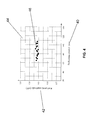
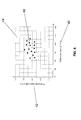
- the figures 3 to 6 illustrate the concept of this invention based on a 2D coordinate system, where one dimension is the deflection interval 40, and another dimension is the peak-peak deflection amplitude 42.
- the 2D plot is divided into grids of predefined resolution in both axes (deflection interval resolution: 10 ms, peak-peak amplitude resolution: 0.1 mV), with square bins 44 having a size of 10 ms times 0.1 mV.
- Figure 3 illustrates a scatter plot of the deflection vectors 46 associated with a plural of deflection complexes within a window of atrial EGM that has regular deflection intervals 40 and stable peak-peak amplitude 42.
- the deflection vectors 46 are concentrated in a condensed area within 2 square bins 44. The distance between each pair of consecutive deflections is small, limited to about 1 bin in either horizontal or vertical axis. Consequently, the CFAE, or the cumulative distance between deflections is small, indicating the corresponding atrial EGM is not fractionated.
- Figure 4 illustrates a scatter plot of the deflection vectors 46 associated with a plural of deflection complexes within a window of atrial EGM that has irregular deflection intervals 40 but regular peak-peak amplitude 42.
- the deflection vectors 46 are concentrated in a narrow row within 1 square bin 44 but widely spread in multiple columns within 5 square bins 44, covering a total scatter area of 5 square bins 44.
- the distance between each pair of consecutive deflections is moderate, limited along vertical axis but large along horizontal axis. Consequently, the CFAE, or the cumulative distance between deflections is moderate, indicating the corresponding atrial EGM is partially fractionated.
- Figure 5 illustrates a scatter plot of the deflection vectors 46 associated with a plural of deflection complexes within a window of atrial EGM that has regular deflection intervals 40 but irregular peak-peak amplitude 42.
- the deflection vectors 46 are concentrated column-wise within 2 square bins 44 but widely spread in multiple rows within 5 square bins 44 and cover a total scatter area of 10 square bins 44.
- the distance between each pair of consecutive deflections is moderate, limited in horizontal axis but large in vertical axis. Consequently, the CFAE, or the cumulative distance between deflections is moderate, indicating the corresponding atrial EGM is partially fractionated.
- Figure 6 illustrates a scatter plot of the deflection vectors 46 associated with a plural of deflection complexes within a window of atrial EGM that has both irregular deflection intervals 40 and irregular peak-peak amplitude 42.
- the deflection vectors 46 are sparsely scattered in the plot, meaning they are widely spread column-wise within 4 to 6 square bins 44 and also widely spread in multiple rows within 3 square bins 44 and cover a total scatter area of 14 square bins 44.
- the distance between each pair of consecutive deflections is large in both horizontal axis and vertical axis. Consequently, the CFAE, or the cumulative distance between deflections is large, indicating the corresponding atrial EGM is highly fractionated.
- the scatter plots can be used to visualize the temporal-amplitude distribution of the fractionated waves.
- the trajectories i.e. the lines between each pair of adjacent deflection vectors
- the distances between pairs of deflection vectors can also be plotted to reveal the transition from one deflection vector to another, and the distances between pairs of deflection vectors.
- other dimensions of the coordinates can also be used to construct the scatter plots to reveal the degree of fractionation.
- other methods to characterize the spatial distribution of the scatter plot such as the eccentricity of the best fit ellipse surrounding the samples, the slope of the best fit linear regression line, the non-empty cells/rows/columns, or the like, can also be used.
Landscapes
- Health & Medical Sciences (AREA)
- Life Sciences & Earth Sciences (AREA)
- Surgery (AREA)
- Engineering & Computer Science (AREA)
- Cardiology (AREA)
- Public Health (AREA)
- General Health & Medical Sciences (AREA)
- Veterinary Medicine (AREA)
- Animal Behavior & Ethology (AREA)
- Biomedical Technology (AREA)
- Heart & Thoracic Surgery (AREA)
- Medical Informatics (AREA)
- Molecular Biology (AREA)
- Physics & Mathematics (AREA)
- Biophysics (AREA)
- Pathology (AREA)
- Nuclear Medicine, Radiotherapy & Molecular Imaging (AREA)
- Plasma & Fusion (AREA)
- Otolaryngology (AREA)
- Robotics (AREA)
- Physiology (AREA)
- Measurement And Recording Of Electrical Phenomena And Electrical Characteristics Of The Living Body (AREA)
Applications Claiming Priority (1)
| Application Number | Priority Date | Filing Date | Title |
|---|---|---|---|
| US201361878052P | 2013-09-16 | 2013-09-16 |
Publications (1)
| Publication Number | Publication Date |
|---|---|
| EP2851002A1 true EP2851002A1 (de) | 2015-03-25 |
Family
ID=51564437
Family Applications (1)
| Application Number | Title | Priority Date | Filing Date |
|---|---|---|---|
| EP14183365.7A Withdrawn EP2851002A1 (de) | 2013-09-16 | 2014-09-03 | Vorrichtung zur automatischen Abbildung eines komplexen fraktionierten atrialen Elektrogramms |
Country Status (2)
| Country | Link |
|---|---|
| US (1) | US9456759B2 (de) |
| EP (1) | EP2851002A1 (de) |
Cited By (1)
| Publication number | Priority date | Publication date | Assignee | Title |
|---|---|---|---|---|
| EP3766416A1 (de) * | 2019-07-16 | 2021-01-20 | Biosense Webster (Israel) Ltd | Abbildung von vorhofflimmern unter verwendung von fragmentierungsindex |
Families Citing this family (25)
| Publication number | Priority date | Publication date | Assignee | Title |
|---|---|---|---|---|
| US9119633B2 (en) | 2006-06-28 | 2015-09-01 | Kardium Inc. | Apparatus and method for intra-cardiac mapping and ablation |
| US11389232B2 (en) | 2006-06-28 | 2022-07-19 | Kardium Inc. | Apparatus and method for intra-cardiac mapping and ablation |
| US8906011B2 (en) | 2007-11-16 | 2014-12-09 | Kardium Inc. | Medical device for use in bodily lumens, for example an atrium |
| US10827977B2 (en) | 2012-05-21 | 2020-11-10 | Kardium Inc. | Systems and methods for activating transducers |
| US9017321B2 (en) | 2012-05-21 | 2015-04-28 | Kardium, Inc. | Systems and methods for activating transducers |
| US9198592B2 (en) | 2012-05-21 | 2015-12-01 | Kardium Inc. | Systems and methods for activating transducers |
| WO2015148470A1 (en) | 2014-03-25 | 2015-10-01 | Acutus Medical, Inc. | Cardiac analysis user interface system and method |
| US10722184B2 (en) | 2014-11-17 | 2020-07-28 | Kardium Inc. | Systems and methods for selecting, activating, or selecting and activating transducers |
| US10368936B2 (en) | 2014-11-17 | 2019-08-06 | Kardium Inc. | Systems and methods for selecting, activating, or selecting and activating transducers |
| US9675261B2 (en) | 2015-01-23 | 2017-06-13 | Medtronic, Inc. | Atrial arrhythmia episode detection in a cardiac medical device |
| US10004418B2 (en) | 2015-01-23 | 2018-06-26 | Medtronic, Inc. | Atrial arrhythmia episode detection in a cardiac medical device |
| US10213125B2 (en) | 2015-01-23 | 2019-02-26 | Medtronic, Inc. | Atrial arrhythmia episode detection in a cardiac medical device |
| US9603543B2 (en) | 2015-02-18 | 2017-03-28 | Medtronic, Inc. | Method and apparatus for atrial arrhythmia episode detection |
| US9901276B2 (en) | 2015-02-18 | 2018-02-27 | Medtronic, Inc. | Method and apparatus for identifying sick sinus syndrome in an implantable cardiac monitoring device |
| US10045710B2 (en) | 2016-03-30 | 2018-08-14 | Medtronic, Inc. | Atrial arrhythmia episode detection in a cardiac medical device |
| US10039469B2 (en) | 2016-03-30 | 2018-08-07 | Medtronic, Inc. | Atrial arrhythmia episode detection in a cardiac medical device |
| WO2018195052A1 (en) * | 2017-04-18 | 2018-10-25 | Boston Scientific Scimed Inc. | Annotation histogram for electrophysiological signals |
| ES2706537B2 (es) * | 2017-09-29 | 2020-08-05 | Univ Madrid Carlos Iii | Sistema y metodo para la deteccion automatica de patrones electrofisiologicos anomalos |
| AU2019209440A1 (en) * | 2018-01-21 | 2020-09-03 | Acutus Medical, Inc. | System for identifying cardiac conduction patterns |
| US11844616B2 (en) * | 2019-08-13 | 2023-12-19 | Biosense Webster (Israel) Ltd. | Enhanced visualization of organ electrical activity |
| JP7252109B2 (ja) * | 2019-10-07 | 2023-04-04 | Cyberdyne株式会社 | 診断支援システムおよび制御プログラム |
| CN113349923B (zh) * | 2021-08-11 | 2021-12-07 | 上海微创电生理医疗科技股份有限公司 | 消融系统 |
| US11969255B2 (en) | 2021-12-12 | 2024-04-30 | Biosense Webster (Israel) Ltd. | Detection of fractionated signals in stable arrhythmias |
| US20240032845A1 (en) * | 2022-07-27 | 2024-02-01 | Biosense Webster (Israel) Ltd. | Method and system for identification of fractionated signals |
| WO2025257094A1 (en) | 2024-06-11 | 2025-12-18 | Gigli Lorenzo | System for measuring the electrophysiological substrate in atrial fibrillation |
Citations (8)
| Publication number | Priority date | Publication date | Assignee | Title |
|---|---|---|---|---|
| US5891048A (en) * | 1996-06-18 | 1999-04-06 | Biotronik Mess- Und Therapiegeraete Gmbh & Co. Ingenieurbuero Berlin | Signal detector |
| US20050171447A1 (en) * | 2001-12-21 | 2005-08-04 | Esperer Hans D. | Method and device for the automateddetection and differentiation of cardiac rhythm disturbances |
| US20060247547A1 (en) * | 2005-04-29 | 2006-11-02 | Shantanu Sarkar | Method and apparatus for detection of tachyarrhythmia using cycle lengths |
| US20070197929A1 (en) | 2006-01-12 | 2007-08-23 | Joshua Porath | Mapping of complex fractionated atrial electrogram |
| EP2179690A1 (de) * | 2008-10-24 | 2010-04-28 | BIOTRONIK CRM Patent AG | Herzüberwachungsvorrichtung und -verfahren |
| US7904143B2 (en) | 2008-07-07 | 2011-03-08 | Biosense Webster, Inc. | Binary logistic mixed model for complex fractionated atrial electrogram procedures |
| WO2012021022A1 (ko) | 2010-08-13 | 2012-02-16 | 연세대학교 산학협력단 | 모의 부정맥 전극도자 절제 시술 시스템 |
| US8315696B2 (en) | 2010-12-09 | 2012-11-20 | Biosense Webster (Israel), Ltd. | Identifying critical CFAE sites using contact measurement |
Family Cites Families (1)
| Publication number | Priority date | Publication date | Assignee | Title |
|---|---|---|---|---|
| US8676305B2 (en) * | 2012-03-21 | 2014-03-18 | Biosense Webster (Israel) Ltd. | Automated analysis of complex fractionated electrograms |
-
2014
- 2014-08-25 US US14/468,267 patent/US9456759B2/en not_active Expired - Fee Related
- 2014-09-03 EP EP14183365.7A patent/EP2851002A1/de not_active Withdrawn
Patent Citations (8)
| Publication number | Priority date | Publication date | Assignee | Title |
|---|---|---|---|---|
| US5891048A (en) * | 1996-06-18 | 1999-04-06 | Biotronik Mess- Und Therapiegeraete Gmbh & Co. Ingenieurbuero Berlin | Signal detector |
| US20050171447A1 (en) * | 2001-12-21 | 2005-08-04 | Esperer Hans D. | Method and device for the automateddetection and differentiation of cardiac rhythm disturbances |
| US20060247547A1 (en) * | 2005-04-29 | 2006-11-02 | Shantanu Sarkar | Method and apparatus for detection of tachyarrhythmia using cycle lengths |
| US20070197929A1 (en) | 2006-01-12 | 2007-08-23 | Joshua Porath | Mapping of complex fractionated atrial electrogram |
| US7904143B2 (en) | 2008-07-07 | 2011-03-08 | Biosense Webster, Inc. | Binary logistic mixed model for complex fractionated atrial electrogram procedures |
| EP2179690A1 (de) * | 2008-10-24 | 2010-04-28 | BIOTRONIK CRM Patent AG | Herzüberwachungsvorrichtung und -verfahren |
| WO2012021022A1 (ko) | 2010-08-13 | 2012-02-16 | 연세대학교 산학협력단 | 모의 부정맥 전극도자 절제 시술 시스템 |
| US8315696B2 (en) | 2010-12-09 | 2012-11-20 | Biosense Webster (Israel), Ltd. | Identifying critical CFAE sites using contact measurement |
Non-Patent Citations (8)
| Title |
|---|
| CIACCIO ET AL., CIRC ARRHYTHM ELECTROPHYSIOL., vol. 4, 2011, pages 470 - 7 |
| GRZEDA ET AL., HEART RHYTHM, vol. 6, 2009, pages 1475 - 82 |
| LAU ET AL., J CARDIAC ELECTROPHYSIOL, vol. 23, 2012, pages 980 - 7 |
| LEE ET AL., HEART RHYTHM, vol. 8, 2011, pages 1714 - 9 |
| LIN ET AL., CIRC ARRHYTHM ELECTROPHYSIOL., vol. 5, 2012, pages 949 - 56 |
| MAYANK KUMAR ET AL: "Computerized detection & classification of ECG signals", EMERGING TRENDS IN ELECTRICAL ENGINEERING AND ENERGY MANAGEMENT (ICETEEEM), 2012 INTERNATIONAL CONFERENCE ON, IEEE, 13 December 2012 (2012-12-13), pages 126 - 130, XP032354873, ISBN: 978-1-4673-4633-7, DOI: 10.1109/ICETEEEM.2012.6494465 * |
| NADEMANEE ET AL., JACC, vol. 43, 2004, pages 2044 - 53 |
| NG ET AL., J CARDIOVASC ELECTROPHYSIOL., vol. 21, 2010, pages 649 - 55 |
Cited By (4)
| Publication number | Priority date | Publication date | Assignee | Title |
|---|---|---|---|---|
| EP3766416A1 (de) * | 2019-07-16 | 2021-01-20 | Biosense Webster (Israel) Ltd | Abbildung von vorhofflimmern unter verwendung von fragmentierungsindex |
| US10905349B1 (en) | 2019-07-16 | 2021-02-02 | Biosense Webster (Israel) Ltd. | Mapping atrial fibrillation using fragmentation index |
| CN112315486A (zh) * | 2019-07-16 | 2021-02-05 | 伯恩森斯韦伯斯特(以色列)有限责任公司 | 使用碎片化指数标测房颤 |
| CN112315486B (zh) * | 2019-07-16 | 2026-01-13 | 伯恩森斯韦伯斯特(以色列)有限责任公司 | 使用碎片化指数标测房颤 |
Also Published As
| Publication number | Publication date |
|---|---|
| US9456759B2 (en) | 2016-10-04 |
| US20150080752A1 (en) | 2015-03-19 |
Similar Documents
| Publication | Publication Date | Title |
|---|---|---|
| US9456759B2 (en) | Device for automatic mapping of complex fractionated atrial electrogram | |
| US10368767B2 (en) | Medical devices for mapping cardiac tissue | |
| US20230334077A1 (en) | Automatic pattern acquisition | |
| US10004413B2 (en) | Signal analysis related to treatment sites | |
| CN101292870B (zh) | 用于心律失常传导途径和病灶的识别的自动起搏标测 | |
| US20210219904A1 (en) | Automatic pattern acquisition | |
| CA2573691C (en) | Mapping of complex fractionated atrial electrogram | |
| JP2017514597A (ja) | 心臓組織をマッピングする医療用デバイス | |
| JP2017520286A (ja) | 心臓組織をマッピングする医療用デバイス | |
| CN103263262B (zh) | 测量胎儿心率的系统及方法 | |
| CN103690156A (zh) | 一种心率获取方法及心电信号的处理方法 | |
| CN112469334B (zh) | 表现出不规则电生理活动的区域的检测 | |
| US11331033B2 (en) | Systems and methods for treating cardiac arrhythmia | |
| US20220015682A1 (en) | Algorithmic techniques for deduction of functional characteristics of cardiac tissue in cardiac electrical fibrillation from a densely packed array of high-resolution electrodes | |
| EP4091547B1 (de) | Medizinisches gerät zur diagnose und ortung von herzarrhythmien | |
| KR20150081763A (ko) | 심전도 신호의 저전력 고효율 r파 검출 방법 및 시스템 | |
| KR101626855B1 (ko) | 체표면 누적전위를 이용한 심장 부정맥 예측방법 및 장치 | |
| US12279877B2 (en) | Systems and methods for treating cardiac arrhythmia | |
| EP4525722A1 (de) | Vorrichtung zur überwachung der aktivierung im herzen | |
| Szilagyi et al. | Sensibility analysis of the Arruda localization method | |
| Szilágyi et al. | An enhanced method for accessory pathway localization in case of Wolff-Parkinson-White syndrome | |
| Rogers et al. | Quantitative analysis of complex rhythms | |
| WO2010114854A1 (en) | Power approach to biomedical signal analysis | |
| AU2014250609A1 (en) | Accurate time annotation of intracardiac ecg signals |
Legal Events
| Date | Code | Title | Description |
|---|---|---|---|
| PUAI | Public reference made under article 153(3) epc to a published international application that has entered the european phase |
Free format text: ORIGINAL CODE: 0009012 |
|
| 17P | Request for examination filed |
Effective date: 20140903 |
|
| AK | Designated contracting states |
Kind code of ref document: A1 Designated state(s): AL AT BE BG CH CY CZ DE DK EE ES FI FR GB GR HR HU IE IS IT LI LT LU LV MC MK MT NL NO PL PT RO RS SE SI SK SM TR |
|
| AX | Request for extension of the european patent |
Extension state: BA ME |
|
| R17P | Request for examination filed (corrected) |
Effective date: 20150911 |
|
| RBV | Designated contracting states (corrected) |
Designated state(s): AL AT BE BG CH CY CZ DE DK EE ES FI FR GB GR HR HU IE IS IT LI LT LU LV MC MK MT NL NO PL PT RO RS SE SI SK SM TR |
|
| STAA | Information on the status of an ep patent application or granted ep patent |
Free format text: STATUS: EXAMINATION IS IN PROGRESS |
|
| 17Q | First examination report despatched |
Effective date: 20191010 |
|
| STAA | Information on the status of an ep patent application or granted ep patent |
Free format text: STATUS: THE APPLICATION IS DEEMED TO BE WITHDRAWN |
|
| 18D | Application deemed to be withdrawn |
Effective date: 20210323 |