EP2851342A1 - Composite polymère de graphène - Google Patents
Composite polymère de graphène Download PDFInfo
- Publication number
- EP2851342A1 EP2851342A1 EP20140186626 EP14186626A EP2851342A1 EP 2851342 A1 EP2851342 A1 EP 2851342A1 EP 20140186626 EP20140186626 EP 20140186626 EP 14186626 A EP14186626 A EP 14186626A EP 2851342 A1 EP2851342 A1 EP 2851342A1
- Authority
- EP
- European Patent Office
- Prior art keywords
- graphene
- strain
- nanocomposite
- substrate
- flake
- Prior art date
- Legal status (The legal status is an assumption and is not a legal conclusion. Google has not performed a legal analysis and makes no representation as to the accuracy of the status listed.)
- Granted
Links
Images






Classifications
-
- C—CHEMISTRY; METALLURGY
- C01—INORGANIC CHEMISTRY
- C01B—NON-METALLIC ELEMENTS; COMPOUNDS THEREOF; METALLOIDS OR COMPOUNDS THEREOF NOT COVERED BY SUBCLASS C01C
- C01B32/00—Carbon; Compounds thereof
- C01B32/15—Nano-sized carbon materials
- C01B32/182—Graphene
- C01B32/184—Preparation
- C01B32/19—Preparation by exfoliation
- C01B32/192—Preparation by exfoliation starting from graphitic oxides
-
- C—CHEMISTRY; METALLURGY
- C08—ORGANIC MACROMOLECULAR COMPOUNDS; THEIR PREPARATION OR CHEMICAL WORKING-UP; COMPOSITIONS BASED THEREON
- C08K—Use of inorganic or non-macromolecular organic substances as compounding ingredients
- C08K3/00—Use of inorganic substances as compounding ingredients
- C08K3/02—Elements
- C08K3/04—Carbon
- C08K3/042—Graphene or derivatives, e.g. graphene oxides
-
- B—PERFORMING OPERATIONS; TRANSPORTING
- B82—NANOTECHNOLOGY
- B82B—NANOSTRUCTURES FORMED BY MANIPULATION OF INDIVIDUAL ATOMS, MOLECULES, OR LIMITED COLLECTIONS OF ATOMS OR MOLECULES AS DISCRETE UNITS; MANUFACTURE OR TREATMENT THEREOF
- B82B1/00—Nanostructures formed by manipulation of individual atoms or molecules, or limited collections of atoms or molecules as discrete units
- B82B1/008—Nanostructures not provided for in groups B82B1/001 - B82B1/007
-
- B—PERFORMING OPERATIONS; TRANSPORTING
- B82—NANOTECHNOLOGY
- B82Y—SPECIFIC USES OR APPLICATIONS OF NANOSTRUCTURES; MEASUREMENT OR ANALYSIS OF NANOSTRUCTURES; MANUFACTURE OR TREATMENT OF NANOSTRUCTURES
- B82Y30/00—Nanotechnology for materials or surface science, e.g. nanocomposites
-
- C—CHEMISTRY; METALLURGY
- C01—INORGANIC CHEMISTRY
- C01B—NON-METALLIC ELEMENTS; COMPOUNDS THEREOF; METALLOIDS OR COMPOUNDS THEREOF NOT COVERED BY SUBCLASS C01C
- C01B32/00—Carbon; Compounds thereof
- C01B32/15—Nano-sized carbon materials
- C01B32/182—Graphene
- C01B32/184—Preparation
- C01B32/19—Preparation by exfoliation
-
- C—CHEMISTRY; METALLURGY
- C01—INORGANIC CHEMISTRY
- C01B—NON-METALLIC ELEMENTS; COMPOUNDS THEREOF; METALLOIDS OR COMPOUNDS THEREOF NOT COVERED BY SUBCLASS C01C
- C01B2204/00—Structure or properties of graphene
- C01B2204/04—Specific amount of layers or specific thickness
-
- Y—GENERAL TAGGING OF NEW TECHNOLOGICAL DEVELOPMENTS; GENERAL TAGGING OF CROSS-SECTIONAL TECHNOLOGIES SPANNING OVER SEVERAL SECTIONS OF THE IPC; TECHNICAL SUBJECTS COVERED BY FORMER USPC CROSS-REFERENCE ART COLLECTIONS [XRACs] AND DIGESTS
- Y02—TECHNOLOGIES OR APPLICATIONS FOR MITIGATION OR ADAPTATION AGAINST CLIMATE CHANGE
- Y02E—REDUCTION OF GREENHOUSE GAS [GHG] EMISSIONS, RELATED TO ENERGY GENERATION, TRANSMISSION OR DISTRIBUTION
- Y02E60/00—Enabling technologies; Technologies with a potential or indirect contribution to GHG emissions mitigation
- Y02E60/30—Hydrogen technology
- Y02E60/32—Hydrogen storage
-
- Y—GENERAL TAGGING OF NEW TECHNOLOGICAL DEVELOPMENTS; GENERAL TAGGING OF CROSS-SECTIONAL TECHNOLOGIES SPANNING OVER SEVERAL SECTIONS OF THE IPC; TECHNICAL SUBJECTS COVERED BY FORMER USPC CROSS-REFERENCE ART COLLECTIONS [XRACs] AND DIGESTS
- Y10—TECHNICAL SUBJECTS COVERED BY FORMER USPC
- Y10T—TECHNICAL SUBJECTS COVERED BY FORMER US CLASSIFICATION
- Y10T428/00—Stock material or miscellaneous articles
- Y10T428/26—Web or sheet containing structurally defined element or component, the element or component having a specified physical dimension
-
- Y—GENERAL TAGGING OF NEW TECHNOLOGICAL DEVELOPMENTS; GENERAL TAGGING OF CROSS-SECTIONAL TECHNOLOGIES SPANNING OVER SEVERAL SECTIONS OF THE IPC; TECHNICAL SUBJECTS COVERED BY FORMER USPC CROSS-REFERENCE ART COLLECTIONS [XRACs] AND DIGESTS
- Y10—TECHNICAL SUBJECTS COVERED BY FORMER USPC
- Y10T—TECHNICAL SUBJECTS COVERED BY FORMER US CLASSIFICATION
- Y10T428/00—Stock material or miscellaneous articles
- Y10T428/30—Self-sustaining carbon mass or layer with impregnant or other layer
-
- Y—GENERAL TAGGING OF NEW TECHNOLOGICAL DEVELOPMENTS; GENERAL TAGGING OF CROSS-SECTIONAL TECHNOLOGIES SPANNING OVER SEVERAL SECTIONS OF THE IPC; TECHNICAL SUBJECTS COVERED BY FORMER USPC CROSS-REFERENCE ART COLLECTIONS [XRACs] AND DIGESTS
- Y10—TECHNICAL SUBJECTS COVERED BY FORMER USPC
- Y10T—TECHNICAL SUBJECTS COVERED BY FORMER US CLASSIFICATION
- Y10T428/00—Stock material or miscellaneous articles
- Y10T428/31504—Composite [nonstructural laminate]
- Y10T428/31551—Of polyamidoester [polyurethane, polyisocyanate, polycarbamate, etc.]
-
- Y—GENERAL TAGGING OF NEW TECHNOLOGICAL DEVELOPMENTS; GENERAL TAGGING OF CROSS-SECTIONAL TECHNOLOGIES SPANNING OVER SEVERAL SECTIONS OF THE IPC; TECHNICAL SUBJECTS COVERED BY FORMER USPC CROSS-REFERENCE ART COLLECTIONS [XRACs] AND DIGESTS
- Y10—TECHNICAL SUBJECTS COVERED BY FORMER USPC
- Y10T—TECHNICAL SUBJECTS COVERED BY FORMER US CLASSIFICATION
- Y10T428/00—Stock material or miscellaneous articles
- Y10T428/31504—Composite [nonstructural laminate]
- Y10T428/31725—Of polyamide
-
- Y—GENERAL TAGGING OF NEW TECHNOLOGICAL DEVELOPMENTS; GENERAL TAGGING OF CROSS-SECTIONAL TECHNOLOGIES SPANNING OVER SEVERAL SECTIONS OF THE IPC; TECHNICAL SUBJECTS COVERED BY FORMER USPC CROSS-REFERENCE ART COLLECTIONS [XRACs] AND DIGESTS
- Y10—TECHNICAL SUBJECTS COVERED BY FORMER USPC
- Y10T—TECHNICAL SUBJECTS COVERED BY FORMER US CLASSIFICATION
- Y10T428/00—Stock material or miscellaneous articles
- Y10T428/31504—Composite [nonstructural laminate]
- Y10T428/31855—Of addition polymer from unsaturated monomers
- Y10T428/31935—Ester, halide or nitrile of addition polymer
-
- Y—GENERAL TAGGING OF NEW TECHNOLOGICAL DEVELOPMENTS; GENERAL TAGGING OF CROSS-SECTIONAL TECHNOLOGIES SPANNING OVER SEVERAL SECTIONS OF THE IPC; TECHNICAL SUBJECTS COVERED BY FORMER USPC CROSS-REFERENCE ART COLLECTIONS [XRACs] AND DIGESTS
- Y10—TECHNICAL SUBJECTS COVERED BY FORMER USPC
- Y10T—TECHNICAL SUBJECTS COVERED BY FORMER US CLASSIFICATION
- Y10T428/00—Stock material or miscellaneous articles
- Y10T428/31504—Composite [nonstructural laminate]
- Y10T428/31855—Of addition polymer from unsaturated monomers
- Y10T428/31938—Polymer of monoethylenically unsaturated hydrocarbon
Definitions
- the present invention relates to novel nanocomposite materials, methods of making nanocomposites and uses of nanocomposite materials.
- Graphene is one of the stiffest known materials, with a Young's modulus of 1 TPa, making it an ideal candidate for use as a reinforcement in high-performance composites.
- novel materials having a range of advantageous properties can be derived from graphene and graphene analogues.
- stress transfer takes place from the polymer matrix to monolayer graphene, showing that the graphene acts as a reinforcing phase.
- shear-lag theory showing that graphene monolayer nanocomposites can be analyzed using continuum mechanics. Additionally, we have been able to monitor stress transfer efficiency and breakdown of the graphene/polymer interface.
- Carbon nanotubes are under active investigation as reinforcements in nanocomposites [6,7] and it is well established that platelet reinforcements such as exfoliated nanoclays [8,9] can be employed as additives to enhance the mechanical and other properties of polymers.
- platelet reinforcements such as exfoliated nanoclays [8,9]
- polymer-based nanocomposites with chemically-treated graphene oxide as a reinforcement may show dramatic improvements in both electronic [10] and mechanical [11] properties (thus a 30 K increase in the glass transition temperature is achieved for only a 1 % loading by weight of the chemically-treated graphene oxide in a poly(methyl methacrylate) matrix).
- Raman spectroscopy can be used to follow stress transfer in a variety of composites reinforced with carbon-based materials such as carbon fibres [12,13] and single- and double-walled carbon nanotubes. [14-16] Such reinforcements have well-defined Raman spectra and their Raman bands are found to shift with stress which enables stress-transfer to be monitored between the matrix and reinforcing phase. Moreover, a universal calibration has been established between the rate of shift of the G' carbon Raman bands with strain [14] that allows the effective Young's modulus of the carbon reinforcement to be estimated.
- nanocomposite material comprising either:
- the nanocomposite material comprises a substrate; graphene or functionalized graphene; an optional adhesive component for adhering the graphene or functionalized graphene to the substrate; and an optional protective layer to cover the graphene or functionalized graphene.
- the nanocomposite material comprises graphene or functionalized graphene attached to the substrate.
- the nanocomposite material is in the form of a substrate in which the graphene or functionalised graphene is distributed.
- the graphene or functionalised graphene may be added to a polymer mix prior to extrusion to form the substrate.
- the nanocomposite material comprises an adhesive component. In an embodiment, the nanocomposite material comprises a protective layer to cover the graphene or functionalized graphene. In an embodiment, the nanocomposite material comprises graphene or functionalized graphene attached to the substrate, an adhesive component and a protective layer to cover the graphene or functionalized graphene. In an embodiment, the nanocomposite material does not comprise a protective layer to cover the graphene or functionalized graphene. In an embodiment, the nanocomposite material comprises graphene or functionalized graphene attached to the substrate and an adhesive component (and does not include a protective layer to cover the graphene or functionalized graphene).
- the substrate of the nanocomposite material may itself be adhered to another structural material.
- structural material includes building materials (e.g. steels or concrete lintels) and also parts of existing structures such as bridges, buildings, aircrafts or other large structures.
- the nanocomposite material comprises graphene attached to a substrate, wherein the graphene has not been previously chemically modified.
- the graphene or functionalized graphene is attached to the substrate by an adhesive component.
- the choice of the adhesive component will depend on the type of substrate and the graphene component (e.g. whether the graphene component is functionalized or not and, if it is functionalized, the type and amount of functionalisation). In this regard, it is possible to tune the interface between the graphene component and the adhesive component by selecting an appropriate adhesive.
- the adhesive component can include contact adhesives (e.g. adhestives that work upon pressure) as well as reactive adhesives.
- the adhesive component may therefore be selected from the group comprising: polyvinyl acetate (PVA) and an epoxy resin.
- adhesives include poly(alcohol), acrylics, poly(urethane), poly(imides), rubber, latex, poly(styrene) cement, cyanoacrylate, ethylenevinyl acetate, poly(vinyl acetate), silicones, acrylonitrile and acrylic.
- the graphene component of the nanocomposite may be present as a one-atom thick layer on the substrate or in certain cases several graphene layers may be built up.
- the graphene layer may be present as a layer in which the thickness is more than one atom e.g. from 2 to 10 atoms, 2 to 50 atoms or even 2 to 100 atoms, e.g. the graphene layer may be present as a layer having a thickness of 2, 3, 4, 5, 6, 7, 8, 9 or 10 atoms. More usually, graphene is present as a monolayer i.e. a one-atom thick layer. Alternatively, the graphene is present as a bilayer or a trilayer, i.e.
- the graphene needs to be at least 10 ⁇ m in length and preferably greater than 30 ⁇ m and most preferably greater than 50 ⁇ m, to provide beneficial structural effects.
- the graphene can be less than 10 ⁇ m in length (e.g. 1, 2, 3, 4, 5, 6, 7, 8 or 9 ⁇ m in length).
- the nanocomposite material may have more than two layers.
- the invention also relates to sandwich structures, such as a sandwich of graphene-polymer-graphene or polymer-graphene-polymer, and to more complex multilayer structures with repeating layers of graphene and polymer substrate.
- sandwich structures such as a sandwich of graphene-polymer-graphene or polymer-graphene-polymer, and to more complex multilayer structures with repeating layers of graphene and polymer substrate.
- sandwich structure having three layers or a multilayer structure of four, five, six or seven layers, eg up to ten layers may have advantageous properties.
- a sandwich of graphene polymer graphene will have utility in fabricating devices such as printed circuit boards because it is not subject to significant thermal expansion and stress.
- Sandwich structures may be particularly advantageous in strain sensing applications e.g. in order to improve the interface between the graphene and the underlying polymer.
- the sandwich structure may alternatively be regarded as a composite material comprising a substrate, a graphene (or functionalised graphene) layer and a protective layer.
- an outer protective coating may be applied to the composite as is present in the composites of example 6.
- the substrate surface to which the graphene is applied is usually substantially flat.
- the methods of the present invention are applicable to irregular surfaces e.g. surfaces containing peaks, troughs and/or corrugations.
- the substrate surface to which the graphene is applied is rounded. Surface variations from flatness may be from 0.1 to 5 nm.
- the thickness of the graphene or functionalized graphene and adhesive component for adhering the graphene or functionalized graphene to the substrate may be as small as 100 nm.
- the thickness of the graphene or functionalized graphene and adhesive component for adhering the graphene or functionalized graphene to the substrate may be from 100 nm to 10 mm, 1 ⁇ m to 10 mm, 10 ⁇ m to 10 mm and will typically be in the range of 50 - 200 ⁇ m.
- the nanocomposite material comprises graphene or functionalized graphene embedded within the substrate.
- the nanocomposite material need not comprise an adhesive component.
- the underlying substrate may be any polymeric material. However, ideally to ensure good adhesion and retention of the graphene it is important for the polarity of the polymer to be compatible with the graphene.
- Suitable polymer substrates include polyolefins, such as polyethylenes and polypropylenes, polyacrylates, polymethacrylates, polyacrylonitriles, polyamides, polyvinylacetates, polyethyleneoxides, polyethylene, terphthalates, polyesters, polyurethanes and polyvinylchlorides.
- Preferred polymer substrates are epoxies, polyacrylates and polymethacrylates.
- the underlying substrate thickness may be from 1 ⁇ m to 10 mm, 10 ⁇ m to 10 mm and will typically be in the range of 50 - 200 ⁇ m.
- the nanocomposite material comprises graphene that has not been previously chemically modified (i.e. pristine graphene).
- the nanocomposite material comprises functionalised graphene (i.e. graphene that has been previously chemically modified, e.g. graphene oxide).
- Graphene may be functionalized in the same way in which carbon nanotubes are functionalized and the skilled person will be familiar with the various synthetic procedures for manufacturing functionalized carbon nanotubes and could readily apply these techniques to the manufacture of functionalized graphene.
- Chemical functionalisation of the graphene may assist in the manufacturing of the graphene polymer composite (e.g. by aiding dispersion of the graphene in an adhesive component or in the substrate component). Chemical functionalisation of the graphene may also improve the interface between the graphene and the adhesive material, which can lead to an increase in the Raman peak shift per unit strain (which in turn leads to a more accurate strain sensor). In this regard, it is possible to tune the interface between the graphene component and the adhesive component by selecting an appropriately functionalized (or partially functionalized) graphene component for a particular adhesive component. However, pristine graphene itself has a stronger Ramen signal as compared with functionalised graphene (which in turn leads to a more accurate strain sensor).
- the nanocomposite when the nanocomposite is to be used as a strain sensor, it is desirable to balance the strength of the Raman signal of the graphene component itself with the possibility of improved interface between the graphene and the other nanocomposite components (and therefore increased Raman peak shift per unit strain).
- very highly functionalised graphene for example graphene oxide
- graphene oxide which has a lower Raman signal than pristine graphene
- the nanocomposite material comprises a graphene or functionalized graphene dispersed in a liquid carrier wherein the liquid carrier once applied to a surface is able to form a film to coat the surface.
- the nanocomposite material may be regarded as a graphene-containing (or functionalized graphene-containing) paint.
- a nanocomposite material has uses in the production of a wide-area strain sensor on structures such as buildings, ships and aircrafts.
- the liquid-carrier is in the form of a paint.
- the paint may have any conventional paint formulation and may, for example, contain a pigment or dye, a filler, a binder and a solvent, and optionally one or more additional components as would be found in conventional paints.
- the graphene or functionalised graphene is dispersed within the paint which can then be applied to a surface and allowed to dry/cure.
- a method of preparing a graphene polymer composite comprising the steps of:
- the graphene may be provided by mechanical cleaving of graphite, or any other way to obtain graphene. Thus, for instance it may be obtained by cleaving graphene from SiC substrates, chemical exfoliation of graphene, or using epitaxial graphene.
- the resulting graphene polymer composite may be treated chemically to functionalise the composite material.
- the substrate thickness may be from 1 ⁇ m to 10 mm, 10 ⁇ m to 10 mm and typically be in the range 50 - 200 ⁇ m. In an embodiment, the substrate thickness is in the range 0.1 mm to 5 mm.
- a method of determining one of more physical properties of a graphene or functionalized graphene monolayer in a nanocomposite comprising the steps of:
- the method of determining one or more physical properties of a graphene or functionalized graphene nanocomposite is equally applicable to any high modulus two layer system that is able to produce a strong Raman signal.
- the method would be applicable to boron nitride.
- Other examples of layers that are able to produce a strong Raman signal inlcude Tungsten disulphide (WS 2 ), carbon nitride (CN) and nitrogen/boron/fluorine doped graphene, including fluorographene.
- the physical properties may be a property such as, for example, deformation or strain.
- the method can therefore be applied to the measurement of strain of bridges and other structures over a period of time.
- a fourth aspect of the invention involves the remote monitoring of the state of a nanocomposite of the present invention (such as strain) by Raman measurements on graphene or functionalised graphene inclusions within the nanocomposite.
- the present invention provides a method of determining the residual strain imparted to a plastics product during its manufacture, the method comprising:
- the above method is useful as a quality control check during the manufacturing process of the plastics product.
- the manufactured plastics product is a nanocomposite graphene-containing or functionalised-graphene-containing material according to the present invention.
- Many plastics products are subject to rigorous safety regulations and the above process can be used to determine other important properties such as the fracture properties of a plastics material.
- the method is particularly suitable for structural plastics products that are required to have significant strength in order to perform their purpose. Additionally, the method is useful for the optimisation of complicated injection processes where it is vital to control and minimise residual strains.
- the plastics product is selected from the group comprising: a water pipe and a gas pipe.
- the plastics product is a structural composite or a coating.
- the plastics product includes automotive panels, aerospace composites, defence applications (e.g. armour) and civil structures (e.g. bridges components and paints).
- the amount of graphene or functionalized graphene added to the plastics material is from 0.001 to 30 wt %, preferably 0.1 to 10 wt %, and more preferably 0.1 to 1 wt %.
- the plastics material is a material selected from the group consisting of: poly(ethylene), poly(styrene), poly(propylene), poly(amide), PTFE, para-aramid, poly(vinyl chloride), poly(ethyl acetate), poly(vinyl alcohol), poly(vinyl acetate), epoxy, viton, polyphenylenebenzobisoxazole (PBO), vectran.
- the plastics material is a material selected from the group consisting of: polyaryletherketones, polyphenylenesulphides, liquid crystalline polyesters, polyamide imides, polyarylates, polyarylsulphones, polybutylene, polybutyleneterephthalates, polyethyleneterephthalate, polycarbonate, polychlorotrifluoroethylene, polyvinyldifluoride, polyperfluoroalkoxy, polydimethylsiloxanes, thermoplastic polyesters, thermosetting polyesters, unsaturated polyesters, polyetherimides, polyethersulphones, thermosetting and thermoplastic polyimides, polyoxymethylene, polyphenylene oxide, polyurethanes, polyvinylidene chloride, acrylic resins, vinylacetate resins, perfluorinatedpolyethylenepropylene, polyphenylenes, polybenzimidazole, fluoropolymers, thermoplastic continuous and discontinuous fibre composites, thermosetting continuous and discontinuous fibre composites, fluorinated e
- the one or more manufacturing steps are selected from the group consisting of: injection moulding, hot pressing, drawing, extrusion, autoclaving, annealing, heat treating, sintering, compression moulding, machining, welding, adhesively bonding, thermoforming, vacuum forming, blow moulding, stretch blow moulding, transfer moulding, calendaring, compounding, orienting, tape laying with in situ consolidation, diaphragm forming, rotational moulding, centrifugal moulding, foam blowing and pultruding.
- the present invention provides a method of improving the mechanical properties of a nanocomposite product of the present invention containing graphene or functionalized graphene, the method comprising strain hardening the nanocomposite product.
- the improving the mechanical properties of the nanocomposite product includes increasing the modulus. In an embodiment, the improving the mechanical properties of a nanocomposite product includes increasing strength. In an embodiment, the improving the mechanical properties of a nanocomposite product includes increasing toughness.
- the improving the mechanical properties of a nanocomposite product includes increasing the modulus and the modulus is increased by 10% or more, preferably the modulus is increased by 100% or more, more preferably the modulus is increased by 200% or more and further preferably the modulus is increased by 300% or more.
- the strain hardening of the nanocomposite product involves one or more cycles of imparting strain to the plastics product.
- the strain hardening of the nanocomposite product involves from 1 to 10 cycles, preferably 2 to 5 cycles of imparting and releasing strain to the nanocomposite product.
- the nanocomposite product is a structural composite or a coating.
- the nanocomposite product includes automotive panels, aerospace composites, defence applications (e.g. armour) and civil structures (e.g. bridges components and paints).
- the nanocomposite product includes from 0.001 to 30 wt %, preferably 0.1 to 10 wt %, and more preferably 0.1 to 1 wt % graphene or functionalized graphene.
- the plastics material of the nanocomposite product is a material selected from the group consisting of: poly(ethylene), poly(styrene), poly(propylene), poly(amide), PTFE, para-aramid, poly(vinyl chloride), poly(ethyl acetate), poly(vinyl alcohol), poly(vinyl acetate), epoxy, viton, PBO, vectran.
- This methodology may also be applicable to other composites such as functionalized graphene composites as shown in the graphene oxide composites of examples 1 and 2.
- the resulting measurements allow us to determine the potential usefulness of the graphene polymer composite as a structural element. In other words, it is possible to determine from our measurements which polymer composites will have the appropriate physical and/or electrical properties for the intended end use.
- a graphene or functionalized graphene nanocomposite for the production of an electronic device and/or a structural material.
- the electronic device may be a sensor, an electrode, a field emitter device or a hydrogen storage device.
- a structural material is a reinforced material that is strengthened on account of the inclusion of graphene or functionalized graphene.
- the combination of electronic and mechanical properties of the graphene polymer composites of the invention renders them suitable for a wide range of uses including: their potential use in future electronics and materials applications, field emitter devices, sensors (e.g. strain sensors), electrodes, high strength composites, and storage structures of hydrogen, lithium and other metals for example, fuel cells, optical devices and transducers.
- composite structures exhibit semiconductive electrical properties, it is of interest to isolate bulk amounts thereof for semiconductor uses.
- the particular graphene area and thickness on the substrate, as well as the topology affects the physical and electronic properties of the composite.
- the strength, stiffness, density, crystallinity, thermal conductivity, electrical conductivity, absorption, magnetic properties, response to doping, utility as semiconductors, optical properties such as absorption and luminescence, utility as emitters and detectors, energy transfer, heat conduction, reaction to changes in pH, buffering capacity, sensitivity to a range of chemicals, contraction and expansion by electrical charge or chemical interaction, nanoporous filtration membranes and many more properties are affected by the above factors.
- the composites When subsequently modified with suitable chemical groups, the composites are chemically compatible with a polymer matrix, allowing transfer of the properties of the nanotubes (such as mechanical strength) to the properties of the composite material as a whole.
- the modified composites can be thoroughly mixed (physically blended) with the polymeric material, and/or, if desired, allowed to react at ambient or elevated temperature. These methods can be utilized to append functionalities to the composites that will further covalently bond to the host polymer substrate.
- FIG. 13a An optical micrograph of a specimen is shown in Figure 13a where the approximately diamond-shaped 12 ⁇ m x 30 ⁇ m graphene monolayer is indicated and Figure 13b shows a schematic diagram of the specimen.
- the slope of the unloading line is ⁇ -60 cm -1 /% strain, similar to the behavior found for the deformation of a free-standing monolayer on a substrate 22,23 .
- the G' band position after unloading is at a higher wavenumber than before loading. This behavior is consistent with the graphene undergoing slippage in the composite during the initial tensile deformation and then becoming subjected to in-plane compression on unloading.
- Mapping the local strain in along a carbon fiber in a polymer matrix allows the level of adhesion between the fiber and matrix to be evaluated.
- Figure 15 shows the local strain in the graphene monolayer determined from the stress-induced Raman band shifts at 0.4 % matrix strain. The laser beam in the spectrometer was focused to a spot around 2 ⁇ m which allows a spatial resolution of the order of 1 ⁇ m on the monolayer by taking overlapping measurements.
- Figure 15a shows the variation of axial strain across the monolayer in the direction parallel to the strain axis.
- n is accepted widely as an effective measure of the interfacial stress transfer efficiency, so ns depends on both the morphology of the graphene flake and the degree of interaction it has with the matrix.
- Example 1 Strain sensitive coating comprising graphene oxide (GO)-polyvinyl alcohol (PVA) which was deposited onto a polymethyl methacrylate (PMMA) beam specimen.
- GO graphene oxide
- PVA polyvinyl alcohol
- graphene oxide (a highly substituted and widely commercially available graphene material) can be used as a strain sensitive coating despite having a modulus of 20% of the modulus of pristine graphene (and therefore a smaller Raman peak shift as compared with pristine graphene).
- a graphene oxide (GO)- polyvinyl alcohol (PVA) coating was deposited on a PMMA beam following the method of Xin Zhao et al. (Macromolecules, 2010, 43, 9411-9416 ) and as described in detail in the following paragraphs.
- each polymer layer will partially infiltrate the underlying layer.
- the number of layers is not important; in this case 20 layers are being used to build up thickness of GO on the substrate (although it is likely that these steps only need to be repeated two or three times).
- a reference resistive strain gauge was then mounted onto the coating.
- the coated PMMA beam was then deformed with the strain increased stepwise (in increments of 0.04 %).
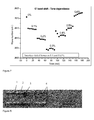
- the average band position was taken across 5 locations on the beam ( Figures 3 and 4 ).
- a peak shift of - 3 cm -1 per % was recorded, showing that the GO was a viable strain gauge. (A peak shift of - 3 cm -1 per % corresponds to an accuracy of 0.17 % for the ⁇ 0.5 cm -1 .)
- Example 2 Strain sensitive coating comprising graphene oxide (GO)-polyvinyl alcohol (PVA) which was deposited onto a steel sample.
- GO graphene oxide
- PVA polyvinyl alcohol
- This example also serves to illustrate that graphene oxide (a highly substituted graphene material) can be used as a strain sensitive coating.
- graphene oxide a highly substituted graphene material
- This example provides an alternative substrate to that used in example 1 and an alternative method of applying the PVA-GO coating to that employed in example 1.
- a GO-PVA coating was solution cast onto the steel sample. 0.12 g GO solution (1 mg GO per ml) was mixed with 1.2 g aqueous PVA solution (0.05 wt%) and stirred for 30 minutes.
- the method for making the GO solution is described in (i) Eda, G.; Fanchini, G.; Chhowalla, M., Large-Area Ultrathin Films of Reduced Graphene Oxide as a Transparent and Flexible Electronic Material. Nat Nano 2008, 3, 270-274 ; or (ii) Hummers, W. S.; Offeman, R. E., Preparation of Graphitic Oxide. JACS 1958, 80, 1339-1339 .
- the mixture was then dispersed using a sonic bath for another 30 minutes.
- a drop of the GO-PVA solution was then casted onto 0.4572mm ( ⁇ 0.5mm) thick spring steel beams and left to dry.
- the concentration of GO in the final PVA/GO composites was 20 wt%.
- the resulting GO-PVA coating is a homogeneous mixture of GO and PVA.
- the reference resistive strain gauge was mounted onto the steel next to the coated area.
- Example 3 The stability of a epoxy-mechanically exfoliated -graphene-PMMA coating on a PMMA beam: Stability and Interface failure
- This example serves to illustrate that pristine, mechanically exfoliated graphene (i.e. an unsubstituted graphene material) can be used as a strain sensitive coating.
- an epoxy film is being used as an adhesive layer rather than the PVA adhesive of examples 1 and 2.
- a thin epoxy film (300nm) was spin coated onto a PMMA beam (5mm thick). Mechanical exfoliated graphene flakes were then deposited on this epoxy film and a PMMA film (50 nm) coated onto the graphene flakes. A reference resistive strain gauge was then mounted onto the top of the PMMA.
- the PMMA beam was deformed stepwise and the peak position was recorded as a function of time at each strain.
- the Raman G' band position was found to decrease with increasing strain up to a strain of 0.3 %, at which point the interface between the graphene and surrounding polymer failed. It is noted that the interface of the GO-PVA composites of examples 1 and 2 do not fail at this level of strain. Without meaning to be bound by theory, it is thought that the presence of oxygen in GO provides a better interface with the PVA than the interface between the pristine graphene and expoxy as in this example. This shows the that the present invention can be easily tuned to meet any specific needs relating to accuracy and interface strength. At a given strain, the strain readings were found to be constant within 1.36 cm -1 up to strains of ⁇ 0.3 %. It should be noted that 0.3% strain is useful for most mechanical applications of the present invention.
- Example 4 Cyclic loading of a epoxy-mechanical exfoliated -graphene-PMMA coating on a PMMA beam.
- This example serves to illustrate that pristine graphene (i.e. an unsubstituted graphene material) coated onto a PMMA substrate via an epoxy film can be used as a strain gauge.
- the example also demonstrates the principle of the strain hardening effect.
- a graphene composite coating was deposited onto a PMMA beam, in the same manner as described in previous examples (example 3 above and example 7 below).
- a reference strain gauge (denoted as reference numeral 3) was mounted on the film ( Figure 8 ).
- the remaining reference numerals of figure 8 relate to the substrate (1), mechanical exfoliated graphene (2) and the electrodes (4) that at attached to the strain sensor (3).
- the strain was increased stepwise, but with an increasing peak strain level in each successive cycle, and then decreased as shown in Figure 9 . It can be seen that, as with example 3 above, the interface fails at 0.3% strain. The strain was increased beyond 0.3% to investigate the effects after interface failure.
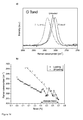
- the Raman peak shift with the strain is shown in Figure 10 .
- Example 5 Straining hardening of graphene composite compared to a single-walled nanotubes (SWNT) composite.
- This example serves to illustrate the advantageous differences between graphene composites compared with SWNT composites.
- a graphene composite coating was deposited onto a PMMA beam, as previously described in examples 3 and 4 with a reference strain gauge also mounted on the film (see Figure 8 which illustrates a strain gauge mounted onto a film).
- a comparable single walled nanotubes composite was produced by mixing 0.1 wt% HiPco ® SWNTs (see http://www.nanointegris.com/en/hipco ) in epoxy and depositing a layer of this mixture on a epoxy beam.
- the beams were deformed to a strain just beneath that at which the carbon interface failed (0.3 % for the graphene and 0.8 % for the SWNTs) and then unloaded. This loading cycle was repeated for a total of 4 times.
- the effective modulus of the SWNTs and graphene in the samples was calculated using a calibration of 1 TPa is equivalent to -50 cm -1 per %. Table 2 summarises the results of the experiment.
- the shift rate is approximately 3 times higher for the graphene samples as compared to the SWNT samples. This means that a graphene based strain sensor is 3 times more sensitive than a nanotube based strain sensor.
- the effective modulus of the SWNTs remained approximately constant with each cyclic loading, where as the modulus for the graphene samples increases from 1.07 to 1.35 GPa on loading from the 1 st and 4 th loading cycles. This shows the benefit of pre-treatment of the graphene composites to increase their modulus.
- Table 2 A summary of the SWNT and graphene cyclic deformation up to same strain level (Graphene-0.3% and SWNT-0.8%) Cycle SWNT (max strain of 0.8%) Graphene (max strain of 0.3%) Shift rate (cm - 1 / %strain) Effective modulus (TPa) Shift rate (cm - 1 / %strain) Effective modulus (TPa) 1 Loading -17.48 0.35 -53.68 1.07 Unloading -16.10 0.32 -47.53 0.95 2 Loading -16.72 0.33 -48.61 1.10 Unloading -13.94 0.28 -48.81 0.98 3 Loading -15.95 0.32 -58.11 1.16 Unloading -12.43 0.25 -53.80 1.08 4 Loading -15.72 0.31 -67.33 1.35 Unloading -11.69 0.23 -48.21 0.96
- Example 6 Graphene vs graphene sandwich
- This example serves to illustrate that a sandwiched graphene composite works as well as a non-sandwiched graphene composite as a strain sensor given sufficiently large graphene flakes and good interface between the graphene and the underlying polymer. This is important as a sandwiched graphene composite will be harder wearing than a non-sandwiched graphene composite and therefore the real-life utility of a strain sensor comprising graphene is improved.
- the specimen was prepared following the general procedure of examples 3 and 4 above and employed a 5 mm thick poly(methyl methacrylate) beam spin-coated with 300 nm of SU-8 epoxy resin.
- the graphene was produced by mechanical cleaving of graphite and deposited on the surface of the SU-8. This method produced graphene with a range of different numbers of layers and the monolayers were identified both optically and by using Raman spectroscopy.
- the PMMA beam was deformed in 4-point bending up to 0.4% strain with the strain monitored using a strain gage attached to the beam surface.
- Well-defined Raman spectra could be obtained from the graphene monolayer using a low-power HeNe laser (1.96 eV and ⁇ 1 mW at the sample in a Renishaw 2000 spectrometer) and the deformation of the graphene in the composite was followed from the shift of the 2D (or G') band.
- the laser beam polarization was always parallel to the tensile axis and the spot size of the laser beam on the sample was approximately 2 ⁇ m using a 50 ⁇ objective lens.
- Raman spectra were obtained at different strain levels through mapping over the graphene monolayer in steps of between 2 ⁇ m and 5 ⁇ m by moving the x-y stage of the microscope manually and checking the position of the laser spot on the specimen relative to the image of the monolayer on the screen of the microscope.
- the strain at each measurement point was determined from the position of the 2D Raman band using the calibration in Figure 2 and strain maps of the monolayer were produced in the form of colored x-y contour maps using the OriginPro 8.1 graph-plotting software package, which interpolates the strain between the measurement points (see figure 11 ).
- the beam was then unloaded and another thin 300 nm layer of SU-8 epoxy resin was then spin-coated on top so that the graphene remained visible when sandwiched between the two coated polymer layers.
- the beam was then reloaded initially up to 0.4% strain, unloaded and then reloaded to various other levels of strain.
- the strain in the graphene monolayer was mapped fully at each strain level as well as in the unloaded state (see figure 11 ).
- a graphene polymer composite was prepared using a 5 mm thick poly(methyl methacrylate) beam spin-coated with 300 nm of SU-8 epoxy resin.
- the graphene produced by the mechanical cleaving of graphite, was deposited on the surface of the SU-8.
- This method produced graphene with a range of different numbers of layers and the monolayers were identified both optically [26] and using Raman spectroscopy.
- a thin 50 nm layer of PMMA was then spin-coated on top of the beam so that the graphene remained visible when sandwiched between the two coated polymer layers as shown in Figure 13a.
- Figure 13b illustrates a schematic diagram (not to scale) of a section through the composite.
- the PMMA beam was deformed in 4-point bending and the strain monitored using a strain gauge attached to the beam surface.
- a well-defined Raman spectrum could be obtained through the PMMA coating using a low-power HeNe laser (1.96 eV and ⁇ 1 mW at the sample in a Renishaw 2000 spectrometer) and the deformation of the graphene in the composite was followed from the shift of the G' band [22-25] (see figures 14a and 14b ).
- the laser beam polarization was always parallel to the tensile axis.
- Raman spectroscopy has been employed to follow the deformation of the graphene in the polymer composite.
- Fig. 17 shows that the technique can also be used to differentiate between flakes of graphene with different numbers of layers.
- the uniform strain assumption means that, if the flake is long enough, in the middle of the flake the strain in the flake equals that in the matrix. Since the flakes have a much higher Young's modulus it means that the flakes carry most of the stress in the composite.
- the relationship between the interfacial shear stress, ⁇ i , near the flake ends and the flake stress, ⁇ f , can be determined by using a force balance of the shear forces at the interface and the tensile forces in a flake element as shown in Fig. 19 .
- the behaviour of a discontinuous flake in a matrix can be modelled using shear lag theory in which it is assumed that the flake is surrounded by a layer of resin at a distance, z , from the flake centre as show in Fig. 20 .
- SU-8 epoxy was spin coated onto a steel substrate. Mechanically cleaved graphene was deposited on the SU-8 and a thin layer of SU-8 epoxy was laid on top of it. A bilayer of graphene was indentified and the shift of the G' plotted as a function of strain as measured from a reference resistive gauge was recorded. The effective modulus of the graphene during loading was 0.28TPa and unloading was 0.35TPa.
Landscapes
- Chemical & Material Sciences (AREA)
- Engineering & Computer Science (AREA)
- Nanotechnology (AREA)
- Organic Chemistry (AREA)
- Crystallography & Structural Chemistry (AREA)
- Materials Engineering (AREA)
- Physics & Mathematics (AREA)
- General Physics & Mathematics (AREA)
- Condensed Matter Physics & Semiconductors (AREA)
- Composite Materials (AREA)
- Inorganic Chemistry (AREA)
- Polymers & Plastics (AREA)
- Medicinal Chemistry (AREA)
- Chemical Kinetics & Catalysis (AREA)
- Health & Medical Sciences (AREA)
- Carbon And Carbon Compounds (AREA)
- Combustion & Propulsion (AREA)
- Life Sciences & Earth Sciences (AREA)
- General Life Sciences & Earth Sciences (AREA)
- Geology (AREA)
- Compositions Of Macromolecular Compounds (AREA)
Applications Claiming Priority (2)
| Application Number | Priority Date | Filing Date | Title |
|---|---|---|---|
| GBGB1000743.3A GB201000743D0 (en) | 2010-01-18 | 2010-01-18 | Graphene polymer composite |
| EP20110702497 EP2526050B1 (fr) | 2010-01-18 | 2011-01-18 | Composite de graphène-polymère |
Related Parent Applications (1)
| Application Number | Title | Priority Date | Filing Date |
|---|---|---|---|
| EP20110702497 Division EP2526050B1 (fr) | 2010-01-18 | 2011-01-18 | Composite de graphène-polymère |
Publications (2)
| Publication Number | Publication Date |
|---|---|
| EP2851342A1 true EP2851342A1 (fr) | 2015-03-25 |
| EP2851342B1 EP2851342B1 (fr) | 2016-11-02 |
Family
ID=42028478
Family Applications (2)
| Application Number | Title | Priority Date | Filing Date |
|---|---|---|---|
| EP14186626.9A Not-in-force EP2851342B1 (fr) | 2010-01-18 | 2011-01-18 | Composite polymère de graphène |
| EP20110702497 Not-in-force EP2526050B1 (fr) | 2010-01-18 | 2011-01-18 | Composite de graphène-polymère |
Family Applications After (1)
| Application Number | Title | Priority Date | Filing Date |
|---|---|---|---|
| EP20110702497 Not-in-force EP2526050B1 (fr) | 2010-01-18 | 2011-01-18 | Composite de graphène-polymère |
Country Status (9)
| Country | Link |
|---|---|
| US (2) | US20120301707A1 (fr) |
| EP (2) | EP2851342B1 (fr) |
| JP (1) | JP6050683B2 (fr) |
| KR (2) | KR20120128614A (fr) |
| CN (1) | CN102741165B (fr) |
| ES (2) | ES2526773T3 (fr) |
| GB (1) | GB201000743D0 (fr) |
| PL (1) | PL2526050T3 (fr) |
| WO (1) | WO2011086391A1 (fr) |
Families Citing this family (89)
| Publication number | Priority date | Publication date | Assignee | Title |
|---|---|---|---|---|
| US9475709B2 (en) | 2010-08-25 | 2016-10-25 | Lockheed Martin Corporation | Perforated graphene deionization or desalination |
| PL222519B1 (pl) | 2011-09-19 | 2016-08-31 | Inst Tech Materiałów Elektronicznych | Sposób otrzymywania warstw grafenowych i pasta zawierająca nanopłatki grafenowe |
| US8486363B2 (en) * | 2011-09-30 | 2013-07-16 | Ppg Industries Ohio, Inc. | Production of graphenic carbon particles utilizing hydrocarbon precursor materials |
| US9988551B2 (en) | 2011-09-30 | 2018-06-05 | Ppg Industries Ohio, Inc. | Black pigments comprising graphenic carbon particles |
| US9475946B2 (en) | 2011-09-30 | 2016-10-25 | Ppg Industries Ohio, Inc. | Graphenic carbon particle co-dispersions and methods of making same |
| US9938416B2 (en) | 2011-09-30 | 2018-04-10 | Ppg Industries Ohio, Inc. | Absorptive pigments comprising graphenic carbon particles |
| US10294375B2 (en) | 2011-09-30 | 2019-05-21 | Ppg Industries Ohio, Inc. | Electrically conductive coatings containing graphenic carbon particles |
| US10240052B2 (en) | 2011-09-30 | 2019-03-26 | Ppg Industries Ohio, Inc. | Supercapacitor electrodes including graphenic carbon particles |
| US9761903B2 (en) | 2011-09-30 | 2017-09-12 | Ppg Industries Ohio, Inc. | Lithium ion battery electrodes including graphenic carbon particles |
| US12421118B2 (en) | 2011-09-30 | 2025-09-23 | Ppg Industries Ohio, Inc. | Graphenic carbon particles |
| US10763490B2 (en) | 2011-09-30 | 2020-09-01 | Ppg Industries Ohio, Inc. | Methods of coating an electrically conductive substrate and related electrodepositable compositions including graphenic carbon particles |
| WO2016070020A2 (fr) * | 2014-10-31 | 2016-05-06 | Ppg Industries Ohio, Inc. | Électrodes de supercondensateur comprenant des particules de carbone graphénique |
| US9832818B2 (en) | 2011-09-30 | 2017-11-28 | Ppg Industries Ohio, Inc. | Resistive heating coatings containing graphenic carbon particles |
| US9951436B2 (en) | 2011-10-27 | 2018-04-24 | Garmor Inc. | Composite graphene structures |
| US20130340533A1 (en) * | 2011-11-28 | 2013-12-26 | Massachusetts Institute Of Technology | Strain gauge using two-dimensional materials |
| GB201201649D0 (en) | 2012-01-31 | 2012-03-14 | Univ Manchester | Graphene polymer composite |
| CN102646575A (zh) * | 2012-04-17 | 2012-08-22 | 北京大学 | 一种二氧化硅图形加工的方法 |
| US10376845B2 (en) | 2016-04-14 | 2019-08-13 | Lockheed Martin Corporation | Membranes with tunable selectivity |
| US10653824B2 (en) | 2012-05-25 | 2020-05-19 | Lockheed Martin Corporation | Two-dimensional materials and uses thereof |
| US9834809B2 (en) | 2014-02-28 | 2017-12-05 | Lockheed Martin Corporation | Syringe for obtaining nano-sized materials for selective assays and related methods of use |
| US10213746B2 (en) | 2016-04-14 | 2019-02-26 | Lockheed Martin Corporation | Selective interfacial mitigation of graphene defects |
| GB201212229D0 (en) * | 2012-07-10 | 2012-08-22 | Johnson Matthey Plc | Ion-conducting membrance |
| KR101430235B1 (ko) | 2012-07-30 | 2014-08-14 | 태극아이비에이(주) | 열전도성과 방열성을 가진 그래핀이 혼합된 내열 코팅제 및 그 코팅 방법 |
| CN103193220A (zh) * | 2012-11-19 | 2013-07-10 | 中国科学院物理研究所 | 一种硅纳米锥复合石墨烯纳米片的材料及其制备方法 |
| EP2928843B1 (fr) * | 2012-12-04 | 2020-08-26 | Drexel University | Compositions contenant des nanocristaux bidimensionnels autonomes |
| CN103013113A (zh) * | 2012-12-12 | 2013-04-03 | 哈尔滨工业大学 | 一种石墨烯/pbo聚合物的制备方法 |
| WO2014138596A1 (fr) | 2013-03-08 | 2014-09-12 | Garmor, Inc. | Production de graphène oxydé à grande échelle pour des applications industrielles |
| WO2014138587A1 (fr) | 2013-03-08 | 2014-09-12 | Garmor, Inc. | Entraînement de graphène dans un hôte |
| WO2014164621A1 (fr) | 2013-03-12 | 2014-10-09 | Lockheed Martin Corporation | Procédé pour la formation de filtre présentant une ouverture de maille uniforme |
| CN103275524B (zh) * | 2013-05-27 | 2015-01-28 | 淮北师范大学 | 一种石墨烯高岭土复合纳米橡胶填料的制备方法 |
| US9572918B2 (en) | 2013-06-21 | 2017-02-21 | Lockheed Martin Corporation | Graphene-based filter for isolating a substance from blood |
| EP3013742B1 (fr) | 2013-06-25 | 2018-05-30 | Council of Scientific & Industrial Research An Indian registered body incorporated under the Registration of Societies Act (Act XXI of 1860) | Oxyde de graphène réduit-phosphate d'argent (rgo-agp) et son procédé de préparation pour la dégradation photochimique de colorants organiques |
| US9296007B2 (en) * | 2013-07-12 | 2016-03-29 | The Boeing Company | Methods and apparatuses for forming large-area carbon coatings |
| CN103663444B (zh) * | 2013-12-17 | 2015-12-02 | 张家港康得新光电材料有限公司 | 一种散热用石墨烯复合膜及其制备方法 |
| SG11201606287VA (en) | 2014-01-31 | 2016-08-30 | Lockheed Corp | Processes for forming composite structures with a two-dimensional material using a porous, non-sacrificial supporting layer |
| CN106232205A (zh) * | 2014-03-12 | 2016-12-14 | 洛克希德马丁公司 | 由有孔石墨烯形成的分离膜 |
| WO2015160822A1 (fr) * | 2014-04-14 | 2015-10-22 | University Of Virginia Patent Foundation | Matériaux de nanotubes de carbone ou de graphène et leur procédé de fabrication et d'utilisation |
| US20170037257A1 (en) * | 2014-04-14 | 2017-02-09 | Board Of Regents, The University Of Texas System | Graphene-based coatings |
| TWI495716B (zh) * | 2014-04-29 | 2015-08-11 | 安炬科技股份有限公司 | 石墨烯散熱結構 |
| JP6665531B2 (ja) * | 2014-06-12 | 2020-03-13 | 東レ株式会社 | 放熱材、ガスバリア材およびそれらの製造方法 |
| TWI560144B (en) | 2014-06-24 | 2016-12-01 | Graphene polymer composite material | |
| CN105313394B (zh) * | 2014-07-03 | 2018-08-03 | 陈汝霖 | 一种含有二维六方晶格材料的人体接触性保护套及其制作方法以及应用 |
| EP3194337A4 (fr) | 2014-08-18 | 2018-04-11 | Garmor Inc. | Entraînement d'oxyde de graphite dans du ciment et asphalte composite |
| MX2017002738A (es) | 2014-09-02 | 2017-08-02 | Lockheed Corp | Membranas de hemodialisis y hemofiltracion basadas en un material de membrana bidimensional y metodos que emplean las mismas. |
| EP3197832B1 (fr) | 2014-09-25 | 2022-06-22 | Drexel University | Formes physiques de matériaux mxene présentant de nouvelles caractéristiques électriques et optiques |
| CN104485157B (zh) * | 2014-12-12 | 2019-01-15 | 中国科学院宁波材料技术与工程研究所 | 石墨烯复合材料及其制备方法 |
| JP6280070B2 (ja) * | 2015-03-12 | 2018-02-14 | 日本電信電話株式会社 | 歪みセンサーおよび歪み検出方法 |
| EP3268311B1 (fr) | 2015-03-13 | 2023-11-08 | University of Central Florida Research Foundation, Inc. | Dispersion uniforme de nanoparticules de graphène dans un hôte |
| EP3274295B1 (fr) | 2015-03-23 | 2025-01-01 | Asbury Graphite of North Carolina, Inc. | Procédé de réalisation d'une ou plusieurs structures composites à partir de paillettes de graphène, oxyde de graphène et/ou oxyde de graphène réduit |
| WO2016167981A1 (fr) | 2015-04-13 | 2016-10-20 | Garmor Inc. | Fibre renforcée d'oxyde de graphite dans des hôtes tels que du béton ou de l'asphalte |
| WO2017011044A2 (fr) | 2015-04-20 | 2017-01-19 | Drexel University | Carbures doubles de métaux de transition bidimensionnels, ordonnés, ayant une composition de cellule unitaire nominale de type m'2m"nxn+1 |
| CA2984160C (fr) * | 2015-04-30 | 2023-10-10 | Board Of Trustees Of Michigan State University | Article composite et procede de fabrication |
| WO2016200469A1 (fr) | 2015-06-09 | 2016-12-15 | Garmor Inc. | Composite à base d'oxyde de graphite et de polyacrylonitrile |
| WO2017023376A1 (fr) | 2015-08-05 | 2017-02-09 | Lockheed Martin Corporation | Feuilles perforables de matériau à base de graphène |
| JP2018530499A (ja) | 2015-08-06 | 2018-10-18 | ロッキード・マーチン・コーポレーション | グラフェンのナノ粒子変性及び穿孔 |
| WO2017053204A1 (fr) | 2015-09-21 | 2017-03-30 | Garmor Inc. | Plaque bipolaire composite hautes performances, de faible coût |
| CA3008827C (fr) * | 2015-12-17 | 2021-05-18 | Nitto Denko Corporation | Membrane d'oxyde de graphene selectivement permeable |
| KR20190018410A (ko) | 2016-04-14 | 2019-02-22 | 록히드 마틴 코포레이션 | 흐름 통로들을 갖는 2차원 막 구조들 |
| KR20180133430A (ko) | 2016-04-14 | 2018-12-14 | 록히드 마틴 코포레이션 | 결함 형성 또는 힐링의 인 시츄 모니터링 및 제어를 위한 방법 |
| WO2017180134A1 (fr) | 2016-04-14 | 2017-10-19 | Lockheed Martin Corporation | Procédés pour l'utilisation in vivo et in vitro de graphène et d'autres matériaux bidimensionnels |
| EP3442739A4 (fr) | 2016-04-14 | 2020-03-04 | Lockheed Martin Corporation | Procédé de traitement de feuilles de graphène pour un transfert à grande échelle à l'aide d'un procédé à flottaison libre |
| EP3532543B1 (fr) | 2016-10-26 | 2022-07-13 | Asbury Graphite of North Carolina, Inc. | Particules enrobées d'additif pour matériaux à haute performance |
| GB2562804B (en) * | 2017-05-26 | 2019-09-25 | Graphitene Ltd | Multilayer film for packaging and method of manufacture thereof |
| US11278862B2 (en) | 2017-08-01 | 2022-03-22 | Drexel University | Mxene sorbent for removal of small molecules from dialysate |
| US11285704B2 (en) * | 2017-09-07 | 2022-03-29 | Lawrence Livermore National Security, Llc. | Ultrathin graphene/polymer laminate films |
| WO2019236539A1 (fr) | 2018-06-06 | 2019-12-12 | Drexel University | Bobines acoustiques à base de mxène et dispositifs acoustiques actifs |
| CN108859300B (zh) * | 2018-06-14 | 2020-09-29 | 沈阳航空航天大学 | 一种高灵敏度石墨烯柔性应变传感器及其制备方法 |
| WO2020008372A1 (fr) | 2018-07-03 | 2020-01-09 | University Of Notre Dame Du Lac | Films nano-composites polymères/exfoliés ayant des propriétés mécaniques supérieures |
| WO2020027023A1 (fr) | 2018-07-30 | 2020-02-06 | 株式会社Adeka | Matériau composite |
| JP7225239B2 (ja) | 2018-07-30 | 2023-02-20 | 株式会社Adeka | 複合材料 |
| KR102710156B1 (ko) | 2018-07-30 | 2024-09-26 | 가부시키가이샤 아데카 | 복합 재료의 제조 방법 |
| KR102228987B1 (ko) * | 2018-07-31 | 2021-03-17 | 충남대학교산학협력단 | 콘크리트용 에폭시 도료 및 그를 이용한 건설구조물 보수 보강재 |
| CN109206650B (zh) * | 2018-09-03 | 2021-02-19 | 四川汇利实业有限公司 | 药品包装用薄膜及其制备方法 |
| KR102747045B1 (ko) | 2018-10-26 | 2024-12-26 | 가부시키가이샤 아데카 | 복합 재료 |
| EP3873850A4 (fr) * | 2018-10-29 | 2022-08-17 | C2Cnt Llc | Utilisation de nanomatériaux en carbone produits avec une faible empreinte carbone pour produire des composites à faible émissions de co2 |
| KR20200080017A (ko) * | 2018-12-26 | 2020-07-06 | 삼성전자주식회사 | 전지 케이스, 및 전지 |
| CN110044251B (zh) * | 2019-02-27 | 2021-04-13 | 浙江大学 | 一种基于石墨烯薄膜的应变检测传感器及其制备方法 |
| GB2583351B (en) | 2019-04-24 | 2024-12-25 | Talga Tech Limited | Functionalised Graphene and Coatings Comprising the Same |
| CN110095449B (zh) * | 2019-04-26 | 2022-03-15 | 中国航发北京航空材料研究院 | 一种金属基复合材料中界面力学行为的分析方法 |
| US11791061B2 (en) | 2019-09-12 | 2023-10-17 | Asbury Graphite North Carolina, Inc. | Conductive high strength extrudable ultra high molecular weight polymer graphene oxide composite |
| US12043720B2 (en) | 2019-12-09 | 2024-07-23 | Swinburne University Of Technology | Piezoresponsive fibre reinforced polymer composite |
| WO2021146771A1 (fr) * | 2020-01-20 | 2021-07-29 | Royal Melbourne Institute Of Technology | Revêtement antimicrobien |
| CN113492562B (zh) * | 2020-03-19 | 2022-10-14 | 上海康天新能源科技有限公司 | 模切贴合法制备水性石墨烯电热膜的加工工艺 |
| CN111849290B (zh) * | 2020-06-05 | 2022-05-17 | 南京中蓝智能科技有限公司 | 一种高导热的阻燃性丙烯酸树脂涂料及其制法 |
| US12398247B2 (en) * | 2020-10-09 | 2025-08-26 | Rutgers, The State University Of New Jersey | Conductive polymer nanocomposites enhanced with in situ formation of 2D nanoparticles for structural sensors and smart materials |
| CA3201924A1 (fr) * | 2020-12-09 | 2022-06-16 | Zhiyong Zhang | Composites de graphene et leurs procedes de production |
| CN113881214B (zh) * | 2021-10-23 | 2022-04-22 | 四川大学 | 一种高导电石墨烯/聚合物复合材料及制备方法 |
| CN114231149B (zh) * | 2021-12-31 | 2022-07-08 | 烯泽韩力石墨烯应用科技(无锡)有限公司 | 抗菌型石墨烯电热膜浆料及其制备方法和电热膜 |
| CN120607878B (zh) * | 2025-08-07 | 2025-10-28 | 浙江大学 | 一种面内外双向高强度的石墨烯导热膜及其制备方法和应用 |
Citations (4)
| Publication number | Priority date | Publication date | Assignee | Title |
|---|---|---|---|---|
| US20070284557A1 (en) * | 2006-06-13 | 2007-12-13 | Unidym, Inc. | Graphene film as transparent and electrically conducting material |
| WO2008048705A2 (fr) * | 2006-03-10 | 2008-04-24 | Goodrich Corporation | Protection contre un foudroiement de faible densité à utiliser dans des aéronefs |
| WO2009123771A2 (fr) * | 2008-02-05 | 2009-10-08 | Crain John M | Revêtements contenant des feuilles de graphène fonctionnalisé et articles revêtus par ceux-ci |
| WO2009152146A1 (fr) * | 2008-06-09 | 2009-12-17 | Unidym, Inc. | Processus de nanotube de carbone/couche de finition améliorés pour réaliser un conducteur de greffon |
Family Cites Families (12)
| Publication number | Priority date | Publication date | Assignee | Title |
|---|---|---|---|---|
| JP4798411B2 (ja) * | 2000-08-09 | 2011-10-19 | 三菱瓦斯化学株式会社 | 炭素からなる骨格を持つ薄膜状粒子の合成方法 |
| JP2003231990A (ja) * | 2002-02-08 | 2003-08-19 | Mitsubishi Gas Chem Co Inc | 炭素からなる骨格を持つ薄膜状粒子を用いた電気メッキの方法 |
| US7714054B2 (en) * | 2002-10-24 | 2010-05-11 | The University Of Akron | Process for making strain-hardened polymer products |
| JP4245438B2 (ja) * | 2003-08-08 | 2009-03-25 | シャープ株式会社 | 炭素薄膜ならびにそれを用いた電界放出電子源および作用電極 |
| US7658901B2 (en) * | 2005-10-14 | 2010-02-09 | The Trustees Of Princeton University | Thermally exfoliated graphite oxide |
| US7623340B1 (en) * | 2006-08-07 | 2009-11-24 | Nanotek Instruments, Inc. | Nano-scaled graphene plate nanocomposites for supercapacitor electrodes |
| US7745528B2 (en) * | 2006-10-06 | 2010-06-29 | The Trustees Of Princeton University | Functional graphene-rubber nanocomposites |
| US8828481B2 (en) * | 2007-04-23 | 2014-09-09 | Applied Sciences, Inc. | Method of depositing silicon on carbon materials and forming an anode for use in lithium ion batteries |
| US8246856B2 (en) * | 2007-08-01 | 2012-08-21 | Dow Global Technologies Llc | Highly efficient process for manufacture of exfoliated graphene |
| CN100491924C (zh) * | 2007-11-15 | 2009-05-27 | 中国计量学院 | 超远程分布式光纤拉曼与布里渊光子传感器 |
| US9105403B2 (en) * | 2008-01-14 | 2015-08-11 | The Regents Of The University Of California | High-throughput solution processing of large scale graphene and device applications |
| KR101462401B1 (ko) * | 2008-06-12 | 2014-11-17 | 삼성전자주식회사 | 그라펜 시트로부터 탄소화 촉매를 제거하는 방법, 탄소화촉매가 제거된 그라펜 시트를 소자에 전사하는 방법, 이에따른 그라펜 시트 및 소자 |
-
2010
- 2010-01-18 GB GBGB1000743.3A patent/GB201000743D0/en not_active Ceased
-
2011
- 2011-01-18 ES ES11702497.6T patent/ES2526773T3/es active Active
- 2011-01-18 PL PL11702497T patent/PL2526050T3/pl unknown
- 2011-01-18 US US13/522,604 patent/US20120301707A1/en not_active Abandoned
- 2011-01-18 WO PCT/GB2011/050068 patent/WO2011086391A1/fr not_active Ceased
- 2011-01-18 CN CN201180006211.0A patent/CN102741165B/zh not_active Expired - Fee Related
- 2011-01-18 EP EP14186626.9A patent/EP2851342B1/fr not_active Not-in-force
- 2011-01-18 EP EP20110702497 patent/EP2526050B1/fr not_active Not-in-force
- 2011-01-18 KR KR1020127019702A patent/KR20120128614A/ko not_active Ceased
- 2011-01-18 KR KR1020187014417A patent/KR20180059566A/ko not_active Ceased
- 2011-01-18 JP JP2012548481A patent/JP6050683B2/ja not_active Expired - Fee Related
- 2011-01-18 ES ES14186626.9T patent/ES2612431T3/es active Active
-
2018
- 2018-06-11 US US16/004,919 patent/US20180354785A1/en not_active Abandoned
Patent Citations (4)
| Publication number | Priority date | Publication date | Assignee | Title |
|---|---|---|---|---|
| WO2008048705A2 (fr) * | 2006-03-10 | 2008-04-24 | Goodrich Corporation | Protection contre un foudroiement de faible densité à utiliser dans des aéronefs |
| US20070284557A1 (en) * | 2006-06-13 | 2007-12-13 | Unidym, Inc. | Graphene film as transparent and electrically conducting material |
| WO2009123771A2 (fr) * | 2008-02-05 | 2009-10-08 | Crain John M | Revêtements contenant des feuilles de graphène fonctionnalisé et articles revêtus par ceux-ci |
| WO2009152146A1 (fr) * | 2008-06-09 | 2009-12-17 | Unidym, Inc. | Processus de nanotube de carbone/couche de finition améliorés pour réaliser un conducteur de greffon |
Non-Patent Citations (37)
| Title |
|---|
| A. C. FERRARI; J. C. MEYER; V. SCARDACI; C. CASIRAGHI; M. LAZZERI; F. MAURI; S. PISCANEC; D. JIANG; K. S. NOVOSELOV; S. ROTH, PHYSICAL REVIEW LETTERS, vol. 97, 2006, pages 187401 |
| A. K. GEIM; K. S. NOVOSELOV, NATURE MATERIALS, vol. 6, 2007, pages 183 |
| A. KELLY; N. H. MACMILLAN: "Strong Solids", 1986, CLARENDON PRESS |
| C. A. COOPER; R. J. YOUNG; M. HALSALL, COMPOSITES PART A-APPLIED SCIENCE AND MANUFACTURING, vol. 32, 2001, pages 401 |
| C. LEE; X. D. WEI; J. W. KYSAR; J. HONE, SCIENCE, vol. 321, 2008, pages 385 |
| E. T. THOSTENSON; Z. F. REN; T. W. CHOU, COMPOSITES SCIENCE AND TECHNOLOGY, vol. 61, 2001, pages 1899 |
| EDA, G.; FANCHINI, G.; CHHOWALLA, M.: "Large-Area Ultrathin Films of Reduced Graphene Oxide as a Transparent and Flexible Electronic Material", NAT NANO, vol. 3, 2008, pages 270 - 274, XP055002980, DOI: doi:10.1038/nnano.2008.83 |
| FERRARI A. C. ET AL.: "Raman spectrum of graphene and graphene layers", PHYSICAL REVIEW LETTERS, vol. 97, 2006, pages 187401 |
| G. TSOUKLERI; J. PARTHENIOS; K. PAPAGELIS; R. JALIL; A. C. FERRARI; A. K. GEIM; K. S. NOVOSELOV; C. GALIOTIS, SMALL, vol. 5, 2009, pages 2397 |
| GOODHUE; J. HUTCHISON; V. SCARDACI; A. C. FERRARI; J. N. COLEMAN, NATURE NANOTECHNOLOGY, vol. 3, 2008, pages 563 |
| H. L. COX, BRITISH JOURNAL OF APPLIED PHYSICS, vol. 3, 1952, pages 72 |
| HUMMERS, W. S.; OFFEMAN, R. E.: "Preparation of Graphitic Oxide", JACS, vol. 80, 1958, pages 1339 - 1339 |
| J. A. NAIRN, MECHANICS OF MATERIALS, vol. 13, 1992, pages 131 |
| J. E. PROCTOR; E. GREGORYANZ; K. S. NOVOSELOV; M. LOTYA; J. N. COLEMAN; M. P. HALSALL, PHYSICAL REVIEW B, vol. 80, 2009, pages 073408 |
| JORIO; A. R. SAITO; J. H. HAFNER; C. M. LIEBER; M. HUNTER; T. MCCLURE; G. DRESSELHAUS; M. S. DRESSELHAUS, PHYSICAL REVIEW LETTERS, vol. 86, 2001, pages 1118 |
| K. S. NOVOSELOV; A. K. GEIM; S. V. MOROZOV; D. JIANG; M. I. KATSNELSON; I. V. GRIGORIEVA; S. V. DUBONOS; A. A. FIRSOV, NATURE, vol. 438, 2005, pages 197 |
| K. S. NOVOSELOV; A. K. GEIM; S. V. MOROZOV; D. JIANG; Y. ZHANG; S. V. DUBONOS; I. V. GRIGORIEVA; A. A. FIRSOV, SCIENCE, vol. 306, 2004, pages 666 |
| KELLY, A.; MACMILLAN, N.H.: "Strong Solids", 1986, CLARENDON PRESS |
| M. LUCAS; R. J. YOUNG, PHYSICAL REVIEW B, vol. 69, 2004, pages 085405 |
| M. Y. HUANG; H. YAN; C. Y. CHEN; D. H. SONG; T. F. HEINZ; J. HONE, PROCEEDINGS OF THE NATIONAL ACADEMY OF SCIENCES, vol. 106, 2009, pages 7304 |
| P. BLAKE; E. W. HILL; A. H. C. NETO; K. S. NOVOSELOV; D. JIANG; R. YANG; T. J. BOOTH; A. K. GEIM, APPLIED PHYSICS LETTERS, vol. 91, 2007, pages 063124 |
| P. BLAKE; P. D. BRIMICOMBE; R. R. NAIR; T. J. BOOTH; D. JIANG; F. SCHEDIN; L. A. PONOMARENKO; S. V. MOROZOV; H. F. GLEESON; E. W., NANO LETTERS, vol. 8, 2008, pages 1704 - 1708 |
| P. C. LEBARON; Z. WANG; T. J. PINNAVAIA, APPLIED CLAY SCIENCE, vol. 15, 1999, pages 11 |
| P. KANNAN; R. J. YOUNG; S. J. EICHHORN, SMALL, vol. 7, 2008, pages 930 |
| P. KANNAN; S. J. EICHHORN; R. J. YOUNG, NANOTECHNOLOGY, vol. 18, 2007, pages 235707 |
| P. W. J. VAN DEN HEUVEL; T. PEIJS; R. J. YOUNG, COMPOSITES SCIENCE AND TECHNOLOGY, vol. 57, 1997, pages 899 |
| R. H. BAUGHMAN; A. A. ZAKHIDOV; W. A. DE HEER, SCIENCE, vol. 297, 2002, pages 787 |
| S. CUI; I. A. KINLOCH; R. J. YOUNG; L. NOE; M. MONTHIOUX, ADVANCED MATERIALS, vol. 21, 2009, pages 3591 |
| S. STANKOVICH; D. A. DIKIN; G. H. B. DOMMETT; K. M. KOHLHAAS; E. J. ZIMNEY; E. A. STACH; R. D. PINER; S. T. NGUYEN; R. S. RUOFF, NATURE, vol. 442, 2006, pages 282 |
| STANKOVICH S ET AL: "Graphene-based composite materials", NATURE, NATURE PUBLISHING GROUP, LONDON, GB, vol. 442, 20 July 2006 (2006-07-20), pages 282 - 286, XP002481410, ISSN: 0028-0836, DOI: 10.1038/NATURE04969 * |
| T. M. G. MOHIUDDIN; A. LOMBARDO; R. R. NAIR; A. BONETTI; G. SAVINI; R. JALIL; N. BONINI; D. M. BASKO; C. GALIOTIS; N. MARZARI, PHYSICAL REVIEW B, vol. 79, 2009, pages 205433 |
| T. RAMANATHAN; A. A. ABDALA; S. STANKOVICH; D. A. DIKIN; M. HERRERA-ALONSO; R. D. PINER; D. H. ADAMSON; H. C. SCHNIEPP; X. CHEN; R, NATURE NANOTECHNOLOGY, vol. 3, 2008, pages 327 |
| XIN ZHAO ET AL., MACROMOLECULES, vol. 43, 2010, pages 9411 - 9416 |
| Y. B. ZHANG; Y. W. TAN; H. L. STORMER; P. KIM, NATURE, vol. 438, 2005, pages 201 |
| Y. KOJIMA; A. USUKI; M. KAWASUMI; A. OKADA; Y. FUKUSHIMA; T. KURAUCHI; O. KAMIGAITO, JOURNAL OF MATERIALS RESEARCH, vol. 8, 1993, pages 1185 |
| Y. L. HUANG; R.J. YOUNG, COMPOSITES SCIENCE AND TECHNOLOGY, vol. 52, 1994, pages 505 |
| YOUNG, R.J.; LOVELL, P.A.: "Introduction to Polymers", CRC PRESS |
Also Published As
| Publication number | Publication date |
|---|---|
| US20120301707A1 (en) | 2012-11-29 |
| JP6050683B2 (ja) | 2016-12-21 |
| US20180354785A1 (en) | 2018-12-13 |
| CN102741165A (zh) | 2012-10-17 |
| GB201000743D0 (en) | 2010-03-03 |
| EP2851342B1 (fr) | 2016-11-02 |
| ES2612431T3 (es) | 2017-05-16 |
| KR20120128614A (ko) | 2012-11-27 |
| CN102741165B (zh) | 2017-12-01 |
| WO2011086391A1 (fr) | 2011-07-21 |
| ES2526773T3 (es) | 2015-01-15 |
| JP2013517200A (ja) | 2013-05-16 |
| EP2526050A1 (fr) | 2012-11-28 |
| EP2526050B1 (fr) | 2014-10-01 |
| PL2526050T3 (pl) | 2015-03-31 |
| KR20180059566A (ko) | 2018-06-04 |
Similar Documents
| Publication | Publication Date | Title |
|---|---|---|
| EP2851342B1 (fr) | Composite polymère de graphène | |
| Gong et al. | Interfacial stress transfer in a graphene monolayer nanocomposite | |
| US11254799B2 (en) | Graphene composites | |
| De la Vega et al. | Simultaneous global and local strain sensing in SWCNT–epoxy composites by Raman and impedance spectroscopy | |
| Anagnostopoulos et al. | Mechanical stability of flexible graphene-based displays | |
| Nacas et al. | Nano boron nitride/polyurethane adhesives in flexible laminated food packaging: peeling resistance and permeability properties | |
| Du et al. | Improvement of mechanical properties of graphene/substrate interface via regulation of initial strain through cyclic loading | |
| Naseer et al. | Graphene effect on mechanical properties of sandwich panel for aerospace structures | |
| Liu | Investigation of interfacial interactions between nanofillers and polymer matrices using a variety of techniques | |
| Luo | Processing-structure-property relationships of carbon nanotube and nanoplatelet enabled piezoresistive sensors | |
| Hoang et al. | Diazonium salt treated single-walled carbon nanotube thin films with high piezoresistive sensitivity | |
| Kumar et al. | Optical properties of carbon nanotubes under axial strain | |
| Wu et al. | Cyclic microbridge testing of graphene oxide membrane | |
| Boyko et al. | The dependence of the graphene electrical resistance on mechanical deformation | |
| Li | Raman Spectroscopic Studies of the Mechanics of Graphene-based Nanocomposites | |
| Atescan et al. | In-situ Structural Health Monitoring of Carbon Fiber Reinforced Composites with CNT Smart Paint | |
| Youssef et al. | Effect of Carbon Nanotubes Percentage on the Gage Factor in Structural Health Monitoring Sensors | |
| Liu | Using a Variety of Techniques | |
| Young | Graphene-Based Polymer Nanocomposites | |
| Kumar et al. | Optical properties of carbon nanotubes under axial strain |
Legal Events
| Date | Code | Title | Description |
|---|---|---|---|
| PUAI | Public reference made under article 153(3) epc to a published international application that has entered the european phase |
Free format text: ORIGINAL CODE: 0009012 |
|
| 17P | Request for examination filed |
Effective date: 20140926 |
|
| AC | Divisional application: reference to earlier application |
Ref document number: 2526050 Country of ref document: EP Kind code of ref document: P |
|
| AK | Designated contracting states |
Kind code of ref document: A1 Designated state(s): AL AT BE BG CH CY CZ DE DK EE ES FI FR GB GR HR HU IE IS IT LI LT LU LV MC MK MT NL NO PL PT RO RS SE SI SK SM TR |
|
| R17P | Request for examination filed (corrected) |
Effective date: 20150925 |
|
| RBV | Designated contracting states (corrected) |
Designated state(s): AL AT BE BG CH CY CZ DE DK EE ES FI FR GB GR HR HU IE IS IT LI LT LU LV MC MK MT NL NO PL PT RO RS SE SI SK SM TR |
|
| 17Q | First examination report despatched |
Effective date: 20151214 |
|
| GRAP | Despatch of communication of intention to grant a patent |
Free format text: ORIGINAL CODE: EPIDOSNIGR1 |
|
| GRAJ | Information related to disapproval of communication of intention to grant by the applicant or resumption of examination proceedings by the epo deleted |
Free format text: ORIGINAL CODE: EPIDOSDIGR1 |
|
| INTG | Intention to grant announced |
Effective date: 20160422 |
|
| GRAP | Despatch of communication of intention to grant a patent |
Free format text: ORIGINAL CODE: EPIDOSNIGR1 |
|
| INTG | Intention to grant announced |
Effective date: 20160524 |
|
| GRAS | Grant fee paid |
Free format text: ORIGINAL CODE: EPIDOSNIGR3 |
|
| GRAA | (expected) grant |
Free format text: ORIGINAL CODE: 0009210 |
|
| AC | Divisional application: reference to earlier application |
Ref document number: 2526050 Country of ref document: EP Kind code of ref document: P |
|
| AK | Designated contracting states |
Kind code of ref document: B1 Designated state(s): AL AT BE BG CH CY CZ DE DK EE ES FI FR GB GR HR HU IE IS IT LI LT LU LV MC MK MT NL NO PL PT RO RS SE SI SK SM TR |
|
| REG | Reference to a national code |
Ref country code: GB Ref legal event code: FG4D |
|
| REG | Reference to a national code |
Ref country code: AT Ref legal event code: REF Ref document number: 841647 Country of ref document: AT Kind code of ref document: T Effective date: 20161115 Ref country code: CH Ref legal event code: EP |
|
| REG | Reference to a national code |
Ref country code: DE Ref legal event code: R079 Ref document number: 602011032090 Country of ref document: DE Free format text: PREVIOUS MAIN CLASS: C01B0031040000 Ipc: C01B0032200000 |
|
| REG | Reference to a national code |
Ref country code: IE Ref legal event code: FG4D |
|
| REG | Reference to a national code |
Ref country code: DE Ref legal event code: R096 Ref document number: 602011032090 Country of ref document: DE |
|
| REG | Reference to a national code |
Ref country code: FR Ref legal event code: PLFP Year of fee payment: 7 |
|
| REG | Reference to a national code |
Ref country code: NL Ref legal event code: FP |
|
| PG25 | Lapsed in a contracting state [announced via postgrant information from national office to epo] |
Ref country code: LV Free format text: LAPSE BECAUSE OF FAILURE TO SUBMIT A TRANSLATION OF THE DESCRIPTION OR TO PAY THE FEE WITHIN THE PRESCRIBED TIME-LIMIT Effective date: 20161102 |
|
| REG | Reference to a national code |
Ref country code: LT Ref legal event code: MG4D |
|
| REG | Reference to a national code |
Ref country code: AT Ref legal event code: MK05 Ref document number: 841647 Country of ref document: AT Kind code of ref document: T Effective date: 20161102 |
|
| PG25 | Lapsed in a contracting state [announced via postgrant information from national office to epo] |
Ref country code: SE Free format text: LAPSE BECAUSE OF FAILURE TO SUBMIT A TRANSLATION OF THE DESCRIPTION OR TO PAY THE FEE WITHIN THE PRESCRIBED TIME-LIMIT Effective date: 20161102 Ref country code: GR Free format text: LAPSE BECAUSE OF FAILURE TO SUBMIT A TRANSLATION OF THE DESCRIPTION OR TO PAY THE FEE WITHIN THE PRESCRIBED TIME-LIMIT Effective date: 20170203 Ref country code: LT Free format text: LAPSE BECAUSE OF FAILURE TO SUBMIT A TRANSLATION OF THE DESCRIPTION OR TO PAY THE FEE WITHIN THE PRESCRIBED TIME-LIMIT Effective date: 20161102 Ref country code: NO Free format text: LAPSE BECAUSE OF FAILURE TO SUBMIT A TRANSLATION OF THE DESCRIPTION OR TO PAY THE FEE WITHIN THE PRESCRIBED TIME-LIMIT Effective date: 20170202 |
|
| REG | Reference to a national code |
Ref country code: ES Ref legal event code: FG2A Ref document number: 2612431 Country of ref document: ES Kind code of ref document: T3 Effective date: 20170516 |
|
| PG25 | Lapsed in a contracting state [announced via postgrant information from national office to epo] |
Ref country code: AT Free format text: LAPSE BECAUSE OF FAILURE TO SUBMIT A TRANSLATION OF THE DESCRIPTION OR TO PAY THE FEE WITHIN THE PRESCRIBED TIME-LIMIT Effective date: 20161102 Ref country code: FI Free format text: LAPSE BECAUSE OF FAILURE TO SUBMIT A TRANSLATION OF THE DESCRIPTION OR TO PAY THE FEE WITHIN THE PRESCRIBED TIME-LIMIT Effective date: 20161102 Ref country code: IS Free format text: LAPSE BECAUSE OF FAILURE TO SUBMIT A TRANSLATION OF THE DESCRIPTION OR TO PAY THE FEE WITHIN THE PRESCRIBED TIME-LIMIT Effective date: 20170302 Ref country code: HR Free format text: LAPSE BECAUSE OF FAILURE TO SUBMIT A TRANSLATION OF THE DESCRIPTION OR TO PAY THE FEE WITHIN THE PRESCRIBED TIME-LIMIT Effective date: 20161102 Ref country code: RS Free format text: LAPSE BECAUSE OF FAILURE TO SUBMIT A TRANSLATION OF THE DESCRIPTION OR TO PAY THE FEE WITHIN THE PRESCRIBED TIME-LIMIT Effective date: 20161102 Ref country code: PT Free format text: LAPSE BECAUSE OF FAILURE TO SUBMIT A TRANSLATION OF THE DESCRIPTION OR TO PAY THE FEE WITHIN THE PRESCRIBED TIME-LIMIT Effective date: 20170302 Ref country code: PL Free format text: LAPSE BECAUSE OF FAILURE TO SUBMIT A TRANSLATION OF THE DESCRIPTION OR TO PAY THE FEE WITHIN THE PRESCRIBED TIME-LIMIT Effective date: 20161102 Ref country code: BE Free format text: LAPSE BECAUSE OF NON-PAYMENT OF DUE FEES Effective date: 20170131 |
|
| PG25 | Lapsed in a contracting state [announced via postgrant information from national office to epo] |
Ref country code: EE Free format text: LAPSE BECAUSE OF FAILURE TO SUBMIT A TRANSLATION OF THE DESCRIPTION OR TO PAY THE FEE WITHIN THE PRESCRIBED TIME-LIMIT Effective date: 20161102 Ref country code: DK Free format text: LAPSE BECAUSE OF FAILURE TO SUBMIT A TRANSLATION OF THE DESCRIPTION OR TO PAY THE FEE WITHIN THE PRESCRIBED TIME-LIMIT Effective date: 20161102 Ref country code: CZ Free format text: LAPSE BECAUSE OF FAILURE TO SUBMIT A TRANSLATION OF THE DESCRIPTION OR TO PAY THE FEE WITHIN THE PRESCRIBED TIME-LIMIT Effective date: 20161102 Ref country code: RO Free format text: LAPSE BECAUSE OF FAILURE TO SUBMIT A TRANSLATION OF THE DESCRIPTION OR TO PAY THE FEE WITHIN THE PRESCRIBED TIME-LIMIT Effective date: 20161102 Ref country code: SK Free format text: LAPSE BECAUSE OF FAILURE TO SUBMIT A TRANSLATION OF THE DESCRIPTION OR TO PAY THE FEE WITHIN THE PRESCRIBED TIME-LIMIT Effective date: 20161102 |
|
| REG | Reference to a national code |
Ref country code: DE Ref legal event code: R097 Ref document number: 602011032090 Country of ref document: DE |
|
| PG25 | Lapsed in a contracting state [announced via postgrant information from national office to epo] |
Ref country code: BG Free format text: LAPSE BECAUSE OF FAILURE TO SUBMIT A TRANSLATION OF THE DESCRIPTION OR TO PAY THE FEE WITHIN THE PRESCRIBED TIME-LIMIT Effective date: 20170202 Ref country code: BE Free format text: LAPSE BECAUSE OF FAILURE TO SUBMIT A TRANSLATION OF THE DESCRIPTION OR TO PAY THE FEE WITHIN THE PRESCRIBED TIME-LIMIT Effective date: 20161102 Ref country code: SM Free format text: LAPSE BECAUSE OF FAILURE TO SUBMIT A TRANSLATION OF THE DESCRIPTION OR TO PAY THE FEE WITHIN THE PRESCRIBED TIME-LIMIT Effective date: 20161102 |
|
| REG | Reference to a national code |
Ref country code: CH Ref legal event code: PL |
|
| PLBE | No opposition filed within time limit |
Free format text: ORIGINAL CODE: 0009261 |
|
| STAA | Information on the status of an ep patent application or granted ep patent |
Free format text: STATUS: NO OPPOSITION FILED WITHIN TIME LIMIT |
|
| PG25 | Lapsed in a contracting state [announced via postgrant information from national office to epo] |
Ref country code: MC Free format text: LAPSE BECAUSE OF FAILURE TO SUBMIT A TRANSLATION OF THE DESCRIPTION OR TO PAY THE FEE WITHIN THE PRESCRIBED TIME-LIMIT Effective date: 20161102 |
|
| 26N | No opposition filed |
Effective date: 20170803 |
|
| PG25 | Lapsed in a contracting state [announced via postgrant information from national office to epo] |
Ref country code: LI Free format text: LAPSE BECAUSE OF NON-PAYMENT OF DUE FEES Effective date: 20170131 Ref country code: CH Free format text: LAPSE BECAUSE OF NON-PAYMENT OF DUE FEES Effective date: 20170131 |
|
| REG | Reference to a national code |
Ref country code: IE Ref legal event code: MM4A |
|
| PG25 | Lapsed in a contracting state [announced via postgrant information from national office to epo] |
Ref country code: LU Free format text: LAPSE BECAUSE OF NON-PAYMENT OF DUE FEES Effective date: 20170118 Ref country code: SI Free format text: LAPSE BECAUSE OF FAILURE TO SUBMIT A TRANSLATION OF THE DESCRIPTION OR TO PAY THE FEE WITHIN THE PRESCRIBED TIME-LIMIT Effective date: 20161102 |
|
| REG | Reference to a national code |
Ref country code: FR Ref legal event code: PLFP Year of fee payment: 8 |
|
| PG25 | Lapsed in a contracting state [announced via postgrant information from national office to epo] |
Ref country code: IE Free format text: LAPSE BECAUSE OF NON-PAYMENT OF DUE FEES Effective date: 20170118 |
|
| PG25 | Lapsed in a contracting state [announced via postgrant information from national office to epo] |
Ref country code: MT Free format text: LAPSE BECAUSE OF NON-PAYMENT OF DUE FEES Effective date: 20170118 |
|
| PG25 | Lapsed in a contracting state [announced via postgrant information from national office to epo] |
Ref country code: HU Free format text: LAPSE BECAUSE OF FAILURE TO SUBMIT A TRANSLATION OF THE DESCRIPTION OR TO PAY THE FEE WITHIN THE PRESCRIBED TIME-LIMIT; INVALID AB INITIO Effective date: 20110118 |
|
| PG25 | Lapsed in a contracting state [announced via postgrant information from national office to epo] |
Ref country code: CY Free format text: LAPSE BECAUSE OF FAILURE TO SUBMIT A TRANSLATION OF THE DESCRIPTION OR TO PAY THE FEE WITHIN THE PRESCRIBED TIME-LIMIT Effective date: 20161102 |
|
| PG25 | Lapsed in a contracting state [announced via postgrant information from national office to epo] |
Ref country code: MK Free format text: LAPSE BECAUSE OF FAILURE TO SUBMIT A TRANSLATION OF THE DESCRIPTION OR TO PAY THE FEE WITHIN THE PRESCRIBED TIME-LIMIT Effective date: 20161102 |
|
| PG25 | Lapsed in a contracting state [announced via postgrant information from national office to epo] |
Ref country code: TR Free format text: LAPSE BECAUSE OF FAILURE TO SUBMIT A TRANSLATION OF THE DESCRIPTION OR TO PAY THE FEE WITHIN THE PRESCRIBED TIME-LIMIT Effective date: 20161102 |
|
| PGFP | Annual fee paid to national office [announced via postgrant information from national office to epo] |
Ref country code: NL Payment date: 20200130 Year of fee payment: 10 |
|
| PG25 | Lapsed in a contracting state [announced via postgrant information from national office to epo] |
Ref country code: AL Free format text: LAPSE BECAUSE OF FAILURE TO SUBMIT A TRANSLATION OF THE DESCRIPTION OR TO PAY THE FEE WITHIN THE PRESCRIBED TIME-LIMIT Effective date: 20161102 |
|
| REG | Reference to a national code |
Ref country code: NL Ref legal event code: MM Effective date: 20210201 |
|
| PG25 | Lapsed in a contracting state [announced via postgrant information from national office to epo] |
Ref country code: NL Free format text: LAPSE BECAUSE OF NON-PAYMENT OF DUE FEES Effective date: 20210201 |
|
| PGFP | Annual fee paid to national office [announced via postgrant information from national office to epo] |
Ref country code: ES Payment date: 20220203 Year of fee payment: 12 |
|
| P01 | Opt-out of the competence of the unified patent court (upc) registered |
Effective date: 20230518 |
|
| PGFP | Annual fee paid to national office [announced via postgrant information from national office to epo] |
Ref country code: IT Payment date: 20230731 Year of fee payment: 13 Ref country code: GB Payment date: 20230714 Year of fee payment: 13 |
|
| PGFP | Annual fee paid to national office [announced via postgrant information from national office to epo] |
Ref country code: FR Payment date: 20230718 Year of fee payment: 13 Ref country code: DE Payment date: 20230720 Year of fee payment: 13 |
|
| REG | Reference to a national code |
Ref country code: ES Ref legal event code: FD2A Effective date: 20240402 |
|
| PG25 | Lapsed in a contracting state [announced via postgrant information from national office to epo] |
Ref country code: ES Free format text: LAPSE BECAUSE OF NON-PAYMENT OF DUE FEES Effective date: 20230119 |
|
| PG25 | Lapsed in a contracting state [announced via postgrant information from national office to epo] |
Ref country code: ES Free format text: LAPSE BECAUSE OF NON-PAYMENT OF DUE FEES Effective date: 20230119 |
|
| REG | Reference to a national code |
Ref country code: DE Ref legal event code: R119 Ref document number: 602011032090 Country of ref document: DE |
|
| GBPC | Gb: european patent ceased through non-payment of renewal fee |
Effective date: 20240118 |
|
| PG25 | Lapsed in a contracting state [announced via postgrant information from national office to epo] |
Ref country code: DE Free format text: LAPSE BECAUSE OF NON-PAYMENT OF DUE FEES Effective date: 20240801 |
|
| PG25 | Lapsed in a contracting state [announced via postgrant information from national office to epo] |
Ref country code: GB Free format text: LAPSE BECAUSE OF NON-PAYMENT OF DUE FEES Effective date: 20240118 |
|
| PG25 | Lapsed in a contracting state [announced via postgrant information from national office to epo] |
Ref country code: FR Free format text: LAPSE BECAUSE OF NON-PAYMENT OF DUE FEES Effective date: 20240131 |
|
| PG25 | Lapsed in a contracting state [announced via postgrant information from national office to epo] |
Ref country code: GB Free format text: LAPSE BECAUSE OF NON-PAYMENT OF DUE FEES Effective date: 20240118 Ref country code: FR Free format text: LAPSE BECAUSE OF NON-PAYMENT OF DUE FEES Effective date: 20240131 Ref country code: DE Free format text: LAPSE BECAUSE OF NON-PAYMENT OF DUE FEES Effective date: 20240801 |
|
| PG25 | Lapsed in a contracting state [announced via postgrant information from national office to epo] |
Ref country code: IT Free format text: LAPSE BECAUSE OF NON-PAYMENT OF DUE FEES Effective date: 20240118 |