EP2851452B1 - Couche fonctionnelle anorganique sur de l'acier galavanisé à chaud - Google Patents
Couche fonctionnelle anorganique sur de l'acier galavanisé à chaud Download PDFInfo
- Publication number
- EP2851452B1 EP2851452B1 EP13004572.7A EP13004572A EP2851452B1 EP 2851452 B1 EP2851452 B1 EP 2851452B1 EP 13004572 A EP13004572 A EP 13004572A EP 2851452 B1 EP2851452 B1 EP 2851452B1
- Authority
- EP
- European Patent Office
- Prior art keywords
- layer
- steel sheet
- suspension
- weight
- sodium
- Prior art date
- Legal status (The legal status is an assumption and is not a legal conclusion. Google has not performed a legal analysis and makes no representation as to the accuracy of the status listed.)
- Active
Links
Images


Classifications
-
- C—CHEMISTRY; METALLURGY
- C23—COATING METALLIC MATERIAL; COATING MATERIAL WITH METALLIC MATERIAL; CHEMICAL SURFACE TREATMENT; DIFFUSION TREATMENT OF METALLIC MATERIAL; COATING BY VACUUM EVAPORATION, BY SPUTTERING, BY ION IMPLANTATION OR BY CHEMICAL VAPOUR DEPOSITION, IN GENERAL; INHIBITING CORROSION OF METALLIC MATERIAL OR INCRUSTATION IN GENERAL
- C23C—COATING METALLIC MATERIAL; COATING MATERIAL WITH METALLIC MATERIAL; SURFACE TREATMENT OF METALLIC MATERIAL BY DIFFUSION INTO THE SURFACE, BY CHEMICAL CONVERSION OR SUBSTITUTION; COATING BY VACUUM EVAPORATION, BY SPUTTERING, BY ION IMPLANTATION OR BY CHEMICAL VAPOUR DEPOSITION, IN GENERAL
- C23C22/00—Chemical surface treatment of metallic material by reaction of the surface with a reactive liquid, leaving reaction products of surface material in the coating, e.g. conversion coatings, passivation of metals
- C23C22/73—Chemical surface treatment of metallic material by reaction of the surface with a reactive liquid, leaving reaction products of surface material in the coating, e.g. conversion coatings, passivation of metals characterised by the process
- C23C22/74—Chemical surface treatment of metallic material by reaction of the surface with a reactive liquid, leaving reaction products of surface material in the coating, e.g. conversion coatings, passivation of metals characterised by the process for obtaining burned-in conversion coatings
-
- C—CHEMISTRY; METALLURGY
- C23—COATING METALLIC MATERIAL; COATING MATERIAL WITH METALLIC MATERIAL; CHEMICAL SURFACE TREATMENT; DIFFUSION TREATMENT OF METALLIC MATERIAL; COATING BY VACUUM EVAPORATION, BY SPUTTERING, BY ION IMPLANTATION OR BY CHEMICAL VAPOUR DEPOSITION, IN GENERAL; INHIBITING CORROSION OF METALLIC MATERIAL OR INCRUSTATION IN GENERAL
- C23C—COATING METALLIC MATERIAL; COATING MATERIAL WITH METALLIC MATERIAL; SURFACE TREATMENT OF METALLIC MATERIAL BY DIFFUSION INTO THE SURFACE, BY CHEMICAL CONVERSION OR SUBSTITUTION; COATING BY VACUUM EVAPORATION, BY SPUTTERING, BY ION IMPLANTATION OR BY CHEMICAL VAPOUR DEPOSITION, IN GENERAL
- C23C22/00—Chemical surface treatment of metallic material by reaction of the surface with a reactive liquid, leaving reaction products of surface material in the coating, e.g. conversion coatings, passivation of metals
- C23C22/05—Chemical surface treatment of metallic material by reaction of the surface with a reactive liquid, leaving reaction products of surface material in the coating, e.g. conversion coatings, passivation of metals using aqueous solutions
- C23C22/60—Chemical surface treatment of metallic material by reaction of the surface with a reactive liquid, leaving reaction products of surface material in the coating, e.g. conversion coatings, passivation of metals using aqueous solutions using alkaline aqueous solutions with pH greater than 8
-
- C—CHEMISTRY; METALLURGY
- C23—COATING METALLIC MATERIAL; COATING MATERIAL WITH METALLIC MATERIAL; CHEMICAL SURFACE TREATMENT; DIFFUSION TREATMENT OF METALLIC MATERIAL; COATING BY VACUUM EVAPORATION, BY SPUTTERING, BY ION IMPLANTATION OR BY CHEMICAL VAPOUR DEPOSITION, IN GENERAL; INHIBITING CORROSION OF METALLIC MATERIAL OR INCRUSTATION IN GENERAL
- C23C—COATING METALLIC MATERIAL; COATING MATERIAL WITH METALLIC MATERIAL; SURFACE TREATMENT OF METALLIC MATERIAL BY DIFFUSION INTO THE SURFACE, BY CHEMICAL CONVERSION OR SUBSTITUTION; COATING BY VACUUM EVAPORATION, BY SPUTTERING, BY ION IMPLANTATION OR BY CHEMICAL VAPOUR DEPOSITION, IN GENERAL
- C23C22/00—Chemical surface treatment of metallic material by reaction of the surface with a reactive liquid, leaving reaction products of surface material in the coating, e.g. conversion coatings, passivation of metals
- C23C22/05—Chemical surface treatment of metallic material by reaction of the surface with a reactive liquid, leaving reaction products of surface material in the coating, e.g. conversion coatings, passivation of metals using aqueous solutions
- C23C22/68—Chemical surface treatment of metallic material by reaction of the surface with a reactive liquid, leaving reaction products of surface material in the coating, e.g. conversion coatings, passivation of metals using aqueous solutions using aqueous solutions with pH between 6 and 8
-
- C—CHEMISTRY; METALLURGY
- C23—COATING METALLIC MATERIAL; COATING MATERIAL WITH METALLIC MATERIAL; CHEMICAL SURFACE TREATMENT; DIFFUSION TREATMENT OF METALLIC MATERIAL; COATING BY VACUUM EVAPORATION, BY SPUTTERING, BY ION IMPLANTATION OR BY CHEMICAL VAPOUR DEPOSITION, IN GENERAL; INHIBITING CORROSION OF METALLIC MATERIAL OR INCRUSTATION IN GENERAL
- C23C—COATING METALLIC MATERIAL; COATING MATERIAL WITH METALLIC MATERIAL; SURFACE TREATMENT OF METALLIC MATERIAL BY DIFFUSION INTO THE SURFACE, BY CHEMICAL CONVERSION OR SUBSTITUTION; COATING BY VACUUM EVAPORATION, BY SPUTTERING, BY ION IMPLANTATION OR BY CHEMICAL VAPOUR DEPOSITION, IN GENERAL
- C23C22/00—Chemical surface treatment of metallic material by reaction of the surface with a reactive liquid, leaving reaction products of surface material in the coating, e.g. conversion coatings, passivation of metals
- C23C22/82—After-treatment
- C23C22/83—Chemical after-treatment
Definitions
- the present invention relates to a galvanized steel sheet having an inorganic functional layer and a method for producing the coated galvanized steel sheet. Furthermore, the invention relates to the use of the steel sheet for the production of motor vehicle components.
- Electrolytically galvanized and hot-dip galvanized sheet steel has been established from the mid-1980s until today as an essential pillar of corrosion protection for high-quality car bodies.
- Zinc-protected surfaces today ensure such high corrosion resistance that the useful life of the entire vehicle is no longer decisively limited by corrosion.
- Electrolytically galvanized steel has been used for years in the automotive body shop.
- the surface finish is applied before galvanizing ("temper rolling").
- the softer zinc layer is subsequently uniformly deposited by electrolysis on the hard base metal.
- the elo-galvanized strip can be phosphated.
- Vorphosphatierung acts as a solid lubricant, reduces friction and prevents welding of the zinc on the tool.
- Prelube oils are used for pre-phosphated sheet metal. Ribbons and sinkers are often washed with low viscosity Prelube oils. A relubrication with drawing oils is only exceptionally necessary.
- Another possibility for improving the formability is the coating with dry lubricant (Drylube, Hotmelt) instead of the Prelubeöle.
- hot-dip galvanized sheets In recent years, the proportion of hot-dip galvanized sheets in the automotive industry has risen sharply. In hot dip galvanizing, the band can only be trained after galvanizing. The texture is thus embossed in contrast to the electrolytically galvanized strip in the soft zinc layer. Due to the process, the zinc immersion bath contains a certain amount of aluminum, which accumulates on the surface as aluminum oxide. Hot-dip galvanized sheets tend to deform during forming Material transfer of the soft zinc to the tool. Friction and wear increase. This effect is also called job wear or galling. Unlike elo-galvanized steel, drawing oils and hotmelts can not sufficiently reduce this phenomenon in hot-dip galvanized steel. A phosphating similar to the Vorphosphatmaschine when elo-galvanized steel is due to the process not applied economically to Feuerzinkblechen.
- Release layers or tribo layers applied to the surface of galvanized steel must be compatible with the raw building adhesives used for automotive use.
- WO 2005/071140 A1 the use of an aqueous treating solution containing sulfate ions in a concentration of at least 0.01 mol / l is known to treat the surface of a galvanized steel sheet to reduce damage to the coating during forming and for temporarily improved corrosion protection.
- ArcelorMittal has developed such a tribolayer for fire zinc sheets and launched it under the name "NIT". This layer is characterized by a very good friction reduction with good adhesive adhesion.
- electrolytically galvanized sheet has been proven in addition to oiling a tri-cation tape phosphating. This is similar to the later applied in the Lackierline tri-cation phosphating.
- DE 102008016050 A1 describes a primer for forming a forming layer, metal substrates coated with this primer and the use of the primer and the coated substrates.
- the primers contain binders, additives, anticorrosive pigments, crosslinking agents and solvents. Branched polyester resins or other resins may be used as the binder, and anticorrosive pigments may be calcium modified silica, zinc phosphates, aluminum phosphates, aluminum triphosphates, silica-magnesium pigments and mixtures.
- WO 2004/050808 A1 discloses a lubricant coated sheet metal having improved forming properties.
- the coating lubricant is a corrosion protection oil, a so-called Prelube oil and / or a dry lubricant (Drylube, Dry Film Lubricant), wherein the metal sheet comprises a layer by applying a solution containing an organic phosphoric acid ester, on the Surface of the sheet is formed.
- a solution which is the organic Contains phosphoric acid ester applied to the top and / or bottom of the sheet and then the lubricant to the thus coated sheet.
- the solution can be applied by dipping, spraying, brushing or knife coating.
- insufficient process compatibility in automotive engineering still limits the use.
- EP 2 570 515 A2 discloses a chromate-free treatment method for aluminum substrates for forming a conversion layer using an aqueous alkaline treatment solution containing Li ions, phosphate, hydroxide ions and carbonate ions and having a pH greater than 10.
- the treatment solution is applied to the metal substrate to produce a wet film of any thickness, depending on the application requirements. Without performing a rinse step, the wet film is dried, wherein the exposure time varies based on the type and thickness of the desired conversion layer.
- US Pat. No. 5,660,707 describes a method of improving the formability and weldability of a galvanized steel sheet by producing a zinc oxide layer on the surface of the steel sheet as a forming auxiliary layer.
- an aqueous, alkaline treatment solution with hydrogen peroxide is used as the oxidizing agent.
- the treatment solution is buffered with NaOH and NaHCO 3 to a pH in a range of 7 to 11 and applied to the galvanized steel sheet to form a wet film which is allowed to act for a predetermined period of time at a predetermined temperature and then rinsed to remove a wet film Zinc oxide layer with at least 150 mg / m 2 to obtain.
- US Pat. No. 6,231,686 B1 describes a method of treating a galvanized steel sheet to improve formability.
- a forming auxiliary layer is produced on the surface of the steel sheet, which comprises a conversion layer of zinc carbonates.
- the aqueous treatment solution used has 1 to 150 g / l of ammonium hydrogencarbonate or alkali metal hydrogencarbonate, resulting in a pH of the solution in a range of 6 to 9.
- the aqueous processing solution is applied to the galvanized steel sheet and a wet film is produced which is at a predetermined time for a predetermined period of time Temperature is allowed to act in dependence of the concentration of the solution. Thereafter, the wet film is rinsed off and the resulting conversion layer has a coating weight of 10 to 100 mg / m 2 surface, which is determined by the contact time and the concentration of the solution.
- the present invention based on the object to produce a conversion layer on the surface of a galvanized steel sheet in a simplified and accelerated work process without affecting subsequent process steps.
- the time-economic and in existing manufacturing processes, especially in automotive integrable production of a galvanized steel sheet with a functional layer is to be made possible, which is significantly improved in terms of formability compared to only oiled surfaces, especially at high contact pressures and high temperatures, and large-scale Apply economically and is safe in terms of environment, health and safety.
- Another object is to provide the galvanized steel sheet with functional layer, which is significantly improved in terms of formability compared to only oiled surfaces, especially at high contact pressures and high temperatures.
- the functional layer should be insoluble or compatible with subsequently sprayed on lubricating oil.
- the functional layer should also show a good adhesion of structural adhesive and suitable for body pretreatment (phosphating and phosphate-free process) and KTL-compatible.
- Claim 12 discloses the use of the coated galvanized steel sheet in automobile construction.
- a method according to the invention for the time-economic production of a galvanized steel sheet having an inorganic functional layer on the surface forming a Umformanges slaughter or part of a Umformologis slaughter begins with the preparation of an aqueous, silane-free (silane-free) solution or suspension containing at least one carbonate Supplier or at least one carbonate supplier and at least one hydroxide supplier.
- carbonate or “hydroxide supplier” refers to salts which are at least partially soluble in aqueous medium and dissociate, so that the desired zinc salts are formed on the galvanized surface by chemical reaction in the aqueous treatment solution or suspension become.
- the carbonate supplier (s) are selected from ammonium bicarbonate, ammonium carbonate, alkali metal hydrogencarbonates, alkali metal carbonates, and alkali metal carboxylates
- the hydroxide source (s) are selected from alkali metal hydroxides, alkali metal oxides, alkali metal alcoholates, and magnesium hydroxide or magnesium oxide.
- an additional hydroxide supplier can advantageously be dispensed with if the carbonate supplier goes into solution with the formation of hydroxide ions in an aqueous medium, as described, for example, in US Pat. B. with alkali metal bicarbonates and alkali metal carbonates is the case.
- a concentration of the carbonate supplier (s) required in the solution or suspension to form the conversion layer is in a range from 1 to 5% by weight, preferably from 3 to 5% by weight.
- the pH of the aqueous solution or suspension is in the range of 8 to 12. It has been found that a pH of (9 ⁇ 0.5) leads to particularly suitable conversion layers. Depending on the type of carbonate or hydroxide suppliers selected, the pH of the treatment solution or suspension may already be in the range mentioned area; however, if desired or required, addition of sodium hydroxide and / or potassium hydroxide may be made to adjust the pH.
- the aqueous solution or suspension is applied to at least one side of the galvanized steel sheet, and thus a wet film having a predetermined thickness is produced, which is adjusted in accordance with the concentration of the treating solution of 1 to 20 ⁇ m, so that a chemical reaction of the metallic coating with the at least partially dissolved in the aqueous medium and dissociated carbonate suppliers or hydroxide suppliers to form zinc salts.
- a conversion layer of zinc salts which are at least partially carbonates, is then obtained as the inorganic functional layer.
- the layer weight of the dry substance after drying the wet film is determined by the thickness of the wet film and the concentration and is advantageously in a range of 25 to 200 mg / m 2 surface, preferably from 40 to 90 mg / m 2 and is thus the desired further processing suitable.
- a deposited dry matter of 40 to 90 mg / m 2 surface is obtained, which converts to hydrozincite.
- the coating weight of the conversion layer is in a range of 190 to 340 mg / m 2 and thus has a favorable and suitable strength for the intended purpose.
- the hot-dip galvanized or elo-galvanized steel sheets with the functional layer can be economically produced with a small amount of time and equipment.
- This treatment solution or suspension advantageously contains neither heavy metals nor organic compounds or solvents.
- the risks associated with the use of alkaline solutions are known and can be well managed; necessary protective measures against chemical burns are limited.
- this conversion layer is oil-resistant and only soluble in acids. The conversion layer shows good adhesion of raw building adhesives and is suitable for car body pretreatment and KTL-compatible.
- any alkali element can generally be used as a cation of the carbonate and hydroxide suppliers, but mainly for cost and availability reasons, sodium and / or potassium will preferably be used.
- Particularly preferred as carbonate suppliers are sodium and / or potassium bicarbonate and / or carbonate and used as hydroxide suppliers sodium or potassium hydroxide.
- a treatment solution or suspension with these components achieves conversion layers with an optimum combination of friction behavior and bondability.
- the application of the aqueous solution or suspension to the galvanized steel sheet can generally be done by spraying without squeezing or jetting and stripping with non-driven squeeze rolls.
- the aqueous solution or suspension is applied by rolling continuously on a strip of galvanized steel sheet.
- a Rollcoater usually per Coating side with two or three rollers (scoop roller, application roller and possibly regulating roller) works, whereby the band is deflected at the counter-pressure roller.
- the aqueous solution or suspension can be rolled up in a time-economical manner by means of two squeeze rolls, between which the hot-dip galvanized steel sheet or steel strip is guided, in a simple and thus preferred manner.
- the aqueous solution or suspension is sprayed in excess onto the squeezing rollers arranged on both sides of the galvanized steel sheet and excess solution or suspension, which drips off the sheet or the rollers, is collected and guided into a feed tank.
- the squeeze rolls are pressurized to the surfaces of the galvanized steel sheet, thereby stripping the aqueous solution or suspension onto the surfaces of the galvanized steel sheet.
- the thickness of the wet film is set in a range of 1 to 20 ⁇ m by selecting the setting pressure, a hardness of rubberizing the squeezing rollers, a speed of the squeezing rollers and a speed of the steel sheet and thus a relative speed of the squeezing rollers to the steel sheet.
- a corrosion protection oil and / or a Prelubeöls or a dry lubricant carried on the conversion layer, so that a lubricating oil layer having a basis weight of 0.2 to 3.0 g / m 2 is obtained.
- An inventive hot-dip galvanized steel sheet has on the surface an inorganic functional layer which forms a forming auxiliary layer or is part of a forming auxiliary layer.
- the inorganic functional layer according to the invention is based on an alternative chemical basis. It is a conversion layer formed of zinc and zinc salts, at least part of which belongs to the carbonates.
- the conversion layer is obtained by applying a treatment medium to the galvanized sheet steel surface which is an aqueous, silicic acid-free solution or suspension which contains at least one carbonate supplier, but preferably at least one carbonate supplier and additionally at least one hydroxide supplier.
- the zinc salts of the conversion layer may further include zinc hydroxides and zinc oxides;
- the conversion layer may thus preferably have a hydrozincite-like mineral structure which is formed from the dry substance deposited by the method according to the invention by application and drying of a wet film with a coating weight of 25 to 200 mg / m 2 surface.
- the conversion layer with a method according to the invention can be displayed time-economically.
- the layer weight of the dry substance which leads to the formation of the conversion layer is from 25 to 200 mg / m 2 surface, preferably from 40 to 90 mg / m 2 , a sufficiently good formability is ensured.
- a tracer system can be provided in the conversion layer, which can be detected by X-ray fluorescence analysis and is selected from potassium, phosphorus, silicon or even tin or titanium compounds.
- the Umformins slaughter the hot-dip galvanized steel sheet also has a lubricating oil layer, which is applied to the conversion layer, which in itself shows only limited anti-corrosion and lubricating effect.
- This lubricating oil layer has a basis weight of 0.2 to 3.0 g / m 2 , typically 1.0 -1.5 g / m 2 , and thus meets the current delivery instructions for oiled steel strip.
- the conversion layer is compatible with subsequently sprayed on corrosion protection oil or Prelube oil or dry lubricants and their suitability for subsequent process steps such as adhesive bonding or removability in automotive shell construction does not affect.
- the application of corrosion protection or prelube oil or dry lubricant is for corrosion protection and lubrication necessary during forming.
- the terms "conversion layer” and "functional layer” are used synonymously. While the term “conversion layer” is used more in the context of chemical composition and formation process, the term “functional layer” is more likely to be associated with the effect of this layer (in subsequent process steps).
- a coated galvanized steel sheet according to the invention can be used for the production of a motor vehicle component, wherein the steel sheet is subjected to one or more forming steps.
- the conversion layer applied to the galvanized sheet steel as a tribo layer is suitable for use in the automotive industry; and also the application of the treatment solution can be industrially implemented in mass production.
- solids with layer lattice structure should be particularly suitable for reducing the solid friction in which the linking of the structure-forming Layers with one another in a spatial direction is much weaker than in the layer plane. This property is found z.
- MoS 2 molybdenum disulfide
- h-BN hexagonal boron nitride
- such solids are generally not suitable for use on sheet metal surfaces for automobile bodies, since they exert a separating effect on the adhesives used in the shell.
- the above-mentioned substances have low surface energies and are insoluble in the treatment baths used for cleaning and pretreating the body panels, which would lead to poor results in the structure of the paint job.
- a suitable mineral is brucite, which consists of magnesium hydroxide, Mg (OH) 2 . It forms a layer grid of the Cdl2 type (where the iodide ions form a hexagonal close-packed spherical packing, the octahedral gaps of every second interlayer space are completely filled with cadmium ions) with pronounced cleavage in one spatial direction, but in contrast to graphite, molybdenum disulfide or hexagonal boron nitride has no pronounced low surface energies and is soluble in treatment baths because of its predominantly ionic bonding character. The solubility in water is low, which makes the continuous application of a drying wet film difficult.
- the functional or conversion layer to be produced on the galvanized steel surface ensures the reduction of the friction during forming of the steel sheet.
- the conversion layer is formed by the reaction of the surface-dried solution described above with the metal surface.
- the thickness of the conversion layer thus results from the concentration of the treatment solution and the thickness of the applied wet film.
- the basis weight of the dry substance is 25 to 200 mg / m 2 , preferably 40 to 90 mg / m 2 .
- the pH of the treatment solution or suspension should be 8 to 12.
- the solutions or suspensions of the carbonate or hydroxide suppliers may contain cations of the elements lithium, sodium, potassium, rubidium, cesium, but preferably sodium and potassium, and magnesium hydroxide or oxide.
- the treatment solution may contain as an additive a tracer system which, although not required to obtain the tribological effect, serves as an indicator for the quantitative detection of the applied amount and does not hinder the formation of the conversion layer.
- a tracer system which, although not required to obtain the tribological effect, serves as an indicator for the quantitative detection of the applied amount and does not hinder the formation of the conversion layer.
- substances of the following elements can be used: potassium, phosphorus, silicon, tin or titanium. These elements can be detected more easily than the element sodium by X-ray fluorescence analysis (RFA).
- the compounds potassium carbonate / bicarbonate, Na / K phosphate or Na / K di- / tri-phosphates, alkali silicate (especially sodium silicate, potassium silicate) tin carbonate / bicarbonate can be used for this purpose.
- the treatment solution can be 0.01 to 1.5 wt .-% of the respective tracer system, preferably 0.05 to 1 wt .-%.
- the application of the solution or suspension can generally be done by dipping, spraying, spraying / squeezing, roller coater or combinations of these methods with subsequent drying - of course, or thermally assisted.
- the galvanized sheet steel coated according to the invention has a reduced coefficient of friction, wherein in addition the stick-slip behavior is avoided or at least reduced. Furthermore, the transfer of material from the workpiece to the tool and the formation of metal abrasion is reduced. On the other hand, the paintability and adhesiveness of the surface is retained.
- the galvanized sheet steel coated according to the invention is wash-resistant to wash oils, while the conversion layer is very readily wettable with water.
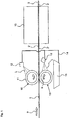
- the Fig. 1 shows a preferred simple method for producing a friction-reducing coated steel sheet according to the invention.
- the sketched for carrying out the process plant can be roughly divided into three steps, jetting, squeezing and drying.
- the galvanized steel strip 1 is moved in accordance with the feed direction a and guided between the rubberized squeezing rollers 10, which are located above and below the steel strip 1.
- the treatment solution L (or suspension) is sprayed in excess onto the rubber coating 11 of the squeeze rollers 10.
- the excess of the processing solution L at the squeegee 10 above the steel strip 1 flows first onto the steel strip 1, then over the strip edge in the receiver 13, while the excess of the treatment solution L at the squeegee 10 below the steel strip 1 directly from the roller 10 back into the storage container 13 passes.
- the treatment solution L is supplied to the application devices 12 via corresponding feed lines 14.
- the self-propelled squeeze rolls 10 are placed on the surfaces of the steel strip 1 with pneumatic or hydraulic pressure and strip the excess processing solution L thereon.
- the upper roller serves as an abutment for the lower roller and vice versa.
- the Anstelldrucks the hardness of the rubber coating 11, the relative speed of the squeeze rolls 10, which rotate at speed b, the steel strip 1 and the speed a of the steel strip 1 wet films 2 'of 1 to 20 microns, but preferably 2 to 3 microns produced become. Thinner wet films may be preferred as they allow shorter dryer runs, lower belt temperatures, or faster belt speeds.
- the wet film 2 ' is dried in a circulating air dryer 15, so that the functional layer 2 is obtained on the hot-dip galvanized steel strip surface. Between outlet squeeze rollers 10 and outlet circulating air dryer 15, the steel strip 1 is tensioned without support.
- the wet film can also be air-dried.
- Construction and arrangement of the application device may well differ from the example shown.
- roller coater equipped with two or three rollers, which allow greater freedom in the design of the wet film independently of the belt speed.
- Rollcoaters are also part of the standard equipment for many systems, especially for the inline coating of antifinger printing.
- roller coater cause significantly higher investment, maintenance and operating costs, they are used for simple post-treatments, as it represents the application of the treatment solution according to the invention, less frequently.
- sodium and potassium carbonate and bicarbonate or sodium and potassium bicarbonate and hydroxide are selected with a total concentration in the treatment solution of 3 to 5 wt .-% and the pH in a range of 7 to 13, preferably 8 to 12, more preferably set to 9.
- the pH of the treatment solution should be in a range from 8 to 12, more preferably about 9, and is optionally adjusted, preferably with NaOH or KOH.
- the exemplary process described here of forming conversion layers by the action of basic alkali metal carbonates on galvanized steel surfaces provides for the formation of structures which resemble the hydrozincite Zn 5 [(OH) 6
- surfaces of hot-dip galvanized steel strips contain not only zinc but also a smaller proportion of aluminum (Z-plates and ZM-plates) or magnesium (ZM-plates).
- the conversion layer resulting from corrosion also contains aluminum or magnesium compounds (hydroxides, carbonates, oxides).
- the formed corrosion layer is amorphous, an exact chemical composition or crystal structure is not given.
- the layers of basic zinc-aluminum carbonate / hydroxide (sheet “Z”), basic zinc / magnesium-aluminum carbonate / hydroxide (sheet “ZM”) or basic zinc carbonate / hydroxide (sheet “ZE”) are referred to below as the conversion layer or Functional layer described.
- the wet film applied to the metal surface according to the invention is dried and subsequently not rinsed with water. Therefore, all non-volatile components remain on the surface.
- the layer weight of the dry substance is in a range from 25 to 200 mg / m 2 surface, preferably 40 to 90 mg / m 2 .
- the coating weight of the forming conversion layer is due to corrosion and incorporation of the zinc, aluminum or magnesium from the sheet surface accordingly greater.
- the coating weight of the dry substance can be determined by the thickness of the wet film as a function of the concentration of the treatment solution. For example, a wet film of a 3% solution is to be applied 1.3 to 3.0 ⁇ m thick in order to achieve the preferred basis weight of the dry matter of 40 to 90 mg / m 2 .
- the layer thickness can be checked by X-ray fluorescence analysis of the added to the solution and present in the dry substance tracer elements potassium, phosphorus, sulfur or silicon, tin, titanium.
- the friction-reducing effect of the conversion layer can be detected, for example, by strip drawing experiments based on VDA 230-213 and by cup draw tests, as described below with reference to FIGS FIGS. 2 to 4 will be shown.
- treatment solutions used to treat the sheets for strip pulling tests and cupping tests are listed in the table below.
- Table 1 Examples of treatment solutions: designation Treatment or aqueous treatment solution FG TS [mg / m 2 ] EMERGENCY untreated - NC 5% by weight NaHCO 3 / NaOH, pH 9 70 KC 5% by weight KHCO 3 / KOH, pH 9 70 NC + KC 4.25% NaHCO 3 + 0.75% KHCO 3 / NaOH, pH 9 70 NC + PH 4.25% NaHCO 3 + 0.75% Na tripolyphosphate / NaOH, pH 9 70 NC + S 4.25% NaHCO 3 + 0.75% Na 2 SO 4 / NaOH, pH 9 70 NC + Si 4.25% NaHCO 3 + 0.75% Na metasilicate / NaOH, pH 9 70 NC + SiO 2 4.25% NaHCO 3 + 0.75% SiO 2 dispersion Aerodisp W 7520 N (Evonik, Hanau) / NaOH, pH 9 70 H 2 O Steam
- the 5% strength by weight treatment solution having a pH of 9 is obtained by dissolving 50 g of NaHCO 3 in 950 g of demineralized water and then the solution with sodium hydroxide solution (eg with 50% by weight of NaOH) pH 9 is adjusted.
- Fig. 2 shows in a graph in which the friction coefficient is plotted against the contact pressure, results for flat-strip stripping experiments, on a treated with 5 wt .-% NaHCO 3 / NaOH aqueous solution (pH 9) NC sheet and a 5 wt. % KHCO 3 / KOH aqueous solution (pH 9) treated sheet KC (see Table 1) and for comparison on an untreated sheet NOT according to VDA 230-213 were performed.
- the maximum punch force on the untreated sheet NOT is plotted against the differently pretreated sheet according to Table 1.
- the presence of tracers is not required.
- the examples given show that the different tracer systems have some influence on the overall layer friction, albeit to a lesser extent.
- the conversion layers of treatment solutions with the tracer systems in particular with phosphate (NC + PH) and silicon dioxide (NC + SiO 2), allow the lowest stamping forces. This suggests that either the presence of certain tracer components is more effective Promotes conversion layer or contribute certain tracer components for better tribological effectiveness and, for example, be installed even in the conversion layer.
- phosphates are known as lubricating components, and the SiO 2 dispersion is attributed to lubricating effect.
- both effects come into consideration.
- the conversion layer is compatible with a subsequent manufacturing process of a car body shell:
- the temporary corrosion protection of the steel sheet is indispensable for the storage and transport of steel coils and still unpainted pressed parts. This is usually achieved by applying anti-corrosive or Prelube oils or waxy hotmelt dry lubricants in the rolling mill.
- the proof of the anti-corrosion properties can be exemplified by a condensed water climate test be carried out as described in the test specification VDA 230-213.
- the Prelube Anticorit PL 3802-39 S used for lubrication has been used for years for coil lubrication in the German steel and automotive industry. It can therefore be assumed that the conversion coatings are suitable for the temporary corrosion protection of coils and pressed parts.
- a good adhesion of the adhesives used is essential for the carcass shell.
- the compatibility of the conversion layer with such structural adhesives can be investigated by way of example with an adhesive bead test.
- a strand (bead) of the still liquid adhesive is applied to the pretreated and with 2.8 to 3.2 g / m 2 Anticorit PL 3802-39 S oiled test sheet and subsequently thermally cured. After cooling, the adhesive bead is mechanically peeled off and the surfaces of the sheet and the removed bead are examined. A retention of adhesive residues on the metal surface indicates good adhesion of adhesive metal.
- Such good adhesion is accompanied by a rough, and thus whitish surface of the adhesive bead.
- the adhesives used were, for example, the products Betamate TM 1496 F and Betamate TM 1040 from Dow Automotive.
- the adhesive beads cured on the sheets were subjected to corrosion before peeling.
- moisture loads were carried out over a period of 504 h at 50 ° C and 95% relative humidity. It was found that the fracture pattern after the corrosion load is also cohesive (CF) or near-surface cohesive (SCF).
Landscapes
- Chemical & Material Sciences (AREA)
- General Chemical & Material Sciences (AREA)
- Chemical Kinetics & Catalysis (AREA)
- Engineering & Computer Science (AREA)
- Materials Engineering (AREA)
- Mechanical Engineering (AREA)
- Metallurgy (AREA)
- Organic Chemistry (AREA)
- Chemical Treatment Of Metals (AREA)
- Other Surface Treatments For Metallic Materials (AREA)
Claims (12)
- Procédé pour la fabrication économique en temps d'une tôle d'acier galvanisée (1) avec une couche auxiliaire de formage composée au moins d'une couche fonctionnelle inorganique (2),
englobant les étapes:- production d'une solution (L) ou suspension aqueuse, sans silanes, composée d'au moins une source de carbonate, ou d'une solution (L) ou suspension aqueuse, sans silanes, composée d'au moins une source de carbonate et d'au moins une source d'hydroxyde, au moins une source de carbonate étant sélectionnée à partir d'hydrogénocarbonate d'ammonium, de carbonate d'ammonium, d'hydrogénocarbonates de métaux alcalins, de carbonates de métaux alcalins, de carboxylates de métaux alcalins et au moins une source d'hydroxyde étant sélectionnée à partir d'hydroxydes de métaux alcalins, d'oxydes de métaux alcalins, d'alcoolates de métaux alcalins, d'hydroxydes de magnésium et d'oxyde de magnésium,
une concentration d'au moins une source de carbonate se situant dans la plage de 1 à 5 % en poids par rapport au poids total de la solution (L) ou suspension,- définition de la valeur du pH de la solution (L) ou suspension dans une plage de 8 à 12,- appliquer de la solution aqueuse (L) ou suspension sur au moins une face de la tôle d'acier galvanisée (1) et produire d'un film humide (2') avec une épaisseur prédéterminée qui est définie en fonction de la concentration de la solution de traitement de 1 à 20 µm,- sans l'exécution d'une étape de rinçage, séchage du film humide (2') par l'obtention d'un poids de couche d'une substance sèche d'une surface de 25 à 200 mg/m2, le poids de couche de la substance sèche étant défini par l'épaisseur du film humide (2') et la concentration, et une couche de conversion en zinc et sels de zinc (2) qui sont au moins partiellement des carbonates, étant obtenue comme couche fonctionnelle inorganique (2). - Procédé conformément à la revendication n°1,
la concentration d'au moins une source de carbonate se situant dans une plage de 3 à 5 % en poids par rapport au poids total de la solution (L) ou suspension et/ou le poids de couche de la substance sèche issue du film humide (2') étant de 40 à 90 mg/m2 et/ou- la valeur du pH de la solution (L) ou suspension étant définie sur 9 □ 0,5, le cas échéant par l'ajout d'hydroxyde de sodium et/ou d'hydroxyde de potassium. - Procédé conformément à la revendication n°1 ou n°2,
les métaux alcalins étant du sodium ou du potassium, de préférence au moins une source de carbonate étant de l'hydrogénocarbonate de sodium et/ou de potassium et/ou du carbonate de sodium et/ou de potassium et au moins une source d'hydroxyde étant de l'hydroxyde de sodium et/ou de potassium. - Procédé conformément au moins à l'une des revendications n°1 à n°3,
englobant l'étape:- pour la détection de l'épaisseur de couche au moyen de l'analyse par fluorescence de rayons X lors de la production de la solution (L) ou suspension aqueuse, sans silanes (L), par l'ajout d'un système de traceur détectable dans l'analyse par fluorescence de rayons X, lequel présente- du phosphate de sodium et/ou de potassium ou du diphosphate et/ou triphosphate de sodium et/ou de potassium ou- de l'hydrogénocarbonate de potassium, du carbonate de potassium ou- du sulfate de sodium et/ou de potassium ou- des silicates de sodium et/ou de potassium, des métasilicates de sodium et/ou de potassium ou une dispersion SiO2 contenant du sodium et/ou des composés d'étain ou de titane avec une concentration dans une plage de 1 à 30 % en poids, de préférence de 10 à 20 % en poids, en particulier de préférence de 15 % en poids, par rapport à la teneur en sources de carbonate et d'hydroxyde. - Procédé conformément au moins à l'une des revendications n°1 à n°4, l'application s'effectuant par- immersion- pulvérisation sans pressage ou- pulvérisation et raclage au moyen de rouleaux de pressage non entraînés ou- laminage au moyen d'une coucheuse à rouleaux ou de préférence au moyen de deux rouleaux de pressage (10), entre lesquels la tôle d'acier galvanisée (1) est guidée.
- Procédé conformément à la revendication n°5,
le laminage au moyen de deux rouleaux de pressage (10) englobant les étapes:- pulvérisation de la solution (L) ou suspension aqueuse en excédent sur les rouleaux de pressage (10) disposés des deux côtés de la tôle d'acier galvanisée (1), la solution ou la suspension excédentaire étant collectée et guidée dans un récipient collecteur (13),- engagement par pression des rouleaux de pressage (10) sur les surfaces de la tôle d'acier galvanisée (1) et raclage de la solution (L) ou suspension aqueuse sur les surfaces de la tôle d'acier galvanisée (1) et- réglage de l'épaisseur du film humide (2') dans une plage de 1 à 20 µm en sélectionnant la pression de surface, une dureté d'un caoutchoutage (11) des rouleaux de pressage (10), une vitesse (b) des rouleaux de pressage (10) et une vitesse (a) de la tôle d'acier. - Procédé conformément au moins à l'une des revendications n°1 à n°6,
englobant les étapes:- application d'une huile de protection anticorrosion et/ou d'une huile de prélubrification et/ou d'un lubrifiant sec sur la couche de conversion (2) de façon à ce qu'une couche d'huile lubrifiante présentant un poids superficiel de 0,2 à 3,0 g/m2 soit obtenue. - Tôle d'acier galvanisée (1) revêtue, dont la surface présente une couche auxiliaire de formage composée d'au moins une couche fonctionnelle inorganique (2).
caractérisée en ce que
la couche fonctionnelle inorganique (2) est une couche de conversion en zinc et sels de zinc avec une structure minérale de type hydrozincite, qui est formée à partir d'une substance sèche avec un poids de couche d'une surface de 25 à 200 mg/m2, séparée par l'application et le séchage d'un film humide (2') au moyen du procédé conformément au moins à l'une des revendications n°1 à n°7. - Tôle d'acier galvanisée (1) conformément à la revendication n°8,
caractérisée en ce que
la tôle d'acier galvanisée (1) est une tôle d'acier zinguée (1). - Tôle d'acier galvanisée (1) conformément à la revendication n°8 ou n°9,
caractérisée en ce que
la couche de conversion (2) présente un système de traceur permettant la détection de l'épaisseur de couche qui est détectable par l'analyse par fluorescence de rayons X et qui est sélectionnée à partir de composés de potassium, de phosphore, de soufre, de silicium, d'étain ou de titane. - Tôle d'acier galvanisée (1) conformément au moins à l'une des revendications n°8 à n°10,
caractérisée en ce que
la couche auxiliaire de formage comprend une couche d'huile lubrifiante qui est appliquée sur la couche de conversion (2), la couche d'huile lubrifiante comprenant de préférence- une huile de protection anticorrosion et/ou une huile de prélubrification et/ou un lubrifiant sec et- présentant un poids superficiel de 0,2 à 3,0 g/m2, de préférence de 1,0 à 1,5 g/m2. - Utilisation d'une tôle d'acier galvanisée (1) revêtue conformément au moins à l'une des revendications n°8 à n°11 pour la fabrication d'une pièce de véhicule automobile par la réalisation au moins d'une étape de formage.
Priority Applications (4)
| Application Number | Priority Date | Filing Date | Title |
|---|---|---|---|
| ES13004572T ES2734456T3 (es) | 2013-09-19 | 2013-09-19 | Capa funcional inorgánica sobre acero galvanizado por inmersión en caliente como ayuda para la conformación |
| PL13004572T PL2851452T3 (pl) | 2013-09-19 | 2013-09-19 | Nieorganiczna powłoka funkcyjna na stali ocynkowanej ogniowo jako pomocna przy formowaniu |
| EP13004572.7A EP2851452B1 (fr) | 2013-09-19 | 2013-09-19 | Couche fonctionnelle anorganique sur de l'acier galavanisé à chaud |
| PCT/EP2014/002550 WO2015039762A1 (fr) | 2013-09-19 | 2014-09-19 | Couche de conversion anorganique à base de carbonate, appliquée sur de l'acier galvanisé |
Applications Claiming Priority (1)
| Application Number | Priority Date | Filing Date | Title |
|---|---|---|---|
| EP13004572.7A EP2851452B1 (fr) | 2013-09-19 | 2013-09-19 | Couche fonctionnelle anorganique sur de l'acier galavanisé à chaud |
Publications (2)
| Publication Number | Publication Date |
|---|---|
| EP2851452A1 EP2851452A1 (fr) | 2015-03-25 |
| EP2851452B1 true EP2851452B1 (fr) | 2019-04-17 |
Family
ID=49236989
Family Applications (1)
| Application Number | Title | Priority Date | Filing Date |
|---|---|---|---|
| EP13004572.7A Active EP2851452B1 (fr) | 2013-09-19 | 2013-09-19 | Couche fonctionnelle anorganique sur de l'acier galavanisé à chaud |
Country Status (4)
| Country | Link |
|---|---|
| EP (1) | EP2851452B1 (fr) |
| ES (1) | ES2734456T3 (fr) |
| PL (1) | PL2851452T3 (fr) |
| WO (1) | WO2015039762A1 (fr) |
Families Citing this family (5)
| Publication number | Priority date | Publication date | Assignee | Title |
|---|---|---|---|---|
| ES2708209T3 (es) | 2014-06-27 | 2019-04-09 | Henkel Ag & Co Kgaa | Lubricante seco para acero recubierto de zinc |
| KR20180102163A (ko) | 2016-01-19 | 2018-09-14 | 티센크루프 스틸 유럽 악티엔게젤샤프트 | 아연 코팅 및 상기 코팅 상에 도포된 마찰공학적 활성 층을 갖는 강 제품의 제조 방법, 및 상응하게 제조된 강 제품 |
| ES2883105T3 (es) | 2017-03-30 | 2021-12-07 | Tata Steel Ijmuiden Bv | Composición ácida acuosa para tratar superficies metálicas, método de tratamiento que usa esta composición y uso de una superficie metálica tratada |
| DE102018216216A1 (de) | 2018-09-24 | 2020-03-26 | Thyssenkrupp Ag | Verfahren zur Verbesserung der Phosphatierbarkeit von metallischen Oberflächen, welche mit einer temporären Vor- bzw. Nachbehandlung versehen werden |
| DE102024111126A1 (de) * | 2024-04-22 | 2025-10-23 | Salzgitter Flachstahl Gmbh | Verfahren und Vorrichtung zur Oberflächenpräparation eines mit einem Zink-Magnesium-Aluminium-Überzug schmelztauchbeschichteten Stahlblechs für eine nachfolgende Behandlung sowie entsprechendes Stahlblech |
Family Cites Families (8)
| Publication number | Priority date | Publication date | Assignee | Title |
|---|---|---|---|---|
| CA2175105C (fr) * | 1995-05-23 | 1999-09-21 | C. Ramadeva Shastry | Procede visant a ameliorer les proprietes de formabilite et de soudabilite de feuilles d'acier galvanise |
| US6231686B1 (en) * | 1997-11-10 | 2001-05-15 | Ltv Steel Company, Inc. | Formability of metal having a zinc layer |
| DE10256639A1 (de) | 2002-12-03 | 2004-06-24 | Thyssenkrupp Stahl Ag | Schmierstoffbeschichtetes Metallblech mit verbesserten Umformeigenschaften |
| KR20060013545A (ko) | 2003-05-20 | 2006-02-10 | 가부시끼가이샤 도시바 | 스퍼터 이온 펌프, 그 제조 방법 및 스퍼터 이온 펌프를구비한 화상 표시 장치 |
| FR2864552B1 (fr) | 2003-12-24 | 2006-07-21 | Usinor | Traitement de surface par hydroxysulfate |
| US20050259683A1 (en) | 2004-04-15 | 2005-11-24 | International Business Machines Corporation | Control service capacity |
| DE102008016050A1 (de) | 2007-12-24 | 2009-06-25 | Voest-Alpine Stahl Gmbh | Flexibler Primer und dessen Verwendung |
| US10876211B2 (en) * | 2011-09-16 | 2020-12-29 | Prc-Desoto International, Inc. | Compositions for application to a metal substrate |
-
2013
- 2013-09-19 ES ES13004572T patent/ES2734456T3/es active Active
- 2013-09-19 EP EP13004572.7A patent/EP2851452B1/fr active Active
- 2013-09-19 PL PL13004572T patent/PL2851452T3/pl unknown
-
2014
- 2014-09-19 WO PCT/EP2014/002550 patent/WO2015039762A1/fr not_active Ceased
Non-Patent Citations (1)
| Title |
|---|
| None * |
Also Published As
| Publication number | Publication date |
|---|---|
| EP2851452A1 (fr) | 2015-03-25 |
| WO2015039762A1 (fr) | 2015-03-26 |
| PL2851452T3 (pl) | 2019-10-31 |
| ES2734456T3 (es) | 2019-12-10 |
Similar Documents
| Publication | Publication Date | Title |
|---|---|---|
| EP2683848B1 (fr) | Utilisation d'un produit en acier plat à l'aide d'un formage à chaud pour former un composant et procédé de fabrication d'un objet formé à chaud | |
| EP2238227B1 (fr) | Procédé d'enduction de surfaces métalliques avec une couche de phosphate puis avec une couche de lubrifiant polymère | |
| EP0700452B1 (fr) | Traitement de revetement par conversion sans chrome pour l'aluminium | |
| EP2995674B1 (fr) | Utilisation d'un sulfate et procede pour la production d'un élément en acier par formage dans une machine de formage | |
| EP1235949B1 (fr) | Procede de phosphatation utilisation des pieces en metal ainsi phosphatees | |
| EP2373770B1 (fr) | Procédé de fabrication de corps de formage à partir de tôle d'acier zinguée unilatéralement ou bilateralement | |
| EP2848715A1 (fr) | Procédé de fabrication d'un composant en acier revêtu d'une coiffe métallique protégeant de la corrosion | |
| EP0324395B1 (fr) | Procédé de phosphatisation de surfaces métalliques | |
| EP3411510A1 (fr) | Installation de galvanisation à chaud et procédé de galvanisation à chaud | |
| EP2851452A1 (fr) | Couche de conversion anorganique à base de carbonate sur de l'acier zingué | |
| EP2311928A2 (fr) | Solution aqueuse contenant un ester d'acide phosphorique organique pour la fabrication d'une tôle métallique revêtue de lubrifiant ayant des propriétés de déformation améliorées | |
| DE102008004728A1 (de) | Phosphatiertes Stahlblech sowie Verfahren zur Herstellung eines solchen Blechs | |
| EP0656957B1 (fr) | Procede de phosphatation d'acier zingue d'un seul cote | |
| DE3512442A1 (de) | Verfahren zur oberflaechenbehandlung von aluminium | |
| US10914009B2 (en) | Method for manufacturing non-phosphate coated metal material for cold heading-plastic working process | |
| DE102014225237B3 (de) | Verfahren zur nasschemischen Vorbehandlung einer Vielzahl von Eisen- und Aluminiumbauteilen in Serie | |
| EP3898860A1 (fr) | Agent de revêtement de formage, feuillard d'acier revêtu de cet agent et son utilisation dans la fabrication de pièces par formage | |
| EP3405600B1 (fr) | Procédé de fabrication d'un produit en acier doté d'un revêtement de zinc et d'une couche active tribilogiquement appliquée sur celui-ci ainsi que produit en acier obtenu de maniere correspondante | |
| EP2373769B1 (fr) | Procédé de fabrication de corps de formage à partir de tôle d'acier zinguée unilatéralement ou bilatéralement | |
| EP1350865A2 (fr) | Tôle en acier zingué et phosphaté et procédé de fabrication | |
| WO2023057300A1 (fr) | Procédé de dressage d'une tôle d'acier, tôle d'acier dressée et pièce fabriquée à partir de celle-ci | |
| WO1998013535A1 (fr) | Procede de phosphatation pour installations a defilement rapide des feuillards | |
| EP3336219B1 (fr) | Procédé de prétraitement de protection anticorrosion et de nettoyage de composants métalliques | |
| EP3643759B1 (fr) | Acier à feuillard revêtu de polycarboxylate et son utilisation pour l'emboutissage | |
| WO2019243146A1 (fr) | Couche de séparation pour formage à chaud |
Legal Events
| Date | Code | Title | Description |
|---|---|---|---|
| PUAI | Public reference made under article 153(3) epc to a published international application that has entered the european phase |
Free format text: ORIGINAL CODE: 0009012 |
|
| 17P | Request for examination filed |
Effective date: 20130919 |
|
| AK | Designated contracting states |
Kind code of ref document: A1 Designated state(s): AL AT BE BG CH CY CZ DE DK EE ES FI FR GB GR HR HU IE IS IT LI LT LU LV MC MK MT NL NO PL PT RO RS SE SI SK SM TR |
|
| AX | Request for extension of the european patent |
Extension state: BA ME |
|
| R17P | Request for examination filed (corrected) |
Effective date: 20150923 |
|
| RBV | Designated contracting states (corrected) |
Designated state(s): AL AT BE BG CH CY CZ DE DK EE ES FI FR GB GR HR HU IE IS IT LI LT LU LV MC MK MT NL NO PL PT RO RS SE SI SK SM TR |
|
| RAP1 | Party data changed (applicant data changed or rights of an application transferred) |
Owner name: FUCHS PETROLUB SE |
|
| STAA | Information on the status of an ep patent application or granted ep patent |
Free format text: STATUS: EXAMINATION IS IN PROGRESS |
|
| 17Q | First examination report despatched |
Effective date: 20180711 |
|
| GRAP | Despatch of communication of intention to grant a patent |
Free format text: ORIGINAL CODE: EPIDOSNIGR1 |
|
| STAA | Information on the status of an ep patent application or granted ep patent |
Free format text: STATUS: GRANT OF PATENT IS INTENDED |
|
| INTG | Intention to grant announced |
Effective date: 20181005 |
|
| GRAS | Grant fee paid |
Free format text: ORIGINAL CODE: EPIDOSNIGR3 |
|
| GRAA | (expected) grant |
Free format text: ORIGINAL CODE: 0009210 |
|
| STAA | Information on the status of an ep patent application or granted ep patent |
Free format text: STATUS: THE PATENT HAS BEEN GRANTED |
|
| AK | Designated contracting states |
Kind code of ref document: B1 Designated state(s): AL AT BE BG CH CY CZ DE DK EE ES FI FR GB GR HR HU IE IS IT LI LT LU LV MC MK MT NL NO PL PT RO RS SE SI SK SM TR |
|
| REG | Reference to a national code |
Ref country code: GB Ref legal event code: FG4D Free format text: NOT ENGLISH |
|
| REG | Reference to a national code |
Ref country code: CH Ref legal event code: EP |
|
| REG | Reference to a national code |
Ref country code: DE Ref legal event code: R096 Ref document number: 502013012631 Country of ref document: DE |
|
| REG | Reference to a national code |
Ref country code: AT Ref legal event code: REF Ref document number: 1121643 Country of ref document: AT Kind code of ref document: T Effective date: 20190515 Ref country code: IE Ref legal event code: FG4D Free format text: LANGUAGE OF EP DOCUMENT: GERMAN |
|
| REG | Reference to a national code |
Ref country code: NL Ref legal event code: FP |
|
| REG | Reference to a national code |
Ref country code: SE Ref legal event code: TRGR |
|
| REG | Reference to a national code |
Ref country code: LT Ref legal event code: MG4D |
|
| PG25 | Lapsed in a contracting state [announced via postgrant information from national office to epo] |
Ref country code: NO Free format text: LAPSE BECAUSE OF FAILURE TO SUBMIT A TRANSLATION OF THE DESCRIPTION OR TO PAY THE FEE WITHIN THE PRESCRIBED TIME-LIMIT Effective date: 20190717 Ref country code: PT Free format text: LAPSE BECAUSE OF FAILURE TO SUBMIT A TRANSLATION OF THE DESCRIPTION OR TO PAY THE FEE WITHIN THE PRESCRIBED TIME-LIMIT Effective date: 20190817 Ref country code: AL Free format text: LAPSE BECAUSE OF FAILURE TO SUBMIT A TRANSLATION OF THE DESCRIPTION OR TO PAY THE FEE WITHIN THE PRESCRIBED TIME-LIMIT Effective date: 20190417 Ref country code: FI Free format text: LAPSE BECAUSE OF FAILURE TO SUBMIT A TRANSLATION OF THE DESCRIPTION OR TO PAY THE FEE WITHIN THE PRESCRIBED TIME-LIMIT Effective date: 20190417 Ref country code: HR Free format text: LAPSE BECAUSE OF FAILURE TO SUBMIT A TRANSLATION OF THE DESCRIPTION OR TO PAY THE FEE WITHIN THE PRESCRIBED TIME-LIMIT Effective date: 20190417 Ref country code: LT Free format text: LAPSE BECAUSE OF FAILURE TO SUBMIT A TRANSLATION OF THE DESCRIPTION OR TO PAY THE FEE WITHIN THE PRESCRIBED TIME-LIMIT Effective date: 20190417 |
|
| PG25 | Lapsed in a contracting state [announced via postgrant information from national office to epo] |
Ref country code: GR Free format text: LAPSE BECAUSE OF FAILURE TO SUBMIT A TRANSLATION OF THE DESCRIPTION OR TO PAY THE FEE WITHIN THE PRESCRIBED TIME-LIMIT Effective date: 20190718 Ref country code: BG Free format text: LAPSE BECAUSE OF FAILURE TO SUBMIT A TRANSLATION OF THE DESCRIPTION OR TO PAY THE FEE WITHIN THE PRESCRIBED TIME-LIMIT Effective date: 20190717 Ref country code: RS Free format text: LAPSE BECAUSE OF FAILURE TO SUBMIT A TRANSLATION OF THE DESCRIPTION OR TO PAY THE FEE WITHIN THE PRESCRIBED TIME-LIMIT Effective date: 20190417 Ref country code: LV Free format text: LAPSE BECAUSE OF FAILURE TO SUBMIT A TRANSLATION OF THE DESCRIPTION OR TO PAY THE FEE WITHIN THE PRESCRIBED TIME-LIMIT Effective date: 20190417 |
|
| REG | Reference to a national code |
Ref country code: ES Ref legal event code: FG2A Ref document number: 2734456 Country of ref document: ES Kind code of ref document: T3 Effective date: 20191210 |
|
| PG25 | Lapsed in a contracting state [announced via postgrant information from national office to epo] |
Ref country code: IS Free format text: LAPSE BECAUSE OF FAILURE TO SUBMIT A TRANSLATION OF THE DESCRIPTION OR TO PAY THE FEE WITHIN THE PRESCRIBED TIME-LIMIT Effective date: 20190817 |
|
| REG | Reference to a national code |
Ref country code: DE Ref legal event code: R097 Ref document number: 502013012631 Country of ref document: DE |
|
| PG25 | Lapsed in a contracting state [announced via postgrant information from national office to epo] |
Ref country code: RO Free format text: LAPSE BECAUSE OF FAILURE TO SUBMIT A TRANSLATION OF THE DESCRIPTION OR TO PAY THE FEE WITHIN THE PRESCRIBED TIME-LIMIT Effective date: 20190417 Ref country code: CZ Free format text: LAPSE BECAUSE OF FAILURE TO SUBMIT A TRANSLATION OF THE DESCRIPTION OR TO PAY THE FEE WITHIN THE PRESCRIBED TIME-LIMIT Effective date: 20190417 Ref country code: EE Free format text: LAPSE BECAUSE OF FAILURE TO SUBMIT A TRANSLATION OF THE DESCRIPTION OR TO PAY THE FEE WITHIN THE PRESCRIBED TIME-LIMIT Effective date: 20190417 Ref country code: DK Free format text: LAPSE BECAUSE OF FAILURE TO SUBMIT A TRANSLATION OF THE DESCRIPTION OR TO PAY THE FEE WITHIN THE PRESCRIBED TIME-LIMIT Effective date: 20190417 Ref country code: SK Free format text: LAPSE BECAUSE OF FAILURE TO SUBMIT A TRANSLATION OF THE DESCRIPTION OR TO PAY THE FEE WITHIN THE PRESCRIBED TIME-LIMIT Effective date: 20190417 |
|
| PLBE | No opposition filed within time limit |
Free format text: ORIGINAL CODE: 0009261 |
|
| STAA | Information on the status of an ep patent application or granted ep patent |
Free format text: STATUS: NO OPPOSITION FILED WITHIN TIME LIMIT |
|
| PG25 | Lapsed in a contracting state [announced via postgrant information from national office to epo] |
Ref country code: SM Free format text: LAPSE BECAUSE OF FAILURE TO SUBMIT A TRANSLATION OF THE DESCRIPTION OR TO PAY THE FEE WITHIN THE PRESCRIBED TIME-LIMIT Effective date: 20190417 |
|
| 26N | No opposition filed |
Effective date: 20200120 |
|
| PG25 | Lapsed in a contracting state [announced via postgrant information from national office to epo] |
Ref country code: SI Free format text: LAPSE BECAUSE OF FAILURE TO SUBMIT A TRANSLATION OF THE DESCRIPTION OR TO PAY THE FEE WITHIN THE PRESCRIBED TIME-LIMIT Effective date: 20190417 Ref country code: MC Free format text: LAPSE BECAUSE OF FAILURE TO SUBMIT A TRANSLATION OF THE DESCRIPTION OR TO PAY THE FEE WITHIN THE PRESCRIBED TIME-LIMIT Effective date: 20190417 |
|
| REG | Reference to a national code |
Ref country code: CH Ref legal event code: PL |
|
| PG25 | Lapsed in a contracting state [announced via postgrant information from national office to epo] |
Ref country code: LU Free format text: LAPSE BECAUSE OF NON-PAYMENT OF DUE FEES Effective date: 20190919 Ref country code: LI Free format text: LAPSE BECAUSE OF NON-PAYMENT OF DUE FEES Effective date: 20190930 Ref country code: CH Free format text: LAPSE BECAUSE OF NON-PAYMENT OF DUE FEES Effective date: 20190930 Ref country code: IE Free format text: LAPSE BECAUSE OF NON-PAYMENT OF DUE FEES Effective date: 20190919 |
|
| PG25 | Lapsed in a contracting state [announced via postgrant information from national office to epo] |
Ref country code: CY Free format text: LAPSE BECAUSE OF FAILURE TO SUBMIT A TRANSLATION OF THE DESCRIPTION OR TO PAY THE FEE WITHIN THE PRESCRIBED TIME-LIMIT Effective date: 20190417 |
|
| PG25 | Lapsed in a contracting state [announced via postgrant information from national office to epo] |
Ref country code: HU Free format text: LAPSE BECAUSE OF FAILURE TO SUBMIT A TRANSLATION OF THE DESCRIPTION OR TO PAY THE FEE WITHIN THE PRESCRIBED TIME-LIMIT; INVALID AB INITIO Effective date: 20130919 Ref country code: MT Free format text: LAPSE BECAUSE OF FAILURE TO SUBMIT A TRANSLATION OF THE DESCRIPTION OR TO PAY THE FEE WITHIN THE PRESCRIBED TIME-LIMIT Effective date: 20190417 |
|
| PG25 | Lapsed in a contracting state [announced via postgrant information from national office to epo] |
Ref country code: MK Free format text: LAPSE BECAUSE OF FAILURE TO SUBMIT A TRANSLATION OF THE DESCRIPTION OR TO PAY THE FEE WITHIN THE PRESCRIBED TIME-LIMIT Effective date: 20190417 |
|
| PGFP | Annual fee paid to national office [announced via postgrant information from national office to epo] |
Ref country code: DE Payment date: 20250919 Year of fee payment: 13 |
|
| PGFP | Annual fee paid to national office [announced via postgrant information from national office to epo] |
Ref country code: NL Payment date: 20250922 Year of fee payment: 13 Ref country code: PL Payment date: 20250905 Year of fee payment: 13 Ref country code: TR Payment date: 20250911 Year of fee payment: 13 |
|
| PGFP | Annual fee paid to national office [announced via postgrant information from national office to epo] |
Ref country code: GB Payment date: 20250923 Year of fee payment: 13 Ref country code: BE Payment date: 20250919 Year of fee payment: 13 |
|
| PGFP | Annual fee paid to national office [announced via postgrant information from national office to epo] |
Ref country code: FR Payment date: 20250926 Year of fee payment: 13 Ref country code: AT Payment date: 20250918 Year of fee payment: 13 |
|
| PGFP | Annual fee paid to national office [announced via postgrant information from national office to epo] |
Ref country code: SE Payment date: 20250922 Year of fee payment: 13 |
|
| PGFP | Annual fee paid to national office [announced via postgrant information from national office to epo] |
Ref country code: IT Payment date: 20250930 Year of fee payment: 13 |
|
| PGFP | Annual fee paid to national office [announced via postgrant information from national office to epo] |
Ref country code: ES Payment date: 20251020 Year of fee payment: 13 |