EP2851709A2 - Vibrateur acoustique marin à basse fréquence - Google Patents
Vibrateur acoustique marin à basse fréquence Download PDFInfo
- Publication number
- EP2851709A2 EP2851709A2 EP14183242.8A EP14183242A EP2851709A2 EP 2851709 A2 EP2851709 A2 EP 2851709A2 EP 14183242 A EP14183242 A EP 14183242A EP 2851709 A2 EP2851709 A2 EP 2851709A2
- Authority
- EP
- European Patent Office
- Prior art keywords
- marine acoustic
- acoustic vibrator
- spring
- piston plate
- fixture
- Prior art date
- Legal status (The legal status is an assumption and is not a legal conclusion. Google has not performed a legal analysis and makes no representation as to the accuracy of the status listed.)
- Withdrawn
Links
- XLYOFNOQVPJJNP-UHFFFAOYSA-N water Substances O XLYOFNOQVPJJNP-UHFFFAOYSA-N 0.000 claims abstract description 42
- 238000000034 method Methods 0.000 claims description 16
- 238000004458 analytical method Methods 0.000 claims description 5
- 230000000153 supplemental effect Effects 0.000 claims description 5
- 230000008569 process Effects 0.000 claims description 2
- 230000033001 locomotion Effects 0.000 description 17
- 230000008901 benefit Effects 0.000 description 9
- 239000000463 material Substances 0.000 description 6
- 239000011435 rock Substances 0.000 description 6
- 230000005540 biological transmission Effects 0.000 description 5
- 230000008878 coupling Effects 0.000 description 4
- 238000010168 coupling process Methods 0.000 description 4
- 238000005859 coupling reaction Methods 0.000 description 4
- 230000014509 gene expression Effects 0.000 description 4
- 239000004593 Epoxy Substances 0.000 description 3
- 230000009471 action Effects 0.000 description 3
- 239000004918 carbon fiber reinforced polymer Substances 0.000 description 3
- 239000011152 fibreglass Substances 0.000 description 3
- 239000012530 fluid Substances 0.000 description 3
- 239000003365 glass fiber Substances 0.000 description 3
- 239000002245 particle Substances 0.000 description 3
- -1 structure Substances 0.000 description 3
- 230000009466 transformation Effects 0.000 description 3
- 229910000881 Cu alloy Inorganic materials 0.000 description 2
- 229910000831 Steel Inorganic materials 0.000 description 2
- XAGFODPZIPBFFR-UHFFFAOYSA-N aluminium Chemical compound [Al] XAGFODPZIPBFFR-UHFFFAOYSA-N 0.000 description 2
- 229910052782 aluminium Inorganic materials 0.000 description 2
- 230000015572 biosynthetic process Effects 0.000 description 2
- 238000010276 construction Methods 0.000 description 2
- 238000010586 diagram Methods 0.000 description 2
- 230000004907 flux Effects 0.000 description 2
- 238000005755 formation reaction Methods 0.000 description 2
- 229930195733 hydrocarbon Natural products 0.000 description 2
- 150000002430 hydrocarbons Chemical class 0.000 description 2
- 229910052500 inorganic mineral Inorganic materials 0.000 description 2
- 239000011707 mineral Substances 0.000 description 2
- 239000000203 mixture Substances 0.000 description 2
- 230000005855 radiation Effects 0.000 description 2
- 238000011084 recovery Methods 0.000 description 2
- 230000004044 response Effects 0.000 description 2
- 239000010935 stainless steel Substances 0.000 description 2
- 229910001220 stainless steel Inorganic materials 0.000 description 2
- 239000010959 steel Substances 0.000 description 2
- 229910000639 Spring steel Inorganic materials 0.000 description 1
- 230000001133 acceleration Effects 0.000 description 1
- 238000003491 array Methods 0.000 description 1
- 230000002238 attenuated effect Effects 0.000 description 1
- 238000005452 bending Methods 0.000 description 1
- 230000006835 compression Effects 0.000 description 1
- 238000007906 compression Methods 0.000 description 1
- 239000004020 conductor Substances 0.000 description 1
- 230000008602 contraction Effects 0.000 description 1
- 238000009795 derivation Methods 0.000 description 1
- 238000006073 displacement reaction Methods 0.000 description 1
- 230000000694 effects Effects 0.000 description 1
- 230000005520 electrodynamics Effects 0.000 description 1
- 239000002360 explosive Substances 0.000 description 1
- 230000007274 generation of a signal involved in cell-cell signaling Effects 0.000 description 1
- 230000003993 interaction Effects 0.000 description 1
- 230000007246 mechanism Effects 0.000 description 1
- 230000004048 modification Effects 0.000 description 1
- 238000012986 modification Methods 0.000 description 1
- 230000003287 optical effect Effects 0.000 description 1
- 239000012858 resilient material Substances 0.000 description 1
- 238000001228 spectrum Methods 0.000 description 1
- 230000001960 triggered effect Effects 0.000 description 1
Images



Classifications
-
- G—PHYSICS
- G01—MEASURING; TESTING
- G01V—GEOPHYSICS; GRAVITATIONAL MEASUREMENTS; DETECTING MASSES OR OBJECTS; TAGS
- G01V1/00—Seismology; Seismic or acoustic prospecting or detecting
- G01V1/02—Generating seismic energy
- G01V1/133—Generating seismic energy using fluidic driving means, e.g. highly pressurised fluids; using implosion
- G01V1/137—Generating seismic energy using fluidic driving means, e.g. highly pressurised fluids; using implosion which fluid escapes from the generator in a pulsating manner, e.g. for generating bursts, airguns
-
- G—PHYSICS
- G01—MEASURING; TESTING
- G01V—GEOPHYSICS; GRAVITATIONAL MEASUREMENTS; DETECTING MASSES OR OBJECTS; TAGS
- G01V1/00—Seismology; Seismic or acoustic prospecting or detecting
- G01V1/02—Generating seismic energy
- G01V1/04—Details
-
- G—PHYSICS
- G01—MEASURING; TESTING
- G01V—GEOPHYSICS; GRAVITATIONAL MEASUREMENTS; DETECTING MASSES OR OBJECTS; TAGS
- G01V1/00—Seismology; Seismic or acoustic prospecting or detecting
- G01V1/02—Generating seismic energy
- G01V1/143—Generating seismic energy using mechanical driving means, e.g. motor driven shaft
- G01V1/145—Generating seismic energy using mechanical driving means, e.g. motor driven shaft by deforming or displacing surfaces, e.g. by mechanically driven vibroseis™
-
- G—PHYSICS
- G01—MEASURING; TESTING
- G01V—GEOPHYSICS; GRAVITATIONAL MEASUREMENTS; DETECTING MASSES OR OBJECTS; TAGS
- G01V1/00—Seismology; Seismic or acoustic prospecting or detecting
- G01V1/02—Generating seismic energy
- G01V1/159—Generating seismic energy using piezoelectric or magnetostrictive driving means
-
- G—PHYSICS
- G01—MEASURING; TESTING
- G01V—GEOPHYSICS; GRAVITATIONAL MEASUREMENTS; DETECTING MASSES OR OBJECTS; TAGS
- G01V1/00—Seismology; Seismic or acoustic prospecting or detecting
- G01V1/38—Seismology; Seismic or acoustic prospecting or detecting specially adapted for water-covered areas
- G01V1/3808—Seismic data acquisition, e.g. survey design
-
- G—PHYSICS
- G01—MEASURING; TESTING
- G01V—GEOPHYSICS; GRAVITATIONAL MEASUREMENTS; DETECTING MASSES OR OBJECTS; TAGS
- G01V1/00—Seismology; Seismic or acoustic prospecting or detecting
- G01V1/38—Seismology; Seismic or acoustic prospecting or detecting specially adapted for water-covered areas
-
- G—PHYSICS
- G01—MEASURING; TESTING
- G01V—GEOPHYSICS; GRAVITATIONAL MEASUREMENTS; DETECTING MASSES OR OBJECTS; TAGS
- G01V2210/00—Details of seismic processing or analysis
- G01V2210/10—Aspects of acoustic signal generation or detection
- G01V2210/12—Signal generation
- G01V2210/129—Source location
- G01V2210/1293—Sea
Definitions
- Embodiments relate generally to marine seismic surveying. More particularly, embodiments relate to marine acoustic vibrators that incorporate one or more piston plates that act on the surrounding water to produce acoustic energy.
- Sound sources including marine acoustic vibrators, are generally devices that generate acoustic energy.
- One use of sound sources is in marine seismic surveying in which the sound sources may be employed to generate acoustic energy that travels downwardly through water and into subsurface rock. After interacting with the subsurface rock, e.g., at boundaries between different subsurface layers, some of the acoustic energy may be returned toward the water surface and detected by specialized sensors in the water, typically either on the water bottom or towed on one or more streamers. The detected energy may be used to infer certain properties of the subsurface rock, such as structure, mineral composition and fluid content, thereby providing information useful in the recovery of hydrocarbons.
- impulsive-type sources Most of the sound sources employed today in marine seismic surveying are of the impulsive type, in which efforts are made to generate as much energy as possible during as short a time span as possible.
- the most commonly used of these impulsive-type sources are air guns that typically utilize compressed air to generate a sound wave.
- Other examples of impulsive-type sources include explosives and weight-drop impulse sources.
- the frequency content of these impulsive-type sound sources typically in use today is controllable only to a small degree.
- different sound sources may be selected for the generation of different frequency ranges based on the surveying needs.
- these impulsive-type sources also have limited acoustic energy output in the very low frequency band from 1-10 Hz.
- Embodiments relate generally to marine acoustic vibrators that incorporate one or more piston plates that may act on the surrounding water to produce acoustic energy.
- the marine acoustic vibrators may further comprise one or more drivers coupled to the piston plates to cause the piston plates to move back and forth.
- the marine acoustic vibrators may also include one or more springs coupled between the piston plates and a fixture in the vibrators.
- the marine acoustic vibrators may display a low resonance frequency in the seismic frequency range of interest.
- the marine acoustic vibrator may display at least one resonance frequency (when submerged in water at a depth of from about 0 meters to about 300 meters) in the seismic frequency range of interest between about 1 Hz to about 200 Hz.
- the marine acoustic vibrator may display at least one resonance frequency (when submerged in water at a depth of from about 0 meters to about 300 meters) between about 0.1 Hz and about 100 Hz and, alternatively, between about 0.1 Hz and about 10 Hz. In some embodiment, the marine acoustic vibrator may display at least two resonance frequencies of about 10 Hz or lower (when submerged in water at a depth of from about 0 meters to about 300 meters).
- An embodiment may provide a marine acoustic vibrator comprising: a containment housing; a piston plate; a fixture coupled to the containment housing; a spring element coupled to the piston plate and the fixture; and a driver coupled to the piston plate and the fixture and configured to move the piston plate back and forth.
- a marine acoustic vibrator comprising a containment housing and a fixture coupled to the containment housing.
- the marine acoustic vibrator may further comprise a first piston plate coupled to the housing.
- the marine acoustic vibrator may further comprise a first driver disposed within the marine acoustic vibrator, the first driver being coupled to the fixture and the first piston plate, wherein the first driver is configured to move the first piston plate back and forth.
- the marine acoustic vibrator may further comprise a first pair of spring elements coupled to the first piston plate and the fixture, wherein the first pair of spring elements are positioned on opposite sides of the first driver from one another.
- the marine acoustic vibrator may further comprise a second piston plate coupled to the housing opposite the first piston plate.
- the marine acoustic vibrator may further comprise a second driver disposed within the marine acoustic vibrator, the second driver being coupled to the fixture and the second piston plate, wherein the second driver is configured to move the second piston plate back and forth.
- the marine acoustic vibrator may further comprise a second pair of spring elements coupled to the second piston plate and the fixture, wherein the second pair of spring elements are positioned on opposite sides of the second driver from one another.
- Yet another embodiment may provide a method comprising: towing a marine acoustic vibrator in a body of water in conjunction with a marine seismic survey; and triggering the marine acoustic vibrator to cause one or more piston plates in the marine acoustic vibrator to move back and forth wherein one or more spring elements exert a biasing force against the one or more piston plates, the spring elements being coupled to the one or more piston plates and a fixture in the marine acoustic vibrator.
- the system may be approximated as a baffled piston.
- embodiments may introduce a resonance in the lower end of the frequency spectrum so that low frequency acoustic energy may be generated more efficiently.
- embodiments of the marine acoustic vibrators may display at least one resonance frequency within the seismic frequency range of about 1 Hz to about 10 Hz. At resonance, the imaginary (reactive) part of the impedance is cancelled, and the marine acoustic vibrator may be able to efficiently transmit acoustic energy into the body of water.
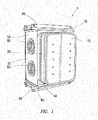
- FIG. 1 is a perspective view of an embodiment of the marine acoustic vibrator 5.
- FIG. 2 is a partial cross-sectional view in perspective of the marine acoustic vibrator 5 of FIG. 1 with one of the piston plates 15 removed.
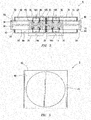
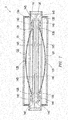
- FIG. 3 is a cross-sectional view of the marine acoustic vibrator 5 of FIGs. 1 and 2 taken along line 1-1.
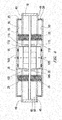
- FIG. 4 is a cross-sectional view of the marine acoustic vibrator 5 of FIGs. 1 and 2 taken along line 2-2.
- the marine acoustic vibrator 5 includes a containment housing 10.
- Piston plates 15 may be flexibly coupled to the containment housing 10, for example, by way of rubber seals 20.
- the piston plates 15 may each have spring elements 25 attached to them.
- the spring elements 25 may be disposed between the piston plates 15 and a fixture 30.
- One or more drivers 35 may be coupled to the piston plates 15 and the fixture 30 to cause the piston plates 15 to move back and forth. This motion of the piston plates 15 takes advantage of the flexibility of the rubber seals 20.
- the rubber seals 20 do not need to be made of rubber, but rather could be made from any material that allows a flexible coupling of the piston plates 15 to the containment housing 10 as further discussed below.
- the containment housing 10 may have a first surface 40 and a second surface 45, which may be opposing one another. As best seen on FIGs. 2-4 , windows or openings 50 and 55 may be formed respectively in the first surface 40 and the second surface 45. While not illustrated, embodiments may include windows or openings 50, 55 that are larger or smaller than the piston plates 15.
- the containment housing 10 together with the piston plates 15 may at least partially define an interior volume 60 of the marine acoustic vibrator 5.
- the spring elements 25 and/or drivers 35 may be at least partially disposed in the interior volume 60 of the marine acoustic vibrator 5. By way of example, a portion of the spring elements 25 and/or drivers 35 may be disposed outside the interior volume 60 of the marine acoustic vibrator.
- the spring elements 25 and/or drivers 35 may be entirely disposed within the interior volume 60. While not illustrated, the spring elements 25 may be disposed outside the interior volume 60 so long as the spring elements 25 are coupled to the fixture 30.
- the marine acoustic vibrator 5 may be pressure compensated such that the pressure of the interior volume 60 may be kept the same as the external pressure (i.e., the pressure on the side of the piston plates 15 opposite that of the interior volume 60), thus enabling operation at increased depth, for example, up to about 300 meters or more.
- the containment housing 10 together with the piston plates 15 and the rubber seals 20 may form a waterproof housing for the other components of the marine acoustic vibrator 5, such as the spring elements 25 and drivers 35.
- the containment housing 10 may be constructed from any suitable material, including, without limitation, steel (e.g., stainless steel), aluminum, a copper alloy, glass-fiber reinforced plastic (e.g., glass-fiber reinforced epoxy), carbon fiber reinforced plastic, and combinations thereof.
- the containment housing 10 as best seen in FIGs. 1 and 2 may have the general shape of a rectangular box. It should be understood that other configurations of the containment housing 10 may be suitable, including those having the general shape of a square box or other suitable shapes.
- the containment housing 10 may further include optional caps 65, which may be disposed in a lateral side 70 of the containment housing 10, as shown on FIG. 1 .
- one or more of the caps 65 may be removable.
- the caps 65 may facilitate attachment of a device, such as a compliance chamber, to the containment housing 10.
- the containment housing 10 may include first and second ends 75, 80 to which brackets 85 may be separately mounted. The brackets 85 may be used for hoisting marine acoustic vibrator 5, for example when deploying the marine acoustic vibrator 5 in the water.
- brackets 85 may facilitate attachment of the marine acoustic vibrator 5 to tow lines, a submersible vessel (e.g., submersible vessel 165 on FIG. 9 ), or other suitable device or mechanism used in conjunction with towing the marine acoustic vibrator 5 through a body of water.
- the piston plates 15 may typically be constructed of a material that will not bend or flex when in use.
- the piston plates 15 may comprise, without limitation, steel (e.g., stainless steel), aluminum, a copper alloy, glass-fiber reinforced plastic (e.g., glass-fiber reinforced epoxy), carbon fiber reinforced plastic, and combinations thereof.
- the piston plates 15 may be substantially rectangular in shape.
- the piston plate 15 shown on FIG. 1 is rectangular in shape except with rounded corners.
- the piston plates 15 may be in the form of flat, circular disks (as best seen in FIG. 5 ).
- the piston plates 15 may each be a flat, circular disk having substantially uniform thickness.
- the piston plates 15 may be square, elliptical, or other suitable shape for providing the desired acoustic energy.
- the piston plates 15 may be curved, either convexly protruding into interior volume 60, or concavely extending interior volume 60.
- the piston plates 15 have a thickness that provides stiffness and also withstands expected pressures. As will be appreciated by those of ordinary skill in the art with the benefit of this disclosure, the plate thickness may vary based on the material of construction, among other factors.
- the mass load of the piston plates 15 and the spring constant of the spring elements 25 may be selected (i.e., tuned) in a manner to produce a first resonance frequency within the seismic frequency range of interest when the marine acoustic vibrator 5 is submerged in water at a depth of from about 0 meters to about 300 meters. While a single one of the piston plates 15 is illustrated on either side of the fixture 30, embodiments may include multiple piston plates 15 on either side of the fixture 30. Moreover, embodiments may include piston plates 15 that are smaller in size with respect to the containment housing 10 as compared to those illustrated on FIGs. 1-4 .
- the piston plates 15 may each be secured to the containment housing 10 in a manner that allows movement of the piston plates 15 relative to the containment housing 10 with substantially no bending or flexing of the piston plates 15 during operation of the marine acoustic vibrator 5.
- a pair of piston plates 15 is shown.
- One of the piston plates 15 may be disposed on one side of the containment housing 10 while the other of the piston plates 15 may be disposed on the opposing side of the containment housing 10.
- one of the piston plates 15 may be coupled to the containment housing 10 at or near the first surface 40 and the other piston plate 15 may be coupled to the second surface 45.
- the piston plates 15 may each cover a corresponding one of the openings 50, 55 in the respective first and second surfaces 40, 45 of the containment housing 10.
- the piston plates 15 are coupled to the containment housing 10 by way of rubber seals 20.
- the rubber seals 20 may not hold the piston plates 15 in place but rather may flex (or otherwise move) to permit movement of the piston plates 15 at their outer edges.
- the piston plates 15 may function as piston transducers, wherein each of the piston plates 15 moves back forth by actuation of the drivers 35. Movement of the pistons plates 15 is illustrated on FIGs. 3 and 4 by arrows 100.
- the piston plates 15 may not bend or flex in operation, but rather may move back and forth acting against the surrounding water.
- spring elements 25 are disposed in the marine acoustic vibrator 5 on either side of the fixture 30.
- pairs of spring elements 25 may be located on either side of the fixture 30 with a first pair of spring elements 25 disposed on one side of the containment housing 10 and a second pair of the spring elements 25 disposed on the opposing side of the containment housing 10.
- the spring elements 25 in the first pair may be disposed on opposite sides of the drivers 35 from one another, and the spring elements 25 in the second pair may also be disposed on opposite sides of the drivers 35 from one another.
- the spring elements 25 may each extend between a corresponding one of the piston plates 15 and the fixture 30.
- the spring elements 25 may be coupled to the piston plates 15 and the fixture 30 to exert a biasing action on the piston plates 15.
- a wide variety of different spring elements 25 may be used that are suitable for exerting the desired biasing action against the piston plates 15, including both linear and nonlinear springs.
- the spring elements 25 may be any of a variety of different types of springs, including compression springs, torsion springs, or other suitable springs for exerting the desired biasing action.
- Specific examples of spring elements 25 that may be used include coil springs, flat springs, bow springs, and leaf springs, among others.
- Suitable spring elements 25 may be constructed from spring steel or other suitable resilient material, such as glass-fiber reinforced plastic (e.g., glass-fiber reinforced epoxy), carbon fiber reinforced plastic, and combinations thereof.
- the dimensions, material make-up, and shape of the spring elements 25 may be selected to provide a sufficient spring constant for vibrations within the seismic frequency range of interest when the marine acoustic vibrator 5 is submerged in water at a depth of from about 0 meters to about 300 meters.
- Drivers 35 may be one of a variety of types of drivers, for example electrodynamic drivers.
- the drivers 35 may be "moving coil” or “voice coil” drivers, which may provide the ability to generate very large acoustic energy amplitudes.
- Other types of drivers 35 may also be used, such as linear servo motors.
- the particular embodiment described herein shows four uni-directional drivers utilized in parallel, embodiments in which one or more bi-directional drivers, embodiments with one or more uni-directional drivers, or embodiments in which more or less than four uni-directional drivers are utilized, are each within the scope of the invention. As best seen in FIGs.
- a pair of the drivers 35 may be coupled to an interior face 90 of one of the piston plates 15 on one side of the containment housing 10 while another pair of the drivers 35 may be coupled to an interior face 90 of another one of the piston plates 15 on an opposing side of the containment housing.
- the drivers 35 may also be coupled to the fixture 30 and disposed within the marine acoustic vibrator 5.
- the drivers 35 may each comprise a uni-directional, moving coil driver, comprising an electric coil 105, transmission element 110, and magnetic circuitry 115, which may work together to generate a magnetic field.
- the magnetic circuitry 115 may be connected to the fixture 30, while the transmission element 110 may connect to the corresponding piston plate 15. In some embodiments (not illustrated), this arrangement may be reversed (i.e., the magnetic circuitry 115 connects to the corresponding piston plate 15, while the transmission element 110 connects to the fixture 30).
- each transmission element 110 may transfer motion of the corresponding electric coil 105 to the interior face 90 of the corresponding piston plate 15.
- Each driver 35 may provide stroke lengths of several inches-up to and including about 10"-which may allow the marine acoustic vibrator 5 to generate enhanced amplitude acoustic energy output in the low frequency ranges, for example, between about 1 Hz and about 10 Hz when the marine acoustic vibrator 5 is submerged in water at a depth of from about 0 meters to about 300 meters.
- the magnetic circuitry 115 may comprise permanent magnets, though any device capable of generating a magnetic flux may be incorporated.
- the fixture 30 suspends the drivers 35 within the containment housing 10.
- the fixture 30 extends along the major axis of containment housing 10 and may be coupled to either end of the containment housing 10.
- the fixture 30 may be circular, square, rectangular, or other suitable cross-section as desired for a particular application.
- An example of a suitable fixture 30 may include a rod, beam, plate, or other suitable frame for supporting internal components such as the drivers 35 in the containment housing 10.
- the fixture 30 may be fixed to the containment housing 10 in a manner that prevents movement to prevent undesired contraction of the major axis of the containment housing 10.
- the piston plates 15 may work in symmetry above and below the fixture 30.
- the fixture 30 may divide the marine acoustic vibrator 5 into symmetrical halves with respect to at least the piston plates 15, spring elements 25, and drivers 35.
- the marine acoustic vibrator 5 may comprise a containment housing 10, which may have a first surface 40.
- the piston plate 15 may be indirectly coupled to the first surface of the containment housing 10.
- a rubber seal e.g., rubber seal 20 on FIG. 1
- the piston plate 15 may be substantially circular in shape while, in other embodiments, the piston plate 15 may have a different shape, such as a substantially square or rectangular shape in one embodiment.
- the containment housing 10 is depicted on FIG. 5 as having a generally square-shaped first surface 40, the containment housing 10 may have other suitable configurations for the first surface 40, including substantially, rectangular, circular, or rounded.
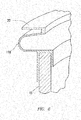
- FIG. 6 an embodiment of the rubber seal 20 is depicted.
- coupling of the rubber seal 20 to a piston plate 15 is shown.
- the rubber seal 20 may also be coupled to the containment housing 10, for example, to form a water-tight seal between the piston plate 15 and the containment housing 10.
- the rubber seal 20 may be configured to allow movement of the piston plate 15 while also maintaining the appropriate seal.
- the rubber seal 20 may have significant curvature (e.g., curved portion 116) to permit a significant amplitude of movement.
- this permitted movement may further enable the piston plates 15 to have several inches of travel, e.g., the piston plates 15 may move back and forth relative to containment housing 10 a distance of from about 1 inch to about 10 inches (or more).
- FIG. 6 illustrates the rubber seal 20 with the curved portion 115 to permit movement
- other techniques for permitting movement may be used, including use of seals with a bellows or accordion-type configuration.
- preceding description describes use of rubber, other materials of construction may be used in coupling the piston plates 15 to the containment housing 10 that can provide the desired seal and movement.
- FIG. 7 a cross-sectional view of one embodiment of the marine acoustic vibrator 5 is provided that includes alternative spring elements 120.
- the cross-sectional view is taken along line 3-3 of FIG. 2 .
- FIG. 7 illustrates the alternative spring elements 120 in the form of bow springs.
- certain elements of the marine acoustic vibrator such as the drivers 35 are not visible.
- one of the alternative spring element 120 may be coupled between one of the piston plate 15 and the fixture 30 one side of the containment housing 10.
- the alternative spring element 120 may be coupled to the piston plate 15 at attachment point 125, which may be a fixed connection, for example, that does not permit movement.
- the alternative spring element 120 may be coupled on either end to a supplemental fixture 130, which may be in the form of a beam, rod, plate, or other suitable frame for supporting the alternative spring element 120 in the containment housing 10.
- the alternative spring element 120 may be coupled to the supplemental fixture 130 by way of bearings 135.
- the bearings 135 may permit movement of the spring element 120, for example, linear bearings that permit linear movement of the ends of alternative spring element 120 as represented by arrows 140.
- the alternative spring element 120 may be allowed to flex and provide a biasing force to the piston plate 15 upon its movement.
- the supplemental fixture 130 may be coupled to the fixture 30 at one or more fixture attachment points 145, which may be fixed connections that do not permit movement.
- the marine acoustic vibrator 5 further includes mass springs 150 with weights 155 affixed thereto.
- the mass springs 150 shown on FIG. 7 may also be used in conjunction with the alternative spring elements 120 shown on FIG. 6 (or other suitable type of spring element).
- the mass springs 150 may be coupled between the fixture 30 and the piston plates 15.
- a pair of mass springs 150 is shown on either side of the fixture 30 so that the marine acoustic vibrator 5 comprises four mass springs 150.
- more or less than four mass springs 150 may be utilized for a particular application.
- the spring constant of the mass springs 150 and the mass of the weights 155 may be selected in a manner to achieve a second system resonance frequency within the seismic frequency range of interest when the marine acoustic vibrator 5 is submerged in water at a depth of from about 0 meters to about 300 meters.
- the marine acoustic vibrator 5 may exhibit a first resonance frequency of about 2.5 Hz and a second resonance frequency of about 4.5 Hz when submerged in water at a depth of from about 0 meters to about 300 meters
- the second resonance frequency when the marine acoustic vibrator 5 shown on FIG. 1 is submerged in water at a depth of from about 0 meters to about 300 meters would typically be much higher than the frequencies within the seismic frequency range of interest.
- finite element analysis may be utilized in order to appropriately tune the piston plates 15, spring elements 25 (or alternative spring elements 120), mass springs 150, and weights 155.
- the following principles of operation may be relevant.
- M piston_plate ⁇ o 8 ⁇ a 3 / 3
- M piston_plate is the mass load acting on the piston plate 15
- ⁇ o is the density of water surrounding the marine acoustic vibrator
- a is the equivalent radius for the piston plate 15 which corresponds to the size of the piston plate 15.
- the second resonance frequency In the absence of the mass springs 150, the second resonance frequency would occur when the piston plate 15 has its second Eigen-mode. This resonance frequency, however, is normally much higher than the first resonance frequency, and accordingly, would typically be outside the seismic frequency range of interest. As is evident from the foregoing equation, the resonance frequency will be reduced if the mass load on the piston plates 15 is increased. However, in some embodiments, in order to add sufficient mass to achieve a second resonance frequency within the seismic frequency range of interest, the amount of mass that would need to be added to the piston plates 15 may make such a system less practical for use in marine seismic surveying operations
- the mass springs 150 may be included inside the containment housing 10 with the weights 155 on the side of the mass springs 150.
- these mass springs 150 may have a transformation factor T mass_spring between the long and short axis of its ellipse, so that the deflection of the two side portions will have a higher amplitude than the deflection of end attached to the piston plate 15 and electric coil.
- mass springs 150 may be equivalent to adding mass in the end of the drivers 35 where it is attached to the piston plates 15.
- M mass_spring T mass_spring 2 ⁇ M added Wherein M mass_spring is the mass of the mass springs 150, T mass_spring is the transformation factor of the mass springs 150, and M added is the mass of the weights 155.
- f resonance ⁇ 2 1 2 ⁇ ⁇ ⁇ K mass_spring + K piston_spring T spring 2 ⁇ M added + M piston_plate
- K mass_spring is the spring constant of mass springs 150
- K piston_spring is the spring constant of spring elements 25 (or alternative spring element 120)
- T mass_spring is the transformation factor of the mass springs 150
- M added is the mass of the weights 155
- M piston_plate is the mass load on the piston plates 15.
- the mass springs 150 may be selected to tune the second resonance frequency. It may also be possible to select the extent of influence the second resonance frequency may have on the system.
- the mass springs 150 have a low spring constant compared to the spring elements 25 (or alternative spring elements 120), and a matching of weights 155 is added to the mass springs 150, the mass springs 150 will function relatively independently from the piston plates 15.
- f resonance ⁇ 2 1 2 ⁇ ⁇ ⁇ K mass_spring T mass_spring 2 ⁇ M added
- mass springs 150 e.g., stiffer mass springs 150
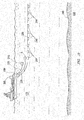
- FIG. 9 a diagram is provided illustrating one embodiment of an array 160 of marine acoustic vibrators 5.
- an array 160 of marine acoustic vibrators 5 such as those shown in FIGS. 1-3 and 5-7 .
- the two or more marine acoustic vibrators 5 in the array 160 may be used in sequence, contemporaneously, or even simultaneously.
- energy emitted from the two or more marine acoustic vibrators 5 may appear in the rock formations below the water bottom as if it emanated from a point source when the dimensions of the array are on the order of about 30 meters or less.
- FIG. 9 illustrates two marine acoustic vibrators 5 in the array 160; however, more than two marine acoustic vibrators 5 may be used in the array 160, for example, depending on the desired acoustic energy output.
- the marine acoustic vibrators 5 may each be disposed in a corresponding submersible vessel 165 for towing through a body of water 170.
- the submersible vessels 165 may be configured to support and position the marine acoustic vibrators 5 in the body of water 170.
- the submersible vessels 165 may each include a fin 175, which may be used, for example, to position the corresponding marine acoustic vibrator 5 in the body of water 170.
- the submersible vessels 165 may each include a bracket 180 or other suitable attachment point for coupling the marine acoustic vibrators 5 to a corresponding lead line 185.
- the array 160 may be used in conjunction with at least one hydrodynamic depressor 190 that may create thrust as moved through the body of water 170 to force the array 160 downward into the body of water 170.
- the towing configuration may provide for towing the marine acoustic vibrators 5 at different depths.
- the marine acoustic vibrators will be held apart by a support structure (not shown). When utilized, the support structure may couple the marine acoustic vibrators 5 to one or more lead lines 185.
- Such variations in towing configuration should be apparent to one of ordinary skill in the art with the benefit of this disclosure.
- FIG. 9 illustrates an example technique for acquiring marine seismic data that can be used with embodiments of the present techniques.
- a survey vessel 200 moves along the surface of the body of water 170, such as a lake or ocean.
- the survey vessel 200 may include thereon equipment, shown generally at 205 and collectively referred to herein as a "recording system.”
- the recording system 205 may include devices (none shown separately) for detecting and making a time indexed record of signals generated by each of seismic sensors 210 (explained further below) and for actuating one or more sound sources (as illustrated, marine acoustic vibrator 5 and/or air guns 215) at selected times.
- the recording system 205 may also include devices (none shown separately) for determining the geodetic position of the survey vessel 200 and the various seismic sensors 210.
- the survey vessel 200 may tow the marine acoustic vibrator 5 in the body of water 170.
- a source cable 220 may couple the marine acoustic vibrator 5 to the survey vessel 200.
- the marine acoustic vibrator 5 may be towed in the body of water 170 at a depth ranging from 0 meters to about 300 meters, for example. While only a single marine acoustic vibrator 5 is shown in FIG. 9 , it is contemplated that embodiments may include more than one marine acoustic vibrator 5, or one or more arrays thereof (e.g., array 160 on FIG. 8 ).
- the survey vessel 200 may further tow one or more air guns 215 (or other sound sources) by the same source cable 220 or different source cable 225.
- the air guns 215 may be towed at a different depth than the marine acoustic vibrator 5. While FIG. 9 illustrates the air guns 215 being towed at a shallower depth than the marine acoustic vibrator 5, it is contemplated that the air guns 215 may be towed at the same or a greater depth than the marine acoustic vibrator 5.
- the marine acoustic vibrator 5 (and/or the air guns 215) may be triggered, for example, by the recording system 205, to generate acoustic energy.
- the survey vessel 200 (or a different vessel) may further tow at least one sensor streamer 230 to detect the acoustic energy that originated from the marine acoustic vibrator 5 (and/or the air guns 215) after it has interacted, for example, with rock formations 235 below the water bottom 240.
- the marine acoustic vibrator 5, the air guns 215, and the sensor streamer 230 may be towed above the water bottom 240.
- the sensor streamer 230 may contain seismic sensors 210 thereon at spaced apart locations.
- seismic sensors 210 may be any type of seismic sensors known in the art, including hydrophones, geophones, particle velocity sensors, particle displacement sensors, particle acceleration sensors, or pressure gradient sensors, for example.
- the seismic sensors 210 may generate response signals, such as electrical or optical signals, in response to detected acoustic energy. Signals generated by the seismic sensors 210 may be communicated to the recording system 205.
- more than one sensor streamer 230 may be towed by the survey vessel 200, and the sensor streamers 230 may be spaced apart laterally, vertically, or both laterally and vertically.
- the detected energy may be used to infer certain properties of the subsurface rock, such as structure, mineral composition, and fluid content, thereby providing information useful in the recovery of hydrocarbons.
- a geophysical data product may be produced.
- the geophysical data product may include data that is obtained by a process that includes detecting the acoustic energy originating from the marine acoustic vibrator 5.
- the geophysical data product may be stored on a non-transitory, tangible computer-readable medium.
- the geophysical data product may be produced offshore (i.e. by equipment on a vessel) or onshore (i.e. at a facility on land) either within the United States or in another country. If the geophysical data product is produced offshore or in another country, it may be imported onshore to a facility in the United States. Once onshore in the United States, geophysical analysis, including further data processing, may be performed on the geophysical data product.
Landscapes
- Life Sciences & Earth Sciences (AREA)
- Physics & Mathematics (AREA)
- Engineering & Computer Science (AREA)
- Remote Sensing (AREA)
- Geology (AREA)
- Environmental & Geological Engineering (AREA)
- Acoustics & Sound (AREA)
- General Life Sciences & Earth Sciences (AREA)
- General Physics & Mathematics (AREA)
- Geophysics (AREA)
- Oceanography (AREA)
- Geophysics And Detection Of Objects (AREA)
- Apparatuses For Generation Of Mechanical Vibrations (AREA)
Applications Claiming Priority (2)
| Application Number | Priority Date | Filing Date | Title |
|---|---|---|---|
| US201361880561P | 2013-09-20 | 2013-09-20 | |
| US14/284,847 US9618637B2 (en) | 2013-09-20 | 2014-05-22 | Low frequency marine acoustic vibrator |
Publications (2)
| Publication Number | Publication Date |
|---|---|
| EP2851709A2 true EP2851709A2 (fr) | 2015-03-25 |
| EP2851709A3 EP2851709A3 (fr) | 2015-10-14 |
Family
ID=51485487
Family Applications (1)
| Application Number | Title | Priority Date | Filing Date |
|---|---|---|---|
| EP14183242.8A Withdrawn EP2851709A3 (fr) | 2013-09-20 | 2014-09-02 | Vibrateur acoustique marin à basse fréquence |
Country Status (4)
| Country | Link |
|---|---|
| US (2) | US9618637B2 (fr) |
| EP (1) | EP2851709A3 (fr) |
| AU (1) | AU2014224158B2 (fr) |
| BR (1) | BR102014023014A2 (fr) |
Families Citing this family (18)
| Publication number | Priority date | Publication date | Assignee | Title |
|---|---|---|---|---|
| US10473803B2 (en) | 2013-02-08 | 2019-11-12 | Pgs Geophysical As | Marine seismic vibrators and methods of use |
| US9995834B2 (en) | 2013-05-07 | 2018-06-12 | Pgs Geophysical As | Variable mass load marine vibrator |
| US9645264B2 (en) | 2013-05-07 | 2017-05-09 | Pgs Geophysical As | Pressure-compensated sources |
| US9864080B2 (en) | 2013-05-15 | 2018-01-09 | Pgs Geophysical As | Gas spring compensation marine acoustic vibrator |
| US9507037B2 (en) | 2013-09-20 | 2016-11-29 | Pgs Geophysical As | Air-spring compensation in a piston-type marine vibrator |
| US9341725B2 (en) | 2013-09-20 | 2016-05-17 | Pgs Geophysical As | Piston integrated variable mass load |
| US9360574B2 (en) | 2013-09-20 | 2016-06-07 | Pgs Geophysical As | Piston-type marine vibrators comprising a compliance chamber |
| WO2015101643A1 (fr) * | 2013-12-30 | 2015-07-09 | Pgs Geophysical As | Système de commande pour générateurs de vibrations maritimes |
| US9612347B2 (en) | 2014-08-14 | 2017-04-04 | Pgs Geophysical As | Compliance chambers for marine vibrators |
| US9389327B2 (en) | 2014-10-15 | 2016-07-12 | Pgs Geophysical As | Compliance chambers for marine vibrators |
| US10488542B2 (en) | 2014-12-02 | 2019-11-26 | Pgs Geophysical As | Use of external driver to energize a seismic source |
| US10605934B2 (en) * | 2015-08-31 | 2020-03-31 | Pgs Geophysical As | Apparatus with thermal stress relief mechanism for heat generating coil and associated methods |
| US10234585B2 (en) | 2015-12-10 | 2019-03-19 | Pgs Geophysical As | Geophysical survey systems and related methods |
| US10222499B2 (en) | 2016-01-11 | 2019-03-05 | Pgs Geophysical As | System and method of marine geophysical surveys with distributed seismic sources |
| US10436926B2 (en) | 2016-08-17 | 2019-10-08 | Pgs Geophysical As | Marine vibrator source acceleration and pressure |
| FR3070567B1 (fr) * | 2017-08-31 | 2020-05-15 | Jean-Dominique Polack | Enceinte acoustique aquatique |
| US12050296B2 (en) * | 2018-05-02 | 2024-07-30 | Woodside Energy (Deepwater) Inc. | System for generating velocity models of subsalt formations |
| US11604296B2 (en) * | 2019-02-20 | 2023-03-14 | Pgs Geophysical As | Seismic source with chamber for housing wave generator |
Family Cites Families (114)
| Publication number | Priority date | Publication date | Assignee | Title |
|---|---|---|---|---|
| US3370672A (en) | 1966-12-01 | 1968-02-27 | Mccollum Lab Inc | Seismic radiator |
| US3384868A (en) | 1967-01-05 | 1968-05-21 | Continental Oil Co | Marine vibrator device |
| US3691516A (en) | 1969-11-21 | 1972-09-12 | Control Data Corp | Acoustic pulse generator utilizing a mechanism for changing the natural frequency of oscillation |
| US4231112A (en) | 1970-07-30 | 1980-10-28 | Fred M. Dellorfano, Jr. | High-power underwater transducer with improved performance and reliability characteristics and method for controlling said improved characteristics |
| US3978940A (en) | 1975-03-10 | 1976-09-07 | Hydroacoustics Inc. | Acoustic source |
| US4185714A (en) | 1975-04-18 | 1980-01-29 | Davies Chadwick O | Implosive acoustic generator |
| NL7706485A (nl) | 1976-06-16 | 1977-12-20 | Pilgrim Eng Dev | Werkwijze voor het vormen van een verbinding tussen een buisvormig orgaal en een mantel. |
| US4211301A (en) | 1979-02-12 | 1980-07-08 | Exxon Production Research Company | Marine seismic transducer |
| US4578784A (en) * | 1981-02-17 | 1986-03-25 | Exxon Production Research Co. | Tunable marine seismic source |
| US4483411A (en) * | 1981-02-17 | 1984-11-20 | Exxon Production Research Co. | Tunable marine seismic source |
| US4557348A (en) * | 1981-02-17 | 1985-12-10 | Exxon Production Research Co. | Tunable marine seismic source |
| US4556963A (en) | 1982-12-01 | 1985-12-03 | The United States Of America As Represented By The Secretary Of The Navy | Underwater sound generator |
| JP2534087B2 (ja) | 1986-03-19 | 1996-09-11 | イギリス国 | ソナ―変換器 |
| US4739859A (en) | 1986-04-10 | 1988-04-26 | Bolt Technology Corporation | Method and apparatus for reducing the stretch of an elastomeric diaphragm of a land seismic source |
| US5062089A (en) | 1987-04-17 | 1991-10-29 | Argotec Inc. | Sonar projector with liquid mass loading for operation at lower frequency |
| US4785430A (en) | 1987-07-07 | 1988-11-15 | Conoco Inc. | Hydraulic vibrator with wide dynamic range |
| US4853905A (en) | 1988-02-05 | 1989-08-01 | Conoco Inc. | Seal for marine seismic source |
| US4868799A (en) | 1988-10-11 | 1989-09-19 | Frank Massa | Means for equalizing the internal pressure in an underwater transducer employing a vibratile piston to permit operation of the transducer at water depths in excess of a few hundred feet |
| GB8900037D0 (en) | 1989-01-03 | 1989-03-01 | Geco As | Marine seismic data conditioning |
| US5206839A (en) | 1990-08-30 | 1993-04-27 | Bolt Beranek And Newman Inc. | Underwater sound source |
| US5225731A (en) | 1991-06-13 | 1993-07-06 | Southwest Research Institute | Solid body piezoelectric bender transducer |
| US5126979A (en) | 1991-10-07 | 1992-06-30 | Westinghouse Electric Corp. | Variable reluctance actuated flextension transducer |
| US5233570A (en) | 1992-08-13 | 1993-08-03 | Donskoy Dimitri M | Low frequency underwater acoustic radiator |
| US5199005A (en) | 1992-08-14 | 1993-03-30 | Argotec, Inc. | Electromagnetic drive assembly for under water sonar transducer |
| NO176457C (no) | 1993-03-15 | 1995-04-05 | Pgs Seres As | Drivenhet for akustiske sendere |
| NO302718B1 (no) | 1994-05-06 | 1998-04-14 | Unaco Systems Ab | Akustisk sender |
| NO179654C (no) | 1994-05-06 | 1996-11-20 | Unaco Systems Ab | Akustisk sender med lydavgivende flater innrettet til å settes i vibrasjonsbevegelse |
| NO301796B1 (no) | 1995-05-18 | 1997-12-08 | Unaco Systems Ab | Drivenhet for akustiske sendere |
| NO301795B1 (no) | 1995-06-28 | 1997-12-08 | Unaco Systems Ab | Elektrodynamisk drivenhet for akustiske sendere |
| NO961765L (no) | 1996-04-30 | 1997-10-31 | Unaco Systems Ab | Akustisk sender II |
| NO303472B1 (no) | 1996-04-30 | 1998-07-13 | Unaco Systems Ab | Akustisk sender |
| US6624539B1 (en) | 1997-05-13 | 2003-09-23 | Edge Technologies, Inc. | High power ultrasonic transducers |
| US5978316A (en) * | 1997-09-29 | 1999-11-02 | Western Atlas International, Inc. | Marine seismic source |
| US6009047A (en) | 1998-07-31 | 1999-12-28 | Gte Internetworking Incorporated | Sound generation device |
| US6230840B1 (en) | 1998-10-16 | 2001-05-15 | Western Atlas International, Inc. | Marine vibrator |
| US6076630A (en) | 1999-02-04 | 2000-06-20 | Western Atlas International, Inc. | Acoustic energy system for marine operations |
| AU5161300A (en) | 1999-05-24 | 2000-12-12 | Edge Technologies, Inc. | High power ultrasonic transducer having a plurality of sub-motors connected to asingle horn |
| US6606958B1 (en) | 1999-06-22 | 2003-08-19 | Hydroacoustics Inc. | Towed acoustic source array system for marine applications |
| US6173803B1 (en) | 1999-07-07 | 2001-01-16 | Gte Service Corporation | High amplitude sound wave generator |
| SE514569C2 (sv) * | 1999-08-13 | 2001-03-12 | Cetus Innovation Ab | Drivanordning för hydroakustiska sändare samt användning av anordningen för sändning av hydroakustiska vågor i en vätska |
| RU2159945C1 (ru) | 1999-11-09 | 2000-11-27 | Нижне-Волжский научно-исследовательский институт геологии и геофизики | Способ сейсмической разведки |
| GB0007034D0 (en) | 2000-03-23 | 2000-05-10 | Geco As | Seismic source arrays |
| US6556510B2 (en) | 2000-11-29 | 2003-04-29 | Westerngeco, L.L.C. | Integrated marine seismic source and method |
| US6788618B2 (en) | 2002-03-14 | 2004-09-07 | Input/Output, Inc. | Method and apparatus for marine source diagnostics |
| US6851511B2 (en) | 2002-05-31 | 2005-02-08 | Stig Rune Lennart Tenghamn | Drive assembly for acoustic sources |
| AU2003282592A1 (en) | 2003-01-16 | 2004-08-13 | Exxonmobil Upstream Research Company | A marine seismic acquisition method and apparatus |
| GB2400662B (en) | 2003-04-15 | 2006-08-09 | Westerngeco Seismic Holdings | Active steering for marine seismic sources |
| US7562740B2 (en) | 2003-10-28 | 2009-07-21 | Schlumberger Technology Corporation | Borehole acoustic source |
| US7926614B2 (en) | 2004-03-03 | 2011-04-19 | Pgs Americas, Inc. | Particle motion sensor mounting for marine seismic sensor streamers |
| US20060193203A1 (en) | 2005-02-16 | 2006-08-31 | Tenghamn Stig R L | Apparatus for attenuating noise in marine seismic streamers |
| US7577060B2 (en) * | 2005-04-08 | 2009-08-18 | Westerngeco L.L.C. | Systems and methods for steering seismic arrays |
| US7468932B2 (en) | 2005-05-13 | 2008-12-23 | Pgs Americas, Inc. | System for noise attenuation in marine seismic streamers |
| US20100135112A1 (en) * | 2005-07-12 | 2010-06-03 | Johan Olof Anders Robertsson | Methods and Apparatus for Acquisition of Marine Seismic Data |
| US7142481B1 (en) | 2005-09-12 | 2006-11-28 | Pgs Geophysical As | Method and system for making marine seismic streamers |
| WO2007126786A2 (fr) | 2006-03-27 | 2007-11-08 | Input/Output, Inc. | Appareil et procédé pour produire un signal de source sismique |
| US7539079B2 (en) | 2006-03-29 | 2009-05-26 | Pgs Geophysical As | System and method for determining positions of towed marine source-array elements |
| US8050867B2 (en) | 2006-05-03 | 2011-11-01 | Exxonmobil Upstream Research Co. | Data adaptive vibratory source acquisition method |
| US7885143B2 (en) | 2006-07-05 | 2011-02-08 | Westerngeco L.L.C. | Seismic acquisition system |
| US7701803B2 (en) * | 2006-07-07 | 2010-04-20 | Westerngeco L.L.C. | Underwater acoustic positioning methods and systems based on modulated acoustic signals |
| US20080253226A1 (en) | 2007-04-11 | 2008-10-16 | Stig Rune Lennart Tenghamn | System and method for marine seismic surveying |
| US8027223B2 (en) | 2007-07-16 | 2011-09-27 | Battelle Energy Alliance, Llc | Earth analysis methods, subsurface feature detection methods, earth analysis devices, and articles of manufacture |
| FR2923916B1 (fr) | 2007-11-16 | 2009-11-27 | Cgg Services | Source sismique marine en etoile |
| US7551518B1 (en) | 2008-02-26 | 2009-06-23 | Pgs Geophysical As | Driving means for acoustic marine vibrator |
| EP2109217A3 (fr) | 2008-04-07 | 2013-05-15 | Stichting IMEC Nederland | Système et procédé de réglage de fréquence à résonnance de dispositifs résonants |
| US20090279387A1 (en) | 2008-05-06 | 2009-11-12 | Pgs Geophysical As | Marine passive seismic method for direct hydrocarbon detection |
| US8724426B2 (en) * | 2008-06-03 | 2014-05-13 | Westerngeco L.L.C. | Marine seismic streamer system configurations, systems, and methods for non-linear seismic survey navigation |
| EP2304468B1 (fr) * | 2008-06-18 | 2018-11-07 | Bp Exploration Operating Company Limited | Source de signaux sismiques marins |
| US8081540B2 (en) | 2008-06-20 | 2011-12-20 | Bp Corporation North America Inc. | Rotary subwoofer marine seismic source |
| US7881158B2 (en) | 2008-06-30 | 2011-02-01 | Pgs Geophysical As | Seismic vibrator having multiple resonant frequencies in the seismic frequency band using multiple spring and mass arrangements to reduce required reactive mass |
| US20100118647A1 (en) | 2008-11-07 | 2010-05-13 | Pgs Geophysical As | Method for optimizing energy output of from a seismic vibrator array |
| US8094514B2 (en) * | 2008-11-07 | 2012-01-10 | Pgs Geophysical As | Seismic vibrator array and method for using |
| US8174927B2 (en) | 2008-12-17 | 2012-05-08 | Westerngeco L.L.C. | Method for optimizing acoustic source array performance |
| US8098542B2 (en) | 2009-01-05 | 2012-01-17 | Pgs Geophysical As | Combined electromagnetic and seismic acquisition system and method |
| US8995232B2 (en) | 2009-03-16 | 2015-03-31 | Board Of Regents Of The University Of Texas System | Electromagnetic seismic vibrator architecture |
| US8050139B2 (en) | 2009-03-27 | 2011-11-01 | Westerngeco L.L.C. | System and method for towing acoustic source arrays |
| US8102731B2 (en) | 2009-04-01 | 2012-01-24 | Pgs Geophysical As | Method for operating marine seismic vibrator array to enhance low frequency output |
| RU2503976C2 (ru) | 2009-05-01 | 2014-01-10 | Айнова Лтд. | Сейсмический вибратор, управляемый с прямым обнаружением перемещения плиты основания |
| US7974152B2 (en) | 2009-06-23 | 2011-07-05 | Pgs Geophysical As | Control system for marine vibrators and seismic acquisition system using such control system |
| US8335127B2 (en) | 2009-08-12 | 2012-12-18 | Pgs Geophysical As | Method for generating spread spectrum driver signals for a seismic vibrator array using multiple biphase modulation operations in each driver signal chip |
| US20110069741A1 (en) | 2009-09-24 | 2011-03-24 | Alan Erickson | System and method for seismological sounding |
| US8400872B2 (en) | 2009-09-25 | 2013-03-19 | Acoustic Zoom, Inc. | Seismic source which incorporates earth coupling as part of the transmitter resonance |
| US9075165B2 (en) * | 2009-11-03 | 2015-07-07 | Pgs Geophysical As | Hydrodynamic depressor for marine sensor streamer arrays |
| US8427901B2 (en) | 2009-12-21 | 2013-04-23 | Pgs Geophysical As | Combined impulsive and non-impulsive seismic sources |
| BR112012016276B1 (pt) | 2009-12-29 | 2020-03-03 | Bp Exploration Operating Company Limited | Fonte sísmica marinha |
| US8079440B2 (en) | 2010-01-26 | 2011-12-20 | Westerngeco L.L.C. | Determining the polarity of movement of an actuator mass in a seismic vibrator |
| US8261875B2 (en) | 2010-02-18 | 2012-09-11 | Conocophillips Company | Seismic transducers and baseplates having external dampeners and methods of use |
| EA022286B1 (ru) | 2010-06-08 | 2015-12-30 | Бп Корпорейшн Норт Америка Инк. | Морской сейсмический источник и способ генерирования волны морской сейсмической энергии в водном пространстве (варианты) |
| US8446798B2 (en) * | 2010-06-29 | 2013-05-21 | Pgs Geophysical As | Marine acoustic vibrator having enhanced low-frequency amplitude |
| US8662243B2 (en) | 2010-08-30 | 2014-03-04 | Conocophillips Company | Baseplate dampening pad |
| US20120075955A1 (en) | 2010-09-28 | 2012-03-29 | Timothy Dean | Efficient seismic source operation in connection with a seismic survey |
| US8804462B2 (en) | 2010-10-01 | 2014-08-12 | Westerngeco L.L.C. | Marine vibrator with improved seal |
| US8582395B2 (en) | 2010-11-04 | 2013-11-12 | Westerngeco L.L.C. | Marine vibroseis motion correction |
| BR112013014329A2 (pt) | 2010-12-10 | 2016-09-27 | Bp Corp North America Inc | métodos para exploração sísmica |
| US9134442B2 (en) | 2010-12-16 | 2015-09-15 | Bp Corporation North America Inc. | Seismic acquisition using narrowband seismic sources |
| US9551798B2 (en) | 2011-01-21 | 2017-01-24 | Westerngeco L.L.C. | Seismic vibrator to produce a continuous signal |
| CN103620928A (zh) | 2011-03-17 | 2014-03-05 | 联合活跃驱动公司 | 多个同步振动致动器的非对称总体振动波形 |
| US8441892B2 (en) | 2011-03-21 | 2013-05-14 | Teledyne Instruments, Inc. | Gas-filled bubble seismo-acoustic source |
| US8634276B2 (en) | 2011-03-21 | 2014-01-21 | Teledyne Instruments, Inc. | Tunable bubble sound source |
| US8331198B2 (en) | 2011-03-21 | 2012-12-11 | Teledyne Instruments, Inc. | Gas-filled bubble sound source |
| US9158019B2 (en) | 2011-06-08 | 2015-10-13 | Westerngeco L.L.C. | Enhancing low frequency content in marine simultaneous vibroseis acquisition |
| US8670292B2 (en) | 2011-08-12 | 2014-03-11 | Pgs Geophysical As | Electromagnetic linear actuators for marine acoustic vibratory sources |
| FR2981746B1 (fr) * | 2011-10-19 | 2014-11-21 | Cggveritas Services Sa | Source et procede d'acquisition sismique marine |
| MX346820B (es) * | 2012-02-03 | 2017-03-31 | Ion Geophysical Corp | Método y aparato para procesar datos sísmicos. |
| US10310123B2 (en) * | 2012-03-09 | 2019-06-04 | Cgg Services Sas | Seismic reflection full waveform inversion for reflected seismic data |
| EP2883088B1 (fr) * | 2012-08-13 | 2022-03-02 | Applied Physical Sciences Corp. | Source de son cohérent pour études sismiques marines |
| US9535180B2 (en) | 2013-02-22 | 2017-01-03 | Cgg Services Sa | Method and system for pneumatic control for vibrator source element |
| US8971152B2 (en) | 2013-02-24 | 2015-03-03 | Stephen Chelminski | Device for marine seismic explorations for deposits |
| US9739900B2 (en) * | 2013-03-08 | 2017-08-22 | Cgg Services Sas | Method and system for augmenting frequency range of conventional marine seismic source with low-frequency |
| US9645264B2 (en) | 2013-05-07 | 2017-05-09 | Pgs Geophysical As | Pressure-compensated sources |
| US9995834B2 (en) | 2013-05-07 | 2018-06-12 | Pgs Geophysical As | Variable mass load marine vibrator |
| US9864080B2 (en) | 2013-05-15 | 2018-01-09 | Pgs Geophysical As | Gas spring compensation marine acoustic vibrator |
| US9360574B2 (en) | 2013-09-20 | 2016-06-07 | Pgs Geophysical As | Piston-type marine vibrators comprising a compliance chamber |
| US9341725B2 (en) | 2013-09-20 | 2016-05-17 | Pgs Geophysical As | Piston integrated variable mass load |
| US9507037B2 (en) | 2013-09-20 | 2016-11-29 | Pgs Geophysical As | Air-spring compensation in a piston-type marine vibrator |
-
2014
- 2014-05-22 US US14/284,847 patent/US9618637B2/en active Active
- 2014-09-02 EP EP14183242.8A patent/EP2851709A3/fr not_active Withdrawn
- 2014-09-15 AU AU2014224158A patent/AU2014224158B2/en not_active Ceased
- 2014-09-17 BR BR102014023014A patent/BR102014023014A2/pt not_active Application Discontinuation
-
2017
- 2017-02-27 US US15/443,757 patent/US20170168176A1/en not_active Abandoned
Non-Patent Citations (1)
| Title |
|---|
| None |
Also Published As
| Publication number | Publication date |
|---|---|
| BR102014023014A2 (pt) | 2015-09-08 |
| US20150085605A1 (en) | 2015-03-26 |
| AU2014224158A1 (en) | 2015-04-09 |
| US9618637B2 (en) | 2017-04-11 |
| AU2014224158B2 (en) | 2019-10-31 |
| EP2851709A3 (fr) | 2015-10-14 |
| US20170168176A1 (en) | 2017-06-15 |
Similar Documents
| Publication | Publication Date | Title |
|---|---|---|
| US9618637B2 (en) | Low frequency marine acoustic vibrator | |
| US9360574B2 (en) | Piston-type marine vibrators comprising a compliance chamber | |
| US10670747B2 (en) | Piston integrated variable mass load | |
| US9995834B2 (en) | Variable mass load marine vibrator | |
| US8446798B2 (en) | Marine acoustic vibrator having enhanced low-frequency amplitude | |
| US10488536B2 (en) | Air-spring compensation in a piston-type marine vibrator | |
| US9864080B2 (en) | Gas spring compensation marine acoustic vibrator | |
| US10481286B2 (en) | Marine seismic vibrator for low frequency and methods of use | |
| US20200393584A1 (en) | Mono and Dipole Acoustic Projector | |
| GB2514484A (en) | Variable mass load marine vibrator | |
| GB2514921A (en) | Gas spring compensation marine acoustic vibrator |
Legal Events
| Date | Code | Title | Description |
|---|---|---|---|
| PUAI | Public reference made under article 153(3) epc to a published international application that has entered the european phase |
Free format text: ORIGINAL CODE: 0009012 |
|
| 17P | Request for examination filed |
Effective date: 20140902 |
|
| AK | Designated contracting states |
Kind code of ref document: A2 Designated state(s): AL AT BE BG CH CY CZ DE DK EE ES FI FR GB GR HR HU IE IS IT LI LT LU LV MC MK MT NL NO PL PT RO RS SE SI SK SM TR |
|
| AX | Request for extension of the european patent |
Extension state: BA ME |
|
| PUAL | Search report despatched |
Free format text: ORIGINAL CODE: 0009013 |
|
| AK | Designated contracting states |
Kind code of ref document: A3 Designated state(s): AL AT BE BG CH CY CZ DE DK EE ES FI FR GB GR HR HU IE IS IT LI LT LU LV MC MK MT NL NO PL PT RO RS SE SI SK SM TR |
|
| AX | Request for extension of the european patent |
Extension state: BA ME |
|
| RIC1 | Information provided on ipc code assigned before grant |
Ipc: G01V 1/143 20060101AFI20150908BHEP Ipc: G01V 1/02 20060101ALI20150908BHEP Ipc: G01V 1/145 20060101ALI20150908BHEP |
|
| R17P | Request for examination filed (corrected) |
Effective date: 20160412 |
|
| RBV | Designated contracting states (corrected) |
Designated state(s): AL AT BE BG CH CY CZ DE DK EE ES FI FR GB GR HR HU IE IS IT LI LT LU LV MC MK MT NL NO PL PT RO RS SE SI SK SM TR |
|
| 17Q | First examination report despatched |
Effective date: 20181009 |
|
| STAA | Information on the status of an ep patent application or granted ep patent |
Free format text: STATUS: THE APPLICATION IS DEEMED TO BE WITHDRAWN |
|
| 18D | Application deemed to be withdrawn |
Effective date: 20200818 |