EP2851876A2 - Carte de service de transport et système et procédé pour faciliter un service de transport - Google Patents
Carte de service de transport et système et procédé pour faciliter un service de transport Download PDFInfo
- Publication number
- EP2851876A2 EP2851876A2 EP14163918.7A EP14163918A EP2851876A2 EP 2851876 A2 EP2851876 A2 EP 2851876A2 EP 14163918 A EP14163918 A EP 14163918A EP 2851876 A2 EP2851876 A2 EP 2851876A2
- Authority
- EP
- European Patent Office
- Prior art keywords
- card
- vehicle
- user
- information
- credit
- Prior art date
- Legal status (The legal status is an assumption and is not a legal conclusion. Google has not performed a legal analysis and makes no representation as to the accuracy of the status listed.)
- Withdrawn
Links
Images


Classifications
-
- G—PHYSICS
- G07—CHECKING-DEVICES
- G07F—COIN-FREED OR LIKE APPARATUS
- G07F17/00—Coin-freed apparatus for hiring articles; Coin-freed facilities or services
- G07F17/0014—Coin-freed apparatus for hiring articles; Coin-freed facilities or services for vending, access and use of specific services not covered anywhere else in G07F17/00
-
- G—PHYSICS
- G06—COMPUTING OR CALCULATING; COUNTING
- G06Q—INFORMATION AND COMMUNICATION TECHNOLOGY [ICT] SPECIALLY ADAPTED FOR ADMINISTRATIVE, COMMERCIAL, FINANCIAL, MANAGERIAL OR SUPERVISORY PURPOSES; SYSTEMS OR METHODS SPECIALLY ADAPTED FOR ADMINISTRATIVE, COMMERCIAL, FINANCIAL, MANAGERIAL OR SUPERVISORY PURPOSES, NOT OTHERWISE PROVIDED FOR
- G06Q20/00—Payment architectures, schemes or protocols
- G06Q20/30—Payment architectures, schemes or protocols characterised by the use of specific devices or networks
- G06Q20/34—Payment architectures, schemes or protocols characterised by the use of specific devices or networks using cards, e.g. integrated circuit [IC] cards or magnetic cards
- G06Q20/342—Cards defining paid or billed services or quantities
-
- G—PHYSICS
- G07—CHECKING-DEVICES
- G07B—TICKET-ISSUING APPARATUS; FARE-REGISTERING APPARATUS; FRANKING APPARATUS
- G07B15/00—Arrangements or apparatus for collecting fares, tolls or entrance fees at one or more control points
- G07B15/02—Arrangements or apparatus for collecting fares, tolls or entrance fees at one or more control points taking into account a variable factor such as distance or time, e.g. for passenger transport, parking systems or car rental systems
-
- G—PHYSICS
- G07—CHECKING-DEVICES
- G07F—COIN-FREED OR LIKE APPARATUS
- G07F7/00—Mechanisms actuated by objects other than coins to free or to actuate vending, hiring, coin or paper currency dispensing or refunding apparatus
- G07F7/08—Mechanisms actuated by objects other than coins to free or to actuate vending, hiring, coin or paper currency dispensing or refunding apparatus by coded identity card or credit card or other personal identification means
- G07F7/0806—Details of the card
- G07F7/0813—Specific details related to card security
-
- G—PHYSICS
- G07—CHECKING-DEVICES
- G07F—COIN-FREED OR LIKE APPARATUS
- G07F7/00—Mechanisms actuated by objects other than coins to free or to actuate vending, hiring, coin or paper currency dispensing or refunding apparatus
- G07F7/08—Mechanisms actuated by objects other than coins to free or to actuate vending, hiring, coin or paper currency dispensing or refunding apparatus by coded identity card or credit card or other personal identification means
- G07F7/12—Card verification
- G07F7/122—Online card verification
Definitions
- Described embodiments relate generally to a transport service card and methods of using such a card to facilitate a transport service.
- Cash or credit cards may be used to pay for such a transport service, commonly in the form of a taxi service.
- the use of taxis can come with risks, both for the driver and the passenger.
- the driver may feel unsafe when transporting intoxicated passengers, and may be particularly intimidated by male passengers of a large stature. As a result, these types of passengers may be ignored by taxi drivers, and may find it difficult to get safely home at certain times of the night. Conversely, some passengers may feel unsafe getting into a taxi with an unknown driver, particularly female passengers.
- both passengers and drivers may be afraid of being taken advantage of or treated unfairly.
- the driver may demand onerous terms, such as demanding an unreasonably high fare amount.
- the taxi driver may be cheated of the full fare amount.
- the prospective passenger may be required to pay upfront, in which case the passenger may not be able to return home due to inadequate funds.
- the credit card details can be captured and subject to fraudulent use.
- Some embodiments relate to a card for use in relation to a transport service, comprising:
- the at least one retroreflective area may cover at least two thirds of the first face and/or the second face.
- the at least one retroreflective area may be disposed on an opposite face to the identification information.
- the code storage means may comprise at least one of: an encodable magnetic substrate; an induction coil; a barcode; a radio-frequency identification (RFID) tag; and an integrated circuit with exposed contacts and a memory chip.
- the identification information may comprise at least one of: a card serial number; a user account number; and a credit or debit account identifier.
- the code storage means may store information enabling a user credit to be automatically determined, wherein the user credit can be applied to pay for a transport fare.
- the identification information may include information identifying a registered user of the card.
- the coded information may comprise a residential address of a registered user of the card.
- Some embodiments relate to use of the card described herein to hail a transport vehicle by facing at least one retroreflective area toward the transport vehicle and to pay for a transport fare.
- Some embodiments relate to a method of facilitating a transport service, comprising:
- the debiting may be performed automatically.
- the debiting may be performed automatically in response to input indicating that the destination has been reached.
- the input indicating that the destination has been reached may be received from the driver or from a navigation system in the vehicle.
- the card may comprise physical address information of a registered user of the card.
- the coded information read from the card may comprise the physical address information.
- the physical address information may be able to be determined based on the coded information read from the card.
- a display in the transport vehicle may display the coded information or at least part of the coded information.
- the method may further comprise transmitting the physical address information to a vehicle navigation system of the transport vehicle.
- the physical address information of the registered user may be printed on the card in a human readable form.
- the in-vehicle computer may display a prompt asking the user to enter a personal identification number (PIN) before determining the pre-paid credit associated with the card.
- PIN personal identification number
- the method may further comprise again reading the card at the end of the transport service using the automated reading means, wherein the debiting may be performed in response to the again reading.
- Some embodiments relate to a system configured to perform the method of facilitating a transport service described.
- Some embodiments relate broadly to a system for facilitating a transport service, comprising:
- the server system may be in communication with an external server hosting an email account associated with the pre-paid account.
- the server system may be in communication with a financial institution server managing a bank account associated with the pre-paid account.
- the server system may be configured to receive fare detail data from the in-vehicle computer and to log this data in a data store accessible to the server system.
- the server system may be configured to store information associated with the user of the pre-paid account, including a default destination address.
- the server system may be further configured to receive a query from the in-vehicle computer in relation to the stored information associated with the user of the pre-paid account, and to transmit a reply to the in-vehicle computer communicating the stored information.
- the system may further comprise a vehicle comprising the in-vehicle card reading device.
- Some embodiments relate to a method of facilitating a transport service operable in a vehicle, the method comprising:
- Some embodiments relate to a system for facilitating a transport service operable in a vehicle, the system comprising:
- Described embodiments relate generally to a transport service card and systems and methods that use data stored on or in relation to such a card to facilitate a transport service.
- described embodiments involve the use of a special card to attract the attention of a service vehicle, such as a taxi, and the card then acts as a means of payment for an ensuing transport service fare for transport to a designated location, which may be by default the card user's home address.
- FIG. 1 is a block diagram of a system 100 for interfacing with a card 105 to facilitate the transport service.
- System 100 comprises a transport vehicle 108, an in-vehicle system 110, an externally hosted transport facilitation service 140 (hosted on a suitable computer server system) and optionally a further external server 160 to host a user's email account 162 and further optionally a financial institution server 165 managing a user's bank account 167.
- the financial institution server 165 need not be in the same country as the hosted service 140 or the vehicle 108 but should be accessible to hosted service 140 over a network, such as the Internet.
- the in-vehicle system 110 comprises an in-vehicle computer 120 in communication with a card reader 115 and the hosted service 140.
- In-vehicle computer 120 is in communication with hosted service 140 over local wireless telecommunications infrastructure 135 in the vicinity of the vehicle 108.
- the in-vehicle computer 120 may also be in communication with an in-vehicle navigation system 125, such as is commonly used in taxis, in the vehicle 108.
- the in-vehicle computer 120 may also communicate to a printer 128 within the vehicle 108 to provide the user with a printed receipt following conclusion of the transport service and the payment therefor.
- the card 105 has a body with a first flat face and an opposite second flat face.
- the body comprises a suitable flexible plastic substrate that is sized to resemble a credit card or other card readily accommodated in a user's wallet or purse.
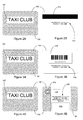
- the card 105 has an area on which is adhered, printed or otherwise formed a retro-reflective material 106 that, when held in front of a light source, such as vehicle headlamps, brightly reflects light back toward a driver of the vehicle, thereby providing a readily noticeable visual indication that the person holding the card has a card specially designed to facilitate transport services.
- a light source such as vehicle headlamps
- retro-reflective materials are commonly used in situations where visibility may be low, such as at night, in order to make one or more objects carrying the retro-reflective material significantly more visible to drivers at night than other reflective (but not retro-reflective) materials.
- the retro-reflective material 106 may be present on one or both faces of the card 105 and may be disposed across at least a substantial portion of one of the faces, in order to maximise visibility to a taxi driver.
- the retro-reflective material 106 may be disposed across about at least two-thirds of the surface area of one face.
- a pattern such as bands ( Fig. 4B ) or striations, can be formed over less than two-thirds of the surface area of one face of the card 105, but in a way that renders the retro-reflective material 106 nevertheless clearly visible in the direction that that card face is presented.
- the card 105 may have indicia 107 on the same face as the retro-reflective material 106 or it may be on the opposite face of the card 105.
- the indicia 107 may include some kind of logo or descriptive text, such as "Taxi Club".
- Other indicia 220 may be printed on the card 105 on an opposite face to the retro-reflective material 106.
- Such other indicia 220 may include user identification details, a card or membership number or account number, for example.
- an image of the user may also be printed on one face of the card 105.
- the user's home address or other designated default destination address may be printed on one face of the card 105.
- the user's home address or other default destination address may be encoded on the card in a machine readable form.
- the user's home address or other default destination may be stored on hosted service 140 and accessible to the driver on the in-vehicle system 110 via the local wireless communications infrastructure 135 upon verification of the card details.
- the default destination may be stored on hosted service 140 by the receipt of user configuration input, which may be via the user using a web-based user interface.
- the web-based user interface may be a website accessible to the user using a browser on a mobile phone, PC or other computing device.
- the website may allow them to log onto an account associated with their card 105, and allow them to adjust details such as the default address, special instructions for passengers with disabilities, and emergency contact details.
- the user may choose to store multiple addresses on hosted service 140, which in some embodiments may be three, four, five, six, seven or more addresses.
- the user may, for example, store one or more of a home address, a work address, and the address of a friend or family member.
- a home address e.g., a home address
- a work address e.g., a work address
- the address of a friend or family member e.g., a friend or family member.
- a user may choose to store the address of their hotel, or another temporary place of residence.
- the card 105 may employ one or several means for encoding information to be carried on the card 105.
- Such encoding means may include an encodable magnetic substrate, such as a magnetic strip 215, a one-dimensional or two-dimensional bar code 315 or a memory chip on an integrated circuit 415 with exposed contacts or an antenna for communication with an external reader 115, for example.
- the encoding means may also or alternatively include a suitable passive induction coil 425 to excite a response from a radio frequency identification (RFID) chip 420 embedded in the body of the card 105.
- RFID radio frequency identification
- the card 105 may carry multiple machine readable encoding means storing coded information separate from, but possibly partly duplicative of, identification information 220 printed on one or both faces of the card 105.
- the encoded information stored by the machine readable encoding means may include the default destination address of the user (if thus configured), the user's name and optionally date of birth, a log of card use and feedback given by drivers, a unique card identifier to enable identification of the card and the user's account information and optionally also an amount of credit associated with the card and the user's card account.
- the encoded information may also include special user care instructions, such as might identify a disability of the user requiring special care by the driver.
- the unique card identifier may act as the primary identifier to enable determination of all other relevant user account information, such as name, address, available credit, country of origin, special user care instructions etc.
- the card 105 functions as a pre-paid debit card with an amount of credit that can be applied to pay for a transport service fare.
- This available credit can be checked at the beginning of the transport service, so that the service operator, such as a taxi driver, can verify that sufficient funds are available to pay for the fare before accepting the passenger.
- the card 105 can be used to convey directions and/or instructions to the driver to allow the driver to easily take the user home, even where there may be language barriers between the user and the driver. These instructions may be able to be stored by the user on hosted service 140 via a web-based user interface, and accessible to the driver on in-vehicle computer 120.
- the card 105 may also be used to store a rating of the user as determined by scores given by previous taxi drivers. This may notify the driver if the user has a history of bad behaviour or non-compliance.
- the in-vehicle computer 120 may comprise one or more existing computing devices or peripherals arranged or configured to perform the functions described herein. Alternatively, the in-vehicle computer 120 may be purpose-built to perform the functions described herein. At a minimum, the in-vehicle computer 120 comprises at least one processor, suitable non-volatile memory for storing processor-executable instructions (to carry out the functions described herein, such as interfacing with the card reader 115, the hosted service 140 and the navigation system 125), suitable input and output interfaces and means to receive and send messages to a remote IP address over a wireless communication interface. The in-vehicle interfaces may comprise or be separate from a radio antenna in the vehicle 108 that actually accomplishes the wireless communication. At least one or both of the in-vehicle computer 120 and card reader 115 has a display (such as display 122) to display messages to the driver and/or passenger (card user).
- a display such as display 122
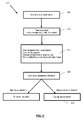
- Figure 5 shows a method 500 of initiating a transport service.
- Method 500 may begin at step 510 when a user attempts to flag down a transport vehicle, such as a taxi, by facing one face of the card 105 having the retro-reflective material 106 on it toward the vehicle.
- the driver of the vehicle may then allow the user to climb into the vehicle, with a degree of confidence that the user has appropriate means for payment of the transport fare.
- the vehicle driver may present the card reader 115 to the passenger user so that the card reader 115 can read the encoded information and the encoding means of the card 105.
- the card 105 may be swiped, inserted or placed adjacent the card reader 115 to enable it to read the encoded information stored on the card 105.
- the user may also enter a personal identification number (PIN) as a form of pre-authorisation of payment of the transport fare.
- PIN personal identification number
- the user may be informed through text on a suitable display 122 incorporated in or associated with the in-vehicle computer 120 that entering their PIN is an authorisation by them for the fare amount to be debited from their account upon arrival at the destination.
- the card reader 115 may provide the encoded information extracted from the encoding means of the card 105 to the hosted service 140 via the in-vehicle computer 120.
- in-vehicle computer 120 is responsible for processing the output signals or messages of the card reader 115, packaging the received information appropriately and transmitting a verification request to the hosted service 140 using a suitable wireless telecommunications protocol.
- the available credit associated with the account is determined by the hosted service.
- the hosted service 140 may check the received information against a user account 150 stored in a local data 145 store accessible to the hosted service 140. If the card account information is recognised by the hosted service 140 (i.e. it matches a user account 150) and there is sufficient credit in the user account, then at step 530 the hosted service 140 generates and sends a message back to the in-vehicle computer 120 to indicate that the card 105 appears to be valid and adequate credit is available in the applicable user account 150.
- the hosted service 140 may also send user account information, such as the user's address or addresses, any special instructions relating to a disability or communication barrier, a rating given to them by previous drivers, and the user's account balance (if these details are not stored physically on the card itself) to the in-vehicle computer 120.
- user account information such as the user's address or addresses, any special instructions relating to a disability or communication barrier, a rating given to them by previous drivers, and the user's account balance (if these details are not stored physically on the card itself) to the in-vehicle computer 120.
- the hosted service 140 looks up the available credit based on user account information, the available credit can also be considered to be determined by the in-vehicle computer 120 by means of sending the validation request and interpreting the data received from the hosted service 140 in the response.
- the hosted service 140 if the hosted service 140 cannot validate the PIN received or cannot locate the user account 150 or optionally if there is minimal or no credit in the user's account, then the hosted service 140 generates and sends a message back to the in-vehicle computer 120 indicating that the card is not recognised or does not have adequate funds, at step 535. At this point, the driver may ask for alternative payment means or decline to perform the transport service.
- the card 105 may have originated from another country that also employs systems 100 in a similar manner.
- the hosted service 140 may determine from a received unique identifier of the card 105 that it originates from another country. The hosted service 140 may then look up an IP address (stored in a local or remote data store 145 accessible to the hosted service 140) of another hosted service 140 in the other country and communicate with that other hosted service 140 to check and/or debit the user's account balance.
- the in-vehicle computer 120 receives a message from the hosted service 140 that the card 105 and user account 150 are valid and contain a suitable credit amount, then an appropriate message may be displayed to the driver via the display 122 incorporated in or associated with the in-vehicle computer 120.
- the display 122 may also display details such as the identity of the passenger, any special instructions relating to a disability or communication barrier, a rating given to them by previous drivers, and the amount of credit available on the card, as determined from the information stored in relation to card 105 on hosted service 140.
- hosted service 140 logs appropriate fare information regarding the proposed transport service at step 540. Such information may include time, location, user identification, vehicle and/or driver identification, proposed destination, user account balance, etc.
- the user's home address or other default destination address or addresses may be displayed to the vehicle driver via the display 122 of in-vehicle computer 120.
- the destination address may be read from the card 105 using card reader 115 and decoded by in-vehicle computer 120 or the home address information may be looked up by the hosted service 140 and contained within the validation message received back from the hosted service 140 at step 530.
- Step 545 may be performed regardless of any response from hosted service 140.
- Step 545 may also include the in-vehicle computer 120 automatically providing the user's default destination address to the in-vehicle navigation system 125.
- automatic reading of the user's home address may be helpful in ensuring that the driver can transport the user to the correct destination.
- automatic provision of the default destination address to the navigation system 125 avoids the need for the card user to communicate the destination address to the driver, which can sometimes be complicated by language difficulties. This also avoids the need for the driver to input the destination address in the navigation system 125, which can sometimes be prone to errors.
- step 550 once the in-vehicle system 110 has received the destination address, either verbally from the user or automatically as described above, the vehicle may depart for that destination.
- step 550 may include prompting the user to agree to the fare amount being debited from their account on arrival at the destination. This may be done, for example, by presenting the terms of the fare on the display 122 incorporated in or associated with the in-vehicle computer 120.
- the display 122 may additionally present an 'I agree' option or similar option for selection by suitable input means on the card reader 115. If the user clicks, presses, or otherwise selects this option, the vehicle may depart for the destination received by (or manually input into) the in-vehicle system 110.
- Figure 6 shows a method 600 of concluding the transport service initiated in method 500.
- the vehicle arrives at the previously determined destination.
- the driver may press a button to communicate to the in-vehicle computer 120 that the destination has been reached (for example by pressing a button on the in-vehicle computer 120 or on a fare meter to stop metering of the fare, resulting in a signal being sent to the in-vehicle computer 120), or this could be automatically communicated to the in-vehicle computer 120 by the in-vehicle navigation system 125 once the GPS data indicates the vehicle 108 is at the destination.
- the in-vehicle system 110 calculates the fare, including any extra charges such as toll fees, and sends the resultant amount to the hosted service 140.
- the host service 140 deducts the fare from the user account balance and full details of the transport service may be logged in a data store (not shown) accessible to the hosted service 140.
- the hosted service 140 may automatically generate a summary of the fare transaction and send this in an electronic message, such as an email, to a designated user account or IP address.
- This summary may also be printed on a piece of paper by the in-vehicle printer 128 and handed by the driver to the user.
- Such a summary may include information to enable the user to subsequently identify the vehicle or the driver in case of any dispute or in case the user left property in the vehicle.
- Such information may also be used to allow the user to provide positive or negative feedback regarding the service of the driver.
- the driver may be invited by in-vehicle computer 120 to provide feedback to the hosted service 140 regarding the passenger. This tracking of the transport service information can provide increased safety and security for both driver and passenger, as well as increasing the ability to catch drivers or passengers that attempt to defraud the other.
- hosted service 140 may check the balance of the user account 150 against a pre-determined minimum balance level.
- This minimum balance level may be in the order of $100, $150 or $200, for example, or optionally an amount corresponding to the maximum possible or likely fare, corresponding to the largest geographical area in which the transport service can operate. If the balance is below the minimum balance level, then at step 625, the hosted service 140 may automatically initiate a top-up transaction and optionally notifies the user of this with the user's nominated financial institution 165. The top-up transaction debits the user's bank account 167 in an amount sufficient to return the balance of user account 150 above the minimum balance level, so that the user will have adequate funds for the next transport fare. Alternatively, the hosted service 140 may automatically generate and send a message to the user's nominated email account 162 or other notification means, indicating that a top-up of the account is needed.
- the driver may present the card reader 115 to the user at step 610 for the user to again enter the PIN, or to otherwise authorise payment of the transport service fare determined at the end of the trip.
- the in-vehicle computer 120 may receive the PIN and encoded information from the card 105 via the card reader 115 and generate and transmit a message wirelessly to hosted service 140 to trigger completion of a debit transaction for the fare amount. If the entered PIN is not recognised, then PIN entry may be reattempted or the driver may request an alternative means of payment.
- step 615 If the PIN is recognised by the host service 140, then an appropriate message is sent back wirelessly to in-vehicle computer 120, following which the user may be asked to accept the calculated fare and conclude the transaction. If the user does not accept the fare, then the user may be asked for an alternative form of payment, such as a conventional credit card or cash. Otherwise, if the fare is accepted, for example by making an appropriate user selection on the card reader 115, then the process continues from step 615.
- card 105 may result in a number of advantages. Drivers may feel secure knowing that a passenger holding card 105 is likely to be able to pay the fare. Likewise, as the identity details of the passenger may be recorded when card 105 is used, the driver may feel less at risk of being the subject of an assault, theft or robbery. Due to this, passengers with the card may feel assured that they will be able to be picked up by a taxi, even if their appearance places them in a demographic that may make taxi drivers generally hesitant about accepting them as passengers. Passengers may likewise feel safe accepting transportation knowing the details of the journey and the driver are recorded. Both the driver and the passenger may be more comfortable using the card knowing they are unlikely to be cheated in terms of the payment.
Landscapes
- General Physics & Mathematics (AREA)
- Physics & Mathematics (AREA)
- Engineering & Computer Science (AREA)
- Business, Economics & Management (AREA)
- Microelectronics & Electronic Packaging (AREA)
- Computer Security & Cryptography (AREA)
- Finance (AREA)
- Computer Networks & Wireless Communication (AREA)
- Accounting & Taxation (AREA)
- Strategic Management (AREA)
- General Business, Economics & Management (AREA)
- Theoretical Computer Science (AREA)
- Devices For Checking Fares Or Tickets At Control Points (AREA)
Applications Claiming Priority (1)
| Application Number | Priority Date | Filing Date | Title |
|---|---|---|---|
| AU2013231074A AU2013231074A1 (en) | 2012-10-08 | 2013-09-19 | Transport service card and system and method for facilitating a transport service |
Publications (2)
| Publication Number | Publication Date |
|---|---|
| EP2851876A2 true EP2851876A2 (fr) | 2015-03-25 |
| EP2851876A3 EP2851876A3 (fr) | 2015-07-08 |
Family
ID=51298515
Family Applications (1)
| Application Number | Title | Priority Date | Filing Date |
|---|---|---|---|
| EP14163918.7A Withdrawn EP2851876A3 (fr) | 2013-09-19 | 2014-04-08 | Carte de service de transport et système et procédé pour faciliter un service de transport |
Country Status (1)
| Country | Link |
|---|---|
| EP (1) | EP2851876A3 (fr) |
Cited By (1)
| Publication number | Priority date | Publication date | Assignee | Title |
|---|---|---|---|---|
| CN110135833A (zh) * | 2018-02-08 | 2019-08-16 | 丰田自动车株式会社 | 汽车共享清算方法和汽车共享管理系统 |
Family Cites Families (6)
| Publication number | Priority date | Publication date | Assignee | Title |
|---|---|---|---|---|
| US5237164A (en) * | 1989-05-12 | 1993-08-17 | Sony Corporation | Card having retroreflective bar codes and a magnetic stripe |
| GB2267626A (en) * | 1992-05-12 | 1993-12-08 | Westinghouse Cubic Limited | Ticket |
| WO2000033258A1 (fr) * | 1998-11-30 | 2000-06-08 | Joachim Albrecht | Procede de decompte du prix d'un billet lors de l'utilisation des transports publics |
| WO2002089338A2 (fr) * | 2001-04-30 | 2002-11-07 | Bnc Ip Switzerland Gmbh | Procede d'enlevement de metal selectif destine a des films holographiques et retro-reflechissants metallises et dispositifs de frequences radio produits selon ce procede |
| PL203289B1 (pl) * | 2001-06-19 | 2009-09-30 | Nippon Carbide Kogyo Kk | Produkt retrorefleksyjny z wbudowanym układem scalonym |
| US7076083B2 (en) * | 2002-12-12 | 2006-07-11 | Eastman Kodak Company | Personnel access control system |
-
2014
- 2014-04-08 EP EP14163918.7A patent/EP2851876A3/fr not_active Withdrawn
Non-Patent Citations (1)
| Title |
|---|
| None |
Cited By (1)
| Publication number | Priority date | Publication date | Assignee | Title |
|---|---|---|---|---|
| CN110135833A (zh) * | 2018-02-08 | 2019-08-16 | 丰田自动车株式会社 | 汽车共享清算方法和汽车共享管理系统 |
Also Published As
| Publication number | Publication date |
|---|---|
| EP2851876A3 (fr) | 2015-07-08 |
Similar Documents
| Publication | Publication Date | Title |
|---|---|---|
| US6609655B1 (en) | Smart card system for providing financial, travel, and entertainment-related services | |
| US7254560B2 (en) | Method and apparatus for an integrated identity security and payment system | |
| US8027872B2 (en) | Passenger transportation system and method for obtaining tickets in such a system | |
| US10878416B2 (en) | Apparatus, method, and computer program product for bus rapid transit ticketing and the like | |
| EP2472483A1 (fr) | Système de location de bicyclettes | |
| EP1199684A2 (fr) | Méthode et poste de transaction au détail, associant un compte de transaction-client avec un identificateur-client | |
| MX2007004899A (es) | Sistema y metodo de transaccion. | |
| RU2576494C2 (ru) | Способ и система для мобильной идентификации, осуществления коммерческих транзакций и операций заключения соглашений | |
| US20200058024A1 (en) | Method and system for automatically receiving and/or emitting information related to transactions | |
| KR20000000304A (ko) | 무선통신단말기를 이용한 티켓예매시스템 | |
| JP4236124B1 (ja) | 小口金清算装置、方法、及びコンピュータプログラム | |
| US20090006144A1 (en) | Ticket Use System and Ticket Use Method | |
| CN100492420C (zh) | 光学支付发射机 | |
| EP2851876A2 (fr) | Carte de service de transport et système et procédé pour faciliter un service de transport | |
| KR20000037046A (ko) | 무선통신단말기를 이용한 티켓예매시스템 | |
| JP7549327B2 (ja) | 車両運賃算出システム | |
| US20140097240A1 (en) | Transport service card and system and method for facilitating a transport service | |
| US20040059652A1 (en) | Electronic accounting method, electronic accounting server, and programming product | |
| AU2006349535B2 (en) | A method and system for processing transactions | |
| JP3816482B2 (ja) | サービス提供システム及び注文受付サーバ | |
| RU2016120753A (ru) | Способ оплаты проезда в общественном транспорте | |
| KR20200052259A (ko) | 태그를 이용한 모바일 결제 시스템 | |
| JP7134301B2 (ja) | 精算システム、ホスト端末、精算方法、プログラム及び車両 | |
| JP6893007B2 (ja) | タクシーチケット運用システム | |
| JP2024046155A (ja) | 車両運賃決済システム及び車両運賃決済装置 |
Legal Events
| Date | Code | Title | Description |
|---|---|---|---|
| PUAI | Public reference made under article 153(3) epc to a published international application that has entered the european phase |
Free format text: ORIGINAL CODE: 0009012 |
|
| 17P | Request for examination filed |
Effective date: 20140408 |
|
| AK | Designated contracting states |
Kind code of ref document: A2 Designated state(s): AL AT BE BG CH CY CZ DE DK EE ES FI FR GB GR HR HU IE IS IT LI LT LU LV MC MK MT NL NO PL PT RO RS SE SI SK SM TR |
|
| AX | Request for extension of the european patent |
Extension state: BA ME |
|
| PUAL | Search report despatched |
Free format text: ORIGINAL CODE: 0009013 |
|
| AK | Designated contracting states |
Kind code of ref document: A3 Designated state(s): AL AT BE BG CH CY CZ DE DK EE ES FI FR GB GR HR HU IE IS IT LI LT LU LV MC MK MT NL NO PL PT RO RS SE SI SK SM TR |
|
| AX | Request for extension of the european patent |
Extension state: BA ME |
|
| RIC1 | Information provided on ipc code assigned before grant |
Ipc: G07F 7/08 20060101AFI20150603BHEP Ipc: G06Q 20/34 20120101ALI20150603BHEP Ipc: G07B 15/00 20110101ALI20150603BHEP Ipc: G07C 5/08 20060101ALI20150603BHEP Ipc: G07F 17/00 20060101ALI20150603BHEP Ipc: G07F 7/12 20060101ALI20150603BHEP |
|
| STAA | Information on the status of an ep patent application or granted ep patent |
Free format text: STATUS: THE APPLICATION IS DEEMED TO BE WITHDRAWN |
|
| 18D | Application deemed to be withdrawn |
Effective date: 20160109 |