EP2851946A1 - Überspannungsschutzvorrichtung - Google Patents
Überspannungsschutzvorrichtung Download PDFInfo
- Publication number
- EP2851946A1 EP2851946A1 EP13185143.8A EP13185143A EP2851946A1 EP 2851946 A1 EP2851946 A1 EP 2851946A1 EP 13185143 A EP13185143 A EP 13185143A EP 2851946 A1 EP2851946 A1 EP 2851946A1
- Authority
- EP
- European Patent Office
- Prior art keywords
- lead frame
- surge protection
- protection device
- junction
- conductivity type
- Prior art date
- Legal status (The legal status is an assumption and is not a legal conclusion. Google has not performed a legal analysis and makes no representation as to the accuracy of the status listed.)
- Withdrawn
Links
Images



Classifications
-
- H—ELECTRICITY
- H10—SEMICONDUCTOR DEVICES; ELECTRIC SOLID-STATE DEVICES NOT OTHERWISE PROVIDED FOR
- H10W—GENERIC PACKAGES, INTERCONNECTIONS, CONNECTORS OR OTHER CONSTRUCTIONAL DETAILS OF DEVICES COVERED BY CLASS H10
- H10W74/00—Encapsulations, e.g. protective coatings
- H10W74/10—Encapsulations, e.g. protective coatings characterised by their shape or disposition
- H10W74/131—Encapsulations, e.g. protective coatings characterised by their shape or disposition the semiconductor body being only partially enclosed
- H10W74/141—Encapsulations, e.g. protective coatings characterised by their shape or disposition the semiconductor body being only partially enclosed the encapsulations being on at least the sidewalls of the semiconductor body
-
- H—ELECTRICITY
- H10—SEMICONDUCTOR DEVICES; ELECTRIC SOLID-STATE DEVICES NOT OTHERWISE PROVIDED FOR
- H10W—GENERIC PACKAGES, INTERCONNECTIONS, CONNECTORS OR OTHER CONSTRUCTIONAL DETAILS OF DEVICES COVERED BY CLASS H10
- H10W70/00—Package substrates; Interposers; Redistribution layers [RDL]
- H10W70/40—Leadframes
- H10W70/411—Chip-supporting parts, e.g. die pads
-
- H—ELECTRICITY
- H10—SEMICONDUCTOR DEVICES; ELECTRIC SOLID-STATE DEVICES NOT OTHERWISE PROVIDED FOR
- H10W—GENERIC PACKAGES, INTERCONNECTIONS, CONNECTORS OR OTHER CONSTRUCTIONAL DETAILS OF DEVICES COVERED BY CLASS H10
- H10W70/00—Package substrates; Interposers; Redistribution layers [RDL]
- H10W70/40—Leadframes
- H10W70/411—Chip-supporting parts, e.g. die pads
- H10W70/417—Bonding materials between chips and die pads
-
- H—ELECTRICITY
- H10—SEMICONDUCTOR DEVICES; ELECTRIC SOLID-STATE DEVICES NOT OTHERWISE PROVIDED FOR
- H10W—GENERIC PACKAGES, INTERCONNECTIONS, CONNECTORS OR OTHER CONSTRUCTIONAL DETAILS OF DEVICES COVERED BY CLASS H10
- H10W70/00—Package substrates; Interposers; Redistribution layers [RDL]
- H10W70/40—Leadframes
- H10W70/481—Leadframes for devices being provided for in groups H10D8/00 - H10D48/00
-
- H—ELECTRICITY
- H10—SEMICONDUCTOR DEVICES; ELECTRIC SOLID-STATE DEVICES NOT OTHERWISE PROVIDED FOR
- H10W—GENERIC PACKAGES, INTERCONNECTIONS, CONNECTORS OR OTHER CONSTRUCTIONAL DETAILS OF DEVICES COVERED BY CLASS H10
- H10W74/00—Encapsulations, e.g. protective coatings
- H10W74/10—Encapsulations, e.g. protective coatings characterised by their shape or disposition
- H10W74/131—Encapsulations, e.g. protective coatings characterised by their shape or disposition the semiconductor body being only partially enclosed
- H10W74/134—Encapsulations, e.g. protective coatings characterised by their shape or disposition the semiconductor body being only partially enclosed the encapsulations being in grooves in the semiconductor body
-
- H—ELECTRICITY
- H10—SEMICONDUCTOR DEVICES; ELECTRIC SOLID-STATE DEVICES NOT OTHERWISE PROVIDED FOR
- H10W—GENERIC PACKAGES, INTERCONNECTIONS, CONNECTORS OR OTHER CONSTRUCTIONAL DETAILS OF DEVICES COVERED BY CLASS H10
- H10W74/00—Encapsulations, e.g. protective coatings
- H10W74/10—Encapsulations, e.g. protective coatings characterised by their shape or disposition
- H10W74/131—Encapsulations, e.g. protective coatings characterised by their shape or disposition the semiconductor body being only partially enclosed
- H10W74/137—Encapsulations, e.g. protective coatings characterised by their shape or disposition the semiconductor body being only partially enclosed the encapsulations being directly on the semiconductor body
-
- H—ELECTRICITY
- H10—SEMICONDUCTOR DEVICES; ELECTRIC SOLID-STATE DEVICES NOT OTHERWISE PROVIDED FOR
- H10D—INORGANIC ELECTRIC SEMICONDUCTOR DEVICES
- H10D62/00—Semiconductor bodies, or regions thereof, of devices having potential barriers
- H10D62/80—Semiconductor bodies, or regions thereof, of devices having potential barriers characterised by the materials
- H10D62/83—Semiconductor bodies, or regions thereof, of devices having potential barriers characterised by the materials being Group IV materials, e.g. B-doped Si or undoped Ge
-
- H—ELECTRICITY
- H10—SEMICONDUCTOR DEVICES; ELECTRIC SOLID-STATE DEVICES NOT OTHERWISE PROVIDED FOR
- H10D—INORGANIC ELECTRIC SEMICONDUCTOR DEVICES
- H10D64/00—Electrodes of devices having potential barriers
- H10D64/60—Electrodes characterised by their materials
- H10D64/62—Electrodes ohmically coupled to a semiconductor
-
- H—ELECTRICITY
- H10—SEMICONDUCTOR DEVICES; ELECTRIC SOLID-STATE DEVICES NOT OTHERWISE PROVIDED FOR
- H10D—INORGANIC ELECTRIC SEMICONDUCTOR DEVICES
- H10D8/00—Diodes
- H10D8/411—PN diodes having planar bodies
-
- H—ELECTRICITY
- H10—SEMICONDUCTOR DEVICES; ELECTRIC SOLID-STATE DEVICES NOT OTHERWISE PROVIDED FOR
- H10W—GENERIC PACKAGES, INTERCONNECTIONS, CONNECTORS OR OTHER CONSTRUCTIONAL DETAILS OF DEVICES COVERED BY CLASS H10
- H10W42/00—Arrangements for protection of devices
- H10W42/60—Arrangements for protection of devices protecting against electrostatic charges or discharges, e.g. Faraday shields
-
- H—ELECTRICITY
- H10—SEMICONDUCTOR DEVICES; ELECTRIC SOLID-STATE DEVICES NOT OTHERWISE PROVIDED FOR
- H10W—GENERIC PACKAGES, INTERCONNECTIONS, CONNECTORS OR OTHER CONSTRUCTIONAL DETAILS OF DEVICES COVERED BY CLASS H10
- H10W72/00—Interconnections or connectors in packages
- H10W72/01—Manufacture or treatment
- H10W72/019—Manufacture or treatment of bond pads
- H10W72/01931—Manufacture or treatment of bond pads using blanket deposition
- H10W72/01938—Manufacture or treatment of bond pads using blanket deposition in gaseous form, e.g. by CVD or PVD
-
- H—ELECTRICITY
- H10—SEMICONDUCTOR DEVICES; ELECTRIC SOLID-STATE DEVICES NOT OTHERWISE PROVIDED FOR
- H10W—GENERIC PACKAGES, INTERCONNECTIONS, CONNECTORS OR OTHER CONSTRUCTIONAL DETAILS OF DEVICES COVERED BY CLASS H10
- H10W72/00—Interconnections or connectors in packages
- H10W72/071—Connecting or disconnecting
- H10W72/073—Connecting or disconnecting of die-attach connectors
-
- H—ELECTRICITY
- H10—SEMICONDUCTOR DEVICES; ELECTRIC SOLID-STATE DEVICES NOT OTHERWISE PROVIDED FOR
- H10W—GENERIC PACKAGES, INTERCONNECTIONS, CONNECTORS OR OTHER CONSTRUCTIONAL DETAILS OF DEVICES COVERED BY CLASS H10
- H10W72/00—Interconnections or connectors in packages
- H10W72/071—Connecting or disconnecting
- H10W72/073—Connecting or disconnecting of die-attach connectors
- H10W72/07331—Connecting techniques
- H10W72/07336—Soldering or alloying
-
- H—ELECTRICITY
- H10—SEMICONDUCTOR DEVICES; ELECTRIC SOLID-STATE DEVICES NOT OTHERWISE PROVIDED FOR
- H10W—GENERIC PACKAGES, INTERCONNECTIONS, CONNECTORS OR OTHER CONSTRUCTIONAL DETAILS OF DEVICES COVERED BY CLASS H10
- H10W72/00—Interconnections or connectors in packages
- H10W72/071—Connecting or disconnecting
- H10W72/073—Connecting or disconnecting of die-attach connectors
- H10W72/07351—Connecting or disconnecting of die-attach connectors characterised by changes in properties of the die-attach connectors during connecting
- H10W72/07352—Connecting or disconnecting of die-attach connectors characterised by changes in properties of the die-attach connectors during connecting changes in structures or sizes
-
- H—ELECTRICITY
- H10—SEMICONDUCTOR DEVICES; ELECTRIC SOLID-STATE DEVICES NOT OTHERWISE PROVIDED FOR
- H10W—GENERIC PACKAGES, INTERCONNECTIONS, CONNECTORS OR OTHER CONSTRUCTIONAL DETAILS OF DEVICES COVERED BY CLASS H10
- H10W72/00—Interconnections or connectors in packages
- H10W72/071—Connecting or disconnecting
- H10W72/075—Connecting or disconnecting of bond wires
-
- H—ELECTRICITY
- H10—SEMICONDUCTOR DEVICES; ELECTRIC SOLID-STATE DEVICES NOT OTHERWISE PROVIDED FOR
- H10W—GENERIC PACKAGES, INTERCONNECTIONS, CONNECTORS OR OTHER CONSTRUCTIONAL DETAILS OF DEVICES COVERED BY CLASS H10
- H10W72/00—Interconnections or connectors in packages
- H10W72/30—Die-attach connectors
- H10W72/321—Structures or relative sizes of die-attach connectors
-
- H—ELECTRICITY
- H10—SEMICONDUCTOR DEVICES; ELECTRIC SOLID-STATE DEVICES NOT OTHERWISE PROVIDED FOR
- H10W—GENERIC PACKAGES, INTERCONNECTIONS, CONNECTORS OR OTHER CONSTRUCTIONAL DETAILS OF DEVICES COVERED BY CLASS H10
- H10W72/00—Interconnections or connectors in packages
- H10W72/30—Die-attach connectors
- H10W72/351—Materials of die-attach connectors
- H10W72/352—Materials of die-attach connectors comprising metals or metalloids, e.g. solders
-
- H—ELECTRICITY
- H10—SEMICONDUCTOR DEVICES; ELECTRIC SOLID-STATE DEVICES NOT OTHERWISE PROVIDED FOR
- H10W—GENERIC PACKAGES, INTERCONNECTIONS, CONNECTORS OR OTHER CONSTRUCTIONAL DETAILS OF DEVICES COVERED BY CLASS H10
- H10W72/00—Interconnections or connectors in packages
- H10W72/30—Die-attach connectors
- H10W72/351—Materials of die-attach connectors
- H10W72/353—Materials of die-attach connectors not comprising solid metals or solid metalloids, e.g. ceramics
- H10W72/354—Materials of die-attach connectors not comprising solid metals or solid metalloids, e.g. ceramics comprising polymers
-
- H—ELECTRICITY
- H10—SEMICONDUCTOR DEVICES; ELECTRIC SOLID-STATE DEVICES NOT OTHERWISE PROVIDED FOR
- H10W—GENERIC PACKAGES, INTERCONNECTIONS, CONNECTORS OR OTHER CONSTRUCTIONAL DETAILS OF DEVICES COVERED BY CLASS H10
- H10W72/00—Interconnections or connectors in packages
- H10W72/30—Die-attach connectors
- H10W72/381—Auxiliary members
- H10W72/387—Flow barriers
-
- H—ELECTRICITY
- H10—SEMICONDUCTOR DEVICES; ELECTRIC SOLID-STATE DEVICES NOT OTHERWISE PROVIDED FOR
- H10W—GENERIC PACKAGES, INTERCONNECTIONS, CONNECTORS OR OTHER CONSTRUCTIONAL DETAILS OF DEVICES COVERED BY CLASS H10
- H10W72/00—Interconnections or connectors in packages
- H10W72/50—Bond wires
- H10W72/531—Shapes of wire connectors
- H10W72/536—Shapes of wire connectors the connected ends being ball-shaped
-
- H—ELECTRICITY
- H10—SEMICONDUCTOR DEVICES; ELECTRIC SOLID-STATE DEVICES NOT OTHERWISE PROVIDED FOR
- H10W—GENERIC PACKAGES, INTERCONNECTIONS, CONNECTORS OR OTHER CONSTRUCTIONAL DETAILS OF DEVICES COVERED BY CLASS H10
- H10W72/00—Interconnections or connectors in packages
- H10W72/50—Bond wires
- H10W72/531—Shapes of wire connectors
- H10W72/5363—Shapes of wire connectors the connected ends being wedge-shaped
-
- H—ELECTRICITY
- H10—SEMICONDUCTOR DEVICES; ELECTRIC SOLID-STATE DEVICES NOT OTHERWISE PROVIDED FOR
- H10W—GENERIC PACKAGES, INTERCONNECTIONS, CONNECTORS OR OTHER CONSTRUCTIONAL DETAILS OF DEVICES COVERED BY CLASS H10
- H10W72/00—Interconnections or connectors in packages
- H10W72/50—Bond wires
- H10W72/59—Bond pads specially adapted therefor
-
- H—ELECTRICITY
- H10—SEMICONDUCTOR DEVICES; ELECTRIC SOLID-STATE DEVICES NOT OTHERWISE PROVIDED FOR
- H10W—GENERIC PACKAGES, INTERCONNECTIONS, CONNECTORS OR OTHER CONSTRUCTIONAL DETAILS OF DEVICES COVERED BY CLASS H10
- H10W72/00—Interconnections or connectors in packages
- H10W72/851—Dispositions of multiple connectors or interconnections
- H10W72/874—On different surfaces
- H10W72/884—Die-attach connectors and bond wires
-
- H—ELECTRICITY
- H10—SEMICONDUCTOR DEVICES; ELECTRIC SOLID-STATE DEVICES NOT OTHERWISE PROVIDED FOR
- H10W—GENERIC PACKAGES, INTERCONNECTIONS, CONNECTORS OR OTHER CONSTRUCTIONAL DETAILS OF DEVICES COVERED BY CLASS H10
- H10W72/00—Interconnections or connectors in packages
- H10W72/90—Bond pads, in general
- H10W72/931—Shapes of bond pads
-
- H—ELECTRICITY
- H10—SEMICONDUCTOR DEVICES; ELECTRIC SOLID-STATE DEVICES NOT OTHERWISE PROVIDED FOR
- H10W—GENERIC PACKAGES, INTERCONNECTIONS, CONNECTORS OR OTHER CONSTRUCTIONAL DETAILS OF DEVICES COVERED BY CLASS H10
- H10W72/00—Interconnections or connectors in packages
- H10W72/90—Bond pads, in general
- H10W72/941—Dispositions of bond pads
- H10W72/944—Dispositions of multiple bond pads
-
- H—ELECTRICITY
- H10—SEMICONDUCTOR DEVICES; ELECTRIC SOLID-STATE DEVICES NOT OTHERWISE PROVIDED FOR
- H10W—GENERIC PACKAGES, INTERCONNECTIONS, CONNECTORS OR OTHER CONSTRUCTIONAL DETAILS OF DEVICES COVERED BY CLASS H10
- H10W72/00—Interconnections or connectors in packages
- H10W72/90—Bond pads, in general
- H10W72/951—Materials of bond pads
- H10W72/952—Materials of bond pads comprising metals or metalloids, e.g. PbSn, Ag or Cu
-
- H—ELECTRICITY
- H10—SEMICONDUCTOR DEVICES; ELECTRIC SOLID-STATE DEVICES NOT OTHERWISE PROVIDED FOR
- H10W—GENERIC PACKAGES, INTERCONNECTIONS, CONNECTORS OR OTHER CONSTRUCTIONAL DETAILS OF DEVICES COVERED BY CLASS H10
- H10W74/00—Encapsulations, e.g. protective coatings
-
- H—ELECTRICITY
- H10—SEMICONDUCTOR DEVICES; ELECTRIC SOLID-STATE DEVICES NOT OTHERWISE PROVIDED FOR
- H10W—GENERIC PACKAGES, INTERCONNECTIONS, CONNECTORS OR OTHER CONSTRUCTIONAL DETAILS OF DEVICES COVERED BY CLASS H10
- H10W74/00—Encapsulations, e.g. protective coatings
- H10W74/10—Encapsulations, e.g. protective coatings characterised by their shape or disposition
- H10W74/111—Encapsulations, e.g. protective coatings characterised by their shape or disposition the semiconductor body being completely enclosed
-
- H—ELECTRICITY
- H10—SEMICONDUCTOR DEVICES; ELECTRIC SOLID-STATE DEVICES NOT OTHERWISE PROVIDED FOR
- H10W—GENERIC PACKAGES, INTERCONNECTIONS, CONNECTORS OR OTHER CONSTRUCTIONAL DETAILS OF DEVICES COVERED BY CLASS H10
- H10W90/00—Package configurations
- H10W90/701—Package configurations characterised by the relative positions of pads or connectors relative to package parts
- H10W90/731—Package configurations characterised by the relative positions of pads or connectors relative to package parts of die-attach connectors
- H10W90/736—Package configurations characterised by the relative positions of pads or connectors relative to package parts of die-attach connectors between a chip and a stacked lead frame, conducting package substrate or heat sink
-
- H—ELECTRICITY
- H10—SEMICONDUCTOR DEVICES; ELECTRIC SOLID-STATE DEVICES NOT OTHERWISE PROVIDED FOR
- H10W—GENERIC PACKAGES, INTERCONNECTIONS, CONNECTORS OR OTHER CONSTRUCTIONAL DETAILS OF DEVICES COVERED BY CLASS H10
- H10W90/00—Package configurations
- H10W90/701—Package configurations characterised by the relative positions of pads or connectors relative to package parts
- H10W90/751—Package configurations characterised by the relative positions of pads or connectors relative to package parts of bond wires
- H10W90/756—Package configurations characterised by the relative positions of pads or connectors relative to package parts of bond wires between a chip and a stacked lead frame, conducting package substrate or heat sink
Definitions
- the present invention relates to surge protection device.
- TVS Transient voltage suppression
- TVS devices provide protection against electrical overstress or electrostatic discharges and are commonly used in portable/consumer electronic devices such as personal computers, audio and video equipment or mobile telephones. According to the International Electrotechnical Commission standards IEC 61643-321 and IEC 61000-4-5 such devices are designed to protect against 10/1000 ⁇ s pulses and 8/20 ⁇ s pulses (where the quoted 10 and 8 ⁇ s are the transient rise time and the 1000 and 20 ⁇ s is the time to half of the peak value). These devices require special clip packages such as clips attached to the top of the device using Pb-rich soft solders to make the electrical connection. Typically devices are rated to cope with 400W, 600 or 1000 Watts of power.
- Such devices can be typically formed of a vertically arranged pn-junction device formed on silicon substrate with soft soldered electrical connections on the front and back side of the junction. This allows the device to withstand the specified surge pulse due to thermal dissipation on both sides of the pn-junction device such that the junction temperature increase is limited.
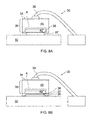
- Wire bonded surge protection diodes such as the type shown in Figure 1 have the pn junction active area (not visible) arranged towards the top of the device and a first contact to either the p or n side (as the case may be) of the junction is made by way of a wire bond 10 attached to the top of device.
- the lead frame (not visible) for such a device will be on the underside and provides the second contact to the junction.
- lead frames are generally formed of metallic materials and thus provide a route for heat dissipation during operation of the device.
- Figures 2a to 2d show the heat dissipation profile over time for an exemplary prior art device.
- the wire bond 10 to the device is connected to the active area 14.
- the device can be seen to heat up with the hot spot 16 shown outside the area of wire bond under the mould compound 12.
- Due to the conductive nature of the wire bond heat generated in the active area 14 will dissipated through the wire bond.
- hot spots will generally occur away from the wire bond under the mould compound. Typically this can be due to the insufficient heat dissipation capability of the mold compound.
- the resulting hot spot can cause the device material to melt resulting in failure of the device, for example as discussed above in relation to Figure 1 .
- the present invention seeks to provide a surge protection device which is not prone to overheating device failure.
- a surge protection device comprising: a lead frame; a semiconductor substrate formed of a first conductivity type and mounted on said lead frame, said semiconductor substrate comprising first and second opposing surfaces, said second surface having a region of second conductivity type, wherein said region of second conductivity type comprises an electrical contact for contactably mounting said substrate to said lead frame; and an insulation layer disposed at the second surface and arranged to insulate the region of first conductivity type from the lead frame.
- the surge protection device provides for improved heat dissipation through the lead frame, thus preventing device failure due to hot spots.
- An insulation layer is arranged to prevent electrical contact between the lead frame and the first conductivity type of the semiconductor substrate.
- the insulation layer may be a passivation layer.
- the lead frame may comprise a raised portion for contacting to the electrical contact.
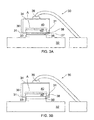
- a surge protection device 30 comprises a p-n junction 36 mounted on a lead frame 32.
- the p-n junction may be formed on an n-type conductivity silicon substrate 40 having a p-type conductivity impurity region 40' formed in the n-type substrate 40.
- the skilled person will recognise that the p-type impurity region 40' can be formed in the n-type substrate 40 by any appropriate means, for example diffusion or implantation.
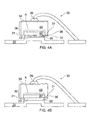
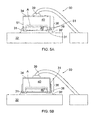
- the p-n junction structure illustrated in Figures 3a and 3b (and also Figures 4a, 4b , 5a and 5b discussed in more detail below) may be considered a planar structure.
- n-type conductivity regions may be formed on p-type substrates.
- Electrical bonds may be made to respective metallic contacts, also known in the art as contact metal, to the p-type and n-type conductivity regions forming the pn-junction 36.
- a first metallic contact 34 is made on a first surface of the pn-junction 36 formed by the n-type substrate.
- a second metallic contact 38 is formed on a second surface of the pn-junction forming a p-type impurity region.
- the first and second surfaces are opposed as therefore are the first 34 and second 38 metallic contacts.
- the first 34 and second 38 metallic contacts may be formed on the respective opposing first and second surfaces of the device 30.
- the formation of the metallic contacts will not be discussed in detail herein, however the skilled person will appreciate that they may be formed of any suitable material, for example Cu, and formed by any suitable process, for example sputtering.
- the lead frame may comprise a raised or "MESA" type portion 33 for mounting the pn-junction thereon 36.
- the p-n junction 36 is mounted and electrically connected on the raised portion 33 via the second contact 38 to the p-type impurity region, such that the active area formed at the junction of the p- and n-type materials is closer to the lead frame than it is to the first metallic contact 34 formed at the n-type substrate material.
- the electrical connection between second contact 38 to the p-type impurity region of the pn junction 36 and the lead frame raised portion 33 may be made by any suitable eutectic die attach material 35 such as for example alloys of Au.
- a diffusion barrier 37 may be included between the second contact 38 and the die attach material 35. The diffusion barrier 37 is provided to prevent out diffusion of the contact metal into the die attach material 35 and/or lead frame 32 material, which may result in failure of the contact 38.
- the semiconductor device 30 is connected to the lead frame using for example, solder based attachment materials 35, 35'.
- solder based attachment materials 35, 35' for example, solder based attachment materials.
- conductive glues, conducting wafer back coatings or conducting films may be used in place of solder.
- the lead frame 32 may be formed of any appropriate material, such as for example high thermal conductivity materials such as Cu.
- the lead frame raised portion 33 may be smaller in width than the width of the p-n junction 36. Therefore any excess die attach material that may spill over during the die attach process may fall to the sides of the lead frame at either side of the raised portion 33 of the lead frame 32.
- a passivation layer 31 may at provided the second surface of the pn-junction such that it partially covers the second surface.
- the passivation layer only partially covers the second surface due to the need for the contact metal applied to the p-type material. Due the close proximity of the active pn-junction region A to the leadframe 32, the passivation layer 31 may provide an isolation layer between the n-type substrate material and the lead frame 32. In the context of semiconductor devices the skilled person will understand the active region to be the interface of n- and p-type conductivity types.
- the proximal nature of the active pn-junction region A to the lead frame provides an efficient heat sink for heat generated in the active region into the lead frame.
- the passivation layer 31 may prevent short circuiting of the n-type substrate with the lead frame 32, caused by for example excessive die attach, solder materials that may fall on to the lead frame 32 and connect to the n-type substrate.
- the passivation layer 31 may also prevent leakage currents shorting the n-type substrate to the lead frame, which may also occur due to the close proximity of the lead frame 32 to the pn-junction active region A. In this way the passivation layer 31 can be said to insulate the n-type substrate from the lead frame 32.
- suitable passivation layer 31 materials include silicon nitride or silicon dioxide.
- the raised portion 33 of the lead frame 32 may be formed by building up the lead frame material, or removal of material so as to define the raised portion 33 of the lead frame 32.
- the raised portion 33 of the lead frame 32 may be formed by deforming the lead frame material to create the raised portion 33.
- the raised portion may be achieved by any appropriate process such as for example stamping, bending and so forth.
- the pn-junction 36 includes two step wafer cuts into the side walls 51 of n-type substrate material in order to provide the space needed to receive the sidewall passivation.
- the passivation layer 31 is formed into the side wall cuts as to provide electrical insulation of the n-type substrate from the die attach material 35'. In situations where the die attach material 35' is a conductive glue, the side wall passivation is advantageous.
- the glue is applied as a liquid and as such it will rise upwardly along the sides of the pn-junction 36 due to the downward pressure of placing the pn-junction 36 on the leadframe 32. Therefore, the sidewall passivation 31 prevents shorting of the n-type substrate to the leadframe 32.
- the example of Figure 5b can also include side wall passivation. However, compared to the example of Figure 4a no side wall cuts are present and the side wall passivation 31 is applied directly to the sides of the pn-junction 36. In Figure 5b the side wall passivation is deposited after crystal separation, for example, by re-using the sidewall passivation deposited during plasma dicing, which avoids the contact of the conductive die attach material 35 and the n-type substrate 40.
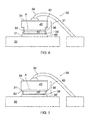
- the pn-junction 36 include side wall trenches 62 which may be formed by either etching or sawing.
- the passivation 31 is provided in the sidewall trenches to prevent shorting of the n-type substrate to the lead frame
- the die attach material has a footprint smaller than the area of the second surface and as before passivation layers are included to prevent unwanted leakage currents and prevent the possibility of short circuits as discussed above.
- the contact 34 may be made to the n-type substrate by an appropriate metal contact together with a ball and wire bond 39 to provide external electrical connection.
- the metal contact 34 may include a diffusion barrier to prevent out diffusion as discussed above.
- clip-type bond arrangements may be used.
- the device may be encapsulated in a mould compound (not illustrated) which may provide additional thermal mass to conduct heat generated in operation away from the active region A.
- the passivation layer 31 described in each of the above examples may be deposited by any appropriate method, for example spin-on glass, thermal or plasma oxides or nitrides.
- FIG. 9 shows an exemplary heat distribution image for the example of Figure 8b .
- heat generated in the active area A will be dissipated more readily through the lead frame 32 rather than semiconductor substrate and ball and wire bond 39.
- the skilled person will immediately recognise the benefits of the present arrangement in terms of preventing device heating generated damage to the pn junction device 36.
- the process for fabricating surge the protection device 30 is as follows. A semiconductor having the individual pn junction 36 formed thereon is cut into dies. The individual pn junctions 36 are then loaded into a die attach machine on an adhesive film. At die attach machine, the individual pn junctions 36 are picked up by a vacuum needle, flipped upside down and placed on the leadframe 32. Normally the die attach material 35 (either glue, solder or other examples as described above) will be provided on the lead frame 32 prior to placement. The leadframe having the pn-junctions placed thereon are then cured or reflow soldered such that they are ready for wire bonding, where the final electrical external connection is made. The device is then fabricated by moulding using standard mould compound, and finally the devices are trimmed, formed, tested and taped ready for shipment.
- the die attach material 35 either glue, solder or other examples as described above
- Applications of the semiconductor device 30 described in the examples above include surge protection of data interface ports, power supplies associated power management units, together with broad applications in automotive electronics, and telecommunication circuits.
- the conductivity types of the substrate and impurity region may be reversed. That is the substrate may be p-type and the conductivity of the impurity region may be n-type.
Landscapes
- Die Bonding (AREA)
Priority Applications (1)
| Application Number | Priority Date | Filing Date | Title |
|---|---|---|---|
| EP13185143.8A EP2851946A1 (de) | 2013-09-19 | 2013-09-19 | Überspannungsschutzvorrichtung |
Applications Claiming Priority (1)
| Application Number | Priority Date | Filing Date | Title |
|---|---|---|---|
| EP13185143.8A EP2851946A1 (de) | 2013-09-19 | 2013-09-19 | Überspannungsschutzvorrichtung |
Publications (1)
| Publication Number | Publication Date |
|---|---|
| EP2851946A1 true EP2851946A1 (de) | 2015-03-25 |
Family
ID=49209277
Family Applications (1)
| Application Number | Title | Priority Date | Filing Date |
|---|---|---|---|
| EP13185143.8A Withdrawn EP2851946A1 (de) | 2013-09-19 | 2013-09-19 | Überspannungsschutzvorrichtung |
Country Status (1)
| Country | Link |
|---|---|
| EP (1) | EP2851946A1 (de) |
Cited By (3)
| Publication number | Priority date | Publication date | Assignee | Title |
|---|---|---|---|---|
| CN108463885A (zh) * | 2015-12-11 | 2018-08-28 | 罗姆股份有限公司 | 半导体装置 |
| WO2021132144A1 (ja) * | 2019-12-26 | 2021-07-01 | 株式会社タムラ製作所 | 半導体装置 |
| CN113412539A (zh) * | 2019-02-13 | 2021-09-17 | 日立安斯泰莫株式会社 | 半导体装置 |
Citations (3)
| Publication number | Priority date | Publication date | Assignee | Title |
|---|---|---|---|---|
| WO1994023455A1 (en) * | 1993-03-31 | 1994-10-13 | Siemens Components, Inc. | High-voltage, vertical-trench semiconductor device |
| JP2009111187A (ja) * | 2007-10-30 | 2009-05-21 | Denso Corp | 半導体装置 |
| EP2315255A1 (de) * | 2009-10-22 | 2011-04-27 | Nxp B.V. | Überspannungsschutzvorrichtung |
-
2013
- 2013-09-19 EP EP13185143.8A patent/EP2851946A1/de not_active Withdrawn
Patent Citations (3)
| Publication number | Priority date | Publication date | Assignee | Title |
|---|---|---|---|---|
| WO1994023455A1 (en) * | 1993-03-31 | 1994-10-13 | Siemens Components, Inc. | High-voltage, vertical-trench semiconductor device |
| JP2009111187A (ja) * | 2007-10-30 | 2009-05-21 | Denso Corp | 半導体装置 |
| EP2315255A1 (de) * | 2009-10-22 | 2011-04-27 | Nxp B.V. | Überspannungsschutzvorrichtung |
Cited By (5)
| Publication number | Priority date | Publication date | Assignee | Title |
|---|---|---|---|---|
| CN108463885A (zh) * | 2015-12-11 | 2018-08-28 | 罗姆股份有限公司 | 半导体装置 |
| CN113412539A (zh) * | 2019-02-13 | 2021-09-17 | 日立安斯泰莫株式会社 | 半导体装置 |
| WO2021132144A1 (ja) * | 2019-12-26 | 2021-07-01 | 株式会社タムラ製作所 | 半導体装置 |
| JP2021106190A (ja) * | 2019-12-26 | 2021-07-26 | 株式会社ノベルクリスタルテクノロジー | 半導体装置 |
| US12482729B2 (en) | 2019-12-26 | 2025-11-25 | Tamura Corporation | Semiconductor device |
Similar Documents
| Publication | Publication Date | Title |
|---|---|---|
| EP2677540A1 (de) | Elektronische Vorrichtung und Verfahren zu dessen Herstellung | |
| CN110546757A (zh) | 电子元器件和半导体装置 | |
| CA2665361C (en) | Plastic surface mount large area power device | |
| TWI414082B (zh) | 具有過電壓保護之發光二極體晶片 | |
| WO2023154646A1 (en) | Semiconductor package with creepage extension structures | |
| US20180331005A1 (en) | Semiconductor chip, semiconductor device, and electronic device | |
| US10410996B2 (en) | Integrated circuit package for assembling various dice in a single IC package | |
| US10529644B2 (en) | Semiconductor device | |
| EP2851946A1 (de) | Überspannungsschutzvorrichtung | |
| US10340264B2 (en) | Semiconductor device comprising a clamping structure | |
| US11257760B2 (en) | Semiconductor device having metal wire bonded to plural metal blocks connected to respective circuit patterns | |
| CN110875264B (zh) | 电子芯片封装 | |
| JP2005354060A (ja) | 表面実装型チップスケールパッケージ | |
| CN110310923A (zh) | 功率元件的制造方法及其结构 | |
| US9685396B2 (en) | Semiconductor die arrangement | |
| JP2015167171A (ja) | 半導体装置 | |
| CN112424943B (zh) | 集成多设备芯片和封装 | |
| US7880281B2 (en) | Switching assembly for an aircraft ignition system | |
| CN102074539A (zh) | 半导体器件的封装 | |
| CN112768503A (zh) | Igbt芯片、其制造方法及功率模块 | |
| US20250300106A1 (en) | Power devices with barrier metal extension and sealing | |
| CN121569619A (zh) | 半导体封装件 | |
| JPH1167769A (ja) | 半導体装置及びその製造方法 |
Legal Events
| Date | Code | Title | Description |
|---|---|---|---|
| PUAI | Public reference made under article 153(3) epc to a published international application that has entered the european phase |
Free format text: ORIGINAL CODE: 0009012 |
|
| 17P | Request for examination filed |
Effective date: 20140326 |
|
| AK | Designated contracting states |
Kind code of ref document: A1 Designated state(s): AL AT BE BG CH CY CZ DE DK EE ES FI FR GB GR HR HU IE IS IT LI LT LU LV MC MK MT NL NO PL PT RO RS SE SI SK SM TR |
|
| AX | Request for extension of the european patent |
Extension state: BA ME |
|
| STAA | Information on the status of an ep patent application or granted ep patent |
Free format text: STATUS: THE APPLICATION IS DEEMED TO BE WITHDRAWN |
|
| 18D | Application deemed to be withdrawn |
Effective date: 20150926 |