EP2852285B1 - Dérivés bufadiènolides substitués en position 3 par un groupement amine hétérocyclique pour le traitement de cancer - Google Patents
Dérivés bufadiènolides substitués en position 3 par un groupement amine hétérocyclique pour le traitement de cancer Download PDFInfo
- Publication number
- EP2852285B1 EP2852285B1 EP13784674.7A EP13784674A EP2852285B1 EP 2852285 B1 EP2852285 B1 EP 2852285B1 EP 13784674 A EP13784674 A EP 13784674A EP 2852285 B1 EP2852285 B1 EP 2852285B1
- Authority
- EP
- European Patent Office
- Prior art keywords
- pyran
- phenanthren
- cyclopenta
- optionally substituted
- hydroxy
- Prior art date
- Legal status (The legal status is an assumption and is not a legal conclusion. Google has not performed a legal analysis and makes no representation as to the accuracy of the status listed.)
- Active
Links
- 0 C[C@@](CC[C@@]([C@@]1CC2)[C@@](C)(CCC(C3)N(C)*)[C@]23O)([C@](CC2)C(C=C3)=COC3=O)[C@@]12O Chemical compound C[C@@](CC[C@@]([C@@]1CC2)[C@@](C)(CCC(C3)N(C)*)[C@]23O)([C@](CC2)C(C=C3)=COC3=O)[C@@]12O 0.000 description 3
- NNIVPHYBYOYMEM-SLMSBUKFSA-N CC(C)[C@H](C(NC(CC[C@]1(C)[C@@H](CC[C@]2(C)[C@H](CC3)C(C=C4)=COC4=O)[C@@H](CC4)[C@]23O)C[C@]14O)=O)N Chemical compound CC(C)[C@H](C(NC(CC[C@]1(C)[C@@H](CC[C@]2(C)[C@H](CC3)C(C=C4)=COC4=O)[C@@H](CC4)[C@]23O)C[C@]14O)=O)N NNIVPHYBYOYMEM-SLMSBUKFSA-N 0.000 description 1
- INKSJMNEACDMQC-TZGNRCLZSA-N C[C@@](CCC([C@H]1CC2)[C@@](C)(CC3)[C@H]2C[C@H]3NC(NCCO)=O)([C@H](CC2)C(C=C3)=COC3=O)[C@@]12O Chemical compound C[C@@](CCC([C@H]1CC2)[C@@](C)(CC3)[C@H]2C[C@H]3NC(NCCO)=O)([C@H](CC2)C(C=C3)=COC3=O)[C@@]12O INKSJMNEACDMQC-TZGNRCLZSA-N 0.000 description 1
Classifications
-
- C—CHEMISTRY; METALLURGY
- C07—ORGANIC CHEMISTRY
- C07J—STEROIDS
- C07J41/00—Normal steroids containing one or more nitrogen atoms not belonging to a hetero ring
- C07J41/0005—Normal steroids containing one or more nitrogen atoms not belonging to a hetero ring the nitrogen atom being directly linked to the cyclopenta(a)hydro phenanthrene skeleton
- C07J41/0011—Unsubstituted amino radicals
-
- A—HUMAN NECESSITIES
- A61—MEDICAL OR VETERINARY SCIENCE; HYGIENE
- A61P—SPECIFIC THERAPEUTIC ACTIVITY OF CHEMICAL COMPOUNDS OR MEDICINAL PREPARATIONS
- A61P35/00—Antineoplastic agents
-
- C—CHEMISTRY; METALLURGY
- C07—ORGANIC CHEMISTRY
- C07J—STEROIDS
- C07J19/00—Normal steroids containing carbon, hydrogen, halogen or oxygen, substituted in position 17 by a lactone ring
-
- C—CHEMISTRY; METALLURGY
- C07—ORGANIC CHEMISTRY
- C07J—STEROIDS
- C07J41/00—Normal steroids containing one or more nitrogen atoms not belonging to a hetero ring
- C07J41/0005—Normal steroids containing one or more nitrogen atoms not belonging to a hetero ring the nitrogen atom being directly linked to the cyclopenta(a)hydro phenanthrene skeleton
-
- C—CHEMISTRY; METALLURGY
- C07—ORGANIC CHEMISTRY
- C07J—STEROIDS
- C07J43/00—Normal steroids having a nitrogen-containing hetero ring spiro-condensed or not condensed with the cyclopenta(a)hydrophenanthrene skeleton
- C07J43/003—Normal steroids having a nitrogen-containing hetero ring spiro-condensed or not condensed with the cyclopenta(a)hydrophenanthrene skeleton not condensed
-
- C—CHEMISTRY; METALLURGY
- C07—ORGANIC CHEMISTRY
- C07J—STEROIDS
- C07J71/00—Steroids in which the cyclopenta(a)hydrophenanthrene skeleton is condensed with a heterocyclic ring
- C07J71/0005—Oxygen-containing hetero ring
- C07J71/001—Oxiranes
- C07J71/0021—Oxiranes at position 14(15)
Definitions
- Cancer can be viewed as a breakdown in the communication between tumor cells and their environment, including their normal neighboring cells. Signals, both growth-stimulatory and growth-inhibitory, are routinely exchanged between cells within a tissue. Normally, cells do not divide in the absence of stimulatory signals, and likewise, will cease dividing in the presence of inhibitory signals. In a cancerous, or neoplastic state, a cell acquires the ability to "override" these signals and to proliferate under conditions in which normal cells would not grow.
- Cardiotonic steroids like digoxin and digitoxin are a class of naturally derived compounds that bind to and inhibit Na + /K + -ATPase (sodium pump). Members of this family have been used for the treatment of heart failure and arrhythmia for many years. Recent findings have revealed that these compounds may be involved in the regulation of several important cellular processes. Several cardiotonic steroids such as digitoxin and oleandrin have shown inhibitory effect on the growth of human tumor cells.
- the invention provides least one chemical entity chosen from compounds of Formula I and pharmaceutically acceptable salts thereof, wherein
- R 1 , R 2 , R 3 , R 4 , R 5 , R 6 , R 9 , R 10 , R 11 and R 12 are independently chosen from hydrogen, hydroxy, optionally substituted alkyl, optionally substituted alkoxy, optionally substituted aminocarbonyloxy, optionally substituted acyloxy, optionally substituted alkoxycarbonyloxy, and optionally substituted amino.
- R 1 , R 2 , R 3 , R 4 , R 5 , R 6 , R 9 , R 10 , R 11 and R 12 are independently chosen from hydrogen, hydroxy, and optionally substituted alkyl.
- R 1 , R 2 , R 3 , R 4 , R 5 , R 6 , R 9 , R 10 , R 11 and R 12 are independently chosen from hydrogen, hydroxy, and methyl.
- R 4 is hydroxy.
- the invention provides a compound of Formula I, wherein R 4 and R 5 are joined together with any intervening atoms to form an optionally substituted 3- to 8-membered heterocycloalkyl ring.
- R 4 and R 5 are joined together with any intervening atoms to form an oxirane ring.
- R 7 is chosen from hydrogen, hydroxy, optionally substituted alkoxy, optionally substituted aminocarbonyloxy, optionally substituted acyloxy, optionally substituted alkoxycarbonyloxy, and optionally substituted amino. In some cases, R 7 is chosen from hydrogen and optionally substituted acyloxy. For example, R 7 is chosen from hydrogen and - OCOCH 3 .
- R 8 and W 2 are independently chosen from hydrogen and optionally substituted alkyl.
- R 13 is chosen from hydrogen and optionally substituted alkyl. In some cases, R 13 is chosen from hydrogen and optionally substituted alkyl. For example, R 13 is chosen from hydrogen, methyl, and hydroxymethyl.
- Y is chosen from O, NH and NCH 3 .
- Y is O.
- R 20 is chosen from cyano, halo, hydroxy, carboxy, sufonyl, optionally substituted alkoxy, optionally substituted alkoxycarbonyl, optionally substituted alkyl, optionally substituted amino, optionally substituted acyl, optionally substituted alkoxycarbonyl, optionally substituted aminocarbonyl, and optionally substituted aminosulfonyl.
- m 0.
- the dotted line represents a single bond. In some examples, the dotted line represents a double bond.
- the compound of Formula I has the formula:
- the compound of Formula I has the formula:
- the compound of Formula I is chosen from compounds of Formula Ia.
- the compound of Formula I is chosen from compounds of Formula Ib.
- the compound of Formula I is chosen from compounds of Formula Ic.
- the compound of Formula I is chosen from compounds of Formula Id.
- the compound of Formula I is chosen from compounds of Formula Ie.
- the compound of Formula I is chosen from compounds of Formula If.
- the compound of Formula I is chosen from compounds of Formula
- the compound of Formula I is chosen from compounds of Formula Ik.
- R 14 and R 15 are joined together with any intervening atoms to form an optionally substituted 4- to 8-membered heterocycloalkyl or or optionally substituted 5- to 8-membered heteroaryl ring.
- R 14 and R 15 form an optionally substituted 5- or 6-membered heterocycloalkyl ring.
- the 5- or 6- membered heterocycloalkyl ring may be, for example, a morpholino, piperazino, or pyrrolidino group.
- R 14 and R 15 are joined together with any intervening atoms to form an optionally substituted 4- to 8-membered heterocycloalkyl ring.
- the invention provides a pharmaceutical composition comprising a pharmaceutically acceptable carrier and at least one chemical entity of Formula I (Ia-Il).
- the pharmaceutical composition of the invention may be formulated in a form of tablets, capsules, powders, liquids, suspensions, suppositories, or aerosols.
- the invention also provides packaged pharmaceutical compositions comprising a pharmaceutical composition of the invention and instructions for using the composition to treat a subject suffering from cancer.
- the invention provides the compounds of formula (I) for use in a method of treating cancer in a subject.
- the methods in question comprise administering to a subject in need thereof a therapeutically effective amount of at least one chemical entity of the invention (Formula I, Ia-g and Ik).
- composition comprising a pharmaceutically acceptable carrier and at least one chemical entity described herein.
- kits for using the composition comprising a pharmaceutical composition described herein and instructions for using the composition to treat a subject suffering from cancer.
- a dash that is not between two letters or symbols is used to indicate a point of attachment for a substituent.
- -CONH 2 is attached through the carbon atom.
- optionally substituted alkyl encompasses both “alkyl” and “substituted alkyl” as defined below. It will be understood by those skilled in the art, with respect to any group containing one or more substituents, that such groups are not intended to introduce any substitution or substitution patterns that are sterically impractical, synthetically non-feasible and/or inherently unstable.
- alkyl refers to straight chain and branched chain having the indicated number of carbon atoms, usually from 1 to 20 carbon atoms, for example 1 to 8 carbon atoms, such as 1 to 6 carbon atoms.
- C 1 -C 6 alkyl encompasses both straight and branched chain alkyl of from 1 to 6 carbon atoms.
- alkyl residue having a specific number of carbons is named, all branched and straight chain versions having that number of carbons are intended to be encompassed; thus, for example, “butyl” is meant to include n-butyl, sec-butyl, isobutyl and t-butyl; "propyl” includes n-propyl and isopropyl.
- “Lower alkyl” refers to alkyl groups having one to six carbons. Examples of alkyl groups include methyl, ethyl, propyl, isopropyl, n-butyl, sec-butyl, tert-butyl, pentyl, 2-pentyl, isopentyl, neopentyl, hexyl, 2-hexyl, 3-hexyl, 3-methylpentyl, and the like.
- Alkylene is a subset of alkyl, referring to the same residues as alkyl, but having two points of attachment. Alkylene groups will usually have from 2 to 20 carbon atoms, for example 2 to 8 carbon atoms, such as from 2 to 6 carbon atoms. For example, C 0 alkylene indicates a covalent bond and C 1 alkylene is a methylene group.
- alkenyl refers to an unsaturated branched or straight-chain alkyl group having at least one carbon-carbon double bond derived by the removal of one molecule of hydrogen from adjacent carbon atoms of the parent alkyl.
- the group may be in either the cis or trans configuration about the double bond(s).
- Typical alkenyl groups include, but are not limited to, ethenyl; propenyls such as prop-1-en-1-yl, prop-1-en-2-yl, prop-2-en-1-yl (allyl), prop-2-en-2-yl; butenyls such as but-1-en-1-yl, but-1-en-2-yl, 2-methyl-prop-1-en-1-yl, but-2-en-1-yl, but-2-en-1-yl, but-2-en-2-yl, buta-1,3-dien-1-yl, buta-1,3-dien-2-yl; and the like.
- an alkenyl group has from 2 to 20 carbon atoms and in other embodiments, from 2 to 6 carbon atoms.
- “Lower alkenyl” refers to alkenyl groups having two to six carbons.
- alkynyl refers to an unsaturated branched or straight-chain alkyl group having at least one carbon-carbon triple bond derived by the removal of two molecules of hydrogen from adjacent carbon atoms of the parent alkyl.
- Typical alkynyl groups include, but are not limited to, ethynyl; propynyls such as prop-1-yn-1-yl, prop-2-yn-1-yl; butynyls such as but-1-yn-1-yl, but-1-yn-3-yl, but-3-yn-1-yl; and the like.
- an alkynyl group has from 2 to 20 carbon atoms and in other embodiments, from 3 to 6 carbon atoms.
- “Lower alkynyl” refers to alkynyl groups having two to six carbons.
- cycloalkyl refers to a non-aromatic carbocyclic ring, usually having from 3 to 8 ring carbon atoms. The ring may be saturated or have one or more carbon-carbon double bonds.
- cycloalkyl groups include cyclopropyl, cyclobutyl, cyclopentyl, cyclopentenyl, cyclohexyl, and cyclohexenyl, as well as bridged and caged ring groups such as norbornane.
- alkoxy refers to an alkyl group of the indicated number of carbon atoms attached through an oxygen bridge such as, for example, methoxy, ethoxy, propoxy, isopropoxy, n-butoxy, sec-butoxy, tert-butoxy, pentyloxy, 2-pentyloxy, isopentyloxy, neopentyloxy, hexyloxy, 2-hexyloxy, 3-hexyloxy, 3-methylpentyloxy, and the like. Alkoxy groups will usually have from 1 to 7 carbon atoms attached through the oxygen bridge. "Lower alkoxy” refers to alkoxy groups having one to six carbons.
- acyl refers to the groups H-C(O)-; (alkyl)-C(O)-; (cycloalkyl)-C(O)-; (aryl)-C(O)-; (heteroaryl)-C(O)-; and (heterocycloalkyl)-C(O)-, wherein the group is attached to the parent structure through the carbonyl functionality and wherein alkyl, cycloalkyl, aryl, heteroaryl, and heterocycloalkyl are as described herein.
- Acyl groups have the indicated number of carbon atoms, with the carbon of the keto group being included in the numbered carbon atoms.
- a C 1 -C 6 alkoxycarbonyl group is an alkoxy group having from 1 to 6 carbon atoms attached through its oxygen to a carbonyl linker.
- azido refers to the group -N 3 .
- amino refers to the group -NH 2 .
- mono- and di-(alkyl)amino refers to secondary and tertiary alkyl amino groups, wherein the alkyl groups are as defined above and have the indicated number of carbon atoms. The point of attachment of the alkylamino group is on the nitrogen. Examples of mono- and di-alkylamino groups include ethylamino, dimethylamino, and methyl-propyl-amino.
- aminocarbonyl refers to the group -CONR b R c , where R b is chosen from H, optionally substituted C 1 -C 6 alkyl, optionally substituted cycloalkyl, optionally substituted heterocycloalkyl, optionally substituted aryl, and optionally substituted heteroaryl, optionally substituted alkoxy; and R c is chosen from hydrogen and optionally substituted C 1 -C 4 alkyl; or R b and R c taken together with the nitrogen to which they are bound, form an optionally substituted 5- to 8-membered nitrogen-containing heterocycloalkyl which optionally includes 1 or 2 additional heteroatoms chosen from O, N, and S in the heterocycloalkyl ring; where each substituted group is independently substituted with one or more substituents independently chosen from C 1 -C 4 alkyl, aryl, heteroaryl, aryl-C 1 -C 4 alkyl-, heteroaryl-C 1 -C 4
- aryl refers to: 6-membered carbocyclic aromatic rings, for example, benzene; bicyclic ring systems wherein at least one ring is carbocyclic and aromatic, for example, naphthalene, indane, and tetralin; and tricyclic ring systems wherein at least one ring is carbocyclic and aromatic, for example, fluorene.
- aryl includes 6-membered carbocyclic aromatic rings fused to a 5- to 7-membered heterocycloalkyl ring containing 1 or more heteroatoms chosen from N, O, and S.
- bicyclic ring systems wherein only one of the rings is a carbocyclic aromatic ring, the point of attachment may be at the carbocyclic aromatic ring or the heterocycloalkyl ring.
- Bivalent radicals formed from substituted benzene derivatives and having the free valences at ring atoms are named as substituted phenylene radicals.
- Bivalent radicals derived from univalent polycyclic hydrocarbon radicals whose names end in "-yl” by removal of one hydrogen atom from the carbon atom with the free valence are named by adding "-idene” to the name of the corresponding univalent radical, e.g. a naphthyl group with two points of attachment is termed naphthylidene.
- Aryl does not encompass or overlap in any way with heteroaryl, separately defined below. Hence, if one or more carbocyclic aromatic rings is fused with a heterocycloalkyl aromatic ring, the resulting ring system is heteroaryl, not aryl, as defined herein.
- aryloxy refers to the group -O-aryl.
- aralkyl refers to the group -alkyl-aryl.
- halo refers to fluoro, chloro, bromo, and iodo
- halogen includes fluorine, chlorine, bromine, and iodine
- haloalkyl refers to alkyl as defined above having the specified number of carbon atoms, substituted with 1 or more halogen atoms, up to the maximum allowable number of halogen atoms.
- haloalkyl include, but are not limited to, trifluoromethyl, difluoromethyl, 2-fluoroethyl, and penta-fluoroethyl.
- heteroaryl refers to:
- heteroaryl includes a 5- to 7-membered heterocycloalkyl, aromatic ring fused to a 5- to 7-membered cycloalkyl or heterocycloalkyl ring.
- bicyclic heteroaryl ring systems wherein only one of the rings contains one or more heteroatoms, the point of attachment may be at either ring.
- the total number of S and O atoms in the heteroaryl group exceeds 1, those heteroatoms are not adjacent to one another.
- the total number of S and O atoms in the heteroaryl group is not more than 2.
- the total number of S and O atoms in the aromatic heterocycle is not more than 1.
- heteroaryl groups include, but are not limited to, (as numbered from the linkage position assigned priority 1), 2-pyridyl, 3-pyridyl, 4-pyridyl, 2,3-pyrazinyl, 3,4-pyrazinyl, 2,4-pyrimidinyl, 3,5-pyrimidinyl, 2,3-pyrazolinyl, 2,4-imidazolyl, isoxazolyl, oxazolyl, thiazolyl, thiadiazolyl, tetrazolyl, thienyl, benzothiophenyl, furanyl, pyrrolyl, benzofuranyl, benzoimidazolyl, indolyl, pyridazinyl, triazolyl, quinolinyl, quinoxalinyl, pyrazolyl, and 5,6,7,8-tetrahydroisoquinolinyl.
- Bivalent radicals derived from univalent heteroaryl radicals whose names end in "-yl” by removal of one hydrogen atom from the atom with the free valence are named by adding "-idene" to the name of the corresponding univalent radical, e.g. a pyridyl group with two points of attachment is a pyridylidene.
- Heteroaryl does not encompass or overlap with aryl, cycloalkyl, or heterocycloalkyl, as defined herein
- Substituted heteroaryl also includes ring systems substituted with one or more oxide (-O - ) substituents, such as pyridinyl N-oxides.
- heterocycloalkyl refers to a single, non-aromatic ring, usually with 3 to 8 ring atoms, containing at least 2 carbon atoms in addition to 1-3 heteroatoms independently chosen from oxygen, sulfur, and nitrogen, as well as combinations comprising at least one of the foregoing heteroatoms.
- the ring may be saturated or have one or more carbon-carbon double bonds.
- Suitable heterocycloalkyl groups include, for example (as numbered from the linkage position assigned priority 1), 2-pyrrolidinyl, 2,4-imidazolidinyl, 2,3-pyrazolidinyl, 2-piperidyl, 3-piperidyl, 4-piperidyl, 2,5-piperazinyl, pyrrolidinyl, azetidinyl, pyranyl, 2,3-dihydrofuranyl, or 2,5-dihydrofuranyl.
- Morpholinyl groups are also contemplated, including 2-morpholinyl and 3-morpholinyl (numbered wherein the oxygen is assigned priority 1).
- Heterocycloalkyl also includes bicyclic ring systems wherein one non-aromatic ring, usually with 3 to 8 ring atoms, contains at least 2 carbon atoms in addition to 1-3 heteroatoms independently chosen from oxygen, sulfur, and nitrogen, as well as combinations comprising at least one of the foregoing heteroatoms; and the other ring, usually with 3 to 8 ring atoms, optionally contains 1-3 heteratoms independently chosen from oxygen, sulfur, and nitrogen and is not aromatic.
- sulfanyl refers to the groups: -S-(optionally substituted (C 1 -C 6 )alkyl), -S-(optionally substituted aryl), -S-(optionally substituted heteroaryl), and -S-(optionally substituted heterocycloalkyl).
- sulfanyl includes the group C 1 -C 6 alkylsulfanyl.
- sulfinyl refers to the groups: -S(O)-(optionally substituted (C 1 -C 6 )alkyl), -S(O)-optionally substituted aryl), -S(O)-optionally substituted heteroaryl), -S(O)-(optionally substituted heterocycloalkyl); and -S(O)-(optionally substituted amino).
- sulfonyl refers to the groups: -S(O 2 )-(optionally substituted (C 1 -C 6 )alkyl), -S(O 2 )-optionally substituted aryl), -S(O 2 )-optionally substituted heteroaryl), -S(O 2 )-(optionally substituted heterocycloalkyl), and -S(O 2 )-(optionally substituted amino).
- substituted refers to any one or more hydrogens on the designated atom or group is replaced with a selection from the indicated group, provided that the designated atom's normal valence is not exceeded.
- substituents and/or variables are permissible only if such combinations result in stable compounds or useful synthetic intermediates.
- a stable compound or stable structure is meant to imply a compound that is sufficiently robust to survive isolation from a reaction mixture, and subsequent formulation as an agent having at least practical utility.
- substituents are named into the core structure. For example, it is to be understood that when (cycloalkyl)alkyl is listed as a possible substituent, the point of attachment of this substituent to the core structure is in the alkyl portion.
- substituted alkyl, cycloalkyl, aryl, heterocycloalkyl, and heteroaryl refer respectively to alkyl, cycloalkyl, aryl, heterocycloalkyl, and heteroaryl wherein one or more (such as up to 5, for example, up to 3) hydrogen atoms are replaced by a substituent independently chosen from -R a , -OR b , optionally substituted amino (including -NR c COR b , -NR c CO 2 R a , -NR c CONR b R c , -NR b C(NR c )NR b R c , -NR b C(NCN)NR b R c , and -NR c SO 2 R a ), halo, cyano, azido, nitro, oxo (as a substituent for cycloalkyl or heterocyclo
- substituted acyl refers to the groups (substituted alkyl)-C(O)-; (substituted cycloalkyl)-C(O)-; (substituted aryl)-C(O)-; (substituted heteroaryl)-C(O)-; and (substituted heterocycloalkyl)-C(O)-, wherein the group is attached to the parent structure through the carbonyl functionality and wherein substituted alkyl, cycloalkyl, aryl, heteroaryl, and heterocycloalkyl, refer respectively to alkyl, cycloalkyl, aryl, heteroaryl, and heterocycloalkyl wherein one or more (such as up to 5, for example, up to 3) hydrogen atoms are replaced by a substituent independently chosen from -R a , -OR b , optionally substituted amino (including -NR c COR b , -
- substituted alkoxy refers to alkoxy wherein the alkyl constituent is substituted (i.e. -O-(substituted alkyl)) wherein “substituted alkyl” refers to alkyl wherein one or more (such as up to 5, for example, up to 3) hydrogen atoms are replaced by a substituent independently chosen from -R a , -OR b , optionally substituted amino (including -NR c COR b , -NR c CO 2 R a , -NR c CONR b R c , -NR b C(NR c )NR b R c , -NR b C(NCN)NR b R c , and -NR c SO 2 R a ), halo, cyano, nitro, oxo (as a substituent for cycloalkyl or heterocycloalkyl), optionally substituted acyl (
- a substituted alkoxy group is "polyalkoxy" or -O-(optionally substituted alkylene)-(optionally substituted alkoxy), and includes groups such as - OCH 2 CH 2 OCH 3 , and residues of glycol ethers such as polyethyleneglycol, and - O(CH 2 CH 2 O) x CH 3 , where x is an integer of 2-20, such as 2-10, and for example, 2-5.
- Another substituted alkoxy group is hydroxyalkoxy or -OCH 2 (CH 2 ) y OH, where y is an integer of 1-10, such as 1-4.
- substituted alkoxycarbonyl refers to the group (substituted alkyl)-O-C(O)- wherein the group is attached to the parent structure through the carbonyl functionality and wherein substituted refers to alkyl wherein one or more (such as up to 5, for example, up to 3) hydrogen atoms are replaced by a substituent independently chosen from -R a , -OR b , optionally substituted amino (including -NR c COR b , -NR c CO 2 R a , -NR c CONR b R c , -NR b C(NR c )NR b R c , -NR b C(NCN)NR b R c , and -NR c SO 2 R a ), halo, cyano, nitro, oxo (as a substituent for cycloalkyl or heterocycloalkyl), optionally substituted acyl (such
- substituted amino refers to the group -NHR d or -NR d R e wherein R d is chosen from hydroxyl, formyl, optionally substituted alkoxy, optionally substituted alkyl, optionally substituted cycloalkyl, optionally substituted acyl, optionally substituted carbamimidoyl, aminocarbonyl, optionally substituted aryl, optionally substituted heteroaryl, optionally substituted heterocycloalkyl, optionally substituted alkoxycarbonyl, sulfinyl and sulfonyl, and wherein R e is chosen from optionally substituted alkyl, optionally substituted cycloalkyl, optionally substituted aryl, optionally substituted heteroaryl, and optionally substituted heterocycloalkyl, and wherein substituted alkyl, cycloalkyl, aryl, heterocycloalkyl, and heteroaryl refer respectively to alkyl, cycloalkyl,
- substituted amino also refers to N-oxides of the groups -NHR d , and NR d R d each as described above.
- N-oxides can be prepared by treatment of the corresponding amino group with, for example, hydrogen peroxide or m-chloroperoxybenzoic acid. The person skilled in the art is familiar with reaction conditions for carrying out the N-oxidation.
- compounds include Z- and E- forms (or cis- and trans- forms) of compounds with carbon-carbon double bonds.
- the term "compound” is intended to include all tautomeric forms of the compound.
- Compounds of Formula I also include crystalline and amorphous forms of those compounds, including, for example, polymorphs, pseudopolymorphs, solvates (including hydrates), unsolvated polymorphs (including anhydrates), conformational polymorphs, and amorphous forms of the compounds, as well as mixtures thereof.
- Crystal form may be used interchangeably herein, and are meant to include all crystalline and amorphous forms of the compound, including, for example, polymorphs, pseudopolymorphs, solvates (including hydrates), unsolvated polymorphs (including anhydrates), conformational polymorphs, and amorphous forms, as well as mixtures thereof, unless a particular crystalline or amorphous form is referred to.
- pharmaceutically acceptable salts of compounds of Formula I also include crystalline and amorphous forms of those compounds, including, for example, polymorphs, pseudopolymorphs, solvates (including hydrates), unsolvated polymorphs (including anhydrates), conformational polymorphs, and amorphous forms of the pharmaceutically acceptable salts, as well as mixtures thereof.
- a “solvate” is formed by the interaction of a solvent and a compound.
- the term “compound” is intended to include solvates of compounds.
- pharmaceutically acceptable salts includes solvates of pharmaceutically acceptable salts. Suitable solvates are pharmaceutically acceptable solvates, such as hydrates, including monohydrates and hemi-hydrates.
- Compounds of Formula I also include other pharmaceutically acceptable forms of the recited compounds, including chelates, non-covalent complexes, prodrugs, and mixtures thereof.
- a “chelate” is formed by the coordination of a compound to a metal ion at two (or more) points.
- the term “compound” is intended to include chelates of compounds.
- pharmaceutically acceptable salts includes chelates of pharmaceutically acceptable salts.
- non-covalent complex is formed by the interaction of a compound and another molecule wherein a covalent bond is not formed between the compound and the molecule.
- complexation can occur through van der Waals interactions, hydrogen bonding, and electrostatic interactions (also called ionic bonding).
- Such non-covalent complexes are included in the term "compound'.
- pharmaceutically acceptable salts includes “non-covalent complexes” of pharmaceutically acceptable salts.
- hydrogen bond refers to a form of association between an electronegative atom (also known as a hydrogen bond acceptor) and a hydrogen atom attached to a second, relatively electronegative atom (also known as a hydrogen bond donor). Suitable hydrogen bond donor and acceptors are well understood in medicinal chemistry.
- Hydrogen bond acceptor refers to a group comprising an oxygen or nitrogen, such as an oxygen or nitrogen that is sp 2 -hybridized, an ether oxygen, or the oxygen of a sulfoxide or N-oxide.
- hydrogen bond donor refers to an oxygen, nitrogen, or heteroaromatic carbon that bears a hydrogen.group containing a ring nitrogen or a heteroaryl group containing a ring nitrogen.
- the compounds disclosed herein can be used in different enriched isotopic forms, e.g., enriched in the content of 2 H, 3 H, 11 C, 13 C and/or 14 C.
- the compound is deuterated at at least one position.
- deuterated forms can be made by the procedure described in U.S. Patent Nos. 5,846,514 and 6,334,997 .
- deuteration can improve the efficacy and increase the duration of action of drugs.
- Deuterium substituted compounds can be synthesized using various methods such as described in: Dean, Dennis C.; Editor. Recent Advances in the Synthesis and Applications of Radiolabeled Compounds for Drug Discovery and Development. [In: Curr., Pharm. Des., 2000; 6(10)] 2000, 110 pp ; George W.; Varma, Rajender S. The Synthesis of Radiolabeled Compounds via Organometallic Intermediates, Tetrahedron, 1989, 45(21), 6601-21 ; and Evans, E. Anthony. Synthesis of radiolabeled compounds, J. Radioanal. Chem., 1981, 64(1-2), 9-32 .
- “Pharmaceutically acceptable salts” include, but are not limited to salts with inorganic acids, such as hydrochlorate, phosphate, diphosphate, hydrobromate, sulfate, sulfinate, nitrate, and like salts; as well as salts with an organic acid, such as malate, maleate, fumarate, tartrate, succinate, citrate, acetate, lactate, methanesulfonate, p-toluenesulfonate, 2-hydroxyethylsulfonate, benzoate, salicylate, stearate, and alkanoate such as acetate, HOOC-(CH 2 ) n -COOH where n is 0-4, and like salts.
- pharmaceutically acceptable cations include, but are not limited to sodium, potassium, calcium, aluminum, lithium, and ammonium.
- the free base can be obtained by basifying a solution of the acid salt.
- an addition salt particularly a pharmaceutically acceptable addition salt, may be produced by dissolving the free base in a suitable organic solvent and treating the solution with an acid, in accordance with conventional procedures for preparing acid addition salts from base compounds.
- Those skilled in the art will recognize various synthetic methodologies that may be used to prepare non-toxic pharmaceutically acceptable addition salts.
- group As used herein the terms "group”, “radical” or “fragment” are synonymous and are intended to indicate functional groups or fragments of molecules attachable to a bond or other fragments of molecules.
- modulation refers to a change in activity as a direct or indirect response to the presence of a chemical entity as described herein, relative to the activity of in the absence of the chemical entity.
- the change may be an increase in activity or a decrease in activity, and may be due to the direct interaction of the compound with the a target or due to the interaction of the compound with one or more other factors that in turn affect the target's activity.
- the presence of the chemical entity may, for example, increase or decrease the target activity by directly binding to the target, by causing (directly or indirectly) another factor to increase or decrease the target activity, or by (directly or indirectly) increasing or decreasing the amount of target present in the cell or organism.
- active agent is used to indicate a chemical entity which has biological activity.
- an “active agent” is a compound having pharmaceutical utility.
- an active agent may be an anti-cancer therapeutic.
- significant refers to any detectable change that is statistically significant in a standard parametric test of statistical significance such as Student's T-test, where p ⁇ 0.05.
- a "pharmaceutically acceptable” component is one that is suitable for use with humans and/or animals without undue adverse side effects (such as toxicity, irritation, and allergic response) commensurate with a reasonable benefit/risk ratio.
- terapéuticaally effective amount of a chemical entity described herein refers to an amount effective, when administered to a human or non-human subject, to provide a therapeutic benefit such as amelioration of symptoms, slowing of disease progression, or prevention of disease.
- Treating” or “treatment” encompasses administration of at least one compound of Formula I, or a pharmaceutically acceptable salt thereof, to a mammalian subject, particularly a human subject, in need of such an administration and includes (i) arresting the development of clinical symptoms of the disease, such as cancer, (ii) bringing about a regression in the clinical symptoms of the disease, such as cancer, and/or (iii) prophylactic treatment for preventing the onset of the disease, such as cancer.
- cancer refers to all types of cancer or neoplasm or malignant tumors found in mammals, including carcinomas and sarcomas.
- examples of cancer are cancer of the brain, breast, cervix, colon, head & neck, kidney, lung, non-small cell lung, melanoma, mesothelioma, ovary, sarcoma, stomach, uterus and Medulloblastoma.
- subject refers to a mammal that has been or will be the object of treatment, observation or experiment.
- the methods described herein can be useful in both human therapy and veterinary applications.
- the subject is a human.
- mamal is intended to have its standard meaning, and encompasses humans, dogs, cats, sheep, and cows, for example.
- R 1 , R 2 , R 3 , R 5 , R 6 , R 9 , R 10 , R 11 and R 12 are independently chosen from hydrogen, hydroxy, optionally substituted alkyl, optionally substituted alkoxy, optionally substituted aminocarbonyloxy, optionally substituted acyloxy, optionally substituted alkoxycarbonyloxy, and optionally substituted amino.
- R 1 , R 2 , R 3 , R 5 , R 6 , R 9 , R 10 , R 11 and R 12 are independently chosen from hydrogen, hydroxy, and optionally substituted alkyl.
- R 1 , R 2 , R 3 , R 5 , R 6 , R 9 , R 10 , R 11 and R 12 are independently chosen from hydrogen, hydroxy, and lower alkyl. In some embodiments, R 1 , R 2 , R 3 , R 5 , R 6 , R 9 , R 10 , R 11 and R 12 are independently chosen from hydrogen, hydroxy, and methyl. In some embodiments, R 1 , R 2 , R 5 , R 6 , R 9 , R 10 , R 11 and R 12 are independently chosen from hydrogen, hydroxy, and methyl; R 3 is chosen from hydroxyl and hydrogen.
- At least one of R 1 and R 2 , or R 5 and R 6 , or R 7 and R 8 , or R 9 and R 10 , or R 11 and R 12 mutually independently, together in each case denotes an oxo group ( O).
- R 4 is hydroxy
- R 4 and R 5 are joined together with any intervening atoms to form an optionally substituted 3- to 8- membered heterocycloalkyl ring. In some embodiments, R 4 and R 5 are joined together with any intervening atoms to form an oxirane ring.
- R 7 is chosen from hydrogen, hydroxy, optionally substituted alkoxy, optionally substituted aminocarbonyloxy, optionally substituted acyloxy, optionally substituted alkoxycarbonyloxy, and optionally substituted amino. In some embodiments, R 7 is chosen from hydrogen and optionally substituted acyloxy. In some embodiments, R 7 is chosen from hydrogen and acyloxy. In some embodiments, R 7 is chosen from hydrogen and -OCOCH 3 .
- R 8 and and W 2 are independently chosen from hydrogen and optionally substituted alkyl. In some embodiments, R 8 and and W 2 are independently chosen from hydrogen and lower alkyl. In some embodiments, R 8 is hydrogen. In some embodiments, W 2 is hydrogen.
- R 13 is chosen from hydrogen and optionally substituted alkyl. In some embodiments, R 13 is chosen from hydrogen and loweralkyl. In some embodiments, R 13 is chosen from hydrogen, methyl, and hydroxymethyl.
- R 14 and R 15 are joined together with any intervening atoms to form an optionally substituted 4- to 8-membered heterocycloalkyl or or optionally substituted 5- to 8-membered heteroaryl ring.
- R 14 and R 15 are joined together with any intervening atoms to form an optionally substituted 4- to 8-membered heterocycloalkyl ring. In some embodiments, R 14 and R 15 are joined together with any intervening atoms to form an morpholin-4-yl, piperidin-1-yl, piperidin-4-yl, piperazin-1-yl, pyrrolidin-1-yl, pyrrolidin-2-yl, each of which is optionally substituted.
- R 14 and R 15 are joined together with any intervening atoms to form an optionally substituted 5- to 8-membered heteroaryl ring. In some embodiments, R 14 and R 15 are joined together with any intervening atoms to form imidazolyl, or pyrazolyl, each of which is optionally substituted.
- Y is chosen from O, NH and NCH 3 . In some embodiments, Y is O.
- R 20 is chosen from cyano, halo, hydroxy, carboxy, sufonyl, optionally substituted alkoxy, optionally substituted alkoxycarbonyl, optionally substituted alkyl, optionally substituted amino, optionally substituted acyl, optionally substituted alkoxycarbonyl, optionally substituted aminocarbonyl, and optionally substituted aminosulfonyl.
- m is 0.
- the dotted line represents a single bond.
- the dotted line represents a double bond.
- the chemical entities described herein can be synthesized utilizing techniques well known in the art from commercially available starting materials and reagents.
- the chemical entities described herein can be prepared as illustrated below with reference to the examples and reaction schemes.
- compounds of Formula I may be prepared by the routes described below.
- Materials used herein are either commercially available or prepared by synthetic methods generally known in the art. These schemes are not limited to the compounds listed or by any particular substituents, which are employed for illustrative purposes. Although various steps of are described and depicted in Schemes A-C, the steps in some cases may be performed in a different order than the order shown in Schemes A-C. Various modifications to these synthetic reaction schemes may be made and will be suggested to one skilled in the art having referred to the disclosure contained in this Application. Numbering does not necessarily correspond to that of claims or other tables.
- B-1 is synthesized from ketone A-2 is converted to amine B-1 using reductive amination in the presence of an amine and a reducing agent such as NaBH 3 CN in a polar organic solvent such as MeOH.
- B-1 can be first separated to give two diastereoisomers B-2 and B-3, which can be derivatized to afford corresponding B-5 and B-6 respectively.
- B-1 can also be first derivatized to give B-4, which can be separated to afford B-5 and B-6.
- ketone A-2 is reduced to give alcohol C-1 as a mixture of two diastereoisomers in the presence of a reducing agent such as NaBH 4 in a polar organic solvent such as MeOH or dioxane.
- a reducing agent such as NaBH 4
- a polar organic solvent such as MeOH or dioxane
- the hydroxyl group of C-1 is then converted to a leaving group such as tosyl (OTs), mesyl (OMs) or triflate (OTf).
- OTs tosyl
- OMs mesyl
- OTf triflate
- Displacement of the leaving group with amine or heteroaryl such as imidazole, pyrazole, or pyrimidin-4(3H)-one in the presence a base affords C-3.
- Suitable bases include, but are not limited to, Et 3 N, pyridine, DMAP, Na 2 CO 3 , K 2 CO 3 , Cs 2 CO 3 , NaOMe, t-BuONa, t-BuOK, NaH, KH, LiH, and CaH 2 .
- Suitable solvents include, but are not limited to, DMF, DMSO, DMA, and N-methyl piperidone. The displacement reaction are generally carried out at a temperature ranging from 25 -240 °C. C-3 can then be separated to afford two corresponding single diastereoisomers. Alternatively, C-1 can be first separated to two single diastereoisomers, which can then be derivatized, displaced to afford the final compound of Formula I.
- the desired product can be purified from the reaction mixture by standard methods, e.g. by extraction and/or silica gel chromatography or high-pressure liquid chromatography.
- the chemical entities described herein may be prepared in substantially pure form, typically by standard chromatographic methods, prior to formulation in a pharmaceutically acceptable form.
- the chemical entities described herein may be used in treating a variety of cancers. Cancers that can be prevented and/or treated by the chemical entities, compositions, and methods described herein include, but are not limited to, human sarcomas and carcinomas, e.g.
- carcinomas e.g., colon carcinoma, pancreatic cancer, breast cancer, ovarian cancer, prostate cancer, fibrosarcoma, myxosarcoma, liposarcoma, chondrosarcoma, osteogenic sarcoma, chondroma, angiosarcoma, endotheliosarcoma, lymphangiosarcoma, lymphangioendotheliosarcoma, synovioma, mesothelioma, Ewing's tumor, leiomyosarcoma, rhabdomyosarcoma, squamous cell carcinoma, basal cell carcinoma, adenocarcinoma, sweat gland carcinoma, sebaceous gland carcinoma, papillary carcinoma, papillary adenocarcinomas, cystadenocarcinoma, medullary carcinoma, bronchogenic carcinoma, renal cell carcinoma, hepatoma, bile duct carcinoma, choriocarcinoma, seminoma, embryonal carcinoma,
- the chemical entities described herein are used for the treatment of cancers of the
- the chemical entities described herein are used for the treatment of colorectal cancer, liver cancer, lung cancer, breast cancer and oral cancer.
- Chemical entities described herein having the desired pharmacological activity may be administered, in some embodiments, as a pharmaceutically acceptable composition comprising an pharmaceutical excipient, to a patient, as described herein.
- the chemical entities may be formulated in a variety of ways as discussed below.
- the concentration of the at least one chemical entity in the formulation may vary from about 0.01-100 wt.%.
- the administration of the chemical entities described herein can be done in a variety of ways, including, but not limited to, orally, subcutaneously, intravenously, intranasally, transdermally, intraperitoneally, intramuscularly, intrapulmonary, vaginally, rectally, or intraocularly.
- Pharmaceutical dosage forms include at least one chemical entity described herein and one or more pharmaceutical excipients.
- pharmaceutical excipients are secondary ingredients which function to enable or enhance the delivery of a drug or medicine in a variety of dosage forms (e.g.: oral forms such as tablets, capsules, and liquids; topical forms such as dermal, opthalmic, and otic forms; suppositories; injectables; respiratory forms and the like).
- Pharmaceutical excipients include inert or inactive ingredients, synergists or chemicals that substantively contribute to the medicinal effects of the active ingredient.
- pharmaceutical excipients may function to improve flow characteristics, product uniformity, stability, taste, or appearance, to ease handling and administration of dose, for convenience of use, or to control bioavailability. While pharmaceutical excipients are commonly described as being inert or inactive, it is appreciated in the art that there is a relationship between the properties of the pharmaceutical excipients and the dosage forms containing them.
- compositions suitable for use as carriers or diluents are well known in the art, and may be used in a variety of formulations. See, e.g., Remington's Pharmaceutical Sciences, 18th Edition, A. R. Gennaro, Editor, Mack Publishing Company (1990 ); Remington: The Science and Practice of Pharmacy, 21st Edition, Lippincott Williams & Wilkins (2005 ); Handbook of Pharmaceutical Excipients, 3rd Edition, A. H. Kibbe, Editor, American Pharmaceutical Association, and Pharmaceutical Press (2000 ); and Handbook of Pharmaceutical Additives, compiled by Michael and Irene Ash,Gower (1995 ).
- Oral solid dosage forms such as tablets will typically comprise one or more pharmaceutical excipients, which may for example help impart satisfactory processing and compression characteristics, or provide additional desirable physical characteristics to the tablet.
- pharmaceutical excipients may be selected from diluents, binders, glidants, lubricants, disintegrants, colors, flavors, sweetening agents, polymers, waxes or other solubility-retarding materials.
- compositions for intravenous administration will generally comprise intravenous fluids, i.e., sterile solutions of simple chemicals such as sugars, amino acids or electrolytes, which can be easily carried by the circulatory system and assimilated.
- intravenous fluids i.e., sterile solutions of simple chemicals such as sugars, amino acids or electrolytes, which can be easily carried by the circulatory system and assimilated.
- Dosage forms for parenteral administration will generally comprise fluids, particularly intravenous fluids, i.e., sterile solutions of simple chemicals such as sugars, amino acids or electrolytes, which can be easily carried by the circulatory system and assimilated.
- fluids are typically prepared with water for injection USP.
- Fluids used commonly for intravenous (IV) use are disclosed in Remington: The Science and Practice of Pharmacy, Lippincott Williams & Wilkins (2005 ).
- the pH of such IV fluids may vary, and will typically be from 3.5 to 8 as known in the art.
- the chemical entities described herein may also be used in conjunction with other well known therapeutic agents that are selected for their particular usefulness against the condition that is being treated.
- the chemical entities described herein may be useful in combination with at least one additional anti-cancer and/or cytotoxic agents.
- the chemical entities described herein may also be useful in combination with other inhibitors of parts of the signaling pathway that links cell surface growth factor receptors to nuclear signals initiating cellular proliferation.
- Such known anti-cancer and/or cytotoxic agents that may be used in combination with the chemical entities described herein include:
- the at least one chemical entity is administered in combination with one or more agents chosen from pacliataxel, bortezomib, dacarbazine, gemcitabine, trastuzumab, bevacizumab, capecitabine, docetaxel, erlotinib, aromatase inhibitors, such as AROMASINTM (exemestane), and estrogen receptor inhibitors, such as FASLODEXTM (fulvestrant).
- the daily dosage will normally be determined by the prescribing physician with the dosage generally varying according to the age, weight, and response of the individual subject, as well as the severity of the subject's symptoms.
- a suitable amount of at least one chemical entity is administered to a mammal undergoing treatment for cancer, for example, breast cancer.
- Administration typically occurs in an amount of between about 0.01 mg/kg of body weight to about 100 mg/kg of body weight per day (administered in single or divided doses), such as at least about 0.1 mg/kg of body weight per day.
- a particular therapeutic dosage can include, e.g., from about 0.01 mg to about 1000 mg of the chemical entity, such as including, e.g., from about 1 mg to about 1000 mg.
- the quantity of the at least one chemical entity in a unit dose of preparation may be varied or adjusted from about 0.1 mg to 1000 mg, such as from about 1 mg to 300 mg, for example 10 mg to 200 mg, according to the particular application.
- the amount administered will vary depending on the particular IC 50 value of the at least one chemical entity used and the judgment of the attending clinician taking into consideration factors such as health, weight, and age. In combinational applications in which the at least one chemical entity described herein is not the sole active ingredient, it may be possible to administer lesser amounts of the at least one chemical entity and still have therapeutic or prophylactic effect.
- the pharmaceutical preparation is in unit dosage form.
- the preparation is subdivided into unit doses containing appropriate quantities of the active component, e.g., an effective amount to achieve the desired purpose.
- the actual dosage employed may be varied depending upon the requirements of the subject and the severity of the condition being treated. Determination of the proper dosage for a particular situation is within the skill of the art. Generally, treatment is initiated with smaller dosages which are less than the optimum dose of the at least one chemical entity. Thereafter, the dosage is increased by small amounts until the optimum effect under the circumstances is reached. For convenience, the total daily dosage may be divided and administered in portions during the day if desired.
- the amount and frequency of administration of the at least one chemical entities described herein, and if applicable other chemotherapeutic agents and/or radiation therapy, will be regulated according to the judgment of the attending clinician (physician) considering such factors as age, condition and size of the subject as well as severity of the disease being treated.
- the chemotherapeutic agent and/or radiation therapy can be administered according to therapeutic protocols well known in the art. It will be apparent to those skilled in the art that the administration of the chemotherapeutic agent and/or radiation therapy can be varied depending on the disease being treated and the known effects of the chemotherapeutic agent and/or radiation therapy on that disease. Also, in accordance with the knowledge of the skilled clinician, the therapeutic protocols (e.g., dosage amounts and times of administration) can be varied in view of the observed effects of the administered therapeutic agents (i.e., antineoplastic agent or radiation) on the subject, and in view of the observed responses of the disease to the administered therapeutic agents.
- the administered therapeutic agents i.e., antineoplastic agent or radiation
- the at least one chemical entities described herein need not be administered in the same pharmaceutical composition as a chemotherapeutic agent, and may, because of different physical and chemical characteristics, be administered by a different route.
- the chemical entities/compositions may be administered orally to generate and maintain good blood levels thereof, while the chemotherapeutic agent may be administered intravenously.
- the determination of the mode of administration and the advisability of administration, where possible, in the same pharmaceutical composition, is well within the knowledge of the skilled clinician.
- the initial administration can be made according to established protocols known in the art, and then, based upon the observed effects, the dosage, modes of administration and times of administration can be modified by the skilled clinician.
- the chemical entities described herein may be administered concurrently (e.g., simultaneously, essentially simultaneously or within the same treatment protocol) or sequentially, depending upon the nature of the proliferative disease, the condition of the subject, and the actual choice of chemotherapeutic agent and/or radiation to be administered in conjunction (i.e., within a single treatment protocol) with the chemical entity/composition.
- the chemical entity/composition and the chemotherapeutic agent and/or radiation need not be administered simultaneously or essentially simultaneously, and the initial order of administration of the chemical entity/composition, and the chemotherapeutic agent and/or radiation, may not be important.
- the at least one chemical entity described herein may be administered first followed by the administration of the chemotherapeutic agent and/or radiation; or the chemotherapeutic agent and/or radiation may be administered first followed by the administration of the at least one chemical entity described herein.
- This alternate administration may be repeated during a single treatment protocol.
- the determination of the order of administration, and the number of repetitions of administration of each therapeutic agent during a treatment protocol is well within the knowledge of the skilled physician after evaluation of the disease being treated and the condition of the subject.
- the chemotherapeutic agent and/or radiation may be administered first, and then the treatment continued with the administration of the at least one chemical entity described herein followed, where determined advantageous, by the administration of the chemotherapeutic agent and/or radiation, and so on until the treatment protocol is complete.
- the practicing physician can modify each protocol for the administration of a chemical entity/composition for treatment according to the individual subject's needs, as the treatment proceeds.
- the attending clinician in judging whether treatment is effective at the dosage administered, will consider the general well-being of the subject as well as more definite signs such as relief of disease-related symptoms, inhibition of tumor growth, actual shrinkage of the tumor, or inhibition of metastasis. Size of the tumor can be measured by standard methods such as radiological studies, e.g., CAT or MRI scan, and successive measurements can be used to judge whether or not growth of the tumor has been retarded or even reversed. Relief of disease-related symptoms such as pain, and improvement in overall condition can also be used to help judge effectiveness of treatment.
- buffers, media, reagents, cells, culture conditions and the like are not intended to be limiting, but are to be read so as to include all related materials that one of ordinary skill in the art would recognize as being of interest or value in the particular context in which that discussion is presented. For example, it is often possible to substitute one buffer system or culture medium for another and still achieve similar, if not identical, results. Those of skill in the art will have sufficient knowledge of such systems and methodologies so as to be able, without undue experimentation, to make such substitutions as will optimally serve their purposes in using the methods and procedures disclosed herein.
- N-((3R,5R,8R,9S,10S,13R,14S,17R)-14-hydroxy-10,13-dimethyl-17-(2-oxo-2H-pyran-5-yl)hexadecahydro-1H-cyclopenta[a]phenanthren-3-yl)pyrrolidine-1-carboxamide (10.6 mg) was prepared as described for N-((3R,5R,8R,9S,10S,13R,14S,17R)-14-hydroxy-10,13-dimethyl-17-(2-oxo-2H-pyran-5-yl)hexadecahydro-1H-cyclopenta[a]phenanthren-3-yl)piperazine-1-carboxamide.
- N-((3R,5R,8R,9S,10S,13R,14S,17R)-14-hydroxy-10,13-dimethyl-17-(2-oxo-2H-pyran-5-yl)hexadecahydro-1H-cyclopenta[a]phenanthren-3-yl)pyrrolidine-1-carboxamide (3.5 mg) was prepared as described for N-((3R,5R,8R,9S,10S,13R,14S,17R)-14-hydroxy-10,13-dimethyl-17-(2-oxo-2H-pyran-5-yl)hexadecahydro-1H-cyclopenta[a]phenanthren-3-yl)piperazine-1-carboxamide.
- N-((5S,8R,9S,10R,13R,14S,17R)-5,14-dihydroxy-10,13-dimethyl-17-(2-oxo-2H-pyran-5-yl)hexadecahydro-1H-cyclopenta[a]phenanthren-3-yl)morpholine-4-carboxamide 9.1 mg was prepared as described for N-((3R,5R,8R,9S,10S,13R,14S,17R)-14-hydroxy-10,13-dimethyl-17-(2-oxo-2H-pyran-5-yl)hexadecahydro-1H-cyclopenta[a]phenanthren-3-yl)morpholine-4-carboxamide.
- Example 37 Inhibition of cancer cell growth by compounds using MTT assay
- Tumor cell lines were purchased from ATCC (American Type Culture Collection, Manassas, VA). All cell lines were maintained in RPMI 1640 (Hyclone) supplemented with 10% fetal bovine serum (FBS, Hyclone), glutamine (2 mM, Hyclone), and antibiotics (penicillin 100 U/mL and streptomycin 50 ⁇ g/mL) at 37°C in a humidified atmosphere of 5% CO 2 in air.
- Taxol (as a positive control, Sigma) and compounds were dissolved in DMSO (Sigma), and the final concentration of DMSO in the medium was 1%.
- Tumor cells were plated in 96-well plates at densities of about 4000 cells/well of a 96-well plate and allowed to adhere/grow for 24 h. They were then treated with various concentrations of drug for 72 h.
- Table 3 shows IC 50 values of several compounds of the invention against A549 cells. The scale utilized in Table 3 is as follows: ++++ less than 20 nM; +++ between 20 nM and 100 nM; ++ between 100 nM and 1000 nM; and + greater than 1000 nM. Table 3.
- IC 50 of several illustrative compounds in A549 cells IC 50 Compounds ++++ C02, C03, C04, C06, C10, C12, C14, C15, C16, C17, C20, C21, C25, C26, C27, C29, C31, C35 +++ C09, C11, C19, C22, C24, C30 ++ C01, C05, C07, C08, C13, C18, C23, C28, C32 + C34
- Example 38 Inhibition of tumor growth in xenograft model
- Relative tumor volume (RTV) was defined as TV t / TV i , the ratio of the volume on a given day (TV t ) and the volume at the start of treatment (TV i ).
- Relative tumor growth rate was defined as RTV T / RTV C , the ratio of relative tumor volume of treatment group (RTV T ) and relative tumor volume of control group (RTV C ) on a given day.
- Inhibition of tumor growth in a A549 tumor xenograft model is shown below in Table 4 for a compound of Table 1.
- In vivo activity of an illustrative compound in A549 tumor model Compound Dose (mg/kg) Schedule Route Tumor Volume Pre-treatment (mm 3 ) Tumor Volume Post-treatment (mm 3 ) T/C Vehicle -- qd X 21 i.v. 279 2083 -- Compound 2 qd X 21 i.v. 278 1238 60%** **. p ⁇ 0.01
Landscapes
- Organic Chemistry (AREA)
- Chemical & Material Sciences (AREA)
- Health & Medical Sciences (AREA)
- General Health & Medical Sciences (AREA)
- Life Sciences & Earth Sciences (AREA)
- Nuclear Medicine, Radiotherapy & Molecular Imaging (AREA)
- Medicinal Chemistry (AREA)
- Pharmacology & Pharmacy (AREA)
- General Chemical & Material Sciences (AREA)
- Animal Behavior & Ethology (AREA)
- Chemical Kinetics & Catalysis (AREA)
- Public Health (AREA)
- Veterinary Medicine (AREA)
- Pharmaceuticals Containing Other Organic And Inorganic Compounds (AREA)
- Steroid Compounds (AREA)
- Organic Low-Molecular-Weight Compounds And Preparation Thereof (AREA)
Claims (10)
- Composé de formule I :
 R1, R2, R3, R4, R5, R6, R9, R10, R11 et R12 sont indépendamment choisis parmi un hydrogène, hydroxy, alkyle éventuellement substitué, cycloalkyle éventuellement substitué, alcényle éventuellement substitué, alcynyle éventuellement substitué, alcoxy éventuellement substitué, aryloxy éventuellement substitué, hétéroaryloxy éventuellement substitué, hétérocycloalkyloxy éventuellement substitué, aminocarbonyloxy éventuellement substitué, acyloxy éventuellement substitué, alcoxycarbonyloxy éventuellement substitué, et amino éventuellement substitué ; ouR1 et R2, R5 et R6, R7 et R8, R9 et R10, ou R11 et R12, mutuellement indépendamment, conjointement dans chaque cas représentent un groupe oxo (=O) ; ouR4 et R5 peuvent éventuellement être joints ensemble avec de quelconques atomes intervenants pour former un cycle hétérocycloalkyle éventuellement substitué ;R7 est choisi parmi un hydrogène, hydroxy, alcoxy éventuellement substitué, aryloxy éventuellement substitué, hétéroaryloxy éventuellement substitué, hétérocycloalkyloxy éventuellement substitué, aminocarbonyloxy éventuellement substitué, acyloxy éventuellement substitué, alcoxycarbonyloxy éventuellement substitué, et amino éventuellement substitué ;R8 est choisi parmi un hydrogène, alkyle éventuellement substitué, cycloalkyle éventuellement substitué, alcényle éventuellement substitué, et alcynyle éventuellement substitué ;R13 est choisi parmi un hydrogène, alkyle éventuellement substitué, et formyle ;R14 et R15 sont joints ensemble avec de quelconques atomes intervenants pour former un cycle hétérocycloalkyle à 4 à 8 chaînons éventuellement substitué ou hétéroaryle à 5 à 8 chaînons éventuellement substitué ;
W1 est : R20 est choisi parmi cyano, halogéno, hydroxy, azido, nitro, carboxy, sulfinyle, sulfanyle, alcoxy éventuellement substitué, aryloxy éventuellement substitué, hétéroaryloxy éventuellement substitué, hétérocycloalkyloxy éventuellement substitué, alcoxycarbonyle éventuellement substitué, alkyle éventuellement substitué, alcényle éventuellement substitué, aryle éventuellement substitué, hétéroaryle éventuellement substitué, hétérocycloalkyle éventuellement substitué, amino éventuellement substitué, acyle éventuellement substitué, aminocarbonyle éventuellement substitué, aminosulfonyle éventuellement substitué, carbaminodoyle éventuellement substitué, et alcynyle éventuellement substitué ;R21 est choisi parmi un hydrogène, alkyle éventuellement substitué, cycloalkyle éventuellement substitué, hétérocycloalkyle éventuellement substitué, aryle éventuellement substitué, et hétéroaryle éventuellement substitué ;W2 est choisi parmi un hydrogène, alkyle éventuellement substitué, cycloalkyle éventuellement substitué, alcényle éventuellement substitué, et alcynyle éventuellement substitué ;m est choisi parmi 0, 1, 2 et 3 ;n, p et q sont indépendamment choisis parmi 0 et 1 ; etla ligne de tirets représente une liaison simple ou une double liaison.
 - Composé ou sel selon la revendication 1, dans lequel R1, R2, R3, R4, R5, R6, R9, R10, R11 et R12 sont indépendamment choisis parmi un hydrogène, hydroxy, alkyle éventuellement substitué, alcoxy éventuellement substitué, aminocarbonyloxy éventuellement substitué, acyloxy éventuellement substitué, alcoxycarbonyloxy éventuellement substitué, et amino éventuellement substitué, ou
dans lequel R1, R2, R3, R4, R5, R6, R9, R10, R11 et R12 sont indépendamment choisis parmi un hydrogène, hydroxy, et alkyle éventuellement substitué, ou
dans lequel R1, R2, R3, R4, R5, R6, R9, R10, R11 et R12 sont indépendamment choisis parmi un hydrogène, hydroxy, et méthyle, ou
dans lequel R1, R2, R3, R5, R6, R9, R10, R11 et R12 sont indépendamment choisis parmi l'hydrogène, hydroxy, et méthyle, et R4 est hydroxy. - Composé ou sel selon la revendication 1 ou 2, dans lequel R4 et R5 sont joints ensemble avec de quelconques atomes intervenants pour former un cycle hétérocycloalkyle à 3 à 8 chaînons éventuellement substitué, éventuellement dans lequel R4 et R5 sont joints ensemble avec de quelconques atomes intervenants pour former un cycle oxirane.
- Composé ou sel selon l'une quelconque des revendications 1, 2 et 3, dans lequel R7 est choisi parmi un hydrogène, hydroxy, alcoxy éventuellement substitué, aminocarbonyloxy éventuellement substitué, acyloxy éventuellement substitué, alcoxycarbonyloxy éventuellement substitué, et amino éventuellement substitué, ou
dans lequel R7 est choisi parmi un hydrogène et acyloxy éventuellement substitué, ou
dans lequel R7 est choisi parmi un hydrogène et-OCOCH3. - Composé ou sel selon l'une quelconque des revendications 1 à 4, comprenant une ou plusieurs des caractéristiques suivantes :(a) R8 et W2 sont indépendamment choisis parmi un hydrogène et alkyle éventuellement substitué,(b) R13 est choisi parmi un hydrogène et alkyle éventuellement substitué, notamment R13 est choisi parmi un hydrogène, méthyle, et hydroxyméthyle,(c) Y est choisi parmi O, NH et NCH3, notamment Y est O,(d) R20 est choisi parmi cyano, halogéno, hydroxy, carboxy, sulfonyle, alcoxy éventuellement substitué, alcoxycarbonyle éventuellement substitué, alkyle éventuellement substitué, amino éventuellement substitué, acyle éventuellement substitué, alcoxycarbonyle éventuellement substitué, aminocarbonyle éventuellement substitué, et aminosulfonyle éventuellement substitué, et(e) m vaut 0.
- Composé ou sel selon l'une quelconque des revendications 1 à 5, dans lequel le composé de formule I est choisi parmi :(a) les composés de formule Ia :
 (b) les composés de formule Ib :
 (c) les composés de formule Ic :
 (d) les composés de formule Id :
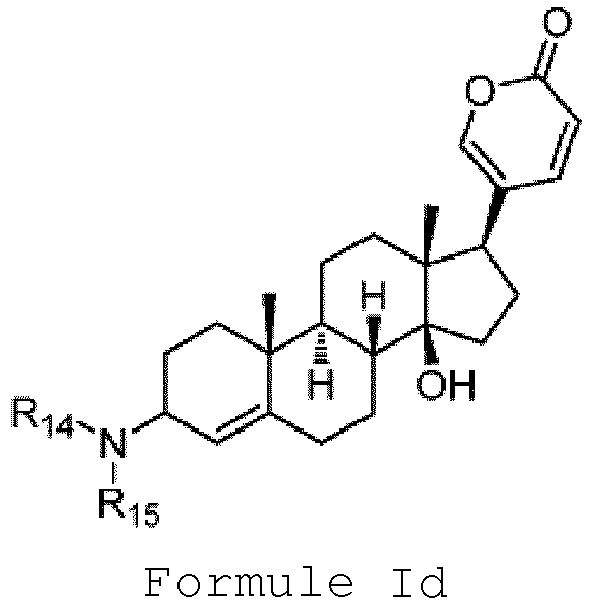 (e) les composés de formule Ie :
 (f) les composés de formule If :
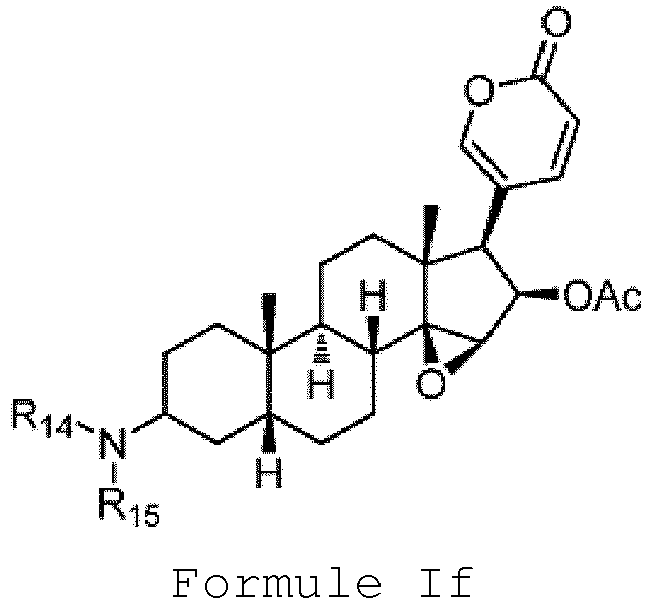 (g) les composés de formule Ig :
 (h) les composés de formule Ik :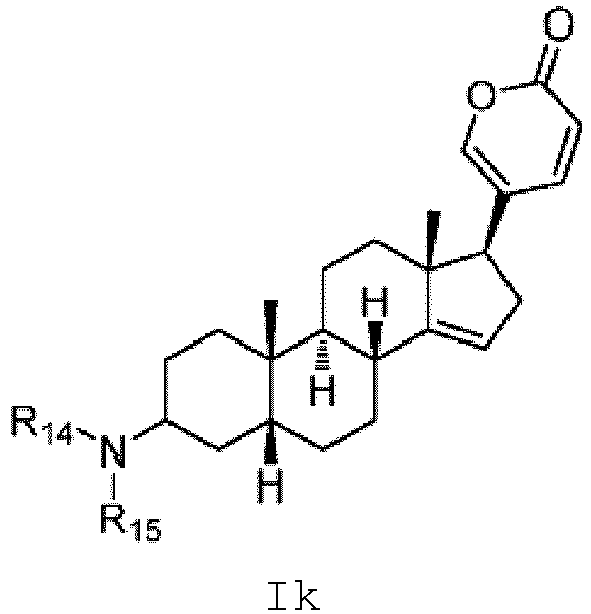
- Composé ou sel selon l'une quelconque des revendications 1 à 6, dans lequel R14 et R15 sont joints ensemble avec de quelconques atomes intervenants pour former un cycle hétérocycloalkyle à 4 à 8 chaînons éventuellement substitué, ou
dans lequel R14 et R15 forment un cycle hétéroaryle ou hétérocycloalkyle à 5 à 6 chaînons éventuellement substitué, ou
dans lequel le cycle est un groupe éventuellement substitué morpholino, pipérazino, pipéridino, pyrrolidino, imidazolyle, ou pyrazolyle. - Composé ou sel selon la revendication 1, lequel composé est choisi parmi les suivants :5-((3S,5R,8R,9S,10S,13R,14S,17R)-14-hydroxy-10,13-diméthyl-3-(pyrrolidin-1-yl)hexadécahydro-1H-cyclopenta[a]phénanthrén-17-yl)-2H-pyran-2-one,5-((3S,5R,8R,9S,10S,13R,14S,17R)-14-hydroxy-10,13-diméthyl-3-(pipérazin-1-yl)hexadécahydro-1H-cyclopenta[a]phénanthrén-17-yl)-2H-pyran-2-one,5-((3S,5R,8R,9S,10S,13R,14S,17R)-14-hydroxy-10,13-diméthyl-3-morpholinohexadécahydro-1H-cyclopenta[a]phénanthrén-17-yl)-2H-pyran-2-one,4-((3S,5R,8R,9S,10S,13R,14S,17R)-14-hydroxy-10,13-diméthyl-17-(2-oxo-2H-pyran-5-yl)hexadécahydro-1H-cyclopenta[a]phénanthrén-3-yl)pipérazin-2-one,5-((5R,8R,9S,10S,13R,14S,17R)-14-hydroxy-10,13-diméthyl-3-(pipérazin-1-yl)hexadécahydro-1H-cyclopenta[a]phénanthrén-17-yl)-2H-pyran-2-one,4-((5R,8R,9S,10S,13R,14S,17R)-14-hydroxy-10,13-diméthyl-17-(2-oxo-2H-pyran-5-yl)hexadécahydro-1H-cyclopenta[a]phénanthrén-3-yl)pipérazin-2-one,5-((5R,8R,9S,10S,13R,14S,17R)-14-hydroxy-10,13-diméthyl-3-(pyrrolidin-1-yl)hexadécahydro-1H-cyclopenta[a]phénanthrén-17-yl)-2H-pyran-2-one,5-((5R,8R,9S,10S,13R,14S,17R)-14-hydroxy-10,13-diméthyl-3-morpholinohexadécahydro-1H-cyclopenta[a]phénanthrén-17-yl)-2H-pyran-2-one,5-((3S,5R,8R,9S,10S,13R,14S,17R)-3-(4-aminopipéridin-1-yl)-14-hydroxy-10,13-diméthylhexadécahydro-1H-cyclopenta[a]phénanthrén-17-yl)-2H-pyran-2-one,5-((3S,5R,8R,9S,10S,13R,14S,17R)-14-hydroxy-3-(4-hydroxypipéridin-1-yl)-10,13-diméthylhexadécahydro-1H-cyclopenta[a]phénanthrén-17-yl)-2H-pyran-2-one,5-((3S,5R,8R,9S,10S,13R,14S,17R)-14-hydroxy-3-(3-hydroxypipéridin-1-yl)-10,13-diméthylhexadécahydro-1H-cyclopenta[a]phénanthrén-17-yl)-2H-pyran-2-one,5-((3S,5R,8R,9S,10S,13R,14S,17R)-3-(3-aminopipéridin-1-yl)-14-hydroxy-10,13-diméthylhexadécahydro-1H-cyclopenta[a]phénanthrén-17-yl)-2H-pyran-2-one,5-((3S,5R,8R,9S,10S,13R,14S,17R)-3-((S)-3-(aminométhyl)morpholino)-14-hydroxy-10,13-diméthylhexadécahydro-1H-cyclopenta[a]phénanthrén-17-yl)-2H-pyran-2-one,5-((3S,5R,8R,9S,10S,13R,14S,17R)-3-((R)-3-(aminométhyl)morpholino)-14-hydroxy-10,13-diméthylhexadécahydro-1H-cyclopenta[a]phénanthrén-17-yl)-2H-pyran-2-one,5-((3S,5R,8R,9S,10S,13R,14S,17R)-14-hydroxy-3-((R)-3-(hydroxyméthyl)morpholino-10,13-diméthylhexadécahydro-1H-cyclopenta[a]phénanthrén-17-yl)-2H-pyran-2-one,5-((3S,5R,8R,9S,10S,13R,14S,17R)-14-hydroxy-3-((S)-3-(hydroxyméthyl)morpholino-10,13-diméthylhexadécahydro-1H-cyclopenta[a]phénanthrén-17-yl)-2H-pyran-2-one,5-((3S,5R,8R,9S,10S,13R,14S,17R)-14-hydroxy-2-((R)-3-(hydroxyméthyl)morpholino-10,13-diméthylhexadécahydro-1H-cyclopenta[a]phénanthrén-17-yl)-2H-pyran-2-one,5-((3S,5R,8R,9S,10S,13R,14S,17R)-3-((S)-2-(aminométhyl)morpholino)-14-hydroxy-10,13-diméthylhexadécahydro-1H-cyclopenta[a]phénanthrén-17-yl)-2H-pyran-2-one,5-((3S,5R,8R,9S,10S,13R,14S,17R)-3-((R)-2-(aminométhyl)morpholino)-14-hydroxy-10,13-diméthylhexadécahydro-1H-cyclopenta[a]phénanthrén-17-yl)-2H-pyran-2-one,5-((3S,5R,8R,9S,10S,13R,14S,17R)-14-hydroxy-3-((S)-2-(hydroxyméthyl)morpholino)-10,13-diméthylhexadécahydro-1H-cyclopenta[a]phénanthrén-17-yl)-2H-pyran-2-one,5-((3S,5R,8R,9S,10S,13R,14S,17R)-14-hydroxy-3-((S)-2-(hydroxyméthyl)pyrrolidin-1-yl)-10,13-diméthylhexadécahydro-1H-cyclopenta[a]phénanthrén-17-yl)-2H-pyran-2-one,5-((3S,5R,8R,9S,10S,13R,14S,17R)-14-hydroxy-3-((R)-2-(hydroxyméthyl)pyrrolidin-1-yl)-10,13-diméthylhexadécahydro-1H-cyclopenta[a]phénanthrén-17-yl)-2H-pyran-2-one,5-((3S,5R,8R,9S,10S,13R,14S,17R)-3-((S)-2-(aminométhyl)pyrrolidin-1-yl)-14-hydroxy-10,13-diméthylhexadécahydro-1H-cyclopenta[a]phénanthrén-17-yl)-2H-pyran-2-one,5-((3S,5R,8R,9S,10S,13R,14S,17R)-3-((R)-2-(aminométhyl)pyrrolidin-1-yl)-14-hydroxy-10,13-diméthylhexadécahydro-1H-cyclopenta[a]phénanthrén-17-yl)-2H-pyran-2-one,5-((3S,5R,8R,9S,10S,13R,14S,17R)-14-hydroxy-3-((S)-3-hydroxypyrrolidin-1-yl)-10,13-diméthylhexadécahydro-1H-cyclopenta[a]phénanthrén-17-yl)-2H-pyran-2-one,5-((3S,5R,8R,9S,10S,13R,14S,17R)-3-((S)-3-aminopyrrolidin-1-yl)-14-hydroxy-10,13-diméthylhexadécahydro-1H-cyclopenta[a]phénanthrén-17-yl)-2H-pyran-2-one,5-((3S,5R,8R,9S,10S,13R,14S,17R)-3-((R)-3-aminopyrrolidin-1-yl)-14-hydroxy-10,13-diméthylhexadécahydro-1H-cyclopenta[a]phénanthrén-17-yl)-2H-pyran-2-one,5-((3S,5R,8R,9S,10S,13R,14S,17R)-14-hydroxy-3-((R)-3-hydroxypyrrolidin-1-yl)-10,13-diméthylhexadécahydro-1H-cyclopenta[a]phénanthrén-17-yl)-2H-pyran-2-one,5-((3S,5R,8R,9S,10S,13R,14S,17R)-3-(1,4-diazépan-1-yl)-14-hydroxy-10,13-diméthylhexadécahydro-1H-cyclopenta[a]phénanthrén-17-yl)-2H-pyran-2-one,5-((3S,5R,8R,9S,10S,13R,14S,17R)-14-hydroxy-10,13-diméthyl-3-(4-méthyl-1,4-diazépan-1-yl)hexadécahydro-1H-cyclopenta[a]phénanthrén-17-yl)-2H-pyran-2-one,5-((3S,5R,8R,9S,10S,13R,14S,17R)-14-hydroxy-10,13-diméthyl-3-(pipéridin-1-yl)hexadécahydro-1H-cyclopenta[a]phénanthrén-17-yl)-2H-pyran-2-one,5-((3S,5R,8R,9S,10S,13R,14S,17R)-14-hydroxy-3-((R)-2-(hydroxyméthyl)pipérazin-1-yl)-10,13-diméthylhexadécahydro-1H-cyclopenta[a]phénanthrén-17-yl)-2H-pyran-2-one,5-((3S,5R,8R,9S,10S,13R,14S,17R)-14-hydroxy-3-((S)-2-(hydroxyméthyl)pipérazin-1-yl)-10,13-diméthylhexadécahydro-1H-cyclopenta[a]phénanthrén-17-yl)-2H-pyran-2-one,5-((3S,5R,8R,9S,10S,13R,14S,17R)-14-hydroxy-3-(2-(hydroxyméthyl)pipérazin-1-yl)-10,13-diméthylhexadécahydro-1H-cyclopenta[a]phénanthrén-17-yl)-2H-pyran-2-one,5-((3S,5R,8R,9S,10S,13R,14S,17R)-14-hydroxy-3-((S)-3-(hydroxyméthyl)pipérazin-1-yl)-10,13-diméthylhexadécahydro-1H-cyclopenta[a]phénanthrén-17-yl)-2H-pyran-2-one,5-((3S,5R,8R,9S,10S,13R,14S,17R)-14-hydroxy-3-((R)-3-(hydroxyméthyl)pipérazin-1-yl)-10,13-diméthylhexadécahydro-1H-cyclopenta[a]phénanthrén-17-yl)-2H-pyran-2-one,5-((3S,5R,8R,9S,10S,13R,14S,17R)-14-hydroxy-3-(3-(hydroxyméthyl)pipérazin-1-yl)-10,13-diméthylhexadécahydro-1H-cyclopenta[a]phénanthrén-17-yl)-2H-pyran-2-one,1-((3S,5R,8R,9S,10S,13R,14S,17R)-14-hydroxy-10,13-diméthyl-17-(2-oxo-2H-pyran-5-yl)hexadécahydro-1H-cyclopenta[a]phénanthrén-3-yl)pipérazin-2-one,5-((3S,5R,8R,9S,10S,13R,14S,17R)-14-hydroxy-3-(1H-imidazol-1-yl)-10,13-diméthylhexadécahydro-1H-cyclopenta[a]phénanthrén-17-yl)-2H-pyran-2-one,5-((3S,5R,8R,9S,10S,13R,14S,17R)-14-hydroxy-10,13-diméthyl-3-(1H-pyrazol-1-yl)hexadécahydro-1H-cyclopenta[a]phénanthrén-17-yl)-2H-pyran-2-one,5-((3S,5R,8R,9S,10S,13R,14S,17R)-14-hydroxy-3-(4-(2-hydroxypropan-2-yl)-1H-imidazol-1-yl)-10,13-diméthylhexadécahydro-1H-cyclopenta[a]phénanthrén-17-yl)-2H-pyran-2-one,5-((3S,5R,8R,9S,10S,13R,14S,17R)-14-hydroxy-10,13-diméthyl-3-(4-méthyl-1H-imidazol-1-yl)hexadécahydro-1H-cyclopenta[a]phénanthrén-17-yl)-2H-pyran-2-one,5-((3S,5R,8R,9S,10S,13R,14S,17R)-14-hydroxy-10,13-diméthyl-3-(2-méthyl-1H-imidazol-1-yl)hexadécahydro-1H-cyclopenta[a]phénanthrén-17-yl)-2H-pyran-2-one,3-((3S,5R,8R,9S,10S,13R,14S,17R)-14-hydroxy-10,13-diméthyl-17-(2-oxo-2H-pyran-5-yl)hexadécahydro-1H-cyclopenta[a]phénanthrén-3-yl)pyrimidin-4(3H)-one,1-((3S,5R,8R,9S,10S,13R,14S,17R)-14-hydroxy-10,13-diméthyl-17-(2-oxo-2H-pyran-5-yl)hexadécahydro-1H-cyclopenta[a]phénanthrén-3-yl)pyrazin-2(1H)-one,1-((3S,5R,8R,9S,10S,13R,14S,17R)-14-hydroxy-10,13-diméthyl-17-(2-oxo-2H-pyran-5-yl)hexadécahydro-1H-cyclopenta[a]phénanthrén-3-yl)pyridin-2(1H)-one,1-((3S,5R,8R,9S,10S,13R,14S,17R)-14-hydroxy-10,13-diméthyl-17-(2-oxo-2H-pyran-5-yl)hexadécahydro-1H-cyclopenta[a]phénanthrén-3-yl)-3-(2-hydroxyéthyl)imidazolidin-2-one,1-(2-aminoéthyl)-3-((3S,5R,8R,9S,10S,13R,14S,17R)-14-hydroxy-10,13-diméthyl-17-(2-oxo-2H-pyran-5-yl)hexadécahydro-1H-cyclopenta[a]phénanthrén-3-yl)imidazolidin-2-one,1-(2-aminoéthyl)-3-((3S,5R,8R,9S,10S,13R,14S,17R)-14-hydroxy-10,13-diméthyl-17-(2-oxo-2H-pyran-5-yl)hexadécahydro-1H-cyclopenta[a]phénanthrén-3-yl)-1H-imidazol-2(3H)-one,1-((3S,5R,8R,9S,10S,13R,14S,17R)-14-hydroxy-10,13-diméthyl-17-(2-oxo-2H-pyran-5-yl)hexadécahydro-1H-cyclopenta[a]phénanthrén-3-yl)-3-(2-hydroxyéthyl)-1H-imidazol-2(3H)-one,acétate de (3S,5R,8R,9S,10S,13R,14S,16S,17R)-14-hydroxy-10,13-diméthyl-17-(2-oxo-2H-pyran-5-yl)-3-(pipéridin-1-yl)hexadécahydro-1H-cyclopenta[a]phénanthrén-16-yle,acétate de (3S,5R,8R,9S,10S,13R,14S,16S,17R)-14-hydroxy-10,13-diméthyl-17-(2-oxo-2H-pyran-5-yl)-3-(pipérazin-1-yl)hexadécahydro-1H-cyclopenta[a]phénanthrén-16-yle,acétate de (3S,5R,8R,9S,10S,13R,14S,16S,17R)-14-hydroxy-10,13-diméthyl-3-(4-méthylpipérazin-1-yl)-17-(2-oxo-2H-pyran-5-yl)hexadécahydro-1H-cyclopenta[a]phénanthrén-16-yle,acétate de (3S,5R,8R,9S,10S,13R,14S,16S,17R)-14-hydroxy-10,13-diméthyl-3-morpholino-17-(2-oxo-2H-pyran-5-yl)hexadécahydro-1H-cyclopenta[a]phénanthrén-16-yle,acétate de (5R,8R,9S,10S,13R,14S,16S,17R)-14-hydroxy-10,13-diméthyl-17-(2-oxo-2H-pyran-5-yl)-3-(pipérazin-1-yl)hexadécahydro-1H-cyclopenta[a]phénanthrén-16-yle,acétate de (5R,8R,9S,10S,13R,14S,16S,17R)-14-hydroxy-10,13-diméthyl-17-(2-oxo-2H-pyran-5-yl)-3-(pyrrolidin-1-yl)hexadécahydro-1H-cyclopenta[a]phénanthrén-16-yle,5-((3S,5S,8R,9S,10R,13R,14S,17R)-5,14-dihydroxy-10,13-diméthyl-3-(pyrrolidin-1-yl)hexadécahydro-1H-cyclopenta[a]phénanthrén-17-yl)-2H-pyran-2-one,5-((5S,8R,9S,10R,13R,14S,17R)-5,14-dihydroxy-10,13-diméthyl-3-(pipérazin-1-yl)hexadécahydro-1H-cyclopenta[a]phénanthrén-17-yl)-2H-pyran-2-one,5-((3S,5S,8R,9S,10R,13R,14S,17R)-5,14-dihydroxy-10,13-diméthyl-3-(pipérazin-1-yl)hexadécahydro-1H-cyclopenta[a]phénanthrén-17-yl)-2H-pyran-2-one,5-((3S,5S,8R,9S,10R,13R,14S,17R)-5,14-dihydroxy-10,13-diméthyl-3-(pipéridin-1-yl)hexadécahydro-1H-cyclopenta[a]phénanthrén-17-yl)-2H-pyran-2-one,5-((3S,5S,8R,9S,10R,13R,14S,17R)-5,14-dihydroxy-10,13-diméthyl-3-morpholinohexadécahydro-1H-cyclopenta[a]phénanthrén-17-yl)-2H-pyran-2-one,4-((3S,5S,8R,9S,10R,13R,14S,17R)-5,14-dihydroxy-10,13-diméthyl-17-(2-oxo-2H-pyran-5-yl)hexadécahydro-1H-cyclopenta[a]phénanthrén-3-yl)pipérazin-2-one,5-((3S,5S,8R,9S,10R,13R,14S,17R)-3-((S)-3-(aminométhyl)morpholino-5,14-dihydroxy-10,13-diméthylhexadécahydro-1H-cyclopenta[a]phénanthrén-17-yl)-2H-pyran-2-one,5-((3S,5S,8R,9S,10R,13R,14S,17R)-3-((R)-3-(aminométhyl)morpholino-5,14-dihydroxy-10,13-diméthylhexadécahydro-1H-cyclopenta[a]phénanthrén-17-yl)-2H-pyran-2-one,5-((3S,5S,8R,9S,10R,13R,14S,17R)-5,14-dihydroxy-3-((R)-3-(hydroxyméthyl)morpholino)-10,13-diméthylhexadécahydro-1H-cyclopenta[a]phénanthrén-17-yl)-2H-pyran-2-one,5-((3S,5S,8R,9S,10R,13R,14S,17R)-5,14-dihydroxy-3-((S)-3-(hydroxyméthyl)morpholino)-10,13-diméthylhexadécahydro-1H-cyclopenta[a]phénanthrén-17-yl)-2H-pyran-2-one,5-((3S,5S,8R,9S,10R,13R,14S,17R)-5,14-dihydroxy-3-((R)-2-(hydroxyméthyl)morpholino)-10,13-diméthylhexadécahydro-1H-cyclopenta[a]phénanthrén-17-yl)-2H-pyran-2-one,5-((3S,5S,8R,9S,10R,13R,14S,17R)-3-((S)-2-(aminométhyl)morpholino)-5,14-dihydroxy-10,13-diméthylhexadécahydro-1H-cyclopenta[a]phénanthrén-17-yl)-2H-pyran-2-one,5-((3S,5S,8R,9S,10R,13R,14S,17R)-3-((R)-2-(aminométhyl)morpholino)-5,14-dihydroxy-10,13-diméthylhexadécahydro-1H-cyclopenta[a]phénanthrén-17-yl)-2H-pyran-2-one,5-((3S,5S,8R,9S,10R,13R,14S,17R)-5,14-dihydroxy-3-((S)-2-(hydroxyméthyl)morpholino)-10,13-diméthylhexadécahydro-1H-cyclopenta[a]phénanthrén-17-yl)-2H-pyran-2-one,5-((3S,5S,8R,9S,10R,13R,14S,17R)-5,14-dihydroxy-3-((S)-2-(hydroxyméthyl)pyrrolidin-1-yl)-10,13-diméthylhexadécahydro-1H-cyclopenta[a]phénanthrén-17-yl)-2H-pyran-2-one,5-((3S,5S,8R,9S,10R,13R,14S,17R)-5,14-dihydroxy-3-((R)-2-(hydroxyméthyl)pyrrolidin-1-yl)-10,13-diméthylhexadécahydro-1H-cyclopenta[a]phénanthrén-17-yl)-2H-pyran-2-one,5-((3S,5S,8R,9S,10R,13R,14S,17R)-3-((S)-2-(aminométhyl)pyrrolidin-1-yl)-5,14-dihydroxy-10,13-diméthylhexadécahydro-1H-cyclopenta[a]phénanthrén-17-yl)-2H-pyran-2-one,5-((3S,5S,8R,9S,10R,13R,14S,17R)-3-((R)-2-(aminométhyl)pyrrolidin-1-yl)-5,14-dihydroxy-10,13-diméthylhexadécahydro-1H-cyclopenta[a]phénanthrén-17-yl)-2H-pyran-2-one,5-((3S,5S,8R,9S,10R,13R,14S,17R)-5,14-dihydroxy-3-((S)-3-hydroxypyrrolidin-1-yl)-10,13-diméthylhexadécahydro-1H-cyclopenta[a]phénanthrén-17-yl)-2H-pyran-2-one,5-((3S,5S,8R,9S,10R,13R,14S,17R)-3-((S)-3-aminopyrrolidin-1-yl)-5,14-dihydroxy-10,13-diméthylhexadécahydro-1H-cyclopenta[a]phénanthrén-17-yl)-2H-pyran-2-one,5-((3S,5S,8R,9S,10R,13R,14S,17R)-3-((R)-3-aminopyrrolidin-1-yl)-5,14-dihydroxy-10,13-diméthylhexadécahydro-1H-cyclopenta[a]phénanthrén-17-yl)-2H-pyran-2-one,5-((3S,5S,8R,9S,10R,13R,14S,17R)-5,14-dihydroxy-3-((R)-3-hydroxypyrrolidin-1-yl)-10,13-diméthylhexadécahydro-1H-cyclopenta[a]phénanthrén-17-yl)-2H-pyran-2-one,5-((3S,5S,8R,9S,10R,13R,14S,17R)-3-(1,4-diazépan-1-yl)-5,14-dihydroxy-10,13-diméthylhexadécahydro-1H-cyclopenta[a]phénanthrén-17-yl)-2H-pyran-2-one,5-((3S,5S,8R,9S,10R,13R,14S,17R)-5,14-dihydroxy-10,13-diméthyl-3-(4-méthyl-1,4-diazépan-1-yl)hexadécahydro-1H-cyclopenta[a]phénanthrén-17-yl)-2H-pyran-2-one,5-((3S,5S,8R,9S,10R,13R,14S,17R)-5,14-dihydroxy-3-((R)-2-(hydroxyméthyl)pipérazin-1-yl)-10,13-diméthylhexadécahydro-1H-cyclopenta[a]phénanthrén-17-yl)-2H-pyran-2-one,5-((3S,5S,8R,9S,10R,13R,14S,17R)-5,14-dihydroxy-3-((S)-2-(hydroxyméthyl)pipérazin-1-yl)-10,13-diméthylhexadécahydro-1H-cyclopenta[a]phénanthrén-17-yl)-2H-pyran-2-one,5-((3S,5S,8R,9S,10R,13R,14S,17R)-5,14-dihydroxy-3-(2-(hydroxyméthyl)pipérazin-1-yl)-10,13-diméthylhexadécahydro-1H-cyclopenta[a]phénanthrén-17-yl)-2H-pyran-2-one,5-((3S,5S,8R,9S,10R,13R,14S,17R)-5,14-dihydroxy-3-((S)-3-(hydroxyméthyl)pipérazin-1-yl)-10,13-diméthylhexadécahydro-1H-cyclopenta[a]phénanthrén-17-yl)-2H-pyran-2-one,5-((3S,5S,8R,9S,10R,13R,14S,17R)-5,14-dihydroxy-3-((R)-3-(hydroxyméthyl)pipérazin-1-yl)-10,13-diméthylhexadécahydro-1H-cyclopenta[a]phénanthrén-17-yl)-2H-pyran-2-one,5-((3S,5S,8R,9S,10R,13R,14S,17R)-5,14-dihydroxy-3-(3-(hydroxyméthyl)pipérazin-1-yl)-10,13-diméthylhexadécahydro-1H-cyclopenta[a]phénanthrén-17-yl)-2H-pyran-2-one,1-((3S,5S,8R,9S,10R,13R,14S,17R)-5,14-dihydroxy-10,13-diméthyl-17-(2-oxo-2H-pyran-5-yl)hexadécahydro-1H-cyclopenta[a]phénanthrén-3-yl)-pipérazin-2-one,5-((3S,5S,8R,9S,10R,13R,14S,17R)-5,14-dihydroxy-3-(1H-imidazol-1-yl)-10,13-diméthylhexadécahydro-1H-cyclopenta[a]phénanthrén-17-yl)-2H-pyran-2-one,5-((3S,5S,8R,9S,10R,13R,14S,17R)-5,14-dihydroxy-3-(4-(2-hydroxypropan-2-yl)-1H-imidazol-1-yl)-10,13-diméthylhexadécahydro-1H-cyclopenta[a]phénanthrén-17-yl)-2H-pyran-2-one,5-((3S,5S,8R,9S,10R,13R,14S,17R)-5,14-dihydroxy-10,13-diméthyl-3-(4-méthyl-1H-imidazol-1-yl)hexadécahydro-1H-cyclopenta[a]phénanthrén-17-yl)-2H-pyran-2-one,5-((3S,5S,8R,9S,10R,13R,14S,17R)-5,14-dihydroxy-10,13-diméthyl-3-(2-méthyl-1H-imidazol-1-yl)hexadécahydro-1H-cyclopenta[a]phénanthrén-17-yl)-2H-pyran-2-one,3-((3S,5S,8R,9S,10R,13R,14S,17R)-5,14-dihydroxy-10,13-diméthyl-17-(2-oxo-2H-pyran-5-yl)hexadécahydro-1H-cyclopenta[a]phénanthrén-3-yl)pyrimidine-4(3H)-one,5-((3S,8R,9S,10R,13R,14S,17R)-14-hydroxy-10,13-diméthyl-3-(pipéridin-1-yl)-2,3,6,7,8,9,10,11,12,13,14,15,16,17-tétradécahydro-1H-cyclopenta[a]phénanthrén-17-yl)-2H-pyran-2-one,5-((3S,8R,9S,10R,13R,14S,17R)-14-hydroxy-10,13-diméthyl-3-(pipérazin-1-yl)-2,3,6,7,8,9,10,11,12,13,14,15,16,17-tétradécahydro-1H-cyclopenta[a]phénanthrén-17-yl)-2H-pyran-2-one,5-((3S,8R,9S,10R,13R,14S,17R)-14-hydroxy-10,13-diméthyl-3-(4-méthylpipérazin-1-yl)-2,3,6,7,8,9,10,11,12,13,14,15,16,17-tétradécahydro-1H-cyclopenta[a]phénanthrén-17-yl)-2H-pyran-2-one,5-((8R,9S,10R,13R,14S,17R)-14-hydroxy-10,13-diméthyl-3-morpholino-2,3,6,7,8,9,10,11,12,13,14,15,16,17-tétradécahydro-1H-cyclopenta[a]phénanthrén-17-yl)-2H-pyran-2-one,5-((3S,8R,9S,10R,13R,14S,17R)-14-hydroxy-10,13-diméthyl-3-morpholino-2,3,6,7,8,9,10,11,12,13,14,15,16,17-tétradécahydro-1H-cyclopenta[a]phénanthrén-17-yl)-2H-pyran-2-one,5-((8R,9S,10R,13R,14S,17R)-14-hydroxy-10,13-diméthyl-3-(pipérazin-1-yl)-2,3,6,7,8,9,10,11,12,13,14,15,16,17-tétradécahydro-1H-cyclopenta[a]phénanthrén-17-yl)-2H-pyran-2-one,5-((8R,9S,10R,13R,14S,17R)-14-hydroxy-10,13-diméthyl-3-(pyrrolidin-1-yl)-2,3,6,7,8,9,10,11,12,13,14,15,16,17-tétradécahydro-1H-cyclopenta[a]phénanthrén-17-yl)-2H-pyran-2-one,5-((1R,2aR,3aS,3bR,5aR,7S,9aS,9bS,11aR)-9a,11a-diméthyl-7-(pipéridin-1-yl)hexadécahydronaphto[1',2':6,7]indéno[1,7a-b]oxirén-1-yl)-2H-pyran-2-one,5-((1R,2aR,3aS,3bR,5aR,7S,9aS,9bS,11aR)-9a,11a-diméthyl-7-(pipérazin-1-yl)hexadécahydronaphto[1',2':6,7]indéno[1,7a-b]oxirén-1-yl)-2H-pyran-2-one,5-((1R,2aR,3aS,3bR,5aR,7S,9aS,9bS,11aR)-9a,11a-diméthyl-7-(4-méthylpipérazin-1-yl)hexadécahydronaphto[1',2':6,7]indéno[1,7a-b]oxirén-1-yl)-2H-pyran-2-one,5-((1R,2aR,3aS,3bR,5aR,7S,9aS,9bS,11aR)-9a,11a-diméthyl-7-morpholinohexadécahydronaphto[1',2':6,7]indéno[1,7a-b]oxirén-1-yl)-2H-pyran-2-one,5-((1R,2aR,3aS,3bR,5aR,9aS,9bS,11aR)-9a,11a-diméthyl-7-(pipérazin-1-yl)hexadécahydronaphto[1',2':6,7]indéno[1,7a-b]oxirén-1-yl)-2H-pyran-2-one,5-((1R,2aR,3aS,3bR,5aR,9aS,9bS,11aR)-9a,11a-diméthyl-7-(pyrrolidin-1-yl)hexadécahydronaphto[1',2':6,7]indéno[1,7a-b]oxirén-1-yl)-2H-pyran-2-one,acétate de (1R,2R,2aR,3aS,3bR,5aR,7S,9aS,9bS,11aR)-9a,11a-diméthyl-1-(2-oxo-2H-pyran-5-yl)-7-(pipéridin-1-yl)hexadécahydronaphto[1',2':6,7]indéno[1,7a-b]oxirén-2-yle,acétate de (1R,2R,2aR,3aS,3bR,5aR,7S,9aS,9bS,11aR)-9a,11a-diméthyl-1-(2-oxo-2H-pyran-5-yl)-7-(pipérazin-1-yl)hexadécahydronaphto[1',2':6,7]indéno[1,7a-b]oxirén-2-yle,acétate de (1R,2R,2aR,3aS,3bR,5aR,7S,9aS,9bS,11aR)-9a,11a-diméthyl-7-(4-méthylpipérazin-1-yl)-1-(2-oxo-2H-pyran-5-yl)hexadécahydronaphto[1',2':6,7]indéno[1,7a-b]oxirén-2-yle,acétate de (1R,2R,2aR,3aS,3bR,5aR,7S,9aS,9bS,11aR)-9a,11a-diméthyl-7-morpholino-1-(2-oxo-2H-pyran-5-yl)hexadécahydronaphto[1',2':6,7]indéno[1,7a-b]oxirén-2-yle,acétate de (1R,2R,2aR,3aS,3bR,5aR,9aS,9bS,11aR)-9a,11a-diméthyl-1-(2-oxo-2H-pyran-5-yl)-7-(pipérazin-1-yl)hexadécahydronaphto[1',2':6,7]indéno[1,7a-b]oxirén-2-yle,acétate de (1R,2R,2aR,3aS,3bR,5aR,9aS,9bS,11aR)-9a,11a-diméthyl-1-(2-oxo-2H-pyran-5-yl)-7-(pyrrolidin-1-yl)hexadécahydronaphto[1',2':6,7]indéno[1,7a-b]oxirén-2-yle,acétate de (1R,2R,2aR,3aS,3bR,5aS,7S,9aR,9bS,11aR)-5a-hydroxy-9a,11a-diméthyl-1-(2-oxo-2H-pyran-5-yl)-7-(pipéridin-1-yl)hexadécahydronaphto[1',2':6,7]indéno[1,7a-b]oxirén-2-yle,acétate de (1R,2R,2aR,3aS,3bR,5aS,7S,9aR,9bS,11aR)-5a-hydroxy-9a,11a-diméthyl-1-(2-oxo-2H-pyran-5-yl)-7-(pipérazin-1-yl)hexadécahydronaphto[1',2':6,7]indéno[1,7a-b]oxirén-2-yle,acétate de (1R,2R,2aR,3aS,3bR,5aS,7S,9aR,9bS,11aR)-5a-hydroxy-9a,11a-diméthyl-7-(4-méthylpipérazin-1-yl)-1-(2-oxo-2H-pyran-5-yl)hexadécahydronaphto[1',2':6,7]indéno[1,7a-b]oxirén-2-yle,acétate de (1R,2R,2aR,3aS,3bR,5aS,7S,9aR,9bS,11aR)-5a-hydroxy-9a,11a-diméthyl-7-morpholino-1-(2-oxo-2H-pyran-5-yl)hexadécahydronaphto[1',2':6,7]indéno[1,7a-b]oxirén-2-yle,acétate de (1R,2R,2aR,3aS,3bR,5aS,9aR,9bS,11aR)-5a-hydroxy-9a,11a-diméthyl-1-(2-oxo-2H-pyran-5-yl)-7-(pipérazin-1-yl)hexadécahydronaphto[1',2':6,7]indéno[1,7a-b]oxirén-2-yle,acétate de (1R,2R,2aR,3aS,3bR,5aS,9aR,9bS,11aR)-5a-hydroxy-9a,11a-diméthyl-1-(2-oxo-2H-pyran-5-yl)-7-(pyrrolidin-1-yl)hexadécahydronaphto[1',2':6,7]indéno[1,7a-b]oxirén-2-yle,5-((5R,8R,9S,10S,13R,17S)-10,13-diméthyl-3-morpholino-2,3,4,5,6,7,8,9,10,11,12,13,16,17-tétradécahydro-1H-cyclopenta[a]phénanthrén-17-yl)-2H-pyran-2-one,5-((5R,8R,9S,10S,13R,17S)-10,13-diméthyl-3-(pipéridin-1-yl)-2,3,4,5,6,7,8,9,10,11,12,13,16,17-tétradécahydro-1H-cyclopenta[a]phénanthrén-17-yl)-2H-pyran-2-one,5-((5R,8R,9S,10S,13R,17S)-10,13-diméthyl-3-(pyrrolidin-1-yl)-2,3,4,5,6,7,8,9,10,11,12,13,16,17-tétradécahydro-1H-cyclopenta[a]phénanthrén-17-yl)-2H-pyran-2-one,5-((3S,5R,8R,9S,10S,13R,17S)-10,13-diméthyl-3-(pipérazin-1-yl)-2,3,4,5,6,7,8,9,10,11,12,13,16,17-tétradécahydro-1H-cyclopenta[a]phénanthrén-17-yl)-2H-pyran-2-one,5-((5R,8R,9S,10S,13R,17S)-10,13-diméthyl-3-(4-méthyl-1,4-diazépan-1-yl)-2,3,4,5,6,7,8,9,10,11,12,13,16,17-tétradécahydro-1H-cyclopenta[a]phénanthrén-17-yl)-2H-pyran-2-one,5-((5R,8R,9S,10S,13R,17S)-3-(1,4-diazépan-1-yl)-10,13-diméthyl-2,3,4,5,6,7,8,9,10,11,12,13,16,17-tétradécahydro-1H-cyclopenta[a]phénanthrén-17-yl)-2H-pyran-2-one,5-((5R,8R,9S,10S,13R,17S)-10,13-diméthyl-3-(pipérazin-1-yl)-2,3,4,5,6,7,8,9,10,11,12,13,16,17-tétradécahydro-1H-cyclopenta[a]phénanthrén-17-yl)-2H-pyran-2-one,5-((3S,5R,8R,9S,10S,13R,17S)-10,13-diméthyl-3-(4-méthylpipérazin-1-yl)-2,3,4,5,6,7,8,9,10,11,12,13,16,17-tétradécahydro-1H-cyclopenta[a]phénanthrén-17-yl)-2H-pyran-2-one,et l'un quelconque de leurs sels pharmaceutiquement acceptables.
- Composition pharmaceutique comprenant un véhicule pharmaceutiquement acceptable et un composé ou sel de l'une quelconque des revendications 1 à 8.
- Composé ou sel selon l'une quelconque des revendications 1 à 8, pour une utilisation dans le traitement d'un cancer.
Priority Applications (1)
| Application Number | Priority Date | Filing Date | Title |
|---|---|---|---|
| EP18180311.5A EP3453713B1 (fr) | 2012-04-29 | 2013-04-29 | Dérivés bufadiènolides substitués en position 3 par un groupement amine pour le traitement du cancer |
Applications Claiming Priority (2)
| Application Number | Priority Date | Filing Date | Title |
|---|---|---|---|
| US201261639930P | 2012-04-29 | 2012-04-29 | |
| PCT/US2013/038705 WO2013165924A1 (fr) | 2012-04-29 | 2013-04-29 | Certaines entités chimiques, compositions et procédés |
Related Child Applications (2)
| Application Number | Title | Priority Date | Filing Date |
|---|---|---|---|
| EP18180311.5A Division-Into EP3453713B1 (fr) | 2012-04-29 | 2013-04-29 | Dérivés bufadiènolides substitués en position 3 par un groupement amine pour le traitement du cancer |
| EP18180311.5A Division EP3453713B1 (fr) | 2012-04-29 | 2013-04-29 | Dérivés bufadiènolides substitués en position 3 par un groupement amine pour le traitement du cancer |
Publications (3)
| Publication Number | Publication Date |
|---|---|
| EP2852285A1 EP2852285A1 (fr) | 2015-04-01 |
| EP2852285A4 EP2852285A4 (fr) | 2016-03-23 |
| EP2852285B1 true EP2852285B1 (fr) | 2018-08-08 |
Family
ID=49514783
Family Applications (2)
| Application Number | Title | Priority Date | Filing Date |
|---|---|---|---|
| EP13784674.7A Active EP2852285B1 (fr) | 2012-04-29 | 2013-04-29 | Dérivés bufadiènolides substitués en position 3 par un groupement amine hétérocyclique pour le traitement de cancer |
| EP18180311.5A Active EP3453713B1 (fr) | 2012-04-29 | 2013-04-29 | Dérivés bufadiènolides substitués en position 3 par un groupement amine pour le traitement du cancer |
Family Applications After (1)
| Application Number | Title | Priority Date | Filing Date |
|---|---|---|---|
| EP18180311.5A Active EP3453713B1 (fr) | 2012-04-29 | 2013-04-29 | Dérivés bufadiènolides substitués en position 3 par un groupement amine pour le traitement du cancer |
Country Status (4)
| Country | Link |
|---|---|
| US (5) | US9340570B2 (fr) |
| EP (2) | EP2852285B1 (fr) |
| CN (2) | CN104427873B (fr) |
| WO (1) | WO2013165924A1 (fr) |
Families Citing this family (8)
| Publication number | Priority date | Publication date | Assignee | Title |
|---|---|---|---|---|
| CN103980337B (zh) | 2010-01-15 | 2016-08-24 | 苏州润新生物科技有限公司 | 蟾蜍灵衍生物、其药物组合物及用途 |
| US9018197B2 (en) | 2010-08-28 | 2015-04-28 | Suzhou Neupharma Co. Ltd. | Tetradecahydro-1H-cyclopenta[a]phenanthrene compounds, compositions, and related methods of use |
| CN103619865B (zh) | 2011-02-02 | 2016-10-12 | 苏州润新生物科技有限公司 | 某些化学个体、组合物及方法 |
| CN104427873B (zh) | 2012-04-29 | 2018-11-06 | 润新生物公司 | 某些化学个体、组合物及方法 |
| CN109988218B (zh) * | 2017-12-29 | 2022-11-25 | 中国科学院上海药物研究所 | 一种菝葜皂苷元衍生物及其制备方法和应用 |
| US12337004B2 (en) | 2019-04-27 | 2025-06-24 | Health Research, Inc. | Coumarin-modified androgens for the treatment of prostate cancer |
| US12030912B2 (en) * | 2020-05-15 | 2024-07-09 | Brigham Young University | Cationic steroidal antimicrobial compounds with urethane linkages |
| WO2023185673A1 (fr) * | 2022-03-31 | 2023-10-05 | 成都赛璟生物医药科技有限公司 | Inhibiteurs de cdk8, leur procédé de préparation et leur utilisation |
Family Cites Families (59)
| Publication number | Priority date | Publication date | Assignee | Title |
|---|---|---|---|---|
| DE2013032C3 (de) * | 1970-03-19 | 1978-12-07 | Hoechst Ag, 6000 Frankfurt | 3-Amino-cardenolide, Verfahren zu ihrer Herstellung sowie deren Verwendung bei der Bekämpfung von Herz- und Kreislauf-Krankheiten |
| US3901882A (en) * | 1970-07-24 | 1975-08-26 | Hoffmann La Roche | 3-amino cardenolides and bufadienolides, derivatives and salts thereof |
| CH559219A5 (en) | 1970-07-24 | 1975-02-28 | Hoffmann La Roche | Cardenolides and bufadienolides from oxime mixtures and 3-substitution - reaction - having inotropic activity with short latent time and short |
| US3981982A (en) | 1974-09-11 | 1976-09-21 | Abbott Laboratories | Radioimmunoassay for determining the digoxin content of a sample |
| US4064227A (en) | 1975-03-17 | 1977-12-20 | Mallinckrodt, Inc. | Radioimmunoassay method for the determination of cardiotonic glycosides |
| DE2526689C2 (de) | 1975-06-14 | 1983-08-11 | Hoechst Ag, 6230 Frankfurt | Verfahren zur Herstellung von 2,5-Dioxo-1,2-Oxa-phospholanen |
| US4082747A (en) | 1975-10-01 | 1978-04-04 | Mallinckrodt, Inc. | Chemical process |
| US4115539A (en) | 1976-05-17 | 1978-09-19 | Union Carbide Corporation | Analytical or clinical derivatives, tagged derivatives and methods of analysis using such derivatives |
| US4273866A (en) | 1979-02-05 | 1981-06-16 | Abbott Laboratories | Ligand analog-irreversible enzyme inhibitor conjugates and methods for use |
| US5604091A (en) | 1984-03-01 | 1997-02-18 | Microgenics Corporation | Methods for protein binding enzyme complementation |
| EP0218010A3 (fr) | 1985-07-10 | 1988-01-07 | Abbott Laboratories | Méthode de détection de ligands et carboxyfluorescéines substituées comme traceurs pour sa mise en oeuvre |
| US4822747A (en) | 1986-12-09 | 1989-04-18 | Miles Inc. | Polyacrylamide gel particles having hapten moieties bound thereto as immunoassay reagent |
| IL85921A0 (en) | 1987-06-10 | 1988-09-30 | Miles Inc | Method,test system and test kit for magnetic separation of labeled reagent in an immunometric binding assay |
| IL85899A0 (en) | 1987-06-10 | 1988-09-30 | Miles Inc | Method,test device and test kit for separating labeled reagent in an immunometric binding assay |
| US5045480A (en) | 1989-02-09 | 1991-09-03 | Miles Inc. | Gel particles having hapten moieties bound thereto as immunoassay reagent |
| US6060598A (en) | 1990-05-15 | 2000-05-09 | Hyperion, Inc. | Fluorescence immunoassays using fluorescent dyes free of aggregation and serum binding |
| EP0647133A4 (fr) | 1992-06-12 | 1997-10-29 | Affymax Tech Nv | Compositions et procedes destines a ameliorer la liberation et l'acheminement de medicaments. |
| US5922703A (en) | 1993-09-24 | 1999-07-13 | The Procter & Gamble Company | Urethane-containing aminosteroid compounds |
| US5503982A (en) | 1993-09-30 | 1996-04-02 | Research Corporation Technologies, Inc. | Detection of an acute myocardial infarction in a patient |
| ES2293638T3 (es) | 1994-03-25 | 2008-03-16 | Isotechnika, Inc. | Mejora de la eficacia de farmacos por deuteracion. |
| US6334997B1 (en) | 1994-03-25 | 2002-01-01 | Isotechnika, Inc. | Method of using deuterated calcium channel blockers |
| GB9624482D0 (en) | 1995-12-18 | 1997-01-15 | Zeneca Phaema S A | Chemical compounds |
| US5891855A (en) * | 1996-02-12 | 1999-04-06 | The Scripps Research Institute | Inhibitors of leaderless protein export |
| DE69720965T2 (de) | 1996-02-13 | 2004-02-05 | Astrazeneca Ab | Chinazolinderivate und deren verwendung als vegf hemmer |
| NZ331191A (en) | 1996-03-05 | 2000-03-27 | Zeneca Ltd | 4-anilinoquinazoline derivatives and pharmaceutical compositions thereof |
| GB9718972D0 (en) | 1996-09-25 | 1997-11-12 | Zeneca Ltd | Chemical compounds |
| GB9714249D0 (en) | 1997-07-08 | 1997-09-10 | Angiogene Pharm Ltd | Vascular damaging agents |
| GB9900334D0 (en) | 1999-01-07 | 1999-02-24 | Angiogene Pharm Ltd | Tricylic vascular damaging agents |
| GB9900752D0 (en) | 1999-01-15 | 1999-03-03 | Angiogene Pharm Ltd | Benzimidazole vascular damaging agents |
| PT1154774E (pt) | 1999-02-10 | 2005-10-31 | Astrazeneca Ab | Derivados de quinazolina como inibidores de angiogenese |
| US6579857B1 (en) * | 1999-06-11 | 2003-06-17 | Evanston Northwestern Healthcare Research Institute | Combination cancer therapy comprising adenosine and deaminase enzyme inhibitors |
| EP1278763B1 (fr) | 2000-04-28 | 2007-02-14 | Inflazyme Pharmaceuticals, Ltd. | Steroides de 3-nitrogene-6,7-dioxygene et utilisations |
| AU2001258628A1 (en) | 2000-05-31 | 2001-12-11 | Astrazeneca Ab | Indole derivatives with vascular damaging activity |
| UA73993C2 (uk) | 2000-06-06 | 2005-10-17 | Астразенека Аб | Хіназолінові похідні для лікування пухлин та фармацевтична композиція |
| MXPA02012903A (es) | 2000-07-07 | 2004-07-30 | Angiogene Pharm Ltd | Derivados de colquinol como inhibidores de angiogenesis. |
| MXPA02012905A (es) | 2000-07-07 | 2004-07-30 | Angiogene Pharm Ltd | Derivados de colquinol como agentes de dano vascular.. |
| AU2001282088A1 (en) * | 2000-08-17 | 2002-02-25 | Terness, Peter | Immunosuppressive, antiinflammatory and analgetic compounds |
| AU2002217841A1 (en) | 2000-11-06 | 2002-05-15 | Trustees Of Boston University | Neuroactive steroid derivatives and methods of use |
| US20040082521A1 (en) * | 2002-03-29 | 2004-04-29 | Azaya Therapeutics Inc. | Novel formulations of digitalis glycosides for treating cell-proliferative and other diseases |
| CA2418458A1 (fr) | 2003-02-06 | 2004-08-06 | Neokimia Inc. | Synthese totale de 14 beta-fluorosteroides via la reaction de diels-alder transannulaire |
| US8507411B2 (en) * | 2004-06-24 | 2013-08-13 | Wisconsin Alumni Research Foundation | Neoglycorandomization and digitoxin analogs |
| US7754874B2 (en) | 2004-06-24 | 2010-07-13 | Wisconsin Alumni Research Foundation | Neoglycorandomization and digitoxin analogs |
| US20060009506A1 (en) | 2004-07-09 | 2006-01-12 | Odyssey Thera, Inc. | Drugs for the treatment of neoplastic disorders |
| US20080027010A1 (en) | 2004-09-02 | 2008-01-31 | Bionaut Pharmaceuticals, Inc. | Treatment of refractory cancers using Na+/K+-ATPase inhibitors |
| US20110076278A1 (en) | 2005-08-02 | 2011-03-31 | Mehran Khodadoust | Modulators of Hypoxia Inducible Factor-1 and Related Uses for the Treatment of Ocular Disorders |
| US20090023666A1 (en) * | 2006-01-09 | 2009-01-22 | BTG plc | Modulators of Hypoxia Inducible Factor-1 and Related Uses |
| CN100569793C (zh) | 2006-02-08 | 2009-12-16 | 赵军 | 一类蟾蜍甾烯化合物及其在药物制备中的应用 |
| US8114636B2 (en) | 2006-02-10 | 2012-02-14 | Life Technologies Corporation | Labeling and detection of nucleic acids |
| EP2048621B1 (fr) * | 2007-10-09 | 2010-05-26 | Agfa HealthCare NV | Procédé et appareil pour rendu de volume d'ensembles de données médicales |
| CN101177445B (zh) | 2006-11-08 | 2012-07-04 | 山东绿叶制药有限公司 | 蟾蜍二烯内酯类化合物及其制备方法与应用 |
| US8361973B2 (en) * | 2008-08-07 | 2013-01-29 | Centrose, Llc | Glycoside compounds and pharmaceutical compositions thereof |
| CZ303037B6 (cs) | 2009-05-28 | 2012-03-07 | Ústav organické chemie a biochemie, Akademie ved CR, v. v. i. | Deriváty pregnanolonu substituované v poloze 3alfa, zpusob jejich výroby a jejich použití |
| JP2013504585A (ja) | 2009-09-09 | 2013-02-07 | セントローズ, エルエルシー | 細胞外標的化薬物複合体 |
| CN103980337B (zh) | 2010-01-15 | 2016-08-24 | 苏州润新生物科技有限公司 | 蟾蜍灵衍生物、其药物组合物及用途 |
| US9018197B2 (en) | 2010-08-28 | 2015-04-28 | Suzhou Neupharma Co. Ltd. | Tetradecahydro-1H-cyclopenta[a]phenanthrene compounds, compositions, and related methods of use |
| CN103619865B (zh) | 2011-02-02 | 2016-10-12 | 苏州润新生物科技有限公司 | 某些化学个体、组合物及方法 |
| US20130005696A1 (en) | 2011-06-30 | 2013-01-03 | Shanghai Institute Of Materia Medica, Chinese Academy Of Sciences | Bufadienolide derivatives, preparing process thereof, composition comprising the same and the use thereof |
| CN102532235B (zh) | 2011-06-30 | 2014-06-04 | 中国科学院上海药物研究所 | 蟾毒配基衍生物及其制备方法、包含该衍生物的组合物、及其用途 |
| CN104427873B (zh) | 2012-04-29 | 2018-11-06 | 润新生物公司 | 某些化学个体、组合物及方法 |
-
2013
- 2013-04-29 CN CN201380034259.1A patent/CN104427873B/zh active Active
- 2013-04-29 EP EP13784674.7A patent/EP2852285B1/fr active Active
- 2013-04-29 US US13/873,059 patent/US9340570B2/en active Active
- 2013-04-29 US US14/397,845 patent/US9676813B2/en active Active
- 2013-04-29 EP EP18180311.5A patent/EP3453713B1/fr active Active
- 2013-04-29 CN CN201811182826.9A patent/CN109354598A/zh active Pending
- 2013-04-29 WO PCT/US2013/038705 patent/WO2013165924A1/fr not_active Ceased
-
2016
- 2016-02-19 US US15/048,703 patent/US10065986B2/en active Active
-
2017
- 2017-05-04 US US15/586,710 patent/US10487108B2/en active Active
-
2019
- 2019-10-08 US US16/595,749 patent/US11325940B2/en active Active
Non-Patent Citations (1)
| Title |
|---|
| None * |
Also Published As
| Publication number | Publication date |
|---|---|
| US20200102344A1 (en) | 2020-04-02 |
| US20160039865A1 (en) | 2016-02-11 |
| US9676813B2 (en) | 2017-06-13 |
| US20160272671A1 (en) | 2016-09-22 |
| WO2013165924A1 (fr) | 2013-11-07 |
| US10065986B2 (en) | 2018-09-04 |
| US11325940B2 (en) | 2022-05-10 |
| CN104427873B (zh) | 2018-11-06 |
| EP2852285A1 (fr) | 2015-04-01 |
| US20170362271A1 (en) | 2017-12-21 |
| US20130345186A1 (en) | 2013-12-26 |
| EP3453713B1 (fr) | 2021-09-08 |
| EP3453713A1 (fr) | 2019-03-13 |
| US10487108B2 (en) | 2019-11-26 |
| EP2852285A4 (fr) | 2016-03-23 |
| CN104427873A (zh) | 2015-03-18 |
| US9340570B2 (en) | 2016-05-17 |
| CN109354598A (zh) | 2019-02-19 |
Similar Documents
| Publication | Publication Date | Title |
|---|---|---|
| EP3296313B1 (fr) | Certaines entités chimiques, compositions et procédés | |
| US11325940B2 (en) | Certain chemical entities, compositions, and methods | |
| US10766920B2 (en) | Certain chemical entities, compositions, and methods | |
| CN102656179B (zh) | 蟾蜍灵衍生物、其药物组合物及用途 | |
| EP2753174A1 (fr) | Entités chimiques particulières, compositions et méthodes | |
| US20130040945A1 (en) | Certain chemical entities, compositions, and methods |
Legal Events
| Date | Code | Title | Description |
|---|---|---|---|
| PUAI | Public reference made under article 153(3) epc to a published international application that has entered the european phase |
Free format text: ORIGINAL CODE: 0009012 |
|
| 17P | Request for examination filed |
Effective date: 20141118 |
|
| AK | Designated contracting states |
Kind code of ref document: A1 Designated state(s): AL AT BE BG CH CY CZ DE DK EE ES FI FR GB GR HR HU IE IS IT LI LT LU LV MC MK MT NL NO PL PT RO RS SE SI SK SM TR |
|
| AX | Request for extension of the european patent |
Extension state: BA ME |
|
| DAX | Request for extension of the european patent (deleted) | ||
| RA4 | Supplementary search report drawn up and despatched (corrected) |
Effective date: 20160224 |
|
| RIC1 | Information provided on ipc code assigned before grant |
Ipc: A61P 35/00 20060101ALI20160218BHEP Ipc: C07J 43/00 20060101ALI20160218BHEP Ipc: C07J 71/00 20060101ALI20160218BHEP Ipc: A61K 31/585 20060101ALI20160218BHEP Ipc: C07J 41/00 20060101AFI20160218BHEP |
|
| STAA | Information on the status of an ep patent application or granted ep patent |
Free format text: STATUS: REQUEST FOR EXAMINATION WAS MADE |
|
| R17P | Request for examination filed (corrected) |
Effective date: 20141118 |
|
| REG | Reference to a national code |
Ref country code: DE Ref legal event code: R079 Ref document number: 602013041718 Country of ref document: DE Free format text: PREVIOUS MAIN CLASS: A01N0045000000 Ipc: C07J0041000000 |
|
| GRAP | Despatch of communication of intention to grant a patent |
Free format text: ORIGINAL CODE: EPIDOSNIGR1 |
|
| STAA | Information on the status of an ep patent application or granted ep patent |
Free format text: STATUS: GRANT OF PATENT IS INTENDED |
|
| RIC1 | Information provided on ipc code assigned before grant |
Ipc: C07J 41/00 20060101AFI20180206BHEP Ipc: C07J 43/00 20060101ALI20180206BHEP Ipc: A61P 35/00 20060101ALI20180206BHEP Ipc: A61K 31/585 20060101ALI20180206BHEP Ipc: C07J 71/00 20060101ALI20180206BHEP |
|
| INTG | Intention to grant announced |
Effective date: 20180226 |
|
| GRAS | Grant fee paid |
Free format text: ORIGINAL CODE: EPIDOSNIGR3 |
|
| GRAA | (expected) grant |
Free format text: ORIGINAL CODE: 0009210 |
|
| STAA | Information on the status of an ep patent application or granted ep patent |
Free format text: STATUS: THE PATENT HAS BEEN GRANTED |
|
| AK | Designated contracting states |
Kind code of ref document: B1 Designated state(s): AL AT BE BG CH CY CZ DE DK EE ES FI FR GB GR HR HU IE IS IT LI LT LU LV MC MK MT NL NO PL PT RO RS SE SI SK SM TR |
|
| REG | Reference to a national code |
Ref country code: GB Ref legal event code: FG4D |
|
| REG | Reference to a national code |
Ref country code: CH Ref legal event code: EP Ref country code: AT Ref legal event code: REF Ref document number: 1026853 Country of ref document: AT Kind code of ref document: T Effective date: 20180815 |
|
| REG | Reference to a national code |
Ref country code: IE Ref legal event code: FG4D |
|
| REG | Reference to a national code |
Ref country code: DE Ref legal event code: R096 Ref document number: 602013041718 Country of ref document: DE |
|
| REG | Reference to a national code |
Ref country code: NL Ref legal event code: MP Effective date: 20180808 |
|
| REG | Reference to a national code |
Ref country code: LT Ref legal event code: MG4D |
|
| REG | Reference to a national code |
Ref country code: AT Ref legal event code: MK05 Ref document number: 1026853 Country of ref document: AT Kind code of ref document: T Effective date: 20180808 |
|
| PG25 | Lapsed in a contracting state [announced via postgrant information from national office to epo] |
Ref country code: NO Free format text: LAPSE BECAUSE OF FAILURE TO SUBMIT A TRANSLATION OF THE DESCRIPTION OR TO PAY THE FEE WITHIN THE PRESCRIBED TIME-LIMIT Effective date: 20181108 Ref country code: AT Free format text: LAPSE BECAUSE OF FAILURE TO SUBMIT A TRANSLATION OF THE DESCRIPTION OR TO PAY THE FEE WITHIN THE PRESCRIBED TIME-LIMIT Effective date: 20180808 Ref country code: NL Free format text: LAPSE BECAUSE OF FAILURE TO SUBMIT A TRANSLATION OF THE DESCRIPTION OR TO PAY THE FEE WITHIN THE PRESCRIBED TIME-LIMIT Effective date: 20180808 Ref country code: LT Free format text: LAPSE BECAUSE OF FAILURE TO SUBMIT A TRANSLATION OF THE DESCRIPTION OR TO PAY THE FEE WITHIN THE PRESCRIBED TIME-LIMIT Effective date: 20180808 Ref country code: BG Free format text: LAPSE BECAUSE OF FAILURE TO SUBMIT A TRANSLATION OF THE DESCRIPTION OR TO PAY THE FEE WITHIN THE PRESCRIBED TIME-LIMIT Effective date: 20181108 Ref country code: PL Free format text: LAPSE BECAUSE OF FAILURE TO SUBMIT A TRANSLATION OF THE DESCRIPTION OR TO PAY THE FEE WITHIN THE PRESCRIBED TIME-LIMIT Effective date: 20180808 Ref country code: IS Free format text: LAPSE BECAUSE OF FAILURE TO SUBMIT A TRANSLATION OF THE DESCRIPTION OR TO PAY THE FEE WITHIN THE PRESCRIBED TIME-LIMIT Effective date: 20181208 Ref country code: RS Free format text: LAPSE BECAUSE OF FAILURE TO SUBMIT A TRANSLATION OF THE DESCRIPTION OR TO PAY THE FEE WITHIN THE PRESCRIBED TIME-LIMIT Effective date: 20180808 Ref country code: SE Free format text: LAPSE BECAUSE OF FAILURE TO SUBMIT A TRANSLATION OF THE DESCRIPTION OR TO PAY THE FEE WITHIN THE PRESCRIBED TIME-LIMIT Effective date: 20180808 Ref country code: GR Free format text: LAPSE BECAUSE OF FAILURE TO SUBMIT A TRANSLATION OF THE DESCRIPTION OR TO PAY THE FEE WITHIN THE PRESCRIBED TIME-LIMIT Effective date: 20181109 Ref country code: FI Free format text: LAPSE BECAUSE OF FAILURE TO SUBMIT A TRANSLATION OF THE DESCRIPTION OR TO PAY THE FEE WITHIN THE PRESCRIBED TIME-LIMIT Effective date: 20180808 |
|
| PG25 | Lapsed in a contracting state [announced via postgrant information from national office to epo] |
Ref country code: AL Free format text: LAPSE BECAUSE OF FAILURE TO SUBMIT A TRANSLATION OF THE DESCRIPTION OR TO PAY THE FEE WITHIN THE PRESCRIBED TIME-LIMIT Effective date: 20180808 Ref country code: LV Free format text: LAPSE BECAUSE OF FAILURE TO SUBMIT A TRANSLATION OF THE DESCRIPTION OR TO PAY THE FEE WITHIN THE PRESCRIBED TIME-LIMIT Effective date: 20180808 Ref country code: HR Free format text: LAPSE BECAUSE OF FAILURE TO SUBMIT A TRANSLATION OF THE DESCRIPTION OR TO PAY THE FEE WITHIN THE PRESCRIBED TIME-LIMIT Effective date: 20180808 |
|
| PG25 | Lapsed in a contracting state [announced via postgrant information from national office to epo] |
Ref country code: IT Free format text: LAPSE BECAUSE OF FAILURE TO SUBMIT A TRANSLATION OF THE DESCRIPTION OR TO PAY THE FEE WITHIN THE PRESCRIBED TIME-LIMIT Effective date: 20180808 Ref country code: RO Free format text: LAPSE BECAUSE OF FAILURE TO SUBMIT A TRANSLATION OF THE DESCRIPTION OR TO PAY THE FEE WITHIN THE PRESCRIBED TIME-LIMIT Effective date: 20180808 Ref country code: CZ Free format text: LAPSE BECAUSE OF FAILURE TO SUBMIT A TRANSLATION OF THE DESCRIPTION OR TO PAY THE FEE WITHIN THE PRESCRIBED TIME-LIMIT Effective date: 20180808 Ref country code: ES Free format text: LAPSE BECAUSE OF FAILURE TO SUBMIT A TRANSLATION OF THE DESCRIPTION OR TO PAY THE FEE WITHIN THE PRESCRIBED TIME-LIMIT Effective date: 20180808 |
|
| REG | Reference to a national code |
Ref country code: DE Ref legal event code: R097 Ref document number: 602013041718 Country of ref document: DE |
|
| PG25 | Lapsed in a contracting state [announced via postgrant information from national office to epo] |
Ref country code: SK Free format text: LAPSE BECAUSE OF FAILURE TO SUBMIT A TRANSLATION OF THE DESCRIPTION OR TO PAY THE FEE WITHIN THE PRESCRIBED TIME-LIMIT Effective date: 20180808 Ref country code: SM Free format text: LAPSE BECAUSE OF FAILURE TO SUBMIT A TRANSLATION OF THE DESCRIPTION OR TO PAY THE FEE WITHIN THE PRESCRIBED TIME-LIMIT Effective date: 20180808 Ref country code: DK Free format text: LAPSE BECAUSE OF FAILURE TO SUBMIT A TRANSLATION OF THE DESCRIPTION OR TO PAY THE FEE WITHIN THE PRESCRIBED TIME-LIMIT Effective date: 20180808 |
|
| PLBE | No opposition filed within time limit |
Free format text: ORIGINAL CODE: 0009261 |
|
| STAA | Information on the status of an ep patent application or granted ep patent |
Free format text: STATUS: NO OPPOSITION FILED WITHIN TIME LIMIT |
|
| 26N | No opposition filed |
Effective date: 20190509 |
|
| PG25 | Lapsed in a contracting state [announced via postgrant information from national office to epo] |
Ref country code: EE Free format text: LAPSE BECAUSE OF FAILURE TO SUBMIT A TRANSLATION OF THE DESCRIPTION OR TO PAY THE FEE WITHIN THE PRESCRIBED TIME-LIMIT Effective date: 20180808 Ref country code: SI Free format text: LAPSE BECAUSE OF FAILURE TO SUBMIT A TRANSLATION OF THE DESCRIPTION OR TO PAY THE FEE WITHIN THE PRESCRIBED TIME-LIMIT Effective date: 20180808 |
|
| REG | Reference to a national code |
Ref country code: BE Ref legal event code: MM Effective date: 20190430 |
|
| PG25 | Lapsed in a contracting state [announced via postgrant information from national office to epo] |
Ref country code: MC Free format text: LAPSE BECAUSE OF FAILURE TO SUBMIT A TRANSLATION OF THE DESCRIPTION OR TO PAY THE FEE WITHIN THE PRESCRIBED TIME-LIMIT Effective date: 20180808 Ref country code: LU Free format text: LAPSE BECAUSE OF NON-PAYMENT OF DUE FEES Effective date: 20190429 |
|
| PG25 | Lapsed in a contracting state [announced via postgrant information from national office to epo] |
Ref country code: BE Free format text: LAPSE BECAUSE OF NON-PAYMENT OF DUE FEES Effective date: 20190430 |
|
| PG25 | Lapsed in a contracting state [announced via postgrant information from national office to epo] |
Ref country code: TR Free format text: LAPSE BECAUSE OF FAILURE TO SUBMIT A TRANSLATION OF THE DESCRIPTION OR TO PAY THE FEE WITHIN THE PRESCRIBED TIME-LIMIT Effective date: 20180808 |
|
| PG25 | Lapsed in a contracting state [announced via postgrant information from national office to epo] |
Ref country code: IE Free format text: LAPSE BECAUSE OF NON-PAYMENT OF DUE FEES Effective date: 20190429 |
|
| PG25 | Lapsed in a contracting state [announced via postgrant information from national office to epo] |
Ref country code: PT Free format text: LAPSE BECAUSE OF FAILURE TO SUBMIT A TRANSLATION OF THE DESCRIPTION OR TO PAY THE FEE WITHIN THE PRESCRIBED TIME-LIMIT Effective date: 20181208 |
|
| PG25 | Lapsed in a contracting state [announced via postgrant information from national office to epo] |
Ref country code: CY Free format text: LAPSE BECAUSE OF FAILURE TO SUBMIT A TRANSLATION OF THE DESCRIPTION OR TO PAY THE FEE WITHIN THE PRESCRIBED TIME-LIMIT Effective date: 20180808 |
|
| PG25 | Lapsed in a contracting state [announced via postgrant information from national office to epo] |
Ref country code: HU Free format text: LAPSE BECAUSE OF FAILURE TO SUBMIT A TRANSLATION OF THE DESCRIPTION OR TO PAY THE FEE WITHIN THE PRESCRIBED TIME-LIMIT; INVALID AB INITIO Effective date: 20130429 Ref country code: MT Free format text: LAPSE BECAUSE OF FAILURE TO SUBMIT A TRANSLATION OF THE DESCRIPTION OR TO PAY THE FEE WITHIN THE PRESCRIBED TIME-LIMIT Effective date: 20180808 |
|
| PG25 | Lapsed in a contracting state [announced via postgrant information from national office to epo] |
Ref country code: MK Free format text: LAPSE BECAUSE OF FAILURE TO SUBMIT A TRANSLATION OF THE DESCRIPTION OR TO PAY THE FEE WITHIN THE PRESCRIBED TIME-LIMIT Effective date: 20180808 |
|
| P01 | Opt-out of the competence of the unified patent court (upc) registered |
Effective date: 20230521 |
|
| PGFP | Annual fee paid to national office [announced via postgrant information from national office to epo] |
Ref country code: DE Payment date: 20250429 Year of fee payment: 13 |
|
| PGFP | Annual fee paid to national office [announced via postgrant information from national office to epo] |
Ref country code: GB Payment date: 20250428 Year of fee payment: 13 |
|
| PGFP | Annual fee paid to national office [announced via postgrant information from national office to epo] |
Ref country code: FR Payment date: 20250425 Year of fee payment: 13 |
|
| PGFP | Annual fee paid to national office [announced via postgrant information from national office to epo] |
Ref country code: CH Payment date: 20250501 Year of fee payment: 13 |