EP2852916B1 - Computer vision based method for extracting features relating to the developmental stage of trichuris spp, eggs - Google Patents
Computer vision based method for extracting features relating to the developmental stage of trichuris spp, eggs Download PDFInfo
- Publication number
- EP2852916B1 EP2852916B1 EP13714850.8A EP13714850A EP2852916B1 EP 2852916 B1 EP2852916 B1 EP 2852916B1 EP 13714850 A EP13714850 A EP 13714850A EP 2852916 B1 EP2852916 B1 EP 2852916B1
- Authority
- EP
- European Patent Office
- Prior art keywords
- egg
- eggs
- structures
- features
- contents
- Prior art date
- Legal status (The legal status is an assumption and is not a legal conclusion. Google has not performed a legal analysis and makes no representation as to the accuracy of the status listed.)
- Active
Links
Images




Classifications
-
- G—PHYSICS
- G06—COMPUTING OR CALCULATING; COUNTING
- G06V—IMAGE OR VIDEO RECOGNITION OR UNDERSTANDING
- G06V20/00—Scenes; Scene-specific elements
- G06V20/60—Type of objects
- G06V20/69—Microscopic objects, e.g. biological cells or cellular parts
- G06V20/698—Matching; Classification
-
- G—PHYSICS
- G06—COMPUTING OR CALCULATING; COUNTING
- G06T—IMAGE DATA PROCESSING OR GENERATION, IN GENERAL
- G06T7/00—Image analysis
- G06T7/0002—Inspection of images, e.g. flaw detection
- G06T7/0012—Biomedical image inspection
-
- A—HUMAN NECESSITIES
- A61—MEDICAL OR VETERINARY SCIENCE; HYGIENE
- A61K—PREPARATIONS FOR MEDICAL, DENTAL OR TOILETRY PURPOSES
- A61K35/00—Medicinal preparations containing materials or reaction products thereof with undetermined constitution
- A61K35/56—Materials from animals other than mammals
- A61K35/62—Leeches; Worms, e.g. cestodes, tapeworms, nematodes, roundworms, earth worms, ascarids, filarias, hookworms, trichinella or taenia
Definitions
- the present invention relates to a computer vision based method for extracting features relating to the developmental stages of Trichuris spp. eggs, wherein for the final developmental stages a larva is present inside the egg. More particularly, the method may be used for extracting features for Trichuris suis eggs.
- helminths intestinal worms
- whipworms Exposure to helminths (intestinal worms) such as whipworms have been shown to have a mitigating effect on a number of autoimmune diseases such as Crohn's disease [1] and Ulcerative colitis [2].
- This new treatment is known as helminthic therapy and it utilizes the immunoregulatory behavior [3] of helminths in the intestines where orally administered whipworm eggs hatch into larvae which establish for a shorter period of time in a self-limiting intestinal infection.
- the presented invention enables an automated, non-invasive and cost-effective way of assessing the biological potency of a particular egg suspension.
- the embodiment of the invention relates to a method as claimed in claim 1.
- the extracted features are related to the contents of an egg, and may also be denoted egg content features.
- the digital images obtained in step a) may be stored in computer memory.
- the detection of one or more Trichuris spp. eggs in the image(s) of step b) may be performed by running one or more computer programs or executing instructions on a computer to thereby detect one or more Trichuris spp. eggs in the image(s).
- the extraction of one or more features from an egg content image region in step c) may be performed by running one or more computer programs or executing instructions on a computer to extract said one or more features from the egg content image region representing at least part of the egg contents of a detected egg.
- the Trichuris spp. eggs are Trichuris suis eggs.
- the stored digital images of the Trichuris spp. eggs comprises one or more bright-field images
- one or more features are extracted from an egg content image region being a bright-field egg content image region.
- the extracted egg content image region excludes the polar plugs of the detected Trichuris spp. egg. It is also preferred that the extracted egg content image region excludes the shell of the detected Trichuris spp. egg.
- the extracted egg content image region may have a substantially elliptical shape, thereby defining a content ellipse image.
- the extraction of one or more features from the egg content image region includes one or more measurements of the direction-dependent structures of the egg contents.
- the extraction of one or more features from the egg content region may include one or more measurements of the longitudinal structures of the egg contents and/or one or more measurements of the transverse structures of the egg contents.
- One or more measurements of the longitudinal structures may be based on a measure of the linear structures and/or edge structures in the longitudinal direction
- one or more measurements of the transverse structures may be based on a measure of the linear structures and/or edge structures in the transverse direction.
- the linear structures and/or edge structures are measured at a predetermined scale.
- one or more measurements of the longitudinal structures may be based on a measure of the linear structures and/or edge structures in the longitudinal direction at one or more scales in a multi-scale representation of the image region from which the features are extracted.
- one or more measurements of the transverse structures may be based on a measure of the linear structures and/or edge structures in the transverse direction at one or more scales in a multi-scale representation of the image region from which the features are extracted.
- the multi-scale representation of the image region from which the features are extracted may be a pyramid representation or a scale space representation.
- one or more measurements of the longitudinal structures of the egg contents is based on a longitudinal comparison of pixels intensities obtained from similarly addressed pixels in first and second image parts representing at least part of the egg contents of a detected egg, with the second image part being obtained by shifting the first image part one or more pixels in a direction substantially following the longitudinal direction of the egg. It is also within one or more embodiments of the invention that one or more measurements of the transverse structures of the egg contents is based on a transverse comparison of pixel intensities obtained from similarly addressed pixels in the first image part and a third image part representing at least part of the egg contents of a detected egg, with the third image part being obtained by shifting the first image part one or more pixels in a direction substantially following the transverse direction of the egg.
- the longitudinal comparison of pixel intensities from the first and second image parts comprises calculating a longitudinal correlation coefficient ⁇ long for pixel intensities representing at least part of the similarly addressed pixels
- the transverse comparison of pixel intensities from the first and third image parts comprises calculating a transverse correlation coefficient ⁇ trans for pixel intensities representing at least part of the similarly addressed pixels.
- the feature extraction may further include a ratio measure based on the ratio between the longitudinal correlation coefficient ⁇ long and the transverse correlation coefficient ⁇ trans .
- edge detector algorithm may be selected from the following algorithms: the Canny edge detector algorithm, the Sobel edge detector algorithm, and the Prewitt edge detector algorithm.
- the expression or expressions representing the edge structures in the longitudinal direction, longitudinal edge count may be defined as the number of edge pixels of the egg contents, which is given by the edge detector algorithm, and which are oriented substantially in the longitudinal direction
- the expression or expressions representing the edge structures in the transverse direction, transverse edge count may be defined as the number of edge pixels of the egg contents, which is given by the edge detector algorithm, and which is oriented substantially in the transverse direction.
- the longitudinal edge count may be defined as the number of edge pixels of the egg contents, which is given by the edge detector algorithm and which are oriented in the longitudinal direction plus/minus an angle within the range of 10-45 degrees, such as within the range of 15-35 degrees, such about 22.5 degrees, and wherein the transverse edge count is defined as the number of edge pixels of the egg contents given by the edge detector algorithm and being oriented in the transverse direction plus/minus an angle within the range of 10-45 degrees, such as within the range of 15-35 degrees, such as about 22.5 degrees.
- the present invention also covers embodiments, wherein in step a) the stored digital images of the Trichuris spp. eggs comprises one or more dark-field images and wherein in step c) one or more features are extracted from an egg content image region being a dark-field egg content image region.
- one or more features may be extracted from a dark-field egg content image region being extracted from a dark-field image region which includes a full representation of a detected Trichuris spp. egg.
- the extracted dark-field egg content image region excludes the polar plugs of the detected Trichuris spp. egg.
- the extracted dark-field egg content image region excludes the shell of the detected Trichuris spp. egg, and here the extracted dark-field egg content image region may have a substantially elliptical shape, thereby defining a content ellipse image.
- the feature extraction of step c) may include dark-field features extracted from the dark-field egg content image region, where the dark-field feature extraction is based on variations in pixel intensities measured or extracted for at least part of the dark-field egg content image region.
- the dark-field feature extraction may comprise a computation of the average of the extracted pixel intensities.
- the dark-field feature extraction may comprise a computation of the mean of the extracted pixel intensities, mean scattering intensity, and/or a computation of the median of the extracted pixel intensities, median scattering intensity.
- the present invention also covers embodiments, which further comprises a classification step, wherein at least part of the features extracted from an egg content image region representing a detected egg are used for classifying the detected egg.
- the classification of the detected egg may be a binary classification with respect to the developmental stage of egg, and the detected egg may be classified as either containing a larva or not containing a larva.
- the classification of the detected egg may also be a multi-class classification with respect to the developmental stage of egg, where the multi-class classification comprises at least three classes of developmental stages.
- the classification step may be performed by running one or more computer programs or executing instructions on a computer to determine or classify the detected egg as containing a larva or not, or to determine the developmental stage of the detected egg.
- the determination or classification results may be used as an indicator of the biological potency of the egg, and the computer system used for the classification may generate a report of the analysis results obtained from the different steps.
- the classification may be at least partly based on extracted features, for which features the extraction includes one or more measurements representing longitudinal structures and transverse structures of the egg contents.
- the classification may be at least partly based on a ratio measure obtained from a measure representing the longitudinal structures of the egg contents and a measure representing the transverse structures of the egg contents.
- the one or more measurements representing the longitudinal structures are based on a measure of the linear structures and/or edge structures in the longitudinal direction
- the one or more measurements representing the transverse structures are based on a measure of the linear structures and/or edge structures in the transverse direction.
- the measurements of the linear structures and/or edge structures in the longitudinal and transverse directions may be measured according to one or more of the herein mentioned embodiments. It is within an embodiment of the invention that a measure representing the longitudinal structures of the egg contents have to exceed a corresponding measure representing the transverse structures of the egg contents by a predetermined factor being larger than one in order to have the egg classified as containing a larvae.
- the present invention also covers embodiments, wherein the classification is at least partly based on extracted dark-field features, where the dark-field features may be extracted according to one or more of the embodiments described herein.
- Trichuris spp. eggs i.e. eggs from various species of the genus Trichuris, also known as whipworms.
- Trichuris spp. eggs in the following denoted Trichuris eggs, have a distinct, lemon-like shape and a smooth outer shell.
- the shape can be described as a prolate spheroid, also known as a prolate ellipsoid of revolution, with protruding, operculate plugs in each end (apex).
- prolate spheroid also known as a prolate ellipsoid of revolution
- protruding plugs in each end apex
- the shape of a Trichuris egg is oblong and elliptical with protruding plugs at the ends [7].
- Trichuris trichiura human whipworm 50 ⁇ - 58 ⁇ 22 ⁇ - 27 ⁇ ⁇ m 7 , 50 ⁇ - 54 ⁇ 22 ⁇ - 23 ⁇ ⁇ m 8 .
- Trichuris suis pig whipworm 50 ⁇ - 68 ⁇ 21 ⁇ - 31 ⁇ ⁇ m 7 , 60 ⁇ 25 ⁇ ⁇ m 9
- Trichuris muris mouse whipworm 67 ⁇ - 70 ⁇ 31 ⁇ - 34 ⁇ ⁇ m 7
- Trichuris vulpis canine whipworm 70 ⁇ - 90 ⁇ 32 ⁇ - 41 ⁇ ⁇ m 7
- Trichuris ovis ruminant whipworm 70 ⁇ - 80 ⁇ 30 ⁇ - 42 ⁇ ⁇ m 7
- a generic setup is as follows: A 40 ⁇ l sample of an egg suspension with approximately 40.000 eggs per ml is placed on a microscope slide or a similar container with a cover glass on top.
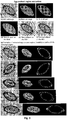
- the slide is placed under an upright or inverted microscope and images are acquired at around 100-200X magnification, in both brightfield and darkfield illumination [10]. Examples of corresponding brightfield and darkfield images can be seen in figure 16 .
- a lateral object is a prolate object that is placed on its side.
- a lateral egg is an egg lying on its side.
- the outline of such an egg is elliptical with protruding polar plugs at the ends.
- An upright object is a prolate object that is placed on one of its apices.
- An upright egg is an egg that is standing upright on one of its polar plugs.
- the outline of such an egg is circular or close to circular with a diameter corresponding to the width of a lateral egg.
- a singularized object is an object that does not touch or overlap with other objects, i.e. is clearly separated from nearby objects.
- a singularized egg is an egg that does not touch or overlap with other eggs or foreign particles.
- a touching object is an object that touches, but does not overlap with, other objects.
- a touching egg is an egg that touches one or more other eggs or impurities, but is not overlapping with them, i.e. its entire content region is clearly visible.
- a partly covered egg is an egg whose full outline is not distinguishable because the egg is covering or covered by one or more other objects, for instance other eggs.
- the terms 'foreign particle' and 'impurity' are used interchangeably to describe all objects in the images that are not Trichuris eggs. This includes both organic and inorganic impurities such as dust particles, fibers, minerals, plant remnants, and pollen, as well as gas, air, or oil bubbles and non- Trichuris eggs.
- multiple objects' is used to describe two or more objects that touch or overlap. In the analysis these are seen and treated as the same object until they are split into a number of separate objects.
- a ROI region-of-interest
- the blob binary large object
- the blob is a binary image of the same dimensions that indicates what pixels that belong to the object of interest in the ROI image. In this description, these are collectively called 'subimages' to distinguish them from the input images of the overall system. These terms are illustrated in figure 5 .
- the orientation of an egg is the angle between its longitudinal axis and the image x-axis. It is also called the direction of the egg. See left half of figure 6 for an illustration of the image coordinate system and the egg axes.
- the level of embryonation and larval development inside Trichuris spp. eggs can be assessed by following morphological changes inside the egg shell [11], [12].
- the eggs can be classified as either unsegmented eggs, eggs undergoing cellular division (1, 2, 3, 6, and many blastomeres), eggs containing cylindrical embryo, and eggs with fully developed, defined infective L1 larva [11].
- the term 'containing a larva' is used to describe the latter two of these.
- the developmental stages are illustrated in figure 15 .
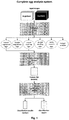
- the microscopic images are passed to the Detection phase (see figure 2 ).
- the microscopic images can be both multispectral (more than one wavelength) and multimodal (more than one illumination mode).
- An image can therefore consist of several bands, each representing a combination of a wavelength (for instance ultraviolet, a visible color, or near-infrared) and an illumination mode (for instance brightfield, darkfield, or phase contrast).
- an object can be assigned an additional, intermediate category: Multiple objects - Two or more objects that touch or overlap. In the analysis these are seen and treated as the same object until they are split into a number of separate objects.
- ROI and blob subimages of each category can be seen on figure 8 .
- the total number of detected eggs (categories 1 through 5) can be used to assess the concentration of the analyzed egg suspension, i.e. the number of eggs per ml.
- the analyzed sample should be representative of the entire suspension.
- the particle count (category 6) can be used to assess the purity of the analyzed egg suspension, for instance measured as the number of impurities or foreign particles per ml. Further analysis of the impurities, for instance a multiclass classification of the detected particles, is not presented here.
- the system finally produces a report of the analysis results, including detection results (e.g. listings and subimages of the detected objects and their categories), feature extraction results (e.g. feature lists), and classification results (e.g. assigned classes, certainty measures of the assigned classes etc.).
- detection results e.g. listings and subimages of the detected objects and their categories
- feature extraction results e.g. feature lists
- classification results e.g. assigned classes, certainty measures of the assigned classes etc.
- This gray-level image can be one of the following:
- a non-linear combination of bands e.g. a channel from another color space, for instance the V-channel of HSV, or a band from the output of a nonlinear dimensionality reduction algorithm.
- the gray-level image is thresholded resulting in a binary image indicating all foreground pixels, in this case pixels with values below the threshold.
- the thresholding can be either fixed (for instance at 0.6), automatic (for instance using Otsu's method [13]), or adaptive to local regions of the image.
- the morphological processing used to prepare the binary image for object detection is hole filling and morphological closing.
- Blobs (binary large objects) - connected groups of foreground pixels - are extracted using a connected-components labeling [14].
- Small blobs are removed if their area (pixel count) is under a predefined threshold (e.g. 1000 pixels). Each of the remaining blobs are then processed one at a time.
- a predefined threshold e.g. 1000 pixels
- a copy of the blob and the corresponding original gray-level image are created. These are then aligned with the image axes as illustrated on figure 6 , by being rotated the same number of degrees so that the longitudinal direction of the object is aligned with the vertical axis of the image coordinate system.
- the blob and its shape profile are then analyzed in order to assign a category to the blob.
- the analysis consists of the following steps:
- the input to the feature extraction phase consists of at least two images, a ROI subimage and a blob subimage. Additionally it may include any number of other ROI subimages of the same region from other bands or illumination modes, like a darkfield ROI subimage used for darkfield-based features.
- the 'egg content region' i.e. the region inside the egg where the egg contents are located, is extracted for further analysis.
- One way to do this, which is independent of the egg orientation, is illustrated in figure 9 and consists of the following:
- One or more features are computed for each egg based on the extracted egg content region.
- Each feature is computed at a chosen scale that depends on the size of the details and structures that the feature is meant to measure. Besides choosing the scale directly and resizing the image to this scale, there are several ways to represent and work with images at multiple scales; three important ways being scale space representation [18], image pyramid representation [19], and multi-resolution analysis [20].
- the direction-dependent linear structures and/or edge structures of the egg contents are measured at this scale.
- the measurements are carried out according to the longitudinal and transverse directions of the egg, either by measuring them in-place at the eggs original orientation or by aligning the egg with the horizontal and vertical image axes via rotation, as illustrated on figure 6 .
- the measurement of longitudinal and transverse structures can sometimes be simplified by aligning the longitudinal and transverse axes of the egg with coordinate system as described above. If the aligned versions are used in the feature extraction it is recommended to align the subimages before extracting the egg content region.
- Example 1 Features based on spatial autocorrelation
- the idea behind these features is to measure the longitudinal and transverse structures of the egg contents using spatial autocorrelation of the egg contents in the longitudinal and transverse direction.
- the longitudinal and transverse spatial autocorrelation coefficients of the egg contents are computed in the following way: The egg subimages are aligned with the image axes and the egg content region is extracted as described above. The extracted egg content region is then downscaled to a resolution of approximately 1.4 pixels per micrometer for eggs around 60 ⁇ m in length.
- the resulting downscaled egg content image denoted I , will form the basis of the spatial autocorrelation computations, which are explained in the following.
- I 1 , I 2 , and I 3 Three copies are made of I called I 1 , I 2 , and I 3 . From I 1 , the last row and the last column of pixels are discarded (cropped away). For I 2 , the first row and the last column of pixels are discarded. For I 3 , the last row and the first column of pixels are discarded. This is illustrated in figure 10 (top).
- An image region called ⁇ is now computed. It is defined to be the intersection of the three egg content regions, i.e. all pixel locations (i,j) where I 1 (i,j), I 2 (i,j), and I 3 (i,j) all contain a pixel from the egg content region, as illustrated in figure 10 (middle). This way, the image region ⁇ covers exactly the locations where the three egg content regions overlap.
- the set of pixels in I 1 that ⁇ covers are called A, and similarly for I 2 , with B, and I 3 with C, as illustrated in figure 10 (bottom).
- the longitudinal autocorrelation coefficient is now computed as the correlation between A and B, and the transverse autocorrelation coefficient is now computed as the correlation between A and C.
- the formula for this is explained in figure 11 .
- the longitudinal and transverse autocorrelation coefficients can be used directly as two separate features in the classification or they can be combined into a single feature, for instance the ratio between the two.
- the ratio between the two defined as the longitudinal autocorrelation coefficient divided by the transverse autocorrelation coefficient is hereby defined as the 'longitudinal anisotropy'.
- a high longitudinal anisotropy corresponds to a relatively larger longitudinal autocorrelation coefficient, which indicates that the longitudinal, linear structures of the egg contents are more prevalent than the transverse, linear structures of the egg contents.
- Example 2 Features based on edge detection
- the egg subimages are aligned with the image axes and the egg content region is extracted as described above.
- the extracted egg content region is then downscaled to a resolution of approximately 2.8 pixels per micrometer for eggs around 60 ⁇ m in length.
- the Canny edge detector [21] is applied to the downscaled egg content region in order to locate and measure the prevalent edges of the egg contents.
- the standard deviation of the Gaussian filter is set to 1, and the high and low sensitivity thresholds are set to 0.15 and 0.05, respectively, although an automatic, heuristic determination of these could be used as well.
- the intermediate horizontal and vertical filter responses of the edge detector are used to compute the orientation of the detected prevalent edges. This is done using the default formula as seen in equation (10.2-11) of [22].
- a possible quantification of the measured edge structures is to compute a 'longitudinal edge count' and a 'transverse edge count' as defined in the following.
- the 'longitudinal edge count' is defined to be the number of edge pixels of the egg content region that are oriented primarily 'north' or 'south'.
- the 'transverse edge count' is defined to be the number of edge pixels that are oriented primarily 'east' or 'west'. Being oriented primarily in one direction is here defined to mean being oriented in that direction plus/minus a margin of 10 to 45 degrees, for instance 22.5 degrees, as illustrated in figure 12 .
- the longitudinal and transverse edge counts can be used directly as two separate features in the classification and/or they can be combined into a single feature, for instance the ratio between the two. It is suggested to use either the ratio as a single feature or use the two edge counts as two separate features.
- the light-scattering behavior/properties of the egg internals under darkfield illumination [10] can be measured and quantified in one or more ways and used as features in the classification.
- the underlying idea is that the internal structures of eggs that do not contain a larva are different than for the eggs that do contain a larva.
- the internal structures of the first group of eggs are generally not as coarse as those of the second group of eggs, and correspondingly seem to scatter the darkfield-illumination to a higher degree. A quantification of the internal scattering can therefore be used to distinguish between the two groups.
- One possible way of quantifying the internal scattering under darkfield illumination is by first extracting the egg content region from the darkfield image (as opposed to extracting it from the brightfield image as in the above-presented examples) and then computing statistics of the extracted pixel intensities.
- One suitable statistic would be the mean scattering intensity, i.e. the mean of the extracted pixel intensities, or the median scattering intensity, but also other statistics like the standard deviation or other image moments or order statistics could be used, including a weighted average or a contrast measure.
- the classification of Trichuris eggs is a statistical classification problem, also known as a supervised learning problem.
- the classification problem can be either binary, where each egg is classified as either containing a larva or not, or multiclass where the developmental stage of each egg is sought determined.
- the developmental stages are defined in the Definitions section.
- the classification results can be used as an indicator of the biological potency of the egg suspension.
- the presented classification phase is illustrated on figure 4 . It consists of two parts; a model construction part and an actual classification part.
- the model construction part is used to build a classification model, which is later used for classifying the eggs.
- the model construction uses an annotated dataset consisting of a feature matrix and an annotation vector.
- the feature matrix consists of a number of feature vectors that each correspond to an egg.
- Each feature vector is a row vector containing one or more features for the given egg.
- the annotation vector is a column vector with one value for each egg, namely the manually determined class of that egg.
- the manual annotation is performed by an experienced technician who is used to classify the eggs based on microscopic inspection.
- the classification model is built on all or a subset of the features in the feature matrix.
- the number of features influences the choice of classification method.
- classification methods and algorithms There exist a plethora of classification methods and algorithms, from k-nearest neighbor classification via linear and quadratic classifiers to decision trees, supper vector machines and neural networks, just to name some of the common approaches.
- the choice of algorithm is not important in this context, so a simple threshold or a linear discriminant analysis is used in the examples later.
- the constructed classification model is applied to feature matrices of new sets of eggs with unknown classes.
- the result of a classification is a vector of assigned classes for each of the eggs.
- the classification results are presented in a report of the analysis results. This report can include listings and images of the detected objects and their assigned categories as well as feature scores, assigned class and possibly a measure of the class assignment certainty.
- Classification example 1 Classification based on the Canny features
- the presented Canny edge detection based feature resulted in two quantities; the longitudinal edge count and the transverse edge count. Besides using them separately as features, the ratio could be used as a feature as well.
- the 'edge count ratio' be defined as the longitudinal edge count divided by the transverse edge count.
- a possible classification based on this feature alone is to use a single threshold value as classifier, for instance the value 1.8. All eggs with an edge count ratio above 1.8 are classified as containing a larva and the remaining are classified as not containing a larva.
- a graph of the edge count ratios of 100 eggs, presented in descending order, is seen on figure 13 (a) . Notice that for a threshold of 1.8, only a single egg out of the 100 is misclassified based on this edge count ratio feature alone.
- Another way to classify the eggs is to use the longitudinal and transverse edge counts as two separate features as mentioned. A linear discriminant analysis with empirical prior probabilities could be used for this task. As seen on figure 13 (b) , this classification is also able to correctly classify all eggs except one.
- Classification example 2 Classification based on longitudinal anisotropy
- FIG 17 illustrates one possible embodiment of the physical system setup.
- a Trichuris spp. egg suspension sample is placed in a sample container, and a combination of light sources is directed at the sample.
- a camera for instance a CCD or CMOS camera
- An extension tube or similar is used to make sure that the sample is in focus.
- the acquired digital images are transferred from the camera to a computer, where the image analysis takes place.
Landscapes
- Engineering & Computer Science (AREA)
- Physics & Mathematics (AREA)
- General Health & Medical Sciences (AREA)
- Health & Medical Sciences (AREA)
- Theoretical Computer Science (AREA)
- General Physics & Mathematics (AREA)
- Biomedical Technology (AREA)
- Life Sciences & Earth Sciences (AREA)
- Molecular Biology (AREA)
- Multimedia (AREA)
- Computer Vision & Pattern Recognition (AREA)
- Quality & Reliability (AREA)
- Radiology & Medical Imaging (AREA)
- Nuclear Medicine, Radiotherapy & Molecular Imaging (AREA)
- Medical Informatics (AREA)
- Image Analysis (AREA)
- Investigating Or Analysing Materials By Optical Means (AREA)
- Image Processing (AREA)
Priority Applications (1)
| Application Number | Priority Date | Filing Date | Title |
|---|---|---|---|
| PL13714850T PL2852916T3 (pl) | 2012-04-27 | 2013-03-21 | Sposób oparty na widzeniu komputerowym do wyodrębniania cech związanych ze stadium rozwojowym jaj Trichuris spp |
Applications Claiming Priority (2)
| Application Number | Priority Date | Filing Date | Title |
|---|---|---|---|
| US201261639229P | 2012-04-27 | 2012-04-27 | |
| PCT/EP2013/000855 WO2013159856A1 (en) | 2012-04-27 | 2013-03-21 | Computer vision based method for extracting features relating to the developmental stage of trichuris spp. eggs |
Publications (2)
| Publication Number | Publication Date |
|---|---|
| EP2852916A1 EP2852916A1 (en) | 2015-04-01 |
| EP2852916B1 true EP2852916B1 (en) | 2019-08-07 |
Family
ID=48050652
Family Applications (1)
| Application Number | Title | Priority Date | Filing Date |
|---|---|---|---|
| EP13714850.8A Active EP2852916B1 (en) | 2012-04-27 | 2013-03-21 | Computer vision based method for extracting features relating to the developmental stage of trichuris spp, eggs |
Country Status (6)
| Country | Link |
|---|---|
| US (1) | US9224200B2 (pl) |
| EP (1) | EP2852916B1 (pl) |
| DK (1) | DK2852916T3 (pl) |
| ES (1) | ES2754075T3 (pl) |
| PL (1) | PL2852916T3 (pl) |
| WO (1) | WO2013159856A1 (pl) |
Families Citing this family (9)
| Publication number | Priority date | Publication date | Assignee | Title |
|---|---|---|---|---|
| US10216762B2 (en) | 2014-06-04 | 2019-02-26 | Panasonic Corporation | Control method and non-transitory computer-readable recording medium for comparing medical images |
| US10713782B2 (en) | 2015-02-17 | 2020-07-14 | MatrixSpec Solutions Inc. | Systems, devices, and methods for detecting fertility and gender of unhatched eggs |
| US9684831B2 (en) * | 2015-02-18 | 2017-06-20 | Qualcomm Incorporated | Adaptive edge-like feature selection during object detection |
| US9773154B2 (en) * | 2015-10-09 | 2017-09-26 | Universidad Nacional Autónoma de México | System for the identification and quantification of helminth eggs in environmental samples |
| CN108256419B (zh) * | 2017-12-05 | 2018-11-23 | 交通运输部规划研究院 | 一种利用多光谱解译提取港口码头图像的方法 |
| US12067793B2 (en) * | 2020-04-22 | 2024-08-20 | Mohd Amin Abu Qura | Enterobius vermicularis detection system |
| CN113450292B (zh) * | 2021-06-17 | 2022-08-16 | 重庆理工大学 | 一种pcba零部件高精度视觉定位方法 |
| CN116973386A (zh) * | 2022-07-03 | 2023-10-31 | 南京财经大学 | 融合虫卵与虫洞结构特征的粮粒内部虫卵快速检测方法、装置、系统与计算机可读介质 |
| CN119832328B (zh) * | 2024-12-26 | 2026-01-09 | 苏州才炬智能科技有限公司 | 一种脱壳后的禽蛋外观检测方法 |
Family Cites Families (6)
| Publication number | Priority date | Publication date | Assignee | Title |
|---|---|---|---|---|
| CA2315790C (en) | 1997-12-31 | 2015-10-06 | University Of Iowa Research Foundation | Use of parasitic biological agents for prevention and control of autoimmune diseases |
| CA2333184C (en) | 1998-06-01 | 2013-11-26 | Weyerhaeuser Company | Methods for classification of somatic embryos |
| DE102006023906A1 (de) | 2006-05-19 | 2007-11-22 | Ovamed Gmbh | Verfahren zum Nachweis der Viabilität |
| MX2010012577A (es) | 2008-05-19 | 2010-12-21 | Idexx Lab Inc | Metodos, dispositivos, kits y composiciones para detectar ascarides, tricocefalos y anquilostomas. |
| US8105795B2 (en) | 2008-05-19 | 2012-01-31 | Idexx Laboratories, Inc. | Methods, devices, kits and compositions for detecting roundworm |
| EP2123774A1 (de) | 2008-05-21 | 2009-11-25 | Dr. Falk Pharma Gmbh | Verfahren zur Charakterisierung der biologischen Aktivität von Helminth-Eiern |
-
2013
- 2013-03-12 US US13/796,660 patent/US9224200B2/en not_active Expired - Fee Related
- 2013-03-21 WO PCT/EP2013/000855 patent/WO2013159856A1/en not_active Ceased
- 2013-03-21 DK DK13714850T patent/DK2852916T3/da active
- 2013-03-21 EP EP13714850.8A patent/EP2852916B1/en active Active
- 2013-03-21 ES ES13714850T patent/ES2754075T3/es active Active
- 2013-03-21 PL PL13714850T patent/PL2852916T3/pl unknown
Non-Patent Citations (1)
| Title |
|---|
| CELSO T N SUZUKI ET AL: "Automatic Segmentation and Classification of Human Intestinal Parasites From Microscopy Images", IEEE TRANSACTIONS ON BIOMEDICAL ENGINEERING, IEEE SERVICE CENTER, PISCATAWAY, NJ, USA, vol. 60, no. 3, 1 March 2013 (2013-03-01), pages 803 - 812, XP011496523, ISSN: 0018-9294, DOI: 10.1109/TBME.2012.2187204 * |
Also Published As
| Publication number | Publication date |
|---|---|
| PL2852916T3 (pl) | 2020-05-18 |
| US20130287252A1 (en) | 2013-10-31 |
| EP2852916A1 (en) | 2015-04-01 |
| ES2754075T3 (es) | 2020-04-15 |
| WO2013159856A1 (en) | 2013-10-31 |
| DK2852916T3 (da) | 2019-11-18 |
| US9224200B2 (en) | 2015-12-29 |
Similar Documents
| Publication | Publication Date | Title |
|---|---|---|
| EP2852916B1 (en) | Computer vision based method for extracting features relating to the developmental stage of trichuris spp, eggs | |
| Castañón et al. | Biological shape characterization for automatic image recognition and diagnosis of protozoan parasites of the genus Eimeria | |
| Mehanian et al. | Computer-automated malaria diagnosis and quantitation using convolutional neural networks | |
| Tonti et al. | An automated approach to the segmentation of HEp-2 cells for the indirect immunofluorescence ANA test | |
| Theodorakopoulos et al. | Hep-2 cells classification via fusion of morphological and textural features | |
| Irshad et al. | Multispectral band selection and spatial characterization: Application to mitosis detection in breast cancer histopathology | |
| Abedy et al. | Leukemia prediction from microscopic images of human blood cell using HOG feature descriptor and logistic regression | |
| Maghsoudi et al. | Informative and uninformative regions detection in WCE frames | |
| Di Cataldo et al. | ANAlyte: A modular image analysis tool for ANA testing with indirect immunofluorescence | |
| de Souza Oliveira et al. | A new approach for malaria diagnosis in thick blood smear images | |
| Aris et al. | Robust image processing framework for intelligent multi-stage malaria parasite recognition of thick and thin smear images | |
| Qadir et al. | Malaria parasite identification from red blood cell images using transfer learning models | |
| Bidwai et al. | Harnessing deep learning for detection of diabetic retinopathy in geriatric group using optical coherence tomography angiography-OCTA: A promising approach | |
| Huang et al. | HEp-2 cell images classification based on textural and statistic features using self-organizing map | |
| Halinkovic et al. | Intrinsically explainable deep learning architecture for semantic segmentation of histological structures in heart tissue | |
| Bruun et al. | Detection and classification of parasite eggs for use in helminthic therapy | |
| Soda et al. | A decision support system for Crithidia Luciliae image classification | |
| Ouertani et al. | Adaptive automatic segmentation of leishmaniasis parasite in indirect immunofluorescence images | |
| Sankaran et al. | Quantitation of Malarial parasitemia in Giemsa stained thin blood smears using Six Sigma threshold as preprocessor | |
| Kamil et al. | An accurate system to measure the diabetic retinopathy using svm classifier | |
| Mondal et al. | An artificial intelligence-based approach for human parasite egg segmentation and classification | |
| Nugroho et al. | Feature analysis for stage identification of Plasmodium vivax based on digital microscopic image | |
| Agrawal | Detection of melanoma using DenseNet-based adaptive weighted loss function | |
| Owoloye et al. | Plasmo3Net: A Convolutional Neural Network-Based Algorithm for Detecting Malaria Parasites in Thin Blood Smear Images | |
| Das et al. | A texture based approach for automatic identification of benign and malignant tumor from FNAC images |
Legal Events
| Date | Code | Title | Description |
|---|---|---|---|
| PUAI | Public reference made under article 153(3) epc to a published international application that has entered the european phase |
Free format text: ORIGINAL CODE: 0009012 |
|
| 17P | Request for examination filed |
Effective date: 20141127 |
|
| AK | Designated contracting states |
Kind code of ref document: A1 Designated state(s): AL AT BE BG CH CY CZ DE DK EE ES FI FR GB GR HR HU IE IS IT LI LT LU LV MC MK MT NL NO PL PT RO RS SE SI SK SM TR |
|
| AX | Request for extension of the european patent |
Extension state: BA ME |
|
| DAX | Request for extension of the european patent (deleted) | ||
| 17Q | First examination report despatched |
Effective date: 20160802 |
|
| STAA | Information on the status of an ep patent application or granted ep patent |
Free format text: STATUS: EXAMINATION IS IN PROGRESS |
|
| GRAP | Despatch of communication of intention to grant a patent |
Free format text: ORIGINAL CODE: EPIDOSNIGR1 |
|
| STAA | Information on the status of an ep patent application or granted ep patent |
Free format text: STATUS: GRANT OF PATENT IS INTENDED |
|
| INTG | Intention to grant announced |
Effective date: 20190411 |
|
| GRAS | Grant fee paid |
Free format text: ORIGINAL CODE: EPIDOSNIGR3 |
|
| GRAA | (expected) grant |
Free format text: ORIGINAL CODE: 0009210 |
|
| STAA | Information on the status of an ep patent application or granted ep patent |
Free format text: STATUS: THE PATENT HAS BEEN GRANTED |
|
| AK | Designated contracting states |
Kind code of ref document: B1 Designated state(s): AL AT BE BG CH CY CZ DE DK EE ES FI FR GB GR HR HU IE IS IT LI LT LU LV MC MK MT NL NO PL PT RO RS SE SI SK SM TR |
|
| REG | Reference to a national code |
Ref country code: GB Ref legal event code: FG4D |
|
| REG | Reference to a national code |
Ref country code: CH Ref legal event code: EP Ref country code: AT Ref legal event code: REF Ref document number: 1164977 Country of ref document: AT Kind code of ref document: T Effective date: 20190815 |
|
| REG | Reference to a national code |
Ref country code: DE Ref legal event code: R096 Ref document number: 602013058749 Country of ref document: DE |
|
| REG | Reference to a national code |
Ref country code: IE Ref legal event code: FG4D |
|
| REG | Reference to a national code |
Ref country code: DK Ref legal event code: T3 Effective date: 20191111 |
|
| REG | Reference to a national code |
Ref country code: SE Ref legal event code: TRGR |
|
| REG | Reference to a national code |
Ref country code: NL Ref legal event code: MP Effective date: 20190807 |
|
| REG | Reference to a national code |
Ref country code: LT Ref legal event code: MG4D |
|
| REG | Reference to a national code |
Ref country code: DE Ref legal event code: R082 Ref document number: 602013058749 Country of ref document: DE Representative=s name: HERNANDEZ, YORCK, DIPL.-ING., DE Ref country code: DE Ref legal event code: R081 Ref document number: 602013058749 Country of ref document: DE Owner name: PARASITE TECHNOLOGIES A/S, DK Free format text: FORMER OWNERS: BRUUN, JOHAN MUSAEUS, KOEBENHAVN, DK; CARSTENSEN, JENS MICHAEL, BJAEVERSKOV, DK; MOLIIN OUTZEN KAPEL, CHRISTIIAN, RUNGSTED KYST, DK; PARASITE TECHNOLOGIES A/S, RUNGSTED KYST, DK |
|
| PG25 | Lapsed in a contracting state [announced via postgrant information from national office to epo] |
Ref country code: HR Free format text: LAPSE BECAUSE OF FAILURE TO SUBMIT A TRANSLATION OF THE DESCRIPTION OR TO PAY THE FEE WITHIN THE PRESCRIBED TIME-LIMIT Effective date: 20190807 Ref country code: NL Free format text: LAPSE BECAUSE OF FAILURE TO SUBMIT A TRANSLATION OF THE DESCRIPTION OR TO PAY THE FEE WITHIN THE PRESCRIBED TIME-LIMIT Effective date: 20190807 Ref country code: BG Free format text: LAPSE BECAUSE OF FAILURE TO SUBMIT A TRANSLATION OF THE DESCRIPTION OR TO PAY THE FEE WITHIN THE PRESCRIBED TIME-LIMIT Effective date: 20191107 Ref country code: PT Free format text: LAPSE BECAUSE OF FAILURE TO SUBMIT A TRANSLATION OF THE DESCRIPTION OR TO PAY THE FEE WITHIN THE PRESCRIBED TIME-LIMIT Effective date: 20191209 Ref country code: LT Free format text: LAPSE BECAUSE OF FAILURE TO SUBMIT A TRANSLATION OF THE DESCRIPTION OR TO PAY THE FEE WITHIN THE PRESCRIBED TIME-LIMIT Effective date: 20190807 Ref country code: FI Free format text: LAPSE BECAUSE OF FAILURE TO SUBMIT A TRANSLATION OF THE DESCRIPTION OR TO PAY THE FEE WITHIN THE PRESCRIBED TIME-LIMIT Effective date: 20190807 Ref country code: NO Free format text: LAPSE BECAUSE OF FAILURE TO SUBMIT A TRANSLATION OF THE DESCRIPTION OR TO PAY THE FEE WITHIN THE PRESCRIBED TIME-LIMIT Effective date: 20191107 |
|
| REG | Reference to a national code |
Ref country code: AT Ref legal event code: MK05 Ref document number: 1164977 Country of ref document: AT Kind code of ref document: T Effective date: 20190807 |
|
| RAP2 | Party data changed (patent owner data changed or rights of a patent transferred) |
Owner name: PARASITE TECHNOLOGIES A/S |
|
| PG25 | Lapsed in a contracting state [announced via postgrant information from national office to epo] |
Ref country code: IS Free format text: LAPSE BECAUSE OF FAILURE TO SUBMIT A TRANSLATION OF THE DESCRIPTION OR TO PAY THE FEE WITHIN THE PRESCRIBED TIME-LIMIT Effective date: 20191207 Ref country code: RS Free format text: LAPSE BECAUSE OF FAILURE TO SUBMIT A TRANSLATION OF THE DESCRIPTION OR TO PAY THE FEE WITHIN THE PRESCRIBED TIME-LIMIT Effective date: 20190807 Ref country code: GR Free format text: LAPSE BECAUSE OF FAILURE TO SUBMIT A TRANSLATION OF THE DESCRIPTION OR TO PAY THE FEE WITHIN THE PRESCRIBED TIME-LIMIT Effective date: 20191108 Ref country code: LV Free format text: LAPSE BECAUSE OF FAILURE TO SUBMIT A TRANSLATION OF THE DESCRIPTION OR TO PAY THE FEE WITHIN THE PRESCRIBED TIME-LIMIT Effective date: 20190807 Ref country code: AL Free format text: LAPSE BECAUSE OF FAILURE TO SUBMIT A TRANSLATION OF THE DESCRIPTION OR TO PAY THE FEE WITHIN THE PRESCRIBED TIME-LIMIT Effective date: 20190807 |
|
| REG | Reference to a national code |
Ref country code: LU Ref legal event code: PD Owner name: PARASITE TECHNOLOGIES A/S; DK Free format text: FORMER OWNER: MOLIIN OUTZEN KAPEL, CHRISTIIAN Effective date: 20200124 |
|
| PG25 | Lapsed in a contracting state [announced via postgrant information from national office to epo] |
Ref country code: TR Free format text: LAPSE BECAUSE OF FAILURE TO SUBMIT A TRANSLATION OF THE DESCRIPTION OR TO PAY THE FEE WITHIN THE PRESCRIBED TIME-LIMIT Effective date: 20190807 |
|
| REG | Reference to a national code |
Ref country code: ES Ref legal event code: FG2A Ref document number: 2754075 Country of ref document: ES Kind code of ref document: T3 Effective date: 20200415 |
|
| PG25 | Lapsed in a contracting state [announced via postgrant information from national office to epo] |
Ref country code: EE Free format text: LAPSE BECAUSE OF FAILURE TO SUBMIT A TRANSLATION OF THE DESCRIPTION OR TO PAY THE FEE WITHIN THE PRESCRIBED TIME-LIMIT Effective date: 20190807 Ref country code: AT Free format text: LAPSE BECAUSE OF FAILURE TO SUBMIT A TRANSLATION OF THE DESCRIPTION OR TO PAY THE FEE WITHIN THE PRESCRIBED TIME-LIMIT Effective date: 20190807 Ref country code: RO Free format text: LAPSE BECAUSE OF FAILURE TO SUBMIT A TRANSLATION OF THE DESCRIPTION OR TO PAY THE FEE WITHIN THE PRESCRIBED TIME-LIMIT Effective date: 20190807 |
|
| PG25 | Lapsed in a contracting state [announced via postgrant information from national office to epo] |
Ref country code: SM Free format text: LAPSE BECAUSE OF FAILURE TO SUBMIT A TRANSLATION OF THE DESCRIPTION OR TO PAY THE FEE WITHIN THE PRESCRIBED TIME-LIMIT Effective date: 20190807 Ref country code: SK Free format text: LAPSE BECAUSE OF FAILURE TO SUBMIT A TRANSLATION OF THE DESCRIPTION OR TO PAY THE FEE WITHIN THE PRESCRIBED TIME-LIMIT Effective date: 20190807 Ref country code: CZ Free format text: LAPSE BECAUSE OF FAILURE TO SUBMIT A TRANSLATION OF THE DESCRIPTION OR TO PAY THE FEE WITHIN THE PRESCRIBED TIME-LIMIT Effective date: 20190807 Ref country code: IS Free format text: LAPSE BECAUSE OF FAILURE TO SUBMIT A TRANSLATION OF THE DESCRIPTION OR TO PAY THE FEE WITHIN THE PRESCRIBED TIME-LIMIT Effective date: 20200224 |
|
| REG | Reference to a national code |
Ref country code: DE Ref legal event code: R097 Ref document number: 602013058749 Country of ref document: DE |
|
| PLBE | No opposition filed within time limit |
Free format text: ORIGINAL CODE: 0009261 |
|
| STAA | Information on the status of an ep patent application or granted ep patent |
Free format text: STATUS: NO OPPOSITION FILED WITHIN TIME LIMIT |
|
| PG2D | Information on lapse in contracting state deleted |
Ref country code: IS |
|
| 26N | No opposition filed |
Effective date: 20200603 |
|
| PG25 | Lapsed in a contracting state [announced via postgrant information from national office to epo] |
Ref country code: SI Free format text: LAPSE BECAUSE OF FAILURE TO SUBMIT A TRANSLATION OF THE DESCRIPTION OR TO PAY THE FEE WITHIN THE PRESCRIBED TIME-LIMIT Effective date: 20190807 |
|
| REG | Reference to a national code |
Ref country code: BE Ref legal event code: MM Effective date: 20200331 |
|
| PG25 | Lapsed in a contracting state [announced via postgrant information from national office to epo] |
Ref country code: BE Free format text: LAPSE BECAUSE OF NON-PAYMENT OF DUE FEES Effective date: 20200331 |
|
| PGFP | Annual fee paid to national office [announced via postgrant information from national office to epo] |
Ref country code: PL Payment date: 20210115 Year of fee payment: 9 |
|
| REG | Reference to a national code |
Ref country code: DE Ref legal event code: R079 Ref document number: 602013058749 Country of ref document: DE Free format text: PREVIOUS MAIN CLASS: G06K0009000000 Ipc: G06V0010000000 |
|
| PGFP | Annual fee paid to national office [announced via postgrant information from national office to epo] |
Ref country code: IE Payment date: 20220215 Year of fee payment: 10 Ref country code: GB Payment date: 20220225 Year of fee payment: 10 Ref country code: DK Payment date: 20220222 Year of fee payment: 10 Ref country code: DE Payment date: 20220214 Year of fee payment: 10 Ref country code: CH Payment date: 20220217 Year of fee payment: 10 |
|
| PG25 | Lapsed in a contracting state [announced via postgrant information from national office to epo] |
Ref country code: MT Free format text: LAPSE BECAUSE OF FAILURE TO SUBMIT A TRANSLATION OF THE DESCRIPTION OR TO PAY THE FEE WITHIN THE PRESCRIBED TIME-LIMIT Effective date: 20190807 Ref country code: CY Free format text: LAPSE BECAUSE OF FAILURE TO SUBMIT A TRANSLATION OF THE DESCRIPTION OR TO PAY THE FEE WITHIN THE PRESCRIBED TIME-LIMIT Effective date: 20190807 |
|
| PGFP | Annual fee paid to national office [announced via postgrant information from national office to epo] |
Ref country code: SE Payment date: 20220217 Year of fee payment: 10 Ref country code: MC Payment date: 20220217 Year of fee payment: 10 Ref country code: LU Payment date: 20220214 Year of fee payment: 10 Ref country code: IT Payment date: 20220215 Year of fee payment: 10 Ref country code: FR Payment date: 20220225 Year of fee payment: 10 |
|
| PG25 | Lapsed in a contracting state [announced via postgrant information from national office to epo] |
Ref country code: MK Free format text: LAPSE BECAUSE OF FAILURE TO SUBMIT A TRANSLATION OF THE DESCRIPTION OR TO PAY THE FEE WITHIN THE PRESCRIBED TIME-LIMIT Effective date: 20190807 |
|
| PGFP | Annual fee paid to national office [announced via postgrant information from national office to epo] |
Ref country code: ES Payment date: 20220425 Year of fee payment: 10 |
|
| REG | Reference to a national code |
Ref country code: DE Ref legal event code: R119 Ref document number: 602013058749 Country of ref document: DE |
|
| PG25 | Lapsed in a contracting state [announced via postgrant information from national office to epo] |
Ref country code: MC Free format text: LAPSE BECAUSE OF NON-PAYMENT OF DUE FEES Effective date: 20230331 |
|
| REG | Reference to a national code |
Ref country code: SE Ref legal event code: EUG Ref country code: CH Ref legal event code: PL |
|
| REG | Reference to a national code |
Ref country code: DK Ref legal event code: EBP Effective date: 20230331 |
|
| GBPC | Gb: european patent ceased through non-payment of renewal fee |
Effective date: 20230321 |
|
| PG25 | Lapsed in a contracting state [announced via postgrant information from national office to epo] |
Ref country code: LU Free format text: LAPSE BECAUSE OF NON-PAYMENT OF DUE FEES Effective date: 20230321 |
|
| REG | Reference to a national code |
Ref country code: IE Ref legal event code: MM4A |
|
| PG25 | Lapsed in a contracting state [announced via postgrant information from national office to epo] |
Ref country code: GB Free format text: LAPSE BECAUSE OF NON-PAYMENT OF DUE FEES Effective date: 20230321 |
|
| PG25 | Lapsed in a contracting state [announced via postgrant information from national office to epo] |
Ref country code: SE Free format text: LAPSE BECAUSE OF NON-PAYMENT OF DUE FEES Effective date: 20230322 Ref country code: LI Free format text: LAPSE BECAUSE OF NON-PAYMENT OF DUE FEES Effective date: 20230331 Ref country code: IE Free format text: LAPSE BECAUSE OF NON-PAYMENT OF DUE FEES Effective date: 20230321 Ref country code: GB Free format text: LAPSE BECAUSE OF NON-PAYMENT OF DUE FEES Effective date: 20230321 Ref country code: FR Free format text: LAPSE BECAUSE OF NON-PAYMENT OF DUE FEES Effective date: 20230331 Ref country code: DE Free format text: LAPSE BECAUSE OF NON-PAYMENT OF DUE FEES Effective date: 20231003 Ref country code: CH Free format text: LAPSE BECAUSE OF NON-PAYMENT OF DUE FEES Effective date: 20230331 |
|
| PG25 | Lapsed in a contracting state [announced via postgrant information from national office to epo] |
Ref country code: IT Free format text: LAPSE BECAUSE OF NON-PAYMENT OF DUE FEES Effective date: 20230321 Ref country code: DK Free format text: LAPSE BECAUSE OF NON-PAYMENT OF DUE FEES Effective date: 20230331 |
|
| REG | Reference to a national code |
Ref country code: ES Ref legal event code: FD2A Effective date: 20240528 |
|
| PG25 | Lapsed in a contracting state [announced via postgrant information from national office to epo] |
Ref country code: ES Free format text: LAPSE BECAUSE OF NON-PAYMENT OF DUE FEES Effective date: 20230322 |
|
| PG25 | Lapsed in a contracting state [announced via postgrant information from national office to epo] |
Ref country code: ES Free format text: LAPSE BECAUSE OF NON-PAYMENT OF DUE FEES Effective date: 20230322 |
|
| PG25 | Lapsed in a contracting state [announced via postgrant information from national office to epo] |
Ref country code: PL Free format text: LAPSE BECAUSE OF NON-PAYMENT OF DUE FEES Effective date: 20220321 |
|
| PG25 | Lapsed in a contracting state [announced via postgrant information from national office to epo] |
Ref country code: PL Free format text: LAPSE BECAUSE OF NON-PAYMENT OF DUE FEES Effective date: 20220321 |