EP2853255B1 - Verfahren zur Formulierung eines Körperpflegeprodukts mit nahezu keiner Bleichungswirkung beim Auftragen auf feuchte Haut sowie Zusammensetzungen damit - Google Patents
Verfahren zur Formulierung eines Körperpflegeprodukts mit nahezu keiner Bleichungswirkung beim Auftragen auf feuchte Haut sowie Zusammensetzungen damit Download PDFInfo
- Publication number
- EP2853255B1 EP2853255B1 EP14185253.3A EP14185253A EP2853255B1 EP 2853255 B1 EP2853255 B1 EP 2853255B1 EP 14185253 A EP14185253 A EP 14185253A EP 2853255 B1 EP2853255 B1 EP 2853255B1
- Authority
- EP
- European Patent Office
- Prior art keywords
- carbomer
- composition
- personal care
- care product
- hlb
- Prior art date
- Legal status (The legal status is an assumption and is not a legal conclusion. Google has not performed a legal analysis and makes no representation as to the accuracy of the status listed.)
- Active
Links
Images




Classifications
-
- A—HUMAN NECESSITIES
- A61—MEDICAL OR VETERINARY SCIENCE; HYGIENE
- A61Q—SPECIFIC USE OF COSMETICS OR SIMILAR TOILETRY PREPARATIONS
- A61Q17/00—Barrier preparations; Preparations brought into direct contact with the skin for affording protection against external influences, e.g. sunlight, X-rays or other harmful rays, corrosive materials, bacteria or insect stings
- A61Q17/04—Topical preparations for affording protection against sunlight or other radiation; Topical sun tanning preparations
-
- A—HUMAN NECESSITIES
- A61—MEDICAL OR VETERINARY SCIENCE; HYGIENE
- A61K—PREPARATIONS FOR MEDICAL, DENTAL OR TOILETRY PURPOSES
- A61K8/00—Cosmetics or similar toiletry preparations
- A61K8/02—Cosmetics or similar toiletry preparations characterised by special physical form
- A61K8/04—Dispersions; Emulsions
- A61K8/06—Emulsions
- A61K8/062—Oil-in-water emulsions
-
- A—HUMAN NECESSITIES
- A61—MEDICAL OR VETERINARY SCIENCE; HYGIENE
- A61K—PREPARATIONS FOR MEDICAL, DENTAL OR TOILETRY PURPOSES
- A61K8/00—Cosmetics or similar toiletry preparations
- A61K8/18—Cosmetics or similar toiletry preparations characterised by the composition
- A61K8/30—Cosmetics or similar toiletry preparations characterised by the composition containing organic compounds
- A61K8/33—Cosmetics or similar toiletry preparations characterised by the composition containing organic compounds containing oxygen
- A61K8/37—Esters of carboxylic acids
- A61K8/375—Esters of carboxylic acids the alcohol moiety containing more than one hydroxy group
-
- A—HUMAN NECESSITIES
- A61—MEDICAL OR VETERINARY SCIENCE; HYGIENE
- A61K—PREPARATIONS FOR MEDICAL, DENTAL OR TOILETRY PURPOSES
- A61K8/00—Cosmetics or similar toiletry preparations
- A61K8/18—Cosmetics or similar toiletry preparations characterised by the composition
- A61K8/30—Cosmetics or similar toiletry preparations characterised by the composition containing organic compounds
- A61K8/49—Cosmetics or similar toiletry preparations characterised by the composition containing organic compounds containing heterocyclic compounds
- A61K8/4973—Cosmetics or similar toiletry preparations characterised by the composition containing organic compounds containing heterocyclic compounds with oxygen as the only hetero atom
-
- A—HUMAN NECESSITIES
- A61—MEDICAL OR VETERINARY SCIENCE; HYGIENE
- A61K—PREPARATIONS FOR MEDICAL, DENTAL OR TOILETRY PURPOSES
- A61K8/00—Cosmetics or similar toiletry preparations
- A61K8/18—Cosmetics or similar toiletry preparations characterised by the composition
- A61K8/72—Cosmetics or similar toiletry preparations characterised by the composition containing organic macromolecular compounds
- A61K8/81—Cosmetics or similar toiletry preparations characterised by the composition containing organic macromolecular compounds obtained by reactions involving only carbon-to-carbon unsaturated bonds
- A61K8/8141—Compositions of homopolymers or copolymers of compounds having one or more unsaturated aliphatic radicals, each having only one carbon-to-carbon double bond, and at least one being terminated by only one carboxyl radical, or of salts, anhydrides, esters, amides, imides or nitriles thereof; Compositions of derivatives of such polymers
- A61K8/8147—Homopolymers or copolymers of acids; Metal or ammonium salts thereof, e.g. crotonic acid, (meth)acrylic acid; Compositions of derivatives of such polymers
-
- A—HUMAN NECESSITIES
- A61—MEDICAL OR VETERINARY SCIENCE; HYGIENE
- A61K—PREPARATIONS FOR MEDICAL, DENTAL OR TOILETRY PURPOSES
- A61K8/00—Cosmetics or similar toiletry preparations
- A61K8/18—Cosmetics or similar toiletry preparations characterised by the composition
- A61K8/72—Cosmetics or similar toiletry preparations characterised by the composition containing organic macromolecular compounds
- A61K8/81—Cosmetics or similar toiletry preparations characterised by the composition containing organic macromolecular compounds obtained by reactions involving only carbon-to-carbon unsaturated bonds
- A61K8/8141—Compositions of homopolymers or copolymers of compounds having one or more unsaturated aliphatic radicals, each having only one carbon-to-carbon double bond, and at least one being terminated by only one carboxyl radical, or of salts, anhydrides, esters, amides, imides or nitriles thereof; Compositions of derivatives of such polymers
- A61K8/8152—Homopolymers or copolymers of esters, e.g. (meth)acrylic acid esters; Compositions of derivatives of such polymers
-
- A—HUMAN NECESSITIES
- A61—MEDICAL OR VETERINARY SCIENCE; HYGIENE
- A61Q—SPECIFIC USE OF COSMETICS OR SIMILAR TOILETRY PREPARATIONS
- A61Q19/00—Preparations for care of the skin
-
- A—HUMAN NECESSITIES
- A61—MEDICAL OR VETERINARY SCIENCE; HYGIENE
- A61K—PREPARATIONS FOR MEDICAL, DENTAL OR TOILETRY PURPOSES
- A61K2800/00—Properties of cosmetic compositions or active ingredients thereof or formulation aids used therein and process related aspects
- A61K2800/20—Chemical, physico-chemical or functional or structural properties of the composition as a whole
- A61K2800/30—Characterized by the absence of a particular group of ingredients
- A61K2800/33—Free of surfactant
Definitions
- the present disclosure relates to a method of formulating a personal care product composition (e.g. sunscreen) that may remain stable when exposed to high and low temperatures for prolonged periods and, when applied to wet skin, may be substantially devoid of any whitening effect while not compromising its other functions (e.g. protecting the skin against solar UV radiation).
- a personal care product composition e.g. sunscreen
- sunscreen products may comprise UV-absorbing or scattering compounds (collectively “sunscreen actives” or “UV filters”) formulated into a cosmetically suitable vehicle for topical application to the skin.
- the active protective component e.g. UV filters or other lipophilic ingredients contained in the composition
- UV filters may form a thin continuous film on the skin which provides an effective, protective barrier against environmental insults (e.g. UV radiation).
- UV radiation e.g. UV radiation
- Some personal care products may be formulated as emulsions wherein the bulk phase is comprised of organic or silicone oils, and the discontinuous phase is comprised of water and/or water-soluble components. Even if these products, when applied to wet skin, adequately perform their protective function, they suffer from an unpleasant greasy feel and persistent whitening that requires excessive rubbing to return the skin's surface to an acceptable appearance. Recently, some products have appeared that claim to be formulated specifically for application to wet skin with little or none of the deficits of more traditional personal care products. For example, U.S. Patent No.
- a sunscreen composition comprising a continuous water phase, a discontinuous oil phase dispersed in the water phase, about 10% or more by weight of an organic UV filter, a water-insoluble C2-C8 liquid silicone, a branched fatty acid ester of a polyprotic carboxylic acid, and about 2% by weight of a mineral particulate that bears a starch coating on its surface.
- Said composition is pondered to substantially maintain its UV protective property after it is applied to wet skin compared to its UV protective property when applied to dry skin. Further, the composition is said to be capable of providing "little to no whitening" when applied to wet skin.
- US 5,833,951 discloses cosmetic and dermatological formulations of the oil-in water type, processes for their preparation and their use for cosmetic and medical purposes.
- EP 0998910 discloses a personal care product having acontinuous water phase, a discontinuous oil phase, preferable free from emulsifiers and comprising a glyceride wax.
- the present disclosure relates, in some embodiments, to methods and compositions for personal care products that become transparent upon application to wet skin, remain clear, are aesthetically pleasant, maintain stability when exposed to high and low temperatures over prolonged periods, and/or have the ability to protect the wearer's skin from damaging ultraviolet radiation.
- compositions may comprise a water phase into which an oil phase comprising organic UV filters, suitable organic and/or silicone solvents, emollients, and oil soluble polymers may be dispersed.
- an oil phase comprising organic UV filters, suitable organic and/or silicone solvents, emollients, and oil soluble polymers may be dispersed.
- a dispersion of oil may be aided by a low HLB emulsifier that may be a liquid at room temperature and present at 0.1-1% by weight.
- a water phase may be gelled by neutralizing one or more polymers of acrylic acid cross-linked with allyl sucrose or allyl pentaerythritol, hereinafter referred to as a "Carbomer Homopolymer,” or a non-emulsifying grade of Carbomer Homopolymer that may also contain a block copolymer of polyethylene glycol and a long chain alkyl acid ester, hereinafter referred to as a "Carbomer Interpolymer,” or a non-emulsifying grade of a copolymer of acrylic acid and a long chain alkyl methacrylate cross-linked with allyl ethers of polyalcohols, hereinafter referred to as a "Carbomer Copolymer;” or a combination of Carbomer Homopolymer, Carbomer Interpolymer, and/or Carbomer Copolymer wherein the total weight percentage of carbomer homopolymer
- the composition may contain an SPF boosting compound, for example, Styrene Acrylates copolymer, which may be available as SUNSPHERES from Dow Chemical Company at a weight percentage of the composition in a range from 0-2%.
- SPF boosting compound for example, Styrene Acrylates copolymer, which may be available as SUNSPHERES from Dow Chemical Company at a weight percentage of the composition in a range from 0-2%.
- SPF boosting compound for example, Styrene Acrylates copolymer, which may be available as SUNSPHERES from Dow Chemical Company at a weight percentage of the composition in a range from 0-2%.
- SPF boosting compound for example, Styrene Acrylates copolymer, which may be available as SUNSPHERES from Dow Chemical Company at a weight percentage of the composition in a range from 0-2%.
- a method may comprise (a) providing separately an oil phase and a water phase, (b) dispersing one or more carbomer polymers in either the oil phase or the water phase, (c) optionally dispersing a hydrophilic-lipophilic balance (HLB) emulsifying compound in the oil phase, wherein the HLB emulsifying compound is a liquid at room temperature and has a HLB less than about 5; (d) combining the oil phase with the water phase to form a pre-emulsion, (e) adding a neutralizing base to the pre-emulsion to form a personal care product emulsion, (f) adding water to the personal care product emulsion, and (g) mixing the personal care product emulsion to form a homogenous composition, wherein the homogenous
- the present disclosure relates, according to some embodiments, to methods of formulating a personal care product (e.g. sunscreen) composition that is stable when exposed to temperatures of about 60°C and/or about 5°C for a period of one week or more and that applies clear to wet skin and remains clear.
- a personal care product e.g. sunscreen
- a method may comprise, for example, combining a discontinuous oil phase with a hydrophilic-lipophilic balance (HLB) emulsifying compound to form an oil phase mixture, wherein the HLB emulsifying compound is a liquid at room temperature and has a HLB less than about 5; heating and mixing the oil phase mixture; dispersing one or more non-emulsifying grade carbomer polymers in a continuous water phase to form a water phase mixture; combining and mixing the oil phase mixture and the water phase mixture to form a pre-emulsion; adding a neutralizing base to the pre-emulsion to form a personal care product emulsion; adding water (e.g., to replace water lost during processing) to the personal care product emulsion; and mixing the personal care product emulsion to form a homogenous composition, wherein the homogenous composition comprises: from about 0.1% to about 1% by weight of the HLB emulsifying compound, a stabilizing, non-whitening amount of one or more carbomer polymers selected
- a stable composition may, in some embodiments, maintain its integrity after prolonged exposure (e.g. one month) to high temperatures (e.g. about 60°C), and low temperatures (e.g. about 5°C).
- the present disclosure relates, in some embodiments, to methods for applying a personal care product composition to a wet human skin surface.
- a method for applying the personal care product composition to the wet human skin surface may comprise, for example, swiping, rubbing, smoothing, massaging, coating, or otherwise working the composition on the skin.
- the applying continues for less than about 5 seconds and the personal care product composition is clear no later than at the conclusion of the applying.
- the composition is clear throughout the applying.
- a personal care product composition for topical application to human skin that applies clear to wet skin comprising:
- a carbomer copolymer, a carbomer interpolymer, and/or a carbomer homopolymer may include the compendia names assigned to various cross-linked polymers of acrylic acid as set forth in the United States Pharmacopeia and National Formulary (USP 34-NF 29), United States Pharmacopeial Convention, Rockville, MD, 2010.
- the term carbomer copolymer may refer to a high molecular weight copolymer of acrylic acid and a long chain alkyl methacrylate cross-linked with allyl ethers of polyalcohols.
- Carbomer copolymers may be polymers of acrylic acid and C10-C30 alkyl acrylate crosslinked with allyl pentaerythritol.
- the term carbomer interpolymer may refer to a carbomer homopolyer or copolymer that contains a block copolymer of polyethylene glycol and a long chain alkyl acid ester.
- the term carbomer homopolyer may refer to a high molecular weight polymer of acrylic acid cross-linked with allyl ethers of polyalcohols.
- Carbomer homopolymers, previously dried, may not contain less than about 56 percent and not more than about 68 percent of carboxylic acid (-COOH) groups.
- a material or composition may be cosmetically acceptable if it is suitable for application to human tissue (e.g., the skin) without undue toxicity, incompatibility, instability, irritation, allergic response, or the like, according to some embodiments.
- Percentages herein are percent by weight based on total concentration of the composition, oil or water phases.
- a composition may be regarded to be stable or have stability where it maintains its integrity in form and function when subjected to high temperatures (e.g., about 60°C or higher) for an extended period of time (e.g., about one week or more) or when subjected to low temperatures (e.g., about 5°C or lower) for an extended period of time (e.g., about one week or more) according to some embodiments.
- a composition may maintain its integrity in form and/or shows no signs of instability such as discoloration, separation (e.g., oil appearing on the surface or the composition settling into layers), appearance of crystals, changes in room temperature viscosity, etc.
- maintaining its integrity in function it is meant that the composition, when returned to room temperature, may provide the same or similar levels of UV protection after exposure to high or low temperatures as before.
- a composition may be formulated to have any desired viscosity.
- a composition have a viscosity that permits it to be applied to (e.g., easily applied to) and/or spread on (e.g., easily spread on) skin (e.g., wet skin).
- a composition may have a viscosity (e.g., a Brookfield RVT viscosity) of about 300 cP to about 115,000 cP, about 4,000 cP to about 11,000 cP, about 29,400 cP to about 39,400 cP, about 30,500 cP to about 39,400 cP, about 1,000 cP to about 10,000 cP, about 10,000 cP to about 20,000 cP, about 20,000 cP to about 30,000 cP, about 30,000 cP to about 40,000 cP, about 40,000 cP to about 50,000 cP, about 50,000 cP to about 60,000 cP, about 60,000 cP to about 70,000 cP, about 70,000 cP to about 80,000 cP, about 80,000 cP to about 90,000 cP, about 90,000 cP to about 100,000 cP, and/or about 100,000 cP to about 110,000 cP.
- a viscosity e.g.,
- aqueous viscosity may be assayed (e.g., with respect to ranges disclosed herein) at a carbomer concentration of about 0.5 wt% mucilage at pH 7.5 and 20 rpm at 25 ⁇ C.
- Aqueous viscosity may be assayed according to USP 34-NF 29 in some embodiments.
- a whitening composition when applied to the skin and spread by a back-and-forth or circular motion of a finger for a few seconds may retain a whitish appearance that partially or completely obscures the skin's natural appearance and color.
- a composition may apply clear, quickly clarify, be clear, have excellent clarity and/or be non-whitening when applied to skin.
- a composition applies clear to wet skin if it is brought into contact with wet skin by limited swiping, rubbing, smoothing, massaging, coating, or otherwise working the composition on the skin, such that the skin's natural color and appearance are visible throughout and/or at the conclusion of application.
- Limited swiping, rubbing, smoothing, massaging, coating, or otherwise working the composition on the skin may include a few repetitions (e.g., from about 1 to about 5 swipes) and/or continued action (e.g., for about 2 to about 5 seconds).
- a composition may emerge from its container with a white appearance and, according to some embodiments, still apply clear to wet skin and/or still be non-whitening on wet skin so long as clarity is achieved while the skin is still wet.
- Wet skin may be damp with sweat or have residual water thereon, for example, immediately after being passed under a running faucet or immediately after being immersed in water, according to some embodiments.
- a method of applying a personal care product composition to a wet human skin surface having a natural appearance and color comprising: applying the personal care product composition to the wet human skin surface, the personal care product composition comprising:
- compositions of the present disclosure may include a discontinuous oil phase and a continuous water phase.
- discontinuous oil phase it is meant that a physically distinctive aggregation of intimately mixed organic, hydrophobic compounds that are stabilized within a water phase.
- Compounds that may be included in the oil phase include, for example, organic UV filters, suitable organic and/or silicone-based stabilizers (e.g., photostabilizers), solvents and emollients, film-forming polymers, SPF boosting compounds and polymers, and other hydrophobic compounds.
- up to about 1% (w/w) of a low hydrophilic-lipophilic balance emulsifier may be included in a composition.
- the concentration of the oil phase may range, as a weight percent of the total composition, from about 10% to about 80%, such as from about 20% to about 60%, such as about 30% to about 50%.
- a composition may have, according to some embodiments, a continuous water phase including a physically distinctive aggregation of water and other optional ingredients that are generally hydrophilic and intimately mixed therewith.
- Ingredients suitable for inclusion in the water phase include for example water, water-soluble preservatives, humectants, chelating agents, pH adjuster, buffers, neutralizers, colorants, and water-soluble biologically active compounds such as glycerin, glycols, extracts, and the like.
- the concentration of the water phase as a weight percent of the total composition, may range from about 10% to about 90%, such as from about 20% to about 80%, such as from about 40% to about 60%. In certain embodiments, the concentration of the water phase may be greater than the concentration of the oil phase.
- Compositions of the present disclosure may include one or more organic UV filters.
- Organic UV filters that are useful in the present disclosure may be cosmetically-acceptable compounds that absorb radiation in the solar UV range (290-400 nm) and may generally be soluble in one or more organic solvents and/or water.
- organic UV filters include without limitation p-aminobenzoic acid and salts and derivatives thereof; anthranilate and derivatives thereof; salicylate and derivatives thereof; cinnamic acid and derivatives thereof; dihydroxycinnamic acid and derivatives thereof; camphor and salts and derivatives thereof; trihydroxycinnamic acid and derivatives thereof; dibenzalacetone naptholsulfonate and salts and derivatives thereof; benzalacetophenone naphtholsulfonate and salts and derives thereof; dihydroxy-naphthoic acid and salts thereof; o-hydroxydiphenyldisulfonate and salts and derivatives thereof; p-hydroxdydiphenyldisulfonate and salts and derivatives thereof; coumarin and derivatives thereof; diazole derivatives; quinine derivatives and salts thereof; quinoline derivatives; hydroxyl-substituted benzophenone derivatives; naphthalate derivatives;
- personal care product e.g. sunscreen compositions may include one or more UV filters selected from the group comprising Octocrylene, salicylic acid esters (e.g., Ethylhexyl salicylate and Homomenthyl salicylate, also known as Homosalate), p-methoxycinnamic acid esters (e.g., Ethylhexyl methoxycinnamate and Isoamyl methoxycinnamate), Avobenzone (also known as Butyl methoxydibenzoylmethane), Oxybenzone (also known as Benzophenone-3), Bemotrizinol (also known as Bis-ethylhexyloxyphenol methoxyphenyl triazone), Bisoctrizole (also known as Methylene bis-benzotriazolyl Tetramethylbutylphenol), 4-Methylbenzylidene camphor, Diethylamino hydroxyl benzoyl
- UV filters selected from
- UV filters may include Octocrylene, Avobenzone, Homosalate, Octisalate (Ethylhexyl salicylate), Octinoxate (Ethylhexyl methoxycinnamate), and Oxybenzone.
- compositions of the oil phase may comprise solvents and emollients selected from the group comprising fatty acid esters, fatty alcohol esters, esters of Guerbet alcohols, benzoic acid esters, esters of dibasic acids, esters of polyprotic acids, esters of polyhydric alcohols including triglycerides, Polyethylene glycols and esters thereof, Polypropylene glycols and esters thereof, polyesters, silicones, organically-modified silicones, hydrocarbon compounds comprising, mineral oils including paraffinic oils, naphthenic oils, and aromatic oils and polymers derived from hydrocarbon compounds such as hydrogenated polyisobutene and polypropylene.
- solvents and emollients selected from the group comprising fatty acid esters, fatty alcohol esters, esters of Guerbet alcohols, benzoic acid esters, esters of dibasic acids, esters of polyprotic acids, esters of polyhydric alcohols including triglycerides, Polyethylene glycols and esters
- the solvents and emollients in the oil phase may be C12-15 alkyl benzoate available as FINSOLV® TN from Innospec, Salisbury, North Carolina, Butyloctyl salicylate available as HALLBRITE® BHB from HallStar, Chicago, Illinois, and Ethylhexyl olivate available as SensoleneTM from HallStar Italia, Arcore, Italy.
- An oil phase may comprise, according to some embodiments, compounds that stabilize other compounds present in the oil phase by, for example, preventing their degradation due to exposure to solar radiation or to oxidation from exposure to the atmosphere.
- the oil phase may contain stabilizers selected from the group comprising Ethylhexyl methoxycrylene (e.g. SOLASTAY® S1 from HallStar, Chicago, Illinois), Diethylhexyl syringylidene malonate (e.g. OXYNEXTM ST from EMD Millipore, Philadelphia, Pennsylvania), Diethylhexyl 2,6-naphthalate (e.g., CORAPANTM TQ from Symrise, Holzminden, Germany), Polyester-8 (e.g.
- Tinogard TL from BASF, Ludwigshafen, Germany
- Tris e.g. Tetramethylhydroxypiperidinol
- Citrate e.g. Tinogard QS from BASF, Ludwigshafen, Germany
- Sodium Benzotriazolyl Butylphenol Sulfonate e.g. Tinogard HS from BASF, Ludwigshafen, Germany
- Bumetrizole e.g. Tinogard AS from BASF, Ludwigshafen, Germany
- Butylated hydroxyltoluene (BHT) Butylated hydroxyanisole (BHA), Tocopherol, and many others.
- BHT Butylated hydroxyltoluene
- BHA Butylated hydroxyanisole
- Tocopherol and many others.
- Other stabilizers known to confer stability against photo- and oxidative degradation in personal care product compositions may also be suitable substitutes.
- Some embodiments of the present disclosure may advantageously comprise a film-forming polymer in the oil phase.
- a film-forming polymer may confer on the composition some amount of water- and wear-resistance after it is applied to the skin.
- Suitable film forming polymers may include natural polymers such as polysaccharides or proteins and synthetic polymers such as polyesters, polyacrylics, polyurethanes, vinyl polymers, polysulfonates, polyureas, polyoxazolines, and the like.
- film-forming polymers may include, for example, acrylic homopolymers or copolymers with hydrophobic groups such as acrylates/octylacrylamide copolymers including DERMACRYL 79 available from Akzo Nobel, Bridgewater, New Jersey; dimethicone/acrylates dimethicone copolymer available as X-22-8247D from Shin-Etsu of Japan; hydrogenated dimer dilinoleyl/dimethylcarbonate copolymer, available as COSMEDIA DC from Cognis Corporation of Ambler, Pennsylvania; copolymers of vinylpyrrolidone and a long-chain alpha-olefin, such as those commercially available as GANEX V-220 and GANEX V-216 and vinylpyrrolidone/tricontanyl copolymer commercially available as GANEX WP660 from Ashland Chemicals of Covington, Kentucky.
- acrylic homopolymers or copolymers with hydrophobic groups such as acrylates/octylacrylamide
- Acrylates/Dimethicone copolymer may advantageously confer good water resistance when present at a concentration of about 3% by weight in a composition tested as prescribed by the U.S. Food and Drug Administration to determine the Sun Protection Factor (SPF) after immersion in water for 80 minutes.
- SPF Sun Protection Factor
- Such a composition may exhibit very little whitening when applied to wet skin.
- Other film forming polymers known to confer water resistance to personal care product compositions may also be suitable substitutes.
- the oil phase of the present disclosure may also contain an emulsifying compound that may aid in the dispersion of the oil phase into the water phase.
- An emulsifying compound may be a liquid at room temperature and have a hydrophilic-lipophilic balance (HLB) less than about 5.
- an emulsifying compound may be Glyceryl Oleate (e.g. HALLSTAR GMO from HallStar, Chicago, Illinois), which may have an HLB of 3.8 and may be a liquid at room temperature.
- Glyceryl Oleate may be present at a concentration by weight of 0-1%, such as 0.1-0.8%.
- Glyceryl Oleate may be present at a concentration by weight of 0.3-0.5%.
- Sorbitan Oleate e.g. SPAN 80 from Croda, Edison, New Jersey
- Sorbitan Oleate may be present at a concentration by weight of 0-1%, such as 0.1-0.8%.
- Sorbitan Oleate may be present at a concentration of 0.2-0.4%.
- the water phase of compositions of the present disclosure may contain, in addition to water, glycols or polyhydric alcohols such as glycerin, propylene glycol, butylene glycol, or hexalene glycol known to exert a moisturizing humectant effect on the skin.
- glycols or polyhydric alcohols such as glycerin, propylene glycol, butylene glycol, or hexalene glycol known to exert a moisturizing humectant effect on the skin.
- Glycols or polyhydric alcohols may be present at concentrations of 0-10% of the composition, such as 1%-7%, such as 3%-5%.
- the water phase of the present disclosure may comprise any of various other cosmetically acceptable ingredients such as preservatives, fragrances, dyes, antioxidants, skin-benefit agents, extracts, neutralizing agents, and the like.
- Certain copolymers of acrylic acid notably Acrylate/C10-30 alkyl acrylates crosspolymers, commonly known as carbomers (e.g. PEMULEN TR-1 and PEMULEN TR-2 from Lubrizol) may be effective as primary emulsifiers.
- Such primary emulsifiers may have a small lipophilic portion in addition to a large hydrophilic portion.
- water soluble polymers e.g. Carbopol®
- carbomers e.g. Pemulen polymers
- the lipophilic portion may adsorb at the oil-water interface, and the hydrophilic portion may swell in the water and thereby form a gel network around oil droplets to provide emulsion stability to a broad range of oils.
- a personal care product e.g.
- sunscreen applies clear (e.g., becomes transparent when applied) to wet skin and remains clear after applicationsome carbomers (e.g., Pemulen® polymeric emulsifiers) may not be suitable in some circumstances because they may exhibit strong whitening upon application to wet skin.
- carbomers e.g., Pemulen® polymeric emulsifiers
- Carbomer Copolymers, Carbomer Homopolymers and Carbomer Interpolymers that are suitable for the purpose of formulating topical personal care products, including sunscreens, that quickly clarify on wet skin and remain clear may include the Carbomer Homopolymers: Carbopol® 71G NF polymer, Carbopol® 971P, and Carbopol 981 and 981 NF polymer, Carbopol® 974P NF polymer, Carbopol® 5984 EP polymer, and Carbopol® 980 and 980 NF polymer, Carbopol® ETD 2050 polymer, and Carbopol® Ultrez 30 polymer, and chemical equivalents thereof.
- Carbomer Homopolymers Carbopol® 71G NF polymer, Carbopol® 971P, and Carbopol 981 and 981 NF polymer, Carbopol® 974P NF polymer, Carbopol® 5984 EP polymer,
- Carbomer Interpolymers Carbopol® Ultrez 10 and Ultrez 10 NF polymer and Carbopol® ETD 2020, and chemical equivalents thereof.
- Carbomer Copolymers Carbopol® Ultrez 20 polymer and Carbopol 21 polymer, and chemical equivalents thereof.
- Other appropriate compounds may include Carbopol® Ultrez 20 Polymer, Carbopol® Ultrez 21 Polymer, Carbopol® Ultrez 30 Polymer, and chemical equivalents thereof.
- Carbopol® ETD 2050 is an exemplary Carbomer Homopolymer that may be commercially available from Lubrizol that may be suitable for the purpose of formulating topical personal care products (e.g. sunscreens) that applies clear on wet skin and remain clear.
- topical personal care products e.g. sunscreens
- Carbomer Homopolymers commercially available from Lubrizol that may be suitable for the purpose of formulating topical personal care products (e.g. sunscreens) that apply clear on wet skin and remain clear may include Carbopol® 71G NF polymer, Carbopol® 971P, and Carbopol 981 and 981 NF polymer, Carbopol® 974P NF polymer, Carbopol® 5984 EP polymer, and Carbopol® 980 and 980 NF polymer, Carbopol® ETD 2050 polymer, and Carbopol Ultrez 30 polymer, and chemical equivalents thereof.
- Topical personal care products e.g. sunscreens
- Carbomer Interpolymers commercially available from Lubrizol that may be suitable for the purpose of formulating topical personal care products (e.g. sunscreens) that apply clear on wet skin and remain clear may include Carbopol® Ultrez 10 and Ultrez 10 NF polymer and Carbopol® ETD 2020, and chemical equivalents thereof.
- Certain embodiments of the present disclosure may contain Carbomer Homopolymers (e.g. Carbopol ETD 2050) in concentrations of about 0.1% to about 0.5%, such as about 0.15% to about 0.4%, such as about 0.3% to about 0.4% by weight of the compositions.
- Carbomer Homopolymers e.g. Carbopol ETD 2050
- concentrations of about 0.1% to about 0.5% such as about 0.15% to about 0.4%, such as about 0.3% to about 0.4% by weight of the compositions.
- Certain embodiments of the present disclosure may contain Carbomer Interpolymers in concentrations of about 0.1% to about 0.5% by weight of the composition, such as about 0.1% to about 0.4%, such as about 0.15% to about 0.3%.
- Certain embodiments of the present disclosure may contain a Carbomer Copolymers in concentrations of about 0.1% to about 0.5% by weight of the composition such as about 0.15% to about 0.25%.
- compositions of the present disclosure may be applied to wet skin such that there may be little or no whitening; i.e. no more than a momentary discoloration or masking of the skin's natural color and appearance while the skin is still wet.
- Applicants have found that formulating compositions of the present disclosure with Carbomer Homopolymers in concentrations of about 0.1% to about 0.5%, such as about 0.15% to about 0.4%, such as about 0.3% by weight of the compositions may provide the compositions with the ability to clarify almost instantly on wet skin as soon as spreading begins.
- compositions may be desirable for compositions to maintain their integrity (stability) when subjected to high or low temperatures for extended periods of time.
- Applicants have found that formulating compositions of the present disclosure with Carbomer Copolymers or Carbomer Interpolymers in concentrations of about 0.1% to about 0.5%, such as about 0.15% to about 0.4%, such as about 0.3% by weight of the composition may be sufficient to stabilize compositions even when continually subjected to temperatures of about 60o C or higher or about 5o C or lower for at least two weeks, even in the absence of any emulsifying compounds.
- compositions may optionally comprise low levels of low HLB emulsifying compounds such as Glyceryl oleate or Sorbitan oleate with HLB values of 3.8 and 4.3 respectively in concentrations of about 0% to about 1%, such as about 0.1% to about 0.6%, such as about 0.2% to about 0.4%, for use primarily as a dispersant.
- HLB emulsifying compounds such as Glyceryl oleate or Sorbitan oleate with HLB values of 3.8 and 4.3 respectively in concentrations of about 0% to about 1%, such as about 0.1% to about 0.6%, such as about 0.2% to about 0.4%, for use primarily as a dispersant.
- Applicants have also found that formulating compositions of the present disclosure with Carbomer Copolymers or Carbomer Interpolymers in concentrations of about 0.25% to about 0.5%, such as about 0.3%, may provide the composition with the ability to clarify almost instantly on wet skin as soon as spreading begins.
- compositions of the present disclosure with a Carbomer Copolymer in a concentration of about 0.1% to about 0.5%, such as about 0.3% may provide compositions with the ability to maintain their integrity (stability) when subjected to high or low temperatures for extended periods of time.
- compositions of the present disclosure may include a Carbomer Copolymer or a Carbomer Interpolymer in combination with a Carbomer Homopolymer in a combined concentration of about 0.3% to about 0.5%.
- the Carbomer Copolymer or Carbomer Interpolymer may contribute stability to the composition and the Carbomer Homopolymer may contribute almost instant clarity when applied and spread onto wet skin.
- Certain embodiments of the present disclosure may contain 0% Carbomer Homopolymer and 0.3% Carbomer Interpolymer and may exhibit both excellent clarity on wet skin and excellent stability.
- Certain embodiments of the present disclosure may contain about 0.15% Carbomer Homopolymer and about 0.15% Carbomer Interpolymer or Carbomer Copolymer in combination and may exhibit both excellent clarity on wet skin and stability.
- a stable composition comprising an oil phase that may be greater than 30% by weight of the composition.
- certain embodiments of the present disclosure containing oil phases as great as about 41.4% by weight of the composition may be both emulsified and stabilized by a non-emulsifying grade of Carbomer Copolymer alone (See Examples 10 and 16 in Table 3), and by Carbomer Interpolymer alone (See Examples 2, 4, 5 6, 7, 8, 13, and 15 in Table 3), and by a non-emulsifying grade of Carbomer Homopolymer alone (see Examples 12 and 17 in Table 3), and by non-emulsifying grades of Carbomer Interpolymer and Carbomer Homopolymer in combined amounts of as little as about 0.3% by weight of the composition (See Examples 2 and 8 in Table 3).
- Carbopol® Polymers may be dispersed as aqueous solutions. Single particles of Carbopol® may wet out very rapidly when exposed to water. Carbopol® polymers may form clumps of particles when haphazardly disperse in polar solvents. Dispersion of Carbopol® polymers may be achieved by taking advantage of its small particle size. Advantages related to its small particle size may be lost if Carbopol® polymers are added too fast. Accordingly, in some dispersions, Carbopol® polymers should be slowly and carefully added into the dispersion medium while the mix is being stirred rapidly. Agitation may enhance the rate of Carbopol® solvation. Various techniques to promote Carbopol® dispersion such as indirect addition and direct addition may be employed.
- compositions may further comprise pharmaceuticals or pharmacologically active ingredients.
- Compositions may be formulated as a pharmaceutical dosage form.
- Compositions may be formulated as a drug delivery system.
- a pharmaceutical may comprise pharmacologically active chemical entity that may be transdermally absorbed. Examples of pharmacologically active chemical entity that may be transdermally absorbed may include acne agents, anesthetics, anti-infective, antibiotics, antifungals, antihistamines, antipsoriatics, antivirals, astringents, debriding agents, depigmenting agents, emollients, keratolytics, steroids, and/or non-steroidal anti-inflammatories. Other pharmacologically active chemical entities or topical dermatological agents may be appropriate depending on the desired composition of an embodiment of the present disclosure.
- compositions, devices, methods, and systems for formulating a personal care product that applies clear to wet skin and remains clear can be envisioned without departing from the description contained herein. Accordingly, the manner of carrying out the disclosure as shown and described is to be construed as illustrative only.
- compositions, devices, systems, methods, and method steps not recited may be included or excluded as desired or required.
- a range endpoint of about 50 in the context of a range of about 5 to about 50 may include 50.5, but not 52.5 or 55 and, on the other hand, a range endpoint of about 50 in the context of a range of about 0.5 to about 50 may include 55, but not 60 or 75.
- each figure disclosed may form the basis of a range (e.g., depicted value +/- about 10%, depicted value +/- about 50%, depicted value +/- about 100%) and/or a range endpoint.
- a value of 50 depicted in an example, table, and/or drawing may form the basis of a range of, for example, about 45 to about 55, about 25 to about 100, and/or about 0 to about 100.
- Disclosed percentages are weight percentages except where indicated otherwise.
- Example Product Composition Formula JZ5-280B Item Ingredient INCI Name (Trade Name [Drug Name], Supplier) % Wt 1 Homosalate [Homosalate] 10.00 2 Octocrylene [Octocrylene] (Neo Heliopan ® 303, Symrise) 6.00 3 Phenethyl Benzoate (X-TendTM 226, Ashland / ISP) 5.00 4* Ethylhexyl Methoxycrylene (SolaStay ® S 1 , HallStar) 4.00 5* Butyloctyl Salicylate (HallBrite ® BHB, HallStar) 3.00 6 Butyl Methoxydibenzoylmethane [Avobenzone] (Neo Heliopan ® 357, Symrise) 3.00 7 Benzophenone-3 [Oxybenzone] (Neo Heliopan ® BB
- Example 1 was determined to have a 80 minute Water Resistant SPF of 66 by Florida Sunscreen Testing Inc., a clinical testing laboratory, according to SOP #2011-01 80 Minute Water Resistant SPF Testing, which is the procedure set forth by the U.S. Food and Drug Administration in 21 CFR Sec. 201.327, subpart (i), SPF Test Procedure, Sunscreen Drug Products for Over-the-Counter Human Use, Final Monograph, Federal Register, Vol. 76, No. 117, June 17, 2011 .
- sunscreen products may contain the statement "water resistant" if a sunscreen product was shown to retain the labeled SPF value after 40 minutes of water immersion.
- a product may contain the statement "very water resistant” if a sunscreen product was shown to retain the labeled SPF value after 80 minutes of water immersion.
- the PFA values in Examples 1-14 and the SPF values displayed for Examples 2-14 were determined according to the in vitro testing methods detailed in HallStar Technical Publication "In vitro SPF Analysis,".
- Example 1 applied clear to wet skin and represents a significant improvement over the aforementioned compositions of Singleton.
- Example 1 was stable when subjected to both 60oC for one month and to 5oC for one month.
- Example 2 summarized in Table 3 below, was prepared from the same ingredient list and using the same preparative procedure as Example 1 except as noted in Table 1 (0.3% Ultrez 10 was replaced by 0.15% Ultrez 10 and 0.15% Carbopol 980) and ingredient #10 was reduced from 2% to 1% by weight of the composition.
- Example 2 exhibits excellent clarity when applied to wet skin and stability when subjected to both 60oC for one month and to 5oC for one month.
- Example 3 was tested by in vitro testing methods detailed in the aforementioned HallStar Technical Publication "In vitro SPF Analysis” and found to achieve SPF 62 and a UVA-PF (UVA Protection Factor) of 24, and to have a Critical Wavelength of 376 nm.
- the composition exhibits excellent clarity when applied to wet skin and stability when subjected to both 60oC for one month and to 5oC for one month.
- the preparative procedure used in Example 3 was also employed to prepare Examples 4-14 listed in Table 1 below. Examples 3-14 in Table 1 share the same ingredient list as Example 2 except for noted substitutions in ingredients Nos. 7, and 15, and substitutions not noted, in ingredient No. 8, which is included at 2% by weight of the compositions for the purpose of improving aesthetic (i.e.
- Table 3 Examples of Compositions of the Present Disclosure Made and Tested Example # Notebook Number Carbomer(s) Low HLB Emulsifier Stability at 5°C Stability at 60°C Whitening or Not SPF/PFA 1 JZ5-280B 0.3% Ultrez 10 (CI) 0.4% GMO Pass 4 months* Pass 4 months* Slight 66/26 2 JZ6-12B 0.15% Ultrez 10 (CI)/0.15% 980NF (CH) 0.4% GMO Pass 3 months* Pass 3 months* Not 60/24 3 JZ6-71 0.3% Ultrez 10 (CI) 0.4% GMO Pass 1 month* Pass 1 month* Not 62/24 4 JZ6-83 0.3% Ultrez 10 (CI) 0% GMO Pass - 1 month Pass - 1 month Not 65/23 5 JZ6-84 0.3% Ultrez 10 (CI) 1.0% GMO Pass* - 1 month Pass* - 1 month Not 65/24 6
- Figures 1-12 may be representative of results obtained according to various embodiments of the present disclosure.
- Figures 1-6 illustrate the application of a personal care product composition according to a specific example embodiment of the present disclosure.
- 50 ⁇ l of deionized water is applied to the surface of a hand. As seen in Figure 1 , the water remains on the skin surface and provides moisture and wetness.
- 50 mg of a personal care product composition according to a specific example embodiment of the present disclosure is applied to the same region where the water was applied.
- the swiping motion of a finger may promote mixing of the water and personal care product composition. Other motions such as a rubbing motion or circular wiping motions may be appropriate to achieving similar results.
- FIG 3 illustrates a personal care product composition after two swipes of a finger.
- Figure 4 illustrates a personal care product composition after thre swipes of a finger.
- Figure 5 illustrates a personal care product composition after four swipes of a finger.
- Figure 6 illustrates a personal care product composition after five swipes of a finger.
- the whiteness of the personal care product composition may be gradually reduced through swipes of the finger.
- whiteness that may form upon interaction of water and personal care product composition may have become substantially clear. Accordingly, in some embodiments, substantial removal of whiteness may be achieved after five swipes.
- a non-whitening composition in some embodiments, may substantially clarify upon application to we skin - although some residue or residual whiteness may remain, a significant amount of whiteness has been removed through the application process.
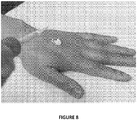
- Figures 7-12 illustrate the application of another personal care product composition according to a specific example embodiment of the present disclosure.
- 50 ⁇ l of deionized water is applied to the surface of a hand.
- 50 mg of a personal care product composition according to a specific example embodiment of the present disclosure is applied to the same region where the water was applied.
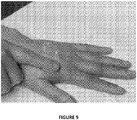
- Figure 9 illustrates a personal care product composition after one swipe of a finger.
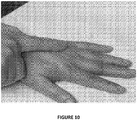
- Figure 10 illustrates a personal care product composition after two swipes of a finger.
- Figure 11 illustrates a personal care product composition after three swipes of a finger. As seen through Figures 9-11 , the whiteness of the personal care product composition may be gradually reduced through swipes of the finger.
- FIG 11 whiteness that may form upon interaction of water and personal care product composition may have become substantially clear. Accordingly, in some embodiments, substantial removal of whiteness may be achieved after as few as three swipes.
- Figure 12 illustrates a completed application of a personal care product. As seen in Figure 12 , very little if any residue or whiteness remains. Thus, clear application of personal care product compositions according to embodiments of the present disclosure may be achieved in as little as three swipes of a finger.
Landscapes
- Health & Medical Sciences (AREA)
- Life Sciences & Earth Sciences (AREA)
- Public Health (AREA)
- Veterinary Medicine (AREA)
- Animal Behavior & Ethology (AREA)
- General Health & Medical Sciences (AREA)
- Epidemiology (AREA)
- Birds (AREA)
- Dermatology (AREA)
- Chemical & Material Sciences (AREA)
- Emergency Medicine (AREA)
- Oil, Petroleum & Natural Gas (AREA)
- Dispersion Chemistry (AREA)
- Cosmetics (AREA)
Claims (19)
- Verfahren zur Formulierung einer Körperpflegeproduktzusammensetzung, die bei Exposition gegenüber Temperaturen von etwa 60 °C und/oder etwa 5 °C für eine Dauer von einer Woche oder mehr stabil ist und die auf feuchte Haut klar aufträgt und klar bleibt, wobei das Verfahren umfasst:Kombinieren einer diskontinuierlichen Ölphase mit einer hydrophil-lipophil-Gleichgewicht(HLB)-emulgierenden Verbindung, um ein Ölphasengemisch zu bilden, wobei die HLB-emulgierende Verbindung bei Raumtemperatur eine Flüssigkeit ist und ein HLB von weniger als etwa 5 aufweist;Erwärmen und Mischen des Ölphasengemischs;Dispergieren eines oder mehrerer Carbomerpolymere in einer kontinuierlichen Wasserphase, um ein Wasserphasengemisch zu bilden;Kombinieren und Mischen des Ölphasengemischs und des Wasserphasengemischs, um eine Voremulsion zu bilden;Zugeben einer neutralisierenden Base zu der Voremulsion, um eine Körperpflegeproduktemulsion zu bilden;Zugeben von Wasser zu der Körperpflegeproduktemulsion; undMischen der Körperpflegeproduktemulsion, um eine homogene Zusammensetzung zu bilden, wobei die homogene Zusammensetzung umfasst:von 0,1 Gew.-% bis 1 Gew.-% an der HLBemulgierenden Verbindung,eine stabilisierende, nicht-aufhellende Menge des einen oder der mehreren Carbomerpolymere, wobei jedes Carbomerpolymer ausgewählt ist aus der Gruppe bestehend aus einem Carbomer-Copolymer, einem Carbomer-Interpolymer und einem Carbomer-Homopolymer, wobei keines von dem einen oder den mehreren Carbomerpolymeren eine emulgierende Sorte ist und wobei die Gesamt-Carbomerpolymerkonzentration weniger als 0,5 Gew.-% der Zusammensetzung beträgt, undwobei die homogene Zusammensetzung frei von jeder anderen emulgierenden Verbindung ist.
- Verfahren gemäß Anspruch 1, ferner umfassend Kombinieren der diskontinuierlichen Ölphase mit einem oder mehreren UV-Filtern, um das Ölphasengemisch zu bilden, wobei die homogene Zusammensetzung bis zu 50 Gew.-% an dem einen oder den mehreren UV-Filtern umfasst.
- Verfahren zur Formulierung einer Öl-in-Wasser-Körperpflegeproduktzusammensetzung, die bei Exposition gegenüber Temperaturen von etwa 60 °C und/oder etwa 5 °C für eine Dauer von einer Woche oder mehr stabil ist, wobei das Verfahren umfasst:getrenntes Bereitstellen einer Ölphase und einer Wasserphase;Dispergieren eines oder mehrerer Carbomerpolymere entweder in der Ölphase oder in der Wasserphase;Dispergieren einer hydrophil-lipophil-Gleichgewicht(HLB)-emulgierenden Verbindung in der Ölphase, wobei die HLB-emulgierende Verbindung bei Raumtemperatur eine Flüssigkeit ist und ein HLB von weniger als etwa 5 aufweist;Kombinieren der Ölphase mit der Wasserphase, um eine Voremulsion zu bilden;Zugeben einer neutralisierenden Base zu der Voremulsion, um eine Körperpflegeproduktemulsion zu bilden;Zugeben von Wasser zu der Körperpflegeproduktemulsion; undMischen der Körperpflegeproduktemulsion, um eine homogene Zusammensetzung zu bilden, wobei die homogene Zusammensetzung umfasst:
von 0,1 Gew.-% bis 1 Gew.-% an der HLBemulgierenden Verbindung, eine stabilisierende Menge des einen oder der mehreren Carbomerpolymere, wobei jedes Carbomerpolymer ausgewählt ist aus der Gruppe bestehend aus einem Carbomer-Copolymer, einem Carbomer-Interpolymer und einem Carbomer-Homopolymer, wobei keines von dem einen oder den mehreren Carbomerpolymeren eine emulgierende Sorte ist und wobei die Gesamt-Carbomerpolymerkonzentration weniger als 0,5 Gew.-% der Zusammensetzung beträgt, undwobei die homogene Zusammensetzung frei von jeder anderen emulgierenden Verbindung ist. - Körperpflegeproduktzusammensetzung zum topischen Aufbringen auf menschliche Haut, die klar auf feuchte Haut aufträgt, umfassend:eine kontinuierliche Wasserphase;eine diskontinuierliche Ölphase, die in der kontinuierlichen Wasserphase dispergiert ist, wobei die diskontinuierliche Ölphase gegebenenfalls einen oder mehrere UV-Filter mit einer Konzentration von bis zu 50 Gew.-% der gesamten Zusammensetzung umfasst;eine hydrophil-lipophil-Gleichgewicht(HLB)-emulgierende Verbindung mit einer Konzentration von 0,1 Gew.-% bis 1 Gew.-% der gesamten Zusammensetzung, wobei die HLB-emulgierende Verbindung bei Raumtemperatur eine Flüssigkeit ist und ein HLB von weniger als etwa 5 aufweist, wobei die Zusammensetzung keine andere emulgierende Verbindung aufweist;eine neutralisierende Base; undeine stabilisierende, nicht-aufhellende Menge des einen oder der mehreren Carbomerpolymere, wobei jedes Carbomerpolymer ausgewählt ist aus der Gruppe bestehend aus einem Carbomer-Copolymer, einem Carbomer-Interpolymer und einem Carbomer-Homopolymer, wobei keines von dem einen oder den mehreren Carbomerpolymeren eine emulgierende Sorte ist und wobei die Gesamt-Carbomerpolymerkonzentration weniger als 0,5 Gew.-% der Zusammensetzung beträgt, undwobei die niedrig-HLB-emulgierende Verbindung Sorbitanoleat oder Glyceryloleat ist.
- Körperpflegeproduktzusammensetzung gemäß Anspruch 4, wobei die kontinuierliche Wasserphase einen Gewichtsprozentanteil von 10 % bis 90 % der gesamten Zusammensetzung bildet und/oder wobei die diskontinuierliche Ölphase einen Gewichtsprozentanteil von 10 % bis 80 % der gesamten Zusammensetzung bildet.
- Körperpflegeproduktzusammensetzung gemäß Anspruch 4 oder Anspruch 5, wobei die kontinuierliche Wasserphase einen Gewichtsprozentanteil der gesamten Zusammensetzung bildet, der größer als der Gewichtsprozentanteil der diskontinuierlichen Ölphase ist.
- Körperpflegeproduktzusammensetzung oder Verfahren gemäß Anspruch 6, wobei die HLB-emulgierende Verbindung 0,1 Gew.-% bis 0,8 Gew.-% der gesamten Zusammensetzung bildet.
- Körperpflegeproduktzusammensetzung oder Verfahren gemäß Anspruch 7, wobei die HLB-emulgierende Verbindung Sorbitanoleat mit 0,2 Gew.-% bis 0,4 Gew.-% der gesamten Zusammensetzung ist; oder
Körperpflegeproduktzusammensetzung oder Verfahren gemäß Anspruch 8, wobei die HLB-emulgierende Verbindung Glyceryloleat mit 0,3 Gew.-% bis 0,5 Gew.-% der gesamten Zusammensetzung ist. - Körperpflegeproduktzusammensetzung oder Verfahren gemäß einem der vorstehenden Ansprüche, wobei jeder der UV-Filter ausgewählt ist aus der Gruppe von 2-Ethylhexyl-2-cyano-3,3-diphenyl-2-propenoat, Salicylsäureestern, Ethylhexylsalicylat, Homomenthylsalicylat, 3,3,5-Trimethylcyclohexyl-2-hydroxybenzoat, p-Methoxyzimtsäureestern, Ethylhexylmethoxycinnamat, Isoamylmethoxycinnamat, 1-(4-Methoxyphenyl)-3-(4-tert-butylphenyl)propan-1,3-dion, Butylmethoxydibenzoylmethan, (2-Hydroxy-4-methoxyphenyl)phenylmethanon, Benzophenon-3, Bemotrizinol, Bisethylhexyloxyphenolmethoxyphenyltriazon, Methylenbisbenzotriazolyl, Tetramethylbutylphenol, 4-Methylbenzylidencampher, Diethylaminohydroxybenzoylhexylbenzoat, Drometrizoltrisiloxan, Ethylhexyltriazon, Diethylhexylbutamidotriazon, Terephthalyidendicamphersulfonsäure und Salzen davon und Menthylanthranilat.
- Körperpflegeproduktzusammensetzung gemäß Anspruch 4 oder einem der vorstehenden Ansprüche, wobei die Zusammensetzung bei etwa 5 °C für wenigstens etwa 1 Monat stabil ist, so dass keine Veränderung der äußeren Erscheinung der Körperpflegeproduktzusammensetzung auftritt; oder
wobei die Zusammensetzung bei etwa 60 °C für wenigstens etwa 1 Monat stabil ist, so dass keine Veränderung der äußeren Erscheinung der Körperpflegeproduktzusammensetzung auftritt. - Körperpflegeproduktzusammensetzung gemäß Anspruch 4 oder einem der vorstehenden Ansprüche, wobei das Carbomerpolymer ein Carbomer-Homopolymer mit 0,15 Gew.-% bis 0,4 Gew.-% der gesamten Zusammensetzung umfasst; oder
wobei das Carbomerpolymer ein Carbomer-Homopolymer mit 0,3 Gew.-% bis 0,4 Gew.-% der gesamten Zusammensetzung umfasst; oder
wobei das Carbomerpolymer ein Carbomer-Interpolymer mit 0,1 Gew.-% bis 0,5 Gew.-% der gesamten Zusammensetzung umfasst; oder
wobei das Carbomerpolymer ein Carbomer-Interpolymer mit 0,15 Gew.-% bis 0,3 Gew.-% der gesamten Zusammensetzung umfasst; oder
wobei das Carbomerpolymer ein Carbomer-Copolymer mit 0,1 Gew.-% bis 0,5 Gew.-% der gesamten Zusammensetzung umfasst; oder
wobei das Carbomerpolymer ein Carbomer-Copolymer mit 0,15 Gew.-% bis 0,25 Gew.-% der gesamten Zusammensetzung umfasst; oder
wobei das eine oder die mehreren Carbomerpolymere insgesamt 0,3 Gew.-% bis 0,5 Gew.-% der gesamten Zusammensetzung bilden. - Körperpflegeproduktzusammensetzung gemäß Anspruch 4 oder einem der vorstehenden Ansprüche, wobei das eine oder die mehreren Carbomerpolymere ein Carbomer-Homopolymer und ein Carbomer-Copolymer umfassen; oder
wobei das eine oder die mehreren Carbomerpolymere umfassen:ein Carbomer-Homopolymer mit 0,15 Gew.-% der gesamten Zusammensetzung undein Carbomer-Copolymer mit 0,15 Gew.-% der gesamten Zusammensetzung. - Körperpflegeproduktzusammensetzung gemäß Anspruch 4 oder einem der vorstehenden Ansprüche, wobei das eine oder die mehreren Carbomerpolymere ein Carbomer-Homopolymer und ein Carbomer-Interpolymer umfassen; oder
wobei das eine oder die mehreren Carbomerpolymere umfassen:ein Carbomer-Homopolymer mit 0,15 Gew.-% der gesamten Zusammensetzung undein Carbomer-Interpolymer mit 0,15 Gew.-% der gesamten Zusammensetzung. - Körperpflegeproduktzusammensetzung gemäß Anspruch 4 oder einem der vorstehenden Ansprüche, wobei die kontinuierliche Wasserphase ein wasserlösliches Konservierungsmittel, ein Feuchthaltemittel, einen Chelatbildner, ein pH-Einstellmittel, einen Puffer, ein Neutralisationsmittel, einen Farbstoff, einen wasserlöslichen biologischen Wirkstoff oder eine Kombination davon umfasst; oder
wobei die kontinuierliche Wasserphase ein Glycol, einen polyhydrischen Alkohol oder ein Glycol und einen polyhydrischen Alkohol umfasst; oder
wobei die kontinuierliche Wasserphase ein Glycerin, ein Propylenglycol, ein Butylenglycol, ein Hexalenglycol oder Kombinationen davon umfasst; oder
wobei die kontinuierliche Wasserphase Feuchthaltemittel mit 0 Gew.-% bis 10 Gew.-% der gesamten Zusammensetzung umfasst. - Körperpflegeproduktzusammensetzung gemäß Anspruch 4 oder einem der vorstehenden Ansprüche, wobei die diskontinuierliche Ölphase ferner einen organischen Stabilisator, einen Stabilisator, ein Lösungsmittel, einen Weichmacher, ein filmbildendes Polymer, eine SPF-Verstärkerverbindung, ein SPF-Verstärkerpolymer oder Kombinationen davon umfasst.
- Körperpflegeproduktzusammensetzung gemäß Anspruch 15, wobei der Stabilisator ausgewählt ist aus Ethylhexylmethoxycrylen, Diethylhexylsyringylidenmalonat, Diethylhexyl-2,6-naphthalat, Polyester-8, Polyester-25, Undecylcrylendimethicon, Pentaerythrityltetradi-t-butylhydroxyhydrocinnamat, Octadecyldi-t-butyl-4-hydroxyhydrocinnamat, Benzotriazolyldodecyl-p-cresol, Tris, Citrat, Natriumbenzotriazolylbutylphenolsulfonat, Bumetrizol, butyliertem Hydroxyltoluol (BHT), butyliertem Hydroxyanisol (BHA), Tocopherol oder Kombinationen davon; oder
wobei das filmbildende Polymer ausgewählt ist aus Acryl-Homopolymeren oder -Copolymeren mit hydrophoben Gruppen; Dimethicon/Acrylat-Dimethicon-Copolymeren; hydrierten Dimer-Dilinoleyl/Dimethylcarbonat-Copolymeren; Copolymeren von Vinylpyrrolidon und einem langkettigen alpha-Olefin, Vinylpyrrolidon/Tricontanyl-Copolymer, VA/Butylmaleat/Isobornylacrylat-Copolymer oder Kombinationen davon; oder
wobei das filmbildende Polymer ein Acrylat-Dimethicon-Copolymer umfasst; oder
wobei die diskontinuierliche Ölphase ferner ein filmbildendes Polymer mit 1 Gew.-% bis 3 Gew.-% der gesamten Zusammensetzung umfasst; oder
wobei die diskontinuierliche Ölphase ferner einen Fettsäureester, einen Fettalkoholester, einen Ester eines Guerbet-Alkohols, einen Benzoesäureester, einen Ester einer zweibasigen Säure, einen Ester einer polyprotischen Säure, einen Ester eines polyhydrischen Alkohols, ein Triglycerid, ein Polyethylenglycol, einen Ester eines Polyethylenglycols, ein Polypropylenglycol, einen Ester eines Polypropylenglycols, einen Polyester, ein Silicon, ein organisch modifiziertes Silicon, eine Kohlenwasserstoffverbindung, die ein Mineralöl, ein Paraffinöl, ein Naphthenöl oder ein aromatisches Öl umfasst, ein von einem Polyisobuten abgeleitetes Polymer, ein von einem Polypropylen abgeleitetes Polymer, ein C12-15-Alkylbenzoat oder eine Kombination davon umfasst. - Körperpflegeproduktzusammensetzung gemäß Anspruch 4 oder einem der vorstehenden Ansprüche, wobei die Körperpflegeproduktzusammensetzung eine Viskosität von etwa 300 cP bis etwa 115.000 cP umfasst.
- Körperpflegeproduktzusammensetzung gemäß Anspruch 4 oder einem der vorstehenden Ansprüche, wobei das Körperpflegeprodukt durch Wischen, Reiben, Glätten, Massieren, Überziehen oder sonstiges Verarbeiten der Zusammensetzung auf der Haut für etwa 2 bis etwa 5 Sekunden aufgebracht wird; oder
wobei die Zusammensetzung eine photoaktive Menge des einen oder der mehreren organischen UV-Filter bis zu 50 Gew.-% der gesamten Zusammensetzung umfasst. - Verfahren zum Aufbringen einer Körperpflegeproduktzusammensetzung auf eine feuchte menschliche Hautoberfläche, die ein natürliches Aussehen und eine natürliche Farbe aufweist, wobei das Verfahren umfasst:Aufbringen der Körperpflegeproduktzusammensetzung auf die feuchte menschliche Hautoberfläche,wobei die Körperpflegeproduktzusammensetzung umfasst:eine kontinuierliche Wasserphase;eine diskontinuierliche Ölphase, die in der kontinuierlichen Wasserphase dispergiert ist, wobei die diskontinuierliche Ölphase einen oder mehrere UV-Filter mit einer Konzentration von wenigstens 5 Gew.-% der gesamten Zusammensetzung umfasst;eine hydrophil-lipophil-Gleichgewicht(HLB)-emulgierende Verbindung mit einer Konzentration von 0,1 Gew.-% bis 1 Gew.-% der gesamten Zusammensetzung, wobei die HLB-emulgierende Verbindung bei Raumtemperatur eine Flüssigkeit ist und ein HLB von weniger als etwa 5 aufweist, wobei die Zusammensetzung keine andere emulgierende Verbindung aufweist;eine neutralisierende Base; undeine stabilisierende, nicht-aufhellende Menge des einen oder der mehreren Carbomerpolymere, wobei jedes Carbomerpolymer ausgewählt ist aus der Gruppe bestehend aus einem Carbomer-Copolymer, einem Carbomer-Interpolymer und einem Carbomer-Homopolymer, wobei keines von dem einen oder den mehreren Carbomerpolymeren eine emulgierende Sorte ist und wobei die Gesamt-Carbomerpolymerkonzentration weniger als 0,5 Gew.-% der Zusammensetzung beträgt,wobeidas Aufbringen Wischen, Reiben, Glätten, Massieren, Überziehen oder sonstiges Verarbeiten der Zusammensetzung auf der Haut umfasst,das Aufbringen weniger als etwa 5 Sekunden andauert unddie Körperpflegeproduktzusammensetzung nicht später als am Ende des Aufbringens klar ist unddie Haut mit der aufgebrachten Körperpflegeproduktzusammensetzung vor Exposition gegenüber wenigstens einer Lichtwellenlänge im Vergleich zu Haut ohne das Körperpflegeprodukt abgeschirmt ist und gegebenenfalls oder vorzugsweise wobei die Körperpflegeproduktzusammensetzung während des gesamten Aufbringens klar ist.
Applications Claiming Priority (2)
| Application Number | Priority Date | Filing Date | Title |
|---|---|---|---|
| US201361883848P | 2013-09-27 | 2013-09-27 | |
| US201414229590A | 2014-03-28 | 2014-03-28 |
Publications (2)
| Publication Number | Publication Date |
|---|---|
| EP2853255A1 EP2853255A1 (de) | 2015-04-01 |
| EP2853255B1 true EP2853255B1 (de) | 2018-11-28 |
Family
ID=51584967
Family Applications (1)
| Application Number | Title | Priority Date | Filing Date |
|---|---|---|---|
| EP14185253.3A Active EP2853255B1 (de) | 2013-09-27 | 2014-09-18 | Verfahren zur Formulierung eines Körperpflegeprodukts mit nahezu keiner Bleichungswirkung beim Auftragen auf feuchte Haut sowie Zusammensetzungen damit |
Country Status (1)
| Country | Link |
|---|---|
| EP (1) | EP2853255B1 (de) |
Cited By (1)
| Publication number | Priority date | Publication date | Assignee | Title |
|---|---|---|---|---|
| US12605314B2 (en) | 2018-03-23 | 2026-04-21 | LCS Advanced Solutions, LLC | Broad-spectrum, mineral, photoprotective compositions |
Families Citing this family (5)
| Publication number | Priority date | Publication date | Assignee | Title |
|---|---|---|---|---|
| FR3037243B1 (fr) * | 2015-06-11 | 2018-11-16 | L'oreal | Composition comprenant un filtre uv, un polymere hydrophile reticule anionique, un tensioactif ayant une hlb inferieure ou egale a 5 et un copolymere silicone |
| ES2776773A1 (es) * | 2019-01-31 | 2020-07-31 | Actigolden S L | Composicion protectora del color y el olor |
| US12083199B2 (en) | 2019-09-10 | 2024-09-10 | LCS Advanced Solutions, LLC | Mineral, anhydrous, broad-spectrum sunscreen |
| CN114195943B (zh) * | 2021-12-17 | 2023-12-19 | 万华化学集团股份有限公司 | 一种能快速润湿分散的卡波姆增稠剂及制备方法 |
| US12059487B2 (en) | 2022-10-15 | 2024-08-13 | LCS Advanced Solutions, LLC | Structurally diverse, stable, and radiation-protective particle matrix sunscreen and cosmetic compositions and related methods |
Family Cites Families (5)
| Publication number | Priority date | Publication date | Assignee | Title |
|---|---|---|---|---|
| DE4425268C2 (de) * | 1994-07-16 | 1998-05-28 | Beiersdorf Ag | Emulgatorfreie, feindisperse kosmetische oder dermatologische Zubereitungen vom Typ Öl-in-Wasser |
| US6838088B2 (en) * | 1998-09-18 | 2005-01-04 | Beiersdorf Ag | Emulsifier-free finely disperse systems of the oil-in-water- and water-in-oil- type |
| DE19846772A1 (de) * | 1998-10-10 | 2000-04-13 | Beiersdorf Ag | Kosmetische und dermatoligische Hydrodispersionen mit einem Gehalt an Triglyceridwachsen |
| GB2439618A (en) * | 2006-06-14 | 2008-01-02 | Reckitt & Colmann Prod Ltd | Skincare composition |
| US8236287B2 (en) | 2010-09-03 | 2012-08-07 | Neutrogena Corporation | Sunscreen compositions |
-
2014
- 2014-09-18 EP EP14185253.3A patent/EP2853255B1/de active Active
Non-Patent Citations (1)
| Title |
|---|
| None * |
Cited By (1)
| Publication number | Priority date | Publication date | Assignee | Title |
|---|---|---|---|---|
| US12605314B2 (en) | 2018-03-23 | 2026-04-21 | LCS Advanced Solutions, LLC | Broad-spectrum, mineral, photoprotective compositions |
Also Published As
| Publication number | Publication date |
|---|---|
| EP2853255A1 (de) | 2015-04-01 |
Similar Documents
| Publication | Publication Date | Title |
|---|---|---|
| JP5934189B2 (ja) | サンスクリーン組成物 | |
| AU2009215013B2 (en) | Photoprotective compositions with glycol and styrene/acrylate copolymer | |
| KR100352356B1 (ko) | 방충성일광차단제 | |
| EP2853255B1 (de) | Verfahren zur Formulierung eines Körperpflegeprodukts mit nahezu keiner Bleichungswirkung beim Auftragen auf feuchte Haut sowie Zusammensetzungen damit | |
| JP6053922B2 (ja) | 水中油型化粧料 | |
| EP2558059B1 (de) | Zusammensetzungen und verfahren für spf-verstärkung mit hochkonzentrierten kosmetikpuderformulierungen | |
| WO2004110366A2 (en) | Sunscreen composition | |
| US6858200B2 (en) | Sunscreen formulations | |
| JP6815093B2 (ja) | 水中油型日焼け止め化粧料 | |
| JP2011513320A (ja) | アボベンゾンを含有するサンケア組成物の増強された光安定性 | |
| US20150272841A1 (en) | Method of making an anhydrous, pigmented composition | |
| CN103249395A (zh) | 高spf防晒组合物 | |
| KR102868522B1 (ko) | 디에틸아미노 히드록시벤조일 헥실 벤조에이트 및 부틸 메톡시디벤조일메탄을 가지며, 옥토크릴렌을 함유하지 않는 효율적인 선스크린 조성물 | |
| JP2024531520A (ja) | 光保護パーソナルケア組成物 | |
| US20150093343A1 (en) | Method of formulating a personal care product with substantially no whitening effect when applied on wet skin and compositions thereof | |
| JP4268763B2 (ja) | 光保護効果の高い組成物およびその使用方法 | |
| WO2024142926A1 (ja) | 水中油型乳化組成物 | |
| CN105188853A (zh) | 光防护个人护理组合物 | |
| US6165449A (en) | Methods and compositions for improving sun protection from sunscreen formulations | |
| JP2000506547A (ja) | 光保護系を含有する3相エマルション | |
| JP2007137825A (ja) | 化粧料 | |
| TW202245731A (zh) | 水中油型乳化化妝料 | |
| JP7362641B2 (ja) | 日焼け止め組成物 | |
| JP3939610B2 (ja) | 皮膚化粧料 | |
| KR102870201B1 (ko) | 디에틸아미노 히드록시벤조일 헥실 벤조에이트 및 부틸 메톡시디벤조일메탄을 갖는 효율적인 선스크린 조성물 |
Legal Events
| Date | Code | Title | Description |
|---|---|---|---|
| PUAI | Public reference made under article 153(3) epc to a published international application that has entered the european phase |
Free format text: ORIGINAL CODE: 0009012 |
|
| 17P | Request for examination filed |
Effective date: 20140918 |
|
| AK | Designated contracting states |
Kind code of ref document: A1 Designated state(s): AL AT BE BG CH CY CZ DE DK EE ES FI FR GB GR HR HU IE IS IT LI LT LU LV MC MK MT NL NO PL PT RO RS SE SI SK SM TR |
|
| AX | Request for extension of the european patent |
Extension state: BA ME |
|
| R17P | Request for examination filed (corrected) |
Effective date: 20150930 |
|
| RBV | Designated contracting states (corrected) |
Designated state(s): AL AT BE BG CH CY CZ DE DK EE ES FI FR GB GR HR HU IE IS IT LI LT LU LV MC MK MT NL NO PL PT RO RS SE SI SK SM TR |
|
| STAA | Information on the status of an ep patent application or granted ep patent |
Free format text: STATUS: EXAMINATION IS IN PROGRESS |
|
| 17Q | First examination report despatched |
Effective date: 20170213 |
|
| GRAP | Despatch of communication of intention to grant a patent |
Free format text: ORIGINAL CODE: EPIDOSNIGR1 |
|
| STAA | Information on the status of an ep patent application or granted ep patent |
Free format text: STATUS: GRANT OF PATENT IS INTENDED |
|
| INTG | Intention to grant announced |
Effective date: 20180514 |
|
| GRAS | Grant fee paid |
Free format text: ORIGINAL CODE: EPIDOSNIGR3 |
|
| GRAA | (expected) grant |
Free format text: ORIGINAL CODE: 0009210 |
|
| STAA | Information on the status of an ep patent application or granted ep patent |
Free format text: STATUS: THE PATENT HAS BEEN GRANTED |
|
| AK | Designated contracting states |
Kind code of ref document: B1 Designated state(s): AL AT BE BG CH CY CZ DE DK EE ES FI FR GB GR HR HU IE IS IT LI LT LU LV MC MK MT NL NO PL PT RO RS SE SI SK SM TR |
|
| RAP1 | Party data changed (applicant data changed or rights of an application transferred) |
Owner name: HALLSTAR BEAUTY AND PERSONAL CARE INNOVATIONS COMP |
|
| REG | Reference to a national code |
Ref country code: CH Ref legal event code: EP |
|
| REG | Reference to a national code |
Ref country code: AT Ref legal event code: REF Ref document number: 1069397 Country of ref document: AT Kind code of ref document: T Effective date: 20181215 |
|
| REG | Reference to a national code |
Ref country code: IE Ref legal event code: FG4D |
|
| REG | Reference to a national code |
Ref country code: DE Ref legal event code: R096 Ref document number: 602014036836 Country of ref document: DE |
|
| REG | Reference to a national code |
Ref country code: NL Ref legal event code: MP Effective date: 20181128 |
|
| REG | Reference to a national code |
Ref country code: LT Ref legal event code: MG4D |
|
| REG | Reference to a national code |
Ref country code: AT Ref legal event code: MK05 Ref document number: 1069397 Country of ref document: AT Kind code of ref document: T Effective date: 20181128 |
|
| PG25 | Lapsed in a contracting state [announced via postgrant information from national office to epo] |
Ref country code: LV Free format text: LAPSE BECAUSE OF FAILURE TO SUBMIT A TRANSLATION OF THE DESCRIPTION OR TO PAY THE FEE WITHIN THE PRESCRIBED TIME-LIMIT Effective date: 20181128 Ref country code: AT Free format text: LAPSE BECAUSE OF FAILURE TO SUBMIT A TRANSLATION OF THE DESCRIPTION OR TO PAY THE FEE WITHIN THE PRESCRIBED TIME-LIMIT Effective date: 20181128 Ref country code: ES Free format text: LAPSE BECAUSE OF FAILURE TO SUBMIT A TRANSLATION OF THE DESCRIPTION OR TO PAY THE FEE WITHIN THE PRESCRIBED TIME-LIMIT Effective date: 20181128 Ref country code: LT Free format text: LAPSE BECAUSE OF FAILURE TO SUBMIT A TRANSLATION OF THE DESCRIPTION OR TO PAY THE FEE WITHIN THE PRESCRIBED TIME-LIMIT Effective date: 20181128 Ref country code: BG Free format text: LAPSE BECAUSE OF FAILURE TO SUBMIT A TRANSLATION OF THE DESCRIPTION OR TO PAY THE FEE WITHIN THE PRESCRIBED TIME-LIMIT Effective date: 20190228 Ref country code: HR Free format text: LAPSE BECAUSE OF FAILURE TO SUBMIT A TRANSLATION OF THE DESCRIPTION OR TO PAY THE FEE WITHIN THE PRESCRIBED TIME-LIMIT Effective date: 20181128 Ref country code: IS Free format text: LAPSE BECAUSE OF FAILURE TO SUBMIT A TRANSLATION OF THE DESCRIPTION OR TO PAY THE FEE WITHIN THE PRESCRIBED TIME-LIMIT Effective date: 20190328 Ref country code: FI Free format text: LAPSE BECAUSE OF FAILURE TO SUBMIT A TRANSLATION OF THE DESCRIPTION OR TO PAY THE FEE WITHIN THE PRESCRIBED TIME-LIMIT Effective date: 20181128 Ref country code: NO Free format text: LAPSE BECAUSE OF FAILURE TO SUBMIT A TRANSLATION OF THE DESCRIPTION OR TO PAY THE FEE WITHIN THE PRESCRIBED TIME-LIMIT Effective date: 20190228 |
|
| PG25 | Lapsed in a contracting state [announced via postgrant information from national office to epo] |
Ref country code: RS Free format text: LAPSE BECAUSE OF FAILURE TO SUBMIT A TRANSLATION OF THE DESCRIPTION OR TO PAY THE FEE WITHIN THE PRESCRIBED TIME-LIMIT Effective date: 20181128 Ref country code: GR Free format text: LAPSE BECAUSE OF FAILURE TO SUBMIT A TRANSLATION OF THE DESCRIPTION OR TO PAY THE FEE WITHIN THE PRESCRIBED TIME-LIMIT Effective date: 20190301 Ref country code: PT Free format text: LAPSE BECAUSE OF FAILURE TO SUBMIT A TRANSLATION OF THE DESCRIPTION OR TO PAY THE FEE WITHIN THE PRESCRIBED TIME-LIMIT Effective date: 20190328 Ref country code: AL Free format text: LAPSE BECAUSE OF FAILURE TO SUBMIT A TRANSLATION OF THE DESCRIPTION OR TO PAY THE FEE WITHIN THE PRESCRIBED TIME-LIMIT Effective date: 20181128 Ref country code: SE Free format text: LAPSE BECAUSE OF FAILURE TO SUBMIT A TRANSLATION OF THE DESCRIPTION OR TO PAY THE FEE WITHIN THE PRESCRIBED TIME-LIMIT Effective date: 20181128 |
|
| PG25 | Lapsed in a contracting state [announced via postgrant information from national office to epo] |
Ref country code: NL Free format text: LAPSE BECAUSE OF FAILURE TO SUBMIT A TRANSLATION OF THE DESCRIPTION OR TO PAY THE FEE WITHIN THE PRESCRIBED TIME-LIMIT Effective date: 20181128 |
|
| PG25 | Lapsed in a contracting state [announced via postgrant information from national office to epo] |
Ref country code: DK Free format text: LAPSE BECAUSE OF FAILURE TO SUBMIT A TRANSLATION OF THE DESCRIPTION OR TO PAY THE FEE WITHIN THE PRESCRIBED TIME-LIMIT Effective date: 20181128 Ref country code: IT Free format text: LAPSE BECAUSE OF FAILURE TO SUBMIT A TRANSLATION OF THE DESCRIPTION OR TO PAY THE FEE WITHIN THE PRESCRIBED TIME-LIMIT Effective date: 20181128 Ref country code: CZ Free format text: LAPSE BECAUSE OF FAILURE TO SUBMIT A TRANSLATION OF THE DESCRIPTION OR TO PAY THE FEE WITHIN THE PRESCRIBED TIME-LIMIT Effective date: 20181128 Ref country code: PL Free format text: LAPSE BECAUSE OF FAILURE TO SUBMIT A TRANSLATION OF THE DESCRIPTION OR TO PAY THE FEE WITHIN THE PRESCRIBED TIME-LIMIT Effective date: 20181128 |
|
| REG | Reference to a national code |
Ref country code: DE Ref legal event code: R097 Ref document number: 602014036836 Country of ref document: DE |
|
| PG25 | Lapsed in a contracting state [announced via postgrant information from national office to epo] |
Ref country code: SK Free format text: LAPSE BECAUSE OF FAILURE TO SUBMIT A TRANSLATION OF THE DESCRIPTION OR TO PAY THE FEE WITHIN THE PRESCRIBED TIME-LIMIT Effective date: 20181128 Ref country code: EE Free format text: LAPSE BECAUSE OF FAILURE TO SUBMIT A TRANSLATION OF THE DESCRIPTION OR TO PAY THE FEE WITHIN THE PRESCRIBED TIME-LIMIT Effective date: 20181128 Ref country code: SM Free format text: LAPSE BECAUSE OF FAILURE TO SUBMIT A TRANSLATION OF THE DESCRIPTION OR TO PAY THE FEE WITHIN THE PRESCRIBED TIME-LIMIT Effective date: 20181128 Ref country code: RO Free format text: LAPSE BECAUSE OF FAILURE TO SUBMIT A TRANSLATION OF THE DESCRIPTION OR TO PAY THE FEE WITHIN THE PRESCRIBED TIME-LIMIT Effective date: 20181128 |
|
| PLBE | No opposition filed within time limit |
Free format text: ORIGINAL CODE: 0009261 |
|
| STAA | Information on the status of an ep patent application or granted ep patent |
Free format text: STATUS: NO OPPOSITION FILED WITHIN TIME LIMIT |
|
| PG25 | Lapsed in a contracting state [announced via postgrant information from national office to epo] |
Ref country code: SI Free format text: LAPSE BECAUSE OF FAILURE TO SUBMIT A TRANSLATION OF THE DESCRIPTION OR TO PAY THE FEE WITHIN THE PRESCRIBED TIME-LIMIT Effective date: 20181128 |
|
| 26N | No opposition filed |
Effective date: 20190829 |
|
| PG25 | Lapsed in a contracting state [announced via postgrant information from national office to epo] |
Ref country code: TR Free format text: LAPSE BECAUSE OF FAILURE TO SUBMIT A TRANSLATION OF THE DESCRIPTION OR TO PAY THE FEE WITHIN THE PRESCRIBED TIME-LIMIT Effective date: 20181128 |
|
| REG | Reference to a national code |
Ref country code: DE Ref legal event code: R119 Ref document number: 602014036836 Country of ref document: DE |
|
| PG25 | Lapsed in a contracting state [announced via postgrant information from national office to epo] |
Ref country code: MC Free format text: LAPSE BECAUSE OF FAILURE TO SUBMIT A TRANSLATION OF THE DESCRIPTION OR TO PAY THE FEE WITHIN THE PRESCRIBED TIME-LIMIT Effective date: 20181128 |
|
| REG | Reference to a national code |
Ref country code: CH Ref legal event code: PL |
|
| PG25 | Lapsed in a contracting state [announced via postgrant information from national office to epo] |
Ref country code: CH Free format text: LAPSE BECAUSE OF NON-PAYMENT OF DUE FEES Effective date: 20190930 Ref country code: DE Free format text: LAPSE BECAUSE OF NON-PAYMENT OF DUE FEES Effective date: 20200401 Ref country code: LI Free format text: LAPSE BECAUSE OF NON-PAYMENT OF DUE FEES Effective date: 20190930 Ref country code: LU Free format text: LAPSE BECAUSE OF NON-PAYMENT OF DUE FEES Effective date: 20190918 Ref country code: IE Free format text: LAPSE BECAUSE OF NON-PAYMENT OF DUE FEES Effective date: 20190918 |
|
| REG | Reference to a national code |
Ref country code: BE Ref legal event code: MM Effective date: 20190930 |
|
| PG25 | Lapsed in a contracting state [announced via postgrant information from national office to epo] |
Ref country code: BE Free format text: LAPSE BECAUSE OF NON-PAYMENT OF DUE FEES Effective date: 20190930 |
|
| GBPC | Gb: european patent ceased through non-payment of renewal fee |
Effective date: 20190918 |
|
| PG25 | Lapsed in a contracting state [announced via postgrant information from national office to epo] |
Ref country code: GB Free format text: LAPSE BECAUSE OF NON-PAYMENT OF DUE FEES Effective date: 20190918 |
|
| PG25 | Lapsed in a contracting state [announced via postgrant information from national office to epo] |
Ref country code: CY Free format text: LAPSE BECAUSE OF FAILURE TO SUBMIT A TRANSLATION OF THE DESCRIPTION OR TO PAY THE FEE WITHIN THE PRESCRIBED TIME-LIMIT Effective date: 20181128 |
|
| PG25 | Lapsed in a contracting state [announced via postgrant information from national office to epo] |
Ref country code: HU Free format text: LAPSE BECAUSE OF FAILURE TO SUBMIT A TRANSLATION OF THE DESCRIPTION OR TO PAY THE FEE WITHIN THE PRESCRIBED TIME-LIMIT; INVALID AB INITIO Effective date: 20140918 Ref country code: MT Free format text: LAPSE BECAUSE OF FAILURE TO SUBMIT A TRANSLATION OF THE DESCRIPTION OR TO PAY THE FEE WITHIN THE PRESCRIBED TIME-LIMIT Effective date: 20181128 |
|
| PG25 | Lapsed in a contracting state [announced via postgrant information from national office to epo] |
Ref country code: MK Free format text: LAPSE BECAUSE OF FAILURE TO SUBMIT A TRANSLATION OF THE DESCRIPTION OR TO PAY THE FEE WITHIN THE PRESCRIBED TIME-LIMIT Effective date: 20181128 |
|
| PGFP | Annual fee paid to national office [announced via postgrant information from national office to epo] |
Ref country code: FR Payment date: 20250922 Year of fee payment: 12 |