EP2853388A1 - Verre stratifié doté d'au moins une pièce de formage en métal - Google Patents
Verre stratifié doté d'au moins une pièce de formage en métal Download PDFInfo
- Publication number
- EP2853388A1 EP2853388A1 EP20140405066 EP14405066A EP2853388A1 EP 2853388 A1 EP2853388 A1 EP 2853388A1 EP 20140405066 EP20140405066 EP 20140405066 EP 14405066 A EP14405066 A EP 14405066A EP 2853388 A1 EP2853388 A1 EP 2853388A1
- Authority
- EP
- European Patent Office
- Prior art keywords
- polymer film
- glass
- molded part
- glass laminate
- recess
- Prior art date
- Legal status (The legal status is an assumption and is not a legal conclusion. Google has not performed a legal analysis and makes no representation as to the accuracy of the status listed.)
- Withdrawn
Links
- 239000005340 laminated glass Substances 0.000 title claims abstract description 90
- 229910052751 metal Inorganic materials 0.000 title claims abstract description 14
- 239000002184 metal Substances 0.000 title claims abstract description 14
- 229920006254 polymer film Polymers 0.000 claims abstract description 95
- 239000011521 glass Substances 0.000 claims abstract description 82
- 229920000642 polymer Polymers 0.000 claims description 10
- 238000000034 method Methods 0.000 claims description 5
- 238000010438 heat treatment Methods 0.000 claims description 4
- 229920003229 poly(methyl methacrylate) Polymers 0.000 claims description 3
- 239000004926 polymethyl methacrylate Substances 0.000 claims description 3
- 229920001169 thermoplastic Polymers 0.000 claims description 3
- 239000010410 layer Substances 0.000 description 25
- 238000000465 moulding Methods 0.000 description 13
- 238000004873 anchoring Methods 0.000 description 7
- 238000004519 manufacturing process Methods 0.000 description 6
- 239000000853 adhesive Substances 0.000 description 3
- 230000001070 adhesive effect Effects 0.000 description 3
- 239000011229 interlayer Substances 0.000 description 3
- 238000003475 lamination Methods 0.000 description 3
- 230000005540 biological transmission Effects 0.000 description 2
- 230000000694 effects Effects 0.000 description 2
- 230000005855 radiation Effects 0.000 description 2
- 239000005336 safety glass Substances 0.000 description 2
- VGGSQFUCUMXWEO-UHFFFAOYSA-N Ethene Chemical compound C=C VGGSQFUCUMXWEO-UHFFFAOYSA-N 0.000 description 1
- CERQOIWHTDAKMF-UHFFFAOYSA-N Methacrylic acid Chemical compound CC(=C)C(O)=O CERQOIWHTDAKMF-UHFFFAOYSA-N 0.000 description 1
- 229910000831 Steel Inorganic materials 0.000 description 1
- RTAQQCXQSZGOHL-UHFFFAOYSA-N Titanium Chemical compound [Ti] RTAQQCXQSZGOHL-UHFFFAOYSA-N 0.000 description 1
- 229910052782 aluminium Inorganic materials 0.000 description 1
- XAGFODPZIPBFFR-UHFFFAOYSA-N aluminium Chemical compound [Al] XAGFODPZIPBFFR-UHFFFAOYSA-N 0.000 description 1
- 239000002131 composite material Substances 0.000 description 1
- 150000001875 compounds Chemical class 0.000 description 1
- 239000004020 conductor Substances 0.000 description 1
- 229920001577 copolymer Polymers 0.000 description 1
- 239000011888 foil Substances 0.000 description 1
- 230000009477 glass transition Effects 0.000 description 1
- 238000010030 laminating Methods 0.000 description 1
- 238000012423 maintenance Methods 0.000 description 1
- 229910021645 metal ion Inorganic materials 0.000 description 1
- 239000002861 polymer material Substances 0.000 description 1
- 239000010959 steel Substances 0.000 description 1
- 239000010936 titanium Substances 0.000 description 1
- 229910052719 titanium Inorganic materials 0.000 description 1
Images


Classifications
-
- B—PERFORMING OPERATIONS; TRANSPORTING
- B32—LAYERED PRODUCTS
- B32B—LAYERED PRODUCTS, i.e. PRODUCTS BUILT-UP OF STRATA OF FLAT OR NON-FLAT, e.g. CELLULAR OR HONEYCOMB, FORM
- B32B17/00—Layered products essentially comprising sheet glass, or glass, slag, or like fibres
- B32B17/06—Layered products essentially comprising sheet glass, or glass, slag, or like fibres comprising glass as the main or only constituent of a layer, next to another layer of a specific material
- B32B17/10—Layered products essentially comprising sheet glass, or glass, slag, or like fibres comprising glass as the main or only constituent of a layer, next to another layer of a specific material of synthetic resin
- B32B17/10005—Layered products essentially comprising sheet glass, or glass, slag, or like fibres comprising glass as the main or only constituent of a layer, next to another layer of a specific material of synthetic resin laminated safety glass or glazing
- B32B17/10165—Functional features of the laminated safety glass or glazing
- B32B17/10293—Edge features, e.g. inserts or holes
-
- B—PERFORMING OPERATIONS; TRANSPORTING
- B32—LAYERED PRODUCTS
- B32B—LAYERED PRODUCTS, i.e. PRODUCTS BUILT-UP OF STRATA OF FLAT OR NON-FLAT, e.g. CELLULAR OR HONEYCOMB, FORM
- B32B17/00—Layered products essentially comprising sheet glass, or glass, slag, or like fibres
- B32B17/06—Layered products essentially comprising sheet glass, or glass, slag, or like fibres comprising glass as the main or only constituent of a layer, next to another layer of a specific material
- B32B17/10—Layered products essentially comprising sheet glass, or glass, slag, or like fibres comprising glass as the main or only constituent of a layer, next to another layer of a specific material of synthetic resin
- B32B17/10005—Layered products essentially comprising sheet glass, or glass, slag, or like fibres comprising glass as the main or only constituent of a layer, next to another layer of a specific material of synthetic resin laminated safety glass or glazing
- B32B17/10009—Layered products essentially comprising sheet glass, or glass, slag, or like fibres comprising glass as the main or only constituent of a layer, next to another layer of a specific material of synthetic resin laminated safety glass or glazing characterized by the number, the constitution or treatment of glass sheets
- B32B17/10036—Layered products essentially comprising sheet glass, or glass, slag, or like fibres comprising glass as the main or only constituent of a layer, next to another layer of a specific material of synthetic resin laminated safety glass or glazing characterized by the number, the constitution or treatment of glass sheets comprising two outer glass sheets
-
- B—PERFORMING OPERATIONS; TRANSPORTING
- B32—LAYERED PRODUCTS
- B32B—LAYERED PRODUCTS, i.e. PRODUCTS BUILT-UP OF STRATA OF FLAT OR NON-FLAT, e.g. CELLULAR OR HONEYCOMB, FORM
- B32B17/00—Layered products essentially comprising sheet glass, or glass, slag, or like fibres
- B32B17/06—Layered products essentially comprising sheet glass, or glass, slag, or like fibres comprising glass as the main or only constituent of a layer, next to another layer of a specific material
- B32B17/10—Layered products essentially comprising sheet glass, or glass, slag, or like fibres comprising glass as the main or only constituent of a layer, next to another layer of a specific material of synthetic resin
- B32B17/10005—Layered products essentially comprising sheet glass, or glass, slag, or like fibres comprising glass as the main or only constituent of a layer, next to another layer of a specific material of synthetic resin laminated safety glass or glazing
- B32B17/1055—Layered products essentially comprising sheet glass, or glass, slag, or like fibres comprising glass as the main or only constituent of a layer, next to another layer of a specific material of synthetic resin laminated safety glass or glazing characterized by the resin layer, i.e. interlayer
- B32B17/10743—Layered products essentially comprising sheet glass, or glass, slag, or like fibres comprising glass as the main or only constituent of a layer, next to another layer of a specific material of synthetic resin laminated safety glass or glazing characterized by the resin layer, i.e. interlayer containing acrylate (co)polymers or salts thereof
-
- B—PERFORMING OPERATIONS; TRANSPORTING
- B32—LAYERED PRODUCTS
- B32B—LAYERED PRODUCTS, i.e. PRODUCTS BUILT-UP OF STRATA OF FLAT OR NON-FLAT, e.g. CELLULAR OR HONEYCOMB, FORM
- B32B3/00—Layered products comprising a layer with external or internal discontinuities or unevennesses, or a layer of non-planar shape; Layered products comprising a layer having particular features of form
- B32B3/02—Layered products comprising a layer with external or internal discontinuities or unevennesses, or a layer of non-planar shape; Layered products comprising a layer having particular features of form characterised by features of form at particular places, e.g. in edge regions
- B32B3/06—Layered products comprising a layer with external or internal discontinuities or unevennesses, or a layer of non-planar shape; Layered products comprising a layer having particular features of form characterised by features of form at particular places, e.g. in edge regions for securing layers together; for attaching the product to another member, e.g. to a support, or to another product, e.g. groove/tongue, interlocking
-
- B—PERFORMING OPERATIONS; TRANSPORTING
- B32—LAYERED PRODUCTS
- B32B—LAYERED PRODUCTS, i.e. PRODUCTS BUILT-UP OF STRATA OF FLAT OR NON-FLAT, e.g. CELLULAR OR HONEYCOMB, FORM
- B32B3/00—Layered products comprising a layer with external or internal discontinuities or unevennesses, or a layer of non-planar shape; Layered products comprising a layer having particular features of form
- B32B3/02—Layered products comprising a layer with external or internal discontinuities or unevennesses, or a layer of non-planar shape; Layered products comprising a layer having particular features of form characterised by features of form at particular places, e.g. in edge regions
- B32B3/08—Layered products comprising a layer with external or internal discontinuities or unevennesses, or a layer of non-planar shape; Layered products comprising a layer having particular features of form characterised by features of form at particular places, e.g. in edge regions characterised by added members at particular parts
-
- B—PERFORMING OPERATIONS; TRANSPORTING
- B32—LAYERED PRODUCTS
- B32B—LAYERED PRODUCTS, i.e. PRODUCTS BUILT-UP OF STRATA OF FLAT OR NON-FLAT, e.g. CELLULAR OR HONEYCOMB, FORM
- B32B37/00—Methods or apparatus for laminating, e.g. by curing or by ultrasonic bonding
- B32B37/14—Methods or apparatus for laminating, e.g. by curing or by ultrasonic bonding characterised by the properties of the layers
- B32B37/16—Methods or apparatus for laminating, e.g. by curing or by ultrasonic bonding characterised by the properties of the layers with all layers existing as coherent layers before laminating
- B32B37/18—Methods or apparatus for laminating, e.g. by curing or by ultrasonic bonding characterised by the properties of the layers with all layers existing as coherent layers before laminating involving the assembly of discrete sheets or panels only
- B32B37/182—Methods or apparatus for laminating, e.g. by curing or by ultrasonic bonding characterised by the properties of the layers with all layers existing as coherent layers before laminating involving the assembly of discrete sheets or panels only one or more of the layers being plastic
-
- B—PERFORMING OPERATIONS; TRANSPORTING
- B32—LAYERED PRODUCTS
- B32B—LAYERED PRODUCTS, i.e. PRODUCTS BUILT-UP OF STRATA OF FLAT OR NON-FLAT, e.g. CELLULAR OR HONEYCOMB, FORM
- B32B38/00—Ancillary operations in connection with laminating processes
- B32B38/0004—Cutting, tearing or severing, e.g. bursting; Cutter details
-
- E—FIXED CONSTRUCTIONS
- E06—DOORS, WINDOWS, SHUTTERS, OR ROLLER BLINDS IN GENERAL; LADDERS
- E06B—FIXED OR MOVABLE CLOSURES FOR OPENINGS IN BUILDINGS, VEHICLES, FENCES OR LIKE ENCLOSURES IN GENERAL, e.g. DOORS, WINDOWS, BLINDS, GATES
- E06B3/00—Window sashes, door leaves, or like elements for closing wall or like openings; Layout of fixed or moving closures, e.g. windows in wall or like openings; Features of rigidly-mounted outer frames relating to the mounting of wing frames
- E06B3/66—Units comprising two or more parallel glass or like panes permanently secured together
-
- B—PERFORMING OPERATIONS; TRANSPORTING
- B32—LAYERED PRODUCTS
- B32B—LAYERED PRODUCTS, i.e. PRODUCTS BUILT-UP OF STRATA OF FLAT OR NON-FLAT, e.g. CELLULAR OR HONEYCOMB, FORM
- B32B2250/00—Layers arrangement
- B32B2250/03—3 layers
-
- B—PERFORMING OPERATIONS; TRANSPORTING
- B32—LAYERED PRODUCTS
- B32B—LAYERED PRODUCTS, i.e. PRODUCTS BUILT-UP OF STRATA OF FLAT OR NON-FLAT, e.g. CELLULAR OR HONEYCOMB, FORM
- B32B2250/00—Layers arrangement
- B32B2250/05—5 or more layers
-
- B—PERFORMING OPERATIONS; TRANSPORTING
- B32—LAYERED PRODUCTS
- B32B—LAYERED PRODUCTS, i.e. PRODUCTS BUILT-UP OF STRATA OF FLAT OR NON-FLAT, e.g. CELLULAR OR HONEYCOMB, FORM
- B32B2250/00—Layers arrangement
- B32B2250/40—Symmetrical or sandwich layers, e.g. ABA, ABCBA, ABCCBA
-
- E—FIXED CONSTRUCTIONS
- E06—DOORS, WINDOWS, SHUTTERS, OR ROLLER BLINDS IN GENERAL; LADDERS
- E06B—FIXED OR MOVABLE CLOSURES FOR OPENINGS IN BUILDINGS, VEHICLES, FENCES OR LIKE ENCLOSURES IN GENERAL, e.g. DOORS, WINDOWS, BLINDS, GATES
- E06B3/00—Window sashes, door leaves, or like elements for closing wall or like openings; Layout of fixed or moving closures, e.g. windows in wall or like openings; Features of rigidly-mounted outer frames relating to the mounting of wing frames
- E06B3/54—Fixing of glass panes or like plates
- E06B3/5436—Fixing of glass panes or like plates involving holes or indentations in the pane
-
- Y—GENERAL TAGGING OF NEW TECHNOLOGICAL DEVELOPMENTS; GENERAL TAGGING OF CROSS-SECTIONAL TECHNOLOGIES SPANNING OVER SEVERAL SECTIONS OF THE IPC; TECHNICAL SUBJECTS COVERED BY FORMER USPC CROSS-REFERENCE ART COLLECTIONS [XRACs] AND DIGESTS
- Y10—TECHNICAL SUBJECTS COVERED BY FORMER USPC
- Y10T—TECHNICAL SUBJECTS COVERED BY FORMER US CLASSIFICATION
- Y10T156/00—Adhesive bonding and miscellaneous chemical manufacture
- Y10T156/10—Methods of surface bonding and/or assembly therefor
- Y10T156/1052—Methods of surface bonding and/or assembly therefor with cutting, punching, tearing or severing
- Y10T156/1062—Prior to assembly
- Y10T156/1064—Partial cutting [e.g., grooving or incising]
-
- Y—GENERAL TAGGING OF NEW TECHNOLOGICAL DEVELOPMENTS; GENERAL TAGGING OF CROSS-SECTIONAL TECHNOLOGIES SPANNING OVER SEVERAL SECTIONS OF THE IPC; TECHNICAL SUBJECTS COVERED BY FORMER USPC CROSS-REFERENCE ART COLLECTIONS [XRACs] AND DIGESTS
- Y10—TECHNICAL SUBJECTS COVERED BY FORMER USPC
- Y10T—TECHNICAL SUBJECTS COVERED BY FORMER US CLASSIFICATION
- Y10T428/00—Stock material or miscellaneous articles
- Y10T428/24—Structurally defined web or sheet [e.g., overall dimension, etc.]
- Y10T428/24008—Structurally defined web or sheet [e.g., overall dimension, etc.] including fastener for attaching to external surface
-
- Y—GENERAL TAGGING OF NEW TECHNOLOGICAL DEVELOPMENTS; GENERAL TAGGING OF CROSS-SECTIONAL TECHNOLOGIES SPANNING OVER SEVERAL SECTIONS OF THE IPC; TECHNICAL SUBJECTS COVERED BY FORMER USPC CROSS-REFERENCE ART COLLECTIONS [XRACs] AND DIGESTS
- Y10—TECHNICAL SUBJECTS COVERED BY FORMER USPC
- Y10T—TECHNICAL SUBJECTS COVERED BY FORMER US CLASSIFICATION
- Y10T428/00—Stock material or miscellaneous articles
- Y10T428/24—Structurally defined web or sheet [e.g., overall dimension, etc.]
- Y10T428/24777—Edge feature
Definitions
- the invention relates to a glass laminate having at least one polymer film arranged between two glass plates and at least one metal molding and a method for producing such a glass laminate.
- Glass laminates with at least one polymer film arranged between two glass plates are known, for example from the automotive industry or from the field of safety glasses. Furthermore, various types of connection of such glasses with other elements, such as a facade known in the art.
- US 7,165,362 Apple Computer a glass laminate as a supporting structure, for. B. for a step.
- a glass sheet of the laminate has recesses on a side edge into which connecting elements can be inserted and glued therein. Through the connecting elements, the glass laminate structure can be attached to other elements.
- the connecting elements may be shaped differently, but preferably have a curved shape.
- the DE 20 2006 007 201 U 1 (Seele GmbH & Co. KG) describes a laminated glass pane comprising at least two individual panes, wherein the outermost pane has a depression which does not completely penetrate the pane, and the inner pane comprises a corresponding through-hole through which a connecting piece can be inserted, which is inserted in the recess of the outer disc engages.
- the depression or the bore in the glass panes can also have an undercut or another conical contour.
- DE 202 18 215 U1 discloses a fastener means for composite glass sheets, which comprises a clamping member which exerts a clamping force only on a carrier glass pane of the laminated glass pane.
- the clamping element is passed through a recess in the carrier glass pane, wherein a flange part of the clamping element engages behind the carrier glass pane.
- SE 519551 C (Fasadglas Backlin AB) describes a glass laminate with three glass panes, in which an anchoring element is inserted in a recess on one side edge of the middle pane of glass.
- the anchoring element is connected in the recess via the polymer intermediate layers with the two outer glass panes.
- EP 1 297 237 discloses a fastening device for a multilayer wall element, such as a laminated glass.
- a building-side disk has a through hole while an outer disk has a recess which is arranged coaxially to the through hole.
- a fastener is inserted through the through-hole, wherein an end portion of this fastener penetrates into the recess of the outside-side disk.
- the cavity between the fastener and the discs is filled by a cured filling compound.
- the recess may have a larger diameter than the through hole, whereby a suitable for fastening the fastener undercut is formed.
- the adhesion of these fasteners is permanently difficult to detect in a fastening of the connecting elements via a polymer interlayer or a separately applied adhesive and can be affected by external weather conditions such as sunlight, moisture or temperature changes.
- the adhesion between the connecting element and glass laminate can be reduced, which deteriorates the safety of use of such a glass laminate.
- this may mean that such an application is not possible.
- recesses or openings introduced into the glass panes weaken the glass component as a result of increased stresses in the region of the recesses or openings.
- the object of the invention is to provide a glass laminate belonging to the technical field mentioned above, in which in an efficient and cost-effective manner, a molded part made of metal, in particular a connecting element, can be introduced, wherein a secure and reliable connection between the molded part and the laminate is reached.
- the glass laminate according to the invention comprises at least two glass plates, wherein between these at least two glass plates at least a first polymer film and at least one shaped part made of metal are arranged.
- the at least one molding is substantially the same thickness as the at least one first polymer film.
- the polymer film has a recess in which the molded part is arranged.
- the at least one molded part further has at least one first region, which is in positive engagement with the at least one first polymer film in the form of an undercut.
- the at least one shaped part is arranged in the region of an edge of the glass laminate and has a width which is less than 10% of the length of the edge.
- the width of the at least one molded part is less than 5% of the length of the edge.
- the molded part Due to the positive engagement of the molded part in the at least one first polymer film, the molded part is additionally anchored safe escape in the plane of the glass plates. Therefore, in order to hold the molded article in the glass laminate, no additional bonding of the molded article is necessary in the present invention.
- the at least one molded part has a width which is smaller by some orders of magnitude than the length of the edge of the glass laminate, in the region of which at least one molded part is arranged, a substantially punctiform arrangement of the at least one molded part can be achieved.
- the compacted form of the laminated molding reduces the stresses which generally occur in the glass laminate due to the different coefficients of thermal expansion between the metal and the film, which improves the durability of the glass laminate in the region of the laminated molding.
- the at least one molded part has a width which is less than 5% of the length of the edge of the glass laminate, in particular less than 2.5% or less than 1%.
- their aggregated widths must not exceed 25% of the length of the edge.
- the added widths should not exceed 10% of the length of the edge.
- the at least two glass plates can be any glass plates that are used for a safety or laminated glass.
- the glass plates can have any dimensions and any shape that corresponds to the particular application of the glass laminate.
- the thickness of the glass plates used may vary depending on the purpose of the glass laminate.
- the first polymer film is used as the intermediate layer of the laminate.
- the first polymer film may consist of any suitable polymer material which has a sufficiently strong adhesion to the glass plates and also a sufficiently high tensile strength, that a secure anchoring of the molded part is ensured in the laminate.
- Such an interlayer film is sold, for example, by DuPont under the name SentryGlas® lonoplast.
- the polymer film is particularly preferably transparent, so that an unadulterated view through the glass laminate is made possible.
- the polymer film may also be colored or imprinted with an image, lettering or the like.
- the polymer film may also have a different transmission for radiation outside the visible range, in particular a smaller transmission for UV rays.
- the molding may be made of any metal suitable for the specific function of the molding, such as steel, aluminum or titanium.
- the thickness of the molded part preferably corresponds to the thickness of the polymer film used. This thickness is for example from 0.8 mm to 3.0 mm.
- substantially means a deviation of ⁇ 10%.
- the recess in the first polymer film is preferably shaped and dimensioned such that the molded part fits flush into the recess. This prevents the molded part from having a movement play within the glass laminate, which would have a negative effect, in particular, when the molded part is used as anchoring of the glass laminate.
- the molded part may have any shape and dimension that corresponds to its respective function.
- a single restriction on the dimension of the molded part lies in the thickness of the molded part, which - as stated above - substantially corresponds to the thickness of the first polymer film used.
- the molded part in the first region must have a shape which is in positive engagement with the recess of the first polymer film in the sense of an undercut.
- the molded part can have at least one widening and / or at least one cut which widen and / or reduce the at least one molded part in a plane parallel to the plane of the at least two glass plates.
- the at least one incision and / or the at least one extension can have any suitable shape, in particular polygonal or rounded.
- the at least one molded part can also have an opening with an arbitrary shape, which is arranged within the surface of the molded part.
- a correspondingly cut-out element of the at least one first polymer film is placed in this opening of the molded part in order to allow an adhesive bond between the at least two glass plates within this opening.
- an inner opening is combined with another area with an undercut in order to increase the anchoring of the molded part within the glass laminate.
- each with a polymer interlayer which is arranged between two glass plates.
- at least one molded part may be arranged in each intermediate layer or alternatively only in one of a plurality of intermediate layers of a multilayer glass laminate.
- a plurality of molded parts are arranged between two glass plates. These several moldings can the same shape and Size or alternatively have different shapes and sizes, depending on what the individual moldings are provided.
- each of these first polymer films may have a corresponding recess for the at least one molded part.
- the molded part in this case may have the same thickness as the plurality of stacked first polymer films.
- the at least one molded part has a second area that protrudes beyond the edge of the glass laminate.
- the molding can be used as anchoring the glass laminate to another structure, such as a facade scaffold, a door of the window hinge or the like.
- the molded part can also be provided as an electrical conductor, for example, to conduct current or data signals into or through the glass laminate.
- a plurality of, in particular two, molded parts are arranged, which have a second region which projects beyond the edge.
- the molded part preferably has at least one connecting element in at least one second area. At least one layer of the at least one first polymer film is arranged between the connecting element and the edge of the glass laminate.
- a connecting element can be laminated to the edge of the glass laminate on the face side in a particularly stable and efficient manner.
- the at least one molded part can be used particularly advantageously for anchoring the glass laminate to a further structure.
- the connecting element can have at least one connecting structure, such as a bore, a threaded bore, a latching element or the like, with the aid of which the connecting element can be connected to a further structure in a particularly simple and efficient manner.
- the connecting element has a shape in which at least one side surface of the connecting element is flush with the surface of at least one glass plate of the glass laminate.
- the connecting element is designed as a cuboid, of which one surface is flush with each one of the at least two glass plates of the glass laminate.
- the at least one layer has at least one recess in which an element of a thermoplastic polymer, in particular of polymethyl methacrylate, with the same thickness as the at least one layer is arranged.
- the distance between the connecting element and the edge of the glass laminate can be maintained exactly, even if during laminating the at least one layer - as well as the at least one first polymer film within the glass laminate - becomes very soft by heating well above the glass transition temperature of the polymer used.
- This allows maintenance of the position of the connector during the lamination process.
- This makes it possible to arrange molded parts with fasteners application-specific and precise at the edges of a glass laminate, without this precise positioning is lost in the further manufacturing process of the glass laminate.
- the at least one first polymer film comprises a polymer having a modulus of elasticity of at least 100 N / mm 2 at a temperature of 50 C and a loading time of about 3 seconds or less.
- the at least one first polymer film comprises a polymer having a modulus of elasticity of at least 15 N / mm 2 at 50 ° C and a loading time of 1 hour.
- At least one second polymer film is arranged between the at least one first polymer film and at least one, preferably both, of the at least two glass plates, these second polymer films lying in the region of the recess of the at least one first polymer film between the at least one molded part and the at least two glass plates.
- the arrangement of at least one second polymer film between the first polymer film and the first glass plate and / or the second glass plate can additionally produce an adhesive bond between the molded part and the at least two glass plates, which additionally increases the attachment of the molded part within the glass laminate.
- more than just a second polymer film can be arranged on both sides between the first polymer film and the at least two glass plates, depending on which properties are desired for the glass laminate.
- the at least one first polymer film should also have a sufficiently large proven adhesion to the at least two glass plates.
- the polymer film comprises a co-polymer of ethene and methacrylic acid.
- a polymer film additionally comprises metal ions.
- Such a polymer film has good adhesion properties to glass, a high tensile strength and a modulus of elasticity in a suitable range.
- a glass laminate can be created, which is stiff and stable at the same time as well as allows for a molded part made of metal desired high pull-out force.
- the present invention further relates to a method for producing a glass laminate having at least two glass plates, wherein between these at least two glass plates, a first polymer film and at least one shaped part made of metal are arranged.
- a first glass plate which presented at least one metal part and the first polymer film.
- the at least one molded part comprises at least a first region which has a shape with an undercut.
- a recess in the first polymer film produced wherein the recess corresponds to the shape and size of the at least one molded part.
- the first polymer film is placed on the first glass plate and the at least one molded part is inserted into the recess.
- the shape of the at least one first region of the molded part with the undercut is such that this at least one first region of the molded article engages in a form-fitting manner with the first polymer film via the undercut. Thereafter, a second glass plate is placed and the two glass plates combined by heating the first polymer film together to form a glass laminate.
- the union of the at least two glass plates, that is, the lamination step, can also be subdivided into sub-steps.
- a prelaminate can be produced by heating the polymer film, which is then processed using pressure and heat to form the finished glass laminate.
- At least one second polymer film is placed on the first glass plate before the first polymer film is applied, and then the first polymer film is then placed on top of this at least one second polymer film.
- the at least one second polymer film has no recess for the at least one molded part, as a result the at least one molded part is placed on this at least one second film, with which in the finished glass laminate the at least one molded part additionally adheres to the first glass plate.
- At least one second polymer film is placed on the first polymer film and the molded part prior to placing the second glass plate.
- at least one additional polymer film layer may in turn be added to the glass laminate.
- Particularly preferred is in each case between the first glass plate and the first Polymer film and placed between this and the second glass plate at least a second polymer film.
- the at least one molded part can additionally be connected in a force-fitting manner to the two glass plates on both sides.
- the Fig. 1 shows an inventive glass laminate 1 in a perspective view.
- the glass laminate comprises a first glass plate 2 and a second glass plate 3.
- a first polymer film 4 and two layers of the second polymer film 8, 9 are arranged between the two glass plates 2, 3.
- the first polymer film 4 is in this case between the two Layers of the second polymer film 8, 9 inserted.
- a second region 7 of a molded part 5 made of metal protrudes beyond an edge of the glass laminate, while a first region 6 of the molded part 5 is inserted in a recess 10 of the first film 4.
- the first region 6 of the molded part 4 has a shape which, in the sense of an undercut, engages in a form-fitting manner with the first polymer film 4.
- the molded part 5 is additionally frictionally connected to the two glass plates 2, 3 by the layers of the second polymer foils 8, 9 present between the latter and the two glass plates 2, 3. Due to the shape of the second region 6 of the molded part 5, this is held so as to be slip-resistant and leak-proof in the glass laminate 1.
- the thickness of the molded part 5 essentially corresponds to the thickness of the first polymer film 4.
- the recess 10 has a shape and size which corresponds to the shape and size of the molded part 5. As a result, a flush arrangement of the molded part 5 in the glass laminate 1 is made possible.
- the third molded part 5.3 exemplarily shows a second region 6.3 with an incision, while the molded parts 5.1, 5.5, 5.6 have first regions 6.1, 6.5, 6.6 with extensions.
- the second molded part 5.2 and the fourth molded part 5.4 of Fig. 2 show examples of variants of the first area 6.2, 6.4 with an opening 11.1, 11.2. Within the opening 11.1, 11.2 a correspondingly sized piece of the first film 4 is arranged in order to achieve the necessary undercut effect.
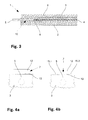
- Fig. 3 shows a section through the glass laminate 1 from the Fig. 1 ,
- a first layer of the second film 8 is placed, which covers substantially the entire surface of the first glass plate 2.
- the first polymer film 4 is placed, which has a recess 10 for the molded part 5. Accordingly, the molded part 5 is inserted in this recess 10.
- Fig. 4a shows a section of a glass laminate 1 with a molded part 5 with a connecting element 12 which is arranged in the second region 7 of the molded part 5.
- the connecting element 12 is formed integrally with the molded part 5.
- the connecting element 12 could also be materially connected to the second region 7 of the molded part 5, for example via a weld seam.
- a layer 13 of the first polymer film 4 is arranged between the connecting element 12 and an edge of the glass laminate, ie an edge of the two glass plates 2, 3, a layer 13 of the first polymer film 4 is arranged.
- Fig. 4b shows a section of a glass laminate 1 with an alternative variant of a connecting element 12.
- the at least one layer 13 of the first polymer film 4 has two recesses 14.1, 14.2, in each of which an element 15.1, 15.2 of a thermoplastic polymer, in particular of polymethyl methacrylate, is arranged.
- the arrangement of the elements 15.1, 15.2 can prevent the connecting element 12 and thus the entire molded part 5 from shifting owing to the polymer of the first polymer film 4 which has been softened due to the lamination process, and the at least one layer 13, in particular with respect to the latter Edge of glass laminate 1 tips.
- Fig. 5 makes a section through a glass laminate 1 after Fig. 4a It can be clearly seen that the connecting element 12 has substantially the same thickness as the glass laminate 1. Furthermore, the layer 13 of the first polymer film 4, which is arranged between the connecting element 12 and the edge of the glass laminate 1, is also clearly visible.
- the connecting element 12 is cuboid-shaped in this embodiment, wherein each one lower and upper side of the connecting element 12 is flush with a surface of the first glass plate 2 and the second glass plate 3.
- Fig. 6 restores a glass laminate 1 Fig. 4a with an alternative embodiment of a connecting element 12.
- the connecting element 12 has a double right-angled bend, so that a surface of the connecting element 12 is flush with the surface of the second glass plate 3.
- any shape for the connecting element 12 is conceivable, which is given a high flexibility in terms of possible locations and purposes.
- the at least one layer 13 of the two embodiments of Fig. 5 and Fig. 6 can of course also analogous to the embodiment of Fig. 4b be provided with at least one recess 14 and an element 15 disposed therein.
Landscapes
- Engineering & Computer Science (AREA)
- Civil Engineering (AREA)
- Structural Engineering (AREA)
- Joining Of Glass To Other Materials (AREA)
- Laminated Bodies (AREA)
Applications Claiming Priority (1)
| Application Number | Priority Date | Filing Date | Title |
|---|---|---|---|
| CH01651/13A CH708611A1 (de) | 2013-09-27 | 2013-09-27 | Glaslaminat mit wenigstens einem Formteil aus Metall. |
Publications (1)
| Publication Number | Publication Date |
|---|---|
| EP2853388A1 true EP2853388A1 (fr) | 2015-04-01 |
Family
ID=51422040
Family Applications (1)
| Application Number | Title | Priority Date | Filing Date |
|---|---|---|---|
| EP20140405066 Withdrawn EP2853388A1 (fr) | 2013-09-27 | 2014-08-20 | Verre stratifié doté d'au moins une pièce de formage en métal |
Country Status (4)
| Country | Link |
|---|---|
| US (1) | US20150093539A1 (fr) |
| EP (1) | EP2853388A1 (fr) |
| CA (1) | CA2861267A1 (fr) |
| CH (1) | CH708611A1 (fr) |
Cited By (3)
| Publication number | Priority date | Publication date | Assignee | Title |
|---|---|---|---|---|
| AT518542A4 (de) * | 2016-09-30 | 2017-11-15 | Richard Feuerhuber | Verkleidungselement |
| US20210170723A1 (en) * | 2017-12-05 | 2021-06-10 | Richard Feuerhuber | Cladding element |
| CN115653224A (zh) * | 2022-12-14 | 2023-01-31 | 汉班(天津)新材料科技有限公司 | 一种复合板材及制备方法和应用 |
Families Citing this family (9)
| Publication number | Priority date | Publication date | Assignee | Title |
|---|---|---|---|---|
| KR102331876B1 (ko) * | 2014-07-10 | 2021-11-29 | 코닝 인코포레이티드 | 냉간 성형된 유리 아플리케 |
| CH710658A1 (de) * | 2015-01-29 | 2016-07-29 | Glas Trösch Holding AG | lsolierglas mit tragenden Eigenschaften. |
| US10562274B1 (en) * | 2016-02-22 | 2020-02-18 | Apple Inc. | Glass fastening and sealing systems |
| FR3051922B1 (fr) * | 2016-05-26 | 2018-06-29 | Saint-Gobain Glass France | Pare-brise de vehicule pour affichage tete haute, vehicule l'incorporant et fabrication. |
| NL2018609B1 (en) * | 2017-03-30 | 2018-10-10 | Abt B V | A structural element of a laminated glass plate and a metal connecting element |
| JP7324228B2 (ja) * | 2018-05-03 | 2023-08-09 | セントラル硝子株式会社 | 剛性中間膜を有する車両用ラミネートグレージング |
| US11660837B2 (en) * | 2018-08-29 | 2023-05-30 | Saint-Gobain Glass France | Composite glass pane |
| DE102019103516B3 (de) * | 2019-02-12 | 2020-03-26 | sedak GmbH & Co. KG | Glasverbundeinheit und Verwendung einer Glasverbundeinheit als funktionelles Element eines Gebäudes |
| CN117124697B (zh) * | 2023-09-15 | 2025-08-29 | 杭州邦齐州科技有限公司 | 一种玻璃间贴合治具 |
Citations (12)
| Publication number | Priority date | Publication date | Assignee | Title |
|---|---|---|---|---|
| EP0525690A2 (fr) * | 1991-07-30 | 1993-02-03 | BGT Bischoff Glastechnik GmbH & Co. KG | Elément pour une construction en verre |
| WO1993002269A1 (fr) * | 1991-07-17 | 1993-02-04 | Chaddesley Investments Pty. Ltd. | Stratifies transparents et parois transparentes monolithiques |
| SE519551C2 (sv) | 2002-02-26 | 2003-03-11 | Fasadglas Baecklin Ab | Tillverkningsförfarande för ett bärande, laminerat glaselement samt ett sådant bärande, laminerat glaselement |
| EP1297237A1 (fr) | 2000-07-06 | 2003-04-02 | Saint-Gobain Glass France | Dispositif de fixation pour un element de paroi feuillete |
| DE20218215U1 (de) | 2002-11-22 | 2004-04-01 | Platz, Karl Otto | Befestigungsmittel für Verbundglasscheiben |
| US20050144862A1 (en) * | 2003-12-18 | 2005-07-07 | Jackson Michael Ii | Integrated laminated glass attachment plate |
| US20050238857A1 (en) * | 2002-07-19 | 2005-10-27 | Pilkington Plc | Laminated glazing panel |
| DE102004023638A1 (de) * | 2004-05-10 | 2005-12-08 | Eckelt Glas Gmbh | Verbundscheibe und Haltekonstruktion mit mindestens einer solchen Verbundscheibe |
| DE69826614T2 (de) * | 1997-11-28 | 2006-02-23 | Saint-Gobain Glass France | Schichtglas und Verfahren zu seiner Herstellung |
| DE202006007201U1 (de) | 2006-05-05 | 2006-10-26 | Seele Gmbh & Co. Kg | Glasscheibe mit schubfestem Verbund |
| US7165362B2 (en) | 2002-07-15 | 2007-01-23 | Apple Computer, Inc. | Glass support member |
| DE102007017971A1 (de) * | 2007-04-11 | 2008-10-16 | Döppner Bauelemente GmbH & Co. KG | Verbundelement und Verfahren zu seiner Herstellung |
Family Cites Families (4)
| Publication number | Priority date | Publication date | Assignee | Title |
|---|---|---|---|---|
| US4799346A (en) * | 1988-07-16 | 1989-01-24 | Advanced Glass Systems Corp. | Laminated glazing unit |
| FR2764841B1 (fr) * | 1997-06-18 | 1999-07-16 | Saint Gobain Vitrage | Vitrage blinde, notamment lateral fixe ou mobile pour vehicule automobile |
| DE10043793A1 (de) * | 2000-09-06 | 2002-03-14 | Daimler Chrysler Ag | Gepanzerte Scheibe |
| DE10207601C1 (de) * | 2002-02-22 | 2003-04-17 | Weidemann Unternehmensgruppe H | Verbundglasscheibe |
-
2013
- 2013-09-27 CH CH01651/13A patent/CH708611A1/de not_active Application Discontinuation
-
2014
- 2014-08-20 EP EP20140405066 patent/EP2853388A1/fr not_active Withdrawn
- 2014-08-27 CA CA 2861267 patent/CA2861267A1/fr not_active Abandoned
- 2014-09-02 US US14/474,996 patent/US20150093539A1/en not_active Abandoned
Patent Citations (12)
| Publication number | Priority date | Publication date | Assignee | Title |
|---|---|---|---|---|
| WO1993002269A1 (fr) * | 1991-07-17 | 1993-02-04 | Chaddesley Investments Pty. Ltd. | Stratifies transparents et parois transparentes monolithiques |
| EP0525690A2 (fr) * | 1991-07-30 | 1993-02-03 | BGT Bischoff Glastechnik GmbH & Co. KG | Elément pour une construction en verre |
| DE69826614T2 (de) * | 1997-11-28 | 2006-02-23 | Saint-Gobain Glass France | Schichtglas und Verfahren zu seiner Herstellung |
| EP1297237A1 (fr) | 2000-07-06 | 2003-04-02 | Saint-Gobain Glass France | Dispositif de fixation pour un element de paroi feuillete |
| SE519551C2 (sv) | 2002-02-26 | 2003-03-11 | Fasadglas Baecklin Ab | Tillverkningsförfarande för ett bärande, laminerat glaselement samt ett sådant bärande, laminerat glaselement |
| US7165362B2 (en) | 2002-07-15 | 2007-01-23 | Apple Computer, Inc. | Glass support member |
| US20050238857A1 (en) * | 2002-07-19 | 2005-10-27 | Pilkington Plc | Laminated glazing panel |
| DE20218215U1 (de) | 2002-11-22 | 2004-04-01 | Platz, Karl Otto | Befestigungsmittel für Verbundglasscheiben |
| US20050144862A1 (en) * | 2003-12-18 | 2005-07-07 | Jackson Michael Ii | Integrated laminated glass attachment plate |
| DE102004023638A1 (de) * | 2004-05-10 | 2005-12-08 | Eckelt Glas Gmbh | Verbundscheibe und Haltekonstruktion mit mindestens einer solchen Verbundscheibe |
| DE202006007201U1 (de) | 2006-05-05 | 2006-10-26 | Seele Gmbh & Co. Kg | Glasscheibe mit schubfestem Verbund |
| DE102007017971A1 (de) * | 2007-04-11 | 2008-10-16 | Döppner Bauelemente GmbH & Co. KG | Verbundelement und Verfahren zu seiner Herstellung |
Cited By (5)
| Publication number | Priority date | Publication date | Assignee | Title |
|---|---|---|---|---|
| AT518542A4 (de) * | 2016-09-30 | 2017-11-15 | Richard Feuerhuber | Verkleidungselement |
| AT518542B1 (de) * | 2016-09-30 | 2017-11-15 | Ing Richard Feuerhuber | Verkleidungselement |
| US20210170723A1 (en) * | 2017-12-05 | 2021-06-10 | Richard Feuerhuber | Cladding element |
| US11951714B2 (en) * | 2017-12-05 | 2024-04-09 | Richard Feuerhuber | Cladding element |
| CN115653224A (zh) * | 2022-12-14 | 2023-01-31 | 汉班(天津)新材料科技有限公司 | 一种复合板材及制备方法和应用 |
Also Published As
| Publication number | Publication date |
|---|---|
| CH708611A1 (de) | 2015-03-31 |
| US20150093539A1 (en) | 2015-04-02 |
| CA2861267A1 (fr) | 2015-03-27 |
Similar Documents
| Publication | Publication Date | Title |
|---|---|---|
| CH708611A1 (de) | Glaslaminat mit wenigstens einem Formteil aus Metall. | |
| DE102005047656A1 (de) | Verbundscheibe mit eiem integrierten Halteelement | |
| EP3279404B1 (fr) | Dispositif de fixation d'une vitre | |
| EP2441576A1 (fr) | Vitrage feuilleté doté d'une matrice à DEL intégrée et son procédé de fabrication | |
| EP3387204B1 (fr) | Dispositif, comprenant un disque et au moins un rail de levage, son procédé de fabrication et son utilisation | |
| DE202007016573U1 (de) | Verbundelement mit einem Befestigungselement | |
| DE29602315U1 (de) | Glasverbundplatte für feststehende und/oder bewegbare Scheiben im Hochbau | |
| WO2007131904A1 (fr) | Élément d'étanchéite pour un panneau de construction léger | |
| DE10110996B4 (de) | Wandelement für eine Ladegutsicherungsvorrichtung und Verfahren zu dessen Herstellung | |
| EP4081733A1 (fr) | Élément de panneau composite pour guider la lumière | |
| EP3034735B1 (fr) | Système de paroi coulissante ayant au moins un élément de battant de porte doté d'une vitre et procédé de fixation de cette vitre dans le système de paroi coulissante | |
| EP2094485A1 (fr) | Élément transparent à plusieurs couches | |
| DE10336359B4 (de) | Plattenförmiges Verbundelement mit einer Lagesicherung für eine Klebeverbindung | |
| EP3318378B1 (fr) | Procédé de revêtement de surfaces discontinues ainsi qu'élément de construction | |
| DE102012104505B4 (de) | Kreuzprofil, Möbelstück und Bausatz dafür | |
| DE102015219094A1 (de) | Kraftfahrzeug-Fensterscheibe sowie Verfahren zu deren Herstellung | |
| EP2565339B1 (fr) | Corps composite translucide et son procédé de fabrication | |
| DE102013112994A1 (de) | Verfahren zum Befestigen eines Beschlagteiles an einer Glasscheibe und im Zusammenhang mit dem Vefahren verwendbares Beschlagteil | |
| DE19709154C2 (de) | Verfahren zum Zusammenbauen von Isolierglasscheiben mit thermoplastischem Abstandhalter und mit eingesetztem Sprossenrahmen | |
| EP1318264B1 (fr) | Elément de support d'un vitrage | |
| EP2593319A1 (fr) | Vitre de fenêtre et procédé pour monter une vitre de fenêtre sur un véhicule | |
| DE202005007415U1 (de) | Fenstersprosse für Isolierglaseinheiten | |
| EP0857847A2 (fr) | Procédé d'assemblage de vitrages isolants avec espaceur thermoplastique et petits bois insérés, petits bois y afférent et vitrages isolants en pourvus | |
| EP2706184A1 (fr) | Fenêtre ou porte, notamment pour une maison passive ou basse énergie, dotée d'un élément de vitrage collé et procédé de fabrication d'une telle fenêtre ou d'une telle porte | |
| EP3034741B1 (fr) | Système de paroi coulissante doté d'un comportement acoustique amélioré |
Legal Events
| Date | Code | Title | Description |
|---|---|---|---|
| PUAI | Public reference made under article 153(3) epc to a published international application that has entered the european phase |
Free format text: ORIGINAL CODE: 0009012 |
|
| 17P | Request for examination filed |
Effective date: 20140820 |
|
| AK | Designated contracting states |
Kind code of ref document: A1 Designated state(s): AL AT BE BG CH CY CZ DE DK EE ES FI FR GB GR HR HU IE IS IT LI LT LU LV MC MK MT NL NO PL PT RO RS SE SI SK SM TR |
|
| AX | Request for extension of the european patent |
Extension state: BA ME |
|
| STAA | Information on the status of an ep patent application or granted ep patent |
Free format text: STATUS: THE APPLICATION IS DEEMED TO BE WITHDRAWN |
|
| 18D | Application deemed to be withdrawn |
Effective date: 20151002 |