EP2853392B1 - Appareil d'enregistrement à éjection de liquide et procédé de récupération de liquide - Google Patents
Appareil d'enregistrement à éjection de liquide et procédé de récupération de liquide Download PDFInfo
- Publication number
- EP2853392B1 EP2853392B1 EP14184979.4A EP14184979A EP2853392B1 EP 2853392 B1 EP2853392 B1 EP 2853392B1 EP 14184979 A EP14184979 A EP 14184979A EP 2853392 B1 EP2853392 B1 EP 2853392B1
- Authority
- EP
- European Patent Office
- Prior art keywords
- liquid
- absorber
- alkanediol
- liquid discharge
- recording apparatus
- Prior art date
- Legal status (The legal status is an assumption and is not a legal conclusion. Google has not performed a legal analysis and makes no representation as to the accuracy of the status listed.)
- Active
Links
Images

Classifications
-
- C—CHEMISTRY; METALLURGY
- C09—DYES; PAINTS; POLISHES; NATURAL RESINS; ADHESIVES; COMPOSITIONS NOT OTHERWISE PROVIDED FOR; APPLICATIONS OF MATERIALS NOT OTHERWISE PROVIDED FOR
- C09D—COATING COMPOSITIONS, e.g. PAINTS, VARNISHES OR LACQUERS; FILLING PASTES; CHEMICAL PAINT OR INK REMOVERS; INKS; CORRECTING FLUIDS; WOODSTAINS; PASTES OR SOLIDS FOR COLOURING OR PRINTING; USE OF MATERIALS THEREFOR
- C09D11/00—Inks
- C09D11/30—Inkjet printing inks
- C09D11/38—Inkjet printing inks characterised by non-macromolecular additives other than solvents, pigments or dyes
-
- B—PERFORMING OPERATIONS; TRANSPORTING
- B41—PRINTING; LINING MACHINES; TYPEWRITERS; STAMPS
- B41J—TYPEWRITERS; SELECTIVE PRINTING MECHANISMS, i.e. MECHANISMS PRINTING OTHERWISE THAN FROM A FORME; CORRECTION OF TYPOGRAPHICAL ERRORS
- B41J2/00—Typewriters or selective printing mechanisms characterised by the printing or marking process for which they are designed
- B41J2/005—Typewriters or selective printing mechanisms characterised by the printing or marking process for which they are designed characterised by bringing liquid or particles selectively into contact with a printing material
- B41J2/01—Ink jet
- B41J2/135—Nozzles
- B41J2/165—Prevention or detection of nozzle clogging, e.g. cleaning, capping or moistening for nozzles
- B41J2/16517—Cleaning of print head nozzles
-
- B—PERFORMING OPERATIONS; TRANSPORTING
- B41—PRINTING; LINING MACHINES; TYPEWRITERS; STAMPS
- B41J—TYPEWRITERS; SELECTIVE PRINTING MECHANISMS, i.e. MECHANISMS PRINTING OTHERWISE THAN FROM A FORME; CORRECTION OF TYPOGRAPHICAL ERRORS
- B41J2/00—Typewriters or selective printing mechanisms characterised by the printing or marking process for which they are designed
- B41J2/005—Typewriters or selective printing mechanisms characterised by the printing or marking process for which they are designed characterised by bringing liquid or particles selectively into contact with a printing material
- B41J2/01—Ink jet
- B41J2/135—Nozzles
- B41J2/165—Prevention or detection of nozzle clogging, e.g. cleaning, capping or moistening for nozzles
- B41J2/16505—Caps, spittoons or covers for cleaning or preventing drying out
- B41J2/16508—Caps, spittoons or covers for cleaning or preventing drying out connected with the printer frame
-
- B—PERFORMING OPERATIONS; TRANSPORTING
- B41—PRINTING; LINING MACHINES; TYPEWRITERS; STAMPS
- B41J—TYPEWRITERS; SELECTIVE PRINTING MECHANISMS, i.e. MECHANISMS PRINTING OTHERWISE THAN FROM A FORME; CORRECTION OF TYPOGRAPHICAL ERRORS
- B41J2/00—Typewriters or selective printing mechanisms characterised by the printing or marking process for which they are designed
- B41J2/005—Typewriters or selective printing mechanisms characterised by the printing or marking process for which they are designed characterised by bringing liquid or particles selectively into contact with a printing material
- B41J2/01—Ink jet
- B41J2/135—Nozzles
- B41J2/165—Prevention or detection of nozzle clogging, e.g. cleaning, capping or moistening for nozzles
- B41J2/16517—Cleaning of print head nozzles
- B41J2/1652—Cleaning of print head nozzles by driving a fluid through the nozzles to the outside thereof, e.g. by applying pressure to the inside or vacuum at the outside of the print head
-
- B—PERFORMING OPERATIONS; TRANSPORTING
- B41—PRINTING; LINING MACHINES; TYPEWRITERS; STAMPS
- B41J—TYPEWRITERS; SELECTIVE PRINTING MECHANISMS, i.e. MECHANISMS PRINTING OTHERWISE THAN FROM A FORME; CORRECTION OF TYPOGRAPHICAL ERRORS
- B41J2/00—Typewriters or selective printing mechanisms characterised by the printing or marking process for which they are designed
- B41J2/005—Typewriters or selective printing mechanisms characterised by the printing or marking process for which they are designed characterised by bringing liquid or particles selectively into contact with a printing material
- B41J2/01—Ink jet
- B41J2/135—Nozzles
- B41J2/165—Prevention or detection of nozzle clogging, e.g. cleaning, capping or moistening for nozzles
- B41J2/16517—Cleaning of print head nozzles
- B41J2/1652—Cleaning of print head nozzles by driving a fluid through the nozzles to the outside thereof, e.g. by applying pressure to the inside or vacuum at the outside of the print head
- B41J2/16523—Waste ink transport from caps or spittoons, e.g. by suction
-
- B—PERFORMING OPERATIONS; TRANSPORTING
- B41—PRINTING; LINING MACHINES; TYPEWRITERS; STAMPS
- B41J—TYPEWRITERS; SELECTIVE PRINTING MECHANISMS, i.e. MECHANISMS PRINTING OTHERWISE THAN FROM A FORME; CORRECTION OF TYPOGRAPHICAL ERRORS
- B41J2/00—Typewriters or selective printing mechanisms characterised by the printing or marking process for which they are designed
- B41J2/005—Typewriters or selective printing mechanisms characterised by the printing or marking process for which they are designed characterised by bringing liquid or particles selectively into contact with a printing material
- B41J2/01—Ink jet
- B41J2/17—Ink jet characterised by ink handling
- B41J2/1721—Collecting waste ink; Collectors therefor
-
- C—CHEMISTRY; METALLURGY
- C09—DYES; PAINTS; POLISHES; NATURAL RESINS; ADHESIVES; COMPOSITIONS NOT OTHERWISE PROVIDED FOR; APPLICATIONS OF MATERIALS NOT OTHERWISE PROVIDED FOR
- C09D—COATING COMPOSITIONS, e.g. PAINTS, VARNISHES OR LACQUERS; FILLING PASTES; CHEMICAL PAINT OR INK REMOVERS; INKS; CORRECTING FLUIDS; WOODSTAINS; PASTES OR SOLIDS FOR COLOURING OR PRINTING; USE OF MATERIALS THEREFOR
- C09D11/00—Inks
- C09D11/30—Inkjet printing inks
- C09D11/32—Inkjet printing inks characterised by colouring agents
- C09D11/322—Pigment inks
-
- C—CHEMISTRY; METALLURGY
- C09—DYES; PAINTS; POLISHES; NATURAL RESINS; ADHESIVES; COMPOSITIONS NOT OTHERWISE PROVIDED FOR; APPLICATIONS OF MATERIALS NOT OTHERWISE PROVIDED FOR
- C09D—COATING COMPOSITIONS, e.g. PAINTS, VARNISHES OR LACQUERS; FILLING PASTES; CHEMICAL PAINT OR INK REMOVERS; INKS; CORRECTING FLUIDS; WOODSTAINS; PASTES OR SOLIDS FOR COLOURING OR PRINTING; USE OF MATERIALS THEREFOR
- C09D11/00—Inks
- C09D11/54—Inks based on two liquids, one liquid being the ink, the other liquid being a reaction solution, a fixer or a treatment solution for the ink
Definitions
- the present invention relates to a liquid discharge recording apparatus and a method for recovering liquid.
- a water-based ink for ink-jet recording (hereinafter referred to as a "water-based ink” or an “ink” in some cases) has been using, as a solvent, a volatile organic solvent (see, for example, Japanese Patent Application Laid-open No. 2003-147243 ).
- a volatile organic solvent see, for example, Japanese Patent Application Laid-open No. 2003-147243 .
- VOC Volatile Organic Compounds
- US 2011/012956 describes an ink-jet recording apparatus which comprises an inkjet recording head having a nozzle from which ink is ejected on the basis of print data, an ink-receiving unit that receives the ink ejected from the nozzle, and a surface-tension-depressant-solution supplying unit that supplies a liquid composition containing a surface tension depressant to the ink-receiving unit when the ink is ejected from the nozzle into the ink-receiving unit.
- WO 2004/080723 describes an ink-jet system that separately ejects a treating liquid composition, containing fine particles being so configured that their dispersion is kept or broken by an external factor such as contact between substance or ultraviolet irradiation, and a recording liquid composition, containing a colorant being so configured that its dispersion or dissolution is kept or broken by the external factor, onto a recording medium. Droplets of the treating liquid composition and of the recording liquid composition are brought into contact with each other to cause a condition change such as a pH change or solubility change. The fine particles and the colorant aggregate separately without being substantially mixed with each other.
- US 2009/258203 describes an inkjet recording method in which two liquids are printed and which can perform inkjet ejection, in which the inkjet recording method is said to provide a high-quality image using a reaction liquid having excellent storage stability, ejection stability, and recoverability from clogging on a recording medium having an absorbing layer of a paper support with low water absorption, the image having excellent abrasion resistance.
- EP-A-2738004 describes an ink jet recording apparatus including a recording head having a plurality of nozzles through which an ink composition containing an inorganic pigment is ejected, a nozzle surface having nozzle orifices, and a liquid-repellant film disposed on the nozzle surface; an absorbing member that absorbs the ink composition containing the inorganic pigment from the nozzle orifices and the nozzle surface; and an actuating mechanism including a pressing member that presses the absorbing member and the nozzle surface relative to each other.
- An object of the present teaching is to provide a liquid discharge recording apparatus and a method for recovering a liquid which are capable of reducing the generation of VOC.
- a liquid discharge recording apparatus comprising:
- a liquid-recovery method for recovering a liquid in a liquid discharge recording apparatus comprising:
- a liquid discharge recording apparatus of the present teaching includes a first liquid containing first 1,2-alkanediol, a liquid discharge head configured to discharge the first liquid, and an absorber which contains a second liquid containing second 1,2-alkanediol and which is configured to absorb the first liquid exited from the liquid discharge head.
- the vapor pressure of the second 1,2-alkanediol is lower than the vapor pressure of the first 1,2-alkanediol.
- the "1,2-alkanediol" is referred to also as “1,2-diol" in some cases.
- the first liquid exited from the liquid discharge head includes the first liquid which is discharged actively and made to exit from the nozzles, and the first liquid which is forced to exit from the nozzles as in the suction purge or push purge.
- the first liquid usable in the liquid discharge recording apparatus of the present teaching includes, for example, a water-based ink for ink-jet recording, a treatment solution (treatment liquid) used in the ink-jet recording, etc.
- the treatment liquid is a liquid which is discharged to a recording medium before or after the discharge of ink, for the purpose of improving the quality of image (image quality), etc.
- the first liquid is not limited to a liquid to be used for ink-jet recording, and is exemplified by, for example, a shipping liquid (preservative liquid), an introductory liquid, an inspection liquid, etc.
- the shipping liquid is a liquid charged into a flow channel, of a liquid discharge recording apparatus, in a state of shipped out from the factory so as to preserve that state inside the flow channel.
- the introductory liquid is a liquid which is charged in advance into the flow channel of the liquid discharge recording apparatus after a liquid discharge head of the apparatus has been produced such that, when the ink is introduced into the flow channel in the factory, the ink is easily introduced into the flow channel.
- the inspection liquid is a liquid to be used for inspecting the discharge of the liquid discharge head in the factory.
- the first liquid contains the first 1,2-diol. It is allowable to prepare the first liquid or to use any commercially available liquid product which contains the first 1,2-diol.
- the present teaching it is possible to reduce the volatilization of the first 1,2-diol contained in the first liquid. Therefore, for example, it is possible to add a necessary and sufficient amount of the first 1,2-diol to an ink applied to the liquid discharge recording apparatus of the present teaching, thereby making it possible to improve the quick-drying property and the image quality as well. Further, 1,2-diol also has the surface-active property. Accordingly, the first liquid containing the necessary and sufficient amount of the first 1,2-diol can be easily introduced into the liquid discharge head and the flow channel of the liquid discharge recording apparatus.
- the above-described effect obtained by the first 1,2-alkanediol contained in the first liquid cannot be obtained with any alkanediols different from 1,2-alkanediol such as, for example, 1,5-pentanediol, 1,6-hexanediol, etc. Further, the alkanediols different from 1,2-alkanediol have low vapor pressure lower than that of 1,2-alkanediol, in many cases.
- the inventors of the present teaching found out that the volatilization of the first 1,2-diol contained in the first liquid can be reduced by absorbing the first liquid with the absorber containing the second liquid containing the second 1,2-diol of which vapor pressure is lower than that of the first 1,2-diol contained in the first liquid.
- the comparison between the vapor pressure of the first 1,2-diol and the vapor pressure of the second 1,2-diol in the specification of the present teaching is, naturally, performed by comparing the respective vapor pressures at a same temperature, and the comparison of the vapor pressures may be performed, for example, at 20 degrees Celsius.
- the method for causing the absorber to absorb the first liquid is not particularly limited; it is allowable, for example, to cause the absorber to absorb the first liquid by discharging the first liquid toward the absorber by a liquid discharge head such as an ink-jet head or to allow the absorber to absorb the first liquid sucked from the liquid discharge head by a suction pump, as will be described below.
- the first 1,2-diol contained in the first liquid is preferably a volatile 1,2-diol
- the second 1,2-diol contained in the second liquid contained in the absorber is preferably a non-volatile 1,2-diol.
- Each of the first and second 1,2-diols is not a solid insoluble to water, but has the solubility to water.
- 1,2-diol is volatile or non-volatile by, for example, the following method. Namely, at first, 5g of 1,2-diol is poured into an open container (open vial, opening size (diameter): 20.2 mm). Then, the open vial is stored for one week at a temperature of 60 degrees Celsius and a relative humidity of 40%. After the storage, in a case that the evaporation rate of the 1,2-diol exceeded 5%, such 1,2-diol is judged to be volatile, and in a case that the evaporation rate of the 1,2-diol is not more than 5%, such 1,2-diol is judged to be non-volatile.
- TABLE 1 shows the results of volatility confirmation for representative 1,2-diols confirmed by this method.
- 1,2-diol 1,2-propanediol (1,2-PDO) 1,2-butane diol (1,2-BDO) 1,2-pentane diol (1,2-PeDO) 1,2-hexane diol (1,2-HeDO) Vapor pressure (20° degrees Celsius) 0.11 hPa 0.10 hPa 0.10 hpa ⁇ 0.01 hPa
- Vapor pressure (20° degrees Celsius) 0.11 hPa 0.10 hPa 0.10 hpa ⁇ 0.01 hPa
- Vapor pressure (20° degrees Celsius) 0.11 hPa 0.10 hPa 0.10 hpa ⁇ 0.01 hPa
- Vapor pressure (20° degrees Celsius) 0.11 hPa 0.10 hPa 0.10 hpa ⁇ 0.01 hPa
- Molecular weight 76.1 90.1 104.2 118.2
- the volatile 1,2-diol includes, for example, 1,2-propanediol (1,2-PDO), 1,2-butane diol (1,2-BDO), 1,2-pentane diol (1,2-PeDO), etc.
- the volatile 1,2-diol is preferably 1,2-PDO. It is allowable that only one kind of the above volatile 1,2-diols is contained in the first liquid, or that two or more kinds of the above volatile 1,2-diols are contained in the first liquid.
- the non-volatile 1,2-diol includes, for example, 1,2-hexane diol (1,2-HeDO), 1,2-heptanol, 1,2-octanediol, 1,2-nonanediol, 1,2-decanediol, etc. It is allowable that only one kind of the above non-volatile 1,2-diols is contained in the second liquid, or that two or more kinds of the above non-volatile 1,2-diols are contained in the second liquid.
- each of the first and second 1,2-alkanediols is straight-chain alkanediol.
- the above-described effect viewing the "coexistence effect" from the opposite standpoint tends to easily occur between substances having similar chemical structures.
- each of the first and second 1,2-alkanediols is straight-chain alkanediol, it is possible to lower the volatilization of the first 1,2-alkanediol contained in the first liquid more effectively.
- the carbon number of each of the first and second 1,2-alkanediols is 3 to 10.
- the carbon number of the first 1,2-alkanediol is not less than 3, the effects such as the realization of quick-drying property and improved image quality and also the effect of realizing easy introduction of the first liquid into the liquid discharge head, etc. are easily achieved; in a case that the carbon number of each of the first and second 1,2-alkanediols is not more than 10, the sufficient solubility of each of the first and second 1,2-alkanediols to water can be ensured.
- the vapor pressure of 1,2-alkanediol tends to be lower as the carbon number of 1,2-alkanediol is great.
- the carbon number of the first 1,2-alkanediol is smaller than the carbon number of the second 1,2-alkanediol. It is further preferable that the carbon number of the first 1,2-alkanediol is 3 to 5 and that the carbon number of the second 1,2-alkanediol is 6 to 10.
- the first liquid is an ink
- at least one of a dye and a pigment may be added as a colorant to the first liquid.
- the blending amount of the colorant in the entire amount of the ink is not particularly limited, and may be appropriately determined based on, for example, desired optical density or color (hue, tint), etc.
- the blending amount of the colorant in the entire amount of the ink is, for example, in a range of 0.2% by weight to 20% by weight, and is preferably in a range of 2% by weight to 10% by weight.
- the blending amount of the first 1,2-diol in the entire amount of the ink is not particularly limited, and is, for example, in a range of 0.5% by weight to 15% by weight, is preferably in a range of 1% by weight to 10% by weight, and is more preferably in a range of 2% by weight to 5% by weight.
- the ink may further contain any other conventionally known additive(s) exemplified by surfactants, rust-preventing agents, fungicides, etc., as necessary.
- the blending amount of the first 1,2-diol in the entire amount of the introductory liquid is not particularly limited, and is preferably in a range of 2% by weight to 30% by weight, in view of the introductory performance of the introductory liquid, and is more preferably in a range of 5% by weight to 15% by weight.
- the blending amount of the first 1,2-diol in the entire amount of the shipping liquid is not particularly limited, and is, for example, in a range of 0.5% by weight to 10% by weight, is preferably in a range of 1% by weight to 7.5% by weight, and is more preferably in a range of 2% by weight to 5% by weight.
- the blending amount of the first 1,2-diol in the entire amount of the inspection liquid is not particularly limited, and is, for example, in a range of 1% by weight to 20% by weight, is preferably in a range of 2% by weight to 15% by weight, and is more preferably in a range of 5% by weight to 10% by weight.
- the inspection liquid may contain a colorant similar to the colorant contained in the ink.
- the first liquid is a liquid different from the ink, such as the introductory liquid, preservative liquid (shipping liquid), inspection liquid, etc.
- the first liquid does not contain any colorant, or that the first liquid contains a colorant so that the presence of the first liquid can be visually confirmed.
- the blending amount of the colorant in the first liquid is preferably not more than 0.5% by weight.
- the absorber which absorbs the first liquid exited from the liquid discharge head may be any absorber provided that the absorber is capable of absorbing the first liquid.
- the absorber is exemplified by melamine foam, urethane foam, polyethylene foam, silicone foam, acrylic foam, chloroprene rubber (CR) sponge, natural rubber (NR) sponge, nitrile rubber (NBR) sponge, ethylene propylene diene rubber (EPDM) sponge, felt foam, needle felt among which melamine foam is preferable.
- the second 1,2-alkanediol in the second liquid contained in the absorber may be any 1,2-alkanediol provided that the vapor pressure of such 1,2-alkanediol is lower than the vapor pressure of the first 1,2-alkanediol. It is preferable, however, that the second 1,2-alkanediol is non-volatile 1,2-alkanediol as described above. Further, it is allowable that the second 1,2-alkanediol is composed substantially only of non-volatile 1,2-alkanediol and does not contain any volatile 1,2-alkanediol.
- the ratio of the non-volatile 1,2-alkanediol to the entire amount of 1,2-alkanediols contained in the absorber is preferably not less than 95% by weight.
- the second liquid is composed only of the second 1,2-alkanediol, or that the second liquid contains another solvent, such as water, that is different from the second 1,2-alkanediol.
- the second liquid may be an aqueous solution of the second 1,2-alkanediol.
- the water is preferably ion exchange water or pure water (purified water).
- the blending amount of the second 1,2-alkanediol in the second liquid is in a range of 50% by weight to 100% by weight, and is more preferably in a range of 80% by weight to 100% by weight.
- the blending ratio (% by weight) of the second 1,2-alkanediol in the second liquid is preferably not less than 2.5 times, is more preferably in a range of 2.5 times to 10 times the blending ratio (% by weight) of the first 1,2-alkanediol in the first liquid.
- the liquid discharge recording apparatus of the present teaching includes a liquid discharge head which discharges the first liquid and an absorber which absorbs the first liquid exited from the liquid discharge head.
- the absorber is at least one of a flushing absorber, a waste liquid absorber and a platen absorber, wherein the flushing absorber is arranged in a non-recording area of the liquid discharge recording apparatus, the waste liquid absorber directly or indirectly absorbs the first liquid exited from the liquid discharge head and stores the first liquid therein, and the platen absorber is arranged in a recording area of the liquid discharge recording apparatus.
- the configuration of the liquid discharge recording apparatus, except for the absorber may be similar to that of a conventional liquid discharge recording apparatus such as an ink-jet recording apparatus.
- the liquid recovery method of the present teaching is practiced by using the liquid discharge recording apparatus of the present teaching.
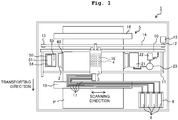
- Fig. 1 shows the configuration of an example of the liquid discharge recording apparatus of the present teaching.
- a liquid discharge recording apparatus 1 of the present teaching includes a platen 2, a carriage 3, an ink-jet head (liquid discharge head) 4, a transporting mechanism 5 and a maintenance unit 6 as main constitutive components or parts.
- the ink-jet head 4 may be of any system including the piezoelectric element system, the thermal ink-jet system, the electrostatic attraction system, etc.
- a recording medium for example, recording paper or recording sheet
- a paper feeding mechanism (not shown in the drawings) is placed on the upper surface of the platen 2.
- Two guide rails 10 and 11 are arranged at a position above or over the platen 2, and extend parallel to each other in the scanning direction (left/right direction in Fig. 1 ).
- the carriage 3 is movable in a reciprocating manner in the scanning direction along the two guide rails 10 and 11 in an area at which the carriage 3 faces or is opposite to the platen 2.
- the two guide rails 10 and 11 extend in the scanning direction to further protrude from the left and right ends of the platen 2.
- the carriage 3 is configured to be movable from the area facing the recording paper P on the platen 2 (recording area) to a position located away from both of the left/right ends of the platen 2 (non-recording area).
- An endless belt 14 wound between two pulleys 12 and 13 is connected to the carriage 3. By driving the endless belt 14 to run by a carriage driving motor 15, the carriage 3 is reciprocated in the scanning direction, accompanying with the running of the endless belt 14.
- the ink-jet head 4 is installed in a lower portion of the carriage 3.
- the lower surface of the ink-jet head 4 is a liquid discharge surface 4a (see Fig. 2 ) which is parallel to the upper surface of the platen 2 and in which a plurality of nozzles 16 are opened.
- the first liquid (ink) is discharged from the plurality of nozzles 16 of the liquid discharge surface 4a toward the recording paper P placed on the platen 2 so as to perform recording on the recording paper P.
- ink supply ports (not shown in the drawings) corresponding to colors of black, yellow, cyan and magenta, respectively are provided on the upper surface of the inkjet head 4, and one ends of four tubes 17 are connected to the four ink supply ports, respectively.
- the other ends of the four tubes 17 are connected to a cartridge installation section 9 that is configured such that four ink cartridges 8 storing the four color inks respectively are detachably attached to the cartridge installation section 9. With this configuration, the inks of the respective four colors are supplied to the ink-jet head 4 from the four ink cartridges 8 installed in the cartridge installation section 9 via the four tubes 17, respectively.
- the transporting mechanism 5 has two transporting rollers 18 and 19 which are arranged so as to sandwich the platen 2 therebetween in a transporting direction (direction from the upper portion to the lower portion on the sheet surface in Fig. 1 ).
- the recording paper P placed on the platen 2 is transported in the transporting direction by the two transporting rollers 18 and 19.
- the liquid discharge recording apparatus 1 discharges the first liquid from the inkjet head 4 installed in the carriage 3 toward the recording paper P placed on the platen 2 and transports the recording paper P in the transporting direction by the two transporting rollers 18 and 19, thereby recording desired image and/or letter, etc., on the recording paper P.
- the maintenance unit 6 includes a purge unit and a flushing unit.
- the purge unit has a waste liquid absorber 22, a suction cap 21 and a suction pump 23 which are arranged on one side in the scanning direction (on the right side in Fig. 1 ) with respect to the platen 2.
- the flushing unit is arranged on the other side in the scanning direction (on the left side in Fig. 1 ) with respect to the platen 2, and includes a first flushing absorber 53, a second flushing absorber 54, a waste liquid tank 50 and a liquid receiving member 51, as main constitutive components or parts.
- the suction cap 21 is driven by a cap driving mechanism including a driving mechanism such as a motor (not shown) so that the suction cap 21 is driven to move in the up and down direction and to make approach/separation with respect to the liquid discharge surface 4a.
- the suction pump 23 is connected to the suction cap 21.
- the suction cap 21 makes contact with the liquid discharge surface 4a, the suction cap 21 covers the openings of the plurality of nozzles 16.
- the suction pump 23 is driven to perform suction and depressurization in the inside of the suction cap 21, thereby causing the first liquid to exit from all of the nozzles 16 covered by the suction cap 21 (suction purge).
- the suction pump 23 is connected to the waste liquid absorber 22.
- the first liquid sucked and made to exit from the nozzles 16 by the suction purge is absorbed by the waste liquid absorber 22 via the suction pump 23.
- the waste liquid absorber 22 is accommodated in a box which is open at an upper portion of the box.
- the waste liquid absorber 22 may be any member provided that such a member is capable of absorbing the first liquid, such as, for example, a melamine foam, etc.
- the purge unit is configured to suck the first liquid from the nozzles 16 by the suction pump 23.
- the purge unit may be configured as a so-called "push purge" mechanism which applies pressure to the first liquid inside the ink-jet head 4 to thereby cause the first liquid to exit from the nozzles 16.
- the first liquid absorbed by the absorber in the present teaching may be the first liquid which is discharged actively and made to exit from the nozzles, or the first liquid which is forced to exit from the nozzles as in the suction purge.
- the absorber receives the first liquid discharged directly to the absorber, or another aspect wherein the absorber, such as the waste liquid absorber 22, receives the first liquid indirectly, e.g. the first liquid fed from the suction pump 23, etc. to the absorber.
- the waste liquid tank 50 has a box-shape which is open at an upper portion thereof, and accommodates the first flushing absorber 53 inside of the waste liquid tank 50.
- the liquid receiving member 51 is arranged at a position above or over the first flushing absorber 53.
- the liquid receiving member 51 has a box-shape which is open at an upper portion thereof, and accommodates the second flushing absorber 54 inside of the liquid receiving member 51.
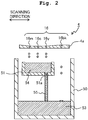
- a discharge port 51a is formed in the liquid receiving member 51 at a portion on the bottom surface and located on one side in the scanning direction (on the right side in Fig. 2 ).
- the discharge port 51a is connected to one end of a tube 55 of which other end makes contact with the upper surface of the first flushing absorber 53.
- first and second flushing absorbers 53 and 54 may be any member provided that such a member is capable of absorbing the first liquid, such as, for example, a melamine foam, etc.
- Fig. 3A is a plane view of the platen 2 and the platen absorber 60
- Fig. 3B is a cross-sectional view of the platen 2 and the platen absorber 60 in the vertical plane including the scanning direction when the liquid is being recovered (during a liquid recovery operation).
- the recording paper P is depicted by broken lines, and the lower portion of the recording paper P is depicted in phantom. As shown in Figs.
- a platen absorber 60 having a rectangular cylindrical shape is integrated into the platen 2 at a lower portion of an area in which an end or edge portion of the recording paper P passes.
- the platen absorber 60 may be any member provided that such a member is capable of absorbing the first liquid, such as, for example, a melamine foam, etc.
- the shape of the platen absorber 60 is not limited to the shape of rectangular cylindrical shape shown in Figs. 3A and 3B , and the platen absorber 60 may have any shape provided that the platen absorber 60 is capable of absorbing the first liquid discharged beyond the end portion of the recording paper P.
- the first flushing absorber 53, the second flushing absorber 54, the waste liquid absorber 22 and the platen absorber 60 contain the second liquid containing the second 1,2-diol of which vapor pressure is lower than the vapor pressure of the first 1,2-diol contained in the first liquid.
- the second liquid containing the second 1,2-diol may be contained only at a portion which makes contact with the first liquid discharged from the ink-jet head 4, or may be contained in the entirety of each of the first and second flushing absorbers 53 and 54 and the platen absorber 60.
- each of the first flushing absorber 53, the second flushing absorber 54, and the platen absorber 60 may be provided independently (separately) respectively for the colors of the first liquids (inks) discharged from the ink-jet head 4.
- the content amounts of the second 1,2-diol contained in each of the first flushing absorber 53, the second flushing absorber 54, and the platen absorber 60 may be determined depending on the content amount of the first 1,2-diol contained in one of the discharged first liquids.
- FIG. 2 is an aspect wherein the first liquid is recovered by discharging the first liquid from the ink-jet head 4 directly to the flushing absorber.
- FIG. 2 is a cross-sectional view of the waste liquid tank 50 in a vertical plane including the scanning direction when the liquid discharge recording apparatus 1 shown in Fig. 1 performs liquid recovery operation.
- reference numerals "16bk", “16y”, “16c” and “16m” indicate nozzles 16 for the black, yellow, cyan and magenta inks, respectively.
- the ink-jet head 4 may further have a nozzle and a supply port for a treatment liquid.
- the liquid discharge recording apparatus 1 may further have a cartridge in which the treatment liquid is stored and a tube for supplying the treatment liquid.
- Fig. 2 shows an example wherein liquid recovery for recovering the black ink from the nozzle 16bk and liquid recovery for recovering the three color inks that are yellow, cyan and magenta inks from the nozzles 16y, 16c and 16m are performed at the same time.
- a timing for discharging the inks is exemplified by a timing before starting the recording on recording paper P, a timing between the paper sheets during a continuous recording (from a point of time after completing recording on one sheet of the recording paper P and until a point of time starting the recording on next sheet of the recording paper P), etc.
- the shipping liquid is discharged from the ink-jet head 4 by a purge performed by the purge unit before the liquid used for the ink-jet recording and including the ink and the treatment liquid, etc., is introduced into the flow channel, and then the shipping liquid is recovered to the waste liquid absorber 22 (is recovered by being absorbed in the waste liquid absorber 22).
- the first liquids are recovered by discharging the inks of the respective colors that are the black ink and the three color inks that area yellow, cyan and magenta inks from the nozzle 16bk of the black ink and the nozzles 16y, 16c and 16m of the three color inks toward the first flushing absorber 53 accommodated in the waste liquid tank 50 and the second flushing absorber 54 accommodated in the liquid receiving member 51, respectively, at a position at which the nozzle 16bk of the black ink is made to face or to be opposite to the first flushing absorber 53, and at which the nozzles 16y, 16c and 16m of the three color inks are made to face the second flushing absorber 54.
- liquid recovery of the liquid from the nozzle 16bk of the black ink and the liquid recovery of the liquids from the nozzles 16y, 16m, and 16c of the three color inks may be performed separately from each other. Further, in a case that the ink-jet head 4 has the nozzle for the treatment liquid, liquid recovery of the treatment liquid from the nozzle for the treatment liquid can also be performed by moving the nozzle for the treatment liquid to a position facing or to be opposite to the first or second flushing absorber 53 or 54, in a similar manner as for the recovery of the inks.
- the maximum amount of the second liquid contained in the first and second flushing absorbers 53 and 54 is preferably not more than 0.91 ⁇ g/mm 3 , and is more preferably not more than 0.7 ⁇ g/mm 3 , in view of preventing any liquid leakage (dripping) from the absorbers.
- the minimum amount of the second liquid contained in the first and second flushing absorbers 53 and 54 is preferably not less than 0.02 ⁇ g/mm 3 and is more preferably not less than 0.04 ⁇ g/mm 3 , in view of sufficiently suppressing the volatilization of the first 1,2-diol contained in the first liquid; in a case that the second liquid contains 50% by weight to 100% by weight of the non-volatile 1,2-diol, the minimum amount of the second liquid contained in the first and second flushing absorbers 53 and 54 is preferably not less than 0.01 ⁇ g/mm 3 and is more preferably not less than 0.02 ⁇ g/mm 3 .
- the amount of the second 1,2-diol in the second liquid contained in the absorber may be determined depending on, for example, the amount of the first 1,2-diol contained in the first liquid, the period of service life or lifetime of the liquid discharge recording apparatus, etc.
- the absorber is the flushing absorber of the liquid discharge recording apparatus
- the amount of the second 1,2-diol in the second liquid contained in the flushing absorber is preferably not less than 0.10 g, is more preferably not less than 0.18 g, is preferably not more than 0.81 g, and is more preferably not more than 0.63 g.
- the second liquid, containing the second 1,2-diol, of which vapor pressure is lower than that of the first 1,2-diol contained in the first liquid, is contained in the first and second flushing absorbers 53 and 54. Therefore, it is possible to reduce the volatilization of the first 1,2-diol contained in the first liquid by the above-described mechanism viewing the "coexistence effect" from the opposite standpoint.
- the liquid recovery method of the present teaching will be explained with reference to Fig. 1 .
- the first liquid (ink) sucked and made to exit by the suction purge is absorbed by the waste liquid absorber 22 via the suction pump 23.
- the maximum amount of the second liquid contained in the waste liquid absorber 22 is preferably not more than 0.91 ⁇ g/mm 3 .
- the minimum amount of the second liquid contained in the waste liquid absorber 22 is preferably not less than 0.1 ⁇ g/mm 3 and is more preferably not less than 0.2 ⁇ g/mm 3 ; in a case that the second liquid contains 50% by weight to 100% by weight of the non-volatile 1,2-diol, the minimum amount of the second liquid contained in the waste liquid absorber 22 is preferably not less than 0.05 ⁇ g/mm 3 and is more preferably not less than 0.5 ⁇ g/mm 3 .
- the waste liquid absorber 22 also contains the second liquid containing the second 1,2-diol of which vapor pressure is lower than that of the first 1,2-diol contained in the first liquid, it is possible to reduce the volatilization of the first 1,2-diol contained in the first liquid by the above-described mechanism viewing the "coexistence effect" from the opposite standpoint.
- the present teaching is applicable also to an aspect wherein the first liquid discharged from the ink-jet head 4 is absorbed by the waste liquid absorber 22 via the suction pump 23, without being limited only to the case that the first liquid discharged from the ink-jet head 4 is directly absorbed.
- FIG. 3B is an aspect wherein the first liquid is recovered by discharging the first liquid from the ink-jet head 4 directly to the platen absorber 60.
- same parts or portions as those in Fig. 2 are assigned with same reference numerals as those in Fig. 2 .
- Fig. 3B shows an example wherein the liquid (first liquid) is recovered from the nozzle 16m for the magenta ink.
- the first liquid (magenta ink) is recovered by discharging the magenta ink from the nozzle 16m of the magenta ink toward the platen absorber 60 integrated into the platen 2, at a position at which the nozzle 16m is made to face or to be opposite to the platen absorber 60.
- the recovery of the first liquids from the nozzles 16bk, 16y and 16c can also be performed by moving the nozzles 16bk, 16y and 16c to positions at each of which one of the nozzles 16bk, 16y and 16c faces the platen absorber 60, in a similar manner as for the recovery of the magenta ink from the nozzle 16m.
- liquid recovery of the treatment liquid from the nozzle for the treatment liquid can also be performed by moving the nozzle for the treatment liquid to a position facing or to be opposite to the platen absorber 60, in a similar manner as for the recovery of the ink(s).
- the maximum amount of the second liquid contained in the platen absorber 60 is preferably not more than 0.91 ⁇ g/mm 3 .
- the second liquid containing the second 1,2-diol, of which vapor pressure is lower than that of the first 1,2-diol contained in the first liquid, is contained in the platen absorber 60. Therefore, it is possible to reduce the volatilization of the first 1,2-diol contained in the first liquid by the above-described mechanism viewing the "coexistence effect" from the opposite standpoint.
- the absorber which contains the second liquid containing the second 1,2-alkanediol of which vapor pressure is lower than that of the first 1,2-alkanediol contained in the first liquid, to absorb the first liquid exited from the liquid discharge head.
- a melamine foam (surface area: 1 cm 2 , thickness: 5 mm) was placed in a vial bottle for HS-GC/MS (Head Space-Gas Chromatography/Mass Spectrometry) measurement.
- 100 ⁇ L of an ink was permeated into the melamine foam and was kept at a temperature of 60 degrees Celsius for 30 minutes.
- the pigment dispersant is CAB-O-JET (trade name) 300 produced by Cabot Corporation; and the surfactant is OLFINE (trade name) E1010 produced by Nissin Chemical Industry Co., Ltd.
- Example 6 a 50 % by weight 1,2-diol-aqeous solution of the 1,2-diol as measurement objective was used; in Example 7, a 25 % by weight 1,2-diol-aqueous solution of the 1,2-diol as measurement objective was used; in Comparative Example 1, glycerol (GLY) was used; in Comparative Example 2, triethylene glycol (TEG) was used; and in Comparative Example 3, triethylene glycol butyl ether (TEB) was used.
- GLY glycerol
- TOG triethylene glycol
- TEB triethylene glycol butyl ether
- EX.1 COM. EX. 2 COM. EX. 3 COM. EX. 4 COM. EX. 5 Ink Ink 1 Ink 1 Ink 1 Ink 2 Ink 3 1,2-diol contained in the ink 1,2-PDO 1,2-PDO 1,2-PDO 1,2-BDO 1,2-PeDO Vapor pressure (hPa-20 degrees Celsius) 0.11 0.11 0.11 0.10 0.10 Compound permeated in the melamine foam
- Example 3 wherein 1,2-PDO was permeated in the ink and 1,2-HeDO was permeated in the melamine foam, the reduction rate was not less than 80% and the volatilization of the 1,2-diol contained in the ink was furthermore lowered.
- the liquid discharge recording apparatus of the present teaching is capable of reducing the generation of VOC.
- the usage of the liquid discharge recording apparatus of the present teaching is not particularly limited, and is widely applicable to a variety of kinds of ink-jet recording.
Landscapes
- Chemical & Material Sciences (AREA)
- Engineering & Computer Science (AREA)
- Life Sciences & Earth Sciences (AREA)
- Materials Engineering (AREA)
- Wood Science & Technology (AREA)
- Organic Chemistry (AREA)
- Chemical Kinetics & Catalysis (AREA)
- Environmental & Geological Engineering (AREA)
- Ink Jet (AREA)
Claims (14)
- Appareil d'enregistrement à éjection de liquide, comprenant :un premier liquide contenant un premier 1,2-alcanediol ;une tête d'éjection de liquide conçue pour éjecter le premier liquide ;un deuxième liquide contenant un deuxième 1,2-alcanediol dont la pression de vapeur est inférieure à celle du premier 1,2-alcanediol ; etun agent absorbant qui contient le deuxième liquide et qui est conçu aux fins d'absorber le premier liquide éjecté par la tête d'éjection de liquide ; dans lequelune quantité de mélange du deuxième 1,2-alcanediol dans le deuxième liquide est située dans une plage allant de 50 % en poids à 100 % en poids, etl'agent absorbant est au moins un agent absorbant choisi dans le groupe constitué d'un agent absorbant de rinçage, d'un agent absorbant de liquide usagé et d'un agent absorbant de platine, dans lequel l'agent absorbant de rinçage est disposé dans une zone de non enregistrement de l'appareil d'enregistrement à éjection de liquide, l'absorbant de liquide usagé absorbe directement ou indirectement le premier liquide éjecté par la tête d'éjection de liquide et stocke le premier liquide en son sein, et l'agent absorbant de platine est disposé dans une zone d'enregistrement de l'appareil d'enregistrement à éjection de liquide.
- Appareil d'enregistrement à éjection de liquide selon la revendication 1, dans lequel le premier 1,2-alcanediol est un 1,2-alcanediol volatil et le deuxième 1,2-alcanediol est un 1,2-alcanediol non volatil.
- Appareil d'enregistrement à éjection de liquide selon la revendication 2, dans lequel le 1,2-alcanediol volatil comprend au moins un élément choisi dans le groupe constitué de : 1,2-propanediol, 1,2-butanediol et 1,2-pentanediol ; et
le 1,2-alcanediol non volatil comprend le 1,2-hexanediol. - Appareil d'enregistrement à éjection de liquide selon la revendication 2, dans lequel le 1,2-alcanediol volatil comprend le 1,2-propanediol ; et
le 1,2-alcanediol non volatil comprend le 1,2-hexanediol. - Appareil d'enregistrement à éjection de liquide selon la revendication 1 ou 2, dans lequel chacun des premier et deuxième 1,2-alcanediols est un alcanediol à chaîne linéaire.
- Appareil d'enregistrement à éjection de liquide selon la revendication 1 ou 2, dans lequel le nombre de carbone de chacun des premier et deuxième 1,2-alcanediols est de 3 à 10.
- Appareil d'enregistrement à éjection de liquide selon la revendication 1 ou 2, dans lequel le nombre de carbone du premier 1,2-alcanediol est inférieur au nombre de carbone du deuxième 1,2-alcanediol.
- Appareil d'enregistrement à éjection de liquide selon la revendication 7, dans lequel le nombre de carbone du premier 1,2-alcanediol est de 3 à 5 et le nombre de carbone du deuxième 1,2-alcanediol est de 6 à 10.
- Appareil d'enregistrement à éjection de liquide selon l'une quelconque des revendications 1 à 8, dans lequel un rapport de mélange entre le deuxième 1,2-alcanediol dans le deuxième liquide n'est pas inférieur à 2,5 fois un rapport de mélange du premier 1,2-alcanediol dans le premier liquide.
- Appareil d'enregistrement à éjection de liquide selon la revendication 9, dans lequel un rapport de mélange entre le deuxième 1,2-alcanediol dans le deuxième liquide est situé dans une plage de 2,5 fois à 10 fois un rapport de mélange du premier 1,2-alcanediol dans le premier liquide.
- Appareil d'enregistrement à éjection de liquide selon l'une quelconque des revendications 1 à 10, dans lequel
l'agent absorbant de rinçage est conçu aux fins de recevoir le premier liquide qui est éjecté par la tête d'éjection de liquide dans une position où la tête d'éjection de liquide fait face à l'agent absorbant de rinçage ; et
l'agent absorbant de platine est conçu aux fins de recevoir le premier liquide qui est éjecté par la tête d'éjection de liquide dans une position où la tête d'éjection de liquide fait face à l'agent absorbant de platine. - Appareil d'enregistrement à éjection de liquide selon l'une quelconque des revendications 1 à 11, dans lequel une quantité du deuxième liquide contenu pour 1 mm3 de l'agent absorbant n'est pas supérieure à 0,91 µg/mm3.
- Procédé de récupération d'un liquide dans un appareil d'enregistrement à éjection de liquide, ledit procédé comprenant les étapes consistant à :faire sortir d'une tête d'éjection de liquide de l'appareil d'enregistrement à éjection de liquide un premier liquide contenant le premier 1,2-alcanediol ; etrécupérer le premier liquide par absorption du premier liquide éjecté par la tête d'éjection de liquide avec un agent absorbant qui est placé dans l'appareil d'enregistrement à éjection de liquide et qui contient un deuxième liquide contenant un deuxième 1,2-alcanediol ayant une pression de vapeur inférieure à celle du premier 1,2-alcanediol ; dans lequelune quantité de mélange du deuxième 1,2-alcanediol dans le deuxième liquide est située dans la plage de 50 % en poids à 100 % en poids, etl'agent absorbant est au moins un agent absorbant choisi dans le groupe constitué d'un agent absorbant de rinçage, d'un agent absorbant de liquide usagé et d'un agent absorbant de platine, dans lequel l'agent absorbant de rinçage est disposé dans une zone de non enregistrement de l'appareil d'enregistrement à éjection de liquide, l'absorbant de liquide usagé absorbe directement ou indirectement le premier liquide éjecté par la tête d'éjection de liquide et stocke le premier liquide en son sein, et l'agent absorbant de platine est disposé dans une zone d'enregistrement de l'appareil d'enregistrement à éjection de liquide.
- Procédé de récupération d'un liquide selon la revendication 13, dans lequel le premier liquide est éjecté par la tête d'éjection de liquide directement sur l'agent absorbant.
Applications Claiming Priority (1)
| Application Number | Priority Date | Filing Date | Title |
|---|---|---|---|
| JP2013205688A JP6209924B2 (ja) | 2013-09-30 | 2013-09-30 | 液体吐出記録装置及び液体回収方法 |
Publications (2)
| Publication Number | Publication Date |
|---|---|
| EP2853392A1 EP2853392A1 (fr) | 2015-04-01 |
| EP2853392B1 true EP2853392B1 (fr) | 2017-03-01 |
Family
ID=51542233
Family Applications (1)
| Application Number | Title | Priority Date | Filing Date |
|---|---|---|---|
| EP14184979.4A Active EP2853392B1 (fr) | 2013-09-30 | 2014-09-16 | Appareil d'enregistrement à éjection de liquide et procédé de récupération de liquide |
Country Status (3)
| Country | Link |
|---|---|
| US (1) | US9050809B2 (fr) |
| EP (1) | EP2853392B1 (fr) |
| JP (1) | JP6209924B2 (fr) |
Families Citing this family (3)
| Publication number | Priority date | Publication date | Assignee | Title |
|---|---|---|---|---|
| JP7289702B2 (ja) * | 2019-04-03 | 2023-06-12 | キヤノン株式会社 | インクジェット記録装置 |
| JP2021066146A (ja) * | 2019-10-28 | 2021-04-30 | セイコーエプソン株式会社 | 液体吸収器および画像形成装置 |
| US10844887B1 (en) * | 2020-05-19 | 2020-11-24 | Vortex Pipe Systems LLC | Fluid flow enhancing device and culvert comprising same |
Family Cites Families (15)
| Publication number | Priority date | Publication date | Assignee | Title |
|---|---|---|---|---|
| US5746818A (en) * | 1995-08-31 | 1998-05-05 | Seiko Epson Corporation | Pigment ink composition capable of forming image having no significant bleeding or feathering |
| JP4033442B2 (ja) | 2001-10-25 | 2008-01-16 | 大日本塗料株式会社 | ジェット印刷用インク組成物 |
| JP2003147243A (ja) | 2001-11-14 | 2003-05-21 | Ricoh Co Ltd | インクジェット記録用インク及び記録方法 |
| KR100779475B1 (ko) * | 2003-03-14 | 2007-11-28 | 가부시키가이샤 리코 | 잉크 세트, 및 이를 이용한 이미지 형성 방법, 이미지 형성기구, 카트리지 및 기록물 |
| US7445312B2 (en) | 2003-06-26 | 2008-11-04 | Seiko Epson Corporation | Inkjet printer and inkjet print method |
| JP2005014424A (ja) | 2003-06-26 | 2005-01-20 | Seiko Epson Corp | インクジェット式記録装置およびインクジェット式記録方法 |
| JP4837885B2 (ja) | 2003-06-26 | 2011-12-14 | セイコーエプソン株式会社 | インクジェット式記録装置およびインクジェット式記録方法 |
| CN1775533B (zh) | 2004-11-19 | 2011-06-15 | 佳能株式会社 | 喷墨打印方法和喷墨打印装置 |
| JP4642641B2 (ja) | 2004-11-19 | 2011-03-02 | キヤノン株式会社 | インクジェット記録方法、およびインクジェット記録装置 |
| JP5481896B2 (ja) * | 2008-04-03 | 2014-04-23 | セイコーエプソン株式会社 | インクジェット記録方法及び記録物 |
| JP5590813B2 (ja) * | 2008-04-30 | 2014-09-17 | キヤノン株式会社 | インクジェット記録方法、記録ユニット、及びインクジェット記録装置 |
| JP5316277B2 (ja) * | 2009-07-16 | 2013-10-16 | セイコーエプソン株式会社 | インクジェット式記録装置、記録方法、およびフラッシング方法 |
| JP2013052519A (ja) | 2011-09-01 | 2013-03-21 | Canon Finetech Inc | 廃インク吸収体及びそれを用いた廃インクタンク |
| JP6115807B2 (ja) * | 2012-11-30 | 2017-04-19 | セイコーエプソン株式会社 | インクジェット記録装置 |
| EP2738004B1 (fr) * | 2012-11-30 | 2018-10-31 | Seiko Epson Corporation | Appareil d'enregistrement à jet d'encre |
-
2013
- 2013-09-30 JP JP2013205688A patent/JP6209924B2/ja active Active
-
2014
- 2014-09-16 EP EP14184979.4A patent/EP2853392B1/fr active Active
- 2014-09-23 US US14/493,457 patent/US9050809B2/en active Active
Non-Patent Citations (1)
| Title |
|---|
| None * |
Also Published As
| Publication number | Publication date |
|---|---|
| JP6209924B2 (ja) | 2017-10-11 |
| US9050809B2 (en) | 2015-06-09 |
| US20150091978A1 (en) | 2015-04-02 |
| EP2853392A1 (fr) | 2015-04-01 |
| JP2015066911A (ja) | 2015-04-13 |
Similar Documents
| Publication | Publication Date | Title |
|---|---|---|
| CN110682689B (zh) | 液体喷射装置以及清洗装置 | |
| JP5316277B2 (ja) | インクジェット式記録装置、記録方法、およびフラッシング方法 | |
| JP6065622B2 (ja) | インクジェット用インクセット及びインクジェット記録システム | |
| WO2013161410A1 (fr) | Composition d'encre destinée à un enregistrement à jet d'encre, système d'alimentation en encre et dispositif d'enregistrement à jet d'encre | |
| US9393792B2 (en) | Liquid discharge recording apparatus and method for recovering liquid | |
| EP2853392B1 (fr) | Appareil d'enregistrement à éjection de liquide et procédé de récupération de liquide | |
| US11827033B2 (en) | Ink jet recording method and ink jet recording apparatus | |
| US9944084B2 (en) | Ink jet recording method and ink jet recording apparatus | |
| EP3061616B1 (fr) | Appareil d'enregistrement à jet d'encre et procédé d'élimination d'accumulation | |
| JP2012214628A (ja) | インクジェット記録用水性インク、インクカートリッジ、インクジェット記録方法及びインクジェット記録装置 | |
| JP6307969B2 (ja) | 液体吐出記録装置及び液体回収方法 | |
| US9296207B2 (en) | Liquid discharge recording apparatus and method for recovering liquid | |
| EP2853391B1 (fr) | Appareil d'enregistrement à éjection de liquide et procédé de récupération de liquide | |
| US9296208B2 (en) | Liquid discharge recording apparatus and method for recovering liquid | |
| US10207501B2 (en) | Ink jet recording method and ink jet recording apparatus | |
| US9302489B2 (en) | Liquid discharge recording apparatus and method for recovering liquid | |
| EP2845734B1 (fr) | Tête d'enregistrement pour enregistrement à jet d'encre, appareil et procédé d'enregistrement à jet d'encre | |
| JP2014208473A (ja) | 液体吐出記録装置及び液体回収方法 | |
| JP2017081057A (ja) | インクジェット記録方法及びインクジェット記録装置 | |
| JP2014151624A (ja) | 液体噴射装置、及び液体噴射装置のメンテナンス方法 | |
| JP2005231318A (ja) | 液体吐出装置及びクリーニング方法 | |
| JP2016159451A (ja) | インクジェット記録装置及び堆積抑制方法 |
Legal Events
| Date | Code | Title | Description |
|---|---|---|---|
| PUAI | Public reference made under article 153(3) epc to a published international application that has entered the european phase |
Free format text: ORIGINAL CODE: 0009012 |
|
| 17P | Request for examination filed |
Effective date: 20140916 |
|
| AK | Designated contracting states |
Kind code of ref document: A1 Designated state(s): AL AT BE BG CH CY CZ DE DK EE ES FI FR GB GR HR HU IE IS IT LI LT LU LV MC MK MT NL NO PL PT RO RS SE SI SK SM TR |
|
| AX | Request for extension of the european patent |
Extension state: BA ME |
|
| R17P | Request for examination filed (corrected) |
Effective date: 20150907 |
|
| RBV | Designated contracting states (corrected) |
Designated state(s): AL AT BE BG CH CY CZ DE DK EE ES FI FR GB GR HR HU IE IS IT LI LT LU LV MC MK MT NL NO PL PT RO RS SE SI SK SM TR |
|
| 17Q | First examination report despatched |
Effective date: 20151215 |
|
| GRAP | Despatch of communication of intention to grant a patent |
Free format text: ORIGINAL CODE: EPIDOSNIGR1 |
|
| RIC1 | Information provided on ipc code assigned before grant |
Ipc: C09D 11/30 20140101ALI20160907BHEP Ipc: C09D 11/322 20140101ALI20160907BHEP Ipc: C09D 11/38 20140101ALI20160907BHEP Ipc: C09D 11/54 20140101ALI20160907BHEP Ipc: B41J 2/00 20060101AFI20160907BHEP Ipc: B41J 2/165 20060101ALI20160907BHEP |
|
| INTG | Intention to grant announced |
Effective date: 20161007 |
|
| STAA | Information on the status of an ep patent application or granted ep patent |
Free format text: STATUS: GRANT OF PATENT IS INTENDED |
|
| GRAS | Grant fee paid |
Free format text: ORIGINAL CODE: EPIDOSNIGR3 |
|
| GRAA | (expected) grant |
Free format text: ORIGINAL CODE: 0009210 |
|
| STAA | Information on the status of an ep patent application or granted ep patent |
Free format text: STATUS: THE PATENT HAS BEEN GRANTED |
|
| AK | Designated contracting states |
Kind code of ref document: B1 Designated state(s): AL AT BE BG CH CY CZ DE DK EE ES FI FR GB GR HR HU IE IS IT LI LT LU LV MC MK MT NL NO PL PT RO RS SE SI SK SM TR |
|
| REG | Reference to a national code |
Ref country code: GB Ref legal event code: FG4D |
|
| REG | Reference to a national code |
Ref country code: AT Ref legal event code: REF Ref document number: 870799 Country of ref document: AT Kind code of ref document: T Effective date: 20170315 Ref country code: CH Ref legal event code: EP |
|
| REG | Reference to a national code |
Ref country code: IE Ref legal event code: FG4D |
|
| REG | Reference to a national code |
Ref country code: DE Ref legal event code: R096 Ref document number: 602014007064 Country of ref document: DE |
|
| REG | Reference to a national code |
Ref country code: NL Ref legal event code: MP Effective date: 20170301 |
|
| REG | Reference to a national code |
Ref country code: LT Ref legal event code: MG4D |
|
| REG | Reference to a national code |
Ref country code: AT Ref legal event code: MK05 Ref document number: 870799 Country of ref document: AT Kind code of ref document: T Effective date: 20170301 |
|
| PG25 | Lapsed in a contracting state [announced via postgrant information from national office to epo] |
Ref country code: HR Free format text: LAPSE BECAUSE OF FAILURE TO SUBMIT A TRANSLATION OF THE DESCRIPTION OR TO PAY THE FEE WITHIN THE PRESCRIBED TIME-LIMIT Effective date: 20170301 Ref country code: GR Free format text: LAPSE BECAUSE OF FAILURE TO SUBMIT A TRANSLATION OF THE DESCRIPTION OR TO PAY THE FEE WITHIN THE PRESCRIBED TIME-LIMIT Effective date: 20170602 Ref country code: NO Free format text: LAPSE BECAUSE OF FAILURE TO SUBMIT A TRANSLATION OF THE DESCRIPTION OR TO PAY THE FEE WITHIN THE PRESCRIBED TIME-LIMIT Effective date: 20170601 Ref country code: LT Free format text: LAPSE BECAUSE OF FAILURE TO SUBMIT A TRANSLATION OF THE DESCRIPTION OR TO PAY THE FEE WITHIN THE PRESCRIBED TIME-LIMIT Effective date: 20170301 Ref country code: FI Free format text: LAPSE BECAUSE OF FAILURE TO SUBMIT A TRANSLATION OF THE DESCRIPTION OR TO PAY THE FEE WITHIN THE PRESCRIBED TIME-LIMIT Effective date: 20170301 |
|
| REG | Reference to a national code |
Ref country code: FR Ref legal event code: PLFP Year of fee payment: 4 |
|
| PG25 | Lapsed in a contracting state [announced via postgrant information from national office to epo] |
Ref country code: RS Free format text: LAPSE BECAUSE OF FAILURE TO SUBMIT A TRANSLATION OF THE DESCRIPTION OR TO PAY THE FEE WITHIN THE PRESCRIBED TIME-LIMIT Effective date: 20170301 Ref country code: SE Free format text: LAPSE BECAUSE OF FAILURE TO SUBMIT A TRANSLATION OF THE DESCRIPTION OR TO PAY THE FEE WITHIN THE PRESCRIBED TIME-LIMIT Effective date: 20170301 Ref country code: ES Free format text: LAPSE BECAUSE OF FAILURE TO SUBMIT A TRANSLATION OF THE DESCRIPTION OR TO PAY THE FEE WITHIN THE PRESCRIBED TIME-LIMIT Effective date: 20170301 Ref country code: BG Free format text: LAPSE BECAUSE OF FAILURE TO SUBMIT A TRANSLATION OF THE DESCRIPTION OR TO PAY THE FEE WITHIN THE PRESCRIBED TIME-LIMIT Effective date: 20170601 Ref country code: AT Free format text: LAPSE BECAUSE OF FAILURE TO SUBMIT A TRANSLATION OF THE DESCRIPTION OR TO PAY THE FEE WITHIN THE PRESCRIBED TIME-LIMIT Effective date: 20170301 Ref country code: LV Free format text: LAPSE BECAUSE OF FAILURE TO SUBMIT A TRANSLATION OF THE DESCRIPTION OR TO PAY THE FEE WITHIN THE PRESCRIBED TIME-LIMIT Effective date: 20170301 |
|
| PG25 | Lapsed in a contracting state [announced via postgrant information from national office to epo] |
Ref country code: NL Free format text: LAPSE BECAUSE OF FAILURE TO SUBMIT A TRANSLATION OF THE DESCRIPTION OR TO PAY THE FEE WITHIN THE PRESCRIBED TIME-LIMIT Effective date: 20170301 |
|
| PG25 | Lapsed in a contracting state [announced via postgrant information from national office to epo] |
Ref country code: EE Free format text: LAPSE BECAUSE OF FAILURE TO SUBMIT A TRANSLATION OF THE DESCRIPTION OR TO PAY THE FEE WITHIN THE PRESCRIBED TIME-LIMIT Effective date: 20170301 Ref country code: CZ Free format text: LAPSE BECAUSE OF FAILURE TO SUBMIT A TRANSLATION OF THE DESCRIPTION OR TO PAY THE FEE WITHIN THE PRESCRIBED TIME-LIMIT Effective date: 20170301 Ref country code: IT Free format text: LAPSE BECAUSE OF FAILURE TO SUBMIT A TRANSLATION OF THE DESCRIPTION OR TO PAY THE FEE WITHIN THE PRESCRIBED TIME-LIMIT Effective date: 20170301 Ref country code: SK Free format text: LAPSE BECAUSE OF FAILURE TO SUBMIT A TRANSLATION OF THE DESCRIPTION OR TO PAY THE FEE WITHIN THE PRESCRIBED TIME-LIMIT Effective date: 20170301 Ref country code: RO Free format text: LAPSE BECAUSE OF FAILURE TO SUBMIT A TRANSLATION OF THE DESCRIPTION OR TO PAY THE FEE WITHIN THE PRESCRIBED TIME-LIMIT Effective date: 20170301 |
|
| PG25 | Lapsed in a contracting state [announced via postgrant information from national office to epo] |
Ref country code: SM Free format text: LAPSE BECAUSE OF FAILURE TO SUBMIT A TRANSLATION OF THE DESCRIPTION OR TO PAY THE FEE WITHIN THE PRESCRIBED TIME-LIMIT Effective date: 20170301 Ref country code: PL Free format text: LAPSE BECAUSE OF FAILURE TO SUBMIT A TRANSLATION OF THE DESCRIPTION OR TO PAY THE FEE WITHIN THE PRESCRIBED TIME-LIMIT Effective date: 20170301 Ref country code: IS Free format text: LAPSE BECAUSE OF FAILURE TO SUBMIT A TRANSLATION OF THE DESCRIPTION OR TO PAY THE FEE WITHIN THE PRESCRIBED TIME-LIMIT Effective date: 20170701 Ref country code: PT Free format text: LAPSE BECAUSE OF FAILURE TO SUBMIT A TRANSLATION OF THE DESCRIPTION OR TO PAY THE FEE WITHIN THE PRESCRIBED TIME-LIMIT Effective date: 20170703 |
|
| REG | Reference to a national code |
Ref country code: DE Ref legal event code: R097 Ref document number: 602014007064 Country of ref document: DE |
|
| PLBE | No opposition filed within time limit |
Free format text: ORIGINAL CODE: 0009261 |
|
| STAA | Information on the status of an ep patent application or granted ep patent |
Free format text: STATUS: NO OPPOSITION FILED WITHIN TIME LIMIT |
|
| PG25 | Lapsed in a contracting state [announced via postgrant information from national office to epo] |
Ref country code: DK Free format text: LAPSE BECAUSE OF FAILURE TO SUBMIT A TRANSLATION OF THE DESCRIPTION OR TO PAY THE FEE WITHIN THE PRESCRIBED TIME-LIMIT Effective date: 20170301 |
|
| 26N | No opposition filed |
Effective date: 20171204 |
|
| PG25 | Lapsed in a contracting state [announced via postgrant information from national office to epo] |
Ref country code: SI Free format text: LAPSE BECAUSE OF FAILURE TO SUBMIT A TRANSLATION OF THE DESCRIPTION OR TO PAY THE FEE WITHIN THE PRESCRIBED TIME-LIMIT Effective date: 20170301 |
|
| REG | Reference to a national code |
Ref country code: CH Ref legal event code: PL |
|
| PG25 | Lapsed in a contracting state [announced via postgrant information from national office to epo] |
Ref country code: MC Free format text: LAPSE BECAUSE OF FAILURE TO SUBMIT A TRANSLATION OF THE DESCRIPTION OR TO PAY THE FEE WITHIN THE PRESCRIBED TIME-LIMIT Effective date: 20170301 |
|
| REG | Reference to a national code |
Ref country code: IE Ref legal event code: MM4A |
|
| REG | Reference to a national code |
Ref country code: BE Ref legal event code: MM Effective date: 20170930 |
|
| PG25 | Lapsed in a contracting state [announced via postgrant information from national office to epo] |
Ref country code: LU Free format text: LAPSE BECAUSE OF NON-PAYMENT OF DUE FEES Effective date: 20170916 |
|
| PG25 | Lapsed in a contracting state [announced via postgrant information from national office to epo] |
Ref country code: LI Free format text: LAPSE BECAUSE OF NON-PAYMENT OF DUE FEES Effective date: 20170930 Ref country code: CH Free format text: LAPSE BECAUSE OF NON-PAYMENT OF DUE FEES Effective date: 20170930 Ref country code: IE Free format text: LAPSE BECAUSE OF NON-PAYMENT OF DUE FEES Effective date: 20170916 |
|
| REG | Reference to a national code |
Ref country code: FR Ref legal event code: PLFP Year of fee payment: 5 |
|
| PG25 | Lapsed in a contracting state [announced via postgrant information from national office to epo] |
Ref country code: BE Free format text: LAPSE BECAUSE OF NON-PAYMENT OF DUE FEES Effective date: 20170930 |
|
| PG25 | Lapsed in a contracting state [announced via postgrant information from national office to epo] |
Ref country code: MT Free format text: LAPSE BECAUSE OF NON-PAYMENT OF DUE FEES Effective date: 20170916 |
|
| PG25 | Lapsed in a contracting state [announced via postgrant information from national office to epo] |
Ref country code: HU Free format text: LAPSE BECAUSE OF FAILURE TO SUBMIT A TRANSLATION OF THE DESCRIPTION OR TO PAY THE FEE WITHIN THE PRESCRIBED TIME-LIMIT; INVALID AB INITIO Effective date: 20140916 |
|
| PG25 | Lapsed in a contracting state [announced via postgrant information from national office to epo] |
Ref country code: CY Free format text: LAPSE BECAUSE OF FAILURE TO SUBMIT A TRANSLATION OF THE DESCRIPTION OR TO PAY THE FEE WITHIN THE PRESCRIBED TIME-LIMIT Effective date: 20170301 |
|
| PG25 | Lapsed in a contracting state [announced via postgrant information from national office to epo] |
Ref country code: MK Free format text: LAPSE BECAUSE OF FAILURE TO SUBMIT A TRANSLATION OF THE DESCRIPTION OR TO PAY THE FEE WITHIN THE PRESCRIBED TIME-LIMIT Effective date: 20170301 |
|
| PG25 | Lapsed in a contracting state [announced via postgrant information from national office to epo] |
Ref country code: TR Free format text: LAPSE BECAUSE OF FAILURE TO SUBMIT A TRANSLATION OF THE DESCRIPTION OR TO PAY THE FEE WITHIN THE PRESCRIBED TIME-LIMIT Effective date: 20170301 |
|
| PG25 | Lapsed in a contracting state [announced via postgrant information from national office to epo] |
Ref country code: AL Free format text: LAPSE BECAUSE OF FAILURE TO SUBMIT A TRANSLATION OF THE DESCRIPTION OR TO PAY THE FEE WITHIN THE PRESCRIBED TIME-LIMIT Effective date: 20170301 |
|
| P01 | Opt-out of the competence of the unified patent court (upc) registered |
Effective date: 20230529 |
|
| PGFP | Annual fee paid to national office [announced via postgrant information from national office to epo] |
Ref country code: DE Payment date: 20250808 Year of fee payment: 12 |
|
| PGFP | Annual fee paid to national office [announced via postgrant information from national office to epo] |
Ref country code: GB Payment date: 20250814 Year of fee payment: 12 |
|
| PGFP | Annual fee paid to national office [announced via postgrant information from national office to epo] |
Ref country code: FR Payment date: 20250808 Year of fee payment: 12 |