EP2854051A2 - Dispositif, programme et procédé de simulation - Google Patents
Dispositif, programme et procédé de simulation Download PDFInfo
- Publication number
- EP2854051A2 EP2854051A2 EP20140179655 EP14179655A EP2854051A2 EP 2854051 A2 EP2854051 A2 EP 2854051A2 EP 20140179655 EP20140179655 EP 20140179655 EP 14179655 A EP14179655 A EP 14179655A EP 2854051 A2 EP2854051 A2 EP 2854051A2
- Authority
- EP
- European Patent Office
- Prior art keywords
- particle
- interaction
- neighboring
- calculating
- displacement
- Prior art date
- Legal status (The legal status is an assumption and is not a legal conclusion. Google has not performed a legal analysis and makes no representation as to the accuracy of the status listed.)
- Withdrawn
Links
Images



Classifications
-
- G—PHYSICS
- G06—COMPUTING OR CALCULATING; COUNTING
- G06F—ELECTRIC DIGITAL DATA PROCESSING
- G06F30/00—Computer-aided design [CAD]
- G06F30/20—Design optimisation, verification or simulation
- G06F30/25—Design optimisation, verification or simulation using particle-based methods
-
- G—PHYSICS
- G06—COMPUTING OR CALCULATING; COUNTING
- G06F—ELECTRIC DIGITAL DATA PROCESSING
- G06F30/00—Computer-aided design [CAD]
- G06F30/20—Design optimisation, verification or simulation
-
- G—PHYSICS
- G06—COMPUTING OR CALCULATING; COUNTING
- G06F—ELECTRIC DIGITAL DATA PROCESSING
- G06F2111/00—Details relating to CAD techniques
- G06F2111/10—Numerical modelling
Definitions
- the embodiments discussed herein are related to a simulation device, simulation program, and simulation method.
- a fluid for which calculations are performed is represented as a collection of particles, and special treatment does not need to be prepared to deal with a moving boundary.
- the particle methods have been widely used in recent years.
- a particle located within a radius of influence (kernel radius) of a certain particle i.e., located within a distance h from the certain particle, is defined as a neighboring particle and information thereon is used.
- formula 1 expresses discretization of an equation of motion in the SPH method.
- D ⁇ v a dt - ⁇ b m b P b + P a ⁇ b ⁇ ⁇ a + ⁇ ab ⁇ ⁇ W ⁇ r a - r b h ⁇ r a
- a subscript a indicates a certain particle
- a subscript b indicates a neighboring particle
- r a , v a , ⁇ a , P a , and m a respectively indicate the position vector, the rate vector, the density, the pressure, and the mass of the particle a.
- W a kernel function
- a function such as the following cubic spline function, formula 2
- W r h ⁇ 1 - 1.5 ⁇ r h 2 + 0.75 ⁇ r h 3 / ⁇ 0 ⁇ r h ⁇ 1 0.25 ⁇ 2 - r h 3 / ⁇ 1 ⁇ r h ⁇ 2 0 2 ⁇ r h
- an acceleration is calculated by discretizing a deformation gradient tensor expressed by the following formula, formula 3.
- F ij ⁇ u i ⁇ X j + I
- X j indicate a j component of the distance between positions; u i , an i component of displacement; I, an identity tensor.
- the deformation gradient tensor of a certain particle a may be expressed by the following formula, formula 4, by superimposing the influence of a neighboring particle b.
- F ij a - ⁇ i m b ⁇ b du i a - du i b ⁇ ⁇ W r h ⁇ x j b + I
- non-patent document 1 a technique is known wherein, in the analyzing of an element such as an elastic body, even after the initial calculation for a neighboring particle progresses and a particle position changes, that particle continues to be dealt with as a neighbor.
- Patent document 1 discloses a technology for identifying a particle that interacts with other particles.
- Patent document 2 discloses the following technology. To search for a particle that is a neighbor of certain distributed particles, the distances from all of the other particles would need to be determined, and a determination would need to be repeatedly made on whether a particle is a neighbor. However, particles distributed within a space are divided into two kinds : particles for which new attribute information is calculated by searching a neighboring particle; and particles for which new attribute information is calculated from attribute information thereof without searching a neighboring particle. Calculating processes corresponding to the two kinds of particles are performed, thereby decreasing the number of times a search of a neighboring particle is performed.
- Patent document 3 discloses a technology wherein, in a functional calculus of a force or potential that corresponds to the distance between particles, a differential coefficient of a function is used to determine a new potential using an interpolation method.
- a value determined according to a distance for an initial position is identical with a value after deformation, but the derivative is not identical with the one for the initial position.
- a calculation needs to be performed after the initial position is converted into the reference position. Accordingly, a stress needs to be calculated as, for example, a Piola-Kirchhoff stress, namely, a stress value for the reference position.
- an object of the present invention is to provide a simulation device, a simulation program, and a simulation method to allow calculations to be readily performed in consideration of stress values that work in the coordinates after deformation of an elastic body.
- the invention uses the following configuration.
- one aspect of the invention provides a simulation program that causes a computer to: for each of one or more first neighboring particles located within a radius of influence of a reference particle of a continuum model expressing a continuum as a collection of particles, calculate a first interaction between the reference particle and the first neighboring particle according to a kernel function and the position of the first neighboring particle after displacement of the continuum model; for each of one or more second neighboring particles that have entered the radius of influence of the reference particle after the displacement occurred, calculate a second interaction between the reference particle and the second neighboring particle according to the kernel function and the position of the second neighboring particle after displacement of the continuum model; and calculate an interaction between the reference particle and a current neighboring particle of the reference particle according to the first and second interactions, wherein calculating the first interaction includes using the deformation gradient tensor of the kernel function.
- the invention relates to a simulation device, a simulation program executed by a computer, and a simulation method, wherein a continuum that is an object of simulation is considered as a collection of particles.
- the simulation device, the simulation program, and the simulation method of the invention are techniques of treating a neighboring particle in a numerical calculation program that uses a particle method.
- they are techniques of numerically calculating a motion of a continuum such as an elastic body using a particle method; more particularly, they are techniques wherein, in the treating of a neighboring particle, a Cauchy stress after deformation is determined while considering a neighboring particle with reference to a reference position, and a calculation is performed by combining the Cauchy stress with a neighbor after coordinate conversion.
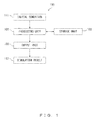
- FIG. 1 illustrates an exemplary configuration of a simulation device to which the invention has been applied.
- a simulation device 100 includes a processing unit 101, a storage unit 102 , and an output unit 103 , and outputs a simulation result 112 after performing a numerical calculation according to an initial condition 111 using a particle method.
- the storage unit 102 stores information on individual calculating formulas for executing a simulation program to which the invention has been applied.
- the processing unit 101 performs a simulation process to which the invention has been applied.
- a first interaction between the reference particle and the first neighboring particle is calculated according to a kernel function and the position of the first neighboring particle after displacement of the continuum model.
- a second interaction between the reference particle and the second neighboring particle is calculated according to the kernel function and the position of the second neighboring particle after displacement of the continuum model.
- an interaction between the reference particle and a current neighboring particle of the reference particle is calculated according to the first and second interactions. Note that the deformation gradient tensor of the kernel function is used to calculate the first interaction.
- the calculating of the interaction between the reference particle and the current neighboring particle in the simulation process allows the first and second interactions to be calculated at an optional ratio.
- the ratio of the calculations of the first and second interactions may be determined in accordance with the degree of displacement of the continuum model.
- the output unit 103 outputs the simulation result 112 of a simulation performed by the processing unit 101.
- a variable with a superscript ini is a value for a reference position
- F a n -1 is a deformation gradient tensor for an (n-1)-th step of a particle a.
- an accurate value of the differentiation of the kernel after deformation of an elastic body may be determined, a Cauchy stress, i.e., a stress within the coordinate system after deformation, can be calculated, and a calculation with another stress within the current coordinate system may be readily performed.
- a deformation gradient tensor may be used in a method for determining the ratio.
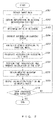
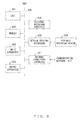
- FIG. 2 is a flowchart illustrating the flow of a simulation process in accordance with a first embodiment.
- step S201 input data is obtained.
- the input data is data to express a continuum particle model that is, for example, a modeled elastic body.
- the input data are, for example, the central coordinates, traveling speeds, radiuses of influence (kernel radiuses), densities, masses, deformation gradient tensors, material property values, and material temperatures of individual particles.
- step S202 according to the central coordinates input in step S201, for each particle, information on a neighboring particle located within a predetermined distance from the particle is obtained and stored in a memory.
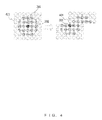
- FIG. 3 illustrates a change in radius of influence that occurs in response to deformation of an elastic body.
- a plurality of neighboring particles 303 are defined within a radius of influence 302 of a reference position that is an arbitrary particle that constitutes the elastic body (hereinafter may be referred to as a "reference particle 301") .
- Deformation of the elastic body results in deformation of the radius of influence 302.
- the radius of influence 302 changes with deformation of the elastic body
- the radius of influence may be supposed to be also extended by N times in that direction.
- the contributions of the volumes of the two particles to each other have the same values as values measured for the reference particle 301. Accordingly, in step S203 in FIG. 2 , without deforming a kernel function under the supposition, the influence after deformation is calculated in accordance with a relative position of the reference particle 301 and the kernel function of the reference particle 301.
- a deformation gradient tensor that uses a differentiation of the kernel function may be calculated without using a position after deformation, and a Cauchy stress may be calculated.
- FIG. 4 illustrates the state of particles indicated when an elastic body is largely deformed.
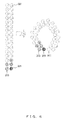
- FIG. 5 illustrates a concept for use of two kinds of neighbors.
- distal particle 401 a particle initially located at a distant position
- distal particle 401 comes very close to the reference particle 301, or even when these particles become overlapped with each other, these particles may have no influence on each other, and such a phenomenon does not appear to fit in with a real state.
- step S204 using the two kinds of situations , i.e., a situation wherein the reference particle 301 and a neighboring particle 303 are adjacent to each other from the beginning and a situation wherein the reference particle 301 and a distant particle 401 become adjacent to each other after the elastic body is largely deformed, these two kinds are overlapped with each other at a certain ratio.
- the amounts of the two influences are the same.
- the neighboring particle 303 in the process of being deformed may be defined as a reference that has a new influence, and three or more neighboring states may be overlapped with each other. Indicators for overlapping are, for example, the following.
- the influence of the distant particle 401 i.e. , a particle initially located at a distant position
- relative-position coordinates of the particles namely, one indicator for a deformation volume
- P x near /2h (0.5 ⁇ x near /2h ⁇ 1)
- P 0.5 (x near /2h>1)
- step S205 in accordance with a physical model set for an elastic body particle, the motion of the elastic body particle is solved, and a stress is determined.
- C indicates a right Cauchy-Green deformation tensor
- E a Green-Lagrange strain tensor
- Q an elastic potential.
- c 1 and c 2 indicate Mooney-Rivlin parameters
- I c and II c indicate principal invariants of the right Cauchy-Green deformation tensor C.
- step S206 an acceleration is calculated using the Cauchy stress determined in accordance with the formulas up to formula 12.
- D ⁇ v Dt - 1 ⁇ ⁇ ⁇
- ⁇ indicates a Cauchy stress tensor.
- step S207 using a time derivative term that includes the acceleration determined at the end, the physical quantity of the continuum particle is time-integrated, a calculation for one step is completed when the time elapses by a time unit.
- step S208 updated information on the neighboring particles 303 is obtained.
- step S209 a calculation result is output as an external file on an as-needed basis, e.g., when a certain number of steps have elapsed or when a certain simulation time has elapsed.
- step S210 it is determined whether a designated number of steps have been completed; when the designated number of steps have not been completed (step S210: No), step S203 and the following steps are repeated as many times as the designated number of steps, and, then, the simulation process in accordance with the first embodiment is finished.
- FIG. 6 illustrates the concept of a situation in which a self-contact calculation is performed.
- the motion of a continuum body particle is solved as described above, and, for a neighboring particle 601 that has become a neighbor after the elastic body is deformed, a repulsive force is determined on the assumption that the reference particle 301 and the neighboring particle 601 have come in contact with each other.
- a repulsive force is determined on the assumption that the reference particle 301 and the neighboring particle 601 have come in contact with each other.
- different influences may be given at a certain ratio, as described above.
- a penalty method or the like may be used to calculate the repulsive force.
- the influences are different factors such as the motion and the contact of the elastic body, and hence the ratio of the influences does not need to be changed.
- FIG. 7 is a flowchart illustrating the flow of a simulation process in accordance with a second embodiment.
- Steps S201-S203 are similar to those in the simulation process of the first embodiment.
- a radius of influence 302 is converted into a radius of influence 302 tailored for the reference coordinates.
- Formula 14 expresses the radius of influence 302, where F indicates a deformation gradient tensor.
- W f r h det ⁇ F ⁇ F - 1 • W r h • F
- W f ( r,h ) indicates a radius of influence specific to a situation in which a reference coordinate system is used.
- step S205 as in the case of the first embodiment, a stress is calculated using both an original neighboring particle 303 and a particle 303 that has become a neighbor after deformation occurred.
- a calculating formula that is essentially the same as that in the first embodiment is used, but a deformation gradient tensor that has not been corrected is used.
- the stress is the one based on the reference coordinate system, which is a first Piola-Kirchhoff stress.
- step S702 using formula 15, a calculation is performed after the stresses are converted into stresses that use the reference coordinate system.
- ⁇ 1 det ⁇ F ⁇ F • ⁇ • F - 1
- Step S206 and the following steps are similar to those in the first embodiment.
- the embodiments of the invention can be widely used for numerical calculations that use a particle method.
- the embodiments can be used to, for example, design a product by analyzing a casting process. Applying any of the embodiments to an elastic body may allow, for example, the shape of sealing gel to be properly determined in the designing of a product.
- the simulation apparatus in FIG. 1 is achievable using, for example, an information processing apparatus (computer) illustrated in FIG. 8 .
- the information processing apparatus in FIG. 8 includes a CPU (Central Processing Unit) 801, a memory 802, an input apparatus 803, an output apparatus 804, an external recording apparatus 805, a medium driving apparatus 806, and a network connecting apparatus 807. These elements are connected to each other by a bus 808.
- CPU Central Processing Unit
- the memory 802 is a semiconductor memory, e.g., a ROM (Read Only Memory), a RAM (Random Access Memory), or a flash memory, and stores a program and data used in the simulation processes.
- the CPU 801 performs the aforementioned simulation processes by executing a program using the memory 802.
- the memory 802 may be used as the storage unit 102 in FIG. 1 .
- the input apparatus 803 is, for example, a keyboard or a pointing device and is used to input information and an instruction from an operator.
- the output apparatus 804 is, for example, a display apparatus, a printer, or a speaker and is used to output a result of processing and to send a query to an operator.
- the output apparatus 804 may be used as the output unit 103 in FIG. 1 .
- the external recording apparatus 805 is, for example, a magnetic disk apparatus, an optical disk apparatus, a magnetic optical disk, or a tape apparatus.
- the external recording apparatus 805 includes a hard disk drive.
- the information processing apparatus may store a program and data in the external recording apparatus 805 and may load them into the memory 802.
- the medium driving apparatus 806 drives a portable recording medium 809 and accesses data recorded therein.
- the portable recording medium 809 is, for example, a memory device, a flexible disk, an optical disk, or a magnetic optical disk.
- the portable recording medium 809 also includes, for example, a Compact Disk Read Only Memory (CD-ROM), a Digital Versatile Disk (DVD), and a Universal Serial Bus (USB) memory.
- CD-ROM Compact Disk Read Only Memory
- DVD Digital Versatile Disk
- USB Universal Serial Bus
- the computer-readable recording media that store a program and data used in the simulation process include physical (non-transitory) recording media such as the memory 802, the external recording apparatus 805, and the portable recording medium 809.
- the network connecting apparatus 807 is a communication interface connected to a communication network 810 and performs data conversion associated with a communication.
- the information processing apparatus may receive a program and data from an external apparatus via the network connecting apparatus 807 and load them into the memory 802.
- the network connecting apparatus 807 may be used as the output unit 103 in FIG. 1 .
- a deformation gradient tensor may be used to calculate an interaction for which consideration is given to the fact that a radius of influence is supposed to change in accordance with deformation caused by movement of a particle, a Cauchy stress may be calculated that is a stress value under coordinates after deformation, and the calculation of an interaction with a particle that has become a neighbor after deformation occurred may be combined, thereby allowing, for example, a self-contact problem to be solved.
- a deformation gradient tensor is often used to indicate the behavior of the elastic body; using a deformation gradient tensor leads to the advantages that values can be calculated without performing a special calculation and that values can be calculated without particularly increasing a calculation amount.
Landscapes
- Engineering & Computer Science (AREA)
- Physics & Mathematics (AREA)
- Theoretical Computer Science (AREA)
- Computer Hardware Design (AREA)
- Evolutionary Computation (AREA)
- Geometry (AREA)
- General Engineering & Computer Science (AREA)
- General Physics & Mathematics (AREA)
- Management, Administration, Business Operations System, And Electronic Commerce (AREA)
- Design And Manufacture Of Integrated Circuits (AREA)
Applications Claiming Priority (1)
| Application Number | Priority Date | Filing Date | Title |
|---|---|---|---|
| JP2013200867A JP6176029B2 (ja) | 2013-09-27 | 2013-09-27 | シミュレーション装置、シミュレーションプログラム及びシミュレーション方法 |
Publications (2)
| Publication Number | Publication Date |
|---|---|
| EP2854051A2 true EP2854051A2 (fr) | 2015-04-01 |
| EP2854051A3 EP2854051A3 (fr) | 2015-06-10 |
Family
ID=51429014
Family Applications (1)
| Application Number | Title | Priority Date | Filing Date |
|---|---|---|---|
| EP14179655.7A Withdrawn EP2854051A3 (fr) | 2013-09-27 | 2014-08-04 | Dispositif, programme et procédé de simulation |
Country Status (3)
| Country | Link |
|---|---|
| US (1) | US20150094998A1 (fr) |
| EP (1) | EP2854051A3 (fr) |
| JP (1) | JP6176029B2 (fr) |
Families Citing this family (1)
| Publication number | Priority date | Publication date | Assignee | Title |
|---|---|---|---|---|
| JP6547547B2 (ja) * | 2015-09-25 | 2019-07-24 | 富士通株式会社 | 粒子シミュレーションプログラム、計算機資源配分方法、および粒子シミュレーション装置 |
Citations (3)
| Publication number | Priority date | Publication date | Assignee | Title |
|---|---|---|---|---|
| JPH04181350A (ja) | 1990-11-16 | 1992-06-29 | Toshiba Corp | 多粒子系時間発展計算法 |
| JP2929840B2 (ja) | 1992-06-18 | 1999-08-03 | 日本電気株式会社 | 粒子情報計算方法 |
| JP3277799B2 (ja) | 1996-03-15 | 2002-04-22 | 富士ゼロックス株式会社 | 多体問題計算方法 |
Family Cites Families (2)
| Publication number | Priority date | Publication date | Assignee | Title |
|---|---|---|---|---|
| US7610184B1 (en) * | 2006-01-23 | 2009-10-27 | Itt Manufacturing Enterprises, Inc. | Sector meshing and neighbor searching for object interaction simulation |
| WO2013042212A1 (fr) * | 2011-09-20 | 2013-03-28 | 富士通株式会社 | Programme de recherche, dispositif de recherche et méthode de recherche |
-
2013
- 2013-09-27 JP JP2013200867A patent/JP6176029B2/ja not_active Expired - Fee Related
-
2014
- 2014-08-04 EP EP14179655.7A patent/EP2854051A3/fr not_active Withdrawn
- 2014-08-05 US US14/451,537 patent/US20150094998A1/en not_active Abandoned
Patent Citations (3)
| Publication number | Priority date | Publication date | Assignee | Title |
|---|---|---|---|---|
| JPH04181350A (ja) | 1990-11-16 | 1992-06-29 | Toshiba Corp | 多粒子系時間発展計算法 |
| JP2929840B2 (ja) | 1992-06-18 | 1999-08-03 | 日本電気株式会社 | 粒子情報計算方法 |
| JP3277799B2 (ja) | 1996-03-15 | 2002-04-22 | 富士ゼロックス株式会社 | 多体問題計算方法 |
Non-Patent Citations (1)
| Title |
|---|
| MINAKI HIROYUKI; NOGUCHI HIROHISA: "Collected Papers from 17th Computational-Dynamics Lecture Meeting", 2004, THE JAPAN SOCIETY OF MECHANICAL ENGINEERS, article "Investigation of Corrections of SPH for High Accuracy Analysis of Large Deformation Elasto-Plastic Problems", pages: 767 - 768 |
Also Published As
| Publication number | Publication date |
|---|---|
| JP2015069268A (ja) | 2015-04-13 |
| JP6176029B2 (ja) | 2017-08-09 |
| EP2854051A3 (fr) | 2015-06-10 |
| US20150094998A1 (en) | 2015-04-02 |
Similar Documents
| Publication | Publication Date | Title |
|---|---|---|
| Chessa et al. | An extended finite element method for two-phase fluids | |
| Küttler et al. | Vector extrapolation for strong coupling fluid-structure interaction solvers | |
| Guo et al. | Implementation of a height function method to alleviate spurious currents in CFD modelling of annular flow in microchannels | |
| Li et al. | Variational multi-scale finite element method for the two-phase flow of polymer melt filling process | |
| JP7102741B2 (ja) | 流体解析装置、流体解析方法、及び流体解析プログラム | |
| Nguyen et al. | A discontinuous Galerkin front tracking method for two-phase flows with surface tension | |
| Sandstöm et al. | Weakly periodic boundary conditions for the homogenization of flow in porous media | |
| Talley et al. | Coalescence prevention algorithm for level set method | |
| Grossi et al. | Verification of a total Lagrangian ANCF solution procedure for fluid–structure interaction problems | |
| Muthu et al. | A comparison of stress intensity factors obtained through crack closure integral and other approaches using eXtended element-free Galerkin method | |
| Shimada | Current issues and trends in meshing and geometric processing for computational engineering analyses | |
| Kalateh et al. | Application of SPH-FE method for fluid-structure interaction using immersed boundary method | |
| Sabel et al. | Application of the particle finite element method in machining simulation discussion of the alpha-shape method in the context of strength of materials | |
| EP2854051A2 (fr) | Dispositif, programme et procédé de simulation | |
| Hay et al. | Time-integration for ALE simulations of fluid–structure interaction problems: stepsize and order selection based on the BDF | |
| Jalušić et al. | Mixed meshless local Petrov–Galerkin collocation method for modeling of material discontinuity | |
| Yamada et al. | Design of compliant thermal actuators using structural optimization based on the level set method | |
| KR101545154B1 (ko) | 중첩 격자에서의 필드라인 생성 장치 및 그 방법 | |
| JP2014241002A (ja) | 数値計算プログラム、数値計算方法及び情報処理装置 | |
| Pons et al. | Multiparameter spectral analysis for aeroelastic instability problems | |
| Tilch et al. | Combination of body‐fitted and embedded grids for external vehicle aerodynamics | |
| EP2602731A1 (fr) | Programme d'ordinateur, procédé et dispositif pour simuler un écoulement à surface libre | |
| Lin et al. | The localized method of approximated particular solutions for solving two-dimensional incompressible viscous flow field | |
| Japhet et al. | A new interface cement equilibrated mortar method with Ventcel conditions | |
| Kwon | Coupling of lattice Boltzmann and finite element methods for fluid-structure interaction application |
Legal Events
| Date | Code | Title | Description |
|---|---|---|---|
| PUAI | Public reference made under article 153(3) epc to a published international application that has entered the european phase |
Free format text: ORIGINAL CODE: 0009012 |
|
| 17P | Request for examination filed |
Effective date: 20140804 |
|
| AK | Designated contracting states |
Kind code of ref document: A2 Designated state(s): AL AT BE BG CH CY CZ DE DK EE ES FI FR GB GR HR HU IE IS IT LI LT LU LV MC MK MT NL NO PL PT RO RS SE SI SK SM TR |
|
| AX | Request for extension of the european patent |
Extension state: BA ME |
|
| PUAL | Search report despatched |
Free format text: ORIGINAL CODE: 0009013 |
|
| AK | Designated contracting states |
Kind code of ref document: A3 Designated state(s): AL AT BE BG CH CY CZ DE DK EE ES FI FR GB GR HR HU IE IS IT LI LT LU LV MC MK MT NL NO PL PT RO RS SE SI SK SM TR |
|
| AX | Request for extension of the european patent |
Extension state: BA ME |
|
| RIC1 | Information provided on ipc code assigned before grant |
Ipc: G06F 17/50 20060101AFI20150504BHEP |
|
| R17P | Request for examination filed (corrected) |
Effective date: 20150812 |
|
| RBV | Designated contracting states (corrected) |
Designated state(s): AL AT BE BG CH CY CZ DE DK EE ES FI FR GB GR HR HU IE IS IT LI LT LU LV MC MK MT NL NO PL PT RO RS SE SI SK SM TR |
|
| STAA | Information on the status of an ep patent application or granted ep patent |
Free format text: STATUS: THE APPLICATION HAS BEEN WITHDRAWN |
|
| 18W | Application withdrawn |
Effective date: 20171105 |