EP2854074A1 - Verfahren und vorrichtung zur implementierung einer erweiterten realität - Google Patents
Verfahren und vorrichtung zur implementierung einer erweiterten realität Download PDFInfo
- Publication number
- EP2854074A1 EP2854074A1 EP20130819639 EP13819639A EP2854074A1 EP 2854074 A1 EP2854074 A1 EP 2854074A1 EP 20130819639 EP20130819639 EP 20130819639 EP 13819639 A EP13819639 A EP 13819639A EP 2854074 A1 EP2854074 A1 EP 2854074A1
- Authority
- EP
- European Patent Office
- Prior art keywords
- image
- target object
- information
- preliminary
- terminal
- Prior art date
- Legal status (The legal status is an assumption and is not a legal conclusion. Google has not performed a legal analysis and makes no representation as to the accuracy of the status listed.)
- Ceased
Links
Images


Classifications
-
- G—PHYSICS
- G06—COMPUTING OR CALCULATING; COUNTING
- G06V—IMAGE OR VIDEO RECOGNITION OR UNDERSTANDING
- G06V20/00—Scenes; Scene-specific elements
- G06V20/20—Scenes; Scene-specific elements in augmented reality scenes
Definitions
- the present invention relates to communications technologies, and in particular, to a method and an apparatus for implementing augmented reality.
- Augmented reality is an emerging computer application and man-machine interaction technology developed based on virtual reality technologies.
- the AR obtains augmented information related to the target object upon recognizing the target object, where the augmented information is, for example, advertisement information, distance information, or one or more other virtual object related to the target object; and then superimposes the target object and the augmented information in a same image by using computer and virtualization technologies, thereby implementing augmented reality.
- a method for implementing augmented reality adopted in the prior art is as follows: a user first needs to determine a target object in the real world the user wants to shoot and identify, for example, the user first determines that he or she wants to shoot a specific architecture; then the user selects a category of the target object, focuses on and shoots the target object in the real world, and performs image matching of an obtained picture with a plurality of prestored image templates belonging to the foregoing selected category to identify which image template matches with the target object in the picture, so that identification of the target object is complete; and subsequently the user obtains augmented information corresponding to the identified target object.
- a disadvantage of this manner is that a to-be-shot target object needs to be determined and a category of the target object needs to be selected, before a user shoots the target object. If the user determines to identify the target object after shooting randomly, subsequent operations, such as identification and matching, cannot be executed because the category is not preselected. Therefore, the user's usage may be significantly limited, thereby resulting in a poor user experience, which may be referred to as a serious limitation on use of the augmented reality.
- the present invention provides a method and an apparatus for implementing augmented reality, to reduce limitation on using the augmented reality, so that it is more convenient for a user to use the augmented reality.
- the present invention provides a method for implementing augmented reality, and the method includes:
- the acquiring a plurality of target objects selected by a user from the real image information includes: performing preliminary identification of the real image information to obtain a preliminary target object image, where definition of the preliminary target object image is lower than definition of the identification image of the target object; and acquiring the plurality of target objects selected by the user from the preliminary target object image.
- the acquiring categorization information of the target object includes: acquiring preliminary categorization information of the target object; and acquiring the categorization information obtained upon correcting the preliminary categorization information.
- the acquiring categorization information of the target object includes: sending the preliminary target object image to a network server, and receiving the preliminary categorization information that is returned by the network server and is corresponding to the preliminary target object image; or, locally determining preliminary categorization information that is corresponding to the preliminary target object image.
- the acquiring the categorization information obtained upon correcting the preliminary categorization information includes: presenting the preliminary categorization information to a user, and receiving the categorization information obtained correcting the preliminary categorization information by the user; or, acquiring the categorization information by locally correcting the preliminary categorization information.
- the acquiring an identification image that is used to identify the target object includes acquiring the identification image by focusing on and shooting the target object by using the ordinary camera; and if the camera is a camera of a light field camera, the acquiring an identification image that is used to identify the target object includes generating the identification image by focusing on the target object in the real image information.
- the present invention provides a method for implementing augmented reality, and the method includes:
- the method before the sending, to a terminal, an image template corresponding to categorization information that is sent by the terminal, the method further includes: receiving a preliminary target object image sent by the terminal, where the preliminary target object image is obtained by performing, by the terminal, preliminary identification of the real image information, and the target object is obtained by selecting from the preliminary target object image; and definition of the preliminary target object image is lower than definition of the identification image of the target object; and sending, to the terminal, preliminary categorization information corresponding to the preliminary target object image, so that the terminal obtains the categorization information obtained upon correcting the preliminary categorization information.
- the present invention provides a terminal, and the terminal includes:
- the image identification unit is further configured to receive the real image information sent by the augmented reality client, and perform preliminary identification of the real image information to obtain a preliminary target object image, where definition of the preliminary target object image is lower than definition of the identification image of the target object; and return the preliminary target object image to the augmented reality client; the augmented reality client is further configured to present the preliminary target object image identified by the image identification unit to the user, and obtain a plurality of target objects selected by the user from the preliminary target object image.
- the augmented reality client is further configured to obtain preliminary categorization information of the target object and the categorization information obtained by correcting the preliminary categorization information.
- the augmented reality client is specifically configured to: send the preliminary target object image to the network server, and receive preliminary categorization information that is returned by the network server and is corresponding to the preliminary target object image; or locally determine preliminary categorization information corresponding to the preliminary target object image.
- the augmented reality client is specifically configured to present the preliminary categorization information to the user and receive the categorization information obtained by the user upon correcting the preliminary categorization information; or, obtain the categorization information upon locally correcting the preliminary categorization information.
- the augmented reality client is further configured to obtain the identification image obtained by focusing on and shooting the target object by using the camera; and if the camera is a camera of a light field camera, the augmented reality client is further configured to generate the identification image by focusing on the target object in the real image information.
- the present invention provides a network server, and the network server includes:
- an image categorization unit is configured to receive a preliminary target object image sent by the terminal, where the preliminary target object image is obtained by performing, by the terminal, preliminary identification of the real image information, and the target object is obtained by selecting from the preliminary target object image; and definition of the preliminary target object image is lower than definition of the identification image of the target object; and send, to the terminal, preliminary categorization information corresponding to the preliminary target object, so that the terminal obtains the categorization information obtained upon correcting the preliminary categorization information.
- the technical effects are: by acquiring real image information first and then selecting, by a user, a target object from the real image information, the user may process augmented reality after randomly shooting instead of determining the target object and a category of the object at first, to reduce a limitation on using the augmented reality, so that it is more convenient for the user to use the augmented reality.
- FIG. 1 is a system architecture applied to a method for implementing augmented reality according to an embodiment of the present invention.
- the augmented reality is implemented between a terminal 11 and a network server 12 by means of communication.
- a plurality of image templates and augmented information are stored on the network server 12, and the terminal 11 may perform image matching of an image obtained by shooting on its own with the image template obtained from the network server 12 to identify a target object in the captured image, to obtain augmented information of the target object from the network server 12.
- the augmented information is superimposed on the target object and displayed at the same time to implement the augmented reality.
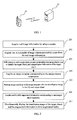
- FIG. 2 is a schematic flowchart of a method for implementing augmented reality according to an embodiment of the present invention. As shown in FIG. 2 , the method provided in the embodiment is executed by the terminal, where the method may include:
- the terminal may obtain the real image information by using a camera of the terminal, where the real image information may be, for example, a picture of a current scenario shot randomly by using the camera, that is, a picture of the real world; or a video frame of the real world obtained by using the camera.
- the real image information may be, for example, a picture of a current scenario shot randomly by using the camera, that is, a picture of the real world; or a video frame of the real world obtained by using the camera.
- the terminal may present the real image information to the user, and the user selects the target object from the real image information.
- the user may select the one or more target objects, so that the terminal may know all at once that the user wants to obtain the one or more target objects of the augmented information, where the target object refers to an object of which the user wants to obtain the augmented information.
- many objects such as a tower, a figure, and a tree
- a picture the real image information
- the user selects the tower and the tree (for example, selection may be made by circling the tower and the tree, or in another manner, which is not limited in the present invention)
- the tower and the tree are called the target objects.
- each target object With respect to each target object, obtain an identification image that is used to identify the target object, and categorization information of the target object.
- the identification image of and the categorization information of the target object need to be obtained. This is because: a plurality of image templates and augmented information corresponding to the image templates are stored on a network server side, and the terminal needs to identify an image template that matches the target object during a process of performing the image matching of an image of the target object with the plurality of image templates, to obtain the corresponding augmented information.
- the network server side stores a template A (that is, a template of an object A), a template B (that is, a template of an object B), and a template C (that is, a template of an object C) and stores augmented information corresponding to each template. It is assumed that after performing image matching of the image shot by the terminal with the foregoing several templates, the image is found to be matched with the template B, which indicates that the image is an image of the object B, that is, the image is identified. And further, augmented information of the object B is augmented information corresponding to the template B (in fact, it is the augmented information of the object B).
- the identification image used to identify the target object needs to be obtained.
- the identification image is a focused image of the target object, because generally, definition of a picture taken by using the camera is relatively low.
- an image with high definition must be used, where the image with high definition is called an identification image, that usually is, an image that is obtained by focusing on and shooting the target object.
- the plurality of templates is stored by categorization, such as a plant template and a building template.
- the categorization information of the target object for example, the target object belongs to a figure or a plant, is usually obtained before acquiring a template from the network server, so that many corresponding image templates that are returned by the network server to the terminal according to the categorization information are used for identification of the target object.
- the terminal After acquiring the categorization information of the target object, the terminal requests the image template from the network server and carries the categorization information.
- the network server may send a plurality of image templates corresponding to the categorization information to the terminal according to the categorization information. For example, if the categorization information sent by the terminal to the network server belongs to the plant template, the network server may return a plurality of image templates corresponding to the plant template to the terminal.
- the terminal may perform image matching of the image template with the identification image of the target object, that is, an identification process of the target object.
- the identification image of the target object that is, an identification process of the target object.
- the terminal upon identifying the target object, requests the augmented information corresponding to the target object from the network server.
- the network server side stores each template and the augmented information corresponding to each template separately.
- the terminal can inform the network server of an identity of the matched image template.
- the terminal informs the network server of an identity of the template B (that is, the target object is the object B represented by the template B), then the network server may send the augmented information corresponding to the template B to the terminal.
- the augmented information is, for example, various types of information related to the object B, such as a distance and an advertisement.
- the terminal simultaneously displays the received augmented information and the identification image of the target object to form the augmented reality.
- the terminal displays the target object "tower” and the augmented information "a height of...is” of the tower to implement the augmented reality, that is, augmentation of the actual object "the tower” in the real world because other relevant information of the object is added.
- a terminal obtains an image template from a network server to implement image matching is used as an example for description.
- part or all of such steps as acquiring of the image template, image matching, and acquiring of augmented information may be executed by the network server.
- the terminal may transfer the identification image and the categorization information of the identification image to the network server;
- the network server obtains the image template of a target object and performs the image matching according to the categorization information, then obtain the corresponding augmented information according to the image template obtained by means of matching; finally the network server transfers the augmented information to the terminal.
- a user may first take a photo of real image information, then selects one or more target objects all at once from the real image information shot by a terminal.
- the terminal may obtain augmented information corresponding to each target object separately. Therefore, the user may take photos randomly without determining the target object and an object category at first, and then process the augmented reality, to reduce limitation on using the augmented reality, so that it is more convenient for the user to use the augmented reality.
- a same processing can only be performed on the plurality of target objects separately, such as selecting a category of the object, then taking a photo and performing the image matching, which causes a low efficiency.
- the terminal may obtain the user's selection of the plurality of target objects more quickly, and obtain augmented information of the plurality of target objects more quickly, so as to significantly improve an implementation efficiency of the augmented reality.
- FIG. 3 is a schematic flowchart of a method for implementing augmented reality according to another embodiment of the present invention, where the method provided in this embodiment is executed by a network server. As shown in FIG. 3 , the method may include:
- the terminal After the terminal obtains a target object selected by a user and obtains categorization information of the target object, the terminal sends the image template acquisition request to the network server, carries the categorization information of the target object, and requests acquiring of an image template corresponding to the categorization information.
- the network server sends the image template corresponding to the categorization information to the terminal, so that the terminal performs the image matching of the image template with an identification image of the target object to identify the target object.
- the terminal may send the augmented information acquisition request to the network server, and request acquiring of the augmented information corresponding to the target object; and the terminal carries the target object identifier, so that the network server searches for corresponding augmented information according to the target object identifier.
- the target object identifier may be, for example, an identity of an image template matched with an identification image of the target object. As described above, assuming that the identification image of the target object that is shot by the terminal matches with a template B, it indicates that the target object is an object represented by the template B. An identity of the template B is used as the target object identifier and is sent to the network server, then the network server may obtain the augmented information corresponding to the template B, and the information is also the augmented information of the target object.
- a network server may send augmented information corresponding to each target object that is identified by a terminal to the terminal, so that the terminal displays the augmented information and an identification image of the target object to form augmented reality.
- FIG. 4A and FIG. 4B are a schematic signaling diagram of a method for implementing augmented reality according to still another embodiment of the present invention.
- This embodiment is executed by a terminal and a network server together, so as to describe the method for implementing augmented reality more specifically.
- a camera, an augmented reality AR client, and an image identification unit included in the terminal are shown in the signaling diagram, and the method is described based on this three units.
- the image identification unit and the AR client may be integrated into a functional module.
- the image identification unit is integrated into the AR client.
- the method may include:
- a camera obtains real image information.
- the terminal may obtain the real image information by using the camera, where the real image information may be a picture or a video frame of the real world; and the camera may be a camera of a light field camera or an ordinary camera.
- the camera sends the real image information to an AR client.
- the AR client sends the real image information to an image identification unit to request performing of preliminary identification.
- An AR client on the terminal sends the real image information obtained by the camera to the image identification unit to request the image identification unit to perform preliminary identification on the real image information.
- the image identification unit performs the preliminary identification on the real image information to obtain a preliminary target object image.
- the image identification unit mainly uses a computer vision technology to obtain an object outline in the real image information, and obtain spatial information of an object according to the object outline and pixel brightness information in an image; that is, this step is equivalent to preliminarily identifying an individuality of the object included in the real image information.
- definition of the image of the individuality is not high enough to perform subsequent image identification, because the definition of the image of the individuality is lower than definition of an identification image of the target object.
- the object preliminarily identified in this step is not the target object that is finally selected by a user, and of which the user expects to obtain augmented information. Therefore, the object is called a preliminary target object.
- FIG. 5 is a schematic diagram of image presentation of a method for implementing augmented reality according to still another embodiment of the present invention.
- A, B and C are three preliminary target objects obtained by performing the preliminary identification by the terminal, where A is a body (BODY), B is a face (FACE), and C is a tower.
- the individuality of the tower includes an outline 51 of the tower, and an entity 52 that is determined according to the pixel brightness information and is surrounded by the outline 51 of the tower.
- the image identification unit sends the preliminary target object image to the AR client.
- the AR client sends the preliminary target object image to the network server to request acquiring of preliminary categorization information.
- the AR client sends the preliminary target object that is identified by the image identification unit to the network server, so as to request the network server to obtain the preliminary categorization information of the preliminary target object, where the preliminary categorization information refers to categorization information corresponding to the preliminary target object.
- the network server obtains preliminary categorization information of the preliminary target object image.
- the network server may determine, according to, for example, experience data, that the preliminary target object image belongs to various different categories, such as a landscape, a face, or an animal, so as to determine the preliminary categorization information of the preliminary target object image. For example, the network server may determine, according to the preliminary target object image shown in FIG. 5 , that A belongs to a body (BODY), B belongs to a face (FACE), and a tower represented by C belongs to a landmark (LANDMARK).
- the network server returns the preliminary categorization information to the AR client.
- the foregoing manner is to identify, assisted by the network server, the preliminary categorization information to which the preliminary target object belongs.
- the manner is not limited to this.
- the preliminary categorization information may be determined by the AR client, and a determining manner may be the same as the network server, for example, based on the experience data.
- the AR client presents the preliminary target object image to a user, and obtains a plurality of target objects selected by the user from the preliminary target object image.
- the AT client presents the preliminary target object image to the user for the user to select; and the user may, by means of touchscreen click, keyboard input, speech input, and the like, select from the preliminary target object image the target object of which the user expects to obtain augmented information.
- the user may select and obtain the target object with augmented information from three preliminary target objects A, B, and C shown in FIG. 5 ,, for example, A and C may be selected.
- the AR client presents the preliminary categorization information to the user, and receives the categorization information obtained upon correcting, by the user, the preliminary categorization information;
- the AR client also presents the preliminary categorization information of the preliminary target object to the user.
- "Catalog" shown on the right in FIG. 5 is the preliminary categorization information that includes: a preliminary categorization of A is a BODY, a preliminary categorization of B is a FACE, and a preliminary categorization of C is a LANDMARK. That the AR client presents the preliminary categorization information to the user is expecting that the user may determine that whether the categorization information is accurate and correct the categorization information if the categorization information is wrong. The user may, according to judgment of the user, perform correction by means of touchscreen click, keyboard input, and speech input. For example, when the preliminary categorization of C is a work of art, the user may correct the preliminary categorization into a landmark LANDMARK.
- a reason for correcting the preliminary categorization information is that an image template is searched according to categorization information when requesting the image template subsequently. Therefore, the categorization information needs to be consistent with categorization on the network server side, otherwise it may affect subsequent searching and processing of the image template.
- the user when the user corrects the preliminary categorization information, the user can know about categorization information that is consistent with the network server side, and the preliminary categorization can be corrected according to these accurate categorization information.
- a manner in which the user knows the foregoing accurate categorization information is not limited in this embodiment.
- the AR client may also correct the preliminary categorization information.
- a correction manner may be, for example, by presetting information. For example, the AR client has preset that when a condition is satisfied, categorization information of an object belongs to category A, then the AR client may determine, according to the preset information, that the preliminary categorization information may be automatically corrected when the information is incorrect.
- the categorization information of the preliminary target object is actually determined.
- a target object selected from the preliminary target object by the user is obtained, correspondingly, categorization information of the target object is obtained; that is, through the foregoing step, the target object selected by the user, and the categorization information of the target object are obtained.
- preliminary categorization information of all preliminary target objects may first be obtained, then the preliminary categorization information corresponding to the target object is corrected after the target object is selected by the user; or the user first selects the target object from the preliminary target object, and then obtains the preliminary categorization information and the categorization information of the target object.
- an execution sequence for acquiring the categorization information is not limited strictly. Just accurate categorization information of the target object is obtained before requesting acquiring of the image template.
- an identification image of the target object needs to be obtained.
- the identification image has higher definition than the preliminary target object image, because the identification image is used to identify the target object during subsequent image identification. Therefore, there is a higher requirement for the definition of the identification image rather than to identify a preliminary outline individuality, as the preliminary target object is processed.
- the identification image is usually a focused image of the target object. In respect of acquiring the focused image, manners of acquiring the focused image may be different when the terminal uses different cameras. For example, if the camera is a camera of a light field camera, step 411 is continued to be executed; if the camera is a camera of an ordinary camera, step 412 is continued to be executed.
- the AR client focuses on the target object in the real image information to generate the identification image.
- the light field camera is a technology of taking a picture of light field information by using microlens, and refocusing on the different objects in the picture after taking the picture. For example, after shooting, two objects such as a man and a flower in the picture may be refocused.
- the real image information is obtained by using the light field camera in step 401, then in this step, different objects in the real image information obtained in step 401 may be focused separately; and specifically, each target object selected by the user from the real image information may be refocused to generate the identification image of the target object.
- the user selects A and C shown in FIG. 5 , then A and C in the real image information may be focused to obtain their respective identification image.
- An advantage of shooting by using the light field camera is that identification images of a plurality of target objects may be obtained by shooting once rather than taking pictures for many times, which is convenient, simple, and efficient.
- the AR client focuses on and shoots the target object by using an ordinary camera to obtain the identification image.
- the real image information is obtained by using the ordinary camera in step 401, then in this step, the plurality of target objects selected by the user needs to be focused on and shot by using the ordinary camera, so as to obtain a clear focused image of the target object, that is, an identification image by focusing and shooting the plurality of target objects separately.
- the AR client sends an image template acquisition request to the network server, and carries categorization information of the target object.
- the network server sends an image template corresponding to the categorization information that is sent by the terminal to the terminal.
- the network server may send the image template corresponding to the categorization information to the terminal. For example, assuming that the categorization information sent by the terminal is "LANDMARK" shown in FIG. 5 , the network server may send a plurality of image templates corresponding to the "LANDMARK" to the terminal.
- the AR client sends the image template to the image identification unit to request the image identification.
- the AR client may send the identification image of the target object obtained in step 411 or step 412, and the image template obtained in step 414 to the image identification unit, so as to request the image identification unit to perform image matching, that is, searching for which image template matches with the identification image.
- the image identification unit performs the image identification.
- the image identification unit compares the identification image with each image template. For example, if an image template is consistent with a size, a shape of the identification image, it indicates that the image template matches with the identification image, the target object is identified, and the target object is an object represented by the image template. For example, as described above, the image identification unit may discover, through the matching process, that one of the plurality of image templates under the "LANDMARK" matches with the identification image of the C tower (that is, a focused image of the tower) shown in FIG. 5 , then identification of the target object C is complete.
- the image identification unit returns an identification result to the AR client.
- the image template on the network server side has a template identity and the template identity may be a name of the object represented by the template, such as a tower, a temple, and a theater.
- Many image templates are provided under the foregoing categorization information "LANDMARK", assuming that the image templates include the image templates of the tower, the temple, and the theater.
- a target object on the terminal side is C, that is, the tower shown in FIG. 5 .
- the image identification unit matches an identification image of the tower with each image template and identifies them, and finally finds that the image template of the tower matches with the identification image of the target object C, then in this case, the template identity for the image template of the tower, that is, the tower, may be fed back to the AR client, by the image identification unit, and the AR client may know that the target object C is the tower.
- the image identification unit returns the identification result to the AR client.
- the AR client sends the image template acquisition request to the network server, and carries the target object identifier.
- the target object identifier may be, for example, the tower.
- the network server sends the augmented information corresponding to the target object to the AR client.
- the network server searches for the augmented information corresponding to the "tower" according to the target object identifier "tower" sent by the terminal, where the augmented information is information related to the target object, tower, such as a height and construction time of the tower.
- the image template, the template identity, and the augmented information may correspond to each other.
- the image template of the tower, the identity "tower", and the augmented information of the tower are stored correspondingly.
- the target object is an object represented by the image template of the tower, that is, the "tower”, and the identity "tower” used as the target object identifier, is sent to the network server for requesting the corresponding augmented information.
- the user may select the plurality of target objects all at once from a piece of real image information.
- a manner of requesting simultaneously may be used. For example, the identity of each target object is sent to the network server, and the network server sends the augmented information of each target object to the AR client simultaneously. Or a manner of requesting separately may be used, that is, each target object is processed separately.
- a manner of requesting separately may be used, that is, each target object is processed separately.
- the manner provided in this embodiment significantly improves a processing efficiency of the augmented reality.
- the method provided in this embodiment has the following advantages: in the prior art, a category of the target object that needs the augmented information is first selected, and then a picture is taken and the image identification is performed on the target object. Therefore, when implementing the AR, the user first needs to determine what the target object that is wanted to select is, then the category may be selected. If the user takes a picture of a current scenario randomly, then subsequent processing steps may not be performed because the category is not preselected by the user. Therefore, it is not convenient to use the manner of implementing augmented reality in the prior art; in addition, the method is complicated. However, the manner provided in this embodiment allows the user to shoot randomly, and perform the processing of selecting and categorizing the target object in the subsequent steps, which provides more convenience for the user. In addition, the manner also can obtain the selection of the plurality of target objects made by the user quickly, and obtain the categorization and augmented information of the plurality of target objects quickly, which is of high efficiency.
- the AR client simultaneously displays the identification image of the target object and the augmented information to form the augmented reality.
- the AR client superimposes the identification image of the target object with the augmented information to form user experience of the augmented reality.
- identification of a plurality of targets is performed by using a hierarchical manner, that is, a preliminary target object and preliminary categorization information are first obtained.
- the user selects a target object and obtains a focused image of the target object, which reduces processing steps, so that an identification image of the target object is only obtained to avoid resources waste of processing a non-target object.
- accurate categorization information is obtained by correcting the preliminary categorization information, which may improve identification accuracy of the categorization information of the target object, so as to better ensure high-speed and accuracy of acquiring an image template according to the categorization information.
- FIG. 6 is a schematic structural diagram of a terminal according to an embodiment of the present invention.
- the terminal may execute a method for implementing augmented reality provided in any embodiment of the present invention.
- This embodiment only briefly describes a structure of the terminal, and for a specific working principle of the terminal, reference may be made to the description of the method embodiment.
- the terminal provided in the embodiment may include: a camera 61, an augmented reality client 62, and an image identification unit 63.
- the camera 61 is configured to obtain real image information.
- the augmented reality client 62 is configured to: obtain the real image information obtained by the camera, obtain one or more target objects selected by a user from the real image information; and with respect to each target object, obtain an identification image that is used to identify the target object and categorization information of the target object; obtain an image template corresponding to the categorization information from a network server; and obtain augmented information corresponding to each identified target object from the network server, and simultaneously display the identification image of the target object and the augmented information to form augmented reality.
- the image identification unit 63 is configured to match the image template obtained by the augmented reality client with the identification image to identify each target object.
- the image identification unit 63 is further configured to receive the real image information sent by the augmented reality client, and perform preliminary identification of the real image information to obtain a preliminary target object image, where definition of the preliminary target object image is lower than definition of the identification image of the target object; and return the preliminary target object image to the augmented reality client; and the augmented reality client 62 is further configured to present the preliminary target object image identified by the image identification unit to the user, and obtain one or more target objects selected by the user from the preliminary target object image.
- the augmented reality client 62 is further configured to obtain preliminary categorization information of the target object, and the categorization information obtained upon correcting the preliminary categorization information.
- the augmented reality client 62 is specifically configured to: send the preliminary target object image to the network server, and receive the preliminary categorization information that is returned by the network server and is corresponding to the preliminary target object image; or locally determine preliminary categorization information corresponding to the preliminary target object image.
- the augmented reality client 62 is specifically configured to present the preliminary categorization information to the user, and receive categorization information obtained upon correcting, by the user, the preliminary categorization information; or obtain the categorization information upon locally correcting the preliminary categorization information.
- the augmented reality client 62 is further configured to obtain the identification image obtained by focusing on and shooting the target object by using the camera; and if the camera is a camera of a light field camera, the augmented reality client 62 is further configured to generate the identification image by focusing on the target object in the real image information.
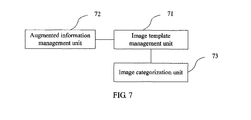
- FIG. 7 is a schematic structural diagram of a network server according to an embodiment of the present invention.
- the network server may execute a method for implementing augmented reality provided in any embodiment of the present invention. This embodiment only briefly describes a structure of the network server, and for a specific working principle of the network server, reference may be made to the description of the method embodiment.
- the network server provided in the embodiment may include: an image template management unit 71 and an augmented information management unit 72, where:
- the network server may include: an image categorization unit 73 that is configured to receive a preliminary target object image sent by the terminal, where the preliminary target object image is obtained by performing, by the terminal, preliminary identification of the real image information, and the target object is obtained by selecting from the preliminary target object image; and definition of the preliminary target object image is lower than definition of the identification image of the target object; and send, to the terminal, preliminary categorization information corresponding to the preliminary target object, so that the terminal obtains the categorization information obtained upon correcting the preliminary categorization information.
- an image categorization unit 73 that is configured to receive a preliminary target object image sent by the terminal, where the preliminary target object image is obtained by performing, by the terminal, preliminary identification of the real image information, and the target object is obtained by selecting from the preliminary target object image; and definition of the preliminary target object image is lower than definition of the identification image of the target object; and send, to the terminal, preliminary categorization information corresponding to the preliminary target object, so that the terminal obtains the categorization information
- the program may be stored in a computer readable storage medium.
- the foregoing storage medium includes: any medium that can store program code, such as a ROM, a RAM, a magnetic disk, or an optical disc.
Landscapes
- Engineering & Computer Science (AREA)
- Physics & Mathematics (AREA)
- General Physics & Mathematics (AREA)
- Multimedia (AREA)
- Theoretical Computer Science (AREA)
- Processing Or Creating Images (AREA)
Applications Claiming Priority (2)
| Application Number | Priority Date | Filing Date | Title |
|---|---|---|---|
| CN201210251097.4A CN103577788A (zh) | 2012-07-19 | 2012-07-19 | 增强现实的实现方法和装置 |
| PCT/CN2013/079507 WO2014012488A1 (zh) | 2012-07-19 | 2013-07-17 | 增强现实的实现方法和装置 |
Publications (2)
| Publication Number | Publication Date |
|---|---|
| EP2854074A1 true EP2854074A1 (de) | 2015-04-01 |
| EP2854074A4 EP2854074A4 (de) | 2015-09-16 |
Family
ID=49948287
Family Applications (1)
| Application Number | Title | Priority Date | Filing Date |
|---|---|---|---|
| EP13819639.9A Ceased EP2854074A4 (de) | 2012-07-19 | 2013-07-17 | Verfahren und vorrichtung zur implementierung einer erweiterten realität |
Country Status (4)
| Country | Link |
|---|---|
| US (1) | US9607222B2 (de) |
| EP (1) | EP2854074A4 (de) |
| CN (1) | CN103577788A (de) |
| WO (1) | WO2014012488A1 (de) |
Families Citing this family (41)
| Publication number | Priority date | Publication date | Assignee | Title |
|---|---|---|---|---|
| EP2908919A1 (de) | 2012-10-22 | 2015-08-26 | Longsand Limited | Kollaborative erweiterte realität |
| CN103823678B (zh) * | 2014-02-21 | 2018-07-03 | 联想(北京)有限公司 | 图像处理方法和图像处理装置 |
| US10572215B1 (en) * | 2014-03-31 | 2020-02-25 | Amazon Technologies, Inc. | Extendable architecture for augmented reality system |
| CN103927966A (zh) * | 2014-04-02 | 2014-07-16 | 北京智谷睿拓技术服务有限公司 | 显示控制方法及显示控制装置 |
| CN104240096A (zh) * | 2014-08-27 | 2014-12-24 | 小米科技有限责任公司 | 信息显示方法及装置、电子设备 |
| CN105574006A (zh) * | 2014-10-10 | 2016-05-11 | 阿里巴巴集团控股有限公司 | 建立拍照模板数据库、提供拍照推荐信息的方法及装置 |
| CN106293038A (zh) * | 2015-06-12 | 2017-01-04 | 刘学勇 | 同步立体支持系统 |
| US10388069B2 (en) | 2015-09-09 | 2019-08-20 | Futurewei Technologies, Inc. | Methods and systems for light field augmented reality/virtual reality on mobile devices |
| CN105590098A (zh) * | 2015-12-22 | 2016-05-18 | 北京百度网讯科技有限公司 | 图像识别方法及装置 |
| EP3206122A1 (de) * | 2016-02-10 | 2017-08-16 | Nokia Technologies Oy | Vorrichtung und entsprechende verfahren |
| CN106101576B (zh) * | 2016-06-28 | 2019-07-16 | Oppo广东移动通信有限公司 | 一种增强现实照片的拍摄方法、装置及移动终端 |
| CN106101574B (zh) * | 2016-06-28 | 2019-04-23 | Oppo广东移动通信有限公司 | 一种图像增强现实的控制方法、装置和移动终端 |
| CN106101575B (zh) * | 2016-06-28 | 2019-06-21 | Oppo广东移动通信有限公司 | 一种增强现实照片的生成方法、装置及移动终端 |
| CN105979154A (zh) * | 2016-06-28 | 2016-09-28 | 广东欧珀移动通信有限公司 | 一种增强现实ar的拍摄方法、装置及智能终端 |
| CN106200915B (zh) * | 2016-06-28 | 2019-05-28 | Oppo广东移动通信有限公司 | 一种增强现实中目标对象的识别方法、装置及移动终端 |
| CN106055708A (zh) * | 2016-06-28 | 2016-10-26 | 广东欧珀移动通信有限公司 | 一种图片生成和展示方法、装置及终端设备 |
| CN107612953B (zh) * | 2016-07-12 | 2020-10-27 | 中国电信股份有限公司 | 增强信息生成和获取方法、装置、终端设备、平台和系统 |
| CN106295504A (zh) * | 2016-07-26 | 2017-01-04 | 车广为 | 人脸识别基础上的增强显示方法 |
| CN106254848B (zh) * | 2016-07-29 | 2019-06-11 | 宇龙计算机通信科技(深圳)有限公司 | 一种基于增强现实的学习方法及终端 |
| CN107767460B (zh) * | 2016-08-18 | 2021-02-19 | 深圳劲嘉盒知科技有限公司 | 增强现实的展示方法和装置 |
| WO2018036456A1 (zh) * | 2016-08-22 | 2018-03-01 | 大辅科技(北京)有限公司 | 追踪识别视频图像中的商品并展示商品信息的方法和装置 |
| CN106373198A (zh) * | 2016-09-18 | 2017-02-01 | 福州大学 | 一种实现增强现实的方法 |
| CN108066981A (zh) * | 2016-11-12 | 2018-05-25 | 金德奎 | 一种基于位置和图像识别的ar或mr游戏方法及系统 |
| CN106780753A (zh) * | 2016-11-22 | 2017-05-31 | 宇龙计算机通信科技(深圳)有限公司 | 一种增强现实注册装置及其方法 |
| CN106778514A (zh) * | 2016-11-24 | 2017-05-31 | 努比亚技术有限公司 | 一种标识物体的方法及装置 |
| CN106598238B (zh) * | 2016-12-03 | 2019-05-24 | 赵良华 | 基于增强现实展示照片书的实现方法及显示系统 |
| CN106982387B (zh) * | 2016-12-12 | 2020-09-18 | 阿里巴巴集团控股有限公司 | 弹幕的显示、推送方法及装置及弹幕应用系统 |
| CN106685941A (zh) * | 2016-12-19 | 2017-05-17 | 宇龙计算机通信科技(深圳)有限公司 | 一种优化ar注册的方法、装置及服务器 |
| CN106683196A (zh) * | 2016-12-30 | 2017-05-17 | 上海悦会信息科技有限公司 | 一种增强现实的展示方法、系统以及智能终端 |
| US20180190033A1 (en) * | 2016-12-30 | 2018-07-05 | Facebook, Inc. | Systems and methods for providing augmented reality effects and three-dimensional mapping associated with interior spaces |
| CN107067295B (zh) * | 2017-03-13 | 2021-12-24 | 联想(北京)有限公司 | 一种信息处理方法及电子设备 |
| CN107622496A (zh) * | 2017-09-11 | 2018-01-23 | 广东欧珀移动通信有限公司 | 图像处理方法及装置 |
| CN107832397A (zh) * | 2017-10-30 | 2018-03-23 | 努比亚技术有限公司 | 一种图像处理方法、装置及计算机可读存储介质 |
| CN110166787B (zh) * | 2018-07-05 | 2022-11-29 | 腾讯数码(天津)有限公司 | 增强现实数据传播方法、系统和存储介质 |
| CN109348003A (zh) * | 2018-09-17 | 2019-02-15 | 深圳市泰衡诺科技有限公司 | 应用控制方法及装置 |
| CN111444746B (zh) * | 2019-01-16 | 2024-01-30 | 北京亮亮视野科技有限公司 | 一种基于神经网络模型的信息标注方法 |
| CN111597466A (zh) * | 2020-04-30 | 2020-08-28 | 北京字节跳动网络技术有限公司 | 展示方法、装置和电子设备 |
| CN112634773B (zh) * | 2020-12-25 | 2022-11-22 | 北京市商汤科技开发有限公司 | 增强现实的呈现方法、装置、展示设备及存储介质 |
| CN112801862B (zh) * | 2021-02-01 | 2024-01-19 | 中科云谷科技有限公司 | 基于图像变换的数据处理方法、数据处理装置及存储介质 |
| US11169832B1 (en) | 2021-05-17 | 2021-11-09 | Hong Kong Applied Science and Technology Research Institute Company Limited | Apparatus and method for augmented reality user manual |
| WO2023168836A1 (zh) * | 2022-03-11 | 2023-09-14 | 亮风台(上海)信息科技有限公司 | 一种投影交互方法、设备、介质及程序产品 |
Family Cites Families (20)
| Publication number | Priority date | Publication date | Assignee | Title |
|---|---|---|---|---|
| US7034317B2 (en) * | 2002-12-17 | 2006-04-25 | Dmetrix, Inc. | Method and apparatus for limiting scanning imaging array data to characteristics of interest |
| US7952063B2 (en) * | 2004-07-28 | 2011-05-31 | Koninklijke Philips Electronics N.V. | Method and system for operating a pointing device to control one or more properties of a plurality of other devices |
| US7945099B2 (en) * | 2005-05-09 | 2011-05-17 | Like.Com | System and method for use of images with recognition analysis |
| US8584002B2 (en) * | 2006-01-09 | 2013-11-12 | Apple Inc. | Automatic sub-template selection based on content |
| WO2010073616A1 (ja) * | 2008-12-25 | 2010-07-01 | パナソニック株式会社 | 情報表示装置および情報表示方法 |
| US9195898B2 (en) * | 2009-04-14 | 2015-11-24 | Qualcomm Incorporated | Systems and methods for image recognition using mobile devices |
| US9001252B2 (en) * | 2009-11-02 | 2015-04-07 | Empire Technology Development Llc | Image matching to augment reality |
| KR20110118421A (ko) * | 2010-04-23 | 2011-10-31 | 엘지전자 주식회사 | 증강 원격제어장치, 증강 원격제어장치 제어방법 및 그 시스템 |
| US8866845B2 (en) * | 2010-03-10 | 2014-10-21 | Empire Technology Development Llc | Robust object recognition by dynamic modeling in augmented reality |
| CN102238466A (zh) * | 2010-04-20 | 2011-11-09 | 上海博路信息技术有限公司 | 一种移动增强现实的手机系统 |
| US20120019703A1 (en) * | 2010-07-22 | 2012-01-26 | Thorn Karl Ola | Camera system and method of displaying photos |
| KR101347518B1 (ko) * | 2010-08-12 | 2014-01-07 | 주식회사 팬택 | 필터의 선택이 가능한 증강 현실 사용자 장치 및 방법, 그리고, 증강 현실 서버 |
| KR101429250B1 (ko) * | 2010-08-20 | 2014-09-25 | 주식회사 팬택 | 단계별 객체 정보 제공이 가능한 단말 장치 및 방법 |
| KR101357260B1 (ko) * | 2010-10-22 | 2014-02-03 | 주식회사 팬택 | 증강 현실 사용자 인터페이스 제공 장치 및 방법 |
| CN102054166B (zh) * | 2010-10-25 | 2016-04-27 | 北京理工大学 | 一种新的用于户外增强现实系统的场景识别方法 |
| KR101338818B1 (ko) * | 2010-11-29 | 2013-12-06 | 주식회사 팬택 | 이동 단말기 및 이를 이용한 정보 표시 방법 |
| JP5703726B2 (ja) * | 2010-12-07 | 2015-04-22 | カシオ計算機株式会社 | 情報表示システム、情報表示装置、情報提供装置、および、プログラム |
| US8768071B2 (en) * | 2011-08-02 | 2014-07-01 | Toyota Motor Engineering & Manufacturing North America, Inc. | Object category recognition methods and robots utilizing the same |
| US9235766B2 (en) * | 2011-10-20 | 2016-01-12 | International Business Machines Corporation | Optimizing the detection of objects in images |
| US9152226B2 (en) * | 2012-06-15 | 2015-10-06 | Qualcomm Incorporated | Input method designed for augmented reality goggles |
-
2012
- 2012-07-19 CN CN201210251097.4A patent/CN103577788A/zh active Pending
-
2013
- 2013-07-17 EP EP13819639.9A patent/EP2854074A4/de not_active Ceased
- 2013-07-17 WO PCT/CN2013/079507 patent/WO2014012488A1/zh not_active Ceased
-
2014
- 2014-12-29 US US14/584,241 patent/US9607222B2/en active Active
Also Published As
| Publication number | Publication date |
|---|---|
| CN103577788A (zh) | 2014-02-12 |
| US20150109339A1 (en) | 2015-04-23 |
| WO2014012488A1 (zh) | 2014-01-23 |
| US9607222B2 (en) | 2017-03-28 |
| EP2854074A4 (de) | 2015-09-16 |
Similar Documents
| Publication | Publication Date | Title |
|---|---|---|
| US9607222B2 (en) | Method and apparatus for implementing augmented reality | |
| US10979624B2 (en) | Methods and devices for establishing photographing template database and providing photographing recommendation information | |
| CN106550182B (zh) | 共享式无人机观景系统 | |
| US10970938B2 (en) | Method and apparatus for generating 3D information | |
| US10311115B2 (en) | Object search method and apparatus | |
| US20170125060A1 (en) | Video playing method and device | |
| TWI586160B (zh) | 利用行動電話及雲端可視化搜尋引擎之即時物體掃描 | |
| CN109241820B (zh) | 基于空间探索的无人机自主拍摄方法 | |
| US12131490B2 (en) | Image processing method and image processing apparatus, and electronic device using same | |
| CN103428537A (zh) | 一种视频处理方法和装置 | |
| US20160191898A1 (en) | Image Processing Method and Electronic Device | |
| CN112969023A (zh) | 图像拍摄方法、设备、存储介质以及计算机程序产品 | |
| CN108021654A (zh) | 一种相册图像处理方法及装置 | |
| CN115588052A (zh) | 视线方向数据采集方法、装置、设备及存储介质 | |
| CN110276737A (zh) | 图像优化处理方法、装置、设备及存储介质 | |
| CN106028140B (zh) | 一种终端用户身份登录方法和系统 | |
| CN110557556A (zh) | 一种多对象拍摄的方法及装置 | |
| CN112651270A (zh) | 一种注视信息确定方法、装置、终端设备及展示对象 | |
| EP2918072B1 (de) | Verfahren und vorrichtung zur aufnahme und anzeige eines bildes | |
| CN113744172B (zh) | 文档图像的处理方法及装置、训练样本的生成方法及装置 | |
| CN112312041A (zh) | 基于拍摄的图像校正方法、装置、电子设备及存储介质 | |
| CN105975566B (zh) | 基于图像的信息搜索方法及装置 | |
| CN110780734B (zh) | 一种基于雷达的手势交互ar投影方法及装置 | |
| CN114390206A (zh) | 拍摄方法、装置和电子设备 | |
| CN109842791B (zh) | 一种图像处理方法及装置 |
Legal Events
| Date | Code | Title | Description |
|---|---|---|---|
| PUAI | Public reference made under article 153(3) epc to a published international application that has entered the european phase |
Free format text: ORIGINAL CODE: 0009012 |
|
| 17P | Request for examination filed |
Effective date: 20141222 |
|
| AK | Designated contracting states |
Kind code of ref document: A1 Designated state(s): AL AT BE BG CH CY CZ DE DK EE ES FI FR GB GR HR HU IE IS IT LI LT LU LV MC MK MT NL NO PL PT RO RS SE SI SK SM TR |
|
| AX | Request for extension of the european patent |
Extension state: BA ME |
|
| RA4 | Supplementary search report drawn up and despatched (corrected) |
Effective date: 20150818 |
|
| RIC1 | Information provided on ipc code assigned before grant |
Ipc: G06K 9/00 20060101AFI20150812BHEP |
|
| DAX | Request for extension of the european patent (deleted) | ||
| 17Q | First examination report despatched |
Effective date: 20170421 |
|
| RAP1 | Party data changed (applicant data changed or rights of an application transferred) |
Owner name: HUAWEI DEVICE (DONGGUAN) CO., LTD. |
|
| REG | Reference to a national code |
Ref country code: DE Ref legal event code: R003 |
|
| STAA | Information on the status of an ep patent application or granted ep patent |
Free format text: STATUS: THE APPLICATION HAS BEEN REFUSED |
|
| 18R | Application refused |
Effective date: 20181029 |