EP2855656B1 - Zellkulturbehälter für den einmalgebrauch - Google Patents
Zellkulturbehälter für den einmalgebrauch Download PDFInfo
- Publication number
- EP2855656B1 EP2855656B1 EP13729250.4A EP13729250A EP2855656B1 EP 2855656 B1 EP2855656 B1 EP 2855656B1 EP 13729250 A EP13729250 A EP 13729250A EP 2855656 B1 EP2855656 B1 EP 2855656B1
- Authority
- EP
- European Patent Office
- Prior art keywords
- cell culture
- culture container
- ketones
- ppm
- aldehydes
- Prior art date
- Legal status (The legal status is an assumption and is not a legal conclusion. Google has not performed a legal analysis and makes no representation as to the accuracy of the status listed.)
- Active
Links
Images


Classifications
-
- C—CHEMISTRY; METALLURGY
- C12—BIOCHEMISTRY; BEER; SPIRITS; WINE; VINEGAR; MICROBIOLOGY; ENZYMOLOGY; MUTATION OR GENETIC ENGINEERING
- C12M—APPARATUS FOR ENZYMOLOGY OR MICROBIOLOGY; APPARATUS FOR CULTURING MICROORGANISMS FOR PRODUCING BIOMASS, FOR GROWING CELLS OR FOR OBTAINING FERMENTATION OR METABOLIC PRODUCTS, i.e. BIOREACTORS OR FERMENTERS
- C12M23/00—Constructional details, e.g. recesses, hinges
- C12M23/02—Form or structure of the vessel
- C12M23/14—Bags
-
- A—HUMAN NECESSITIES
- A61—MEDICAL OR VETERINARY SCIENCE; HYGIENE
- A61L—METHODS OR APPARATUS FOR STERILISING MATERIALS OR OBJECTS IN GENERAL; DISINFECTION, STERILISATION OR DEODORISATION OF AIR; CHEMICAL ASPECTS OF BANDAGES, DRESSINGS, ABSORBENT PADS OR SURGICAL ARTICLES; MATERIALS FOR BANDAGES, DRESSINGS, ABSORBENT PADS OR SURGICAL ARTICLES
- A61L2/00—Disinfection or sterilisation of materials or objects, in general; Accessories therefor
- A61L2/02—Disinfection or sterilisation of materials or objects, in general; Accessories therefor using physical processes
- A61L2/08—Radiation
- A61L2/081—Gamma radiation
-
- C—CHEMISTRY; METALLURGY
- C12—BIOCHEMISTRY; BEER; SPIRITS; WINE; VINEGAR; MICROBIOLOGY; ENZYMOLOGY; MUTATION OR GENETIC ENGINEERING
- C12M—APPARATUS FOR ENZYMOLOGY OR MICROBIOLOGY; APPARATUS FOR CULTURING MICROORGANISMS FOR PRODUCING BIOMASS, FOR GROWING CELLS OR FOR OBTAINING FERMENTATION OR METABOLIC PRODUCTS, i.e. BIOREACTORS OR FERMENTERS
- C12M23/00—Constructional details, e.g. recesses, hinges
- C12M23/28—Constructional details, e.g. recesses, hinges disposable or single use
-
- C—CHEMISTRY; METALLURGY
- C12—BIOCHEMISTRY; BEER; SPIRITS; WINE; VINEGAR; MICROBIOLOGY; ENZYMOLOGY; MUTATION OR GENETIC ENGINEERING
- C12M—APPARATUS FOR ENZYMOLOGY OR MICROBIOLOGY; APPARATUS FOR CULTURING MICROORGANISMS FOR PRODUCING BIOMASS, FOR GROWING CELLS OR FOR OBTAINING FERMENTATION OR METABOLIC PRODUCTS, i.e. BIOREACTORS OR FERMENTERS
- C12M47/00—Means for after-treatment of the produced biomass or of the fermentation or metabolic products, e.g. storage of biomass
- C12M47/16—Sterilization
Definitions
- the present invention relates to u. a. a method for producing a cell culture container for single use.
- Such cell culture containers are known from the prior art for a long time and are at least partially made of polymer material.
- the known cell culture containers may be multi-layered, with the inner layer, i. the layer which comes into contact with the cell cultures is made of polymer material.
- the inner layer i. the layer which comes into contact with the cell cultures is made of polymer material.
- at least this layer or layer consists of polyethylene (PE) or ethyl vinyl acetate (EVA).
- a disposable cell culture container is a container that can be used in bulk for the biopharmaceutical or other production of peptides, proteins, antibodies or other bacterial, microbiological or cellular products. This process is also referred to as fermentation, and so-called bioreactors are used for this fermentation process.
- a disposable cell culture container which is usually constructed of polymer material in the form of a bag for the production of large quantities of biological materials, one can also speak of a disposable bioreactor.
- the term cell culture container refers to any form of cell culture container for single use or disposable cell culture container or bag or bioreactor for the production of biomaterials.
- the known cell culture containers which are present in particular in the form of cell culture bags, they are treated for sterilization with gamma radiation. This is necessary so that all microorganisms that could interfere with or influence optimal cell growth are killed. As a rule, sterilization takes place in such a way that a large number of cell culture containers enter a radiation apparatus is introduced. Subsequently, the cell culture containers are treated with gamma radiation.
- the publication DE 695 30 386 T discloses a method for sterilizing a container made of polymeric materials with gamma radiation and an oxygen absorber.
- the present invention is therefore based on the object to overcome the disadvantages of the disposable cell culture container of the prior art.
- the invention is in particular the object of providing cell culture containers for single use are available which are sufficiently sterile and in which an "extended lag phase" does not occur or at least greatly reduced.
- the amount of oxygen present can be chosen so that in the treatment of the cell culture container with gamma rays aldehydes and ketones in an amount of not more than 3 ppm, the treatment with gamma radiation in the presence of 0.05 to 15% oxygen he follows.
- aldehydes and ketones are responsible for the described "extended lag phase". These aldehydes and ketones are evidently formed by a reaction of free radicals formed during gamma irradiation with atmospheric oxygen. As will be explained below and also be seen from the experimental results and tables or curves described later, these resulting aldehydes and ketones are responsible in an appropriate concentration clearly for the extended lag phase.
- Inert gas refers to gases that are very inert (inert), so participate in only a few chemical reactions.
- nitrogen is preferably used as the inert gas.
- noble gases in particular argon, or mixtures of noble gases and nitrogen as the inert gas.
- the cell culture container is filled with inert gas before a gamma irradiation and / or introduced into a sealable container filled with inert gas.
- inert gas i. d. R. proceeded so that the cell culture container is repeatedly filled with inert gas and emptied again until it is finally filled one last time and emptied so that a small amount of inert gas remains in the container.
- This ensures that no oxygen in the air is present in the interior of the cell culture container.
- the cell culture container is treated with inert gas prior to treatment with gamma radiation.
- the gamma irradiation be promptly followed by treatment with inert gas.
- the gamma irradiation for sterilization within 24 hours, for example within 18 or 12 hours, carried out after the inert gas treatment. This ensures optimum results as far as cell growth in the cell culture container according to the invention is concerned.
- the cell culture container according to the invention can be introduced into a second container, in particular a bag, which contains inert gas. Both the cell culture container according to the invention and this second bag preferably have gas barrier layers.
- the cell culture container according to the invention has an outer layer of polyethylene with a thickness of 0.1 to 0.5 mm and an inner, coming into contact with the cell culture to be cultivated further layer of polyethylene or EVA, which also 0.1 to 0.5 mm is thick, up.
- the term “inner layer” refers to a layer which is in contact with the cell culture to be cultivated
- the term “outer layer” refers to another layer which is different from this layer.
- the outer layer is for example a layer which is in contact with the environment, ie forms the outermost layer of the cell culture container.
- a preferred cell culture container has an outer layer of polyethylene with a thickness of 0.15 to 0.35 mm and an inner layer of polyethylene or EVA coming into contact with the cell culture to be cultivated which also has 0.15 to 0, 35 mm thick.
- the cell culture container has an outer layer of polyethylene with a thickness of 0.18 to 0.3 mm, for example 0.2 mm, and an inner further layer of polyethylene or EVA, which is also 0, 18 to 0.3 mm, for example 0.2 mm thick.
- EVOH ethyl vinyl alcohol
- This gas barrier layer prevents inert gas, which has been introduced into the cell culture container from gamma irradiation, from escaping.
- the cell culture container can be purged with inert gas prior to irradiation with gamma rays and charged with inert gas and / or a defined amount of oxygen which is below the oxygen content of the air.
- This can either prevent the formation of aldehydes and ketones, and thus the occurrence of an "extended lag phase", or a certain amount of aldehydes and ketones can be formed, thereby even improving cell growth in the cell culture vessel.
- the present invention thus relates, in a specific embodiment, to a process for sterilizing a disposable cell culture container made at least in part from polymer material, wherein the cell culture container is treated with inert gas before irradiation with gamma radiation as described above in order to prevent the formation of aldehydes and ketones, which are responsible for the occurrence of an "extended lag phase", or to cause a certain amount of aldehydes and ketones to arise, thereby improving cell growth in the cell culture container.
- the irradiation with gamma radiation takes place in the presence of 0.05 to 15% oxygen.
- the intensity of the gamma radiation itself and the polymer material of the cell culture container according to the invention and the type of cells to be cultivated also influence the amount of aldehydes produced and ketones.
- the oxygen content during irradiation with gamma radiation is 0.05 to 15%. Further examples of a preferred oxygen content are ranges from 0.05 to 10%, 0.1 to 9% or 0.2 to 8%.
- aldehydes and ketones mentioned are, in particular, water-soluble aldehydes and ketones.
- Water-insoluble aldehydes and ketones have lesser effects on cell growth in the cell culture container according to the invention, because lipophilic components with a higher chain length do not cross into cell culture media to the same extent, since these usually contain water as their main constituent.
- water-soluble aldehydes and ketones are understood to mean those whose solubility in water at 20 ° C. is at least 30 g / l.
- aldehydes in particular formaldehyde, acetaldehyde and propionaldehyde are of importance.
- acetone, butanone, methyl propyl ketone and 3-pentanone are mentioned in the ketones.
- the present invention also relates to a cell culture container for single use, producible according to one of claims 2 and 2.
- the cell culture container according to the invention contains aldehydes and ketones, in particular water-soluble aldehydes and ketones, in a concentration of 0.01 to 3 ppm.
- this is preferably free of aldehydes and ketones, in particular of water-soluble aldehydes and ketones.
- free of aldehydes and ketones is understood to mean that the cell culture container according to the invention contains aldehydes and ketones in an amount of 0 to 0.01 ppm.
- aldehydes and ketones are often allowed because of Provisions of the drug law should not be present.
- the cell culture container according to the invention is sterilized with the exclusion of oxygen with gamma radiation.
- the cell culture containers according to the invention contain these aldehydes and ketones with a concentration of about 0.01 to about 3 ppm, in particular from 0.1 to 1 ppm. Surprisingly, particularly good cell growth can be observed in this area.
- the cell culture container according to the invention is preferably designed as a multilayer bag which may comprise up to seven layers, for example three layers.
- the different layers of the cell culture container according to the invention can be made of different materials or of the same materials, wherein the outer and the inner layer preferably consist of PE and / or EVA.
- a layer other than the outer and inner layer which is hereinafter referred to as a "middle layer”
- the cell culture container according to the invention is designed as a three-layer bag, wherein the inner and outer layer preferably consists of PE or EVA and the middle layer is a gas barrier layer, in particular an EVOH layer.
- UV stabilizers or so-called “anti-rads” are contained at least in an inner layer or layer of the cell culture container according to the invention.
- Anti-rads are substances that act similar to UV stabilizers and prevent or reduce negative effects of gamma radiation on polymer material. These stabilizers also suppress the formation of aldehydes and ketones by suppressing radical formation upon irradiation of the cell culture container of the present invention with gamma rays.
- UV stabilizers are 2,6-di-tert-butylphenol and butylhydroxytoluene (BHT). These examples are not intended to limit the scope of the present invention in any way.
- BHT butylhydroxytoluene
- UV stabilizers and anti-rads with sulfur or nitrogen molecules in the ring structure commonly used in polymer chemistry prohibit the use of polymers in cell culture, because of these molecules under the action of gamma-ray sulfite and nitroso compounds can arise, which have a high cytotoxic effect.
- concentrations and concentration ranges specified herein in "ppm" give, for various aldehydes and ketones, in part contrary concentrations in moles / liter, which is due to the different molecular weight and the different densities of e.g. Explain acetone and formaldehyde.
- the observed opposite tendency at ppm and ⁇ M therefore leads to the indication of concentration ranges which should in no way be considered as exclusive or absolute. Rather, this information may mean a concentration ranging from +/- 10% to 20% of the specified absolute limits.
- the present invention is based, on the one hand, on the recognition that aldehydes and ketones which are formed during the irradiation with gamma rays during a sterilization process of a cell culture container are responsible for the "extended lag phase" described. Moreover, the present invention is based on the finding that in the presence of small amounts of oxygen and thus in the presence of small amounts of aldehydes and / or ketones cell growth can even be optimized. This makes it possible to enable more effective cell cultivation.
- the present invention therefore also provides a method for cell culture in which a cell suspension of water-soluble aldehydes and / or ketones selected from the group consisting of formaldehyde, acetaldehyde, propionaldehyde, acetone, butanone, 2-pentanone and 3-pentanone, in one concentration from about 0.01 to 3 ppm, preferably from 0.1 to 1 ppm.
- FIG. 2 shows the results of another round of five different cell culture approaches with different concentrations (narrow concentration range) of acetone and formaldehyde.
- FIG. 2 To test the proliferation-enhancing effect of small amounts of aldehydes and ketones, a further series of experiments was carried out, which in FIG. 2 is summarized.
- an amount of 31.25 ⁇ M of formaldehyde and acetone was added to a cell suspension of CHO-Luc cells. This corresponds to a concentration of about 1 ppm of aldehydes and ketones.
- this cell sample shows an increased proliferation, which in addition to the results from the first experiment over a wide concentration range, the growth-promoting effect of aldehydes and ketones in a concentration of about 1 ppm for suspension Cell cultures clarified.
- a culture bag to be tested was filled with 0.5 ml of distilled water per cm 2 bag inner surface. The water was left in the bag for 24 hours. Subsequently, the amount of water-soluble aldehydes and ketones formed was measured. With this method, all water-soluble aldehydes and ketones can be detected. The measurement of the aldehydes and ketones can be carried out, for example, by means of GC-MS.
- PE film (0.2 mm thickness) was welded into bags (surface of the inside about 100 cm 2.
- the bags were each 3 times with air, oxygen (O 2 ), or nitrogen (N 2 ) filled and emptied, so The pouches were then placed in 50 ml PP centrifuge tubes which were each gassed 3 times with air, O 2 or N 2 and sealed, then the bags were treated with 50 kGy gamma radiation After irradiation, the bags were each filled with sterile 5 ml FMX-8 medium and incubated for 24 h at 37 ° C.
- the medium was aspirated from the respective bags and each 1.5 ml thereof added in a 1:10 dilution to 1.5 ml of cell suspension, so that a cell number of 50,000 per ml was present at the beginning of the incubations.
- the cells were incubated for 4 d at 37 ° C and 5% CO 2 and then counted.
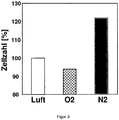
- FIG. 3 Figure 1 shows cell growth using the medium of air-treated bags as a control and defining it as 100% has been.
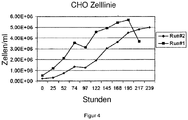
- FIG. 4 Figure 3 shows cell growth in two different poly-ethylene cell culture containers both treated with gamma radiation before being filled with cell suspensions.
- the two cell culture containers shown here are from the same batch of containers which were simultaneously charged with gamma-rays in an irradiation device.
- the container labeled run # 2 shows a distinct extended lag phase. This effect is less pronounced with the cell culture container shown with run # 1. In the following example, this is because the run # 2 container was placed at the top when irradiated and thus came into contact with most of the oxygen in the air. As a result, much more aldehydes and ketones are formed in this cell culture container than in the run # 1 container, which was located further down during the irradiation process and therefore contacted with less atmospheric oxygen. This phenomenon, which often occurs in the production of cell culture containers, has so far neither been explained nor eliminated.
Landscapes
- Health & Medical Sciences (AREA)
- Life Sciences & Earth Sciences (AREA)
- Engineering & Computer Science (AREA)
- Zoology (AREA)
- Organic Chemistry (AREA)
- Bioinformatics & Cheminformatics (AREA)
- Chemical & Material Sciences (AREA)
- Wood Science & Technology (AREA)
- Biotechnology (AREA)
- General Health & Medical Sciences (AREA)
- Biomedical Technology (AREA)
- Sustainable Development (AREA)
- Biochemistry (AREA)
- General Engineering & Computer Science (AREA)
- Microbiology (AREA)
- Genetics & Genomics (AREA)
- Clinical Laboratory Science (AREA)
- Epidemiology (AREA)
- Animal Behavior & Ethology (AREA)
- Public Health (AREA)
- Veterinary Medicine (AREA)
- Apparatus Associated With Microorganisms And Enzymes (AREA)
- Micro-Organisms Or Cultivation Processes Thereof (AREA)
Description
- Die vorliegende Erfindung betrifft u. a. ein Verfahren zur Herstellung eines Zellkulturbehälters für den Einmalgebrauch.
- Derartige Zellkulturbehälter sind aus dem Stand der Technik seit langer Zeit bekannt und sind mindestens teilweise aus Polymermaterial gefertigt. Die bekannten Zellkulturbehälter können mehrlagig aufgebaut sein, wobei die Innenlage, d.h. diejenige Lage, die mit den Zellkulturen in Berührung kommt, aus Polymermaterial gefertigt ist. In der Regel besteht zumindest diese Lage bzw. Schicht aus Polyethylen (PE) oder Ethylvinylacetat (EVA).
- Ein Zellkulturbehälter für den Einmalgebrauch ist ein Behälter, der für die biopharmazeutische oder sonstige Produktion von Peptiden, Proteinen, Antikörpern oder sonstigen bakteriellen, mikrobiologischen oder zellulären Produkten in großen Mengen verwendet werden kann. Dieser Prozess wird auch als Fermentation bezeichnet, und für diesen Fermentationsprozess werden sogenannte Bioreaktoren verwendet. Im Zusammenhang mit der beschriebenen Erfindung kann man bei einem Zellkulturbehälter für den Einmalgebrauch, der üblicherweise aus Polymermaterial in Form eines Beutels für die Produktion großer Mengen biologischer Materialien konstruiert ist auch von einem Wegwerf-Bioreaktor sprechen. Im folgenden Text bezeichnet der Begriff Zellkulturbehälter jede Form eines Zellkulturbehälters für den Einmalgebrauch oder entsorgbaren Zellkulturbehälters oder Beutels oder Bioreaktors für die Produktion von Biomaterialien.
- Vor dem Befüllen der bekannten Zellkulturbehälter, die insbesondere in Form von Zellkulturbeuteln vorliegen, werden diese zur Sterilisierung mit gamma-Strahlung behandelt. Dies ist nötig, damit sämtliche Mikroorganismen, die ein optimales Zellwachstum stören oder beeinflussen könnten, abgetötet werden. Die Sterilisierung läuft i. d. R. so ab, dass eine Vielzahl von Zellkulturbehältern in einen Strahlenapparat eingebracht wird. Anschließend werden die Zellkulturbehälter mit gamma-Strahlung behandelt.
- Die Druckschrift
DE 695 30 386 T offenbart ein Verfahren zum Sterilisieren eines aus Polymermaterialien hergestellten Behälters mit Gamma-Strahlung und einem Sauerstoff-Absorber. - Es hat sich gezeigt, dass bei einer Vielzahl der oben beschriebenen Zellkulturbehälter für den Einmalgebrauch das Wachstum von Zellkulturen oder bakteriellen oder mikrobiellen Kulturen beeinträchtigt ist. Es kommt nämlich häufig zu einer sogenannten "extended lag phase", nämlich einem verzögerten Wachstum der zu kultivierenden Zellen oder Organismen. Eine derartige "extended lag phase" ist insbesondere bei Bioprozessen zur Arzneimittelproduktion äußerst unerwünscht.
- In der Vergangenheit wurde fast die gesamte bio-pharamazeutische Produktion in fest eingebauten Bioreaktoren in Form von Edelstahltanks durchgeführt. Traditionell wurde dabei Serum, normalerweise fetales Rinderserum, als Nahrungsergänzung verwendet, um Zellwachstum zu fördern.
- Die Anwesenheit von Serum im Produktionsprozess behindert jedoch das sog. "downstream processing", d.h. die Gewinnung und Aufreinigung der Endprodukte. Deshalb geht seit etwa zehn Jahren das Bestreben der Hersteller ganz klar zur Vermeidung von Serum in Zellkulturen wegen des einfacheren "downstream processings". Zusätzlich führt das Entfernen von Serum aus den Zellkulturen zu einer wesentlichen Erleichterung der Zulassung und Zertifizierung biopharmazeutischer Produkte. In etwa demselben Zeitraum hat die pharmazeutische und biotechnologische Produktion in fixierten Stahltankanlagen deutlich abgenommen, wodurch Flexibilität gewonnen und Aufbauzeiten sowie Produktionskosten reduziert werden konnten. In fest eingebauten Anlagen wurde das Problem der "extended lag phase" kaum beobachtet. In Anwesenheit von Serum zeigen Zellkulturbehälter für den Einmalgebrauch keine "extended lag phase". Die Kombination von Zellkulturbehältern für den Einmalgebrauch mit serum-freien Medien, welche bei pharmazeutischen und biotechnologischen Produktionsprozessen immer mehr Anwendung findet ist jedoch regelmäßig betroffen vom Auftreten einer "extended lag phase". Bislang konnte dieses Problem nicht gelöst werden.
- Der vorliegenden Erfindung liegt somit die Aufgabe zugrunde, die Nachteile der Einmal-Zellkulturbehälter aus dem Stand der Technik zu überwinden. Der Erfindung liegt insbesondere die Aufgabe zugrunde, Zellkulturbehälter für den Einmalgebrauch zur Verfügung zu stellen welche in ausreichendem Maße steril sind und bei denen eine "extended lag phase" nicht auftritt oder zumindest stark reduziert wird.
- Diese Aufgabe wird gelöst durch ein Verfahren zur Herstellung gemäß Anspruch 1 eines mindestens teilweise aus Polymermaterial gefertigten Zellkulturbehälters für den Einmalgebrauch, wobei der Zellkulturbehälter zur Sterilisierung mit gamma-Strahlung in einer Bestrahlungsdosis von 25 bis 50 kGy behandelt wird, dadurch gekennzeichnet, dass der Zellkulturbehälter vor der Behandlung mit gamma-Strahlen mit Inertgas behandelt wird. Hierdurch kann die Menge an anwesendem Sauerstoff so gewählt werden, dass bei der Behandlung des Zellkulturbehälters mit gamma-Strahlen Aldehyde und Ketone in einer Menge von maximal 3 ppm entstehen, wobei die Behandlung mit gamma-Strahlung unter Anwesenheit von 0,05 bis 15% Sauerstoff erfolgt.
- Die oben genannte Aufgabe wird ferner durch einen Zellkulturbehälter, der durch das erfindungsgemäße Verfahren hergestellt wurde, gelöst.
- Die Erfinder haben überraschenderweise herausgefunden, dass bei der Behandlung der Zellkulturbehälter Aldehyde und Ketone entstehen und diese Aldehyde und Ketone für die beschriebene "extended lag phase" verantwortlich sind. Diese Aldehyde und Ketone entstehen offensichtlich durch eine Reaktion von bei der gamma-Bestrahlung entstehenden freien Radikalen mit Luftsauerstoff. Wie weiter unten dargelegt werden wird und auch den später beschriebenen Versuchsergebnissen und Tabellen bzw. Kurven zu entnehmen ist, sind diese entstehenden Aldehyde und Ketone in entsprechender Konzentration eindeutig für die extended lag phase verantwortlich.
- Durch die Behandlung der Zellkulturbehälter mit Inertgas vor einer gamma-Bestrahlung kann eine Bildung von Ketonen und Aldehyden unterbunden werden. Als Inertgas bezeichnet man Gase, die sehr reaktionsträge (inert) sind, sich also an nur wenigen chemischen Reaktionen beteiligen. Beim erfindungsgemäßen Verfahren wird bevorzugt Stickstoff als Inertgas verwendet. Es können jedoch auch Edelgase, insbesondere Argon, oder Gemische aus Edelgasen und Stickstoff als Inertgas verwendet werden.
- Bei einer bevorzugten Verfahrensvariante wird der Zellkulturbehälter vor einer gamma-Bestrahlung mit Inertgas gefüllt und/oder in einen verschließbaren, mit Inertgas gefüllten Behälter eingebracht. Beim Befüllen des Zellkulturbehälters mit Inertgas wird i. d. R. so vorgegangen, dass der Zellkulturbehälter mehrmals mit Inertgas befüllt und wieder entleert wird, bis er schließlich ein letztes Mal befüllt und so entleert wird, dass noch eine geringe Menge Inertgas im Behälter verbleibt. Dadurch wird sichergestellt, dass kein Luftsauerstoff mehr im Inneren des Zellkulturbehälters anwesend ist. Entscheidend ist, dass vor einer Behandlung mit gamma-Strahlung der Zellkulturbehälter mit Inertgas behandelt wird. Es ist jedoch bevorzugt, dass die gamma-Bestrahlung zeitnah auf die Behandlung mit Inertgas folgt. Vorzugsweise soll die gamma-Bestrahlung zur Sterilisierung innerhalb von 24 Stunden, beispielsweise innerhalb von 18 oder 12 Stunden, nach der Inertgasbehandlung erfolgen. Dies gewährleistet optimale Ergebnisse, was ein Zellwachstum im erfindungsgemäßen Zellkulturbehälter betrifft.
- Wie oben erwähnt, kann der erfindungsgemäße Zellkulturbehälter vor einem Bestrahlen mit gamma-Strahlung in einen zweiten Behälter, insbesondere einen Beutel, welcher Inertgas enthält, eingebracht werden. Sowohl der erfindungsgemäße Zellkulturbehälter als auch dieser zweite Beutel weisen vorzugsweise Gassperrschichten auf. Der erfindungsgemäße Zellkulturbehälter weist eine äußere Schicht aus Polyethylen mit einer Dicke von 0,1 bis 0,5 mm sowie eine innere, mit der zu kultivierenden Zellkultur in Berührung kommende weitere Schicht aus Polyethylen oder EVA, die ebenfalls 0,1 bis 0,5 mm dick ist, auf. Gemäß der vorliegenden Erfindung betrifft der Begriff "innere Schicht" eine Lage, welche mit der zu kultivierenden Zellkultur in Kontakt steht, und der Begriff "äußere Schicht" eine weitere Lage, welche von dieser Schicht verschieden ist.
- Die äußere Lage ist beispielsweise eine Lage, welche mit der Umwelt in Kontakt steht, also die äußerste Lage des Zellkulturbehälters bildet.
- Ein bevorzugter erfindungsgemäßer Zellkulturbehälter weist eine äußere Schicht aus Polyethylen mit einer Dicke von 0,15 bis 0,35 mm sowie eine innere, mit der zu kultivierenden Zellkultur in Berührung kommende weitere Schicht aus Polyethylen oder EVA auf, die ebenfalls 0,15 bis 0,35 mm dick ist. Gemäß einer besonders bevorzugen Ausführungsform der vorliegenden Erfindung weist der Zellkulturbehälter eine äußere Schicht aus Polyethylen mit einer Dicke von 0,18 bis 0,3 mm, beispielsweise 0,2 mm, sowie eine innere weitere Schicht aus Polyethylen oder EVA auf, die ebenfalls 0,18 bis 0,3 mm, beispielsweise 0,2 mm, dick ist.
- Zwischen den beiden Polyethylenschichten befindet sich vorzugsweise eine Schicht aus Ethylvinylalkohol (EVOH), die als Gassperrschicht dient. Durch diese Gassperrschicht wird verhindert, dass Inertgas, das in den Zellkulturbehälter vor einer gamma-Bestrahlung eingebracht wurde, entweichen kann.
- Wie bereits oben dargelegt, wird bei einem kompletten Ausschluss von Sauerstoff beim Bestrahlen mit gamma-Strahlung eine "extended lag phase" verhindert. Nun wurde ferner überraschend festgestellt, dass bei Anwesenheit von geringen Mengen an Sauerstoff und damit bei Anwesenheit geringer Mengen an Aldehyden und/oder Ketonen ein Zellwachstum sogar noch optimiert werden kann. Je nach Intensität der gamma-Strahlung, des verwendeten Polymermaterials des erfindungsgemäßen Zellkulturbehälters und der Art der zu kultivierenden Zellen kann die Bestrahlung mit gamma-Strahlung unter Anwesenheit von bis zu 15% Sauerstoff erfolgen. Wie bereits oben dargelegt, wird bei Anwesenheit von 0% Sauerstoff eine "extended lag phase" sicher verhindert und Zellen können ohne jegliche Beeinträchtigung wachsen.
- Allerdings kann das Zellwachstum unter Anwesenheit bestimmter Mengen an Sauerstoff, die jedoch unterhalb des Sauerstoffgehalts der Luft liegen müssen, durch Entstehung geringer Mengen an Aldehyden und Ketonen verbessert werden. Um dies zu erreichen, wird die Menge von 0,05 bis 15% an anwesendem Sauerstoff so gewählt, dass beim Bestrahlen mit gamma-Strahlung in einer Bestrahlungsdosis von 25 bis 50 kGy Aldehyde und Ketone mit einer Konzentration von max. ca. 3 ppm entstehen. Bei Werten über 3 ppm kommt es i. d. R. bereits zur ungewünschten "extended lag phase".
- Zur Steuerung eines solchen Effekts kann bei dem erfindungsgemäßen Verfahren der Zellkulturbehälter vor der Bestrahlung mit gamma-Strahlen mit Inertgas gespült und mit Inertgas und/oder einer definierten Menge an Sauerstoff, die unterhalb des Sauerstoffgehalts der Luft liegt, beschickt werden. Hierdurch kann die Entstehung von Aldehyden und Ketonen, und damit das Auftreten einer "extended lag phase" entweder verhindert werden, oder eine bestimmte Menge an Aldehyden und Ketonen kann entstehen, um dadurch das Zellwachstum in dem Zellkulturbehälter sogar zu verbessern.
- Die vorliegende Erfindung betrifft somit in einer spezifischen Ausführungsform ein Verfahren zur Sterilisation eines mindestens teilweise aus Polymermaterial gefertigten Zellkulturbehälters für den Einmalgebrauch, wobei der Zellkulturbehälter vor der Bestrahlung mit gamma-Strahlung wie vorstehend beschrieben mit Inertgas behandelt wird, um die Entstehung von Aldehyden und Ketonen, die für das Auftreten einer "extended lag phase" verantwortlich sind, zu verhindern oder eine bestimmte Menge an Aldehyden und Ketonen entstehen zu lassen, um dadurch das Zellwachstum in dem Zellkulturbehälter zu verbessern.
- Gemäß der vorliegenden Erfindung erfolgt die Bestrahlung mit gamma-Strahlung unter Anwesenheit von 0,05 bis 15% Sauerstoff. Wie bereits vorstehend dargelegt, beeinflusst neben der Sauerstoffkonzentration, bei der mit gamma-Strahlung bestrahlt wird, auch die Intensität der gamma-Strahlung selbst und das verwendete Polymermaterial des erfindungsgemäßen Zellkulturbehälters sowie die Art der zu kultivierenden Zellen die Menge der entstehenden Aldehyde und Ketone. Bei Bestrahlungsdosen von 25 bis 50 kGy beträgt der Sauerstoffgehalt während der Bestrahlung mit gamma-Strahlung 0,05 bis 15%. Als weitere Beispiele für einen bevorzugten Sauerstoffgehalt sind Bereiche von 0,05 bis 10%, 0,1 bis 9% oder 0,2 bis 8% zu nennen.
- Bei den genannten entstehenden Aldehyden und Ketonen handelt es sich insbesondere um wasserlösliche Aldehyde und Ketone. Wasserunlösliche Aldehyde und Ketone haben auf das Zellwachsturn im erfindungsgemäßen Zellkulturbehälter geringere Auswirkungen, weil lipophile Komponenten mit höherer Kettenlänge nicht im gleichen Maße in Zellkulturmedien übertreten, da diese üblicherweise Wasser als Hauptbestandteil enthalten. Im Rahmen der vorliegenden Erfindung werden als wasserlösliche Aldehyde und Ketone solche verstanden, deren Wasserlöslichkeit bei 20°C mindestens 30 g/l beträgt.
- Bei den Aldehyden sind insbesondere Formaldehyd, Acetaldehyd und Propionaldehyd von Bedeutung. Bei den Ketonen sind insbesondere Aceton, Butanon, Methylpropylketon sowie 3-Pentanon zu nennen.
- Die vorliegende Erfindung betrifft auch einen Zellkulturbehälter für den Einmalgebrauch, herstellbar nach einem der Ansprüche 2 und 2.
- Wie bereits oben dargelegt, enthält der erfindungsgemäße Zellkulturbehälter Aldehyde und Ketone, insbesondere wasserlösliche Aldehyde und Ketone, in einer Konzentration von 0,01 bis 3 ppm.
- Insbesondere bei Anwendungen des erfindungsgemäßen Zellkulturbehälters im Arzneimittelbereich ist dieser vorzugsweise frei von Aldehyden und Ketonen, insbesondere von wasserlöslichen Aldehyden und Ketonen. Erfindungsgemäß wird unter "frei von Aldehyden und Ketonen" verstanden, dass der erfindungsgemäße Zellkulturbehälter Aldehyde und Ketone in einer Menge von 0 bis zu 0,01 ppm enthält. Im Arzneimittelsektor dürfen Aldehyde und Ketone oftmals auch wegen Vorschriften aus dem Arzneimittelgesetz nicht vorhanden sein. In diesem Falle wird der erfindungsgemäße Zellkulturbehälter unter Ausschluss von Sauerstoff mit gamma-Strahlung sterilisiert.
- Die erfindungsgemäßen Zellkulturbehälter enthalten diese Aldehyde und Ketone mit einer Konzentration von ca. 0,01 bis ca. 3 ppm, insbesondere von 0,1 bis 1 ppm. In diesem Bereich ist überraschender Weise ein besonders gutes Zellwachstum zu beobachten.
- Wie bereits oben erwähnt, ist der erfindungsgemäße Zellkulturbehälter vorzugsweise als mehrlagiger Beutel ausgebildet, der bis zu sieben Lagen, beispielsweise drei Lagen, umfassen kann. Die verschiedenen Lagen des erfindungsgemäßen Zellkulturbehälters können aus unterschiedlichen Materialien oder aus denselben Materialien gefertigt sein, wobei die äußere und die innere Lage vorzugsweise aus PE und/oder EVA bestehen. In dieser Konfiguration ist es weiterhin bevorzugt, dass eine von der äußeren und inneren Lage verschiedene Lage, die im Folgenden als eine "mittlere Lage" bezeichnet wird, eine Gassperrschicht, insbesondere eine EVOH-Lage ist. Gemäß einer bevorzugten Ausführungsform ist der erfindungsgemäße Zellkulturbehälter als dreilagiger Beutel ausgebildet, wobei die innere und äußere Schicht vorzugsweise aus PE oder EVA besteht und die mittlere Lage eine Gassperrschicht, insbesondere eine EVOH-Lage ist.
- Vorzugsweise sind mindestens in einer inneren Schicht bzw. Lage des erfindungsgemäßen Zellkulturbehälters UV-Stabilisatoren oder sogenannte "Anti-rads" enthalten. "Anti-rads" sind Substanzen, die ähnlich wie UV-Stabilisatoren wirken und negative Effekte der gamma-Strahlung auf Polymermaterial verhindern oder reduzieren. Diese Stabilisatoren unterdrücken ebenfalls die Bildung von Aldehyden und Ketonen, indem sie eine Radikalbildung beim Bestrahlen des erfindungsgemäßen Zellkulturbehälters mit gamma-Strahlen unterdrücken. Beispiele für UV-Stabilisatoren sind 2,6-Di-tert-butylphenol sowie Butyl-hydroxytoluol (BHT). Diese Beispiele sollen den Bereich der gegenwärtigen Erfindung in keiner Weise beschränken. Zusätzlich kann eine Kombination von zwei oder mehr UV-Stabilisatoren und/oder "Anti-rads" für die Produktion derartiger Zellkulturbehälter verwendet werden.
- Die in der Polymerchemie üblicherweise verwendeten UV-Stabilisatoren und Anti-rads mit Schwefel- oder Stickstoffmolekülen in der Ringstruktur verbieten sich für eine Anwendung von Polymeren in der Zellkultur trotz ihrer überlegenen Wirkungsweise, weil aus diesen Molekülen unter Einwirkung von gamma-Strahlen Sulfit- und Nitrosoverbindungen entstehen können, welche eine hohe zytotoxische Wirkung besitzen.
- Die hierin angegebenen Konzentrationen und Konzentrationsbereiche in "ppm" ergeben für unterschiedliche Aldehyde und Ketone zum Teil gegenläufige Konzentrationen in Mol/Liter, was sich durch das unterschiedliche Molekulargewicht und die unterschiedlichen Dichten von z.B. Aceton und Formaldehyd erklären lässt. Die zu beobachtende gegensätzliche Tendenz bei ppm und µM führt deshalb zur Angabe von Konzentrationsbereichen, die in keiner Weise als ausschließlich oder absolut betrachtet werden sollen. Vielmehr kann durch diese Angaben eine Konzentration gemeint sein, die sich im Bereich von +/- 10% bis 20% der angegebenen absoluten Grenzwerte bewegt.
- Wie vorstehend beschrieben, basiert die vorliegende Erfindung zum einen auf der Erkenntnis, dass Aldehyde und Ketone, die während der Bestrahlung mit gamma-Strahlen im Rahmen eines Sterilisierungsverfahrens eines Zellkulturbehälters entstehen, für die beschriebene "extended lag phase" verantwortlich sind. Darüber hinaus basiert die vorliegende Erfindung auf der Erkenntnis, dass bei Anwesenheit von geringen Mengen an Sauerstoff und damit bei Anwesenheit geringer Mengen an Aldehyden und/oder Ketonen ein Zellwachstum sogar noch optimiert werden kann. Dadurch ist es möglich, eine effektivere Zellkultivierung zu ermöglichen. Die vorliegende Erfindung stellt daher auch ein Verfahren zur Zellkultivierung bereit, bei dem einer Zellsuspension wasserlösliche Aldehyde und/oder Ketone, ausgewählt aus der Gruppe, bestehend aus Formaldehyd, Acetaldehyd, Propionaldehyd, Aceton, Butanon, 2-Pentanon und 3-Pentanon, in einer Konzentration von ca. 0,01 bis 3 ppm, bevorzugt von 0,1 bis 1 ppm zugesetzt werden.
- Fünf Proben einer Zellsuspension aus CHO AA8-Luc-Zellen (Zellen aus Ovarien chinesischer Hamster) und einem Medium (FMX-8), dessen Zusammensetzung in Tabelle 1 angegeben ist, wurden mit unterschiedlichen Mengen (weiter Konzentrationsbereich) an Aceton und Formaldehyd inkubiert. In der
Figur 1 ist das unterschiedliche Zellwachstum dargestellt: - AFO ist eine Kontrolle ohne Zugabe von Aceton oder Formaldehyd (= FMX-8 Medium). Hier ist ein normales, ungestörtes Wachstum zu beobachten.
- AF1 entspricht 250 ppm Aceton und 250 ppm Formaldehyd (entspricht 4,3 mM Aceton und 8,325 mM Formaldehyd). Bei dieser Konzentration sterben alle Zellen ab.
- AF2 entspricht 25 ppm Aceton und 25 ppm Formaldehyd (entspricht 430 µM Aceton und 832,5 µM Formaldehyd). Auch hier sterben alle Zellen ab.
- AF3 entspricht 2,5 ppm Aceton und 2,5 ppm Formaldehyd (entspricht 43 µM Aceton und 83,25 µM Formaldehyd). Hier ist klar eine "extended lag phase" zu beobachten.
- AF4 entspricht 0,25 ppm Aceton und 0,25 ppm Formaldehyd (entspricht 4,3 µM Aceton und 8,325 µM Formaldehyd). Hier ist ein verbessertes Wachstum zu beobachten.
- Die beiden entscheidenden Kurven sind AF3 und AF4. Diese Ansätze zeigen eindeutig die unterschiedliche Wirkung von Aldehyd und Keton auf das Zellwachstum. Ist die Menge an zugesetztem Aceton/Formaldehyd gering, so zeigt sich gegenüber der Kontrolle AFO (Abwesenheit von Aldehyd und Keton) sogar ein verbessertes Wachstum. Bei AF3 ist eindeutig die sogenannte "extended lag phase" zu sehen, die häufig bei den Zellkulturbehältern aus dem Stand der Technik vorkommt. Beim Bestrahlen mit gamma-Strahlung entsteht in der Regel eine Menge an Aldehyden und Ketonen, die im Bereich von AF3 liegen. Innerhalb der ersten drei bis vier Tage Inkubationszeit der Zellkulturen ist hier nur ein äußerst geringes Zellwachstum zu erkennen. Erst nach dem dritten Tag kommt es zu einer Steigerung des Zellwachstums. Diese Erscheinung wird als "extended lag phase" bezeichnet.
-
Figur 2 zeigt die Ergebnisse aus einem weiteren Durchgang mit fünf verschiedenen Zellkulturansätzen mit unterschiedlichen Konzentrationen (enger Konzentrationsbereich) an Aceton und Formaldehyd. - Zur Überprüfung der Proliferationssteigernden Wirkung von geringen Mengen an Aldehyden und Ketonen wurde eine weitere Versuchsreihe durchgeführt, die in
Figur 2 zusammengefasst ist. Hier wurde u. a. eine Menge von 31,25 µM an Formaldehyd und Aceton zu einer Zellsuspension aus CHO-Luc Zellen gegeben. Dies entspricht einer Konzentration von ca. 1 ppm an Aldehyden und Ketonen. Gegenüber der Kontrolle, bei der keine Aldehyde oder Ketone zugegeben wurden, zeigt diese Zellprobe eine gesteigerte Proliferation, was zusätzlich zu den Ergebnissen aus dem ersten Versuch über einen weiten Konzentrationsbereich den Wachstumsfördernden Effekt von Aldehyden und Ketonen in einer Konzentration von etwa 1 ppm für Suspensions-Zellkulturen verdeutlicht. - 0 ist Kontrolle (= FMX-8 Medium)>> normales Wachstum
31,25 µM 5 Aceton (= 1,82 ppm) und 31,25 µM Formaldehyd (= 0,94 ppm)
>> verbessertes Wachstum
62,5 µM Aceton (= 3,64 ppm) und 62,5 µM Formaldehyd (= 1,88 ppm)
>> kein Effekt
125 µM Aceton (= 7,28 ppm) und 125 µM Formaldehyd (= 3,76 ppm)
>> kein Effekt
250 µM Aceton (= 14,56 ppm) und 250 µM Formaldehyd (= 7,52 ppm)
>> extended lag phase - Durch das unterschiedliche Molekulargewicht und die unterschiedliche Dichte von Aceton und Formaldehyd ist eine gegensätzliche Tendenz bei ppm und µM zu beobachten.
- Ein zu testender Kulturbeutel wurde mit 0,5 ml destilliertem Wasser pro cm2 Beutelinnenfläche gefüllt. Das Wasser wurde 24 Stunden im Beutel belassen. Anschließend wurde die Menge an entstandenen wasserlöslichen Aldehyden und Ketonen gemessen. Mit dieser Methode können sämtliche wasserlösliche Aldehyde und Ketone erfasst werden. Die Messung der Aldehyde und Ketone kann beispielsweise mittels GC-MS durchgeführt werden.
- PE-Folie (0,2 mm Dicke) wurde zu Beuteln verschweißt (Oberfläche der Innenseite ca. 100 cm2. Die Beutel wurden jeweils 3x mit Luft, Sauerstoff (O2), bzw. Stickstoff (N2) gefüllt und entleert, so dass ein kleiner Rest des Gases im Beutel verblieb. Anschließend wurden die Beutel in 50 ml Zentrifugenröhrchen aus PP gegeben, diese wieder je 3x mit Luft, O2 oder N2 begast und dicht verschlossen. Dann wurden die Beutel mit 50 kGy gamma-Strahlung behandelt. Nach der Bestrahlung wurden die Beutel mit je 5 ml FMX-8 Medium steril befüllt und für 24 h bei 37°C inkubiert.
- Das Medium wurde aus den jeweiligen Beuteln abgesaugt und je 1,5ml davon in einer 1:10 Verdünnung zu je 1,5 ml Zellsuspension gegeben, so dass eine Zellzahl von 50.000 pro ml bei Beginn der Inkubationen vorlag. Die Zellen wurden für 4 d bei 37°C und 5% CO2 inkubiert und anschließend ausgezählt.
- In
Figur 3 dargestellt ist das Zellwachstum, wobei das Medium aus mit Luft behandelten Beuteln als Kontrolle verwendet wurde und diese als 100% definiert wurde. - Eine Behandlung der Beutel mit O2 führt zu einer Verzögerung des Zellwachstums. Eine Behandlung mit N2 führt zu einer Verbesserung des Zellwachstums. Hier entstehen im Vergleich zu mit Luft oder reinem Sauerstoffbehandelten Beuteln kaum Aldehyde und Ketone (siehe
Fig. 3 ). -
Figur 4 zeigt das Zellwachstum in zwei verschiedenen Zellkulturbehältern aus Poly-ethylen, die beide mit gamma-Strahlung behandelt wurden, bevor sie mit Zellsuspensionen gefüllt wurden. Die beiden hier dargestellten Zellkulturbehälter stammen aus der gleichen Charge an Behältern, die gleichzeitig in einer Bestrahlungsvorrichtung mit gamma-Strahlen beschickt wurden. Der mit run #2 bezeichnete Behälter zeigt eine deutlich ausgeprägte "extended lag phase". Bei dem mit run #1 dargestellten Zellkulturbehälter ist dieser Effekt weniger ausgeprägt. Dies liegt im folgenden Beispiel daran, dass der run #2 Behälter beim Bestrahlen ganz oben aufgelegen ist und dadurch mit dem meisten Luftsauerstoff in Berührung gekommen ist. Dadurch sind in diesem Zellkulturbehälter wesentlich mehr Aldehyde und Ketone entstanden als bei dem run #1 Behälter, der während des Bestrahlunsgsprozesses weiter unten angeordnet war, und deshalb mit weniger Luftsauerstoff in Kontakt trat. Dieses Phänomen, das bei der Herstellung von Zellkulturbehältern häufig auftritt, konnte bisher weder erklärt noch beseitigt werden.
Claims (5)
- Verfahren zur Herstellung eines mindestens teilweise aus Polymermaterial gefertigten Zellkulturbehälters für den Einmalgebrauch, wobei der Zellkulturbehälter eine äußere Schicht aus Polyethylen mit einer Dicke von 0,1 bis 0,5 mm sowie eine innere, mit der zu kultivierenden Zellkultur in Berührung kommende weitere Schicht aus Polyethylen oder EVA aufweist, die 0,1 bis 0,5 mm dick ist, wobei der Zellkulturbehälter zur Sterilisierung mit gamma-Strahlung in einer Bestrahlungsdosis von 25 bis 50 kGy behandelt wird, dadurch gekennzeichnet, dass der Zellkulturbehälter vor der Behandlung mit gamma-Strahlung mit Inertgas behandelt wird, wodurch die Menge an anwesendem Sauerstoff so gewählt wird, dass bei der Behandlung des Zellkulturbehälters mit gamma-Strahlung Aldehyde und Ketone in einer Konzentration von 0,01 bis 3 ppm entstehen, und wobei die Behandlung mit gamma-Strahlung unter Anwesenheit von 0,05 bis 15% Sauerstoff erfolgt.
- Verfahren nach Anspruch 1, dadurch gekennzeichnet, dass der Zellkulturbehälter vor der Behandlung mit gamma-Strahlung mit Inertgas gefüllt und/oder in einen verschließbaren, mit Inertgas gefüllten Behälter eingebracht wird.
- Zellkulturbehälter, herstellbar nach Anspruch 1 oder 2.
- Zellkulturbehälter nach Anspruch 3, dadurch gekennzeichnet, dass er Aldehyde und/oder Ketone in einer Menge von 0,01 bis zu 3 ppm, insbesondere von 0,1 bis 1 ppm enthält.
- Zellkulturbehälter nach Anspruch 3 oder 4, dadurch gekennzeichnet, dass mindestens in der innersten Lage UV-Stabilisatoren und/oder Anti-rads enthalten sind.
Applications Claiming Priority (2)
| Application Number | Priority Date | Filing Date | Title |
|---|---|---|---|
| DE102012010155.4A DE102012010155B4 (de) | 2012-05-24 | 2012-05-24 | Zellkulturbehälter für den Einmalgebrauch |
| PCT/EP2013/001525 WO2013174515A1 (de) | 2012-05-24 | 2013-05-23 | Zellkulturbehälter für den einmalgebrauch |
Publications (2)
| Publication Number | Publication Date |
|---|---|
| EP2855656A1 EP2855656A1 (de) | 2015-04-08 |
| EP2855656B1 true EP2855656B1 (de) | 2019-09-18 |
Family
ID=48628597
Family Applications (1)
| Application Number | Title | Priority Date | Filing Date |
|---|---|---|---|
| EP13729250.4A Active EP2855656B1 (de) | 2012-05-24 | 2013-05-23 | Zellkulturbehälter für den einmalgebrauch |
Country Status (4)
| Country | Link |
|---|---|
| US (1) | US9938493B2 (de) |
| EP (1) | EP2855656B1 (de) |
| DE (1) | DE102012010155B4 (de) |
| WO (1) | WO2013174515A1 (de) |
Families Citing this family (2)
| Publication number | Priority date | Publication date | Assignee | Title |
|---|---|---|---|---|
| PL3865563T3 (pl) * | 2014-11-25 | 2024-01-29 | Corning Incorporated | Materiały i sposoby do przedłużania pożywki do hodowli komórkowej |
| CN114945659A (zh) | 2020-01-02 | 2022-08-26 | 豪夫迈·罗氏有限公司 | 具有一个或多个原位在线传感器的一次性细胞培养容器 |
Family Cites Families (14)
| Publication number | Priority date | Publication date | Assignee | Title |
|---|---|---|---|---|
| US5414049A (en) | 1993-06-01 | 1995-05-09 | Howmedica Inc. | Non-oxidizing polymeric medical implant |
| SE9401986D0 (sv) | 1994-06-08 | 1994-06-08 | Pharmacia Ab | New process for sterilization and articles sterilized thereby |
| US5577368A (en) | 1995-04-03 | 1996-11-26 | Johnson & Johnson Professional, Inc. | Method for improving wear resistance of polymeric bioimplantable components |
| US5730933A (en) * | 1996-04-16 | 1998-03-24 | Depuy Orthopaedics, Inc. | Radiation sterilization of biologically active compounds |
| IL119310A (en) * | 1996-09-26 | 1999-07-14 | Metabogal Ltd | Cell/tissue culturing device and method |
| AU4890400A (en) | 1999-07-29 | 2001-02-01 | Depuy Orthopaedics, Inc. | Two step gamma irradiation of polymeric bioimplant |
| US20040120848A1 (en) | 2002-12-20 | 2004-06-24 | Maria Teodorczyk | Method for manufacturing a sterilized and calibrated biosensor-based medical device |
| US6933026B2 (en) * | 2003-02-06 | 2005-08-23 | Aradgim Corporation | Method to reduce damage caused by irradiation of halogenated polymers |
| WO2006034157A2 (en) | 2004-09-17 | 2006-03-30 | Poly-Med, Inc. | Package components for radiochemical sterilization |
| US8367099B2 (en) * | 2004-09-28 | 2013-02-05 | Atrium Medical Corporation | Perforated fatty acid films |
| US20060246537A1 (en) * | 2005-04-29 | 2006-11-02 | Jenkins Lauri L | Multi-step process for the manufacture of therapeutic protein |
| WO2006130869A1 (en) * | 2005-06-02 | 2006-12-07 | Alza Corporation | Method for terminal sterilization of transdermal delivery devices |
| DE102006022307A1 (de) * | 2006-05-11 | 2007-11-15 | Respironics Novametrix, LLC, Wallingford | Einwegbioreaktor mit Sensoranordnung |
| WO2009149519A1 (en) * | 2008-06-12 | 2009-12-17 | Winwick Business Solutions Pty Ltd | System for cultivation and processing of microorganisms and products therefrom |
-
2012
- 2012-05-24 DE DE102012010155.4A patent/DE102012010155B4/de active Active
-
2013
- 2013-05-23 EP EP13729250.4A patent/EP2855656B1/de active Active
- 2013-05-23 WO PCT/EP2013/001525 patent/WO2013174515A1/de not_active Ceased
- 2013-05-23 US US14/403,433 patent/US9938493B2/en active Active
Non-Patent Citations (1)
| Title |
|---|
| None * |
Also Published As
| Publication number | Publication date |
|---|---|
| DE102012010155B4 (de) | 2015-06-11 |
| DE102012010155A8 (de) | 2014-02-06 |
| US20150247113A1 (en) | 2015-09-03 |
| DE102012010155A1 (de) | 2013-11-28 |
| EP2855656A1 (de) | 2015-04-08 |
| WO2013174515A1 (de) | 2013-11-28 |
| US9938493B2 (en) | 2018-04-10 |
Similar Documents
| Publication | Publication Date | Title |
|---|---|---|
| DE60129597T3 (de) | Verfahren zur verbesserung der stabilität einer pharmazeutischen zubereitung | |
| DE69933309T2 (de) | Verfahren zur zucht von mikroorganismen in vorgefüllten flexiblen behältern | |
| DE69530386T2 (de) | VERFAHREN ZUM STERILISIEREN MITTELS -g(g)-STRAHLUNG UND EINES SAUERSTOFF-ABSORBERS, SOWIE NACH DIESEM VERFAHREN STERILISIERTER BEHÄLTER UND MEDIZINISCHE ARTIKEL | |
| DE68924485T2 (de) | UV Sterilisation, insbs. für Blutprodukte. | |
| EP3356115B1 (de) | Verfahren zur reduzierung der mikrobiologischen belastung von behältererzeugnissen | |
| EP2048949B1 (de) | Konservierungsmittel auf basis von carbonsäureanhydriden | |
| DE102008056551A1 (de) | Verfahren zur Verringerung der viralen und mikrobiellen Belastung feststoffhaltiger biologischer Extrakte | |
| EP0995449A1 (de) | UHMW-Polyethylen für Implantate | |
| Savage | Nitralin and trifluralin persistence in soil | |
| DE69735141T2 (de) | Verfahren zur sterilisation von geschlossenen behältern | |
| EP1968652B1 (de) | Verfahren zur bestrahlung von thrombozytenkonzentraten in flexiblen behältnissen mit ultraviolettem licht | |
| EP0343596A2 (de) | Behälter zum Gefriertrocknen unter sterilen Bedingungen | |
| EP2855656B1 (de) | Zellkulturbehälter für den einmalgebrauch | |
| EP2328623B1 (de) | Verfahren zur verringerung der viralen und mikrobiellen belastung feststoffhaltiger aus dem pankreas von tieren gewonnener extrakte | |
| EP3285815B1 (de) | Verfahren zur sterilisierung eines chromatographiematerials und danach sterilisiertes chromatographiematerial | |
| DE202021102503U1 (de) | Spritzensterilisation | |
| DE102008010918B4 (de) | Zellkultur-Bestrahlungskammer | |
| DE2011366C3 (de) | Verfahren zur Herstellung eines Nährbodenbehälters mit Matrix | |
| EP1485135B1 (de) | Verfahren zur prüfung einer sterilisierverpackungseinheit auf wirksamkeit gegen rekontamination | |
| EP4297725B1 (de) | Verfahren zur spritzensterilisation | |
| KR102144710B1 (ko) | 감마선 조사에 의한 변성이 저감되는 배지 조성물 | |
| DE102018124664A1 (de) | Verfahren zum Inaktivieren biologisch aktiver Bestandteile innerhalb einer Flüssigkeit | |
| WO2020069944A1 (de) | Verfahren zum stimulieren des wachstums von in einer flüssigkeit enthaltenen biomasse innerhalb eines bioreaktors | |
| DD98111B1 (de) | Verfahren zur herstellung eines biologischen indikators | |
| DE2243611A1 (de) | Biologischer indikator und verfahren zu dessen herstellung |
Legal Events
| Date | Code | Title | Description |
|---|---|---|---|
| PUAI | Public reference made under article 153(3) epc to a published international application that has entered the european phase |
Free format text: ORIGINAL CODE: 0009012 |
|
| 17P | Request for examination filed |
Effective date: 20141226 |
|
| AK | Designated contracting states |
Kind code of ref document: A1 Designated state(s): AL AT BE BG CH CY CZ DE DK EE ES FI FR GB GR HR HU IE IS IT LI LT LU LV MC MK MT NL NO PL PT RO RS SE SI SK SM TR |
|
| AX | Request for extension of the european patent |
Extension state: BA ME |
|
| RAP1 | Party data changed (applicant data changed or rights of an application transferred) |
Owner name: PAN-BIOTECH GMBH |
|
| DAX | Request for extension of the european patent (deleted) | ||
| RAP1 | Party data changed (applicant data changed or rights of an application transferred) |
Owner name: SARTORIUS STEDIM BIOTECH GMBH |
|
| GRAP | Despatch of communication of intention to grant a patent |
Free format text: ORIGINAL CODE: EPIDOSNIGR1 |
|
| STAA | Information on the status of an ep patent application or granted ep patent |
Free format text: STATUS: GRANT OF PATENT IS INTENDED |
|
| INTG | Intention to grant announced |
Effective date: 20190418 |
|
| GRAS | Grant fee paid |
Free format text: ORIGINAL CODE: EPIDOSNIGR3 |
|
| GRAA | (expected) grant |
Free format text: ORIGINAL CODE: 0009210 |
|
| STAA | Information on the status of an ep patent application or granted ep patent |
Free format text: STATUS: THE PATENT HAS BEEN GRANTED |
|
| AK | Designated contracting states |
Kind code of ref document: B1 Designated state(s): AL AT BE BG CH CY CZ DK EE ES FI FR GB GR HR HU IE IS IT LI LT LU LV MC MK MT NL NO PL PT RO RS SE SI SK SM TR |
|
| RBV | Designated contracting states (corrected) |
Designated state(s): AL AT BE BG CH CY CZ DK EE ES FI FR GB GR HR HU IE IS IT LI LT LU LV MC MK MT NL NO PL PT RO RS SE SI SK SM TR |
|
| REG | Reference to a national code |
Ref country code: GB Ref legal event code: FG4D Free format text: NOT ENGLISH Ref country code: DE Ref legal event code: R108 |
|
| REG | Reference to a national code |
Ref country code: CH Ref legal event code: EP Ref country code: CH Ref legal event code: NV Representative=s name: BOHEST AG, CH |
|
| REG | Reference to a national code |
Ref country code: AT Ref legal event code: REF Ref document number: 1181324 Country of ref document: AT Kind code of ref document: T Effective date: 20191015 |
|
| REG | Reference to a national code |
Ref country code: IE Ref legal event code: FG4D Free format text: LANGUAGE OF EP DOCUMENT: GERMAN |
|
| REG | Reference to a national code |
Ref country code: SE Ref legal event code: TRGR |
|
| REG | Reference to a national code |
Ref country code: NL Ref legal event code: FP |
|
| PG25 | Lapsed in a contracting state [announced via postgrant information from national office to epo] |
Ref country code: FI Free format text: LAPSE BECAUSE OF FAILURE TO SUBMIT A TRANSLATION OF THE DESCRIPTION OR TO PAY THE FEE WITHIN THE PRESCRIBED TIME-LIMIT Effective date: 20190918 Ref country code: NO Free format text: LAPSE BECAUSE OF FAILURE TO SUBMIT A TRANSLATION OF THE DESCRIPTION OR TO PAY THE FEE WITHIN THE PRESCRIBED TIME-LIMIT Effective date: 20191218 Ref country code: BG Free format text: LAPSE BECAUSE OF FAILURE TO SUBMIT A TRANSLATION OF THE DESCRIPTION OR TO PAY THE FEE WITHIN THE PRESCRIBED TIME-LIMIT Effective date: 20191218 Ref country code: HR Free format text: LAPSE BECAUSE OF FAILURE TO SUBMIT A TRANSLATION OF THE DESCRIPTION OR TO PAY THE FEE WITHIN THE PRESCRIBED TIME-LIMIT Effective date: 20190918 Ref country code: LT Free format text: LAPSE BECAUSE OF FAILURE TO SUBMIT A TRANSLATION OF THE DESCRIPTION OR TO PAY THE FEE WITHIN THE PRESCRIBED TIME-LIMIT Effective date: 20190918 |
|
| REG | Reference to a national code |
Ref country code: LT Ref legal event code: MG4D |
|
| PG25 | Lapsed in a contracting state [announced via postgrant information from national office to epo] |
Ref country code: AL Free format text: LAPSE BECAUSE OF FAILURE TO SUBMIT A TRANSLATION OF THE DESCRIPTION OR TO PAY THE FEE WITHIN THE PRESCRIBED TIME-LIMIT Effective date: 20190918 Ref country code: LV Free format text: LAPSE BECAUSE OF FAILURE TO SUBMIT A TRANSLATION OF THE DESCRIPTION OR TO PAY THE FEE WITHIN THE PRESCRIBED TIME-LIMIT Effective date: 20190918 Ref country code: RS Free format text: LAPSE BECAUSE OF FAILURE TO SUBMIT A TRANSLATION OF THE DESCRIPTION OR TO PAY THE FEE WITHIN THE PRESCRIBED TIME-LIMIT Effective date: 20190918 Ref country code: GR Free format text: LAPSE BECAUSE OF FAILURE TO SUBMIT A TRANSLATION OF THE DESCRIPTION OR TO PAY THE FEE WITHIN THE PRESCRIBED TIME-LIMIT Effective date: 20191219 |
|
| PG25 | Lapsed in a contracting state [announced via postgrant information from national office to epo] |
Ref country code: RO Free format text: LAPSE BECAUSE OF FAILURE TO SUBMIT A TRANSLATION OF THE DESCRIPTION OR TO PAY THE FEE WITHIN THE PRESCRIBED TIME-LIMIT Effective date: 20190918 Ref country code: PL Free format text: LAPSE BECAUSE OF FAILURE TO SUBMIT A TRANSLATION OF THE DESCRIPTION OR TO PAY THE FEE WITHIN THE PRESCRIBED TIME-LIMIT Effective date: 20190918 Ref country code: ES Free format text: LAPSE BECAUSE OF FAILURE TO SUBMIT A TRANSLATION OF THE DESCRIPTION OR TO PAY THE FEE WITHIN THE PRESCRIBED TIME-LIMIT Effective date: 20190918 Ref country code: PT Free format text: LAPSE BECAUSE OF FAILURE TO SUBMIT A TRANSLATION OF THE DESCRIPTION OR TO PAY THE FEE WITHIN THE PRESCRIBED TIME-LIMIT Effective date: 20200120 Ref country code: EE Free format text: LAPSE BECAUSE OF FAILURE TO SUBMIT A TRANSLATION OF THE DESCRIPTION OR TO PAY THE FEE WITHIN THE PRESCRIBED TIME-LIMIT Effective date: 20190918 |
|
| PG25 | Lapsed in a contracting state [announced via postgrant information from national office to epo] |
Ref country code: CZ Free format text: LAPSE BECAUSE OF FAILURE TO SUBMIT A TRANSLATION OF THE DESCRIPTION OR TO PAY THE FEE WITHIN THE PRESCRIBED TIME-LIMIT Effective date: 20190918 Ref country code: SM Free format text: LAPSE BECAUSE OF FAILURE TO SUBMIT A TRANSLATION OF THE DESCRIPTION OR TO PAY THE FEE WITHIN THE PRESCRIBED TIME-LIMIT Effective date: 20190918 Ref country code: IS Free format text: LAPSE BECAUSE OF FAILURE TO SUBMIT A TRANSLATION OF THE DESCRIPTION OR TO PAY THE FEE WITHIN THE PRESCRIBED TIME-LIMIT Effective date: 20200224 Ref country code: SK Free format text: LAPSE BECAUSE OF FAILURE TO SUBMIT A TRANSLATION OF THE DESCRIPTION OR TO PAY THE FEE WITHIN THE PRESCRIBED TIME-LIMIT Effective date: 20190918 |
|
| PLBE | No opposition filed within time limit |
Free format text: ORIGINAL CODE: 0009261 |
|
| STAA | Information on the status of an ep patent application or granted ep patent |
Free format text: STATUS: NO OPPOSITION FILED WITHIN TIME LIMIT |
|
| PG2D | Information on lapse in contracting state deleted |
Ref country code: IS |
|
| PG25 | Lapsed in a contracting state [announced via postgrant information from national office to epo] |
Ref country code: DK Free format text: LAPSE BECAUSE OF FAILURE TO SUBMIT A TRANSLATION OF THE DESCRIPTION OR TO PAY THE FEE WITHIN THE PRESCRIBED TIME-LIMIT Effective date: 20190918 Ref country code: IS Free format text: LAPSE BECAUSE OF FAILURE TO SUBMIT A TRANSLATION OF THE DESCRIPTION OR TO PAY THE FEE WITHIN THE PRESCRIBED TIME-LIMIT Effective date: 20200119 |
|
| 26N | No opposition filed |
Effective date: 20200619 |
|
| PG25 | Lapsed in a contracting state [announced via postgrant information from national office to epo] |
Ref country code: SI Free format text: LAPSE BECAUSE OF FAILURE TO SUBMIT A TRANSLATION OF THE DESCRIPTION OR TO PAY THE FEE WITHIN THE PRESCRIBED TIME-LIMIT Effective date: 20190918 |
|
| PG25 | Lapsed in a contracting state [announced via postgrant information from national office to epo] |
Ref country code: MC Free format text: LAPSE BECAUSE OF FAILURE TO SUBMIT A TRANSLATION OF THE DESCRIPTION OR TO PAY THE FEE WITHIN THE PRESCRIBED TIME-LIMIT Effective date: 20190918 |
|
| PG25 | Lapsed in a contracting state [announced via postgrant information from national office to epo] |
Ref country code: LU Free format text: LAPSE BECAUSE OF NON-PAYMENT OF DUE FEES Effective date: 20200523 |
|
| REG | Reference to a national code |
Ref country code: AT Ref legal event code: MM01 Ref document number: 1181324 Country of ref document: AT Kind code of ref document: T Effective date: 20200523 |
|
| PG25 | Lapsed in a contracting state [announced via postgrant information from national office to epo] |
Ref country code: AT Free format text: LAPSE BECAUSE OF NON-PAYMENT OF DUE FEES Effective date: 20200523 |
|
| PG25 | Lapsed in a contracting state [announced via postgrant information from national office to epo] |
Ref country code: TR Free format text: LAPSE BECAUSE OF FAILURE TO SUBMIT A TRANSLATION OF THE DESCRIPTION OR TO PAY THE FEE WITHIN THE PRESCRIBED TIME-LIMIT Effective date: 20190918 Ref country code: MT Free format text: LAPSE BECAUSE OF FAILURE TO SUBMIT A TRANSLATION OF THE DESCRIPTION OR TO PAY THE FEE WITHIN THE PRESCRIBED TIME-LIMIT Effective date: 20190918 Ref country code: CY Free format text: LAPSE BECAUSE OF FAILURE TO SUBMIT A TRANSLATION OF THE DESCRIPTION OR TO PAY THE FEE WITHIN THE PRESCRIBED TIME-LIMIT Effective date: 20190918 |
|
| PG25 | Lapsed in a contracting state [announced via postgrant information from national office to epo] |
Ref country code: MK Free format text: LAPSE BECAUSE OF FAILURE TO SUBMIT A TRANSLATION OF THE DESCRIPTION OR TO PAY THE FEE WITHIN THE PRESCRIBED TIME-LIMIT Effective date: 20190918 |
|
| P01 | Opt-out of the competence of the unified patent court (upc) registered |
Effective date: 20230508 |
|
| PGFP | Annual fee paid to national office [announced via postgrant information from national office to epo] |
Ref country code: NL Payment date: 20250522 Year of fee payment: 13 |
|
| PGFP | Annual fee paid to national office [announced via postgrant information from national office to epo] |
Ref country code: GB Payment date: 20250522 Year of fee payment: 13 |
|
| PGFP | Annual fee paid to national office [announced via postgrant information from national office to epo] |
Ref country code: IT Payment date: 20250530 Year of fee payment: 13 Ref country code: BE Payment date: 20250520 Year of fee payment: 13 |
|
| PGFP | Annual fee paid to national office [announced via postgrant information from national office to epo] |
Ref country code: FR Payment date: 20250523 Year of fee payment: 13 |
|
| PGFP | Annual fee paid to national office [announced via postgrant information from national office to epo] |
Ref country code: CH Payment date: 20250601 Year of fee payment: 13 |
|
| PGFP | Annual fee paid to national office [announced via postgrant information from national office to epo] |
Ref country code: IE Payment date: 20250521 Year of fee payment: 13 |
|
| PGFP | Annual fee paid to national office [announced via postgrant information from national office to epo] |
Ref country code: SE Payment date: 20250522 Year of fee payment: 13 |