EP2857041B9 - Non-lithotripsic kidney-stone therapy - Google Patents
Non-lithotripsic kidney-stone therapy Download PDFInfo
- Publication number
- EP2857041B9 EP2857041B9 EP14191119.8A EP14191119A EP2857041B9 EP 2857041 B9 EP2857041 B9 EP 2857041B9 EP 14191119 A EP14191119 A EP 14191119A EP 2857041 B9 EP2857041 B9 EP 2857041B9
- Authority
- EP
- European Patent Office
- Prior art keywords
- polymer
- composition
- medicament
- lumen
- use according
- Prior art date
- Legal status (The legal status is an assumption and is not a legal conclusion. Google has not performed a legal analysis and makes no representation as to the accuracy of the status listed.)
- Expired - Lifetime
Links
Images



Classifications
-
- A—HUMAN NECESSITIES
- A61—MEDICAL OR VETERINARY SCIENCE; HYGIENE
- A61B—DIAGNOSIS; SURGERY; IDENTIFICATION
- A61B17/00—Surgical instruments, devices or methods
- A61B17/22—Implements for squeezing-off ulcers or the like on inner organs of the body; Implements for scraping-out cavities of body organs, e.g. bones; for invasive removal or destruction of calculus using mechanical vibrations; for removing obstructions in blood vessels, not otherwise provided for
-
- A—HUMAN NECESSITIES
- A61—MEDICAL OR VETERINARY SCIENCE; HYGIENE
- A61B—DIAGNOSIS; SURGERY; IDENTIFICATION
- A61B17/00—Surgical instruments, devices or methods
- A61B17/32—Surgical cutting instruments
- A61B17/3205—Excision instruments
- A61B17/32056—Surgical snare instruments
-
- A—HUMAN NECESSITIES
- A61—MEDICAL OR VETERINARY SCIENCE; HYGIENE
- A61K—PREPARATIONS FOR MEDICAL, DENTAL OR TOILETRY PURPOSES
- A61K47/00—Medicinal preparations characterised by the non-active ingredients used, e.g. carriers or inert additives; Targeting or modifying agents chemically bound to the active ingredient
- A61K47/06—Organic compounds, e.g. natural or synthetic hydrocarbons, polyolefins, mineral oil, petrolatum or ozokerite
- A61K47/08—Organic compounds, e.g. natural or synthetic hydrocarbons, polyolefins, mineral oil, petrolatum or ozokerite containing oxygen, e.g. ethers, acetals, ketones, quinones, aldehydes, peroxides
- A61K47/10—Alcohols; Phenols; Salts thereof, e.g. glycerol; Polyethylene glycols [PEG]; Poloxamers; PEG/POE alkyl ethers
-
- A—HUMAN NECESSITIES
- A61—MEDICAL OR VETERINARY SCIENCE; HYGIENE
- A61K—PREPARATIONS FOR MEDICAL, DENTAL OR TOILETRY PURPOSES
- A61K47/00—Medicinal preparations characterised by the non-active ingredients used, e.g. carriers or inert additives; Targeting or modifying agents chemically bound to the active ingredient
- A61K47/30—Macromolecular organic or inorganic compounds, e.g. inorganic polyphosphates
- A61K47/36—Polysaccharides; Derivatives thereof, e.g. gums, starch, alginate, dextrin, hyaluronic acid, chitosan, inulin, agar or pectin
-
- A—HUMAN NECESSITIES
- A61—MEDICAL OR VETERINARY SCIENCE; HYGIENE
- A61K—PREPARATIONS FOR MEDICAL, DENTAL OR TOILETRY PURPOSES
- A61K49/00—Preparations for testing in vivo
- A61K49/0002—General or multifunctional contrast agents, e.g. chelated agents
-
- A—HUMAN NECESSITIES
- A61—MEDICAL OR VETERINARY SCIENCE; HYGIENE
- A61K—PREPARATIONS FOR MEDICAL, DENTAL OR TOILETRY PURPOSES
- A61K9/00—Medicinal preparations characterised by special physical form
- A61K9/0012—Galenical forms characterised by the site of application
- A61K9/0019—Injectable compositions; Intramuscular, intravenous, arterial, subcutaneous administration; Compositions to be administered through the skin in an invasive manner
-
- A—HUMAN NECESSITIES
- A61—MEDICAL OR VETERINARY SCIENCE; HYGIENE
- A61K—PREPARATIONS FOR MEDICAL, DENTAL OR TOILETRY PURPOSES
- A61K9/00—Medicinal preparations characterised by special physical form
- A61K9/0012—Galenical forms characterised by the site of application
- A61K9/0053—Mouth and digestive tract, i.e. intraoral and peroral administration
- A61K9/0068—Rumen, e.g. rumen bolus
-
- A—HUMAN NECESSITIES
- A61—MEDICAL OR VETERINARY SCIENCE; HYGIENE
- A61L—METHODS OR APPARATUS FOR STERILISING MATERIALS OR OBJECTS IN GENERAL; DISINFECTION, STERILISATION OR DEODORISATION OF AIR; CHEMICAL ASPECTS OF BANDAGES, DRESSINGS, ABSORBENT PADS OR SURGICAL ARTICLES; MATERIALS FOR BANDAGES, DRESSINGS, ABSORBENT PADS OR SURGICAL ARTICLES
- A61L24/00—Surgical adhesives or cements; Adhesives for colostomy devices
- A61L24/001—Use of materials characterised by their function or physical properties
-
- A—HUMAN NECESSITIES
- A61—MEDICAL OR VETERINARY SCIENCE; HYGIENE
- A61L—METHODS OR APPARATUS FOR STERILISING MATERIALS OR OBJECTS IN GENERAL; DISINFECTION, STERILISATION OR DEODORISATION OF AIR; CHEMICAL ASPECTS OF BANDAGES, DRESSINGS, ABSORBENT PADS OR SURGICAL ARTICLES; MATERIALS FOR BANDAGES, DRESSINGS, ABSORBENT PADS OR SURGICAL ARTICLES
- A61L24/00—Surgical adhesives or cements; Adhesives for colostomy devices
- A61L24/04—Surgical adhesives or cements; Adhesives for colostomy devices containing macromolecular materials
- A61L24/046—Surgical adhesives or cements; Adhesives for colostomy devices containing macromolecular materials obtained otherwise than by reactions only involving carbon-to-carbon unsaturated bonds
-
- A—HUMAN NECESSITIES
- A61—MEDICAL OR VETERINARY SCIENCE; HYGIENE
- A61P—SPECIFIC THERAPEUTIC ACTIVITY OF CHEMICAL COMPOUNDS OR MEDICINAL PREPARATIONS
- A61P1/00—Drugs for disorders of the alimentary tract or the digestive system
- A61P1/16—Drugs for disorders of the alimentary tract or the digestive system for liver or gallbladder disorders, e.g. hepatoprotective agents, cholagogues, litholytics
-
- A—HUMAN NECESSITIES
- A61—MEDICAL OR VETERINARY SCIENCE; HYGIENE
- A61P—SPECIFIC THERAPEUTIC ACTIVITY OF CHEMICAL COMPOUNDS OR MEDICINAL PREPARATIONS
- A61P1/00—Drugs for disorders of the alimentary tract or the digestive system
- A61P1/18—Drugs for disorders of the alimentary tract or the digestive system for pancreatic disorders, e.g. pancreatic enzymes
-
- A—HUMAN NECESSITIES
- A61—MEDICAL OR VETERINARY SCIENCE; HYGIENE
- A61P—SPECIFIC THERAPEUTIC ACTIVITY OF CHEMICAL COMPOUNDS OR MEDICINAL PREPARATIONS
- A61P13/00—Drugs for disorders of the urinary system
- A61P13/04—Drugs for disorders of the urinary system for urolithiasis
-
- A—HUMAN NECESSITIES
- A61—MEDICAL OR VETERINARY SCIENCE; HYGIENE
- A61P—SPECIFIC THERAPEUTIC ACTIVITY OF CHEMICAL COMPOUNDS OR MEDICINAL PREPARATIONS
- A61P13/00—Drugs for disorders of the urinary system
- A61P13/12—Drugs for disorders of the urinary system of the kidneys
-
- C—CHEMISTRY; METALLURGY
- C08—ORGANIC MACROMOLECULAR COMPOUNDS; THEIR PREPARATION OR CHEMICAL WORKING-UP; COMPOSITIONS BASED THEREON
- C08L—COMPOSITIONS OF MACROMOLECULAR COMPOUNDS
- C08L71/00—Compositions of polyethers obtained by reactions forming an ether link in the main chain; Compositions of derivatives of such polymers
- C08L71/02—Polyalkylene oxides
-
- A—HUMAN NECESSITIES
- A61—MEDICAL OR VETERINARY SCIENCE; HYGIENE
- A61B—DIAGNOSIS; SURGERY; IDENTIFICATION
- A61B17/00—Surgical instruments, devices or methods
- A61B2017/00743—Type of operation; Specification of treatment sites
- A61B2017/00818—Treatment of the gastro-intestinal system
-
- A—HUMAN NECESSITIES
- A61—MEDICAL OR VETERINARY SCIENCE; HYGIENE
- A61B—DIAGNOSIS; SURGERY; IDENTIFICATION
- A61B17/00—Surgical instruments, devices or methods
- A61B2017/00831—Material properties
- A61B2017/0084—Material properties low friction
- A61B2017/00849—Material properties low friction with respect to tissue, e.g. hollow organs
-
- A—HUMAN NECESSITIES
- A61—MEDICAL OR VETERINARY SCIENCE; HYGIENE
- A61B—DIAGNOSIS; SURGERY; IDENTIFICATION
- A61B17/00—Surgical instruments, devices or methods
- A61B2017/00831—Material properties
- A61B2017/00853—Material properties low friction, hydrophobic and corrosion-resistant fluorocarbon resin coating (ptf, ptfe, polytetrafluoroethylene)
-
- A—HUMAN NECESSITIES
- A61—MEDICAL OR VETERINARY SCIENCE; HYGIENE
- A61B—DIAGNOSIS; SURGERY; IDENTIFICATION
- A61B17/00—Surgical instruments, devices or methods
- A61B17/22—Implements for squeezing-off ulcers or the like on inner organs of the body; Implements for scraping-out cavities of body organs, e.g. bones; for invasive removal or destruction of calculus using mechanical vibrations; for removing obstructions in blood vessels, not otherwise provided for
- A61B2017/22037—Fecal impaction removal
-
- A—HUMAN NECESSITIES
- A61—MEDICAL OR VETERINARY SCIENCE; HYGIENE
- A61B—DIAGNOSIS; SURGERY; IDENTIFICATION
- A61B17/00—Surgical instruments, devices or methods
- A61B17/22—Implements for squeezing-off ulcers or the like on inner organs of the body; Implements for scraping-out cavities of body organs, e.g. bones; for invasive removal or destruction of calculus using mechanical vibrations; for removing obstructions in blood vessels, not otherwise provided for
- A61B2017/22082—Implements for squeezing-off ulcers or the like on inner organs of the body; Implements for scraping-out cavities of body organs, e.g. bones; for invasive removal or destruction of calculus using mechanical vibrations; for removing obstructions in blood vessels, not otherwise provided for after introduction of a substance
-
- A—HUMAN NECESSITIES
- A61—MEDICAL OR VETERINARY SCIENCE; HYGIENE
- A61B—DIAGNOSIS; SURGERY; IDENTIFICATION
- A61B18/00—Surgical instruments, devices or methods for transferring non-mechanical forms of energy to or from the body
- A61B2018/00315—Surgical instruments, devices or methods for transferring non-mechanical forms of energy to or from the body for treatment of particular body parts
- A61B2018/00482—Digestive system
- A61B2018/005—Rectum
-
- A—HUMAN NECESSITIES
- A61—MEDICAL OR VETERINARY SCIENCE; HYGIENE
- A61B—DIAGNOSIS; SURGERY; IDENTIFICATION
- A61B18/00—Surgical instruments, devices or methods for transferring non-mechanical forms of energy to or from the body
- A61B2018/00315—Surgical instruments, devices or methods for transferring non-mechanical forms of energy to or from the body for treatment of particular body parts
- A61B2018/00505—Urinary tract
- A61B2018/00511—Kidney
-
- A—HUMAN NECESSITIES
- A61—MEDICAL OR VETERINARY SCIENCE; HYGIENE
- A61L—METHODS OR APPARATUS FOR STERILISING MATERIALS OR OBJECTS IN GENERAL; DISINFECTION, STERILISATION OR DEODORISATION OF AIR; CHEMICAL ASPECTS OF BANDAGES, DRESSINGS, ABSORBENT PADS OR SURGICAL ARTICLES; MATERIALS FOR BANDAGES, DRESSINGS, ABSORBENT PADS OR SURGICAL ARTICLES
- A61L2400/00—Materials characterised by their function or physical properties
- A61L2400/06—Flowable or injectable implant compositions
Definitions
- Lithiasis is a common human ailment characterized by calculi or "stones" formed within a passage of the human body. While stones have been documented in just about every passage within the body, kidney stones (nephrolithiasis) and gallstones (cholelithiasis) remain the most common. Regardless of its location, however, a stone is typically an extremely hard and unyielding mass which blocks the passage (e.g., lumen) in which it presents.
- Removal of stones from the kidneys or urinary tract can be effected medically, mechanically or surgically.
- a well-known surgical approach involves passing a flexible basket in a retrograde manner up the ureter from the bladder, and using the basket to capture the stones.
- the baskets require post-capture removal and only work well for medium-sized stones.
- Surgery has also been used to remove kidney stones, especially so-called staghorn stones which get lodged in the ureter.
- Another surgical technique percutaneous ultrasonic lithotripsy, requires the passage of a rigid cystoscopy-like instrument in the renal pelvis through a small incision in the flank whereupon stones are broken up by a small ultrasound transducer and then removed directly.
- Another surgical technique is laser lithotripsy via a ureteroscope. All of these procedures, which can be quite painful, are elaborate and expensive, and they do not always result in complete removal of the stones and fragments.
- One non-invasive technique known as extracorporeal lithotripsy, entails transmission of high-intensity shock waves from outside the body to fragment the stones within the body. The resulting stone fragments are then voided with urine.
- Stents have also been used to decompress ureteral obstruction, ensuring that urine drains from the kidney to the bladder. It was recognized that placement of a stent within the ureter could help small stones and stone fragments to transit the ureter.
- a guide wire is passed through the ureter to the renal pelvis.
- a hollow, flexible, cylindrical stent is then advanced with a pusher over the guide wire.
- the guide wire and pusher are then extracted from the stent and the body, leaving an open lumen for urine to pass through.
- the lumen defined by the cylindrical stent is even smaller than the ureter itself, all but the smallest stones and sludge are precluded from passing through. In many cases, stone fragments often block the open stent passageway.
- WO2005037062 discloses injecting temporary plugs in front and behind a concretion (for extracorporeal lithotripsy) or behind a concretion (for intracorporeal lithotripsy).
- the method of WO2005037062 involves injecting an inverse thermosensitive polymer solution into a lumen, thereby preventing the migration of a concretion, or its fragments, upon extracorporeal or intracorporeal lithotripsy.
- the present invention discloses a medicament comprising a first composition and optionally a second composition, for use in treating lithiasis in a lumen of a mammal, comprising the steps of:injecting into a lumen of a mammal at a first position upstream from a calculi a first composition, wherein said first composition does not contact said calculi and wherein said first composition comprises an inverse thermosensitive polymer; optionally injecting into said lumen at a second position upstream from said calculi a second composition, wherein said second composition does not contact said calculi; wherein (i) said first composition and said second composition admix to form the polymer plug; or (ii) said first composition alone forms a polymer plug; and allowing peristalsis to cause said polymer plug to traverse said lumen, thereby forcing said calculi from said lumen.
- One aspect of the present invention provides an approach to the treatment of lithiasis.
- the present invention mitigates the risk of damage to surrounding body tissue when removing a calculi (e . g ., biological concretions such as urinary, biliary, and pancreatic stones) which obstructs or may otherwise be present within a body's anatomical lumen.
- a calculi e . g ., biological concretions such as urinary, biliary, and pancreatic stones
- the present invention improves significantly the treatment of lithiasis, while simultaneously reducing the risk of tissue damage and decreasing the procedure time.
- the instant invention provides a method of using a non-tissue adhesive polymer plug to partially or completely occlude a lumen and using the plug to remove calculi and/or calculi fragments from the lumen through the passage of the polymer plug through the lumen due to the natural action of peristalsis on the polymer plug.
- the method is used as an alternative to conventional lithotripsy.
- the polymer plug is generated in situ by temperature change.
- a dual lumen catheter is utilized to inject two solutions proximal to the stone, the mixing of said solutions causing a polymer plug to form.
- the polymers used in the methods of the invention are inverse thermosensitive polymers.
- gel formation due to ionic charges may be used to form a polymer plug.
- the polymer plug rapidly dissolves, e . g ., in the bladder, after being passed through the lumen.
- an element means one element or more than one element.
- reversibly gelling and "inverse thermosensitive” refer to the property of a polymer wherein gelation takes place upon an increase in temperature, rather than a decrease in temperature.
- transition temperature refers to the temperature or temperature range at which gelation of an inverse thermosensitive polymer occurs.
- contrast-enhancing refers to materials capable of being monitored during injection into a mammalian subject by methods for monitoring and detecting such materials, for example by radiography or fluoroscopy.
- An example of a contrast-enhancing agent is a radiopaque material.
- Contrast-enhancing agents including radiopaque materials may be either water soluble or water insoluble. Examples of water soluble radiopaque materials include metrizamide, iopamidol, iothalamate sodium, iodomide sodium, and meglumine. Examples of water insoluble radiopaque materials include metals and metal oxides such as gold, titanium, silver, stainless steel, oxides thereof, aluminum oxide, zirconium oxide, etc.
- polymer means a molecule, formed by the chemical union of two or more oligomer units.
- the chemical units are normally linked together by covalent linkages.
- the two or more combining units in a polymer can be the same, in which case the polymer is referred to as a homopolymer. They can be also be different and, thus, the polymer will be a combination of the different units; these polymers are referred to as copolymers.
- crosslinking is when individual polymer chains are linked together by covalent bonds (“chemical crosslinking") or ionic bonds (“ionic crosslinking”) to form a three dimensional network. In certain polymers this kind of process has the effect of producing a gel.
- biocompatible refers to having the property of being biologically compatible by not producing a toxic, injurious, or immunological response in living tissue.
- non-tissue adhesive denotes a substance ( e . g . a polymer plug) does not adhere to biological tissue.
- polystyrene resin denotes a symmetrical block copolymer, consisting of a core of PPG polyoxyethylated at both of its terminal hydroxyl groups, i . e ., conforming to the interchangeable generic formula (PEG) X -(PPG) Y -(PEG) X and (PEO) X -(PPO) Y -(PEO) X .
- PEG interchangeable generic formula
- polyxamine denotes a polyalkoxylated symmetrical block copolymer of ethylene diamine conforming to the general type [(PEG) X -(PPG) Y]2 -NCH 2 CH 2 N-[(PPG) Y -(PEG) X ] 2 .
- Each Poloxamine name is followed by an arbitrary code number, which is related to the average numerical values of the respective monomer units denoted by X and Y.
- inverse thermosensitive polymer refers to a polymer that is soluble in water at ambient temperature, but at least partially phase-separates out of water at physiological temperature.
- Inverse thermosensitive polymers include poloxamer 407, poloxamer 188, Pluronic® F127, Pluronic® F68, poly(N-isopropylacrylamide), poly(methyl vinyl ether), poly(N-vinylcaprolactam); and certain poly(organophosphazenes). See Bull. Korean Chem. Soc. 2002, 23, 549-554 .
- Alginic acid as used here in is a naturally occurring hydrophilic colloidal polysaccharide obtained from the various species of brown seaweed ( Phaeophyceae ). It occurs in white to yellowish brown filamentous, grainy, granular or powdered forms. It is a linear copolymer consisting mainly of residues of ⁇ -1,4-linked D-mannuronic acid and ⁇ -1,4-linked L-glucuronic acid. These monomers are often arranged in homopolymeric blocks separated by regions approximating an alternating sequence of the two acid monomers, as shown below: The formula weight of the structural unit is 176.13 (theoretical; 200 is the actual average). The formula weight of the macromolecule ranges from about 10,000 to about 600,000 (typical average).
- Sodium alginate and “potassium alginate” are salts of alginic acid.
- “potassium alginate” is shown below:
- Gellan gum is a high molecular weight polysaccharide gum produced by a pure culture fermentation of a carbohydrate by Pseudomonas elodea , purified by recovery with isopropyl alcohol, dried, and milled.
- the high molecular weight polysaccharide is principally composed of a tetrasaccharide repeating unit of one rhamnose, one glucuronic acid, and two glucose units, and is substituted with acyl (glyceryl and acetyl) groups as the O-glycosidically-linked esters.
- the glucuronic acid is neutralized to a mixed potassium, sodium, calcium, and magnesium salt. It usually contains a small amount of nitrogen containing compounds resulting from the fermentation procedures. It has a formula weight of about 500,000.
- "Sodium gellan” and “potassium gellan” are salts of gellan gum.
- Carboxymethylcellulose is a polymer derived from natural cellulose. Unlike cellulose, CMC is highly water-soluble. The CMC structure is based on the b-(1®4)-D-glucopyranose polymer of cellulose. Different preparations may have different degrees of substitution, but it is generally in the range 0.6 - 0.95 derivatives per monomer unit, as shown below:
- CMC molecules are somewhat shorter, on average, than native cellulose with uneven derivatization giving areas of high and low substitution. This substitution is mostly 2-O- and 6-O-linked, followed in order of importance by 2,6-di-O- then 3-O-, 3,6-di-O-, 2,3-di-O- lastly 2,3,6-tri-O-linked. It appears that the substitution process is a slightly cooperative (within residues) rather than random process giving slightly higher than expected unsubstituted and trisubstituted areas. CMC molecules are most extended (rod-like) at low concentrations but at higher concentrations the molecules overlap and coil up and then, at high concentrations, entangle to become a thermoreversible gel.
- CMC may form crosslinks through lactonization between carboxylic acid and free hydroxyl groups.
- Poly vinyl alcohol is a water soluble polymer synthesized by hydrolysis of a poly vinyl ester such as the acetate and used for preparation of fibers.
- PVA a thermoplastic that is produced from full or partial hydrolysis of vinyl ester such as vinyl acetate resulting in the replacement of some or all of the acetyl groups with hydroxyl groups.
- polyvinyl alcohol (PVA) is a synthetic resin produced by polymerisation of vinyl acetate (VAM) followed by hydrolysis of the polyvinyl acetate (PVAc) polymer. The degree of polymerisation determines the molecular weight and viscosity in solution.
- the degree of hydrolysis signifies the extent of conversion of the Polyvinyl Acetate to the Polyvinyl Alcohol
- n Degree of Hydrolysis
- MW Weight Average Molecular Weight
- Hyaluronic acid is a polymer composed of repeating dimeric units of glucuronic acid and N-acetyl glucosamine. It may be of extremely high molecular weight (up to several million daltons) and forms the core of complex proteoglycan aggregates found in extracellular matrix.
- HA is comprised of linear, unbranching, polyanionic disaccharide units consisting of glucuronic acid (GlcUA) an N-acetyl glucosamine (GlcNAc) joined alternately by ⁇ -1-3 and ⁇ -1-4 glycosidic bonds (see below). It is a member of the glycosaminoglycan family which includes chondroitin sulphate, dermatin sulphate and heparan sulphate. Unlike other members of this family, it is not found covalently bound to proteins.
- HA solutions are characteristically viscoelastic and pseudoplastic. This rheology is found even in very dilute solutions of the polymer where very viscous gels are formed.
- the viscoelastic property of HA solutions which is important in its use as a biomaterial is controlled by the concentration and molecular weight of the HA chains.
- the molecular weight of HA from different sources is polydisperse and highly variable ranging from 10 4 to 10 7 Da.
- the extrusion of HA through the cell membrane as it is produced permits unconstrained polymer elongation and hence a very high molecular weight molecule.
- polydispersity index refers to the ratio of the "weight average molecular weight” to the "number average molecular weight” for a particular polymer; it reflects the distribution of individual molecular weights in a polymer sample.
- weight average molecular weight refers to a particular measure of the molecular weight of a polymer.
- the weight average molecular weight is calculated as follows: determine the molecular weight of a number of polymer molecules; add the squares of these weights; and then divide by the total weight of the molecules.
- number average molecular weight refers to a particular measure of the molecular weight of a polymer.
- the number average molecular weight is the common average of the molecular weights of the individual polymer molecules. It is determined by measuring the molecular weight of n polymer molecules, summing the weights, and dividing by n .
- concreti and “calculus” denote one or more masses or nodules of solid matter formed by growing together, by congelation, condensation, coagulation, induration, etc.
- a concretion is a hard lump of mineral salts found in a hollow organ or duct.
- concretion refers to stone-like objects found within an organ ( e . g ., the kidneys) of an organism.
- lumen denotes the space enclosed by a tube-like structure or hollow organ, such as inside an artery, a vein, a kidney, a gall bladder, a ureter, a urinary bladder, a pancreas, a salivary gland, a small intestine or a large intestine (i.e., an opening, space, or cavity in a biological system).
- a lumen has an "inlet” and an “outlet” based on the direction of the flow of materials through the lumen.
- upstream from a given object in a lumen means between said object and the inlet of the lumen;
- downstream from a given object in a lumen means between said object and the outlet of the lumen.
- Peristalsis refers to a series of coordinated, rhythmic muscle contractions. For example, it is an automatic and vital process that moves food through the digestive tract, urine from the kidneys through the ureters into the bladder, and bile from the gallbladder into the duodenum. Peristalsis moves material in a lumen towards the outlet of the lumen.
- “Lithotripsy” as used herein refers to any procedure, surgery or technique that fragments or breaks up a stone.
- Lithiasis refers to a common human ailment characterized by calculi or “stones” formed within a passage or lumen of a human.
- Calculi can develop in parts of the body, such as in the kidneys, pancreas, ureter and gallbladder. It is not uncommon for biological calculi to be referred to as stones, especially when they are composed of mineral salts. For example, calculi formed in the biliary system are called gallstones. Those that form in the bladder are often known as vesical calculi or bladder stones. Calculi occurring in the kidney are often called kidney stones. Calculi can also occur in the ureter; there they are usually the result of the incomplete passage of a calculi originating in a kidney. It is also possible to observe a calculi in a salivary duct or gland.
- a polymer plug is generated in situ by one or more physical phenomena, such as temperature, pH changes and/or ionic interactions.
- the polymer plugs of the invention is formed from an aqueous solution of one or more inverse thermosensitive polymers. These polymer solutions are liquids below body temperature and gel at about body temperature.
- the polymer solution is prepared external of the body, i.e., at a temperature below body temperature.
- the polymer solution may be further chilled to prolong the time the gel stays in the liquid form upon introduction into the body.
- a preferred temperature is about 10 °C below the gelation temperature of the polymer solution.
- the inverse thermosensitive polymers used in the methods of the invention which become a gel at or about body temperature, can be injected into a patient's body in a liquid form.
- the injected material upon reaching body temperature undergoes a transition from a liquid to a gel.
- the inverse thermosensitive polymers used in connection with the methods of the invention may comprise a block copolymer with inverse thermal gelation properties.
- the block copolymer can further comprise a polyoxyethylene-polyoxypropylene block copolymer, such as a biodegradable, biocompatible copolymer of polyethylene oxide and polypropylene oxide.
- the inverse thermosensitive polymer can include a therapeutic agent.
- the molecular weight of the inverse thermosensitive polymer is preferably between 1,000 and 50,000, more preferably between 5,000 and 35,000.
- the polymer is in an aqueous solution.
- typical aqueous solutions contain about 5% to about 30% polymer, preferably about 10% to about 25%.
- the molecular weight of a suitable inverse thermosensitive polymer (such as a poloxamer or poloxamine) may be, for example, between 5,000 and 25,000, and more particularly between 7,000 and 20,000.
- the pH of the inverse thermosensitive polymer formulation administered to the mammal is, generally, about 6.0 to about 7.8, which are suitable pH levels for injection into the mammalian body.
- the pH level may be adjusted by any suitable acid or base, such as hydrochloric acid or sodium hydroxide.
- Suitable inverse thermosensitive polymers include polyoxyethylene-polyoxypropylene (PEO-PPO) block copolymers.
- Pluronic ® F127 and F108 are PEO-PPO block copolymers with molecular weights of 12,600 and 14,600, respectively. Each of these compounds is available from BASF of Mount Olive, N.J.
- Pluronic ® F108 at 12-25% concentration in phosphate buffered saline (PBS) is an example of a suitable inverse thermosensitive polymeric material.
- Pluronic ® acid F127 at 12-25% concentration in PBS is another example of a suitable material.
- Low concentrations of dye such as crystal violet
- hormones, therapeutic agents, fillers, and antibiotics can be added to the inverse thermosensitive polymer.
- other biocompatible, biodegradable PEO-PPO block copolymers that exist as a gel at body temperature and a liquid at below body temperature may also be used according to the present invention.
- Pluronic ® polymers have unique surfactant abilities and extremely low toxicity and immunogenic responses. These products have low acute oral and dermal toxicity and low potential for causing irritation or sensitization, and their general chronic and sub-chronic toxicity is low.
- Pluronic ® polymers are among a small number of surfactants that have been approved by the FDA for direct use in medical applications and as food additives (BASF (1990) Pluronic ® & Tetronic ® Surfactants, BASF Co., Mount Olive, N.J.).
- Pluronic ® polymers have been found to enhance the therapeutic effect of drugs, and the gene transfer efficiency mediated by adenovirus ( March K L, Madison J E, Trapnell B C. "Pharmacokinetics of adenoviral vector-mediated gene delivery to vascular smooth muscle cells: modulation by poloxamer 407 and implication for cardiovascular gene therapy" Hum. Gene Therapy 1995, 6, 41-53 ).
- the average molecular weights of the poloxamers range from about 1,000 to greater than 16,000 daltons. Because the poloxamers are products of a sequential series of reactions, the molecular weights of the individual poloxamer molecules form a statistical distribution about the average molecular weight. In addition, commercially available poloxamers contain substantial amounts of poly(oxyethylene) homopolymer and poly(oxyethylene)/poly(oxypropylene diblock polymers. The relative amounts of these byproducts increase as the molecular weights of the component blocks of the poloxamer increase. Depending upon the manufacturer, these byproducts may constitute from about 15 to about 50% of the total mass of the polymer.
- the inverse thermosensitive polymers may be purified using a process for the fractionation of water-soluble polymers, comprising the steps of dissolving a known amount of the polymer in water, adding a soluble extraction salt to the polymer solution, maintaining the solution at a constant optimal temperature for a period of time adequate for two distinct phases to appear, and separating physically the phases. Additionally, the phase containing the polymer fraction of the preferred molecular weight may be diluted to the original volume with water, extraction salt may be added to achieve the original concentration, and the separation process repeated as needed until a polymer having a narrower molecular weight distribution than the starting material and optimal physical characteristics can be recovered.
- a purified poloxamer or poloxamine has a polydispersity index from about 1.5 to about 1.0. In certain embodiments, a purified poloxamer or poloxamine has a polydispersity index from about 1.2 to about 1.0. In certain embodiments, a purified poloxamer or poloxamine has a polydispersity index from about 1.1 to about 1.0.
- the aforementioned process consists of forming an aqueous two-phase system composed of the polymer and an appropriate salt in water.
- a soluble salt can be added to a single phase polymer-water system to induce phase separation to yield a high salt, low polymer bottom phase, and a low salt, high polymer upper phase.
- Lower molecular weight polymers partition preferentially into the high salt, low polymer phase.
- Polymers that can be fractionated using this process include polyethers, glycols such as poly(ethylene glycol) and poly(ethylene oxide)s, polyoxyalkylene block copolymers such as poloxamers, poloxamines, and polyoxypropylene/ polyoxybutylene copolymers, and other polyols, such as polyvinyl alcohol.
- the average molecular weight of these polymers may range from about 800 to greater than 100,000 daltons. See U.S. Patent 6,761,824 .
- the aforementioned purification process inherently exploits the differences in size and polarity, and therefore solubility, among the poloxamer molecules, the poly(oxyethylene) homopolymer and the poly(oxyethylene)/poly(oxypropylene) diblock byproducts.
- the polar fraction of the poloxamer which generally includes the lower molecular weight fraction and the byproducts, is removed allowing the higher molecular weight fraction of poloxamer to be recovered.
- the larger molecular weight poloxamer recovered by this method has physical characteristics substantially different from the starting material or commercially available poloxamer including a higher average molecular weight, lower polydispersity and a higher viscosity in aqueous solution.
- WO 92/16484 discloses the use of gel permeation chromatography to isolate a fraction of poloxamer 188 that exhibits beneficial biological effects, without causing potentially deleterious side effects.
- the copolymer thus obtained had a polydispersity index of 1.07 or less, and was substantially saturated.
- the potentially harmful side effects were shown to be associated with the low molecular weight, unsaturated portion of the polymer, while the medically beneficial effects resided in the uniform higher molecular weight material.
- Other similarly improved copolymers were obtained by purifying either the polyoxypropylene center block during synthesis of the copolymer, or the copolymer product itself (e.g., U.S. Pat. No. 5,523,492 and U.S. Pat. No. 5,696,298 ).
- a supercritical fluid extraction technique has been used to fractionate a polyoxyalkylene block copolymer as disclosed in U.S. Pat. No. 5,567,859 .
- a purified fraction was obtained, which was composed of a fairly uniform polyoxyalkylene block copolymer having a polydispersity of less than 1.17.
- the lower molecular weight fraction was removed in a stream of carbon dioxide maintained at a pressure of 2200 pounds per square inch (psi) and a temperature of 40 °C.
- U.S. Pat. No. 5,800,711 discloses a process for the fractionation of polyoxyalkylene block copolymers by the batchwise removal of low molecular weight species using a salt extraction and liquid phase separation technique. Poloxamer 407 and poloxamer 188 were fractionated by this method. In each case, a copolymer fraction was obtained which had a higher average molecular weight and a lower polydispersity index as compared to the starting material. However, the changes in polydispersity index were modest and analysis by gel permeation chromatography indicated that some low-molecular-weight material remained.
- the viscosity of aqueous solutions of the fractionated polymers was significantly greater than the viscosity of the commercially available polymers at temperatures between 10 °C and 37 °C, an important property for some medical and drug delivery applications. Nevertheless, some of the low molecular weight contaminants of these polymers are thought to cause deleterious side effects when used inside the body, making it especially important that they be removed in the fractionation process. As a consequence, polyoxyalkylene block copolymers fractionated by this process are not appropriate for all medical uses.
- the polymers used are block polymers such as polyoxyethylene-polyoxypropylene (PEO-PPO) block polymers of the general structure A-B, (A-B) n , A-B-A ( e . g ., Pluronic ® ), or (A-B-A) n with A being the PEO part and B being the PPO part and n being greater than 1.
- the polymers used are branched polymers of polyoxyethylene-polyoxypropylene (PEO-PPO) like tetra-functional poloxamines ( e . g ., Tetronic ® ).
- the present invention provides an approach to the treatment of lithiasis.
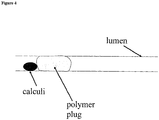
- a polymer is injected between the inlet of a lumen and a calculi in said lumen to form a polymer plug which occludes the lumen; the subsequent action of peristalsis causes the polymer plug to traverse the lumen, forcing the calculi out of the lumen.
- the present invention relates to a method of treating lithiasis, comprising the steps of:
- the present invention relates to the aforementioned method, wherein said second composition is injected into said lumen.
- the present invention relates to the aforementioned method, wherein said first position is between about 1 cm and about 5 cm upstream of said calculi.
- the present invention relates to the aforementioned method, wherein said first position is between about 2 cm and about 4 cm upstream of said calculi.
- the present invention relates to the aforementioned method, wherein said first position is about 3 cm upstream of said calculi.
- the present invention relates to the aforementioned method, wherein the distance between said first position and said second position is less than about 3mm.
- the present invention relates to the aforementioned method, wherein the distance between said first position and said second position is less than about 1mm.
- the present invention relates to the aforementioned method, wherein the distance between said first position and said second position is less than about 0.5mm.
- the present invention relates to the aforementioned method, wherein the distance between said first position and said second position is less than about 0.1mm.
- the present invention relates to the aforementioned method, wherein said first composition is injected into said lumen through a percutaneous access device.
- the present invention relates to the aforementioned method, wherein said first composition is injected into said lumen through a catheter or a syringe.
- the present invention relates to the aforementioned method, wherein the catheter is a dual lumen catheter or a triple lumen catheter.
- the present invention relates to the aforementioned method, wherein said lumen is or is a portion of a kidney, gall bladder, ureter, urinary bladder, pancreas, salivary gland, small intestine or large intestine.
- the present invention relates to the aforementioned method, wherein said lumen is or is a portion of a ureter or kidney.
- the present invention relates to the aforementioned method, wherein said calculi is a kidney stone, pancreatic stone, salivary stone, or biliary stone.
- the present invention relates to the aforementioned method, wherein said calculi is a kidney stone.
- the present invention relates to the aforementioned method, wherein said mammal is a human.
- the present invention relates to the aforementioned method, wherein said second composition comprises a contrast-enhancing agent.
- the present invention relates to the aforementioned method, wherein said contrast-enhancing agent is selected from the group consisting of radiopaque materials, paramagnetic materials, heavy atoms, transition metals, lanthanides, actinides, dyes, and radionuclide-containing materials.
- the present invention relates to the aforementioned method, wherein said inverse thermosensitive polymer is a block copolymer, random copolymer, graft polymer, or branched copolymer.
- the present invention relates to the aforementioned method, wherein said inverse thermosensitive polymer is a block polymer or a branched copolymer.
- the present invention relates to the aforementioned method, wherein said inverse thermosensitive polymer is an optionally purified poloxamer or poloxamine.
- the present invention relates to the aforementioned method, wherein said inverse thermosensitive polymer is optionally purified and selected from the group consisting ofpoloxamine 1107, poloxamine. 1307, poloxamer 338 and poloxamer 407.
- the present invention relates to the aforementioned method, wherein said inverse thermosensitive polymer is an optionally purified poloxamer 407.
- the present invention relates to the aforementioned method, wherein said first composition has a transition temperature of between about 10 °C and 40 °C.
- the present invention relates to the aforementioned method, wherein said first composition has a transition temperature of between about 15 °C and 30 °C.
- the present invention relates to the aforementioned method, wherein said first composition has a transition temperature of about 25 °C.
- the present invention relates to the aforementioned method, wherein said first composition comprises about 5 % to about 30 % of said inverse thermosensitive polymer.
- the present invention relates to the aforementioned method, wherein said first composition comprises about 10 % to about 25 % said inverse thermosensitive polymer.
- the present invention relates to the aforementioned method, wherein the inverse thermosensitive polymer has a polydispersity index from about 1.5 to 1.0.
- the present invention relates to the aforementioned method, wherein the inverse thermosensitive polymer has a polydispersity index from about 1.2 to 1.0.
- the present invention relates to the aforementioned method, wherein the inverse thermosensitive polymer has a polydispersity index from about 1.1 to 1.0.
- the present invention relates to the aforementioned method, wherein said inverse thermosensitive polymer is an optionally purified poloxamer or poloxamine; and said first composition has a transition temperature of between about 10 °C and 40 °C.
- the present invention relates to the aforementioned method, wherein said inverse thermosensitive polymer is an optionally purified poloxamer or poloxamine; and said first composition has a transition temperature of between about 15 °C and 30 °C.
- the present invention relates to the aforementioned method, wherein said inverse thermosensitive polymer is an optionally purified poloxamer or poloxamine; and said first composition has a transition temperature of about 25 °C.
- Another aspect of the present invention relates to a method of treating lithiasis, comprising the steps of:
- the present invention relates to the aforementioned method, wherein said second composition is injected into said lumen.
- the present invention relates to the aforementioned method, wherein said first position is between about 1 cm and about 5 cm upstream of said calculi.
- the present invention relates to the aforementioned method, wherein said first position is between about 2 cm and about 4 cm upstream of said calculi.
- the present invention relates to the aforementioned method, wherein said first position is about 3 cm upstream of said calculi.
- the present invention relates to the aforementioned method, wherein the distance between said first position and said second position is less than about 3mm.
- the present invention relates to the aforementioned method, wherein the distance between said first position and said second position is less than about 1mm.
- the present invention relates to the aforementioned method, wherein the distance between said first position and said second position is less than about 0.5mm.
- the present invention relates to the aforementioned method, wherein the distance between said first position and said second position is less than about 0.1mm.
- the present invention relates to the aforementioned method, wherein said first and second compositions are injected into said lumen through a percutaneous access device.
- the present invention relates to the aforementioned method, wherein said first and second compositions are injected into said lumen through a catheter or a syringe.
- the present invention relates to the aforementioned method, wherein the catheter is a dual lumen catheter or a triple lumen catheter.
- the present invention relates to the aforementioned method, wherein said lumen is or is a portion of a kidney, gall bladder, ureter, urinary bladder, pancreas, salivary gland, small intestine or large intestine.
- the present invention relates to the aforementioned method, wherein said lumen is or is a portion of a ureter or kidney.
- the present invention relates to the aforementioned method, wherein said calculi is a kidney stone, pancreatic stone, salivary stone, or biliary stone.
- the present invention relates to the aforementioned method, wherein said calculi is a kidney stone.
- the present invention relates to the aforementioned method, wherein said mammal is a human.
- the present invention relates to the aforementioned method, wherein said second composition comprises a contrast-enhancing agent.
- the present invention relates to the aforementioned method, wherein said contrast-enhancing agent is selected from the group consisting of radiopaque materials, paramagnetic materials, heavy atoms, transition metals, lanthanides, actinides, dyes, and radionuclide-containing materials.
- the polymer was weighed into a plastic tube. To achieve the required concentration the weight was multiplied by 4, for 25 weight percent (w%), and by 5, for 20 weight percent (w%), and the required final weight was achieved by adding saline. The solutions were placed in the fridge at 4 °C and usually were ready within 24 hours. Gelation points were measured in a Brookfield viscometer and the point at which viscosity exceeded the range of the plate/cone (greater than about 102,000 cP) was called the gelation temperature. Table 1 Gelation Temperature of Selected Inverse Thermosensitive Polymer Solutions in Saline.
- Purified polymers were weighed into 50 mL centrifuge tubes and a 1:1 mixture of saline and 100% Omnipaque 300 were added until a specific weight percentage was reached. Gelatin points were measured in a Brookfield viscometer and the point at which the viscosity exceeded the range of the plate/cone greater than about 102 Pa.s (about 102,000 cP)) was called the gelation point. All solutions were further heated to 37 °C to ascertain that the material still exceeded the viscosity range and remained a gel. All gels passed.
- the dissolution of the purified poloxamer 407 gel was tested by injecting 0.5 milliliter of the gel into a petri dish covered in saline at 37 °C. The gel was visualized by small addition of methylene blue and the dissolution of the gel was followed visually. Two different shapes of the gels were used for the dissolution tests: a sphere which has the least amount of surface area; and a string, which has the highest surface area, in which a 20 gauge syringe was used to extrude the string of polymer onto the bottom of the Petri dish.
- the petri dish was not disturbed and every minute, the petri dish was observed visually and complete dissolution was confirmed by swirling the petri dish.
- the dissolution was dependent on the concentration of the polymer. The lower the polymer concentration, the faster the gel dissolved as depicted in the Figure 5 . Further, the dissolution was dependent on the surface area in direct contact with the surrounding liquid, the sphere-shaped gel taking longer to dissolve than the string.
- the dissolution of the 22.5% purified poloxamer 407 gel was tested by injecting 2.5 milliliter of the gel into a petri dish covered in about 100 mL urine at 37 °C. A syringe without a needle was used to extrude a string of polymer onto the bottom of the Petri dish. The gel was visualized by small addition of methylene blue and the dissolution of the gel was followed visually. Upon extrusion the string broke in two. The petri dish was not disturbed and every minute, the petri dish was observed visually and complete dissolution was confirmed by swirling the petri dish. The complete dissolution time (about 26 minutes) was identical for the two strings.
- a 22.5 w% solution of purified Poloxamer PF127, colored with methylene blue, in a Medallion 5 ml syringe was used.
- an artificial stone made of plaster of Paris, was surgically implanted in the right ureter a few centimeters above the site of the incision.
- the solution was then injected behind the stone through the same incision site, using a 3F catheter [Embocath HIC 100 from BioSphere Medical, lot# 03W-6930].
- the catheter was flushed with 10 cc of cold saline to keep it cool during the injection and avoid hardening of the polymer within the catheter.
- Each procedure was monitored with a camera inserted in the ureter between the stone and the incision site.
- Pig #1 -- 3 ml of solution were injected behind the stone that occluded ca. 1/4 to 1/3 of the cross-section of the ureter, and created a well visible blue polymer plug that completed occluded the ureter behind the stone. After a little over 1 minute, the polymer plug or some urine accumulating behind it created contraction waves of the ureteral walls (peristalsis) which forced the plug to slide forward towards the camera and out of the ureter, carrying with it the entire stone, without any need for lithotripsy.
- Pig #2 Same as the 1 st pig but the stone was slightly larger, and immediately after the injection of the polymer lithotripsy (EHL) was used to break the stone into small fragments. Within one minute of the completion of lithotripsy peristalsis started and the stone debris were pushed by the sliding plug out of the ureter.
- EHL polymer lithotripsy
- Pig #3 Same as the 2 nd pig but the stone was even larger. Within one minute of the completion of lithotripsy peristalsis started and the stone debris were pushed by the sliding plug out of the ureter.
Landscapes
- Health & Medical Sciences (AREA)
- Life Sciences & Earth Sciences (AREA)
- Chemical & Material Sciences (AREA)
- General Health & Medical Sciences (AREA)
- Veterinary Medicine (AREA)
- Public Health (AREA)
- Animal Behavior & Ethology (AREA)
- Epidemiology (AREA)
- Medicinal Chemistry (AREA)
- Engineering & Computer Science (AREA)
- Pharmacology & Pharmacy (AREA)
- Surgery (AREA)
- Chemical Kinetics & Catalysis (AREA)
- Nuclear Medicine, Radiotherapy & Molecular Imaging (AREA)
- General Chemical & Material Sciences (AREA)
- Organic Chemistry (AREA)
- Bioinformatics & Cheminformatics (AREA)
- Biomedical Technology (AREA)
- Heart & Thoracic Surgery (AREA)
- Medical Informatics (AREA)
- Molecular Biology (AREA)
- Inorganic Chemistry (AREA)
- Oil, Petroleum & Natural Gas (AREA)
- Orthopedic Medicine & Surgery (AREA)
- Vascular Medicine (AREA)
- Materials Engineering (AREA)
- Dermatology (AREA)
- Urology & Nephrology (AREA)
- Gastroenterology & Hepatology (AREA)
- Polymers & Plastics (AREA)
- Nutrition Science (AREA)
- Physiology (AREA)
- Materials For Medical Uses (AREA)
- Medicinal Preparation (AREA)
- Pharmaceuticals Containing Other Organic And Inorganic Compounds (AREA)
- Surgical Instruments (AREA)
- Media Introduction/Drainage Providing Device (AREA)
- Medicines That Contain Protein Lipid Enzymes And Other Medicines (AREA)
Applications Claiming Priority (3)
| Application Number | Priority Date | Filing Date | Title |
|---|---|---|---|
| US67675705P | 2005-05-02 | 2005-05-02 | |
| EP06758729.5A EP1877096B1 (en) | 2005-05-02 | 2006-04-27 | Non-lithotripsic kidney-stone therapy |
| EP12193441.8A EP2601972B1 (en) | 2005-05-02 | 2006-04-27 | Non-lithotripsic kidney-stone therapy |
Related Parent Applications (2)
| Application Number | Title | Priority Date | Filing Date |
|---|---|---|---|
| EP06758729.5A Division EP1877096B1 (en) | 2005-05-02 | 2006-04-27 | Non-lithotripsic kidney-stone therapy |
| EP12193441.8A Division EP2601972B1 (en) | 2005-05-02 | 2006-04-27 | Non-lithotripsic kidney-stone therapy |
Publications (3)
| Publication Number | Publication Date |
|---|---|
| EP2857041A1 EP2857041A1 (en) | 2015-04-08 |
| EP2857041B1 EP2857041B1 (en) | 2017-04-05 |
| EP2857041B9 true EP2857041B9 (en) | 2018-02-14 |
Family
ID=36928585
Family Applications (3)
| Application Number | Title | Priority Date | Filing Date |
|---|---|---|---|
| EP14191119.8A Expired - Lifetime EP2857041B9 (en) | 2005-05-02 | 2006-04-27 | Non-lithotripsic kidney-stone therapy |
| EP12193441.8A Expired - Lifetime EP2601972B1 (en) | 2005-05-02 | 2006-04-27 | Non-lithotripsic kidney-stone therapy |
| EP06758729.5A Expired - Lifetime EP1877096B1 (en) | 2005-05-02 | 2006-04-27 | Non-lithotripsic kidney-stone therapy |
Family Applications After (2)
| Application Number | Title | Priority Date | Filing Date |
|---|---|---|---|
| EP12193441.8A Expired - Lifetime EP2601972B1 (en) | 2005-05-02 | 2006-04-27 | Non-lithotripsic kidney-stone therapy |
| EP06758729.5A Expired - Lifetime EP1877096B1 (en) | 2005-05-02 | 2006-04-27 | Non-lithotripsic kidney-stone therapy |
Country Status (15)
| Country | Link |
|---|---|
| US (4) | US8361455B2 (da) |
| EP (3) | EP2857041B9 (da) |
| JP (4) | JP5646813B2 (da) |
| KR (3) | KR101610796B1 (da) |
| CN (2) | CN105056310A (da) |
| AU (1) | AU2006242509B2 (da) |
| BR (1) | BRPI0611278A2 (da) |
| CA (4) | CA2985117A1 (da) |
| DK (2) | DK2601972T3 (da) |
| ES (2) | ES2458141T3 (da) |
| MX (1) | MX2007013827A (da) |
| PL (2) | PL2601972T3 (da) |
| PT (2) | PT1877096E (da) |
| SI (2) | SI1877096T1 (da) |
| WO (1) | WO2006119009A1 (da) |
Families Citing this family (21)
| Publication number | Priority date | Publication date | Assignee | Title |
|---|---|---|---|---|
| US20050143678A1 (en) | 2003-10-14 | 2005-06-30 | Pluromed, Inc. | Confinement of kidney-stone fragments during lithotripsy |
| DK2601972T3 (da) * | 2005-05-02 | 2015-02-16 | Genzyme Corp | Nyrestensbehandling uden litotripsi |
| US8062282B2 (en) * | 2006-02-13 | 2011-11-22 | Fossa Medical, Inc. | Methods and apparatus for temporarily occluding body openings |
| US8608760B2 (en) * | 2006-06-21 | 2013-12-17 | The Board Of Trustees Of The Leland Stanford Junior University | Compositions and methods for joining non-conjoined lumens |
| CA2656179A1 (en) | 2006-06-21 | 2007-12-27 | The Board Of Trustees Of The Leland Stanford Junior University | Compositions and methods for joining non-conjoined lumens |
| US8197499B2 (en) * | 2006-06-21 | 2012-06-12 | The Board Of Trustees Of The Leland Stanford Junior University | Compositions and methods for joining non-conjoined lumens |
| US20080103481A1 (en) * | 2006-09-29 | 2008-05-01 | Pluromed, Inc. | Methods for Preventing Retropulsion of Concretions and Fragments During Lithotripsy |
| JP2010512230A (ja) * | 2006-12-11 | 2010-04-22 | プルーロームド インコーポレイテッド | 灌流臓器止血法 |
| EP2125092A4 (en) * | 2007-02-22 | 2012-03-14 | Pluromed Inc | USE OF REVERSIBLE HEAT-SENSITIVE POLYMERS FOR FLOW CONTROL OF A BIOLOGICAL LIQUID AFTER MEDICAL USE |
| WO2009070793A1 (en) * | 2007-11-29 | 2009-06-04 | Pluromed, Inc. | Endoscopic mucosal resectioning using purified inverse thermosensitive polymers |
| WO2009086206A2 (en) * | 2007-12-20 | 2009-07-09 | Synvascular, Inc. | Compositions and methods for joining non-conjoined lumens |
| US8563037B2 (en) * | 2009-02-06 | 2013-10-22 | Tautona Group, L.P. | Compositions and methods for joining non-conjoined lumens |
| ES2671907T3 (es) * | 2010-01-13 | 2018-06-11 | Georg Bischof | Composición para la generación de una oclusión intestinal temporal |
| DE202013012287U1 (de) | 2013-04-23 | 2016-01-18 | Fraunhofer-Gesellschaft zur Förderung der angewandten Forschung e.V. | Gelbildendes System zum Entfernen von Nierensteinfragmenten |
| DE202013012275U1 (de) | 2013-04-23 | 2015-12-18 | Fraunhofer-Gesellschaft zur Förderung der angewandten Forschung e.V. | Kit zum Herstellen eines vernetzten Gels zum Umschließen von Nierensteinen und/oder Nierensteinfragmenten |
| ES2577102T3 (es) | 2013-04-23 | 2016-07-13 | Fraunhofer-Gesellschaft zur Förderung der angewandten Forschung e.V. | Sistema gelificante para eliminar fragmentos de cálculos renales |
| EP2796101B1 (de) | 2013-04-23 | 2016-04-20 | Fraunhofer-Gesellschaft zur Förderung der angewandten Forschung e.V. | Kit zum Herstellen eines vernetzten Gels zum Umschließen von Nierensteinen und/oder Nierensteinfragmenten |
| WO2015168671A1 (en) * | 2014-05-02 | 2015-11-05 | Arthrodynamic Technologies, Animal Health Division, Inc. | Glycosaminoglycan composition and method of use for kidney stone removal |
| CN106264642B (zh) * | 2016-07-27 | 2019-06-28 | 湖南瑞邦医疗科技发展有限公司 | 一次性使用温控液体凝胶封堵导管 |
| GB2579707A (en) | 2018-10-15 | 2020-07-01 | Avent Inc | Compositions, systems, kits, and methods for neural ablation |
| WO2022201161A1 (en) * | 2021-03-25 | 2022-09-29 | Clayman Ralph V | Thermosensitive bio-adhesive hydrogel for removal of ureteral and renal stones |
Family Cites Families (52)
| Publication number | Priority date | Publication date | Assignee | Title |
|---|---|---|---|---|
| US4308905A (en) | 1980-03-24 | 1982-01-05 | Nancy Gallagher | Cover for air conditioner |
| US4608979A (en) | 1984-02-22 | 1986-09-02 | Washington Research Foundation | Apparatus for the noninvasive shock fragmentation of renal calculi |
| JPS6116735A (ja) | 1984-07-03 | 1986-01-24 | 京都府 | 結石破砕装置 |
| DE3506873A1 (de) | 1985-02-27 | 1986-08-28 | Farco-Pharma GmbH, 5000 Köln | System zum auffangen von bruchstuecken, die anfallen beim zerkleinern von steinen in koerperhoehlen lebender menschen und warmbluetiger tiere |
| EP0200668A3 (en) * | 1985-04-25 | 1988-03-09 | FOGARTY, Thomas J. | Apparatus and method for dislodging and removing occlusive objects from body passages |
| US4781677A (en) | 1985-07-17 | 1988-11-01 | Wilcox Gilbert M | Method of treatment utilizing a double balloon nasobiliary occlusion catheter |
| US5567859A (en) | 1991-03-19 | 1996-10-22 | Cytrx Corporation | Polyoxypropylene/polyoxyethylene copolymers with improved biological activity |
| US4845125A (en) | 1987-11-10 | 1989-07-04 | Indianapolis Center For Advanced Research, Inc. | Chemolytic EDTA-citric acid composition for dissolution of calculi |
| US4979948A (en) | 1989-04-13 | 1990-12-25 | Purdue Research Foundation | Method and apparatus for thermally destroying a layer of an organ |
| US5059200A (en) | 1990-04-06 | 1991-10-22 | John Tulip | Laser lithotripsy |
| ES2140408T3 (es) | 1991-03-19 | 2000-03-01 | Cytrx Corp | Copolimeros de polioxipropileno/polioxietileno con actividad biologica mejorada. |
| US5696298A (en) | 1991-03-19 | 1997-12-09 | Cytrx Corporation | Polyoxypropylene/polyoxyethylene copolymers with improved biological activity |
| US5129910A (en) | 1991-07-26 | 1992-07-14 | The Regents Of The University Of California | Stone expulsion stent |
| US5599300A (en) | 1992-05-11 | 1997-02-04 | Arrow Precision Products, Inc. | Method for electrosurgically obtaining access to the biliary tree with an adjustably positionable needle-knife |
| US5843028A (en) | 1992-05-11 | 1998-12-01 | Medical Innovations Corporation | Multi-lumen endoscopic catheter |
| US5536248A (en) | 1992-05-11 | 1996-07-16 | Arrow Precision Products, Inc. | Method and apparatus for electrosurgically obtaining access to the biliary tree and placing a stent therein |
| US5397302A (en) | 1992-05-11 | 1995-03-14 | Arrow Precision Products, Inc. | Method of using a dual lumen biliary catheter |
| US6770066B1 (en) | 1992-05-11 | 2004-08-03 | Ballard Medical Products | Multi-lumen endoscopic catheter |
| US5401257A (en) | 1993-04-27 | 1995-03-28 | Boston Scientific Corporation | Ureteral stents, drainage tubes and the like |
| US5448363A (en) | 1993-08-09 | 1995-09-05 | Hager; Horst | Food sorting by reflection of periodically scanned laser beam |
| JP3107488B2 (ja) | 1993-09-29 | 2000-11-06 | 株式会社資生堂 | 架橋ヒアルロン酸を用いた徐放性製剤及び塞栓剤 |
| US5531716A (en) * | 1993-09-29 | 1996-07-02 | Hercules Incorporated | Medical devices subject to triggered disintegration |
| US5403324A (en) | 1994-01-14 | 1995-04-04 | Microsonic Engineering Devices Company, Inc. | Flexible catheter with stone basket and ultrasonic conductor |
| DE4405656C2 (de) | 1994-02-22 | 1998-12-10 | Ferton Holding | Einrichtung zum Entfernen von Körpersteinen |
| US5860972A (en) | 1995-10-26 | 1999-01-19 | Xintec Corporation | Method of detection and destruction of urinary calculi and similar structures |
| US5860872A (en) | 1996-03-07 | 1999-01-19 | Vitale; Kevin | Batter's stride training device |
| US5814006A (en) | 1996-05-28 | 1998-09-29 | Planz; Konrad | Temporary stent in the urine path |
| US5855601A (en) | 1996-06-21 | 1999-01-05 | The Trustees Of Columbia University In The City Of New York | Artificial heart valve and method and device for implanting the same |
| US5800711A (en) | 1996-10-18 | 1998-09-01 | Mdv Technologies, Inc. | Process for the fractionation of polyoxyalkylene block copolymers |
| WO1999009897A1 (de) | 1997-08-22 | 1999-03-04 | Karl Storz Gmbh & Co. | Vorrichtung zur zerstörung bzw. zertrümmerung von konkrementen |
| DE69839888D1 (de) | 1997-11-12 | 2008-09-25 | Genesis Technologies Llc | Vorrichtung zum entfernen von okklusionen in biologischen durchgängen |
| US6149656A (en) | 1998-09-11 | 2000-11-21 | Volker Walz | Electrodynamic lithotriptor |
| US6309384B1 (en) * | 1999-02-01 | 2001-10-30 | Adiana, Inc. | Method and apparatus for tubal occlusion |
| JP4310049B2 (ja) | 1999-02-19 | 2009-08-05 | ボストン サイエンティフィック リミテッド | 吸引を用いるレーザー砕石術デバイス |
| US6159220A (en) | 1999-03-11 | 2000-12-12 | Scimed Life Systems, Inc. | Medical retrieval device |
| US7214229B2 (en) | 1999-03-18 | 2007-05-08 | Fossa Medical, Inc. | Radially expanding stents |
| US6709465B2 (en) | 1999-03-18 | 2004-03-23 | Fossa Medical, Inc. | Radially expanding ureteral device |
| US6214037B1 (en) | 1999-03-18 | 2001-04-10 | Fossa Industries, Llc | Radially expanding stent |
| US6620172B1 (en) | 1999-07-01 | 2003-09-16 | Medsource Technologies, Inc. | Entraining biological calculi |
| US7039453B2 (en) | 2000-02-08 | 2006-05-02 | Tarun Mullick | Miniature ingestible capsule |
| US6440061B1 (en) | 2000-03-24 | 2002-08-27 | Donald E. Wenner | Laparoscopic instrument system for real-time biliary exploration and stone removal |
| US6761824B2 (en) | 2000-08-17 | 2004-07-13 | Reeve Lorraine E | Process for the fractionation of polymers |
| US20040266983A1 (en) | 2000-08-17 | 2004-12-30 | Reeve Lorraine E | Purified polyoxyalkylene block copolymers |
| US6565530B2 (en) | 2001-02-28 | 2003-05-20 | Scimed Life Systems, Inc. | Immobilizing objects in the body |
| US7041139B2 (en) | 2001-12-11 | 2006-05-09 | Boston Scientific Scimed, Inc. | Ureteral stents and related methods |
| EP1489983A4 (en) | 2002-02-15 | 2010-11-10 | Boston Scient Corp | METHOD AND DEVICE FOR TREATING TISSUE IN ADDITION TO A BODY THROUGH THERMOCOMPRESSION AND MEDICAMENTS |
| US6949125B2 (en) | 2002-04-16 | 2005-09-27 | Boston Scientific Scimed, Inc. | Ureteral stent with end-effector and related methods |
| DE10224352A1 (de) | 2002-06-01 | 2003-12-11 | Mueller Schulte Detlef | Thermosensitive Polymerträger mit veränderbarer physikalischer Struktur für die biochemische Analytik, Diagnostik und Therapie |
| US20050143678A1 (en) | 2003-10-14 | 2005-06-30 | Pluromed, Inc. | Confinement of kidney-stone fragments during lithotripsy |
| US7052489B2 (en) | 2003-12-05 | 2006-05-30 | Scimed Life Systems, Inc. | Medical device with deflecting shaft and related methods of manufacture and use |
| DK2601972T3 (da) * | 2005-05-02 | 2015-02-16 | Genzyme Corp | Nyrestensbehandling uden litotripsi |
| EP1892231A1 (en) | 2006-08-21 | 2008-02-27 | Bayer Schering Pharma Aktiengesellschaft | A large scale method for the deoxofluorination of ketones |
-
2006
- 2006-04-27 DK DK12193441.8T patent/DK2601972T3/da active
- 2006-04-27 SI SI200631770T patent/SI1877096T1/sl unknown
- 2006-04-27 AU AU2006242509A patent/AU2006242509B2/en not_active Expired
- 2006-04-27 KR KR1020137021797A patent/KR101610796B1/ko not_active Expired - Lifetime
- 2006-04-27 CN CN201510382009.8A patent/CN105056310A/zh active Pending
- 2006-04-27 MX MX2007013827A patent/MX2007013827A/es active IP Right Grant
- 2006-04-27 US US11/412,407 patent/US8361455B2/en active Active
- 2006-04-27 DK DK06758729.5T patent/DK1877096T3/da active
- 2006-04-27 CN CNA2006800242466A patent/CN101237887A/zh active Pending
- 2006-04-27 EP EP14191119.8A patent/EP2857041B9/en not_active Expired - Lifetime
- 2006-04-27 CA CA2985117A patent/CA2985117A1/en not_active Abandoned
- 2006-04-27 ES ES06758729.5T patent/ES2458141T3/es not_active Expired - Lifetime
- 2006-04-27 CA CA2900229A patent/CA2900229A1/en not_active Abandoned
- 2006-04-27 PT PT67587295T patent/PT1877096E/pt unknown
- 2006-04-27 BR BRPI0611278-1A patent/BRPI0611278A2/pt not_active Application Discontinuation
- 2006-04-27 ES ES12193441.8T patent/ES2529130T3/es not_active Expired - Lifetime
- 2006-04-27 JP JP2008510072A patent/JP5646813B2/ja not_active Expired - Lifetime
- 2006-04-27 KR KR1020077028231A patent/KR20080033159A/ko not_active Ceased
- 2006-04-27 SI SI200631885T patent/SI2601972T1/sl unknown
- 2006-04-27 PL PL12193441T patent/PL2601972T3/pl unknown
- 2006-04-27 PL PL06758729T patent/PL1877096T3/pl unknown
- 2006-04-27 WO PCT/US2006/016208 patent/WO2006119009A1/en not_active Ceased
- 2006-04-27 KR KR1020157000965A patent/KR101808201B1/ko not_active Expired - Lifetime
- 2006-04-27 CA CA2606714A patent/CA2606714C/en not_active Expired - Lifetime
- 2006-04-27 CA CA2831752A patent/CA2831752A1/en not_active Abandoned
- 2006-04-27 EP EP12193441.8A patent/EP2601972B1/en not_active Expired - Lifetime
- 2006-04-27 EP EP06758729.5A patent/EP1877096B1/en not_active Expired - Lifetime
- 2006-04-27 PT PT121934418T patent/PT2601972E/pt unknown
-
2012
- 2012-12-14 US US13/714,933 patent/US20130178866A1/en not_active Abandoned
-
2013
- 2013-03-27 JP JP2013066253A patent/JP2013172971A/ja active Pending
-
2014
- 2014-04-22 US US14/259,103 patent/US9161767B2/en not_active Expired - Lifetime
-
2015
- 2015-06-03 JP JP2015112997A patent/JP6076404B2/ja not_active Expired - Fee Related
- 2015-09-29 US US14/869,335 patent/US9968369B2/en not_active Expired - Lifetime
-
2016
- 2016-11-24 JP JP2016228021A patent/JP2017070768A/ja active Pending
Also Published As
Similar Documents
| Publication | Publication Date | Title |
|---|---|---|
| US9968369B2 (en) | Non-lithotripsic kidney-stone therapy | |
| US20210353301A1 (en) | Methods for preventing retropulsion of concretions and fragments during lithotripsy | |
| US8491623B2 (en) | Atraumatic occlusion balloons and skirts, and methods of use thereof | |
| HK1205935B (en) | Non-lithotripsic kidney-stone therapy |
Legal Events
| Date | Code | Title | Description |
|---|---|---|---|
| PUAI | Public reference made under article 153(3) epc to a published international application that has entered the european phase |
Free format text: ORIGINAL CODE: 0009012 |
|
| 17P | Request for examination filed |
Effective date: 20141030 |
|
| AC | Divisional application: reference to earlier application |
Ref document number: 2601972 Country of ref document: EP Kind code of ref document: P Ref document number: 1877096 Country of ref document: EP Kind code of ref document: P |
|
| AK | Designated contracting states |
Kind code of ref document: A1 Designated state(s): AT BE BG CH CY CZ DE DK EE ES FI FR GB GR HU IE IS IT LI LT LU LV MC NL PL PT RO SE SI SK TR |
|
| RIN1 | Information on inventor provided before grant (corrected) |
Inventor name: SAACO, DIANNE, E Inventor name: VOGEL, JEAN-MARIE Inventor name: MCDOUGAL, W., SCOTT Inventor name: SCHWARZ, ALEXANDER |
|
| R17P | Request for examination filed (corrected) |
Effective date: 20151006 |
|
| RBV | Designated contracting states (corrected) |
Designated state(s): AT BE BG CH CY CZ DE DK EE ES FI FR GB GR HU IE IS IT LI LT LU LV MC NL PL PT RO SE SI SK TR |
|
| REG | Reference to a national code |
Ref country code: HK Ref legal event code: DE Ref document number: 1205935 Country of ref document: HK |
|
| RIC1 | Information provided on ipc code assigned before grant |
Ipc: A61L 24/04 20060101ALI20151216BHEP Ipc: A61K 9/00 20060101ALI20151216BHEP Ipc: A61L 24/00 20060101ALI20151216BHEP Ipc: A61B 17/22 20060101ALI20151216BHEP Ipc: A61K 47/36 20060101ALI20151216BHEP Ipc: A61K 47/26 20060101ALI20151216BHEP Ipc: A61K 47/10 20060101ALI20151216BHEP Ipc: A61B 18/00 20060101AFI20151216BHEP Ipc: A61B 17/3205 20060101ALI20151216BHEP |
|
| GRAP | Despatch of communication of intention to grant a patent |
Free format text: ORIGINAL CODE: EPIDOSNIGR1 |
|
| INTG | Intention to grant announced |
Effective date: 20160209 |
|
| GRAJ | Information related to disapproval of communication of intention to grant by the applicant or resumption of examination proceedings by the epo deleted |
Free format text: ORIGINAL CODE: EPIDOSDIGR1 |
|
| REG | Reference to a national code |
Ref country code: DE Ref legal event code: R079 Ref document number: 602006052216 Country of ref document: DE Free format text: PREVIOUS MAIN CLASS: A61K0047100000 Ipc: A61K0049000000 |
|
| GRAP | Despatch of communication of intention to grant a patent |
Free format text: ORIGINAL CODE: EPIDOSNIGR1 |
|
| INTC | Intention to grant announced (deleted) | ||
| RIC1 | Information provided on ipc code assigned before grant |
Ipc: A61L 24/00 20060101ALI20161020BHEP Ipc: A61L 24/04 20060101ALI20161020BHEP Ipc: A61K 47/10 20060101ALI20161020BHEP Ipc: A61K 9/00 20060101ALI20161020BHEP Ipc: A61B 17/22 20060101ALI20161020BHEP Ipc: A61K 47/36 20060101ALI20161020BHEP Ipc: A61K 49/00 20060101AFI20161020BHEP Ipc: A61B 17/3205 20060101ALI20161020BHEP Ipc: A61B 17/00 20060101ALI20161020BHEP Ipc: A61B 18/00 20060101ALI20161020BHEP |
|
| INTG | Intention to grant announced |
Effective date: 20161103 |
|
| RIN1 | Information on inventor provided before grant (corrected) |
Inventor name: SCHWARZ, ALEXANDER Inventor name: SAACO, DIANNE, E Inventor name: MCDOUGAL, W., SCOTT Inventor name: VOGEL, JEAN-MARIE |
|
| GRAS | Grant fee paid |
Free format text: ORIGINAL CODE: EPIDOSNIGR3 |
|
| GRAA | (expected) grant |
Free format text: ORIGINAL CODE: 0009210 |
|
| AC | Divisional application: reference to earlier application |
Ref document number: 1877096 Country of ref document: EP Kind code of ref document: P Ref document number: 2601972 Country of ref document: EP Kind code of ref document: P |
|
| AK | Designated contracting states |
Kind code of ref document: B1 Designated state(s): AT BE BG CH CY CZ DE DK EE ES FI FR GB GR HU IE IS IT LI LT LU LV MC NL PL PT RO SE SI SK TR |
|
| REG | Reference to a national code |
Ref country code: GB Ref legal event code: FG4D |
|
| REG | Reference to a national code |
Ref country code: CH Ref legal event code: EP |
|
| REG | Reference to a national code |
Ref country code: AT Ref legal event code: REF Ref document number: 881175 Country of ref document: AT Kind code of ref document: T Effective date: 20170415 |
|
| REG | Reference to a national code |
Ref country code: IE Ref legal event code: FG4D |
|
| REG | Reference to a national code |
Ref country code: DE Ref legal event code: R096 Ref document number: 602006052216 Country of ref document: DE |
|
| REG | Reference to a national code |
Ref country code: FR Ref legal event code: PLFP Year of fee payment: 12 |
|
| REG | Reference to a national code |
Ref country code: NL Ref legal event code: MP Effective date: 20170405 |
|
| REG | Reference to a national code |
Ref country code: LT Ref legal event code: MG4D |
|
| REG | Reference to a national code |
Ref country code: AT Ref legal event code: MK05 Ref document number: 881175 Country of ref document: AT Kind code of ref document: T Effective date: 20170405 |
|
| PG25 | Lapsed in a contracting state [announced via postgrant information from national office to epo] |
Ref country code: NL Free format text: LAPSE BECAUSE OF FAILURE TO SUBMIT A TRANSLATION OF THE DESCRIPTION OR TO PAY THE FEE WITHIN THE PRESCRIBED TIME-LIMIT Effective date: 20170405 |
|
| PG25 | Lapsed in a contracting state [announced via postgrant information from national office to epo] |
Ref country code: GR Free format text: LAPSE BECAUSE OF FAILURE TO SUBMIT A TRANSLATION OF THE DESCRIPTION OR TO PAY THE FEE WITHIN THE PRESCRIBED TIME-LIMIT Effective date: 20170706 Ref country code: LT Free format text: LAPSE BECAUSE OF FAILURE TO SUBMIT A TRANSLATION OF THE DESCRIPTION OR TO PAY THE FEE WITHIN THE PRESCRIBED TIME-LIMIT Effective date: 20170405 Ref country code: FI Free format text: LAPSE BECAUSE OF FAILURE TO SUBMIT A TRANSLATION OF THE DESCRIPTION OR TO PAY THE FEE WITHIN THE PRESCRIBED TIME-LIMIT Effective date: 20170405 Ref country code: ES Free format text: LAPSE BECAUSE OF FAILURE TO SUBMIT A TRANSLATION OF THE DESCRIPTION OR TO PAY THE FEE WITHIN THE PRESCRIBED TIME-LIMIT Effective date: 20170405 Ref country code: AT Free format text: LAPSE BECAUSE OF FAILURE TO SUBMIT A TRANSLATION OF THE DESCRIPTION OR TO PAY THE FEE WITHIN THE PRESCRIBED TIME-LIMIT Effective date: 20170405 |
|
| GRAT | Correction requested after decision to grant or after decision to maintain patent in amended form |
Free format text: ORIGINAL CODE: EPIDOSNCDEC |
|
| PG25 | Lapsed in a contracting state [announced via postgrant information from national office to epo] |
Ref country code: SE Free format text: LAPSE BECAUSE OF FAILURE TO SUBMIT A TRANSLATION OF THE DESCRIPTION OR TO PAY THE FEE WITHIN THE PRESCRIBED TIME-LIMIT Effective date: 20170405 Ref country code: LV Free format text: LAPSE BECAUSE OF FAILURE TO SUBMIT A TRANSLATION OF THE DESCRIPTION OR TO PAY THE FEE WITHIN THE PRESCRIBED TIME-LIMIT Effective date: 20170405 Ref country code: IS Free format text: LAPSE BECAUSE OF FAILURE TO SUBMIT A TRANSLATION OF THE DESCRIPTION OR TO PAY THE FEE WITHIN THE PRESCRIBED TIME-LIMIT Effective date: 20170805 Ref country code: BG Free format text: LAPSE BECAUSE OF FAILURE TO SUBMIT A TRANSLATION OF THE DESCRIPTION OR TO PAY THE FEE WITHIN THE PRESCRIBED TIME-LIMIT Effective date: 20170705 Ref country code: PL Free format text: LAPSE BECAUSE OF FAILURE TO SUBMIT A TRANSLATION OF THE DESCRIPTION OR TO PAY THE FEE WITHIN THE PRESCRIBED TIME-LIMIT Effective date: 20170405 |
|
| REG | Reference to a national code |
Ref country code: CH Ref legal event code: PL |
|
| REG | Reference to a national code |
Ref country code: DE Ref legal event code: R097 Ref document number: 602006052216 Country of ref document: DE |
|
| REG | Reference to a national code |
Ref country code: IE Ref legal event code: MM4A |
|
| PG25 | Lapsed in a contracting state [announced via postgrant information from national office to epo] |
Ref country code: MC Free format text: LAPSE BECAUSE OF FAILURE TO SUBMIT A TRANSLATION OF THE DESCRIPTION OR TO PAY THE FEE WITHIN THE PRESCRIBED TIME-LIMIT Effective date: 20170405 Ref country code: EE Free format text: LAPSE BECAUSE OF FAILURE TO SUBMIT A TRANSLATION OF THE DESCRIPTION OR TO PAY THE FEE WITHIN THE PRESCRIBED TIME-LIMIT Effective date: 20170405 Ref country code: CZ Free format text: LAPSE BECAUSE OF FAILURE TO SUBMIT A TRANSLATION OF THE DESCRIPTION OR TO PAY THE FEE WITHIN THE PRESCRIBED TIME-LIMIT Effective date: 20170405 Ref country code: SK Free format text: LAPSE BECAUSE OF FAILURE TO SUBMIT A TRANSLATION OF THE DESCRIPTION OR TO PAY THE FEE WITHIN THE PRESCRIBED TIME-LIMIT Effective date: 20170405 Ref country code: RO Free format text: LAPSE BECAUSE OF FAILURE TO SUBMIT A TRANSLATION OF THE DESCRIPTION OR TO PAY THE FEE WITHIN THE PRESCRIBED TIME-LIMIT Effective date: 20170405 Ref country code: DK Free format text: LAPSE BECAUSE OF FAILURE TO SUBMIT A TRANSLATION OF THE DESCRIPTION OR TO PAY THE FEE WITHIN THE PRESCRIBED TIME-LIMIT Effective date: 20170405 |
|
| PLBE | No opposition filed within time limit |
Free format text: ORIGINAL CODE: 0009261 |
|
| STAA | Information on the status of an ep patent application or granted ep patent |
Free format text: STATUS: NO OPPOSITION FILED WITHIN TIME LIMIT |
|
| PG25 | Lapsed in a contracting state [announced via postgrant information from national office to epo] |
Ref country code: CH Free format text: LAPSE BECAUSE OF NON-PAYMENT OF DUE FEES Effective date: 20170430 Ref country code: LI Free format text: LAPSE BECAUSE OF NON-PAYMENT OF DUE FEES Effective date: 20170430 Ref country code: LU Free format text: LAPSE BECAUSE OF NON-PAYMENT OF DUE FEES Effective date: 20170427 Ref country code: IT Free format text: LAPSE BECAUSE OF FAILURE TO SUBMIT A TRANSLATION OF THE DESCRIPTION OR TO PAY THE FEE WITHIN THE PRESCRIBED TIME-LIMIT Effective date: 20170405 |
|
| 26N | No opposition filed |
Effective date: 20180108 |
|
| REG | Reference to a national code |
Ref country code: FR Ref legal event code: PLFP Year of fee payment: 13 |
|
| REG | Reference to a national code |
Ref country code: BE Ref legal event code: MM Effective date: 20170430 |
|
| REG | Reference to a national code |
Ref country code: HK Ref legal event code: GR Ref document number: 1205935 Country of ref document: HK |
|
| PG25 | Lapsed in a contracting state [announced via postgrant information from national office to epo] |
Ref country code: IE Free format text: LAPSE BECAUSE OF NON-PAYMENT OF DUE FEES Effective date: 20170427 |
|
| PG25 | Lapsed in a contracting state [announced via postgrant information from national office to epo] |
Ref country code: SI Free format text: LAPSE BECAUSE OF FAILURE TO SUBMIT A TRANSLATION OF THE DESCRIPTION OR TO PAY THE FEE WITHIN THE PRESCRIBED TIME-LIMIT Effective date: 20170405 Ref country code: BE Free format text: LAPSE BECAUSE OF NON-PAYMENT OF DUE FEES Effective date: 20170430 |
|
| PG25 | Lapsed in a contracting state [announced via postgrant information from national office to epo] |
Ref country code: HU Free format text: LAPSE BECAUSE OF FAILURE TO SUBMIT A TRANSLATION OF THE DESCRIPTION OR TO PAY THE FEE WITHIN THE PRESCRIBED TIME-LIMIT; INVALID AB INITIO Effective date: 20060427 |
|
| PG25 | Lapsed in a contracting state [announced via postgrant information from national office to epo] |
Ref country code: CY Free format text: LAPSE BECAUSE OF FAILURE TO SUBMIT A TRANSLATION OF THE DESCRIPTION OR TO PAY THE FEE WITHIN THE PRESCRIBED TIME-LIMIT Effective date: 20170405 |
|
| PG25 | Lapsed in a contracting state [announced via postgrant information from national office to epo] |
Ref country code: TR Free format text: LAPSE BECAUSE OF FAILURE TO SUBMIT A TRANSLATION OF THE DESCRIPTION OR TO PAY THE FEE WITHIN THE PRESCRIBED TIME-LIMIT Effective date: 20170405 |
|
| PG25 | Lapsed in a contracting state [announced via postgrant information from national office to epo] |
Ref country code: PT Free format text: LAPSE BECAUSE OF FAILURE TO SUBMIT A TRANSLATION OF THE DESCRIPTION OR TO PAY THE FEE WITHIN THE PRESCRIBED TIME-LIMIT Effective date: 20170405 |
|
| PGFP | Annual fee paid to national office [announced via postgrant information from national office to epo] |
Ref country code: FR Payment date: 20250310 Year of fee payment: 20 |
|
| PGFP | Annual fee paid to national office [announced via postgrant information from national office to epo] |
Ref country code: GB Payment date: 20250306 Year of fee payment: 20 |
|
| PGFP | Annual fee paid to national office [announced via postgrant information from national office to epo] |
Ref country code: DE Payment date: 20250305 Year of fee payment: 20 |