EP2857564A2 - Faden - Google Patents
Faden Download PDFInfo
- Publication number
- EP2857564A2 EP2857564A2 EP14002483.7A EP14002483A EP2857564A2 EP 2857564 A2 EP2857564 A2 EP 2857564A2 EP 14002483 A EP14002483 A EP 14002483A EP 2857564 A2 EP2857564 A2 EP 2857564A2
- Authority
- EP
- European Patent Office
- Prior art keywords
- thread
- thermofusible
- panel
- ply
- fabric
- Prior art date
- Legal status (The legal status is an assumption and is not a legal conclusion. Google has not performed a legal analysis and makes no representation as to the accuracy of the status listed.)
- Withdrawn
Links
Images



Classifications
-
- D—TEXTILES; PAPER
- D02—YARNS; MECHANICAL FINISHING OF YARNS OR ROPES; WARPING OR BEAMING
- D02G—CRIMPING OR CURLING FIBRES, FILAMENTS, THREADS, OR YARNS; YARNS OR THREADS
- D02G3/00—Yarns or threads, e.g. fancy yarns; Processes or apparatus for the production thereof, not otherwise provided for
- D02G3/02—Yarns or threads characterised by the material or by the materials from which they are made
-
- D—TEXTILES; PAPER
- D02—YARNS; MECHANICAL FINISHING OF YARNS OR ROPES; WARPING OR BEAMING
- D02G—CRIMPING OR CURLING FIBRES, FILAMENTS, THREADS, OR YARNS; YARNS OR THREADS
- D02G3/00—Yarns or threads, e.g. fancy yarns; Processes or apparatus for the production thereof, not otherwise provided for
- D02G3/22—Yarns or threads characterised by constructional features, e.g. blending, filament/fibre
- D02G3/36—Cored or coated yarns or threads
-
- D—TEXTILES; PAPER
- D01—NATURAL OR MAN-MADE THREADS OR FIBRES; SPINNING
- D01F—CHEMICAL FEATURES IN THE MANUFACTURE OF ARTIFICIAL FILAMENTS, THREADS, FIBRES, BRISTLES OR RIBBONS; APPARATUS SPECIALLY ADAPTED FOR THE MANUFACTURE OF CARBON FILAMENTS
- D01F6/00—Monocomponent artificial filaments or the like of synthetic polymers; Manufacture thereof
- D01F6/44—Monocomponent artificial filaments or the like of synthetic polymers; Manufacture thereof from mixtures of polymers obtained by reactions only involving carbon-to-carbon unsaturated bonds as major constituent with other polymers or low-molecular-weight compounds
- D01F6/50—Monocomponent artificial filaments or the like of synthetic polymers; Manufacture thereof from mixtures of polymers obtained by reactions only involving carbon-to-carbon unsaturated bonds as major constituent with other polymers or low-molecular-weight compounds of polyalcohols, polyacetals or polyketals
-
- D—TEXTILES; PAPER
- D02—YARNS; MECHANICAL FINISHING OF YARNS OR ROPES; WARPING OR BEAMING
- D02G—CRIMPING OR CURLING FIBRES, FILAMENTS, THREADS, OR YARNS; YARNS OR THREADS
- D02G3/00—Yarns or threads, e.g. fancy yarns; Processes or apparatus for the production thereof, not otherwise provided for
- D02G3/22—Yarns or threads characterised by constructional features, e.g. blending, filament/fibre
- D02G3/38—Threads in which fibres, filaments, or yarns are wound with other yarns or filaments, e.g. wrap yarns, i.e. strands of filaments or staple fibres are wrapped by a helically wound binder yarn
-
- D—TEXTILES; PAPER
- D02—YARNS; MECHANICAL FINISHING OF YARNS OR ROPES; WARPING OR BEAMING
- D02G—CRIMPING OR CURLING FIBRES, FILAMENTS, THREADS, OR YARNS; YARNS OR THREADS
- D02G3/00—Yarns or threads, e.g. fancy yarns; Processes or apparatus for the production thereof, not otherwise provided for
- D02G3/22—Yarns or threads characterised by constructional features, e.g. blending, filament/fibre
- D02G3/40—Yarns in which fibres are united by adhesives; Impregnated yarns or threads
- D02G3/402—Yarns in which fibres are united by adhesives; Impregnated yarns or threads the adhesive being one component of the yarn, i.e. thermoplastic yarn
-
- D—TEXTILES; PAPER
- D02—YARNS; MECHANICAL FINISHING OF YARNS OR ROPES; WARPING OR BEAMING
- D02G—CRIMPING OR CURLING FIBRES, FILAMENTS, THREADS, OR YARNS; YARNS OR THREADS
- D02G3/00—Yarns or threads, e.g. fancy yarns; Processes or apparatus for the production thereof, not otherwise provided for
- D02G3/22—Yarns or threads characterised by constructional features, e.g. blending, filament/fibre
- D02G3/40—Yarns in which fibres are united by adhesives; Impregnated yarns or threads
- D02G3/404—Yarns or threads coated with polymeric solutions
- D02G3/406—Yarns or threads coated with polymeric solutions where the polymeric solution is removable at a later stage, e.g. by washing
-
- D—TEXTILES; PAPER
- D04—BRAIDING; LACE-MAKING; KNITTING; TRIMMINGS; NON-WOVEN FABRICS
- D04C—BRAIDING OR MANUFACTURE OF LACE, INCLUDING BOBBIN-NET OR CARBONISED LACE; BRAIDING MACHINES; BRAID; LACE
- D04C1/00—Braid or lace, e.g. pillow-lace; Processes for the manufacture thereof
- D04C1/02—Braid or lace, e.g. pillow-lace; Processes for the manufacture thereof made from particular materials
-
- D—TEXTILES; PAPER
- D10—INDEXING SCHEME ASSOCIATED WITH SUBLASSES OF SECTION D, RELATING TO TEXTILES
- D10B—INDEXING SCHEME ASSOCIATED WITH SUBLASSES OF SECTION D, RELATING TO TEXTILES
- D10B2321/00—Fibres made from polymers obtained by reactions only involving carbon-to-carbon unsaturated bonds
- D10B2321/06—Fibres made from polymers obtained by reactions only involving carbon-to-carbon unsaturated bonds polymers of unsaturated alcohols, e.g. polyvinyl alcohol, or of their acetals or ketals
-
- D—TEXTILES; PAPER
- D10—INDEXING SCHEME ASSOCIATED WITH SUBLASSES OF SECTION D, RELATING TO TEXTILES
- D10B—INDEXING SCHEME ASSOCIATED WITH SUBLASSES OF SECTION D, RELATING TO TEXTILES
- D10B2401/00—Physical properties
- D10B2401/04—Heat-responsive characteristics
- D10B2401/041—Heat-responsive characteristics thermoplastic; thermosetting
-
- D—TEXTILES; PAPER
- D10—INDEXING SCHEME ASSOCIATED WITH SUBLASSES OF SECTION D, RELATING TO TEXTILES
- D10B—INDEXING SCHEME ASSOCIATED WITH SUBLASSES OF SECTION D, RELATING TO TEXTILES
- D10B2501/00—Wearing apparel
- D10B2501/06—Details of garments
-
- Y—GENERAL TAGGING OF NEW TECHNOLOGICAL DEVELOPMENTS; GENERAL TAGGING OF CROSS-SECTIONAL TECHNOLOGIES SPANNING OVER SEVERAL SECTIONS OF THE IPC; TECHNICAL SUBJECTS COVERED BY FORMER USPC CROSS-REFERENCE ART COLLECTIONS [XRACs] AND DIGESTS
- Y10—TECHNICAL SUBJECTS COVERED BY FORMER USPC
- Y10T—TECHNICAL SUBJECTS COVERED BY FORMER US CLASSIFICATION
- Y10T428/00—Stock material or miscellaneous articles
- Y10T428/29—Coated or structually defined flake, particle, cell, strand, strand portion, rod, filament, macroscopic fiber or mass thereof
- Y10T428/2913—Rod, strand, filament or fiber
- Y10T428/2933—Coated or with bond, impregnation or core
- Y10T428/2964—Artificial fiber or filament
- Y10T428/2967—Synthetic resin or polymer
Definitions
- the present invention relates to thread, typically of a kind that may be used in the manufacture of garments in which it is desired to construct durable creases.
- Garments with such creases are known per s ⁇ .
- One way in which durable creases are manufactured is by the provision of a substance in the region of the crease which acts to create a degree of rigidity in and mutual adherence between fibres of the fabric at the apex of and immediately adjacent the crease. The action of the substance on the fabric ensures that the crease remains present in the fabric for longer and in a more pronounced way.
- Such a substance may have the form of a resin in the region of the crease applied in the region of the crease, which is then melted by heat.
- a manner of creating a durable crease is one used by Supercrease Ltd under the registered trade mark SUPERCREASE.
- a first aspect of the present Invention relates to thread which may be used to achieve such creases and which comprises a thermo-fusible element.
- a further aspect of the present invention relates to a method of generating a crease in a panel of fabric using a thermofusible thread.
- a durable crease is applied to a panel of fabric by laying a stiffening thread along a crease line of the fabric panel.
- the stiffening thread comprises one or more elements of thermofusible material.
- the melted fusible material within the fabric acts to add rigidity to the fibres of the fabric and, additionally, by filling the spaces between them, to assist in retaining the relative configuration of those fibres. This, in turn, makes the fabric in the panel in the region of the crease line significantly more rigid which results in the crease itself having greater durability.
- One embodiment of the present invention provides a stiffening thread for use in increasing the durability of a crease in a panel of fabric, the thread comprising at least one ply of thermofusible material having a melting point between 75°C and 125°C and at least one carrier ply of material which is not thermofusible, having a melting point above 125°C, wherein the at least one thermofusible ply is a monofilament thermofusible ply.
- a further embodiment of the present invention provides a stiffening thread for use in increasing the durability of a crease in a panel of fabric, the thread comprising at least one ply of thermofusible material having a melting point between 75°C and 125°C and at least one carrier ply of material which is not thermofusible, having a melting point above 125°C, wherein the thread is of wrapped construction with the carrier ply providing a core and the thermofusible ply being wrapped around the carrier ply.
- a further embodiment of the present invention provides a stiffening thread for use in increasing the durability of a crease in a panel of fabric, the thread comprising a ply of thermofusible material having a melting point between 75°C and 125°C and at least one carrier ply of material which is not thermofusible, having a melting point above 125°C, wherein the carrier ply is of polyvinyl alcohol (PVA) and is soluble in water at temperatures of above 40°C.
- PVA polyvinyl alcohol
- a further embodiment of the present invention provides a stiffening thread for use in increasing the durability of a crease in a panel of fabric, the thread comprising a ply of thermofusible material having a melting point between 75°C and 125°C and at least one carrier ply of material which is not thermofusible, having a melting point above 125°C, wherein the thread is of braided construction.
- a panel 10 of fabric has a crease line 12 extending within it which then defines two sides 14A and B to the panel.
- the panel 10 is of a man-made material which may habitually washed in water, though this is not essential and natural fabrics, such as wool or linen may also be used.
- the crease line is typically created initially by pressing with a hot iron (or the industrial equivalent in the case of large scale manufacture of garments using such panels).
- a habitual problem with creases created in this way is that any garment in which such a crease is created will, inevitably during the course of being worn, be subjected to stresses and strains in the fabric which will act to degrade the integrity of the crease line, leaving it less sharply defined. This will, in turn, leave the garment in which the crease is created looking less smart.
- a stiffening thread 20 is laid along the crease line 12 of the fabric panel 10.
- the thread 20 comprises one or more elements of thermofusible material.
- the stiffening thread is then fixed to the panel by stitching.
- the fixing stitch is a stitch configuration which can be readily unpicked, for example a stitch which is capable of being unpicked by simply pulling along its length once the stitch pattern has been broken at one point.
- the fixing stitch is a chainstitch.
- thermofusible material of the threat causes the thermofusible material of the threat to melt.
- the thermofusible material On melting the thermofusible material becomes mobile and flows to some degree through the fibres of the panel 10. The extent of this flow is amplified by the pressing action.
- the effect of the pressure is to force the hot, fluid thermofusible material to propagate through the fibres of the panel 10.
- the melted fusible material within the fabric Once the melted fusible material within the fabric has cooled and thus solidified once again, it acts to add rigidity to the fibres of the fabric and, additionally, by filling the spaces between them, to assist in retaining the relative configuration of those fibres. This, in turn, makes the fabric in the panel 10 in the region of the crease line significantly more rigid which, in turn, causes the crease itself have greater durability.
- the stiffening thread 20 comprises, as has been stated previously, at least an element which is made of thermofusible material.
- Thermofusible material is known per se.
- the stiffening thread 20 may further include one or more elements which are not thermofusible. Examples of such combination threads are also manufactured by Grilon EMS of Switzerland, under the trade mark designation 'C', such as, for example, C85.
- a thread for use in generating a durable crease comprises a plurality of plied yarns, at least one of which comprises filaments which are thermofusible at a first temperature and at least a further one of which is a carrier ply providing structural integrity to the thermofusible ply.
- the plies of the thermofusible material may be plied in a traditional manner by twisting them around each other in an anti-clockwise direction (an S twist) or a clockwise direction (a Z twist).
- an S twist anti-clockwise direction
- a Z twist clockwise direction
- the individual filaments of those plies are typically twisted in the opposite direction to the ply direction to counteract the torque and provide a plied thread which is torque neutral, or nearly torque neutral.
- the or each carrier ply and the or each thermofusible ply are braided.
- One preferred embodiment comprises a single carrier ply and two thermofusible plies.
- the stiffening thread is of wrapped construction, having a core ply around which is wrapped one (in the illustrated embodiment) or more cover plies 42 which are typically of lower grist.
- the stiffening thread comprises at least one thermofusible ply, having a melting point between 70 and 120 °C and of between 200 and 600 Denier and preferably 400 Denier; and at least one carrier ply which is not thermofusible and having a grist of between 100 and 400 Denier.
- the carrier ply has a grist of 270 Denier.
- the carrier ply has a melting point above 120 °C.
- the thermofusible ply is a monofilament ply though multifilament may also be used.
- a preferred embodiment of stiffening thread comprises a 3 ply thread of wrapped construction.
- the core of the stiffening thread is the carrier ply, which is of polyvinyl alcohol (PVA) of 270 Denier.
- the thread further comprises two cover plies, wrapped around the core, each being monofilament yarns of polyamide having a melting point of 110°C, each of which is of grist 400 Denier.
- the PVA core is soluble in water at a temperature of 30°C.
- the core of the stiffening thread is of polyester corespun or staple yarn having a grist 225 Denier.
- thermofusible ply has a melting point of 85°C.
- stiffening thread of whatever thread construction
- any aspect of any embodiment (such as for example, thread construction) are not limited to the embodiments in connection with which they are first disclosed (such as for example, the grist value, melting point and construction of the individual plies) and each such modification is hereby explicitly disclosed in conjunction with each thread construction.
- thermofusible plies have been found to provide improved durability of the resultant crease by comparison to the use of multifilament plies of thermofusible material. This is thought to be because of the smaller degree of propagation of the melted thermofusible material in the case of monofilament plies, which therefore provides a greater concentration and stiffness in the immediate region of the crease. Where a lower stiffness is required, for example in the case of a finer fabric in the garment providing greater fabric mobility, multifilament thermofusible plies or lower grist plies may be used.
- the carrier ply of the stiffening thread has served its purpose.
- carrier ply typically, to reduce costs, a PVA ply of a single colour (typically white though not essentially so), is used rather than matching the colour of the carrier ply to the fabric colour. This means that the carrier ply will be visible unless the garment is of the same colour.
- the carrier ply is of PVA, and PVA is water soluble, the carrier thread will, during a washing process, dissolve in the water used to wash the garment. It will, therefore, effectively, be washed out of the garment during the first and few subsequent washing operations, leaving only the now fused and distributed thermofusible thread which maintains the durability of the crease.
- the core of the wrapped thread is of polyester.
- An embodiment of the present invention provides a stiffening thread for use in increasing the durability of a crease in a panel of fabric, the thread comprising at least one ply of thermofusible material having a melting point between 75°C and 125°C and at least one carrier ply of material which is not thermofusible, having a melting point above 125°C, wherein the at least one thermofusible ply is a monofilament thermofusible ply.
- the melting point of the thermofusible ply is between 80°C and 115°C.
- a stiffening thread for use in increasing the durability of a crease in a panel of fabric, the thread comprising at least one ply of thermofusible material having a melting point between 75°C and 125°C and at least one carrier ply of material which is not thermofusible, having a melting point above 125°C, wherein the thread is of wrapped construction with the carrier ply providing a core and the thermofusible ply being wrapped around the carrier ply.
- the thread comprises two thermofusible plies and one carrier ply.
- a stiffening thread for use in increasing the durability of a crease in a panel of fabric, the thread comprising a ply of thermofusible material having a melting point between 75°C and 125°C and at least one carrier ply of material which is not thermofusible, having a melting point above 125°C, wherein the thread is of braided construction.
- the thread comprises two thermofusible plies and one carrier ply.
- a stiffening thread for use in increasing the durability of a crease in a panel of fabric, the thread comprising a ply of thermofusible material having a melting point between 75°C and 125°C and at least one carrier ply of material which is not thermofusible, having a melting point above 125°C, wherein the carrier ply is of polyvinyl alcohol (PVA) and is soluble in water at temperatures of above 40°C.
- PVA polyvinyl alcohol
- the carrier ply is soluble in water at temperatures of above 30°C
- FIG. 5 the panel 10 which is supported on a sewing table lies under the presser foot 50 of a sewing machine.
- a stiffening thread 20 is drawn from a reel or cone or other suitable thread carrier (not shown) under the panel 10.
- a guide 60 for the stiffening thread 20 comprises a plate 62 by which the guide is fixed in position on the table while the thread 20 passes through a semi-circular guide tube 64 which serves to fix the relative position of the panel 10 and the thread 20 as the thread is drawn under the presser foot 50.
- the needle 66 of the sewing machine then fixes the stiffening thread to the panel 10 by stitching a fixing stitch, formed from fixing thread 68.
- the fixing stitch is of a configuration which can easily be unpicked once broken at one point along its length.
- the fixing stitch configuration is a chain stitch.
- the fixing stitch is stitch type 402, being a twin needle chainstitch which further requires a looper thread for fastening. Referring to Fig. 6 the stiffening thread 20 is shown, fixed to the panel 10 by the fixing stitch 70.
- the panel is then folded along the crease line 12 and pressed along the crease line (which in Fig 6 is then coincident with the fixed position of the stiffening thread 20). This is typically performed.using an open press or other suitable form of pressing equipment which applies both pressure and heat to the panel in a folded configuration. Typically, steam or another medium may be used additionally to conduct heat through the panel during the pressing process to assist in generating a crease and, additionally, to melting the thermofusible material. After formation of the crease and melting of the thermofusible material, the panel is then allowed to cool and the thermofusible material then sets in the manner and having the effect described above. In the illustrated embodiment the stiffening thread is coincident with the crease line; but laying the thread substantially coincident (for example offset to one or other side for example) is acceptable provided that an improved durability in the crease can be obtained.
- the fixing stitch When the panel has cooled and the thermofusible material has set, the fixing stitch has then served its purpose and is removed.
- the fixing stitch has a configuration which is easily unpickable, such that breaking It at one point along its length then permits the thread 66 used for the stitch then simply to be pulled out in a single operation.
- One preferred embodiment of fixing stitch is a chainstitch.
- the stiffening thread is positioned and the fabric panel creased along a line coincident with the location of the thread position, and heated.
- this is achieved by guiding the thread into the correct alignment with respect to the fabric panel (shown in Fig. 9 ) and then passing the guided thread through a sequence of mangling rollers whilst applying heat to the thread to cause the thermofusible elements of it to melt.
- it has been found that it is not necessary to fix the stiffening thread to the fabric panel, for example by stitching, prior to folding, pressing and heating the panel to create the durable crease.
- a suitable apparatus shown without the fabric panel or stiffening thread, includes a planar bed 210 upon which the fabric panel in which a crease is to be created is laid and which supports that panel.
- the fabric panel may incorporate guide marks or other indicia indicating the desired location of the crease line, though this is not essential.
- a guide groove 212 extends along the bed 210. In use, an operator will align the fabric panel so that the guide groove 212 extends substantially coincident with the desired position of the crease line on the panel. Where the panel carries marks, the marks on the fabric panel may advantageously be aligned with the groove 212.
- a pilot member whose function is to deform the panel of fabric to create a fold which will eventually become a durable crease is, in the present embodiment, provided by guide foot 216, mounted on an arm 218.
- the guide foot 216 urges the panel 226 into the groove 212 as the panel is drawn past the guide foot 216 by the action of the rollers and, in so doing, creates a fold 228 in the panel 226 at the desired position of the crease line.
- the base of the foot 216 has a groove 222, which is shaped so as to provide a guide along which the stiffening thread 224 can be drawn and retained. This ensures that once the fabric panel 226 has had a fold applied 228 to it, because the thread 224 is retained on the guide foot 216 which itself is creating the fold 228, the thread 224 is retained coincident with the fold 228 in the panel enters the rollers 214, 220 in the correct alignment with respect to the fold 228 in the panel 226 of fabric (as long as the fabric panel is correctly aligned with the groove 212).
- the fold 228, which is the precursor to the crease line is formed coincident with the location of the stiffening thread 224 relative to the panel 226 prior to the panel being pinched by the drive rollers 214A,B.
- the pinched (and therefore folded by virtue of the pinching) panel 226 is then fed through a pair of heating rollers 220A,B.
- Heat applied by the heating rollers causes the fusible component of the stiffening thread to melt with the consequence of producing a durable crease as discussed above.
- the heated rollers 220 are also motorised and rotate fractionally faster than the guide rollers 214 so as to stretch the fabric. This serves to avoid snagging and, additionally, provides better dispersion of the fusible components of the melted thread into the fibres of the fabric panel.
- a single set of rollers providing drive and heating simultaneously is provided.
- the rollers 220 either serve merely for guidance or are omitted and hot air is passed through the fold in the panel to melt the fusible thread.
- the stiffening thread 224 will typically be drawn off a reel containing a longer length and Is cut following passage of the panel through the rollers 214, 220 then subsequently trimmed if required.
- the foregoing embodiment of the present invention provides a method of applying a durable crease to a panel of fabric (which may be used in a garment) comprising the steps of: placing a composite thread comprising at least one ply of thermofusible material upon the panel; applying a fold to the panel whilst locating the thread; and applying heat to the panel thereby to melt the at least one thermofusible ply.
- the panel and stiffening thread are fed into a folding mechanism simultaneously substantially along the direction of the crease.
- the feeding of the panel and thread takes place by the action of mutually opposing rollers which grip the sides of the panel and draw the panel and thread with a mangling action.
- a pivoting heated press includes two pressing plates 260A, B.
- the plates 260A,B each comprise a structural bed 262, typically of a conductor such as metal, upon which is coated a layer 264 of material of some resilience.
- the layers 264 provides some 'give' when the fabric panel is pressed between them. Pressing is performed by a pivoting action of the plates generally about a point or on a locus situated at their lower end.
- the precise nature of the pivoting action may vary in that there may be a strict pivoting of the plates 260A, B about a point in the region of their base or the apparatus may be constructed to provide a more arcuate pivoting path which, therefore, additionally involves some translation.
- a further element of the apparatus is the pilot member which, in this embodiment generates the fold in the fabric panel whilst locating the thread relative to the panel and, at the same time provides the motive force by means of which the panel is drawn into the space between the pressing plates 260.
- the pilot member is provided by a shaping blade 270, which is mounted for translational projection and retraction between the plates.
- Projection of the blade 270 into the space between the plates 260A,B serves to position the fabric panel prior to closing of the plates 260A,B for a pressing operation.
- the blade is typically made of stainless steel and has a planar construction tapering at its lower edge 272.
- a retaining groove 274 in the lower edge holds the stiffening thread 280 relative to the blade 270 so that, when the blade 270 is projecting into the space between the plates 260A,B to draw in the fabric panel 290 prior to a pressing operation, the thread 280 is correctly located relative to the blade 270 and therefore, relative also to the fold which the drawing action of the blade 270 generates.
- the groove therefore ensures that the stiffening thread 80 remains in the proper position with respect to the fabric during pressing.
- a pressing operation commences with the fabric panel 290 being placed across the upper ends of the plates 260A, B when in the open position.
- the blade 270 is then moved downwards to project into the space between the plates 260 while, simultaneously, pivoting of the plates into the closed position then starts to occur.
- the projecting motion of the blade 270 causes a fold to be created in the fabric panel, the apex 296 of which is coincident with the position of the stiffening thread 280, and the fabric panel 290 to be drawn into the space between the closing plates 260A,B.
- the plates 260A,B continue to close fully around the panel as the blade is retracted further.
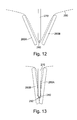
- the resilience of the covering layer 264 providing the necessary give to enable gripping of the apex 292 of the panel 290 and retaining the stiffening thread 280 within the panel 290 at the location where the crease is to be created and, simultaneously, full retraction of the blade 270 to occur whilst the panel 290 retains the stiffening thread 280 in the correct place under the pressing action of the plates 260. This is shown in Fig. 14 .
- the pressing and heating action of the plates 260A,B then cause the creation of the crease and, simultaneously, melting of the thermofusible element or elements of the stiffening thread 280.
- the thread may be drawn into and along the retraining groove 274 from a reel (not shown) prior to pressing and is then, once full projection of the blade 270 and gripping of the panel 290 by the plates 260A,B has occurred, is cut from the reel.
- the foregoing embodiment provides a method of applying a durable crease to a panel of fabric (which may be used in a garment) comprising the steps of: placing a composite thread comprising at least one ply of thermofusible material upon the panel; applying a fold to the panel whilst locating the thread; and applying heat to the panel thereby to melt the at least one thermofusible ply.
- the panel is drawn into a space between a pair of pressing plates by a blade in a direction substantially perpendicular to the direction of the crease.
- the foregoing embodiment enables creases of significant depth with regard to the size of the fabric panel to be created.
Landscapes
- Engineering & Computer Science (AREA)
- Textile Engineering (AREA)
- Mechanical Engineering (AREA)
- Chemical & Material Sciences (AREA)
- Chemical Kinetics & Catalysis (AREA)
- General Chemical & Material Sciences (AREA)
- Manufacturing & Machinery (AREA)
- Treatment Of Fiber Materials (AREA)
- Yarns And Mechanical Finishing Of Yarns Or Ropes (AREA)
- Knitting Of Fabric (AREA)
Applications Claiming Priority (1)
| Application Number | Priority Date | Filing Date | Title |
|---|---|---|---|
| GBGB1312822.8A GB201312822D0 (en) | 2013-07-17 | 2013-07-17 | Thread |
Publications (2)
| Publication Number | Publication Date |
|---|---|
| EP2857564A2 true EP2857564A2 (de) | 2015-04-08 |
| EP2857564A3 EP2857564A3 (de) | 2015-07-08 |
Family
ID=49081437
Family Applications (1)
| Application Number | Title | Priority Date | Filing Date |
|---|---|---|---|
| EP14002483.7A Withdrawn EP2857564A3 (de) | 2013-07-17 | 2014-07-17 | Faden |
Country Status (3)
| Country | Link |
|---|---|
| US (1) | US20150024202A1 (de) |
| EP (1) | EP2857564A3 (de) |
| GB (1) | GB201312822D0 (de) |
Cited By (1)
| Publication number | Priority date | Publication date | Assignee | Title |
|---|---|---|---|---|
| CN110325065A (zh) * | 2016-12-29 | 2019-10-11 | 爱德华·斯托弗尔 | 服装特别是运动服装 |
Families Citing this family (5)
| Publication number | Priority date | Publication date | Assignee | Title |
|---|---|---|---|---|
| CN105764368A (zh) * | 2013-11-29 | 2016-07-13 | 林成珪 | 具有撕裂预定线的功能性运动服 |
| DK3009020T3 (en) * | 2014-10-17 | 2018-10-15 | Cofemel Soc De Vestuario S A | Garment and method of manufacture |
| US12371822B2 (en) | 2017-06-06 | 2025-07-29 | Welspun India Limited | Hygro textile structures and related processes |
| US20240017685A1 (en) * | 2022-07-18 | 2024-01-18 | J. & P. Coats, Limited | Vehicle component based on selective commingled fiber bundle having integral electrical harness and embedded electronics |
| JP2025537258A (ja) * | 2022-11-10 | 2025-11-14 | ダブリュ.エル.ゴア アンド アソシエイツ,インコーポレイティド | 海藻栽培システム |
Family Cites Families (6)
| Publication number | Priority date | Publication date | Assignee | Title |
|---|---|---|---|---|
| GB8600487D0 (en) * | 1986-01-09 | 1986-02-12 | Birkin & Co Ltd | Lace making yarn & method |
| US5203939A (en) * | 1991-08-05 | 1993-04-20 | Coats Viyella, Plc | Process for production of internally bonded sewing threads |
| JPH06166905A (ja) * | 1992-06-03 | 1994-06-14 | Sakae Furukawa | ズボン等の衣類の折り目加工材と折り目加工方法 |
| JPH07173764A (ja) * | 1993-12-21 | 1995-07-11 | Sakae Furukawa | ズボンなどの衣類の折り目加工材 |
| WO2012124562A1 (ja) * | 2011-03-15 | 2012-09-20 | グンゼ株式会社 | 生体吸収性縫合糸及び生体吸収性縫合糸の製造方法 |
| DE102011052477A1 (de) * | 2011-08-08 | 2013-02-14 | Mayser Gmbh & Co. Kg | Coregarn |
-
2013
- 2013-07-17 GB GBGB1312822.8A patent/GB201312822D0/en not_active Ceased
-
2014
- 2014-07-17 US US14/333,845 patent/US20150024202A1/en not_active Abandoned
- 2014-07-17 EP EP14002483.7A patent/EP2857564A3/de not_active Withdrawn
Non-Patent Citations (1)
| Title |
|---|
| None |
Cited By (3)
| Publication number | Priority date | Publication date | Assignee | Title |
|---|---|---|---|---|
| CN110325065A (zh) * | 2016-12-29 | 2019-10-11 | 爱德华·斯托弗尔 | 服装特别是运动服装 |
| CN110325065B (zh) * | 2016-12-29 | 2021-11-05 | 爱德华·斯托弗尔 | 服装 |
| US11547157B2 (en) | 2016-12-29 | 2023-01-10 | Edouard STAUFFER | Garment, in particular a sports garment |
Also Published As
| Publication number | Publication date |
|---|---|
| EP2857564A3 (de) | 2015-07-08 |
| GB201312822D0 (en) | 2013-08-28 |
| US20150024202A1 (en) | 2015-01-22 |
Similar Documents
| Publication | Publication Date | Title |
|---|---|---|
| EP2857564A2 (de) | Faden | |
| US20050188907A1 (en) | Sewing method to increase seam strength | |
| CN105764369B (zh) | 连续折叠并带折痕的腰头、领座和用于制造连续折叠并带折痕的腰头、领座的方法和系统 | |
| US10918149B2 (en) | Article of apparel | |
| US3792672A (en) | Apparatus for cutting, folding and attaching tabs of flexible ribbon-like material | |
| US3453662A (en) | Method of laying out,cutting,and sewing a garment to provide minimal stitch pucker | |
| CN112773031B (zh) | 解决针织衬衫卷边的生产工艺 | |
| JP5896042B2 (ja) | 布地の縫製方法 | |
| US20210214872A1 (en) | Processing technology of luminous and exothermic fabrics | |
| Jana | Sewing equipment and work aids | |
| US2011512A (en) | Method of binding the edges of knitted fabrics | |
| EP2826913A1 (de) | Kleidungsstückherstellung | |
| CN114098202B (zh) | 一种免烫服装双向无缝边结构的制作工艺 | |
| US3649399A (en) | Method in tailoring of preventing one side of cloth folded back from being unfolded | |
| KR102012334B1 (ko) | 파이핑용 봉제장치 | |
| CN213866764U (zh) | 双门襟自动折边机 | |
| CN114150432A (zh) | 解决针织衬衫缝纫抽丝的生产工艺 | |
| CN110512343B (zh) | 一种全成形横向沿背中心分片编织方法及编织织物 | |
| CN115613190A (zh) | 柔软织唛及其制备方法 | |
| CN208857454U (zh) | 一种双线环缝纫机 | |
| CN217471644U (zh) | 一种手感柔软的绣花被套 | |
| TWI565848B (zh) | Sewing machine 's thread cutter and tangent method | |
| US2180424A (en) | Cutting and hemming and stitching apparatus | |
| CN119571516B (zh) | 一种可机洗可免烫亚麻面料、服装及制作方法 | |
| JP3860668B2 (ja) | 縁縫いテープと縁縫いテープ製造方法 |
Legal Events
| Date | Code | Title | Description |
|---|---|---|---|
| PUAI | Public reference made under article 153(3) epc to a published international application that has entered the european phase |
Free format text: ORIGINAL CODE: 0009012 |
|
| 17P | Request for examination filed |
Effective date: 20140717 |
|
| AK | Designated contracting states |
Kind code of ref document: A2 Designated state(s): AL AT BE BG CH CY CZ DE DK EE ES FI FR GB GR HR HU IE IS IT LI LT LU LV MC MK MT NL NO PL PT RO RS SE SI SK SM TR |
|
| AX | Request for extension of the european patent |
Extension state: BA ME |
|
| PUAL | Search report despatched |
Free format text: ORIGINAL CODE: 0009013 |
|
| AK | Designated contracting states |
Kind code of ref document: A3 Designated state(s): AL AT BE BG CH CY CZ DE DK EE ES FI FR GB GR HR HU IE IS IT LI LT LU LV MC MK MT NL NO PL PT RO RS SE SI SK SM TR |
|
| AX | Request for extension of the european patent |
Extension state: BA ME |
|
| RIC1 | Information provided on ipc code assigned before grant |
Ipc: D02G 3/36 20060101AFI20150603BHEP Ipc: D02G 3/40 20060101ALI20150603BHEP |
|
| STAA | Information on the status of an ep patent application or granted ep patent |
Free format text: STATUS: THE APPLICATION IS DEEMED TO BE WITHDRAWN |
|
| 18D | Application deemed to be withdrawn |
Effective date: 20160109 |