EP2860040A1 - Sicherheitselement, Wertdokument mit einem Sicherheitselement und Verfahren zur Herstellung des Sicherheitselements und des Wertdokuments - Google Patents
Sicherheitselement, Wertdokument mit einem Sicherheitselement und Verfahren zur Herstellung des Sicherheitselements und des Wertdokuments Download PDFInfo
- Publication number
- EP2860040A1 EP2860040A1 EP20130188267 EP13188267A EP2860040A1 EP 2860040 A1 EP2860040 A1 EP 2860040A1 EP 20130188267 EP20130188267 EP 20130188267 EP 13188267 A EP13188267 A EP 13188267A EP 2860040 A1 EP2860040 A1 EP 2860040A1
- Authority
- EP
- European Patent Office
- Prior art keywords
- groove
- foil
- substrate
- security element
- ply
- Prior art date
- Legal status (The legal status is an assumption and is not a legal conclusion. Google has not performed a legal analysis and makes no representation as to the accuracy of the status listed.)
- Granted
Links
Images



Classifications
-
- B—PERFORMING OPERATIONS; TRANSPORTING
- B42—BOOKBINDING; ALBUMS; FILES; SPECIAL PRINTED MATTER
- B42D—BOOKS; BOOK COVERS; LOOSE LEAVES; PRINTED MATTER CHARACTERISED BY IDENTIFICATION OR SECURITY FEATURES; PRINTED MATTER OF SPECIAL FORMAT OR STYLE NOT OTHERWISE PROVIDED FOR; DEVICES FOR USE THEREWITH AND NOT OTHERWISE PROVIDED FOR; MOVABLE-STRIP WRITING OR READING APPARATUS
- B42D25/00—Information-bearing cards or sheet-like structures characterised by identification or security features; Manufacture thereof
- B42D25/20—Information-bearing cards or sheet-like structures characterised by identification or security features; Manufacture thereof characterised by a particular use or purpose
- B42D25/29—Securities; Bank notes
Definitions
- the invention relates to a security element and a valuable document comprising a security element.
- the invention also relates to methods of manufacturing the security element and the valuable document.
- the substrates may be provided with through-windows thereby allowing observation of a security feature located on the foil and arranged in the window.
- a security element for a valuable document comprises a substrate.
- the substrate, or the plies of the substrate in case of a multi layer substrate may comprise cellulose fibers, particularly cotton fibers and/or organic synthetic fibers and/or mineral fibers.
- the substrate can generally be fibrous as for example any paper-like substrate.
- a first groove (or depression) is arranged on a first surface of the substrate, and a second groove (or depression) is arranged on a second surface of the substrate.
- the second surface of the substrate is opposite to the first surface.
- the first groove and the second groove face into opposite directions and away from the substrate.
- the first groove and the second groove are aligned with each other such that the first groove and the second groove are at least substantially superposed. In other words, the two groves substantially coincide or overlap if they are viewed perpendicular to the surface of the substrate.
- the security element comprises at least two elongate flat elements.
- the elongate elements advantageously have defined and even thickness over their full length and width. They can be attached to the substrate or any ply of the substrate after the grooves in the substrate or in any ply of the substrate has been formed.
- the elongate elements are advantageously elements in strip form, as for example a foil or a flat element of small size, as for example a patch which is attached to the surface of the ply or substrate.
- the elongate elements can advantageously be attached once the fibrous substrate or ply has dried, for example outside the papermaking machine production line.
- the elongate elements are a first foil and a second foil.
- the first foil front foil
- the second foil reverse foil
- the thickness of the first foil and the thickness of the second foil would contribute to the overall thickness of the foils and the substrate together.
- the thickness of the first foil and the thickness of the second foil are at least partially or substantially compensated by the dimensions of the first groove and the second groove.
- the thickness of the first foil and the thickness of the second foil are only partially compensated by the dimensions of the first groove and the second groove.
- a security element is provided that is based on a double groove - double foil concept which provides better quality of the security feature in terms of costs, durability, reproducibility and processability than the prior art and still has sufficient flatness.
- the dimensions of the first groove and the second groove comprise the depth, the length and the width of the first groove and the second groove, respectively. This provides that the additional thickness of the first and second foil is compensated substantially or to a certain extent over the area of the first foil and the second foil.
- the area of the foils or the grooves is the product of length and width.
- the depth of the first groove can be equal to or lower than the thickness of the first foil. It is particularly noteworthy that the depth of the first groove can be lower than the thickness of the first foil. This is based on the recognition that it is not necessary that the entire thickness of the first foil is compensated by the first groove. In other words, in an embodiment, the thickness of the first foil can therefore be greater than the depth of the first groove, for example by 5 ⁇ m to 35 ⁇ m.
- the width and length of the first groove are advantageously dimensioned such that the first foil fits into the first groove.
- the thickness of the second foil can also be greater than the depth of the second groove, for example by 5 ⁇ m to 20 ⁇ m. However, in an advantageous embodiment, the depth of the second groove can be about equal to the thickness of the second foil.
- the present invention particularly applies to embodiments in which the width of the first groove, the width of the second groove, the width of the first foil and the width of the second foil are equal to or greater than 0.8 cm.
- the width of the first groove can range from 0.8 cm to 3 cm.
- the width of the second groove can also range from 0.8 cm to 3 cm.
- the width of the first foil can range from 0.8 to 3 cm.
- the width of the second foil can range from 1 cm to 4 cm. This implies that the width of the second foil can advantageously always be greater than the width of the second groove.
- the width of the first foil can be equal to or lower than the width of the first groove.
- the width of the first foil can, for example be slightly lower than the width of the first groove by 1 mm to 6 mm.
- the thickness of the second foil is at least partially compensated by the second groove.
- the depth of the second groove can be equal to or lower than the thickness of the second foil.
- the width of the second foil can be equal to or greater than the width of the second groove.
- the width of the second foil can, for example be greater than the width of the second groove by 1 to 4 mm.
- the length of the second foil is advantageously equal to the length of the second groove.
- the width of the second foil can be greater than the width of the first foil.
- the second groove may inherently be a bit narrower than the first groove. It is then particularly advantageous that a certain overlap over the longitudinal edges of the second groove is acceptable.
- banknotes undergo a huge number of processing steps from manufacturing until they are sorted out and destroyed, it has been found that the two foils do not need to be entirely embedded in the substrate.
- a certain additional thickness or thickness variations are tolerable within the limits and definitions given in this specification.
- the first and second grooves as well as the first and second foils extend over the full length or width of the valuable document.
- the two grooves and the two foils of the security element typically all have the same length.
- the length of the first foil can advantageously be equal to the length of the second foil and also the first groove and the second groove can have the same length.
- the first and/or second foil advantageously have a width generally ranging between 8 mm and 30 mm, a thickness ranging between 10 ⁇ m and 50 ⁇ m, and a position from one edge to the opposite edge, across an entire length or an entire width of the substrate and therefore do not occupy the entire surface area of the substrate.
- a layer of the substrate can remain between the first groove and the second groove over the major part of the area in which the first groove and the second groove are superposed. In other words, in the area where the first groove and the second groove are superposed, or coincide, the majority of the substrate is not removed.
- the thickness of the remaining layer of the substrate in the area in which the first groove and the second groove are superposed can be 80 ⁇ m 130 ⁇ m. However, this value also depends on the overall thickness of the substrate. In terms of the reduction of the thickness of the substrate due to the first groove and the second groove, the reduction can range from 4 ⁇ m to 35 ⁇ m, and advantageously from 8 ⁇ m to 12 ⁇ m.
- the security element can further comprise a window in the substrate in the area in which the first groove and the second groove are superposed. In the area of the window, the substrate is entirely removed.
- the security element can further comprise a security feature that is arranged in the first foil and/or the second foil.
- the security feature can advantageously have a visual effect.
- the security feature in either the first and/or second foil can then advantageously be arranged in the window.
- the security feature is located in the first foil, if the first foil is thicker than the second foil and does not overlap the first groove at the longitudinal edges of the first groove.
- the substrate can be made of a single layer or ply. However, advantageously, the substrate can comprise a plurality of layers of plies. In an embodiment, the substrate may comprise a first ply (layer) of fabric and a second ply of fabric. The first ply and the second ply can extend over the entire substrate. In other words, the substrate can be formed of at least two plies, the first and the second ply.
- the first ply can be thicker than the second ply.
- the first ply is also referred to as mould layer.
- the mould layer or first ply can be thicker than the second ply.
- the second ply is also referred to as short-former layer.
- the short-former layer is advantageously the thinner layer.
- the invention also provides a method of manufacturing the security element according to the aspects and embodiments of the invention and a method of manufacturing a valuable document, in particular a banknote, comprising the security element.
- the grooves are formed by method steps relating to watermarking.
- the first groove can be formed by drainage control, i.e. by a locally reduced dewatering region. By locally different dewatering conditions, a reduced thickness can be achieved in the region of the first groove.
- This aspect advantageously applies to the first ply, i.e. the mould layer, if the first ply is the thicker layer.
- the second ply can then sink or settle into a groove on the second surface of the first ply in order to form the second groove.
- the drainage control can be used to produce two superposed grooves on the first ply.
- One of the grooves is the first groove, while the other groove serves as a depression in which the second ply (short-former layer) sinks in order to form the second groove on the opposite surface of the substrate.
- the second ply is removed first in order to create the second groove and then the first groove is created as a result of the missing second ply of the second groove.
- the second groove is created first, and by natural compensation of the internal tension during the paper formation, the first groove is spontaneously generated on the other side.
- the first groove and/or the second groove can be formed by lamination or localized calendering such that the fibers of the substrate are more compressed in the area of the first groove and/or the second groove.
- the bottom of the grooves is more compressed, i.e. the remaining layer or layers of the substrate are more compressed.
- first groove in the first layer can also be formed by mould cover relief.
- the first foil and/or the second foil can be configured such that the first groove and/or second groove are unperceivable to the naked eye.
- the reduced thickness of the substrate in the area of the grooves can become visible as an increased transparency of the substrate.
- either one or both of the foils can be made substantially opaque.
- the grooves are then hidden due to a specific property of one or both foils.
- a pigment may be added to the first and/or second foil in order to make one or both foils opaque.
- a metallic layer may be applied to one or both foils in order to render the grooves unperceivable.
- either one or both of the foils may be made of polymers which are inherently opaque.
- a pigment may be added to the second foil (backside foil) and a metallic or an opaque carrier medium may be added to the first foil (front foil).
- the invention also provides a valuable document comprising the security element according to the aspects and embodiments of the invention.
- the valuable document is advantageously a banknote.
- the first and second groove as well as the first and second foil may then advantageously extend over the full width or length of the valuable document, in particular the banknote.
- the sandwich structure of the first and second groove, remaining layer of the substrate and first and second foil extends over the width or length of the valuable document.
- FIG. 1 shows a simplified cross sectional view of a security element 10 according to an embodiment of the invention.
- the substrate 1 has a first grove 2 on a first surface.
- On the opposite surface of the substrate 1 is a second groove 3.
- the first groove 2 and the second groove 3 are superimposed, i.e. they are aligned one above the other.
- a first foil 4, in form of an elongate strip, is arranged in the first groove 2.
- a second foil 5, also in the form of an elongate strip, is arranged in the second groove 3.
- the first foil 4, the second foil 5 and the remaining layer 8 of the substrate 1 between the superimposed grooves 2, 3 form a sandwich structure. Accordingly, a sequence of foil, substrate and foil is provided while the two foils are substantially arranged in respective grooves.
- the width of the first foil 4 is F1W.
- the thickness of the first foil 4 is F1T.
- the width of the second foil 5 is F2W.
- the thickness of the second foil 5 is F2T. In this embodiment, the thickness F1T of the first foil 4 is greater than the thickness F2T of the second foil 5.
- the width of the first groove 2 is G1W.
- the depth of the first groove is G1T.
- the width of the second groove 3 is G2W.
- the depth of the second groove is G2T.
- the width G1W of the first groove 2 is slightly greater than the width F1W of the first foil 4. This means that the width G1W of the first groove 2 is dimensioned such that the first foil 2 fits into the first groove 2.
- the thickness F1T of the first foil 4 is greater than the depth G1T of the first foil 4. This allows even complex security features to be incorporated into the first foil 4 rather than into the second foil 5 which is thinner than the first foil 4.
- the thickness F2T of the second foil 5 is greater than the depth G2T of the second groove 3.
- the thickness F2T of the second foil 5 can even be greater than the sum of the thicknesses G1T, G2T of both grooves 2, 3 (i.e. F2T can be greater than G1T + G2T).
- the thickness of the second foil 5 can be greater than the depth of the second groove, for example by 5 ⁇ m to 35 ⁇ m.
- the width G2W of the second groove 3 is lower than the width F2W of the second foil 5. This means that the width G2W of the second groove 3 is dimensioned such that the second foil 5 (slightly) overlaps the longitudinal edges of the second groove 3. This small overlap has turned out to be tolerable and it simplifies the manufacturing procedure.
- the width of the second foil 5 can, for example be greater than the width of the second groove 3 by 1 mm to 4 mm.
- the width F2W of the second foil is also greater than the width G1W of the first groove 2.
- the first and/or second foil 4, 5 advantageously have a width generally ranging between 8 mm and 30 mm, a thickness ranging between 10 ⁇ m and 50 ⁇ m, and a position from one edge to the opposite edge, across an entire length or an entire width of the substrate 1 and therefore do not occupy the entire surface area of the substrate 1.
- the width G1W of the first groove 2 can range from 0.8 cm to 3 cm.
- the width G2W of the second groove 3 can also range from 0.8 cm to 3 cm.
- the width F1W of the first foil 4 can range from 0.8 to 3 cm.
- the width F2W of the second foil 5 can range from 1 cm to 4 cm. This implies that the width F2W of the second foil 5 can advantageously always be greater than the width G2W of the second groove 3.
- the width F1W of the first foil 4 can be equal to or lower than the width G1W of the first groove 2.
- the width F1W of the first foil 4 can, for example be lower than the width G1W of the first groove 2 by 1 mm to 6 mm.
- the foils 4, 5 compensate the mechanical properties (for example resistance) due the reduced thickness of the substrate in the area of the grooves.
- the grooves compensate the additional thickness of the foils.
- the thickness of the foils 4,5 is only partly compensated by the depth of the grooves 2,3.
- the sandwich structure of the security element 10 provides high quality, stability, durability and processability.
- the first foil 4 and the second foil 5 are not necessarily entirely embedded into the substrate 1. Certain overlaps due to the thickness F1T of the first foil 4 and the width F2W of the second foil 5 are acceptable. This simplifies production.
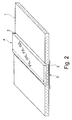
- FIG. 2 shows a simplified perspective view on the security element shown in FIG. 1 .
- the foils 4, 5 and the grooves 2, 3 extend over the entire substrate.
- the lengths of the first and second groove G1L, G2L and the lengths of the first and second foil F1L, F2L are then equal.
- FIG. 3 shows a simplified cross sectional view of a substrate 1 according to an embodiment.
- the reduced thickness of the substrate in the area of the first groove 2 and the second groove 3 is mainly or exclusively achieved by localized drainage variations on the first ply 6 (mould layer).
- the thinner second ply 7 (short-former layer) mainly sinks into the groove on the surface of the first ply 6 which is opposite to the first groove 2.
- the thickness of the first ply 6 is SP1T outside the groove areas of grooves 2, 3.
- the thickness of the second ply 7 is SP2T outside the groove areas of grooves 2, 3.
- the first ply 6 has only thickness of SP1T* with SP1T being greater than SP1T*.
- the second ply 7 has the thickness SP2T* with SP2T* being equal to SP2T.
- the thickness of the remaining layer 8 between the grooves is then SP1T* plus SP2T*.
- the thickness SP1T*+SP2T* of the remaining layer 8 of the substrate in the area in which the first groove and the second groove are superposed can be 80 ⁇ m to 130 ⁇ m. However, this value also depends on the overall thickness of the substrate. In terms of the reduction of the thickness of the substrate due to the first and second groove, the reduction can range from 4 ⁇ m to 35 ⁇ m, and advantageously from 8 ⁇ m to 12 ⁇ m.
- the advantage of using localized varying drainage is that the bottom surface of the grooves remains rather flat over the entire surface of the bottom surface.
- FIG. 4 shows a simplified cross sectional view of a substrate 1 according to another embodiment.
- the first ply 6 only has a groove on its outer surface which is the first groove 2.
- the second groove 3 is formed by removing the second ply 7 in the area of the second groove 3.
- the thickness of the remaining layer 8 of the substrate is then defined by SP1T*, i.e. only by the thickness of the first ply 6 in the area of the first groove 2.
- the second ply 7 is removed first in order to create the second groove 3 and then the first groove 2 is created as result of the missing second ply 7 of the second groove 3.
- the second groove is created first and by natural compensation of the internal tension during the paper formation, the first groove 2 is spontaneously generated on the other side of the substrate.
- FIG. 5 shows a simplified cross sectional view of a substrate 1 according to another embodiment.
- the two grooves 6, 7 are created by calendering.
- the two plies 6, 7 are more compressed inside the area of the grooves 6, 7 than outside the grooves.
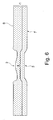
- FIG. 6 shows a simplified cross sectional view of a substrate 1 according to still another embodiment.
- the two groves are formed by mould cover relief modulation. Similar to the embodiment of FIG. 3 , also here two superimposed grooves are only generated on the first ply 6. The thickness of the second ply 7 remains unaffected.
- This well-known method of creating grooves or depressions in fibrous substrates has the disadvantage that the bottom surface of the grooves is uneven and that the edges of the grooves are less steep and sharp than with the other methods of manufacturing the grooves.
- the first foil 4 and/or the second foil 5 can be configured such that the first groove 2 and/or second groove 3 are not perceivable to the naked eye.
- the reduced thickness of the substrate 1 in the area of the grooves 2, 3 can become visible as an increased transparency of the substrate.
- either one or both of the foils 4, 5 can be made substantially opaque.
- the grooves 2, 3 are then hidden due to a specific property of one or both foils 4, 5.
- a pigment may be added to the first and/or second foil 4, 5 in order to make one or both foils 4, 5 opaque.
- a metallic layer may be applied to one or both foils 4, 5 in order to render the grooves unperceivable.
- either one or both of the foils 4, 5 may be made of polymers which are inherently opaque.
- a pigment may be added to the second foil 5 (backside foil) and a metallic or an opaque carrier medium may be added to the first foil 4 (front foil).
Landscapes
- Business, Economics & Management (AREA)
- Accounting & Taxation (AREA)
- Finance (AREA)
- Credit Cards Or The Like (AREA)
Priority Applications (2)
| Application Number | Priority Date | Filing Date | Title |
|---|---|---|---|
| ES13188267.2T ES2611960T3 (es) | 2013-10-11 | 2013-10-11 | Elemento de seguridad, documento de valor que comprende un elemento de seguridad y método para fabricar el elemento de seguridad y el documento de valor |
| EP13188267.2A EP2860040B1 (de) | 2013-10-11 | 2013-10-11 | Sicherheitselement, wertdokument mit einem sicherheitselement und verfahren zur herstellung des sicherheitselements und des wertdokuments |
Applications Claiming Priority (1)
| Application Number | Priority Date | Filing Date | Title |
|---|---|---|---|
| EP13188267.2A EP2860040B1 (de) | 2013-10-11 | 2013-10-11 | Sicherheitselement, wertdokument mit einem sicherheitselement und verfahren zur herstellung des sicherheitselements und des wertdokuments |
Publications (2)
| Publication Number | Publication Date |
|---|---|
| EP2860040A1 true EP2860040A1 (de) | 2015-04-15 |
| EP2860040B1 EP2860040B1 (de) | 2016-12-07 |
Family
ID=49356249
Family Applications (1)
| Application Number | Title | Priority Date | Filing Date |
|---|---|---|---|
| EP13188267.2A Active EP2860040B1 (de) | 2013-10-11 | 2013-10-11 | Sicherheitselement, wertdokument mit einem sicherheitselement und verfahren zur herstellung des sicherheitselements und des wertdokuments |
Country Status (2)
| Country | Link |
|---|---|
| EP (1) | EP2860040B1 (de) |
| ES (1) | ES2611960T3 (de) |
Cited By (4)
| Publication number | Priority date | Publication date | Assignee | Title |
|---|---|---|---|---|
| WO2017137369A1 (fr) | 2016-02-10 | 2017-08-17 | Oberthur Fiduciaire Sas | Procédé de fabrication de documents de sécurité et documents correspondants |
| WO2018115515A1 (fr) | 2016-12-23 | 2018-06-28 | Oberthur Fiduciaire Sas | Document securise |
| EP3623528A1 (de) | 2018-09-14 | 2020-03-18 | Oberthur Fiduciaire SAS | Herstellungsverfahren eines plattenmaterials, entsprechende maschine, entsprechendes plattenmaterial und entsprechendes sicherheitsdokument |
| DE102021003553A1 (de) | 2021-06-28 | 2022-12-29 | Giesecke+Devrient Currency Technology Gmbh | Sicherheitssubstrat |
Families Citing this family (1)
| Publication number | Priority date | Publication date | Assignee | Title |
|---|---|---|---|---|
| DE102019006890A1 (de) * | 2019-10-02 | 2021-04-08 | Giesecke+Devrient Currency Technology Gmbh | Herstellverfahren für ein Sicherheitspapier und damit erhältliches Sicherheitspapier |
Citations (5)
| Publication number | Priority date | Publication date | Assignee | Title |
|---|---|---|---|---|
| US5248544A (en) * | 1990-02-01 | 1993-09-28 | Gao Gesellschaft Fur Automation Und Organisation Mbh | Paper of value having an optically variable security element |
| EP0773220A1 (de) | 1995-11-09 | 1997-05-14 | SUMIKA FINE CHEMICALS Co., Ltd. | 2-Amino-6-chlorpurin und Verfahren zu seiner Herstellung |
| WO1999037488A1 (en) * | 1998-01-21 | 1999-07-29 | Securency Pty. Ltd. | Method of verifying the authenticity of a security document and document for use in such a method |
| WO2003053713A1 (de) * | 2001-12-21 | 2003-07-03 | Giesecke & Devrient Gmbh | Sicherheitselement für sicherheitspapiere und wertdokumente |
| EP2199095A2 (de) * | 2008-12-17 | 2010-06-23 | Giesecke & Devrient GmbH | Sicherheitselement für Datenträger und Verfahren zum Herstellen desselben |
-
2013
- 2013-10-11 EP EP13188267.2A patent/EP2860040B1/de active Active
- 2013-10-11 ES ES13188267.2T patent/ES2611960T3/es active Active
Patent Citations (5)
| Publication number | Priority date | Publication date | Assignee | Title |
|---|---|---|---|---|
| US5248544A (en) * | 1990-02-01 | 1993-09-28 | Gao Gesellschaft Fur Automation Und Organisation Mbh | Paper of value having an optically variable security element |
| EP0773220A1 (de) | 1995-11-09 | 1997-05-14 | SUMIKA FINE CHEMICALS Co., Ltd. | 2-Amino-6-chlorpurin und Verfahren zu seiner Herstellung |
| WO1999037488A1 (en) * | 1998-01-21 | 1999-07-29 | Securency Pty. Ltd. | Method of verifying the authenticity of a security document and document for use in such a method |
| WO2003053713A1 (de) * | 2001-12-21 | 2003-07-03 | Giesecke & Devrient Gmbh | Sicherheitselement für sicherheitspapiere und wertdokumente |
| EP2199095A2 (de) * | 2008-12-17 | 2010-06-23 | Giesecke & Devrient GmbH | Sicherheitselement für Datenträger und Verfahren zum Herstellen desselben |
Cited By (4)
| Publication number | Priority date | Publication date | Assignee | Title |
|---|---|---|---|---|
| WO2017137369A1 (fr) | 2016-02-10 | 2017-08-17 | Oberthur Fiduciaire Sas | Procédé de fabrication de documents de sécurité et documents correspondants |
| WO2018115515A1 (fr) | 2016-12-23 | 2018-06-28 | Oberthur Fiduciaire Sas | Document securise |
| EP3623528A1 (de) | 2018-09-14 | 2020-03-18 | Oberthur Fiduciaire SAS | Herstellungsverfahren eines plattenmaterials, entsprechende maschine, entsprechendes plattenmaterial und entsprechendes sicherheitsdokument |
| DE102021003553A1 (de) | 2021-06-28 | 2022-12-29 | Giesecke+Devrient Currency Technology Gmbh | Sicherheitssubstrat |
Also Published As
| Publication number | Publication date |
|---|---|
| EP2860040B1 (de) | 2016-12-07 |
| ES2611960T3 (es) | 2017-05-11 |
Similar Documents
| Publication | Publication Date | Title |
|---|---|---|
| RU2652225C9 (ru) | Подложка для защищенных бумаг и способ ее изготовления | |
| EP2860040B1 (de) | Sicherheitselement, wertdokument mit einem sicherheitselement und verfahren zur herstellung des sicherheitselements und des wertdokuments | |
| CN106605022B (zh) | 安全纸张和制造方法 | |
| US8268128B2 (en) | Security substrates | |
| AU2016330006B2 (en) | Security print media and method of manufacture thereof | |
| US20100181036A1 (en) | Process for manufacturing a sheet material | |
| CN107250459B (zh) | 用于安全器件到基底的表面施加的方法 | |
| US20100207377A1 (en) | Process for manufacturing a sheet material | |
| CN105209688A (zh) | 具有水印和防伪线的有价和防伪元件 | |
| US20140238628A1 (en) | Method for Manufacturing a Security Paper and Microlens Thread | |
| EP1929090B2 (de) | Sicherheitsvorrichtung für sicherheitssubstrate | |
| CA2646275C (en) | Identity document with tissue reinforcement | |
| GB2395724A (en) | Fibrous substrate incorporating electronic chips | |
| EP2886364B1 (de) | Sicherheitsdokument sowie Verfahren zum Herstellen eines Sicherheitsdokuments | |
| EP2993057B1 (de) | Banknote mit fenster | |
| RU2427468C1 (ru) | Многослойная бумага для изготовления ценных документов, содержащая упрочняющие полосы | |
| US20180072088A1 (en) | Security element | |
| TH96315A (th) | เอกสารปลอดปลอมซึ่งประกอบด้วยอุปกรณ์อาร์เอฟไอดี |
Legal Events
| Date | Code | Title | Description |
|---|---|---|---|
| PUAI | Public reference made under article 153(3) epc to a published international application that has entered the european phase |
Free format text: ORIGINAL CODE: 0009012 |
|
| 17P | Request for examination filed |
Effective date: 20131011 |
|
| AK | Designated contracting states |
Kind code of ref document: A1 Designated state(s): AL AT BE BG CH CY CZ DE DK EE ES FI FR GB GR HR HU IE IS IT LI LT LU LV MC MK MT NL NO PL PT RO RS SE SI SK SM TR |
|
| AX | Request for extension of the european patent |
Extension state: BA ME |
|
| R17P | Request for examination filed (corrected) |
Effective date: 20151015 |
|
| RBV | Designated contracting states (corrected) |
Designated state(s): AL AT BE BG CH CY CZ DE DK EE ES FI FR GB GR HR HU IE IS IT LI LT LU LV MC MK MT NL NO PL PT RO RS SE SI SK SM TR |
|
| REG | Reference to a national code |
Ref country code: DE Ref legal event code: R079 Ref document number: 602013014965 Country of ref document: DE Free format text: PREVIOUS MAIN CLASS: B42D0015000000 Ipc: B42D0025290000 |
|
| GRAP | Despatch of communication of intention to grant a patent |
Free format text: ORIGINAL CODE: EPIDOSNIGR1 |
|
| RIC1 | Information provided on ipc code assigned before grant |
Ipc: B42D 25/29 20140101AFI20160503BHEP |
|
| INTG | Intention to grant announced |
Effective date: 20160520 |
|
| GRAS | Grant fee paid |
Free format text: ORIGINAL CODE: EPIDOSNIGR3 |
|
| GRAA | (expected) grant |
Free format text: ORIGINAL CODE: 0009210 |
|
| AK | Designated contracting states |
Kind code of ref document: B1 Designated state(s): AL AT BE BG CH CY CZ DE DK EE ES FI FR GB GR HR HU IE IS IT LI LT LU LV MC MK MT NL NO PL PT RO RS SE SI SK SM TR |
|
| REG | Reference to a national code |
Ref country code: GB Ref legal event code: FG4D |
|
| REG | Reference to a national code |
Ref country code: CH Ref legal event code: EP Ref country code: CH Ref legal event code: NV Representative=s name: BUGNION S.A., CH Ref country code: AT Ref legal event code: REF Ref document number: 851358 Country of ref document: AT Kind code of ref document: T Effective date: 20161215 |
|
| REG | Reference to a national code |
Ref country code: IE Ref legal event code: FG4D |
|
| REG | Reference to a national code |
Ref country code: DE Ref legal event code: R096 Ref document number: 602013014965 Country of ref document: DE |
|
| REG | Reference to a national code |
Ref country code: NL Ref legal event code: FP |
|
| PG25 | Lapsed in a contracting state [announced via postgrant information from national office to epo] |
Ref country code: LV Free format text: LAPSE BECAUSE OF FAILURE TO SUBMIT A TRANSLATION OF THE DESCRIPTION OR TO PAY THE FEE WITHIN THE PRESCRIBED TIME-LIMIT Effective date: 20161207 |
|
| REG | Reference to a national code |
Ref country code: LT Ref legal event code: MG4D |
|
| PG25 | Lapsed in a contracting state [announced via postgrant information from national office to epo] |
Ref country code: SE Free format text: LAPSE BECAUSE OF FAILURE TO SUBMIT A TRANSLATION OF THE DESCRIPTION OR TO PAY THE FEE WITHIN THE PRESCRIBED TIME-LIMIT Effective date: 20161207 Ref country code: GR Free format text: LAPSE BECAUSE OF FAILURE TO SUBMIT A TRANSLATION OF THE DESCRIPTION OR TO PAY THE FEE WITHIN THE PRESCRIBED TIME-LIMIT Effective date: 20170308 Ref country code: LT Free format text: LAPSE BECAUSE OF FAILURE TO SUBMIT A TRANSLATION OF THE DESCRIPTION OR TO PAY THE FEE WITHIN THE PRESCRIBED TIME-LIMIT Effective date: 20161207 Ref country code: NO Free format text: LAPSE BECAUSE OF FAILURE TO SUBMIT A TRANSLATION OF THE DESCRIPTION OR TO PAY THE FEE WITHIN THE PRESCRIBED TIME-LIMIT Effective date: 20170307 |
|
| REG | Reference to a national code |
Ref country code: ES Ref legal event code: FG2A Ref document number: 2611960 Country of ref document: ES Kind code of ref document: T3 Effective date: 20170511 |
|
| PG25 | Lapsed in a contracting state [announced via postgrant information from national office to epo] |
Ref country code: RS Free format text: LAPSE BECAUSE OF FAILURE TO SUBMIT A TRANSLATION OF THE DESCRIPTION OR TO PAY THE FEE WITHIN THE PRESCRIBED TIME-LIMIT Effective date: 20161207 Ref country code: FI Free format text: LAPSE BECAUSE OF FAILURE TO SUBMIT A TRANSLATION OF THE DESCRIPTION OR TO PAY THE FEE WITHIN THE PRESCRIBED TIME-LIMIT Effective date: 20161207 Ref country code: HR Free format text: LAPSE BECAUSE OF FAILURE TO SUBMIT A TRANSLATION OF THE DESCRIPTION OR TO PAY THE FEE WITHIN THE PRESCRIBED TIME-LIMIT Effective date: 20161207 |
|
| PG25 | Lapsed in a contracting state [announced via postgrant information from national office to epo] |
Ref country code: IS Free format text: LAPSE BECAUSE OF FAILURE TO SUBMIT A TRANSLATION OF THE DESCRIPTION OR TO PAY THE FEE WITHIN THE PRESCRIBED TIME-LIMIT Effective date: 20170407 Ref country code: RO Free format text: LAPSE BECAUSE OF FAILURE TO SUBMIT A TRANSLATION OF THE DESCRIPTION OR TO PAY THE FEE WITHIN THE PRESCRIBED TIME-LIMIT Effective date: 20161207 Ref country code: EE Free format text: LAPSE BECAUSE OF FAILURE TO SUBMIT A TRANSLATION OF THE DESCRIPTION OR TO PAY THE FEE WITHIN THE PRESCRIBED TIME-LIMIT Effective date: 20161207 Ref country code: CZ Free format text: LAPSE BECAUSE OF FAILURE TO SUBMIT A TRANSLATION OF THE DESCRIPTION OR TO PAY THE FEE WITHIN THE PRESCRIBED TIME-LIMIT Effective date: 20161207 Ref country code: SK Free format text: LAPSE BECAUSE OF FAILURE TO SUBMIT A TRANSLATION OF THE DESCRIPTION OR TO PAY THE FEE WITHIN THE PRESCRIBED TIME-LIMIT Effective date: 20161207 |
|
| PG25 | Lapsed in a contracting state [announced via postgrant information from national office to epo] |
Ref country code: SM Free format text: LAPSE BECAUSE OF FAILURE TO SUBMIT A TRANSLATION OF THE DESCRIPTION OR TO PAY THE FEE WITHIN THE PRESCRIBED TIME-LIMIT Effective date: 20161207 Ref country code: PL Free format text: LAPSE BECAUSE OF FAILURE TO SUBMIT A TRANSLATION OF THE DESCRIPTION OR TO PAY THE FEE WITHIN THE PRESCRIBED TIME-LIMIT Effective date: 20161207 Ref country code: BE Free format text: LAPSE BECAUSE OF FAILURE TO SUBMIT A TRANSLATION OF THE DESCRIPTION OR TO PAY THE FEE WITHIN THE PRESCRIBED TIME-LIMIT Effective date: 20161207 Ref country code: PT Free format text: LAPSE BECAUSE OF FAILURE TO SUBMIT A TRANSLATION OF THE DESCRIPTION OR TO PAY THE FEE WITHIN THE PRESCRIBED TIME-LIMIT Effective date: 20170407 Ref country code: BG Free format text: LAPSE BECAUSE OF FAILURE TO SUBMIT A TRANSLATION OF THE DESCRIPTION OR TO PAY THE FEE WITHIN THE PRESCRIBED TIME-LIMIT Effective date: 20170307 |
|
| REG | Reference to a national code |
Ref country code: DE Ref legal event code: R097 Ref document number: 602013014965 Country of ref document: DE |
|
| PLBE | No opposition filed within time limit |
Free format text: ORIGINAL CODE: 0009261 |
|
| STAA | Information on the status of an ep patent application or granted ep patent |
Free format text: STATUS: NO OPPOSITION FILED WITHIN TIME LIMIT |
|
| REG | Reference to a national code |
Ref country code: FR Ref legal event code: PLFP Year of fee payment: 5 |
|
| 26N | No opposition filed |
Effective date: 20170908 |
|
| PG25 | Lapsed in a contracting state [announced via postgrant information from national office to epo] |
Ref country code: DK Free format text: LAPSE BECAUSE OF FAILURE TO SUBMIT A TRANSLATION OF THE DESCRIPTION OR TO PAY THE FEE WITHIN THE PRESCRIBED TIME-LIMIT Effective date: 20161207 Ref country code: SI Free format text: LAPSE BECAUSE OF FAILURE TO SUBMIT A TRANSLATION OF THE DESCRIPTION OR TO PAY THE FEE WITHIN THE PRESCRIBED TIME-LIMIT Effective date: 20161207 |
|
| PG25 | Lapsed in a contracting state [announced via postgrant information from national office to epo] |
Ref country code: MC Free format text: LAPSE BECAUSE OF FAILURE TO SUBMIT A TRANSLATION OF THE DESCRIPTION OR TO PAY THE FEE WITHIN THE PRESCRIBED TIME-LIMIT Effective date: 20161207 |
|
| REG | Reference to a national code |
Ref country code: IE Ref legal event code: MM4A |
|
| PG25 | Lapsed in a contracting state [announced via postgrant information from national office to epo] |
Ref country code: LU Free format text: LAPSE BECAUSE OF NON-PAYMENT OF DUE FEES Effective date: 20171011 |
|
| PG25 | Lapsed in a contracting state [announced via postgrant information from national office to epo] |
Ref country code: MT Free format text: LAPSE BECAUSE OF NON-PAYMENT OF DUE FEES Effective date: 20171011 |
|
| REG | Reference to a national code |
Ref country code: FR Ref legal event code: PLFP Year of fee payment: 6 |
|
| PG25 | Lapsed in a contracting state [announced via postgrant information from national office to epo] |
Ref country code: IE Free format text: LAPSE BECAUSE OF NON-PAYMENT OF DUE FEES Effective date: 20171011 |
|
| PG25 | Lapsed in a contracting state [announced via postgrant information from national office to epo] |
Ref country code: HU Free format text: LAPSE BECAUSE OF FAILURE TO SUBMIT A TRANSLATION OF THE DESCRIPTION OR TO PAY THE FEE WITHIN THE PRESCRIBED TIME-LIMIT; INVALID AB INITIO Effective date: 20131011 |
|
| PG25 | Lapsed in a contracting state [announced via postgrant information from national office to epo] |
Ref country code: CY Free format text: LAPSE BECAUSE OF FAILURE TO SUBMIT A TRANSLATION OF THE DESCRIPTION OR TO PAY THE FEE WITHIN THE PRESCRIBED TIME-LIMIT Effective date: 20161207 |
|
| REG | Reference to a national code |
Ref country code: AT Ref legal event code: UEP Ref document number: 851358 Country of ref document: AT Kind code of ref document: T Effective date: 20161207 |
|
| PG25 | Lapsed in a contracting state [announced via postgrant information from national office to epo] |
Ref country code: MK Free format text: LAPSE BECAUSE OF FAILURE TO SUBMIT A TRANSLATION OF THE DESCRIPTION OR TO PAY THE FEE WITHIN THE PRESCRIBED TIME-LIMIT Effective date: 20161207 |
|
| PG25 | Lapsed in a contracting state [announced via postgrant information from national office to epo] |
Ref country code: TR Free format text: LAPSE BECAUSE OF FAILURE TO SUBMIT A TRANSLATION OF THE DESCRIPTION OR TO PAY THE FEE WITHIN THE PRESCRIBED TIME-LIMIT Effective date: 20161207 |
|
| PG25 | Lapsed in a contracting state [announced via postgrant information from national office to epo] |
Ref country code: AL Free format text: LAPSE BECAUSE OF FAILURE TO SUBMIT A TRANSLATION OF THE DESCRIPTION OR TO PAY THE FEE WITHIN THE PRESCRIBED TIME-LIMIT Effective date: 20161207 |
|
| P01 | Opt-out of the competence of the unified patent court (upc) registered |
Effective date: 20230515 |
|
| REG | Reference to a national code |
Ref country code: CH Ref legal event code: U11 Free format text: ST27 STATUS EVENT CODE: U-0-0-U10-U11 (AS PROVIDED BY THE NATIONAL OFFICE) Effective date: 20251101 |
|
| PGFP | Annual fee paid to national office [announced via postgrant information from national office to epo] |
Ref country code: NL Payment date: 20251021 Year of fee payment: 13 |
|
| PGFP | Annual fee paid to national office [announced via postgrant information from national office to epo] |
Ref country code: DE Payment date: 20250721 Year of fee payment: 13 |
|
| PGFP | Annual fee paid to national office [announced via postgrant information from national office to epo] |
Ref country code: GB Payment date: 20251022 Year of fee payment: 13 |
|
| PGFP | Annual fee paid to national office [announced via postgrant information from national office to epo] |
Ref country code: AT Payment date: 20251022 Year of fee payment: 13 |
|
| PGFP | Annual fee paid to national office [announced via postgrant information from national office to epo] |
Ref country code: IT Payment date: 20251024 Year of fee payment: 13 |
|
| PGFP | Annual fee paid to national office [announced via postgrant information from national office to epo] |
Ref country code: FR Payment date: 20251030 Year of fee payment: 13 |
|
| PGFP | Annual fee paid to national office [announced via postgrant information from national office to epo] |
Ref country code: CH Payment date: 20251101 Year of fee payment: 13 |
|
| PGFP | Annual fee paid to national office [announced via postgrant information from national office to epo] |
Ref country code: ES Payment date: 20251210 Year of fee payment: 13 |