EP2861003A1 - Verfahren und vorrichtung zur kontrolle von anwendungsrechten - Google Patents
Verfahren und vorrichtung zur kontrolle von anwendungsrechten Download PDFInfo
- Publication number
- EP2861003A1 EP2861003A1 EP12879120.9A EP12879120A EP2861003A1 EP 2861003 A1 EP2861003 A1 EP 2861003A1 EP 12879120 A EP12879120 A EP 12879120A EP 2861003 A1 EP2861003 A1 EP 2861003A1
- Authority
- EP
- European Patent Office
- Prior art keywords
- application
- permission
- policy
- trust level
- monitoring policy
- Prior art date
- Legal status (The legal status is an assumption and is not a legal conclusion. Google has not performed a legal analysis and makes no representation as to the accuracy of the status listed.)
- Withdrawn
Links
Images





Classifications
-
- H—ELECTRICITY
- H04—ELECTRIC COMMUNICATION TECHNIQUE
- H04L—TRANSMISSION OF DIGITAL INFORMATION, e.g. TELEGRAPHIC COMMUNICATION
- H04L63/00—Network architectures or network communication protocols for network security
- H04L63/10—Network architectures or network communication protocols for network security for controlling access to devices or network resources
- H04L63/105—Multiple levels of security
-
- G—PHYSICS
- G06—COMPUTING OR CALCULATING; COUNTING
- G06F—ELECTRIC DIGITAL DATA PROCESSING
- G06F21/00—Security arrangements for protecting computers, components thereof, programs or data against unauthorised activity
- G06F21/50—Monitoring users, programs or devices to maintain the integrity of platforms, e.g. of processors, firmware or operating systems
- G06F21/57—Certifying or maintaining trusted computer platforms, e.g. secure boots or power-downs, version controls, system software checks, secure updates or assessing vulnerabilities
-
- H—ELECTRICITY
- H04—ELECTRIC COMMUNICATION TECHNIQUE
- H04L—TRANSMISSION OF DIGITAL INFORMATION, e.g. TELEGRAPHIC COMMUNICATION
- H04L9/00—Cryptographic mechanisms or cryptographic arrangements for secret or secure communications; Network security protocols
- H04L9/32—Cryptographic mechanisms or cryptographic arrangements for secret or secure communications; Network security protocols including means for verifying the identity or authority of a user of the system or for message authentication, e.g. authorization, entity authentication, data integrity or data verification, non-repudiation, key authentication or verification of credentials
- H04L9/3247—Cryptographic mechanisms or cryptographic arrangements for secret or secure communications; Network security protocols including means for verifying the identity or authority of a user of the system or for message authentication, e.g. authorization, entity authentication, data integrity or data verification, non-repudiation, key authentication or verification of credentials involving digital signatures
-
- H—ELECTRICITY
- H04—ELECTRIC COMMUNICATION TECHNIQUE
- H04W—WIRELESS COMMUNICATION NETWORKS
- H04W4/00—Services specially adapted for wireless communication networks; Facilities therefor
- H04W4/60—Subscription-based services using application servers or record carriers, e.g. SIM application toolkits
-
- H—ELECTRICITY
- H04—ELECTRIC COMMUNICATION TECHNIQUE
- H04L—TRANSMISSION OF DIGITAL INFORMATION, e.g. TELEGRAPHIC COMMUNICATION
- H04L63/00—Network architectures or network communication protocols for network security
- H04L63/08—Network architectures or network communication protocols for network security for authentication of entities
- H04L63/0823—Network architectures or network communication protocols for network security for authentication of entities using certificates
-
- H—ELECTRICITY
- H04—ELECTRIC COMMUNICATION TECHNIQUE
- H04M—TELEPHONIC COMMUNICATION
- H04M1/00—Substation equipment, e.g. for use by subscribers
- H04M1/72—Mobile telephones; Cordless telephones, i.e. devices for establishing wireless links to base stations without route selection
- H04M1/724—User interfaces specially adapted for cordless or mobile telephones
- H04M1/72448—User interfaces specially adapted for cordless or mobile telephones with means for adapting the functionality of the device according to specific conditions
- H04M1/72463—User interfaces specially adapted for cordless or mobile telephones with means for adapting the functionality of the device according to specific conditions to restrict the functionality of the device
Definitions
- the present invention relates to the field of communications, and in particular to a method and device for controlling permission of an application.
- the current intelligent mobile terminal system may only ensure the detection of stability and data integrity of a download program but cannot verify the source of a mobile phone application effectively due to the lack of a comprehensive test and an effective verification mechanism; and moreover, it cannot monitor a security threat which may be posed to an installed application effectively, therefore, the security of the mobile terminal cannot be ensured effectively.
- a security system for controlling permission of an application is absent, posing a huge security risk to the mobile terminal due to the vague permission of the application when the mobile terminal downloads and runs an application or in other processes.
- the present invention provides a method and device for controlling a permission of an application, so as to at least solve the problem that a security system for controlling permission of an application is absent in the related art, posing a huge security risk to the mobile terminal due to the vague permission of the application when the mobile terminal downloads and runs an application or in other processes.
- a method for controlling permission of an application includes: a trust level of an application is acquired according to signature information of the application, wherein the application includes at least one of the followings: an application to be downloaded, an application to be installed and an installed application; and the permission of the application is controlled according to the trust level and a preset monitoring policy.
- acquiring the trust level of the application according to the signature information of the application may include : the signature information of the application is acquired; and the signature information is matched with at least one certificate public key of at least one preset certificate in a mobile terminal and the trust level is set for the application according to a matching result, wherein different matching results correspond to different trust levels.
- setting the trust level for the application according to the matching result may include: the number of at least one pair of matched signature information and certificate public key, or a name of a certificate is recorded; and the trust level of the application is set according to the number of the at least one pair or the name of the certificate.
- the permission of the application is controlled according to the trust level and the preset monitoring policy may include: it is detected whether a currently used permission of the application is one of permissions in a system default monitoring policy; and if so, a policy corresponding to the trust level is searched in the system default monitoring policy and the permission of the application is controlled according to the corresponding policy.
- searching for the policy corresponding to the trust level in the system default monitoring policy may include: it is detected whether there is an application monitoring policy corresponding to the currently used permission of the application, wherein the application monitoring policy is used for indicating a period during which usage condition of the permission is monitored; and if so, the policy corresponding to the trust level is searched in the application monitoring policy.
- the method may further include: a process of controlling the currently used permission of the application is saved and analyzed to acquire a processing policy; or, the process of controlling the current permission of the application is synchronized to a cloud server to acquire the processing policy.
- a device for controlling permission of an application is provided.
- the device is applied to a mobile terminal and includes: an acquisition entity configured to acquire a trust level of an application according to signature information of the application, wherein the application includes at least one of the followings: an application to be downloaded, an application to be installed and an installed application; and a control entity configured to control the permission of the application according to the trust level and a preset monitoring policy.
- the acquisition entity may include: an acquisition unit configured to acquire the signature information of the application; a matching unit configured to match the signature information with at least one certificate public key of at least one preset certificate in a mobile terminal; and a setting unit configured to set the trust level for the application according to a matching result, wherein different matching results correspond to different trust levels.
- control entity may include: a detecting unit configured to detect whether a currently used permission of the application is one of the permissions in a system default monitoring policy; a finding unit configured to search for a policy, which is corresponding to the trust level, in the system default monitoring policy when the current permission is one of permissions in the system default monitoring policy; and a control unit configured to control the permission of the application according to the corresponding found policy.
- a detecting unit configured to detect whether a currently used permission of the application is one of the permissions in a system default monitoring policy
- finding unit configured to search for a policy, which is corresponding to the trust level, in the system default monitoring policy when the current permission is one of permissions in the system default monitoring policy
- control unit configured to control the permission of the application according to the corresponding found policy.
- the device may further include: a saving entity configured to save and analyze a process of controlling the currently used permission of the application to acquire a processing policy or synchronize the process of controlling the current permission of the application to a cloud server to acquire the processing policy.
- a saving entity configured to save and analyze a process of controlling the currently used permission of the application to acquire a processing policy or synchronize the process of controlling the current permission of the application to a cloud server to acquire the processing policy.
- the acquired trust level is added to the process of controlling the application permission and a corresponding monitoring policy is preset for the trust level.
- the mobile terminal is relatively poor in the application monitoring capability. It is mainly manifested in the following aspects: (1) a trust level of an application, which is essential for monitoring the permission effectively, cannot be supported and verified effectively, so that the permission of the application cannot be monitored well by classification; (2) there are relatively many permissions needing monitoring by default and the monitoring is too complicated, but only some permissions are monitored according to the actual requirements of a user; and (3) an open platform is relatively open so that the control for the permission of the application in the mobile terminal is relatively flexible and most of permission application developers may achieve acquisition only by statement.
- the sensitive permissions of a mobile phone device involving a permission referring to charging of a user (including sending a message, making a call, surfing on an internet and the like), a permission for private information of a user (including a message record, a contact record, a call record and the like), a permission for local connection of a mobile phone device (including WIFI connection, Bluetooth connection and the like) is not monitored effectively.
- an embodiment of the present invention provides a method for controlling permission of an application.
- the flow of the method is as shown in Fig. 1 , including Steps S102-S104.
- Step S102 A trust level of an application is acquired according to signature information of the application, wherein the application includes at least one of the followings: an application to be downloaded, an application to be installed and an installed application.
- Step 104 The permission of the application is controlled according to the trust level and a preset monitoring policy.
- the acquired trust level is employed in a process of controlling the application permission and a corresponding monitoring policy is preset for the trust level, so that the problem that a security system for controlling permission of an application is absent in the related arts, posing a huge security risk to the mobile terminal due to the vague permission of the application when the mobile terminal downloads and runs an application or in other processes is solved, and a relatively secure and comprehensive method for monitoring the application permission is provided to improve the performance of the mobile terminal.
- acquiring the trust level of the application according to the signature information of the application may include: the signature information of the application is acquired; and the signature information is matched with at least one certificate public key of at least one preset certificate in a mobile terminal and the trust level is set according to a matching result, wherein different trust levels correspond to different matching results.
- Setting the trust level for the application according to the matching result may further include: the number of at least one pair of matched signature information and certificate public key, or a name of a certificate is recorded; and the trust level of the application is set according to the number of the at least one pair or the name of the certificate.
- the trust level may be presented in a trusted form and an un-trusted form or in a form of different trust levels, such as trust level 1 and trust level 2.
- the trust level when the trust level is presented in a form of different trust levels, there are two conditions.
- the first condition is that the trust level may be set according to the name of the certificate, such as a "manufacturer trust level", an "operator trust level” and a "third-party partner trust level", so that the trust level corresponding to a certificate may be acquired when the signature information is authenticated successfully by the certificate.
- the second condition is that the trust level may also be set according to the number of different authentication certificates by which the signature information is authenticated successfully. For example, if the signature information is authenticated successfully by one authentication certificate, the trust level is set to 1, namely, trust level 1; or, the application is set to level 2 if the signature information is authenticated by two authentication certificates.
- a matching threshold may be set; namely, when the number of at least one pair of matched signature information of the application and certificate public key reaches a preset value, it is determined that the trust level of the application is a trusted level; and when the trusted application uses a sensitive permission, its operation permission may not be controlled.
- the matching threshold may be further set to pass a fixed certificate. For example, after the signature information of the application is matched with an operator certificate, it is determined that the trust level of the application is a trusted level, and the trust level is regarded to be an un-trusted level if the signature information of the application is not authenticated by the operator certificate.
- the trust level may be set correspondingly according to different requirements of different users.
- step S102 it is detected whether the currently used permission of the application is one of permissions in the system default monitoring policy. If yes, it is indicated that the currently used permission is a valued permission of the user, the policy corresponding to the trust level is searched in the system default monitoring policy, and the permission of the application is controlled according to the corresponding found policy. If it is not one the permissions in the system default monitoring policy, the currently used permission may not be controlled.
- the policy corresponding to the trust level may be searched in the application monitoring policy. For example, when it is detected that a player, the trust level of which is 3, accesses a contact database, it is detected whether accessing contact database is one of permissions in the system default monitoring policy. If yes, the control policy of the player, the trust level of which is 3, is searched in the system default monitoring policy.
- the player is not controlled when accessing the contact database. If the trust levels 1-3 are corresponding to a policy that the sensitive permission is not allowed, a control process is recorded or an alarm is given when the player accesses the contact database or the alarm is recorded at the same time.
- the mobile terminal when the mobile terminal detects that a game application uses an internet permission, which is a sensitive permission, at 3 a.m., the process of using the internet permission is recorded for further processing.
- a prompt dialog box may pop up in the system to remind a user and wait to receive the setting of the application monitoring policy made by the user. Then, the monitoring setting of the permission made by the user (a full-time monitoring/a full-time non-monitoring/a periodic monitoring) is converted into the application monitoring policy used by the permission, and a monitoring policy record value recorded by the system is saved and updated. At the moment, the system has the application monitoring policy and the used permission may be monitored according to the policy.
- the process of controlling the currently used permission of the application may be analyzed to acquire a processing policy or is synchronized to a cloud server to acquire the processing policy. If the permission of the application is analyzed locally, the record of the analyzing process may be presented to a user to be processed according to the actual condition; and if the process of controlling the currently used permission of the application is synchronized to the cloud server to acquire the processing policy, the cloud server analyzes it according to the synchronized process and sends the analysis result to a mobile terminal so that the user carries out processing according to the processing policy acquired by the analysis of the cloud server.
- a preferred embodiment provides a method for controlling permission of an application.
- a mobile terminal which is a mobile phone, is taken as an example for description.
- Fig. 2 shows the flow of acquiring a trust level of an application, and the method includes steps S202-S212.
- Step S202 information of an application package is parsed when scanning is performed after power on or when the application is installed.
- the application package is uncompressed and then the information of the application package is parsed.
- Step S204 signature information of the application is extracted according to a parsing result of the application package and then the signature information of the application is recorded.
- Step S206 The signature information of the application is authenticated by comparing with at least one public key file of at least one preset digital certificate in a mobile phone and it is detected whether the authentication is passed. If the authentication is passed, the step S208 is performed; otherwise, the step 210 is performed.
- Step S208 A trust level corresponding to the digital certificate which passes the authentication is set, such as a "manufacturer trust level", an “operator trust level” and a “third-party partner trust level”; or, the trust level may also be set according to the number of different authentication certificates by which the signature information of the application is successfully authenticated. For example, the trust level is set to 1 when the signature information of the application is authenticated by one authentication certificate, namely, trust level 1, or the trust level of the application is set to 2 when the signature information of the application is authenticated by two authentication certificates.
- the step S212 is performed.
- Step S210 An "un-trusted level" is set for the application.
- Step S212 The trust level of the application obtained by authentication is recorded in a property configuration file corresponding to the application, wherein the trust level of the application is taken as a normal property of the application.
- Fig. 3 which is a flowchart of a method for generating a system default monitoring policy, the flow includes steps S302-S306.
- Step S302 A configuration file for the system default monitoring policy is loaded.
- the preset configuration file for the system default monitoring policy is loaded to a specified directory of the system when an initialization is performed after power on.
- Step S304 The configuration file for the system default monitoring policy is parsed to acquire a list of permission needing to be monitored by each application entity.
- Step S306 The parsed list of permission needing to be monitored by each application entity is recorded to a data structure in the memory to generate a system default monitoring policy.
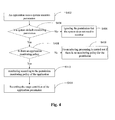
- Fig. 4 is a flowchart of a process of generating an application control policy, and the flow includes steps S402-S414.
- Step S402 When it is monitored that the current application uses a sensitive permission in the system, the step S404 is performed.
- the sensitive permission may be customized according to the requirements of a user, such as a permission referring to the charging of the user or a permission referring to the private information of the user.
- Step S404 it is detected whether the currently used permission belongs to one of permissions needing to be controlled by the system default control policy. If so, turn to the step S408. If not, turn to the step S406.
- Step S406 The currently used permission, which is not belonging to the permissions needing to be monitored by the system default monitoring policy, is not monitored.
- Step S408 it is detected whether there is an application monitoring policy for the currently used permission. If there is no application monitoring policy for the currently used permission, the step S410 is performed; otherwise, the step S412 is performed.
- Step S410 If there is no application monitoring policy for the currently used permission, monitoring processing is omitted.
- Step S412 Monitoring is carried out according to the application monitoring policy.
- Step S414 Usage condition of the permission is recorded.
- Fig. 5 shows an overall flow of monitoring permission of an application, and the whole monitoring process is described below in combination with Fig. 5 .
- the process includes steps S502-S518.
- Step S502 When it is monitored that a sensitive permission of an application is accessed, the step S504 is performed.
- Step S504 it is detected whether the currently used permission belongs to the permissions needing to be controlled by a system default control policy. In the implementation process of the step, it is necessary to search the currently used permission in the system default control policy. If the currently used permission does not belong to the permissions in the system default control policy, the step S506 is performed; otherwise, the step 508 is performed.
- Step S506 The currently used permission, which does not belong to the permissions needing to be controlled by the system default control policy, is not monitored. For example, when the sensitive permission accessed by a user refers to a local connection permission of a mobile phone device, the currently used permission, which is not in the system default control policy, is not controlled.
- Step S508 it is detected whether there is an application monitoring policy for the currently used permission. If there is the application monitoring policy for the currently used permission, the step S510 is performed; otherwise, the step S512 is performed.
- Step S510 the application monitoring policy for the currently used permission is acquired and the currently used permission is monitored according to the application monitoring policy.
- Step S512 if there is no corresponding application monitoring policy for the currently used permission, a prompt dialog box pops up to remind the user that a sensitive permission of the system is being used, and the sensitive permission is not monitored to wait to receive further setting of the permission monitoring made by the user.
- Step S514 The setting for the application monitoring policy made by the user is received.
- Step S516 The monitoring setting for the currently used permission made by the user is converted into the application monitoring policy for the currently used permission, and a monitoring policy record value recorded by the system is saved and updated, wherein the monitoring setting may be a full-time monitoring, a full-time a non-monitoring, periodic monitoring and other settings.
- Step S518 Monitoring is carried out according to the application monitoring policy set by the user.
- applications in the mobile phone terminal may classified based on the trust level effectively and the sensitive permissions are classified to be managed according to the classification of trust levels of the applications.
- control for the sensitive permission of a mobile phone may be customized and adjusted dynamically according to different control requirements of a manufacturer or a user.
- the user can manage and control a key sensitive permission group in the mobile phone terminal easily and manage and control a security threat possibly posed to the mobile phone application effectively, thereby ensuring the security of the mobile phone effectively.
- a sensitive permission group in an intelligent mobile phone which may be subjected to malicious intrusion most frequently and needs high protection most may be monitored by software.
- the permission group to be monitored may include: a permission of sending a message, a permission of making a call, a permission of accessing and controlling network flow, a permission of accessing a contact record, a permission of accessing a message record, a permission of accessing mobile phone device information, a permission of accessing geographic location information, a permission of establishing WIFI connection and a permission of establishing Bluetooth connection.
- the monitoring for the permission which is an "un-trusted application"
- the application permissions in other trust levels all adopt similar monitoring principles and processing flow.
- a system default monitoring policy is set.
- Such permissions as a permission of sending a message, a permission of making a call and a permission of accessing network flow are added to the permissions needing to be controlled, wherein the permissions needing to be controlled are corresponding to an "un-trusted application trust level”.
- a file is configured and is defined in an xml file format. The content of the defined configuration file is as follows:
- a sysControlPermission tag represents a system default control permission; a trustLevel tag represents a permission trust level; "unApproved" indicates that the permission is un-trusted and needs monitoring; a permission tag represents a permission needing to be monitored in a trust level; SEND_SMS represents a permission of sending a message; CALL_PHONE represents a permission of making a call; ACCESS_ INTERNET represents a permission of accessing network flow; ACCESS_MESSAGE represents a permission of accessing a message record; ACCESS_CONTACTS represents a permission of accessing a contact record; ACCESS_MESSAGE represents a permission of accessing a message record; ACCESS_CALLLOG represents a permission of accessing a call log; ACCESS_LOCATION represents a permission of accessing personal geographic location information (including GPS positioning and base station positioning); ACCESS_DEVICE_INFO represents a permission of accessing mobile phone device information (including IMEI, IMSI, own number and the like
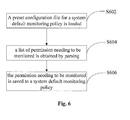
- Fig. 6 which is a flowchart of a process for generating a system default monitoring policy, the flow includes steps S602-S606.
- Step S602 A preset configuration file for a system default monitoring policy is loaded to a specified directory of the system during the initialization when the system is started.
- Step S604 The configuration file for the system default monitoring policy is parsed to acquire a list of permission needing to be monitored in an "un-trusted monitoring permission".
- Step S606 The parsed list of permission needing to be monitored is recorded in a memory to form a system default monitoring policy.
- Step S702 When it is monitored that permission is used by an application, the step S704 is performed. For example, when it is recorded that a player application accesses a contact database in its service process, the step S704 is performed.
- Step S704 The currently used permission of the application is acquired and is compared with a system default permission list.
- Step S706 it is detected whether the currently used permission belongs to the permissions controlled by the system by default. If it does not belong to the permission controlled by the system by default, the step S708 is performed; and if it belongs to the permission controlled by the system by default, the step S710 is executed.
- Step S708 The usage condition of the currently used permission is not monitored because the permission does not belong to the permissions controlled by the system by default.
- Step S710 it is detected whether there is an application monitoring policy for the currently used permission. If so, the step S712 is performed; otherwise, the step S714 is performed.
- Step S712 An application monitoring policy for the currently used permission is acquired and the currently used permission is monitored according to the application monitoring policy.
- Step S714 There is no application monitoring policy for the currently used permission, so that a prompt dialog box may pop up in the system to remind a user to wait to receive the setting of the application monitoring policy which is for the currently used permission and is made by the user.
- Step S716 the application monitoring policy for the currently used permission is received from the user.
- Step S718 The setting of the application monitoring policy which is for the currently used permission and is made by the user (a full-time monitoring/a full-time non-monitoring/a periodic monitoring) is converted into the application monitoring policy for the currently used permission, and a monitoring policy record value recorded by the system is saved and updated.
- Step S720 The currently used permission is monitored according to the choice of the user.
- Step S722 The monitoring information is saved or synchronized to a cloud server.
- Step S724 The saved data is analyzed according to an analysis policy or a cloud processing policy is fed back to the user.
- the permissions of different applications may be well controlled; the permission (such as a permission of sending a message, a permission of making a call and a permission of accessing network flow) of an application in a mobile phone may be monitored and managed respectively; and the application monitoring policy for the permission of the application may be adjusted flexibly according to the actual monitoring requirement and scenario of the user.
- the permission of a mobile phone terminal may be monitored and managed and such security threat behaviour as malicious intrusion of the mobile phone terminal may be effectively found and instantly reminded and prevented, so that the security of the permission of the mobile phone terminal may be ensured effectively.
- An embodiment of the present invention further provides a device for controlling permission of an application.
- the device may be configured to detect the security of the application permission in a mobile terminal.
- the block diagram showing the structure of the device is shown in Fig. 8 , including: an acquisition entity 10 configured to acquire a trust level of an application according to signature information of the application, wherein the application includes at least one of the followings: an application to be downloaded, an application to be mounted and an installed application; and a control entity 20 coupled with the acquisition entity 10 and configured to control the permission of the application according to the trust level and a preset monitoring policy.
- the acquisition entity 10 of the device shown in Fig. 9 may include: an acquisition unit 102 configured to acquire the signature information of the application; a matching unit 104 coupled with the acquisition unit 102 and configured to match the signature information with at least one certificate public key of at least one preset certificates in the mobile terminal; and a setting unit 106 coupled with the matching unit 104 and configured to set the trust levels for the application according to a matching result, wherein different trust levels corresponds to different matching results.
- the acquisition entity 10 may be further configured to record the number of at least one pair of matched signature information and certificate public key and to set the trust level of the application according to the number of at least one pair of matched signature information and certificate public key.
- the device for controlling the permission of the application may be as shown in Fig. 10 .
- Its control entity 20 may include: a detecting unit 202 configured to detect whether a currently used permission of the application is one of permissions in the system default monitoring policy; a finding unit 204 coupled with the detecting unit 202 and configured to search a policy ,which is corresponding to the trust level, in the system default monitoring policy when the currently used permission is one of the permissions in the system default monitoring policy; and a control unit 206 coupled with the finding unit 204 and configured to control the permission of the application according to the corresponding found policy.
- control entity 20 may be further configured to detect whether there is an application monitoring policy for the currently used permission of the application; and if so, the policy corresponding to the trust level is searched in the application monitoring policy.
- the device for controlling the permission of the application shown in Fig. 11 may further include a saving entity 30 coupled with the control entity 20 and configured to save and analyze a process of controlling the currently used permission of the application to acquire a processing policy or synchronize the process of controlling the currently used permission of the application to a cloud server to acquire the processing policy.
- a saving entity 30 coupled with the control entity 20 and configured to save and analyze a process of controlling the currently used permission of the application to acquire a processing policy or synchronize the process of controlling the currently used permission of the application to a cloud server to acquire the processing policy.
- the preferred embodiment provides a device for controlling permission of an application.
- the device is implemented based on a mechanism that trust levels of applications are classified according to the signature authentication, and applications preset/installed in a mobile phone may be effectively classified based on the trust levels.
- An application monitoring policy is established for the permission of the application needing to be monitored, the application monitoring policy may be configured according to the requirements of a user, namely, the permissions to be monitored for each application may be adjusted flexibly.
- a user may define the application monitoring policy for the application according to the actual requirement; and based on the support of the mechanisms that are the trust level of the application and the application monitoring policy of permission and log analysis policy mechanism, the key sensitive permission of a system of a mobile phone may be monitored dynamically.
- the names of respective entities are slightly different from the names of entities in the device in the embodiments above, but the combination of respective entities in the embodiment may implement the same function as the device in the embodiment above.
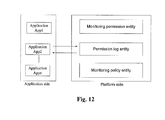
- the embodiment includes the following entities:
- the diagram showing the structure of the preferred embodiment may be as shown in Fig. 12 .
- the monitoring policy entity is called and a preset monitoring policy configuration file is loaded and parsed; and then the system default monitoring permission policy is generated according to the parsing result.
- the authentication entity When the system is started, the authentication entity is called and then the monitoring permission entity is loaded for background monitoring.
- the usage condition of the permission may be transmitted to the permission log entity to be recorded; and then the analysis process is performed by the analyzing permission policy entity.
- the monitoring permission entity cooperates with the permission log entity and the monitoring policy entity to finally monitor the usage condition of the application permission and provide a suggestion to the user.
- the present invention adopts the following method that the acquired trust level is employed in a process of controlling the application permission and a corresponding monitoring policy is preset for the trust level.
- the entities or steps of the present invention may be implemented by general computing device and centralized in a single computing device or distributed in a network consisting of multiple computing devices.
- the entities or steps may be implemented by program codes executable by the computing device, so that they may be stored in a storage device and executed by the computing device, and, in some cases, the steps can be executed in a sequence different from the illustrated or described sequence, or they are respectively made into the integrated circuit entities or many of them are made into a single integrated circuit entity.
- the present invention is not limited to any specific combination of hardware and software.
Landscapes
- Engineering & Computer Science (AREA)
- Computer Security & Cryptography (AREA)
- Computer Hardware Design (AREA)
- General Engineering & Computer Science (AREA)
- Computer Networks & Wireless Communication (AREA)
- Signal Processing (AREA)
- Theoretical Computer Science (AREA)
- Software Systems (AREA)
- Computing Systems (AREA)
- General Physics & Mathematics (AREA)
- Physics & Mathematics (AREA)
- Telephone Function (AREA)
- Mobile Radio Communication Systems (AREA)
- Storage Device Security (AREA)
Applications Claiming Priority (2)
| Application Number | Priority Date | Filing Date | Title |
|---|---|---|---|
| CN201210192660.5A CN103491056B (zh) | 2012-06-12 | 2012-06-12 | 应用权限的控制方法及装置 |
| PCT/CN2012/079659 WO2013185413A1 (zh) | 2012-06-12 | 2012-08-03 | 应用权限的控制方法及装置 |
Publications (2)
| Publication Number | Publication Date |
|---|---|
| EP2861003A1 true EP2861003A1 (de) | 2015-04-15 |
| EP2861003A4 EP2861003A4 (de) | 2015-10-28 |
Family
ID=49757463
Family Applications (1)
| Application Number | Title | Priority Date | Filing Date |
|---|---|---|---|
| EP12879120.9A Withdrawn EP2861003A4 (de) | 2012-06-12 | 2012-08-03 | Verfahren und vorrichtung zur kontrolle von anwendungsrechten |
Country Status (4)
| Country | Link |
|---|---|
| US (1) | US20150222641A1 (de) |
| EP (1) | EP2861003A4 (de) |
| CN (1) | CN103491056B (de) |
| WO (1) | WO2013185413A1 (de) |
Cited By (2)
| Publication number | Priority date | Publication date | Assignee | Title |
|---|---|---|---|---|
| EP4287050A1 (de) * | 2022-05-30 | 2023-12-06 | Siemens Aktiengesellschaft | Überwachung eines anwendungsprogramms in abhängigkeit dessen privilegs |
| US20240241959A1 (en) * | 2023-01-12 | 2024-07-18 | Giesecke+Devrient Mobile Security Germany Gmbh | Change and recovery of personalization data in a secure element |
Families Citing this family (28)
| Publication number | Priority date | Publication date | Assignee | Title |
|---|---|---|---|---|
| WO2014036021A1 (en) * | 2012-08-28 | 2014-03-06 | Visa International Service Association | Secure device service enrollment |
| US20140123300A1 (en) | 2012-11-26 | 2014-05-01 | Elwha Llc | Methods and systems for managing services and device data |
| US9619497B2 (en) | 2012-10-30 | 2017-04-11 | Elwah LLC | Methods and systems for managing one or more services and/or device data |
| US9749206B2 (en) | 2012-10-30 | 2017-08-29 | Elwha Llc | Methods and systems for monitoring and/or managing device data |
| US20140123325A1 (en) | 2012-11-26 | 2014-05-01 | Elwha Llc | Methods and systems for managing data and/or services for devices |
| US9088450B2 (en) | 2012-10-31 | 2015-07-21 | Elwha Llc | Methods and systems for data services |
| US10091325B2 (en) | 2012-10-30 | 2018-10-02 | Elwha Llc | Methods and systems for data services |
| US9635486B2 (en) * | 2014-06-10 | 2017-04-25 | Microsoft Technology Licensing, Llc | Network selection for a given application or context |
| US9521153B2 (en) * | 2014-08-18 | 2016-12-13 | Dell Products L.P. | Platform trust extension |
| CN104318180A (zh) * | 2014-11-18 | 2015-01-28 | 上海斐讯数据通信技术有限公司 | 基于智能终端的系统安全权限处理状态机模型 |
| CN105243311B (zh) | 2015-10-19 | 2017-02-22 | 广东欧珀移动通信有限公司 | 一种指纹信息的安全调用方法、装置及移动终端 |
| CN105468939B (zh) * | 2015-11-24 | 2018-12-14 | 苏州铭冠软件科技有限公司 | 移动终端安全防护系统 |
| US20170149828A1 (en) | 2015-11-24 | 2017-05-25 | International Business Machines Corporation | Trust level modifier |
| CN105760751B (zh) * | 2016-02-14 | 2019-02-05 | 联想(北京)有限公司 | 一种信息处理方法和电子设备 |
| CN106650444B (zh) * | 2016-11-25 | 2020-01-14 | 成都网安科技发展有限公司 | 一种基于软件签名和安装时间的Android系统应用检测方法 |
| US20180183836A1 (en) * | 2016-12-28 | 2018-06-28 | Ca, Inc. | Discovery driven web-based application resource protection |
| CN108268793A (zh) * | 2016-12-30 | 2018-07-10 | 珠海金山办公软件有限公司 | 一种权限编辑方法及装置 |
| CN107172646A (zh) * | 2017-06-06 | 2017-09-15 | 苏州小雨伞网络科技有限公司 | 一种跨设备网络监控方法 |
| US11222135B2 (en) | 2018-05-28 | 2022-01-11 | International Business Machines Corporation | User device privacy protection |
| CN109195158B (zh) * | 2018-07-04 | 2022-04-26 | 中国联合网络通信集团有限公司 | 一种出境安检方法及系统 |
| CN108513300A (zh) * | 2018-07-11 | 2018-09-07 | 北京奇安信科技有限公司 | 一种管控wifi连接的处理方法及终端 |
| CN109711161B (zh) * | 2018-12-03 | 2022-04-22 | 联想(北京)有限公司 | 一种监控方法及电子设备 |
| CN109684825B (zh) * | 2018-12-28 | 2023-07-07 | 维沃移动通信有限公司 | 一种权限管理方法及终端设备 |
| CN110046494B (zh) * | 2019-04-24 | 2019-11-19 | 天聚地合(苏州)数据股份有限公司 | 基于终端的大数据处理方法及系统 |
| CN110334518B (zh) * | 2019-07-05 | 2021-05-14 | 北京可信华泰信息技术有限公司 | 基于可信计算平台的度量策略的验证方法及装置 |
| US11438325B2 (en) | 2020-02-28 | 2022-09-06 | EMC IP Holding Company LLC | Trust establishment by escalation |
| CN113746690B (zh) * | 2020-08-12 | 2023-01-31 | 西安京迅递供应链科技有限公司 | 监控流量数据的方法、装置及计算机可读存储介质 |
| CN111683107A (zh) * | 2020-08-14 | 2020-09-18 | 北京东方通软件有限公司 | 面向互联网的安全审计方法和系统 |
Family Cites Families (15)
| Publication number | Priority date | Publication date | Assignee | Title |
|---|---|---|---|---|
| US7099663B2 (en) * | 2001-05-31 | 2006-08-29 | Qualcomm Inc. | Safe application distribution and execution in a wireless environment |
| EP1564957B1 (de) * | 2004-02-11 | 2007-08-22 | Sony Ericsson Mobile Communications AB | Vorrichtung und Verfahren zur dynamischen Sicherheitsverwaltung |
| JP2005275839A (ja) * | 2004-03-25 | 2005-10-06 | Nec Corp | ソフトウェア利用許可方法及びシステム |
| US7853793B2 (en) * | 2004-05-03 | 2010-12-14 | Piotr Cofta | Trusted signature with key access permissions |
| US7797545B2 (en) * | 2005-09-29 | 2010-09-14 | Research In Motion Limited | System and method for registering entities for code signing services |
| US8020001B2 (en) * | 2006-02-23 | 2011-09-13 | Qualcomm Incorporated | Trusted code groups |
| US8245031B2 (en) * | 2006-07-07 | 2012-08-14 | Sandisk Technologies Inc. | Content control method using certificate revocation lists |
| CN101513008B (zh) * | 2006-07-31 | 2012-09-19 | 意大利电信股份公司 | 在电信终端上实现安全性的系统 |
| US9218200B2 (en) * | 2008-08-21 | 2015-12-22 | Vmware, Inc. | Selective class hiding in open API component architecture system |
| CN101651697A (zh) * | 2009-09-21 | 2010-02-17 | 杭州华三通信技术有限公司 | 一种网络访问权限的管理方法和设备 |
| CN101707652B (zh) * | 2009-10-20 | 2013-05-01 | 天地融科技股份有限公司 | 能够实现数字证书应用的手机 |
| US8832447B2 (en) * | 2011-08-10 | 2014-09-09 | Sony Corporation | System and method for using digital signatures to assign permissions |
| CN102404727B (zh) * | 2011-11-24 | 2017-12-05 | 中兴通讯股份有限公司 | 移动终端的安全控制方法及装置 |
| CN102420902B (zh) * | 2011-11-24 | 2015-08-12 | 中兴通讯股份有限公司 | 一种分类管理功能使用权限的方法及移动终端 |
| CN102413220B (zh) * | 2011-11-24 | 2014-08-20 | 中兴通讯股份有限公司 | 一种控制连接功能的使用权限的方法及移动终端 |
-
2012
- 2012-06-12 CN CN201210192660.5A patent/CN103491056B/zh active Active
- 2012-08-03 WO PCT/CN2012/079659 patent/WO2013185413A1/zh not_active Ceased
- 2012-08-03 US US14/415,650 patent/US20150222641A1/en not_active Abandoned
- 2012-08-03 EP EP12879120.9A patent/EP2861003A4/de not_active Withdrawn
Cited By (2)
| Publication number | Priority date | Publication date | Assignee | Title |
|---|---|---|---|---|
| EP4287050A1 (de) * | 2022-05-30 | 2023-12-06 | Siemens Aktiengesellschaft | Überwachung eines anwendungsprogramms in abhängigkeit dessen privilegs |
| US20240241959A1 (en) * | 2023-01-12 | 2024-07-18 | Giesecke+Devrient Mobile Security Germany Gmbh | Change and recovery of personalization data in a secure element |
Also Published As
| Publication number | Publication date |
|---|---|
| CN103491056A (zh) | 2014-01-01 |
| US20150222641A1 (en) | 2015-08-06 |
| EP2861003A4 (de) | 2015-10-28 |
| WO2013185413A1 (zh) | 2013-12-19 |
| CN103491056B (zh) | 2017-12-26 |
Similar Documents
| Publication | Publication Date | Title |
|---|---|---|
| EP2861003A1 (de) | Verfahren und vorrichtung zur kontrolle von anwendungsrechten | |
| US11722496B2 (en) | Tracking or storing of equipment configuration data using immutable ledger functionality of blockchains | |
| CN109309657B (zh) | 未授权访问点探测系统及方法、用于其的用户终端及计算机程序 | |
| KR101389682B1 (ko) | 바이러스 피해를 방지하는 시스템 및 방법 | |
| US9417849B2 (en) | Communications network, computer architecture, computer-implemented method and computer program product for development and management of femtocell-based applications | |
| EP2759956B1 (de) | System zum Prüfen einer Computeranwendung | |
| US20200021585A1 (en) | Secure updating of telecommunication terminal configuration | |
| US20140258128A1 (en) | Method for managing fund security and mobile terminal | |
| JP2012084159A5 (de) | ||
| CN113225339B (zh) | 网络安全监测方法、装置、计算机设备及存储介质 | |
| CN103546436A (zh) | 一种安全控制方法及终端、云服务器 | |
| CN104519490A (zh) | Wifi连接方法、装置、移动终端及系统 | |
| US12120522B2 (en) | Provision of application level identity | |
| KR101244037B1 (ko) | 휴대용 단말의 관리 방법 및 시스템 | |
| US20250392614A1 (en) | Home Gateway Monitoring for Vulnerable Home Internet of Things Devices | |
| US10979280B2 (en) | Managing devices through secondary communication channels | |
| CN111988784A (zh) | 一种信息处理方法、终端设备及存储介质 | |
| EP3876129A1 (de) | Integrität für einen mobilen netzwerkdatenspeicher | |
| US10542434B2 (en) | Evaluating as to whether or not a wireless terminal is authorized | |
| KR20070120157A (ko) | 무선 통신 네트워크를 통한 무선 장치의 서비스프로그래밍을 위한 장치 및 방법 | |
| CN104782154A (zh) | 一种用于禁用在装置中的算法的方法和设备 | |
| CN109039676A (zh) | 一种网络故障诊断方法、装置和计算机可读存储介质 | |
| CN106485104A (zh) | 终端安全策略的自动修复方法和装置、系统 | |
| CN116032763B (zh) | 网络业务的处理方法、系统和网关设备 | |
| CN109714371B (zh) | 一种工控网络安全检测系统 |
Legal Events
| Date | Code | Title | Description |
|---|---|---|---|
| PUAI | Public reference made under article 153(3) epc to a published international application that has entered the european phase |
Free format text: ORIGINAL CODE: 0009012 |
|
| 17P | Request for examination filed |
Effective date: 20150112 |
|
| AK | Designated contracting states |
Kind code of ref document: A1 Designated state(s): AL AT BE BG CH CY CZ DE DK EE ES FI FR GB GR HR HU IE IS IT LI LT LU LV MC MK MT NL NO PL PT RO RS SE SI SK SM TR |
|
| AX | Request for extension of the european patent |
Extension state: BA ME |
|
| DAX | Request for extension of the european patent (deleted) | ||
| RIC1 | Information provided on ipc code assigned before grant |
Ipc: H04L 29/06 20060101ALN20150917BHEP Ipc: H04M 1/725 20060101ALN20150917BHEP Ipc: G06F 21/57 20130101ALI20150917BHEP Ipc: H04W 4/00 20090101AFI20150917BHEP |
|
| RA4 | Supplementary search report drawn up and despatched (corrected) |
Effective date: 20150925 |
|
| 17Q | First examination report despatched |
Effective date: 20170112 |
|
| STAA | Information on the status of an ep patent application or granted ep patent |
Free format text: STATUS: THE APPLICATION IS DEEMED TO BE WITHDRAWN |
|
| 18D | Application deemed to be withdrawn |
Effective date: 20180424 |