EP2861076B1 - Verfahren zur kontinuierlichen herstellung von in dünnen platten wiederverarbeitetem hackfleisch, sowie anlage zur durchführung dieses verfahrens - Google Patents
Verfahren zur kontinuierlichen herstellung von in dünnen platten wiederverarbeitetem hackfleisch, sowie anlage zur durchführung dieses verfahrens Download PDFInfo
- Publication number
- EP2861076B1 EP2861076B1 EP13737331.2A EP13737331A EP2861076B1 EP 2861076 B1 EP2861076 B1 EP 2861076B1 EP 13737331 A EP13737331 A EP 13737331A EP 2861076 B1 EP2861076 B1 EP 2861076B1
- Authority
- EP
- European Patent Office
- Prior art keywords
- meat
- strip
- film
- minced meat
- continuously
- Prior art date
- Legal status (The legal status is an assumption and is not a legal conclusion. Google has not performed a legal analysis and makes no representation as to the accuracy of the status listed.)
- Active
Links
Images
Classifications
-
- A—HUMAN NECESSITIES
- A22—BUTCHERING; MEAT TREATMENT; PROCESSING POULTRY OR FISH
- A22C—PROCESSING MEAT, POULTRY, OR FISH
- A22C7/00—Apparatus for pounding, forming, or pressing meat, sausage-meat, or meat products
- A22C7/0023—Pressing means
- A22C7/003—Meat-moulds
- A22C7/0076—Devices for making meat patties
-
- A—HUMAN NECESSITIES
- A23—FOODS OR FOODSTUFFS; TREATMENT THEREOF, NOT COVERED BY OTHER CLASSES
- A23L—FOODS, FOODSTUFFS OR NON-ALCOHOLIC BEVERAGES, NOT OTHERWISE PROVIDED FOR; PREPARATION OR TREATMENT THEREOF
- A23L13/00—Meat products; Meat meal; Preparation or treatment thereof
- A23L13/60—Comminuted or emulsified meat products, e.g. sausages; Reformed meat from comminuted meat product
- A23L13/67—Reformed meat products other than sausages
Definitions
- the present invention relates to the technical sector of the meat industry, its processing and packaging, and relates more particularly to a continuous manufacturing process of minced meat cooked continuously, reconstituted in thin plates.
- the invention also relates to an installation for implementing said method.
- This method has many interests and advantages, both in terms of productivity and product presentation, however it does not allow to obtain a meat cooked continuously, but rather a dried meat.
- the object of the invention is to overcome the aforementioned drawbacks by proposing a continuous manufacturing process of minced meat cooked continuously, reconstituted in thin plates, to obtain at the output a meat cooked continuously, having an optimal microbiological stability.
- the invention also aims to provide an installation for implementing the method which is simple and safe and rational design.
- the aforementioned method allows to cook continuously meat previously minced salted spicy or not.
- the meat obtained is thus not dried but cooked continuously.
- the meat obtained is therefore stable microbiologically.
- the step of continuously unrolling in a rinsing tank the continuously cooked stretched minced meat web facilitates the step of removing the controlled permeability film sheets. Indeed, when the meat is cooked, the film adheres to it. The rinsing thus makes it easier to peel off the film but also to rinse off the residual cooking solution and to be able to recycle it.
- the method comprises, subsequently to the step of equalizing the thickness and spreading the ground meat disposed between the two sheets of paper, the steps of crushing the edges of the strip of meat so as to completely isolate the meat from the cooking solution, and adjust the extra thickness of meat caused by the crushing.
- the method comprises, after the steps of crushing and adjusting the excess thickness, a step of folding the crushed edges on the meat strip.
- the method comprises, subsequent to the step of feeding the thin strip of meat to the exit conveyor, a step of applying a plastic interlayer to said meat strip and winding it on itself.
- This step allows the storage of meat in the form of a roll, and the introduction of the plastic film facilitates the unrolling step of said roll, the meat does not adhere to the plastic surface.
- the method comprises, further to the step of conveying the thin strip of meat to the output conveyor, a step of continuously cutting said strip of meat, in order to directly prepare a setting. trays of said cut meat slices.
- the minced meat is fed continuously by means of the meat pump into the extrusion nozzle.
- This nozzle makes it possible to form a thin layer of meat in a continuous manner.
- This meat plate is then positioned between two sheets of permeability controlled film to form a strip of meat.
- This strip of meat is then immersed in a bath of cooking solution to be cooked continuously. The cooking time is variable and depends on the desired degree of cooking on the finished product.
- the strip of meat is then rinsed with water and then conveyed to a carpet where it is stripped of the controlled permeability film.
- the installation comprises, downstream of the rolling device, two crushing knobs of the edges of the meat strip, and a second rolling device.
- the installation also comprises, downstream of the second rolling device, means for folding the crushed edges of the meat strip, on said meat strip.
- the installation comprises, downstream of the output conveyor, a distribution system and arrangement of a plastic film on the meat strip and means for winding the meat strip on herself.
- the plant comprises, downstream of the output conveyor, a device for cutting and packaging in thin slices of the cooked minced meat.
- the meat strip after being rinsed and stripped of its controlled permeability film, thus baked continuously can be wound on itself to form a roll or cut continuously so as to be packaged.
- the continuously cooked meat packaged under vacuum can then be treated at high pressure to microbiologically stabilize the finished product in its final package.
- the bath of cooking solution is a bath of cooking brine at a temperature above 60 ° C.
- the cooking brine has a pH of less than 7, which makes it possible to lower the pH of the meat and to stabilize it microbiologically.
- the cooking brine is thus acidic, the bacteria no longer grow in it, the brine is also microbiologically stabilized.
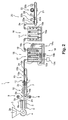
- the plant (1) allowing the continuous manufacture of salted and baked minced meat continuously reconstituted in thin plates comprises from upstream to downstream the following different means represented figure 2 .
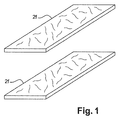
- the minced and processed meat is referenced as a whole (2) by and sub-references will be used according to the different phases of treatment and implementation of the process, referring to its shape.
- the installation (1) comprises a feed hopper (3) for receiving minced meat (2a), more or less noble, in the raw state.
- the hopper (3) can receive either only ground meat in the raw state, or also complementary food products such as spices and other ingredients that can bring nutritional or sensory qualities to the final product.
- Said feed hopper (3) has at its output a meat pump (4) connected to an extrusion nozzle (5).
- the meat pump (4) allows a continuous feed of minced meat (2a) from the extrusion nozzle (5).
- the extrusion nozzle (5) allows the presentation of the minced meat in the form of a tube or a continuous flattened strip (2b), for a continuous scrolling.
- the minced meat is thus in a tubular or flattened configuration during a manufacturing phase.
- the thickness of the meat is adjusted by adjusting the end of the nozzle (5), and in particular the size of its opening (5a). More specifically, a series of screws (5b) makes it possible to constrict said end and to vary the opening of said nozzle (5) to obtain more or less thick meat plates (2b).
- the wall of the extrusion nozzle (5) is preferably doubled to allow to introduce into the space between the two walls of the heating means (6) for slightly heating the meat flowing in the extrusion nozzle (5). ). This allows in particular to avoid the deposition of certain fat contained in the meat on the walls of the extrusion nozzle (5).
- the installation (1) also comprises a first distribution and arrangement system (8) on the conveyor (7) of a first sheet of film (8a) with controlled permeability, under the meat strip (2b).
- This first system (8) is advantageously in the form of a first roll of controlled permeability film, arranged substantially under the conveyor (7), at its end and intended to unwind a first sheet of film (8a) which comes to rest on said conveyor (7).
- the first roll of film (8) is held at both ends by supports disposed on either side of said conveyor (7), and pivotally to allow unwinding of said first sheet of film (8a).
- the first sheet of film (8a) thus substantially covers the surface of the conveyor (7), and the meat strip (2b) recovered by said conveyor (7) is deposited on said first sheet of film (8a) with controlled permeability.
- the installation (1) comprises a second distribution and arrangement system (9) on the meat strip (2b) of a second sheet of film (9a) with controlled permeability.
- This second system (9) is in the form of a second roll of film, similar to the first, arranged substantially above the conveyor (7), at its end and intended to unwind a second sheet of film (9a). which comes to rest on the strip of meat (2b).
- the second roll of film is held at both ends by supports disposed on either side of said conveyor (7), and pivotally to allow unwinding of said second sheet of film (9a) controlled permeability.
- a mechanical system is provided allowing the first (8a) and second (9a) sheets of film to unwind at a defined speed depending on the meat processing conditions.
- the tube or strip (2b) of minced meat wrapped and protected by said controlled permeability film sheets (8a, 9a) is then conveyed to a horizontal or vertical rolling device (10) comprising several pairs of rolling rolls allowing progressive crushing and thin-layer stretching of minced meat.
- a horizontal or vertical rolling device 10 comprising several pairs of rolling rolls allowing progressive crushing and thin-layer stretching of minced meat.
- the minced meat is surrounded by sheets of film (8a, 9a) with controlled permeability, in a flattened state (2c) in a thin, compact continuous band, without the appearance of the meat granules. minced, giving the appearance of a continuous and firm texture.
- the plant (1) Downstream of the rolling, the plant (1) comprises in a particular embodiment, two crushing wheels (11) edges of the meat strip, and a second rolling device (12).
- the knobs (11) are arranged on both sides of the meat strip (2c), on the edges thereof.
- the rotation of the knobs (11) is mechanized, they are held by supports, and in contact with the conveyor (7) to crush the edges of the meat strip (2c), when they pass between the conveyor (7) and said wheels (11).
- the crushing of the meat strip (2c) makes it possible, in particular, to seal the first (8a) and second (9a) sheets of film and to isolate the meat inside the said sheets for the purpose of its subsequent immersion in a bath of cooking solution.
- the second rolling device (12) is similar to the first rolling device (10), it is to this effect, in the form of a roller for crushing the meat strip (2c) to readjust the excess thickness of meat caused by crushing curbs.
- the installation (1) Downstream of the second rolling device (12), the installation (1) comprises means (13) for folding the crushed edges of the meat strip (2c), on said meat strip.
- These means (13) are in the form of two lateral parts (13a) of the conveyor folded each followed by a wheel (13b) for pressing the folded edge.
- the edges due to the advancement of the meat strip (2c) on the conveyor (7), are folded when they cooperate with said side portions (13a). This in particular makes it possible to optimize the insulation of the meat for immersion in the bath of cooking solution.
- the continuous strip of drawn and rolled minced meat (2d) is then introduced successively into a bath of cooking solution (15), and a rinsing tank (16).
- the bath (15) as well as the tank (16) includes a continuous roller conveying device (17) allowing the meat strip (2d) to travel in the bath (15) or the tank (16). and for a time considered.
- the length of the bath (15) or the tank (16) is determined by the immersion time necessary for the cooking effect of the meat at first and the rinsing effect in a second and last time.
- the bath of cooking solution (15) is arranged with a circuit (18) for recycling and solution reinjection.
- the circuit (18) comprises for this purpose a reinjection pump (18a), as well as sensors (18b) pH control and solute concentrations of the cooking bath.
- An evaporative concentration and metering device (18c) integrated in said circuit makes it possible to readjust the pH of the concentration and the composition of the solution.
- the conveying devices (17) can be immersed in whole or in part in the bath of cooking solution (15), and the tank (16) of rinsing.
- the bath of cooking solution (15) is in the form of a tank (15a) containing a solution of preferably acidified cooking brine (15b).
- the pH of the cooking brine is in particular less than 7 and its temperature is higher than 60 ° C.
- the brine bath (15) is used to continuously cook the meat strip (2d).
- the baking brine bath (15) maintains the baking brine (15b) at a relatively high temperature to continuously cook the meat.
- the cooking brine solution (15b) is thus heated by a heat exchanger (15c) for example.
- the wall of the cooking vessel (15a) is insulated in order to minimize thermal losses.
- the cooking time of the meat depends on the duration of contact with the cooking brine (15b).
- the acid pH of the cooking brine also lowers the pH of the meat during cooking to increase its microbiological stability.
- Scraper means (19), such as a squeegee is advantageously arranged at the outlet of the cooking vessel (15a), so as to scrape the surface of the meat strip in order to scrape residual brine on the second sheet of film (9a). ) and return it to said cooking vessel (15a) to optimally prepare the rinsing step.
- the continuous cooking of the meat also makes it possible to reduce the microbial flora of said meat, which contributes greatly to its microbiological stability.
- the rinsing tank (16) is in the form of a tank provided with a plurality of rinsing solution spraying nozzles (16a), such as water, for spraying water onto the web of meat in order to rinse it and to optimize the separation of the meat and the film (8a, 9a) with controlled permeability.
- rinsing solution spraying nozzles (16a) such as water
- first (8a) and second (9a) sheets of film surrounding the minced meat and rolled they are chosen to meet different criteria, taking into account the conditions of the process of the invention.
- These sheets (8a, 9a) controlled permeability film must first be able not to be damaged during the soaking time in the bath of cooking solution (15). They must have a controlled permeability and also allow by conduction the desired effect of cooking the meat in its entirety of its volume and thickness, and more generally properties that gives it the solution. These sheets (8a, 9a) must also have a resistance during the passage in the conveying device (17) disposed in the bath of cooking solution (15), and in the rinsing tank (16), and in particular during the passage around the different return rollers.
- controlled permeability film (8a, 9a) optimally responding to all these constraints. It can be made of any material allowing the diffusion of water, such as animal fibers (collagen), cellulose, polyether sulfane ...
- the continuously cooked stretched minced meat web (2e) is conveyed to a device (20) for separating the film sheets (8a, 9a) from the meat web (2e). ) and an output conveyor (21).
- the output conveyor (21) is able to recover the meat strip (2e) at the outlet of the rinsing tank (16) and to route it to packaging or cutting stations.
- the device (20) for separating the film sheets (8a, 9a) from the meat web (2e) is, in a preferred embodiment, in the form of two opening means (20a), such that circular brushes, free in rotation disposed at the edges of the meat strip (2e) and able to unfold on the crushed and folded edges along said meat strip, the device also comprises sleeves (20b) mounted free in rotation and intended to recover said leaves (8a, 9a) controlled permeability film by wrapping around said sleeves.
- the installation (1), and more particularly the output conveyor (21) further comprises in a preferred embodiment, a distribution system and arrangement (22) of a plastic interlayer (22a) on the strip of meat stripped of its film, and means (23) for winding the meat band on itself.
- the dispensing and dispensing system (22) is in the form of a roll of plastic film, arranged at the output conveyor (21) held at its ends and rotatably mounted so as to be able to deposit a strip of plastic film (22a) on the meat strip.
- the means (23) enabling the meat band to be wound on itself are in the form of a fitted sheath, arranged at the output conveyor (21) held at its ends and rotatably mounted. so as to be able to wind the meat band on said sheath.
- the plant (1), and more particularly the output conveyor (21) comprises a cutting and packaging station, consisting of portioning said strip of meat stripped of its permeability controlled film.
- said portions are thin and obtained in cutting configurations corresponding to the shapes to be obtained desired.
- minced meat slices have a compact texture and it is no longer visually detectable to identify the original configuration.
- This new method of processing minced meat into thin plates has many important interests and advantages.
- the method and the installation (1) also make it possible to rinse and recycle the cooking brine.
- the process is easy to industrialize by allowing a fast and continuous treatment of this minced meat, with a transformation time that can be only a few minutes to a few hours. It requires only a small amount of manpower.
- the film sheets (8a, 9a) provide a triple function, namely of protecting the meat, of interfacing with the solution by allowing the transferability of the properties of the solution into the meat, and also a Carrier function throughout the process.
- the shape of the minced meat slices thus obtained may vary according to the cutting tool and adapt to any possible packaging.
- the cutting tool allows for more complex shapes, for example rings, triangles, or other, which can bring an innovative aspect to marketing.
- the meat strip can also be rolled up on itself to form tubes or other shapes.
- ingredients and aromatics can be adapted according to the production lines, on desired and variable quantities.
- the method applies to all compositions based on meat products.
Landscapes
- Life Sciences & Earth Sciences (AREA)
- Engineering & Computer Science (AREA)
- Food Science & Technology (AREA)
- Wood Science & Technology (AREA)
- Zoology (AREA)
- Health & Medical Sciences (AREA)
- Nutrition Science (AREA)
- Chemical & Material Sciences (AREA)
- Polymers & Plastics (AREA)
- Meat, Egg Or Seafood Products (AREA)
Claims (10)
- Verfahren zur Herstellung und Weiterverarbeitung von Hackfleisch (2a), wobei im Rahmen des Verfahrens nachstehende Arbeitsschritte ausgeführt werden, um kontinuierlich aus zuvor zerkleinertem Fleisch (2a) kontinuierlich gegartes und in dünnen Pellets restrukturiertes Hackfleisch (2e) zu erhalten:- Sicherung einer kontinuierlichen Zuführung des Hackfleisches (2a) in Form eines kontinuierlichen, runden oder abgeflachten Strangs (2b);- Positionierung des kontinuierlichen, runden oder abgeflachten Fleischstrangs (2b) zwischen zwei Folienstreifen (8a, 9a) mit kontrollierter Durchlässigkeit;- Erzielung einer gleichförmigen Dicke und Streckung des Hackfleischs zwischen den beiden Folienstreifen (8a, 9a) zu einer dünnen Schicht in Bandform zur Erzielung eines Verdichtungs- und Texturzustands (2c), bei dem die Fleischteile selbst nicht mehr erkennbar sind;wobei das Verfahren dadurch gekennzeichnet ist, dass darüber hinaus folgende Arbeitsschritte ausgeführt werden:- kontinuierliches Abrollen des gestreckten Hackfleischbandes in ein Bad aus Garlösung (15);- kontinuierliches Abrollen des gestreckten, kontinuierlich gegarten Hackfleischbandes in einen Spültrog (16);- nach Verlassen des Spültrogs (16), Entfernung der Folienstreifen (8a, 9a) mit kontrollierter Durchlässigkeit;- Abtransport des dünnen Bandes aus gewalztem, kontinuierlich gegartem und gespültem Hackfleisch (2e) zu einem Ausgangsförderer (21).
- Verfahren nach Anspruch 1, dadurch gekennzeichnet, dass das Verfahren nach dem Schritt zur Erzielung einer gleichförmigen Dicke und Streckung des Hackfleischs zwischen den beiden Folienstreifen (8a, 9a) weitere Arbeitsschritte zum Abquetschen der Randstreifen des Fleischbandes (2c) umfasst, um das Fleisch komplett von der Garlösung zu isolieren und die durch das Abquetschen verursachten Verdickungen auszugleichen.
- Verfahren nach Anspruch 2, dadurch gekennzeichnet, dass das Verfahren nach den Schritten zum Abquetschen und Ausgleichen der Verdickungen einen Arbeitsschritt umfasst, der darin besteht, die gequetschten Ränder wieder auf das Fleischband (2c) zu klappen.
- Verfahren nach Anspruch 1, dadurch gekennzeichnet, dass das Verfahren nach dem Schritt zum Abtransport des dünnen Fleischbandes (2e) zum Ausgangsförderer einen Arbeitsschritt umfasst, der darin besteht, eine Zwischenlage (22a) aus Kunststofffolie auf das Fleischband (2e) aufzutragen und dieses um die eigene Achse zusammenzurollen.
- Verfahren nach Anspruch 1, dadurch gekennzeichnet, dass das Verfahren nach dem Schritt zum Abtransport des dünnen Fleischbandes (2e) zum Ausgangsförderer (21) einen Arbeitsschritt umfasst, der darin besteht, das Fleischband kontinuierlich zuzuschneiden.
- Anlage (1) zur Herstellung und Weiterverarbeitung von Hackfleisch (2a), wobei die Anlage (1) nachstehende Anlagenteile umfasst, um kontinuierlich aus zuvor zerkleinertem Fleisch kontinuierlich gegartes und in dünnen Pellets restrukturiertes Hackfleisch (2e) zu erhalten:- Einen Fülltrichter (3), an dessen Ausgang sich zur Zuführung des Hackfleisches in Form eines kontinuierlichen, runden oder abgeflachten Strangs (2b) eine Fleischpumpe (4) befindet, die mit einer Extrusionsdüse (5) verbunden ist;- einen Förderer (7) zur Aufnahme des Fleischbandes (2b) am Ausgang der Extrusionsdüse (5);- ein erstes System zur Ausgabe und Anordnung (8) auf dem Förderer (7) eines ersten Folienstreifens (8a) mit kontrollierter Durchlässigkeit unter dem Fleischband (2b);- ein zweites System zur Ausgabe und Anordnung (9) eines zweiten Folienstreifens (9a) mit kontrollierter Durchlässigkeit auf dem Fleischband (2b);- eine erste Walzvorrichtung (10), die hinter den Systemen zur Ausgabe und Anordnung (8, 9) der Folienstreifen (8a, 9a) angeordnet ist;wobei die Anlage (1) dadurch gekennzeichnet ist, dass sie außerdem Folgendes umfasst- ein Bad aus Garlösung (15) mit einer mechanischen Vorrichtung (17) zur Beförderung des gestreckten, kontinuierlich gegarten Hackfleischs (2d);- einen Spültrog (16) mit einer mechanischen Vorrichtung (17) zur Beförderung des gestreckten, kontinuierlich gegarten Hackfleischs;- eine Vorrichtung (20) zum Ablösen der Folienstreifen (8a, 9a) mit kontrollierter Durchlässigkeit vom kontinuierlich gegarten Fleischband im Anschluss an den Spültrog (16);- einen Ausgangsförderer (21).
- Anlage (1) nach Anspruch 6, dadurch gekennzeichnet, dass die Anlage im Anschluss an die Walzvorrichtung (10) zwei Quetschmesser (11) zum Abquetschen der Fleischbandränder, eine zweite Walzvorrichtung (12) und Mittel (13) zum Umklappen der gequetschten Fleischbandränder auf das Fleischband umfasst.
- Anlage (1) nach Anspruch 6, dadurch gekennzeichnet, dass die Anlage im Anschluss an den Ausgangsförderer (21) ein System zur Ausgabe und Anordnung (22) einer Kunststofffolie (22a) auf das Fleischband und Mittel (23) zum Zusammenrollen des Fleischbandes um die eigene Achse umfasst.
- Anlage (1) nach Anspruch 6, dadurch gekennzeichnet, dass die Anlage im Anschluss an den Ausgangsförderer (21) eine Vorrichtung zum Zuschneiden und Abpacken von Hackfleisch in dünnen Scheiben umfasst.
- Anlage (1) nach Anspruch 6, dadurch gekennzeichnet, dass es sich bei dem Bad aus Garlösung (15) um ein Gar-Salzbad (15b) mit einer Temperatur von über 60° und einem pH-Wert von unter 7 handelt.
Applications Claiming Priority (2)
| Application Number | Priority Date | Filing Date | Title |
|---|---|---|---|
| FR1255673A FR2991850B1 (fr) | 2012-06-18 | 2012-06-18 | Procede de fabrication en continu de viande hachee assaisonnee cuite en continu, reconstituee en plaques minces, et installation pour la mise en oeuvre dudit procede |
| PCT/FR2013/051414 WO2013190228A1 (fr) | 2012-06-18 | 2013-06-17 | Procede de fabrication en continu de viande hachee cuite en continu, reconstituee en plaques minces, et installation pour la mise en oeuvre dudit procede |
Publications (2)
| Publication Number | Publication Date |
|---|---|
| EP2861076A1 EP2861076A1 (de) | 2015-04-22 |
| EP2861076B1 true EP2861076B1 (de) | 2016-10-12 |
Family
ID=47022765
Family Applications (1)
| Application Number | Title | Priority Date | Filing Date |
|---|---|---|---|
| EP13737331.2A Active EP2861076B1 (de) | 2012-06-18 | 2013-06-17 | Verfahren zur kontinuierlichen herstellung von in dünnen platten wiederverarbeitetem hackfleisch, sowie anlage zur durchführung dieses verfahrens |
Country Status (3)
| Country | Link |
|---|---|
| EP (1) | EP2861076B1 (de) |
| FR (1) | FR2991850B1 (de) |
| WO (1) | WO2013190228A1 (de) |
Family Cites Families (5)
| Publication number | Priority date | Publication date | Assignee | Title |
|---|---|---|---|---|
| GB2105168B (en) * | 1981-09-09 | 1984-12-19 | Alan Holt | Laminated meat product and method of making same |
| JPS62220407A (ja) * | 1986-03-12 | 1987-09-28 | 食品産業エクストル−ジヨンクツキング技術研究組合 | ソ−セ−ジ等の連続成形包装方法 |
| NZ227806A (en) * | 1988-02-09 | 1991-03-26 | Nadreph Ltd | Proteinaceous food product; meat protein dough passed between rollers |
| EP0840694A1 (de) * | 1995-07-26 | 1998-05-13 | Pascont Technologies Limited | Verfahren zum aufarbeiten eines fleischproduktes |
| FR2827122B1 (fr) * | 2001-07-13 | 2004-01-16 | Adiv Dev | Procede de fabrication en continu de viande hachee, sechee, reconstituee en plaques minces, l'installation de mise en oeuvre du procede et produit obtenu |
-
2012
- 2012-06-18 FR FR1255673A patent/FR2991850B1/fr not_active Expired - Fee Related
-
2013
- 2013-06-17 EP EP13737331.2A patent/EP2861076B1/de active Active
- 2013-06-17 WO PCT/FR2013/051414 patent/WO2013190228A1/fr not_active Ceased
Also Published As
| Publication number | Publication date |
|---|---|
| EP2861076A1 (de) | 2015-04-22 |
| WO2013190228A1 (fr) | 2013-12-27 |
| FR2991850A1 (fr) | 2013-12-20 |
| FR2991850B1 (fr) | 2015-03-27 |
Similar Documents
| Publication | Publication Date | Title |
|---|---|---|
| EP2911533B1 (de) | Herstellverfahren für gefüllte lebensmittel, und korrespondierende vorrichtung | |
| EP2330913B1 (de) | Verfahren zur herstellung eines extrudierten nahrungsmittelprodukts | |
| EP2911834B1 (de) | Greifer für ein verformbares produkt | |
| EP0431144A1 (de) | Verfahren und vorrichtung zum herstellen eines produktes, welches aus einer unterlage mit einer klebefläche langzeitiger klebefähigkeit und einem schutzband besteht. | |
| EP2861077B1 (de) | Verfahren zur kontinuierlichen herstellung von pasteurisiertem, getrocknetem, in dünnen platten wiederverarbeitetem hackfleisch, sowie anlage zur durchführung dieses verfahrens | |
| EP1406501B1 (de) | Verfahren zur kontinuierlichen herstellung von getrocknetem und dünnem fleisch, wiederverarbeitet in hackfleischplatten | |
| FR2634980A1 (fr) | Procede et installation de fabrication d'un produit complexe a base d'oeuf | |
| CH616320A5 (de) | ||
| WO2013190228A1 (fr) | Procede de fabrication en continu de viande hachee cuite en continu, reconstituee en plaques minces, et installation pour la mise en oeuvre dudit procede | |
| WO2021198599A1 (fr) | Gâteau industriel plié ou roulé décoré par impression avant cuisson, procédé industriel de fabrication d'un tel gâteau, dispositif pour la mise en oeuvre de ce procédé | |
| EP2438818B1 (de) | Verfahren und Vorrichtung zum Herstellen von Portionen von Lebensmittelprodukten, die mit einer Garnierung versehen sind. | |
| CA2444258A1 (fr) | Procede de fabrication de galettes a base de farine de cereales | |
| EP1958512B1 (de) | Verfahren zur Herstellung von Lebensmitteln und entsprechende Fertigungsstrasse | |
| BE1030078B1 (fr) | Procédé de fabrication de pâtes laminées avec élimination d'amidon périphérique | |
| EP3213644B1 (de) | Verfahren zur herstellung eines lebensmittels auf basis von surimi in form einer nuss pectinidae, wie sankt jakobs muscheln, deren produkte und herstellugskette | |
| CN115088817B (zh) | 蟹味棒加工生产线及其加工工艺 | |
| FR2796810A1 (fr) | Procede et dispositif pour la fabrication industrielle de produits alimentaires a base de pate a pain | |
| EP0156718B1 (de) | Verfahren und Maschine zum Beschichten von Obst und Gemüse in einer Plastikfolie | |
| FR2964836A1 (fr) | Appareil de refroidissement d'un produit, en vue de sa solidification, et son procede de mise en œuvre | |
| WO2003096813A1 (fr) | Procede et installation pour la fabrication automatisee de fond de tarte a pizza et fond de tarte obtenu a partir de tels procede et installation | |
| FR2819379A1 (fr) | Machine de fabrication automatique de pate fine alimentaire | |
| CH345232A (fr) | Procédé et dispositif pour la cuisson de céréales et légumineuses | |
| CH295829A (fr) | Procédé et machine pour la fabrication de capsules en matière plastique remplies de liquide. | |
| WO1998057547A1 (fr) | Procede de fabrication d'un produit alimentaire, du type pizza, dispositif de mise en oeuvre et produit obtenu | |
| WO1997042828A1 (fr) | Procede de fabrication en continu d'un produit alimentaire realise a partir d'un paton extrude et produit ainsi obtenu |
Legal Events
| Date | Code | Title | Description |
|---|---|---|---|
| PUAI | Public reference made under article 153(3) epc to a published international application that has entered the european phase |
Free format text: ORIGINAL CODE: 0009012 |
|
| 17P | Request for examination filed |
Effective date: 20141125 |
|
| AK | Designated contracting states |
Kind code of ref document: A1 Designated state(s): AL AT BE BG CH CY CZ DE DK EE ES FI FR GB GR HR HU IE IS IT LI LT LU LV MC MK MT NL NO PL PT RO RS SE SI SK SM TR |
|
| AX | Request for extension of the european patent |
Extension state: BA ME |
|
| DAX | Request for extension of the european patent (deleted) | ||
| RIN1 | Information on inventor provided before grant (corrected) |
Inventor name: RISPAL, OLIVIER Inventor name: PEYRON, ALAIN |
|
| GRAP | Despatch of communication of intention to grant a patent |
Free format text: ORIGINAL CODE: EPIDOSNIGR1 |
|
| INTG | Intention to grant announced |
Effective date: 20160506 |
|
| GRAS | Grant fee paid |
Free format text: ORIGINAL CODE: EPIDOSNIGR3 |
|
| GRAA | (expected) grant |
Free format text: ORIGINAL CODE: 0009210 |
|
| AK | Designated contracting states |
Kind code of ref document: B1 Designated state(s): AL AT BE BG CH CY CZ DE DK EE ES FI FR GB GR HR HU IE IS IT LI LT LU LV MC MK MT NL NO PL PT RO RS SE SI SK SM TR |
|
| REG | Reference to a national code |
Ref country code: GB Ref legal event code: FG4D Free format text: NOT ENGLISH |
|
| RIN1 | Information on inventor provided before grant (corrected) |
Inventor name: RISPAL, OLIVIER Inventor name: PEYRON, ALAIN |
|
| REG | Reference to a national code |
Ref country code: CH Ref legal event code: EP |
|
| REG | Reference to a national code |
Ref country code: AT Ref legal event code: REF Ref document number: 835610 Country of ref document: AT Kind code of ref document: T Effective date: 20161015 |
|
| REG | Reference to a national code |
Ref country code: IE Ref legal event code: FG4D Free format text: LANGUAGE OF EP DOCUMENT: FRENCH |
|
| REG | Reference to a national code |
Ref country code: DE Ref legal event code: R096 Ref document number: 602013012721 Country of ref document: DE |
|
| REG | Reference to a national code |
Ref country code: NL Ref legal event code: FP |
|
| REG | Reference to a national code |
Ref country code: LT Ref legal event code: MG4D |
|
| PG25 | Lapsed in a contracting state [announced via postgrant information from national office to epo] |
Ref country code: LV Free format text: LAPSE BECAUSE OF FAILURE TO SUBMIT A TRANSLATION OF THE DESCRIPTION OR TO PAY THE FEE WITHIN THE PRESCRIBED TIME-LIMIT Effective date: 20161012 |
|
| REG | Reference to a national code |
Ref country code: AT Ref legal event code: MK05 Ref document number: 835610 Country of ref document: AT Kind code of ref document: T Effective date: 20161012 |
|
| PG25 | Lapsed in a contracting state [announced via postgrant information from national office to epo] |
Ref country code: GR Free format text: LAPSE BECAUSE OF FAILURE TO SUBMIT A TRANSLATION OF THE DESCRIPTION OR TO PAY THE FEE WITHIN THE PRESCRIBED TIME-LIMIT Effective date: 20170113 Ref country code: NO Free format text: LAPSE BECAUSE OF FAILURE TO SUBMIT A TRANSLATION OF THE DESCRIPTION OR TO PAY THE FEE WITHIN THE PRESCRIBED TIME-LIMIT Effective date: 20170112 Ref country code: SE Free format text: LAPSE BECAUSE OF FAILURE TO SUBMIT A TRANSLATION OF THE DESCRIPTION OR TO PAY THE FEE WITHIN THE PRESCRIBED TIME-LIMIT Effective date: 20161012 Ref country code: LT Free format text: LAPSE BECAUSE OF FAILURE TO SUBMIT A TRANSLATION OF THE DESCRIPTION OR TO PAY THE FEE WITHIN THE PRESCRIBED TIME-LIMIT Effective date: 20161012 |
|
| PG25 | Lapsed in a contracting state [announced via postgrant information from national office to epo] |
Ref country code: RS Free format text: LAPSE BECAUSE OF FAILURE TO SUBMIT A TRANSLATION OF THE DESCRIPTION OR TO PAY THE FEE WITHIN THE PRESCRIBED TIME-LIMIT Effective date: 20161012 Ref country code: HR Free format text: LAPSE BECAUSE OF FAILURE TO SUBMIT A TRANSLATION OF THE DESCRIPTION OR TO PAY THE FEE WITHIN THE PRESCRIBED TIME-LIMIT Effective date: 20161012 Ref country code: AT Free format text: LAPSE BECAUSE OF FAILURE TO SUBMIT A TRANSLATION OF THE DESCRIPTION OR TO PAY THE FEE WITHIN THE PRESCRIBED TIME-LIMIT Effective date: 20161012 Ref country code: IS Free format text: LAPSE BECAUSE OF FAILURE TO SUBMIT A TRANSLATION OF THE DESCRIPTION OR TO PAY THE FEE WITHIN THE PRESCRIBED TIME-LIMIT Effective date: 20170212 Ref country code: FI Free format text: LAPSE BECAUSE OF FAILURE TO SUBMIT A TRANSLATION OF THE DESCRIPTION OR TO PAY THE FEE WITHIN THE PRESCRIBED TIME-LIMIT Effective date: 20161012 Ref country code: PL Free format text: LAPSE BECAUSE OF FAILURE TO SUBMIT A TRANSLATION OF THE DESCRIPTION OR TO PAY THE FEE WITHIN THE PRESCRIBED TIME-LIMIT Effective date: 20161012 Ref country code: PT Free format text: LAPSE BECAUSE OF FAILURE TO SUBMIT A TRANSLATION OF THE DESCRIPTION OR TO PAY THE FEE WITHIN THE PRESCRIBED TIME-LIMIT Effective date: 20170213 Ref country code: ES Free format text: LAPSE BECAUSE OF FAILURE TO SUBMIT A TRANSLATION OF THE DESCRIPTION OR TO PAY THE FEE WITHIN THE PRESCRIBED TIME-LIMIT Effective date: 20161012 |
|
| REG | Reference to a national code |
Ref country code: FR Ref legal event code: PLFP Year of fee payment: 5 |
|
| REG | Reference to a national code |
Ref country code: DE Ref legal event code: R097 Ref document number: 602013012721 Country of ref document: DE |
|
| PG25 | Lapsed in a contracting state [announced via postgrant information from national office to epo] |
Ref country code: SK Free format text: LAPSE BECAUSE OF FAILURE TO SUBMIT A TRANSLATION OF THE DESCRIPTION OR TO PAY THE FEE WITHIN THE PRESCRIBED TIME-LIMIT Effective date: 20161012 Ref country code: CZ Free format text: LAPSE BECAUSE OF FAILURE TO SUBMIT A TRANSLATION OF THE DESCRIPTION OR TO PAY THE FEE WITHIN THE PRESCRIBED TIME-LIMIT Effective date: 20161012 Ref country code: DK Free format text: LAPSE BECAUSE OF FAILURE TO SUBMIT A TRANSLATION OF THE DESCRIPTION OR TO PAY THE FEE WITHIN THE PRESCRIBED TIME-LIMIT Effective date: 20161012 Ref country code: RO Free format text: LAPSE BECAUSE OF FAILURE TO SUBMIT A TRANSLATION OF THE DESCRIPTION OR TO PAY THE FEE WITHIN THE PRESCRIBED TIME-LIMIT Effective date: 20161012 Ref country code: EE Free format text: LAPSE BECAUSE OF FAILURE TO SUBMIT A TRANSLATION OF THE DESCRIPTION OR TO PAY THE FEE WITHIN THE PRESCRIBED TIME-LIMIT Effective date: 20161012 |
|
| PLBE | No opposition filed within time limit |
Free format text: ORIGINAL CODE: 0009261 |
|
| STAA | Information on the status of an ep patent application or granted ep patent |
Free format text: STATUS: NO OPPOSITION FILED WITHIN TIME LIMIT |
|
| PG25 | Lapsed in a contracting state [announced via postgrant information from national office to epo] |
Ref country code: IT Free format text: LAPSE BECAUSE OF FAILURE TO SUBMIT A TRANSLATION OF THE DESCRIPTION OR TO PAY THE FEE WITHIN THE PRESCRIBED TIME-LIMIT Effective date: 20161012 Ref country code: BG Free format text: LAPSE BECAUSE OF FAILURE TO SUBMIT A TRANSLATION OF THE DESCRIPTION OR TO PAY THE FEE WITHIN THE PRESCRIBED TIME-LIMIT Effective date: 20170112 Ref country code: SM Free format text: LAPSE BECAUSE OF FAILURE TO SUBMIT A TRANSLATION OF THE DESCRIPTION OR TO PAY THE FEE WITHIN THE PRESCRIBED TIME-LIMIT Effective date: 20161012 |
|
| 26N | No opposition filed |
Effective date: 20170713 |
|
| PG25 | Lapsed in a contracting state [announced via postgrant information from national office to epo] |
Ref country code: SI Free format text: LAPSE BECAUSE OF FAILURE TO SUBMIT A TRANSLATION OF THE DESCRIPTION OR TO PAY THE FEE WITHIN THE PRESCRIBED TIME-LIMIT Effective date: 20161012 |
|
| PG25 | Lapsed in a contracting state [announced via postgrant information from national office to epo] |
Ref country code: MC Free format text: LAPSE BECAUSE OF FAILURE TO SUBMIT A TRANSLATION OF THE DESCRIPTION OR TO PAY THE FEE WITHIN THE PRESCRIBED TIME-LIMIT Effective date: 20161012 |
|
| REG | Reference to a national code |
Ref country code: CH Ref legal event code: PL |
|
| REG | Reference to a national code |
Ref country code: IE Ref legal event code: MM4A |
|
| PG25 | Lapsed in a contracting state [announced via postgrant information from national office to epo] |
Ref country code: CH Free format text: LAPSE BECAUSE OF NON-PAYMENT OF DUE FEES Effective date: 20170630 Ref country code: LU Free format text: LAPSE BECAUSE OF NON-PAYMENT OF DUE FEES Effective date: 20170617 Ref country code: LI Free format text: LAPSE BECAUSE OF NON-PAYMENT OF DUE FEES Effective date: 20170630 Ref country code: IE Free format text: LAPSE BECAUSE OF NON-PAYMENT OF DUE FEES Effective date: 20170617 |
|
| REG | Reference to a national code |
Ref country code: FR Ref legal event code: PLFP Year of fee payment: 6 |
|
| PG25 | Lapsed in a contracting state [announced via postgrant information from national office to epo] |
Ref country code: MT Free format text: LAPSE BECAUSE OF FAILURE TO SUBMIT A TRANSLATION OF THE DESCRIPTION OR TO PAY THE FEE WITHIN THE PRESCRIBED TIME-LIMIT Effective date: 20161012 |
|
| PG25 | Lapsed in a contracting state [announced via postgrant information from national office to epo] |
Ref country code: HU Free format text: LAPSE BECAUSE OF FAILURE TO SUBMIT A TRANSLATION OF THE DESCRIPTION OR TO PAY THE FEE WITHIN THE PRESCRIBED TIME-LIMIT; INVALID AB INITIO Effective date: 20130617 |
|
| PGFP | Annual fee paid to national office [announced via postgrant information from national office to epo] |
Ref country code: NL Payment date: 20190515 Year of fee payment: 7 |
|
| PGFP | Annual fee paid to national office [announced via postgrant information from national office to epo] |
Ref country code: DE Payment date: 20190611 Year of fee payment: 7 |
|
| PGFP | Annual fee paid to national office [announced via postgrant information from national office to epo] |
Ref country code: BE Payment date: 20190523 Year of fee payment: 7 |
|
| PG25 | Lapsed in a contracting state [announced via postgrant information from national office to epo] |
Ref country code: CY Free format text: LAPSE BECAUSE OF FAILURE TO SUBMIT A TRANSLATION OF THE DESCRIPTION OR TO PAY THE FEE WITHIN THE PRESCRIBED TIME-LIMIT Effective date: 20161012 |
|
| PGFP | Annual fee paid to national office [announced via postgrant information from national office to epo] |
Ref country code: GB Payment date: 20190620 Year of fee payment: 7 |
|
| PG25 | Lapsed in a contracting state [announced via postgrant information from national office to epo] |
Ref country code: MK Free format text: LAPSE BECAUSE OF FAILURE TO SUBMIT A TRANSLATION OF THE DESCRIPTION OR TO PAY THE FEE WITHIN THE PRESCRIBED TIME-LIMIT Effective date: 20161012 |
|
| PG25 | Lapsed in a contracting state [announced via postgrant information from national office to epo] |
Ref country code: TR Free format text: LAPSE BECAUSE OF FAILURE TO SUBMIT A TRANSLATION OF THE DESCRIPTION OR TO PAY THE FEE WITHIN THE PRESCRIBED TIME-LIMIT Effective date: 20161012 |
|
| PG25 | Lapsed in a contracting state [announced via postgrant information from national office to epo] |
Ref country code: AL Free format text: LAPSE BECAUSE OF FAILURE TO SUBMIT A TRANSLATION OF THE DESCRIPTION OR TO PAY THE FEE WITHIN THE PRESCRIBED TIME-LIMIT Effective date: 20161012 |
|
| REG | Reference to a national code |
Ref country code: DE Ref legal event code: R119 Ref document number: 602013012721 Country of ref document: DE |
|
| REG | Reference to a national code |
Ref country code: NL Ref legal event code: MM Effective date: 20200701 |
|
| GBPC | Gb: european patent ceased through non-payment of renewal fee |
Effective date: 20200617 |
|
| REG | Reference to a national code |
Ref country code: BE Ref legal event code: MM Effective date: 20200630 |
|
| PG25 | Lapsed in a contracting state [announced via postgrant information from national office to epo] |
Ref country code: NL Free format text: LAPSE BECAUSE OF NON-PAYMENT OF DUE FEES Effective date: 20200701 Ref country code: GB Free format text: LAPSE BECAUSE OF NON-PAYMENT OF DUE FEES Effective date: 20200617 |
|
| PG25 | Lapsed in a contracting state [announced via postgrant information from national office to epo] |
Ref country code: DE Free format text: LAPSE BECAUSE OF NON-PAYMENT OF DUE FEES Effective date: 20210101 Ref country code: BE Free format text: LAPSE BECAUSE OF NON-PAYMENT OF DUE FEES Effective date: 20200630 |
|
| P01 | Opt-out of the competence of the unified patent court (upc) registered |
Effective date: 20230527 |
|
| P02 | Opt-out of the competence of the unified patent court (upc) changed |
Effective date: 20230712 |
|
| PGFP | Annual fee paid to national office [announced via postgrant information from national office to epo] |
Ref country code: FR Payment date: 20250624 Year of fee payment: 13 |