EP2863165B1 - Loading method of an explosive device with controlled destructive capacity and corresponding explosive device - Google Patents
Loading method of an explosive device with controlled destructive capacity and corresponding explosive device Download PDFInfo
- Publication number
- EP2863165B1 EP2863165B1 EP14188995.6A EP14188995A EP2863165B1 EP 2863165 B1 EP2863165 B1 EP 2863165B1 EP 14188995 A EP14188995 A EP 14188995A EP 2863165 B1 EP2863165 B1 EP 2863165B1
- Authority
- EP
- European Patent Office
- Prior art keywords
- explosive
- filler material
- inert filler
- explosive charge
- meniscus
- Prior art date
- Legal status (The legal status is an assumption and is not a legal conclusion. Google has not performed a legal analysis and makes no representation as to the accuracy of the status listed.)
- Active
Links
Images

Classifications
-
- F—MECHANICAL ENGINEERING; LIGHTING; HEATING; WEAPONS; BLASTING
- F42—AMMUNITION; BLASTING
- F42B—EXPLOSIVE CHARGES, e.g. FOR BLASTING, FIREWORKS, AMMUNITION
- F42B33/00—Manufacture of ammunition; Dismantling of ammunition; Apparatus therefor
- F42B33/02—Filling cartridges, missiles, or fuzes; Inserting propellant or explosive charges
- F42B33/0207—Processes for loading or filling propulsive or explosive charges in containers
-
- F—MECHANICAL ENGINEERING; LIGHTING; HEATING; WEAPONS; BLASTING
- F42—AMMUNITION; BLASTING
- F42B—EXPLOSIVE CHARGES, e.g. FOR BLASTING, FIREWORKS, AMMUNITION
- F42B12/00—Projectiles, missiles or mines characterised by the warhead, the intended effect, or the material
- F42B12/02—Projectiles, missiles or mines characterised by the warhead, the intended effect, or the material characterised by the warhead or the intended effect
- F42B12/20—Projectiles, missiles or mines characterised by the warhead, the intended effect, or the material characterised by the warhead or the intended effect of high-explosive type
- F42B12/201—Projectiles, missiles or mines characterised by the warhead, the intended effect, or the material characterised by the warhead or the intended effect of high-explosive type characterised by target class
- F42B12/202—Projectiles, missiles or mines characterised by the warhead, the intended effect, or the material characterised by the warhead or the intended effect of high-explosive type characterised by target class for attacking land area or area targets, e.g. airburst
-
- F—MECHANICAL ENGINEERING; LIGHTING; HEATING; WEAPONS; BLASTING
- F42—AMMUNITION; BLASTING
- F42B—EXPLOSIVE CHARGES, e.g. FOR BLASTING, FIREWORKS, AMMUNITION
- F42B12/00—Projectiles, missiles or mines characterised by the warhead, the intended effect, or the material
- F42B12/02—Projectiles, missiles or mines characterised by the warhead, the intended effect, or the material characterised by the warhead or the intended effect
- F42B12/20—Projectiles, missiles or mines characterised by the warhead, the intended effect, or the material characterised by the warhead or the intended effect of high-explosive type
- F42B12/207—Projectiles, missiles or mines characterised by the warhead, the intended effect, or the material characterised by the warhead or the intended effect of high-explosive type characterised by the explosive material or the construction of the high explosive warhead, e.g. insensitive ammunition
-
- F—MECHANICAL ENGINEERING; LIGHTING; HEATING; WEAPONS; BLASTING
- F42—AMMUNITION; BLASTING
- F42B—EXPLOSIVE CHARGES, e.g. FOR BLASTING, FIREWORKS, AMMUNITION
- F42B25/00—Fall bombs
-
- F—MECHANICAL ENGINEERING; LIGHTING; HEATING; WEAPONS; BLASTING
- F42—AMMUNITION; BLASTING
- F42B—EXPLOSIVE CHARGES, e.g. FOR BLASTING, FIREWORKS, AMMUNITION
- F42B33/00—Manufacture of ammunition; Dismantling of ammunition; Apparatus therefor
- F42B33/02—Filling cartridges, missiles, or fuzes; Inserting propellant or explosive charges
- F42B33/0285—Measuring explosive-charge levels in containers or cartridge cases; Methods or devices for controlling the quantity of material fed or filled
-
- F—MECHANICAL ENGINEERING; LIGHTING; HEATING; WEAPONS; BLASTING
- F42—AMMUNITION; BLASTING
- F42B—EXPLOSIVE CHARGES, e.g. FOR BLASTING, FIREWORKS, AMMUNITION
- F42B8/00—Practice or training ammunition
- F42B8/12—Projectiles or missiles
- F42B8/14—Projectiles or missiles disintegrating in flight or upon impact
- F42B8/16—Projectiles or missiles disintegrating in flight or upon impact containing an inert filler in powder or granular form
-
- F—MECHANICAL ENGINEERING; LIGHTING; HEATING; WEAPONS; BLASTING
- F42—AMMUNITION; BLASTING
- F42B—EXPLOSIVE CHARGES, e.g. FOR BLASTING, FIREWORKS, AMMUNITION
- F42B8/00—Practice or training ammunition
- F42B8/12—Projectiles or missiles
- F42B8/22—Fall bombs
Definitions
- the present invention relates to a loading method of an explosive device having a controlled destructive capacity and the relative explosive device.
- EP 0 407 288 A1 , US 3 693 548 A and WO2013088090 A1 represent the relevant prior art for the present invention.
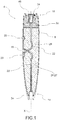
- reference numeral 4 globally denotes a schematic overall view of an explosive device, such as an aerial bomb, according to the present invention.
- the explosive device 4 comprises a bomb body 8 which defines a cavity 12 and having, at opposite axial ends, in a main axial direction X-X, an ogive 14 and a closing cap 16.
- the bomb body 8 is preferably fitted with an armament well 18 and attachments 20 to a vector, typically an aircraft.
- the armament well 18 is usually connected by means of ducts or pipes 22 to one or more firing-fuse holders 24, in a known manner.
- cables are made to pass inside said ducts or pipes 22.
- sealing layer 27 comprises for example, a first application of asphalt paint, to which a subsequent tar coating is applied.
- the cavity 12 is at least partially filled by means of an inert filler material 28 up to a predetermined level, in other words, it is possible to predetermine the quantity of inert filler material with which fill at least partially the cavity 12.
- inert materials preferably polymeric materials in liquid or semi-solid form are used which, once cross-linked, give a consistency similar to a hard rubber.
- inert materials in a liquid or semi-liquid state permits optimum coverage of the cavity 12 to be achieved; in fact, the force of gravity helps to level the inert charge 28, positioning the free surface of the liquid always parallel to the ground and optimally filling every crevice of the cavity; moreover the inert material 28 in liquid phase is able to adhere around the inner components of the cavity 12 filling them completely and avoiding the formation of voids.
- the cavity 12 is at least partially filled with an explosive charge 32 according to a predefined quantity; in other words the mass of the explosive charge 32 to equip the explosive device 4 with can be established. This way, as described further below, it is possible to predefine the destructive capacity of the explosive device 4 and thus limit at will, the collateral effects depending on the chosen objective.
- the amount of explosive loaded in the bomb body can substantially be varied at will in order to determine a different destructive effect.
- the amount of explosive also determines how the bomb body 8 fragments, determining the number, size, weight and distance of body fragments originating during the explosion.
- polymer-based explosives with specific mechanical characteristics are preferably used, in that once cross-linked they acquire a consistency similar to that of a hard rubber.
- the presence of the sealing layer 27 is advantageous in that it prevents both the inert charge 28 and the explosive charge 32 from coming directly into contact with the inner side wall 26 of the bomb body 8 defining said cavity 12. This avoids oxidation/corrosion phenomena on the inner side wall 26 and, above all, helps to isolate both the inert charge 28 and the explosive charge 32 from the bomb body 8.
- mutually facing free surfaces 28', 32' respectively of the inert filler material 28 and of the explosive charge 32 are separated by the interposition of an encapsulating meniscus 36, so as to prevent any contact between the explosive charge 32 and the inert filler material 28.
- the encapsulating meniscus 36 is flexible and is configured to slide axially with the explosive charge (32), on the layer of sealant (27) covering the inner lateral surface of the device body (8) so as to adapt to the mechanical deformation and thermal expansion of the explosive charge 32 due to accelerations and temperature variations respectively.
- the explosive charge 32 is subject to continuous deformation due both to accelerations during transport and due to thermal changes.
- the flexibility of the encapsulating meniscus 36 such deformations of the explosive charge 32 are supported by the encapsulating meniscus which is able to deform according to the geometrical variations of the explosive charge 32, ensuring that the latter is always properly encapsulated in all conditions.
- the deformability of the encapsulating meniscus 36 prevents the explosive charge 32 from being subjected locally to excessive tensions on account of the aforementioned thermal and mechanical stresses.
- the material of the encapsulating meniscus 36 is a rubbery inert material, compatible with the explosive charge 32.
- the material of the encapsulating meniscus 36 is the same as that of the sealing layer 27.
- the material of the encapsulating meniscus 36 is a polyurethane.
- the encapsulating meniscus 36 has the function of adhering to the free surface of the explosive charge 32 so as to seal said charge and follow the volumetric variations and/or displacements of the mass of explosive charge 32 following mechanical and thermal stresses.
- the inert filler material 28 is placed on the side of the ogive 14 and the explosive charge 32 is placed on the side of the closing cap 16.
- the inert filler material 28 and the explosive charge 32 have similar specific weights; for example, the difference between the specific weights of the inert filler material 28 and of the explosive charge 32 is less than 10%. Preferably said difference between the specific weights of the inert filler material 28 and of the explosive charge 32 is less than 4%.
- the inert filler material 28 and the explosive charge 32 have similar stiffness; for example, the difference between the stiffness of inert filler material 28 and of the explosive charge 32, measured in relation to the explosive charge 32, is less than 60%.
- the inert filler material 28 and the explosive charge 32 have similar impedances, where a material's impedance is defined as the product of the density (and thus the specific weight) of the material and the propagation speed of sound inside it.
- the impedances of the inert filler material 28 and the explosive charge 32 differ at most by 40%, this difference being measured relative to the impedance of the explosive charge 32.
- the impedance characterises the transmission of the shock wave in the material determining the speed transmitted to the bomb body 8 and thus the size and speed of the fragments of the latter at the time of the explosion. Thanks to the similarity in the impedance values of the inert filler material 28 and the explosive charge 32 the shock wave is less altered in the passage between the explosive 32 and inert material 28 and thus the correct and desired fragmentation of the bomb body 8 and speed of the relative fragments is achieved.
- the explosive device 4 further comprises at least one firing fuse 40 positioned so as to guarantee the triggering of the explosive charge 32, in the known manner.
- the bomb body 8 defining the inner cavity 12 which extends in the main axial direction X-X, between the ogive 14 and the closing cap 16, is prepared.
- the loading steps are carried out holding the bomb body 8 in a vertical position, i.e. so as to present the main axial direction X-X perpendicular to a support surface of the explosive device 4.
- the loading is performed level with the bomb body 8 positioned vertically.
- a step of coating the inner side wall 26 of the device body 8 which defines the cavity 12, with a layer of sealant 27 ( figure 2 ) is then performed.
- the inert filler material must reproduce the inertial characteristics of the explosive (same density) but also the same characteristics of stiffness and impedance.
- the inert filler material 28 is placed on the side of the ogive 14 and the explosive charge 32 is placed on the side of the closing cap 16.
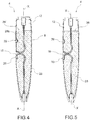
- the loading step may take place in several stages, i.e. through a deposition of a first portion of inert material 28a ( figure 3 ) followed by the deposition of a second portion of inert material 28b ( figure 4 ); in other words, successive depositions are made of the inert material in the liquid phase.
- the loading of the second portion of inert material is performed following the complete solidification of the first portion 28a.
- the loading with inert filler material 28 is performed up to a certain level, determined according to the amount of residual volume that is to be left for the loading of explosive.
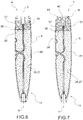
- An encapsulating meniscus 36 is then applied to the free surface 28' of the portion of inert material 28 ( figure 5 ).
- Such meniscus thus prevents any contact between the explosive charge 32 and inert filler material 28.
- said encapsulating meniscus 36 flexible so as to adapt to the mechanical deformation and thermal expansion of the explosive charge 32 due to accelerations and temperature variations respectively, This way, thanks to the flexibility of the encapsulating meniscus 36, such deformations of the explosive charge 32 are supported by the encapsulating meniscus which can deform according to the geometrical variations of the explosive charge 32 ensuring that the latter is always properly encapsulated in all conditions. Moreover, the deformability of the encapsulating meniscus 36 prevents the explosive charge 32 from being subjected locally to excessive tensions on account of the aforementioned thermal and mechanical stresses.
- the closing cap 16 is then closed, applying in advance at least one firing fuse 40 in contact with the explosive charge 32.
- the loading of the explosive charge 32 is conducted reaching the customary level of loading for a standard bomb. This ensures that the firing fuse 40 located in the rear holder 24 is interfaced with the explosive in the same way thus guaranteeing the same reliability for the triggering.
- At least one felt disc 44 is inserted which prevents direct contact between the explosive charge 32 and the closing cap 16.
- the felt 44 guarantees an space containing air to allow the expansion of the explosive.
- a layer of sealant called thermosetting is applied which fills all the spaces sealing both the explosive charge 32 and said felt 44; the felt 44 is not in contact with the closing cap 16.
- the present invention makes it possible to overcome the drawbacks mentioned of the prior art.
- the bomb body according to the present invention is not changed: the bomb has all the geometric and interface characteristics of a standard bomb loaded with explosive inside, while presenting a variable explosive charge according to the specific requirements as needed.
- the same bomb body can be loaded with different percentages of inert material and explosive, making it possible to vary the destructive effect of the bomb and making it possible to destroy several targets and to minimise collateral damage.
- the materials chosen for the inert charge and for the explosive charge are mechanically compatible with each other, so as to have the same physical and mechanical characteristics, the same inertial and vibratory and thus ballistic behaviour as a bomb fully loaded with an explosive substance.
- the inert filler material and the explosive charge have similar specific weights and similar stiffness: this way they have similar mechanical, inertial and vibratory behaviour
- the inert filler material and the explosive charge have similar impedances, where a material's impedance is defined as the product of the density (and thus the specific weight) of the material and the propagation speed of sound inside it.
- the impedance characterises the transmission of the shock wave in the material determining the speed transmitted to the bomb body and thus the size and speed of the fragments of the latter at the time of the explosion. Thanks to the similarity in the impedance values of the inert filler material and the explosive charge the shock wave is less altered in the passage between the explosive and inert material and thus the correct and desired fragmentation of the bomb body and speed of the relative fragments is achieved.
- the loading of explosive also complies with the load levels used in a bomb loaded with explosive only, ensuring the correct functioning of the rear triggering fuse.
- the rearward placement of the explosive charge i.e. on the side of the closing cap, on the other hand limits the number of fragments of the bomb body following the explosion and on the other concentrates the distribution of said fragments; consequently the placement in the tail of the explosive charge is used to control the falling range of bomb body fragments, in order to have a further limitation and control of collateral damage.
- the explosive charge is advantageously encapsulated both on the inner side wall of the bomb body and at the separation meniscus from the charge of inert material.
- the meniscus is able to slide axially with the explosive charge, on the bitumen or waterproof paint covering the inner lateral surface of the bomb body.
- This aspect is a further advantage given that the masses of the inert charge and the explosive charge inevitably present differences of thermal expansion; this way the meniscus, sliding on the interior paint, is able to 'follow' the displacement of the explosive charge so as to always guarantee a perfect sealing of the explosive charge and thus its integrity and reliability over time.
- the encapsulating meniscus meniscus is flexible so as to adapt to the mechanical deformation and thermal expansion of the explosive charge due to accelerations and temperature variations respectively.
Landscapes
- Engineering & Computer Science (AREA)
- General Engineering & Computer Science (AREA)
- Chemical & Material Sciences (AREA)
- Combustion & Propulsion (AREA)
- Manufacturing & Machinery (AREA)
- Pressure Welding/Diffusion-Bonding (AREA)
- Portable Nailing Machines And Staplers (AREA)
- Air Transport Of Granular Materials (AREA)
Applications Claiming Priority (1)
| Application Number | Priority Date | Filing Date | Title |
|---|---|---|---|
| IT000145A ITBS20130145A1 (it) | 2013-10-16 | 2013-10-16 | Metodo di caricamento di un dispositivo esplosivo avente capacita' distruttiva controllata e relativo dispositvo esplosivo |
Publications (2)
| Publication Number | Publication Date |
|---|---|
| EP2863165A1 EP2863165A1 (en) | 2015-04-22 |
| EP2863165B1 true EP2863165B1 (en) | 2017-07-19 |
Family
ID=49817150
Family Applications (1)
| Application Number | Title | Priority Date | Filing Date |
|---|---|---|---|
| EP14188995.6A Active EP2863165B1 (en) | 2013-10-16 | 2014-10-15 | Loading method of an explosive device with controlled destructive capacity and corresponding explosive device |
Country Status (3)
| Country | Link |
|---|---|
| EP (1) | EP2863165B1 (it) |
| ES (1) | ES2643910T3 (it) |
| IT (1) | ITBS20130145A1 (it) |
Families Citing this family (3)
| Publication number | Priority date | Publication date | Assignee | Title |
|---|---|---|---|---|
| FR2984483B1 (fr) * | 2011-12-14 | 2017-09-01 | Eurenco France | Munition, chargement pour une telle munition et procede de fabrication d'une telle munition |
| US10101139B1 (en) * | 2016-12-15 | 2018-10-16 | The United States Of America As Represented By The Secretary Of The Navy | Cook-off mitigation systems |
| DE102018108766A1 (de) * | 2018-04-12 | 2019-10-17 | Rheinmetall Waffe Munition Gmbh | Sprenggeschoss |
Family Cites Families (5)
| Publication number | Priority date | Publication date | Assignee | Title |
|---|---|---|---|---|
| US3693548A (en) * | 1970-11-02 | 1972-09-26 | Robertson Co H H | Military bomb |
| FR2649195B1 (fr) * | 1989-07-03 | 1993-12-31 | Matra Manurhin Defense | Projectile d'exercice pour arme automatique ou manuelle |
| US5939662A (en) * | 1997-12-03 | 1999-08-17 | Raytheon Company | Missile warhead design |
| EP2100088A4 (en) * | 2006-12-20 | 2012-11-28 | James D Ruhlman | COLLATERAL DAMAGE BOMB (RCDB) COMPRISING A FUSE SYSTEM WITH A SHAPING LOAD, SYSTEM AND METHOD FOR MANUFACTURING THE SAME |
| DE102009022495A1 (de) * | 2009-05-25 | 2010-12-02 | Rheinmetall Waffe Munition Gmbh | Verfahren zur Herstellung eines großkalibrigen Sprenggeschosses und Sprenggeschoss, hergestellt nach diesem Verfahren |
-
2013
- 2013-10-16 IT IT000145A patent/ITBS20130145A1/it unknown
-
2014
- 2014-10-15 ES ES14188995.6T patent/ES2643910T3/es active Active
- 2014-10-15 EP EP14188995.6A patent/EP2863165B1/en active Active
Non-Patent Citations (1)
| Title |
|---|
| None * |
Also Published As
| Publication number | Publication date |
|---|---|
| ES2643910T3 (es) | 2017-11-27 |
| ITBS20130145A1 (it) | 2015-04-17 |
| EP2863165A1 (en) | 2015-04-22 |
Similar Documents
| Publication | Publication Date | Title |
|---|---|---|
| US20160349027A1 (en) | Munition with preformed fragments | |
| EP3105538B1 (en) | Munition comprising a penetrator and an external harness | |
| EP2863165B1 (en) | Loading method of an explosive device with controlled destructive capacity and corresponding explosive device | |
| EP1695023B1 (en) | Multi-mission payload system | |
| US8191479B2 (en) | Reduced collateral damage bomb (RCDB) including fuse system with shaped charges and a system and method of making same | |
| US7992498B2 (en) | Reduced collateral damage bomb (RCDB) and system and method of making same | |
| US9874427B2 (en) | Container for packaging and storing ammunition units, a unit cargo comprising such containers and a method for packaging and storing such containers | |
| US9140529B2 (en) | Fin-stabilized penetrators arranged in a carrier shell | |
| EP2048470A2 (en) | A bomb, bomb explosive filling and a method of filling a bomb | |
| US20120227607A1 (en) | Shock dampened explosive initiator assembly and method for dampening shock within a delivery vehicle | |
| FI3775755T3 (fi) | Räjähdeammus |
Legal Events
| Date | Code | Title | Description |
|---|---|---|---|
| PUAI | Public reference made under article 153(3) epc to a published international application that has entered the european phase |
Free format text: ORIGINAL CODE: 0009012 |
|
| 17P | Request for examination filed |
Effective date: 20141015 |
|
| AK | Designated contracting states |
Kind code of ref document: A1 Designated state(s): AL AT BE BG CH CY CZ DE DK EE ES FI FR GB GR HR HU IE IS IT LI LT LU LV MC MK MT NL NO PL PT RO RS SE SI SK SM TR |
|
| AX | Request for extension of the european patent |
Extension state: BA ME |
|
| R17P | Request for examination filed (corrected) |
Effective date: 20151022 |
|
| RBV | Designated contracting states (corrected) |
Designated state(s): AL AT BE BG CH CY CZ DE DK EE ES FI FR GB GR HR HU IE IS IT LI LT LU LV MC MK MT NL NO PL PT RO RS SE SI SK SM TR |
|
| GRAP | Despatch of communication of intention to grant a patent |
Free format text: ORIGINAL CODE: EPIDOSNIGR1 |
|
| GRAC | Information related to communication of intention to grant a patent modified |
Free format text: ORIGINAL CODE: EPIDOSCIGR1 |
|
| INTG | Intention to grant announced |
Effective date: 20170131 |
|
| INTG | Intention to grant announced |
Effective date: 20170208 |
|
| GRAS | Grant fee paid |
Free format text: ORIGINAL CODE: EPIDOSNIGR3 |
|
| GRAA | (expected) grant |
Free format text: ORIGINAL CODE: 0009210 |
|
| AK | Designated contracting states |
Kind code of ref document: B1 Designated state(s): AL AT BE BG CH CY CZ DE DK EE ES FI FR GB GR HR HU IE IS IT LI LT LU LV MC MK MT NL NO PL PT RO RS SE SI SK SM TR |
|
| REG | Reference to a national code |
Ref country code: GB Ref legal event code: FG4D |
|
| REG | Reference to a national code |
Ref country code: CH Ref legal event code: EP |
|
| REG | Reference to a national code |
Ref country code: IE Ref legal event code: FG4D |
|
| REG | Reference to a national code |
Ref country code: AT Ref legal event code: REF Ref document number: 910805 Country of ref document: AT Kind code of ref document: T Effective date: 20170815 |
|
| REG | Reference to a national code |
Ref country code: DE Ref legal event code: R096 Ref document number: 602014011894 Country of ref document: DE |
|
| REG | Reference to a national code |
Ref country code: FR Ref legal event code: PLFP Year of fee payment: 4 |
|
| REG | Reference to a national code |
Ref country code: NL Ref legal event code: MP Effective date: 20170719 |
|
| REG | Reference to a national code |
Ref country code: ES Ref legal event code: FG2A Ref document number: 2643910 Country of ref document: ES Kind code of ref document: T3 Effective date: 20171127 |
|
| REG | Reference to a national code |
Ref country code: LT Ref legal event code: MG4D |
|
| REG | Reference to a national code |
Ref country code: AT Ref legal event code: MK05 Ref document number: 910805 Country of ref document: AT Kind code of ref document: T Effective date: 20170719 |
|
| PG25 | Lapsed in a contracting state [announced via postgrant information from national office to epo] |
Ref country code: HR Free format text: LAPSE BECAUSE OF FAILURE TO SUBMIT A TRANSLATION OF THE DESCRIPTION OR TO PAY THE FEE WITHIN THE PRESCRIBED TIME-LIMIT Effective date: 20170719 Ref country code: NO Free format text: LAPSE BECAUSE OF FAILURE TO SUBMIT A TRANSLATION OF THE DESCRIPTION OR TO PAY THE FEE WITHIN THE PRESCRIBED TIME-LIMIT Effective date: 20171019 Ref country code: LT Free format text: LAPSE BECAUSE OF FAILURE TO SUBMIT A TRANSLATION OF THE DESCRIPTION OR TO PAY THE FEE WITHIN THE PRESCRIBED TIME-LIMIT Effective date: 20170719 Ref country code: AT Free format text: LAPSE BECAUSE OF FAILURE TO SUBMIT A TRANSLATION OF THE DESCRIPTION OR TO PAY THE FEE WITHIN THE PRESCRIBED TIME-LIMIT Effective date: 20170719 Ref country code: NL Free format text: LAPSE BECAUSE OF FAILURE TO SUBMIT A TRANSLATION OF THE DESCRIPTION OR TO PAY THE FEE WITHIN THE PRESCRIBED TIME-LIMIT Effective date: 20170719 Ref country code: SE Free format text: LAPSE BECAUSE OF FAILURE TO SUBMIT A TRANSLATION OF THE DESCRIPTION OR TO PAY THE FEE WITHIN THE PRESCRIBED TIME-LIMIT Effective date: 20170719 Ref country code: FI Free format text: LAPSE BECAUSE OF FAILURE TO SUBMIT A TRANSLATION OF THE DESCRIPTION OR TO PAY THE FEE WITHIN THE PRESCRIBED TIME-LIMIT Effective date: 20170719 |
|
| PG25 | Lapsed in a contracting state [announced via postgrant information from national office to epo] |
Ref country code: IS Free format text: LAPSE BECAUSE OF FAILURE TO SUBMIT A TRANSLATION OF THE DESCRIPTION OR TO PAY THE FEE WITHIN THE PRESCRIBED TIME-LIMIT Effective date: 20171119 Ref country code: RS Free format text: LAPSE BECAUSE OF FAILURE TO SUBMIT A TRANSLATION OF THE DESCRIPTION OR TO PAY THE FEE WITHIN THE PRESCRIBED TIME-LIMIT Effective date: 20170719 Ref country code: PL Free format text: LAPSE BECAUSE OF FAILURE TO SUBMIT A TRANSLATION OF THE DESCRIPTION OR TO PAY THE FEE WITHIN THE PRESCRIBED TIME-LIMIT Effective date: 20170719 Ref country code: GR Free format text: LAPSE BECAUSE OF FAILURE TO SUBMIT A TRANSLATION OF THE DESCRIPTION OR TO PAY THE FEE WITHIN THE PRESCRIBED TIME-LIMIT Effective date: 20171020 Ref country code: BG Free format text: LAPSE BECAUSE OF FAILURE TO SUBMIT A TRANSLATION OF THE DESCRIPTION OR TO PAY THE FEE WITHIN THE PRESCRIBED TIME-LIMIT Effective date: 20171019 Ref country code: LV Free format text: LAPSE BECAUSE OF FAILURE TO SUBMIT A TRANSLATION OF THE DESCRIPTION OR TO PAY THE FEE WITHIN THE PRESCRIBED TIME-LIMIT Effective date: 20170719 |
|
| REG | Reference to a national code |
Ref country code: DE Ref legal event code: R097 Ref document number: 602014011894 Country of ref document: DE |
|
| PG25 | Lapsed in a contracting state [announced via postgrant information from national office to epo] |
Ref country code: DK Free format text: LAPSE BECAUSE OF FAILURE TO SUBMIT A TRANSLATION OF THE DESCRIPTION OR TO PAY THE FEE WITHIN THE PRESCRIBED TIME-LIMIT Effective date: 20170719 Ref country code: CZ Free format text: LAPSE BECAUSE OF FAILURE TO SUBMIT A TRANSLATION OF THE DESCRIPTION OR TO PAY THE FEE WITHIN THE PRESCRIBED TIME-LIMIT Effective date: 20170719 Ref country code: RO Free format text: LAPSE BECAUSE OF FAILURE TO SUBMIT A TRANSLATION OF THE DESCRIPTION OR TO PAY THE FEE WITHIN THE PRESCRIBED TIME-LIMIT Effective date: 20170719 |
|
| PLBE | No opposition filed within time limit |
Free format text: ORIGINAL CODE: 0009261 |
|
| STAA | Information on the status of an ep patent application or granted ep patent |
Free format text: STATUS: NO OPPOSITION FILED WITHIN TIME LIMIT |
|
| PG25 | Lapsed in a contracting state [announced via postgrant information from national office to epo] |
Ref country code: SK Free format text: LAPSE BECAUSE OF FAILURE TO SUBMIT A TRANSLATION OF THE DESCRIPTION OR TO PAY THE FEE WITHIN THE PRESCRIBED TIME-LIMIT Effective date: 20170719 Ref country code: EE Free format text: LAPSE BECAUSE OF FAILURE TO SUBMIT A TRANSLATION OF THE DESCRIPTION OR TO PAY THE FEE WITHIN THE PRESCRIBED TIME-LIMIT Effective date: 20170719 Ref country code: MC Free format text: LAPSE BECAUSE OF FAILURE TO SUBMIT A TRANSLATION OF THE DESCRIPTION OR TO PAY THE FEE WITHIN THE PRESCRIBED TIME-LIMIT Effective date: 20170719 Ref country code: SM Free format text: LAPSE BECAUSE OF FAILURE TO SUBMIT A TRANSLATION OF THE DESCRIPTION OR TO PAY THE FEE WITHIN THE PRESCRIBED TIME-LIMIT Effective date: 20170719 |
|
| REG | Reference to a national code |
Ref country code: CH Ref legal event code: PL |
|
| 26N | No opposition filed |
Effective date: 20180420 |
|
| REG | Reference to a national code |
Ref country code: IE Ref legal event code: MM4A |
|
| PG25 | Lapsed in a contracting state [announced via postgrant information from national office to epo] |
Ref country code: CH Free format text: LAPSE BECAUSE OF NON-PAYMENT OF DUE FEES Effective date: 20171031 Ref country code: LI Free format text: LAPSE BECAUSE OF NON-PAYMENT OF DUE FEES Effective date: 20171031 Ref country code: LU Free format text: LAPSE BECAUSE OF NON-PAYMENT OF DUE FEES Effective date: 20171015 |
|
| REG | Reference to a national code |
Ref country code: BE Ref legal event code: MM Effective date: 20171031 |
|
| PG25 | Lapsed in a contracting state [announced via postgrant information from national office to epo] |
Ref country code: BE Free format text: LAPSE BECAUSE OF NON-PAYMENT OF DUE FEES Effective date: 20171031 Ref country code: SI Free format text: LAPSE BECAUSE OF FAILURE TO SUBMIT A TRANSLATION OF THE DESCRIPTION OR TO PAY THE FEE WITHIN THE PRESCRIBED TIME-LIMIT Effective date: 20170719 |
|
| PG25 | Lapsed in a contracting state [announced via postgrant information from national office to epo] |
Ref country code: MT Free format text: LAPSE BECAUSE OF NON-PAYMENT OF DUE FEES Effective date: 20171015 |
|
| PG25 | Lapsed in a contracting state [announced via postgrant information from national office to epo] |
Ref country code: IE Free format text: LAPSE BECAUSE OF NON-PAYMENT OF DUE FEES Effective date: 20171015 |
|
| REG | Reference to a national code |
Ref country code: FR Ref legal event code: PLFP Year of fee payment: 5 |
|
| PG25 | Lapsed in a contracting state [announced via postgrant information from national office to epo] |
Ref country code: HU Free format text: LAPSE BECAUSE OF FAILURE TO SUBMIT A TRANSLATION OF THE DESCRIPTION OR TO PAY THE FEE WITHIN THE PRESCRIBED TIME-LIMIT; INVALID AB INITIO Effective date: 20141015 |
|
| PG25 | Lapsed in a contracting state [announced via postgrant information from national office to epo] |
Ref country code: CY Free format text: LAPSE BECAUSE OF FAILURE TO SUBMIT A TRANSLATION OF THE DESCRIPTION OR TO PAY THE FEE WITHIN THE PRESCRIBED TIME-LIMIT Effective date: 20170719 |
|
| PG25 | Lapsed in a contracting state [announced via postgrant information from national office to epo] |
Ref country code: MK Free format text: LAPSE BECAUSE OF FAILURE TO SUBMIT A TRANSLATION OF THE DESCRIPTION OR TO PAY THE FEE WITHIN THE PRESCRIBED TIME-LIMIT Effective date: 20170719 |
|
| PG25 | Lapsed in a contracting state [announced via postgrant information from national office to epo] |
Ref country code: TR Free format text: LAPSE BECAUSE OF FAILURE TO SUBMIT A TRANSLATION OF THE DESCRIPTION OR TO PAY THE FEE WITHIN THE PRESCRIBED TIME-LIMIT Effective date: 20170719 |
|
| PG25 | Lapsed in a contracting state [announced via postgrant information from national office to epo] |
Ref country code: PT Free format text: LAPSE BECAUSE OF FAILURE TO SUBMIT A TRANSLATION OF THE DESCRIPTION OR TO PAY THE FEE WITHIN THE PRESCRIBED TIME-LIMIT Effective date: 20170719 |
|
| PG25 | Lapsed in a contracting state [announced via postgrant information from national office to epo] |
Ref country code: AL Free format text: LAPSE BECAUSE OF FAILURE TO SUBMIT A TRANSLATION OF THE DESCRIPTION OR TO PAY THE FEE WITHIN THE PRESCRIBED TIME-LIMIT Effective date: 20170719 |
|
| PGFP | Annual fee paid to national office [announced via postgrant information from national office to epo] |
Ref country code: IT Payment date: 20250806 Year of fee payment: 12 |
|
| PGFP | Annual fee paid to national office [announced via postgrant information from national office to epo] |
Ref country code: FR Payment date: 20250930 Year of fee payment: 12 |
|
| PGFP | Annual fee paid to national office [announced via postgrant information from national office to epo] |
Ref country code: DE Payment date: 20251027 Year of fee payment: 12 |
|
| PGFP | Annual fee paid to national office [announced via postgrant information from national office to epo] |
Ref country code: GB Payment date: 20251022 Year of fee payment: 12 |
|
| PGFP | Annual fee paid to national office [announced via postgrant information from national office to epo] |
Ref country code: ES Payment date: 20251103 Year of fee payment: 12 |