EP2863694B1 - Procédé d'affectation d'un nombre de candidats canaux de commande et d'une fréquence de détection aveugle, station de base et équipement utilisateur - Google Patents
Procédé d'affectation d'un nombre de candidats canaux de commande et d'une fréquence de détection aveugle, station de base et équipement utilisateur Download PDFInfo
- Publication number
- EP2863694B1 EP2863694B1 EP12887840.2A EP12887840A EP2863694B1 EP 2863694 B1 EP2863694 B1 EP 2863694B1 EP 12887840 A EP12887840 A EP 12887840A EP 2863694 B1 EP2863694 B1 EP 2863694B1
- Authority
- EP
- European Patent Office
- Prior art keywords
- aggregation levels
- epdcch
- aggregation
- blind detection
- base station
- Prior art date
- Legal status (The legal status is an assumption and is not a legal conclusion. Google has not performed a legal analysis and makes no representation as to the accuracy of the status listed.)
- Active
Links
Images




Classifications
-
- H—ELECTRICITY
- H04—ELECTRIC COMMUNICATION TECHNIQUE
- H04L—TRANSMISSION OF DIGITAL INFORMATION, e.g. TELEGRAPHIC COMMUNICATION
- H04L5/00—Arrangements affording multiple use of the transmission path
- H04L5/003—Arrangements for allocating sub-channels of the transmission path
-
- H—ELECTRICITY
- H04—ELECTRIC COMMUNICATION TECHNIQUE
- H04W—WIRELESS COMMUNICATION NETWORKS
- H04W72/00—Local resource management
- H04W72/20—Control channels or signalling for resource management
- H04W72/23—Control channels or signalling for resource management in the downlink direction of a wireless link, i.e. towards a terminal
-
- H—ELECTRICITY
- H04—ELECTRIC COMMUNICATION TECHNIQUE
- H04L—TRANSMISSION OF DIGITAL INFORMATION, e.g. TELEGRAPHIC COMMUNICATION
- H04L5/00—Arrangements affording multiple use of the transmission path
-
- H—ELECTRICITY
- H04—ELECTRIC COMMUNICATION TECHNIQUE
- H04L—TRANSMISSION OF DIGITAL INFORMATION, e.g. TELEGRAPHIC COMMUNICATION
- H04L5/00—Arrangements affording multiple use of the transmission path
- H04L5/0001—Arrangements for dividing the transmission path
- H04L5/0003—Two-dimensional division
- H04L5/0005—Time-frequency
- H04L5/0007—Time-frequency the frequencies being orthogonal, e.g. OFDM(A) or DMT
-
- H—ELECTRICITY
- H04—ELECTRIC COMMUNICATION TECHNIQUE
- H04W—WIRELESS COMMUNICATION NETWORKS
- H04W72/00—Local resource management
- H04W72/04—Wireless resource allocation
-
- H—ELECTRICITY
- H04—ELECTRIC COMMUNICATION TECHNIQUE
- H04L—TRANSMISSION OF DIGITAL INFORMATION, e.g. TELEGRAPHIC COMMUNICATION
- H04L5/00—Arrangements affording multiple use of the transmission path
- H04L5/003—Arrangements for allocating sub-channels of the transmission path
- H04L5/0053—Allocation of signalling, i.e. of overhead other than pilot signals
-
- Y—GENERAL TAGGING OF NEW TECHNOLOGICAL DEVELOPMENTS; GENERAL TAGGING OF CROSS-SECTIONAL TECHNOLOGIES SPANNING OVER SEVERAL SECTIONS OF THE IPC; TECHNICAL SUBJECTS COVERED BY FORMER USPC CROSS-REFERENCE ART COLLECTIONS [XRACs] AND DIGESTS
- Y02—TECHNOLOGIES OR APPLICATIONS FOR MITIGATION OR ADAPTATION AGAINST CLIMATE CHANGE
- Y02D—CLIMATE CHANGE MITIGATION TECHNOLOGIES IN INFORMATION AND COMMUNICATION TECHNOLOGIES [ICT], I.E. INFORMATION AND COMMUNICATION TECHNOLOGIES AIMING AT THE REDUCTION OF THEIR OWN ENERGY USE
- Y02D30/00—Reducing energy consumption in communication networks
- Y02D30/70—Reducing energy consumption in communication networks in wireless communication networks
Definitions
- Embodiments of the present invention relate to the field of wireless communications, and in particular, to a method for assigning the number of control channel candidates and the number of blind detection times, a base station, and a user equipment.
- a long term evolution (Long Term Evolution, LTE) Rel-8/9/10 communications system employs a dynamic scheduling technology to improve system performance, that is, an evolved NodeB (evolved NodeB, eNB) schedules and allocates resources according to a channel state of each user equipment (User Equipment, UE), so that each scheduled user performs communication on an optimal channel of the user.
- eNB evolved NodeB
- UE User Equipment
- the eNB sends a physical downlink shared channel (Physical Downlink Shared Channel, PDSCH) and a physical downlink control channel (Physical Downlink Control Channel, PDCCH) corresponding to the PDSCH to each scheduled UE according to a result of the dynamic scheduling, where the PDSCH bears data that the eNB sends to the UE, and accordingly, the PDCCH is mainly used for indicating a transmission format or scheduling information of the PDSCH, for example, resource allocation, a transport block size, a modulation and coding scheme a transmission rank, precoding matrix information, and so on.
- PDSCH Physical Downlink Shared Channel
- PDCCH Physical Downlink Control Channel
- all PDCCHs used for uplink and downlink scheduling are multiplexed on N control channel elements (Control Channel Element, CCE) in a PDCCH region, where N is greater than 1, and the control channel elements are numbered from 0.
- CCE Control Channel Element
- Each PDCCH is an aggregation of L consecutive CCEs, where L is one of 1, 2, 4, or 8, that is, the PDCCH has four aggregation levels in total.
- the number of CCEs aggregated in each PDCCH is determined by the size of an information block size in the PDCCH and a channel state of a UE corresponding to the PDCCH.
- the N CCEs multiplexed in the PDCCH region are interleaved, and then the interleaved CCEs are mapped to a reserved RE in the PDCCH region in sequence and sent.
- the UE needs to perform blind detection on the N CCEs to obtain a PDCCH corresponding to the UE.
- PDCCH candidates are limited. The less the candidate PDCCHs are, the less the number of blind detection times of the UE is. For example, in the prior art, when the CCE aggregation level L is equal to 8, the number of PDCCH candidates is 2, that is, only CCE 0 to CCE 7 and CCE 8 to CCE 15 need to be detected.
- the number of blind detection times corresponding to each aggregation level is still in positive correlation with the number N of CCEs in the PDCCH region, that is, the number of blind detection times increases as the N increases.
- the maximum number of times of blind detection that the UE needs to perform is defined, which is called a search space.
- Search spaces are classified into a common search space and a UE-specific search space, and the difference between the two lies in that a location of a start CCE in the common search space is fixed while a start CCE in the UE-specific search space is determined by an identifier of the UE and a subframe number of a subframe where the PDCCH is located.
- the common search space and the UE-specific search space may overlap each other.
- An existing PDCCH is enhanced in LTE Rel-11, that is, a part of resources in a PDSCH region are divided to transmit an enhanced physical downlink control channel (Enhanced Physical Downlink Control Channel, EPDCCH), so that resources assigned to the control channel are more flexible, and are no longer limited by three orthogonal frequency division multiplexing (Orthogonal Frequency Division Multiplexing, OFDM) symbols.
- the EPDCCH may use a transmission manner based on a demodulation reference signal (Demodulation Reference Signal, DMRS) to implement spatial reuse, so as to improve transmission efficiency of the control channel.
- DMRS Demodulation Reference Signal
- control channels of UEs serving different radio remote units may occupy the same time frequency resource as long as being desirably isolated in space, and in this way, the capacity of the PDCCH or the number of UEs scheduled at the same time is improved.
- Radio Remote Unit Radio Remote Unit
- aggregation levels that can be supported by the EPDCCH are 2, 4, 8 or 16; and in other cases, aggregation levels that can be supported by the EPDCCH are 1, 2, 4, 8, or 16.
- the total number of blind detection times of the UE is 32 (in a special case such as multiple-input multiple-output (Multiple-Input Multiple-Output, MIMO), the total number of blind detection times of the UE is 48).
- MIMO Multiple-Input Multiple-Output
- the number of blind detection times is assigned to the aggregation levels that can be supported by the EPDCCH, and then is assigned among EPDCCH sets corresponding to each aggregation level.
- Transmission formats that can be supported by the EPDCCH mainly include downlink control information (Downlink Control Information, DCI) format series 1X, including 1, 1A, 1B, 1C, and the like; DCI format series 2X, including 2, 2A, 2B, 2C, and the like; and DCI formats 0, 4, and the like used for indicating a data transmission format of an uplink traffic channel.
- DCI format series 2X is generally much greater than that of the DCI format series 1X.
- aggregation levels that can be supported by an EPDCCH are determined by the comparison between the number of valid resource units included in each physical resource block pair in a search space where the EPDCCH is located and a predetermined threshold.
- a transmission code rate of the EPDCCH transmitted in the DCI format 1A is not greater than 0.8, but this conclusion is not applicable to an EPDCCH transmitted in the DCI format series 2X.
- the transmission code rate of the EPDCCH is not greater than 0.8.
- the transmission code rate thereof is within a certain threshold, and the transmission code rate thereof is even possibly greater than 1.
- the determined lowest aggregation level may not support data transmission in the DCI format series 2X.
- the UE skips blind detection for the DCI format series 2X at the lowest aggregation level, and only detects EPDCCH candidates transmitted in the DCI format series 2X at other aggregation levels.
- sizes of the control channel elements are not balanced, and sizes of EPDCCH candidates corresponding to a certain aggregation level are not balanced either, which may lead to a phenomenon that at the same aggregation level, some EPDCCH candidates support transmission in the DCI format series 2X, while some EPDCCH candidates do not support transmission in the DCI format series 2X.
- the UE also skips the EPDCCH candidates that do not support the transmission in the DCI format series 2X, which decreases the utilization of the number of EPDCCH candidates and the number of blind detection times.
- Document 3GPP R1-124555 Patent, "EPDCCH search space and aggregation levels ") discloses a method for how to split the blind decoding trials among EPDCCH sets and how to dertermin EPDCCH candidates within each EPDCCH set.
- Embodiments of the present invention provide a method for assigning the number of control channel candidates and the number of blind detection times, a base station, and a user equipment, which improve the utilization of EPDCCH candidates and the number of blind detection times.
- the base station reassigns the number of EPDCCH candidates corresponding to an aggregation level not supported by the EPDCCH to be detected, thereby improving the utilization of the EPDCCH candidates.
- the UE reassigns the number of blind detection times corresponding to the aggregation level not supported by the EPDCCH to be detected, thereby improving the utilization of the blind detection times.
- GSM Global System of Mobile communication
- CDMA code division multiple access
- WCDMA wideband code division multiple access
- GPRS General Packet Radio Service
- LTE Long Term Evolution
- LTE-A advanced long term evolution
- Universal Mobile Telecommunication System Universal Mobile Telecommunication System
- a user equipment includes but is not limited to a mobile station (Mobile Station, MS), a mobile terminal (Mobile Terminal), a mobile telephone (Mobile Telephone), a handset (handset), portable equipment (portable equipment), and the like, and the user equipment may communicate with one or more core networks through a radio access network (Radio Access Network, RAN).
- the user equipment may be a mobile telephone (or called a "cellular" phone), a computer with a wireless communication function, and the user equipment may also be a portable mobile apparatus, a pocket-sized mobile apparatus, a handheld mobile apparatus, a computer built-in mobile apparatus, or a vehicle-mounted mobile apparatus.
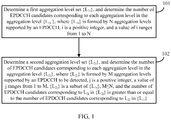
- FIG. 1 is a flowchart of a method for assigning the number of control channel candidates according to an embodiment of the present invention.
- the method in FIG. 1 is executed by a base station, which, for example, may be an eNB in the LTE technology, and may also be a radio network controller (Radio Network Controller, RNC) in the WCDMA technology.
- a base station which, for example, may be an eNB in the LTE technology, and may also be a radio network controller (Radio Network Controller, RNC) in the WCDMA technology.
- RNC Radio Network Controller
- 102 Determine a second aggregation level set ⁇ L 2j ⁇ , and determine the number of EPDCCH candidates corresponding to each aggregation level in the aggregation level ⁇ L 2j ⁇ , where ⁇ L 2j ⁇ is formed by M aggregation levels supported by an EPDCCH to be detected, j is a positive integer, a value of j ranges from 1 to M, ⁇ L 2j ⁇ is a subset of ⁇ L 1i ⁇ , M ⁇ N, and the number of EPDCCH candidates corresponding to L 2j in ⁇ L 2j ⁇ is greater than or equal to the number of EPDCCH candidates corresponding to L 2j in ⁇ L 1i ⁇ .
- the base station reassigns the number of EPDCCH candidates corresponding to the aggregation level not supported by the EPDCCH to be detected, thereby improving the utilization of the EPDCCH candidates.
- the number of EPDCCH candidates that the base station needs to assign may be the same as the number of blind detection times of a UE. For example, when the UE supports 32 times of blind detection, the base station may assign 32 EPDCCH candidates to the UE; when the UE employs an uplink MIMO technology, the number of blind detection times that can be supported by the UE is 48, and the base station may assign 48 EPDCCH candidates to the UE. It should be understood that, the number of EPDCCH candidates assigned by the base station may also be different from the number of blind detection times supported by the UE, which is not limited in the embodiment of the present invention.
- N aggregation levels supported by an EPDCCH is a generalized concept, and may not refer in particular to a certain EPDCCH; moreover, the base station may determine the N aggregation levels supported by the EPDCCH before actually sending the EPDCCH; the EPDCCH to be detected may be a specific EPDCCH in a certain subframe.
- step 102 may include: determining (N-M) remaining aggregation level after the aggregation levels in ⁇ L 2j ⁇ are removed from ⁇ L 1i ⁇ ; determining the total number P of EPDCCH candidates corresponding to the (N-M) aggregation level in ⁇ L 1i ⁇ ; and assigning P EPDCCH candidates to the aggregation levels in ⁇ L 2j ⁇ .
- the present invention does not limit the specific assignment manner for assigning P EPDCCH candidates to the aggregation levels in ⁇ L 2j ⁇ ; the EPDCCH candidates may be assigned evenly, or assigned proportionally, or assigned randomly. In addition, the present invention does not limit the assignment sequence either; the EPDCCH candidates may be assigned according to a descending order of the aggregation levels, or assigned according to an ascending order of the aggregation levels; the EPDCCH candidates may be completely assigned in one time, or assigned in several times.
- the assigning P EPDCCH candidates to the aggregation levels in ⁇ L 2j ⁇ may include: assigning P1 EPDCCH candidates to the aggregation levels in ⁇ L 2j ⁇ in a first time; and assigning P2 EPDCCH candidates to the aggregation levels in ⁇ L 2j ⁇ in a second time, where P1+P2 ⁇ P.
- P1 and P2 may be determined in advance; or, an assignment rule may be determined in advance, and P2 EPDCCH candidates remain after the assignment based on the rule, while P1 is not determined in advance but is obtained after the assignment based on the rule.
- the assigning P1 EPDCCH candidates to the aggregation levels in ⁇ L 2j ⁇ in a first time may include: evenly assigning P1 EPDCCH candidates to the aggregation levels in ⁇ L 2j ⁇ .
- each aggregation level is assigned with 2.5 EPDCCH candidates.
- the assigning P1 EPDCCH candidates to the aggregation levels in ⁇ L 2j ⁇ in a first time may include: assigning the P1 EPDCCH candidates according to a ratio of the number of EPDCCH candidates corresponding to each aggregation level of ⁇ L 2j ⁇ in ⁇ L 1i ⁇ to the total number of EPDCCH candidates corresponding to all the aggregation levels of ⁇ L 2j ⁇ in ⁇ L 1i ⁇ .
- the assigning P1 EPDCCH candidates to the aggregation levels in ⁇ L 2j ⁇ in a first time may include: assigning the P1 EPDCCH candidates to the aggregation levels in ⁇ L 2j ⁇ according to a proportional relationship between N and M.
- the assigning P1 EPDCCH candidates to the aggregation levels in ⁇ L 2j ⁇ in a first time may include: assigning the P1 EPDCCH candidates to one aggregation level in ⁇ L 2j ⁇ .
- the embodiment of the present invention does not limit the assignment manner of P2; the P2 EPDCCH candidates may be assigned based on a certain rule, or assigned randomly; a part of the P2 EPDCCH candidates may be assigned first, and then the rest are assigned; the P2 EPDCCH candidates may be assigned completely, or some of the P2 EPDCCH candidates may remain.
- the assigning P2 EPDCCH candidates to the aggregation levels in ⁇ L 2j ⁇ in a second time may include: cyclically assigning one EPDCCH candidate to each aggregation level in ⁇ L 2j ⁇ in sequence according to an ascending order of the aggregation levels; or cyclically assigning one EPDCCH candidate to each aggregation level in ⁇ L 2j ⁇ in sequence according to a descending order of the aggregation levels.
- EPDCCH candidates among P2 EPDCCH candidates may be assigned based on the same rule, that is, the assignment is performed cyclically in sequence.
- the determining a second aggregation level set ⁇ L 2j ⁇ may include: determining ⁇ L 2j ⁇ according to a DCI format of the EPDCCH to be detected and/or the number of available resource units of each physical resource block pair corresponding to the EPDCCH to be detected.
- the determining ⁇ L 2j ⁇ according to a DCI format of the EPDCCH to be detected may include: determining at least one threshold according to the DCI format of the EPDCCH; and determining ⁇ L 2j ⁇ according to the at least one threshold.
- the base station may determine a first threshold for an EPDCCH transmitted in DCI format 1A, and the first threshold may also be used for an EPDCCH transmitted in DCI format series 2X.
- the base station may also determine a second threshold for the EPDCCH transmitted in DCI format series 2X, and the second threshold may also be used for the EPDCCH transmitted in DCI format 1A; or, the base station re-determines a third threshold met by both the EPDCCH transmitted in the DCI format 1A and the EPDCCH transmitted in the DCI format series 2X.
- both of the thresholds can ensure that the EPDCCH transmitted in the DCI format series 2X meets a transmission code rate requirement, and therefore, the EPDCCH transmitted in DCI format 1A meets the transmission code rate requirement even better.
- the number of blind detection times may be assigned, based on a predetermined rule, to the aggregation levels determined according to the foregoing thresholds.
- the base station may determine a first threshold for an EPDCCH transmitted in the DCI format 1A, and determine a second threshold for an EPDCCH transmitted in the DCI format series 2X.
- determining different thresholds for different transmission formats determined aggregation levels that can be supported by EPDDCHs to be detected may be different.
- the embodiment of the present invention it is also possible that a part of EPDCCH candidates corresponding to one or some aggregation levels among the aggregation levels supported by the EPDCCH to be detected do not support the transmission of a certain EPDCCH which is to be detected and with the DCI transmission format, and the rest support the transmission of the EPDCCH with the DCI transmission format.
- the number of candidates corresponding to this part of EPDCCH candidates may also be reassigned.
- the embodiment of the present invention does not limit the reassignment principle, which may be any one of or a combination of multiple principles mentioned in the embodiments of the present invention, and may also be a new principle.
- the present invention does not limit the object of the reassignment either; the object may or may not include the foregoing one or some aggregation levels.
- N 5, and the N aggregation levels are ⁇ 1, 2, 4, 8, 16 ⁇ . It is assumed that the aggregation level 1 has been assigned with 10 EPDCCH candidates. For failing to meet the code rate requirement, the aggregation level 1 cannot be used for transmitting EPDCCHs with the DCI format series 2X, and all other aggregation levels meet the code rate requirement.
- the base station may assign 10 EPDCCH candidates to the 4 remaining aggregation levels ⁇ 2, 4, 8, 16 ⁇ .
- N 4, N aggregation levels are ⁇ 2, 4, 8, 16 ⁇ , and all the aggregation levels meet the code rate requirement. It is assumed that the aggregation level 2 has been assigned with 4 EPDCCH candidates, but 2 EPDCCH candidates in the aggregation level 2 do not meet the code rate requirement.
- the base station may assign 2 EPDCCH candidates to the 3 remaining aggregation levels ⁇ 4, 8, 16 ⁇ .
- N 5, and N aggregation levels are ⁇ 1, 2, 4, 8, 16 ⁇ . It is assumed that the aggregation level 1 and the aggregation level 2 each correspond to 10 EPDCCH candidates. The aggregation level 1 does not meet the code rate requirement, and 5 EPDCCH candidates in the aggregation level 2 do not meet the code rate requirement.
- the base station may assign 15 EPDCCH candidates to the 4 remaining aggregation levels ⁇ 2, 4, 8, 16 ⁇ .
- an aggregation level corresponding to the P1 EPDCCH candidates is used as (N-M) aggregation level.
- N 5
- N aggregation levels are ⁇ 1, 2, 4, 8, 16 ⁇ .
- the aggregation level 1 does not meet the code rate requirement
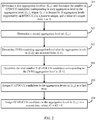
- FIG. 2 is a flowchart of a method for assigning the number of control channel candidates according to another embodiment of the present invention.
- the method in FIG. 2 is executed by a base station.
- the embodiment in FIG. 2 is a more specific implementation manner of the embodiment in FIG. 1 , and therefore, detailed descriptions are properly omitted herein.
- 201 Determine a first aggregation level set ⁇ L 1i ⁇ , and determine the number of EPDCCH candidates corresponding to each aggregation level in the aggregation level ⁇ L 1i ⁇ , where ⁇ L 1i ⁇ is formed by N aggregation levels supported by an EPDCCH, i is a positive integer, and a value of i ranges from 1 to N.
- the base station reassigns the number of EPDCCH candidates corresponding to the aggregation level not supported by the EPDCCH to be detected, thereby improving the utilization of the EPDCCH candidates.
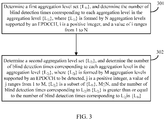
- FIG. 3 is a flowchart of a method for assigning the number of blind detection times according to an embodiment of the present invention.
- the method in FIG. 3 is executed by a UE.
- the embodiment in FIG. 3 is corresponding to the embodiment in FIG. 1 .
- the difference between the executor, the base station, in FIG. 1 and the executor, the UE, in FIG. 3 is that the assigned objects are different.
- the base station assigns the EPDCCH candidates, and the UE assigns the number of blind detection times; the assignment manners may be the same or corresponding to each other, and therefore, detailed descriptions are omitted herein.
- 301 Determine a first aggregation level set ⁇ L 1i ⁇ , and determine the number of blind detection times corresponding to each aggregation level in the aggregation level ⁇ L 1i ⁇ , where ⁇ L 1i ⁇ is formed by N aggregation levels supported by an EPDCCH, i is a positive integer, and a value of i ranges from 1 to N.
- ⁇ L 2j ⁇ is formed by M aggregation levels supported by an EPDCCH to be detected
- j is a positive integer
- a value of j ranges from 1 to M
- ⁇ L 2j ⁇ is a subset of ⁇ L 1i ⁇ , M ⁇ N
- the number of blind detection times corresponding to L 2j in ⁇ L 2j ⁇ is greater than or equal to the number of blind detection times corresponding to L 2j in ⁇ L 1i ⁇ .
- the UE reassigns the number of blind detection times corresponding to an aggregation level that is not supported by the EPDCCH to be detected, thereby improving the utilization of the blind detection times.
- the determining the number of blind detection times corresponding to each aggregation level in the aggregation level ⁇ L 2j ⁇ may include: determining (N-M) remaining aggregation level after the aggregation levels in ⁇ L 2j ⁇ are removed from ⁇ L 1i ⁇ ; determining the number P of blind detection times corresponding to the (N-M) aggregation level in ⁇ L 1i ⁇ ; and assigning P times of blind detection to the aggregation levels in ⁇ L 2j ⁇ .
- the assigning P times of blind detection to the aggregation levels in ⁇ L 2j ⁇ may include: assigning P1 times of blind detection to the aggregation levels in ⁇ L 2j ⁇ in a first time; and assigning P2 times of blind detection to the aggregation levels in ⁇ L 2j ⁇ in a second time, where P1+P2 ⁇ P.
- the assigning P1 times of blind detection to the aggregation levels in ⁇ L 2j ⁇ in a first time may include: evenly assigning P1 times of blind detection to the aggregation levels in ⁇ L 2j ⁇ .
- the assigning P1 times of blind detection to the aggregation levels in ⁇ L 2j ⁇ in a first time may include: assigning the P1 times of blind detection according to a ratio of the number of blind detection times corresponding to each aggregation level of ⁇ L 2j ⁇ in ⁇ L 1i ⁇ to the total number of blind detection times corresponding to all the aggregation levels of ⁇ L 2j ⁇ in ⁇ L 1i ⁇ .
- the assigning P1 times of blind detection to the aggregation levels in ⁇ L 2j ⁇ in a first time may include: assigning P1 times of blind detection to the aggregation levels in ⁇ L 2j ⁇ according to a proportional relationship between N and M.
- the assigning P2 times of blind detection to the aggregation levels in ⁇ L 2j ⁇ in a second time may include: cyclically assigning one time of blind detection to each aggregation level in ⁇ L 2j ⁇ in sequence according to an ascending order of the aggregation levels; or cyclically assigning one time of blind detection to each aggregation level in ⁇ L 2j ⁇ in sequence according to a descending order of the aggregation levels.
- the assigning P1 times of blind detection to the aggregation levels in ⁇ L 2j ⁇ in a first time may include: assigning P1 times of blind detection to one aggregation level in ⁇ L 2j ⁇ .
- the determining a second aggregation level set ⁇ L 2j ⁇ may include: determining ⁇ L 2j ⁇ according to a DCI format of the EPDCCH to be detected and/or the number of available resource units of each physical resource block pair corresponding to the EPDCCH to be detected.
- the determining ⁇ L 2j ⁇ according to a DCI format of the EPDCCH to be detected may include: determining at least one threshold according to the DCI format of the EPDCCH; and determining ⁇ L 2j ⁇ according to the at least one threshold.
- the total number of aggregation levels that can be supported by the UE is K, and the total number of blind detection times is 32 (the total number of blind detection times may be 48 in the case of UL MIMO).
- the total number of blind detection times is assigned to the K aggregation levels based on a certain predetermined rule, to obtain an assignment result 1 of the K aggregation levels.
- the number of aggregation levels that actually can be supported by the UE declines from K to T, where T ⁇ K
- the number of blind detection times corresponding to the (K-T) aggregation levels that are not supported are assigned to the T aggregation levels, to obtain an assignment result 2 of the T aggregation levels.
- the assignment of the number of blind detection times for the aggregation levels in S1 is based on the assignment of the number of blind detection times for the aggregation levels in S2.
- the number of blind detection times corresponding to the aggregation level 1 in S2 is assigned to each aggregation level in the set S1 based on a certain preset rule.
- This rule may be one or more rules in the embodiment of the present invention.
- the assignment of the number of blind detection times corresponding to all other cases in the right area of Table 1 may be used as blind detection assignment 1, and the assignment of the number of blind detection times corresponding to the aggregation levels ⁇ 2, 4, 8, 16 ⁇ in the left area of Table 1 is obtained from the blind detection assignment 1 of the aggregation levels ⁇ 1, 2, 4, 8, 16 ⁇ in the right area.
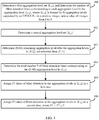
- FIG. 4 is a flowchart of a method for assigning the number of blind detection times according to another embodiment of the present invention. The method in FIG. 4 is executed by an UE.
- 401 Determine a first aggregation level set ⁇ L 1i ⁇ , and determine the number of blind detection times corresponding to each aggregation level in the aggregation level ⁇ L 1i ⁇ , where ⁇ L 1i ⁇ is formed by N aggregation levels supported by an EPDCCH, i is a positive integer, and a value of i ranges from 1 to N.
- the UE reassigns the number of blind detection times corresponding to an aggregation level that is not supported by the EPDCCH to be detected, thereby improving the utilization of the blind detection times.
- FIG. 5 is a flowchart of a method for assigning the number of control channel candidates according to another embodiment of the present invention.
- a base station determines that aggregation levels supported by an EPDCCH are ⁇ 1, 2, 4, 8, 16 ⁇ .
- the base station determines that the number of EPDCCH candidates corresponding to the five aggregation levels are ⁇ a, b, c, d, e ⁇ .
- the aggregation level 1 is assigned with a EPDCCH candidates
- the aggregation level 2 is assigned with b EPDCCH candidates
- the aggregation level 4 is assigned with c EPDCCH candidates
- the aggregation level 8 is assigned with d EPDCCH candidates
- the aggregation level 16 is assigned with e EPDCCH candidates.
- the base station determines that aggregation levels supported by an EPDCCH to be detected are ⁇ 2, 4, 8, 16 ⁇ .
- the base station assigns the a EPDCCH candidates corresponding to the aggregation level 1 to the aggregation levels 2, 4, 8, and 16 according to proportions of b/(b+c+d+e), c/(b+c+d+e), d/(b+c+d+e), and e/(b+c+d+e):
- the base station assigns one of (a-b/(b+c+d+e)-c/(b+c+d+e)-d/(b+c+d+e)-e/(b+c+d+e)) remaining EPDCCH candidates to the aggregation levels ⁇ 2, 4, 8, 16 ⁇ in sequence according to a descending order of the aggregation levels.
- a more generalized assignment criterion may be expressed as follows: it is assumed that aggregation levels that can be supported by an enhanced control channel determined according to a certain threshold are L1, L2, ..., Lk, where the numbers of candidates corresponding to the aggregation levels are M L1 , M L2 , ..., M Lk , respectively.
- the aggregation level Li cannot meet a code rate requirement of an enhanced control channel with a certain DCI format; a user terminal skips the detection of this aggregation level, and at the same time assigns the number M Li of blind detection times corresponding to this aggregation level to other aggregation levels that meet the condition.
- R M Li ⁇ ⁇ t ⁇ i M Lt ' ⁇ M Lt
- R is evenly assigned to the other aggregation levels that meet the condition from a high aggregation level to a low aggregation level.
- the M Li in the foregoing formula (6) is corresponding to the total number of candidates of all the aggregation levels that do not meet the condition.
- the base station reassigns the number of EPDCCH candidates corresponding to the aggregation level not supported by the EPDCCH to be detected, thereby improving the utilization of the EPDCCH candidates.
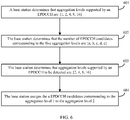
- FIG. 6 is a flowchart of a method for assigning the number of control channel candidates according to another embodiment of the present invention.
- a base station determines that aggregation levels supported by an EPDCCH are ⁇ 1, 2, 4, 8, 16 ⁇ .
- the base station determines that the number of EPDCCH candidates corresponding to the five aggregation levels are ⁇ a, b, c, d, e ⁇ .
- the aggregation level 1 is assigned with a EPDCCH candidates
- the aggregation level 2 is assigned with b EPDCCH candidates
- the aggregation level 4 is assigned with c EPDCCH candidates
- the aggregation level 8 is assigned with d EPDCCH candidates
- the aggregation level 16 is assigned with e EPDCCH candidates.
- the base station determines that aggregation levels supported by an EPDCCH to be detected are ⁇ 2, 4, 8, 16 ⁇ .
- the base station assigns the a EPDCCH candidates corresponding to the aggregation level 1 to the aggregation level 2.
- the aggregation level 2 to which the a EPDCCH candidates are assigned is merely an aggregation level selected from the second set, and may also be any aggregation level in the second set.
- a more generalized assignment criterion may be expressed as follows: it is assumed that aggregation levels that can be supported by an enhanced control channel determined according to a certain threshold are L1, L2, ..., Lk, where the numbers of candidates corresponding to the aggregation levels are M L1 , M L2 , ..., M Lk , respectively. It is assumed that the aggregation level Li cannot meet a code rate requirement of an enhanced control channel with a certain DCI format; a user terminal skips the detection of this aggregation level, and at the same time assigns the number of blind detection times M Li corresponding to this aggregation level to a certain aggregation level among the other aggregation levels that meet the condition.
- the base station reassigns the number of EPDCCH candidates corresponding to the aggregation level not supported by the EPDCCH to be detected, thereby improving the utilization of the EPDCCH candidates.
- FIG. 7 is a flowchart of a method for assigning the number of control channel candidates according to another embodiment of the present invention.
- a base station determines that aggregation levels supported by an EPDCCH are ⁇ 1, 2, 4, 8, 16 ⁇ .
- the base station determines that the number of EPDCCH candidates corresponding to the five aggregation levels are ⁇ a, b, c, d, e ⁇ .
- the aggregation level 1 is assigned with a EPDCCH candidates
- the aggregation level 2 is assigned with b EPDCCH candidates
- the aggregation level 4 is assigned with c EPDCCH candidates
- the aggregation level 8 is assigned with d EPDCCH candidates
- the aggregation level 16 is assigned with e EPDCCH candidates.
- the base station determines that aggregation levels supported by an EPDCCH to be detected are ⁇ 2, 4, 8, 16 ⁇ .
- the base station assigns (5b/4-b), (5c/4-c), (5d/4-d), and (5e/4-e) to the aggregation levels ⁇ 2, 4, 8, 16 ⁇ in sequence according to a ratio 5/4 of the number of aggregation levels supported by the EPDCCH to the number of aggregation levels supported by the EPDCCH to be detected:
- the EPDCCH candidates may be assigned according to a descending order or an ascending order of the aggregation levels.
- the assignment stops.
- the base station assigns one of ( a - b'-c' - d'-e ') remaining EPDCCH candidates to the aggregation levels ⁇ 2, 4, 8, 16 ⁇ in sequence according to a descending order of the aggregation levels.
- a more generalized assignment criterion may be expressed as follows: it is assumed that aggregation levels that can be supported by an enhanced control channel determined according to a certain threshold are L1, L2, ..., Lk (the total number of aggregation levels is k), where the numbers of candidates corresponding to the aggregation levels are M L1 , M L2 , ..., M Lk , respectively.
- the aggregation level Li cannot meet a code rate requirement of an enhanced control channel with a certain DCI format; a user terminal skips the detection of this aggregation level, and at the same time assigns the number M Li of blind detection times corresponding to this aggregation level to other aggregation levels (the total number of aggregation levels is m) that meet the condition.
- R M Li ⁇ ⁇ t ⁇ i M Lt ' ⁇ M Lt
- R is evenly assigned to the other aggregation levels that meet the condition starting from a low aggregation level or a high aggregation level.
- the base station reassigns the number of EPDCCH candidates corresponding to the aggregation level not supported by the EPDCCH to be detected, thereby improving the utilization of the EPDCCH candidates.
- FIG. 8 is a flowchart of a method for assigning the number of control channel candidates according to another embodiment of the present invention.
- a base station determines that aggregation levels supported by an EPDCCH are ⁇ 1, 2, 4, 8, 16 ⁇ .
- the base station determines that the number of EPDCCH candidates corresponding to the five aggregation levels are ⁇ a, b, c, d, e ⁇ .
- the aggregation level 1 is assigned with a EPDCCH candidates
- the aggregation level 2 is assigned with b EPDCCH candidates
- the aggregation level 4 is assigned with c EPDCCH candidates
- the aggregation level 8 is assigned with d EPDCCH candidates
- the aggregation level 16 is assigned with e EPDCCH candidates.
- the base station determines that aggregation levels supported by an EPDCCH to be detected are ⁇ 2, 4, 8, 16 ⁇ .
- the base station assigns one of ( a - ⁇ a / m ⁇ - ⁇ a / m ⁇ - ⁇ a / m ⁇ - ⁇ a / m ⁇ - ⁇ a / m ⁇ ) remaining EPDCCH candidates to the aggregation levels ⁇ 2, 4, 8, 16 ⁇ in sequence according to a descending order of the aggregation levels.
- the embodiment of the present invention does not limit the method for assigning remaining EPDCCH candidates, and the remaining EPDCCH candidates may be assigned according to a descending order or an ascending order, or based on a certain predetermined sequence.
- a more generalized assignment criterion may be expressed as follows: it is assumed that aggregation levels that can be supported by an enhanced control channel determined according to a certain threshold are L1, L2, ..., Lk (the total number of aggregation levels is k), where the numbers of candidates corresponding to the aggregation levels are M L1 , M L2 , ..., M Lk , respectively.
- the aggregation level Li cannot meet a code rate requirement of an enhanced control channel with a certain DCI format; then a user terminal skips the detection of this aggregation level, and at the same time assigns the number of blind detection times M Li corresponding to this aggregation level to other aggregation levels (the total number of aggregation levels is m) that meet the condition.
- R M Li ⁇ ⁇ t ⁇ i M Lt ' ⁇ M Lt
- R is evenly assigned to the other aggregation levels that meet the condition starting from a low aggregation level or a high aggregation level.
- the base station reassigns the number of EPDCCH candidates corresponding to the aggregation level not supported by the EPDCCH to be detected, thereby improving the utilization of the EPDCCH candidates.
- FIG. 9 is a flowchart of a method for assigning the number of blind detection times according to another embodiment of the present invention.
- the embodiment in FIG. 9 is corresponding to the embodiment in FIG. 5 ; the assignment manner of the number of EPDCCH candidates in the embodiment in FIG. 5 and the assignment manner of the number of blind detection times in the embodiment in FIG. 9 are the same or corresponding to each other. To avoid repetition, the assignment manner is not described in detail again.
- a UE determines that aggregation levels supported by an EPDCCH are ⁇ 1, 2, 4, 8, 16 ⁇ .
- the UE determines that the number of blind detection times corresponding to the five aggregation levels are ⁇ a, b, c, d, e ⁇ .
- the UE determines that aggregation levels supported by an EPDCCH to be detected are ⁇ 2, 4, 8, 16 ⁇ .
- the UE assigns the a times of blind detection corresponding to the aggregation level 1 to the aggregation levels 2, 4, 8, and 16 according to proportions of b/(b+c+d+e), c/(b+c+d+e), d/(b+c+d+e), and e/(b+c+d+e).
- the UE assigns one of (a-b/(b+c+d+e)-c/(b+c+d+e)-d/(b+c+d+e)-e/(b+c+d+e)) remaining times of blind detection to the aggregation levels ⁇ 2, 4, 8, 16 ⁇ in sequence according to a descending order of the aggregation levels.
- the UE reassigns the number of blind detection times corresponding to an aggregation level that is not supported by the EPDCCH to be detected, thereby improving the utilization of the blind detection times.
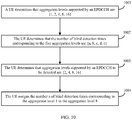
- FIG. 10 is a flowchart of a method for assigning the number of blind detection times according to another embodiment of the present invention.
- the embodiment in FIG. 10 is corresponding to the embodiment in FIG. 6 ; the assignment manner of the number of EPDCCH candidates in the embodiment in FIG. 6 and the assignment manner of the number of blind detection times in the embodiment in FIG. 10 are the same or corresponding to each other. To avoid repetition, the assignment manner is not described in detail again.
- a UE determines that aggregation levels supported by an EPDCCH are ⁇ 1, 2, 4, 8, 16 ⁇ .
- the UE determines that the number of blind detection times corresponding to the five aggregation levels are ⁇ a, b, c, d, e ⁇ .
- the UE determines that aggregation levels supported by an EPDCCH to be detected are ⁇ 2, 4, 8, 16 ⁇ .
- the UE assigns the number a of blind detection times corresponding to the aggregation level 1 to the aggregation level 8.
- the UE reassigns the number of blind detection times corresponding to an aggregation level that is not supported by the EPDCCH to be detected, thereby improving the utilization of the blind detection times.
- FIG. 11 is a flowchart of a method for assigning the number of blind detection times according to another embodiment of the present invention.
- the embodiment in FIG. 11 is corresponding to the embodiment in FIG. 7 ; the assignment manner of the number of EPDCCH candidates in the embodiment in FIG. 7 and the assignment manner of the number of blind detection times in the embodiment in FIG. 11 are the same or corresponding to each other. To avoid repetition, the assignment manner is not described in detail again.
- a UE determines that aggregation levels supported by an EPDCCH are ⁇ 1, 2, 4, 8, 16 ⁇ .
- the UE determines that the number of blind detection times corresponding to the five aggregation levels are ⁇ a, b, c, d, e ⁇ .
- the UE determines that aggregation levels supported by an EPDCCH to be detected are ⁇ 2, 4, 8, 16 ⁇ .
- the UE assigns 5b/4, 5c/4, 5d/4, and 5e/4 times of blind detection to the aggregation levels ⁇ 2, 4, 8, 16 ⁇ in sequence according to a ratio 5/4 of the number of aggregation levels supported by the EPDCCH to the number of aggregation levels supported by the EPDCCH to be detected.
- the UE assigns one of remaining (a-5b/4-5c/4-5d/4-5e/4) times of blind detection to the aggregation levels ⁇ 2, 4, 8, 16 ⁇ in sequence according to a descending order of the aggregation levels.
- the UE reassigns the number of blind detection times corresponding to an aggregation level that is not supported by the EPDCCH to be detected, thereby improving the utilization of the blind detection times.
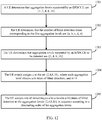
- FIG. 12 is a flowchart of a method for assigning the number of blind detection times according to another embodiment of the present invention.
- the embodiment in FIG. 12 is corresponding to the embodiment in FIG. 8 ; the assignment manner of the number of EPDCCH candidates in the embodiment in FIG. 8 and the assignment manner of the number of blind detection times in the embodiment in FIG. 12 are the same or corresponding to each other. To avoid repetition, the assignment manner is not described in detail again.
- a UE determines that aggregation levels supported by an EPDCCH are ⁇ 1, 2, 4, 8, 16 ⁇ .
- the UE determines that the number of blind detection times corresponding to the five aggregation levels are ⁇ a, b, c, d, e ⁇ .
- the UE determines that aggregation levels supported by an EPDCCH to be detected are ⁇ 2, 4, 8, 16 ⁇ .
- the UE evenly assigns a to the set ⁇ 2, 4, 8, 16 ⁇ , where each aggregation level obtains a/4 times of blind detection.
- the UE assigns one of remaining (a-5b/4-5c/4-5d/4-5e/4) times of blind detection to the aggregation levels ⁇ 2, 4, 8, 16 ⁇ in sequence according to a descending order of the aggregation levels.
- the UE reassigns the number of blind detection times corresponding to an aggregation level that is not supported by the EPDCCH to be detected, thereby improving the utilization of the blind detection times.
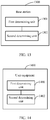
- FIG. 13 is a block diagram of a base station according to an embodiment of the present invention.
- a base station 1300 in FIG. 13 includes a first determining unit 1301 and a second determining unit 1302.
- the base station in FIG. 13 is capable of executing the steps performed by the base station in FIG. 1 , FIG. 2 , and FIG. 5 to FIG. 8 . To avoid repetition, the steps are not described in detail again.
- the first determining unit 1301 is configured to determine a first aggregation level set ⁇ L 1i ⁇ , and determine the number of EPDCCH candidates corresponding to each aggregation level in the aggregation level ⁇ L 1i ⁇ , where ⁇ L 1i ⁇ is formed by N aggregation levels supported by an EPDCCH, i is a positive integer, and a value of i ranges from 1 to N.
- the second determining unit 1302 is configured to determine a second aggregation level set ⁇ L 2j ⁇ , and determine the number of EPDCCH candidates corresponding to each aggregation level in the aggregation level ⁇ L 2j ⁇ , where ⁇ L 2j ⁇ is formed by M aggregation levels supported by an EPDCCH to be detected, j is a positive integer, a value of j ranges from 1 to M, ⁇ L 2j ⁇ is a subset of ⁇ L 1i ⁇ , M ⁇ N, and the number of EPDCCH candidates corresponding to L 2j in ⁇ L 2j ⁇ is greater than or equal to the number of EPDCCH candidates corresponding to L 2j in ⁇ L 1i ⁇ .
- the base station reassigns the number of EPDCCH candidates corresponding to the aggregation level not supported by the EPDCCH to be detected, thereby improving the utilization of the EPDCCH candidates.
- the second determining unit 1302 is specifically configured to determine (N-M) remaining aggregation level after the aggregation levels in ⁇ L 2j ⁇ are removed from ⁇ L 1i ⁇ ; determine the total number P of EPDCCH candidates corresponding to the (N-M) aggregation level in ⁇ L 1i ⁇ ; and assign P EPDCCH candidates to the aggregation levels in ⁇ L 2j ⁇ .
- the second determining unit 1302 is specifically configured to assign PI EPDCCH candidates to the aggregation levels in ⁇ L 2j ⁇ in a first time; and assign P2 EPDCCH candidates to the aggregation levels in ⁇ L 2j ⁇ in a second time, where P1+P2 ⁇ P.
- the second determining unit 1302 is specifically configured to evenly assign the P1 EPDCCH candidates to the aggregation levels in ⁇ L 2j ⁇ .
- the second determining unit 1302 is specifically configured to assign the P1 EPDCCH candidates according to a ratio of the number of EPDCCH candidates corresponding to each aggregation level of ⁇ L 2j ⁇ in ⁇ L 1i ⁇ to the total number of EPDCCH candidates corresponding to all the aggregation levels of ⁇ L 2j ⁇ in ⁇ L 1i ⁇ .
- the second determining unit 1302 is specifically configured to assign the P1 EPDCCH candidates to the aggregation levels in ⁇ L 2j ⁇ according to a proportional relationship between N and M.
- the second determining unit 1302 is specifically configured to cyclically assign one EPDCCH candidate to the aggregation levels in ⁇ L 2j ⁇ in sequence according to an ascending order of the aggregation levels; or cyclically assign one EPDCCH candidate to the aggregation levels in ⁇ L 2j ⁇ in sequence according to a descending order of the aggregation levels.
- the second determining unit 1302 is specifically configured to assign the P1 EPDCCH candidates to one aggregation level in ⁇ L 2j ⁇ .
- the second determining unit 1302 is specifically configured to determine ⁇ L 2j ⁇ according to a DCI format of the EPDCCH to be detected and/or the number of available resource units of each physical resource block pair corresponding to the EPDCCH to be detected.
- the second determining unit 1302 is specifically configured to determine at least one threshold according to the DCI format of the EPDCCH; and determine ⁇ L 2j ⁇ according to the at least one threshold.
- FIG. 14 is a block diagram of a user equipment according to an embodiment of the present invention.
- a 1400 in FIG. 14 includes a first determining unit 1401 and a second determining unit 1402.
- the UE in FIG. 14 is capable of executing the steps performed by the base stations in FIG. 3 , FIG. 4 , and FIG. 9 to FIG. 12 . To avoid repetition, the steps are not described in detail again.
- the first determining unit 1401 is configured to determine a first aggregation level set ⁇ L 1i ⁇ , and determine the number of blind detection times corresponding to each aggregation level in the aggregation level ⁇ L 1i ⁇ , where ⁇ L 1i ⁇ is formed by N aggregation levels supported by an EPDCCH, i is a positive integer, and a value of i ranges from 1 to N.
- the second determining unit 1402 is configured to determine a second aggregation level set ⁇ L 2j ⁇ , and determine the number of blind detection times corresponding to each aggregation level in the aggregation level ⁇ L 2j ⁇ , where ⁇ L 2j ⁇ is formed by M aggregation levels supported by an EPDCCH to be detected, j is a positive integer, a value of j ranges from 1 to M, ⁇ L 2j ⁇ is a subset of ⁇ L 1i ⁇ , M ⁇ N, and the number of blind detection times corresponding to L 2j in ⁇ L 2j ⁇ is greater than or equal to the number of blind detection times corresponding to L 2j in ⁇ L 1i ⁇ .
- the UE reassigns the number of blind detection times corresponding to an aggregation level that is not supported by the EPDCCH to be detected, thereby improving the utilization of the blind detection times.
- the second determining unit 1402 is specifically configured to determine (N-M) remaining aggregation level after the aggregation levels in ⁇ L 2j ⁇ are removed from ⁇ L 1i ⁇ ; determine the number P of blind detection times corresponding to the (N-M) aggregation level in ⁇ L 1i ⁇ ; and assign P times of blind detection to the aggregation levels in ⁇ L 2j ⁇ .
- the second determining unit 1402 is specifically configured to assign PI times of blind detection to the aggregation levels in ⁇ L 2j ⁇ in a first time; and assign P2 times of blind detection to the aggregation levels in ⁇ L 2j ⁇ in a second time, where P1+P2 ⁇ P.
- the second determining unit 1402 is specifically configured to evenly assign the P1 times of blind detection to the aggregation levels in ⁇ L 2j ⁇ .
- the second determining unit 1402 is specifically configured to assign the P1 times of blind detection according to a ratio of the number of blind detection times corresponding to each aggregation level of ⁇ L 2j ⁇ in ⁇ L 1i ⁇ to the total number of blind detection times corresponding to all the aggregation levels of ⁇ L 2j ⁇ in ⁇ L 1i ⁇ .
- the second determining unit 1402 is specifically configured to assign the P1 times of blind detection to the aggregation levels in ⁇ L 2j ⁇ according to a proportional relationship between N and M.
- the second determining unit 1402 is specifically configured to cyclically assign one time of blind detection to the aggregation levels in ⁇ L 2j ⁇ in sequence according to an ascending order of the aggregation levels; or cyclically assign one time of blind detection to the aggregation levels in ⁇ L 2j ⁇ in sequence according to a descending order of the aggregation levels.
- the second determining unit 1402 is specifically configured to assign the P1 times of blind detection to one aggregation level in ⁇ L 2j ⁇ .
- the second determining unit 1402 is specifically configured to determine ⁇ L 2j ⁇ according to a DCI format of the EPDCCH to be detected and/or the number of available resource units of each physical resource block pair corresponding to the EPDCCH to be detected.
- the second determining unit 1402 is specifically configured to determine at least one threshold according to the DCI format of the EPDCCH; and determine ⁇ L 2j ⁇ according to the at least one threshold.
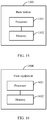
- FIG. 15 is a block diagram of a base station according to another embodiment of the present invention.
- a base station 1500 includes a processor 1501 and a memory 1502.
- the base station in FIG. 15 is capable of executing the steps performed by the base station in FIG. 1 , FIG. 2 , and FIG. 5 to FIG. 8 . To avoid repetition, the steps are not described in detail again.
- the processor 1501 is configured to determine a first aggregation level set ⁇ L 1i ⁇ , and determine the number of EPDCCH candidates corresponding to each aggregation level in the aggregation level ⁇ L 1i ⁇ , where ⁇ L 1i ⁇ is formed by N aggregation levels supported by an EPDCCH, i is a positive integer, and a value of i ranges from 1 to N.
- the memory 1502 is configured to store ⁇ L 1i ⁇ and the number of EPDCCH candidates corresponding to the aggregation levels in ⁇ L 1i ⁇ .
- the processor 1501 is configured to determine a second aggregation level set ⁇ L 2j ⁇ , and determine the number of EPDCCH candidates corresponding to each aggregation level in the aggregation level ⁇ L 2j ⁇ , where ⁇ L 2j ⁇ is formed by M aggregation levels supported by an EPDCCH to be detected, j is a positive integer, a value of j ranges from 1 to M, ⁇ L 2j ⁇ is a subset of ⁇ L i ⁇ , M ⁇ N, and the number of EPDCCH candidates corresponding to L 2j in ⁇ L 2j ⁇ is greater than or equal to the number of EPDCCH candidates corresponding to L 2j in ⁇ L 1i ⁇ .
- the memory 1502 is configured to store ⁇ L 2j ⁇ and the number of EPDCCH candidates corresponding to the aggregation levels in ⁇ L 2j ⁇ .
- the base station reassigns the number of EPDCCH candidates corresponding to the aggregation level not supported by the EPDCCH to be detected, thereby improving the utilization of the EPDCCH candidates.
- the processor 1501 is specifically configured to get ⁇ L 1i ⁇ from the processor 1502, determine (N-M) remaining aggregation level after the aggregation levels in ⁇ L 2j ⁇ are removed from ⁇ L 1i ⁇ ; determine the total number P of EPDCCH candidates corresponding to the (N-M) aggregation level in ⁇ L 1i ⁇ ; and assign P EPDCCH candidates to the aggregation levels in ⁇ L 2j ⁇ .
- the processor 1501 is specifically configured to get ⁇ L 2j ⁇ from the processor 1502, assign P1 EPDCCH candidates to the aggregation levels in ⁇ L 2j ⁇ in a first time; and assign P2 EPDCCH candidates to the aggregation levels in ⁇ L 2j ⁇ in a second time, where P1+P2 ⁇ P.
- the processor 1501 is specifically configured to evenly assign the P1 EPDCCH candidates to the aggregation levels in ⁇ L 2j ⁇ .
- the processor 1501 is specifically configured to assign the P1 EPDCCH candidates according to a ratio of the number of EPDCCH candidates corresponding to each aggregation level of ⁇ L 2j ⁇ in ⁇ L 1i ⁇ to the total number of EPDCCH candidates corresponding to all the aggregation levels of ⁇ L 2j ⁇ in ⁇ L 1i ⁇ .
- the processor 1501 is specifically configured to assign the P1 EPDCCH candidates to the aggregation levels in ⁇ L 2j ⁇ according to a proportional relationship between N and M.
- the processor 1501 is specifically configured to cyclically assign one EPDCCH candidate to the aggregation levels in ⁇ L 2j ⁇ in sequence according to an ascending order of the aggregation levels; or cyclically assign one EPDCCH candidate to the aggregation levels in ⁇ L 2j ⁇ in sequence according to a descending order of the aggregation levels.
- the processor 1501 is specifically configured to assign the P1 EPDCCH candidates to one aggregation level in ⁇ L 2j ⁇ .
- the processor 1501 is specifically configured to determine ⁇ L 2j ⁇ according to a DCI format of the EPDCCH to be detected and/or the number of available resource units of each physical resource block pair corresponding to the EPDCCH to be detected.
- the processor 1501 is specifically configured to determine at least one threshold according to the DCI format of the EPDCCH; and determine ⁇ L 2j ⁇ according to the at least one threshold.
- FIG. 16 is a block diagram of a user equipment according to another embodiment of the present invention.
- FIG. 1600 includes a processor 1601 and a memory 1602 The UE in FIG. 16 is capable of executing the steps performed by the base stations in FIG. 3 , FIG. 4 , and FIG. 9 to FIG. 12 . To avoid repetition, the steps are not described in detail again.
- the processor 1601 is configured to determine a first aggregation level set ⁇ L 1i ⁇ , and determine the number of blind detection times corresponding to each aggregation level in the aggregation level ⁇ L 1i ⁇ , where ⁇ L 1i ⁇ is formed by N aggregation levels supported by an EPDCCH, i is a positive integer, and a value of i ranges from 1 to N.
- the memory 1602 is configured to store ⁇ L 1i ⁇ and the number of blind detection times corresponding to the aggregation levels in ⁇ L 1i ⁇ .
- the processor 1601 is configured to determine a second aggregation level set ⁇ L 2j ⁇ , and determine the number of blind detection times corresponding to each aggregation level in the aggregation level ⁇ L 2j ⁇ , where ⁇ L 2j ⁇ is formed by M aggregation levels supported by an EPDCCH to be detected, j is a positive integer, a value of j ranges from 1 to M, ⁇ L 2j ⁇ is a subset of ⁇ L 1i ⁇ , M ⁇ N, and the number of blind detection times corresponding to L 2j in ⁇ L 2j ⁇ is greater than or equal to the number of blind detection times corresponding to L 2j in ⁇ L 1i ⁇ .
- the memory 1602 is configured to store ⁇ L 2j ⁇ and the number of blind detection times corresponding to the aggregation levels in ⁇ L 2j ⁇ .
- the UE reassigns the number of blind detection times corresponding to an aggregation level that is not supported by the EPDCCH to be detected, thereby improving the utilization of the blind detection times.
- the processor 1601 is specifically configured to get ⁇ L 1i ⁇ from the processor, determine (N-M) remaining aggregation level after the aggregation levels in ⁇ L 2j ⁇ are removed from ⁇ L 1i ⁇ ; determine the number P of blind detection times corresponding to the (N-M) aggregation level in ⁇ L 1i ⁇ ; and assign P times of blind detection to the aggregation levels in ⁇ L 2j ⁇ .
- the processor 1601 is specifically configured to get ⁇ L 2j ⁇ from the processor, assign P1 times of blind detection to the aggregation levels in ⁇ L 2j ⁇ in a first time; and assign P2 times of blind detection to the aggregation levels in ⁇ L 2j ⁇ in a second time, where P1+P2 ⁇ P.
- the processor 1601 is specifically configured to evenly assign the P1 times of blind detection to the aggregation levels in ⁇ L 2j ⁇ .
- the processor 1601 is specifically configured to assign the P1 times of blind detection according to a ratio of the number of blind detection times corresponding to each aggregation level of ⁇ L 2j ⁇ in ⁇ L 1i ⁇ to the total number of blind detection times corresponding to all the aggregation levels of ⁇ L 2j ⁇ in ⁇ L 1i ⁇ .
- the processor 1601 is specifically configured to assign the P1 times of blind detection to the aggregation levels in ⁇ L 2j ⁇ according to a proportional relationship between N and M.
- the processor 1601 is specifically configured to cyclically assign one time of blind detection to the aggregation levels in ⁇ L 2j ⁇ in sequence according to an ascending order of the aggregation levels; or cyclically assign one time of blind detection to the aggregation levels in ⁇ L 2j ⁇ in sequence according to a descending order of the aggregation levels.
- the processor 1601 is specifically configured to assign the P1 times of blind detection to one aggregation level in ⁇ L 2j ⁇ .
- the processor 1601 is specifically configured to determine ⁇ L 2j ⁇ according to a DCI format of the EPDCCH to be detected and/or the number of available resource units of each physical resource block pair corresponding to the EPDCCH to be detected.
- the processor 1601 is specifically configured to determine at least one threshold according to the DCI format of the EPDCCH; and determine ⁇ L 2j ⁇ according to the at least one threshold.
- the total number of candidates is assigned among the aggregation levels.
- the number of enhanced control channel elements ECCEs is different. For example, when each physical resource block pair corresponds to physical resource units of 4 ECCEs, the number of enhanced control channel elements ECCEs in 2 physical resource block pairs is 8, and therefore, the total numbers of candidates of different aggregation levels ⁇ 1, 2, 4, 8, 16 ⁇ that can be supported by the 2 physical resource block pairs are ⁇ 8, 4, 2, 1, 0 ⁇ , respectively; the total number of enhanced control channel elements in 4 physical resource block pairs is 16, and therefore, the total numbers of candidates of different aggregation levels ⁇ 1, 2, 4, 8, 16 ⁇ that can be supported by the 4 physical resource block pairs are ⁇ 16, 8, 4, 2, 1 ⁇ , respectively.
- the total number of enhanced control channel elements in 8 physical resource block pairs is 32, and therefore, the total numbers of candidates of different aggregation levels ⁇ 1, 2, 4, 8, 16 ⁇ that can be supported by the 8 physical resource block pairs are ⁇ 32, 16, 8, 4, 2 ⁇ , respectively.
- the disclosed system, apparatus, and method may be implemented in other manners.
- the described apparatus embodiments are merely exemplary.
- the unit division is merely logical function division and may be other division in actual implementation.
- a plurality of units or components may be combined or integrated into another system, or some features may be ignored or not performed.
- the displayed or discussed mutual couplings or direct couplings or communication connections may be implemented through some interfaces.
- the indirect couplings or communication connections between the apparatuses or units may be implemented in electronic, mechanical, or other forms.
- the units described as separate parts may or may not be physically separate, and the parts displayed as units may or may not be physical units, may be located in one position, or may be distributed on a plurality of network units. A part of or all of the units may be selected according to actual needs to achieve the objectives of the solutions of the embodiments.
- the functions When the functions are implemented in a form of a software functional module and sold or used as an independent product, the functions may be stored in a computer-readable storage medium. Based on such an understanding, the technical solutions of the present invention essentially, or the part contributing to the prior art, or a part of the technical solutions may be implemented in a form of a software product.
- the computer software product is stored in a storage medium and includes several instructions for instructing a computer device (which may be a personal computer, a server, or a network device or the like) to perform all or a part of the steps of the methods described in the embodiments of the present invention.
- the foregoing storage medium includes: any mediums capable of storing program code, such as a USB flash drive, a removable hard disk, a read-only memory (ROM, Read-Only Memory), a random access memory (RAM, Random Access Memory), a magnetic disk, or an optical disc.
- program code such as a USB flash drive, a removable hard disk, a read-only memory (ROM, Read-Only Memory), a random access memory (RAM, Random Access Memory), a magnetic disk, or an optical disc.
Landscapes
- Engineering & Computer Science (AREA)
- Signal Processing (AREA)
- Computer Networks & Wireless Communication (AREA)
- Mobile Radio Communication Systems (AREA)
Claims (15)
- Procédé pour attribuer le nombre de candidats de canaux de commande, consistant à :déterminer (101), avec une station de base, un premier ensemble de niveaux d'agrégation {L1i} ;déterminer (101), avec la station de base, le nombre de candidats de canaux de commande en liaison descendante physiques améliorés, EPDCCH, correspondant à chaque niveau d'agrégation dans le {L1i}, dans lequel le {L1i} est formé de N niveaux d'agrégation supportés par un EPDCCH, i est un entier positif et une valeur de i varie de 1 à N;déterminer (102), avec la station de base, un second ensemble de niveaux d'agrégation {L2j} ; etdéterminer (102), avec la station de base, le nombre de candidats EPDCCH correspondant à chaque niveau d'agrégation dans le {L2j}, dans lequel {L2j} est formé de M niveaux d'agrégation supportés par un EPDCCH à détecter, j est un entier positif et une valeur de j varie de 1 à M, le {L2j} est un sous-ensemble du {L1i}, M≤N, et le nombre de candidats EPDCCH correspondant à L2j dans le {L2j} est supérieur ou égal au nombre de candidats EPDCCH correspondant à L2j dans le {L1i}, dans lequel le {L2j} est déterminé en fonction d'un seuil qui est déterminé pour l'EPDCCH transmis en format DCI séries 2X, et dans lequel le seuil s'applique au nombre d'unités de ressources valides comprises dans chaque paire de blocs de ressources physiques ; ledit procédé étant caractérisé en ce quele seuil est différent de celui déterminé pour d'autres formats.
- Procédé selon la revendication 1, dans lequel la détermination, avec la station de base, du nombre de candidats EPDCCH correspondant à chaque niveau d'agrégation dans le {L2j} consiste à :déterminer, avec la station de base, N-M niveaux d'agrégation restants une fois que les niveaux d'agrégation dans le {L2j} sont retirés du {L1i} ;déterminer, avec la station, de base le nombre total P de candidats EPDCCH correspondant aux N-M niveaux d'agrégation dans le {L1i} ; etattribuer, avec la station, de base les P candidats EPDCCH aux niveaux d'agrégation dans le {L2j}.
- Procédé selon la revendication 2, dans lequel l'attribution, avec la station de base, des P candidats EPDCCH aux niveaux d'agrégation dans le {L2j} consiste à :attribuer, avec la station de base, P1 candidats EPDCCH aux niveaux d'agrégation dans le {L2j} dans un premier temps ; etattribuer, avec la station de base, P2 candidats EPDCCH aux niveaux d'agrégation dans le {L2j} dans un second temps, où P1+P2≤P.
- Procédé selon la revendication 3, dans lequel l'attribution, avec la station de base, de P1 candidats EPDCCH aux niveaux d'agrégation dans le {L2j} dans un premier temps consiste à :attribuer uniformément, avec la station de base, les P1 candidats EPDCCH aux niveaux d'agrégation dans le {L2j} ; ouattribuer, avec la station de base, les P1 candidats EPDCCH selon un rapport entre le nombre de candidats EPDCCH correspondant à chaque niveau d'agrégation du {L2j} dans le {L1i} et le nombre total de candidats EPDCCH correspondant à tous les niveaux d'agrégation du {L2j} dans le {L1i} ; ouattribuer, avec la station de base, les P1 candidats EPDCCH aux niveaux d'agrégation dans le {L2j} en fonction d'une relation proportionnelle entre N et M ; ouattribuer, avec la station de base, les P1 candidats EPDCCH à un niveau d'agrégation dans le {L2j}.
- Procédé selon la revendication 3, dans lequel l'attribution, avec la station de base, de P2 candidats EPDCCH aux niveaux d'agrégation dans le {L2j} dans un second temps consiste à :attribuer cycliquement, avec la station de base, un candidat EPDCCH à chaque niveau d'agrégation dans le {L2j} en séquence en fonction d'un ordre croissant des niveaux d'agrégation ; ouattribuer cycliquement, avec la station de base, un candidat EPDCCH à chaque niveau d'agrégation dans le {L2j} en séquence en fonction d'un ordre décroissant des niveaux d'agrégation.
- Station de base comprenant :une première unité de détermination (1301) conçue pour déterminer un premier ensemble de niveaux d'agrégation {L1i}, et déterminer le nombre de candidats de canaux de commande en liaison descendante physiques améliorés, EPDCCH, correspondant à chaque niveau d'agrégation dans le {L1i}, dans laquelle le {L1i} est formé de N niveaux d'agrégation supportés par un EPDCCH, i est un entier positif et une valeur de i varie de 1 à N ; etune seconde unité de détermination (1302) conçue pour déterminer un second ensemble de niveaux d'agrégation {L2j}, et déterminer le nombre de candidats EPDCCH correspondant à chaque niveau d'agrégation dans le {L2j}, dans laquelle {L2j} est formé de M niveaux d'agrégation supportés par un EPDCCH à détecter, j est un entier positif et une valeur de j varie de 1 à M, le {L2j} est un sous-ensemble du {L1i}, M≤N, et le nombre de candidats EPDCCH correspondant à L2j dans le {L2j} est supérieur ou égal au nombre de candidats EPDCCH correspondant à L2j dans le {L1i},dans laquelle le {L2j} est déterminé en fonction d'un seuil qui est déterminé pour l'EPDCCH transmis en format DCI séries 2X, et dans laquelle le seuil s'applique au nombre d'unités de ressources valides comprises dans chaque paire de blocs de ressources physiques ; ladite station de base étant caractérisée en ce que le seuil est différent de celui déterminé pour d'autres formats.
- Station de base selon la revendication 6, dans laquelle la seconde unité de détermination est spécifiquement conçue pour :déterminer N-M niveaux d'agrégation restants une fois que les niveaux d'agrégation dans le {L2j} sont retirés du {L1i} ;déterminer le nombre total P de candidats EPDCCH correspondant aux N-M niveaux d'agrégation dans le {L1i} ; etattribuer les P candidats EPDCCH aux niveaux d'agrégation dans le {L2j}.
- Station de base selon la revendication 7, dans laquelle la seconde unité de détermination est spécifiquement conçue pour :attribuer P1 candidats EPDCCH aux niveaux d'agrégation dans le {L2j} dans un premier temps ; etattribuer P2 candidats EPDCCH aux niveaux d'agrégation dans le {L2j} dans un second temps, où P1+P2≤P.
- Station de base selon la revendication 8, dans laquelle la seconde unité de détermination est spécifiquement conçue pour :attribuer uniformément les P1 candidats EPDCCH aux niveaux d'agrégation dans le {L2j} ; ouattribuer les P1 candidats EPDCCH selon un rapport entre le nombre de candidats EPDCCH correspondant à chaque niveau d'agrégation du {L2j} dans le {L1i} et le nombre total de candidats EPDCCH correspondant à tous les niveaux d'agrégation du {L2j} dans le {L1i} ; ouattribuer les P1 candidats EPDCCH aux niveaux d'agrégation dans le {L2j} en fonction d'une relation proportionnelle entre N et M ; ouattribuer les P1 candidats EPDCCH à un niveau d'agrégation dans le {L2j}.
- Station de base selon la revendication 8, dans laquelle la seconde unité de détermination est conçue pour attribuer P2 candidats EPDCCH aux niveaux d'agrégation dans le {L2j} dans un second temps, ce qui consiste à :attribuer cycliquement un candidat EPDCCH aux niveaux d'agrégation dans le {L2j} en séquence en fonction d'un ordre croissant des niveaux d'agrégation ; ouattribuer cycliquement un candidat EPDCCH aux niveaux d'agrégation dans le {L2j} en séquence en fonction d'un ordre décroissant des niveaux d'agrégation.
- Équipement d'utilisateur, UE, comprenant :une première unité de détermination (1401) conçue pour déterminer un premier ensemble de niveaux d'agrégation {L1i}, et déterminer le nombre de temps de détection en aveugle correspondant à chaque niveau d'agrégation dans le {L1i}, dans lequel le {L1i} est formé de N niveaux d'agrégation supportés par un canal de commande en liaison descendante physique amélioré, EPDCCH, i est un entier positif et une valeur de i varie de 1 à N; etune seconde unité de détermination (1402) conçue pour déterminer un second ensemble de niveaux d'agrégation {L2j}, et déterminer le nombre de temps de détection en aveugle correspondant à chaque niveau d'agrégation dans le {L2j}, dans lequel {L2j} est formé de M niveaux d'agrégation supportés par un EPDCCH à détecter, j est un entier positif et une valeur de j varie de 1 à M, le {L2j} est un sous-ensemble du {L1i}, M≤N, et le nombre de temps de détection en aveugle correspondant à L2j dans le {L2j} est supérieur ou égal au nombre de temps de détection en aveugle correspondant à L2j dans le {L1i}, dans lequel le {L2j} est déterminé en fonction d'un seuil qui est déterminé pour l'EPDCCH transmis en format DCI séries 2X, et dans lequel le seuil s'applique au nombre d'unités de ressources valides comprises dans chaque paire de blocs de ressources physiques ; ledit UE étant caractérisé en ce quele seuil est différent de celui déterminé pour d'autres formats.
- Equipement d'utilisateur selon la revendication 11, dans lequel la seconde unité de détermination est spécifiquement conçue pour :déterminer N-M niveaux d'agrégation restants une fois que les niveaux d'agrégation dans le {L2j} sont retirés du {L1i} ;déterminer le nombre P de temps de détection en aveugle correspondant aux N-M niveaux d'agrégation dans le {L1i} ; etattribuer les P temps de détection en aveugle aux niveaux d'agrégation dans le {L2j}.
- Equipement d'utilisateur selon la revendication 12, dans lequel la seconde unité de détermination est spécifiquement conçue pour :attribuer P1 temps de détection en aveugle aux niveaux d'agrégation dans le {L2j} dans un premier temps ; etattribuer P2 temps de détection en aveugle aux niveaux d'agrégation dans le {L2j} dans un second temps, où P1+P2≤P.
- Equipement d'utilisateur selon la revendication 13, dans lequel la seconde unité de détermination est spécifiquement conçue pour :attribuer uniformément les P1 temps de détection en aveugle aux niveaux d'agrégation dans le {L2j} ; ouattribuer les P1 temps de détection en aveugle selon un rapport entre le nombre de temps de détection en aveugle correspondant à chaque niveau d'agrégation du {L2j} dans le {L1i} et le nombre total de temps de détection en aveugle correspondant à tous les niveaux d'agrégation du {L2j} dans le {L1i} ; ouattribuer les P1 temps de détection en aveugle aux niveaux d'agrégation dans le {L2j} en fonction d'une relation proportionnelle entre N et M ; ouattribuer les P1 temps de détection en aveugle à un niveau d'agrégation dans le {L2j}.
- Equipement d'utilisateur selon la revendication 13, dans lequel la seconde unité de détermination est spécifiquement conçue pour attribuer P2 temps de détection en aveugle aux niveaux d'agrégation dans le {L2j} dans un second temps, ce qui consiste à :attribuer cycliquement un temps de détection en aveugle aux niveaux d'agrégation dans le {L2j} en séquence en fonction d'un ordre croissant des niveaux d'agrégation ; ouattribuer cycliquement un temps de détection en aveugle aux niveaux d'agrégation dans le {L2j} en séquence en fonction d'un ordre décroissant des niveaux d'agrégation.
Applications Claiming Priority (1)
| Application Number | Priority Date | Filing Date | Title |
|---|---|---|---|
| PCT/CN2012/084025 WO2014067141A1 (fr) | 2012-11-02 | 2012-11-02 | Procédé d'affectation d'un nombre de candidats canaux de commande et d'une fréquence de détection aveugle, station de base et équipement utilisateur |
Related Child Applications (1)
| Application Number | Title | Priority Date | Filing Date |
|---|---|---|---|
| EP18173995.4 Division-Into | 2018-05-24 |
Publications (3)
| Publication Number | Publication Date |
|---|---|
| EP2863694A1 EP2863694A1 (fr) | 2015-04-22 |
| EP2863694A4 EP2863694A4 (fr) | 2015-07-15 |
| EP2863694B1 true EP2863694B1 (fr) | 2018-08-08 |
Family
ID=50626360
Family Applications (1)
| Application Number | Title | Priority Date | Filing Date |
|---|---|---|---|
| EP12887840.2A Active EP2863694B1 (fr) | 2012-11-02 | 2012-11-02 | Procédé d'affectation d'un nombre de candidats canaux de commande et d'une fréquence de détection aveugle, station de base et équipement utilisateur |
Country Status (9)
| Country | Link |
|---|---|
| US (2) | US9730203B2 (fr) |
| EP (1) | EP2863694B1 (fr) |
| KR (2) | KR101643855B1 (fr) |
| CN (1) | CN103947274B (fr) |
| BR (1) | BR112015009772B1 (fr) |
| CA (1) | CA2879382C (fr) |
| MX (1) | MX360549B (fr) |
| RU (1) | RU2599729C1 (fr) |
| WO (1) | WO2014067141A1 (fr) |
Cited By (1)
| Publication number | Priority date | Publication date | Assignee | Title |
|---|---|---|---|---|
| US12549296B2 (en) | 2023-02-14 | 2026-02-10 | T-Mobile Usa, Inc. | Flexible threshold-based carrier aggregation |
Families Citing this family (14)
| Publication number | Priority date | Publication date | Assignee | Title |
|---|---|---|---|---|
| KR101895170B1 (ko) * | 2016-08-11 | 2018-09-05 | 주식회사 케이티 | 멀티캐스트 통신 방법 및 장치 |
| MX2019007209A (es) | 2016-12-26 | 2019-08-16 | Guangdong Oppo Mobile Telecommunications Corp Ltd | Procedimiento de comunicaciones inalambricas, dispositivo de red y dispositivo terminal. |
| WO2018137242A1 (fr) * | 2017-01-26 | 2018-08-02 | 华为技术有限公司 | Procédé et appareil de traitement d'informations de commande de liaison descendante |
| CN108365913B (zh) | 2017-01-26 | 2023-06-02 | 华为技术有限公司 | 下行控制信息发送和接收方法及设备 |
| CN108401294B (zh) * | 2017-02-04 | 2021-10-26 | 华为技术有限公司 | 控制信息的发送和接收方法、接入网设备和终端设备 |
| CN108809505B (zh) * | 2017-05-05 | 2019-12-24 | 维沃移动通信有限公司 | 下行控制信息的传输方法、终端及网络侧设备 |
| CN109067499B (zh) * | 2017-06-13 | 2020-10-27 | 维沃移动通信有限公司 | 一种下行控制信息的发送方法、接收方法及相关设备 |
| RU2737109C1 (ru) | 2017-08-10 | 2020-11-24 | Гуандун Оппо Мобайл Телекоммьюникейшнс Корп., Лтд. | Способ беспроводной связи, сетевое устройство и оконечное устройство |
| CN110166203B (zh) * | 2018-02-13 | 2024-11-19 | 中兴通讯股份有限公司 | 物理下行控制信道的确定、检测方法及装置、基站和终端 |
| WO2019157677A1 (fr) * | 2018-02-13 | 2019-08-22 | Oppo广东移动通信有限公司 | Procédé de détection aveugle de canal de commande de liaison descendante physique et dispositif terminal |
| CN110351841B (zh) * | 2018-04-04 | 2023-01-10 | 中国移动通信有限公司研究院 | 一种物理下行控制信道的检测方法、发送方法及设备 |
| CN110855405A (zh) * | 2018-08-20 | 2020-02-28 | 普天信息技术有限公司 | 一种多子带系统的下行控制信道盲检方法、装置和系统 |
| CN111865479B (zh) * | 2019-04-28 | 2022-04-05 | 华为技术有限公司 | 一种通信方法及装置 |
| CN111917520B (zh) * | 2020-09-21 | 2022-04-01 | 紫光展锐(重庆)科技有限公司 | 一种用于寻呼dci盲检方法、装置及设备 |
Family Cites Families (28)
| Publication number | Priority date | Publication date | Assignee | Title |
|---|---|---|---|---|
| CN101796867B (zh) * | 2007-06-22 | 2014-11-12 | 三菱电机株式会社 | 通信方法、基站及移动终端 |
| WO2009040653A2 (fr) * | 2007-09-26 | 2009-04-02 | Nokia Corporation | Limitation de signalisation de plusieurs tailles de charge utile destinées à des attributions de ressources |
| KR101448309B1 (ko) * | 2007-09-28 | 2014-10-08 | 엘지전자 주식회사 | 무선통신 시스템에서 하향링크 제어채널 모니터링 방법 |
| JP5162416B2 (ja) * | 2008-11-07 | 2013-03-13 | 株式会社エヌ・ティ・ティ・ドコモ | 無線基地局 |
| EP2194751B1 (fr) * | 2008-12-02 | 2013-01-23 | Samsung Electronics Co., Ltd. | Transmission d'attributions de programmation dans de multiples bandes d' opération |
| US9705653B2 (en) * | 2009-05-04 | 2017-07-11 | Qualcomm Inc. | Downlink control transmission in multicarrier operation |
| HUE060448T2 (hu) * | 2009-06-02 | 2023-02-28 | Blackberry Ltd | Rendszer és eljárás vakdekódolás csökkentésére vivõaggregációhoz és keresési terek véletlen generálásához a vivõindex, RNTI, és alkeret index függvényében |
| EP2445289B1 (fr) * | 2009-06-16 | 2015-09-23 | Huawei Technologies Co., Ltd. | Procédé de mappage de canal de commande, procédé de détection de canal de commande et dispositif correspondant |
| CN102014494B (zh) * | 2009-09-29 | 2012-07-04 | 电信科学技术研究院 | 一种下行调度信息的配置方法及装置 |
| CN102035772B (zh) * | 2009-09-29 | 2014-06-04 | 华为技术有限公司 | 基于多载波的盲检测方法和用户设备 |
| CN102045849B (zh) * | 2009-10-12 | 2014-06-11 | 中国移动通信集团公司 | 一种pdcch信息的发送方法、pdcch搜索空间的确定方法及装置 |
| KR20110049595A (ko) * | 2009-11-05 | 2011-05-12 | 주식회사 팬택 | 무선 통신 시스템에서 제어 정보를 송신 및 수신하는 방법 및 장치 |
| JP5850826B2 (ja) * | 2010-03-19 | 2016-02-03 | パナソニック インテレクチュアル プロパティ コーポレーション オブアメリカPanasonic Intellectual Property Corporation of America | 基地局及び送信方法 |
| TW201208436A (en) * | 2010-05-26 | 2012-02-16 | Ind Tech Res Inst | Control channel allocation method, control channel searching method and communication apparatus using the same |
| US8797922B2 (en) | 2010-08-24 | 2014-08-05 | Qualcomm Incorporated | Handling ambiguous relay physical downlink control channel (R-PDCCH) decoding for a relay node |
| US20120054258A1 (en) * | 2010-08-27 | 2012-03-01 | Futurewei Technologies, Inc. | System and Method for Transmitting a Control Channel |
| CN103493451B (zh) * | 2010-12-09 | 2016-08-17 | 爱立信(中国)通信有限公司 | 无线通信系统中的方法和装置 |
| CN115767752A (zh) * | 2011-02-11 | 2023-03-07 | 交互数字专利控股公司 | 用于增强型控制信道的系统和方法 |
| EP2728775B1 (fr) * | 2011-06-29 | 2021-03-03 | LG Electronics Inc. | Procédé et appareil de réception d'informations de commande dans un système de communication sans fil |
| CN102255688B (zh) * | 2011-07-06 | 2013-04-10 | 合肥东芯通信股份有限公司 | Ltepdcch盲检控制方法和装置 |
| US9252918B2 (en) * | 2011-08-15 | 2016-02-02 | Google Technology Holdings LLC | Method and apparatus for control channel transmission and reception |
| US20130064216A1 (en) * | 2011-09-12 | 2013-03-14 | Research In Motion Limited | DMRS Association and Signaling for Enhanced PDCCH in LTE Systems |
| DK2777206T3 (da) * | 2011-11-07 | 2016-03-14 | Ericsson Telefon Ab L M | Fremgangsmåde og indretning til modtagelse af downlink-styringsinformation til mobil trådløs kommunikation |
| CN102404076B (zh) | 2011-11-07 | 2014-12-10 | 电信科学技术研究院 | 信息发送及盲检方法和设备 |
| CN102368871B (zh) * | 2011-11-10 | 2014-06-04 | 电信科学技术研究院 | 一种pdcch资源的配置应用方法及装置 |
| CN104081709B (zh) * | 2012-01-27 | 2017-09-08 | 交互数字专利控股公司 | 用于在基于多载波和/或准校准网络中提供ePDCCH的装置和/或方法 |
| WO2013138981A1 (fr) * | 2012-03-19 | 2013-09-26 | 华为技术有限公司 | Procédé, station de base et équipement utilisateur pour transmission de canal de commande |
| WO2014048503A1 (fr) * | 2012-09-28 | 2014-04-03 | Huawei Technologies Co., Ltd. | Émission et réception de canal pdcch évolué |
-
2012
- 2012-11-02 MX MX2015005365A patent/MX360549B/es active IP Right Grant
- 2012-11-02 WO PCT/CN2012/084025 patent/WO2014067141A1/fr not_active Ceased
- 2012-11-02 EP EP12887840.2A patent/EP2863694B1/fr active Active
- 2012-11-02 CN CN201280009692.5A patent/CN103947274B/zh active Active
- 2012-11-02 KR KR1020157003210A patent/KR101643855B1/ko active Active
- 2012-11-02 RU RU2015120744/07A patent/RU2599729C1/ru active
- 2012-11-02 BR BR112015009772-3A patent/BR112015009772B1/pt active IP Right Grant
- 2012-11-02 CA CA2879382A patent/CA2879382C/fr active Active
- 2012-11-02 KR KR1020167020038A patent/KR101689999B1/ko active Active
-
2015
- 2015-01-19 US US14/599,841 patent/US9730203B2/en active Active
-
2017
- 2017-07-27 US US15/660,980 patent/US10075947B2/en active Active
Non-Patent Citations (1)
| Title |
|---|
| LG ELECTRONICS: "Details of EPDCCH set configuration", vol. RAN WG1, no. San Diego, USA; 20121008 - 20121012, 29 September 2012 (2012-09-29), XP050662220, Retrieved from the Internet <URL:http://www.3gpp.org/ftp/tsg_ran/WG1_RL1/TSGR1_70b/Docs/> [retrieved on 20120929] * |
Cited By (1)
| Publication number | Priority date | Publication date | Assignee | Title |
|---|---|---|---|---|
| US12549296B2 (en) | 2023-02-14 | 2026-02-10 | T-Mobile Usa, Inc. | Flexible threshold-based carrier aggregation |
Also Published As
| Publication number | Publication date |
|---|---|
| EP2863694A4 (fr) | 2015-07-15 |
| BR112015009772B1 (pt) | 2022-10-04 |
| CN103947274B (zh) | 2018-08-21 |
| EP2863694A1 (fr) | 2015-04-22 |
| MX360549B (es) | 2018-10-26 |
| WO2014067141A1 (fr) | 2014-05-08 |
| CA2879382A1 (fr) | 2014-05-08 |
| BR112015009772A2 (pt) | 2017-07-11 |
| CN103947274A (zh) | 2014-07-23 |
| KR20150028351A (ko) | 2015-03-13 |
| KR101689999B1 (ko) | 2016-12-26 |
| US9730203B2 (en) | 2017-08-08 |
| US20170325206A1 (en) | 2017-11-09 |
| US20150131591A1 (en) | 2015-05-14 |
| KR20160091455A (ko) | 2016-08-02 |
| CA2879382C (fr) | 2019-06-04 |
| US10075947B2 (en) | 2018-09-11 |
| RU2599729C1 (ru) | 2016-10-10 |
| MX2015005365A (es) | 2016-01-22 |
| KR101643855B1 (ko) | 2016-07-29 |
Similar Documents
| Publication | Publication Date | Title |
|---|---|---|
| EP2863694B1 (fr) | Procédé d'affectation d'un nombre de candidats canaux de commande et d'une fréquence de détection aveugle, station de base et équipement utilisateur | |
| US10462778B2 (en) | Method, base station, and user equipment for communicating downlink control information | |
| KR101688877B1 (ko) | 통신 시스템에서의 e-pdcch를 위한 pucch 자원 할당 | |
| US10912038B2 (en) | Uplink scheduling method and apparatus | |
| US10912076B2 (en) | Physical downlink control channel transmission method and apparatus | |
| US10757725B2 (en) | Grant-free transmission method, network device, and terminal device | |
| EP2693677A1 (fr) | E-PDCCH pour LTE Advanced communication sans fil | |
| EP2892295B1 (fr) | Procédé de transmission d'information de commande en liaison descendante, dispositif côté réseau et équipement d'utilisateur | |
| EP3474480A1 (fr) | Procédé, appareil et système pour configurer un espace de recherche | |
| EP3429297A1 (fr) | Procédé de transmission de données de liaison montante et appareil correspondant | |
| CN118511619A (zh) | 无线通信中的多pdcch监测和多pdsch/pusch调度 | |
| HK1208571B (en) | Pucch resource allocation for e-pdcch in communications system |
Legal Events
| Date | Code | Title | Description |
|---|---|---|---|
| PUAI | Public reference made under article 153(3) epc to a published international application that has entered the european phase |
Free format text: ORIGINAL CODE: 0009012 |
|
| 17P | Request for examination filed |
Effective date: 20150114 |
|
| AK | Designated contracting states |
Kind code of ref document: A1 Designated state(s): AL AT BE BG CH CY CZ DE DK EE ES FI FR GB GR HR HU IE IS IT LI LT LU LV MC MK MT NL NO PL PT RO RS SE SI SK SM TR |
|
| AX | Request for extension of the european patent |
Extension state: BA ME |
|
| RA4 | Supplementary search report drawn up and despatched (corrected) |
Effective date: 20150616 |
|
| RIC1 | Information provided on ipc code assigned before grant |
Ipc: H04W 72/04 20090101AFI20150610BHEP Ipc: H04L 5/00 20060101ALI20150610BHEP |
|
| DAX | Request for extension of the european patent (deleted) | ||
| 17Q | First examination report despatched |
Effective date: 20160318 |
|
| GRAP | Despatch of communication of intention to grant a patent |
Free format text: ORIGINAL CODE: EPIDOSNIGR1 |
|
| INTG | Intention to grant announced |
Effective date: 20180219 |
|
| GRAS | Grant fee paid |
Free format text: ORIGINAL CODE: EPIDOSNIGR3 |
|
| GRAA | (expected) grant |
Free format text: ORIGINAL CODE: 0009210 |
|
| AK | Designated contracting states |
Kind code of ref document: B1 Designated state(s): AL AT BE BG CH CY CZ DE DK EE ES FI FR GB GR HR HU IE IS IT LI LT LU LV MC MK MT NL NO PL PT RO RS SE SI SK SM TR |
|
| REG | Reference to a national code |
Ref country code: GB Ref legal event code: FG4D |
|
| REG | Reference to a national code |
Ref country code: CH Ref legal event code: EP Ref country code: AT Ref legal event code: REF Ref document number: 1028561 Country of ref document: AT Kind code of ref document: T Effective date: 20180815 |
|
| REG | Reference to a national code |
Ref country code: IE Ref legal event code: FG4D |
|
| REG | Reference to a national code |
Ref country code: DE Ref legal event code: R096 Ref document number: 602012049691 Country of ref document: DE |
|
| REG | Reference to a national code |
Ref country code: NL Ref legal event code: MP Effective date: 20180808 |
|
| REG | Reference to a national code |
Ref country code: LT Ref legal event code: MG4D |
|
| REG | Reference to a national code |
Ref country code: AT Ref legal event code: MK05 Ref document number: 1028561 Country of ref document: AT Kind code of ref document: T Effective date: 20180808 |
|
| PG25 | Lapsed in a contracting state [announced via postgrant information from national office to epo] |
Ref country code: NO Free format text: LAPSE BECAUSE OF FAILURE TO SUBMIT A TRANSLATION OF THE DESCRIPTION OR TO PAY THE FEE WITHIN THE PRESCRIBED TIME-LIMIT Effective date: 20181108 Ref country code: GR Free format text: LAPSE BECAUSE OF FAILURE TO SUBMIT A TRANSLATION OF THE DESCRIPTION OR TO PAY THE FEE WITHIN THE PRESCRIBED TIME-LIMIT Effective date: 20181109 Ref country code: AT Free format text: LAPSE BECAUSE OF FAILURE TO SUBMIT A TRANSLATION OF THE DESCRIPTION OR TO PAY THE FEE WITHIN THE PRESCRIBED TIME-LIMIT Effective date: 20180808 Ref country code: IS Free format text: LAPSE BECAUSE OF FAILURE TO SUBMIT A TRANSLATION OF THE DESCRIPTION OR TO PAY THE FEE WITHIN THE PRESCRIBED TIME-LIMIT Effective date: 20181208 Ref country code: RS Free format text: LAPSE BECAUSE OF FAILURE TO SUBMIT A TRANSLATION OF THE DESCRIPTION OR TO PAY THE FEE WITHIN THE PRESCRIBED TIME-LIMIT Effective date: 20180808 Ref country code: SE Free format text: LAPSE BECAUSE OF FAILURE TO SUBMIT A TRANSLATION OF THE DESCRIPTION OR TO PAY THE FEE WITHIN THE PRESCRIBED TIME-LIMIT Effective date: 20180808 Ref country code: FI Free format text: LAPSE BECAUSE OF FAILURE TO SUBMIT A TRANSLATION OF THE DESCRIPTION OR TO PAY THE FEE WITHIN THE PRESCRIBED TIME-LIMIT Effective date: 20180808 Ref country code: PL Free format text: LAPSE BECAUSE OF FAILURE TO SUBMIT A TRANSLATION OF THE DESCRIPTION OR TO PAY THE FEE WITHIN THE PRESCRIBED TIME-LIMIT Effective date: 20180808 Ref country code: LT Free format text: LAPSE BECAUSE OF FAILURE TO SUBMIT A TRANSLATION OF THE DESCRIPTION OR TO PAY THE FEE WITHIN THE PRESCRIBED TIME-LIMIT Effective date: 20180808 Ref country code: BG Free format text: LAPSE BECAUSE OF FAILURE TO SUBMIT A TRANSLATION OF THE DESCRIPTION OR TO PAY THE FEE WITHIN THE PRESCRIBED TIME-LIMIT Effective date: 20181108 Ref country code: NL Free format text: LAPSE BECAUSE OF FAILURE TO SUBMIT A TRANSLATION OF THE DESCRIPTION OR TO PAY THE FEE WITHIN THE PRESCRIBED TIME-LIMIT Effective date: 20180808 |
|
| PG25 | Lapsed in a contracting state [announced via postgrant information from national office to epo] |
Ref country code: AL Free format text: LAPSE BECAUSE OF FAILURE TO SUBMIT A TRANSLATION OF THE DESCRIPTION OR TO PAY THE FEE WITHIN THE PRESCRIBED TIME-LIMIT Effective date: 20180808 Ref country code: HR Free format text: LAPSE BECAUSE OF FAILURE TO SUBMIT A TRANSLATION OF THE DESCRIPTION OR TO PAY THE FEE WITHIN THE PRESCRIBED TIME-LIMIT Effective date: 20180808 Ref country code: LV Free format text: LAPSE BECAUSE OF FAILURE TO SUBMIT A TRANSLATION OF THE DESCRIPTION OR TO PAY THE FEE WITHIN THE PRESCRIBED TIME-LIMIT Effective date: 20180808 |
|
| PG25 | Lapsed in a contracting state [announced via postgrant information from national office to epo] |
Ref country code: EE Free format text: LAPSE BECAUSE OF FAILURE TO SUBMIT A TRANSLATION OF THE DESCRIPTION OR TO PAY THE FEE WITHIN THE PRESCRIBED TIME-LIMIT Effective date: 20180808 Ref country code: RO Free format text: LAPSE BECAUSE OF FAILURE TO SUBMIT A TRANSLATION OF THE DESCRIPTION OR TO PAY THE FEE WITHIN THE PRESCRIBED TIME-LIMIT Effective date: 20180808 Ref country code: CZ Free format text: LAPSE BECAUSE OF FAILURE TO SUBMIT A TRANSLATION OF THE DESCRIPTION OR TO PAY THE FEE WITHIN THE PRESCRIBED TIME-LIMIT Effective date: 20180808 Ref country code: ES Free format text: LAPSE BECAUSE OF FAILURE TO SUBMIT A TRANSLATION OF THE DESCRIPTION OR TO PAY THE FEE WITHIN THE PRESCRIBED TIME-LIMIT Effective date: 20180808 Ref country code: IT Free format text: LAPSE BECAUSE OF FAILURE TO SUBMIT A TRANSLATION OF THE DESCRIPTION OR TO PAY THE FEE WITHIN THE PRESCRIBED TIME-LIMIT Effective date: 20180808 |
|
| REG | Reference to a national code |
Ref country code: DE Ref legal event code: R097 Ref document number: 602012049691 Country of ref document: DE |
|
| PG25 | Lapsed in a contracting state [announced via postgrant information from national office to epo] |
Ref country code: SK Free format text: LAPSE BECAUSE OF FAILURE TO SUBMIT A TRANSLATION OF THE DESCRIPTION OR TO PAY THE FEE WITHIN THE PRESCRIBED TIME-LIMIT Effective date: 20180808 Ref country code: SM Free format text: LAPSE BECAUSE OF FAILURE TO SUBMIT A TRANSLATION OF THE DESCRIPTION OR TO PAY THE FEE WITHIN THE PRESCRIBED TIME-LIMIT Effective date: 20180808 Ref country code: DK Free format text: LAPSE BECAUSE OF FAILURE TO SUBMIT A TRANSLATION OF THE DESCRIPTION OR TO PAY THE FEE WITHIN THE PRESCRIBED TIME-LIMIT Effective date: 20180808 |
|
| PLBE | No opposition filed within time limit |
Free format text: ORIGINAL CODE: 0009261 |
|
| STAA | Information on the status of an ep patent application or granted ep patent |
Free format text: STATUS: NO OPPOSITION FILED WITHIN TIME LIMIT |
|
| REG | Reference to a national code |
Ref country code: CH Ref legal event code: PL |
|
| 26N | No opposition filed |
Effective date: 20190509 |
|
| GBPC | Gb: european patent ceased through non-payment of renewal fee |
Effective date: 20181108 |
|
| PG25 | Lapsed in a contracting state [announced via postgrant information from national office to epo] |
Ref country code: LU Free format text: LAPSE BECAUSE OF NON-PAYMENT OF DUE FEES Effective date: 20181102 Ref country code: MC Free format text: LAPSE BECAUSE OF FAILURE TO SUBMIT A TRANSLATION OF THE DESCRIPTION OR TO PAY THE FEE WITHIN THE PRESCRIBED TIME-LIMIT Effective date: 20180808 |
|
| REG | Reference to a national code |
Ref country code: BE Ref legal event code: MM Effective date: 20181130 |
|
| REG | Reference to a national code |
Ref country code: IE Ref legal event code: MM4A |
|
| PG25 | Lapsed in a contracting state [announced via postgrant information from national office to epo] |
Ref country code: LI Free format text: LAPSE BECAUSE OF NON-PAYMENT OF DUE FEES Effective date: 20181130 Ref country code: SI Free format text: LAPSE BECAUSE OF FAILURE TO SUBMIT A TRANSLATION OF THE DESCRIPTION OR TO PAY THE FEE WITHIN THE PRESCRIBED TIME-LIMIT Effective date: 20180808 Ref country code: CH Free format text: LAPSE BECAUSE OF NON-PAYMENT OF DUE FEES Effective date: 20181130 |
|
| PG25 | Lapsed in a contracting state [announced via postgrant information from national office to epo] |
Ref country code: IE Free format text: LAPSE BECAUSE OF NON-PAYMENT OF DUE FEES Effective date: 20181102 Ref country code: FR Free format text: LAPSE BECAUSE OF NON-PAYMENT OF DUE FEES Effective date: 20181130 |
|
| PG25 | Lapsed in a contracting state [announced via postgrant information from national office to epo] |
Ref country code: BE Free format text: LAPSE BECAUSE OF NON-PAYMENT OF DUE FEES Effective date: 20181130 |
|
| PG25 | Lapsed in a contracting state [announced via postgrant information from national office to epo] |
Ref country code: GB Free format text: LAPSE BECAUSE OF NON-PAYMENT OF DUE FEES Effective date: 20181108 |
|
| PG25 | Lapsed in a contracting state [announced via postgrant information from national office to epo] |
Ref country code: MT Free format text: LAPSE BECAUSE OF NON-PAYMENT OF DUE FEES Effective date: 20181102 |
|
| PG25 | Lapsed in a contracting state [announced via postgrant information from national office to epo] |
Ref country code: TR Free format text: LAPSE BECAUSE OF FAILURE TO SUBMIT A TRANSLATION OF THE DESCRIPTION OR TO PAY THE FEE WITHIN THE PRESCRIBED TIME-LIMIT Effective date: 20180808 |
|
| PG25 | Lapsed in a contracting state [announced via postgrant information from national office to epo] |
Ref country code: PT Free format text: LAPSE BECAUSE OF FAILURE TO SUBMIT A TRANSLATION OF THE DESCRIPTION OR TO PAY THE FEE WITHIN THE PRESCRIBED TIME-LIMIT Effective date: 20180808 |
|
| PG25 | Lapsed in a contracting state [announced via postgrant information from national office to epo] |
Ref country code: CY Free format text: LAPSE BECAUSE OF FAILURE TO SUBMIT A TRANSLATION OF THE DESCRIPTION OR TO PAY THE FEE WITHIN THE PRESCRIBED TIME-LIMIT Effective date: 20180808 Ref country code: MK Free format text: LAPSE BECAUSE OF NON-PAYMENT OF DUE FEES Effective date: 20180808 Ref country code: HU Free format text: LAPSE BECAUSE OF FAILURE TO SUBMIT A TRANSLATION OF THE DESCRIPTION OR TO PAY THE FEE WITHIN THE PRESCRIBED TIME-LIMIT; INVALID AB INITIO Effective date: 20121102 |
|
| PGFP | Annual fee paid to national office [announced via postgrant information from national office to epo] |
Ref country code: DE Payment date: 20250930 Year of fee payment: 14 |