EP2863698B1 - Réseau de communications, macro-cellule, petite cellule, système de communication et procédé de communication - Google Patents
Réseau de communications, macro-cellule, petite cellule, système de communication et procédé de communication Download PDFInfo
- Publication number
- EP2863698B1 EP2863698B1 EP13290285.9A EP13290285A EP2863698B1 EP 2863698 B1 EP2863698 B1 EP 2863698B1 EP 13290285 A EP13290285 A EP 13290285A EP 2863698 B1 EP2863698 B1 EP 2863698B1
- Authority
- EP
- European Patent Office
- Prior art keywords
- cell
- macro cell
- user equipment
- random access
- small
- Prior art date
- Legal status (The legal status is an assumption and is not a legal conclusion. Google has not performed a legal analysis and makes no representation as to the accuracy of the status listed.)
- Not-in-force
Links
Images



Classifications
-
- H—ELECTRICITY
- H04—ELECTRIC COMMUNICATION TECHNIQUE
- H04W—WIRELESS COMMUNICATION NETWORKS
- H04W48/00—Access restriction; Network selection; Access point selection
-
- H—ELECTRICITY
- H04—ELECTRIC COMMUNICATION TECHNIQUE
- H04W—WIRELESS COMMUNICATION NETWORKS
- H04W36/00—Hand-off or reselection arrangements
- H04W36/0005—Control or signalling for completing the hand-off
- H04W36/0055—Transmission or use of information for re-establishing the radio link
- H04W36/0058—Transmission of hand-off measurement information, e.g. measurement reports
-
- H—ELECTRICITY
- H04—ELECTRIC COMMUNICATION TECHNIQUE
- H04L—TRANSMISSION OF DIGITAL INFORMATION, e.g. TELEGRAPHIC COMMUNICATION
- H04L1/00—Arrangements for detecting or preventing errors in the information received
- H04L1/02—Arrangements for detecting or preventing errors in the information received by diversity reception
-
- H—ELECTRICITY
- H04—ELECTRIC COMMUNICATION TECHNIQUE
- H04L—TRANSMISSION OF DIGITAL INFORMATION, e.g. TELEGRAPHIC COMMUNICATION
- H04L5/00—Arrangements affording multiple use of the transmission path
- H04L5/003—Arrangements for allocating sub-channels of the transmission path
- H04L5/0048—Allocation of pilot signals, i.e. of signals known to the receiver
-
- H—ELECTRICITY
- H04—ELECTRIC COMMUNICATION TECHNIQUE
- H04W—WIRELESS COMMUNICATION NETWORKS
- H04W36/00—Hand-off or reselection arrangements
- H04W36/0005—Control or signalling for completing the hand-off
- H04W36/0083—Determination of parameters used for hand-off, e.g. generation or modification of neighbour cell lists
- H04W36/0085—Hand-off measurements
- H04W36/0094—Definition of hand-off measurement parameters
-
- H—ELECTRICITY
- H04—ELECTRIC COMMUNICATION TECHNIQUE
- H04W—WIRELESS COMMUNICATION NETWORKS
- H04W36/00—Hand-off or reselection arrangements
- H04W36/24—Reselection being triggered by specific parameters
- H04W36/30—Reselection being triggered by specific parameters by measured or perceived connection quality data
- H04W36/302—Reselection being triggered by specific parameters by measured or perceived connection quality data due to low signal strength
-
- H—ELECTRICITY
- H04—ELECTRIC COMMUNICATION TECHNIQUE
- H04W—WIRELESS COMMUNICATION NETWORKS
- H04W52/00—Power management, e.g. Transmission Power Control [TPC] or power classes
- H04W52/02—Power saving arrangements
- H04W52/0203—Power saving arrangements in the radio access network or backbone network of wireless communication networks
- H04W52/0206—Power saving arrangements in the radio access network or backbone network of wireless communication networks in access points, e.g. base stations
-
- H—ELECTRICITY
- H04—ELECTRIC COMMUNICATION TECHNIQUE
- H04W—WIRELESS COMMUNICATION NETWORKS
- H04W72/00—Local resource management
- H04W72/04—Wireless resource allocation
- H04W72/044—Wireless resource allocation based on the type of the allocated resource
-
- H—ELECTRICITY
- H04—ELECTRIC COMMUNICATION TECHNIQUE
- H04W—WIRELESS COMMUNICATION NETWORKS
- H04W74/00—Wireless channel access
- H04W74/08—Non-scheduled access, e.g. ALOHA
- H04W74/0833—Random access procedures, e.g. with 4-step access
-
- H—ELECTRICITY
- H04—ELECTRIC COMMUNICATION TECHNIQUE
- H04W—WIRELESS COMMUNICATION NETWORKS
- H04W76/00—Connection management
-
- H—ELECTRICITY
- H04—ELECTRIC COMMUNICATION TECHNIQUE
- H04B—TRANSMISSION
- H04B7/00—Radio transmission systems, i.e. using radiation field
- H04B7/02—Diversity systems; Multi-antenna system, i.e. transmission or reception using multiple antennas
- H04B7/022—Site diversity; Macro-diversity
- H04B7/024—Co-operative use of antennas of several sites, e.g. in co-ordinated multipoint or co-operative multiple-input multiple-output [MIMO] systems
-
- H—ELECTRICITY
- H04—ELECTRIC COMMUNICATION TECHNIQUE
- H04L—TRANSMISSION OF DIGITAL INFORMATION, e.g. TELEGRAPHIC COMMUNICATION
- H04L5/00—Arrangements affording multiple use of the transmission path
- H04L5/003—Arrangements for allocating sub-channels of the transmission path
- H04L5/0053—Allocation of signalling, i.e. of overhead other than pilot signals
-
- H—ELECTRICITY
- H04—ELECTRIC COMMUNICATION TECHNIQUE
- H04W—WIRELESS COMMUNICATION NETWORKS
- H04W16/00—Network planning, e.g. coverage or traffic planning tools; Network deployment, e.g. resource partitioning or cells structures
- H04W16/24—Cell structures
- H04W16/32—Hierarchical cell structures
-
- H—ELECTRICITY
- H04—ELECTRIC COMMUNICATION TECHNIQUE
- H04W—WIRELESS COMMUNICATION NETWORKS
- H04W36/00—Hand-off or reselection arrangements
- H04W36/04—Reselecting a cell layer in multi-layered cells
-
- H—ELECTRICITY
- H04—ELECTRIC COMMUNICATION TECHNIQUE
- H04W—WIRELESS COMMUNICATION NETWORKS
- H04W48/00—Access restriction; Network selection; Access point selection
- H04W48/20—Selecting an access point
-
- H—ELECTRICITY
- H04—ELECTRIC COMMUNICATION TECHNIQUE
- H04W—WIRELESS COMMUNICATION NETWORKS
- H04W72/00—Local resource management
- H04W72/12—Wireless traffic scheduling
-
- H—ELECTRICITY
- H04—ELECTRIC COMMUNICATION TECHNIQUE
- H04W—WIRELESS COMMUNICATION NETWORKS
- H04W74/00—Wireless channel access
- H04W74/08—Non-scheduled access, e.g. ALOHA
- H04W74/0833—Random access procedures, e.g. with 4-step access
- H04W74/0838—Random access procedures, e.g. with 4-step access using contention-free random access [CFRA]
-
- H—ELECTRICITY
- H04—ELECTRIC COMMUNICATION TECHNIQUE
- H04W—WIRELESS COMMUNICATION NETWORKS
- H04W84/00—Network topologies
- H04W84/02—Hierarchically pre-organised networks, e.g. paging networks, cellular networks, WLAN [Wireless Local Area Network] or WLL [Wireless Local Loop]
- H04W84/04—Large scale networks; Deep hierarchical networks
- H04W84/042—Public Land Mobile systems, e.g. cellular systems
- H04W84/045—Public Land Mobile systems, e.g. cellular systems using private Base Stations, e.g. femto Base Stations, home Node B
-
- Y—GENERAL TAGGING OF NEW TECHNOLOGICAL DEVELOPMENTS; GENERAL TAGGING OF CROSS-SECTIONAL TECHNOLOGIES SPANNING OVER SEVERAL SECTIONS OF THE IPC; TECHNICAL SUBJECTS COVERED BY FORMER USPC CROSS-REFERENCE ART COLLECTIONS [XRACs] AND DIGESTS
- Y02—TECHNOLOGIES OR APPLICATIONS FOR MITIGATION OR ADAPTATION AGAINST CLIMATE CHANGE
- Y02D—CLIMATE CHANGE MITIGATION TECHNOLOGIES IN INFORMATION AND COMMUNICATION TECHNOLOGIES [ICT], I.E. INFORMATION AND COMMUNICATION TECHNOLOGIES AIMING AT THE REDUCTION OF THEIR OWN ENERGY USE
- Y02D30/00—Reducing energy consumption in communication networks
- Y02D30/70—Reducing energy consumption in communication networks in wireless communication networks
Definitions
- the present invention relates to a communications network, a macro cell, a small cell, a communications system and a communications method.
- the control-plane which is closely related to the cell identity and the handover procedure, may be solely transmitted by the umbrella macro cells, whereas the user-plane, which carries user equipment (UE) specific information, can be transmitted by both the umbrella macro and the underlay small cells.
- the umbrella macro cells may handle the radio resource control (RRC) layers of UEs connected to the underlay small cells.
- RRC radio resource control
- the UEs use the control-plane of the umbrella macro cells to synchronize and access the network, while the umbrella macro or the underlay small cells provide their data channels.
- the umbrella macro cells broadcast cell identities (a handover differentiator)
- UEs do not trigger standard macro-to-small cell or small-to-small cell handovers.
- US2013/0028180 describes a method and system for access and uplink power control for a wireless system having multiple transmit points, respective ones of which use different PRACH resources.
- US 2013/021926 A1 describes a method and system in which small cells are configured with transmit orthogonal CSI-RS.
- WO 2011/072726 A1 describes a method and apparatus for deciding on a signalling scheme for handover.
- a heterogeneous communications network as provided in claim 1.
- the control-plane information may indicate physical random access channel resources and random access preambles.
- the control-plane is broadcast to UEs and may indicate, among other parameters, physical random access channel resources and random access preambles.
- the user equipment may identify the most appropriate cell to operate as the serving cell.
- the connection request may comprise a random access preamble. If the small cell is identified to be the most appropriate cell to operate as the serving cell to be the small cell, the connection request may comprise a modified random access preamble.
- the network may comprise a plurality of small cells each identified by individual CSI-RS signals.
- the modified random access preamble or part of it comprises (is scrambled with) the CSI-RS signal of the most appropriate small cell to operate as the serving cell.
- Only the small cell identified by the CSI-RS signal in the modified random access preamble may be operable to decode the modified random access preamble and upon decoding the modified random access preamble that small cell may be determined to be the serving cell of the user equipment.
- the best serving cell may be identified through inter-base station coordination.
- a user equipment as provided in claim 5.
- the user equipment can be operable check a handover condition using measurements from the serving cell and neighbouring cells and transmit a measurement report to the serving cell indicating that a better serving cell is present, and the serving cell is operable to perform a handover to the better serving cell by transmitting an RRCConnection Reconfiguration delta message to the user equipment in which only the changes between the serving cell and the better serving cell are indicated.
- the better serving cell may be identified using power measurements or a precoding matrix estimated over CSI-RS.
- the signalling network is designed in order to guarantee a wide coverage area and its transceivers are designed to be energy efficient for low data rates and long-range transmissions.
- the data network is flexible and smart, and designed for high data rates. This separation brings two immediate advantages. Firstly, signalling base stations, which are only in charge of providing the always connected signalling service, can be simplified. Secondly, data base stations can be switched off as soon as no user equipment (UE) is active under their coverage. As a result, at the areas where no UEs are active, no signal from any data base station is provided in order to avoid the waste of energy and radio resources.
- UE user equipment
- the UE can communicate to the signalling base station its request and the system can provide data connectivity by turning on a data base station that can serve the UE. Ideally, the UE is spotlighted with the data service only where and when it is needed.
- a simple way to realize a network with split control-plane and user-plane is through conventional Carrier Aggregation (CA) using Remote Radio Heads (RRH).
- CA Carrier Aggregation
- RRH Remote Radio Heads
- the base band processing is performed in a centralized node, e.g., the central processing unit, which is also in charge of providing coverage and managing the RRC layers of UEs.
- RRHs transmit user data in specific component carriers. Due to its centralized nature, a requirement for this network configuration is the optical fibre link between the central processing unit and its RRHs.
- CA cross-scheduling is also a key feature of this network configuration, since it allows operating different carriers in the different RRHs, while only transmitting control information in a subset of them.
- this network configuration has the typical drawbacks of a centralized architecture, namely that the centralized processing at the central processing unit may limit the number of RRHs that it can support (scalability issues), throughput and latency requirements for backhaul may be quite stringent, and single points of failure could also occur.
- a network configuration is proposed with split control-plane and user-plane, where small cells (sometimes referred to as phantom-cells or soft-cells) do not rely on a centralized processing unit.
- small cells are capable of independent base band processing.
- Figure 1 shows a heterogeneous communications network comprising a macro cell 102 having a macro cellular base station 104, small cells 106 having a small cell base stations 107 and a small cell 108 having a small cell base station 109.
- a plurality of user equipment (UE) 110 are served by the macro cell and/or small cells in the heterogeneous communications network.
- UE user equipment
- the small cells 106, 108 in Figure 1 do not transmit any control plane identification information such as primary synchronization signal (PSS), secondary synchronization signal (SSS), broadcast channel (BCH) and common reference signal (CRS).
- PSS primary synchronization signal
- SSS secondary synchronization signal
- BCH broadcast channel
- CRS common reference signal
- the small cells 106, 108 only engage in UE data transmissions. In other words, the small cells do not transmit primary portions of the control-plane, but handle the transmission of user-plane information.
- Such small cells will be referred in the following to as small data cells.
- control-plane identification information is provided to UEs 110 only by the umbrella macro cell 102 on behalf of the hosted small data cells 106, 108.
- the umbrella macro cell 102 to which each small data cell is anchored may operate in the same or a different frequency band as their small data cells.
- Figure 1 illustrates a heterogeneous network in which the umbrella macro cell 102 transmits control- and user-plane information, while small data cells 106, 108 only transmit user-plane information and rely on the macro cell control-plane information for UE synchronization. Since the small data cells 106, 108 do not transmit any control plane, there is no need for triggering standard handovers among the umbrella macro cells and small data cells or among small data cells themselves. Moreover, since small data cells do not transmit in the resource elements used by the umbrella macro cells (and/or neighbouring cells) to transmit their CRSs, UEs wideband signal to interference plus noise ratio (SINR) estimations are free of any inter-cell interference and thus radio link failures are significantly mitigated in co-channel roll-outs.
- SINR signal to interference plus noise ratio
- the small data cells 106, 108 may not transmit any data on the resource elements used by their umbrella macro cells to transmit their CRSs to allow UEs a good detection of the macro cell CRS within its coverage area, and thus facilitate mobility management and mitigate radio link failure (UEs declaring out-of-sync by themselves because they cannot decode the macro cell CRS).
- the proposed small data cells 106, 108 may transmit both the CSI-RS to allow UEs served by small data cells to estimate channel state information, and the demodulation-reference Signals (DM-RS) to provide UEs served by small data cells with a pilot signal for coherent demodulation.
- CSI-RS channel state information
- DM-RS demodulation-reference Signals
- CSI-RSs are used not only for channel estate information estimation purposes, but also as soft-pilots to (i) allow UEs to identify the strongest small data cell, (ii) compute the path loss to it for UL fractional power control purposes and (iii) estimate the multi-antenna precoder/beamformer weights to maximize SINR.
- the proposed network is equipped with a method, centralized and/or distributed, able to efficiently reuse CSI-RS across the network such that confusion and collision problems are mitigated.
- control-plane and user-plane are split in the network of Figure 1 , mobility management in an RRC-Idle and an RRC-Connected mode can be enhanced with respect to the conventional scenario.
- RRC-Idle mode is a UE state in which the UE is switched on but does not have any established RRC layer, meaning that the presence of the UE is unknown to the network because it does not have any context for the UE.
- the location of the UE in RRC-Idle is known to the network at the level of tracking areas, and the UE is responsible for synchronizing and accessing the network through a random access procedure in order to establish a context with the network.
- RRC-Connected is a UE state in which the UE is switched on and has an established RRC layer, meaning that the presence of the UE is known to the network because it has a context for the UE.
- the RRC layers control the communications between BSs and UEs at the radio interface and the mobility of UEs across cells through the handover method.
- Embodiments propose new cell selection and handover mechanisms that allow an adequate cell-to-UE association in a network with split control-plane and user-plane.
- Embodiments specify mechanisms for RRC-Idle cell (re)selection and RRC-Connected handover.
- a UE may synchronize with the network through the most approraite cell, using one of the following three mechanisms, which are based on a modified random access procedure.
- paging messages should be transmitted through macrocells only and coordinated with the UE's discontinuous reception (DRX) modes for energy efficiency reasons. In this way, small data cells and UEs can go into sleep mode for longer periods of time and save energy.
- DRX discontinuous reception
- the frequency-time resources of the physical random access channel (PRACH) for an umbrella macrocell 102 and all its small data cells 106, 108 in the network 100 of Figure 1 are the same and are specified to the UE through the umbrella macrocell system information. Therefore, all these cells can receive the random access preamble of a UE.
- PRACH physical random access channel
- a UE may follow a random access procedure using the system information broadcast by the umbrella macrocell 102.
- the UE first sends the random access preamble in the indicated PRACH resources, and then the umbrella macrocell 102 replies with the random access response, i.e., the initial UE connection is always through the macrocell 102 .
- the macrocell 102 may immediately hand the UE over a small data cell if necessary using the procedures that we will described below in relation to the RRC-Connected mode section.
- the UE may not be able to receive the random access response if this UE is nearby a small data cell due to inter-cell interference. Therefore, in a second proposed cell-selection method, the UE may first send the random access preamble in the indicated PRACH resources, and then the network decides by using a subsequently specified inter-base station (BS) coordination procedure which is the most suitable small data cell for serving the UE (e.g., the cell that receives the random access preamble with the highest received signal strength). The selected cell through the inter-BS coordination procedure replies with the random access response, and later transfers the RRC context to the umbrella macro cell.
- BS inter-base station
- the UE may first estimate which is the most suitable cell to serve the UE based on CRS/CSI-RS measurements, and may then use an enhanced-random access procedure, in which, if the most adequate cell is a small data cell, the random access preamble is scrambled with the Gold code of this small data cell CSI-RS, thus implicitly identifying the serving cell. Then, after receiving the preamble either the umbrella macro cell may instruct the selected cell to provide the random access response or the selected small cell directly follows with the random access response and later transfers the RRC context to the macro cell.
- FIGs 2A and 2B illustrate the proposed macro-centric random access procedure of the first cell-selection method in the RRC-Idle mode.
- heterogeneous communications network 200 comprises a macro cell 202 having a macro cellular base station 204, a plurality of small data cells 206 1 to 206 N having a small cell base stations 207 1 to 207 N and a UE 210 served by the macro cell and/or small cells in the heterogeneous communications network 200.
- each small data cell may be identified by a different CSI-RS.
- the UE follows a standard random access procedure, and sends a random access preamble in the PRACH resources.
- the network assumes the umbrella macro cell as the master BS, which proceeds with the random access response to the UE.
- inter-cell interference coordination may be needed to avoid small data cells jamming the random access response and other messages that the umbrella macro cell sends to UEs that are located nearby small data cell BSs (classic victim UE problem).
- a change of serving BS is required (change from macro to small data cell). This case is covered in the following description relating to the RRC-Connected mode.
- Figure 2B illustrates the first cell-selection method.
- the macro cell transmits system information including available preambles to the UE at step 250.
- the UE receives that system information and transmits a random access preamble to the macro cell.
- the macro cell successfully decodes the random access preamble and transmits a random access preamble response to the UE.
- the UE is synchronised with the network and transmits over the UL-SCH its terminal indetity to the macro cell.
- the macro cell and the UE perform contention resolution to determine if a more appropriate cell is available as the serving cell and at step 260 a handover to a small cell is performed if it is determined to be a better serving cell.
- the UE and small cell communicate uplink and/or downlink data.
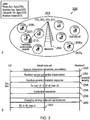
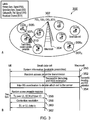
- FIGS 3A and 3B illustrate the second cell-selection method in the RRC-Idle mode.
- heterogeneous communications network 300 comprises a macro cell 302 having a macro cellular base station 304, a plurality of small data cells 306 1 to 306 N having a small cell base stations 307 1 to 307 N and a UE 310 served by the macro cell and/or small cells in the heterogeneous communications network 300.
- each small data cell may be identified by a different CSI-RS.
- the UE In the second cell-selection method, the UE also follows a standard random access procedure as in Figure 2 , and sends a random access preamble in the PRACH resources. Thereafter, the network exploits an inter-BS coordination procedure to decide which cell among those cells that were able to listen the random access preamble is the most appropriate to serve the UE.
- This inter-BS coordination can follow a macro-centric procedure, in which the small data cells covey information to the umbrella macro cell, which then performs the decision making and distribute the solutions.
- the conveyed information by the small data cells to the umbrella macro cell can be the random access preamble received signal strength or quality, and the most appropriate cell could be the one that received the random access preamble with the highest received signal strength or quality.
- the selected cell follows with the random access response to the UE.
- the strongest cell provides the random access response
- inter-cell interference is mitigated and thus there is no need for the inter-cell interference coordination of the previous macro-centric random access procedure.
- the cell following with the random access response handles time alignment by using the standard procedure.
- the RRC layer of the UE is managed by the umbrella macrocell after successful handover.
- Figure 3B illustrates the second cell-selection method.
- the macro cell transmits system information including available preambles to the UE at step 350.
- the UE receives that system information and transmits a random access preamble to the macro cell.
- the macro cell and the small cell successfully decode the random access preamble and perform inter-BS coordination to decide which of the small cell of the macro cell is the better serving base station for the UE.
- the small cell is determined to be the better serving cell for the UE and the small cell transmits a random access preamble response to the UE.
- the UE is synchronised with the network and transmits over the UL-SCH its terminal identity to the small cell.
- the small cell and the UE perform contention resolution to determine if a more appropriate cell is available as the serving cell and at step 362 the UE and small cell communicate uplink and/or downlink data.
- FIGs 4A and 4B illustrate the third cell-selection method in the RRC-Idle mode.
- heterogeneous communications network 400 comprises a macro cell 402 having a macro cellular base station 404, a plurality of small data cells 406 1 to 406 N having a small cell base stations 407 1 to 407 N and a UE 410 served by the macro cell and/or small cells in the heterogeneous communications network 400.
- each small data cell may be identified by a different CSI-RS.
- Individual CSI-RS signals can be distinguished by embedded Gold code sequences. If a small data cell is the most adequate cell, the UE scrambles the random access preamble with the Gold code of a CSI-RS corresponding to the selected small data cell. If the macro cell is the most appropriate cell, the UE does not scramble the standard random access preamble. After receiving a random access preamble in the PRACH resources, either the umbrella macro cell instructs the selected cell to provide the random access response or the selected small cell directly follows with the random access response and later transfers the RRC context to the macro cell.
- each small data cell after receiving a random access preamble in the PRACH resources, each small data cell will attempt to decode the received random access preamble making use of its CSI-RS Gold code. Then, if the decoding of the scrambled random access preamble checks, the small data cell knows that the random access preamble was intended for it, and that it is the most adequate cell to serve the UE. The selected small data cell should thus follow with the random access response to the UE. On the contrary, if the decoding of the scrambled random access preamble does not check, the small data cell does not take any action, since it knows that the random access procedure was not intended for it. The cell following with the random access response handles time alignment by using the standard procedure. The RRC layer of the UE is managed by the umbrella macrocell after successful handover.
- Figure 4B illustrates the third cell-selection method.
- the macro cell transmits system information including available preambles to the UE at step 450.
- the UE estimates which is the most suitable cell to serve the UE based on CRS/CSI-RS measurements.
- the UE transmits an enhanced random access preamble to the macro cell comprising the CSI-RS of the small cell.
- the enhanced random access preamble may be a random access preamble that is scrambled with the Gold code of this small data cell CSI-RS.
- the macro cell cannot decode the enhanced random access preamble, but the small cell identified by the enhanced random access preamble can successfully decode the enhanced random access preamble.
- the small cell successfully decodes the enhanced random access preamble transmission and transmits a random access preamble response to the UE.
- the UE is synchronised with the network and transmits over the UL-SCH its terminal identity to the small cell.
- the small cell and the UE perform contention resolution to determine if a more appropriate cell is available as the serving cell and at step 462 the UE and small cell communicate uplink and/or downlink data.
- the neighbouring small data cells transmit CSI-RS in the form of Gold codes, and the UE receives a superposition of Gold code signals from K small data cell BSs.
- x [ x [1], ⁇ , x [ L ]] correspond to this received signal at the UE of length L .
- the UE compares the signal strengths of the CSI-RSs from all small data cell BSs, and selects, as serving cell, BS k , where k ⁇ ⁇ 1, ...
- each antenna may transmit a unique Gold code as the pilot signal.
- CSI-RS C k [c k ,1 , ⁇ , c k , M ].
- the UE first obtains the strongest antenna m from each small data cell and then select the strongest BS k , as explained above.
- y k ⁇
- CSI-RS for cell identification purposes may be transmitted from only one antenna or a subset of them in a multi-antenna small data cell BS. We then identify the strongest small data cell k as explained above.
- a precode could be applied to the random access preamble so that its signal quality is maximized at the selected small data cell BS. Note that the UE knows a priori the strongest cell based on the cell selection procedures described above.
- s be the CSI-RS transmitted by small data cell BS k and received by all neighbouring UEs.
- the optimal w k can be obtained by choosing the basis vector of r k .
- a precode could be applied to the random access preamble in the above second cell-selection method to facilitate the identification of the strongest cell in the inter-BS coordination process.
- the traditional UE CRS measurements that drive the standard handover procedure are replaced by UE CSI-RS measurements when the measured cell is a small data cell, and then the UE alerts the network of possible changes of serving cell through a measurement report.
- handover triggering is not handled by the UE, but by the network based on standard channel state information (CSI) reports provided by the UE on a regular basis and measured over CSI-RSs. Based on the CSI pre-coding matrix, the serving cell can discern which cell should serve the UE and then initiate the change.
- CSI channel state information
- the Handover_Command can be simplified, which should help its successful decoding.
- a UE may change its serving BS, from the source cell to the most appropriate target cell, using the following two mechanisms. It is important to note that in the RRC-Connection mode, the UE has both a serving/source cell and an RRC layer.
- the UE periodically checks the handover entry condition (e.g., serving cell received power multiplied by a hysteresis margin is weaker than neighbouring cell received power) based on i) CRS measurements over neighbouring macro cells and CSI-RS measurements over neighbouring small data cells and ii) using standard L1 and L3 filtering. If the handover entry condition is met, the UE follows the standard procedure and initiates time-to-trigger. If after time-to-trigger the handover entry condition still holds, the UE sends a measurement report to the serving cell indicating that there may be a better serving cell. Then, the handover preparation phase followed by the execution phase will take place.
- the handover entry condition e.g., serving cell received power multiplied by a hysteresis margin is weaker than neighbouring cell received power
- an RRCConnectionReconfiguration delta message can be sent to the UE, in which only the changes in configuration between the target and source are indicated.
- this RRCConnectionReconfiguration delta message can be much smaller than the in traditional configuration or could even be neglected (if the source and target cell operate in the same frequency carrier and has the same DL/UL bandwidths and security algorithms), which should help with (or even avoid the need for) the Handover_ Command decoding. Otherwise, if the source and target cells have a different control-plane, standard handover preparation and execution phases follow.
- the UE In order to gain time alignment with the target cell, it can order the UE to perform a contention-free random access procedure, since the RNTI of the UE is known.
- Figure 5 shows the CSI-RS RSRP layer 1 and layer 3 filtering
- Figure 6 shows the handover process
- w n , ⁇ n ⁇ ⁇ 1, ⁇ , N ⁇ be the list of pre-coding vectors that can be used for CSI feedback.
- the SNR measure in the above covariance matrix can be replaced by the SINR measure for improved performance.
- the optimal precoder w n maximizing the signal to leakage ratio from BS k is the basis vectors ⁇ j w n T r j ⁇ 1 w n T r k .
- a cellular network with inter-BS coordination can be used to perform coordinated MIMO processing.
- the network computes a linear combination of the precoder output from all BS to maximize the overall SINR at the network. Given the SINR covariance matrix , this can be obtained by performing a Singular value decomposition or Eigen decomposition of . Combining these signals using the dominant Eigen vector would provide us with the SINR maximizing network/coordinated case.
- the standard handover preparation and execution phases should take place.
- the UE do not need to take CRS and/or CSI-RS RSRP measurements, initiate time-to-trigger or sent a measurement report.
- the UE only needs to periodically feedback MIMO alike CSI reports, and the network will take care of selecting the transmission point.
- CRS and CSI-RS transmit power should be setup with the same base line transmit power to allow comparison among macrocell CSI and small data cell CSI-RS measurements.
- a given subset of CSI-RS may not be used for small-cell identification, but could be reserved for the actual MIMO functionality (similarly to the reservation of certain PCIs for small cells).
- small data cells CSI-RSs should be transmitted at least as often as the UEs measure the macrocell RSRP and RSRQ, e.g., every 40ms.
- Radio link failure avoidance Since the small data cells do not transmit any data on the resource elements used by their umbrella macro cells to transmit their CRSs, UEs will always be able to carry out a good detection of the macro cell CRS (i.e., the UE can always see the CRS of the cell that provides the control-plane), and will thus not declare out-of-synchronization/radio link failures by themselves.
- PDCCH Physical Downlink Control Channel failure mitigation
- the proposed network configuration can take advantage of LTE Release 11 features such as Enhanced physical downlink control channel (EPDCCH) to schedule Handover_Command and/or Handover_Complete downlink control information (DCI) messages in appropriate resources.
- EPDCCH Enhanced physical downlink control channel
- DCI Handover_Complete downlink control information
- EPDCCH can be scheduled in specific RBs, similarly to UE data - carried on PDSCHs, and thus a great deal of inter-cell interference mitigation can be achieved through inter-cell interference coordination. Efficient EPDCCH scheduling will thus help to alleviate Handover_Command and/or Handover_Complete failures.
- the proposed network configuration together with the proposed cell selection and handover procedures may be applicable to allow efficient lightRadio pico cell deployments.
- Pico cells would become pico data cells.
- a large number of pico cells could be deployed in large hot spot areas (e.g., downtown Madrid), while allowing seamless mobility for connected UEs.
- hot spot UEs will still benefit from low latency and large throughputs through spatial reuse.
- pico data cells do not transmit any signalling when there is no active UE, large energy saving can be achieve since these cells can go into sleep mode for longer periods of time.
- the proposed approach works even for operators with only one carrier, and would facilitate network deployment and reduce power consumption.
- cell selection and handover can be aided by a network architecture where multiple small data cells are controlled by a central node different than the macro cell with ideal backhaul. In this way, medium to high UE speeds can be supported, since cell selection and handovers can be performed much faster.
- the proposed cell selection and handover mechanism may be complemented with a method, centralized and/or distributed, able to efficiently reuse CSI-RS across the network such as to mitigate confusion and collision problems.
Landscapes
- Engineering & Computer Science (AREA)
- Signal Processing (AREA)
- Computer Networks & Wireless Communication (AREA)
- Computer Security & Cryptography (AREA)
- Mobile Radio Communication Systems (AREA)
Claims (7)
- Réseau de communication hétérogène (100 ; 200 ; 300 ; 400), comprenant :une macrocellule (104 ; 204 ; 304 ; 404) ; une pluralité de petites cellules (106, 108 ; 206 ; 306 ; 406), chacune identifiée par des signaux CSI-RS individuels, pourvues dans la zone de couverture de la macrocellule (104 ; 204 ; 304 ; 404) ; etun équipement utilisateur (110 ; 210 ; 310 ; 410) pourvu dans la zone de couverture de la macrocellule (104 ; 204 ; 304 ; 404), où l'équipement utilisateur (110 ; 210; 310 ; 410) peut fonctionner pour recevoir des informations de plan de commande indiquant des ressources de canal d'accès aléatoire physique, PRACH, et des préambules d'accès aléatoire de la macrocellule (104 ; 204; 304 ; 404) et des informations de plan d'utilisateur de la macrocellule (104 ; 204 ; 304 ; 404) et/ou de l'une des petites cellules (106, 108 ; 206 ; 306 ; 406), et où les ressources fréquence-temps d'un PRACH pour la macrocellule (104 ; 204 ; 304 ; 404) et de ladite cellule des petites cellules (106, 108 ; 206 ; 306 ; 406) sont les mêmes et sont spécifiées à l'équipement utilisateur (110 ; 210 ; 310 ; 410) au moyen de la macrocellule (104 ; 204 ; 304 ; 404), où :l'équipement utilisateur (110 ; 210 ; 310 ; 410) est utilisable pour transmettre une demande de connexion sur la base des informations de plan de commande reçues en utilisant les ressources PRACH spécifiées, et identifier la cellule la plus appropriée pour fonctionner comme cellule de desserte ;la macrocellule (104 ; 204 ; 304 ; 404) et/ou l'une des petites cellules (106, 108 ; 206 ; 306 ; 406) peuvent fonctionner pour déterminer laquelle de la macrocellule (104 ; 204 ; 304 ; 404) et de ladite cellule des petites cellules (106, 108 ; 206 ; 306 ; 406) doit fonctionner en tant que cellule de desserte pour l'équipement utilisateur (110 ; 210 ; 310 ; 410) sur la base de la demande de connexion, etla cellule de desserte déterminée peut fonctionner pour transmettre une réponse de connexion à l'équipement utilisateur (110 ; 210; 310 ; 410), où, si la macrocellule (104 ; 204 ; 304 ; 404) est identifiée comme étant la cellule la plus appropriée pour fonctionner en tant que cellule de desserte, la demande de connexion comprend un préambule d'accès aléatoire, tandis que si ladite cellule des petites cellules (106, 108 ; 206 ; 306 ; 406) est identifiée comme étant la cellule la plus appropriée pour fonctionner en tant que cellule de desserte, la demande de connexion comprend un préambule d'accès aléatoire modifié, où le préambule d'accès aléatoire modifié ou une partie de celui-ci est brouillé avec le code Gold du signal CSI-RS de ladite cellule des petites cellules.
- Réseau de communication (100 ; 200 ; 300 ; 400) selon la revendication 1, dans lequel ladite cellule des petites cellules (106, 108 ; 206 ; 306 ; 406) identifiée par le signal CSI-RS dans le préambule d'accès aléatoire modifié peut fonctionner pour décoder le préambule d'accès aléatoire modifié et, après décodage du préambule d'accès aléatoire modifié, une des petites cellules est déterminée comme étant la cellule de desserte de l'équipement utilisateur.
- Macrocellule (104 ; 204 ; 304 ; 404) destinée à un réseau de communication hétérogène (100 ; 200 ; 300 ; 400), le réseau de communication hétérogène (100 ; 200 ; 300 ; 400) comprenant une pluralité de petites cellules (106, 108 ; 206 ; 306 ; 406), chacune identifiée par des signaux CSI-RS individuels, pourvues dans la zone de couverture de la macrocellule (104 ; 204 ; 304 ; 404) et un équipement utilisateur pourvu dans la zone de couverture de la macrocellule (104 ; 204 ; 304 ; 404), l'équipement utilisateur étant utilisable pour recevoir des informations de plan de commande indiquant des ressources de canal d'accès aléatoire physique, PRACH, et des préambules d'accès aléatoire de la macrocellule (104 ; 204 ; 304 ; 404) et des informations de plan d'utilisateur de la macrocellule (104 ; 204 ; 304 ; 404) et/ou de l'une des petites cellules (106, 108 ; 206 ; 306 ; 406), où les ressources fréquence-temps d'un PRACH pour la macrocellule (104 ; 204 ; 304 ; 404) et ladite cellule des petites cellules (106, 108 ; 206 ; 306 ; 406) sont les mêmes et sont spécifiées à l'équipement utilisateur (110 ; 210; 310 ; 410) au moyen de la macrocellule (104 ; 204 ; 304 ; 404), où la macrocellule (104 ; 204 ; 304 ; 404) est utilisable pour :transmettre des informations de plan de commande à l'équipement utilisateur comprenant les ressources PRACH spécifiées ;recevoir une demande de connexion de l'équipement utilisateur au moyen des ressources PRACH spécifiées ; déterminer laquelle de la macrocellule (104 ; 204 ; 304 ; 404) et de ladite cellule des petites cellules (106, 108 ; 206 ; 306 ; 406) doit fonctionner comme cellule de desserte pour l'équipement utilisateur sur la base de la demande de connexion ; ets'il est déterminé que la macrocellule (104 ; 204 ; 304 ; 404) doit fonctionner en tant que cellule de desserte pour l'équipement utilisateur, transmettre une réponse de connexion à l'équipement utilisateur où, si la macrocellule (104 ; 204 ; 304 ; 404) est identifiée par l'équipement utilisateur comme étant la cellule la plus appropriée pour fonctionner en tant que cellule de desserte, la demande de connexion comprend un préambule d'accès aléatoire, tandis que si ladite cellule des petites cellules (106, 108 ; 206 ; 306 ; 406) est identifiée par l'équipement utilisateur comme étant la cellule la plus appropriée pour fonctionner en tant que cellule de desserte, la demande de connexion comprend un préambule d'accès aléatoire modifié, où le préambule d'accès aléatoire modifié ou une partie de celui-ci est brouillé avec le code Gold du signal CSI-RS de ladite cellule des petites cellules.
- Petite cellule (106, 108 ; 206 ; 306 ; 406) destinée à un réseau de communication hétérogène (100 ; 200 ; 300 ; 400), la petite cellule étant identifiée par un signal CSI-RS, le réseau de communication hétérogène (100 ; 200 ; 300 ; 400) comprenant une macrocellule (104 ; 204 ; 304 ; 404) et un équipement utilisateur pourvu dans la zone de couverture de la macrocellule (104 ; 204 ; 304 ; 404), la petite cellule (106, 108 ; 206 ; 306 ; 406) étant pourvue dans la zone de couverture de la macrocellule (104 ; 204 ; 304 ; 404), l'équipement utilisateur étant utilisable pour recevoir des informations de plan de commande indiquant des ressources de canal d'accès aléatoire physique, PRACH, et des préambules d'accès aléatoire de la macrocellule (104 ; 204; 304 ; 404) et des informations de plan d'utilisateur de la macrocellule (104 ; 204 ; 304 ; 404) et/ou de la petite cellule (106, 108 ; 206 ; 306 ; 406), où les ressources fréquence-temps d'un PRACH pour la macrocellule (104 ; 204 ; 304 ; 404) et la petite cellule (106, 108 ; 206 ; 306 ; 406) sont les mêmes et sont spécifiées à l'équipement utilisateur (110 ; 210 ; 310 ; 410) au moyen de la macrocellule (104 ; 204 ; 304 ; 404), où la petite cellule (106, 108 ; 206 ; 306 ; 406) est utilisable pour :recevoir une demande de connexion de l'équipement utilisateur en utilisant les ressources PRACH spécifiées ;déterminer laquelle de la petite cellule (106, 108 ; 206 ; 306 ; 406) et de la macrocellule (104 ; 204 ; 304 ; 404) doit fonctionner en tant que cellule de desserte pour l'équipement utilisateur sur la base de la demande de connexion ; ets'il est déterminé que la petite cellule (106, 108 ; 206 ; 306 ; 406) doit fonctionner en tant que cellule de desserte pour l'équipement utilisateur, transmettre une réponse de connexion à l'équipement utilisateur où, si la macrocellule (104 ; 204 ; 304 ; 404) est identifiée par l'équipement utilisateur comme étant la cellule la plus appropriée pour fonctionner en tant que cellule de desserte, la demande de connexion comprend un préambule d'accès aléatoire, tandis que si la petite cellule (106, 108 ; 206 ; 306 ; 406) est identifiée par l'équipement utilisateur comme étant la cellule la plus appropriée pour fonctionner en tant que cellule de desserte, la demande de connexion comprend un préambule d'accès aléatoire modifié, où le préambule d'accès aléatoire modifié ou une partie de celui-ci est brouillé avec le code Gold du signal CSI-RS de la petite cellule.
- Équipement utilisateur (110 ; 210; 310 ; 410) destiné à un réseau de communication hétérogène (100 ; 200 ; 300 ; 400), le réseau de communication hétérogène (100 ; 200 ; 300 ; 400) comprenant une macrocellule (104 ; 204 ; 304 ; 404) et une pluralité de petites cellules (106, 108 ; 206 ; 306 ; 406), chacune identifiée par des signaux CSI-RS individuels, pourvue dans la zone de couverture de la macrocellule, où l'équipement utilisateur est pourvu dans la zone de couverture de la macrocellule (104 ; 204; 304 ; 404) et est utilisable pour recevoir des informations de plan de commande indiquant des ressources de canal d'accès aléatoire physique PRACH et des préambules d'accès aléatoire de la macrocellule (104 ; 204 ; 304 ; 404) et des informations de plan d'utilisateur de la macrocellule (104 ; 204 ; 304 ; 404) et/ou de l'une des petites cellules (106, 108 ; 206 ; 306 ; 406), où les ressources fréquence-temps d'un PRACH pour la macrocellule (104 ; 204 ; 304 ; 404) et ladite cellule des petites cellules sont identiques et sont spécifiées à l'équipement utilisateur (110 ; 210 ; 310 ; 410) au moyen de la macrocellule (104 ; 204 ; 304 ; 404), où l'équipement utilisateur est utilisable pour :recevoir des informations de plan de commande de la macrocellule (104 ; 204; 304 ; 404) comprenant des ressources PRACH spécifiées ;identifier la cellule la plus appropriée pour fonctionner en tant que cellule de desserte ;transmettre une demande de connexion sur la base des informations de plan de commande reçues au moyen des ressources PRACH spécifiées ; etrecevoir une réponse de connexion soit de la macrocellule (104 ; 204; 304 ; 404), soit de l'une des petites cellules (106, 108 ; 206 ; 306 ; 406) qui est déterminée par la macrocellule (104 ; 204 ; 304 ; 404) et/ou par ladite cellule des petites cellules (106 ; 108 ; 206 ; 306 ; 406) comme étant la cellule de desserte pour l'équipement utilisateur sur la base de la demande de connexion,où, si la macrocellule (104 ; 204; 304 ; 404) est identifiée comme étant la cellule la plus appropriée pour fonctionner en tant que cellule de desserte, la demande de connexion comprend un préambule d'accès aléatoire, tandis que si l'une des petites cellules (106, 108 ; 206 ; 306 ; 406) est identifiée comme étant la cellule la plus appropriée pour fonctionner en tant que cellule de desserte, la demande de connexion comprend un préambule d'accès aléatoire modifié, où le préambule d'accès aléatoire modifié ou une partie de celui-ci est brouillé avec le code Gold du signal CSI-RS de ladite cellule des petites cellules.
- Procédé de communication dans un réseau de communication hétérogène (100 ; 200 ; 300 ; 400), le réseau de communication hétérogène (100 ; 200 ; 300 ; 400) comprenant une macrocellule (104 ; 204 ; 304 ; 404), une pluralité de petites cellules (106, 108 ; 206 ; 306 ; 406), chacune identifiée par des signaux CSI-RS individuels, pourvues dans la zone de couverture de la macrocellule (104 ; 204; 304 ; 404) et un équipement utilisateur pourvu dans la zone de couverture de la macrocellule (104 ; 204 ; 304 ; 404), le procédé comprenant :la réception, au niveau de l'équipement utilisateur, d'informations de plan de commande indiquant des ressources de canal d'accès aléatoire physique, PRACH, et des préambules d'accès aléatoire de la macrocellule (104 ; 204 ; 304 ; 404) et des informations de plan d'utilisateur de la macrocellule et/ou de l'une des petites cellules (106, 108 ; 206 ; 306 ; 406), où les ressources fréquence-temps d'un PRACH pour la macrocellule (104 ; 204 ; 304 ; 404) et ladite cellule des petites cellules (106, 108 ; 206 ; 306 ; 406) sont identiques et sont spécifiées à l'équipement utilisateur (110 ; 210 ; 310 ; 410) au moyen de la macrocellule (104 ; 204 ; 304 ; 404) ;la réception, au niveau de l'équipement utilisateur, d'informations de plan de commande incluant les ressources PRACH spécifiées de la macrocellule (104 ; 204 ; 304 ; 404) ;l'identification de la cellule la plus appropriée pour fonctionner en tant que cellule de desserte ;la transmission, depuis l'équipement utilisateur, d'une demande de connexion basée sur les informations de plan de commande reçues au moyen des ressources PRACH spécifiées ;la détermination, au moyen de la macrocellule, de laquelle, parmi la macrocellule (104 ; 204 ; 304 ; 404) et de la petite cellule (106, 108 ; 206 ; 306 ; 406), doit fonctionner en tant cellule de desserte pour l'équipement utilisateur sur la base de la demande de connexion ; etla transmission d'une réponse de connexion à l'équipement utilisateur depuis la cellule de desserte déterminée où, si la macrocellule (104 ; 204 ; 304 ; 404) est identifiée comme étant la cellule la plus appropriée pour fonctionner en tant que cellule de desserte, la demande de connexion comprend un préambule d'accès aléatoire, tandis que si ladite cellule des petites cellules (106, 108 ; 206 ; 306 ; 406) est identifiée comme étant la cellule la plus appropriée pour fonctionner en tant que cellule de desserte, la demande de connexion comprend un préambule d'accès aléatoire modifié, où le préambule d'accès aléatoire modifié ou une partie de celui-ci est brouillé avec le code Gold du signal CSI-RS de ladite cellule des petites cellules.
- Produit programme informatique, comprenant un support utilisable par un ordinateur sur lequel est intégré un code de programme lisible par ordinateur, ledit code de programme lisible par ordinateur étant adapté pour être exécuté par un ordinateur d'une macrocellule selon la revendication 3 ou par un ordinateur d'une petite cellule selon la revendication 4 ou par un ordinateur d'un équipement utilisateur selon la revendication 5 pour mettre en oeuvre les étapes de procédé correspondantes de la revendication 6.
Priority Applications (5)
| Application Number | Priority Date | Filing Date | Title |
|---|---|---|---|
| ES13290285T ES2719803T3 (es) | 2013-10-16 | 2013-10-16 | Una red de comunicaciones, macro célula, célula pequeña, sistema de comunicaciones y método de comunicaciones |
| EP13290285.9A EP2863698B1 (fr) | 2013-10-16 | 2013-10-16 | Réseau de communications, macro-cellule, petite cellule, système de communication et procédé de communication |
| CN201480065437.1A CN105794295B (zh) | 2013-10-16 | 2014-09-17 | 通信网络、宏小区、小小区、通信系统及通信方法 |
| US15/029,382 US10039130B2 (en) | 2013-10-16 | 2014-09-17 | Communications network, macro cell, small cell, communications system and communications method |
| PCT/EP2014/002505 WO2015055271A1 (fr) | 2013-10-16 | 2014-09-17 | Réseau de communications, macrocellule, petite cellule, système de communications et procédé de communications |
Applications Claiming Priority (1)
| Application Number | Priority Date | Filing Date | Title |
|---|---|---|---|
| EP13290285.9A EP2863698B1 (fr) | 2013-10-16 | 2013-10-16 | Réseau de communications, macro-cellule, petite cellule, système de communication et procédé de communication |
Publications (2)
| Publication Number | Publication Date |
|---|---|
| EP2863698A1 EP2863698A1 (fr) | 2015-04-22 |
| EP2863698B1 true EP2863698B1 (fr) | 2019-02-27 |
Family
ID=49766002
Family Applications (1)
| Application Number | Title | Priority Date | Filing Date |
|---|---|---|---|
| EP13290285.9A Not-in-force EP2863698B1 (fr) | 2013-10-16 | 2013-10-16 | Réseau de communications, macro-cellule, petite cellule, système de communication et procédé de communication |
Country Status (5)
| Country | Link |
|---|---|
| US (1) | US10039130B2 (fr) |
| EP (1) | EP2863698B1 (fr) |
| CN (1) | CN105794295B (fr) |
| ES (1) | ES2719803T3 (fr) |
| WO (1) | WO2015055271A1 (fr) |
Families Citing this family (14)
| Publication number | Priority date | Publication date | Assignee | Title |
|---|---|---|---|---|
| US10700830B2 (en) * | 2014-10-21 | 2020-06-30 | Qualcomm Incorporated | Techniques for conveying identification information in a preamble transmission |
| JP6388076B2 (ja) * | 2015-04-09 | 2018-09-12 | 富士通株式会社 | 無線通信システム、無線装置および処理方法 |
| DE112017000018T5 (de) * | 2016-04-06 | 2017-12-21 | Sony Corporation | Basisstation, virtuelle zelle, benutzergerät |
| JPWO2017203591A1 (ja) * | 2016-05-24 | 2019-03-22 | オリンパス株式会社 | 無線通信端末、無線通信システム、無線通信方法、およびプログラム |
| KR102318011B1 (ko) * | 2016-05-24 | 2021-10-27 | 삼성전자 주식회사 | 이동통신 시스템에서 단말 및 기지국의 저전력 동작을 위한 방법 및 장치 |
| CN107770827A (zh) * | 2016-08-22 | 2018-03-06 | 上海交通大学 | 高频异构网络中基于波束选择和基站切换的中断处理方法 |
| ES2861397T3 (es) * | 2017-01-16 | 2021-10-06 | Ericsson Telefon Ab L M | Conmutador de enlace en un sistema de comunicación inalámbrico |
| WO2018174609A2 (fr) * | 2017-03-22 | 2018-09-27 | Samsung Electronics Co., Ltd. | Procédé et équipement utilisateur pour effectuer un alignement de faisceau initial pendant une procédure d'accès aléatoire (rach) |
| CN109302720B (zh) * | 2017-07-25 | 2021-03-23 | 华为技术有限公司 | 一种选择波束的方法及设备 |
| EP4243505A3 (fr) | 2018-06-15 | 2023-11-15 | Samsung Electronics Co., Ltd. | Procédé et appareil pour effectuer une communication dans un réseau hétérogène |
| US11057092B2 (en) | 2018-08-10 | 2021-07-06 | At&T Intellectual Property I, L.P. | Facilitating fast channel state information computation for 5G wireless communication systems |
| CN110839265B (zh) * | 2018-08-17 | 2021-12-28 | 维沃移动通信有限公司 | 一种信息配置方法、终端设备和网络设备 |
| US10917836B2 (en) | 2018-12-04 | 2021-02-09 | At&T Intellectual Property I, L.P. | Small cell identification using machine learning |
| CN111901849B (zh) * | 2020-06-08 | 2025-02-11 | 中兴通讯股份有限公司 | 网络接入、资源维护方法、装置、设备和存储介质 |
Family Cites Families (13)
| Publication number | Priority date | Publication date | Assignee | Title |
|---|---|---|---|---|
| US8526374B2 (en) * | 2008-09-12 | 2013-09-03 | Qualcomm Incorporated | Physical random access channel (PRACH) transmission in multicarrier operation |
| US8842604B2 (en) * | 2008-09-15 | 2014-09-23 | Qualcomm Incorporated | Wireless communication systems with femto nodes |
| WO2011072726A1 (fr) * | 2009-12-15 | 2011-06-23 | Nokia Siemens Networks Oy | Procédés, appareils, produit programme d'ordinateur correspondant et structure de données pour décider d'un système de signalisation pour transfert |
| CN102348244B (zh) * | 2010-08-03 | 2014-11-05 | 华为技术有限公司 | 蜂窝通信系统、终端在小区间切换的方法及宏基站 |
| PT2673976E (pt) * | 2011-02-09 | 2015-06-02 | Ericsson Telefon Ab L M | Configuração de símbolos de recursos em função de pontos numa célula sem fios |
| US9559820B2 (en) * | 2011-02-18 | 2017-01-31 | Qualcomm Incorporated | Feedback reporting based on channel state information reference signal (CSI-RS) groups |
| US9635624B2 (en) * | 2011-02-22 | 2017-04-25 | Qualcomm Incorporated | Discovery reference signal design for coordinated multipoint operations in heterogeneous networks |
| US9485075B2 (en) * | 2011-04-29 | 2016-11-01 | Futurewei Technologies Inc. | Method and system for transmission and reception of signals and related method of signaling |
| US9107173B2 (en) * | 2011-07-28 | 2015-08-11 | Blackberry Limited | Method and system for access and uplink power control for a wireless system having multiple transmit points |
| JP2013211749A (ja) * | 2012-03-30 | 2013-10-10 | Ntt Docomo Inc | 無線通信方法、無線基地局、ユーザ端末及び無線通信システム |
| US9225449B2 (en) * | 2012-05-11 | 2015-12-29 | Intel Corporation | Performing a handover in a heterogeneous wireless network |
| US9622170B2 (en) * | 2012-11-02 | 2017-04-11 | Blackberry Limited | Wireless communication in heterogeneous networks |
| ES2964882T3 (es) * | 2013-08-19 | 2024-04-09 | Blackberry Ltd | Método y equipamiento de usuario para comunicar con un nodo de la red de acceso inalámbrico que tiene un estado apagado |
-
2013
- 2013-10-16 EP EP13290285.9A patent/EP2863698B1/fr not_active Not-in-force
- 2013-10-16 ES ES13290285T patent/ES2719803T3/es active Active
-
2014
- 2014-09-17 CN CN201480065437.1A patent/CN105794295B/zh not_active Expired - Fee Related
- 2014-09-17 US US15/029,382 patent/US10039130B2/en active Active
- 2014-09-17 WO PCT/EP2014/002505 patent/WO2015055271A1/fr not_active Ceased
Non-Patent Citations (1)
| Title |
|---|
| None * |
Also Published As
| Publication number | Publication date |
|---|---|
| ES2719803T3 (es) | 2019-07-16 |
| WO2015055271A1 (fr) | 2015-04-23 |
| US10039130B2 (en) | 2018-07-31 |
| EP2863698A1 (fr) | 2015-04-22 |
| CN105794295A (zh) | 2016-07-20 |
| US20160278129A1 (en) | 2016-09-22 |
| CN105794295B (zh) | 2019-08-02 |
Similar Documents
| Publication | Publication Date | Title |
|---|---|---|
| US10039130B2 (en) | Communications network, macro cell, small cell, communications system and communications method | |
| US12471086B2 (en) | System and method for repetition of scheduling information on a control channel | |
| US11075725B2 (en) | System and method for beam adjustment request | |
| EP3677074B1 (fr) | Double connectivité avec un réseau utilisant un spectre de fréquences sans licence | |
| US20250247716A1 (en) | Communication system | |
| KR102698598B1 (ko) | 빔 변경 명령 수신의 실패 동안의 폴백 빔 선택 절차 | |
| EP2673909B1 (fr) | Sélection de station de base (antenne) pour la reception des transmissions de liaison montante de signaux de référence de sondage, srs, d'un équipement utilisateur, ue | |
| AU2017278673B2 (en) | Informing base station regarding user equipment's reception of beam change instruction | |
| US11229055B2 (en) | Rach timeline | |
| US20190182007A1 (en) | Method of wireless communication and user equipment | |
| JP6955024B2 (ja) | 無線通信ネットワークにおける通信を扱うための、無線ネットワークノード、および無線ネットワークノードにおいて実施される方法 | |
| CN115173902A (zh) | 用户设备操作管理的系统和方法 | |
| US20160345247A1 (en) | Method for controlling small cell and apparatus for same | |
| WO2022125230A1 (fr) | Découverte en deux étapes dans une liaison latérale | |
| CN106792564B (zh) | 一种系统广播消息的传输方法和装置 | |
| US20240040419A1 (en) | Uplink based radio resource management procedure | |
| US20240107416A1 (en) | Relay ue admission and cell change when protocol state is idle or inactive | |
| WO2013126509A1 (fr) | Cellule composite | |
| EP2824958B1 (fr) | Noeuds de réseau de télécommunications sans fil et procédés | |
| WO2025026199A1 (fr) | Procédé et appareil d'indication d'hypothèse de faisceau rx | |
| HK1224876B (zh) | 使用上行链路信道特性进行提早切换的基站和方法 |
Legal Events
| Date | Code | Title | Description |
|---|---|---|---|
| PUAI | Public reference made under article 153(3) epc to a published international application that has entered the european phase |
Free format text: ORIGINAL CODE: 0009012 |
|
| 17P | Request for examination filed |
Effective date: 20131016 |
|
| AK | Designated contracting states |
Kind code of ref document: A1 Designated state(s): AL AT BE BG CH CY CZ DE DK EE ES FI FR GB GR HR HU IE IS IT LI LT LU LV MC MK MT NL NO PL PT RO RS SE SI SK SM TR |
|
| AX | Request for extension of the european patent |
Extension state: BA ME |
|
| R17P | Request for examination filed (corrected) |
Effective date: 20151022 |
|
| RBV | Designated contracting states (corrected) |
Designated state(s): AL AT BE BG CH CY CZ DE DK EE ES FI FR GB GR HR HU IE IS IT LI LT LU LV MC MK MT NL NO PL PT RO RS SE SI SK SM TR |
|
| RAP1 | Party data changed (applicant data changed or rights of an application transferred) |
Owner name: ALCATEL LUCENT |
|
| STAA | Information on the status of an ep patent application or granted ep patent |
Free format text: STATUS: EXAMINATION IS IN PROGRESS |
|
| 17Q | First examination report despatched |
Effective date: 20180419 |
|
| GRAP | Despatch of communication of intention to grant a patent |
Free format text: ORIGINAL CODE: EPIDOSNIGR1 |
|
| STAA | Information on the status of an ep patent application or granted ep patent |
Free format text: STATUS: GRANT OF PATENT IS INTENDED |
|
| RIC1 | Information provided on ipc code assigned before grant |
Ipc: H04W 48/20 20090101ALN20181016BHEP Ipc: H04W 36/30 20090101ALN20181016BHEP Ipc: H04W 36/08 20090101ALN20181016BHEP Ipc: H04W 36/04 20090101ALN20181016BHEP Ipc: H04W 84/04 20090101ALN20181016BHEP Ipc: H04W 88/08 20090101ALN20181016BHEP Ipc: H04W 74/08 20090101AFI20181016BHEP |
|
| INTG | Intention to grant announced |
Effective date: 20181115 |
|
| GRAS | Grant fee paid |
Free format text: ORIGINAL CODE: EPIDOSNIGR3 |
|
| GRAA | (expected) grant |
Free format text: ORIGINAL CODE: 0009210 |
|
| STAA | Information on the status of an ep patent application or granted ep patent |
Free format text: STATUS: THE PATENT HAS BEEN GRANTED |
|
| AK | Designated contracting states |
Kind code of ref document: B1 Designated state(s): AL AT BE BG CH CY CZ DE DK EE ES FI FR GB GR HR HU IE IS IT LI LT LU LV MC MK MT NL NO PL PT RO RS SE SI SK SM TR |
|
| REG | Reference to a national code |
Ref country code: GB Ref legal event code: FG4D |
|
| REG | Reference to a national code |
Ref country code: CH Ref legal event code: EP |
|
| REG | Reference to a national code |
Ref country code: AT Ref legal event code: REF Ref document number: 1103250 Country of ref document: AT Kind code of ref document: T Effective date: 20190315 |
|
| REG | Reference to a national code |
Ref country code: IE Ref legal event code: FG4D |
|
| REG | Reference to a national code |
Ref country code: DE Ref legal event code: R096 Ref document number: 602013051354 Country of ref document: DE |
|
| REG | Reference to a national code |
Ref country code: NL Ref legal event code: FP |
|
| REG | Reference to a national code |
Ref country code: LT Ref legal event code: MG4D |
|
| REG | Reference to a national code |
Ref country code: ES Ref legal event code: FG2A Ref document number: 2719803 Country of ref document: ES Kind code of ref document: T3 Effective date: 20190716 |
|
| PG25 | Lapsed in a contracting state [announced via postgrant information from national office to epo] |
Ref country code: PT Free format text: LAPSE BECAUSE OF FAILURE TO SUBMIT A TRANSLATION OF THE DESCRIPTION OR TO PAY THE FEE WITHIN THE PRESCRIBED TIME-LIMIT Effective date: 20190627 Ref country code: SE Free format text: LAPSE BECAUSE OF FAILURE TO SUBMIT A TRANSLATION OF THE DESCRIPTION OR TO PAY THE FEE WITHIN THE PRESCRIBED TIME-LIMIT Effective date: 20190227 Ref country code: FI Free format text: LAPSE BECAUSE OF FAILURE TO SUBMIT A TRANSLATION OF THE DESCRIPTION OR TO PAY THE FEE WITHIN THE PRESCRIBED TIME-LIMIT Effective date: 20190227 Ref country code: NO Free format text: LAPSE BECAUSE OF FAILURE TO SUBMIT A TRANSLATION OF THE DESCRIPTION OR TO PAY THE FEE WITHIN THE PRESCRIBED TIME-LIMIT Effective date: 20190527 Ref country code: LT Free format text: LAPSE BECAUSE OF FAILURE TO SUBMIT A TRANSLATION OF THE DESCRIPTION OR TO PAY THE FEE WITHIN THE PRESCRIBED TIME-LIMIT Effective date: 20190227 |
|
| PG25 | Lapsed in a contracting state [announced via postgrant information from national office to epo] |
Ref country code: IS Free format text: LAPSE BECAUSE OF FAILURE TO SUBMIT A TRANSLATION OF THE DESCRIPTION OR TO PAY THE FEE WITHIN THE PRESCRIBED TIME-LIMIT Effective date: 20190627 Ref country code: GR Free format text: LAPSE BECAUSE OF FAILURE TO SUBMIT A TRANSLATION OF THE DESCRIPTION OR TO PAY THE FEE WITHIN THE PRESCRIBED TIME-LIMIT Effective date: 20190528 Ref country code: HR Free format text: LAPSE BECAUSE OF FAILURE TO SUBMIT A TRANSLATION OF THE DESCRIPTION OR TO PAY THE FEE WITHIN THE PRESCRIBED TIME-LIMIT Effective date: 20190227 Ref country code: LV Free format text: LAPSE BECAUSE OF FAILURE TO SUBMIT A TRANSLATION OF THE DESCRIPTION OR TO PAY THE FEE WITHIN THE PRESCRIBED TIME-LIMIT Effective date: 20190227 Ref country code: RS Free format text: LAPSE BECAUSE OF FAILURE TO SUBMIT A TRANSLATION OF THE DESCRIPTION OR TO PAY THE FEE WITHIN THE PRESCRIBED TIME-LIMIT Effective date: 20190227 Ref country code: BG Free format text: LAPSE BECAUSE OF FAILURE TO SUBMIT A TRANSLATION OF THE DESCRIPTION OR TO PAY THE FEE WITHIN THE PRESCRIBED TIME-LIMIT Effective date: 20190527 |
|
| REG | Reference to a national code |
Ref country code: AT Ref legal event code: MK05 Ref document number: 1103250 Country of ref document: AT Kind code of ref document: T Effective date: 20190227 |
|
| PG25 | Lapsed in a contracting state [announced via postgrant information from national office to epo] |
Ref country code: CZ Free format text: LAPSE BECAUSE OF FAILURE TO SUBMIT A TRANSLATION OF THE DESCRIPTION OR TO PAY THE FEE WITHIN THE PRESCRIBED TIME-LIMIT Effective date: 20190227 Ref country code: IT Free format text: LAPSE BECAUSE OF FAILURE TO SUBMIT A TRANSLATION OF THE DESCRIPTION OR TO PAY THE FEE WITHIN THE PRESCRIBED TIME-LIMIT Effective date: 20190227 Ref country code: RO Free format text: LAPSE BECAUSE OF FAILURE TO SUBMIT A TRANSLATION OF THE DESCRIPTION OR TO PAY THE FEE WITHIN THE PRESCRIBED TIME-LIMIT Effective date: 20190227 Ref country code: EE Free format text: LAPSE BECAUSE OF FAILURE TO SUBMIT A TRANSLATION OF THE DESCRIPTION OR TO PAY THE FEE WITHIN THE PRESCRIBED TIME-LIMIT Effective date: 20190227 Ref country code: DK Free format text: LAPSE BECAUSE OF FAILURE TO SUBMIT A TRANSLATION OF THE DESCRIPTION OR TO PAY THE FEE WITHIN THE PRESCRIBED TIME-LIMIT Effective date: 20190227 Ref country code: AL Free format text: LAPSE BECAUSE OF FAILURE TO SUBMIT A TRANSLATION OF THE DESCRIPTION OR TO PAY THE FEE WITHIN THE PRESCRIBED TIME-LIMIT Effective date: 20190227 Ref country code: SK Free format text: LAPSE BECAUSE OF FAILURE TO SUBMIT A TRANSLATION OF THE DESCRIPTION OR TO PAY THE FEE WITHIN THE PRESCRIBED TIME-LIMIT Effective date: 20190227 |
|
| REG | Reference to a national code |
Ref country code: DE Ref legal event code: R097 Ref document number: 602013051354 Country of ref document: DE |
|
| PG25 | Lapsed in a contracting state [announced via postgrant information from national office to epo] |
Ref country code: PL Free format text: LAPSE BECAUSE OF FAILURE TO SUBMIT A TRANSLATION OF THE DESCRIPTION OR TO PAY THE FEE WITHIN THE PRESCRIBED TIME-LIMIT Effective date: 20190227 Ref country code: SM Free format text: LAPSE BECAUSE OF FAILURE TO SUBMIT A TRANSLATION OF THE DESCRIPTION OR TO PAY THE FEE WITHIN THE PRESCRIBED TIME-LIMIT Effective date: 20190227 |
|
| PG25 | Lapsed in a contracting state [announced via postgrant information from national office to epo] |
Ref country code: AT Free format text: LAPSE BECAUSE OF FAILURE TO SUBMIT A TRANSLATION OF THE DESCRIPTION OR TO PAY THE FEE WITHIN THE PRESCRIBED TIME-LIMIT Effective date: 20190227 |
|
| PLBE | No opposition filed within time limit |
Free format text: ORIGINAL CODE: 0009261 |
|
| STAA | Information on the status of an ep patent application or granted ep patent |
Free format text: STATUS: NO OPPOSITION FILED WITHIN TIME LIMIT |
|
| 26N | No opposition filed |
Effective date: 20191128 |
|
| PG25 | Lapsed in a contracting state [announced via postgrant information from national office to epo] |
Ref country code: SI Free format text: LAPSE BECAUSE OF FAILURE TO SUBMIT A TRANSLATION OF THE DESCRIPTION OR TO PAY THE FEE WITHIN THE PRESCRIBED TIME-LIMIT Effective date: 20190227 |
|
| PG25 | Lapsed in a contracting state [announced via postgrant information from national office to epo] |
Ref country code: TR Free format text: LAPSE BECAUSE OF FAILURE TO SUBMIT A TRANSLATION OF THE DESCRIPTION OR TO PAY THE FEE WITHIN THE PRESCRIBED TIME-LIMIT Effective date: 20190227 |
|
| PG25 | Lapsed in a contracting state [announced via postgrant information from national office to epo] |
Ref country code: MC Free format text: LAPSE BECAUSE OF FAILURE TO SUBMIT A TRANSLATION OF THE DESCRIPTION OR TO PAY THE FEE WITHIN THE PRESCRIBED TIME-LIMIT Effective date: 20190227 |
|
| REG | Reference to a national code |
Ref country code: CH Ref legal event code: PL |
|
| PG25 | Lapsed in a contracting state [announced via postgrant information from national office to epo] |
Ref country code: LI Free format text: LAPSE BECAUSE OF NON-PAYMENT OF DUE FEES Effective date: 20191031 Ref country code: CH Free format text: LAPSE BECAUSE OF NON-PAYMENT OF DUE FEES Effective date: 20191031 Ref country code: LU Free format text: LAPSE BECAUSE OF NON-PAYMENT OF DUE FEES Effective date: 20191016 |
|
| REG | Reference to a national code |
Ref country code: BE Ref legal event code: MM Effective date: 20191031 |
|
| PG25 | Lapsed in a contracting state [announced via postgrant information from national office to epo] |
Ref country code: BE Free format text: LAPSE BECAUSE OF NON-PAYMENT OF DUE FEES Effective date: 20191031 |
|
| PG25 | Lapsed in a contracting state [announced via postgrant information from national office to epo] |
Ref country code: IE Free format text: LAPSE BECAUSE OF NON-PAYMENT OF DUE FEES Effective date: 20191016 |
|
| PG25 | Lapsed in a contracting state [announced via postgrant information from national office to epo] |
Ref country code: CY Free format text: LAPSE BECAUSE OF FAILURE TO SUBMIT A TRANSLATION OF THE DESCRIPTION OR TO PAY THE FEE WITHIN THE PRESCRIBED TIME-LIMIT Effective date: 20190227 |
|
| PG25 | Lapsed in a contracting state [announced via postgrant information from national office to epo] |
Ref country code: MT Free format text: LAPSE BECAUSE OF FAILURE TO SUBMIT A TRANSLATION OF THE DESCRIPTION OR TO PAY THE FEE WITHIN THE PRESCRIBED TIME-LIMIT Effective date: 20190227 Ref country code: HU Free format text: LAPSE BECAUSE OF FAILURE TO SUBMIT A TRANSLATION OF THE DESCRIPTION OR TO PAY THE FEE WITHIN THE PRESCRIBED TIME-LIMIT; INVALID AB INITIO Effective date: 20131016 |
|
| PGFP | Annual fee paid to national office [announced via postgrant information from national office to epo] |
Ref country code: NL Payment date: 20210928 Year of fee payment: 9 Ref country code: FR Payment date: 20210913 Year of fee payment: 9 |
|
| PGFP | Annual fee paid to national office [announced via postgrant information from national office to epo] |
Ref country code: ES Payment date: 20211110 Year of fee payment: 9 |
|
| PG25 | Lapsed in a contracting state [announced via postgrant information from national office to epo] |
Ref country code: MK Free format text: LAPSE BECAUSE OF FAILURE TO SUBMIT A TRANSLATION OF THE DESCRIPTION OR TO PAY THE FEE WITHIN THE PRESCRIBED TIME-LIMIT Effective date: 20190227 |
|
| REG | Reference to a national code |
Ref country code: NL Ref legal event code: MM Effective date: 20221101 |
|
| PG25 | Lapsed in a contracting state [announced via postgrant information from national office to epo] |
Ref country code: NL Free format text: LAPSE BECAUSE OF NON-PAYMENT OF DUE FEES Effective date: 20221101 Ref country code: FR Free format text: LAPSE BECAUSE OF NON-PAYMENT OF DUE FEES Effective date: 20221031 |
|
| PGFP | Annual fee paid to national office [announced via postgrant information from national office to epo] |
Ref country code: GB Payment date: 20230831 Year of fee payment: 11 |
|
| REG | Reference to a national code |
Ref country code: ES Ref legal event code: FD2A Effective date: 20231201 |
|
| PG25 | Lapsed in a contracting state [announced via postgrant information from national office to epo] |
Ref country code: ES Free format text: LAPSE BECAUSE OF NON-PAYMENT OF DUE FEES Effective date: 20221017 |
|
| PG25 | Lapsed in a contracting state [announced via postgrant information from national office to epo] |
Ref country code: ES Free format text: LAPSE BECAUSE OF NON-PAYMENT OF DUE FEES Effective date: 20221017 |
|
| PGFP | Annual fee paid to national office [announced via postgrant information from national office to epo] |
Ref country code: DE Payment date: 20230830 Year of fee payment: 11 |
|
| REG | Reference to a national code |
Ref country code: DE Ref legal event code: R119 Ref document number: 602013051354 Country of ref document: DE |
|
| GBPC | Gb: european patent ceased through non-payment of renewal fee |
Effective date: 20241016 |
|
| PG25 | Lapsed in a contracting state [announced via postgrant information from national office to epo] |
Ref country code: DE Free format text: LAPSE BECAUSE OF NON-PAYMENT OF DUE FEES Effective date: 20250501 |
|
| PG25 | Lapsed in a contracting state [announced via postgrant information from national office to epo] |
Ref country code: GB Free format text: LAPSE BECAUSE OF NON-PAYMENT OF DUE FEES Effective date: 20241016 |