EP2865705A1 - Verfahren zur Herstellung von Glasfaserverbundwerkstoffen - Google Patents
Verfahren zur Herstellung von Glasfaserverbundwerkstoffen Download PDFInfo
- Publication number
- EP2865705A1 EP2865705A1 EP20130190219 EP13190219A EP2865705A1 EP 2865705 A1 EP2865705 A1 EP 2865705A1 EP 20130190219 EP20130190219 EP 20130190219 EP 13190219 A EP13190219 A EP 13190219A EP 2865705 A1 EP2865705 A1 EP 2865705A1
- Authority
- EP
- European Patent Office
- Prior art keywords
- salt
- matrix
- reactive moiety
- reactive
- sizing
- Prior art date
- Legal status (The legal status is an assumption and is not a legal conclusion. Google has not performed a legal analysis and makes no representation as to the accuracy of the status listed.)
- Withdrawn
Links
- 239000003365 glass fiber Substances 0.000 title claims abstract description 108
- 239000002131 composite material Substances 0.000 title claims abstract description 64
- 238000000034 method Methods 0.000 title claims abstract description 48
- 230000008569 process Effects 0.000 title claims abstract description 47
- 239000011159 matrix material Substances 0.000 claims abstract description 119
- 150000003839 salts Chemical class 0.000 claims abstract description 80
- 238000004513 sizing Methods 0.000 claims abstract description 64
- 239000000203 mixture Substances 0.000 claims abstract description 44
- 229920001169 thermoplastic Polymers 0.000 claims abstract description 44
- 239000004416 thermosoftening plastic Substances 0.000 claims abstract description 39
- 239000008188 pellet Substances 0.000 claims abstract description 28
- 238000002156 mixing Methods 0.000 claims abstract description 19
- 239000004610 Internal Lubricant Substances 0.000 claims abstract description 18
- 239000002667 nucleating agent Substances 0.000 claims abstract description 16
- 238000001746 injection moulding Methods 0.000 claims abstract description 12
- 150000001457 metallic cations Chemical class 0.000 claims abstract description 11
- 125000002887 hydroxy group Chemical group [H]O* 0.000 claims abstract description 10
- 125000000129 anionic group Chemical group 0.000 claims abstract description 7
- 238000004519 manufacturing process Methods 0.000 claims abstract description 7
- BLRPTPMANUNPDV-UHFFFAOYSA-N Silane Chemical compound [SiH4] BLRPTPMANUNPDV-UHFFFAOYSA-N 0.000 claims abstract description 6
- 239000007795 chemical reaction product Substances 0.000 claims abstract description 6
- 238000002347 injection Methods 0.000 claims abstract description 6
- 239000007924 injection Substances 0.000 claims abstract description 6
- 229910000077 silane Inorganic materials 0.000 claims abstract description 6
- BVKZGUZCCUSVTD-UHFFFAOYSA-L Carbonate Chemical compound [O-]C([O-])=O BVKZGUZCCUSVTD-UHFFFAOYSA-L 0.000 claims abstract description 4
- QAOWNCQODCNURD-UHFFFAOYSA-L Sulfate Chemical compound [O-]S([O-])(=O)=O QAOWNCQODCNURD-UHFFFAOYSA-L 0.000 claims abstract description 4
- 150000001449 anionic compounds Chemical class 0.000 claims abstract description 4
- 229910001412 inorganic anion Inorganic materials 0.000 claims abstract description 4
- 229910021653 sulphate ion Inorganic materials 0.000 claims abstract description 3
- CJZGTCYPCWQAJB-UHFFFAOYSA-L calcium stearate Chemical compound [Ca+2].CCCCCCCCCCCCCCCCCC([O-])=O.CCCCCCCCCCCCCCCCCC([O-])=O CJZGTCYPCWQAJB-UHFFFAOYSA-L 0.000 claims description 59
- 239000008116 calcium stearate Substances 0.000 claims description 54
- 235000013539 calcium stearate Nutrition 0.000 claims description 54
- 229920013730 reactive polymer Polymers 0.000 claims description 20
- 239000004952 Polyamide Substances 0.000 claims description 18
- 229920002647 polyamide Polymers 0.000 claims description 18
- 125000003277 amino group Chemical group 0.000 claims description 14
- -1 polyethylene terephthalate Polymers 0.000 claims description 14
- 239000004594 Masterbatch (MB) Substances 0.000 claims description 12
- 229920001577 copolymer Polymers 0.000 claims description 11
- 229920001707 polybutylene terephthalate Polymers 0.000 claims description 10
- 239000004593 Epoxy Substances 0.000 claims description 9
- 239000011575 calcium Substances 0.000 claims description 9
- 229920000139 polyethylene terephthalate Polymers 0.000 claims description 9
- 239000005020 polyethylene terephthalate Substances 0.000 claims description 9
- 229920003986 novolac Polymers 0.000 claims description 8
- 239000006087 Silane Coupling Agent Substances 0.000 claims description 7
- 150000008064 anhydrides Chemical group 0.000 claims description 7
- IISBACLAFKSPIT-UHFFFAOYSA-N bisphenol A Chemical compound C=1C=C(O)C=CC=1C(C)(C)C1=CC=C(O)C=C1 IISBACLAFKSPIT-UHFFFAOYSA-N 0.000 claims description 7
- PXKLMJQFEQBVLD-UHFFFAOYSA-N bisphenol F Chemical compound C1=CC(O)=CC=C1CC1=CC=C(O)C=C1 PXKLMJQFEQBVLD-UHFFFAOYSA-N 0.000 claims description 7
- 125000002843 carboxylic acid group Chemical group 0.000 claims description 7
- 229920000728 polyester Polymers 0.000 claims description 7
- 125000003700 epoxy group Chemical group 0.000 claims description 6
- LYCAIKOWRPUZTN-UHFFFAOYSA-N Ethylene glycol Chemical compound OCCO LYCAIKOWRPUZTN-UHFFFAOYSA-N 0.000 claims description 5
- OFOBLEOULBTSOW-UHFFFAOYSA-N Propanedioic acid Natural products OC(=O)CC(O)=O OFOBLEOULBTSOW-UHFFFAOYSA-N 0.000 claims description 5
- VZCYOOQTPOCHFL-UPHRSURJSA-N maleic acid Chemical compound OC(=O)\C=C/C(O)=O VZCYOOQTPOCHFL-UPHRSURJSA-N 0.000 claims description 5
- 239000011976 maleic acid Substances 0.000 claims description 5
- FPYJFEHAWHCUMM-UHFFFAOYSA-N maleic anhydride Chemical compound O=C1OC(=O)C=C1 FPYJFEHAWHCUMM-UHFFFAOYSA-N 0.000 claims description 5
- UTOPWMOLSKOLTQ-UHFFFAOYSA-M octacosanoate Chemical compound CCCCCCCCCCCCCCCCCCCCCCCCCCCC([O-])=O UTOPWMOLSKOLTQ-UHFFFAOYSA-M 0.000 claims description 5
- FZHAPNGMFPVSLP-UHFFFAOYSA-N silanamine Chemical class [SiH3]N FZHAPNGMFPVSLP-UHFFFAOYSA-N 0.000 claims description 5
- VZCYOOQTPOCHFL-UHFFFAOYSA-N trans-butenedioic acid Natural products OC(=O)C=CC(O)=O VZCYOOQTPOCHFL-UHFFFAOYSA-N 0.000 claims description 5
- 238000011144 upstream manufacturing Methods 0.000 claims description 5
- XLYOFNOQVPJJNP-UHFFFAOYSA-N water Substances O XLYOFNOQVPJJNP-UHFFFAOYSA-N 0.000 claims description 5
- QTWJRLJHJPIABL-UHFFFAOYSA-N 2-methylphenol;3-methylphenol;4-methylphenol Chemical compound CC1=CC=C(O)C=C1.CC1=CC=CC(O)=C1.CC1=CC=CC=C1O QTWJRLJHJPIABL-UHFFFAOYSA-N 0.000 claims description 4
- VTYYLEPIZMXCLO-UHFFFAOYSA-L Calcium carbonate Chemical compound [Ca+2].[O-]C([O-])=O VTYYLEPIZMXCLO-UHFFFAOYSA-L 0.000 claims description 4
- 239000004971 Cross linker Substances 0.000 claims description 4
- FYYHWMGAXLPEAU-UHFFFAOYSA-N Magnesium Chemical compound [Mg] FYYHWMGAXLPEAU-UHFFFAOYSA-N 0.000 claims description 4
- ISWSIDIOOBJBQZ-UHFFFAOYSA-N Phenol Chemical compound OC1=CC=CC=C1 ISWSIDIOOBJBQZ-UHFFFAOYSA-N 0.000 claims description 4
- 229920002873 Polyethylenimine Polymers 0.000 claims description 4
- HCHKCACWOHOZIP-UHFFFAOYSA-N Zinc Chemical compound [Zn] HCHKCACWOHOZIP-UHFFFAOYSA-N 0.000 claims description 4
- 229940106691 bisphenol a Drugs 0.000 claims description 4
- 229930003836 cresol Natural products 0.000 claims description 4
- 239000003822 epoxy resin Substances 0.000 claims description 4
- 239000012948 isocyanate Substances 0.000 claims description 4
- 150000002513 isocyanates Chemical class 0.000 claims description 4
- 229920000647 polyepoxide Polymers 0.000 claims description 4
- NIXOWILDQLNWCW-UHFFFAOYSA-N acrylic acid group Chemical group C(C=C)(=O)O NIXOWILDQLNWCW-UHFFFAOYSA-N 0.000 claims description 3
- 230000032683 aging Effects 0.000 claims description 3
- 235000010237 calcium benzoate Nutrition 0.000 claims description 3
- 239000004301 calcium benzoate Substances 0.000 claims description 3
- AXCZMVOFGPJBDE-UHFFFAOYSA-L calcium dihydroxide Chemical compound [OH-].[OH-].[Ca+2] AXCZMVOFGPJBDE-UHFFFAOYSA-L 0.000 claims description 3
- 239000000920 calcium hydroxide Substances 0.000 claims description 3
- 229910001861 calcium hydroxide Inorganic materials 0.000 claims description 3
- 235000011116 calcium hydroxide Nutrition 0.000 claims description 3
- HZQXCUSDXIKLGS-UHFFFAOYSA-L calcium;dibenzoate;trihydrate Chemical compound O.O.O.[Ca+2].[O-]C(=O)C1=CC=CC=C1.[O-]C(=O)C1=CC=CC=C1 HZQXCUSDXIKLGS-UHFFFAOYSA-L 0.000 claims description 3
- 239000011521 glass Substances 0.000 claims description 3
- 230000007062 hydrolysis Effects 0.000 claims description 3
- 238000006460 hydrolysis reaction Methods 0.000 claims description 3
- IQPQWNKOIGAROB-UHFFFAOYSA-N isocyanate group Chemical group [N-]=C=O IQPQWNKOIGAROB-UHFFFAOYSA-N 0.000 claims description 3
- 229910052751 metal Inorganic materials 0.000 claims description 3
- 239000002184 metal Substances 0.000 claims description 3
- 125000005395 methacrylic acid group Chemical group 0.000 claims description 3
- CEGOLXSVJUTHNZ-UHFFFAOYSA-K aluminium tristearate Chemical compound [Al+3].CCCCCCCCCCCCCCCCCC([O-])=O.CCCCCCCCCCCCCCCCCC([O-])=O.CCCCCCCCCCCCCCCCCC([O-])=O CEGOLXSVJUTHNZ-UHFFFAOYSA-K 0.000 claims description 2
- 229940063655 aluminum stearate Drugs 0.000 claims description 2
- 229910000019 calcium carbonate Inorganic materials 0.000 claims description 2
- 229940057948 magnesium stearate Drugs 0.000 claims description 2
- 239000000344 soap Substances 0.000 claims description 2
- WXMKPNITSTVMEF-UHFFFAOYSA-M sodium benzoate Chemical compound [Na+].[O-]C(=O)C1=CC=CC=C1 WXMKPNITSTVMEF-UHFFFAOYSA-M 0.000 claims description 2
- 235000010234 sodium benzoate Nutrition 0.000 claims description 2
- 239000004299 sodium benzoate Substances 0.000 claims description 2
- OJLSABVGUWNJKD-UHFFFAOYSA-M sodium;2-chlorobenzoate Chemical compound [Na+].[O-]C(=O)C1=CC=CC=C1Cl OJLSABVGUWNJKD-UHFFFAOYSA-M 0.000 claims description 2
- 229940057977 zinc stearate Drugs 0.000 claims description 2
- WGCNASOHLSPBMP-UHFFFAOYSA-N hydroxyacetaldehyde Natural products OCC=O WGCNASOHLSPBMP-UHFFFAOYSA-N 0.000 claims 1
- 239000000047 product Substances 0.000 claims 1
- 239000000654 additive Substances 0.000 description 39
- 230000000996 additive effect Effects 0.000 description 35
- 238000006243 chemical reaction Methods 0.000 description 20
- 230000000052 comparative effect Effects 0.000 description 18
- 229920000642 polymer Polymers 0.000 description 17
- 229920002292 Nylon 6 Polymers 0.000 description 14
- 239000000835 fiber Substances 0.000 description 11
- 229940114926 stearate Drugs 0.000 description 11
- QIQXTHQIDYTFRH-UHFFFAOYSA-N octadecanoic acid Chemical compound CCCCCCCCCCCCCCCCCC(O)=O QIQXTHQIDYTFRH-UHFFFAOYSA-N 0.000 description 9
- 229920002125 Sokalan® Polymers 0.000 description 6
- 230000007246 mechanism Effects 0.000 description 5
- 238000006386 neutralization reaction Methods 0.000 description 5
- 239000004584 polyacrylic acid Substances 0.000 description 5
- 150000001732 carboxylic acid derivatives Chemical class 0.000 description 4
- 239000008187 granular material Substances 0.000 description 4
- 239000000314 lubricant Substances 0.000 description 4
- 239000000243 solution Substances 0.000 description 4
- OKKJLVBELUTLKV-UHFFFAOYSA-N Methanol Chemical compound OC OKKJLVBELUTLKV-UHFFFAOYSA-N 0.000 description 3
- 229920002302 Nylon 6,6 Polymers 0.000 description 3
- 239000004954 Polyphthalamide Substances 0.000 description 3
- 239000007822 coupling agent Substances 0.000 description 3
- 230000007423 decrease Effects 0.000 description 3
- 230000001419 dependent effect Effects 0.000 description 3
- 235000014113 dietary fatty acids Nutrition 0.000 description 3
- 230000000694 effects Effects 0.000 description 3
- 239000000194 fatty acid Substances 0.000 description 3
- 229930195729 fatty acid Natural products 0.000 description 3
- 239000011152 fibreglass Substances 0.000 description 3
- 239000000463 material Substances 0.000 description 3
- 229920006375 polyphtalamide Polymers 0.000 description 3
- VXHYVVAUHMGCEX-UHFFFAOYSA-N 2-(2-hydroxyphenoxy)phenol Chemical compound OC1=CC=CC=C1OC1=CC=CC=C1O VXHYVVAUHMGCEX-UHFFFAOYSA-N 0.000 description 2
- OYPRJOBELJOOCE-UHFFFAOYSA-N Calcium Chemical compound [Ca] OYPRJOBELJOOCE-UHFFFAOYSA-N 0.000 description 2
- 150000001450 anions Chemical class 0.000 description 2
- 230000015572 biosynthetic process Effects 0.000 description 2
- 229910052791 calcium Inorganic materials 0.000 description 2
- 239000003795 chemical substances by application Substances 0.000 description 2
- 150000001875 compounds Chemical class 0.000 description 2
- 230000001627 detrimental effect Effects 0.000 description 2
- 238000001125 extrusion Methods 0.000 description 2
- 150000004665 fatty acids Chemical class 0.000 description 2
- 239000011133 lead Substances 0.000 description 2
- 229910052749 magnesium Inorganic materials 0.000 description 2
- 239000011777 magnesium Substances 0.000 description 2
- 239000000155 melt Substances 0.000 description 2
- 238000005457 optimization Methods 0.000 description 2
- 230000009467 reduction Effects 0.000 description 2
- 150000004756 silanes Chemical class 0.000 description 2
- 229910052725 zinc Inorganic materials 0.000 description 2
- 239000011701 zinc Substances 0.000 description 2
- WYTZZXDRDKSJID-UHFFFAOYSA-N (3-aminopropyl)triethoxysilane Chemical compound CCO[Si](OCC)(OCC)CCCN WYTZZXDRDKSJID-UHFFFAOYSA-N 0.000 description 1
- 239000004953 Aliphatic polyamide Substances 0.000 description 1
- 229910052582 BN Inorganic materials 0.000 description 1
- ZOXJGFHDIHLPTG-UHFFFAOYSA-N Boron Chemical compound [B] ZOXJGFHDIHLPTG-UHFFFAOYSA-N 0.000 description 1
- PZNSFCLAULLKQX-UHFFFAOYSA-N Boron nitride Chemical compound N#B PZNSFCLAULLKQX-UHFFFAOYSA-N 0.000 description 1
- 101150088727 CEX1 gene Proteins 0.000 description 1
- 101100439211 Caenorhabditis elegans cex-2 gene Proteins 0.000 description 1
- WHXSMMKQMYFTQS-UHFFFAOYSA-N Lithium Chemical compound [Li] WHXSMMKQMYFTQS-UHFFFAOYSA-N 0.000 description 1
- 229920000299 Nylon 12 Polymers 0.000 description 1
- 229920003189 Nylon 4,6 Polymers 0.000 description 1
- 229910002808 Si–O–Si Inorganic materials 0.000 description 1
- 229920003231 aliphatic polyamide Polymers 0.000 description 1
- 239000004411 aluminium Substances 0.000 description 1
- 229910052782 aluminium Inorganic materials 0.000 description 1
- XAGFODPZIPBFFR-UHFFFAOYSA-N aluminium Chemical compound [Al] XAGFODPZIPBFFR-UHFFFAOYSA-N 0.000 description 1
- 230000002238 attenuated effect Effects 0.000 description 1
- OHJMTUPIZMNBFR-UHFFFAOYSA-N biuret Chemical compound NC(=O)NC(N)=O OHJMTUPIZMNBFR-UHFFFAOYSA-N 0.000 description 1
- 230000000903 blocking effect Effects 0.000 description 1
- 229910052796 boron Inorganic materials 0.000 description 1
- 239000006227 byproduct Substances 0.000 description 1
- 150000001718 carbodiimides Chemical class 0.000 description 1
- 150000001768 cations Chemical class 0.000 description 1
- 238000006482 condensation reaction Methods 0.000 description 1
- 238000001816 cooling Methods 0.000 description 1
- 239000013078 crystal Substances 0.000 description 1
- 238000002425 crystallisation Methods 0.000 description 1
- 230000008025 crystallization Effects 0.000 description 1
- 238000005520 cutting process Methods 0.000 description 1
- UQLDLKMNUJERMK-UHFFFAOYSA-L di(octadecanoyloxy)lead Chemical compound [Pb+2].CCCCCCCCCCCCCCCCCC([O-])=O.CCCCCCCCCCCCCCCCCC([O-])=O UQLDLKMNUJERMK-UHFFFAOYSA-L 0.000 description 1
- 238000009792 diffusion process Methods 0.000 description 1
- 238000009863 impact test Methods 0.000 description 1
- 230000016507 interphase Effects 0.000 description 1
- ZFSLODLOARCGLH-UHFFFAOYSA-N isocyanuric acid Chemical compound OC1=NC(O)=NC(O)=N1 ZFSLODLOARCGLH-UHFFFAOYSA-N 0.000 description 1
- 238000012417 linear regression Methods 0.000 description 1
- 229910052744 lithium Inorganic materials 0.000 description 1
- HGPXWXLYXNVULB-UHFFFAOYSA-M lithium stearate Chemical compound [Li+].CCCCCCCCCCCCCCCCCC([O-])=O HGPXWXLYXNVULB-UHFFFAOYSA-M 0.000 description 1
- 239000000178 monomer Substances 0.000 description 1
- 230000003472 neutralizing effect Effects 0.000 description 1
- 239000006259 organic additive Substances 0.000 description 1
- 150000002891 organic anions Chemical class 0.000 description 1
- 229920003023 plastic Polymers 0.000 description 1
- 239000004033 plastic Substances 0.000 description 1
- 229920006122 polyamide resin Polymers 0.000 description 1
- 238000006068 polycondensation reaction Methods 0.000 description 1
- 229920001225 polyester resin Polymers 0.000 description 1
- 239000004645 polyester resin Substances 0.000 description 1
- 239000011112 polyethylene naphthalate Substances 0.000 description 1
- 229920006324 polyoxymethylene Polymers 0.000 description 1
- 230000035484 reaction time Effects 0.000 description 1
- 229920005989 resin Polymers 0.000 description 1
- 239000011347 resin Substances 0.000 description 1
- 230000000452 restraining effect Effects 0.000 description 1
- 229920006012 semi-aromatic polyamide Polymers 0.000 description 1
- 150000004819 silanols Chemical class 0.000 description 1
- 150000003384 small molecules Chemical class 0.000 description 1
- 239000007787 solid Substances 0.000 description 1
- 239000001993 wax Substances 0.000 description 1
- 238000009736 wetting Methods 0.000 description 1
Images

Classifications
-
- C—CHEMISTRY; METALLURGY
- C08—ORGANIC MACROMOLECULAR COMPOUNDS; THEIR PREPARATION OR CHEMICAL WORKING-UP; COMPOSITIONS BASED THEREON
- C08J—WORKING-UP; GENERAL PROCESSES OF COMPOUNDING; AFTER-TREATMENT NOT COVERED BY SUBCLASSES C08B, C08C, C08F, C08G or C08H
- C08J5/00—Manufacture of articles or shaped materials containing macromolecular substances
- C08J5/04—Reinforcing macromolecular compounds with loose or coherent fibrous material
- C08J5/06—Reinforcing macromolecular compounds with loose or coherent fibrous material using pretreated fibrous materials
- C08J5/08—Reinforcing macromolecular compounds with loose or coherent fibrous material using pretreated fibrous materials glass fibres
-
- C—CHEMISTRY; METALLURGY
- C03—GLASS; MINERAL OR SLAG WOOL
- C03C—CHEMICAL COMPOSITION OF GLASSES, GLAZES OR VITREOUS ENAMELS; SURFACE TREATMENT OF GLASS; SURFACE TREATMENT OF FIBRES OR FILAMENTS MADE FROM GLASS, MINERALS OR SLAGS; JOINING GLASS TO GLASS OR OTHER MATERIALS
- C03C25/00—Surface treatment of fibres or filaments made from glass, minerals or slags
- C03C25/10—Coating
- C03C25/24—Coatings containing organic materials
- C03C25/40—Organo-silicon compounds
-
- C—CHEMISTRY; METALLURGY
- C08—ORGANIC MACROMOLECULAR COMPOUNDS; THEIR PREPARATION OR CHEMICAL WORKING-UP; COMPOSITIONS BASED THEREON
- C08J—WORKING-UP; GENERAL PROCESSES OF COMPOUNDING; AFTER-TREATMENT NOT COVERED BY SUBCLASSES C08B, C08C, C08F, C08G or C08H
- C08J5/00—Manufacture of articles or shaped materials containing macromolecular substances
- C08J5/04—Reinforcing macromolecular compounds with loose or coherent fibrous material
- C08J5/10—Reinforcing macromolecular compounds with loose or coherent fibrous material characterised by the additives used in the polymer mixture
-
- C—CHEMISTRY; METALLURGY
- C08—ORGANIC MACROMOLECULAR COMPOUNDS; THEIR PREPARATION OR CHEMICAL WORKING-UP; COMPOSITIONS BASED THEREON
- C08K—Use of inorganic or non-macromolecular organic substances as compounding ingredients
- C08K13/00—Use of mixtures of ingredients not covered by one single of the preceding main groups, each of these compounds being essential
- C08K13/06—Pretreated ingredients and ingredients covered by the main groups C08K3/00 - C08K7/00
-
- C—CHEMISTRY; METALLURGY
- C08—ORGANIC MACROMOLECULAR COMPOUNDS; THEIR PREPARATION OR CHEMICAL WORKING-UP; COMPOSITIONS BASED THEREON
- C08K—Use of inorganic or non-macromolecular organic substances as compounding ingredients
- C08K3/00—Use of inorganic substances as compounding ingredients
- C08K3/18—Oxygen-containing compounds, e.g. metal carbonyls
- C08K3/20—Oxides; Hydroxides
- C08K3/22—Oxides; Hydroxides of metals
-
- C—CHEMISTRY; METALLURGY
- C08—ORGANIC MACROMOLECULAR COMPOUNDS; THEIR PREPARATION OR CHEMICAL WORKING-UP; COMPOSITIONS BASED THEREON
- C08K—Use of inorganic or non-macromolecular organic substances as compounding ingredients
- C08K3/00—Use of inorganic substances as compounding ingredients
- C08K3/18—Oxygen-containing compounds, e.g. metal carbonyls
- C08K3/24—Acids; Salts thereof
- C08K3/26—Carbonates; Bicarbonates
-
- C—CHEMISTRY; METALLURGY
- C08—ORGANIC MACROMOLECULAR COMPOUNDS; THEIR PREPARATION OR CHEMICAL WORKING-UP; COMPOSITIONS BASED THEREON
- C08K—Use of inorganic or non-macromolecular organic substances as compounding ingredients
- C08K5/00—Use of organic ingredients
- C08K5/04—Oxygen-containing compounds
- C08K5/09—Carboxylic acids; Metal salts thereof; Anhydrides thereof
- C08K5/098—Metal salts of carboxylic acids
-
- C—CHEMISTRY; METALLURGY
- C08—ORGANIC MACROMOLECULAR COMPOUNDS; THEIR PREPARATION OR CHEMICAL WORKING-UP; COMPOSITIONS BASED THEREON
- C08K—Use of inorganic or non-macromolecular organic substances as compounding ingredients
- C08K9/00—Use of pretreated ingredients
- C08K9/04—Ingredients treated with organic substances
- C08K9/06—Ingredients treated with organic substances with silicon-containing compounds
-
- C—CHEMISTRY; METALLURGY
- C08—ORGANIC MACROMOLECULAR COMPOUNDS; THEIR PREPARATION OR CHEMICAL WORKING-UP; COMPOSITIONS BASED THEREON
- C08J—WORKING-UP; GENERAL PROCESSES OF COMPOUNDING; AFTER-TREATMENT NOT COVERED BY SUBCLASSES C08B, C08C, C08F, C08G or C08H
- C08J2367/00—Characterised by the use of polyesters obtained by reactions forming a carboxylic ester link in the main chain; Derivatives of such polymers
-
- C—CHEMISTRY; METALLURGY
- C08—ORGANIC MACROMOLECULAR COMPOUNDS; THEIR PREPARATION OR CHEMICAL WORKING-UP; COMPOSITIONS BASED THEREON
- C08J—WORKING-UP; GENERAL PROCESSES OF COMPOUNDING; AFTER-TREATMENT NOT COVERED BY SUBCLASSES C08B, C08C, C08F, C08G or C08H
- C08J2377/00—Characterised by the use of polyamides obtained by reactions forming a carboxylic amide link in the main chain; Derivatives of such polymers
Definitions
- the present invention relates to a process for producing short glass fibre reinforced thermoplastic composites.
- it concerns a process for producing such composites wherein the matrix comprises a polycondensate and wherein an additive such as an internal lubricant or a nucleating agent is used, said process allowing the reduction of the drop in mechanical properties induced by the addition of such additive.
- Short glass fibre reinforced thermoplastic composites are advantageously produced by first blending a thermoplastic polymer with short glass fibres in an extruder, drawing a fibre reinforced profile out of a die and chopping said profile to produce fibre reinforced pellets. Said pellets can then be injection moulded to form a glass fibre reinforced composite part. Injection moulding allows the production at high rates of composite parts of quite complex shapes. In order to facilitate demoulding of a part out of the tool, it may be necessary to use a demoulding agent. Since the production rates are too high to envisage applying a demoulding agent onto the surface of the tool before each injection, an internal lubricant is usually added to the matrix.
- An internal lubricant is a lubricant which is incorporated into a plastic compound or resin prior to processing, as opposed to one which is applied to the mould or die.
- Examples of internal lubricants are: waxes, fatty acids, fatty acid amines and metallic stearates such as zinc, calcium, magnesium, lead and lithium stearate.
- the lubricants reduce friction between polymers and metal surfaces, improve flow characteristics and enhance wetting properties of compounds. (cf. http://composite.about.com/library/glossary/i/bldef-i2861 .htm).
- JP61188457 and JP61097356 disclose a process for manufacturing glass fibre reinforced composites wherein the matrix comprises a polycondensate, such as a polyamide or a polyester, and including the blending thereof with glass fibres and a lubricating agent.
- a polycondensate such as a polyamide or a polyester
- the mechanical properties of such composite materials depend on a number of parameters including fibre length, fibre aspect ratio, molecular weight and degree of crystallinity of the thermoplastic matrix, adhesion force between fibre and matrix, and so on.
- parameters including material dependent, their optimization is often dependent on process conditions. For example, fibre length is reduced during blending of a thermoplastic polymer and fibres in an extruder, in particular in a twin-screw extruder, because of the high shear forces required for an optimal blending. For this reason, running glass fibres more than once in an extruder is, as far as possible, avoided.
- Another example of the influence of processing conditions on the optimization of the foregoing parameters is crystallinity.
- JP7179753 discloses a process for manufacturing glass fibre reinforced composites wherein the matrix comprises a polyamide, a polyphthalamide, and including the blending thereof with glass fibres and a nucleating agent.
- thermoplastic matrix Usually the thermoplastic polymer and a master batch comprising the additives pre-blended with a small amount of thermoplastic polymer are introduced into the extrusion chamber and the glass fibres are thereafter added to the melt.
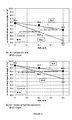
- the white circles in the graph of Figure 3(a) shows the drop in Charpy un-notched impact strength measured according to ISO 179/1eU, on a glass fibre reinforced polyamide 6 (PA6) as a function of content of calcium stearate (CaSt), used e.g., in JP61188457 as internal lubricant and e.g., in JP7179753 as nucleating agent.
- CaSt calcium stearate
- the present invention proposes a solution for substantially reducing the drop in some mechanical properties of glass fibre reinforced composites wherein the thermoplastic matrix comprises a polycondensate, observed when additives such as an internal lubricant or a nucleating agent are added.
- the present invention concerns a process for the production of injection moulded glass fibre reinforced composites from extruded glass fibre reinforced pellets, said process comprising the following steps:
- the sizing composition comprises a silane coupling agent and preferably a reactive polymer of functionality, f ⁇ 2.
- said at least one sizing reactive moiety, A1 belongs to the silane coupling agent, preferably selected among aminosilanes and epoxysilanes.
- said at least one sizing reactive moiety, A2 belongs to said reactive polymer of functionality, f ⁇ 2, comprising at least two such sizing reactive moieties, A2.
- Said reactive polymer is preferably selected among an epoxy resin based on bisphenol-A or bisphenol-F, an epoxy phenol novolac (EPN), an epoxy cresol novolac (ECN), a (co-)polymer comprising acrylic and/or methacrylic acid groups, a copolymer of maleic acid or maleic anhydride, a (co-)polymer grafted with maleic acid or maleic anhydride, isocyanate cross-linkers, polyvinylamine and polyethyleneimine.
- an epoxy resin based on bisphenol-A or bisphenol-F an epoxy phenol novolac (EPN), an epoxy cresol novolac (ECN), a (co-)polymer comprising acrylic and/or methacrylic acid groups, a copolymer of maleic acid or maleic anhydride, a (co-)polymer grafted with maleic acid or maleic anhydride, isocyanate cross-linkers, polyvinylamine and polyethyleneimine.
- the matrix comprises a polycondensate.
- said polycondensate comprises a polyamide.
- the first and second matrix reactive moieties, B1, B2 are an amine group and a carboxylic acid group, respectively.
- the polycondensate comprises a polyester, preferably polyethylene terephthalate or polybutylene terephthalate.
- the first and second matrix reactive moieties, B1, B2 are a hydroxyl group and a carboxylic acid group, respectively.
- the salt is an internal lubricant. It is preferably a metal soap such as calcium-, zinc-, magnesium-, or aluminum-stearate or montanate, preferably the internal lubricant is calcium stearate or montanate.
- the organic salt is a nucleating agent, preferably selected among slaked lime (Ca(OH 2 ) 2 ), calcium benzoate, sodium benzoate, sodium o-chlorobenzoate, calcium carbonate.
- the glass fibres and thermoplastic matrix polycondensate may be blended upstream of an extruding screw chamber, and the salt may be added downstream of said extruding screw chamber to produce glass fibre reinforced pellets comprising the reaction product of a blend of glass fibres, thermoplastic matrix polycondensate, and salt.
- the matrix and glass fibres are blended alone in an extruder to form fibre reinforced granules or pellets. These granules are introduced into the screw chamber of an injection moulding machine, and blended therein with a master batch comprising the salt and thermoplastic matrix, in amounts such that a composite part with the desired contents of glass fibres, thermoplastic matrix and additive are produced.
- Some mechanical properties of a glass fibre reinforced composite produced with a process according to the present invention may be higher than the ones of a composite material with same components and amounts, wherein the thermoplastic matrix polycondensate and salt are blended prior to adding the glass fibres
- the notched or un-notched charpy values measured according to ISO 179/1eA(f) and ISO 179/1eU may be 10% or more higher, or the tensile strength measured according to ISO 527 may be at least 5% higher.
- DAM dry as moulded
- PA66 maintained at a temperature of 130°C in 50/50 water/ethylene glycol during a time of up to 1000 h
- PET and PBT maintained at a temperature of 110°C in water steam at 1.5 bar for a period of up to 72 h for PET and comprised between 72 and 240 h for PBT.
- the present application also concerns a glass fibre reinforced composite obtained by a process as defined above.
- the present application also concerns a process for producing glass reinforced pellets, said process comprising the following steps:
- the present application also concerns glass fibre reinforced pellets obtained by the foregoing process.
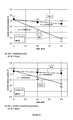
- FIGs 3 and 4(b) show with the white circles the drop in un-notched impact strength and tensile strain as a function of contents of calcium stearate (CaSt) in a 30 wt.% glass fibre reinforced polyamide 6 (PA6) composite (6b) processed as described above according to the prior art illustrated in Figure 1 (a) .
- the polyamide 6 is a virgin polyamide 6, and the glass fibres are 173X-11P and DS1110-10N available from 3B Fibreglass. It can be seen that the un-notched impact strength drops linearly by over 30% with addition of 0.4 wt.% CaSt, with respect to the total weight of composite. Similarly the tensile strain drops linearly by a little less than 30% with addition of 0.4% CaSt.
- the sizing composition generally comprises an alkoxysilane coupling agent, forming silanols upon hydrolization thereof, which react with the surface of the glass fibres forming an Si-O-Si covalent structure.
- Silanes with a sizing reactive moiety, A1 are generally used.
- aminosilanes and epoxy silanes are widely used to this effect, the sizing reactive moiety, A1 : amino-group or epoxy group, respectively, remaining conveniently available for reaction with first and/or second matrix reactive moieties, B1, B2 of the polycondensate polymer and thus forming covalent bonds therewith.
- the sizing composition generally also comprises a reactive polymer comprising at least two sizing reactive moieties, A2, (i.e., having a functionality, f ⁇ 2) which can readily react with the first and/or second matrix reactive moieties, B1, B2 of the polycondensate polymer.
- A2 i.e., having a functionality, f ⁇ 2
- first and/or second matrix reactive moieties, B1, B2 of the polycondensate polymer react:
- the salt added as internal lubricant or as nucleating agent may comprise a salt reactive moiety, C, capable of reacting with the at least one sizing reactive moiety, A1, A2, and/or with the first or second matrix reactive moiety, B1, B2, thus blocking various reactive sites preventing chain extension of the matrix polymeric chains and covalent bonding of the latter to the surface of the sized glass fibres. This translates into a sharp drop of some mechanical properties of a composite material, in particular impact strength and tensile strain at rupture.
- the silane coupling agent is preferably an aminosilane or an epoxysilane.
- the sizing reactive moiety, A1, associated with the silane coupling agent is therefore preferably an amine group or an epoxy group.
- the reactive polymer of the sizing composition may conveniently be selected among an epoxy resin based on bisphenol-A or bisphenol-F, an epoxy phenol novolac (EPN), an epoxy cresol novolac (ECN), a (co-)polymer comprising acrylic and/or methacrylic acid groups, a copolymer of maleic acid or maleic anhydride, a (co-)polymer grafted with maleic acid or maleic anhydride, isocyanate cross-linkers, polyvinylamine and polyethyleneimine.
- the sizing reactive moiety, A2 associated with the foregoing reactive polymers are therefore a carboxylic acid and an anhydride group, respectively.
- the reactive polymer comprises polyacrylic acid groups
- the cation, Ca 2+ of calcium stearate, due to its high mobility, will promptly react with a carboxylic acid moiety, A2, of the polyacrylic acid thus neutralizing it and preventing it from reacting with an amine group of a polyamide chain of the matrix and thus restraining the covalent bonding of matrix chains to the glass fibres and stopping chain extension of the polyamide chains.
- the stearate anions of calcium stearate enter in competition with the carboxylic acid, A2, of the reactive polymer of the sizing composition, in the reaction with amine groups, B1, of the polyamide matrix. Since said anion has a functionality of 1, such reaction stops chain extension of the polymeric matrix. Because the salt is much more mobile than the polymeric chains and also than the reactive polymer, the diffusion controlled reaction rate of the salt reactive moiety, C, is higher than the one of the other components of the composite.
- a maleic anhydride copolymer can be used as reactive polymer instead of polyacrylic acid, because it is less sensitive than the latter to salts formation with metallic cations, such as Ca 2+ .
- the competition between said maleic anhydride copolymer and the stearate anion in the reaction with the amine groups of polyamide chains remains important and detrimental to the mechanical properties of the composites thus produced.
- the sizing reactive moiety, A2 associated with a reactive polymer of the sizing composition may also be an isocyanate group, an epoxy group, or an amine group. Examples of such reactive polymers include:
- polycondensates are meant herein to refer to any kind of polymers formed through a condensation reaction where molecules join together losing small molecules as by-products such as water or methanol, as opposed to addition polymers which involve the reaction of unsaturated monomers.
- Polycondensates are sensitive to interruption of chain extension by reaction with a salt reactive moiety, C, of a salt. Examples of polycondensates include polyamides, polyesters, and polyacetals.
- preferred polycondensate comprise polyamides (PA), preferably aliphatic polyamides such as polyamide 6 (PA6), polyamide 12 (PA12), polyamide 66 (PA66), polyamide 46 (PA46), or semi aromatic PA's like polyphthalamide (PPA).
- PA polyamides
- a first matrix reactive moiety, B1 is an amine group
- a second matrix reactive moiety, B2 is a carboxylic acid group.
- the polycondensate of the matrix may be a polyester such as polyethylene terephthalate (PET), polybutylene terephthalate (PBT), polyethylene naphthalate (PEN), and the like.
- the matrix polycondensate is PA6, PET, or PBT.
- the polycondensate of the matrix is a polyester
- a first matrix reactive moiety, B1 is an hydroxyl group
- a second matrix reactive moiety, B2 is a carboxylic acid group.
- the additive according to the present invention is an internal lubricant or a nucleating agent. It is preferably a salt comprising a metallic cation, such as calcium, zinc, magnesium, aluminium, lead, boron or lithium.
- the anion is preferably organic and selected among fatty acids like stearates and montanate.
- the salt reactive moiety, C is therefore either a metallic cation, the anionic form of a carboxylic group or a hydroxyl group, or an inorganic anion such as carbonate or sulfate.
- Preferred internal lubricants are metallic stearates, in particular, calcium stearate (CaSt).
- Preferred nucleating agents are slaked lime (Ca(OH 2 ) 2 ), calcium benzoate, boron nitride, and the like. It is believed that such additives are prompt to react with sizing reactive moieties, A1, A2, and with matrix reactive moieties, B1, B2, according to a mechanism as described above. Such reactions may advantageously be hindered with a process according to the present invention, since most reactive sites between the reactive components of the sizing composition on the glass fibres and the polymeric matrix have already reacted before the additive is added to the fibre / matrix blend.
- the amounts of salt additive (3) to be added to the glass fibre / matrix blend are of the order of from 0.05 to 5 wt.%, preferably from 0.1 to 2.5 wt.%" more preferably from 0.15 to 0.5 wt.%.
- the salt additive (3) may be advantageous to introduce the salt additive (3) into the screw chamber of an extruder (10) or of an injection moulding machine (20) as part of a master batch.
- the master batch comprises a blend of the salt additive and a polymer. More preferably said polymer belongs to the matrix.
- the master batch preferably comprises said one or more additional polymers, such as to reduce the amounts of reactions between the salt reactive moiety, C, and any matrix reactive moiety present in the master batch. If the matrix is composed solely of polycondensates, then the master batch shall comprise a mixture of the salt additive and at least one polycondensate of the matrix.
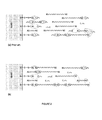
- a composite part (4b) produced by a process according to the present invention, two embodiments of which being illustrated in Figure 1(b) &(c) has higher mechanical properties than a composite part (6b) of same composition produced by a process of the prior art illustrated in Figure 1(a) , wherein matrix (1); glass fibres (2), and salt additive (3) are added together into a mixing screw chamber of an extruder (10).
- the matrix consists of pure polyamide 6 devoid of any additive.
- the glass fibres are 11 ⁇ m Advantex fibres available from 3B fibreglass.
- the sizing (173X) comprises a ⁇ -aminopropyltriethoxysilane coupling agent A1100 and a polyacrylic acid.
- a twin-screw extruder ZSK-26 was used to blend the polyamide and glass fibres and, for the prior art process, the calcium stearate pre-mixed with the polyamide granules.
- the temperature of the screw mixing chamber of the extruded (10) was maintained at a temperature ranging from 240 and 280°C depending on the position in the screw. Glass fibre reinforced pellets (6a) and (5a) were thus produced with the prior art process ( Figure 1(a) ) and the present process ( Figure 1(c) ).
- Said pellets were introduced into the screw mixing chamber of an injection moulding machine Arburg 420C, with a chamber temperature ranging from 255 and 270°C depending on the position in the screw and a mould temperature of 80°C.
- a master batch comprising PA6 and calcium stearate was added to the glass fibre reinforced granules (5a).
- the melts (6) and (5) were injected into acooled tool to produce a composite part (6b), (4b) according to the prior art and the present invention, respectively.
- Test samples were cut out of the composite parts and tested in tensile mode and charpy un-notched impact with 0, 0.1, 0.2, 0.3, and 0.4 wt.% calcium stearate.
- the values of the charpy impact strength and tensile strain are represented as a function of CaSt content in Figures 3(a) and 4(a) , respectively.
- the composite according to the present invention (black circles) also undergo a drop of impact strength with increasing amounts of additive, but said drop is much smaller than for the prior art samples, dropping 12% from 78.4 kJ / m 2 without additive to 68.6 kJ / m 2 with 0.4 wt.% CaSt.
- the slope of the curve is -24.6 kJ / m 2 / %CaSt, I.e., considerably lower than for the prior art composites.
- Example 1 Comparative Example 1
- glass fibres were replaced by 10 ⁇ m Advantex DS1110-10N glass fibres available from 3B Fibreglass, sized with a sizing composition comprising A1100 aminosilane coupling agent and an ethylene-co-maleic acid anhydride reactive polymer.
- Table 1 summarizes the materials used and the mechanical properties obtained with the composites of Examples and Comparative Examples 1&2.
- the difference in mechanical properties in the absence of CaSt between a composite of Example 1 and a composite of Example 2 is to ascribe solely to the larger diameter of 11 ⁇ m of the glass fibres used in Example 1 compared with 1 0 ⁇ m of the glass fibres used in Example 2.
- a salt additive viz., calcium stearate
- Examples 1&2) allows a substantial decrease in the mechanical properties, in particular charpy impact strength and tensile strain, compared with adding the salt additive together with the glass fibres and polyamide (Comparative Examples 1&2).
- Table 1 and Figures 3 &4 were measured on samples dry as moulded (DAM).
- Preliminary results with a polyester resin (PBT) and a polyamide resin (PA66) suggest that similar conclusions can be drawn with respect to resistance to hydrolysis ageing.
- Table 1 materials and mechanical properties of composites according to Examples and Comparative Examples 1&2 EX1 CEX1 EX2 CEX2 Process cf.
- Figure 1(a) GF diameter, ⁇ m 11 11 10 10 silane coupling agent A1100 A1100 A1100 A1100 A1100 A1 amine amine amine amine reactive polymer polyacrylic ac. polyacrylic ac. maleic anhydr. Copm maleic anhydr. Copm A2 carboxylic ac. carboxylic ac. anhydride anhydride Matrix PA6 PA6 PA6 PA6 PA6 PA6 PA6 PA6 PA6 PA6 PA6 PA6 PA6 PA6 B1 amine amine amine amine B2 carboxylic ac. carboxylic ac. carboxylic ac. carboxylic ac.
Landscapes
- Chemical & Material Sciences (AREA)
- Chemical Kinetics & Catalysis (AREA)
- Organic Chemistry (AREA)
- Health & Medical Sciences (AREA)
- Medicinal Chemistry (AREA)
- Polymers & Plastics (AREA)
- Engineering & Computer Science (AREA)
- Materials Engineering (AREA)
- Manufacturing & Machinery (AREA)
- Life Sciences & Earth Sciences (AREA)
- General Life Sciences & Earth Sciences (AREA)
- General Chemical & Material Sciences (AREA)
- Geochemistry & Mineralogy (AREA)
- Compositions Of Macromolecular Compounds (AREA)
- Reinforced Plastic Materials (AREA)
Priority Applications (2)
| Application Number | Priority Date | Filing Date | Title |
|---|---|---|---|
| EP20130190219 EP2865705A1 (de) | 2013-10-25 | 2013-10-25 | Verfahren zur Herstellung von Glasfaserverbundwerkstoffen |
| PCT/EP2014/070987 WO2015058939A1 (en) | 2013-10-25 | 2014-09-30 | Process for producing glass fibre reinforced composites |
Applications Claiming Priority (1)
| Application Number | Priority Date | Filing Date | Title |
|---|---|---|---|
| EP20130190219 EP2865705A1 (de) | 2013-10-25 | 2013-10-25 | Verfahren zur Herstellung von Glasfaserverbundwerkstoffen |
Publications (1)
| Publication Number | Publication Date |
|---|---|
| EP2865705A1 true EP2865705A1 (de) | 2015-04-29 |
Family
ID=49552161
Family Applications (1)
| Application Number | Title | Priority Date | Filing Date |
|---|---|---|---|
| EP20130190219 Withdrawn EP2865705A1 (de) | 2013-10-25 | 2013-10-25 | Verfahren zur Herstellung von Glasfaserverbundwerkstoffen |
Country Status (2)
| Country | Link |
|---|---|
| EP (1) | EP2865705A1 (de) |
| WO (1) | WO2015058939A1 (de) |
Cited By (4)
| Publication number | Priority date | Publication date | Assignee | Title |
|---|---|---|---|---|
| EP2876134A3 (de) * | 2013-11-22 | 2015-08-05 | Johns Manville | Faserverstärkte Verbundwerkstoffe aus thermoplastischen Harzzusammensetzungen und reaktiv koppelnden Fasern |
| CN109401290A (zh) * | 2018-11-05 | 2019-03-01 | 西华大学 | 复合成核剂及包含该复合成核剂的尼龙复合材料及制备方法 |
| CN109749193A (zh) * | 2017-11-03 | 2019-05-14 | 南亚塑胶工业股份有限公司 | 树脂强化胶粒、强化塑料混合料及低温重载塑料制品的制造方法 |
| CN110255926A (zh) * | 2019-07-26 | 2019-09-20 | 重庆三磊玻纤股份有限公司 | 用于生产绝缘子合股纱玻璃纤维的浸润剂及其制备方法 |
Families Citing this family (1)
| Publication number | Priority date | Publication date | Assignee | Title |
|---|---|---|---|---|
| CN113321826B (zh) * | 2020-08-18 | 2022-01-28 | 山东玻纤集团股份有限公司 | 一种玻璃纤维树脂复合材料的制备方法 |
Citations (6)
| Publication number | Priority date | Publication date | Assignee | Title |
|---|---|---|---|---|
| JPS6197356A (ja) | 1984-10-18 | 1986-05-15 | Seiko Epson Corp | 樹脂組成物 |
| JPS61188457A (ja) | 1985-02-15 | 1986-08-22 | Asahi Chem Ind Co Ltd | 薄肉成形品用ポリアミド樹脂組成物 |
| JPH07179753A (ja) | 1993-12-24 | 1995-07-18 | Calp Corp | 複合樹脂組成物 |
| DE19904813A1 (de) * | 1999-02-05 | 2000-08-10 | Basf Ag | Schlagzähe Polyesterformmassen |
| US20060204763A1 (en) * | 2004-06-18 | 2006-09-14 | Hartman David R | Sizing for high performance glass fibers and composite materials incorporating same |
| WO2013139708A2 (en) * | 2012-03-20 | 2013-09-26 | 3B Fibreglass Sprl | Two part sizing composition for coating glass fibres and composite reinforced with such glass fibres |
-
2013
- 2013-10-25 EP EP20130190219 patent/EP2865705A1/de not_active Withdrawn
-
2014
- 2014-09-30 WO PCT/EP2014/070987 patent/WO2015058939A1/en not_active Ceased
Patent Citations (6)
| Publication number | Priority date | Publication date | Assignee | Title |
|---|---|---|---|---|
| JPS6197356A (ja) | 1984-10-18 | 1986-05-15 | Seiko Epson Corp | 樹脂組成物 |
| JPS61188457A (ja) | 1985-02-15 | 1986-08-22 | Asahi Chem Ind Co Ltd | 薄肉成形品用ポリアミド樹脂組成物 |
| JPH07179753A (ja) | 1993-12-24 | 1995-07-18 | Calp Corp | 複合樹脂組成物 |
| DE19904813A1 (de) * | 1999-02-05 | 2000-08-10 | Basf Ag | Schlagzähe Polyesterformmassen |
| US20060204763A1 (en) * | 2004-06-18 | 2006-09-14 | Hartman David R | Sizing for high performance glass fibers and composite materials incorporating same |
| WO2013139708A2 (en) * | 2012-03-20 | 2013-09-26 | 3B Fibreglass Sprl | Two part sizing composition for coating glass fibres and composite reinforced with such glass fibres |
Cited By (8)
| Publication number | Priority date | Publication date | Assignee | Title |
|---|---|---|---|---|
| EP2876134A3 (de) * | 2013-11-22 | 2015-08-05 | Johns Manville | Faserverstärkte Verbundwerkstoffe aus thermoplastischen Harzzusammensetzungen und reaktiv koppelnden Fasern |
| US9493612B2 (en) | 2013-11-22 | 2016-11-15 | Johns Manville | Fiber-reinforced composites made with thermoplastic resin compositions and reactive coupling fibers |
| US9725564B2 (en) | 2013-11-22 | 2017-08-08 | Johns Manville | Fiber-reinforced composites made with thermoplastic resin compositions and reactive coupling fibers |
| US10407553B2 (en) | 2013-11-22 | 2019-09-10 | Johns Manville | Fiber-reinforced composites made with thermoplastic resin compositions and reactive coupling fibers |
| CN109749193A (zh) * | 2017-11-03 | 2019-05-14 | 南亚塑胶工业股份有限公司 | 树脂强化胶粒、强化塑料混合料及低温重载塑料制品的制造方法 |
| CN109401290A (zh) * | 2018-11-05 | 2019-03-01 | 西华大学 | 复合成核剂及包含该复合成核剂的尼龙复合材料及制备方法 |
| CN109401290B (zh) * | 2018-11-05 | 2021-05-11 | 西华大学 | 复合成核剂及包含该复合成核剂的尼龙复合材料及制备方法 |
| CN110255926A (zh) * | 2019-07-26 | 2019-09-20 | 重庆三磊玻纤股份有限公司 | 用于生产绝缘子合股纱玻璃纤维的浸润剂及其制备方法 |
Also Published As
| Publication number | Publication date |
|---|---|
| WO2015058939A1 (en) | 2015-04-30 |
Similar Documents
| Publication | Publication Date | Title |
|---|---|---|
| CN110776742B (zh) | 一种高填充低翘曲电池模组端板用的聚苯硫醚复合材料及其制备方法 | |
| EP2865705A1 (de) | Verfahren zur Herstellung von Glasfaserverbundwerkstoffen | |
| KR900003356B1 (ko) | 유리섬유강화 폴리프로필렌 조성물 | |
| CN103242649B (zh) | 一种用于挤出成型的玻纤增强尼龙材料及制备方法与应用 | |
| CN102816384B (zh) | 一种浅缩痕低翘曲的玻纤增强聚丙烯材料及其制法与应用 | |
| CN101693777B (zh) | 汽车保险杠用材料及其制备方法 | |
| US12104024B2 (en) | Polyvinyl alcohol-sized fillers for reinforcing plastics | |
| JP5210068B2 (ja) | レーザ溶着用熱可塑性樹脂組成物、樹脂成形品の製造方法、及び樹脂成形品 | |
| CN106221204B (zh) | 玻纤增强聚酰胺组合物及其制备方法和应用 | |
| CN103289369B (zh) | 一种聚酰胺木塑复合材料及其制备方法 | |
| CN107892772A (zh) | 一种轻质抗翘曲连续玻纤增强聚丙烯复合材料及制备方法 | |
| WO2016062774A1 (en) | Reinforced polymer molding composition | |
| CN102964674A (zh) | 一种超高韧性阻燃聚丙烯复合材料及其制备方法 | |
| CN115011081A (zh) | 一种结晶快速的玻纤增强pet组合物及其制备方法 | |
| CN104231628A (zh) | 一种高强度聚苯硫醚增强增韧复合材料及其制备方法 | |
| CN114891331A (zh) | 一种增韧聚乳酸/淀粉共混材料及其制备方法 | |
| CN103849123A (zh) | 一种高强度低密度改性pet材料及其制备方法 | |
| CN104371229A (zh) | 高浸润性高强度连续碳纤维增强聚偏氟乙烯复合材料及制法 | |
| JP3664133B2 (ja) | 樹脂製歯車 | |
| JP5156124B2 (ja) | ポリカーボネート組成物、その製造方法およびそれを含む物品 | |
| CN103849121A (zh) | 一种高强度低密度阻燃改性pet材料及其制备方法 | |
| CN104292640A (zh) | 高浸润性连续碳纤维增强聚丙烯复合材料及其制备方法 | |
| TW201527363A (zh) | 用以製備玻璃纖維強化複合材料之方法 | |
| KR20140146117A (ko) | 열가소성 성형 배합물 | |
| CN102408708B (zh) | 聚邻苯二甲酰胺长纤包覆增强材料的生产方法 |
Legal Events
| Date | Code | Title | Description |
|---|---|---|---|
| PUAI | Public reference made under article 153(3) epc to a published international application that has entered the european phase |
Free format text: ORIGINAL CODE: 0009012 |
|
| 17P | Request for examination filed |
Effective date: 20131025 |
|
| AK | Designated contracting states |
Kind code of ref document: A1 Designated state(s): AL AT BE BG CH CY CZ DE DK EE ES FI FR GB GR HR HU IE IS IT LI LT LU LV MC MK MT NL NO PL PT RO RS SE SI SK SM TR |
|
| AX | Request for extension of the european patent |
Extension state: BA ME |
|
| STAA | Information on the status of an ep patent application or granted ep patent |
Free format text: STATUS: THE APPLICATION IS DEEMED TO BE WITHDRAWN |
|
| 18D | Application deemed to be withdrawn |
Effective date: 20151030 |