EP2865767B1 - Procédé pur façonner une empeigne en une seule pièce - Google Patents
Procédé pur façonner une empeigne en une seule pièce Download PDFInfo
- Publication number
- EP2865767B1 EP2865767B1 EP13190178.7A EP13190178A EP2865767B1 EP 2865767 B1 EP2865767 B1 EP 2865767B1 EP 13190178 A EP13190178 A EP 13190178A EP 2865767 B1 EP2865767 B1 EP 2865767B1
- Authority
- EP
- European Patent Office
- Prior art keywords
- leather
- tanning agent
- tanning
- fatliquor
- mixture
- Prior art date
- Legal status (The legal status is an assumption and is not a legal conclusion. Google has not performed a legal analysis and makes no representation as to the accuracy of the status listed.)
- Not-in-force
Links
- 238000000034 method Methods 0.000 title claims description 18
- 239000010985 leather Substances 0.000 claims description 87
- 239000003795 chemical substances by application Substances 0.000 claims description 38
- XLYOFNOQVPJJNP-UHFFFAOYSA-N water Substances O XLYOFNOQVPJJNP-UHFFFAOYSA-N 0.000 claims description 30
- 239000000203 mixture Substances 0.000 claims description 20
- VEXZGXHMUGYJMC-UHFFFAOYSA-N Hydrochloric acid Chemical compound Cl VEXZGXHMUGYJMC-UHFFFAOYSA-N 0.000 claims description 16
- 235000013311 vegetables Nutrition 0.000 claims description 15
- 235000019197 fats Nutrition 0.000 claims description 14
- 239000000284 extract Substances 0.000 claims description 12
- 241000283690 Bos taurus Species 0.000 claims description 11
- 150000003839 salts Chemical class 0.000 claims description 10
- 235000017343 Quebracho blanco Nutrition 0.000 claims description 9
- 241000065615 Schinopsis balansae Species 0.000 claims description 9
- 239000000126 substance Substances 0.000 claims description 7
- 239000012874 anionic emulsifier Substances 0.000 claims description 6
- 235000019737 Animal fat Nutrition 0.000 claims description 5
- 238000005554 pickling Methods 0.000 claims description 4
- 238000003801 milling Methods 0.000 claims 2
- 239000001648 tannin Substances 0.000 description 20
- 229920001864 tannin Polymers 0.000 description 20
- 235000018553 tannin Nutrition 0.000 description 20
- 239000003925 fat Substances 0.000 description 12
- 210000003491 skin Anatomy 0.000 description 11
- 239000000047 product Substances 0.000 description 10
- -1 Fatty alcohol sulfates Chemical class 0.000 description 9
- 239000007788 liquid Substances 0.000 description 8
- ICUTUKXCWQYESQ-UHFFFAOYSA-N triclocarban Chemical compound C1=CC(Cl)=CC=C1NC(=O)NC1=CC=C(Cl)C(Cl)=C1 ICUTUKXCWQYESQ-UHFFFAOYSA-N 0.000 description 8
- 230000000694 effects Effects 0.000 description 7
- 238000004519 manufacturing process Methods 0.000 description 7
- 235000014113 dietary fatty acids Nutrition 0.000 description 4
- 229930195729 fatty acid Natural products 0.000 description 4
- 239000000194 fatty acid Substances 0.000 description 4
- 150000004665 fatty acids Chemical class 0.000 description 4
- 239000000835 fiber Substances 0.000 description 4
- 239000003921 oil Substances 0.000 description 4
- 239000002023 wood Substances 0.000 description 4
- QTBSBXVTEAMEQO-UHFFFAOYSA-N Acetic acid Chemical compound CC(O)=O QTBSBXVTEAMEQO-UHFFFAOYSA-N 0.000 description 3
- 244000305267 Quercus macrolepis Species 0.000 description 3
- YXFVVABEGXRONW-UHFFFAOYSA-N Toluene Chemical compound CC1=CC=CC=C1 YXFVVABEGXRONW-UHFFFAOYSA-N 0.000 description 3
- 210000004207 dermis Anatomy 0.000 description 3
- 210000002683 foot Anatomy 0.000 description 3
- 239000000463 material Substances 0.000 description 3
- 230000035515 penetration Effects 0.000 description 3
- PFTAWBLQPZVEMU-DZGCQCFKSA-N (+)-catechin Chemical compound C1([C@H]2OC3=CC(O)=CC(O)=C3C[C@@H]2O)=CC=C(O)C(O)=C1 PFTAWBLQPZVEMU-DZGCQCFKSA-N 0.000 description 2
- 241001070941 Castanea Species 0.000 description 2
- 235000014036 Castanea Nutrition 0.000 description 2
- 235000008733 Citrus aurantifolia Nutrition 0.000 description 2
- 206010013911 Dysgeusia Diseases 0.000 description 2
- 240000003152 Rhus chinensis Species 0.000 description 2
- 235000014220 Rhus chinensis Nutrition 0.000 description 2
- LSNNMFCWUKXFEE-UHFFFAOYSA-N Sulfurous acid Chemical compound OS(O)=O LSNNMFCWUKXFEE-UHFFFAOYSA-N 0.000 description 2
- 235000011941 Tilia x europaea Nutrition 0.000 description 2
- 241000396377 Tranes Species 0.000 description 2
- 230000009286 beneficial effect Effects 0.000 description 2
- 210000004556 brain Anatomy 0.000 description 2
- RWGFKTVRMDUZSP-UHFFFAOYSA-N cumene Chemical compound CC(C)C1=CC=CC=C1 RWGFKTVRMDUZSP-UHFFFAOYSA-N 0.000 description 2
- 238000013461 design Methods 0.000 description 2
- 235000013399 edible fruits Nutrition 0.000 description 2
- 239000010685 fatty oil Substances 0.000 description 2
- 239000004519 grease Substances 0.000 description 2
- JVTAAEKCZFNVCJ-UHFFFAOYSA-N lactic acid Chemical compound CC(O)C(O)=O JVTAAEKCZFNVCJ-UHFFFAOYSA-N 0.000 description 2
- 239000004571 lime Substances 0.000 description 2
- BDAGIHXWWSANSR-UHFFFAOYSA-N methanoic acid Natural products OC=O BDAGIHXWWSANSR-UHFFFAOYSA-N 0.000 description 2
- 230000003647 oxidation Effects 0.000 description 2
- 238000007254 oxidation reaction Methods 0.000 description 2
- 238000004321 preservation Methods 0.000 description 2
- 238000012545 processing Methods 0.000 description 2
- 238000009958 sewing Methods 0.000 description 2
- 239000000344 soap Substances 0.000 description 2
- 238000003892 spreading Methods 0.000 description 2
- BDHFUVZGWQCTTF-UHFFFAOYSA-M sulfonate Chemical compound [O-]S(=O)=O BDHFUVZGWQCTTF-UHFFFAOYSA-M 0.000 description 2
- 150000003871 sulfonates Chemical class 0.000 description 2
- 210000001364 upper extremity Anatomy 0.000 description 2
- 150000003739 xylenols Chemical class 0.000 description 2
- 244000089265 zong er cha Species 0.000 description 2
- FFRBMBIXVSCUFS-UHFFFAOYSA-N 2,4-dinitro-1-naphthol Chemical compound C1=CC=C2C(O)=C([N+]([O-])=O)C=C([N+]([O-])=O)C2=C1 FFRBMBIXVSCUFS-UHFFFAOYSA-N 0.000 description 1
- OSWFIVFLDKOXQC-UHFFFAOYSA-N 4-(3-methoxyphenyl)aniline Chemical compound COC1=CC=CC(C=2C=CC(N)=CC=2)=C1 OSWFIVFLDKOXQC-UHFFFAOYSA-N 0.000 description 1
- 241000251468 Actinopterygii Species 0.000 description 1
- 235000011468 Albizia julibrissin Nutrition 0.000 description 1
- 241000048176 Astronium urundeuva Species 0.000 description 1
- 241000283726 Bison Species 0.000 description 1
- LSNNMFCWUKXFEE-UHFFFAOYSA-M Bisulfite Chemical compound OS([O-])=O LSNNMFCWUKXFEE-UHFFFAOYSA-M 0.000 description 1
- 241000282817 Bovidae Species 0.000 description 1
- 241001124537 Bovinae Species 0.000 description 1
- 244000036978 Caesalpinia bonduc Species 0.000 description 1
- 235000014145 Caesalpinia bonduc Nutrition 0.000 description 1
- 235000009133 Caesalpinia coriaria Nutrition 0.000 description 1
- 235000005082 Caesalpinia paraguariensis Nutrition 0.000 description 1
- ZAMOUSCENKQFHK-UHFFFAOYSA-N Chlorine atom Chemical compound [Cl] ZAMOUSCENKQFHK-UHFFFAOYSA-N 0.000 description 1
- 102000002322 Egg Proteins Human genes 0.000 description 1
- 108010000912 Egg Proteins Proteins 0.000 description 1
- 244000119298 Emblica officinalis Species 0.000 description 1
- 235000015489 Emblica officinalis Nutrition 0.000 description 1
- 241000196324 Embryophyta Species 0.000 description 1
- 102000004190 Enzymes Human genes 0.000 description 1
- 108090000790 Enzymes Proteins 0.000 description 1
- 241001465754 Metazoa Species 0.000 description 1
- 240000005852 Mimosa quadrivalvis Species 0.000 description 1
- 241001494479 Pecora Species 0.000 description 1
- 229920000473 Phlobaphene Polymers 0.000 description 1
- 240000009120 Phyllanthus emblica Species 0.000 description 1
- 241000218657 Picea Species 0.000 description 1
- 229920000388 Polyphosphate Polymers 0.000 description 1
- 241001225886 Prosopis argentina Species 0.000 description 1
- 235000015290 Rumex hymenosepalus Nutrition 0.000 description 1
- 244000107498 Rumex hymenosepalus Species 0.000 description 1
- 241000124033 Salix Species 0.000 description 1
- CDBYLPFSWZWCQE-UHFFFAOYSA-L Sodium Carbonate Chemical compound [Na+].[Na+].[O-]C([O-])=O CDBYLPFSWZWCQE-UHFFFAOYSA-L 0.000 description 1
- 235000011517 Terminalia chebula Nutrition 0.000 description 1
- 239000001887 acacia decurrens willd. var. dealbata absolute Substances 0.000 description 1
- 235000011054 acetic acid Nutrition 0.000 description 1
- 206010000496 acne Diseases 0.000 description 1
- 150000008052 alkyl sulfonates Chemical class 0.000 description 1
- 125000000129 anionic group Chemical group 0.000 description 1
- 210000003423 ankle Anatomy 0.000 description 1
- 238000005452 bending Methods 0.000 description 1
- 230000005540 biological transmission Effects 0.000 description 1
- 238000004061 bleaching Methods 0.000 description 1
- 235000014121 butter Nutrition 0.000 description 1
- 125000004432 carbon atom Chemical group C* 0.000 description 1
- YCIMNLLNPGFGHC-UHFFFAOYSA-N catechol Chemical group OC1=CC=CC=C1O YCIMNLLNPGFGHC-UHFFFAOYSA-N 0.000 description 1
- 239000000460 chlorine Substances 0.000 description 1
- 229910052801 chlorine Inorganic materials 0.000 description 1
- 239000007859 condensation product Substances 0.000 description 1
- 238000001816 cooling Methods 0.000 description 1
- 230000001419 dependent effect Effects 0.000 description 1
- 238000011161 development Methods 0.000 description 1
- 230000018109 developmental process Effects 0.000 description 1
- 235000013345 egg yolk Nutrition 0.000 description 1
- 210000002969 egg yolk Anatomy 0.000 description 1
- 239000003995 emulsifying agent Substances 0.000 description 1
- 230000001804 emulsifying effect Effects 0.000 description 1
- 210000002615 epidermis Anatomy 0.000 description 1
- RTZKZFJDLAIYFH-UHFFFAOYSA-N ether Substances CCOCC RTZKZFJDLAIYFH-UHFFFAOYSA-N 0.000 description 1
- 239000012467 final product Substances 0.000 description 1
- 229940013317 fish oils Drugs 0.000 description 1
- 235000019253 formic acid Nutrition 0.000 description 1
- 238000009472 formulation Methods 0.000 description 1
- 239000012676 herbal extract Substances 0.000 description 1
- 238000010348 incorporation Methods 0.000 description 1
- 239000004310 lactic acid Substances 0.000 description 1
- 235000014655 lactic acid Nutrition 0.000 description 1
- 230000002045 lasting effect Effects 0.000 description 1
- 238000005461 lubrication Methods 0.000 description 1
- 235000013336 milk Nutrition 0.000 description 1
- 239000008267 milk Substances 0.000 description 1
- 210000004080 milk Anatomy 0.000 description 1
- 238000002156 mixing Methods 0.000 description 1
- 239000008239 natural water Substances 0.000 description 1
- 230000037368 penetrate the skin Effects 0.000 description 1
- 239000003208 petroleum Substances 0.000 description 1
- 229920000642 polymer Polymers 0.000 description 1
- 150000008442 polyphenolic compounds Polymers 0.000 description 1
- 239000001205 polyphosphate Substances 0.000 description 1
- 235000011176 polyphosphates Nutrition 0.000 description 1
- 239000002244 precipitate Substances 0.000 description 1
- 102000004169 proteins and genes Human genes 0.000 description 1
- 108090000623 proteins and genes Proteins 0.000 description 1
- LSEKLPKUWRDLKY-UHFFFAOYSA-N protoleucomelone Chemical compound C1=CC(OC(=O)C)=CC=C1C1=C(OC(C)=O)C(OC(C)=O)=C(C=2C(=CC(OC(C)=O)=C(OC(C)=O)C=2)O2)C2=C1OC(C)=O LSEKLPKUWRDLKY-UHFFFAOYSA-N 0.000 description 1
- 239000005871 repellent Substances 0.000 description 1
- 239000011347 resin Substances 0.000 description 1
- 229920005989 resin Polymers 0.000 description 1
- AKHNMLFCWUSKQB-UHFFFAOYSA-L sodium thiosulfate Chemical compound [Na+].[Na+].[O-]S([O-])(=O)=S AKHNMLFCWUSKQB-UHFFFAOYSA-L 0.000 description 1
- 235000019345 sodium thiosulphate Nutrition 0.000 description 1
- 239000002425 soil liming agent Substances 0.000 description 1
- 230000006641 stabilisation Effects 0.000 description 1
- 238000011105 stabilization Methods 0.000 description 1
- 238000010186 staining Methods 0.000 description 1
- 230000019635 sulfation Effects 0.000 description 1
- 238000005670 sulfation reaction Methods 0.000 description 1
- 150000004763 sulfides Chemical class 0.000 description 1
- 150000003467 sulfuric acid derivatives Chemical class 0.000 description 1
- 230000008961 swelling Effects 0.000 description 1
- 239000003760 tallow Substances 0.000 description 1
- 150000003613 toluenes Chemical class 0.000 description 1
- 238000005406 washing Methods 0.000 description 1
- 210000000051 wattle Anatomy 0.000 description 1
Images



Classifications
-
- C—CHEMISTRY; METALLURGY
- C14—SKINS; HIDES; PELTS; LEATHER
- C14C—CHEMICAL TREATMENT OF HIDES, SKINS OR LEATHER, e.g. TANNING, IMPREGNATING, FINISHING; APPARATUS THEREFOR; COMPOSITIONS FOR TANNING
- C14C3/00—Tanning; Compositions for tanning
- C14C3/02—Chemical tanning
- C14C3/08—Chemical tanning by organic agents
- C14C3/10—Vegetable tanning
-
- A—HUMAN NECESSITIES
- A43—FOOTWEAR
- A43B—CHARACTERISTIC FEATURES OF FOOTWEAR; PARTS OF FOOTWEAR
- A43B23/00—Uppers; Boot legs; Stiffeners; Other single parts of footwear
- A43B23/02—Uppers; Boot legs
- A43B23/0205—Uppers; Boot legs characterised by the material
- A43B23/021—Leather
-
- A—HUMAN NECESSITIES
- A43—FOOTWEAR
- A43B—CHARACTERISTIC FEATURES OF FOOTWEAR; PARTS OF FOOTWEAR
- A43B23/00—Uppers; Boot legs; Stiffeners; Other single parts of footwear
- A43B23/02—Uppers; Boot legs
- A43B23/04—Uppers made of one piece; Uppers with inserted gussets
- A43B23/042—Uppers made of one piece
-
- C—CHEMISTRY; METALLURGY
- C14—SKINS; HIDES; PELTS; LEATHER
- C14C—CHEMICAL TREATMENT OF HIDES, SKINS OR LEATHER, e.g. TANNING, IMPREGNATING, FINISHING; APPARATUS THEREFOR; COMPOSITIONS FOR TANNING
- C14C3/00—Tanning; Compositions for tanning
- C14C3/02—Chemical tanning
- C14C3/08—Chemical tanning by organic agents
- C14C3/10—Vegetable tanning
- C14C3/12—Vegetable tanning using purified or modified vegetable tanning agents
-
- C—CHEMISTRY; METALLURGY
- C14—SKINS; HIDES; PELTS; LEATHER
- C14C—CHEMICAL TREATMENT OF HIDES, SKINS OR LEATHER, e.g. TANNING, IMPREGNATING, FINISHING; APPARATUS THEREFOR; COMPOSITIONS FOR TANNING
- C14C3/00—Tanning; Compositions for tanning
- C14C3/02—Chemical tanning
- C14C3/08—Chemical tanning by organic agents
- C14C3/14—Fat tanning; Oil tanning
-
- C—CHEMISTRY; METALLURGY
- C14—SKINS; HIDES; PELTS; LEATHER
- C14C—CHEMICAL TREATMENT OF HIDES, SKINS OR LEATHER, e.g. TANNING, IMPREGNATING, FINISHING; APPARATUS THEREFOR; COMPOSITIONS FOR TANNING
- C14C3/00—Tanning; Compositions for tanning
- C14C3/02—Chemical tanning
- C14C3/08—Chemical tanning by organic agents
- C14C3/18—Chemical tanning by organic agents using polycondensation products or precursors thereof
-
- C—CHEMISTRY; METALLURGY
- C14—SKINS; HIDES; PELTS; LEATHER
- C14C—CHEMICAL TREATMENT OF HIDES, SKINS OR LEATHER, e.g. TANNING, IMPREGNATING, FINISHING; APPARATUS THEREFOR; COMPOSITIONS FOR TANNING
- C14C9/00—Impregnating leather for preserving, waterproofing, making resistant to heat or similar purposes
- C14C9/02—Impregnating leather for preserving, waterproofing, making resistant to heat or similar purposes using fatty or oily materials, e.g. fat liquoring
Definitions
- a leg width of a boot may be adjusted by providing a slit whose width is adjusted by shoelaces, such as 10 in FIG EP 0569012 B1 shown. Furthermore, it is known to subsequently subsequently slightly deform a finished shoe by means of a shoe, in order to adapt it to an individual foot shape, as for example in US Pat US 2006 / 0117501A1 is disclosed.
- the DE 86 412 shows a method for producing one-piece boot shafts, wherein the one-piece boot leather is tanned in a manner not described in detail and then drummed into shape.
- the present specification discloses a method for forming an upper leather in which first a tubular integral upper leather is provided as a portion of a leg portion of a bovine skin which is specially tanned and then widened prior to processing as the upper leather.
- Leg area refers to the area around one of the runs. In particular, the front leg is around the front legs.
- the skin Before the actual tanning the leather is pre-processed in a water workshop.
- the switch the skin is placed in water so that it is cleaned and brought to the original, natural water content. It is then inserted into the liming area for a few hours to days to remove the hairy epidermis and loosen the fiber structure.
- the liming agent may, for example, comprise lime milk, lime and sulfides and / or enzymes. The soaked and depilated skin is called nakedness.
- the sub-skin is removed mechanically, so that finally only the dermis remains.
- the dermis is cut horizontally over the entire surface. Due to the strong alkaline treatment of the limp, the skin swells up. During the decalcifying process, the liming chemicals are removed from the skin, the pH is largely neutralized, and the skin regains its natural state of swelling. This makes it easier for the chemicals and tannins to penetrate the skin.
- the present description uses a very slow vegetable tanning with vegetable tannins (tannins in leaves, barks, woods and fruits) and / or a tanning or tanning with, for example, fish and marine oils (Trane) or fats of the brain, or a Synthetic tanning with synthetically produced tanning agents (syntans, resin tanning agents, polymer tanning agents, polyphosphates, paraffinsulfochloride), which could also be used for the tanning of transmission belts.
- vegetable tannins tannins in leaves, barks, woods and fruits
- a tanning or tanning with, for example, fish and marine oils (Trane) or fats of the brain or a Synthetic tanning with synthetically produced tanning agents (syntans, resin tanning agents, polymer tanning agents, polyphosphates, paraffinsulfochloride), which could also be used for the tanning of transmission belts.
- Vegetabilgerbstoffe requires a careful Vorgerbung for the first stabilization of the fiber structure of Skin.
- a pretreatment lasting up to 12 months can be carried out in dilute tanning agent, which is also referred to as "old-grape tanning”.
- fats with a tanning effect are introduced into the leather.
- a tanning effect such as Trane or fish oils
- leathers are not treated with the crude fatty substances, but with mixtures containing considerable amounts of emulsifying substances.
- emulsifying substances can be soaps, sulfated or oxidized or chlorinated fats, which are called “licker”.
- “Lickern” means, among other things, the greasing with emulsified fats and related substances (Lickerfette) in the barrel at medium temperatures.
- the upper leather is pre-tanned by a fat tanning using fat and Licker, in particular Tran and Baykanollicker, such as Baykanollicker T are suitable.
- the upper leather is retanned by a vegetable tanning with increasing concentration of a tanning agent mixture, wherein the concentration of the tanning mixture is in the range of 3 - 6 Beaume degrees.
- the retanning tanning mixture comprises about 49 parts of a vegetable tanning agent and about 51 parts of a synthetic tannin tanning agent.
- the above-mentioned weight ratio of 49 to 51 parts gives a particularly intense retanning.
- Even at a ratio of 40 to 60 parts or at a ratio of 55 to 45 parts of vegetable to synthetic still results in a good retanning.
- the tanning effect becomes too weak.
- an extract obtained from the bark or the wood of a tree and, in particular, a cold-soluble quebracho extract can be used as the herbal extract.
- the synthetic tannin tannin consists entirely or predominantly of a synthetically produced tannin such as Tanigan from Bayer / Lanxess.
- tannin synthetic tanning agent In retanning, the use of Tanigan in the synthetic tannin tanning agent proves beneficial, with the proportion of tannin synthetic tanning agent being about 96 weight percent Tanigan and about 4 weight percent of another synthetic tanning agent.
- blending the Tanigan extra NR product to accelerate the tanning and lightening of the leather color and the Tanigan BL product for bleaching proves beneficial.
- the upper leather is licked with a Lickermischung comprising water, an anionic emulsifier and a licker.
- the water preferably has a temperature of about 45 ° C, but water in the temperature range of 40 - 50 ° C can be used.
- a Lickertemperatur of up to 60 ° C is still possible.
- even a Lickertemperatur of 30 ° C still lead to useful results, but then extends the treatment time considerably.
- Tanigan supra LH is added as aftertaste to the lickermixture of the licker and the anionic emulsifier after the upper leather is loosened, so that an improved tanning is achieved. Even with a follow-up of only 1% Tanigan supra LH the tanning effect is intensified even more.
- the special tanning of the skin used for the upper of the boot allows a large width, as it is necessary for a one-piece bootleg. Without the special tanning according to the application, the upper leather would break wide.
- a boot shaft broader is inserted into a shaft of the upper.
- the upper leather is widened by at least 100% relative to the circumference at the narrowest point of a shaft portion of the upper.
- a propulsion is converted by means of a wedge effect in a spreading movement.
- the spreading movement can in particular be such that a front wedge and a rear wedge of the bootleg broader unfold like a hinge.
- the shaft extension may also be such that one or more parts are moved apart by a screw mechanism and / or a wedge.
- improved tanning and softening of the leather is achieved by pre-tanning a step of flexing with a mixture of 100% water, 12-15% animal fat, for example, Tran, and about 4% licker at a temperature of about 28-30 ° C. Even a temperature range of up to 26 ° C to 35 ° C is still possible.
- the proportion of animal fat can be as low as 10% or even 17%.
- the walking can be carried out by hand or with the aid of tools or else in a walking barrel, which rotates at high speed.
- the leather can be pickled before tanning.
- This proves pimples with a mixture of 100% water, about 10% salt and about 3% - 5% hydrochloric acid for at least 4 hours, as effective, wherein the weights are based on the present before pickling leather weight, so for example on the pelt weight. It can also be used only 1% hydrochloric acid or 7% hydrochloric acid for pimpling. At higher hydrochloric acid content, however, the leather could be damaged.
- the salt content can vary from 5 to 15%. Instead of hydrochloric acid and salt also formic acid, acetic acid or lactic acid can be used for pimpling. Instead of 100% water, only 90% water or up to 110% water can be used.
- the present disclosure discloses a boot having a one-piece bovid-leather seamless upper with the upper of the boot pre-tanned with grease and licker, retanned with vegetable tanning agent and synthetic tannin tannin and kneaded with anionic emulsifier and licker is cut from a leg piece of bovine skin and is at least 100% expanded, based on the smallest circumference in the shaft area.
- the upper leather can also be widened to three times the circumference or more.
- the present description discloses a boot which is treated and expanded according to one of the aforementioned methods.
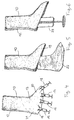
- a funnel-shaped upper leather 10 is cut out of a bovine skin 11.
- This upper leather 10 may be obtained, for example, from a leg of a bovine, as in Fig. 1 to 3 illustrated.
- the cut-out area of the upper 10 is marked by dashed lines.
- the upper leather 10 is stripped from top to bottom of the bovine lobe, as in Fig. 2 shown.
- Fig. 3 shows that according to Fig. 1 and Fig. 2
- the upper leather 10 has a hose-like region 12 or a shaft 12 and a funnel-shaped widened area 13 which is asymmetrical with respect to the hose-like region 12.
- bovine leather pieces of leather from the lobe area of other bovids may also be used which have a sufficiently large lobe.
- members of the subfamily "Bovinae” such as, for example, cattle, buffalo and bison are suitable for this purpose.
- the upper leather 10 is now defiled, depilated and pickled.
- the resulting leather is also referred to as "leatherblank” or as a nakedness.
- Pimpling can be done, for example, by pickling the leather with a mixture of 100% water, 10% salt and 3-5% hydrochloric acid for at least 4 hours and then de-piping it with a mixture containing 12-16% antichlorine , where the best possible Naturalentpickelung is to strive for.
- the leather blanks are then subjected to leather tanning as described herein.
- a leather tanning according to the present description can improve the tear strength and the extensibility of the leather, so that treatment with stretching and stretching devices without tearing the boot leg is made possible in the first place.
- the pickled leather blanks are rolled with a mixture of 12 - 15% Tran and 4% Baykanollicker T at a temperature of 28 - 30 ° C until they are completely tanned.
- the dermis is hung for oxidation for about 1 to 2 weeks. If the oxidation has taken place, as can be seen for example from a golden yellow section of the leather, the leather is washed out with 1-3% soda at 38-42 ° C. The washing is repeated until no more leaking at double bending. The leather is then rinsed lukewarm and ventilated.
- the leather is retanned with increasing concentration of a tanning agent of 3 to 6 Baume degrees (° Be). It has proved to be effective, the concentration of the tanning agent during rethening from 3 degrees to 6 degrees Be instead of working immediately with the higher concentration.
- the retanning can be done in several operations, for example, in 3 operations, wherein the concentration of the tanning agent increases for each operation.
- the concentration according to Beaume can be determined for example with a Beaume spindle or with an arometer.
- the tanning agent contains 49 parts of cold soluble Quebracho or quebracho extract, 49 parts of Tanigan extra NR and 2 parts of Tanigan BLG, each based on the Ringer's material.
- the leather is then jacked up, rinsed and ironed, the licker containing 200-300% water at 45 ° C., 2% cutisan and 1% Baykanollicker T, and 2% Tanigan supra LH as aftertaste.
- Baykanol-Licker T is a fatliquoring agent manufactured by Bayer AG. Similar products which can also be used are, for example, Baykanol-Licker KM, Baykanol-Licker SCLM and Baykanol-Licker TSI as well as Baykanol PFM, Baykanol SL and OC-product 2101, which are available from Lanxess AG.
- Tanigan extra NR, BLG and supra LH are synthetic tannins manufactured by Bayer AG. Tannins are polyhydroxyphenols. Similar products that can also be used include Tanigan 3LN liquid, Tanigan BN liquid, Tanigan CF liquid, Tanigan HO liquid, Tanigan MB liquid, Tanigan NH, TANIGAN UW EXP 4006, Tanigan 3LN, Tanigan AN, Tanigan BL-I Tanigan BN, Tanigan CLS 50 liquid, Tanigan F, Tanigan HO, Tanigan OS, Tanigan OS-N liquid, Tanigan PAK, Tanigan PAK-N liquid, Tanigan PR, Tanigan PV, Tanigan QF, Tanigan RFS, Tanigan S EXP 4005 and Tanigan VR available from Lanxess AG.
- Cutisan BS is an anionic emulsifier which is a sulfonate of the type R-SO3Na and which is a sulfite product of unsaturated fatty oils and fatty acids, where "R” is a long chain alkyl radical of 8-24 carbon atoms.
- Antichlor is another name for sodium thiosulfate that is used in tanning to remove excess chlorine or excess hydrochloric acid from a solution.
- Quebracho extract is extracted from the inner red heartwood of the Quebracho tribe, which grows in South America and mainly in Argentina and Paraguay.
- Quebracho tanned leather gives a very firm, tough and reddish leather. The leather is sensitive to light after tanning and darkens.
- the leached out of Quebrachoholz extract belongs to the catechol group and is attributed to the condensed type of tannin.
- the cold-soluble Quebrachoexschreib is a sulfited Quebrachoex Exercise with increased tannin content of 72 to 80% increasing, in which by a special treatment of Quebrachoholzausman with sulfite or bisulfite the sparingly soluble components are changed so that this extract can be solved with cold water.
- the above tanning with Tran is an example of a fat tanning.
- Core soap, foot oil, Vietnamese red oil, yak butter or egg yolk can be used instead of the trans.
- Vegetable tanning agents are obtained, inter alia, from the following parts of plants: barks woods fruit leaves root excesses oak bark Oak wood Valonea sumac Badan Gallen spruce bark quebracho Trillo Gambier canaigre Knoppern wattle chestnut Myrobalan Mangroverinde urunday Algarobilla Malettorinde Tizeraholz Dividivi willow bark Katechuholz tare Hemlockrinde Bablah
- the choice of vegetable tanning agent depends on the properties to be achieved with the tanning agent.
- oak bark is suitable for a firm, tough yellow-brown leather with a dark cut
- Gambier extract for soft, elastic leather, chestnut wood extract for uniform, compact and durable leather with high light fastness
- Mimosa extract for the production of soles -, belt, pocket and furniture leather
- Mimosa bark for firm, light and slightly red-tinged leather
- Myrabolan extract for combination with other tannins and for soft leather
- sumac for soft, flexible and light leather tare for one good dyeable leather with high light fastness
- trillo for cuddly soft as well as firm and permanent leather
- valonea extract for soft leather.
- the upper leather 10 is widened and shaped.
- Various devices are shown that may be used in accordance with the present description.
- the reference is taken to the salt weight, d. H. the weight that the skin material has after preservation prior to incorporation into the tannery.
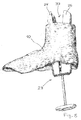
- Fig. 4 shows four screw clamps 15, 16, 17, 18, which are clamped to a sole region 19 of the upper 10.
- the sole region corresponds to the edge of the funnel-shaped region 13.
- the tubular region 13 forms the upper 13 of the upper leather.
- the region further protruding from the tubular portion 12 and cut out from the front of a lobe forms the front portion 20 of the upper 10 and the portion less projecting from the tubular portion 12 and cut out from the rear portion of the lobe is, forms the heel area 21 of the upper leather.
- FIG. 5 shows a wood forming template 22 shaped similar to a cross-section of a foot and dimensioned to be inserted into the upper leather 10 from the sole region 19.
- the form template may be used in conjunction with the in Fig. 4 used screw clamps are used. This is especially good in Fig. 9 to recognize.
- Fig. 6 shows a boot leg farther 23 which is inserted into the upper 12 of the upper.
- the Bootschaftweiter 23 is in Fig. 7 shown in more detail.
- the bootleg further 32 has a front wedge 24 and a rear wedge 25.
- the front wedge 24 is connected to the back wedge 25 via a connecting portion 26 with each other so that the front wedge 24 and the wedge 25 can be unfolded, wherein the connecting portion 26 forms a hinge.
- the linkage 27 has an external thread 27, which engages in an internal thread that is located in the interior of the Stiefelschaftweiters 32, and in Fig. 7 not shown.
- This internal thread is stationary in the direction of the linkage 27 connected to the front wedge 24 and the wedge 25.
- a pressure body 30 is connected to the threaded rod 27 so that it moves with a movement of the threaded rod 27 along the longitudinal direction of the threaded rod 27 with the threaded rod 27.
- the pressure body 30 is dimensioned so that it bears against the inner sides of the front wedge 24 and the wedge 25, or that it bears against the inner sides of another body, which is in contact with the inner sides of the front wedge 24 and the wedge 25.
- the front wedge 24 and the back wedge 25 of the boot shank extension 23 are inserted into the shank 12, so that the outer surfaces of the front wedge 24 and the rear wedge 25 bear against the shank 12 from the inside.
- an initial angular position between the front wedge 24 and the wedge 25 can be adjusted in the manner described below.
- the hand wheel 28 is rotated in a forward direction 31, so that the threaded rod 27 along its longitudinal axis and in a forward direction 32 in the space between the Front wedge 24 and the wedge 25 moves.
- the Vorretesch 31 is shown here for a right-hand thread and would be entered the other way around for a left-hand thread.
- the use of a left or right-hand thread depends, among other things, on whether the boot shaft further 23 is to be operated by a right-handed or a left-handed person.
- the pressure body 30 By the movement of the threaded rod 27, the pressure body 30 is driven along the forward direction 32 in the space between the front wedge 24 and the wedge 25, so that a wedge effect is created, which hingedly fold the front wedge 24 and the wedge 25 against each other, wherein a fulcrum the unfolding movement in the region of the fastening region 26 is located.
- the attachment portion 26 acts as a kind of hinge.
- the expansion of the shaft 12 can in particular be such that the boot shaft further 23 is repeatedly held in its last position to let the leather work. If for this purpose the self-locking of the thread is not sufficient, a separate locking device can be provided for this purpose.
- a doubling or tripling of the diameter of the shaft can be achieved, or even an even greater widening. This is done so that the boots can be tightened comfortably later, without the need for an additional seam, such as a zipper.
- the handwheel 28 is rotated counter to the advancing direction 31 until the Stiefelschaftweiter 23 dissolves from the inside of the shaft 12.
- Fig. 8 shows a position of the Stiefelschaftweiters 23 after bootleg widening in which the gap 33 between the front wedge 24 and wedge 25 has widened wedge-shaped and in which the shaft 12 has expanded so far that he has assumed the diameter of a human ankle.
- FIG. 9 Figure 4 shows another upper leather forming apparatus 10 having a template 22 inserted into the upper leather 10 from the side of the sole.
- a template 22 inserted into the upper leather 10 from the side of the sole.
- Fig. 9 are three screw clamps 15, 16, 17 respectively supported on support plates 34 down against a lower edge of the template 22 and another screw clamp 18 is supported via a support plate, not shown here forward against a front edge of the template.
- a first region of the sole region 19 is fastened in each case with a first fastening screw 35 and a first retaining plate 36 to the respective screw clamp 15, 16, 17, 18, and a second region of the sole region 19 opposite the first region is each provided with a second fastening screw 37 and a second fastening screw 37 second holding plate 38 to the respective screw clamp 15, 16, 17, 18 attached.
- the screw clamps each have a threaded rod 39 and a rotary knob 40, which are in a manner known in principle with an internal thread, not shown here, of a housing 41 and with the support plate 34 in conjunction.
- knob 40 of the screw clamp 15 is rotated in a propulsion direction 42, then that moves Housing 41 in a stretching direction 43 from the lower edge of the template 22 away, so that the leather is stretched in a stretched direction 44.
- the stretching direction 43 corresponds to the opposite direction of the forward direction 32 of FIG Fig. 7
- the propulsion direction 42 corresponds to the propulsion direction 31 of FIG Fig. 7
- the rotary knob 40 corresponds to the hand wheel 28 of Fig. 7
- the threaded rod 39 corresponds to the threaded rod 27 of Fig. 7 ,
- an inner shank and an intermediate shank or intermediate lining can be fastened inside the upper shoe 10, for example by sewing and an insole or insole and an outsole connected thereto can be fastened to the sole area, for example by nailing or by sewing.
Landscapes
- Chemical & Material Sciences (AREA)
- Chemical Kinetics & Catalysis (AREA)
- General Chemical & Material Sciences (AREA)
- Organic Chemistry (AREA)
- Oil, Petroleum & Natural Gas (AREA)
- Life Sciences & Earth Sciences (AREA)
- Zoology (AREA)
- Engineering & Computer Science (AREA)
- Materials Engineering (AREA)
- Treatment And Processing Of Natural Fur Or Leather (AREA)
Claims (6)
- Procédé pour façonner une empeigne, comprenant:- Pourvoir une empeigne intégrale tubulaire comme une section d'une jambe d'une peau de bovidé,- Prétannage de l'empeigne en utilisant de graisse et de liqueur grasse,- Retannage de l'empeigne sous une concentration croissante d'une mixture de tannin, dans lequel la concentration est dans la région de 3 à 6 degrés Beaumé, et dans lequel la mixture du tannin comprend environ 49 parts d'un tannin végétal et environ 51 parts d'un tannin synthétique,- Graissage de l'empeigne avec une mixture de liqueur grasse qui comprend de l'eau, de l'émulsifiant anionique et de la liqueur grasse, dans lequel l'eau a une température d'environ 45 °C,- Introduction d'un extenseur de botte dans une tige de l'empeigne,- Elargissement de la tige avec l'extenseur de botte par au moins 100%.
- Procédé selon revendication 1, dans lequel le tannin végétal comprend un extrait de quebracho soluble à froid.
- Procédé selon une des revendications précédentes, dans lequel le prétannage comprend une étape de foulage avec une mixture d'environ 100% d'eau, environ 12 à 15 % de graisse d'animal et environ 4% de liqueur grasse, à une température d'environ 28 à 30 °C, et dans lequel les pourcentages sont des pourcentages en poids par rapport au poids du cuir avant l'étape de foulage.
- Procédé selon une des revendications précédentes, comprenant en outre une étape de picklage avec une mixture d'environ 100 % d'eau, environ 10 % de sel, et environ 3 à 5 % d'acide chlorhydrique, dans lequel les pourcentages sont des pourcentages en poids par rapport au poids de cuir avant le picklage.
- Une botte avec une tige intégrale et sans couture de cuir de bovidé, prétraité avec les substances suivantes:- graisse et liqueur grasse pour prétanner,- une mixture de tannin végétal et tannin synthétique, dans lequel la mixture de tannin comprend environ 49 9 parts du tannin végétal et 51 parts du tannin synthétique,- d'émulsifiant anionique et liqueur de grasse pour graissage,dans lequel la tige est coupée d'une zone de jambe de la peau de bovidé et élargie par au moins 100%.
- Botte selon revendication 5, qui est traitée et élargie par un procédé selon une des revendications 1 à 4.
Priority Applications (1)
| Application Number | Priority Date | Filing Date | Title |
|---|---|---|---|
| EP13190178.7A EP2865767B1 (fr) | 2013-10-25 | 2013-10-25 | Procédé pur façonner une empeigne en une seule pièce |
Applications Claiming Priority (1)
| Application Number | Priority Date | Filing Date | Title |
|---|---|---|---|
| EP13190178.7A EP2865767B1 (fr) | 2013-10-25 | 2013-10-25 | Procédé pur façonner une empeigne en une seule pièce |
Publications (2)
| Publication Number | Publication Date |
|---|---|
| EP2865767A1 EP2865767A1 (fr) | 2015-04-29 |
| EP2865767B1 true EP2865767B1 (fr) | 2016-02-03 |
Family
ID=49513741
Family Applications (1)
| Application Number | Title | Priority Date | Filing Date |
|---|---|---|---|
| EP13190178.7A Not-in-force EP2865767B1 (fr) | 2013-10-25 | 2013-10-25 | Procédé pur façonner une empeigne en une seule pièce |
Country Status (1)
| Country | Link |
|---|---|
| EP (1) | EP2865767B1 (fr) |
Family Cites Families (5)
| Publication number | Priority date | Publication date | Assignee | Title |
|---|---|---|---|---|
| DE86412C (fr) * | ||||
| US4784664A (en) * | 1986-06-24 | 1988-11-15 | Seton Company | Non-chrome tanning method |
| DE9206162U1 (de) | 1992-05-08 | 1992-07-30 | Haix-Schuhe Produktions und Vertriebs GmbH, 8302 Mainburg | Stiefel |
| US20060117501A1 (en) | 2004-12-08 | 2006-06-08 | Villanueva Baltasar A | Toe shoe widener |
| DE102005012329A1 (de) * | 2005-03-17 | 2006-09-28 | Lanxess Deutschland Gmbh | Verfahren zur Hydrophobierung von Leder mittels Alkylalkoxysilanen sowie hydrophobiertes Leder |
-
2013
- 2013-10-25 EP EP13190178.7A patent/EP2865767B1/fr not_active Not-in-force
Also Published As
| Publication number | Publication date |
|---|---|
| EP2865767A1 (fr) | 2015-04-29 |
Similar Documents
| Publication | Publication Date | Title |
|---|---|---|
| EP2956558B1 (fr) | Procédé pour la fabrication de cuir | |
| EP2421995B1 (fr) | Procédé de tannage de peaux d'animaux | |
| EP2865767A1 (fr) | Procédé pur façonner une empeigne en une seule pièce | |
| EP0569410A1 (fr) | Procede d'auto-tannage, de pre-tannage et de co-tannage de cuirs et de peaux, et de retannage de cuirs et de peaux. | |
| EP3440227B1 (fr) | Composition et procédé de tannage basé sur des aldéhydes sous forme des acétals comme agent de tannage | |
| EP3740595B1 (fr) | Agents de tannage à base de chrome | |
| US10280474B2 (en) | Dispersing agent composition for tanning of hides/skins and process for the preparation thereof | |
| DE3238180C1 (de) | Verfahren zum Fetten von Leder und Pelzen | |
| DE1233530B (de) | Verfahren zum enzymatischen Enthaaren und bzw. oder Beizen von Haeuten und Fellen | |
| WO2010043680A1 (fr) | Procédé de production de cuir | |
| DE106041C (fr) | ||
| DE2215212C3 (de) | Verwendung von pulverförmigen, rieselfähigen, in Wasser löslichen bzw. emulgierbaren oder dispergierbaren Produkten zum Fetten von Leder oder Pelzfellen | |
| DE102009060176A1 (de) | Verfahren zur Herstellung von gegerbtem Leder | |
| DE1494839C3 (de) | Verfahren zum Schnellgerben von Ledern | |
| DE110092C (fr) | ||
| DE1494827C3 (de) | Verfahren zur Herstellung von weichen, gegebenenfalls wasserabweisenden Ledern mit geringen Mengen an extrahierbarem Fett | |
| DE479927C (de) | Verfahren zum Weichen und Nassmachen von Leder und Haeuten | |
| DE2843755A1 (de) | Fett-einweichungsverfahren | |
| DE50480C (de) | Verfahren, mittelst Kresotinsäure Häute und Felle von Kalk zu befreien und zu schwellen | |
| AT117838B (de) | Verfahren zur Herstellung eines Hilfsmittels für die Ledergerberei. | |
| US20230287527A1 (en) | Retanning and fatliquoring compositions comprising a hemp oil derivative | |
| DE102016004191A1 (de) | Zusammensetzung und Verfahren zur Gerbung basierend auf einem Acetal eines aldehydischen Gerbstoffes | |
| DE1284028C2 (de) | Verfahren zum schnellgerben von haeuten | |
| DE747248C (de) | Verfahren zum Gerben von tierischen Haeuten und Fellen mit Chromgerbstoffen | |
| DE711462C (de) | Verfahren zur Herstellung von kuenstlichem Leder |
Legal Events
| Date | Code | Title | Description |
|---|---|---|---|
| PUAI | Public reference made under article 153(3) epc to a published international application that has entered the european phase |
Free format text: ORIGINAL CODE: 0009012 |
|
| 17P | Request for examination filed |
Effective date: 20131025 |
|
| AK | Designated contracting states |
Kind code of ref document: A1 Designated state(s): AL AT BE BG CH CY CZ DE DK EE ES FI FR GB GR HR HU IE IS IT LI LT LU LV MC MK MT NL NO PL PT RO RS SE SI SK SM TR |
|
| AX | Request for extension of the european patent |
Extension state: BA ME |
|
| R17P | Request for examination filed (corrected) |
Effective date: 20150706 |
|
| RBV | Designated contracting states (corrected) |
Designated state(s): AL AT BE BG CH CY CZ DE DK EE ES FI FR GB GR HR HU IE IS IT LI LT LU LV MC MK MT NL NO PL PT RO RS SE SI SK SM TR |
|
| GRAP | Despatch of communication of intention to grant a patent |
Free format text: ORIGINAL CODE: EPIDOSNIGR1 |
|
| INTG | Intention to grant announced |
Effective date: 20150910 |
|
| GRAS | Grant fee paid |
Free format text: ORIGINAL CODE: EPIDOSNIGR3 |
|
| GRAA | (expected) grant |
Free format text: ORIGINAL CODE: 0009210 |
|
| AK | Designated contracting states |
Kind code of ref document: B1 Designated state(s): AL AT BE BG CH CY CZ DE DK EE ES FI FR GB GR HR HU IE IS IT LI LT LU LV MC MK MT NL NO PL PT RO RS SE SI SK SM TR |
|
| REG | Reference to a national code |
Ref country code: GB Ref legal event code: FG4D Free format text: NOT ENGLISH |
|
| REG | Reference to a national code |
Ref country code: AT Ref legal event code: REF Ref document number: 773739 Country of ref document: AT Kind code of ref document: T Effective date: 20160215 Ref country code: CH Ref legal event code: EP |
|
| REG | Reference to a national code |
Ref country code: IE Ref legal event code: FG4D Free format text: LANGUAGE OF EP DOCUMENT: GERMAN |
|
| REG | Reference to a national code |
Ref country code: DE Ref legal event code: R096 Ref document number: 502013001891 Country of ref document: DE |
|
| REG | Reference to a national code |
Ref country code: LT Ref legal event code: MG4D Ref country code: NL Ref legal event code: MP Effective date: 20160203 |
|
| PG25 | Lapsed in a contracting state [announced via postgrant information from national office to epo] |
Ref country code: ES Free format text: LAPSE BECAUSE OF FAILURE TO SUBMIT A TRANSLATION OF THE DESCRIPTION OR TO PAY THE FEE WITHIN THE PRESCRIBED TIME-LIMIT Effective date: 20160203 Ref country code: IT Free format text: LAPSE BECAUSE OF FAILURE TO SUBMIT A TRANSLATION OF THE DESCRIPTION OR TO PAY THE FEE WITHIN THE PRESCRIBED TIME-LIMIT Effective date: 20160203 Ref country code: HR Free format text: LAPSE BECAUSE OF FAILURE TO SUBMIT A TRANSLATION OF THE DESCRIPTION OR TO PAY THE FEE WITHIN THE PRESCRIBED TIME-LIMIT Effective date: 20160203 Ref country code: GR Free format text: LAPSE BECAUSE OF FAILURE TO SUBMIT A TRANSLATION OF THE DESCRIPTION OR TO PAY THE FEE WITHIN THE PRESCRIBED TIME-LIMIT Effective date: 20160504 Ref country code: FI Free format text: LAPSE BECAUSE OF FAILURE TO SUBMIT A TRANSLATION OF THE DESCRIPTION OR TO PAY THE FEE WITHIN THE PRESCRIBED TIME-LIMIT Effective date: 20160203 Ref country code: NO Free format text: LAPSE BECAUSE OF FAILURE TO SUBMIT A TRANSLATION OF THE DESCRIPTION OR TO PAY THE FEE WITHIN THE PRESCRIBED TIME-LIMIT Effective date: 20160503 |
|
| PG25 | Lapsed in a contracting state [announced via postgrant information from national office to epo] |
Ref country code: RS Free format text: LAPSE BECAUSE OF FAILURE TO SUBMIT A TRANSLATION OF THE DESCRIPTION OR TO PAY THE FEE WITHIN THE PRESCRIBED TIME-LIMIT Effective date: 20160203 Ref country code: PL Free format text: LAPSE BECAUSE OF FAILURE TO SUBMIT A TRANSLATION OF THE DESCRIPTION OR TO PAY THE FEE WITHIN THE PRESCRIBED TIME-LIMIT Effective date: 20160203 Ref country code: PT Free format text: LAPSE BECAUSE OF FAILURE TO SUBMIT A TRANSLATION OF THE DESCRIPTION OR TO PAY THE FEE WITHIN THE PRESCRIBED TIME-LIMIT Effective date: 20160603 Ref country code: SE Free format text: LAPSE BECAUSE OF FAILURE TO SUBMIT A TRANSLATION OF THE DESCRIPTION OR TO PAY THE FEE WITHIN THE PRESCRIBED TIME-LIMIT Effective date: 20160203 Ref country code: LV Free format text: LAPSE BECAUSE OF FAILURE TO SUBMIT A TRANSLATION OF THE DESCRIPTION OR TO PAY THE FEE WITHIN THE PRESCRIBED TIME-LIMIT Effective date: 20160203 Ref country code: NL Free format text: LAPSE BECAUSE OF FAILURE TO SUBMIT A TRANSLATION OF THE DESCRIPTION OR TO PAY THE FEE WITHIN THE PRESCRIBED TIME-LIMIT Effective date: 20160203 Ref country code: IS Free format text: LAPSE BECAUSE OF FAILURE TO SUBMIT A TRANSLATION OF THE DESCRIPTION OR TO PAY THE FEE WITHIN THE PRESCRIBED TIME-LIMIT Effective date: 20160603 Ref country code: LT Free format text: LAPSE BECAUSE OF FAILURE TO SUBMIT A TRANSLATION OF THE DESCRIPTION OR TO PAY THE FEE WITHIN THE PRESCRIBED TIME-LIMIT Effective date: 20160203 |
|
| PG25 | Lapsed in a contracting state [announced via postgrant information from national office to epo] |
Ref country code: DK Free format text: LAPSE BECAUSE OF FAILURE TO SUBMIT A TRANSLATION OF THE DESCRIPTION OR TO PAY THE FEE WITHIN THE PRESCRIBED TIME-LIMIT Effective date: 20160203 Ref country code: EE Free format text: LAPSE BECAUSE OF FAILURE TO SUBMIT A TRANSLATION OF THE DESCRIPTION OR TO PAY THE FEE WITHIN THE PRESCRIBED TIME-LIMIT Effective date: 20160203 |
|
| REG | Reference to a national code |
Ref country code: DE Ref legal event code: R097 Ref document number: 502013001891 Country of ref document: DE |
|
| PG25 | Lapsed in a contracting state [announced via postgrant information from national office to epo] |
Ref country code: SM Free format text: LAPSE BECAUSE OF FAILURE TO SUBMIT A TRANSLATION OF THE DESCRIPTION OR TO PAY THE FEE WITHIN THE PRESCRIBED TIME-LIMIT Effective date: 20160203 Ref country code: CZ Free format text: LAPSE BECAUSE OF FAILURE TO SUBMIT A TRANSLATION OF THE DESCRIPTION OR TO PAY THE FEE WITHIN THE PRESCRIBED TIME-LIMIT Effective date: 20160203 Ref country code: RO Free format text: LAPSE BECAUSE OF FAILURE TO SUBMIT A TRANSLATION OF THE DESCRIPTION OR TO PAY THE FEE WITHIN THE PRESCRIBED TIME-LIMIT Effective date: 20160203 Ref country code: SK Free format text: LAPSE BECAUSE OF FAILURE TO SUBMIT A TRANSLATION OF THE DESCRIPTION OR TO PAY THE FEE WITHIN THE PRESCRIBED TIME-LIMIT Effective date: 20160203 |
|
| PLBE | No opposition filed within time limit |
Free format text: ORIGINAL CODE: 0009261 |
|
| STAA | Information on the status of an ep patent application or granted ep patent |
Free format text: STATUS: NO OPPOSITION FILED WITHIN TIME LIMIT |
|
| 26N | No opposition filed |
Effective date: 20161104 |
|
| PG25 | Lapsed in a contracting state [announced via postgrant information from national office to epo] |
Ref country code: SI Free format text: LAPSE BECAUSE OF FAILURE TO SUBMIT A TRANSLATION OF THE DESCRIPTION OR TO PAY THE FEE WITHIN THE PRESCRIBED TIME-LIMIT Effective date: 20160203 Ref country code: BE Free format text: LAPSE BECAUSE OF NON-PAYMENT OF DUE FEES Effective date: 20161031 Ref country code: BG Free format text: LAPSE BECAUSE OF FAILURE TO SUBMIT A TRANSLATION OF THE DESCRIPTION OR TO PAY THE FEE WITHIN THE PRESCRIBED TIME-LIMIT Effective date: 20160503 |
|
| REG | Reference to a national code |
Ref country code: CH Ref legal event code: PL |
|
| REG | Reference to a national code |
Ref country code: IE Ref legal event code: MM4A |
|
| REG | Reference to a national code |
Ref country code: FR Ref legal event code: ST Effective date: 20170630 |
|
| PG25 | Lapsed in a contracting state [announced via postgrant information from national office to epo] |
Ref country code: LI Free format text: LAPSE BECAUSE OF NON-PAYMENT OF DUE FEES Effective date: 20161031 Ref country code: FR Free format text: LAPSE BECAUSE OF NON-PAYMENT OF DUE FEES Effective date: 20161102 Ref country code: CH Free format text: LAPSE BECAUSE OF NON-PAYMENT OF DUE FEES Effective date: 20161031 |
|
| PG25 | Lapsed in a contracting state [announced via postgrant information from national office to epo] |
Ref country code: LU Free format text: LAPSE BECAUSE OF NON-PAYMENT OF DUE FEES Effective date: 20161025 |
|
| PG25 | Lapsed in a contracting state [announced via postgrant information from national office to epo] |
Ref country code: IE Free format text: LAPSE BECAUSE OF NON-PAYMENT OF DUE FEES Effective date: 20161025 |
|
| REG | Reference to a national code |
Ref country code: BE Ref legal event code: MM Effective date: 20161031 |
|
| PG25 | Lapsed in a contracting state [announced via postgrant information from national office to epo] |
Ref country code: HU Free format text: LAPSE BECAUSE OF FAILURE TO SUBMIT A TRANSLATION OF THE DESCRIPTION OR TO PAY THE FEE WITHIN THE PRESCRIBED TIME-LIMIT; INVALID AB INITIO Effective date: 20131025 |
|
| GBPC | Gb: european patent ceased through non-payment of renewal fee |
Effective date: 20171025 |
|
| PG25 | Lapsed in a contracting state [announced via postgrant information from national office to epo] |
Ref country code: MT Free format text: LAPSE BECAUSE OF FAILURE TO SUBMIT A TRANSLATION OF THE DESCRIPTION OR TO PAY THE FEE WITHIN THE PRESCRIBED TIME-LIMIT Effective date: 20160203 Ref country code: MC Free format text: LAPSE BECAUSE OF FAILURE TO SUBMIT A TRANSLATION OF THE DESCRIPTION OR TO PAY THE FEE WITHIN THE PRESCRIBED TIME-LIMIT Effective date: 20160203 Ref country code: MK Free format text: LAPSE BECAUSE OF FAILURE TO SUBMIT A TRANSLATION OF THE DESCRIPTION OR TO PAY THE FEE WITHIN THE PRESCRIBED TIME-LIMIT Effective date: 20160203 Ref country code: CY Free format text: LAPSE BECAUSE OF FAILURE TO SUBMIT A TRANSLATION OF THE DESCRIPTION OR TO PAY THE FEE WITHIN THE PRESCRIBED TIME-LIMIT Effective date: 20160203 |
|
| PG25 | Lapsed in a contracting state [announced via postgrant information from national office to epo] |
Ref country code: GB Free format text: LAPSE BECAUSE OF NON-PAYMENT OF DUE FEES Effective date: 20171025 |
|
| PG25 | Lapsed in a contracting state [announced via postgrant information from national office to epo] |
Ref country code: AL Free format text: LAPSE BECAUSE OF FAILURE TO SUBMIT A TRANSLATION OF THE DESCRIPTION OR TO PAY THE FEE WITHIN THE PRESCRIBED TIME-LIMIT Effective date: 20160203 Ref country code: TR Free format text: LAPSE BECAUSE OF FAILURE TO SUBMIT A TRANSLATION OF THE DESCRIPTION OR TO PAY THE FEE WITHIN THE PRESCRIBED TIME-LIMIT Effective date: 20160203 |
|
| REG | Reference to a national code |
Ref country code: AT Ref legal event code: MM01 Ref document number: 773739 Country of ref document: AT Kind code of ref document: T Effective date: 20181025 |
|
| PG25 | Lapsed in a contracting state [announced via postgrant information from national office to epo] |
Ref country code: AT Free format text: LAPSE BECAUSE OF NON-PAYMENT OF DUE FEES Effective date: 20181025 |
|
| PGFP | Annual fee paid to national office [announced via postgrant information from national office to epo] |
Ref country code: DE Payment date: 20200409 Year of fee payment: 7 |
|
| REG | Reference to a national code |
Ref country code: DE Ref legal event code: R119 Ref document number: 502013001891 Country of ref document: DE |
|
| PG25 | Lapsed in a contracting state [announced via postgrant information from national office to epo] |
Ref country code: DE Free format text: LAPSE BECAUSE OF NON-PAYMENT OF DUE FEES Effective date: 20210501 |