EP2865978A1 - Procédé de décomposition à basse température de l'air et installation de décomposition de l'air à basse température - Google Patents
Procédé de décomposition à basse température de l'air et installation de décomposition de l'air à basse température Download PDFInfo
- Publication number
- EP2865978A1 EP2865978A1 EP20130005245 EP13005245A EP2865978A1 EP 2865978 A1 EP2865978 A1 EP 2865978A1 EP 20130005245 EP20130005245 EP 20130005245 EP 13005245 A EP13005245 A EP 13005245A EP 2865978 A1 EP2865978 A1 EP 2865978A1
- Authority
- EP
- European Patent Office
- Prior art keywords
- pressure column
- column
- low
- air separation
- strands
- Prior art date
- Legal status (The legal status is an assumption and is not a legal conclusion. Google has not performed a legal analysis and makes no representation as to the accuracy of the status listed.)
- Withdrawn
Links
- 238000000926 separation method Methods 0.000 title claims abstract description 47
- 238000000034 method Methods 0.000 title claims abstract description 15
- 238000004821 distillation Methods 0.000 claims abstract description 53
- IJGRMHOSHXDMSA-UHFFFAOYSA-N Atomic nitrogen Chemical compound N#N IJGRMHOSHXDMSA-UHFFFAOYSA-N 0.000 claims abstract description 38
- 238000001704 evaporation Methods 0.000 claims abstract description 25
- 230000008020 evaporation Effects 0.000 claims abstract description 24
- 239000003990 capacitor Substances 0.000 claims abstract description 21
- 239000007788 liquid Substances 0.000 claims abstract description 19
- 238000012856 packing Methods 0.000 claims abstract description 19
- 229910052757 nitrogen Inorganic materials 0.000 claims abstract description 16
- MYMOFIZGZYHOMD-UHFFFAOYSA-N Dioxygen Chemical compound O=O MYMOFIZGZYHOMD-UHFFFAOYSA-N 0.000 claims abstract description 14
- 229910001873 dinitrogen Inorganic materials 0.000 claims abstract description 6
- 229910001882 dioxygen Inorganic materials 0.000 claims abstract description 6
- 239000002184 metal Substances 0.000 claims abstract 3
- DOTMOQHOJINYBL-UHFFFAOYSA-N molecular nitrogen;molecular oxygen Chemical compound N#N.O=O DOTMOQHOJINYBL-UHFFFAOYSA-N 0.000 claims description 4
- 201000009240 nasopharyngitis Diseases 0.000 claims description 3
- 230000008016 vaporization Effects 0.000 abstract description 2
- 238000009834 vaporization Methods 0.000 abstract 1
- XKRFYHLGVUSROY-UHFFFAOYSA-N Argon Chemical compound [Ar] XKRFYHLGVUSROY-UHFFFAOYSA-N 0.000 description 28
- 229910052786 argon Inorganic materials 0.000 description 14
- QVGXLLKOCUKJST-UHFFFAOYSA-N atomic oxygen Chemical compound [O] QVGXLLKOCUKJST-UHFFFAOYSA-N 0.000 description 13
- 239000001301 oxygen Substances 0.000 description 13
- 229910052760 oxygen Inorganic materials 0.000 description 13
- 238000011084 recovery Methods 0.000 description 6
- 238000007906 compression Methods 0.000 description 5
- 230000006835 compression Effects 0.000 description 5
- 239000012530 fluid Substances 0.000 description 5
- 238000001816 cooling Methods 0.000 description 3
- 230000002349 favourable effect Effects 0.000 description 3
- 238000004140 cleaning Methods 0.000 description 2
- 238000010276 construction Methods 0.000 description 2
- 239000007789 gas Substances 0.000 description 2
- 238000004519 manufacturing process Methods 0.000 description 2
- 238000000746 purification Methods 0.000 description 2
- 238000010992 reflux Methods 0.000 description 2
- 241000883306 Huso huso Species 0.000 description 1
- 238000004887 air purification Methods 0.000 description 1
- 238000003889 chemical engineering Methods 0.000 description 1
- 238000009833 condensation Methods 0.000 description 1
- 230000005494 condensation Effects 0.000 description 1
- 238000000354 decomposition reaction Methods 0.000 description 1
- 230000001419 dependent effect Effects 0.000 description 1
- 230000000694 effects Effects 0.000 description 1
- 238000005265 energy consumption Methods 0.000 description 1
- 239000011552 falling film Substances 0.000 description 1
- 238000011049 filling Methods 0.000 description 1
- 238000009434 installation Methods 0.000 description 1
- 239000011810 insulating material Substances 0.000 description 1
- 238000009413 insulation Methods 0.000 description 1
- 239000000463 material Substances 0.000 description 1
- 239000002808 molecular sieve Substances 0.000 description 1
- 238000004172 nitrogen cycle Methods 0.000 description 1
- 229910052756 noble gas Inorganic materials 0.000 description 1
- 150000002835 noble gases Chemical class 0.000 description 1
- 238000005192 partition Methods 0.000 description 1
- 235000019362 perlite Nutrition 0.000 description 1
- 239000010451 perlite Substances 0.000 description 1
- 238000005057 refrigeration Methods 0.000 description 1
- URGAHOPLAPQHLN-UHFFFAOYSA-N sodium aluminosilicate Chemical compound [Na+].[Al+3].[O-][Si]([O-])=O.[O-][Si]([O-])=O URGAHOPLAPQHLN-UHFFFAOYSA-N 0.000 description 1
- 238000004781 supercooling Methods 0.000 description 1
- 238000011144 upstream manufacturing Methods 0.000 description 1
Images

Classifications
-
- F—MECHANICAL ENGINEERING; LIGHTING; HEATING; WEAPONS; BLASTING
- F25—REFRIGERATION OR COOLING; COMBINED HEATING AND REFRIGERATION SYSTEMS; HEAT PUMP SYSTEMS; MANUFACTURE OR STORAGE OF ICE; LIQUEFACTION SOLIDIFICATION OF GASES
- F25J—LIQUEFACTION, SOLIDIFICATION OR SEPARATION OF GASES OR GASEOUS OR LIQUEFIED GASEOUS MIXTURES BY PRESSURE AND COLD TREATMENT OR BY BRINGING THEM INTO THE SUPERCRITICAL STATE
- F25J3/00—Processes or apparatus for separating the constituents of gaseous or liquefied gaseous mixtures involving the use of liquefaction or solidification
- F25J3/02—Processes or apparatus for separating the constituents of gaseous or liquefied gaseous mixtures involving the use of liquefaction or solidification by rectification, i.e. by continuous interchange of heat and material between a vapour stream and a liquid stream
- F25J3/04—Processes or apparatus for separating the constituents of gaseous or liquefied gaseous mixtures involving the use of liquefaction or solidification by rectification, i.e. by continuous interchange of heat and material between a vapour stream and a liquid stream for air
- F25J3/04642—Recovering noble gases from air
- F25J3/04648—Recovering noble gases from air argon
- F25J3/04654—Producing crude argon in a crude argon column
- F25J3/04666—Producing crude argon in a crude argon column as a parallel working rectification column of the low pressure column in a dual pressure main column system
- F25J3/04672—Producing crude argon in a crude argon column as a parallel working rectification column of the low pressure column in a dual pressure main column system having a top condenser
- F25J3/04678—Producing crude argon in a crude argon column as a parallel working rectification column of the low pressure column in a dual pressure main column system having a top condenser cooled by oxygen enriched liquid from high pressure column bottoms
-
- F—MECHANICAL ENGINEERING; LIGHTING; HEATING; WEAPONS; BLASTING
- F25—REFRIGERATION OR COOLING; COMBINED HEATING AND REFRIGERATION SYSTEMS; HEAT PUMP SYSTEMS; MANUFACTURE OR STORAGE OF ICE; LIQUEFACTION SOLIDIFICATION OF GASES
- F25J—LIQUEFACTION, SOLIDIFICATION OR SEPARATION OF GASES OR GASEOUS OR LIQUEFIED GASEOUS MIXTURES BY PRESSURE AND COLD TREATMENT OR BY BRINGING THEM INTO THE SUPERCRITICAL STATE
- F25J3/00—Processes or apparatus for separating the constituents of gaseous or liquefied gaseous mixtures involving the use of liquefaction or solidification
- F25J3/02—Processes or apparatus for separating the constituents of gaseous or liquefied gaseous mixtures involving the use of liquefaction or solidification by rectification, i.e. by continuous interchange of heat and material between a vapour stream and a liquid stream
- F25J3/04—Processes or apparatus for separating the constituents of gaseous or liquefied gaseous mixtures involving the use of liquefaction or solidification by rectification, i.e. by continuous interchange of heat and material between a vapour stream and a liquid stream for air
- F25J3/04006—Providing pressurised feed air or process streams within or from the air fractionation unit
- F25J3/04078—Providing pressurised feed air or process streams within or from the air fractionation unit providing pressurized products by liquid compression and vaporisation with cold recovery, i.e. so-called internal compression
- F25J3/04084—Providing pressurised feed air or process streams within or from the air fractionation unit providing pressurized products by liquid compression and vaporisation with cold recovery, i.e. so-called internal compression of nitrogen
-
- F—MECHANICAL ENGINEERING; LIGHTING; HEATING; WEAPONS; BLASTING
- F25—REFRIGERATION OR COOLING; COMBINED HEATING AND REFRIGERATION SYSTEMS; HEAT PUMP SYSTEMS; MANUFACTURE OR STORAGE OF ICE; LIQUEFACTION SOLIDIFICATION OF GASES
- F25J—LIQUEFACTION, SOLIDIFICATION OR SEPARATION OF GASES OR GASEOUS OR LIQUEFIED GASEOUS MIXTURES BY PRESSURE AND COLD TREATMENT OR BY BRINGING THEM INTO THE SUPERCRITICAL STATE
- F25J3/00—Processes or apparatus for separating the constituents of gaseous or liquefied gaseous mixtures involving the use of liquefaction or solidification
- F25J3/02—Processes or apparatus for separating the constituents of gaseous or liquefied gaseous mixtures involving the use of liquefaction or solidification by rectification, i.e. by continuous interchange of heat and material between a vapour stream and a liquid stream
- F25J3/04—Processes or apparatus for separating the constituents of gaseous or liquefied gaseous mixtures involving the use of liquefaction or solidification by rectification, i.e. by continuous interchange of heat and material between a vapour stream and a liquid stream for air
- F25J3/04006—Providing pressurised feed air or process streams within or from the air fractionation unit
- F25J3/04078—Providing pressurised feed air or process streams within or from the air fractionation unit providing pressurized products by liquid compression and vaporisation with cold recovery, i.e. so-called internal compression
- F25J3/0409—Providing pressurised feed air or process streams within or from the air fractionation unit providing pressurized products by liquid compression and vaporisation with cold recovery, i.e. so-called internal compression of oxygen
-
- F—MECHANICAL ENGINEERING; LIGHTING; HEATING; WEAPONS; BLASTING
- F25—REFRIGERATION OR COOLING; COMBINED HEATING AND REFRIGERATION SYSTEMS; HEAT PUMP SYSTEMS; MANUFACTURE OR STORAGE OF ICE; LIQUEFACTION SOLIDIFICATION OF GASES
- F25J—LIQUEFACTION, SOLIDIFICATION OR SEPARATION OF GASES OR GASEOUS OR LIQUEFIED GASEOUS MIXTURES BY PRESSURE AND COLD TREATMENT OR BY BRINGING THEM INTO THE SUPERCRITICAL STATE
- F25J3/00—Processes or apparatus for separating the constituents of gaseous or liquefied gaseous mixtures involving the use of liquefaction or solidification
- F25J3/02—Processes or apparatus for separating the constituents of gaseous or liquefied gaseous mixtures involving the use of liquefaction or solidification by rectification, i.e. by continuous interchange of heat and material between a vapour stream and a liquid stream
- F25J3/04—Processes or apparatus for separating the constituents of gaseous or liquefied gaseous mixtures involving the use of liquefaction or solidification by rectification, i.e. by continuous interchange of heat and material between a vapour stream and a liquid stream for air
- F25J3/04406—Processes or apparatus for separating the constituents of gaseous or liquefied gaseous mixtures involving the use of liquefaction or solidification by rectification, i.e. by continuous interchange of heat and material between a vapour stream and a liquid stream for air using a dual pressure main column system
- F25J3/04412—Processes or apparatus for separating the constituents of gaseous or liquefied gaseous mixtures involving the use of liquefaction or solidification by rectification, i.e. by continuous interchange of heat and material between a vapour stream and a liquid stream for air using a dual pressure main column system in a classical double column flowsheet, i.e. with thermal coupling by a main reboiler-condenser in the bottom of low pressure respectively top of high pressure column
-
- F—MECHANICAL ENGINEERING; LIGHTING; HEATING; WEAPONS; BLASTING
- F25—REFRIGERATION OR COOLING; COMBINED HEATING AND REFRIGERATION SYSTEMS; HEAT PUMP SYSTEMS; MANUFACTURE OR STORAGE OF ICE; LIQUEFACTION SOLIDIFICATION OF GASES
- F25J—LIQUEFACTION, SOLIDIFICATION OR SEPARATION OF GASES OR GASEOUS OR LIQUEFIED GASEOUS MIXTURES BY PRESSURE AND COLD TREATMENT OR BY BRINGING THEM INTO THE SUPERCRITICAL STATE
- F25J3/00—Processes or apparatus for separating the constituents of gaseous or liquefied gaseous mixtures involving the use of liquefaction or solidification
- F25J3/02—Processes or apparatus for separating the constituents of gaseous or liquefied gaseous mixtures involving the use of liquefaction or solidification by rectification, i.e. by continuous interchange of heat and material between a vapour stream and a liquid stream
- F25J3/04—Processes or apparatus for separating the constituents of gaseous or liquefied gaseous mixtures involving the use of liquefaction or solidification by rectification, i.e. by continuous interchange of heat and material between a vapour stream and a liquid stream for air
- F25J3/04763—Start-up or control of the process; Details of the apparatus used
- F25J3/04866—Construction and layout of air fractionation equipments, e.g. valves, machines
- F25J3/04872—Vertical layout of cold equipments within in the cold box, e.g. columns, heat exchangers etc.
- F25J3/04884—Arrangement of reboiler-condensers
-
- F—MECHANICAL ENGINEERING; LIGHTING; HEATING; WEAPONS; BLASTING
- F25—REFRIGERATION OR COOLING; COMBINED HEATING AND REFRIGERATION SYSTEMS; HEAT PUMP SYSTEMS; MANUFACTURE OR STORAGE OF ICE; LIQUEFACTION SOLIDIFICATION OF GASES
- F25J—LIQUEFACTION, SOLIDIFICATION OR SEPARATION OF GASES OR GASEOUS OR LIQUEFIED GASEOUS MIXTURES BY PRESSURE AND COLD TREATMENT OR BY BRINGING THEM INTO THE SUPERCRITICAL STATE
- F25J3/00—Processes or apparatus for separating the constituents of gaseous or liquefied gaseous mixtures involving the use of liquefaction or solidification
- F25J3/02—Processes or apparatus for separating the constituents of gaseous or liquefied gaseous mixtures involving the use of liquefaction or solidification by rectification, i.e. by continuous interchange of heat and material between a vapour stream and a liquid stream
- F25J3/04—Processes or apparatus for separating the constituents of gaseous or liquefied gaseous mixtures involving the use of liquefaction or solidification by rectification, i.e. by continuous interchange of heat and material between a vapour stream and a liquid stream for air
- F25J3/04763—Start-up or control of the process; Details of the apparatus used
- F25J3/04866—Construction and layout of air fractionation equipments, e.g. valves, machines
- F25J3/0489—Modularity and arrangement of parts of the air fractionation unit, in particular of the cold box, e.g. pre-fabrication, assembling and erection, dimensions, horizontal layout "plot"
-
- F—MECHANICAL ENGINEERING; LIGHTING; HEATING; WEAPONS; BLASTING
- F25—REFRIGERATION OR COOLING; COMBINED HEATING AND REFRIGERATION SYSTEMS; HEAT PUMP SYSTEMS; MANUFACTURE OR STORAGE OF ICE; LIQUEFACTION SOLIDIFICATION OF GASES
- F25J—LIQUEFACTION, SOLIDIFICATION OR SEPARATION OF GASES OR GASEOUS OR LIQUEFIED GASEOUS MIXTURES BY PRESSURE AND COLD TREATMENT OR BY BRINGING THEM INTO THE SUPERCRITICAL STATE
- F25J3/00—Processes or apparatus for separating the constituents of gaseous or liquefied gaseous mixtures involving the use of liquefaction or solidification
- F25J3/02—Processes or apparatus for separating the constituents of gaseous or liquefied gaseous mixtures involving the use of liquefaction or solidification by rectification, i.e. by continuous interchange of heat and material between a vapour stream and a liquid stream
- F25J3/04—Processes or apparatus for separating the constituents of gaseous or liquefied gaseous mixtures involving the use of liquefaction or solidification by rectification, i.e. by continuous interchange of heat and material between a vapour stream and a liquid stream for air
- F25J3/04763—Start-up or control of the process; Details of the apparatus used
- F25J3/04866—Construction and layout of air fractionation equipments, e.g. valves, machines
- F25J3/04896—Details of columns, e.g. internals, inlet/outlet devices
- F25J3/04909—Structured packings
-
- F—MECHANICAL ENGINEERING; LIGHTING; HEATING; WEAPONS; BLASTING
- F25—REFRIGERATION OR COOLING; COMBINED HEATING AND REFRIGERATION SYSTEMS; HEAT PUMP SYSTEMS; MANUFACTURE OR STORAGE OF ICE; LIQUEFACTION SOLIDIFICATION OF GASES
- F25J—LIQUEFACTION, SOLIDIFICATION OR SEPARATION OF GASES OR GASEOUS OR LIQUEFIED GASEOUS MIXTURES BY PRESSURE AND COLD TREATMENT OR BY BRINGING THEM INTO THE SUPERCRITICAL STATE
- F25J3/00—Processes or apparatus for separating the constituents of gaseous or liquefied gaseous mixtures involving the use of liquefaction or solidification
- F25J3/02—Processes or apparatus for separating the constituents of gaseous or liquefied gaseous mixtures involving the use of liquefaction or solidification by rectification, i.e. by continuous interchange of heat and material between a vapour stream and a liquid stream
- F25J3/04—Processes or apparatus for separating the constituents of gaseous or liquefied gaseous mixtures involving the use of liquefaction or solidification by rectification, i.e. by continuous interchange of heat and material between a vapour stream and a liquid stream for air
- F25J3/04763—Start-up or control of the process; Details of the apparatus used
- F25J3/04866—Construction and layout of air fractionation equipments, e.g. valves, machines
- F25J3/04896—Details of columns, e.g. internals, inlet/outlet devices
- F25J3/04915—Combinations of different material exchange elements, e.g. within different columns
-
- F—MECHANICAL ENGINEERING; LIGHTING; HEATING; WEAPONS; BLASTING
- F25—REFRIGERATION OR COOLING; COMBINED HEATING AND REFRIGERATION SYSTEMS; HEAT PUMP SYSTEMS; MANUFACTURE OR STORAGE OF ICE; LIQUEFACTION SOLIDIFICATION OF GASES
- F25J—LIQUEFACTION, SOLIDIFICATION OR SEPARATION OF GASES OR GASEOUS OR LIQUEFIED GASEOUS MIXTURES BY PRESSURE AND COLD TREATMENT OR BY BRINGING THEM INTO THE SUPERCRITICAL STATE
- F25J3/00—Processes or apparatus for separating the constituents of gaseous or liquefied gaseous mixtures involving the use of liquefaction or solidification
- F25J3/02—Processes or apparatus for separating the constituents of gaseous or liquefied gaseous mixtures involving the use of liquefaction or solidification by rectification, i.e. by continuous interchange of heat and material between a vapour stream and a liquid stream
- F25J3/04—Processes or apparatus for separating the constituents of gaseous or liquefied gaseous mixtures involving the use of liquefaction or solidification by rectification, i.e. by continuous interchange of heat and material between a vapour stream and a liquid stream for air
- F25J3/04763—Start-up or control of the process; Details of the apparatus used
- F25J3/04866—Construction and layout of air fractionation equipments, e.g. valves, machines
- F25J3/04896—Details of columns, e.g. internals, inlet/outlet devices
- F25J3/04915—Combinations of different material exchange elements, e.g. within different columns
- F25J3/04921—Combinations of different material exchange elements, e.g. within different columns within the same column
-
- F—MECHANICAL ENGINEERING; LIGHTING; HEATING; WEAPONS; BLASTING
- F25—REFRIGERATION OR COOLING; COMBINED HEATING AND REFRIGERATION SYSTEMS; HEAT PUMP SYSTEMS; MANUFACTURE OR STORAGE OF ICE; LIQUEFACTION SOLIDIFICATION OF GASES
- F25J—LIQUEFACTION, SOLIDIFICATION OR SEPARATION OF GASES OR GASEOUS OR LIQUEFIED GASEOUS MIXTURES BY PRESSURE AND COLD TREATMENT OR BY BRINGING THEM INTO THE SUPERCRITICAL STATE
- F25J3/00—Processes or apparatus for separating the constituents of gaseous or liquefied gaseous mixtures involving the use of liquefaction or solidification
- F25J3/02—Processes or apparatus for separating the constituents of gaseous or liquefied gaseous mixtures involving the use of liquefaction or solidification by rectification, i.e. by continuous interchange of heat and material between a vapour stream and a liquid stream
- F25J3/04—Processes or apparatus for separating the constituents of gaseous or liquefied gaseous mixtures involving the use of liquefaction or solidification by rectification, i.e. by continuous interchange of heat and material between a vapour stream and a liquid stream for air
- F25J3/04763—Start-up or control of the process; Details of the apparatus used
- F25J3/04866—Construction and layout of air fractionation equipments, e.g. valves, machines
- F25J3/04951—Arrangements of multiple air fractionation units or multiple equipments fulfilling the same process step, e.g. multiple trains in a network
-
- F—MECHANICAL ENGINEERING; LIGHTING; HEATING; WEAPONS; BLASTING
- F25—REFRIGERATION OR COOLING; COMBINED HEATING AND REFRIGERATION SYSTEMS; HEAT PUMP SYSTEMS; MANUFACTURE OR STORAGE OF ICE; LIQUEFACTION SOLIDIFICATION OF GASES
- F25J—LIQUEFACTION, SOLIDIFICATION OR SEPARATION OF GASES OR GASEOUS OR LIQUEFIED GASEOUS MIXTURES BY PRESSURE AND COLD TREATMENT OR BY BRINGING THEM INTO THE SUPERCRITICAL STATE
- F25J3/00—Processes or apparatus for separating the constituents of gaseous or liquefied gaseous mixtures involving the use of liquefaction or solidification
- F25J3/02—Processes or apparatus for separating the constituents of gaseous or liquefied gaseous mixtures involving the use of liquefaction or solidification by rectification, i.e. by continuous interchange of heat and material between a vapour stream and a liquid stream
- F25J3/04—Processes or apparatus for separating the constituents of gaseous or liquefied gaseous mixtures involving the use of liquefaction or solidification by rectification, i.e. by continuous interchange of heat and material between a vapour stream and a liquid stream for air
- F25J3/04763—Start-up or control of the process; Details of the apparatus used
- F25J3/04866—Construction and layout of air fractionation equipments, e.g. valves, machines
- F25J3/04951—Arrangements of multiple air fractionation units or multiple equipments fulfilling the same process step, e.g. multiple trains in a network
- F25J3/04957—Arrangements of multiple air fractionation units or multiple equipments fulfilling the same process step, e.g. multiple trains in a network and inter-connecting equipments upstream of the fractionation unit (s), i.e. at the "front-end"
-
- F—MECHANICAL ENGINEERING; LIGHTING; HEATING; WEAPONS; BLASTING
- F25—REFRIGERATION OR COOLING; COMBINED HEATING AND REFRIGERATION SYSTEMS; HEAT PUMP SYSTEMS; MANUFACTURE OR STORAGE OF ICE; LIQUEFACTION SOLIDIFICATION OF GASES
- F25J—LIQUEFACTION, SOLIDIFICATION OR SEPARATION OF GASES OR GASEOUS OR LIQUEFIED GASEOUS MIXTURES BY PRESSURE AND COLD TREATMENT OR BY BRINGING THEM INTO THE SUPERCRITICAL STATE
- F25J3/00—Processes or apparatus for separating the constituents of gaseous or liquefied gaseous mixtures involving the use of liquefaction or solidification
- F25J3/02—Processes or apparatus for separating the constituents of gaseous or liquefied gaseous mixtures involving the use of liquefaction or solidification by rectification, i.e. by continuous interchange of heat and material between a vapour stream and a liquid stream
- F25J3/04—Processes or apparatus for separating the constituents of gaseous or liquefied gaseous mixtures involving the use of liquefaction or solidification by rectification, i.e. by continuous interchange of heat and material between a vapour stream and a liquid stream for air
- F25J3/04763—Start-up or control of the process; Details of the apparatus used
- F25J3/04866—Construction and layout of air fractionation equipments, e.g. valves, machines
- F25J3/04951—Arrangements of multiple air fractionation units or multiple equipments fulfilling the same process step, e.g. multiple trains in a network
- F25J3/04963—Arrangements of multiple air fractionation units or multiple equipments fulfilling the same process step, e.g. multiple trains in a network and inter-connecting equipment within or downstream of the fractionation unit(s)
-
- F—MECHANICAL ENGINEERING; LIGHTING; HEATING; WEAPONS; BLASTING
- F25—REFRIGERATION OR COOLING; COMBINED HEATING AND REFRIGERATION SYSTEMS; HEAT PUMP SYSTEMS; MANUFACTURE OR STORAGE OF ICE; LIQUEFACTION SOLIDIFICATION OF GASES
- F25J—LIQUEFACTION, SOLIDIFICATION OR SEPARATION OF GASES OR GASEOUS OR LIQUEFIED GASEOUS MIXTURES BY PRESSURE AND COLD TREATMENT OR BY BRINGING THEM INTO THE SUPERCRITICAL STATE
- F25J2245/00—Processes or apparatus involving steps for recycling of process streams
- F25J2245/58—Processes or apparatus involving steps for recycling of process streams the recycled stream being argon or crude argon
-
- F—MECHANICAL ENGINEERING; LIGHTING; HEATING; WEAPONS; BLASTING
- F25—REFRIGERATION OR COOLING; COMBINED HEATING AND REFRIGERATION SYSTEMS; HEAT PUMP SYSTEMS; MANUFACTURE OR STORAGE OF ICE; LIQUEFACTION SOLIDIFICATION OF GASES
- F25J—LIQUEFACTION, SOLIDIFICATION OR SEPARATION OF GASES OR GASEOUS OR LIQUEFIED GASEOUS MIXTURES BY PRESSURE AND COLD TREATMENT OR BY BRINGING THEM INTO THE SUPERCRITICAL STATE
- F25J2250/00—Details related to the use of reboiler-condensers
- F25J2250/02—Bath type boiler-condenser using thermo-siphon effect, e.g. with natural or forced circulation or pool boiling, i.e. core-in-kettle heat exchanger
-
- F—MECHANICAL ENGINEERING; LIGHTING; HEATING; WEAPONS; BLASTING
- F25—REFRIGERATION OR COOLING; COMBINED HEATING AND REFRIGERATION SYSTEMS; HEAT PUMP SYSTEMS; MANUFACTURE OR STORAGE OF ICE; LIQUEFACTION SOLIDIFICATION OF GASES
- F25J—LIQUEFACTION, SOLIDIFICATION OR SEPARATION OF GASES OR GASEOUS OR LIQUEFIED GASEOUS MIXTURES BY PRESSURE AND COLD TREATMENT OR BY BRINGING THEM INTO THE SUPERCRITICAL STATE
- F25J2250/00—Details related to the use of reboiler-condensers
- F25J2250/10—Boiler-condenser with superposed stages
-
- F—MECHANICAL ENGINEERING; LIGHTING; HEATING; WEAPONS; BLASTING
- F25—REFRIGERATION OR COOLING; COMBINED HEATING AND REFRIGERATION SYSTEMS; HEAT PUMP SYSTEMS; MANUFACTURE OR STORAGE OF ICE; LIQUEFACTION SOLIDIFICATION OF GASES
- F25J—LIQUEFACTION, SOLIDIFICATION OR SEPARATION OF GASES OR GASEOUS OR LIQUEFIED GASEOUS MIXTURES BY PRESSURE AND COLD TREATMENT OR BY BRINGING THEM INTO THE SUPERCRITICAL STATE
- F25J2250/00—Details related to the use of reboiler-condensers
- F25J2250/20—Boiler-condenser with multiple exchanger cores in parallel or with multiple re-boiling or condensing streams
-
- F—MECHANICAL ENGINEERING; LIGHTING; HEATING; WEAPONS; BLASTING
- F25—REFRIGERATION OR COOLING; COMBINED HEATING AND REFRIGERATION SYSTEMS; HEAT PUMP SYSTEMS; MANUFACTURE OR STORAGE OF ICE; LIQUEFACTION SOLIDIFICATION OF GASES
- F25J—LIQUEFACTION, SOLIDIFICATION OR SEPARATION OF GASES OR GASEOUS OR LIQUEFIED GASEOUS MIXTURES BY PRESSURE AND COLD TREATMENT OR BY BRINGING THEM INTO THE SUPERCRITICAL STATE
- F25J2290/00—Other details not covered by groups F25J2200/00 - F25J2280/00
- F25J2290/12—Particular process parameters like pressure, temperature, ratios
Definitions
- the invention relates to a method for the cryogenic separation of air according to the preamble of patent claim 1.
- the distillation column system of the invention can basically be designed as a classic two-column system with a high-pressure column and a low-pressure column.
- it can have other devices for obtaining other air components, in particular noble gases, for example argon recovery.
- the main capacitor is formed in the invention as a condenser-evaporator.
- condenser-evaporator refers to a heat exchanger in which a first condensing fluid stream undergoes indirect heat exchange with a second evaporating fluid stream.
- Each condenser-evaporator has a liquefaction space and an evaporation space, which consist of liquefaction passages or evaporation passages. In the liquefaction space, the condensation (liquefaction) of a first fluid flow is performed, in the evaporation space the evaporation of a second fluid flow. Evaporation and liquefaction space are formed by groups of passages that are in heat exchange relationship with each other.
- the distillation column system of an air separation plant is arranged in one or more cold boxes.
- a "cold box” is here understood to mean an insulating casing which comprises a heat-insulated interior completely with outer walls; in the interior are arranged to be isolated plant parts, for example, one or more separation columns and / or heat exchangers.
- the insulating effect can be effected by appropriate design of the outer walls and / or by the filling of the gap between system parts and outer walls with an insulating material. In the latter variant, a powdery material such as perlite is preferably used.
- Both the distillation column system for nitrogen-oxygen separation of a cryogenic air separation plant and the main heat exchanger and other cold plant parts must be enclosed by one or more cold boxes.
- the outer dimensions of the coldbox usually determine the transport dimensions of the package in prefabricated systems.
- the invention relates to a multi-stranded plant having at least with respect to the distillation column system two basically independent strands (trains).
- the two or more distillation column system strands are regularly built the same in their interior; but one or more strands can also be configured differently from the others.
- the process steps upstream and downstream of the distillation column system may be single-stranded or also multi-stranded, wherein the number of strands in the different serial steps may be the same or different.
- a three-stranded main air compressor is associated with single-stream air pre-cooling and purification, and the purified air is introduced into a three-strand cold section, each of the cold strands containing a main heat exchanger and a distillation column system.
- Multi-stranded methods of the type mentioned and corresponding devices are made WO 2013093305 A1 .
- WO 2009024672 A2 and EP 1666823 A1 US 7516626 B2 known.
- the amount of product obtained per unit (strand) is severely limited. Therefore, many trains are often required to deliver the required amount of product, for example, to oxygen to customers.
- the limitation of the column diameter also means that the columns of multi-strand systems in the cold box are equipped with packages with a very low specific surface area (for example 350 m 2 / m 2 ); The same applies to single-strand systems of very large capacity. This is favorable in that, with limited column diameter, a particularly high capacity per column is achieved.
- the columns are particularly high and there is also the need for use of cryogenic transfer pumps (either a liquid nitrogen pump for arranging the columns one above the other or a liquid oxygen transfer pump for side by side columns). In addition to an increase in the total costs, this also negatively influences the complexity and the energy requirement of the system.
- the invention has for its object to provide such a method and a corresponding device, which have high capacity, relatively low investment costs and a relatively small space requirement with favorable energy consumption.
- the invention uses an ordered packing of particularly high density in the low-pressure columns.
- a part of the mass transfer region of each of the two low-pressure columns may be filled with a particularly dense packing (and the remainder for example by packing of lower density or else by a combination of packing and conventional rectification trays), or all mass transfer elements are formed by the particularly dense packing.
- the high-pressure columns are either a ordered packing, preferably with more than 1000 m 2 / m 3 , or sieve trays or a combination of these two types of mass transfer elements used.
- the high-pressure columns and the low-pressure columns of a strand according to the invention in pairs the "same size" on. This is understood here to mean that the corresponding column heights and diameters do not differ from one another by more than 10%, in particular not more than 5%.
- the comparison relates in pairs to the mutually corresponding sections of the first and second high-pressure columns or of the first and the second low-pressure columns
- a particularly high product capacity (per strand) can be achieved despite a limited column diameter; the required footprint and the height of the coldbox remain relatively small.
- the capacity for oxygen production can be increased by 20 to 30% compared to a conventional design.
- the advantages of the method according to the invention are particularly noticeable in very large systems that are multi-stranded, wherein at least two strands or all strands of the overall system according to the invention are formed.
- a total capacity can be achieved which corresponds to a conventional five-strand plant; For example, in a plant that would have to be designed conventionally with six strands, five strands of the invention suffice.
- the invention is realized by a two-stranded or multi-stranded plant, wherein at least two air separation strands are formed by distillation column systems with the four columns each. Each distillation column system is enclosed by its own cold box or several cold boxes and forms a single strand.
- FIG. 3 which is explained below, shows an example of a four-stranded embodiment.
- the four columns in the form of two double columns are arranged side by side, as described in claim 2 in detail.
- the two double columns can be prefabricated in the workshop and then transported to the site, the critical transport dimensions, for example, a maximum of 4.8 m diameter are met and still a high capacity of the distillation column system strand is achieved.
- the two double columns are installed in an insulation, preferably in a common cold box.
- the first main capacitor is arranged in the bottom region of the first low-pressure column.
- the main condenser is below the mass transfer elements of the first low-pressure column in the same container as this.
- the main capacitor is used for the operation of all four columns. This arrangement can be applied to both variants of the invention.
- the main condenser is arranged in a separate container from the first low-pressure column, which is located, for example, between the first low-pressure column and the first high-pressure column or adjacent to these two columns.
- the first and the second high-pressure column can be supplied separately with air via two strands.
- both are supplied via a common air line, which delivers a total compressed air flow, which is branched into at least two compressed air streams, wherein the first compressed air sub-stream is introduced into the first high-pressure column and the second compressed air sub-stream in the second high-pressure column.
- the air separation train formed by the four columns of the distillation column system then has only a single strand for air compression, purification and cooling.
- the second low-pressure column, the first low-pressure column, the main condenser, the first high-pressure column and the second high-pressure column are arranged in a common coldbox.
- a single main condenser can supply all four columns with reflux liquid. In this way, a reduction in the expenditure on equipment and a particularly high flexibility in the installation of the individual column, which can be used for a space-saving arrangement of the columns.
- the columns are connected in pairs in parallel, resulting in a particularly high capacity with limited column diameter.
- a separate second main capacitor for the second high pressure column and the second low pressure column is used, which is arranged for example in the bottom of the second low pressure column.
- the evaporation space of a common first main capacitor must also be charged with liquid. This happens in the invention for example, in that both a first liquid oxygen stream from the first low-pressure column and a second liquid oxygen stream from the second low-pressure column are introduced into the evaporation space of the main condenser.
- the invention also relates to a device according to claim 6.
- the device according to the invention can be supplemented by device features which correspond to the features of the dependent method claims.
- each of the strands can be constructed, for example, in parallel in four or five times identical copy and then forms a multi-stranded system according to the invention.
- the main air compressors, cleaning devices and main heat exchangers, not shown, are also four- or five-stranded in these embodiments.
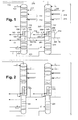
- the distillation column system of the embodiment of the FIG. 1 has a first high-pressure column 101, a second high-pressure column 201, a first low-pressure column 102, a second low-pressure column 202, a first main capacitor 103 and a second main capacitor 203.
- Both main capacitors 103, 203 are formed in the example by a respective six-stage or two three-stage cascade evaporator.
- the columns are arranged in the form of two double columns.
- Each double column can be controlled substantially independently.
- the pressure in the low-pressure columns for example, can be set and controlled separately. Through this decoupling, the overall control effort is made easier and any manufacturing tolerances in both double columns can be better compensated.
- a total compressed air flow 1 is brought up. This was, as usual in the air separation, compressed in a main air compressor, cleaned in a cleaning device and cooled in a main heat exchanger to about dew point. (These steps are not shown in the drawing.)
- the total compressed air flow 1 is branched into a first compressed air sub-stream 100 and a second compressed air sub-stream 200.
- the first compressed air sub-stream 100 is introduced into the first high-pressure column 101, the second compressed air sub-stream 200 into the second high-pressure column 201.
- the main condenser 103 has a uniform liquefaction space and a uniform evaporation space, ie these spaces are not subdivided into one or more liquefaction subspaces and / or evaporation subspaces, as in other exemplary embodiments of the invention.
- a first nitrogen gas stream 104, 114 from the first high-pressure column 101 is introduced into the liquefaction space of the first main condenser 103.
- liquid nitrogen 115 is generated, which is passed to at least a first part as a first liquid nitrogen stream 105 to the first high-pressure column 101.
- a second nitrogen gas stream 204, 214 from the second high-pressure column 201 is introduced into the liquefaction space of the second main condenser 203.
- liquid nitrogen 215 is generated, which is passed to at least a first part as a second liquid nitrogen flow 205 to the second high-pressure column 201.
- a first liquid oxygen stream 106 from the first low-pressure column 102 flows from the lower end of the lowermost mass transfer layer 107 of the first low-pressure column 102 and is thereby introduced into the evaporation space of the first main capacitor 103.
- gaseous oxygen is formed in the evaporation space of the first main capacitor 103. It is introduced at least to a first part as the first oxygen gas stream 108 in the first low pressure column 102 by flowing from below into the bottom mass transfer layer 107 of the first low-pressure column 102; if necessary, a second part can be obtained directly as a gaseous oxygen product and heated in the main heat exchanger.
- a second liquid oxygen stream 206 from the second low-pressure column 202 flows from the lower end of the lowermost mass transfer layer 107 of the second low-pressure column 202 and is thereby introduced into the evaporation space of the second main condenser 203.
- gaseous oxygen is formed in the evaporation space of the second main capacitor 203. It is introduced at least to a first part as a second oxygen gas stream 208 in the second low-pressure column 202 by flowing from below into the bottom mass transfer layer 207 of the second low-pressure column 202; if necessary, a second part can be obtained directly as a gaseous oxygen product and heated in the main heat exchanger.
- the reflux liquids 109, 209 for the two low-pressure columns 102, 202 are each formed by a nitrogen-enriched liquid 20, which at both High pressure columns 101, 201 is withdrawn from an intermediate point or directly from the head. From the top of both low-pressure columns 102, 202, impure nitrogen 110, 210 is withdrawn and passed as residual gas through a subcooling countercurrent to the main heat exchanger (both not shown).
- each oxygen-enriched bottoms liquid stream cooled in the subcooling countercurrent 23 and introduced into the evaporation space of the top condenser or top condensers at least one crude argon column.
- the bottoms can either be run separately or mixed before the supercooling countercurrent and then split.
- Via the lines 111, 211, low-pressure columns 102, 202 are fed with liquid air at an intermediate point. This liquid air originates from the main heat exchanger, in which liquid pressurized oxygen 41 evaporates from the low pressure columns or (if the oxygen pressure is supercritical) is pseudo-vaporized.
- liquid oxygen 141, 241 is withdrawn from the evaporation spaces of the main condensers 103, 203, combined and fed via line 14 to an internal compression, not shown.
- the liquid oxygen is pumped to a high product pressure, vaporized or pseudo-evaporated under this high product pressure, warmed to about ambient temperature and finally stripped off as gaseous pressure oxygen product.
- pressurized nitrogen is withdrawn directly from the head of the high-pressure columns 101, 201 (lines 104, 142 and 204), passed together via line 42 to the main heat exchanger, warmed there and finally recovered as a gaseous pressurized nitrogen product.
- a part 143, 243 of the liquid nitrogen produced in the main condensers 103, 104 can each be supplied to an internal compression and recovered as a high-pressure gaseous nitrogen product.
- argon is to be produced as a product, via the line pairs 113, 114, 213, 214 a common classical argon recovery or a separate first and a second argon recovery may be connected, wherein the line pairs 113, 213 are connected to the lower portion of a crude argon column or each one of two parallel Rohargonklalen.
- the internal structure and mode of operation of such a classic argon recovery are, for example, in DE 2325422 A .
- EP 942246 A2 EP 1103772 A1 .
- a crude argon column can be connected in a similar manner, which then serves only for the discharge of argon.
- the crude argon column (s) and optionally the pure argon column (s) can be housed in separate cold boxes or in a common cold box with one or both double columns.
- the mass transfer elements in the two low-pressure columns 102, 202 are formed exclusively by ordered packing.
- the oxygen sections of the two low-pressure columns 102, 202 (area below the lines 113/213 are provided with an ordered packing having a specific surface area of 700 m 2 / m 3 or alternatively 1200 m 2 / m 3 , in the remaining sections, the packing has a specific surface area of 500 m 2 / m 3.
- the two low-pressure columns 10, 202 may have a nitrogen section above the mass transfer sections shown in the drawing, which is then packed with a specific surface area of 500 m 2 / m 3 or alternatively of 1200 m 2 / m 3 were charged. Notwithstanding this, it is possible to combine a structured packing of different specific surface within each of said sections.
- the mass transfer elements are formed exclusively by ordered packing with a specific surface area of 1200 m 2 / m 3 .
- some of the mass transfer elements in one or both high pressure columns 101, 201 could be formed by conventional distillation trays, for example through sieve trays.
- FIG. 2 is different from this FIG. 1 in that the mass transfer elements of the high-pressure columns 101, 201 are formed exclusively by sieve trays.
- the main condensers are six-stage cascade evaporators educated. Alternatively, it is also possible to use two three-stage cascade evaporators.
- FIG. 1 and 2 can be modified in that instead of two three-stage main capacitors 103, 203 and respectively a six-stage main capacitor 103, 203, a common main capacitor is used, which is formed for example as a two-block existing six-stage cascade evaporator. This is then preferably not placed in the container of one of the low-pressure columns 102, 202, but outside in a separate container.
- FIG. 3 is a multi-stranded plant by two or more distillation column systems according to one of Figures 1 or 2 educated.
- Each distillation column system is enclosed by its own Coldbox 301 and forms a strand of a distillation column system.
- all four air separation strands are constructed identically; alternatively, individual or all strands could be designed differently.
- Each string has an atmospheric air inlet filter 302, a main air compressor 303, an air pre-cooler 304, an air purifier 305 (typically formed by a pair of molecular sieve adsorbers), a Booster Air Compressor 306 with aftercooler 307, and an air cooler 306 Main heat exchanger 308 in its own coldbox 309; These devices are each independent of the other strands.
- the post-compressed air in the reboiler 306 is liquefied (or pseudo-liquefied, if its pressure is supercritical) via line 311 to the distillation column system in the cold box 300 where it flows into the streams 111 and 112 of FIG FIG. 1 branched.
- the further flow 1 emerging from the main heat exchanger 308 and the fluids 41, 42, 32 flowing to the warm end of the main heat exchanger 308 are as in FIG. 1 numbered.
- the liquid oxygen 32 is vaporized or pseudo-evaporated in the main heat exchanger under high pressure (internal compression). All return streams are warmed in the main heat exchanger to about ambient temperature and withdrawn via the product lines P.
- Both the warm part (air compression, pre-cooling and air purification) and / or the main heat exchanger may have a different number of strands than have the distillation column system.
- one distillation column system strand could be supplied by two main air compressor strands or two distillation column system strands from four main air compressor strands.
- the concept of the invention can also be applied to a process without air recompression 306/307 (for example, with the total air compressed to more than 5 bar above the highest of the operating pressures of the two high pressure columns) or to processes with other elements such as a nitrogen cycle.
- the refrigeration is in FIG. 3 not shown. Any known type of turbine circuit can be chosen, with one, two or more turbines.
- the distillation column system is in FIG. 3 deviating from the Figures 1 and 2 shown without argon recovery; but it can - as in the Figures 1 and 2 - Have an argon recovery, or even a column for the discharge of argon to improve the rectification.
- the number of distillation column system strands can be reduced by the invention, for example from six to five or from five to four.
Landscapes
- Engineering & Computer Science (AREA)
- Physics & Mathematics (AREA)
- Mechanical Engineering (AREA)
- Thermal Sciences (AREA)
- General Engineering & Computer Science (AREA)
- Health & Medical Sciences (AREA)
- Emergency Medicine (AREA)
- Separation By Low-Temperature Treatments (AREA)
Priority Applications (1)
| Application Number | Priority Date | Filing Date | Title |
|---|---|---|---|
| EP20130005245 EP2865978A1 (fr) | 2013-10-25 | 2013-11-07 | Procédé de décomposition à basse température de l'air et installation de décomposition de l'air à basse température |
Applications Claiming Priority (2)
| Application Number | Priority Date | Filing Date | Title |
|---|---|---|---|
| EP13005105 | 2013-10-25 | ||
| EP20130005245 EP2865978A1 (fr) | 2013-10-25 | 2013-11-07 | Procédé de décomposition à basse température de l'air et installation de décomposition de l'air à basse température |
Publications (1)
| Publication Number | Publication Date |
|---|---|
| EP2865978A1 true EP2865978A1 (fr) | 2015-04-29 |
Family
ID=49509912
Family Applications (1)
| Application Number | Title | Priority Date | Filing Date |
|---|---|---|---|
| EP20130005245 Withdrawn EP2865978A1 (fr) | 2013-10-25 | 2013-11-07 | Procédé de décomposition à basse température de l'air et installation de décomposition de l'air à basse température |
Country Status (1)
| Country | Link |
|---|---|
| EP (1) | EP2865978A1 (fr) |
Cited By (2)
| Publication number | Priority date | Publication date | Assignee | Title |
|---|---|---|---|---|
| EP3133361A1 (fr) * | 2015-08-20 | 2017-02-22 | Linde Aktiengesellschaft | Systeme de colonnes de distillation et installation de production d'oxygene par separation cryogenique de l'air |
| EP3163237A1 (fr) | 2015-10-29 | 2017-05-03 | Linde Aktiengesellschaft | Systeme de colonnes de distillation et procede de production d'oxygene par separation cryogenique de l'air |
Citations (5)
| Publication number | Priority date | Publication date | Assignee | Title |
|---|---|---|---|---|
| US5896755A (en) * | 1998-07-10 | 1999-04-27 | Praxair Technology, Inc. | Cryogenic rectification system with modular cold boxes |
| US6128921A (en) * | 1998-02-06 | 2000-10-10 | L'air Liquide | Air distillation plant comprising a plurality of cryogenic distillation units of the same type |
| EP1544559A1 (fr) * | 2003-12-20 | 2005-06-22 | Linde AG | Procédé et dispositif pour la séparation cryogénique d'air |
| US20110138855A1 (en) * | 2009-12-10 | 2011-06-16 | Henry Edward Howard | Oxygen production method and apparatus |
| EP2645033A1 (fr) * | 2012-03-29 | 2013-10-02 | Linde Aktiengesellschaft | Paquet transportable avec boîtier frigorifique et procédé de fabrication d'une installation de décomposition de l'air à basse température |
-
2013
- 2013-11-07 EP EP20130005245 patent/EP2865978A1/fr not_active Withdrawn
Patent Citations (5)
| Publication number | Priority date | Publication date | Assignee | Title |
|---|---|---|---|---|
| US6128921A (en) * | 1998-02-06 | 2000-10-10 | L'air Liquide | Air distillation plant comprising a plurality of cryogenic distillation units of the same type |
| US5896755A (en) * | 1998-07-10 | 1999-04-27 | Praxair Technology, Inc. | Cryogenic rectification system with modular cold boxes |
| EP1544559A1 (fr) * | 2003-12-20 | 2005-06-22 | Linde AG | Procédé et dispositif pour la séparation cryogénique d'air |
| US20110138855A1 (en) * | 2009-12-10 | 2011-06-16 | Henry Edward Howard | Oxygen production method and apparatus |
| EP2645033A1 (fr) * | 2012-03-29 | 2013-10-02 | Linde Aktiengesellschaft | Paquet transportable avec boîtier frigorifique et procédé de fabrication d'une installation de décomposition de l'air à basse température |
Cited By (5)
| Publication number | Priority date | Publication date | Assignee | Title |
|---|---|---|---|---|
| EP3133361A1 (fr) * | 2015-08-20 | 2017-02-22 | Linde Aktiengesellschaft | Systeme de colonnes de distillation et installation de production d'oxygene par separation cryogenique de l'air |
| CN106468498A (zh) * | 2015-08-20 | 2017-03-01 | 林德股份公司 | 用于通过低温分馏空气来制备氧气的蒸馏塔系统和装置 |
| CN106468498B (zh) * | 2015-08-20 | 2020-09-22 | 林德股份公司 | 用于通过低温分馏空气来制备氧气的蒸馏塔系统和装置 |
| US10845118B2 (en) | 2015-08-20 | 2020-11-24 | Linde Aktiengesellschaft | Distillation column system and plant for production of oxygen by cryogenic fractionation of air |
| EP3163237A1 (fr) | 2015-10-29 | 2017-05-03 | Linde Aktiengesellschaft | Systeme de colonnes de distillation et procede de production d'oxygene par separation cryogenique de l'air |
Similar Documents
| Publication | Publication Date | Title |
|---|---|---|
| EP3133361B1 (fr) | Systeme de colonnes de distillation et installation de production d'oxygene par separation cryogenique de l'air | |
| EP1482266A1 (fr) | Procédé et dispositif pour la récupération de Krypton et/ou Xénon par séparation cryogénique d'air | |
| DE19904527A1 (de) | Luftdestillationsanlage mit mehreren kryogenen Destillationseinheiten des gleichen Typs | |
| EP2758734B1 (fr) | Procédé et dispositif destinés à la décomposition à basse température d'air | |
| EP2489968A1 (fr) | Procédé et dispositif destinés à la décomposition à basse température d'air | |
| EP2986924B1 (fr) | Dispositif pouvant être rééquipé, destiné à la décomposition à basse température de l'air, installation pouvant être rééquipée et procédé de rééquipement d'une installation de décomposition de l'air à basse température | |
| WO2016146246A1 (fr) | Système permettant de produire de l'oxygène par fractionnement d'air à basse température | |
| EP2938952A2 (fr) | Procédé et dispositif de séparation de l'air à basse température | |
| EP1319913A1 (fr) | Appareil et procédé de production d'oxygène gazeux sous pression élevée | |
| EP3067650B1 (fr) | Installation et procede de production d'oxygene par separation cryogenique de l'air | |
| DE102016002115A1 (de) | Destillationssäulen-System und Verfahren zur Erzeugung von Sauerstoff durch Tieftemperaturzerlegung von Luft | |
| EP2600090B1 (fr) | Procédé et dispositif destinés à la production d'oxygène sous pression par décomposition à basse température de l'air | |
| WO2016146238A1 (fr) | Système de colonnes de distillation, installation et procédé servant à produire de l'oxygène par décomposition de l'air à très basse température | |
| EP2767787A1 (fr) | Procédé de production d'oxygène gazeux par décomposition à basse température de l'air | |
| DE102013018664A1 (de) | Verfahren zur Tieftemperaturzerlegung von Luft und Tieftemperatur-Luftzerlegungsanlage | |
| EP2645032A1 (fr) | Paquet transportable avec boîtier frigorifique et procédé de fabrication d'une installation de décomposition de l'air à basse température | |
| EP3067648A1 (fr) | Système de colonnes de distillation et procédé de production d'oxygène par séparation cryogénique de l'air | |
| EP3040665A1 (fr) | Système de colonne de distillation et installation pour la production d'oxygène par séparation cryogénique de l'air | |
| EP4396508A2 (fr) | Installation et procédé de séparation cryogénique de l'air | |
| DE20319823U1 (de) | Vorrichtung zur Gewinnung von Krypton und/oder Xenon durch Tieftemperaturzerlegung | |
| WO2020038607A2 (fr) | Procédé et installation de séparation d'air à basse température | |
| EP2865977A1 (fr) | Procédé de décomposition à basse température de l'air, installation de décomposition à basse température de l'air et procédé de fabrication d'une installation de décomposition à basse température de l'air | |
| DE102011113668A1 (de) | Verfahren und Vorrichtung zur Tieftemperaturzerlegung von Luft | |
| EP2645033A1 (fr) | Paquet transportable avec boîtier frigorifique et procédé de fabrication d'une installation de décomposition de l'air à basse température | |
| DE102011113671A1 (de) | Verfahren und Vorrichtung zur Tieftemperaturzerlegung von Luft |
Legal Events
| Date | Code | Title | Description |
|---|---|---|---|
| PUAI | Public reference made under article 153(3) epc to a published international application that has entered the european phase |
Free format text: ORIGINAL CODE: 0009012 |
|
| 17P | Request for examination filed |
Effective date: 20131107 |
|
| AK | Designated contracting states |
Kind code of ref document: A1 Designated state(s): AL AT BE BG CH CY CZ DE DK EE ES FI FR GB GR HR HU IE IS IT LI LT LU LV MC MK MT NL NO PL PT RO RS SE SI SK SM TR |
|
| AX | Request for extension of the european patent |
Extension state: BA ME |
|
| STAA | Information on the status of an ep patent application or granted ep patent |
Free format text: STATUS: THE APPLICATION IS DEEMED TO BE WITHDRAWN |
|
| 18D | Application deemed to be withdrawn |
Effective date: 20151030 |