EP2865992B1 - Dispersion contrôlée d'un gyroscope à fibre optique interférométrique - Google Patents
Dispersion contrôlée d'un gyroscope à fibre optique interférométrique Download PDFInfo
- Publication number
- EP2865992B1 EP2865992B1 EP14186492.6A EP14186492A EP2865992B1 EP 2865992 B1 EP2865992 B1 EP 2865992B1 EP 14186492 A EP14186492 A EP 14186492A EP 2865992 B1 EP2865992 B1 EP 2865992B1
- Authority
- EP
- European Patent Office
- Prior art keywords
- fiber
- input
- output
- pigtail
- signal
- Prior art date
- Legal status (The legal status is an assumption and is not a legal conclusion. Google has not performed a legal analysis and makes no representation as to the accuracy of the status listed.)
- Active
Links
- 239000000835 fiber Substances 0.000 title claims description 237
- 239000006185 dispersion Substances 0.000 title claims description 107
- 230000003287 optical effect Effects 0.000 claims description 38
- 238000000034 method Methods 0.000 claims description 10
- 238000005259 measurement Methods 0.000 description 5
- 238000010586 diagram Methods 0.000 description 4
- 239000013307 optical fiber Substances 0.000 description 4
- 230000005374 Kerr effect Effects 0.000 description 3
- 238000004364 calculation method Methods 0.000 description 3
- 239000003638 chemical reducing agent Substances 0.000 description 3
- 230000001747 exhibiting effect Effects 0.000 description 2
- 239000011159 matrix material Substances 0.000 description 2
- 230000001902 propagating effect Effects 0.000 description 2
- 238000004088 simulation Methods 0.000 description 2
- 238000001228 spectrum Methods 0.000 description 2
- 241000700143 Castor fiber Species 0.000 description 1
- 238000004458 analytical method Methods 0.000 description 1
- 230000001934 delay Effects 0.000 description 1
- 230000003111 delayed effect Effects 0.000 description 1
- 238000005516 engineering process Methods 0.000 description 1
- 230000006870 function Effects 0.000 description 1
- 239000004973 liquid crystal related substance Substances 0.000 description 1
- 238000005457 optimization Methods 0.000 description 1
- 230000000737 periodic effect Effects 0.000 description 1
- 230000010363 phase shift Effects 0.000 description 1
- 230000010287 polarization Effects 0.000 description 1
- 239000004065 semiconductor Substances 0.000 description 1
- 230000003595 spectral effect Effects 0.000 description 1
- 230000002269 spontaneous effect Effects 0.000 description 1
- 230000003068 static effect Effects 0.000 description 1
- 230000001360 synchronised effect Effects 0.000 description 1
Images



Classifications
-
- G—PHYSICS
- G01—MEASURING; TESTING
- G01C—MEASURING DISTANCES, LEVELS OR BEARINGS; SURVEYING; NAVIGATION; GYROSCOPIC INSTRUMENTS; PHOTOGRAMMETRY OR VIDEOGRAMMETRY
- G01C19/00—Gyroscopes; Turn-sensitive devices using vibrating masses; Turn-sensitive devices without moving masses; Measuring angular rate using gyroscopic effects
- G01C19/58—Turn-sensitive devices without moving masses
- G01C19/64—Gyrometers using the Sagnac effect, i.e. rotation-induced shifts between counter-rotating electromagnetic beams
- G01C19/72—Gyrometers using the Sagnac effect, i.e. rotation-induced shifts between counter-rotating electromagnetic beams with counter-rotating light beams in a passive ring, e.g. fibre laser gyrometers
-
- G—PHYSICS
- G01—MEASURING; TESTING
- G01C—MEASURING DISTANCES, LEVELS OR BEARINGS; SURVEYING; NAVIGATION; GYROSCOPIC INSTRUMENTS; PHOTOGRAMMETRY OR VIDEOGRAMMETRY
- G01C19/00—Gyroscopes; Turn-sensitive devices using vibrating masses; Turn-sensitive devices without moving masses; Measuring angular rate using gyroscopic effects
- G01C19/58—Turn-sensitive devices without moving masses
- G01C19/64—Gyrometers using the Sagnac effect, i.e. rotation-induced shifts between counter-rotating electromagnetic beams
- G01C19/72—Gyrometers using the Sagnac effect, i.e. rotation-induced shifts between counter-rotating electromagnetic beams with counter-rotating light beams in a passive ring, e.g. fibre laser gyrometers
- G01C19/721—Details, e.g. optical or electronical details
Definitions
- Bias stability of depolarized interferometric fiber optic gyroscopes is affected by nonlinear optical effects in the sensing loop of the IFOG.
- IFOG interferometric fiber optic gyroscopes
- Patent document number US5469257A describes a noise reducer for reducing the results in the system output signal of optical noise introduced into an optical subsystem therein, having a phase modulator, by a source through obtaining a noise representation signal used to offset the noise components in the signal obtained from the output of the optical subsystem.
- This noise representation signal is not delayed in the obtaining thereof by any more than half the delays of the waves emitted from the source in reaching the optical subsystem output.
- the noise reducer may incorporate a device for adjusting the amplitude of the noise representation signal. It may also include another device for adjusting the phase of the noise representation signal, which may be used to affect the amplitude of the noise representation signal.
- the phase adjustment may be accomplished by affecting the phase of the bias modulation signal that goes to demodulate the fiber optic gyroscope system output signal or to demodulate both the fiber optic gyroscope system output signal and the noise representation signal, before the two latter signals are combined.
- a generator may be used for constructing a periodic signal, such as a triangular wave, having an appropriate amplitude and phase, to be a noise representation signal that is used to offset or cancel the noise components in the output signal from the fiber optic gyroscope system.
- Patent document number EP1391693A1 describes Sagnac interferometers in which hollow-core photonic-bandgap fiber is used, including but not limited to fiber optic gyroscopes.
- Use of the hollow-core photonic-bandgap fiber reduces Rayleigh backscattering and Kerr effects, which otherwise would introduce phase shift into light propagating through the optical fiber and result in errors in the output of the interferometer.
- Narrowband light sources such as semiconductor lasers currently employed for telecommunication applications, which provide increased wavelength stability, as well as broadband light sources, can be used to drive the fiber optic interferometers. Modulation can also be employed to improve the accuracy of the output of these sensors.
- I ( t ) is the instantaneous light intensity
- ⁇ is the delay time.
- the angle bracket represents average over time.
- Perfect thermal source means: there is no correlation between the many harmonic or wavelength components that make up the light source spectrum.
- a dispersion managed interferometric fiber optic gyroscope comprising a broadband light source configured to provide an input signal.
- a coupler is coupled to the broadband light source via a first input fiber.
- the first input fiber is configured to carry the input signal from the broadband light source to the coupler, wherein the coupler has a first coupler output and a second coupler output.
- a rate detector coupled to the second output via an output fiber.
- the fiber optic gyroscope also includes an integrated optical circuit.
- the integrated optical circuit comprises a beamsplitter that directs the input signal to a first output and a second output, and a combiner coupled to the first output and the second output.
- the combiner is configured to combine a first return signal from the first output and a second return signal from the second output into a combined return signal.
- An integrated optical circuit input is coupled to the first coupler output via a second input fiber, the second input fiber configured to carry the input signal from first coupler output to the integrated optical circuit input and the combined return signal from the integrated optical circuit input to the coupler.
- a first pigtail fiber is coupled to the first output.
- a second pigtail fiber is coupled to the second output.
- a fiber optic gyroscope sensing coil is coupled to the first pigtail fiber and second pigtail fiber.
- the fiber optic gyroscope sensing coil comprising one or more sensing fibers, wherein the first pigtail fiber carries the input signal to the fiber optic gyroscope sensing coil and the first return signal from fiber optic gyroscope sensing coil to the first output.
- the second pigtail fiber carries the input signal to the fiber optic gyroscope sensing coil and the second return signal from fiber optic gyroscope sensing coil to the second output.
- At least one dispersion slope of at least one of the first input fiber, second input fiber, first pigtail fiber, second pigtail fiber, and the one or more sensing fibers is selected such that at least one of the input signal or combined return signal at the integrated optical circuit input has a second order coherence g11 substantially equal to two.
- fibers with offsetting dispersion slopes may be used as described below. Furthermore, it is also possible to use fibers with a dispersion slope that corrects or compensates for a light source's non-ideal characteristics.
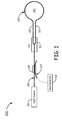
- FIG. 1 illustrates an exemplary optical schematic for a fiber optic gyroscope 100.
- Fiber optic gyroscope 100 includes broadband light source 101.
- Broadband light source 101 generates a light signal that is comprised of many waves with different wavelengths and polarization states.
- a perfectly thermal broadband light source 101 has no correlation between the different harmonic or spectral components that make up the source.
- a perfectly thermal broadband light source 101 has a second order coherence number, g11, of 2.0.
- Input fiber 103 couples broadband light source 101 to coupler 105 and the same fiber 103 couples light from coupler 105 to the waveguide of integrated optical circuit (IOC) 110.
- Coupler 105 includes both input fiber 103 and output fiber 107.
- Output fiber 107 carries a returned signal from the IOC to a rate detector 109 which reads the signal returning from the sensing fiber 125.
- IOC 110 includes a beam-splitting / combining element 111, a polarizing element, and two or more electrodes used for phase-modulation of the light beams passing through the IOC 110.
- the beam-splitter is a y-branch beam-splitter 111, splitting the signal into two signals.
- the polarizing element could be the waveguide of the IOC 110 itself, while in other embodiments the polarizing element could be a separate element along the optical path.
- the signal from the broadband light source 101 is linearly polarized by passing through the IOC 110.
- Pigtail fibers 121 and 123 couple the IOC 110 to sensing coil 120.
- the signal is depolarized with a depolarizer placed between the sensing coil 120 and the IOC.
- the depolarizer can be placed on either pigtail fiber 121 and/or 123.
- Sensing coil 120 comprises a sensing fiber 125 wound in a coil shape.
- a fiber with zero dispersion slope may be used for the input fiber 103, IOC pigtail fibers 121 and 123, and sensing fiber 125.
- Dispersion refers to group velocity dispersion.
- Theoretical analysis shows that for a fiber without a dispersion slope, the broadband light source statistics can be maintained in a perfectly thermal state, which effectively reduces nonlinear optical effects.
- the light source second order coherence, g11 can be kept at 2.0 so that the optical Kerr effects can be substantially reduced. In other words, the light source statistics are preserved at the desired value of 2.0 by using zero dispersion slope optical fibers.
- a fiber with a specific large dispersion slope may be used.
- Input fiber 103, fiber pigtails 121 and 123, and sensing fiber 125 are fibers with a large dispersion slopes.
- the g11 can be maintained at or close to 2.
- the relationship between second order coherence g11 for broadband light propagating through a fiber and the fiber dispersion slope is illustrated in more detail in figure 4 .
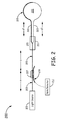
- FIG. 2 illustrates an alternative embodiment of a dispersion managed interferometric fiber optic gyroscope.
- Fiber optic gyroscope 200 includes broadband light source 201.
- light source 201 is a perfectly thermal light source exhibiting ideal light source statistics.
- the light source 201 exhibits non-ideal statistics.
- Input fiber 203 couples broadband light source 201 to coupler 207 over a length x.
- Input fiber 203 has a positive dispersion slope value a .
- Fiber 205 couples the signal from coupler to integrated optical circuit 210 over length z.
- Fiber 205 has a negative dispersion slope of value - b , a dispersion slope opposite of input fiber 203.
- Coupler 207 includes input fiber 203 and output fiber 209.
- Output fiber 209 carries a coupled signal returned from the sensing coil 220 to a rate detector 213 which reads the signal.
- IOC 210 includes a beam-splitting / combining element 211, a polarizing element, and one or more electrodes used for phase-modulation of the light beams passing through the IOC 210.
- the beam-splitter is a y-branch beam-splitter 211, splitting the signal into two signals.
- the polarizing element could be the waveguide of the IOC 210 itself, while in other embodiments the polarizing element could be a separate element along the optical path.
- the signal from the broadband light source 201 is linearly polarized by passing through the IOC 210.
- the sensing loop 220 comprises two types of fibers 221 and 223 that are wound into a sensing coil 220.
- Fiber 221 is configured to have a length y1 and positive dispersion slope value c.
- the signal is depolarized with depolarizers placed between the sensing coil 220 and the IOC 210.
- Fibers with opposite dispersion slopes are used for input fibers 203/205, and fibers 221/223.
- the total dispersion in the fibers of the system is effectively kept at zero.
- broadband light source statistics can be maintained in a nearly perfect thermal state, which effectively reduces any nonlinear optical effects.
- the light source second order coherence, g11 can theoretically be kept at 2 so that optical Kerr effects can be substantially reduced.
- this may include use of different lengths of fiber with different dispersion slopes, selected such that total system dispersion is kept at 0, where lengths do not have to be matched to be equal.
- the light source already exhibits non-ideal characteristics. Fibers are selected with dispersion slopes and lengths, such that the non-ideal characteristics of the light source are corrected for by the IFOG itself.
- Figure 3 illustrates a graph depicting the total dispersion of a system 300. Using a length of fiber with positive dispersion 301, and an equal length of fiber with negative dispersion 303, with equal and opposite dispersion slopes, the dispersion of the fibers offset one another. Graph 305 illustrates the relationship of total dispersion vs. fiber length.
- Figure 4 illustrates graphs 400 depicting an exemplary relationship between signal characteristics and fiber dispersion slope.
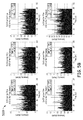
- Figures 5A and 5B illustrate output time waveform graphs and g11 of a nearly-thermal input optical spectrum after light propagation through 8 km fiber with various dispersion slopes.
- the previously described figures 5A , and 5B illustrate that propagation through a fiber with zero dispersion and zero dispersion slope does not cause the light source statistics g11 to change in propagation through the fiber.
- Propagation through fibers with a small amount of dispersion slope may cause the source statistics (g11) to deviate substantially from 2.0.
- a large fiber dispersion slope may compensate for imperfect (non-thermal) source statistics and restore the output g11 close to ideal value of 2.0.
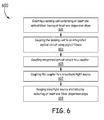
- Figure 6 illustrates a block diagram for a method 600 of managing dispersion in an IFOG.
- a sensing coil is created, comprising at least one optical fiber having at least a dispersion slope that is substantially close to zero. In another embodiment, this may include a splicing of two fibers to create the sensing coil, each fiber having a respective dispersion slope opposite in sign. The lengths of fibers are selected in such a way that the accumulated dispersion is zero. In other embodiments, more than two fibers may be used.
- the sensing coil is coupled to an integrated optical circuit using pigtail fibers 603.
- the two pigtail fibers may be used, each pigtail fiber having a respective dispersion slope equal in magnitude, but opposite in sign, such that the respective dispersions slopes of the fibers offset each other.
- a single kind of pigtail fiber may be used, the pigtail fibers both having a dispersion slope of zero.
- the integrated optical circuit is coupled to a coupler by a second input fiber.
- the second input fiber couples to a first output of the coupler.
- the coupler includes an output fiber, which provides an output signal to a rate detector via an output fiber coupled to a second output of the coupler.
- the output signal carries the signal from the sensing coil for measurement at the rate detector.
- the coupler is coupled to a broadband light source via a first input fiber.
- the first input fiber has a positive dispersion which couples to the coupler.
- the second input fiber has a negative dispersion, the first input fiber with positive dispersion having equal length to the second input fiber with negative dispersion, both fibers having a dispersion slope equal in magnitude, opposite in sign.
- the first and second input fiber can be multiple fibers with offsetting dispersion slopes such that the total length-integrated dispersion of the multiple fibers is zero, or a single fiber with a zero dispersion slope.
- the input fiber may be a single fiber having a zero dispersion slope, or more than two fibers.
- light source statistics are kept ideal by selecting at least one dispersion slope of at least one optical fiber of the IFOG. In one embodiment, this is accomplished by using a fiber with a zero dispersion slope. In another embodiment, fibers of equal length, with equal but opposite dispersion slopes may be used to keep total dispersion at zero.
- a fiber dispersion slope may be selected to correct for non-ideal light source characteristics.
- Figure 6 depicts an exemplary embodiment and that it is not necessary to perform the method in the order in which the blocks are presented. Therefore, Figure 6 and the above description are not to be taken in a limiting sense.
- FIG. 7 is a system block diagram illustrating an exemplary system 700 for a dispersion managed interferometric fiber optic gyroscope 700.
- dispersion managed IFOG 710 is coupled to measurement unit 720.
- Measurement unit 720 comprises a processor 723 coupled to computer readable memory/media 725, containing readout instructions 727.
- measurement unit 720 may further include an optional rate detector 729.
- the processor 723 is coupled to interface device 730.
- Suitable computer readable memory includes any available media that can be accessed by a general purpose or special purpose computer or processor, or any programmable logic device.
- suitable processor-readable media may include storage or memory media such as, but not limited to, conventional hard disks, Compact Disk - Read Only Memory (CD-ROM), volatile or non-volatile media such as Random Access Memory (RAM) (including, but not limited to, Synchronous Dynamic Random Access Memory (SDRAM), Double Data Rate (DDR) RAM, RAMBUS Dynamic RAM (RDRAM), Static RAM (SRAM), etc.), Read Only Memory (ROM), Electrically Erasable Programmable ROM (EEPROM), and flash memory, etc.
- RAM Random Access Memory
- SDRAM Synchronous Dynamic Random Access Memory
- DDR Double Data Rate
- RDRAM RAMBUS Dynamic RAM
- SRAM Static RAM
- ROM Read Only Memory
- EEPROM Electrically Erasable Programmable ROM
- flash memory etc.
- the dispersion managed IFOG 710 includes a broadband light source that generates a light signal with second order coherence g11 substantially close to 2.0.
- An input fiber couples broadband light source to a coupler, and from the coupler to the waveguide of an integrated optical circuit (IOC).
- the coupler includes both the input fiber and an output fiber.
- the output fiber carries a coupled signal from the IOC and sensing loop to a rate detector 729 which reads the signal.
- the IOC includes a beam-splitting / combining element, a polarizing element, and one or more electrodes used for phase-modulation of the light beams passing through the IOC.
- the beam-splitter is a y-branch beam-splitter, splitting the signal into two signals.
- Pigtail fibers are used to couple the IOC to a sensing coil.
- the sensing coil comprises a sensing fiber wound in a coil shape.
- the dispersion slope of the fibers used in the dispersion managed IFOG 710 are chosen to maintain a second order coherence number, g11, close to the desired 2.0.
- different configurations of the fibers with various dispersion slopes may be used, including, but not limited to, zero dispersion slope fibers, fibers with offsetting opposite dispersion slopes, or fibers with a positive total dispersion.
- Measurement unit 720 comprises processor 723 coupled to system memory and/or media 725, which includes readout instructions 727 configured to cause processor 723 to read an IFOG signal from dispersion managed IFOG 710, and calculate a rotational movement of the IFOG 710. In some embodiments, this might be a calculation of the attitude of the IFOG 710, or other calculations made in an inertial reference unit.
- the processor reads the signal from the IFOG 710 at an optional rate detector 729.
- the optional rate detector 729 is configured to read a return signal from the output fiber of the coupler, which carries a returned signal from the sensing coil to the optional rate detector 729 which reads the signal.
- the optional rate detector 729 is a photodetector.
- Processor 723 is coupled to interface device 730.
- the processor is configured to cause the interface device 730 to visually, aurally, or otherwise indicate a result indicative of the IFOG signal.
- interface device 730 is a display that is capable of displaying graphical content. Suitable exemplary displays include, but are not limited to, a display associated with an aircraft inertial navigation system. Suitable technologies for implementing the display include, but are not limited to, a cathode ray tube (CRT) display, an active matrix liquid crystal display (LCD), a passive matrix LCD, a light emitting diode display (LED), or plasma display unit.
- the interface device 730 is a speaker capable of aurally indicating a calculation of the processor, such as the attitude of IFOG 710 or rotational movement of the IFOG 710.
Landscapes
- Physics & Mathematics (AREA)
- Engineering & Computer Science (AREA)
- Optics & Photonics (AREA)
- Electromagnetism (AREA)
- Power Engineering (AREA)
- General Physics & Mathematics (AREA)
- Radar, Positioning & Navigation (AREA)
- Remote Sensing (AREA)
- Gyroscopes (AREA)
Claims (10)
- Gyroscope à fibre optique interférométrique à dispersion contrôlée (100, 200, 710) comprenant :une source de lumière à large bande (101, 201) configurée pour fournir un signal d'entrée ;un coupleur (105, 207) couplé à la source de lumière à large bande par l'intermédiaire d'une première fibre d'entrée (103, 203), la première fibre d'entrée étant configurée pour acheminer le signal d'entrée provenant de la source de lumière à large bande au coupleur, où le coupleur comprend une première sortie de coupleur et une seconde sortie de coupleur ;un détecteur de vitesse (109, 213) couplé à la seconde sortie de coupleur par l'intermédiaire d'une fibre de sortie (107, 209) ;un circuit optique intégré (110, 210) comprenant :un séparateur de faisceau (111, 211) qui dirige le signal d'entrée vers une première sortie et une seconde sortie ;un combineur (111, 211) couplé à la première sortie et la seconde sortie, le combineur étant configuré pour combiner un premier signal de retour issu de la première sortie et un second signal de retour issu de la seconde sortie en un signal de retour combiné ;une entrée du circuit optique intégré couplée à la première sortie de coupleur par l'intermédiaire d'une seconde fibre d'entrée, la seconde fibre d'entrée étant configurée pour acheminer le signal d'entrée depuis la première sortie de coupleur à l'entrée du circuit optique intégré et le signal de retour combiné depuis l'entrée du circuit optique intégré au coupleur ;une première fibre amorce (121, 221) couplée à la première sortie ;une seconde fibre amorce (123, 223) couplée à la seconde sortie ;une bobine de détection de gyroscope à fibre optique (120, 220) couplée à la première fibre amorce et à la seconde fibre amorce, la bobine de détection de gyroscope à fibre optique comprenant une ou plusieurs fibres de détection (125, 225), où la première fibre amorce achemine le signal d'entrée à la bobine de détection de gyroscope à fibre optique et le premier signal de retour depuis la bobine de détection de gyroscope à fibre optique à la première sortie, où la seconde fibre amorce achemine le signal d'entrée à la bobine de détection de gyroscope à fibre optique et le second signal de retour depuis la bobine de détection de gyroscope à fibre optique à la seconde sortie ;caractérisé en ce queau moins un élément parmi la première fibre d'entrée, la seconde fibre d'entrée, la première fibre amorce, la seconde fibre amorce, et les une ou plusieurs fibres de détection ont des pentes de dispersion de décalage telles que la dispersion intégrée sur la longueur totale des multiples fibres conduit à au moins un signal parmi le signal d'entrée ou un signal de retour combiné au niveau de l'entrée de circuit optique intégré ayant une cohérence de deuxième ordre g11 sensiblement égale à 2.
- Gyroscope à fibre optique selon la revendication 1, dans lequel la première fibre d'entrée, la seconde fibre d'entrée, la première fibre amorce, la seconde fibre amorce, et une ou plusieurs fibres de détection ont une pente de dispersion nulle.
- Gyroscope à fibre optique selon la revendication 1, dans lequel la première fibre d'entrée et la seconde fibre d'entrée sont de longueur égale et ont une pente de dispersion respective d'amplitude égale, mais de signe opposé.
- Gyroscope à fibre optique selon la revendication 1, dans lequel la première fibre amorce et la seconde fibre amorce sont de longueur égale avec une dispersion respective d'amplitude égale, mais de signe opposé.
- Gyroscope à fibre optique selon la revendication 1, dans lequel la bobine de détection comprend une première fibre de détection et une seconde fibre de détection, où la première fibre de détection et la seconde fibre de détection sont de longueur égale, avec une dispersion respective d'amplitude égale, mais de signe opposé.
- Gyroscope à fibre optique selon la revendication 1, dans lequel la dispersion totale est égale à zéro, où la dispersion totale est une somme de chaque produit d'une pente de dispersion respective et d'une longueur de fibre respective de la première fibre d'entrée, la seconde fibre d'entrée, de la première fibre amorce, de la seconde fibre amorce, et de une ou plusieurs fibres de détection.
- Gyroscope à fibre optique selon la revendication 1, dans lequel la dispersion totale est supérieure à 0, où la dispersion totale est une somme de chaque produit d'une pente de dispersion respective et d'une longueur de fibre respective de la première fibre d'entrée, de la seconde fibre d'entrée, de la première fibre amorce, de la seconde fibre amorce, et de une ou plusieurs fibres de détection.
- Procédé de gestion de la dispersion d'un gyroscope à fibre optique interférométrique (100, 200, 710) comprenant les étapes suivantes :recevoir un signal d'entrée ayant une cohérence de deuxième ordre g11 au niveau d'une première fibre d'entrée (103, 203), où le signal d'entrée est généré par une source de lumière à large bande (101, 201) ;transmettre le signal d'entrée sur le première fibre d'entrée à un coupleur (105, 207) ayant une première sortie et une seconde sortie, une seconde fibre d'entrée (205) couplée à la seconde sortie et une fibre de sortie couplée à la première sortie ;transmettre le signal d'entrée sur la seconde fibre optique à une entrée de circuit optique intégré d'un circuit optique intégré (110, 210), où le circuit optique intégré a un séparateur de faisceau et un combineur (111) ;séparer le signal d'entrée en un premier signal de sortie et un second signal de sortie ;transmettre le premier signal de sortie sur une première fibre amorce (121, 221) à une bobine de détection (120, 220), où la bobine de détection a une ou plusieurs fibres de détection (125, 225) ;transmettre le second signal de sortie sur une seconde fibre amorce (123, 223) à la bobine de détection ;recevoir des premier et second signaux de retour de la bobine de détection ;transmettre le premier signal de retour sur la première fibre amorce ;transmettre le second signal de retour sur la seconde fibre amorce ;combiner le premier signal de retour et le second signal de retour en un signal de retour combiné ;transmettre le signal de retour combiné au coupleur sur la seconde fibre d'entrée ;sélectionner au moins une fibre parmi la première fibre d'entrée, la seconde fibre d'entrée, la première fibre amorce, la seconde fibre amorce, et une ou plusieurs fibres de détection pour avoir des pentes de dispersion de décalage telles que la dispersion intégrée sur la longueur totale des multiples fibres conduit à au moins un signal parmi le signal d'entrée ou un signal de retour combiné au niveau de l'entrée de circuit optique intégré ayant une cohérence de deuxième ordre g11 sensiblement égale à 2.
- Procédé selon la revendication 8, comprenant de sélectionner une pente de dispersion nulle pour la première fibre d'entrée, la seconde fibre d'entrée, la première fibre amorce, la seconde fibre amorce, et une ou plusieurs fibres de détection.
- Procédé selon la revendication 8, dans lequel la source de lumière à large bande présente des statistiques de source de lumière non idéales, où au moins une fibre parmi la première fibre d'entrée, la seconde fibre d'entrée, la première fibre amorce, la seconde fibre amorce, et une ou plusieurs fibres de détection compense les statistiques de source de lumière non idéales.
Applications Claiming Priority (1)
| Application Number | Priority Date | Filing Date | Title |
|---|---|---|---|
| US14/063,456 US9041934B2 (en) | 2013-10-25 | 2013-10-25 | Dispersion managed interferometric fiber optic gyroscope |
Publications (2)
| Publication Number | Publication Date |
|---|---|
| EP2865992A1 EP2865992A1 (fr) | 2015-04-29 |
| EP2865992B1 true EP2865992B1 (fr) | 2016-02-03 |
Family
ID=51589222
Family Applications (1)
| Application Number | Title | Priority Date | Filing Date |
|---|---|---|---|
| EP14186492.6A Active EP2865992B1 (fr) | 2013-10-25 | 2014-09-25 | Dispersion contrôlée d'un gyroscope à fibre optique interférométrique |
Country Status (3)
| Country | Link |
|---|---|
| US (1) | US9041934B2 (fr) |
| EP (1) | EP2865992B1 (fr) |
| JP (1) | JP2015083972A (fr) |
Families Citing this family (4)
| Publication number | Priority date | Publication date | Assignee | Title |
|---|---|---|---|---|
| US10876840B2 (en) * | 2018-06-15 | 2020-12-29 | The Charles Stark Draper Laboratory, Inc. | Second-order passive ring interferometer sensor and method |
| CN109099914B (zh) * | 2018-10-16 | 2021-11-09 | 中国船舶重工集团公司第七0七研究所 | 一种采用光电分离式光纤陀螺的惯性组件热结构 |
| CN111811492B (zh) * | 2020-06-24 | 2025-07-04 | 北京思卓博瑞科技有限公司 | 抑制启动漂移的光纤陀螺 |
| CN111811494B (zh) * | 2020-07-03 | 2022-04-05 | 浙江大学 | 一种光纤陀螺光路的多次光学倍增装置及方法 |
Family Cites Families (18)
| Publication number | Priority date | Publication date | Assignee | Title |
|---|---|---|---|---|
| JPH06103189B2 (ja) | 1989-11-07 | 1994-12-14 | 日本航空電子工業株式会社 | 光干渉角速度計 |
| US5365338A (en) | 1991-05-28 | 1994-11-15 | The United States Of America As Represented By The Secretary Of The Navy | Wavelength sensor for fiber optic gyroscope |
| US5327213A (en) | 1991-11-14 | 1994-07-05 | Honeywell Inc. | Configuration control of mode coupling errors |
| US5260768A (en) | 1991-11-25 | 1993-11-09 | Litton Systems, Inc. | Fiber optic gyro with low-birefringence and PM networks |
| US5386290A (en) | 1992-04-30 | 1995-01-31 | Japan Aviation Electronics Industry Limited | Optical interferometric angular rate meter with a self-diagnostic capability |
| US5469257A (en) | 1993-11-24 | 1995-11-21 | Honeywell Inc. | Fiber optic gyroscope output noise reducer |
| US6040908A (en) | 1998-07-28 | 2000-03-21 | Litton Systems, Inc. | Method for stress tuning fiber optic sensor coils |
| JP2001290031A (ja) | 2000-01-31 | 2001-10-19 | Sumitomo Electric Ind Ltd | 光ファイバコイル及びその製造方法 |
| GB2371160B (en) | 2001-01-10 | 2004-06-30 | Univ Aston | Optical pulse regenerating transmission lines |
| US6801319B2 (en) | 2002-01-03 | 2004-10-05 | Honeywell International, Inc. | Symmetrical depolarized fiber optic gyroscope |
| US20040061863A1 (en) | 2002-08-20 | 2004-04-01 | Digonnet Michel J.F. | Fiber optic sensors with reduced noise |
| US7180598B2 (en) | 2002-11-13 | 2007-02-20 | The Charles Stark Draper Laboratory, Inc. | Photonic crystal interferometric fiber optical gyroscope system |
| US6978056B2 (en) | 2003-06-04 | 2005-12-20 | Covega, Inc. | Waveguide modulators having bias control with reduced temperature dependence |
| EP1710935A1 (fr) | 2005-04-07 | 2006-10-11 | Alcatel | Ligne de transmission à fibre optique avec compensation de dispersion |
| US20070097374A1 (en) | 2005-11-01 | 2007-05-03 | Liu Ren-Young | IFOG modulation technique for real-time calibration of wavelength reference under harsh environment |
| US7317847B1 (en) | 2006-10-20 | 2008-01-08 | Kvh Industries, Inc. | Optical fibers, devices and methods for making same |
| US7844152B2 (en) | 2007-07-06 | 2010-11-30 | Honeywell International Inc. | Kerr effect compensated optical ring resonator |
| US7777889B2 (en) | 2008-08-07 | 2010-08-17 | Honeywell International Inc. | Bias-instability reduction in fiber optic gyroscopes |
-
2013
- 2013-10-25 US US14/063,456 patent/US9041934B2/en active Active
-
2014
- 2014-09-25 EP EP14186492.6A patent/EP2865992B1/fr active Active
- 2014-10-15 JP JP2014210602A patent/JP2015083972A/ja active Pending
Also Published As
| Publication number | Publication date |
|---|---|
| US20150116722A1 (en) | 2015-04-30 |
| US9041934B2 (en) | 2015-05-26 |
| EP2865992A1 (fr) | 2015-04-29 |
| JP2015083972A (ja) | 2015-04-30 |
Similar Documents
| Publication | Publication Date | Title |
|---|---|---|
| EP2188592B1 (fr) | Capteur à fibres optiques de faible bruit utilisant une source laser | |
| JP6719794B2 (ja) | 光学系およびホワイトノイズ変調を用いてレーザ駆動光源を利用する方法 | |
| AU2020415534B2 (en) | Atomic gyroscope and atomic interferometer | |
| US8681339B2 (en) | Optical sensor having a non-negligible source coherence length | |
| Guattari et al. | A simple optical technique to compensate for excess RIN in a fiber-optic gyroscope | |
| EP2865992B1 (fr) | Dispersion contrôlée d'un gyroscope à fibre optique interférométrique | |
| JP5704679B2 (ja) | 光ファイバセンサ、光ファイバセンサを作動させる方法、および光ファイバセンサを構成する方法 | |
| Vojtech et al. | Joint accurate time and stable frequency distribution infrastructure sharing fiber footprint with research network | |
| US20150098089A1 (en) | Optical passive resonator gyro with three beams | |
| EP2958254A1 (fr) | Modulation contrôlée de faisceau lumineux avec suppression hautement stable de porteuse ou bandes latérales | |
| JP2007147628A (ja) | 光ファイバ・ジャイロスコープを校正する方法およびシステム | |
| US20160116301A1 (en) | Gyro rate computation for an interferometric fiber optic gyro | |
| EP4538640A1 (fr) | Systèmes et procédés de soustraction efficace de bruit d'intensité relative pour un gyroscope optique à résonateur à large bande | |
| CN105278205B (zh) | 消除全光Sagnac干涉仪中寄生光的方法 | |
| Zheng et al. | All-optical relative intensity noise suppression method for the high precision fiber optic gyroscope | |
| Chamoun | A laser-driven fiber optic gyroscope for inertial navigation of aircraft | |
| Kurbatov et al. | Polarisation non-reciprocity cancelling in Sagnac fibre ring interferometer: an attempt of realistic study | |
| Jia et al. | Fiber optic gyroscope interrogated with three multiplexed broadened semiconductor lasers | |
| Wheeler | A Laser-Driven Fiber-Optic Gyroscope for Inertial Guidance of Transoceanic Flights | |
| US10101160B2 (en) | RFOG with low chromatic dispersion | |
| Moslehi et al. | Low-cost and compact fiber-optic gyroscope with long-term stability | |
| Nuño et al. | Fiber Sagnac interferometers with ultralong and random distributed feedback Raman laser amplification | |
| Christensen et al. | A ring laser gyro with fast fight and slow light based on stimulated Brillouin scattering in fiber | |
| Lloyd et al. | Near shot-noise limited performance of an open loop laser-driven interferometric fiber optic gyroscope | |
| Seçmen | Simulation on interferometric fiber optic gyroscope with amplified optical feedback |
Legal Events
| Date | Code | Title | Description |
|---|---|---|---|
| PUAI | Public reference made under article 153(3) epc to a published international application that has entered the european phase |
Free format text: ORIGINAL CODE: 0009012 |
|
| 17P | Request for examination filed |
Effective date: 20140925 |
|
| AK | Designated contracting states |
Kind code of ref document: A1 Designated state(s): AL AT BE BG CH CY CZ DE DK EE ES FI FR GB GR HR HU IE IS IT LI LT LU LV MC MK MT NL NO PL PT RO RS SE SI SK SM TR |
|
| AX | Request for extension of the european patent |
Extension state: BA ME |
|
| GRAP | Despatch of communication of intention to grant a patent |
Free format text: ORIGINAL CODE: EPIDOSNIGR1 |
|
| INTG | Intention to grant announced |
Effective date: 20151009 |
|
| GRAS | Grant fee paid |
Free format text: ORIGINAL CODE: EPIDOSNIGR3 |
|
| RAP1 | Party data changed (applicant data changed or rights of an application transferred) |
Owner name: HONEYWELL INTERNATIONAL INC. |
|
| GRAA | (expected) grant |
Free format text: ORIGINAL CODE: 0009210 |
|
| AK | Designated contracting states |
Kind code of ref document: B1 Designated state(s): AL AT BE BG CH CY CZ DE DK EE ES FI FR GB GR HR HU IE IS IT LI LT LU LV MC MK MT NL NO PL PT RO RS SE SI SK SM TR |
|
| REG | Reference to a national code |
Ref country code: GB Ref legal event code: FG4D |
|
| REG | Reference to a national code |
Ref country code: AT Ref legal event code: REF Ref document number: 773901 Country of ref document: AT Kind code of ref document: T Effective date: 20160215 Ref country code: CH Ref legal event code: EP |
|
| REG | Reference to a national code |
Ref country code: IE Ref legal event code: FG4D |
|
| REG | Reference to a national code |
Ref country code: DE Ref legal event code: R096 Ref document number: 602014000848 Country of ref document: DE |
|
| REG | Reference to a national code |
Ref country code: LT Ref legal event code: MG4D Ref country code: NL Ref legal event code: MP Effective date: 20160203 |
|
| REG | Reference to a national code |
Ref country code: AT Ref legal event code: MK05 Ref document number: 773901 Country of ref document: AT Kind code of ref document: T Effective date: 20160203 |
|
| PG25 | Lapsed in a contracting state [announced via postgrant information from national office to epo] |
Ref country code: ES Free format text: LAPSE BECAUSE OF FAILURE TO SUBMIT A TRANSLATION OF THE DESCRIPTION OR TO PAY THE FEE WITHIN THE PRESCRIBED TIME-LIMIT Effective date: 20160203 Ref country code: NO Free format text: LAPSE BECAUSE OF FAILURE TO SUBMIT A TRANSLATION OF THE DESCRIPTION OR TO PAY THE FEE WITHIN THE PRESCRIBED TIME-LIMIT Effective date: 20160503 Ref country code: IT Free format text: LAPSE BECAUSE OF FAILURE TO SUBMIT A TRANSLATION OF THE DESCRIPTION OR TO PAY THE FEE WITHIN THE PRESCRIBED TIME-LIMIT Effective date: 20160203 Ref country code: GR Free format text: LAPSE BECAUSE OF FAILURE TO SUBMIT A TRANSLATION OF THE DESCRIPTION OR TO PAY THE FEE WITHIN THE PRESCRIBED TIME-LIMIT Effective date: 20160504 Ref country code: HR Free format text: LAPSE BECAUSE OF FAILURE TO SUBMIT A TRANSLATION OF THE DESCRIPTION OR TO PAY THE FEE WITHIN THE PRESCRIBED TIME-LIMIT Effective date: 20160203 Ref country code: FI Free format text: LAPSE BECAUSE OF FAILURE TO SUBMIT A TRANSLATION OF THE DESCRIPTION OR TO PAY THE FEE WITHIN THE PRESCRIBED TIME-LIMIT Effective date: 20160203 |
|
| REG | Reference to a national code |
Ref country code: FR Ref legal event code: PLFP Year of fee payment: 3 |
|
| PG25 | Lapsed in a contracting state [announced via postgrant information from national office to epo] |
Ref country code: AT Free format text: LAPSE BECAUSE OF FAILURE TO SUBMIT A TRANSLATION OF THE DESCRIPTION OR TO PAY THE FEE WITHIN THE PRESCRIBED TIME-LIMIT Effective date: 20160203 Ref country code: LT Free format text: LAPSE BECAUSE OF FAILURE TO SUBMIT A TRANSLATION OF THE DESCRIPTION OR TO PAY THE FEE WITHIN THE PRESCRIBED TIME-LIMIT Effective date: 20160203 Ref country code: RS Free format text: LAPSE BECAUSE OF FAILURE TO SUBMIT A TRANSLATION OF THE DESCRIPTION OR TO PAY THE FEE WITHIN THE PRESCRIBED TIME-LIMIT Effective date: 20160203 Ref country code: NL Free format text: LAPSE BECAUSE OF FAILURE TO SUBMIT A TRANSLATION OF THE DESCRIPTION OR TO PAY THE FEE WITHIN THE PRESCRIBED TIME-LIMIT Effective date: 20160203 Ref country code: PT Free format text: LAPSE BECAUSE OF FAILURE TO SUBMIT A TRANSLATION OF THE DESCRIPTION OR TO PAY THE FEE WITHIN THE PRESCRIBED TIME-LIMIT Effective date: 20160603 Ref country code: LV Free format text: LAPSE BECAUSE OF FAILURE TO SUBMIT A TRANSLATION OF THE DESCRIPTION OR TO PAY THE FEE WITHIN THE PRESCRIBED TIME-LIMIT Effective date: 20160203 Ref country code: IS Free format text: LAPSE BECAUSE OF FAILURE TO SUBMIT A TRANSLATION OF THE DESCRIPTION OR TO PAY THE FEE WITHIN THE PRESCRIBED TIME-LIMIT Effective date: 20160603 Ref country code: PL Free format text: LAPSE BECAUSE OF FAILURE TO SUBMIT A TRANSLATION OF THE DESCRIPTION OR TO PAY THE FEE WITHIN THE PRESCRIBED TIME-LIMIT Effective date: 20160203 Ref country code: SE Free format text: LAPSE BECAUSE OF FAILURE TO SUBMIT A TRANSLATION OF THE DESCRIPTION OR TO PAY THE FEE WITHIN THE PRESCRIBED TIME-LIMIT Effective date: 20160203 |
|
| PG25 | Lapsed in a contracting state [announced via postgrant information from national office to epo] |
Ref country code: EE Free format text: LAPSE BECAUSE OF FAILURE TO SUBMIT A TRANSLATION OF THE DESCRIPTION OR TO PAY THE FEE WITHIN THE PRESCRIBED TIME-LIMIT Effective date: 20160203 Ref country code: DK Free format text: LAPSE BECAUSE OF FAILURE TO SUBMIT A TRANSLATION OF THE DESCRIPTION OR TO PAY THE FEE WITHIN THE PRESCRIBED TIME-LIMIT Effective date: 20160203 |
|
| REG | Reference to a national code |
Ref country code: DE Ref legal event code: R097 Ref document number: 602014000848 Country of ref document: DE |
|
| PG25 | Lapsed in a contracting state [announced via postgrant information from national office to epo] |
Ref country code: CZ Free format text: LAPSE BECAUSE OF FAILURE TO SUBMIT A TRANSLATION OF THE DESCRIPTION OR TO PAY THE FEE WITHIN THE PRESCRIBED TIME-LIMIT Effective date: 20160203 Ref country code: SK Free format text: LAPSE BECAUSE OF FAILURE TO SUBMIT A TRANSLATION OF THE DESCRIPTION OR TO PAY THE FEE WITHIN THE PRESCRIBED TIME-LIMIT Effective date: 20160203 Ref country code: SM Free format text: LAPSE BECAUSE OF FAILURE TO SUBMIT A TRANSLATION OF THE DESCRIPTION OR TO PAY THE FEE WITHIN THE PRESCRIBED TIME-LIMIT Effective date: 20160203 Ref country code: RO Free format text: LAPSE BECAUSE OF FAILURE TO SUBMIT A TRANSLATION OF THE DESCRIPTION OR TO PAY THE FEE WITHIN THE PRESCRIBED TIME-LIMIT Effective date: 20160203 |
|
| PLBE | No opposition filed within time limit |
Free format text: ORIGINAL CODE: 0009261 |
|
| STAA | Information on the status of an ep patent application or granted ep patent |
Free format text: STATUS: NO OPPOSITION FILED WITHIN TIME LIMIT |
|
| PG25 | Lapsed in a contracting state [announced via postgrant information from national office to epo] |
Ref country code: BE Free format text: LAPSE BECAUSE OF FAILURE TO SUBMIT A TRANSLATION OF THE DESCRIPTION OR TO PAY THE FEE WITHIN THE PRESCRIBED TIME-LIMIT Effective date: 20160203 |
|
| 26N | No opposition filed |
Effective date: 20161104 |
|
| PG25 | Lapsed in a contracting state [announced via postgrant information from national office to epo] |
Ref country code: SI Free format text: LAPSE BECAUSE OF FAILURE TO SUBMIT A TRANSLATION OF THE DESCRIPTION OR TO PAY THE FEE WITHIN THE PRESCRIBED TIME-LIMIT Effective date: 20160203 Ref country code: BG Free format text: LAPSE BECAUSE OF FAILURE TO SUBMIT A TRANSLATION OF THE DESCRIPTION OR TO PAY THE FEE WITHIN THE PRESCRIBED TIME-LIMIT Effective date: 20160503 |
|
| PG25 | Lapsed in a contracting state [announced via postgrant information from national office to epo] |
Ref country code: MC Free format text: LAPSE BECAUSE OF FAILURE TO SUBMIT A TRANSLATION OF THE DESCRIPTION OR TO PAY THE FEE WITHIN THE PRESCRIBED TIME-LIMIT Effective date: 20160203 |
|
| REG | Reference to a national code |
Ref country code: IE Ref legal event code: MM4A |
|
| PG25 | Lapsed in a contracting state [announced via postgrant information from national office to epo] |
Ref country code: IE Free format text: LAPSE BECAUSE OF NON-PAYMENT OF DUE FEES Effective date: 20160925 |
|
| PG25 | Lapsed in a contracting state [announced via postgrant information from national office to epo] |
Ref country code: LU Free format text: LAPSE BECAUSE OF NON-PAYMENT OF DUE FEES Effective date: 20160925 |
|
| REG | Reference to a national code |
Ref country code: FR Ref legal event code: PLFP Year of fee payment: 4 |
|
| REG | Reference to a national code |
Ref country code: CH Ref legal event code: PL |
|
| PG25 | Lapsed in a contracting state [announced via postgrant information from national office to epo] |
Ref country code: HU Free format text: LAPSE BECAUSE OF FAILURE TO SUBMIT A TRANSLATION OF THE DESCRIPTION OR TO PAY THE FEE WITHIN THE PRESCRIBED TIME-LIMIT; INVALID AB INITIO Effective date: 20140925 |
|
| PG25 | Lapsed in a contracting state [announced via postgrant information from national office to epo] |
Ref country code: CY Free format text: LAPSE BECAUSE OF FAILURE TO SUBMIT A TRANSLATION OF THE DESCRIPTION OR TO PAY THE FEE WITHIN THE PRESCRIBED TIME-LIMIT Effective date: 20160203 Ref country code: MK Free format text: LAPSE BECAUSE OF FAILURE TO SUBMIT A TRANSLATION OF THE DESCRIPTION OR TO PAY THE FEE WITHIN THE PRESCRIBED TIME-LIMIT Effective date: 20160203 Ref country code: MT Free format text: LAPSE BECAUSE OF NON-PAYMENT OF DUE FEES Effective date: 20160930 |
|
| PG25 | Lapsed in a contracting state [announced via postgrant information from national office to epo] |
Ref country code: LI Free format text: LAPSE BECAUSE OF NON-PAYMENT OF DUE FEES Effective date: 20170930 Ref country code: CH Free format text: LAPSE BECAUSE OF NON-PAYMENT OF DUE FEES Effective date: 20170930 |
|
| REG | Reference to a national code |
Ref country code: FR Ref legal event code: PLFP Year of fee payment: 5 |
|
| PG25 | Lapsed in a contracting state [announced via postgrant information from national office to epo] |
Ref country code: TR Free format text: LAPSE BECAUSE OF FAILURE TO SUBMIT A TRANSLATION OF THE DESCRIPTION OR TO PAY THE FEE WITHIN THE PRESCRIBED TIME-LIMIT Effective date: 20160203 Ref country code: AL Free format text: LAPSE BECAUSE OF FAILURE TO SUBMIT A TRANSLATION OF THE DESCRIPTION OR TO PAY THE FEE WITHIN THE PRESCRIBED TIME-LIMIT Effective date: 20160203 |
|
| GBPC | Gb: european patent ceased through non-payment of renewal fee |
Effective date: 20180925 |
|
| PG25 | Lapsed in a contracting state [announced via postgrant information from national office to epo] |
Ref country code: GB Free format text: LAPSE BECAUSE OF NON-PAYMENT OF DUE FEES Effective date: 20180925 |
|
| PGFP | Annual fee paid to national office [announced via postgrant information from national office to epo] |
Ref country code: DE Payment date: 20200928 Year of fee payment: 7 |
|
| REG | Reference to a national code |
Ref country code: DE Ref legal event code: R119 Ref document number: 602014000848 Country of ref document: DE |
|
| PG25 | Lapsed in a contracting state [announced via postgrant information from national office to epo] |
Ref country code: DE Free format text: LAPSE BECAUSE OF NON-PAYMENT OF DUE FEES Effective date: 20220401 |
|
| P01 | Opt-out of the competence of the unified patent court (upc) registered |
Effective date: 20230525 |
|
| PGFP | Annual fee paid to national office [announced via postgrant information from national office to epo] |
Ref country code: FR Payment date: 20240925 Year of fee payment: 11 |