EP2866457B1 - Empfangsvorrichtung und synchrones verarbeitungsverfahren dafür - Google Patents
Empfangsvorrichtung und synchrones verarbeitungsverfahren dafür Download PDFInfo
- Publication number
- EP2866457B1 EP2866457B1 EP13806945.5A EP13806945A EP2866457B1 EP 2866457 B1 EP2866457 B1 EP 2866457B1 EP 13806945 A EP13806945 A EP 13806945A EP 2866457 B1 EP2866457 B1 EP 2866457B1
- Authority
- EP
- European Patent Office
- Prior art keywords
- image
- time
- stream
- time code
- image stream
- Prior art date
- Legal status (The legal status is an assumption and is not a legal conclusion. Google has not performed a legal analysis and makes no representation as to the accuracy of the status listed.)
- Active
Links
Images


Classifications
-
- H—ELECTRICITY
- H04—ELECTRIC COMMUNICATION TECHNIQUE
- H04N—PICTORIAL COMMUNICATION, e.g. TELEVISION
- H04N21/00—Selective content distribution, e.g. interactive television or video on demand [VOD]
- H04N21/40—Client devices specifically adapted for the reception of or interaction with content, e.g. set-top-box [STB]; Operations thereof
- H04N21/43—Processing of content or additional data, e.g. demultiplexing additional data from a digital video stream; Elementary client operations, e.g. monitoring of home network or synchronising decoder's clock; Client middleware
- H04N21/4302—Content synchronisation processes, e.g. decoder synchronisation
- H04N21/4307—Synchronising the rendering of multiple content streams or additional data on devices, e.g. synchronisation of audio on a mobile phone with the video output on the TV screen
- H04N21/43072—Synchronising the rendering of multiple content streams or additional data on devices, e.g. synchronisation of audio on a mobile phone with the video output on the TV screen of multiple content streams on the same device
-
- H—ELECTRICITY
- H04—ELECTRIC COMMUNICATION TECHNIQUE
- H04N—PICTORIAL COMMUNICATION, e.g. TELEVISION
- H04N21/00—Selective content distribution, e.g. interactive television or video on demand [VOD]
- H04N21/40—Client devices specifically adapted for the reception of or interaction with content, e.g. set-top-box [STB]; Operations thereof
- H04N21/43—Processing of content or additional data, e.g. demultiplexing additional data from a digital video stream; Elementary client operations, e.g. monitoring of home network or synchronising decoder's clock; Client middleware
- H04N21/4302—Content synchronisation processes, e.g. decoder synchronisation
- H04N21/4305—Synchronising client clock from received content stream, e.g. locking decoder clock with encoder clock, extraction of the PCR packets
-
- H—ELECTRICITY
- H04—ELECTRIC COMMUNICATION TECHNIQUE
- H04H—BROADCAST COMMUNICATION
- H04H20/00—Arrangements for broadcast or for distribution combined with broadcast
- H04H20/18—Arrangements for synchronising broadcast or distribution via plural systems
-
- H—ELECTRICITY
- H04—ELECTRIC COMMUNICATION TECHNIQUE
- H04N—PICTORIAL COMMUNICATION, e.g. TELEVISION
- H04N21/00—Selective content distribution, e.g. interactive television or video on demand [VOD]
- H04N21/20—Servers specifically adapted for the distribution of content, e.g. VOD servers; Operations thereof
- H04N21/23—Processing of content or additional data; Elementary server operations; Server middleware
- H04N21/242—Synchronisation processes, e.g. processing of PCR [Programme Clock References]
-
- H—ELECTRICITY
- H04—ELECTRIC COMMUNICATION TECHNIQUE
- H04N—PICTORIAL COMMUNICATION, e.g. TELEVISION
- H04N21/00—Selective content distribution, e.g. interactive television or video on demand [VOD]
- H04N21/40—Client devices specifically adapted for the reception of or interaction with content, e.g. set-top-box [STB]; Operations thereof
- H04N21/45—Management operations performed by the client for facilitating the reception of or the interaction with the content or administrating data related to the end-user or to the client device itself, e.g. learning user preferences for recommending movies, resolving scheduling conflicts
- H04N21/462—Content or additional data management e.g. creating a master electronic programme guide from data received from the Internet and a Head-end or controlling the complexity of a video stream by scaling the resolution or bit-rate based on the client capabilities
- H04N21/4622—Retrieving content or additional data from different sources, e.g. from a broadcast channel and the Internet
-
- H—ELECTRICITY
- H04—ELECTRIC COMMUNICATION TECHNIQUE
- H04N—PICTORIAL COMMUNICATION, e.g. TELEVISION
- H04N21/00—Selective content distribution, e.g. interactive television or video on demand [VOD]
- H04N21/60—Network structure or processes for video distribution between server and client or between remote clients; Control signalling between clients, server and network components; Transmission of management data between server and client, e.g. sending from server to client commands for recording incoming content stream; Communication details between server and client
- H04N21/61—Network physical structure; Signal processing
- H04N21/6106—Network physical structure; Signal processing specially adapted to the downstream path of the transmission network
- H04N21/6125—Network physical structure; Signal processing specially adapted to the downstream path of the transmission network involving transmission via Internet
-
- H—ELECTRICITY
- H04—ELECTRIC COMMUNICATION TECHNIQUE
- H04N—PICTORIAL COMMUNICATION, e.g. TELEVISION
- H04N21/00—Selective content distribution, e.g. interactive television or video on demand [VOD]
- H04N21/80—Generation or processing of content or additional data by content creator independently of the distribution process; Content per se
- H04N21/85—Assembly of content; Generation of multimedia applications
- H04N21/854—Content authoring
- H04N21/8547—Content authoring involving timestamps for synchronizing content
Definitions
- the present invention relates to: a receiver apparatus capable of receiving one of a plurality of images to be synchronized and reproduced by broadcasting, receiving the other via a network, and synchronizing and reproducing them; and a synchronization processing method thereof.
- Wider frequency band for broadcasting may not be expected in the future in the face of growing demands for wider frequency band for communication such as mobile phones in recent years. Meanwhile, a larger frequency band is required to transmit content (e.g., 3D program, high-resolution image, etc.), and it is expected that the frequency for broadcasting will not be enough.
- content e.g., 3D program, high-resolution image, etc.
- a service which uses broadcasting and the Internet in an integrative manner and transmits a program requiring a wider frequency band such as a 3D program or a high-resolution image, is under consideration.
- Patent Document 1 discloses a technology including: transmitting main broadcast audio data as a broadcast wave; transmitting multi-viewpoint image data and multi-auditory point audio data via a network; and receiving and presenting, by a receiver apparatus, the main broadcast audio data, the multi-viewpoint image data, and the multi-auditory point audio data.
- Patent Document 1 Japanese Patent Application Laid-open No. 2005-159592 KR 2012-0063431 A and the corresponding EP 2651142 A2 (published after the priority date of the present application) discloses a receiving unit for receiving, through different paths, a first signal including a left-side image and a first synchronization information item, and a second signal including a right-side image and a second synchronization information item; and a signal processing unit for synchronizing and reproducing the left-side image and the right-side image using the first synchronization information item and the second synchronization information item.
- At least one information item from among a content start information item, a timestamp difference between a first data item and a second data item, a frame index, a time code information item, a UTC information item, and a frame count information item, can be used as the first and second synchronization information items. Accordingly, different data can be effectively synchronized.
- JP 2009/010971 A discloses a broadcast retransmitting device having a pilot-information generator generating a pilot information showing an amount of delay of a retransmitting wave to the broadcast wave, and an OFDM-modulated retransmitter generating the retransmitting wave including the pilot information.
- a broadcast receiving device is equipped with a delay-amount calculator to calculate the amount of delay of the retransmitting wave to the broadcast wave, a delay-amount memory to store the calculated amount of delay, and a delay-amount determinator to determine the amount of delay in STC based on the amount of delay stored in the delay-amount memory.
- a receiver apparatus capable of, when two image streams to be synchronized and reproduced are separately transmitted by broadcasting and by the Internet, successfully synchronizing and reproducing the two image streams; and a synchronization processing method thereof.
- a receiver apparatus as defined in claim 1.
- the time code processor is configured to obtain the first time code added to the received first image stream and the second time code added to the second image stream at predetermined timing, and to calculate an amount of delay of the second time code behind the first time code.
- the adjuster is configured to adjust the criterion time with reference to the amount of delay, the criterion time being used to generate timing to execute process of presenting the first image stream. As a result, it is possible to synchronize and reproduce the streams even if the communication stream is received after the broadcast stream.
- the time code processor may be configured, at least when the communication stream is received for the first time when the broadcast stream is being received, to obtain the first time code added to the received first image stream and the second time code added to the second image stream, and to calculate an amount of delay of the second time code behind the first time code.
- the adjuster may be configured to adjust the criterion time based on time data, the time data being obtained by adding a predetermined margin to the amount of delay.
- the criterion time generator may be configured to generate the criterion time based on a time reference value added to the broadcast stream.
- the first time code may be added to a front picture of each GOP of the first image stream, and the second time code may be added to each picture of the second image stream.
- presentation time information may be added to the second image stream
- the receiver apparatus may further include a first image decoder configured to decode the first image stream received by the broadcast receiver such that the first image stream is to be presented at the timing when the presentation time information added to the first image stream coincides with the criterion time, and a second image decoder configured to decode the second image stream received by the communication receiver such that the second image stream is to be presented at the timing when the presentation time information added to the second image stream coincides with the criterion time.
- a synchronization processing method is presented as defined in claim 10
- the synchronization processing method may further include: after the criterion time is adjusted, decoding, by a first image decoder, the received first image stream such that the first image stream is to be presented at the timing when the presentation time information added to the first image stream coincides with the criterion time; and after the criterion time is adjusted, decoding, by a second image decoder, the received second image stream such that the second image stream is to be presented at the timing when the presentation time information added to the second image stream coincides with the criterion time.
- This embodiment relates to: a transmitter apparatus configured to transmit a stream (hereinafter referred to as "broadcast stream”.) containing images transmitted by broadcasting, and a stream (hereinafter referred to as “communication stream”.) containing images transmitted by the Internet; a receiver apparatus configured to receive the broadcast stream and the communication stream transmitted by the transmitter apparatus, and to synchronize and reproduce them; and its synchronization processing method.
- a broadcast stream containing images transmitted by broadcasting
- communication stream hereinafter referred to as "communication stream”.
- Examples of such a system for synchronizing and transmitting a broadcast stream and a communication stream include the following.
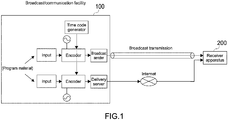
- Fig. 1 is a diagram showing the configuration of a 3D program transmitting system.
- the image from one viewpoint out of images from a plurality of viewpoints, which configure a 3D program, is transmitted by broadcasting, and the image from the other viewpoint is transmitted by communication.
- a receiver receives the two images transmitted by broadcasting and by communication, synchronizes, reproduces, and merges them, and presents a 3D image.
- a plurality of cameras take images of one object simultaneously, an obtained image of one view, i.e., a main-view, is transmitted by broadcasting, and the other images of one or more views, i.e., sub-views, are transmitted by communication.
- a receiver receives those images of the plurality of views, and displays the main-view image in a main-window and displays the one or more sub-view images in sub-windows at the same time. Alternatively, the receiver alternately selects one of the main-view and the sub-views as an image displayed on a main-window.
- an image taken by a high-resolution camera of 4K (number of pixels: 3840x2160) is divided in quarters, whereby four-block images each having a HD size (number of pixels: 1920x1080) are obtained. Some of them are transmitted by broadcasting, and the others are transmitted by communication.
- a receiver receives the four-block images each having a HD size, synchronizes, reproduces, and merges them, and presents a high-resolution image having a 4K size.
- an image taken by a high-resolution camera is frequency-resolved by wavelet transform or the like, an image having a HD size having low-resolution components is transmit by broadcasting, and the rest images having high-frequency components are transmitted by communication.
- a receiver frequency-synthesizes the received four images each having the HD size by wavelet inverse transform or the like, and reconstructs and presents one high-resolution image.
- an image and the Japanese speech are transmitted by broadcasting, and multilingually-dubbed speech for that image is transmitted by communication.
- a receiver receives the image and the Japanese speech by broadcasting and receives the multilingually-dubbed speech of the image by communication at the same time, and synchronizes, reproduces, and presents the broadcast image and the dubbed-speech in response to a request from a user.
- Fig. 1 is a diagram showing the configuration of the above-mentioned system for synchronizing and transmitting a broadcast stream and a communication stream.
- Examples of a program material include a 3D program, a multi-view program, a high-resolution program, a dubbing service program, and the like.
- the broadcast/communication facility 100 divides a program material into a signal for broadcasting and a signal for communication. Each encoder encodes the signal for broadcasting or the signal for communication into a stream of MPEG2_TS or the like. Time codes, i.e., presentation time information, are inserted in each encoded stream. One stream in which the time codes are inserted is transmitted by broadcasting, and the other stream in which the time codes are inserted is delivered from a delivery server by communication via the Internet. Moreover, when encoding, a PCR (Program Clock Reference), i.e., a periodic time reference value, is inserted into each video TS packet. Alternatively, PCR packets each containing a PCR are added periodically.
- Program Clock Reference i.e., a periodic time reference value
- a receiver apparatus 200 receives a broadcast stream and a communication stream of one program.
- the receiver apparatus 200 extracts PCRs from the received broadcast stream and PCRs from the communication stream, and sets up or calibrates the STC (System Time Clock), i.e., the criterion time of the receiver apparatus 200, based on the PCRs.
- the image presentation timing is generated based on the STC and PTSs (Presentation Time Stamps), i.e., presentation time information contained in image TS packets.
- the receiver apparatus 200 may receive a communication stream after a broadcast stream, which is to be synchronized with the communication stream and reproduced. If a communication stream is behind a broadcast stream, it is necessary to store a received broadcast stream in a buffer and to thus delay reproduction of the broadcast stream. However, typically, it is presupposed that the receiver apparatus 200 uniquely determines image stream presentation timing based on the STC, which is generated based on PCRs, and based on PTSs, i.e., time managing information of reproduction, in image TS packets. Because of this, actually, it is difficult to synchronize and reproduce a broadcast stream and a communication stream only by storing a received broadcast stream in a buffer.
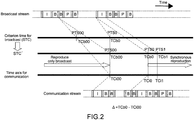
- the STC of a receiver apparatus is adjusted and a broadcast stream and a communication stream are synchronized and reproduced based on the fact that each time code added to an image stream such as for example an MPEG2 video stream or an MPEG4-AVC video stream is data, which indicates the presentation time of a front picture of a GOP or each picture by units of hour, minute, second, and frame.
- Fig. 2 is a timing diagram showing the outline of an operation in which a receiver apparatus 300 according to a first embodiment of the present technology adjusts the STC and thus synchronizes a broadcast stream and a communication stream.
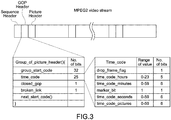
- Fig. 3 is a diagram illustrating a time code of an MPEG2 video stream.
- Sequence_Header is described at the beginning of a picture layer, i.e., the uppermost layer. Sequence_Header defines header data of an MPEG2 bit stream sequence. GOP_Header and Picture_Header are described after Sequence_Header.
- GOP_Header defines header data of the GOP (group_of_picture) layer of an MPEG bit stream.
- the GOP_Header contains group_start_code, time_code, closed_gop, broken_link, and the like.
- group_start_code is data showing a start synchronization code of a GOP layer.
- time_code is a time code showing time from the front of a sequence of the front picture of a GOP. In other words, time_code is a time code added to each GOP (first unit).
- closed_gop is flag data showing that it is possible to reproduce an image in a GOP independent of other GOPs.
- broken_link is flag data showing that it is not possible to reproduce the front B picture in a GOP accurately because of editing or the like.
- time_code contains hour, minute, second, and frame (picture) data showing the presentation time of the front picture of a GOP, and other data.
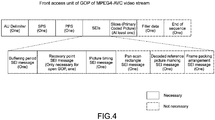
- Fig. 4 is a diagram showing the configuration of the front access unit of a GOP of an MPEG4-AVC (Advanced Video Coding) video stream.
- MPEG4-AVC Advanced Video Coding
- AU delimiter is information showing the boundary position of a picture.
- SPS Sequence Parameter Set
- SPS contains a buffer size (picture or slice) of a virtual buffer, and bit rate information.
- PPS Picture Parameter Set
- SEIs Supplemental Enhancement Information
- Slices are data of one picture in an access unit.
- Picture timing SEI contains Picture timing SEI.
- Picture timing SEI is timing information showing decoding and display timing of a Slice (picture data).
- Fig. 5 is a diagram showing the configuration of an access unit other than the front access unit of a GOP of an MPEG4-AVC video stream.
- An access unit other than the front of a GOP contains AU delimiter, PPS, SEIs, and Slices. Moreover, SEIs contain Picture timing SEI similar to the access unit of the front of a GOP.
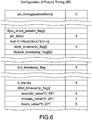
- Fig. 6 is a diagram showing the configuration of Picture Timing SEI.
- Picture Timing SEI describes hour, minute, second, and frame (n_frame) data.
- Picture Timing SEI is a time code showing the presentation time of each picture.
- Picture Timing SEI is a time code at least added to each GOP.
- an MPEG2 video stream is used to transmit an image by broadcasting
- an MPEG4-AVC video stream is used to transmit an image by the Internet (communication). Because of this, in this case, time_code of an MPEG2 video stream is used as a first time code, and Picture timing SEI of an MPEG4-AVC video stream is used as a second time code.
- Fig. 7 is a block diagram showing the configuration of the receiver apparatus 300 of this embodiment.
- the receiver apparatus 300 includes a tuner 301 (broadcast receiver), a broadcast DeMUX 302, a broadcast image buffer 303, a broadcast image decoder 304 (first image decoder), an STC generator 305 (criterion time generator), a network I/F 307 (communication receiver), an HTML browser 308, a VOD player 309, a communication streaming buffer 310, a communication DeMUX 311, a communication image buffer 312, an STC adjuster 313 (adjuster), a communication image decoder 314 (second image decoder), an image merger 315, and a time code processor 316.
- the tuner 301 receives a broadcast stream (first image stream) of a channel selected by a user, generates a transport stream (TS), and transmits the transport stream to the broadcast DeMUX 302.
- the broadcast DeMUX 302 demultiplexes the transport stream, separates image TS packets therefrom, supplies the image TS packets to the broadcast image buffer 303 as an image stream, extracts PCRs from the image TS packets, and supplies the PCRs to the STC generator 305.
- the broadcast image buffer 303 buffers the image stream to be supplied to the broadcast image decoder 304.
- the broadcast image decoder 304 decodes the image stream read from the broadcast image buffer 303, and outputs an image signal to the image merger 315 based on the time of the STC from the STC generator 305. More specifically, the broadcast image decoder 304 controls decoding-start timing and output timing such that the image is to be presented at times when PTSs (Presentation Time Stamps) added to image TS packets coincide with the STC values.
- PTSs Presentation Time Stamps
- the broadcast image decoder 304 constantly supplies time codes (first time codes) added to an image stream to be decoded to the time code processor 316 in order to synchronize and reproduce broadcasting and communication.
- the STC generator 305 generates an STC of 27 MHz with reference to the PCRs extracted from a broadcast stream, and supplies the STC to the broadcast image decoder 304 and the like.
- the STC generator 305 is capable of adjusting the STC based on data-to-adjust-STC from the STC adjuster 313.
- Broadcast-related application software which is operated by an HTML (HyperText Markup Language) browser 308, outputs an instruction to synchronize and reproduce a broadcast stream and a communication stream to the VOD (Video On Demand) player 309, whereby the VOD player 309 supplies a request to obtain a communication stream to the network I/F 307.
- the network I/F 307 sends the request to a delivery server of the broadcast/communication facility 100 via the Internet, and receives a communication stream (second image stream), which is to be synchronized with a broadcast stream and reproduced, as a response from the delivery server.
- the communication streaming buffer 310 buffers the received communication stream.
- the communication streaming buffer 310 retrieves the stored communication stream, and supplies the communication stream to the communication DeMUX 311.
- the communication DeMUX 311 separates image TS packets from a communication stream retrieved from the streaming buffer 310, and supplies the image TS packets to the communication image buffer 312 as an image stream.
- the communication image buffer 312 buffers the image stream to be supplied to the communication image decoder 314.
- the communication image decoder 314 decodes the image stream retrieved from the communication image buffer 312, and supplies a communication-related image signal to the image merger 315.
- the communication image decoder 314 supplies, to the time code processor 316, a time code (second time code) in image data obtained for the first time after an instruction to synchronize and reproduce a broadcast stream and a communication stream is generated.
- the communication image decoder 314 retrieves an image data unit of a communication stream having a second time code, which is the same as the first time code value supplied from the time code processor, from the communication image buffer 312, decodes the image data unit, and outputs the image data unit to the image merger 315 as a communication-related image signal.
- the image merger 315 merges the broadcast-related image signal and the communication-related image signal, generates an image signal to be presented, and outputs the image signal to a not-shown display.
- the image signals are merged based on a method corresponding to a method of separating a program material (3D program, multi-view program, high-resolution program, dubbing service program, etc.) into broadcasting and communication.
- the time code processor 316 compares the second time code, which is supplied from the communication image decoder 314 for the first time after an instruction to synchronize and reproduce a broadcast stream and a communication stream is generated, to the latest first time code supplied from the broadcast image decoder 304. If the second time code is behind the first time code, the time code processor 316 supplies the difference to the STC adjuster 313.
- the time code processor 316 supplies the first time code, which is supplied from the broadcast image decoder 304, to the communication image decoder 314 in order to synchronize and reproduce a broadcast stream and a communication stream.
- a host controller 317 includes a CPU (Central Processing Unit), a ROM (Read Only Memory), a RAM (Random Access Memory), and the like.
- the ROM fixedly stores programs executed by the CPU and data. The programs stored in the ROM are loaded in the RAM, and the CPU executes the loaded programs.
- the programs loaded in the RAM cause the host controller 317 to operate as at least the STC generator 305, the HTML browser 308, the VOD player 309, the time code processor 316, and the STC adjuster 313.
- the host controller 317 is capable of receiving various kinds of instructions and data input by a user by using a not-shown remote control, for example.
- the STC generator 305, the time code processor 316, and the STC adjuster 313 may not be software but may be hardware.
- a user of the receiver apparatus 300 selects a broadcast channel by using a not-shown remote control or the like.
- the host controller 317 processes selected-channel information, which is input by the user and received by the remote control or the like.
- the host controller 317 controls the tuner 301 based on the selected-channel information input by the user.
- the tuner 301 transmits a broadcast stream of the received channel to the broadcast DeMUX 302.
- the DeMUX 302 separates image TS packets, audio TS packets, and the other TS packets such as SI (Service Information: program array information) from the broadcast stream.
- the broadcast DeMUX 302 supplies the separated image TS packets, i.e., an image stream, to the broadcast image buffer 303.
- the broadcast image buffer 303 temporarily stores the image stream.
- the broadcast DeMUX 302 constantly extracts PCRs from the image TS packets, and supplies the PCRs to the STC generator 305.
- the STC generator 305 generates a STC (System Time Clock) of 27 MHz with reference to the PCRs.
- the broadcast image decoder 304 decodes the image stream read from the broadcast image buffer 303, and supplies an image signal to the image merger 315. At this time, the broadcast image decoder 304 controls decoding-and-output timing of the image stream such that the image is to be presented at times when the PTSs (Program Clock Reference) of the image TS packets coincide with the STC from the STC generator 305. Moreover, the broadcast image decoder 304 supplies the time codes, which are added to the image stream to be decoded, to the time code processor 316 in order to synchronize and reproduce the broadcast stream and a communication stream.
- PTSs Program Clock Reference
- the receiver apparatus 300 obtains application software (broadcast-related application software) related to the channel or a program by broadcasting or communication, and executes the application software.
- the broadcast-related application software causes the receiver apparatus 300 to: allow a user to watch, for example, a 3D program, a multi-view program, a high-resolution program, a dubbing service program, or the like, in which a broadcast stream and a communication stream are synchronized and reproduced; receive a watch-instruction (instruction to synchronize and reproduce broadcast stream and communication stream) from a user; and then cause the VOD player 309 to send a request to obtain a communication stream from a delivery server.
- broadcast-related application software includes, for example, HTML (Hyper Text Markup Language) documents, BML documents (Broadcast Markup Language), MHEG documents (Multimedia and Hypermedia information coding), Java (registered trademark) scripts, still-image files, moving-image files, and the like.
- HTML Hyper Text Markup Language
- BML documents Broadcast Markup Language
- MHEG documents Multimedia and Hypermedia information coding
- Java registered trademark
- the VOD player 309 receives the instruction to synchronize and reproduce a broadcast stream and a communication stream, the VOD player 309 causes the network I/F 307 to send a request to transmit a communication stream (communication stream to be synchronized with broadcast stream and reproduced) related to the selected channel or a program to a delivery server via the Internet, and supplies an instruction to generate an offset ⁇ to the time code processor 316. If the time code processor 316 receives the instruction, the time code processor 316 waits for a first time code to be supplied from the communication image decoder 314.
- the communication streaming buffer 310 stores a communication stream transmitted from the delivery server via the network I/F 307 in response to the request.
- the communication streaming buffer 310 stores the front image TS packet of the communication stream, reads the front image TS packet immediately after that, and supplies the front image TS packet to the communication DeMUX 311.
- the communication DeMUX 311 separates image TS packets from the communication stream read from the streaming buffer 310, and supplies the image TS packets to the communication image buffer 312.
- the communication image decoder 314 decodes the image stream read from the communication image buffer 312, and supplies an image signal to the image merger 315. At this time, the communication image decoder 314 supplies a second time code of the image stream to the time code processor 316 as the latest second time code after an instruction to synchronize and reproduce a broadcast stream and a communication stream is generated.
- the latest second time code supplied from the communication image decoder 314 is TCi00
- the first time code supplied from the broadcast image decoder 304 at the same time as the above-mentioned second time code is TCb0.
- the time code processor 316 compares TCi00 to TCb0, and determines if the condition TCb0>TCi00 is satisfied or not. If TCb0>TCi00 is satisfied, then it means that the image data of the communication stream is actually received after image data of a broadcast stream, the communication stream being to be synchronized with the broadcast stream and reproduced.
- the value of the offset ⁇ is supplied to the STC adjuster 313.
- TCbh is a time code (hour) or broadcasting
- TCbm is a time code (minute) of broadcasting
- TCbs is a time code (second) of broadcasting
- TCbf is a time code (frame) of broadcasting
- TCih is a time code (hour) of broadcasting
- TCim is a time code (minute) of communication
- TCis is a time code (second) of communication
- TCif is a time code (frame) of communication.
- the STC adjuster 313 receives the offset ⁇ , and then generates an adjusted value of the STC, i.e., STC', based on the following formula.
- STC ⁇ ⁇ x 90 ⁇ m STC ′
- the offset ⁇ is multiplied by 90 to thereby mapping between the offset ⁇ (millisecond) and a counter value of 90 KHz, which is same as the STC, is established.
- m is predetermined margin.
- the STC' generated as described above is supplied to the STC generator 305, and the STC generator 305 resets the STC', whereby the STC is adjusted.
- the broadcast image decoder 304 extracts the first time code added to the image stream to be decoded, supplies the first time code to the time code processor 316, decodes the image stream, and supplies an image signal to the image merger 315.
- the receiver apparatus 300 restarts decoding and reproducing the broadcast stream.
- the communication image decoder 314 retrieves an image data unit of an image stream, whose second time code (TCi0) is the same as the first time code (TCb0) obtained from the time code processor 316, from the communication image buffer 312, and decodes the image data unit.
- the communication image decoder 314 obtains an image signal, and supplies the image signal to the image merger 315.
- the synchronized broadcast-related image signal and communication-related image signal are supplied to the image merger 315.
- an original program such as a 3D program, a multi-view program, a high-resolution program, or a dubbing service program is reconstructed accurately.
- the adjusted STC' is corrected to the original STC simultaneously with the end of the broadcast program decoded based on the STC'.
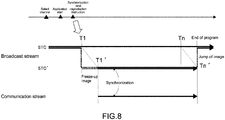
- Fig. 8 is a timing diagram showing firstly selection of a broadcast channel, processing of synchronizing a broadcast stream and a communication stream, and finally the end of the synchronization processing, which have been described above.
- the receiver apparatus 300 updates the STC with the STC'. As a result, the time T1 to start decoding an image stream is delayed, and the time T1' is set. A freeze-up image is displayed between T1 and T1'. Then decoding of a broadcast image stream and a communication image stream is restarted at the time T1'. After that, decoding is performed with reference to the STC' until the end of the program. When the program is finished, the STC is used again instead of the STC', an access unit whose PTS coincides with the STC is selected, and decoding is performed.
- the broadcast image decoder 304 constantly supplies first time codes added to an image stream to be decoded to the time code processor 316.
- the time code processor 316 supplies a first time code, which is supplied from the broadcast image decoder 304, to the communication image decoder 314 in order to synchronize and reproduce a broadcast stream and a communication stream.
- the communication image decoder 314 retrieves an image data unit of a communication stream, whose second time code is the same as the first time code supplied from the time code processor 316, from the communication image buffer 312, and decodes the image data unit.
- a broadcast image decoder may control decoding-start timing and output timing such that the image is to be presented at times when PTSs (Presentation Time Stamps) added to image TS packets coincide with the adjusted STC'
- a communication image decoder may control decoding-start timing and output timing such that the image is to be presented at times when PTSs (Presentation Time Stamps) added to image TS packets coincide with the adjusted STC'.
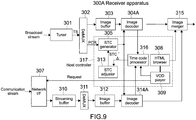
- Fig. 9 is a block diagram showing the configuration of a receiver apparatus 300A according to a second embodiment.
- the time code processor 316 of the receiver apparatus 300A compares the second time code, which is supplied from the communication image decoder 314A for the first time after an instruction to synchronize and reproduce a broadcast stream and a communication stream is generated, to the latest first time code supplied from the broadcast image decoder 304A. If the second time code is behind the first time code, the time code processor 316 supplies the offset ⁇ to the STC adjuster 313.
- the STC adjuster 313 receives the offset ⁇ , and then generates an adjusted value of the STC, i.e., STC'.
- the STC adjuster 313 supplies the adjusted STC' to the STC generator 305, whereby the STC of the STC generator 305 is adjusted.
- the broadcast image decoder 304A controls decoding-start timing and output timing such that the image is to be presented at times when PTSs (Presentation Time Stamps) added to image broadcast TS packets coincide with the adjusted STC' values.
- PTSs Presentation Time Stamps
- the communication image decoder 314A controls decoding-start timing and output timing such that the image is to be presented at times when PTSs added to communication broadcast TS packets coincide with the adjusted STC' values.
- the receiver apparatus 300A of this embodiment is also capable of synchronizing and reproducing those streams successfully even if a communication stream is received after a broadcast stream.
- the STC is adjusted once before synchronized reproduction of a broadcast stream and a communication stream is started.
- the STC may also be adjusted after the synchronized reproduction is started.
- Examples of conditions of adjusting the STC after the synchronized reproduction is started include
- the margin m which is used to calculate the offset ⁇ , may be variable depending on a receiving status of a communication stream or the like. In other words, if a margin is too large, a freeze-up broadcast stream is displayed for a long time, and a viewer is likely to feel something wrong. To the contrary, if a margin is too small, reproduction of a 3D program or the like is likely to be failed because a communication stream is absent. In view of this, it is desirable that a requisite minimum margin be dynamically set up such that reproduction of a program is not failed depending on a receiving status of a communication stream.
- an MPEG2 video stream is used to transmit an image by broadcasting
- an MPEG4-AVC video stream is used to transmit an image by the Internet (communication).
- the present technology is not limited to this.
- an MPEG2 video stream may be used to transmit an image by broadcasting and to transmit an image by communication.
- An MPEG4-AVC video stream may be used to transmit an image by broadcasting and to transmit an image by communication.
- the present technology may use a video stream other than the MPEG2 video stream and the MPEG4-AVC video stream as long as a time code is added to each predetermined unit of image data.
- the present technology is not limited to the above-mentioned illustrated examples, and may be variously modified within the gist of the present invention, as a matter of course.
Landscapes
- Engineering & Computer Science (AREA)
- Signal Processing (AREA)
- Multimedia (AREA)
- Databases & Information Systems (AREA)
- Two-Way Televisions, Distribution Of Moving Picture Or The Like (AREA)
- Synchronisation In Digital Transmission Systems (AREA)
- Computer Security & Cryptography (AREA)
Claims (15)
- Empfangsvorrichtung, umfassend:einen Rundfunkempfänger (301), der ausgestaltet ist, einen ersten Bildstrom durch Rundfunk zu empfangen, wobei der erste Bildstrom Präsentationszeitinformation umfasst, die einen ersten Zeitcode beinhalten, der in jeder ersten Einheit von ersten Bilddaten des ersten Bildstroms enthalten ist;einen Kommunikationsempfänger (307), der ausgestaltet ist, einen zweiten Bildstrom über das Internet zu empfangen, wobei ein zweiter Zeitcode in mindestens jeder ersten Einheit von zweiten Bilddaten des zweiten Bildstroms enthalten ist, wobei die zweiten Bilddaten mit den ersten Bilddaten synchronisiert und wiedergegeben werden sollen;einen Kriteriumszeitgenerator (305), der ausgestaltet ist, Kriteriumszeit zu erzeugen, wobei die Kriteriumszeit verwendet wird, um einen Zeitpunkt zum Ausführen eines Prozesses zum Präsentieren der ersten Bilddaten zu erzeugen;einen ersten Bilddekodierer (304), der ausgestaltet ist, den ersten Bildstrom zu dekodieren, der von dem Rundfunkempfänger empfangen wird;einen zweiten Bilddekodierer (314), der ausgestaltet ist, den zweiten Bildstrom zu dekodieren, der von dem Kommunikationsempfänger empfangen wird;einen Zeitcodeprozessor (316), der ausgestaltet ist, zu einem bestimmten Zeitpunkt den ersten Zeitcode, der in dem empfangenen ersten Bildstrom enthalten ist, und den zweiten Zeitcode, der in dem zweiten Bildstrom enthalten ist, zu erhalten; unddadurch gekennzeichnet, dass die Empfangsvorrichtung umfasst,eine Einstellvorrichtung (313), die ausgestaltet ist, die Kriteriumszeit in Bezug auf eine Verzögerungszeit des zweiten Zeitcodes hinter dem ersten Zeitcode einzustellen,wobei der erste Bilddekodierer (304) ausgestaltet ist, um nach dem Einstellen der Kriteriumszeit den ersten Bildstrom so zu dekodieren, dass der erste Bildstrom zu dem Zeitpunkt zu präsentieren ist, an dem die Präsentationszeitinformation mit der Kriteriumszeit übereinstimmen,der Zeitcodeprozessor (316) ausgestaltet ist, um nach dem Einstellen der Kriteriumszeit den ersten Zeitcode zu erhalten, der in jeder ersten Einheit der ersten Bilddaten des ersten Bildstroms enthalten ist, der von dem ersten Bilddekodierer dekodiert werden soll, und um den ersten Zeitcode an den zweiten Bilddekodierer zu liefern, undder zweite Bilddekodierer (314) ausgestaltet ist, um nach dem Einstellen der Kriteriumszeit die erste Einheit der zweiten Bilddaten des zweiten Bildstroms mit dem zweiten Zeitcode zu dekodieren, der derselbe ist wie der gelieferte erste Zeitcode, der in der ersten Einheit der ersten Bilddaten des ersten Bildstroms enthalten ist.
- Empfangsvorrichtung nach Anspruch 1, wobei
der Zeitcodeprozessor (316) ausgestaltet ist, zumindest wenn der Kommunikationsstrom zum ersten Mal empfangen wird, wenn der Rundfunkstrom empfangen wird, den ersten Zeitcode, der in dem empfangenen ersten Bildstrom enthalten ist, und den zweiten Zeitcode, der in dem zweiten Bildstrom enthalten ist, zu erhalten und die Verzögerungszeit des zweiten Zeitcodes hinter dem ersten Zeitcode zu berechnen. - Empfangsvorrichtung nach Anspruch 2, wobei
die Einstellvorrichtung (313) ausgestaltet ist, die Kriteriumszeit basierend auf Zeitdaten einzustellen, wobei die Zeitdaten durch Hinzufügen einer Zeitspanne zu dem Betrag der Verzögerung erhalten werden. - Empfangsvorrichtung nach Anspruch 3, wobei
der Kriteriumszeitgenerator (305) ausgestaltet ist, die Kriteriumszeit basierend auf einem Zeitreferenzwert, insbesondere einem Programmtaktreferenzwert, PCR, zu erzeugen, der in dem Sendestrom enthalten ist. - Empfangsvorrichtung nach Anspruch 4, wobei
der erste Zeitcode in einem Frontbild jedes GOP des ersten Bildstroms enthalten ist, und
der zweite Zeitcode in jedem Bild des zweiten Bildstroms enthalten ist. - Empfangsvorrichtung nach einem vorhergehenden Anspruch, wobei
die Empfangsvorrichtung ferner einen Bildfusionierer (315) umfasst, der ausgestaltet ist, eine Vielzahl von Bildern zusammenzuführen, die von den ersten Bilddekodierer und dem zweiten Bilddekodierer dekodiert wurden. - Empfangsvorrichtung nach einem vorhergehenden Anspruch, wobei
die ersten Bilder einer einem Objekt zugeordneten ersten Ansicht und die zweiten Bilder mindestens einer dem Objekt zugeordneten zweiten Ansicht entsprechen. - Empfangsvorrichtung nach einem vorhergehenden Anspruch, wobei
ein hochauflösendes Bild das erste Bild mit einer niedrigen Auflösung und Hochfrequenzkomponenten, die in den zweiten Bildern enthalten sind, enthält. - Empfangsvorrichtung nach einem vorhergehenden Anspruch, wobei
die ersten Bilder erste Sprachdaten und die zweiten Bilder mehrsprachig synchronisierte Daten enthalten. - Empfangsverarbeitungsverfahren, umfassend:Empfangen eines ersten Bildstroms durch Rundfunk durch einen Rundfunkempfänger (301), wobei der erste Bildstrom Präsentationszeitinformation umfasst, die einen ersten Zeitcode beinhalten, der in jeder ersten Einheit von ersten Bilddaten des ersten Bildstroms enthalten ist;Empfangen eines zweiten Bildstroms über ein Netzwerk durch einen Kommunikationsempfänger (307), wobei ein zweiter Zeitcode in mindestens jeder ersten Einheit von zweiten Bilddaten des zweiten Bildstroms enthalten ist, wobei die zweiten Bilddaten mit den ersten Bilddaten synchronisiert und wiedergegeben werden sollen;Erzeugen von Kriteriumszeit durch einen Kriteriumszeitgenerator (305), wobei die Kriteriumszeit verwendet wird, um einen Zeitpunkt zum Ausführen eines Prozesses zum Präsentieren der ersten Bilddaten zu erzeugen;Dekodieren des ersten Bildstroms, der vom Rundfunkempfänger empfangen wird, durch einen ersten Bilddekodierer (304);Dekodieren des zweiten Bildstroms, der vom Kommunikationsempfänger empfangen wird, durch einen zweiten Bilddekodierer (314);Erhalten des ersten Zeitcodes, der in dem empfangenen ersten Bildstrom enthalten ist, und des zweiten Zeitcodes, der in dem zweiten Bildstrom enthalten ist, durch einen Zeitcodeprozessor (316) zu einem bestimmten Zeitpunkt;gekennzeichnet durch die VerfahrensschritteEinstellen einer Kriteriumszeit durch eine Einstellvorrichtung (313) in Bezug auf eine Verzögerungszeit des zweiten Zeitcodes hinter dem ersten Zeitcode;nach dem Einstellen der Kriteriumszeit, Dekodieren des ersten Bildstroms durch den ersten Bilddekodierer (304), sodass der erste Bildstrom zu dem Zeitpunkt zu präsentieren ist, an dem die Präsentationszeitinformation mit der Kriteriumszeit übereinstimmt,nach dem Einstellen der Kriteriumszeit, Erhalten des ersten Zeitcodes, der in jeder ersten Einheit der ersten Bilddaten des ersten Bildstroms, der von dem ersten Bilddekodierer (304) zu dekodieren ist, enthalten ist, durch den Zeitcodeprozessor (316), und Liefern des ersten Zeitcodes an den zweiten Bilddekodierer; undnach dem Einstellen der Kriteriumszeit, Dekodieren durch den zweiten Bilddekodierer (314), wobei die erste Einheit der zweiten Bilddaten des zweiten Bildstroms den zweiten Zeitcode aufweist, der derselbe ist wie der gelieferte erste Zeitcode, der in der ersten Einheit der ersten Bilddaten des ersten Bildstroms enthalten ist.
- Empfangsverarbeitungsverfahren nach Anspruch 10,
ferner umfassend den Schritt des Zusammenführens einer Vielzahl von Bildern, die von dem ersten Bilddekodierer und dem zweiten Bilddekodierer dekodiert wurden. - Empfangsverarbeitungsverfahren nach Anspruch 10 oder 11,
wobei die ersten Bilder einer einem Objekt zugeordneten ersten Ansicht und die zweiten Bilder mindestens einer dem Objekt zugeordneten zweiten Ansicht entsprechen. - Empfangsverarbeitungsverfahren nach einem der Ansprüche 10 bis 12,
wobei ein hochauflösendes Bild die ersten Bilder mit einer niedrigen Auflösung und Hochfrequenzkomponenten, die in den zweiten Bildern enthalten sind, enthält. - Empfangsverarbeitungsverfahren nach einem der Ansprüche 10 bis 13,
wobei die ersten Bilder erste Sprachdaten und die zweiten Bilder mehrsprachig synchronisierte Daten beinhalten. - Computerprogramm, umfassend Programmcodemittel, um einen Computer zu veranlassen, die Schritte des Verfahrens, wie in einem der Ansprüche 10 bis 14 beansprucht, auszuführen, wenn das Computerprogram auf den Computer ausgeführt wird.
Applications Claiming Priority (2)
| Application Number | Priority Date | Filing Date | Title |
|---|---|---|---|
| JP2012140938 | 2012-06-22 | ||
| PCT/JP2013/003527 WO2013190789A1 (ja) | 2012-06-22 | 2013-06-05 | 受信装置およびその同期処理方法 |
Publications (3)
| Publication Number | Publication Date |
|---|---|
| EP2866457A1 EP2866457A1 (de) | 2015-04-29 |
| EP2866457A4 EP2866457A4 (de) | 2015-11-04 |
| EP2866457B1 true EP2866457B1 (de) | 2019-03-20 |
Family
ID=49768404
Family Applications (1)
| Application Number | Title | Priority Date | Filing Date |
|---|---|---|---|
| EP13806945.5A Active EP2866457B1 (de) | 2012-06-22 | 2013-06-05 | Empfangsvorrichtung und synchrones verarbeitungsverfahren dafür |
Country Status (5)
| Country | Link |
|---|---|
| US (1) | US10397633B2 (de) |
| EP (1) | EP2866457B1 (de) |
| JP (1) | JP6313704B2 (de) |
| AR (1) | AR091450A1 (de) |
| WO (1) | WO2013190789A1 (de) |
Families Citing this family (14)
| Publication number | Priority date | Publication date | Assignee | Title |
|---|---|---|---|---|
| US8560719B2 (en) * | 2011-09-14 | 2013-10-15 | Mobitv, Inc. | Fragment server directed device fragment caching |
| US20150109413A1 (en) * | 2013-10-21 | 2015-04-23 | Electronics And Telecommunications Research Institute | Video reception apparatus to provide hybrid service based on transport stream system target decoder model |
| KR20150057149A (ko) * | 2013-11-18 | 2015-05-28 | 한국전자통신연구원 | 재전송망에 기초한 3d 방송 서비스 제공 시스템 및 방법 |
| JP6127964B2 (ja) * | 2013-12-26 | 2017-05-17 | ソニー株式会社 | 信号切換装置および信号切換装置の動作制御方法 |
| JP6178234B2 (ja) | 2013-12-27 | 2017-08-09 | 日立マクセル株式会社 | 放送受信装置及び映像表示方法 |
| US9374604B2 (en) | 2014-03-31 | 2016-06-21 | Arris Enterprises, Inc. | Adaptive streaming transcoder synchronization |
| JP6822407B2 (ja) * | 2015-09-01 | 2021-01-27 | ソニー株式会社 | 受信装置、データ処理方法、及び、プログラム |
| CN105516118B (zh) * | 2015-12-03 | 2019-06-11 | Tcl集团股份有限公司 | 一种基于非rtc智能电视的时间同步方法及系统 |
| US10764473B2 (en) * | 2016-01-14 | 2020-09-01 | Disney Enterprises, Inc. | Automatically synchronizing multiple real-time video sources |
| JP6546326B2 (ja) * | 2018-07-27 | 2019-07-17 | マクセル株式会社 | 放送受信装置及び映像表示方法 |
| JP6908170B2 (ja) * | 2019-03-26 | 2021-07-21 | ソニーグループ株式会社 | 送信方法 |
| JP7120399B2 (ja) * | 2020-07-29 | 2022-08-17 | ソニーグループ株式会社 | 送信方法 |
| CN114598909B (zh) * | 2022-03-30 | 2023-12-01 | 青岛海信宽带多媒体技术有限公司 | 一种智能机顶盒及直播节目的时间轴显示方法 |
| JP2025079585A (ja) * | 2023-11-10 | 2025-05-22 | キヤノン株式会社 | 通信装置、通信装置の制御方法及びプログラム |
Family Cites Families (35)
| Publication number | Priority date | Publication date | Assignee | Title |
|---|---|---|---|---|
| JPH1032815A (ja) * | 1996-07-16 | 1998-02-03 | Toshiba Corp | 画面合成装置 |
| US6587505B1 (en) * | 1998-08-31 | 2003-07-01 | Canon Kabushiki Kaisha | Image processing apparatus and method |
| US6512552B1 (en) * | 1999-03-29 | 2003-01-28 | Sony Corporation | Subpicture stream change control |
| EP1158799A1 (de) * | 2000-05-18 | 2001-11-28 | Deutsche Thomson-Brandt Gmbh | Verfahren und Empfänger zur Bereitstellung von mehrsprachigen Untertiteldaten auf Anfrage |
| US7346698B2 (en) * | 2000-12-20 | 2008-03-18 | G. W. Hannaway & Associates | Webcasting method and system for time-based synchronization of multiple, independent media streams |
| JP4380930B2 (ja) * | 2001-03-19 | 2009-12-09 | 株式会社東芝 | オーディオ・ビデオ復号再生装置とその同期再生方法 |
| US9948977B2 (en) * | 2003-01-09 | 2018-04-17 | Avago Technologies General Ip (Singapore) Pte. Ltd. | System, method, and apparatus for determining presentation time for picture without presentation time stamp |
| KR20060134911A (ko) * | 2003-09-02 | 2006-12-28 | 소니 가부시끼 가이샤 | 콘텐츠 수신 장치, 비디오 오디오 출력 타이밍 제어 방법및 콘텐츠 제공 시스템 |
| JP2005123789A (ja) * | 2003-10-15 | 2005-05-12 | Matsushita Electric Ind Co Ltd | Av同期システム |
| JP2005159592A (ja) | 2003-11-25 | 2005-06-16 | Nippon Hoso Kyokai <Nhk> | コンテンツ送信装置およびコンテンツ受信装置 |
| KR100526189B1 (ko) * | 2004-02-14 | 2005-11-03 | 삼성전자주식회사 | 트랜스코딩 전후에 타이밍 파라미터를 일정하게유지시키는 트랜스코딩 시스템 및 방법 |
| JP4229035B2 (ja) * | 2004-09-28 | 2009-02-25 | ソニー株式会社 | 記録再生装置および方法、再生装置および方法、記録装置および方法、並びにプログラム |
| US8140954B2 (en) * | 2005-06-05 | 2012-03-20 | International Business Machines Corporation | System and method for providing on demand captioning of broadcast programs |
| JP2007013714A (ja) * | 2005-06-30 | 2007-01-18 | Toshiba Corp | 情報再生装置及び情報再生方法 |
| CN100442858C (zh) * | 2005-10-11 | 2008-12-10 | 华为技术有限公司 | 分组网络中多媒体实时传输的唇同步方法及其装置 |
| JP2008005112A (ja) * | 2006-06-21 | 2008-01-10 | Matsushita Electric Ind Co Ltd | ストリームエンコーダ及びストリームデコーダ |
| KR100905723B1 (ko) * | 2006-12-08 | 2009-07-01 | 한국전자통신연구원 | 비실시간 기반의 디지털 실감방송 송수신 시스템 및 그방법 |
| JP4176808B2 (ja) * | 2007-03-30 | 2008-11-05 | シャープ株式会社 | 放送受信装置、放送再送信装置、放送再送信方法、放送受信システム、制御プログラム、および制御プログラムを記録したコンピュータ読み取り可能な記録媒体 |
| JP5212473B2 (ja) * | 2008-06-26 | 2013-06-19 | 富士通セミコンダクター株式会社 | 映像音声データ出力装置および映像音声データ出力方法 |
| JP4409611B2 (ja) | 2008-08-04 | 2010-02-03 | シャープ株式会社 | 放送受信装置、放送受信方法、制御プログラム、および制御プログラムを記録したコンピュータ読み取り可能な記録媒体 |
| KR101535827B1 (ko) * | 2008-12-05 | 2015-07-27 | 삼성전자주식회사 | 무선 통신 네트워크에서 오디오 및 비디오 동기화 장치 및 방법 |
| KR101164857B1 (ko) * | 2008-12-19 | 2012-07-11 | 한국전자통신연구원 | 비실시간으로 3차원 입체 방송을 제공하기 위한 방송 송수신 시스템 및 방법 |
| JP2011066871A (ja) * | 2009-08-21 | 2011-03-31 | Sony Corp | コンテンツ伝送方法及び表示装置 |
| JP2011123195A (ja) | 2009-12-09 | 2011-06-23 | Fuji Xerox Co Ltd | 定着装置及び画像形成装置 |
| JP5172874B2 (ja) * | 2010-02-12 | 2013-03-27 | 日本電信電話株式会社 | 映像同期装置、映像表示装置、映像同期方法及びプログラム |
| US20130024900A1 (en) * | 2010-04-04 | 2013-01-24 | Jong Yeul Suh | Method and apparatus for processing non-real-time broadcast service and content transmitted by broadcast signal |
| JP5399984B2 (ja) | 2010-06-23 | 2014-01-29 | 日本放送協会 | 送信装置、サーバ装置、および受信装置 |
| KR20120010785A (ko) * | 2010-07-27 | 2012-02-06 | 대양롤랜트 주식회사 | 하우징 일체형 다중 베어링 유닛 |
| KR101831775B1 (ko) | 2010-12-07 | 2018-02-26 | 삼성전자주식회사 | 멀티미디어 컨텐츠를 송수신하는 송신 장치 및 수신 장치와, 그 재생 방법 |
| EP2498494A1 (de) * | 2011-03-11 | 2012-09-12 | Thomson Licensing | Decodierer und Verfahren am Decodierer zur Synchronisierung der Abbildung von über verschiedene Netzwerke empfangenen Inhalten |
| US9179118B2 (en) * | 2011-05-12 | 2015-11-03 | Intel Corporation | Techniques for synchronization of audio and video |
| EP2744197A4 (de) * | 2011-08-11 | 2015-02-18 | Panasonic Corp | Abspielvorrichtung, abspielverfahren, integrierter schaltkreis, rundfunksystem und rundfunkverfahren |
| JP5132808B1 (ja) * | 2011-10-11 | 2013-01-30 | 株式会社東芝 | デジタル放送録画再生装置およびデジタル放送録画再生方法 |
| JP5121993B1 (ja) * | 2011-10-11 | 2013-01-16 | 株式会社東芝 | コンテンツ処理装置、及びコンテンツ同期方法 |
| JP5903924B2 (ja) | 2012-02-17 | 2016-04-13 | ソニー株式会社 | 受信装置および字幕処理方法 |
-
2013
- 2013-06-05 EP EP13806945.5A patent/EP2866457B1/de active Active
- 2013-06-05 WO PCT/JP2013/003527 patent/WO2013190789A1/ja not_active Ceased
- 2013-06-05 JP JP2014520906A patent/JP6313704B2/ja active Active
- 2013-06-05 US US14/400,612 patent/US10397633B2/en active Active
- 2013-06-14 AR ARP130102103 patent/AR091450A1/es unknown
Non-Patent Citations (1)
| Title |
|---|
| None * |
Also Published As
| Publication number | Publication date |
|---|---|
| JP6313704B2 (ja) | 2018-04-18 |
| US20150135247A1 (en) | 2015-05-14 |
| WO2013190789A1 (ja) | 2013-12-27 |
| JPWO2013190789A1 (ja) | 2016-02-08 |
| EP2866457A1 (de) | 2015-04-29 |
| AR091450A1 (es) | 2015-02-04 |
| EP2866457A4 (de) | 2015-11-04 |
| US10397633B2 (en) | 2019-08-27 |
Similar Documents
| Publication | Publication Date | Title |
|---|---|---|
| EP2866457B1 (de) | Empfangsvorrichtung und synchrones verarbeitungsverfahren dafür | |
| EP2866458B1 (de) | Empfangsvorrichtung und synchrones verarbeitungsverfahren dafür | |
| US11025982B2 (en) | System and method for synchronizing content and data for customized display | |
| CA2554306C (en) | Synchronization and automation in an itv environment | |
| US9699522B2 (en) | Method for transceiving media files and device for transmitting/receiving using same | |
| JP5903924B2 (ja) | 受信装置および字幕処理方法 | |
| US11070872B2 (en) | Receiving device, transmitting device, and data processing method | |
| EP2498495B1 (de) | Decodierer und Verfahren am Decodierer zur Synchronisierung der Abbildung von über verschiedene Netzwerke empfangenen Inhalten | |
| EP2574064A1 (de) | Bilddatenübertragungsvorrichtung, bilddatenübertragungsverfahren und bilddatenempfangsvorrichtung | |
| US9210354B2 (en) | Method and apparatus for reception and transmission | |
| US8760579B2 (en) | Video display apparatus, video display system and video display method | |
| EP2485501B1 (de) | Schnelle Kanalwechselbegleitstromlösung mit Bandbreitenoptimierung | |
| JP2023029415A (ja) | 送信方法、受信方法、送信装置及び受信装置 | |
| EP2814256B1 (de) | Verfahren und Vorrichtung zur Modifizierung eines Stroms aus digitalem Inhalt | |
| US9426506B2 (en) | Apparatuses for providing and receiving augmented broadcasting service in hybrid broadcasting environment | |
| EP3101902A1 (de) | Übertragungsvorrichtung, übertragungsverfahren, empfangsvorrichtung und empfangsverfahren | |
| Köhnen et al. | A DVB/IP streaming testbed for hybrid digital media content synchronization | |
| JP6996490B2 (ja) | 送信装置、送信方法、受信装置および受信方法 | |
| Le Feuvre et al. | Hybrid broadcast services using MPEG DASH | |
| KR100802133B1 (ko) | 오디오/비디오신호의 동기화를 위한 디지털신호 처리장치및 그의 방법 |
Legal Events
| Date | Code | Title | Description |
|---|---|---|---|
| PUAI | Public reference made under article 153(3) epc to a published international application that has entered the european phase |
Free format text: ORIGINAL CODE: 0009012 |
|
| 17P | Request for examination filed |
Effective date: 20141212 |
|
| AK | Designated contracting states |
Kind code of ref document: A1 Designated state(s): AL AT BE BG CH CY CZ DE DK EE ES FI FR GB GR HR HU IE IS IT LI LT LU LV MC MK MT NL NO PL PT RO RS SE SI SK SM TR |
|
| AX | Request for extension of the european patent |
Extension state: BA ME |
|
| DAX | Request for extension of the european patent (deleted) | ||
| RA4 | Supplementary search report drawn up and despatched (corrected) |
Effective date: 20151007 |
|
| RIC1 | Information provided on ipc code assigned before grant |
Ipc: H04N 21/44 20110101ALI20151001BHEP Ipc: H04N 21/43 20110101ALI20151001BHEP Ipc: H04N 21/61 20110101ALI20151001BHEP Ipc: H04N 21/462 20110101AFI20151001BHEP Ipc: H04H 60/13 20080101ALI20151001BHEP |
|
| 17Q | First examination report despatched |
Effective date: 20160825 |
|
| STAA | Information on the status of an ep patent application or granted ep patent |
Free format text: STATUS: EXAMINATION IS IN PROGRESS |
|
| RAP1 | Party data changed (applicant data changed or rights of an application transferred) |
Owner name: SATURN LICENSING LLC |
|
| GRAP | Despatch of communication of intention to grant a patent |
Free format text: ORIGINAL CODE: EPIDOSNIGR1 |
|
| STAA | Information on the status of an ep patent application or granted ep patent |
Free format text: STATUS: GRANT OF PATENT IS INTENDED |
|
| RIC1 | Information provided on ipc code assigned before grant |
Ipc: H04N 21/61 20110101ALI20180919BHEP Ipc: H04N 21/44 20110101ALI20180919BHEP Ipc: H04N 21/462 20110101AFI20180919BHEP Ipc: H04N 21/43 20110101ALI20180919BHEP Ipc: H04N 21/8547 20110101ALI20180919BHEP Ipc: H04H 20/18 20080101ALI20180919BHEP Ipc: H04H 60/13 20080101ALI20180919BHEP |
|
| INTG | Intention to grant announced |
Effective date: 20181011 |
|
| GRAS | Grant fee paid |
Free format text: ORIGINAL CODE: EPIDOSNIGR3 |
|
| GRAA | (expected) grant |
Free format text: ORIGINAL CODE: 0009210 |
|
| STAA | Information on the status of an ep patent application or granted ep patent |
Free format text: STATUS: THE PATENT HAS BEEN GRANTED |
|
| AK | Designated contracting states |
Kind code of ref document: B1 Designated state(s): AL AT BE BG CH CY CZ DE DK EE ES FI FR GB GR HR HU IE IS IT LI LT LU LV MC MK MT NL NO PL PT RO RS SE SI SK SM TR |
|
| REG | Reference to a national code |
Ref country code: GB Ref legal event code: FG4D |
|
| REG | Reference to a national code |
Ref country code: CH Ref legal event code: EP |
|
| REG | Reference to a national code |
Ref country code: DE Ref legal event code: R096 Ref document number: 602013052673 Country of ref document: DE |
|
| REG | Reference to a national code |
Ref country code: AT Ref legal event code: REF Ref document number: 1111734 Country of ref document: AT Kind code of ref document: T Effective date: 20190415 |
|
| REG | Reference to a national code |
Ref country code: IE Ref legal event code: FG4D |
|
| REG | Reference to a national code |
Ref country code: NL Ref legal event code: FP |
|
| PG25 | Lapsed in a contracting state [announced via postgrant information from national office to epo] |
Ref country code: LT Free format text: LAPSE BECAUSE OF FAILURE TO SUBMIT A TRANSLATION OF THE DESCRIPTION OR TO PAY THE FEE WITHIN THE PRESCRIBED TIME-LIMIT Effective date: 20190320 Ref country code: SE Free format text: LAPSE BECAUSE OF FAILURE TO SUBMIT A TRANSLATION OF THE DESCRIPTION OR TO PAY THE FEE WITHIN THE PRESCRIBED TIME-LIMIT Effective date: 20190320 Ref country code: NO Free format text: LAPSE BECAUSE OF FAILURE TO SUBMIT A TRANSLATION OF THE DESCRIPTION OR TO PAY THE FEE WITHIN THE PRESCRIBED TIME-LIMIT Effective date: 20190620 Ref country code: FI Free format text: LAPSE BECAUSE OF FAILURE TO SUBMIT A TRANSLATION OF THE DESCRIPTION OR TO PAY THE FEE WITHIN THE PRESCRIBED TIME-LIMIT Effective date: 20190320 |
|
| REG | Reference to a national code |
Ref country code: LT Ref legal event code: MG4D |
|
| PG25 | Lapsed in a contracting state [announced via postgrant information from national office to epo] |
Ref country code: HR Free format text: LAPSE BECAUSE OF FAILURE TO SUBMIT A TRANSLATION OF THE DESCRIPTION OR TO PAY THE FEE WITHIN THE PRESCRIBED TIME-LIMIT Effective date: 20190320 Ref country code: GR Free format text: LAPSE BECAUSE OF FAILURE TO SUBMIT A TRANSLATION OF THE DESCRIPTION OR TO PAY THE FEE WITHIN THE PRESCRIBED TIME-LIMIT Effective date: 20190621 Ref country code: LV Free format text: LAPSE BECAUSE OF FAILURE TO SUBMIT A TRANSLATION OF THE DESCRIPTION OR TO PAY THE FEE WITHIN THE PRESCRIBED TIME-LIMIT Effective date: 20190320 Ref country code: BG Free format text: LAPSE BECAUSE OF FAILURE TO SUBMIT A TRANSLATION OF THE DESCRIPTION OR TO PAY THE FEE WITHIN THE PRESCRIBED TIME-LIMIT Effective date: 20190620 Ref country code: RS Free format text: LAPSE BECAUSE OF FAILURE TO SUBMIT A TRANSLATION OF THE DESCRIPTION OR TO PAY THE FEE WITHIN THE PRESCRIBED TIME-LIMIT Effective date: 20190320 |
|
| REG | Reference to a national code |
Ref country code: AT Ref legal event code: MK05 Ref document number: 1111734 Country of ref document: AT Kind code of ref document: T Effective date: 20190320 |
|
| PG25 | Lapsed in a contracting state [announced via postgrant information from national office to epo] |
Ref country code: SK Free format text: LAPSE BECAUSE OF FAILURE TO SUBMIT A TRANSLATION OF THE DESCRIPTION OR TO PAY THE FEE WITHIN THE PRESCRIBED TIME-LIMIT Effective date: 20190320 Ref country code: RO Free format text: LAPSE BECAUSE OF FAILURE TO SUBMIT A TRANSLATION OF THE DESCRIPTION OR TO PAY THE FEE WITHIN THE PRESCRIBED TIME-LIMIT Effective date: 20190320 Ref country code: CZ Free format text: LAPSE BECAUSE OF FAILURE TO SUBMIT A TRANSLATION OF THE DESCRIPTION OR TO PAY THE FEE WITHIN THE PRESCRIBED TIME-LIMIT Effective date: 20190320 Ref country code: ES Free format text: LAPSE BECAUSE OF FAILURE TO SUBMIT A TRANSLATION OF THE DESCRIPTION OR TO PAY THE FEE WITHIN THE PRESCRIBED TIME-LIMIT Effective date: 20190320 Ref country code: PT Free format text: LAPSE BECAUSE OF FAILURE TO SUBMIT A TRANSLATION OF THE DESCRIPTION OR TO PAY THE FEE WITHIN THE PRESCRIBED TIME-LIMIT Effective date: 20190720 Ref country code: AL Free format text: LAPSE BECAUSE OF FAILURE TO SUBMIT A TRANSLATION OF THE DESCRIPTION OR TO PAY THE FEE WITHIN THE PRESCRIBED TIME-LIMIT Effective date: 20190320 Ref country code: IT Free format text: LAPSE BECAUSE OF FAILURE TO SUBMIT A TRANSLATION OF THE DESCRIPTION OR TO PAY THE FEE WITHIN THE PRESCRIBED TIME-LIMIT Effective date: 20190320 Ref country code: EE Free format text: LAPSE BECAUSE OF FAILURE TO SUBMIT A TRANSLATION OF THE DESCRIPTION OR TO PAY THE FEE WITHIN THE PRESCRIBED TIME-LIMIT Effective date: 20190320 |
|
| PG25 | Lapsed in a contracting state [announced via postgrant information from national office to epo] |
Ref country code: PL Free format text: LAPSE BECAUSE OF FAILURE TO SUBMIT A TRANSLATION OF THE DESCRIPTION OR TO PAY THE FEE WITHIN THE PRESCRIBED TIME-LIMIT Effective date: 20190320 Ref country code: SM Free format text: LAPSE BECAUSE OF FAILURE TO SUBMIT A TRANSLATION OF THE DESCRIPTION OR TO PAY THE FEE WITHIN THE PRESCRIBED TIME-LIMIT Effective date: 20190320 |
|
| PG25 | Lapsed in a contracting state [announced via postgrant information from national office to epo] |
Ref country code: IS Free format text: LAPSE BECAUSE OF FAILURE TO SUBMIT A TRANSLATION OF THE DESCRIPTION OR TO PAY THE FEE WITHIN THE PRESCRIBED TIME-LIMIT Effective date: 20190720 Ref country code: AT Free format text: LAPSE BECAUSE OF FAILURE TO SUBMIT A TRANSLATION OF THE DESCRIPTION OR TO PAY THE FEE WITHIN THE PRESCRIBED TIME-LIMIT Effective date: 20190320 |
|
| REG | Reference to a national code |
Ref country code: DE Ref legal event code: R097 Ref document number: 602013052673 Country of ref document: DE |
|
| PLBE | No opposition filed within time limit |
Free format text: ORIGINAL CODE: 0009261 |
|
| STAA | Information on the status of an ep patent application or granted ep patent |
Free format text: STATUS: NO OPPOSITION FILED WITHIN TIME LIMIT |
|
| PG25 | Lapsed in a contracting state [announced via postgrant information from national office to epo] |
Ref country code: MC Free format text: LAPSE BECAUSE OF FAILURE TO SUBMIT A TRANSLATION OF THE DESCRIPTION OR TO PAY THE FEE WITHIN THE PRESCRIBED TIME-LIMIT Effective date: 20190320 Ref country code: DK Free format text: LAPSE BECAUSE OF FAILURE TO SUBMIT A TRANSLATION OF THE DESCRIPTION OR TO PAY THE FEE WITHIN THE PRESCRIBED TIME-LIMIT Effective date: 20190320 |
|
| REG | Reference to a national code |
Ref country code: CH Ref legal event code: PL |
|
| 26N | No opposition filed |
Effective date: 20200102 |
|
| PG25 | Lapsed in a contracting state [announced via postgrant information from national office to epo] |
Ref country code: SI Free format text: LAPSE BECAUSE OF FAILURE TO SUBMIT A TRANSLATION OF THE DESCRIPTION OR TO PAY THE FEE WITHIN THE PRESCRIBED TIME-LIMIT Effective date: 20190320 |
|
| REG | Reference to a national code |
Ref country code: BE Ref legal event code: MM Effective date: 20190630 |
|
| PG25 | Lapsed in a contracting state [announced via postgrant information from national office to epo] |
Ref country code: TR Free format text: LAPSE BECAUSE OF FAILURE TO SUBMIT A TRANSLATION OF THE DESCRIPTION OR TO PAY THE FEE WITHIN THE PRESCRIBED TIME-LIMIT Effective date: 20190320 |
|
| PG25 | Lapsed in a contracting state [announced via postgrant information from national office to epo] |
Ref country code: IE Free format text: LAPSE BECAUSE OF NON-PAYMENT OF DUE FEES Effective date: 20190605 |
|
| PG25 | Lapsed in a contracting state [announced via postgrant information from national office to epo] |
Ref country code: LU Free format text: LAPSE BECAUSE OF NON-PAYMENT OF DUE FEES Effective date: 20190605 Ref country code: BE Free format text: LAPSE BECAUSE OF NON-PAYMENT OF DUE FEES Effective date: 20190630 Ref country code: CH Free format text: LAPSE BECAUSE OF NON-PAYMENT OF DUE FEES Effective date: 20190630 Ref country code: LI Free format text: LAPSE BECAUSE OF NON-PAYMENT OF DUE FEES Effective date: 20190630 |
|
| PG25 | Lapsed in a contracting state [announced via postgrant information from national office to epo] |
Ref country code: CY Free format text: LAPSE BECAUSE OF FAILURE TO SUBMIT A TRANSLATION OF THE DESCRIPTION OR TO PAY THE FEE WITHIN THE PRESCRIBED TIME-LIMIT Effective date: 20190320 |
|
| PG25 | Lapsed in a contracting state [announced via postgrant information from national office to epo] |
Ref country code: HU Free format text: LAPSE BECAUSE OF FAILURE TO SUBMIT A TRANSLATION OF THE DESCRIPTION OR TO PAY THE FEE WITHIN THE PRESCRIBED TIME-LIMIT; INVALID AB INITIO Effective date: 20130605 Ref country code: MT Free format text: LAPSE BECAUSE OF FAILURE TO SUBMIT A TRANSLATION OF THE DESCRIPTION OR TO PAY THE FEE WITHIN THE PRESCRIBED TIME-LIMIT Effective date: 20190320 |
|
| PG25 | Lapsed in a contracting state [announced via postgrant information from national office to epo] |
Ref country code: MK Free format text: LAPSE BECAUSE OF FAILURE TO SUBMIT A TRANSLATION OF THE DESCRIPTION OR TO PAY THE FEE WITHIN THE PRESCRIBED TIME-LIMIT Effective date: 20190320 |
|
| P01 | Opt-out of the competence of the unified patent court (upc) registered |
Effective date: 20230514 |
|
| PGFP | Annual fee paid to national office [announced via postgrant information from national office to epo] |
Ref country code: DE Payment date: 20250626 Year of fee payment: 13 |
|
| PGFP | Annual fee paid to national office [announced via postgrant information from national office to epo] |
Ref country code: GB Payment date: 20250617 Year of fee payment: 13 |
|
| PGFP | Annual fee paid to national office [announced via postgrant information from national office to epo] |
Ref country code: NL Payment date: 20250624 Year of fee payment: 13 |
|
| PGFP | Annual fee paid to national office [announced via postgrant information from national office to epo] |
Ref country code: FR Payment date: 20250624 Year of fee payment: 13 |