EP2868652A1 - Katalytische Hydrierung zur Herstellung von Aminen aus Amidacetalen, Keten-N,O-acetalen oder Esterimiden - Google Patents
Katalytische Hydrierung zur Herstellung von Aminen aus Amidacetalen, Keten-N,O-acetalen oder Esterimiden Download PDFInfo
- Publication number
- EP2868652A1 EP2868652A1 EP20130191498 EP13191498A EP2868652A1 EP 2868652 A1 EP2868652 A1 EP 2868652A1 EP 20130191498 EP20130191498 EP 20130191498 EP 13191498 A EP13191498 A EP 13191498A EP 2868652 A1 EP2868652 A1 EP 2868652A1
- Authority
- EP
- European Patent Office
- Prior art keywords
- alkyl
- aryl
- group
- cycloalkyl
- heterocycloalkyl
- Prior art date
- Legal status (The legal status is an assumption and is not a legal conclusion. Google has not performed a legal analysis and makes no representation as to the accuracy of the status listed.)
- Withdrawn
Links
- -1 amide acetals Chemical class 0.000 title claims abstract description 65
- 150000001412 amines Chemical class 0.000 title claims abstract description 21
- 238000002360 preparation method Methods 0.000 title claims abstract description 11
- 238000009903 catalytic hydrogenation reaction Methods 0.000 title description 2
- 229910052739 hydrogen Inorganic materials 0.000 claims abstract description 52
- 239000003054 catalyst Substances 0.000 claims abstract description 38
- 238000005984 hydrogenation reaction Methods 0.000 claims abstract description 27
- 238000000034 method Methods 0.000 claims abstract description 26
- 239000001257 hydrogen Substances 0.000 claims abstract description 23
- UFHFLCQGNIYNRP-UHFFFAOYSA-N Hydrogen Chemical compound [H][H] UFHFLCQGNIYNRP-UHFFFAOYSA-N 0.000 claims abstract description 21
- 238000006243 chemical reaction Methods 0.000 claims abstract description 17
- DHKHKXVYLBGOIT-UHFFFAOYSA-N acetaldehyde Diethyl Acetal Natural products CCOC(C)OCC DHKHKXVYLBGOIT-UHFFFAOYSA-N 0.000 claims abstract description 12
- 125000006686 (C1-C24) alkyl group Chemical group 0.000 claims description 63
- 125000006651 (C3-C20) cycloalkyl group Chemical group 0.000 claims description 56
- 125000005915 C6-C14 aryl group Chemical group 0.000 claims description 44
- 239000002904 solvent Substances 0.000 claims description 21
- 125000001072 heteroaryl group Chemical group 0.000 claims description 20
- 229910052751 metal Inorganic materials 0.000 claims description 17
- 239000002184 metal Substances 0.000 claims description 17
- 125000006413 ring segment Chemical group 0.000 claims description 15
- 125000006702 (C1-C18) alkyl group Chemical group 0.000 claims description 7
- 125000006552 (C3-C8) cycloalkyl group Chemical group 0.000 claims description 7
- 150000002148 esters Chemical class 0.000 claims description 4
- 230000000737 periodic effect Effects 0.000 claims description 4
- 150000001298 alcohols Chemical class 0.000 claims description 3
- 150000002170 ethers Chemical class 0.000 claims description 3
- 229930195733 hydrocarbon Natural products 0.000 claims description 3
- 150000002430 hydrocarbons Chemical class 0.000 claims description 3
- OKKJLVBELUTLKV-UHFFFAOYSA-N Methanol Chemical compound OC OKKJLVBELUTLKV-UHFFFAOYSA-N 0.000 description 21
- 125000001495 ethyl group Chemical group [H]C([H])([H])C([H])([H])* 0.000 description 17
- 125000002496 methyl group Chemical group [H]C([H])([H])* 0.000 description 17
- LFQSCWFLJHTTHZ-UHFFFAOYSA-N Ethanol Chemical compound CCO LFQSCWFLJHTTHZ-UHFFFAOYSA-N 0.000 description 16
- 229910052763 palladium Inorganic materials 0.000 description 15
- 229910018072 Al 2 O 3 Inorganic materials 0.000 description 13
- 229910052799 carbon Inorganic materials 0.000 description 13
- 125000004432 carbon atom Chemical group C* 0.000 description 13
- RTZKZFJDLAIYFH-UHFFFAOYSA-N ether Substances CCOCC RTZKZFJDLAIYFH-UHFFFAOYSA-N 0.000 description 12
- 125000001997 phenyl group Chemical group [H]C1=C([H])C([H])=C(*)C([H])=C1[H] 0.000 description 12
- BASFCYQUMIYNBI-UHFFFAOYSA-N platinum Substances [Pt] BASFCYQUMIYNBI-UHFFFAOYSA-N 0.000 description 12
- 150000003254 radicals Chemical class 0.000 description 12
- 125000000959 isobutyl group Chemical group [H]C([H])([H])C([H])(C([H])([H])[H])C([H])([H])* 0.000 description 11
- 125000004108 n-butyl group Chemical group [H]C([H])([H])C([H])([H])C([H])([H])C([H])([H])* 0.000 description 11
- 125000001280 n-hexyl group Chemical group C(CCCCC)* 0.000 description 11
- 125000004123 n-propyl group Chemical group [H]C([H])([H])C([H])([H])C([H])([H])* 0.000 description 11
- 125000003136 n-heptyl group Chemical group [H]C([H])([H])C([H])([H])C([H])([H])C([H])([H])C([H])([H])C([H])([H])C([H])([H])* 0.000 description 9
- 125000000740 n-pentyl group Chemical group [H]C([H])([H])C([H])([H])C([H])([H])C([H])([H])C([H])([H])* 0.000 description 9
- 229910052697 platinum Inorganic materials 0.000 description 9
- 229910052707 ruthenium Inorganic materials 0.000 description 8
- BCJVBDBJSMFBRW-UHFFFAOYSA-N 4-diphenylphosphanylbutyl(diphenyl)phosphane Chemical compound C=1C=CC=CC=1P(C=1C=CC=CC=1)CCCCP(C=1C=CC=CC=1)C1=CC=CC=C1 BCJVBDBJSMFBRW-UHFFFAOYSA-N 0.000 description 7
- 125000001449 isopropyl group Chemical group [H]C([H])([H])C([H])(*)C([H])([H])[H] 0.000 description 7
- XEKOWRVHYACXOJ-UHFFFAOYSA-N Ethyl acetate Chemical compound CCOC(C)=O XEKOWRVHYACXOJ-UHFFFAOYSA-N 0.000 description 6
- 125000001797 benzyl group Chemical group [H]C1=C([H])C([H])=C(C([H])=C1[H])C([H])([H])* 0.000 description 6
- 125000005842 heteroatom Chemical group 0.000 description 6
- 125000003118 aryl group Chemical group 0.000 description 5
- 125000000113 cyclohexyl group Chemical group [H]C1([H])C([H])([H])C([H])([H])C([H])(*)C([H])([H])C1([H])[H] 0.000 description 5
- 125000001624 naphthyl group Chemical group 0.000 description 5
- BZLVMXJERCGZMT-UHFFFAOYSA-N Methyl tert-butyl ether Chemical compound COC(C)(C)C BZLVMXJERCGZMT-UHFFFAOYSA-N 0.000 description 4
- 238000005481 NMR spectroscopy Methods 0.000 description 4
- RWRDLPDLKQPQOW-UHFFFAOYSA-N Pyrrolidine Chemical compound C1CCNC1 RWRDLPDLKQPQOW-UHFFFAOYSA-N 0.000 description 4
- WYURNTSHIVDZCO-UHFFFAOYSA-N Tetrahydrofuran Chemical compound C1CCOC1 WYURNTSHIVDZCO-UHFFFAOYSA-N 0.000 description 4
- 125000000217 alkyl group Chemical group 0.000 description 4
- 125000003710 aryl alkyl group Chemical group 0.000 description 4
- 125000003178 carboxy group Chemical group [H]OC(*)=O 0.000 description 4
- 125000000524 functional group Chemical group 0.000 description 4
- 150000002463 imidates Chemical class 0.000 description 4
- 238000004519 manufacturing process Methods 0.000 description 4
- 239000000047 product Substances 0.000 description 4
- 125000004076 pyridyl group Chemical group 0.000 description 4
- 125000004209 (C1-C8) alkyl group Chemical group 0.000 description 3
- YMWUJEATGCHHMB-UHFFFAOYSA-N Dichloromethane Chemical compound ClCCl YMWUJEATGCHHMB-UHFFFAOYSA-N 0.000 description 3
- LYCAIKOWRPUZTN-UHFFFAOYSA-N Ethylene glycol Chemical compound OCCO LYCAIKOWRPUZTN-UHFFFAOYSA-N 0.000 description 3
- YNAVUWVOSKDBBP-UHFFFAOYSA-N Morpholine Chemical compound C1COCCN1 YNAVUWVOSKDBBP-UHFFFAOYSA-N 0.000 description 3
- GLUUGHFHXGJENI-UHFFFAOYSA-N Piperazine Chemical compound C1CNCCN1 GLUUGHFHXGJENI-UHFFFAOYSA-N 0.000 description 3
- NQRYJNQNLNOLGT-UHFFFAOYSA-N Piperidine Chemical compound C1CCNCC1 NQRYJNQNLNOLGT-UHFFFAOYSA-N 0.000 description 3
- HEMHJVSKTPXQMS-UHFFFAOYSA-M Sodium hydroxide Chemical compound [OH-].[Na+] HEMHJVSKTPXQMS-UHFFFAOYSA-M 0.000 description 3
- 125000003342 alkenyl group Chemical group 0.000 description 3
- ZSIQJIWKELUFRJ-UHFFFAOYSA-N azepane Chemical compound C1CCCNCC1 ZSIQJIWKELUFRJ-UHFFFAOYSA-N 0.000 description 3
- 238000001914 filtration Methods 0.000 description 3
- 150000002431 hydrogen Chemical class 0.000 description 3
- 229910044991 metal oxide Inorganic materials 0.000 description 3
- 150000004706 metal oxides Chemical class 0.000 description 3
- 150000002739 metals Chemical class 0.000 description 3
- VLKZOEOYAKHREP-UHFFFAOYSA-N n-Hexane Chemical compound CCCCCC VLKZOEOYAKHREP-UHFFFAOYSA-N 0.000 description 3
- 229910052760 oxygen Inorganic materials 0.000 description 3
- 229910052703 rhodium Inorganic materials 0.000 description 3
- 125000001424 substituent group Chemical group 0.000 description 3
- 229910052717 sulfur Inorganic materials 0.000 description 3
- 125000003837 (C1-C20) alkyl group Chemical group 0.000 description 2
- FQUYSHZXSKYCSY-UHFFFAOYSA-N 1,4-diazepane Chemical compound C1CNCCNC1 FQUYSHZXSKYCSY-UHFFFAOYSA-N 0.000 description 2
- UQSXHKLRYXJYBZ-UHFFFAOYSA-N Iron oxide Chemical compound [Fe]=O UQSXHKLRYXJYBZ-UHFFFAOYSA-N 0.000 description 2
- KFZMGEQAYNKOFK-UHFFFAOYSA-N Isopropanol Chemical compound CC(C)O KFZMGEQAYNKOFK-UHFFFAOYSA-N 0.000 description 2
- CPLXHLVBOLITMK-UHFFFAOYSA-N Magnesium oxide Chemical compound [Mg]=O CPLXHLVBOLITMK-UHFFFAOYSA-N 0.000 description 2
- CSNNHWWHGAXBCP-UHFFFAOYSA-L Magnesium sulfate Chemical compound [Mg+2].[O-][S+2]([O-])([O-])[O-] CSNNHWWHGAXBCP-UHFFFAOYSA-L 0.000 description 2
- LRHPLDYGYMQRHN-UHFFFAOYSA-N N-Butanol Chemical compound CCCCO LRHPLDYGYMQRHN-UHFFFAOYSA-N 0.000 description 2
- IMNFDUFMRHMDMM-UHFFFAOYSA-N N-Heptane Chemical compound CCCCCCC IMNFDUFMRHMDMM-UHFFFAOYSA-N 0.000 description 2
- VYPSYNLAJGMNEJ-UHFFFAOYSA-N Silicium dioxide Chemical compound O=[Si]=O VYPSYNLAJGMNEJ-UHFFFAOYSA-N 0.000 description 2
- FAPWRFPIFSIZLT-UHFFFAOYSA-M Sodium chloride Chemical compound [Na+].[Cl-] FAPWRFPIFSIZLT-UHFFFAOYSA-M 0.000 description 2
- HEDRZPFGACZZDS-MICDWDOJSA-N Trichloro(2H)methane Chemical compound [2H]C(Cl)(Cl)Cl HEDRZPFGACZZDS-MICDWDOJSA-N 0.000 description 2
- MCMNRKCIXSYSNV-UHFFFAOYSA-N Zirconium dioxide Chemical compound O=[Zr]=O MCMNRKCIXSYSNV-UHFFFAOYSA-N 0.000 description 2
- 150000001241 acetals Chemical class 0.000 description 2
- 125000002252 acyl group Chemical group 0.000 description 2
- 125000001931 aliphatic group Chemical group 0.000 description 2
- 125000000304 alkynyl group Chemical group 0.000 description 2
- PNEYBMLMFCGWSK-UHFFFAOYSA-N aluminium oxide Inorganic materials [O-2].[O-2].[O-2].[Al+3].[Al+3] PNEYBMLMFCGWSK-UHFFFAOYSA-N 0.000 description 2
- WGQKYBSKWIADBV-UHFFFAOYSA-N benzylamine Chemical compound NCC1=CC=CC=C1 WGQKYBSKWIADBV-UHFFFAOYSA-N 0.000 description 2
- 150000008280 chlorinated hydrocarbons Chemical class 0.000 description 2
- 150000001875 compounds Chemical class 0.000 description 2
- ZUOUZKKEUPVFJK-UHFFFAOYSA-N diphenyl Chemical compound C1=CC=CC=C1C1=CC=CC=C1 ZUOUZKKEUPVFJK-UHFFFAOYSA-N 0.000 description 2
- 239000000706 filtrate Substances 0.000 description 2
- 238000002290 gas chromatography-mass spectrometry Methods 0.000 description 2
- 229910052736 halogen Inorganic materials 0.000 description 2
- 150000002367 halogens Chemical class 0.000 description 2
- 150000004678 hydrides Chemical class 0.000 description 2
- 150000003840 hydrochlorides Chemical class 0.000 description 2
- 239000000203 mixture Substances 0.000 description 2
- MUMZUERVLWJKNR-UHFFFAOYSA-N oxoplatinum Chemical compound [Pt]=O MUMZUERVLWJKNR-UHFFFAOYSA-N 0.000 description 2
- 229910003446 platinum oxide Inorganic materials 0.000 description 2
- 239000007858 starting material Substances 0.000 description 2
- 238000003786 synthesis reaction Methods 0.000 description 2
- YLQBMQCUIZJEEH-UHFFFAOYSA-N tetrahydrofuran Natural products C=1C=COC=1 YLQBMQCUIZJEEH-UHFFFAOYSA-N 0.000 description 2
- ZKKBIZXAEDFPNL-HWKANZROSA-N (e)-3-(dimethylamino)prop-2-enenitrile Chemical compound CN(C)\C=C\C#N ZKKBIZXAEDFPNL-HWKANZROSA-N 0.000 description 1
- WSLDOOZREJYCGB-UHFFFAOYSA-N 1,2-Dichloroethane Chemical compound ClCCCl WSLDOOZREJYCGB-UHFFFAOYSA-N 0.000 description 1
- RYHBNJHYFVUHQT-UHFFFAOYSA-N 1,4-Dioxane Chemical compound C1COCCO1 RYHBNJHYFVUHQT-UHFFFAOYSA-N 0.000 description 1
- DURPTKYDGMDSBL-UHFFFAOYSA-N 1-butoxybutane Chemical compound CCCCOCCCC DURPTKYDGMDSBL-UHFFFAOYSA-N 0.000 description 1
- NSGZJRLXAKBRPC-UHFFFAOYSA-N 2-[benzyl(ethyl)amino]ethanol Chemical compound OCCN(CC)CC1=CC=CC=C1 NSGZJRLXAKBRPC-UHFFFAOYSA-N 0.000 description 1
- VUWNHKMNCFFTPF-UHFFFAOYSA-N 3-(dimethylamino)-3-ethoxyprop-2-enenitrile Chemical group CCOC(=CC#N)N(C)C VUWNHKMNCFFTPF-UHFFFAOYSA-N 0.000 description 1
- AICVYGPQFSNINY-UHFFFAOYSA-N 3-benzyl-2-ethoxy-2-methyl-1,3-oxazolidine Chemical compound CCOC1(C)OCCN1Cc1ccccc1 AICVYGPQFSNINY-UHFFFAOYSA-N 0.000 description 1
- 125000003682 3-furyl group Chemical group O1C([H])=C([*])C([H])=C1[H] 0.000 description 1
- 125000004575 3-pyrrolidinyl group Chemical group [H]N1C([H])([H])C([H])([H])C([H])(*)C1([H])[H] 0.000 description 1
- 125000001397 3-pyrrolyl group Chemical group [H]N1C([H])=C([*])C([H])=C1[H] 0.000 description 1
- 125000001541 3-thienyl group Chemical group S1C([H])=C([*])C([H])=C1[H] 0.000 description 1
- 125000000339 4-pyridyl group Chemical group N1=C([H])C([H])=C([*])C([H])=C1[H] 0.000 description 1
- OKTJSMMVPCPJKN-UHFFFAOYSA-N Carbon Chemical compound [C] OKTJSMMVPCPJKN-UHFFFAOYSA-N 0.000 description 1
- OIFBSDVPJOWBCH-UHFFFAOYSA-N Diethyl carbonate Chemical compound CCOC(=O)OCC OIFBSDVPJOWBCH-UHFFFAOYSA-N 0.000 description 1
- XTHFKEDIFFGKHM-UHFFFAOYSA-N Dimethoxyethane Chemical compound COCCOC XTHFKEDIFFGKHM-UHFFFAOYSA-N 0.000 description 1
- OAKJQQAXSVQMHS-UHFFFAOYSA-N Hydrazine Chemical group NN OAKJQQAXSVQMHS-UHFFFAOYSA-N 0.000 description 1
- VEXZGXHMUGYJMC-UHFFFAOYSA-N Hydrochloric acid Chemical compound Cl VEXZGXHMUGYJMC-UHFFFAOYSA-N 0.000 description 1
- 239000002253 acid Substances 0.000 description 1
- 125000000641 acridinyl group Chemical group C1(=CC=CC2=NC3=CC=CC=C3C=C12)* 0.000 description 1
- YKIOKAURTKXMSB-UHFFFAOYSA-N adams's catalyst Chemical compound O=[Pt]=O YKIOKAURTKXMSB-UHFFFAOYSA-N 0.000 description 1
- 238000006136 alcoholysis reaction Methods 0.000 description 1
- 150000001335 aliphatic alkanes Chemical class 0.000 description 1
- 150000001350 alkyl halides Chemical class 0.000 description 1
- 150000001408 amides Chemical class 0.000 description 1
- 238000004458 analytical method Methods 0.000 description 1
- 125000005428 anthryl group Chemical group [H]C1=C([H])C([H])=C2C([H])=C3C(*)=C([H])C([H])=C([H])C3=C([H])C2=C1[H] 0.000 description 1
- 125000004429 atom Chemical group 0.000 description 1
- 125000004196 benzothienyl group Chemical group S1C(=CC2=C1C=CC=C2)* 0.000 description 1
- 230000015572 biosynthetic process Effects 0.000 description 1
- 235000010290 biphenyl Nutrition 0.000 description 1
- 239000004305 biphenyl Substances 0.000 description 1
- 229910052794 bromium Inorganic materials 0.000 description 1
- 239000006227 byproduct Substances 0.000 description 1
- 125000002915 carbonyl group Chemical group [*:2]C([*:1])=O 0.000 description 1
- 239000000969 carrier Substances 0.000 description 1
- 230000003197 catalytic effect Effects 0.000 description 1
- 229910052801 chlorine Inorganic materials 0.000 description 1
- 125000004122 cyclic group Chemical group 0.000 description 1
- 125000001995 cyclobutyl group Chemical group [H]C1([H])C([H])([H])C([H])(*)C1([H])[H] 0.000 description 1
- 125000000582 cycloheptyl group Chemical group [H]C1([H])C([H])([H])C([H])([H])C([H])([H])C([H])(*)C([H])([H])C1([H])[H] 0.000 description 1
- AVKNGPAMCBSNSO-UHFFFAOYSA-N cyclohexylmethanamine Chemical compound NCC1CCCCC1 AVKNGPAMCBSNSO-UHFFFAOYSA-N 0.000 description 1
- 125000001511 cyclopentyl group Chemical group [H]C1([H])C([H])([H])C([H])([H])C([H])(*)C1([H])[H] 0.000 description 1
- 125000001559 cyclopropyl group Chemical group [H]C1([H])C([H])([H])C1([H])* 0.000 description 1
- 150000001470 diamides Chemical class 0.000 description 1
- IEJIGPNLZYLLBP-UHFFFAOYSA-N dimethyl carbonate Chemical compound COC(=O)OC IEJIGPNLZYLLBP-UHFFFAOYSA-N 0.000 description 1
- VUPKGFBOKBGHFZ-UHFFFAOYSA-N dipropyl carbonate Chemical compound CCCOC(=O)OCCC VUPKGFBOKBGHFZ-UHFFFAOYSA-N 0.000 description 1
- 238000004821 distillation Methods 0.000 description 1
- 238000002474 experimental method Methods 0.000 description 1
- 229910052731 fluorine Inorganic materials 0.000 description 1
- 238000009904 heterogeneous catalytic hydrogenation reaction Methods 0.000 description 1
- 238000007327 hydrogenolysis reaction Methods 0.000 description 1
- 125000002887 hydroxy group Chemical group [H]O* 0.000 description 1
- 229910052740 iodine Inorganic materials 0.000 description 1
- 229910052741 iridium Inorganic materials 0.000 description 1
- 125000001972 isopentyl group Chemical group [H]C([H])([H])C([H])(C([H])([H])[H])C([H])([H])C([H])([H])* 0.000 description 1
- JMMWKPVZQRWMSS-UHFFFAOYSA-N isopropanol acetate Natural products CC(C)OC(C)=O JMMWKPVZQRWMSS-UHFFFAOYSA-N 0.000 description 1
- 229940011051 isopropyl acetate Drugs 0.000 description 1
- GWYFCOCPABKNJV-UHFFFAOYSA-N isovaleric acid Chemical compound CC(C)CC(O)=O GWYFCOCPABKNJV-UHFFFAOYSA-N 0.000 description 1
- 239000007788 liquid Substances 0.000 description 1
- 239000000395 magnesium oxide Substances 0.000 description 1
- 229910052943 magnesium sulfate Inorganic materials 0.000 description 1
- 235000019341 magnesium sulphate Nutrition 0.000 description 1
- 239000000463 material Substances 0.000 description 1
- 238000002156 mixing Methods 0.000 description 1
- 125000004572 morpholin-3-yl group Chemical group N1C(COCC1)* 0.000 description 1
- NSAPXUDYDIZBMW-UHFFFAOYSA-N n-benzyl-2-(2-benzyliminoethoxy)ethanimine;hydrochloride Chemical compound Cl.C=1C=CC=CC=1CN=CCOCC=NCC1=CC=CC=C1 NSAPXUDYDIZBMW-UHFFFAOYSA-N 0.000 description 1
- 229910052759 nickel Inorganic materials 0.000 description 1
- 150000002825 nitriles Chemical class 0.000 description 1
- 229910052757 nitrogen Inorganic materials 0.000 description 1
- 229910000510 noble metal Inorganic materials 0.000 description 1
- 239000012454 non-polar solvent Substances 0.000 description 1
- TVMXDCGIABBOFY-UHFFFAOYSA-N octane Chemical compound CCCCCCCC TVMXDCGIABBOFY-UHFFFAOYSA-N 0.000 description 1
- 125000002347 octyl group Chemical group [H]C([*])([H])C([H])([H])C([H])([H])C([H])([H])C([H])([H])C([H])([H])C([H])([H])C([H])([H])[H] 0.000 description 1
- 239000012074 organic phase Substances 0.000 description 1
- 125000001181 organosilyl group Chemical group [SiH3]* 0.000 description 1
- 125000004430 oxygen atom Chemical group O* 0.000 description 1
- 239000002245 particle Substances 0.000 description 1
- UEZVMMHDMIWARA-UHFFFAOYSA-M phosphonate Chemical compound [O-]P(=O)=O UEZVMMHDMIWARA-UHFFFAOYSA-M 0.000 description 1
- 229910052698 phosphorus Inorganic materials 0.000 description 1
- 125000004482 piperidin-4-yl group Chemical group N1CCC(CC1)* 0.000 description 1
- 239000002798 polar solvent Substances 0.000 description 1
- 150000003141 primary amines Chemical class 0.000 description 1
- 125000004943 pyrimidin-6-yl group Chemical group N1=CN=CC=C1* 0.000 description 1
- 125000002943 quinolinyl group Chemical group N1=C(C=CC2=CC=CC=C12)* 0.000 description 1
- 239000011541 reaction mixture Substances 0.000 description 1
- 230000000717 retained effect Effects 0.000 description 1
- 229910052702 rhenium Inorganic materials 0.000 description 1
- QBERHIJABFXGRZ-UHFFFAOYSA-M rhodium;triphenylphosphane;chloride Chemical compound [Cl-].[Rh].C1=CC=CC=C1P(C=1C=CC=CC=1)C1=CC=CC=C1.C1=CC=CC=C1P(C=1C=CC=CC=1)C1=CC=CC=C1.C1=CC=CC=C1P(C=1C=CC=CC=1)C1=CC=CC=C1 QBERHIJABFXGRZ-UHFFFAOYSA-M 0.000 description 1
- 125000002914 sec-butyl group Chemical group [H]C([H])([H])C([H])([H])C([H])(*)C([H])([H])[H] 0.000 description 1
- 150000003334 secondary amides Chemical class 0.000 description 1
- 150000003335 secondary amines Chemical class 0.000 description 1
- 238000000926 separation method Methods 0.000 description 1
- 239000000377 silicon dioxide Substances 0.000 description 1
- 239000011780 sodium chloride Substances 0.000 description 1
- 239000007787 solid Substances 0.000 description 1
- 238000001228 spectrum Methods 0.000 description 1
- 239000000126 substance Substances 0.000 description 1
- 238000006467 substitution reaction Methods 0.000 description 1
- 150000005846 sugar alcohols Polymers 0.000 description 1
- BDHFUVZGWQCTTF-UHFFFAOYSA-M sulfonate Chemical compound [O-]S(=O)=O BDHFUVZGWQCTTF-UHFFFAOYSA-M 0.000 description 1
- 238000010189 synthetic method Methods 0.000 description 1
- 150000003511 tertiary amides Chemical class 0.000 description 1
- 239000011995 wilkinson's catalyst Substances 0.000 description 1
Classifications
-
- C—CHEMISTRY; METALLURGY
- C07—ORGANIC CHEMISTRY
- C07C—ACYCLIC OR CARBOCYCLIC COMPOUNDS
- C07C209/00—Preparation of compounds containing amino groups bound to a carbon skeleton
- C07C209/44—Preparation of compounds containing amino groups bound to a carbon skeleton by reduction of carboxylic acids or esters thereof in presence of ammonia or amines, or by reduction of nitriles, carboxylic acid amides, imines or imino-ethers
- C07C209/52—Preparation of compounds containing amino groups bound to a carbon skeleton by reduction of carboxylic acids or esters thereof in presence of ammonia or amines, or by reduction of nitriles, carboxylic acid amides, imines or imino-ethers by reduction of imines or imino-ethers
-
- C—CHEMISTRY; METALLURGY
- C07—ORGANIC CHEMISTRY
- C07B—GENERAL METHODS OF ORGANIC CHEMISTRY; APPARATUS THEREFOR
- C07B43/00—Formation or introduction of functional groups containing nitrogen
- C07B43/04—Formation or introduction of functional groups containing nitrogen of amino groups
-
- C—CHEMISTRY; METALLURGY
- C07—ORGANIC CHEMISTRY
- C07C—ACYCLIC OR CARBOCYCLIC COMPOUNDS
- C07C209/00—Preparation of compounds containing amino groups bound to a carbon skeleton
- C07C209/68—Preparation of compounds containing amino groups bound to a carbon skeleton from amines, by reactions not involving amino groups, e.g. reduction of unsaturated amines, aromatisation, or substitution of the carbon skeleton
-
- C—CHEMISTRY; METALLURGY
- C07—ORGANIC CHEMISTRY
- C07C—ACYCLIC OR CARBOCYCLIC COMPOUNDS
- C07C213/00—Preparation of compounds containing amino and hydroxy, amino and etherified hydroxy or amino and esterified hydroxy groups bound to the same carbon skeleton
-
- C—CHEMISTRY; METALLURGY
- C07—ORGANIC CHEMISTRY
- C07C—ACYCLIC OR CARBOCYCLIC COMPOUNDS
- C07C213/00—Preparation of compounds containing amino and hydroxy, amino and etherified hydroxy or amino and esterified hydroxy groups bound to the same carbon skeleton
- C07C213/02—Preparation of compounds containing amino and hydroxy, amino and etherified hydroxy or amino and esterified hydroxy groups bound to the same carbon skeleton by reactions involving the formation of amino groups from compounds containing hydroxy groups or etherified or esterified hydroxy groups
-
- C—CHEMISTRY; METALLURGY
- C07—ORGANIC CHEMISTRY
- C07C—ACYCLIC OR CARBOCYCLIC COMPOUNDS
- C07C253/00—Preparation of carboxylic acid nitriles
- C07C253/30—Preparation of carboxylic acid nitriles by reactions not involving the formation of cyano groups
-
- C—CHEMISTRY; METALLURGY
- C07—ORGANIC CHEMISTRY
- C07D—HETEROCYCLIC COMPOUNDS
- C07D295/00—Heterocyclic compounds containing polymethylene-imine rings with at least five ring members, 3-azabicyclo [3.2.2] nonane, piperazine, morpholine or thiomorpholine rings, having only hydrogen atoms directly attached to the ring carbon atoms
- C07D295/02—Heterocyclic compounds containing polymethylene-imine rings with at least five ring members, 3-azabicyclo [3.2.2] nonane, piperazine, morpholine or thiomorpholine rings, having only hydrogen atoms directly attached to the ring carbon atoms containing only hydrogen and carbon atoms in addition to the ring hetero elements
- C07D295/023—Preparation; Separation; Stabilisation; Use of additives
-
- C—CHEMISTRY; METALLURGY
- C07—ORGANIC CHEMISTRY
- C07D—HETEROCYCLIC COMPOUNDS
- C07D295/00—Heterocyclic compounds containing polymethylene-imine rings with at least five ring members, 3-azabicyclo [3.2.2] nonane, piperazine, morpholine or thiomorpholine rings, having only hydrogen atoms directly attached to the ring carbon atoms
- C07D295/02—Heterocyclic compounds containing polymethylene-imine rings with at least five ring members, 3-azabicyclo [3.2.2] nonane, piperazine, morpholine or thiomorpholine rings, having only hydrogen atoms directly attached to the ring carbon atoms containing only hydrogen and carbon atoms in addition to the ring hetero elements
- C07D295/027—Heterocyclic compounds containing polymethylene-imine rings with at least five ring members, 3-azabicyclo [3.2.2] nonane, piperazine, morpholine or thiomorpholine rings, having only hydrogen atoms directly attached to the ring carbon atoms containing only hydrogen and carbon atoms in addition to the ring hetero elements containing only one hetero ring
-
- C—CHEMISTRY; METALLURGY
- C07—ORGANIC CHEMISTRY
- C07D—HETEROCYCLIC COMPOUNDS
- C07D295/00—Heterocyclic compounds containing polymethylene-imine rings with at least five ring members, 3-azabicyclo [3.2.2] nonane, piperazine, morpholine or thiomorpholine rings, having only hydrogen atoms directly attached to the ring carbon atoms
- C07D295/02—Heterocyclic compounds containing polymethylene-imine rings with at least five ring members, 3-azabicyclo [3.2.2] nonane, piperazine, morpholine or thiomorpholine rings, having only hydrogen atoms directly attached to the ring carbon atoms containing only hydrogen and carbon atoms in addition to the ring hetero elements
- C07D295/027—Heterocyclic compounds containing polymethylene-imine rings with at least five ring members, 3-azabicyclo [3.2.2] nonane, piperazine, morpholine or thiomorpholine rings, having only hydrogen atoms directly attached to the ring carbon atoms containing only hydrogen and carbon atoms in addition to the ring hetero elements containing only one hetero ring
- C07D295/03—Heterocyclic compounds containing polymethylene-imine rings with at least five ring members, 3-azabicyclo [3.2.2] nonane, piperazine, morpholine or thiomorpholine rings, having only hydrogen atoms directly attached to the ring carbon atoms containing only hydrogen and carbon atoms in addition to the ring hetero elements containing only one hetero ring with the ring nitrogen atoms directly attached to acyclic carbon atoms
-
- C—CHEMISTRY; METALLURGY
- C07—ORGANIC CHEMISTRY
- C07C—ACYCLIC OR CARBOCYCLIC COMPOUNDS
- C07C2601/00—Systems containing only non-condensed rings
- C07C2601/12—Systems containing only non-condensed rings with a six-membered ring
- C07C2601/14—The ring being saturated
Definitions
- the present invention relates to a process for preparing amines, wherein an amide acetal, ketene-N, O-acetal or ester imide with H 2 in the presence of a hydrogenation catalyst, wherein catalyst and amide acetal or ketene-N, O-acetal or ester imide in a molar Ratio of 1:10 to 1: 100,000 are used and wherein a hydrogen pressure of 0.1 bar to 200 bar is set and wherein a temperature in the range of 0 ° C to 250 ° C is set.
- the amide acetals, ketene-N, O-acetals or esterimides can be hydrogenated highly selectively and under very mild conditions to give amines by this process.
- Brodkorb describes that the hydrochlorides of the primary imino ethers can be converted into the primary amines in high yields by hydrogenation in the presence of Adams catalyst (platinum oxide).
- Adams catalyst platinum oxide
- a repeat of Experimental Protocol 1 of the patent was performed and the products were characterized by modern methods (GC-MS and NMR). However, the product analysis showed that among the in DE604277C given conditions for the most part the bis (dicyclohexylmethyl) amine is formed, a secondary amine with hydrogenated benzene rings (Example 1 in the chapter embodiments).
- the development of synthetic methods for the production of amide acetals and imido esters has seen a great boom.
- the object of the present invention was therefore to provide a process for the preparation of amines by means of catalytic hydrogenation of acid amide acetals, ketene-N, O-acetals and acid esterimides with hydrogen.
- amide acetals, ketene-N, O-acetals and esterimides can be hydrogenated to amines under very mild conditions in the presence of conventional hydrogenation catalysts. It will be various functional groups tolerated, including nitriles, carboxyl and phosphonic groups are retained.
- a (C 1 -C n ) -alkyl radical is to be understood as meaning both linear and branched alkyl radicals having 1 to n C atoms. In the case of branched alkyl radicals, the branching can occur at any carbon atom.
- Preferred (C 1 -C n ) -alkyl radicals are methyl, ethyl, n-propyl, isopropyl, n-butyl, isobutyl, sec-butyl, n-pentyl, iso-pentyl, n-hexyl, n-heptyl, n Octyl, n-nonyl, n-decyl, n-dodecyl and n-octadecyl.
- the (C 1 -C n ) -alkyl radical may be substituted or unsubstituted.
- a (C 3 -C n ) -cycloalkyl radical denotes a mono-, bi- or tricyclic aliphatic system of a total of 3 to n C atoms, where each ring can be three, four, five, six or seven members. Preference is given to (C 6 -C 12 ) -cycloalkyl radicals. Particularly preferred (C 3 -C n ) -cycloalkyl radicals are cyclopropyl, cyclobutyl, cyclopentyl, cyclohexyl, cycloheptyl and 1-adamantyl, 9-fluorenyl.
- the (C 3 -C n ) -cycloalkyl radical may be substituted or unsubstituted.
- a (C 2 -C n ) -heterocycloalkyl radical denotes a mono-, bi- or tricyclic aliphatic system of a total of 2 to n C atoms, where each ring may be tri-, four-, five-, six- or seven-membered, and wherein the number of heteroatoms selected from the group N, O, and S is 1 or 2 and the heteroatoms are the same or different.
- Preferred heterocycloalkyl radicals are 2-, 3-tetrahydrofuryl, 1-, 2-, 3-pyrrolidinyl, 1-, 2-, 3-, 4-piperidinyl, 1-, 2-piperazinyl, 1-, 2-, 3-morpholinyl, Tetrahydropyranyl-2 or -3 and 2,3-dihydrobenzothiophenyl-2 or -3.
- the (C 2 -C n ) -heterocycloalkyl radical may be substituted or unsubstituted.
- a (C 6 -C n ) -aryl radical denotes a mono-, bi- and tricyclic aromatic system having 6 to n C atoms, where each ring may be in each case five, six or seven members.
- Preferred (C 6 -C n ) -aryl radicals are phenyl, naphthyl, anthryl, phenantryl, biphenyl.
- the (C 6 -C n ) -aryl radical may be substituted or unsubstituted.
- a (C 3 -C n ) -heteroaryl radical denotes a mono-, bi- or tricyclic aromatic system of a total of 3 to n C atoms, each ring being in each case five-, six- or seven-membered, and wherein the number of Heteroatoms selected from the group N, O, and S is 1 or 2 and the heteroatoms are the same or different.
- Preferred (C 2 -C n ) -heteroaryl radicals are 2-, 3-furyl, 2-, 3-pyrrolyl, 2-, 4-, 5-imidazolyl, 2-, 3-thienyl, 2-, 3-, 4- pyridyl, 2-, 3-, 4-, 5-, 6-, 7-indolyl, 3-, 4-, 5-pyrazolyl, 2-, 4-, 5-, 6-pyrimidinyl, acridinyl, quinolinyl, phenantridinyl, benzothienyl. It may be substituted or unsubstituted.
- (C 1 -C n ) -alkyloxy is defined as a linear or branched (C 1 -C n ) -alkyl group having 1 to n carbon atoms, with the proviso that they have an oxygen atom attached to this group Molecule is bound.
- C 2 -C n alkenyl is defined as a linear or branched (C 2 -C n ) alkyl group having 2 to n carbon atoms with the proviso that it has a CC double bond.
- (C 2 -C n ) -alkynyl is defined as a linear or branched (C 2 -C n ) -alkyl group having 2 to n carbon atoms, with the proviso that it has a C-C triple bond.
- (C 6 -C n ) aralkyl a group containing both an alkyl and an aryl group contains and has in total 6 to n carbon atoms.
- the aralkyl group may be bonded via any of its carbon atoms to the molecule bearing this group.
- a (C 6 -C n ) aralkyl group may also be substituted with at least one substituent, the substituents being independent are selected from the group consisting of halogen, (C 1 -C 8 ) -alkyl, (C 1 -C 8 ) -alkyloxy, -NH 2 , -NO, -NO 2 , NH (C 1 -C 8 ) - Alkyl, -N ((C 1 -C 8 ) alkyl) 2 , -OH, -CF 3 , -C n F 2n + 1 (where n is an integer from 2 to 5), NH (C 1 -C 8 ) acyl, -N ((C 1 -C 8 ) -acyl) 2 , (C 1 -C 8 ) -acyl, (C 1 -C 8 ) -acyloxy, -SO 2 - (C 1 -C 8 ) -Alkyl, -SO 2
- the hydrogenation catalyst it is possible to select all hydrogenation catalysts which are suitable for the purpose for the person skilled in the art. Preference is given to using those hydrogenation catalysts which contain at least one active metal.
- the active metal is one of Groups VII B and / or VIII B of the Periodic Table of the Elements, with noble metals and Ni being preferred, in particular, Ru, Rh, Pd, Pt, Re and Ni are preferred.
- the metals may be present in the hydrogenation catalyst either (a) as such or in the form of oxides or (b) as metal complexes. In case (a), the metal or metal oxide can either be supported or used as particles.
- the support material is not limited, usually ordinary carriers such as alumina, silica, alumina, iron oxide, magnesia, zirconia, carbon or the like will become apparent to those skilled in the art used in the field of hydrogenation known carrier.
- the content of metal or metal oxide on the support is selected in a range from 1% by weight to 25% by weight, based on the total weight of the catalyst. Preferably, a content of 1 to 5 wt .-% metal or metal oxide is selected on the support.
- hydrogenation catalysts examples include Pt / C, Pd / C, Rh / C, Ru / C, Pd / CaCO 3 , Pd / Al 2 O 3 , Ru / Al 2 O 3 , Rh / Al 2 O 3 , Pd / Re / C, Pt / Re / C, RuO 2 .
- the metals can also be used in the form of metal complexes as hydrogenation catalysts.
- metal complexes of the metals Rh, Ir or Ru for example the Wilkinson catalyst ClRh (PPh 3 ) 3 or [(dppb) Rh (cod)] BF 4, [Ir (PCy 3 (C 5 H 5 N) (cod)] PF 6 , [Cl 2 Ru (PPh 3 ) 3 ] and [(dppb) Ru (metallyl) 2 ].
- the hydrogenation catalyst is preferably selected from the group consisting of Pd / C, Pd / Al 2 O 3 , Pd / CaCO 3 , Pt / C, Ru / Al 2 O 3 , Pd / Re / C, Pt / Re / C and (dppb) Rh (cod)] BF 4 .
- Particularly preferred are 5% Pd / C, 5% Pd / Al 2 O 3 , 5% Pd / CaCO 3 , 5% Pt / C, 5% Ru / Al 2 O 3 , and [(dppb) Rh (cod)] BF 4 .
- the amount of the hydrogenation catalyst can be freely selected by those skilled in the art, wherein the molar ratio of hydrogenation catalyst to amide acetal or ketene-N, O-acetal or ester imide in a range of 1:10 to 1: 100,000. More preferred is a range of 1:20 to 1: 10,000, more preferably a range of 1:50 to 1: 2,000.
- the hydrogen pressure of the reaction is set in a range from 0.1 to 200 bar, preferably from 0.1 to 100 bar, and more preferably from 0.1 to 60 bar.
- the temperature to be set during the reaction can be determined by the skilled person and is usually in a range of 0 ° C to 250 ° C. It should be so high that the intended reaction proceeds in a sufficiently fast time, but should be as low as possible so that the by-product spectrum in the reaction according to the invention can be kept as low as possible.
- a temperature in the range of 0 ° C to 120 ° C is set. Particularly preferred is a temperature from the range of 10 ° C to 100 ° C is set, most preferably a temperature in the range of 20 ° C to 50 ° C is set.
- the skilled person is free to choose the solvent that he would like to use in the process according to the invention. Due to the fact that the starting materials are often in liquid form, so far can be dispensed with the use of a solvent. However, if the use of solvents is desired in the process according to the invention, it is advantageous to use those solvents which dissolve the components of the reaction correspondingly well and otherwise prove to be inert towards the reaction according to the invention.
- polar or nonpolar solvents in particular, inter alia, hydrocarbons, chlorinated hydrocarbons, ethers, esters and alcohols into consideration.
- Alkanes, haloalkanes, monohydric and polyhydric alcohols, cyclic and acyclic ethers, and esters are preferred.
- Preferred solvents are those selected from the group consisting of hexane, heptane, octane, dimethyl glycol ether (DMGE), 1,4-dioxane, methyl tert-butyl ether (MTBE), tetrahydrofuran (THF), ethyl acetate, isopropyl acetate, Dibutyl ether, dimethyl carbonate, diethyl carbonate, dipropyl carbonate, methanol, ethanol, isopropanol, butanol, ethylene glycol, dichloromethane, 1,2-dichloroethane. Particularly preferred are methanol and ethanol.
- amide acetals For the preparation of amide acetals, ketene-N, O-acetals and esterimides it is also possible to select all of the reactions which are suitable for this purpose.
- Amide acetals can e.g. generated by the exchange of amines and acetals, while esterimides e.g. can be generated by alcoholysis of chlorimines.
- a particular embodiment of the invention is a process for the preparation of amines, wherein the hydrogenation catalyst contains at least one active metal.
- a particular embodiment of the invention is a process for preparing amines, wherein the hydrogenation catalyst contains at least one active metal of group VII B and / or VIII B of the Periodic Table of the Elements.
- a particular embodiment of the invention is a process for the preparation of amines, wherein the reaction is carried out in a solvent.
- a particular embodiment of the invention is a process for the preparation of amines, wherein the solvent is selected from the group consisting of Hydrocarbons, chlorinated hydrocarbons, ethers, esters and alcohols.
- a particular embodiment of the invention is a process for the preparation of amines, wherein anhydrous solvent is used.
- Another particular embodiment of the invention is a process for the preparation of amines, wherein the reaction is carried out without a solvent.
- Preferred reaction conditions in the hydrogenation can be found in Table 1.
- Table 1 Preferred reaction conditions in the hydrogenation. print temperature hydrogenation solvent Mol ratio of catalyst: starting material 0.1-200 0 ° C-250 ° C [A] Yes 1: 10-1: 100,000 0.1-200 0 ° C-250 ° C [A] No 1: 10-1: 100,000 0.1-200 0 ° C-120 ° C [A] Yes 1: 10-1: 100,000 0.1-200 0 ° C-120 ° C [A] No 1: 10-1: 100,000 0.1-200 10 ° C-100 ° C [A] Yes 1: 10-1: 100,000 0.1-200 10 ° C-100 ° C [A] No 1: 10-1: 100,000 0.1-100 0 ° C-250 ° C [A] Yes 1: 10-1: 100,000 0.1-100 0 ° C-250 ° C [A] No 1: 10-1: 100,000 0.1-100 0 ° C-250 ° C [A] No 1: 10-1: 100,000
- the process according to the invention is generally carried out by mixing in an autoclave the amide acetal or ester imide or ketene-N, O-acetal and the hydrogenation catalyst in said molar ratio with a suitable amount of solvent. Subsequently, the autoclave is rinsed several times with hydrogen and the mixture is hydrogenated at a suitable pressure. After the hydrogen pressure has been released, the reaction mixture is filtered off and the filtrate is worked up by methods known to those skilled in the art.
- Example 2-25 The catalysts used and yields of Examples 2-25 can be found in Table 2.
- Table 2 Yields of Examples 2-25.
Landscapes
- Chemical & Material Sciences (AREA)
- Organic Chemistry (AREA)
- Chemical Kinetics & Catalysis (AREA)
- Organic Low-Molecular-Weight Compounds And Preparation Thereof (AREA)
- Low-Molecular Organic Synthesis Reactions Using Catalysts (AREA)
Abstract
Die vorliegende Erfindung betrifft ein Verfahren zur Herstellung von Aminen, umfassend die folgenden Schritte: Umsetzung eines (i) Amidacetals der allgemeinen Formel (I), oder (ii) Keten-N,0-acetals der allgemeinen Formel (II), oder (iii) Esterimids der allgemeinen Formel (III) mit H 2 in Gegenwart eines Hydrierkatalysators, wobei Katalysator und Amidacetal oder Keten-N,0-acetal oder Esterimid in einem Mol-Verhältnis von 1:10 bis 1:100.000 eingesetzt werden und wobei ein Wasserstoffdruck von 0,1 bar bis 200 bar eingestellt wird und wobei eine Temperatur im Bereich von 0°C bis 250°C eingestellt wird.
Description
- Die vorliegende Erfindung betrifft ein Verfahren zur Herstellung von Aminen, wobei ein Amidacetal, Keten-N,O-acetal oder Esterimid mit H2 in Gegenwart eines Hydrierkatalysators, wobei Katalysator und Amidacetal oder Keten-N,O-acetal oder Esterimid in einem Mol-Verhältnis von 1:10 bis 1:100.000 eingesetzt werden und wobei ein Wasserstoffdruck von 0,1 bar bis 200 bar eingestellt wird und wobei eine Temperatur im Bereich von 0°C bis 250°C eingestellt wird. Die Amidacetale, Keten-N,O-acetale oder Esterimide können nach diesem Verfahren hochselektiv und unter sehr milden Bedingungen zu Aminen hydriert werden.
- Reduktion von Amiden gehört mit zu den wichtigsten Methoden für die Herstellung von Aminen. Das klassische Verfahren basiert auf der Reduktion durch komplexe Hydride, wobei jedoch stöchiometrische Mengen an Hydrid erforderlich sind und die Selektivität relativ gering ist. Die Entwicklung der katalytischen Reduktion mit Wasserstoff bleibt bis heute eine der größten Herausforderungen. In der Literatur sind derartige Hydrierungen bekannt, jedoch sind große Mengen (15 mol % und mehr) an Katalysator, sehr hohe Drücke und Temperaturen über 200°C notwendig, um brauchbare Ausbeuten zu erzielen (S. Nishimura, Handbook of Heterogeneous Catalytic Hydrogenation for Organic Synthesis 2001, pp. 406-411, Wiley, N.Y.,). Kürzlich wurde über die Hydrierung von tertiären und sekundären Amiden zu Aminen bei 120-160°C über einen bimetallischen Pd-Re-Katalysator berichten (M. Stein , B. Breit, Angew. Chem. 2013, 125, 2287-2290). Trotz etwas milderer Bedingungen wird kaum eine funktionelle Gruppe toleriert, sogar olefinische Doppelbindungen und aromatische Ringe werden durchhydriert.
Über die Hydrogenolyse von Amidacetalen und Iminoethern ist dagegen kaum etwas bekannt. Das PatentDE 604277C (W. Klempt, F. Brodkorb) beschreibt, dass die Hydrochloride der primären Iminoether durch Hydrieren in Gegenwart von Adams-Katalysator (Platinoxid) mit hohen Ausbeuten in die primären Amine umgewandelt werden können. Eine Wiederholung von Versuchsprotokoll 1 aus der Patentschrift wurde durchgeführt, und die Produkte wurden mit modernen Methoden (GC-MS und NMR) charakterisiert. Die Produktanalyse zeigte jedoch, dass unter den inDE604277C angegebenen Bedingungen zum größten Teil das Bis(dicyclohexylmethyl)amin entsteht, ein sekundäres Amin mit durchhydrierten Benzolringen (Beispiel 1 im Kapitel Ausführungsbeispiele).
In den letzten 50 Jahren nahm die Entwicklung von synthetischen Methoden zur Herstellung von Amidacetalen und Imidoestern einen breiten Aufschwung. Bekannterweise zählen heute die Amidacetale und Imidoester zu den leicht zugänglichen Substanzklassen (G. Simchen, Methoden Org. Chem., 1985, E5/1, S. 1-192 (Houben-Weyl); N. Nakajima, M. Ubukata, Science of Synthesis 2005, Vol. 22, pp. 343-360, Thieme Chemistry Stuttgart). - Die Aufgabe der vorliegenden Erfindung war es daher, ein Verfahren zur Herstellung von Aminen mittels katalytischer Hydrierung von Säureamidacetalen, Keten-N,O-acetalen und Säureesterimiden mit Wasserstoff zur Verfügung zu stellen.
- Überraschenderweise wurde nun gefunden, dass Amidacetale, Keten-N,O-acetale und Esterimide unter sehr milden Bedingungen in Gegenwart von üblichen Hydrierkatalysatoren zu Aminen hydriert werden können. Dabei werden unterschiedlichste funktionelle Gruppen toleriert, unter anderem bleiben Nitrile, Carboxyl- und Phosphon-Gruppen erhalten.
- Die technische Aufgabe wird gelöst durch ein Verfahren zur Herstellung von Aminen umfassend die folgenden Schritte: a. Umsetzung eines
- i. Amidacetals der allgemeinen Formel (I)

- R ausgewählt wird aus der Gruppe bestehend aus H, (C1-C24)-Alkyl, (C3-C20)-Cycloalkyl, (C2-C13) - Heterocycloalkyl, (C6-C14)-Aryl oder (C3-C13)-Heteroaryl, CN, COO-(C1-C18)-Alkyl, CONH-(C1-C18)-Alkyl, CF3;
- R' und R" unabhängig voneinander ausgewählt werden aus der Gruppe (C1-C24)-Alkyl, (C3-C20) -Cycloalkyl, (C2-C13)-Heterocycloalkyl; und
- R1 und R2 unabhängig voneinander ausgewählt werden aus der Gruppe bestehend aus H, (C1-C24)-Alkyl, (C3-C8)-Cycloalkyl, (C2-C7)-Heterocycloalkyl, (C6-C14)-Aryl und (C3-C13)-Heteroaryl;
- wobei auch aus jeweils zwei Resten ausgewählt aus R, R1, R2, R' und R" gemeinsam eine (C2-C8)-AlkylenBrücke gebildet werden kann, so dass ein Ring mit insgesamt 4-11 Ringatomen entsteht; oder
- ii. Keten-N,O-acetals der allgemeinen Formel (II)

- R' ausgewählt wird aus der Gruppe bestehend aus (C1-C24)-Alkyl, (C3-C20)-Cycloalkyl, (C2-C13) - Heterocycloalkyl; und
- R1, R2 unabhängig voneinander ausgewählt werden aus der Gruppe bestehend aus H, (C1-C24)-Alkyl, (C3-C20)-Cycloalkyl, (C2-C13)-Heterocycloalkyl, (C6-C14)-Aryl und (C3-C13)-Heteroaryl;
- R3 und R4 unabhängig voneinander ausgewählt werden aus der Gruppe bestehend aus H, (C1-C24)-Alkyl, (C3-C20) - Cycloalkyl, (C2-C13)-Heterocycloalkyl, (C6-C14)-Aryl und (C3-C13) -Heteroaryl, CN, COO- (C1-C18) -Alkyl, CONH- (C1-C18)-Alkyl und CF3,
- wobei auch aus jeweils zwei Resten ausgewählt aus R1, R2, R3, R4 und R' gemeinsam eine (C2-C8)-Alkylen-Brücke gebildet werden kann, so dass ein Ring mit insgesamt 3-11 Ringatomen entsteht;
- iii. Esterimids der allgemeinen Formel (III)

- R' ausgewählt wird aus der Gruppe bestehend aus (C1-C24)-Alkyl, (C3-C20)-Cycloalkyl, (C2-C13)- Heterocycloalkyl;
- R ausgewählt aus der Gruppe bestehend aus H, (C1-C24)-Alkyl, (C3-C20)-Cycloalkyl, (C2-C13)-Heterocycloalkyl, (C6-C14)-Aryl oder (C3-C13) -Heteroaryl, CN, COO- (C1-C18)-Alkyl, CONH- (C1-C18)-Alkyl, CF3;
- R1 ausgewählt aus der Gruppe bestehend aus H, (C1-C24)-Alkyl, (C3-C20)-Cycloalkyl, (C2-C13)-Heterocycloalkyl, (C6-C14) -Aryl oder (C3-C13)-Heteroaryl;
- wobei auch aus jeweils zwei Resten ausgewählt aus R, R1 und R' gemeinsam eine (C2-C8)-Alkylen-Brücke gebildet werden kann, so dass ein Ring mit insgesamt 4-11 Ringatomen entsteht;
- Im Sinne der vorliegenden Erfindung bezieht sich der Begriff Amidacetal auf alle Arten von Amidacetalen der allgemeinen Formel (I), unabhängig davon, ob es Acetale von Mono- oder Diamiden, ob es cyclische Amidacetale oder acyclische Amidacetale sind.

- R ausgewählt wird aus der Gruppe bestehend aus H, (C1-C24)-Alkyl, (C3-C20)-Cycloalkyl, (C2-C13)-Heterocycloalkyl, (C6-C14)-Aryl oder (C3-C13) -Heteroaryl, CN, COO- (C1-C18) -Alkyl, CONH- (C1-C18) -Alkyl, CF3;
- R' und R" unabhängig voneinander ausgewählt werden aus der Gruppe (C1-C24)-Alkyl, (C3-C20) -Cycloalkyl, (C2-C13)-Heterocycloalkyl; und
- R1 und R2 unabhängig voneinander ausgewählt werden aus der Gruppe bestehend aus H, (C1-C24)-Alkyl, (C3-C8)-Cycloalkyl, (C2-C7)-Heterocycloalkyl, (C6-C14)-Aryl und (C3-C13)-Heteroaryl;
- wobei auch aus jeweils zwei Resten ausgewählt aus R, R1, R2, R' und R" gemeinsam eine (C2-C8)-Alkylen-Brücke gebildet werden kann, so dass ein Ring mit insgesamt 4-11 Ringatomen entsteht.
- R ist bevorzugt ausgewählt aus der Gruppe bestehend aus H, Methyl, Ethyl, n-Propyl, n-Butyl, iso-Butyl, n-Pentyl, n-Hexyl, Cyclohexyl, n-Heptyl, n-Octyl, Phenyl, Pyridyl, Naphthyl.
- R' sind R" bevorzugt ausgewählt aus der Gruppe bestehend aus Methyl, Ethyl, Benzyl, 1,2-Ethylen;
- R1 und R2 sind bevorzugt ausgewählt aus der Gruppe bestehend aus Methyl, Ethyl, n-Propyl, iso-Propyl, n-Butyl, iso-Butyl, n-Pentyl, n-Hexyl, n-Heptyl, n-Octyl, Butandi-1,4-yl, Pentandi-1,5-yl, Hexandi-1,6-yl und Phenyl.
- Ein Ring wird bevorzugt zwischen den Resten R und R1 oder R1 und R' gebildet, wobei der Ring insgesamt bevorzugt 5, 6 oder 7 Ringatome aufweist. Bevorzugt gebildete Ringe sind Pyrrolidin, Piperidin, Morpholin, Piperazin, Homopiperidin und Homopiperazin und deren Derivate.
- Im Sinne der vorliegenden Erfindung bezieht sich der Begriff Keten-N,O-acetale auf Verbindungen der allgemeinen Formel (II)

- R' ausgewählt wird aus der Gruppe bestehend aus (C1-C24)-Alkyl, (C3-C20)-Cycloalkyl, (C2-C13) -Heterocycloalkyl; und R1, R2 unabhängig voneinander ausgewählt werden aus der Gruppe bestehend aus H, (C1-C24)-Alkyl, (C3-C20)-Cycloalkyl, (C2-C13)-Heterocycloalkyl, (C6-C14)-Aryl und (C3-C13)-Heteroaryl;
- R3 und R4 unabhängig voneinander ausgewählt werden aus der Gruppe bestehend aus H, (C1-C24)-Alkyl, (C3-C20)-Cycloalkyl, (C2-C13)-Heterocycloalkyl, (C6-C14)-Aryl und (C3-C13)-Heteroaryl, CN, COO-(C1-C18)-Alkyl, CONH-(C1-C18)-Alkyl und CF3,
- wobei auch aus jeweils zwei Resten ausgewählt aus R1, R2, R3, R4 und R' gemeinsam eine (C2-C8)-Alkylen-Brücke gebildet werden kann, so dass ein Ring mit insgesamt 3-11 Ringatomen entsteht.
- R' ist bevorzugt ausgewählt aus der Gruppe bestehend aus Methyl und Ethyl;
- R1 und R2 sind bevorzugt ausgewählt aus der Gruppe bestehend aus Methyl, Ethyl, n-Propyl, iso-Propyl, n-Butyl, iso-Butyl, n-Pentyl, n-Hexyl, n-Heptyl, n-Octyl, Butandi-1,4-yl, Pentandi-1,5-yl, Hexandi-1,6-yl und Phenyl.
- R3 und R4 sind bevorzugt ausgewählt aus der Gruppe bestehend aus H, (C6-C14)-Aryl, CN, COO-(C1-C18)-Alkyl, CONH-(C1-C18)-Alkyl und CF3.
- Ein Ring wird bevorzugt zwischen den Resten R1 und R2 oder R1 und R4 oder R3 und R4 gebildet, wobei der Ring insgesamt bevorzugt 5, 6 oder 7 Ringatome aufweist.
- Im Sinne der vorliegenden Erfindung bezieht sich der Begriff Esterimid auf Verbindungen der allgemeinen Formel (III)

- R' ausgewählt wird aus der Gruppe bestehend aus (C1-C24)-Alkyl, (C3-C20)-Cycloalkyl, (C2-C13) -Heterocycloalkyl;
- R ausgewählt aus der Gruppe bestehend aus H, (C1-C24)-Alkyl, (C3-C20)-Cycloalkyl, (C2-C13)-Heterocycloalkyl, (C6-C14)-Aryl oder (C3-C13)-Heteroaryl, CN, COO-(C1-C18)-Alkyl, CONH-(C1-C18)-Alkyl, CF3;
- R1 ausgewählt aus der Gruppe bestehend aus H, (C1-C24)-Alkyl, (C3-C20)-Cycloalkyl, (C2-C13)-Heterocycloalkyl, (C6-C14)-Aryl oder (C3-C13)-Heteroaryl;
- wobei auch aus jeweils zwei Resten ausgewählt aus R, R1 und R' gemeinsam eine (C2-C8)-Alkylen-Brücke gebildet werden kann, so dass ein Ring mit insgesamt 4-11 Ringatomen entsteht.
- Der Begriff Esterimid im Sinne der vorliegenden Erfindung umfasst nicht die Hydrochloride der Esterimide.
- R ist bevorzugt ausgewählt aus der Gruppe bestehend aus H, Methyl, Ethyl, n-Propyl, n-Butyl, iso-Butyl, n-Pentyl, n-Hexyl, Cyclohexyl, n-Heptyl, n-Octyl, Phenyl, Pyridyl, Naphthyl.
- R' ist bevorzugt ausgewählt aus der Gruppe bestehend aus Methyl, Ethyl, und Benzyl;
- R1 ist bevorzugt ausgewählt aus der Gruppe bestehend aus Wasserstoff, Methyl, Ethyl, n-Propyl, iso-Propyl, n-Butyl, iso-Butyl, n-Hentyl, n-Hexyl, n-Octyl, Benzyl und Phenyl. Ein Ring wird bevorzugt zwischen den Resten R und R1 oder R1 und R' gebildet, wobei der Ring insgesamt bevorzugt 5, 6 oder 7 Ringatome aufweist.
- Unter einem (C1-Cn)-Alkylrest sind sowohl lineare als auch verzweigte Alkylreste mit 1 bis n C-Atomen zu verstehen. Bei verzweigten Alkylresten kann die Verzweigung an einem beliebigen Kohlenstoff-Atom auftreten.
Bevorzugte (C1-Cn)-Alkylreste sind Methyl, Ethyl, n-Propyl, iso-Propyl, n-Butyl, iso-Butyl, sec-Butyl, n-Pentyl, isoPentyl, n-Hexyl, n-Heptyl, n-Octyl, n-Nonyl, n-Decyl, n-Dodecyl und n-Octadecyl.
Der (C1-Cn)-Alkylrest kann substituiert oder unsubstituiert sein. - Ein (C3-Cn)-Cycloalkylrest bezeichnet ein mono-, bi- oder tricyclisches, aliphatisches System aus insgesamt 3 bis n C-Atomen, wobei jeder Ring drei-, vier-, fünf-, sechs- oder siebengliedrig sein kann. Bevorzugt sind (C6-C12)-Cycloalkylreste. Besonders bevorzugte (C3-Cn)-Cycloalkylreste sind Cyclopropyl, Cyclobutyl, Cyclopentyl, Cyclohexyl, Cycloheptyl und 1-Adamantyl, 9-Fluorenyl.
- Der (C3-Cn)-Cycloalkylrest kann substituiert oder unsubstituiert sein.
- Ein (C2-Cn)-Heterocycloalkylrest bezeichnet ein mono-, bi- oder tricyclisches, aliphatisches System aus insgesamt 2 bis n C-Atomen, wobei jeder Ring drei-, vier-, fünf-, sechs- oder siebengliedrig sein kann, und wobei die Anzahl der Heteroatome, ausgewählt aus der Gruppe N, O, und S 1 oder 2 beträgt und die Heteroatome gleich oder verschieden sind. Bevorzugte Heterocycloalkylreste sind 2-, 3-Tetrahydrofuryl, 1-, 2-, 3-Pyrrolidinyl, 1-, 2-, 3-, 4-Piperidinyl, 1-, 2-Piperazinyl, 1-, 2-, 3-Morpholinyl, Tetrahydropyranyl-2 oder -3 und 2,3-Dihydrobenzothiophenyl-2 oder -3.
Der (C2-Cn)-Heterocycloalkylrest kann substituiert oder unsubstituiert sein. - Ein (C6-Cn)-Arylrest bezeichnet ein mono-, bi- und tricyclisches, aromatisches System mit 6 bis n C-Atomen, wobei jeder Ring jeweils fünf-, sechs- oder siebengliedrig sein kann. Bevorzugte (C6-Cn)-Arylreste sind Phenyl, Naphthyl, Anthryl, Phenantryl, Biphenyl.
Der (C6-Cn)-Arylrest kann substituiert oder unsubstituiert sein. - Ein (C3-Cn)-Heteroarylrest bezeichnet ein mono-, bi- oder tricyclisches, aromatisches System aus insgesamt 3 bis n C-Atomen, wobei jeder Ring jeweils fünf-, sechs- oder siebengliedrig sein kann, und wobei die Anzahl der Heteroatome, ausgewählt aus der Gruppe N, O, und S 1 oder 2 beträgt und die Heteroatome gleich oder verschieden sind. Bevorzugte (C2-Cn)-Heteroarylreste sind 2-, 3-Furyl, 2-, 3-Pyrrolyl, 2-, 4-, 5-Imidazolyl, 2-, 3-Thienyl, 2-, 3-, 4-Pyridyl, 2-, 3-, 4-, 5-, 6-, 7-Indolyl, 3-, 4-, 5-Pyrazolyl, 2-, 4-, 5-, 6-Pyrimidinyl, Acridinyl, Chinolinyl, Phenantridinyl, Benzothienyl.
Der kann substituiert oder unsubstituiert sein. - Substituenten werden ausgewählt aus der Gruppe bestehend aus Halogenen wie F, Cl, Br, I, und heteroatomhaltigen funktionellen Gruppen, die ein oder mehrere Atome ausgewählt aus der Gruppe bestehend aus N, O, P, S, oder Si enthalten, wobei Einfach- und Mehrfachsubstitution möglich ist. Beispiele für heteroatomhaltige funktionelle Gruppen sind Carbonyl-, Carboxyl-, Sulphonat-, Phosphonat-, Hydroxyl-, Silyl-, Amino-, Ammoniumgruppen wie
- -OH,
- -(C1-C8)-Alkyloxy
- -COOH,
- -NH({C1-C8}-Acyl),
- -NH({C1-C8}-Acyloxy)
- -N((C1-C20)-Alkyl)({C1-C8)-Acyl),
- -N({C6-C14}-Aryl)({C1-C8}-Acyl),
- -N({C6-C14}-Aralkyl)({C1-C8}-Acyl),
- -N({C1-C8}-Acyl)2,
- -NH3 +,
- -NH({C1-C20}-Alkyl)2 +,
- -NH({C6-C14}-Aryl)2 +,
- -NH({C6-C14}-Aralkyl)2 +,
- -NH({C1-C20}-Alkyl)({C6-C14}-Aryl)+,
- -N({C6-C14}-Aryl)({C1-C20}-Alkyl)+,
- -N({C6-C14}-Aryl)2({C1-C20}-Alkyl)+,
- -O-C(=O)-O-{C1-C20}-Alkyl,
- -O-C(=O)-O-{C6-C14}-Aryl,
- -O-C(=O)-O-{C6-C14}-Aralkyl,
- -NH-C(=O)-O-{C1-C20}-Alkyl,
- -NH-C(=O)-O-{C6-C14}-Aryl,
- -NH-C(=O)-O-{C6-C14}-Aralkyl,
- -O-C(=O)-NH-{C1-C20}-Alkyl,
- -O-C(=O)-NH-{C6-C14}-Aryl,
- -O-C(=O)-NH-{C6-C14}-Aralkyl,
- -CN,
- -SO2-O-{C1-C20} -Alkyl,
- -SO2-O-{C6-C14}-Aryl,
- -SO2-O-{C6-C14}-Aralkyl,
- -SO2-{C1-C20}-Alkyl,
- -SO2-{C6-C14}-Aryl,
- -SO2-{C6-C14}-Aralkyl,
- -SO-{C1-C20}-Alkyl,
- -SO-{C6-C14}-Aryl,
- -SO-{C6-C14}-Aralkyl,
- -Si({C1-C20}-Alkyl)3,
- -Si({C6-C14}-Aryl)3,
- -Si({C6-C14}-Aryl)({C1-C20}-Alkyl)2,
- -Si({C6-C14}-Aryl)2({C1-C20}-Alkyl),
- -{C1-C20}-Perfluoroalkyl,
- -PO(O-{C1-C20}-Alkyl)2,
- -PO(O-{C6-C14}-Aryl)2,
- -PO(O-{C1-C20}-Alkyl) (O-{C6-C14}-Aryl),
- -PO({C1-C20}-Alkyl)2,
- -PO({C6-C14}-Aryl)2,
- -PO({C1-C20}-Alkyl)({C6-C14}-Aryl).
- Im Sinne der vorliegenden Erfindung ist (C1-Cn)-Alkyloxy definiert als lineare oder verzweigte (C1-Cn)-Alkylgruppe mit 1 bis n C-Atomen mit der Maßgabe, dass diese über ein Sauerstoffatom an das diese Gruppe tragende Molekül gebunden ist.
- Im Sinne der vorliegenden Erfindung ist (C1-Cn)-Acyl definiert als eine Gruppe mit der allgemeinen Struktur R-(C=O)- mit insgesamt 1 bis n Kohlenstoffatomen, wobei R ausgewählt wird aus der Gruppe bestehend aus H, (C1-Cn-1)-Alkyl, (C1-Cn-1)-Alkenyl, (C6-Cn-1)-Aryl, (C6-Cn-1)-Heteroaryl und (C2-Cn-1)-Alkinyl.
- Im Sinne der vorliegenden Erfindung ist (C1-Cn)-Acyloxy eine Gruppe mit der allgemeinen Struktur R'-(C=O)O- mit insgesamt 1 bis n Kohlenstoffatomen, wobei R' ausgewählt wird aus der Gruppe bestehend aus H, (C1-Cn-1)-Alkyl, (C1-Cn1)-Alkenyl, (C6-Cn-1)-Aryl, (C6-Cn-1)-Heteroaryl und (C2-Cn-1)-Alkinyl.
- Im Sinne der vorliegenden Erfindung ist (C2-Cn)-Alkenyl definiert als lineare oder verzweigte (C2-Cn)-Alkylgruppe mit 2 bis n Kohlenstoffatomen mit der Maßgabe, dass diese eine C-C-Doppelbindung aufweist.
- Im Sinne der vorliegenden Erfindung ist (C2-Cn)-Alkinyl definiert als lineare oder verzweigte (C2-Cn)-Alkylgruppe mit 2 bis n Kohlenstoffatomen mit der Maßgabe, dass diese eine C-C-Dreifachbindung aufweist.
- Im Sinne der vorliegenden Erfindung bezeichnet (C6-Cn)-Aralkyl
eine Gruppe, die sowohl eine Alkyl- als auch eine Arylgruppe
enthält und in Summe 6 bis n Kohlenstoffatome aufweist. Die Aralkylgruppe kann über jedes ihrer Kohlenstoffatome an das diese Gruppe tragende Molekül gebunden sein. Eine (C6-Cn)-Aralkylgruppe kann auch mit wenigstens einem Substituenten substitutiert sein, wobei die Substituenten unabhängig voneinander ausgewählt werden aus der Gruppe bestehend aus Halogen, (C1-C8)-Alkyl, (C1-C8)-Alkyloxy, -NH2, -NO, -NO2, NH(C1-C8)-Alkyl, -N( (C1-C8)-Alkyl)2, -OH, -CF3, -CnF2n+1 (wobei n eine ganze Zahl von 2 bis 5 ist), NH(C1-C8)-Acyl, -N((C1-C8)-Acyl)2, (C1-C8)-Acyl, (C1-C8)-Acyloxy, -SO2- (C1-C8) -Alkyl, -SO2- (C6-C14) - Aryl, -SO- (C1-C8)-Alkyl, -SO-(C6-C14)-Aryl, -PO(O-{C1-C20}-Alkyl)2, -PO(O-{C6-C14}-Aryl)2, -PO(O-{C1-C20}-Alkyl)(O-{C6-C14}-Aryl), -PO({C1-C20}-Alkyl)2, -PO({C6-C14}-Aryl)2, -PO({C1-C20}-Alkyl)({C6-C14}-Aryl). - Als Hydrierkatalysator können alle dem Fachmann für diesen Zweck in Frage kommenden Hydrierkatalysatoren ausgewählt werden. Bevorzugt werden solche Hydrierkatalysatoren eingesetzt, die mindestens ein aktives Metall enthalten. Bevorzugt ist das aktive Metall eines der Gruppen VII B und/oder VIII B des Periodensystems der Elemente, wobei Edelmetalle und Ni bevorzugt sind, insbesondere sind Ru, Rh, Pd, Pt, Re und Ni bevorzugt. Die Metalle können im Hydrierkatalysator entweder (a) als solche oder in Form von Oxiden oder (b) als Metallkomplexe vorliegen.
In Fall (a) kann das Metall oder Metalloxid entweder auf einem Träger aufgebracht oder als Partikel eingesetzt werden. Das Trägermaterial ist nicht beschränkt, üblicherweise werden gewöhnliche Träger wie Aluminiumoxid, Siliciumdioxid, Aluminiumoxid, Eisenoxid, Magnesiumoxid, Zirkoniumdioxid, Kohlenstoff oder ähnliche dem Fachmann auf dem Gebiet der Hydrierung bekannte Träger eingesetzt. Der Gehalt an Metall oder Metalloxid auf dem Träger wird in einem Bereich von 1 Gew.-% bis 25 Gew.-% bezogen auf das Gesamtgewicht des Katalysators gewählt. Bevorzugt wird ein Gehalt von 1 bis 5 Gew.-% Metall oder Metalloxid auf dem Träger gewählt.
Beispiele für derartige Hydrierkatalysatoren sind Pt/C, Pd/C, Rh/C, Ru/C, Pd/CaCO3, Pd/Al2O3, Ru/Al2O3, Rh/Al2O3, Pd/Re/C, Pt/Re/C, RuO2.
In Fall (b) können die Metalle auch in Form von MetallKomplexen als Hydrierkatalysatoren eingesetzt werden. Beispiele hierfür sind Metall-Komplexe der Metalle Rh, Ir oder Ru, wie z.B. der Wilkinson-Katalysator ClRh(PPh3)3 oder [(dppb)Rh(cod)]BF4, [Ir(PCy3(C5H5N)(cod)]PF6, [Cl2Ru(PPh3)3] und [(dppb)Ru(metallyl)2].
Bevorzugt wird der Hydrierkatalysator ausgewählt aus der Gruppe bestehend aus Pd/C, Pd/Al2O3, Pd/CaCO3, Pt/C, Ru/Al2O3, Pd/Re/C, Pt/Re/C und [(dppb)Rh(cod)]BF4. Besonders bevorzugt sind 5%Pd/C, 5%Pd/Al2O3, 5%Pd/CaCO3, 5%Pt/C, 5%Ru/Al2O3, und [(dppb)Rh(cod)]BF4.
Die Menge des Hydrierkatalysators kann vom Fachmann frei gewählt werden, wobei das Mol-Verhältnis von Hydrierkatalysator zu Amidacetal oder Keten-N,O-acetal oder Esterimid in einem Bereich von 1:10 bis 1:100.000 liegt. Weiter bevorzugt ist ein Bereich von 1:20 bis 1:10.000, besonders bevorzugt ist ein Bereich von 1:50 bis 1:2.000. - Der Wasserstoffdruck der Reaktion wird in einem Bereich von 0,1 bis 200 bar, vorzugsweise von 0,1 bis 100 bar, und besonders bevorzugt von 0,1 bis 60 bar eingestellt.
- Die Temperatur, die während der Reaktion einzustellen ist, kann vom Fachmann bestimmt werden und liegt üblicherweise in einem Bereich von 0°C bis 250°C. Sie sollte so hoch sein, dass die anvisierte Reaktion in ausreichend schneller Zeit abläuft, doch möglichst so niedrig sein, dass das Nebenproduktspektrum bei der erfindungsgemäßen Reaktion so gering wie möglich gehalten werden kann. Bevorzugt wird eine Temperatur aus dem Bereich von 0°C bis 120°C eingestellt. Besonders bevorzugt wird eine Temperatur aus dem Bereich von 10°C bis 100°C eingestellt, ganz besonders bevorzugt wird eine Temperatur aus dem Bereich von 20°C bis 50°C eingestellt.
- Prinzipiell ist der Fachmann frei in der Wahl des Lösungsmittels, das er in dem erfindungsgemäßen Verfahren einsetzen möchte. Aufgrund der Tatsache, dass die Ausgangsstoffe häufig in flüssiger Form vorliegen, kann insofern auf den Einsatz eines Lösungsmittels auch verzichtet werden. Wenn jedoch der Einsatz von Lösungsmitteln in dem erfindungsgemäßen Verfahren gewünscht ist, ist es vorteilhaft, solche Lösungsmittel heranzuziehen, die die eingesetzten Komponenten der Reaktion entsprechend gut lösen und sich im Übrigen gegenüber der erfindungsgemäßen Reaktion als inert erweisen. Als solche kommen polare oder unpolare Lösungsmittel, insbesondere u.a. Kohlenwasserstoffe, Chlorkohlenwasserstoffe, Ether, Ester und Alkohole in Betracht. Bevorzugt sind dabei Alkane, Halogenalkane, einwertige und mehrwertige Alkohole, cyclische und acyclische Ether, und Ester.
Bevorzugte Lösungsmittel sind solche ausgewählt aus der Gruppe bestehend aus Hexan, Heptan, Octan, Dimethylglykolether (DMGE), 1,4-Dioxan, Methyl-tert-butylether (MTBE), Tetradydrofuran (THF), Essigsäureethylester, Essigsäureisopropyl-ester, Dibutylether, Dimethylcarbonat, Diethylcarbonat, Dipropylcarbonat, Methanol, Ethanol, Isopropanol, Butanol, Ethylenglycol, Dichlormethan, 1,2-Dichlorethan. Besonders bevorzugt sind Methanol und Ethanol. - Es ist vorteilhaft wasserfrei zu arbeiten, so dass bevorzugt wasserfreies Lösungsmittel eingesetzt wird.
- Zur Herstellung von Amidacetalen, Keten-N,O-acetalen und Esterimiden können außerdem alle dem Fachmann für diesen Zweck in Frage kommenden Reaktionen ausgewählt werden. Amidacetale können z.B. durch den Austausch von Aminen und Acetalen generiert werden, während Esterimide z.B. durch Alkoholyse von Chloriminen generiert werden können.
- Eine besondere Ausführungsform der Erfindung ist ein Verfahren zur Herstellung von Aminen, wobei der Hydrierkatalysator mindestens ein aktives Metall enthält.
- Eine besondere Ausführungsform der Erfindung ist ein Verfahren zur Herstellung von Aminen, wobei der Hydrierkatalysator mindestens ein aktives Metall der Gruppe VII B und/oder VIII B des Periodensystems der Elemente enthält.
- Eine besondere Ausführungsform der Erfindung ist ein Verfahren zur Herstellung von Aminen, wobei die Umsetzung in einem Lösungsmittel durchgeführt wird.
- Eine besondere Ausführungsform der Erfindung ist ein Verfahren zur Herstellung von Aminen, wobei das Lösungsmittel ausgewählt wird aus der Gruppe bestehend aus Kohlenwasserstoffen, Chlorkohlenwasserstoffen, Ethern, Estern und Alkoholen.
- Eine besondere Ausführungsform der Erfindung ist ein Verfahren zur Herstellung von Aminen, wobei wasserfreies Lösungsmittel eingesetzt wird.
- Eine weitere besondere Ausführungsform der Erfindung ist ein Verfahren zur Herstellung von Aminen, wobei die Umsetzung ohne Lösungsmittel durchgeführt wird.
- Ein weiterer Gegenstand der Erfindung ist ein Amin erhältlich durch ein Verfahren umfassend die folgenden Schritte:
- a. Umsetzung eines
- i. Amidacetals der allgemeinen Formel (I),

- R ausgewählt wird aus der Gruppe bestehend aus H, (C1-C24)-Alkyl, (C3-C20)-Cycloalkyl, (C2-C13)-Heterocycloalkyl, (C6-C14)-Aryl oder (C3-C13)-Heteroaryl, CN, COO-(C1-C18)-Alkyl, CONH-(C1-C18)-Alkyl, CF3;
- R' und R" unabhängig voneinander ausgewählt werden aus der Gruppe (C1-C24)-Alkyl, (C3-C20)-Cycloalkyl, (C2-C13) -Heterocycloalkyl; und
- R1 und R2 unabhängig voneinander ausgewählt werden aus der Gruppe bestehend aus H, (C1-C24)-Alkyl, (C3-C8)-Cycloalkyl, (C2-C7)-Heterocycloalkyl, (C6-C14) -Aryl und (C3-C13)-Heteroaryl;
- wobei auch aus jeweils zwei Resten ausgewählt aus R, R1, R2, R' und R" gemeinsam eine (C2-C8)-Alkylen-Brücke gebildet werden kann, so dass ein Ring mit insgesamt 4-11 Ringatomen entsteht;
oder
- ii. Keten-N,O-acetals der allgemeinen Formel (II),

- R' ausgewählt wird aus der Gruppe bestehend aus (C1-C24)-Alkyl, (C3-C20)-Cycloalkyl, (C2-C13)-Heterocycloalkyl; und
- R1, R2 unabhängig voneinander ausgewählt werden aus der Gruppe bestehend aus H, (C1-C24)-Alkyl, (C3-C20)-Cycloalkyl, (C2-C13)-Heterocycloalkyl, (C6-C14) -Aryl und (C3-C13)-Heteroaryl;
- R3 und R4 unabhängig voneinander ausgewählt werden aus der Gruppe bestehend aus H, (C1-C24)-Alkyl, (C3-C20)-Cycloalkyl, (C2-C13)-Heterocycloalkyl, (C6-C14) -Aryl und (C3-C13)-Heteroaryl, CN, COO-(C1-C18)-Alkyl, CONH-(C1-C18)-Alkyl und CF3, wobei auch aus jeweils zwei Resten ausgewählt aus R1, R2, R3, R4 und R' gemeinsam eine (C2-C8)-Alkylen-Brücke gebildet werden kann, so dass ein Ring mit insgesamt 3-11 Ringatomen entsteht;
oder
- iii. Esterimids der allgemeinen Formel (III)

- R' ausgewählt wird aus der Gruppe bestehend aus (C1-C24)-Alkyl, (C3-C20)-Cycloalkyl, (C2-C13)-Heterocycloalkyl;
- R ausgewählt aus der Gruppe bestehend aus H, (C1-C24)-Alkyl, (C3-C20)-Cycloalkyl, (C2-C13)-Heterocycloalkyl, (C6-C14)-Aryl oder (C3-C13)-Heteroaryl, CN, COO-(C1-C18)-Alkyl, CONH-(C1-C18)-Alkyl, CF3;
- R1 ausgewählt aus der Gruppe bestehend aus H, (C1-C24)-Alkyl, (C3-C20)-Cycloalkyl, (C2-C13)-Heterocycloalkyl, (C6-C14)-Aryl oder (C3-C13)-Heteroaryl;
- wobei auch aus jeweils zwei Resten ausgewählt aus R, R1 und R' gemeinsam eine (C2-C8)-Alkylen-Brücke gebildet werden kann, so dass ein Ring mit insgesamt 4-11 Ringatomen entsteht;
- i. Amidacetals der allgemeinen Formel (I),
- Bevorzugte Reaktionsbedingungen bei der Hydrierung können Tabelle 1 entnommen werden.
Tabelle 1: Bevorzugte Reaktionsbedingungen bei der Hydrierung. Druck Temperatur Hydrierkatalysator Lösungsmittel Mol-Verhältnis Katalysator : Edukt 0,1-200 0°C-250°C [a] ja 1:10-1:100.000 0,1-200 0°C-250°C [a] nein 1:10-1:100.000 0,1-200 0°C-120°C [a] ja 1:10-1:100.000 0,1-200 0°C-120°C [a] nein 1:10-1:100.000 0,1-200 10°C-100°C [a] ja 1:10-1:100.000 0,1-200 10°C-100°C [a] nein 1:10-1:100.000 0,1-100 0°C-250°C [a] ja 1:10-1:100.000 0,1-100 0°C-250°C [a] nein 1:10-1:100.000 0,1-100 0°C-120°C [a] ja 1:10-1:100.000 0,1-100 0°C-120°C [a] nein 1:10-1:100.000 0,1-100 10°C-100°C [a] ja 1:10-1:100.000 0,1-100 10°C-100°C [a] nein 1:10-1:100.000 0,1-60 0°C-250°C [a] ja 1:10-1:100.000 0,1-60 0°C-250°C [a] nein 1:10-1:100.000 0,1-60 0°C-120°C [a] ja 1:10-1:100.000 0,1-60 0°C-120°C [a] nein 1:10-1:100.000 0,1-60 10°C-100°C [a] ja 1:10-1:100.000 0,1-60 10°C-100°C [a] nein 1:10-1:100.000 40 bar H2 20°C-50°C [a] ja 1:10-1:100.000 40 bar H2 20°-50°C [a] nein 1:10-1:100.000 0,1-200 0°C-250°C [b] ja 1:10-1:100.000 0,1-200 0°C-250°C [b] nein 1:10-1:100.000 0,1-200 0°C-120°C [b] ja 1:10-1:100.000 0,1-200 0°C-120°C [b] nein 1:10-1:100.000 0,1-200 10°C-100°C [b] ja 1:10-1:100.000 0,1-200 10°C-100°C [b] nein 1:10-1:100.000 0,1-100 0°C-250°C [b] ja 1:10-1:100.000 0,1-100 0°C-250°C [b] nein 1:10-1:100.000 0,1-100 0°C-120°C [b] ja 1:10-1:100.000 0,1-100 0°C-120°C [b] nein 1:10-1:100.000 0,1-100 10°C-100°C [b] ja 1:10-1:100.000 0,1-100 10°C-100°C [b] nein 1:10-1:100.000 0,1-60 0°C-250°C [b] ja 1:10-1:100.000 0,1-60 0°C-250°C [b] nein 1:10-1:100.000 0,1-60 0°C-120°C [b] ja 1:10-1:100.000 0,1-60 0°C-120°C [b] nein 1:10-1:100.000 0,1-60 10°C-100°C [b] ja 1:10-1:100.000 0,1-60 10°C-100°C [b] nein 1:10-1:100.000 40 bar H2 20°C-50°C [b] ja 1:10-1:100.000 40 bar H2 20°-50°C [b] nein 1:10-1:100.000 0,1-200 0°C-250°C [c] ja 1:10-1:100.000 0,1-200 0°C-250°C [c] nein 1:10-1:100.000 0,1-200 0°C-120°C [c] ja 1:10-1:100.000 0,1-200 0°C-120°C [c] nein 1:10-1:100.000 0,1-200 10°C-100°C [c] ja 1:10-1:100.000 0,1-200 10°C-100°C [c] nein 1:10-1:100.000 0,1-100 0°C-250°C [c] ja 1:10-1:100.000 0,1-100 0°C-250°C [c] nein 1:10-1:100.000 0,1-100 0°C-120°C [c] ja 1:10-1:100.000 0,1-100 0°C-120°C [c] nein 1:10-1:100.000 0,1-100 10°C-100°C [c] ja 1:10-1:100.000 0,1-100 10°C-100°C [c] nein 1:10-1:100.000 0,1-60 0°C-250°C [c] ja 1:10-1:100.000 0,1-60 0°C-250°C [c] nein 1:10-1:100.000 0,1-60 0°C-120°C [c] ja 1:10-1:100.000 0,1-60 0°C-120°C [c] nein 1:10-1:100.000 0,1-60 10°C-100°C [c] ja 1:10-1:100.000 0,1-60 10°C-100°C [c] nein 1:10-1:100.000 40 bar H2 20°C-50°C [c] ja 1:10-1:100.000 40 bar H2 20°-50°C [c] nein 1:10-1:100.000 0,1-200 0°C-250°C [a] ja 1:20-1:10.000 0,1-200 0°C-250°C [a] nein 1:20-1:10.000 0,1-200 0°C-120°C [a] ja 1:20-1:10.000 0,1-200 0°C-120°C [a] nein 1:20-1:10.000 0,1-200 10°C-100°C [a] ja 1:20-1:10.000 0,1-200 10°C-100°C [a] nein 1:20-1:10.000 0,1-100 0°C-250°C [a] ja 1:20-1:10.000 0,1-100 0°C-250°C [a] nein 1:20-1:10.000 0,1-100 0°C-120°C [a] ja 1:20-1:10.000 0,1-100 0°C-120°C [a] nein 1:20-1:10.000 0,1-100 10°C-100°C [a] ja 1:20-1:10.000 0,1-100 10°C-100°C [a] nein 1:20-1:10.000 0,1-60 0°C-250°C [a] ja 1:20-1:10.000 0,1-60 0°C-250°C [a] nein 1:20-1:10.000 0,1-60 0°C-120°C [a] ja 1:20-1:10.000 0,1-60 0°C-120°C [a] nein 1:20-1:10.000 0,1-60 10°C-100°C [a] ja 1:20-1:10.000 0,1-60 10°C-100°C [a] nein 1:20-1:10.000 40 bar H2 20°C-50°C [a] ja 1:20-1:10.000 40 bar H2 20°-50°C [a] nein 1:20-1:10.000 0,1-200 0°C-250°C [b] ja 1:20-1:10.000 0,1-200 0°C-250°C [b] nein 1:20-1:10.000 0,1-200 0°C-120°C [b] ja 1:20-1:10.000 0,1-200 0°C-120°C [b] nein 1:20-1:10.000 0,1-200 10°C-100°C [b] ja 1:20-1:10.000 0,1-200 10°C-100°C [b] nein 1:20-1:10.000 0,1-100 0°C-250°C [b] ja 1:20-1:10.000 0,1-100 0°C-250°C [b] nein 1:20-1:10.000 0,1-100 0°C-120°C [b] ja 1:20-1:10.000 0,1-100 0°C-120°C [b] nein 1:20-1:10.000 0,1-100 10°C-100°C [b] ja 1:20-1:10.000 0,1-100 10°C-100°C [b] nein 1:20-1:10.000 0,1-60 0°C-250°C [b] ja 1:20-1:10.000 0,1-60 0°C-250°C [b] nein 1:20-1:10.000 0,1-60 0°C-120°C [b] ja 1:20-1:10.000 0,1-60 0°C-120°C [b] nein 1:20-1:10.000 0,1-60 10°C-100°C [b] ja 1:20-1:10.000 0,1-60 10°C-100°C [b] nein 1:20-1:10.000 40 bar H2 20°C-50°C [b] ja 1:20-1:10.000 40 bar H2 20°-50°C [b] nein 1:20-1:10.000 0,1-200 0°C-250°C [c] ja 1:20-1:10.000 0,1-200 0°C-250°C [c] nein 1:20-1:10.000 0,1-200 0°C-120°C [c] ja 1:20-1:10.000 0,1-200 0°C-120°C [c] nein 1:20-1:10.000 0,1-200 10°C-100°C [c] ja 1:20-1:10.000 0,1-200 10°C-100°C [c] nein 1:20-1:10.000 0,1-100 0°C-250°C [c] ja 1:20-1:10.000 0,1-100 0°C-250°C [c] nein 1:20-1:10.000 0,1-100 0°C-120°C [c] ja 1:20-1:10.000 0,1-100 0°C-120°C [c] nein 1:20-1:10.000 0,1-100 10°C-100°C [c] ja 1:20-1:10.000 0,1-100 10°C-100°C [c] nein 1:20-1:10.000 0,1-60 0°C-250°C [c] ja 1:20-1:10.000 0,1-60 0°C-250°C [c] nein 1:20-1:10.000 0,1-60 0°C-120°C [c] ja 1:20-1:10.000 0,1-60 0°C-120°C [c] nein 1:20-1:10.000 0,1-60 10°C-100°C [c] ja 1:20-1:10.000 0,1-60 10°C-100°C [c] nein 1:20-1:10.000 40 bar H2 20°C-50°C [c] ja 1:20-1:10.000 40 bar H2 20°-50°C [c] nein 1:20-1:10.000 0,1-200 0°C-250°C [a] ja 1:50-1:2.000 0,1-200 0°C-250°C [a] nein 1:50-1:2.000 0,1-200 0°C-120°C [a] ja 1:50-1:2.000 0,1-200 0°C-120°C [a] nein 1:50-1:2.000 0,1-200 10°C-100°C [a] ja 1:50-1:2.000 0,1-200 10°C-100°C [a] nein 1:50-1:2.000 0,1-100 0°C-250°C [a] ja 1:50-1:2.000 0,1-100 0°C-250°C [a] nein 1:50-1:2.000 0,1-100 0°C-120°C [a] ja 1:50-1:2.000 0,1-100 0°C-120°C [a] nein 1:50-1:2.000 0,1-100 10°C-100°C [a] ja 1:50-1:2.000 0,1-100 10°C-100°C [a] nein 1:50-1:2.000 0,1-60 0°C-250°C [a] ja 1:50-1:2.000 0,1-60 0°C-250°C [a] nein 1:50-1:2.000 0,1-60 0°C-120°C [a] ja 1:50-1:2.000 0,1-60 0°C-120°C [a] nein 1:50-1:2.000 0,1-60 10°C-100°C [a] ja 1:50-1:2.000 0,1-60 10°C-100°C [a] nein 1:50-1:2.000 40 bar H2 20°C-50°C [a] ja 1:50-1:2.000 40 bar H2 20°-50°C [a] nein 1:50-1:2.000 0,1-200 0°C-250°C [b] ja 1:50-1:2.000 0,1-200 0°C-250°C [b] nein 1:50-1:2.000 0,1-200 0°C-120°C [b] ja 1:50-1:2.000 0,1-200 0°C-120°C [b] nein 1:50-1:2.000 0,1-200 10°C-100°C [b] ja 1:50-1:2.000 0,1-200 10°C-100°C [b] nein 1:50-1:2.000 0,1-100 0°C-250°C [b] ja 1:50-1:2.000 0,1-100 0°C-250°C [b] nein 1:50-1:2.000 0,1-100 0°C-120°C [b] ja 1:50-1:2.000 0,1-100 0°C-120°C [b] nein 1:50-1:2.000 0,1-100 10°C-100°C [b] ja 1:50-1:2.000 0,1-100 10°C-100°C [b] nein 1:50-1:2.000 0,1-60 0°C-250°C [b] ja 1:50-1:2.000 0,1-60 0°C-250°C [b] nein 1:50-1:2.000 0,1-60 0°C-120°C [b] ja 1:50-1:2.000 0,1-60 0°C-120°C [b] nein 1:50-1:2.000 0,1-60 10°C-100°C [b] ja 1:50-1:2.000 0,1-60 10°C-100°C [b] nein 1:50-1:2.000 40 bar H2 20°C-50°C [b] ja 1:50-1:2.000 40 bar H2 20°-50°C [b] nein 1:50-1:2.000 0,1-200 0°C-250°C [c] ja 1:50-1:2.000 0,1-200 0°C-250°C [c] nein 1:50-1:2.000 0,1-200 0°C-120°C [c] ja 1:50-1:2.000 0,1-200 0°C-120°C [c] nein 1:50-1:2.000 0,1-200 10°C-100°C [c] ja 1:50-1:2.000 0,1-200 10°C-100°C [c] nein 1:50-1:2.000 0,1-100 0°C-250°C [c] ja 1:50-1:2.000 0,1-100 0°C-250°C [c] nein 1:50-1:2.000 0,1-100 0°C-120°C [c] ja 1:50-1:2.000 0,1-100 0°C-120°C [c] nein 1:50-1:2.000 0,1-100 10°C-100°C [c] ja 1:50-1:2.000 0,1-100 10°C-100°C [c] nein 1:50-1:2.000 0,1-60 0°C-250°C [c] ja 1:50-1:2.000 0,1-60 0°C-250°C [c] nein 1:50-1:2.000 0,1-60 0°C-120°C [c] ja 1:50-1:2.000 0,1-60 0°C-120°C [c] nein 1:50-1:2.000 0,1-60 10°C-100°C [c] ja 1:50-1:2.000 0,1-60 10°C-100°C [c] nein 1:50-1:2.000 40 bar H2 20°C-50°C [c] ja 1:50-1:2.000 40 bar H2 20°-50°C [c] nein 1:50-1:2.000 [a] = Hydrierkatalysator mit mindestens einem aktiven Metall der Gruppe VII B und/oder VIII B des Periodensystems der Elemente
[b] = Pd/C, Pd/Al2O3, Pd/CaCO3, Pt/C, Ru/Al2O3, Pd/Re/C, Pt/Re/C oder [(dppb)Rh(cod)]BF4
[c] = 5%Pd/C, 5%Pd/Al2O3, 5%Pd/CaCO3, 5%Pt/C, 5%Ru/Al2O3 oder [(dppb)Rh(cod)]BF4 - Bei dem erfindungsgemäßen Verfahren geht man im Allgemeinen so vor, dass man in einem Autoklaven das Amidacetal oder Esterimid oder Keten-N,O-acetal und den Hydrierkatalysator in dem genannten Mol-Verhältnis mit einer geeigneten Menge Lösungsmittel vermischt. Anschließend wird der Autoklav mehrmals mit Wasserstoff gespült und die Mischung bei geeignetem Druck hydriert. Nachdem der Wasserstoffdruck abgelassen wurde, wird die Reaktionsmischung abfiltriert und das Filtrat nach dem Fachmann bekannten Verfahren aufgearbeitet.
- Die nachstehenden Beispiele dienen zur Erläuterung der Erfindung, ohne sie darauf zu beschränken.
- In einem 300 ml Autoklav wird Benzyliminoethylether Hydrochlorid (37 g, 0.2 mol) in 30 mL gekühltem absolutem Ethanol suspendiert und nach Zugabe von 0.5 g Platinoxid (Adams)-Katalysator mit Wasserstoff gespült, anschließend wurden 40 bar Wasserstoff aufgepresst und bei 30°C und konstantem Druck 12 Stunden gerührt. Nach Abfiltrieren vom Katalysator und Abdestillieren des Lösungsmittels wurde der Rückstand mit 50 ml 2N Natronlauge versetzt, und das Produkt wird mit Diethylether extrahiert. Die organische Phase wird über K2CO3 getrocknet, das Lösemittel wird am Rotationsverdampfer entfernt, und der Rückstand wird mittels GC-MS und NMR Spektroskopie analysiert. Das Gemisch besteht aus 2% Benzylamin, 21 % (Cyclohexylmethyl)amin und 77% Di-(cyclohexalmethyl)amin.
- In einem 10 ml Autoklav wird ein Amidacetal (5mmol) in 5mL absolutem Methanol gelöst, nach Zugabe von 1 mol% Katalysator wird mit Wasserstoff gespült. Anschließend werden 40 bar Wasserstoff aufgepresst, und es wird bei 25°C und konstantem Druck gerührt, bis keine Wasserstoffaufnahme mehr zu erkennen ist (1-2 h). Die Reaktionslösung wird nach Abfiltrieren vom Katalysator mit 10 ml 1MHCl Lösung in Methanol versetzt, das Lösemittel wird am Rotationsverdampfer entfernt, der Rückstand wird mit Ether versetzt. Das feste Amin-hydrochlorid wird abfiltriert, mit Diethylether gewaschen und im Vakuum getrocknet.
- In einem Autoklav wird 2-Ethoxy-2-methyl-3-benzyl-oxazolidin (5.55 g, 25 mmol) in 25mL absolutem Ethanol gelöst und nach Zugabe von 1 mol% Katalysator mit Wasserstoff gespült. Anschließend werden 40 bar Wasserstoff aufgepresst, und es wird bei 25°C und konstantem Druck gerührt, bis keine Wasserstoffaufnahme mehr zu erkennen ist (2-3 h). Nach Abtrennen vom Katalysator und Destillieren erhält man N-Benzyl-2-(ethylamino)ethanol: Kp 63°C/0.03 mbar; Rf = 0.33 in Ethylacetat; 1H NMR (CDCl3) δ7.33-7.37 (m, 4H), 7. 27-7.30 (m, 1H), 3. 66 (s, 2H), 3.60 (t, J = 5.4, 2H), 2.96 (br. s, OH), 2.69 (t, J = 5.4, 2H), 2.61 (q, J = 7.2, 2H), 1.10 (t, J = 7.2, 3H).
- Die eingesetzten Katalysatoren und Ausbeuten der Beispiele 2-25 können Tabelle 2 entnommen werden.
Tabelle 2: Ausbeuten der Beispiele 2-25. Beispiele 2-7 8-13 14-19 20-25 Amidacetal 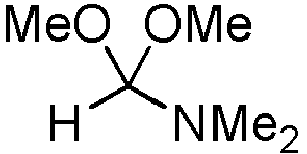


Amin NMe3 EtNMe2 

5%Pd/C 60 % 84 % 74 % 80 % 5%Pd/Al2O3 70 % 99 % 64 % 50 % 5%Pd/CaCO3 74 % 93 % 69 % 40 % 5%Pt/C 78 % 82 % 99 % 82 % 5%Ru/Al2O3 83 % 80 % 76 % 22 % [(dppb)Rh(cod)]BF4 96 % 97 % 95 % 97 % - In einem Autoklav wird ein Esterimid (25 mmol) in 25 mL absolutem Methanol oder Ethanol gelöst und nach Zugabe von 5% Pt/C (975 mg, 1 mol%) mit Wasserstoff gespült. Anschließend werden 40 bar Wasserstoff aufgepresst, und es wird bei 25°C und konstantem Druck 16 Stunden gerührt. Nach Abtrennen vom Katalysator wird das Filtrat destilliert.
Die Reaktionsbedingungen und Ausbeuten können Tabelle 3 entnommen werden.Tabelle 3: Reaktionsbedingungen und Ausbeuten der Beispiele 26-31. Beispiel Esterimid Produkt Lösemittel Ausbeute, % 26 

EtOH 86 27 

MeOH 84 28 

MeOH 85 29 

- 60 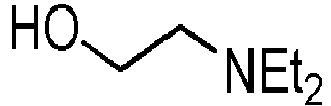
- 19 30 
(C5H11)2NH EtOH 88 31 
Bn2NH EtOH 85 -

- In einem Autoklav wird 2-Dimethylamino-2-ethoxy-1-cyanoethylen (7 g, 50 mmol) in 20 mL absolutem Ethanol gelöst. Nach Zugabe von 5% Pt/C (975 mg, 0.5mol%) wird der Autoklav mit Wasserstoff gespült, anschließend werden 40 bar Wasserstoff aufgepresst, und es wird bei 50°C und konstantem Druck 16 Stunden gerührt. Nach Abfiltrieren vom Katalysator und Abdestillieren des Lösungsmittels wird der Rückstand in Diethylether aufgenommen, mit konzentrierter NaCl-Lösung gewaschen und über MgSO4 getrocknet. Nach Destillieren erhält man 3.1 g (65%) von 3-(Dimethylamino)acrylonitril; Kp = 66°C/0.1mbar, 1H NMR (CD2Cl2) (bevorzugte isomer) δ6.95 (d, J = 13.6, 1H), 3.70 (d, J = 13.5, 1H), 2.86 (br. S, 6H).
Claims (8)
- Verfahren zur Herstellung von Aminen umfassend die folgenden Schritte:a. Umsetzung einesi. Amidacetals der allgemeinen Formel (I),
 R ausgewählt wird aus der Gruppe bestehend aus H, (C1-C24)-Alkyl, (C3-C20)-Cycloalkyl, (C2-C13)-Heterocycloalkyl, (C6-C14)-Aryl oder (C3-C13) -Heteroaryl, CN, COO- (C1-C18) -Alkyl, CONH- (C1-C18) -Alkyl, CF3;R' und R" unabhängig voneinander ausgewählt werden aus der Gruppe (C1-C24)-Alkyl, (C3-C20)-Cycloalkyl, (C2-C13)-Heterocycloalkyl;
undR1 und R2 unabhängig voneinander ausgewählt werden aus der Gruppe bestehend aus H, (C1-C24)-Alkyl, (C3-C8)-Cycloalkyl, (C2-C7)-Heterocycloalkyl, (C6-C14) -Aryl und (C3-C13)-Heteroaryl;wobei auch aus jeweils zwei Resten ausgewählt aus R, R1, R2, R' und R" gemeinsam eine (C2-C8)-Alkylen-Brücke gebildet werden kann, so dass ein Ring mit insgesamt 4-11 Ringatomen entsteht;
oderii. Keten-N,O-acetals der allgemeinen Formel (II), R' ausgewählt wird aus der Gruppe bestehend aus (C1-C24)-Alkyl, (C3-C20)-Cycloalkyl, (C2-C13)-Heterocycloalkyl; undR1, R2 unabhängig voneinander ausgewählt werden aus der Gruppe bestehend aus H, (C1-C24)-Alkyl, (C3-C20)-Cycloalkyl, (C2-C13)-Heterocycloalkyl, (C6-C14) -Aryl und (C3-C13)-Heteroaryl;R3 und R4 unabhängig voneinander ausgewählt werden aus der Gruppe bestehend aus H, (C1-C24)-Alkyl, (C3-C20)-Cycloalkyl, (C2-C13)-Heterocycloalkyl, (C6-C14) -Aryl und (C3-C13)-Heteroaryl, CN, COO-(C1-C18)-Alkyl, CONH-(C1-C18)-Alkyl und CF3,wobei auch aus jeweils zwei Resten ausgewählt aus R1, R2, R3, R4 und R' gemeinsam eine (C2-C8)-Alkylen-Brücke gebildet werden kann, so dass ein Ring mit insgesamt 3-11 Ringatomen entsteht; oderiii. Esterimids der allgemeinen Formel (III)mit H2 in Gegenwart eines Hydrierkatalysators, wobei Katalysator und Amidacetal oder Keten-N,O-acetal oder Esterimid in einem Mol-Verhältnis von 1:10 bis 1:100.000 eingesetzt werden und wobei ein Wasserstoffdruck von 0,1 bar bis 200 bar eingestellt wird und wobei eine Temperatur im Bereich von 0°C bis 250°C eingestellt wird.
 R' ausgewählt wird aus der Gruppe bestehend aus (C1-C24)-Alkyl, (C3-C20)-Cycloalkyl, (C2-C13)-Heterocycloalkyl;R ausgewählt aus der Gruppe bestehend aus H, (C1-C24)-Alkyl, (C3-C20)-Cycloalkyl, (C2-C13)-Heterocycloalkyl, (C6-C14)-Aryl oder (C3-C13)-Heteroaryl, CN, COO-(C1-C18)-Alkyl, CONH-(C1-C18)-Alkyl, CF3;R1 ausgewählt aus der Gruppe bestehend aus H, (C1-C24)-Alkyl, (C3-C20)-Cycloalkyl, (C2-C13)-Heterocycloalkyl, (C6-C14)-Aryl oder (C3-C13)-Heteroaryl;wobei auch aus jeweils zwei Resten ausgewählt aus R, R1 und R' gemeinsam eine (C2-C8)-Alkylen-Brücke gebildet werden kann, so dass ein Ring mit insgesamt 4-11 Ringatomen entsteht;
 - Verfahren gemäß Anspruch 1, wobei der Hydrierkatalysator mindestens ein aktives Metall enthält.
- Verfahren gemäß Anspruch 2, wobei das aktive Metall ein Metall der Gruppe VII B und/oder VIII B des Periodensystems der Elemente ist.
- Verfahren gemäß einem der Ansprüche 1-3, wobei die Umsetzung in einem Lösungsmittel durchgeführt wird.
- Verfahren gemäß Anspruch 4, wobei das Lösungsmittel ausgewählt wird aus der Gruppe bestehend aus Kohlenwasserstoffen, Chlorkohlenwasserstoffen, Ethern, Estern und Alkoholen.
- Verfahren gemäß Anspruch 5, wobei wasserfreies Lösungsmittel eingesetzt wird.
- Verfahren gemäß einem der Ansprüche 1-3, wobei die Umsetzung ohne Lösungsmittel durchgeführt wird.
- Amin erhältlich durch ein Verfahren gemäß einem der Ansprüche 1-7.
Priority Applications (6)
| Application Number | Priority Date | Filing Date | Title |
|---|---|---|---|
| EP20130191498 EP2868652A1 (de) | 2013-11-05 | 2013-11-05 | Katalytische Hydrierung zur Herstellung von Aminen aus Amidacetalen, Keten-N,O-acetalen oder Esterimiden |
| US15/034,135 US9890108B2 (en) | 2013-11-05 | 2014-10-15 | Catalytic hydrogenation for the preparation of amines from amide acetals, ketene N, O-acetals or ester imides |
| CN201480060764.8A CN105873897B (zh) | 2013-11-05 | 2014-10-15 | 用于从酰胺缩醛、烯酮n,o-缩醛或酯酰亚胺制备胺的催化加氢 |
| JP2016550969A JP6483145B2 (ja) | 2013-11-05 | 2014-10-15 | アミドアセタール、ケテン−n,o−アセタール、又はエステルイミドからアミンを製造するための接触水素化 |
| PCT/EP2014/072109 WO2015067448A1 (de) | 2013-11-05 | 2014-10-15 | Katalytische hydrierung zur herstellung von aminen aus amidacetalen, keten-n, o-acetalen oder esterimiden |
| EP14787131.3A EP3066070B1 (de) | 2013-11-05 | 2014-10-15 | Katalytische hydrierung zur herstellung von aminen aus amidacetalen, keten-n, o-acetalen oder esterimiden |
Applications Claiming Priority (1)
| Application Number | Priority Date | Filing Date | Title |
|---|---|---|---|
| EP20130191498 EP2868652A1 (de) | 2013-11-05 | 2013-11-05 | Katalytische Hydrierung zur Herstellung von Aminen aus Amidacetalen, Keten-N,O-acetalen oder Esterimiden |
Publications (1)
| Publication Number | Publication Date |
|---|---|
| EP2868652A1 true EP2868652A1 (de) | 2015-05-06 |
Family
ID=49554032
Family Applications (2)
| Application Number | Title | Priority Date | Filing Date |
|---|---|---|---|
| EP20130191498 Withdrawn EP2868652A1 (de) | 2013-11-05 | 2013-11-05 | Katalytische Hydrierung zur Herstellung von Aminen aus Amidacetalen, Keten-N,O-acetalen oder Esterimiden |
| EP14787131.3A Not-in-force EP3066070B1 (de) | 2013-11-05 | 2014-10-15 | Katalytische hydrierung zur herstellung von aminen aus amidacetalen, keten-n, o-acetalen oder esterimiden |
Family Applications After (1)
| Application Number | Title | Priority Date | Filing Date |
|---|---|---|---|
| EP14787131.3A Not-in-force EP3066070B1 (de) | 2013-11-05 | 2014-10-15 | Katalytische hydrierung zur herstellung von aminen aus amidacetalen, keten-n, o-acetalen oder esterimiden |
Country Status (5)
| Country | Link |
|---|---|
| US (1) | US9890108B2 (de) |
| EP (2) | EP2868652A1 (de) |
| JP (1) | JP6483145B2 (de) |
| CN (1) | CN105873897B (de) |
| WO (1) | WO2015067448A1 (de) |
Families Citing this family (2)
| Publication number | Priority date | Publication date | Assignee | Title |
|---|---|---|---|---|
| EP2868643A1 (de) | 2013-11-05 | 2015-05-06 | Evonik Industries AG | Katalytische Hydrierung zur Herstellung von Aminen aus Carbonsäureamiden, Carbonsäurediamiden, Di-, Tri- oder Polypeptiden oder Peptidamiden |
| EP3202758A1 (de) | 2016-02-03 | 2017-08-09 | Evonik Degussa GmbH | Reduktive alkylierung von aminen mit orthocarbonsäureestern |
Citations (1)
| Publication number | Priority date | Publication date | Assignee | Title |
|---|---|---|---|---|
| DE604277C (de) | 1933-03-17 | 1934-10-18 | Kohlentechnik M B H Ges | Verfahren zur Herstellung der Hydrochloride von Aminen oder Aminosaeureestern |
Family Cites Families (5)
| Publication number | Priority date | Publication date | Assignee | Title |
|---|---|---|---|---|
| DE604227C (de) * | ||||
| DE2453055C3 (de) * | 1974-11-08 | 1979-03-08 | Hoechst Ag, 6000 Frankfurt | Verfahren zur Herstellung von 1,2,4-Triaminobenzolen |
| ES2122905B1 (es) * | 1996-07-11 | 1999-11-16 | Astur Pharma Sa | Sintesis de 11,12-hidrogenoortoborato de 9-desoxo-9a-aza-11,12-desoxi-9a-metil-9a-homoeritromicina a. un procedimiento para la preparacion de 9-desoxo-9a-aza-9a-metil-9a-homoeritromicina a dihidrato (azitromicina dihidrato). |
| US9290441B2 (en) | 2007-10-30 | 2016-03-22 | Yeda Research And Development Co. Ltd. | Use of ruthenium complexes for formation and/or hydrogenation of amides and related carboxylic acid derivatives |
| EP2868643A1 (de) | 2013-11-05 | 2015-05-06 | Evonik Industries AG | Katalytische Hydrierung zur Herstellung von Aminen aus Carbonsäureamiden, Carbonsäurediamiden, Di-, Tri- oder Polypeptiden oder Peptidamiden |
-
2013
- 2013-11-05 EP EP20130191498 patent/EP2868652A1/de not_active Withdrawn
-
2014
- 2014-10-15 EP EP14787131.3A patent/EP3066070B1/de not_active Not-in-force
- 2014-10-15 WO PCT/EP2014/072109 patent/WO2015067448A1/de not_active Ceased
- 2014-10-15 CN CN201480060764.8A patent/CN105873897B/zh not_active Expired - Fee Related
- 2014-10-15 US US15/034,135 patent/US9890108B2/en not_active Expired - Fee Related
- 2014-10-15 JP JP2016550969A patent/JP6483145B2/ja not_active Expired - Fee Related
Patent Citations (1)
| Publication number | Priority date | Publication date | Assignee | Title |
|---|---|---|---|---|
| DE604277C (de) | 1933-03-17 | 1934-10-18 | Kohlentechnik M B H Ges | Verfahren zur Herstellung der Hydrochloride von Aminen oder Aminosaeureestern |
Non-Patent Citations (6)
| Title |
|---|
| G. SIMCHEN, METHODEN ORG. CHEM., vol. E5/1, 1985, pages 1 - 192 |
| M. STEIN; B. BREIT, ANGEW. CHEM., vol. 125, 2013, pages 2287 - 2290 |
| MARIO STEIN ET AL: "Catalytic Hydrogenation of Amides to Amines under Mild Conditions", ANGEWANDTE CHEMIE INTERNATIONAL EDITION, vol. 52, no. 8, 18 February 2013 (2013-02-18), pages 2231 - 2234, XP055107456, ISSN: 1433-7851, DOI: 10.1002/anie.201207803 * |
| N. NAKAJIMA; M. UBUKATA, SCIENCE OF SYNTHESIS, vol. 22, 2005, pages 343 - 360 |
| S. NISHIMURA: "Handbook of Heterogeneous Catalytic Hydrogenation for Organic Synthesis", 2001, WILEY, pages: 406 - 411 |
| SASHIDA H ET AL: "STUDIES ON DIAZEPINES. XXIX.1) SYNTHESIS OF 3H- AND 5H-1,4-BENZODIAZEPINES FROM 3-AZIDOQUINOLINES", CHEMICAL AND PHARMACEUTICAL BULLETIN, PHARMACEUTICAL SOCIETY OF JAPAN, JP, vol. 10, no. 35, 1 January 1987 (1987-01-01), pages 4110 - 4116, XP001084322, ISSN: 0009-2363 * |
Also Published As
| Publication number | Publication date |
|---|---|
| CN105873897B (zh) | 2018-06-15 |
| EP3066070A1 (de) | 2016-09-14 |
| JP2016536358A (ja) | 2016-11-24 |
| US9890108B2 (en) | 2018-02-13 |
| EP3066070B1 (de) | 2019-07-17 |
| JP6483145B2 (ja) | 2019-03-13 |
| WO2015067448A1 (de) | 2015-05-14 |
| US20160264513A1 (en) | 2016-09-15 |
| CN105873897A (zh) | 2016-08-17 |
Similar Documents
| Publication | Publication Date | Title |
|---|---|---|
| EP1414783B1 (de) | Verfahren zur herstellung von aminen durch reduktive aminierung von carbonylverbindungen unter transfer-hydrierungsbedingungen | |
| WO2008116799A1 (de) | Verfahren zur herstellung von ameisensäure | |
| DE602004008478T2 (de) | Biphosphinrutheniumkomplexe mit chiralen diaminliganden als katalysatoren | |
| EP3066070B1 (de) | Katalytische hydrierung zur herstellung von aminen aus amidacetalen, keten-n, o-acetalen oder esterimiden | |
| EP0869113B1 (de) | Verfahren zur Herstellung tertiärer Amine aus Nitrilen und sekundären Aminen | |
| DE69614899T2 (de) | Verfahren zur Herstellung von Aryl-alkyl-hydroperoxiden | |
| DE102012019441A1 (de) | Verfahren zur Herstellung von Formamidverbindungen | |
| DE2357370A1 (de) | Verfahren zur herstellung aromatischer hydroxylamine in gegenwart von katalysatoren | |
| EP1235775B1 (de) | Verfahren zur isomerisierung von allylalkoholen | |
| EP0397042B1 (de) | Herstellung von Isochinolinderivaten | |
| DE112024000946T5 (de) | Phosphinliganden und deren Verwendung zur Carbonylierung von Acetylen/Ethylen zur Synthese von Acrylat-/Propionatestern | |
| DE2455238A1 (de) | Verfahren zur herstellung aromatischer hydroxylamine durch hydrierung aromatischer nitroderivate | |
| EP3066065B1 (de) | Katalytische hydrierung zur herstellung von aminen aus carbonsäureamiden, carbonsäurediamiden, di-, tri- oder polypeptiden oder peptidamiden | |
| DE2404306C3 (de) | Optisch aktive Pinanderivate | |
| DE2630562C2 (de) | Verfahren zur katalytischen Hydrierung von Perfluoralkyl-substituierten Anilinen | |
| EP3202758A1 (de) | Reduktive alkylierung von aminen mit orthocarbonsäureestern | |
| AT400435B (de) | Verfahren zur herstellung von n-(2-amino-3,5- dibrom-benzyl)-trans-4-aminocyclohexanol | |
| DE3843390A1 (de) | Verfahren zur herstellung von optisch aktiven (alpha)-aminoacetalen | |
| DE60002523T2 (de) | Racemisierung von optisch aktiven Alkoxyaminen | |
| EP0051805B1 (de) | Verfahren zur Herstellung von aromatischen Aminen | |
| DE19907829C2 (de) | Verfahren zur Herstellung von cis-2,6-Dimethylpiperazin | |
| DE4210311A1 (de) | Verfahren zur Herstellung von Aminen aus Azinen | |
| DE1230791B (de) | Verfahren zur Herstellung von Carbodiimiden | |
| DE1279026B (de) | Verfahren zur Herstellung von 1-Hydroxy-2-naphthamidderivaten | |
| DE1668626C3 (de) |
Legal Events
| Date | Code | Title | Description |
|---|---|---|---|
| PUAI | Public reference made under article 153(3) epc to a published international application that has entered the european phase |
Free format text: ORIGINAL CODE: 0009012 |
|
| 17P | Request for examination filed |
Effective date: 20131105 |
|
| AK | Designated contracting states |
Kind code of ref document: A1 Designated state(s): AL AT BE BG CH CY CZ DE DK EE ES FI FR GB GR HR HU IE IS IT LI LT LU LV MC MK MT NL NO PL PT RO RS SE SI SK SM TR |
|
| AX | Request for extension of the european patent |
Extension state: BA ME |
|
| RAP1 | Party data changed (applicant data changed or rights of an application transferred) |
Owner name: EVONIK DEGUSSA GMBH |
|
| STAA | Information on the status of an ep patent application or granted ep patent |
Free format text: STATUS: THE APPLICATION IS DEEMED TO BE WITHDRAWN |
|
| 18D | Application deemed to be withdrawn |
Effective date: 20151107 |