EP2868760B1 - Feuille d'alliage d'aluminium pour moulage par soufflage et procédé de production correspondant - Google Patents
Feuille d'alliage d'aluminium pour moulage par soufflage et procédé de production correspondant Download PDFInfo
- Publication number
- EP2868760B1 EP2868760B1 EP13809532.8A EP13809532A EP2868760B1 EP 2868760 B1 EP2868760 B1 EP 2868760B1 EP 13809532 A EP13809532 A EP 13809532A EP 2868760 B1 EP2868760 B1 EP 2868760B1
- Authority
- EP
- European Patent Office
- Prior art keywords
- aluminum alloy
- blow forming
- mass
- less
- aluminum
- Prior art date
- Legal status (The legal status is an assumption and is not a legal conclusion. Google has not performed a legal analysis and makes no representation as to the accuracy of the status listed.)
- Active
Links
Images
Classifications
-
- C—CHEMISTRY; METALLURGY
- C22—METALLURGY; FERROUS OR NON-FERROUS ALLOYS; TREATMENT OF ALLOYS OR NON-FERROUS METALS
- C22F—CHANGING THE PHYSICAL STRUCTURE OF NON-FERROUS METALS AND NON-FERROUS ALLOYS
- C22F1/00—Changing the physical structure of non-ferrous metals or alloys by heat treatment or by hot or cold working
- C22F1/04—Changing the physical structure of non-ferrous metals or alloys by heat treatment or by hot or cold working of aluminium or alloys based thereon
- C22F1/043—Changing the physical structure of non-ferrous metals or alloys by heat treatment or by hot or cold working of aluminium or alloys based thereon of alloys with silicon as the next major constituent
-
- C—CHEMISTRY; METALLURGY
- C22—METALLURGY; FERROUS OR NON-FERROUS ALLOYS; TREATMENT OF ALLOYS OR NON-FERROUS METALS
- C22C—ALLOYS
- C22C21/00—Alloys based on aluminium
-
- C—CHEMISTRY; METALLURGY
- C22—METALLURGY; FERROUS OR NON-FERROUS ALLOYS; TREATMENT OF ALLOYS OR NON-FERROUS METALS
- C22C—ALLOYS
- C22C21/00—Alloys based on aluminium
- C22C21/02—Alloys based on aluminium with silicon as the next major constituent
-
- C—CHEMISTRY; METALLURGY
- C22—METALLURGY; FERROUS OR NON-FERROUS ALLOYS; TREATMENT OF ALLOYS OR NON-FERROUS METALS
- C22C—ALLOYS
- C22C21/00—Alloys based on aluminium
- C22C21/02—Alloys based on aluminium with silicon as the next major constituent
- C22C21/04—Modified aluminium-silicon alloys
-
- C—CHEMISTRY; METALLURGY
- C22—METALLURGY; FERROUS OR NON-FERROUS ALLOYS; TREATMENT OF ALLOYS OR NON-FERROUS METALS
- C22C—ALLOYS
- C22C21/00—Alloys based on aluminium
- C22C21/06—Alloys based on aluminium with magnesium as the next major constituent
- C22C21/08—Alloys based on aluminium with magnesium as the next major constituent with silicon
-
- C—CHEMISTRY; METALLURGY
- C22—METALLURGY; FERROUS OR NON-FERROUS ALLOYS; TREATMENT OF ALLOYS OR NON-FERROUS METALS
- C22F—CHANGING THE PHYSICAL STRUCTURE OF NON-FERROUS METALS AND NON-FERROUS ALLOYS
- C22F1/00—Changing the physical structure of non-ferrous metals or alloys by heat treatment or by hot or cold working
-
- C—CHEMISTRY; METALLURGY
- C22—METALLURGY; FERROUS OR NON-FERROUS ALLOYS; TREATMENT OF ALLOYS OR NON-FERROUS METALS
- C22F—CHANGING THE PHYSICAL STRUCTURE OF NON-FERROUS METALS AND NON-FERROUS ALLOYS
- C22F1/00—Changing the physical structure of non-ferrous metals or alloys by heat treatment or by hot or cold working
- C22F1/04—Changing the physical structure of non-ferrous metals or alloys by heat treatment or by hot or cold working of aluminium or alloys based thereon
-
- C—CHEMISTRY; METALLURGY
- C22—METALLURGY; FERROUS OR NON-FERROUS ALLOYS; TREATMENT OF ALLOYS OR NON-FERROUS METALS
- C22F—CHANGING THE PHYSICAL STRUCTURE OF NON-FERROUS METALS AND NON-FERROUS ALLOYS
- C22F1/00—Changing the physical structure of non-ferrous metals or alloys by heat treatment or by hot or cold working
- C22F1/04—Changing the physical structure of non-ferrous metals or alloys by heat treatment or by hot or cold working of aluminium or alloys based thereon
- C22F1/047—Changing the physical structure of non-ferrous metals or alloys by heat treatment or by hot or cold working of aluminium or alloys based thereon of alloys with magnesium as the next major constituent
-
- C—CHEMISTRY; METALLURGY
- C22—METALLURGY; FERROUS OR NON-FERROUS ALLOYS; TREATMENT OF ALLOYS OR NON-FERROUS METALS
- C22F—CHANGING THE PHYSICAL STRUCTURE OF NON-FERROUS METALS AND NON-FERROUS ALLOYS
- C22F1/00—Changing the physical structure of non-ferrous metals or alloys by heat treatment or by hot or cold working
- C22F1/04—Changing the physical structure of non-ferrous metals or alloys by heat treatment or by hot or cold working of aluminium or alloys based thereon
- C22F1/05—Changing the physical structure of non-ferrous metals or alloys by heat treatment or by hot or cold working of aluminium or alloys based thereon of alloys of the Al-Si-Mg type, i.e. containing silicon and magnesium in approximately equal proportions
Definitions
- the present disclosure relates to an aluminum alloy plate for blow forming having good mold release properties, surface properties and corrosion resistance and capable of providing a high strength after age hardening heat treatment, for use in the blow forming of aluminum alloy plates having a low high-temperature strength, in which deformation of formed articles upon release from molds poses a major challenge; and to a method for producing the same.
- the blow forming is a forming method which takes the advantage of the fact, in particular, that aluminum shows a markedly high ductility at high temperature, referred to as super-plasticity.
- an aluminum plate is usually sandwiched between heated upper and lower molds, and after heating the aluminum plate, the plate is pressurized with high pressure gas, to be formed into the shape of the forming mold.
- the use of blow forming not only allows utilizing the high temperature ductility of aluminum so that aluminum can be formed into complex shapes, which is very difficult to achieve with cold press forming, but also makes aluminum suitable for processing of parts having high design properties, utilizing the excellent transferability to a mold due to the low deformation resistance of aluminum.
- the blow forming often requires only one side of the molds and the cost of the mold is low compared with that of cold press forming. Therefore, the blow forming is often used for processing of various kinds of small-lot parts.
- Aluminum alloys for blow forming consisting essentially of 6000 series aluminum alloys have been developed in recent years, as described in Patent Literature 1 to Patent Literature 3.
- Aluminum alloys for blow forming consisting essentially of 6000 series aluminum alloys are suitable for general parts application, since these alloys are excellent in corrosion resistance and weldability, and also in recycling properties due to the low contents of added alloy elements. At the same time, these alloys are capable of providing a strength equal to or greater than that of 5000 series aluminum alloys through aging heat treatment after the blow forming, so that thinner and lighter weight products can be obtained.
- Patent Literature 1 to Patent Literature 3 are silent about the deformation resistance at high temperature and the mold release properties of the aluminum alloys described therein, and therefore, the shape accuracy of the blow formed article made therefrom is not assured.
- Patent Literature 4 Although there is a method for preventing adhesion between the material and the mold after forming by applying a mold releasing agent, as described in Patent Literature 4, the use of this method has led to an increase in the cost, because not only the amount of the mold releasing agent used increases with an increase in the production quantity of parts, but also steps of applying the mold releasing agent and washing are required.
- Patent Literature 5 there also is a method in which sol or water glass of metallic oxides is applied to the aluminum alloy plate instead of mold releasing agent in order to improve the mold release properties.
- sol or water glass of metallic oxides is detached from the mold during the blow forming due to the sliding against the mold, and there is a possibility that not only the surface condition of the aluminum alloy material may deteriorate, but also the detached sol or water glass of metallic oxides may deposit on the mold.
- introduction of a new step of applying sol or water glass of metallic oxides to the aluminum alloy plate was necessary. As described above, it was difficult to stably produce formed articles that are excellent in shape and accuracy, using materials for blow forming consisting essentially of conventional 6000 series aluminum alloys.
- An objective of the disclosure is to provide an aluminum alloy plate for blow forming having good mold release properties, surface properties and corrosion resistance and capable of providing a high strength after age hardening heat treatment, without causing the deterioration of the surface properties of materials or of molds after blow forming; and to provide a method for producing the same.
- the present disclosure provides an aluminum alloy plate for blow forming, the alloy comprising:
- the aluminum alloy plate for blow forming may further comprise 0.05% by mass or more and 0.3% by mass or less of Cr.
- the aluminum alloy plate for blow forming may further comprise 0.1% by mass or more and 0.4% by mass or less of Cu.
- X may satisfy the relation: 0.10 ⁇ X in one surface of the aluminum alloy plate for blow forming;
- X may satisfy the relation: 0 ⁇ X ⁇ 0.10 in the other surface of the aluminum alloy plate for blow forming.
- the balance of the aluminum alloy plate for blow forming may consist essentially of aluminum and unavoidable impurities.
- the present disclosure provides a method for producing an aluminum alloy plate for blow forming, the method comprising the steps of:
- the step of cold rolling in the method for producing an aluminum alloy plate for blow forming may comprise the step of performing intermediate annealing of the aluminum alloy at a temperature of 500°C or more and less than the melting point of the aluminum alloy.
- the aluminum alloy may be cold rolled using two rolls having different surface properties.
- the aluminum alloy may be cold rolled using two rolls having different surface properties such that
- X satisfies the relation: 0.10 ⁇ X in one surface of the aluminum alloy, and X satisfies the relation: 0 ⁇ X ⁇ 0.10 in the other surface of the aluminum alloy.
- the present disclosure provides an aluminum alloy plate for blow forming produced by the method for producing an aluminum alloy plate for blow forming.
- the present disclosure serves to provide an aluminum alloy plate for blow forming having good mold release properties, surface properties and corrosion resistance and capable of providing a high strength after age hardening heat treatment, without causing the deterioration of the surface properties of materials or of molds after blow forming; and to provide a method for producing the same.
- the present inventors have considered that there is a close relationship between the high-temperature strength and the surface properties of the 6000 series aluminum alloy plate with the mold release properties thereof, and performed various experiments and examination, controlling the surface properties of the aluminum alloy plate for blow forming through final cold rolling.
- the present inventors have found that, in cases where valleys of certain depth exist on the surface of the aluminum alloy plate for blow forming before blow forming, the valleys remain after the blow forming, and serves to avoid the adhesion to the mold.
- the inventors have also found that increasing the high-temperature strength during the blow forming serves to reduce the ratio of tightly adhered regions between the surface of the aluminum alloy for blow forming and the mold, and is effective in improving the mold release properties.
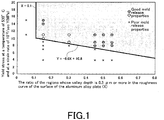
- the present inventors have performed experiments to identify the relationship between the surface properties, high-temperature strength, and mold release properties ( FIG. 1 ), and have optimized the surface properties through adjusting the contents of alloy components such as Mg, Si and Mn, and the final rolling, thereby inventing an aluminum alloy plate for blow forming which is excellent in all of the mold release properties, age hardenability and corrosion resistance, and is suitable for general parts.
- Mg and Si are essential components of the aluminum alloy plate for blow forming according to the embodiment of the present disclosure, and are necessary for securing the super-plastic formability required for blow forming, and for the aluminum alloy plate for blow forming according to the embodiment of the present disclosure to obtain a strength equal to or greater than that of 5000 series aluminum alloys through age hardening treatment. If the Mg content in the aluminum alloy is less than 0.3% by mass, and the Si content in the aluminum alloy is less than 0.6% by mass, the above described effect will be poor. If the Mg content in the aluminum alloy is more than 1.8% by mass, and the Si content in the aluminum alloy is more than 1.6% by mass, securing of the age hardenability of the aluminum alloy for blow forming becomes difficult.
- the Mg content in the aluminum alloy is within the range of 0.3% by mass or more and 1.8% by mass or less, and the Si content in the aluminum alloy is within the range of 0.6% by mass or more and 1.6% by mass or less.
- Mn is effective in increasing the high-temperature strength of the 6000 series aluminum alloys constituting the aluminum alloy for blow forming according to the embodiment of the present disclosure, without compromising the corrosion resistance thereof. Further, the addition of Mn has an effect of inhibiting the abnormal grain growth in the aluminum alloy after the blow forming. If the Mn content in the aluminum alloy is less than 0.2% by mass, the effect of increasing the high-temperature strength becomes poor. On the other hand, the addition of a large amount of Mn to the aluminum alloy decreases the age hardenability of the aluminum alloy, and a Mn content in the aluminum alloy exceeding 1.2% by mass complicates the securing of the age hardenability of the aluminum alloy plate for blow forming. Therefore, the Mn content in the aluminum alloy plate for blow forming according to the embodiment of the present disclosure is within the 0.2% by mass or more and 1.2% by mass or less.
- Cr has the same effect as Mn, and can be added to the aluminum alloy for blow forming as necessary. If the Cr content in the aluminum alloy is 0.05% by mass or more, the effect of increasing the high-temperature strength of the aluminum alloy plate for blow forming can be improved. If the Cr content in the aluminum alloy is 0.3% by mass or less, the age hardenability of the aluminum alloy plate for blow forming can be further secured. In other words, the Cr content in the aluminum alloy according to the embodiment of the present disclosure is selected as appropriate within the range in which the effect of the disclosure is exhibited, and is more preferably 0.05% by mass or more and 0.3% by mass or less, but not limited thereto.
- the Cu serves to improve the age hardenability, and may be added to the aluminum alloy for blow forming as necessary. If the Cu content in the aluminum alloy is 0.1% by mass or more, the effect of increasing the strength of the aluminum alloy for blow forming can be obtained sufficiently. If the Cu content in the aluminum alloy is 0.4% by mass or less, a better corrosion resistance of the aluminum alloy for blow forming can be maintained, and the alloy can be suitably used as materials for general parts. In other words, the Cu content in the aluminum alloy according to the embodiment of the present disclosure is selected as appropriate within the range in which the effect of the disclosure is exhibited, and is preferably 0.1% by mass or more and 0.4% by mass or less, but not limited thereto.
- the balance of the aluminum alloy constituting the aluminum alloy plate for blow forming according to the embodiment of the present disclosure consists essentially of aluminum and unavoidable impurities such as Fe.
- the content of each of unavoidable impurities is selected as appropriate within the range in which the effect of the disclosure is not compromised.
- the method for producing the aluminum alloy plate for blow forming according to the embodiment of the present disclosure will now be described.
- the 6000 series aluminum alloy plate constituting the aluminum alloy plate for blow forming according to the embodiment of the present disclosure is produced, for example, through each of the melt casting step, homogenizing step, hot rolling step, and cold rolling step.
- Melt casting is carried out by a common method, such as DC (Direct Chill) casting method. It is more preferred that a higher cooling rate be used in order to increase the amount of Mn and Cr solid-dissolved into the aluminum alloy.
- DC Direct Chill
- an ingot of the aluminum alloy obtained by the melt casting is heated and subjected to homogenization treatment.
- the heating temperature be set at 500°C or more and less than the melting point temperature of the aluminum alloy according to the embodiment of the present disclosure (for example, about 580°C).
- a heating temperature of 500°C or more promotes the re-solid-dissolution of Mn-, Cr-based crystallized products, and facilitates the securing of the solid-dissolved amount of the Mn and Cr in the aluminum alloy.
- the use of a heating temperature of less than the melting point temperature of the aluminum alloy according to the embodiment of the present disclosure serves to prevent the melting of the aluminum alloy.
- the aluminum alloy After performing the homogenization treatment, the aluminum alloy is subjected to hot rolling.
- the material temperature of the aluminum alloy during the hot rolling is preferably within the range of 200°C or more and 400°C or less. If the material temperature of the aluminum alloy during hot rolling is 400°C or less, the deposition of Mn and Cr can be minimized and the amount of solid-dissolution thereof can be secured.
- the above material temperature is effective in refining the hot-rolled microstructure, and contributes to the improvement of the formability and the surface properties of the aluminum alloy for blow forming. Further, a material temperature of 200°C or more serves to reduce the deformation resistance of the aluminum alloy material for blow forming, and the rolling can be performed with further ease.
- the aluminum alloy for blow forming is subjected to cold rolling, until the alloy reaches the final plate thickness. It is more preferred that the intermediate annealing be performed once or twice during the cold rolling. By performing the intermediate annealing, Mn- and Cr-based intermetallic compounds refined by the cold rolling become more susceptible to re-solid-dissolution. In addition, equiaxialization of the flattened crystal grain structure is promoted, and the formability and the surface properties of the aluminum alloy for blow forming can further be improved. If the intermediate annealing temperature is, for example, 500°C or more, the re-solid-dissolution of the Mn-, Cr- based intermetallic compounds can be further promoted.
- the melting of the aluminum alloy can further be inhibited.
- the final plate thickness of the aluminum alloy plate after cold rolling is selected as appropriate within the range in which the effect of the disclosure is exhibited, and, for example, a final plate thickness within the range of 0.2 mmt or more and 3.0 mmt or less is suitably used; and a final plate thickness within the range of 0.8 mmt or more and 1.6 mmt or less is more suitably used, but not limited thereto.
- the aluminum alloy plate for blow forming it is possible to perform solution treatment by the heating applied during the blow forming. Therefore, it is more preferred that the aluminum alloy plate be used as it is after the cold rolling, without being subjected to the final annealing. Thus, the step of final annealing can be omitted to achieve further reduction in the manufacturing cost.
- the aluminum alloy plate for blow forming according to the embodiment of the present disclosure can be obtained by the steps described above.
- the surface properties of the aluminum alloy plate for blow forming be controlled by adjusting the surface properties of the rolls used in the final cold rolling.
- the control of the surface properties of the aluminum alloy plate for blow forming by adjusting the surface properties of the rolls used in the cold rolling will now be described.
- the surface properties of the surface, which comes in contact with the mold upon blow forming, of the material of the aluminum alloy plate for blow forming is adjusted such that, when X represents the ratio of the regions whose valley depth is 0.3 ⁇ m or more in the cross section perpendicular to the rolling direction of the aluminum alloy plate for blow forming, X satisfies the relation: 0.10 ⁇ X.
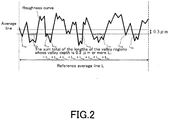
- the valley depth herein refers to the depth of a cavity in the material relative to the average line, in the roughness curve in which the long wavelength components (average line) are subtracted from the measured profile curve, according to JISB0601:'01 (see FIG.2 ).
- the surface roughness is measured, for example, using a surface roughness measuring device or the like.
- L represents the reference length of the average line
- L 1 represents the sum total of the horizontal lengths of the regions whose valley depth is 0.3 ⁇ m or more
- the cavities whose depth is 0.3 ⁇ m or more present on the surface of the aluminum alloy plate before blow forming still exist after the blow forming, and serves to reduce the contact area between the aluminum alloy and the mold, thereby improving the mold release properties of the aluminum alloy for blow forming.
- X is 0.10 or more, the adhesion between the mold and the aluminum alloy plate for blow forming can be inhibited, and good mold release properties of the aluminum alloy plate for blow forming from the mold can be obtained. If X > 0.50, the mold releasing effect tends to be saturated, and if X ⁇ 0.50, better surface properties of the aluminum alloy plate for blow forming can be obtained.
- the present embodiment describes the case in which X in the cross section perpendicular to the rolling direction, where the surface roughness is typically high, is used, the same effect can be obtained using X in cross sections in other directions, as long as X satisfies the above condition. Therefore, the cases in which X satisfies the above condition (X is 0.10 or more) in cross sections in other directions also fall within the present disclosure.
- the high-temperature strength of the aluminum alloy for blow forming also correlates with the mold release properties.
- the present inventors have found, as a results of experiments, that when Y(MPa), representing the yield stress at a temperature of 530°C and at a strain rate of 10 -2 /sec which are the typical blow forming conditions of 6000 series aluminum alloys, satisfies the relation: Y ⁇ -8.0X + 10.8, good mold release properties of the aluminum alloy for blow forming is obtained ( FIG.1 ).
- the yield stress can be measured, for example, using a tensile tester or the like.
- the aluminum alloy plate for blow forming when X represents the ratio of the regions whose valley depth is 0.3 ⁇ m or more, X satisfies both the relation: 0.10 ⁇ X, and the relation: Y ⁇ -8.0X + 10.8. Therefore, the aluminum alloy plate for blow forming having good mold release properties, surface properties and corrosion resistance, and having a high strength after age hardening heat treatment can be obtained.
- the surface properties of one surface and the surface properties of the other surface of the aluminum alloy for blow forming be controlled independently, so that the one surface in which the surface properties is controlled to have good mold release properties corresponds with the surface which comes in contact with the mold; and the surface which does not come in contact with the mold (the other surface) corresponds with the outer surface of the formed article which is exposed to the public view.
- the surface properties of the both surfaces of the aluminum alloy for blow forming can be controlled independently.
- the blow forming be performed at a temperature of not less than 500°C, which is the solution treatment temperature, and less than the melting point of the aluminum alloy plate for blow forming.
- the blow forming also serves as a solution treatment step, leading to the reduction of steps.
- the blow forming temperature is 500°C or more, Mg and Si can be sufficiently solid-dissolved, and a sufficient strength due to age hardening can be obtained.
- the blow forming temperature is more preferably 530°C or more. Further, if the blow forming temperature of the aluminum alloy plate for blow forming is less than the melting point temperature, the melting of the aluminum alloy plate for blow forming can be prevented.
- the gas pressure in the blow forming is, for example, within the range of 0.5 MPa or more and 5 MPa or less, a higher ductility can be obtained and the forming of the aluminum alloy for blow forming is further facilitated.
- a cooling rate of, for example, 3°C/sec or more after the blow forming and by immediately performing the age hardening treatment at a temperature of 170°C or more and 230°C or less, a higher strength can be obtained.
- a formed article be cooled using a large fan or the like after the blow forming, then the formed article be immediately placed in an air furnace controlled at a temperature of 170°C or more and 230°C or less, and the heating be performed for 2 minutes or more, depending on the forming time.
- evaluation of age hardenability is performed by measuring the 0.2% yield strength after the age hardening using, for example, a tensile tester or the like.
- the 0.2% yield strength refers to the stress at which the permanent strain without the load of the tensile tester or the like is 0.2%.
- the aluminum alloy for blow forming which is excellent in all of the mold release properties, age hardenability, corrosion resistance, and surface appearance can be obtained.
- the present disclosure is not limited to the above described embodiment, and various alterations and applications are possible.
- the above embodiment describes the case in which the intermediate annealing during the cold rolling is performed once or twice, the intermediate annealing may not be performed, or the intermediate annealing may be performed for three times or more.
- the final annealing may be performed after the cold rolling step.
- the above embodiment describes the case in which the aluminum alloy is cold rolled using two rolls having different surface properties in the cold rolling step.
- the method of cold rolling the aluminum alloy is selected as appropriate within the range in which the effect of the disclosure is obtained, and the aluminum alloy may be cold rolled using two rolls having the same surface properties, or the aluminum alloy may be cold rolled using other methods, for example, using more than two rolls, such as 4 rolls or 6 rolls, but not limited thereto.
- the above embodiment describes the case in which X satisfies the relation: 0.10 ⁇ X in one surface of the aluminum alloy, and X satisfies the relation: 0 ⁇ X ⁇ 0.10 in the other surface of the aluminum alloy.
- the relation in one surface of the aluminum alloy and the relation in the other surface aluminum alloy are selected as appropriate within the range in which the effect of the disclosure is obtained, and, for example, the relation in one surface of the aluminum alloy may be X ⁇ 0.10, and the relation in the other surface of the aluminum alloy may be X > 0.10, but not limited thereto.
- each of the aluminum alloys consisting essentially of: alloy components having the composition shown in Table 1; unavoidable impurities; and aluminum; was melted, and cast using a DC casting method.
- each of the ingots of the aluminum alloys was homogenized at a temperature of 550°C. Then the temperature of the each ingot was lowered to 380°C, and hot rolling was performed to achieve a plate thickness of 3 mmt.
- the cold rolling was performed using rolling rolls having different surface roughnesses, and the surface properties (X) of both surfaces of the rolled aluminum alloy plates for blow forming were adjusted.
- the aluminum alloy plates for blow forming of alloy number 1 to alloy number 24 were manufactured, respectively, by the above described manufacturing process.
- Table 1 "-" shows that the component is not contained, or contained only in a slight amount no more than the detection lower limit.
- Each of the rolled aluminum alloy plates for blow forming was subjected to high temperature blow forming, using a mold.
- a mold in the shape of a square cylinder of 300 mm square and 70 mm depth was used, and the blow forming temperature was set to 530°C, the temperature at which the solution treatment of the 6000 series aluminum alloy constituting the aluminum alloy plate for blow forming used in the present Examples can be performed sufficiently.
- the blow forming was performed using a high pressure gas of 2 MPa.
- each of the formed articles was released from the mold. After being released from the mold, the formed article was air-cooled by a fan, and was immediately placed in the air furnace and heated to 180°C to perform age hardening treatment. After heating for one hour, the formed article was removed from the air furnace and allowed to cool. Then a tensile test piece was obtained from the central part of the bottom surface of the formed article, and tensile test was performed using a tensile tester, to measure the 0.2% yield strength.
- X represents the ratio of the regions whose valley depth is 0.3 ⁇ m or more, in the cross section perpendicular to the rolling direction of the aluminum alloy plate for blow forming.
- the valley depth refers to the depth of the cavity in the material relative to the average line, in the roughness curve in which the long wavelength components (average line) are subtracted from the measured profile curve, according to JISB0601:'01.
- L represents the reference length of the average line
- L 1 represents the sum total of the horizontal lengths of the regions whose valley depth is 0.3 ⁇ m or more
- a test piece was obtained from each of the aluminum alloy plates for blow forming before the forming, and L 1 and L of each of the tensile test pieces were measured using a surface roughness measuring device.
- the yield stress Y (MPa) of each of the tensile test pieces under the conditions of a temperature of 530°C and a strain rate of 10 -2 /sec was measured, using a tensile tester.
- the mold release properties of the aluminum alloys were evaluated according to the following standards: " ⁇ , excellent”: The formed article was smoothly released from the mold. “ ⁇ ”: Slight adhesion to the mold was observed, but there was no large deformation in the formed article, “ ⁇ ”: Large deformation was observed in the formed article due to low high-temperature deformation resistance and the strong adhesion to the mold.
- yield strength of the aluminum alloys those having a 0.2% yield strength of 250 MPa or more, which is the strength equal to or greater than that of 5000 series aluminum alloys, were evaluated as " ⁇ ", as having a sufficient age hardenability; and those having a 0.2% yield strength of less than 250 MPa was evaluated as " ⁇ ".
- Example 1 The aluminum alloys for blow forming in Example 1, Examples 3 to 10 and 13 to 14 had good mold release properties and good age hardenability. As shown in Example 2, 13 and 14, it was found that these aluminum alloys have equally good mold release properties and good age hardenability, regardless of the plate thicknesses: 0.8 mmt, 1 mmt, and 1.6 mmt.
- Example 2 and in Examples 11 had better mold release properties and good age hardenability.
- Comparative Example 2 Comparative Example 3
- Comparative Example 12 Comparative Example 13
- a sufficient age hardenability since these alloys had a Mn content of less than 0.2% by mass and a low high-temperature strength, the mold release properties of the alloy were insufficient.
- these aluminum alloys had a sufficient age hardenability regardless of the plate thicknesses: 0.8 mmt, 1 mmt, and 1.6 mmt; but the alloys had insufficient mold release properties because of the low high-temperature strength due to the Mn content being less than 0.2% by mass.
- the aluminum alloy for blow forming in Comparative Example 4 had sufficient mold release properties, but the age hardenability was insufficient, due to the Mn content being more than 1.2% by mass.
- the aluminum alloy for blow forming in Comparative Example 5 had an insufficient blow formability and insufficient mold release properties, due to the Mg content being less than 0.3% by mass.
- the alloy also had an insufficient age hardenability.
- the aluminum alloy for blow forming in Comparative Example 6 had sufficient mold release properties, but the age hardenability was insufficient, due to the Mg content being more than 1.8% by mass.
- the aluminum alloy for blow forming in Comparative Example 7 had insufficient mold release properties and age hardenability, due to the Si content being less than 1.6% by mass.
- the aluminum alloy for blow forming in Comparative Example 9 had a Mg content of less than 0.3% by mass, a Si content of less than 0.6% by mass, and a Mn content of less than 0.2% by mass, the alloy had a low high-temperature strength and large deformation occurred upon release from the mold. The alloy also had an insufficient age hardenability.
- Each of the aluminum alloys for blow forming in Examples 15 to 18 and 26 to 27 was the aluminum alloy of alloy number 1.
- the values of X in Example 15, Example 26 and Example 27 were 0.30; the value of X in Example 16 was 0.45; the value of X in Example 17 was 0.50; and the value of X in Example 18 was X 0.55.
- Table 3 the bigger the value of X, the more improved the mold release properties.
- all of the alloys in Examples 15 to 18 had a good age hardenability.
- Example 15 As shown in the experiment results of Example 15, Example 26 and Example 27, in which the values of X are all 0.30, it was found that these alloys have equally good mold release properties and good age hardenability, regardless of the plate thicknesses: 0.8 mmt, 1 mmt, and 1.6 mmt.
- Each of the aluminum alloys for blow forming in Examples 19 to 22 was the aluminum alloy of alloy number 3.
- the value of X in Example 19 was 0.30; the value of X in Example 20 was 0.45; the value of X in Example 21 was 0.50; and the value of X in Example 22 was 0.55. It was found that although the aluminum alloys for blow forming in Examples 19 to 22 have almost the same high-temperature strength, as shown in Table 3, the mold release properties are more improved as the value of X increases. In addition, all of the alloys in Examples 19 to 22 had a good age hardenability.
- Each of the aluminum alloys for blow forming in Examples 23 to 25 was the aluminum alloy of alloy number 24.
- the value of X in Example 23 was 0.45
- the value of X in Example 24 was 0.50
- the value of X in Example 25 was 0.55. It was found that although the aluminum alloys for blow forming in Examples 23 to 25 have almost the same high-temperature strength, these alloys have better mold release properties due to higher values of X. In addition, all of the alloys in Examples 23 to 25 had a good age hardenability.
- each of the aluminum alloys for blow forming in Comparative Examples 14 to 16 and 23 to 24 was the aluminum alloy of alloy number 22. Since these aluminum alloys had a Mg content of less than 0.3% by mass, a Si content of less than 0.6% by mass, and a Mn content of less than 0.2% by mass, the alloys had a low high-temperature strength; and even with the values of X being 0.45, 0.50 and 0.55, respectively, the mold release properties were insufficient, and deformation occurred upon release from the molds. The alloys also had an insufficient age hardenability.
- the aluminum alloy for blow forming in Comparative Example 17 was the aluminum alloy of alloy number 1; and the aluminum alloy for blow forming in Comparative Example 18 was the aluminum alloy of alloy number 21. Although the high-temperature strength was sufficient in both of the alloys, both values of X were less than 0.1. Therefore, the adhesion between each of the aluminum alloys for blow forming and the molds was strong, resulting in insufficient mold release properties, and thereby in deformation upon release from the mold.
- the aluminum alloy for blow forming in Comparative Example 19 was the aluminum alloy of alloy number 24. Since, Y satisfied the relation: Y ⁇ -8.0 X + 10.8 in the aluminum alloy for blow forming in Comparative Example 19, the alloy had a low high-temperature strength and insufficient mold release properties.
- each of the aluminum alloys for blow forming in Comparative Examples 20 to 22 was the aluminum alloy of alloy number 5. Since these alloys had a Mn content of less than 0.2% by mass and a low high-temperature strength, the mold release properties were insufficient and large deformation occurred in the formed articles. Further, as shown in Comparative Examples 20 to 22, it was found that these alloys have insufficient mold release properties regardless of the plate thicknesses: 0.8 mmt, 1 mmt and 1.6 mmt; resulting in large deformation of the formed articles, since these alloys had a Mn content of less than 0.2% by mass and had a low high-temperature strength.
- the homogenization treatment temperature in the manufacturing process was 500°C or more and less than the melting point temperature of the aluminum alloy for blow forming of alloy number 12. As a result, it was found that the solid-dissolution of Mn is further promoted; the high-temperature strength is increased; and the mold release properties are improved.
- the alloy also had a good age hardenability.
- the aluminum alloy for blow forming in Example 31 had good mold release properties and age hardenability.
- the aluminum alloy for blow forming in Example 32 had good mold release properties and age hardenability.
- Example 33 In the aluminum alloy for blow forming in Example 33, as shown in Table 4, the temperature before hot rolling in the manufacturing process was 200°C or more and 400°C or less. As a result, it was found that the deposition of Mn is further inhibited; the high-temperature strength is further increased; and the mold release properties are improved. The alloy also had a good age hardenability.
- the aluminum alloy for blow forming in Example 34 had good mold release properties and age hardenability.
- the intermediate annealing temperature in the manufacturing process was 500°C or more and less than the melting point temperature of the aluminum alloy for blow forming of alloy number 12. As a result, it was found that the solid-dissolution of Mn is facilitated; the high-temperature strength is increased; and the mold release properties are improved. The alloy also had a good age hardenability.
Landscapes
- Chemical & Material Sciences (AREA)
- Engineering & Computer Science (AREA)
- Materials Engineering (AREA)
- Mechanical Engineering (AREA)
- Metallurgy (AREA)
- Organic Chemistry (AREA)
- Physics & Mathematics (AREA)
- Thermal Sciences (AREA)
- Crystallography & Structural Chemistry (AREA)
- Shaping Metal By Deep-Drawing, Or The Like (AREA)
- Metal Rolling (AREA)
Claims (6)
- Plaque d'alliage d'aluminium pour formage par soufflage, l'alliage comprenant :0,3 % en masse ou plus et 1,8 % en masse ou moins de Mg ;0,6 % en masse ou plus et 1,6 % en masse ou moins de Si ; et0,2 % en masse ou plus et 1,2 % en masse ou moins de Mn ;dans laquelle le reste est constitué d'aluminium et d'impuretés inévitables, et dans au moins une surface de la plaque d'alliage d'aluminium pour formage par soufflage,
X et Y satisfont les relations suivantes : 0,10 ≤ X, et Y ≥ -8,0X + 10,8 ;
dans lesquelles
X représente le rapport des régions dont la profondeur des vallées sur une courbe de rugosité est de 0,3 µm ou plus selon la norme JISB0601 : '01 ; et
Y représente la limite apparente d'élasticité lors de la déformation de la plaque d'alliage d'aluminium pour formage par soufflage dans les conditions de la limite apparente d'élasticité à une température de 530 °C et à une sollicitation de 10-2/s. - Plaque d'alliage d'aluminium pour formage par soufflage selon la revendication 1, comprenant en outre 0,05 % en masse ou plus et 0,3 % en masse ou moins de Cr.
- Plaque d'alliage d'aluminium pour formage par soufflage selon la revendication 1 ou 2, comprenant en outre 0,1 % en masse ou plus et 0,4 % en masse ou moins de Cu.
- Plaque d'alliage d'aluminium pour formage par soufflage selon l'une quelconque des revendications 1 à 3,
dans laquelle X satisfait la relation : 0,10 ≤ X dans une surface de la plaque d'alliage d'aluminium pour formage par soufflage ; et dans laquelle X satisfait la relation : 0 ≤ X ≤ 0,10 dans l'autre surface de la plaque d'alliage d'aluminium pour formage par soufflage. - Procédé de production d'une plaque d'alliage d'aluminium pour formage par soufflage, le procédé comprenant les étapes de :homogénéisation d'un alliage d'aluminium comprenant 0,3 % en masse ou plus et 1,8 % en masse ou moins de Mg, 0,6 % en masse ou plus et 1,6 % en masse ou moins de Si, et 0,2 % en masse ou plus et 1,2 % en masse ou moins de Mn, à une température de 500 °C ou plus et inférieure au point de fusion de l'alliage d'aluminium dont le reste est constitué d'aluminium et d'impuretés inévitables ;laminage à chaud de l'alliage d'aluminium homogénéisé à une température de 200 °C ou plus et de 400 °C ou moins ; etlaminage à froid de l'alliage d'aluminium laminé à chaud,dans laquelle, dans l'étape de laminage à froid, l'alliage d'aluminium est laminé à froid en utilisant deux cylindres ayant différentes propriétés de surface de manière à ce queX représente le rapport des régions dont la profondeur des vallées sur une courbe de rugosité est de 0,3 µm ou plus selon la norme JISB0601 : '01 ; etX satisfasse la relation : 0,10 ≤ X dans une surface de l'alliage d'aluminium, etX satisfasse la relation : 0 ≤ X ≤ 0,10 dans l'autre surface de l'alliage d'aluminium.
- Procédé de production d'une plaque d'alliage d'aluminium pour formage par soufflage selon la revendication 6, dans lequel l'étape de laminage à froid comprend l'étape de réalisation d'un recuit intermédiaire de l'alliage d'aluminium à une température de 500 °C ou plus et inférieure au point de fusion de l'alliage d'aluminium.
Applications Claiming Priority (2)
| Application Number | Priority Date | Filing Date | Title |
|---|---|---|---|
| JP2012144382 | 2012-06-27 | ||
| PCT/JP2013/067568 WO2014003074A1 (fr) | 2012-06-27 | 2013-06-26 | Feuille d'alliage d'aluminium pour moulage par soufflage et procédé de production correspondant |
Publications (3)
| Publication Number | Publication Date |
|---|---|
| EP2868760A1 EP2868760A1 (fr) | 2015-05-06 |
| EP2868760A4 EP2868760A4 (fr) | 2016-04-13 |
| EP2868760B1 true EP2868760B1 (fr) | 2018-09-05 |
Family
ID=49783215
Family Applications (1)
| Application Number | Title | Priority Date | Filing Date |
|---|---|---|---|
| EP13809532.8A Active EP2868760B1 (fr) | 2012-06-27 | 2013-06-26 | Feuille d'alliage d'aluminium pour moulage par soufflage et procédé de production correspondant |
Country Status (5)
| Country | Link |
|---|---|
| US (1) | US10907241B2 (fr) |
| EP (1) | EP2868760B1 (fr) |
| JP (1) | JP6316747B2 (fr) |
| CA (1) | CA2887468C (fr) |
| WO (1) | WO2014003074A1 (fr) |
Families Citing this family (6)
| Publication number | Priority date | Publication date | Assignee | Title |
|---|---|---|---|---|
| JP6345016B2 (ja) * | 2014-07-24 | 2018-06-20 | 株式会社Uacj | 熱間成形用アルミニウム合金板及びその製造方法 |
| CA2958723A1 (fr) * | 2016-02-26 | 2017-08-26 | Uacj Corporation | Plaque d'alliage en aluminium formee a chaud et methode de production associee |
| CN110079709A (zh) * | 2019-05-08 | 2019-08-02 | 常熟希那基汽车零件有限公司 | 一种合金材料及其生产工艺 |
| CN113249621A (zh) * | 2021-04-23 | 2021-08-13 | 上海泽升汽车科技有限公司 | 一种应用于吸能盒的6系铝合金型材及其制备方法 |
| CN113462931A (zh) * | 2021-06-17 | 2021-10-01 | 上海泽升汽车科技有限公司 | 一种应用于电池框的6系铝合金及其制备方法 |
| CN117467876A (zh) * | 2023-11-29 | 2024-01-30 | 中铝材料应用研究院有限公司 | 一种阳极氧化后表面异色改善的5000系铝合金板带材及其制备方法 |
Family Cites Families (9)
| Publication number | Priority date | Publication date | Assignee | Title |
|---|---|---|---|---|
| JPS62202061A (ja) * | 1986-03-03 | 1987-09-05 | Sky Alum Co Ltd | 微細結晶粒を有するアルミニウム合金材料の製造方法 |
| JPH11158485A (ja) | 1997-11-26 | 1999-06-15 | Sky Alum Co Ltd | 超塑性成形用潤滑離型剤 |
| DE10163039C1 (de) * | 2001-12-21 | 2003-07-24 | Daimler Chrysler Ag | Warm- und kaltumformbares Bauteil aus einer Aluminiumlegierung und Verfahren zu seiner Herstellung |
| JP4201745B2 (ja) * | 2004-07-23 | 2008-12-24 | 新日本製鐵株式会社 | 塗装焼付け硬化性に優れた超塑性成形用6000系アルミニウム合金板およびその製造方法 |
| JP2006265723A (ja) | 2005-02-24 | 2006-10-05 | Sumitomo Light Metal Ind Ltd | ブロー成形用熱処理型アルミニウム合金板及びその製造方法 |
| JP2007061842A (ja) | 2005-08-30 | 2007-03-15 | Sumitomo Light Metal Ind Ltd | 熱間ブロー成形用アルミニウム合金板 |
| JP2008062255A (ja) * | 2006-09-05 | 2008-03-21 | Kobe Steel Ltd | キャビティ発生の少ないAl−Mg−Si系アルミニウム合金板の超塑性成形方法およびAl−Mg−Si系アルミニウム合金成形板 |
| JP5260883B2 (ja) * | 2007-04-17 | 2013-08-14 | 株式会社神戸製鋼所 | 温間成形用アルミニウム合金板および温間成形方法 |
| JP5111966B2 (ja) * | 2007-07-26 | 2013-01-09 | 古河スカイ株式会社 | アルミニウム合金パネルの製造方法 |
-
2013
- 2013-06-26 JP JP2014522663A patent/JP6316747B2/ja active Active
- 2013-06-26 US US14/411,229 patent/US10907241B2/en active Active
- 2013-06-26 WO PCT/JP2013/067568 patent/WO2014003074A1/fr not_active Ceased
- 2013-06-26 EP EP13809532.8A patent/EP2868760B1/fr active Active
- 2013-06-26 CA CA2887468A patent/CA2887468C/fr active Active
Also Published As
| Publication number | Publication date |
|---|---|
| CA2887468A1 (fr) | 2014-01-03 |
| JPWO2014003074A1 (ja) | 2016-06-02 |
| JP6316747B2 (ja) | 2018-04-25 |
| EP2868760A1 (fr) | 2015-05-06 |
| US20150152536A1 (en) | 2015-06-04 |
| CA2887468C (fr) | 2020-04-07 |
| US10907241B2 (en) | 2021-02-02 |
| WO2014003074A1 (fr) | 2014-01-03 |
| EP2868760A4 (fr) | 2016-04-13 |
Similar Documents
| Publication | Publication Date | Title |
|---|---|---|
| EP3245309B1 (fr) | Tôle d'aluminium hautement déformable pour l'industrie automobile à striage réduit ou nul et procédé de préparation | |
| EP2868760B1 (fr) | Feuille d'alliage d'aluminium pour moulage par soufflage et procédé de production correspondant | |
| TWI454584B (zh) | 熱壓印構件用鋼板及其製造方法 | |
| US20160047021A1 (en) | Aluminum alloy sheet for press forming, process for manufacturing same, and press-formed product thereof | |
| KR101401060B1 (ko) | 높은 소성 요구에 적용하기 위한 almgsi 스트립 | |
| EP2219860B1 (fr) | Produit de tôle plaquée et son procédé de production | |
| CN108474065A (zh) | 新型6xxx铝合金及其制备方法 | |
| KR102313176B1 (ko) | 높은 양극산화 품질을 갖는 aa6xxx 알루미늄 합금 시트 및 이를 만드는 방법 | |
| CN121046693A (zh) | 为提高耐腐蚀性和粘结性能而对铝合金微观结构进行的控制 | |
| EP3135790B1 (fr) | Procédé de fabrication d'une pièce en alliage d'aluminium et pièce en alliage d'aluminium fabriqueé par ce procédé | |
| EP1771590B1 (fr) | Méthode de fabrication associée d'une feuille d'alliage d'aluminium | |
| JP7025428B2 (ja) | 自然時効硬化に耐性のある高強度および高成形性のアルミニウム合金ならびにその作製方法 | |
| CN108138266A (zh) | 用于使处于t4回火状态的可时效硬化铝合金温成形的方法 | |
| JP2024023221A (ja) | 成形性高強度アルミ合金製造物、及びその作製方法 | |
| JP4780600B2 (ja) | 深絞り性に優れたマグネシウム合金板およびその製造方法 | |
| JP3838504B2 (ja) | パネル成形用アルミニウム合金板およびその製造方法 | |
| JP5329746B2 (ja) | 温間成形用アルミニウム合金板 | |
| JP4022497B2 (ja) | アルミニウム合金パネルの製造方法 | |
| EP3662092B1 (fr) | Panneau extérieur d'automobile fabriqué à partir d'un produit en tôle d'alliage d'aluminium série 6xxx | |
| JP4719456B2 (ja) | 高温ブロー成形用アルミニウム合金板 | |
| JP2024509070A (ja) | 高強度5xxxアルミニウム合金の変種及びその調製方法 | |
| JP6085473B2 (ja) | プレス成形性に優れたアルミニウム合金板 | |
| JP2008062255A (ja) | キャビティ発生の少ないAl−Mg−Si系アルミニウム合金板の超塑性成形方法およびAl−Mg−Si系アルミニウム合金成形板 | |
| CN118475715A (zh) | 热成型用钢材、热成型部件及它们的制造方法 |
Legal Events
| Date | Code | Title | Description |
|---|---|---|---|
| PUAI | Public reference made under article 153(3) epc to a published international application that has entered the european phase |
Free format text: ORIGINAL CODE: 0009012 |
|
| 17P | Request for examination filed |
Effective date: 20150123 |
|
| AK | Designated contracting states |
Kind code of ref document: A1 Designated state(s): AL AT BE BG CH CY CZ DE DK EE ES FI FR GB GR HR HU IE IS IT LI LT LU LV MC MK MT NL NO PL PT RO RS SE SI SK SM TR |
|
| AX | Request for extension of the european patent |
Extension state: BA ME |
|
| DAX | Request for extension of the european patent (deleted) | ||
| RAP1 | Party data changed (applicant data changed or rights of an application transferred) |
Owner name: UACJ CORPORATION |
|
| REG | Reference to a national code |
Ref country code: DE Ref legal event code: R079 Ref document number: 602013043259 Country of ref document: DE Free format text: PREVIOUS MAIN CLASS: C22C0021000000 Ipc: C22C0021080000 |
|
| RA4 | Supplementary search report drawn up and despatched (corrected) |
Effective date: 20160316 |
|
| RIC1 | Information provided on ipc code assigned before grant |
Ipc: C22C 21/02 20060101ALI20160310BHEP Ipc: C22C 21/00 20060101ALI20160310BHEP Ipc: C22F 1/05 20060101ALI20160310BHEP Ipc: C22C 21/08 20060101AFI20160310BHEP |
|
| STAA | Information on the status of an ep patent application or granted ep patent |
Free format text: STATUS: EXAMINATION IS IN PROGRESS |
|
| 17Q | First examination report despatched |
Effective date: 20161111 |
|
| GRAP | Despatch of communication of intention to grant a patent |
Free format text: ORIGINAL CODE: EPIDOSNIGR1 |
|
| STAA | Information on the status of an ep patent application or granted ep patent |
Free format text: STATUS: GRANT OF PATENT IS INTENDED |
|
| INTG | Intention to grant announced |
Effective date: 20180420 |
|
| GRAS | Grant fee paid |
Free format text: ORIGINAL CODE: EPIDOSNIGR3 |
|
| GRAA | (expected) grant |
Free format text: ORIGINAL CODE: 0009210 |
|
| STAA | Information on the status of an ep patent application or granted ep patent |
Free format text: STATUS: THE PATENT HAS BEEN GRANTED |
|
| AK | Designated contracting states |
Kind code of ref document: B1 Designated state(s): AL AT BE BG CH CY CZ DE DK EE ES FI FR GB GR HR HU IE IS IT LI LT LU LV MC MK MT NL NO PL PT RO RS SE SI SK SM TR |
|
| REG | Reference to a national code |
Ref country code: GB Ref legal event code: FG4D |
|
| REG | Reference to a national code |
Ref country code: CH Ref legal event code: EP |
|
| REG | Reference to a national code |
Ref country code: AT Ref legal event code: REF Ref document number: 1037876 Country of ref document: AT Kind code of ref document: T Effective date: 20180915 |
|
| REG | Reference to a national code |
Ref country code: IE Ref legal event code: FG4D |
|
| REG | Reference to a national code |
Ref country code: DE Ref legal event code: R096 Ref document number: 602013043259 Country of ref document: DE |
|
| REG | Reference to a national code |
Ref country code: NL Ref legal event code: MP Effective date: 20180905 |
|
| REG | Reference to a national code |
Ref country code: LT Ref legal event code: MG4D |
|
| PG25 | Lapsed in a contracting state [announced via postgrant information from national office to epo] |
Ref country code: LT Free format text: LAPSE BECAUSE OF FAILURE TO SUBMIT A TRANSLATION OF THE DESCRIPTION OR TO PAY THE FEE WITHIN THE PRESCRIBED TIME-LIMIT Effective date: 20180905 Ref country code: SE Free format text: LAPSE BECAUSE OF FAILURE TO SUBMIT A TRANSLATION OF THE DESCRIPTION OR TO PAY THE FEE WITHIN THE PRESCRIBED TIME-LIMIT Effective date: 20180905 Ref country code: BG Free format text: LAPSE BECAUSE OF FAILURE TO SUBMIT A TRANSLATION OF THE DESCRIPTION OR TO PAY THE FEE WITHIN THE PRESCRIBED TIME-LIMIT Effective date: 20181205 Ref country code: GR Free format text: LAPSE BECAUSE OF FAILURE TO SUBMIT A TRANSLATION OF THE DESCRIPTION OR TO PAY THE FEE WITHIN THE PRESCRIBED TIME-LIMIT Effective date: 20181206 Ref country code: FI Free format text: LAPSE BECAUSE OF FAILURE TO SUBMIT A TRANSLATION OF THE DESCRIPTION OR TO PAY THE FEE WITHIN THE PRESCRIBED TIME-LIMIT Effective date: 20180905 Ref country code: RS Free format text: LAPSE BECAUSE OF FAILURE TO SUBMIT A TRANSLATION OF THE DESCRIPTION OR TO PAY THE FEE WITHIN THE PRESCRIBED TIME-LIMIT Effective date: 20180905 Ref country code: NO Free format text: LAPSE BECAUSE OF FAILURE TO SUBMIT A TRANSLATION OF THE DESCRIPTION OR TO PAY THE FEE WITHIN THE PRESCRIBED TIME-LIMIT Effective date: 20181205 |
|
| REG | Reference to a national code |
Ref country code: AT Ref legal event code: MK05 Ref document number: 1037876 Country of ref document: AT Kind code of ref document: T Effective date: 20180905 |
|
| PG25 | Lapsed in a contracting state [announced via postgrant information from national office to epo] |
Ref country code: HR Free format text: LAPSE BECAUSE OF FAILURE TO SUBMIT A TRANSLATION OF THE DESCRIPTION OR TO PAY THE FEE WITHIN THE PRESCRIBED TIME-LIMIT Effective date: 20180905 Ref country code: LV Free format text: LAPSE BECAUSE OF FAILURE TO SUBMIT A TRANSLATION OF THE DESCRIPTION OR TO PAY THE FEE WITHIN THE PRESCRIBED TIME-LIMIT Effective date: 20180905 Ref country code: AL Free format text: LAPSE BECAUSE OF FAILURE TO SUBMIT A TRANSLATION OF THE DESCRIPTION OR TO PAY THE FEE WITHIN THE PRESCRIBED TIME-LIMIT Effective date: 20180905 |
|
| PG25 | Lapsed in a contracting state [announced via postgrant information from national office to epo] |
Ref country code: CZ Free format text: LAPSE BECAUSE OF FAILURE TO SUBMIT A TRANSLATION OF THE DESCRIPTION OR TO PAY THE FEE WITHIN THE PRESCRIBED TIME-LIMIT Effective date: 20180905 Ref country code: RO Free format text: LAPSE BECAUSE OF FAILURE TO SUBMIT A TRANSLATION OF THE DESCRIPTION OR TO PAY THE FEE WITHIN THE PRESCRIBED TIME-LIMIT Effective date: 20180905 Ref country code: ES Free format text: LAPSE BECAUSE OF FAILURE TO SUBMIT A TRANSLATION OF THE DESCRIPTION OR TO PAY THE FEE WITHIN THE PRESCRIBED TIME-LIMIT Effective date: 20180905 Ref country code: PL Free format text: LAPSE BECAUSE OF FAILURE TO SUBMIT A TRANSLATION OF THE DESCRIPTION OR TO PAY THE FEE WITHIN THE PRESCRIBED TIME-LIMIT Effective date: 20180905 Ref country code: IS Free format text: LAPSE BECAUSE OF FAILURE TO SUBMIT A TRANSLATION OF THE DESCRIPTION OR TO PAY THE FEE WITHIN THE PRESCRIBED TIME-LIMIT Effective date: 20190105 Ref country code: NL Free format text: LAPSE BECAUSE OF FAILURE TO SUBMIT A TRANSLATION OF THE DESCRIPTION OR TO PAY THE FEE WITHIN THE PRESCRIBED TIME-LIMIT Effective date: 20180905 Ref country code: IT Free format text: LAPSE BECAUSE OF FAILURE TO SUBMIT A TRANSLATION OF THE DESCRIPTION OR TO PAY THE FEE WITHIN THE PRESCRIBED TIME-LIMIT Effective date: 20180905 Ref country code: EE Free format text: LAPSE BECAUSE OF FAILURE TO SUBMIT A TRANSLATION OF THE DESCRIPTION OR TO PAY THE FEE WITHIN THE PRESCRIBED TIME-LIMIT Effective date: 20180905 Ref country code: AT Free format text: LAPSE BECAUSE OF FAILURE TO SUBMIT A TRANSLATION OF THE DESCRIPTION OR TO PAY THE FEE WITHIN THE PRESCRIBED TIME-LIMIT Effective date: 20180905 |
|
| PG25 | Lapsed in a contracting state [announced via postgrant information from national office to epo] |
Ref country code: SM Free format text: LAPSE BECAUSE OF FAILURE TO SUBMIT A TRANSLATION OF THE DESCRIPTION OR TO PAY THE FEE WITHIN THE PRESCRIBED TIME-LIMIT Effective date: 20180905 Ref country code: SK Free format text: LAPSE BECAUSE OF FAILURE TO SUBMIT A TRANSLATION OF THE DESCRIPTION OR TO PAY THE FEE WITHIN THE PRESCRIBED TIME-LIMIT Effective date: 20180905 Ref country code: PT Free format text: LAPSE BECAUSE OF FAILURE TO SUBMIT A TRANSLATION OF THE DESCRIPTION OR TO PAY THE FEE WITHIN THE PRESCRIBED TIME-LIMIT Effective date: 20190105 |
|
| REG | Reference to a national code |
Ref country code: DE Ref legal event code: R097 Ref document number: 602013043259 Country of ref document: DE |
|
| PLBE | No opposition filed within time limit |
Free format text: ORIGINAL CODE: 0009261 |
|
| STAA | Information on the status of an ep patent application or granted ep patent |
Free format text: STATUS: NO OPPOSITION FILED WITHIN TIME LIMIT |
|
| PG25 | Lapsed in a contracting state [announced via postgrant information from national office to epo] |
Ref country code: DK Free format text: LAPSE BECAUSE OF FAILURE TO SUBMIT A TRANSLATION OF THE DESCRIPTION OR TO PAY THE FEE WITHIN THE PRESCRIBED TIME-LIMIT Effective date: 20180905 |
|
| 26N | No opposition filed |
Effective date: 20190606 |
|
| PG25 | Lapsed in a contracting state [announced via postgrant information from national office to epo] |
Ref country code: SI Free format text: LAPSE BECAUSE OF FAILURE TO SUBMIT A TRANSLATION OF THE DESCRIPTION OR TO PAY THE FEE WITHIN THE PRESCRIBED TIME-LIMIT Effective date: 20180905 |
|
| REG | Reference to a national code |
Ref country code: DE Ref legal event code: R119 Ref document number: 602013043259 Country of ref document: DE |
|
| PG25 | Lapsed in a contracting state [announced via postgrant information from national office to epo] |
Ref country code: MC Free format text: LAPSE BECAUSE OF FAILURE TO SUBMIT A TRANSLATION OF THE DESCRIPTION OR TO PAY THE FEE WITHIN THE PRESCRIBED TIME-LIMIT Effective date: 20180905 |
|
| REG | Reference to a national code |
Ref country code: CH Ref legal event code: PL |
|
| REG | Reference to a national code |
Ref country code: BE Ref legal event code: MM Effective date: 20190630 |
|
| PG25 | Lapsed in a contracting state [announced via postgrant information from national office to epo] |
Ref country code: TR Free format text: LAPSE BECAUSE OF FAILURE TO SUBMIT A TRANSLATION OF THE DESCRIPTION OR TO PAY THE FEE WITHIN THE PRESCRIBED TIME-LIMIT Effective date: 20180905 |
|
| PG25 | Lapsed in a contracting state [announced via postgrant information from national office to epo] |
Ref country code: DE Free format text: LAPSE BECAUSE OF NON-PAYMENT OF DUE FEES Effective date: 20200101 |
|
| PG25 | Lapsed in a contracting state [announced via postgrant information from national office to epo] |
Ref country code: CH Free format text: LAPSE BECAUSE OF NON-PAYMENT OF DUE FEES Effective date: 20190630 Ref country code: BE Free format text: LAPSE BECAUSE OF NON-PAYMENT OF DUE FEES Effective date: 20190630 Ref country code: LU Free format text: LAPSE BECAUSE OF NON-PAYMENT OF DUE FEES Effective date: 20190626 Ref country code: LI Free format text: LAPSE BECAUSE OF NON-PAYMENT OF DUE FEES Effective date: 20190630 |
|
| PG25 | Lapsed in a contracting state [announced via postgrant information from national office to epo] |
Ref country code: FR Free format text: LAPSE BECAUSE OF NON-PAYMENT OF DUE FEES Effective date: 20190630 |
|
| PG25 | Lapsed in a contracting state [announced via postgrant information from national office to epo] |
Ref country code: CY Free format text: LAPSE BECAUSE OF FAILURE TO SUBMIT A TRANSLATION OF THE DESCRIPTION OR TO PAY THE FEE WITHIN THE PRESCRIBED TIME-LIMIT Effective date: 20180905 |
|
| PG25 | Lapsed in a contracting state [announced via postgrant information from national office to epo] |
Ref country code: HU Free format text: LAPSE BECAUSE OF FAILURE TO SUBMIT A TRANSLATION OF THE DESCRIPTION OR TO PAY THE FEE WITHIN THE PRESCRIBED TIME-LIMIT; INVALID AB INITIO Effective date: 20130626 Ref country code: MT Free format text: LAPSE BECAUSE OF FAILURE TO SUBMIT A TRANSLATION OF THE DESCRIPTION OR TO PAY THE FEE WITHIN THE PRESCRIBED TIME-LIMIT Effective date: 20180905 |
|
| PG25 | Lapsed in a contracting state [announced via postgrant information from national office to epo] |
Ref country code: MK Free format text: LAPSE BECAUSE OF FAILURE TO SUBMIT A TRANSLATION OF THE DESCRIPTION OR TO PAY THE FEE WITHIN THE PRESCRIBED TIME-LIMIT Effective date: 20180905 |
|
| P01 | Opt-out of the competence of the unified patent court (upc) registered |
Effective date: 20230816 |
|
| PGFP | Annual fee paid to national office [announced via postgrant information from national office to epo] |
Ref country code: GB Payment date: 20250508 Year of fee payment: 13 |
|
| PGFP | Annual fee paid to national office [announced via postgrant information from national office to epo] |
Ref country code: IE Payment date: 20250509 Year of fee payment: 13 |