EP2869878B1 - Wiegenartiges kissen mit seitlichen stabilisatoren - Google Patents
Wiegenartiges kissen mit seitlichen stabilisatoren Download PDFInfo
- Publication number
- EP2869878B1 EP2869878B1 EP13762569.5A EP13762569A EP2869878B1 EP 2869878 B1 EP2869878 B1 EP 2869878B1 EP 13762569 A EP13762569 A EP 13762569A EP 2869878 B1 EP2869878 B1 EP 2869878B1
- Authority
- EP
- European Patent Office
- Prior art keywords
- patient
- cradle style
- cushion according
- central sealing
- cradle
- Prior art date
- Legal status (The legal status is an assumption and is not a legal conclusion. Google has not performed a legal analysis and makes no representation as to the accuracy of the status listed.)
- Active
Links
Images





Classifications
-
- A—HUMAN NECESSITIES
- A61—MEDICAL OR VETERINARY SCIENCE; HYGIENE
- A61M—DEVICES FOR INTRODUCING MEDIA INTO, OR ONTO, THE BODY; DEVICES FOR TRANSDUCING BODY MEDIA OR FOR TAKING MEDIA FROM THE BODY; DEVICES FOR PRODUCING OR ENDING SLEEP OR STUPOR
- A61M16/00—Devices for influencing the respiratory system of patients by gas treatment, e.g. ventilators; Tracheal tubes
- A61M16/06—Respiratory or anaesthetic masks
- A61M16/0605—Means for improving the adaptation of the mask to the patient
- A61M16/0616—Means for improving the adaptation of the mask to the patient with face sealing means comprising a flap or membrane projecting inwards, such that sealing increases with increasing inhalation gas pressure
- A61M16/0622—Means for improving the adaptation of the mask to the patient with face sealing means comprising a flap or membrane projecting inwards, such that sealing increases with increasing inhalation gas pressure having an underlying cushion
-
- A—HUMAN NECESSITIES
- A61—MEDICAL OR VETERINARY SCIENCE; HYGIENE
- A61M—DEVICES FOR INTRODUCING MEDIA INTO, OR ONTO, THE BODY; DEVICES FOR TRANSDUCING BODY MEDIA OR FOR TAKING MEDIA FROM THE BODY; DEVICES FOR PRODUCING OR ENDING SLEEP OR STUPOR
- A61M16/00—Devices for influencing the respiratory system of patients by gas treatment, e.g. ventilators; Tracheal tubes
- A61M16/0057—Pumps therefor
-
- A—HUMAN NECESSITIES
- A61—MEDICAL OR VETERINARY SCIENCE; HYGIENE
- A61M—DEVICES FOR INTRODUCING MEDIA INTO, OR ONTO, THE BODY; DEVICES FOR TRANSDUCING BODY MEDIA OR FOR TAKING MEDIA FROM THE BODY; DEVICES FOR PRODUCING OR ENDING SLEEP OR STUPOR
- A61M16/00—Devices for influencing the respiratory system of patients by gas treatment, e.g. ventilators; Tracheal tubes
- A61M16/06—Respiratory or anaesthetic masks
- A61M16/0666—Nasal cannulas or tubing
-
- A—HUMAN NECESSITIES
- A61—MEDICAL OR VETERINARY SCIENCE; HYGIENE
- A61M—DEVICES FOR INTRODUCING MEDIA INTO, OR ONTO, THE BODY; DEVICES FOR TRANSDUCING BODY MEDIA OR FOR TAKING MEDIA FROM THE BODY; DEVICES FOR PRODUCING OR ENDING SLEEP OR STUPOR
- A61M16/00—Devices for influencing the respiratory system of patients by gas treatment, e.g. ventilators; Tracheal tubes
- A61M16/06—Respiratory or anaesthetic masks
- A61M16/0683—Holding devices therefor
-
- A—HUMAN NECESSITIES
- A61—MEDICAL OR VETERINARY SCIENCE; HYGIENE
- A61M—DEVICES FOR INTRODUCING MEDIA INTO, OR ONTO, THE BODY; DEVICES FOR TRANSDUCING BODY MEDIA OR FOR TAKING MEDIA FROM THE BODY; DEVICES FOR PRODUCING OR ENDING SLEEP OR STUPOR
- A61M16/00—Devices for influencing the respiratory system of patients by gas treatment, e.g. ventilators; Tracheal tubes
- A61M16/08—Bellows; Connecting tubes ; Water traps; Patient circuits
- A61M16/0816—Joints or connectors
-
- A—HUMAN NECESSITIES
- A61—MEDICAL OR VETERINARY SCIENCE; HYGIENE
- A61M—DEVICES FOR INTRODUCING MEDIA INTO, OR ONTO, THE BODY; DEVICES FOR TRANSDUCING BODY MEDIA OR FOR TAKING MEDIA FROM THE BODY; DEVICES FOR PRODUCING OR ENDING SLEEP OR STUPOR
- A61M16/00—Devices for influencing the respiratory system of patients by gas treatment, e.g. ventilators; Tracheal tubes
- A61M16/06—Respiratory or anaesthetic masks
-
- A—HUMAN NECESSITIES
- A61—MEDICAL OR VETERINARY SCIENCE; HYGIENE
- A61M—DEVICES FOR INTRODUCING MEDIA INTO, OR ONTO, THE BODY; DEVICES FOR TRANSDUCING BODY MEDIA OR FOR TAKING MEDIA FROM THE BODY; DEVICES FOR PRODUCING OR ENDING SLEEP OR STUPOR
- A61M2210/00—Anatomical parts of the body
- A61M2210/06—Head
- A61M2210/0618—Nose
Definitions
- the present invention pertains to patient interface devices structured to deliver a flow of breathing gas to a user, and, in particular, to a cradle style sealing cushion for a patient interface device that has side stabilizers providing an improved fit and seal.
- CPAP continuous positive airway pressure
- variable airway pressure wherein the pressure provided to the airway of the patient is varied with the patient's respiratory cycle.
- Such therapies are typically provided to the patient at night while the patient is sleeping.
- Non-invasive ventilation and pressure support therapies involve the placement of a patient interface device including a mask component having a soft, flexible sealing cushion on the face of a patient.
- the mask component may be, without limitation, a nasal mask that covers the patient's nose, a nasal/oral mask that covers the patient's nose and mouth, or a full face mask that covers the patient's face.
- Such patient interface devices may also employ other patient contacting components, such as forehead supports, cheek pads and chin pads.
- the patient interface device is connected to a gas delivery tube or conduit and interfaces the ventilator or pressure support device with the airway of the patient, so that a flow of breathing gas can be delivered from the pressure/flow generating device to the airway of the patient. It is known to maintain such devices on the face of a wearer by a headgear having one or more straps adapted to fit over/around the patient's head.
- a cradle style sealing cushion is structured to rest beneath the patient's nose and provides an air-tight seal against the surfaces of the nasal septum and nostrils (and also possibly the upper lip).
- a patient interface assembly with such a cushion is disclosed in document WO2005/076874 .
- One major disadvantage of current cradle style sealing cushions is that the seal between the cushion and the nose is very sensitive to the alignment of the cushion to the nose. For this reason, many wearers find it difficult to maintain a reliable seal when using a mask with a cradle style sealing cushion due to misalignment caused by movement of the wearer or external forces acting on the mask (e.g. from a bed pillow). When the seal is broken, the ability of the respiratory therapy device to deliver adequate airflow to the wearer may be compromised. Additionally, air leakage may be directed into the wearer's face, causing discomfort.
- cradle style sealing cushion that overcomes the shortcomings of conventional cradle style sealing cushions.
- This object is achieved according to one embodiment of the present invention by providing cradle style sealing cushion that includes side stabilizers providing an improved fit and seal.
- a cradle style cushion for a patient interface device includes a central sealing body portion defining an internal chamber, the central sealing body portion including a front wall, a rear wall, a top wall and a bottom wall.
- the top wall includes a central sealing surface structured to engage a septum and a bottom of each nostril of a patent (and possibly the portion of the patient's mouth above the upper lip) when the patient interface device is donned by the patient, a first stabilizing surface and a second stabilizing surface, the first and second stabilizing surfaces each extending upwardly and outwardly with respect to the central sealing surface and a top edge of the front wall in a direction away from the bottom wall and being structured to wrap around and at portions thereof engage an outer side (transverse to the bottom) of a respective one of the nostrils when the patient interface device is donned by the patient, wherein the first stabilizing surface includes a first front side edge portion and the second stabilizing surface includes a second front side edge portion, and wherein the top edge of the front wall,
- the word "unitary” means a component is created as a single piece or unit. That is, a component that includes pieces that are created separately and then coupled together as a unit is not a “unitary” component or body.
- the statement that two or more parts or components "engage” one another shall mean that the parts exert a force against one another either directly or through one or more intermediate parts or components.
- the term “number” shall mean one or an integer greater than one (i.e., a plurality).
- FIG. 1 A system 2 adapted to provide a regimen of respiratory therapy to a patient according to one exemplary embodiment of the invention is generally shown in FIG. 1 .
- System 2 includes a pressure generating device 4, a delivery conduit 6, and a patient interface device 8.
- Pressure generating device 4 is structured to generate a flow of breathing gas and may include, without limitation, ventilators, constant pressure support devices (such as a continuous positive airway pressure device, or CPAP device), variable pressure devices (e.g., BiPAP®, Bi-Flex®, or C-FlexTM devices manufactured and distributed by Philips Respironics of Murrysville, Pennsylvania), and auto-titration pressure support devices.
- Delivery conduit 6 is structured to communicate the flow of breathing gas from pressure generating device 4 to patient interface device 8.
- patient interface device 8 comprises a cradle style nasal mask structured to engage the nose of the patient and provide a seal against the surfaces of the nasal septum and nostrils (and possibly the portion of the patient's mouth above the upper lip) as described in detail herein.
- patient interface device 8 includes a cradle style sealing cushion 10 coupled to a tubing assembly 12.
- tubing assembly 12 includes a first arm 14A structured to rest along a first side of the patient's head and a second arm 14B structured to rest along a second side of the patient's head when patient interface device 8 is donned by the patient.
- a first end of first arm 14A and a first end of second arm 14B are each fluidly coupled to cradle style sealing cushion 10.
- a second end of first arm 14A and a second end of second arm 14B are each fluidly coupled to a coupling connector 16 structured to rest on top of the head of the patient when patient interface device 8 is donned by the patient.
- Delivery conduit 6 is fluidly coupled to coupling connector 16 to allow the flow of breathing gas from pressure generating device 4 to be communicated to cradle style sealing cushion 10 through tubing assembly 12, and then, to the airway of a patient.
- Straps 18 of a headgear component are attached to first arm 14A and second arm 14B via attachment members 20 to secure patient interface device 8 to the patient's head.
- FIG. 2 is a front isometric view
- FIG. 3 is a front elevational view
- FIG. 4 is a side elevational view
- FIG. 5 is a rear elevational view
- FIG. 6 is a top plan view of cradle style sealing cushion 10 according to an exemplary embodiment of the present invention.
- cradle style sealing cushion 10 is defined from a unitary piece of soft, flexible, cushiony material, such as, without limitation, silicone rubber, an appropriately soft thermoplastic elastomer, a fabric, or any combination of such materials. It will be understood, however, that cradle style sealing cushion 10 does not need to be unitary within the scope of the present invention. Rather, cradle style sealing cushion 10, and the parts thereof, may be made of separate components that are coupled to one another by suitable means.
- Cradle style sealing cushion 10 includes a central sealing body portion 22 defining an internal chamber, a first port portion 24A provided on and extending from a first side of central sealing body portion 22, and a second port portion 24B provided on and extending from a second, opposite side of central sealing body portion 22.
- First port portion 24A and second port portion 24B are fluidly coupled to the internal chamber of central sealing body portion 22.
- First port portion 24A includes a first opening 26A and is structured to be fluidly coupled to first arm 14A, while second port portion 24B includes a second opening 26B and is structured to be fluidly coupled to second arm 14B.
- Central sealing body portion 22 includes a front side 28 including a front wall 29 and a rear side 30 opposite front side 28 and including a rear wall 31.
- a plurality of exhaust holes 32 are provided in front wall 29 and act as an exhaust port for patient interface device 8. Exhaust holes 32 may be directed in any direction (or combination of directions) including directly away from the wearer (as shown in the illustrated embodiment), up towards the top of the wearer's head, down towards the wearer's chin, or to the sides. Alternatively, an exhaust port in the form of a semi-permeable porous material, such as a woven fabric, may be provided in place of exhaust holes 32.
- Central sealing body portion 22 also includes a top wall 34 and bottom wall 36 opposite top wall 34.
- Top wall 34 includes a central sealing surface 38 including a hole 39 (providing access to the internal chamber of central sealing body portion 22), and first and second stabilizing surfaces 40A and 40B.
- central sealing surface 38 is structured to engage and form a seal against a septum and a bottom of each nostril of a patent (and possibly the portion of the patient's mouth above the upper lip in one particular embodiment) when the patient interface device is donned by the patient.
- first and second stabilizing surfaces 40A and 40B extend upwardly and outwardly from central sealing surface 38 (and the top edge of front wall 29) in a direction away from bottom wall 36 (and the top edge of front wall 29), and are structured to wrap around and, at portions thereof, contact the outer sides (transverse to the bottom) of the nostrils (the alare) of the patient when patient interface device 8 is donned by the patient.
- first and second stabilizing surfaces 40A and 40B with central sealing surface 38 each comprises a rounded, filleted portion (forming a part of first and second stabilizing surfaces 40A and 40B in the exemplary embodiment) which in each case provides a smooth transition between the two surfaces.
- first stabilizing surface 40A and second stabilizing surface 40B are provided between the top edge of front wall 29 and the top edge of rear wall 31.
- first stabilizing surface 40A has a generally triangular shape including a base portion 42A, a front side edge portion 44A, a rear side edge portion 46A, and an apex portion 48A.
- second stabilizing surface 40B also has a generally triangular shape including a base portion 42B, a front side edge portion 44B, a rear side edge portion 46B, and an apex portion 48B.
- first and second stabilizing surfaces 40A, 40B may have other shapes, such as generally rectangular or trapezoidal shapes.
- cradle style sealing cushion 10 has a transverse axis 52 that is a line of symmetry for cradle style sealing cushion 10.
- Transverse axis 52 is perpendicular to a longitudinal axis 54 of central sealing body portion 22, shown in FIGS. 3 and 4 .
- a center line 56 of central sealing surface 38 extends through the middle of central sealing surface 38 from the center of front side 28 (and front wall 29) to the center of rear side 30 (and rear wall 31).
- Center line 56 lies in and defines a sealing plane of cradle style sealing cushion 10.
- the sealing plane of cradle style sealing cushion 10 when viewed from the front as shown in FIG.
- 3 is not orthogonal to transverse axis 52, but instead is angled and extends/slopes downwardly from front to back at an angle of slightly more than zero to thirty degrees with respect to a line or axis that is orthogonal to transverse axis 52.
- first and second stabilizing surfaces 40A and 40B each include a contacting portion 41 A, 41B that is structured to engage the outside of the nostrils (the alare) of the patient when patient interface device 8 is donned by the patient.
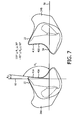
- contacting portions 41A and 41B are configured to lie at an angle ⁇ 1 ( FIGS. 7 and 8 ) (which may be constant or vary within contacting portions 41 A and 41B) with respect to the sealing plane (labeled 58 in FIG. 7 ) of cradle style sealing cushion 10 that is less than or equal to 135 degrees and greater than or equal to 30 degrees.
- contacting portions 41 A and 41 B are configured to lie at an angle ⁇ 1 with respect to sealing plane 58 that is less than or equal to 90 degrees and greater than or equal to 30 degrees.
- a complementary angle ⁇ 2 is also shown in FIG.
- ⁇ 2 is measured with respect to a plane 60 that is orthogonal to sealing plane 58 and is less than or equal to 60 degrees and greater than or equal to -45 degrees (less than or equal to 60 degrees and greater than or equal to 0 degrees in the particular exemplary embodiment).
- the distance between contacting portions 41A and 41B is 25 mm to 55 mm.
- the combination of the side stabilizing features comprising first and second stabilizing surfaces 40A and 40B and the open front (opening 50) serves to direct any air leakage away from the wearer, while blocking the flow of air leakage from the sides of cradle style sealing cushion 10.
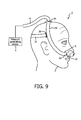
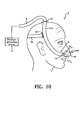
- headgear attachment points 62 serve to anchor cradle style sealing cushion 10 to the face, but an external force (e.g. gravity) of sufficient magnitude could cause cradle style sealing cushion 10 to rotate about this anchor point ( FIG. 10 ).
- the cradle style sealing cushion 10 is blocked by the patient's nose from rotating in a counterclockwise direction, but could potentially rotate clockwise away from the nose. In this situation, the seal adjacent to the face would be maintained, blocking air from jetting into the face of the wearer, while the open front of cradle style sealing cushion 10 (opening 50) facilitates air flow away from the wearer, thereby minimizing discomfort.
- FIGS. 11-13 show cradle style sealing cushions 10', 10" and 10"' according to alterative embodiments wherein first and second stabilizing surfaces 40A', 40A", 40A"' and 40B', 40B", 40B'" thereof curve around toward the nose tip to varying degrees while still maintaining a front opening 50', 50", 50"'. Maintaining a wider front opening may help to accommodate noses of extreme length, while maintaining a narrower opening may offer increased stability due to the corresponding larger stabilizing surfaces.
- FIGS. 1-13 cradle style sealing cushions 10, 10', 10" and 10'" are shown and described in a resting, non-inflated/non-deformed state (i.e., without pressurized gas therein).
- FIG. 1-13 cradle style sealing cushions 10, 10', 10" and 10'" are shown and described in a resting, non-inflated/non-deformed state (i.e., without pressurized gas therein).
- first and second stabilizing surfaces 40A-1 and 40B-1 thereof may or may not satisfy the angular specifications ( ⁇ 1 and ⁇ 2 ) described herein with respect to cradle style sealing cushion 10, but wherein in an inflated/deformed state (responsive to an internal pressure of 4-30 cmH 2 0), cradle style sealing cushion 10-1 will expand (see arrows in FIG.
- first and second stabilizing surfaces 40A-1 and 40B-1 thereof will be caused to satisfy the angular specifications ( ⁇ 1 and ⁇ 2 ) described herein with respect to cradle style sealing cushion 10 and will be caused to engage the outside of the patient's nostrils.
- the cradle style sealing cushions described herein could be constructed of a very soft material (e.g., soft silicone, a gel, or a visco-foam) that could be deformed by contact with the facial anatomy such that first and second stabilizing surfaces 40A-1 and 40B-1 thereof will be caused to satisfy the angular specifications ( ⁇ 1 and ⁇ 2 ) described herein with respect to cradle style sealing cushion 10 (in the resting state, those condition may or may not be satisfied).
- a very soft material e.g., soft silicone, a gel, or a visco-foam
- System 2-2 adapted to provide a regimen of respiratory therapy to a patient according to an alternative exemplary embodiment of the invention is generally shown in FIG. 15 .
- System 2-2 includes a pressure generating device 4 and a delivery conduit 6 as described elsewhere herein.
- System 2-2 includes an alternative patient interface device 8-2.
- Patient interface device 8-2 comprises a cradle style nasal mask structured to engage the nose of the patient that includes a cradle style sealing cushion 10-2 that is similar to cradle style sealing cushion 10.
- cradle style sealing cushion 10-2 includes a central sealing body portion 22-2 defining an internal chamber that is similar in structure to central sealing body portion 22 in that it includes first and second stabilizing surfaces 40A-2 and 40B-2 having contacting portions that satisfy the angular specifications ( ⁇ 1 and ⁇ 2 ) described herein with respect to cradle style sealing cushion 10 and a front opening 50-2 similar in structure to front opening 50.
- first and second stabilizing surfaces 40A-2 and 40B-2 having contacting portions that satisfy the angular specifications ( ⁇ 1 and ⁇ 2 ) described herein with respect to cradle style sealing cushion 10 and a front opening 50-2 similar in structure to front opening 50.
- the sides of cradle style sealing cushion 10-2 are coupled (not fluidly) to the arms of headgear assembly 64.
- the front of central sealing body portion 22-2 is provided with an orifice 66 that provides access to the inner chamber of central sealing body portion 22-2.
- An elbow conduit 68 having an exhaust port 70 is fluidly coupled to both central sealing body portion 22-2 through orifice 66 and to delivery conduit 6 so that pressured gas from pressure generating device 4 may be supplied to the inner chamber of central sealing body portion 22-2, and then to the airways of the patient.
- FIG. 16 is a top plan view of a cradle style sealing cushion 10-3 that is similar to (and may be substituted for) cradle style sealing cushion 10 (like parts are labeled with like reference numerals including a "-3" designation). However, rather than including a top wall 34 that includes a central sealing surface 38 including a single hole 39, cradle style sealing cushion 10-3 includes a top wall 34-3 that includes a central sealing surface 38-3 including a first hole 72A and a second hole 72B, wherein each hole 72A, 72B is structured to be aligned with a respective nostril of the patient.
- the first stabilizing surface (40A, 40A', 40A", 40A'", 40A-1, 40A-2, 40A-3) and the second stabilizing surface (40B, 40B', 40B", 40B"', 40B-1, 40B-2, 40B-3) each include at least a portion wherein the radius of curvature has a certain minimum value that is within a pre-defined minimum range. In the exemplary embodiment, that range is 0 mm to 15 mm.
- FIGS. 17A, 17B and 17C using stabilizing surface 40A
- the portion has a radius of curvature r that is equal to 0 (the rest of the stabilizing surface is flat with r equal to infinity), wherein in FIG. 17B , the portion has a radius of curvature r that is equal to about 3 mm (the rest of the stabilizing surface has a radius of curvature r equal to about 300 mm), and wherein in FIG. 17C , the portion comprises the entire stabilizing surface and has a radius of curvature r that is equal to about 15 mm.
- any reference signs placed between parentheses shall not be construed as limiting the claim.
- the word “comprising” or “including” does not exclude the presence of elements or steps other than those listed in a claim.
- several of these means may be embodied by one and the same item of hardware.
- the word “a” or “an” preceding an element does not exclude the presence of a plurality of such elements.
- any device claim enumerating several means several of these means may be embodied by one and the same item of hardware.
- the mere fact that certain elements are recited in mutually different dependent claims does not indicate that these elements cannot be used in combination.
Landscapes
- Health & Medical Sciences (AREA)
- Pulmonology (AREA)
- Hematology (AREA)
- Life Sciences & Earth Sciences (AREA)
- Engineering & Computer Science (AREA)
- Anesthesiology (AREA)
- Biomedical Technology (AREA)
- Heart & Thoracic Surgery (AREA)
- Veterinary Medicine (AREA)
- Emergency Medicine (AREA)
- Animal Behavior & Ethology (AREA)
- General Health & Medical Sciences (AREA)
- Public Health (AREA)
- Otolaryngology (AREA)
- Orthopedics, Nursing, And Contraception (AREA)
- Respiratory Apparatuses And Protective Means (AREA)
Claims (17)
- Wiegenartiges Kissen (10, 10', 10", 10"', 10-1, 10-2, 10-3) für eine Patientenschnittstellenvorrichtung (8, 8-1, 8-2), umfassend:ein zentrales Abdichtungskörperteil (22, 22-1, 22-2, 22-3), das eine Innenkammer definiert, wobei das zentrale Abdichtungskörperteil Folgendes umfasst:eine Vorderwand (29),eine Rückwand (31),eine obere Wand (34) undeine untere Wand (36), wobei die obere Wand Folgendes umfasst:eine zentrale Abdichtungsfläche (38), die strukturiert ist, um in ein Septum und einen Boden jedes Nasenlochs eines Patienten einzugreifen, wenn die Patientenschnittstellenvorrichtung von dem Patienten getragen wird,eine erste stabilisierende Fläche (40A, 40A', 40A", 40A"', 40A-1, 40A-2, 40A-3) undeine zweite stabilisierende Fläche (40B, 40B', 40B", 40B"', 40B-1, 40B-2, 40B-3), dadurch gekennzeichnet, dass sich die erste und die zweite stabilisierende Fläche jeweils nach oben und nach außen in Bezug auf die zentrale Abdichtungsfläche erstrecken und der obere Rand der Vorderwand in eine Richtung weg von der unteren Wand verläuft und strukturiert ist, um sich um eine Außenseite eines jeweiligen der Nasenlöcher des Patienten zu legen und in Bereiche hiervon einzugreifen, wenn die Patientenschnittstellenvorrichtung von dem Patienten getragen wird, wobei die erste stabilisierende Fläche einen ersten Vorderseitenrandbereich (44A) umfasst und die zweite stabilisierende Fläche einen zweiten Vorderseitenrandbereich (44B) umfasst, und wobei der obere Rand der Vorderwand, der erste Vorderseitenrandbereich und der zweite Vorderseitenrandbereich gemeinsam eine vordere Öffnung (50) des zentralen Abdichtungskörperteils definieren.
- Wiegenartiges Kissen nach Anspruch 1, wobei eine Mittellinie (56) der zentralen Abdichtungsfläche von einem Mittelpunkt der Vorderwand durch eine Mitte der zentralen Abdichtungsfläche zu einem Mittelpunkt der Rückwand verläuft, wobei die Mittellinie in einer Abdichtungsebene des wiegenartigen Abdichtungskissens liegt und diese definiert, wobei die erste stabilisierende Fläche einen ersten Kontaktbereich umfasst, der strukturiert ist, um in die Außenseite eines ersten der Nasenlöcher einzugreifen, wenn die Patientenschnittstellenvorrichtung von dem Patienten getragen wird, wobei die zweite stabilisierende Fläche einen zweiten Kontaktbereich umfasst, der strukturiert ist, um in die Außenseite eines zweiten der Nasenlöcher einzugreifen, wenn die Patientenschnittstellenvorrichtung von dem Patienten getragen wird, und wobei an jeder Stelle entlang der Fläche von sowohl dem ersten als auch dem zweiten Kontaktbereich der erste und der zweite Kontaktbereich jeweils konfiguriert sind, um in einem Winkel in Bezug auf die Abdichtungsebene zu liegen, der kleiner oder gleich 135 Grad ist und größer oder gleich 30 Grad ist.
- Wiegenartiges Kissen nach Anspruch 2, wobei an jeder Stelle entlang der Fläche von sowohl dem ersten als auch dem zweiten Kontaktbereich der erste und der zweite Kontaktbereich jeweils konfiguriert sind, um in einem Winkel in Bezug auf die Abdichtungsebene zu liegen, der kleiner oder gleich 90 Grad ist und der größer oder gleich 30 Grad ist.
- Wiegenartiges Kissen nach Anspruch 3, wobei an jeder Stelle entlang der Fläche von sowohl dem ersten als auch dem zweiten Kontaktbereich der erste und der zweite Kontaktbereich jeweils konfiguriert sind, um in einem Winkel in Bezug auf die Abdichtungsebene zu liegen, der kleiner oder gleich 90 Grad ist und größer oder gleich 30 Grad ist, wenn das wiegenartige Kissen sich in einem Ruhezustand befindet und nicht mit einem unter Druck stehenden Gas von 4-30 cmH2O gefüllt ist.
- Wiegenartiges Kissen nach Anspruch 3, wobei an jeder Stelle entlang der Fläche von sowohl dem ersten als auch dem zweiten Kontaktbereich der erste und der zweite Kontaktbereich jeweils konfiguriert sind, um in einem Winkel in Bezug auf die Abdichtungsebene zu liegen, der kleiner oder gleich 90 Grad ist oder größer oder gleich 30 Grad ist in Reaktion darauf, dass das wiegenartige Kissen mit einem unter Druck stehenden Gas von 4-30 cmH2O gefüllt ist.
- Wiegenartiges Kissen nach Anspruch 1, wobei die erste stabilisierende Fläche und die zweite stabilisierende Fläche jeweils zwischen dem oberen Rand der Vorderwand und einem oberen Rand der Rückwand vorgesehen sind.
- Wiegenartiges Kissen nach Anspruch 1, wobei die erste stabilisierende Fläche eine im Allgemeinen dreieckige Form mit einem ersten Basisabschnitt, dem ersten Vorderseitenrandbereich, einem ersten Rückseitenrandbereich und einem ersten Scheitelbereich hat, und wobei die zweite stabilisierende Fläche eine im Allgemeinen dreieckige Form mit einem zweiten Basisabschnitt, dem zweiten Vorderseitenrandbereich, einem zweiten Rückseitenrandbereich und einem zweiten Scheitelbereich hat.
- Wiegenartiges Kissen nach Anspruch 1, wobei die zentrale Abdichtungsfläche ein einzelnes Loch (39) umfasst.
- Wiegenartiges Kissen nach Anspruch 1, wobei die zentrale Abdichtungsfläche ein erstes Loch (72A) und ein zweites Loch (72B) umfasst.
- Wiegenartiges Kissen nach Anspruch 1, weiterhin umfassend ein erstes Anschlussteil (24A), das an einer ersten Seite des zentralen Abdichtungskörperteils vorgesehen ist und hiervon ausgeht, und ein zweites Anschlussteil (24B), das an einer zweiten Seite des zentralen Abdichtungskörperteils vorgesehen ist und hiervon ausgeht, wobei das erste Anschlussteil und das zweite Anschlussteil über eine Fluidkopplung mit der Innenkammer des zentralen Abdichtungskörperteils verbunden sind, wobei das erste Anschlussteil eine erste Öffnung (26A) umfasst und das zweite Anschlussteil eine zweite Öffnung (26B) umfasst.
- Wiegenartiges Kissen nach Anspruch 1, wobei das zentrale Abdichtungskörperteil mit einer Öffnung versehen ist, die Zugang zu der Innenkammer des zentralen Abdichtungskörperteils bietet, wobei die Öffnung strukturiert ist, um mit einem ellbogenförmigen Kanal (68) gekoppelt zu werden.
- Wiegenartiges Kissen nach Anspruch 1, wobei mindestens ein Teil der ersten stabilisierenden Fläche einen ersten Krümmungsradius von 0 mm bis 15 mm hat und wobei mindestens ein Teil der zweiten stabilisierenden Fläche einen zweiten Krümmungsradius von 0 mm bis 15 mm hat.
- Wiegenartiges Kissen nach Anspruch 1, wobei die zentrale Abdichtungsfläche strukturiert ist, um in einen Teil des Munds des Patienten über einer Oberlippe des Patienten einzugreifen, wenn die Patientenschnittstellenvorrichtung von dem Patienten getragen wird.
- Wiegenartiges Kissen nach Anspruch 3, wobei an jeder Stelle entlang der Fläche von sowohl dem ersten als auch dem zweiten Kontaktbereich der erste und der zweite Kontaktbereich jeweils konfiguriert sind, um in einem Winkel in Bezug auf die Abdichtungsebene zu liegen, der kleiner oder gleich 90 Grad ist und der größer oder gleich 30 Grad ist in Reaktion darauf, dass das wiegenartige Kissen durch die Gesichtsanatomie des Patienten verformt wird.
- Wiegenartiges Kissen nach Anspruch 1, wobei die erste stabilisierende Fläche und die zweite stabilisierende Fläche jeweils eine im Allgemeinen dreieckige, rechteckige oder trapezförmige Form haben.
- Patientenschnittstellenvorrichtung mit einem wiegenartigen Kissen nach Anspruch 1.
- System (2, 2-1, 2-2) zum Zuführen einer Atemgasströmung an einen Patienten, umfassend ein Druckerzeugungssystem (4), das strukturiert ist, um die Atemgasströmung zu erzeugen, und eine Patientenschnittstellenvorrichtung, die über eine Fluidkopplung mit dem Druckerzeugungssystem verbunden ist, wobei die Patientenschnittstellenvorrichtung ein wiegenartiges Kissen nach Anspruch 1 umfasst.
Applications Claiming Priority (2)
| Application Number | Priority Date | Filing Date | Title |
|---|---|---|---|
| US201261671926P | 2012-07-16 | 2012-07-16 | |
| PCT/IB2013/055440 WO2014013371A1 (en) | 2012-07-16 | 2013-07-03 | Cradle cushion having side stabilizers |
Publications (2)
| Publication Number | Publication Date |
|---|---|
| EP2869878A1 EP2869878A1 (de) | 2015-05-13 |
| EP2869878B1 true EP2869878B1 (de) | 2015-12-23 |
Family
ID=49170758
Family Applications (1)
| Application Number | Title | Priority Date | Filing Date |
|---|---|---|---|
| EP13762569.5A Active EP2869878B1 (de) | 2012-07-16 | 2013-07-03 | Wiegenartiges kissen mit seitlichen stabilisatoren |
Country Status (7)
| Country | Link |
|---|---|
| US (4) | US9764107B2 (de) |
| EP (1) | EP2869878B1 (de) |
| JP (1) | JP5895103B2 (de) |
| CN (1) | CN104487121B (de) |
| BR (1) | BR112015000758B1 (de) |
| RU (1) | RU2640443C2 (de) |
| WO (1) | WO2014013371A1 (de) |
Families Citing this family (46)
| Publication number | Priority date | Publication date | Assignee | Title |
|---|---|---|---|---|
| US10603456B2 (en) | 2011-04-15 | 2020-03-31 | Fisher & Paykel Healthcare Limited | Interface comprising a nasal sealing portion |
| JP6170036B2 (ja) | 2011-04-15 | 2017-07-26 | フィッシャー アンド ペイケル ヘルスケア リミテッド | ロールする鼻梁部を有するインタフェース |
| US9950130B2 (en) | 2012-09-04 | 2018-04-24 | Fisher & Paykel Healthcare Limited | Valsalva mask |
| JP6360485B2 (ja) | 2012-10-17 | 2018-07-18 | フィッシャー アンド ペイケル ヘルスケア リミテッド | 鼻封止部分およびローリングヒンジを備えるインタフェース |
| CN104968387B (zh) | 2012-11-16 | 2018-02-23 | 费雪派克医疗保健有限公司 | 鼻部密封件和呼吸接口 |
| NZ728967A (en) | 2013-01-16 | 2018-08-31 | ResMed Pty Ltd | Patient interface and method for making same |
| BR112015026821A2 (pt) | 2013-04-26 | 2017-07-25 | Fisher & Paykel Healthcare Ltd | acessório de cabeça para máscara de respiração |
| EP3865168B1 (de) * | 2013-08-05 | 2025-11-19 | Fisher & Paykel Healthcare Limited | Schnittstelle |
| CN118045266A (zh) | 2013-11-15 | 2024-05-17 | 瑞思迈私人有限公司 | 患者接口与用于制造它的方法 |
| WO2015170285A1 (en) * | 2014-05-09 | 2015-11-12 | Fisher & Paykel Healthcare Limited | Diffuser arrangements for a vent of a respiratory interface |
| EP4245343B1 (de) | 2014-06-17 | 2024-12-25 | Fisher & Paykel Healthcare Limited | Patientenschnittstellen |
| CN112121269B (zh) | 2014-08-25 | 2024-08-06 | 费雪派克医疗保健有限公司 | 呼吸面罩及其相关部分、部件或子组件 |
| JP2016049132A (ja) * | 2014-08-28 | 2016-04-11 | アトムメディカル株式会社 | カニューラ装置 |
| CN118286563A (zh) | 2014-11-26 | 2024-07-05 | 瑞思迈私人有限公司 | 纺织品患者接口 |
| JP6720186B2 (ja) * | 2014-12-30 | 2020-07-08 | コーニンクレッカ フィリップス エヌ ヴェKoninklijke Philips N.V. | 患者インターフェースデバイス |
| USD799699S1 (en) * | 2015-10-09 | 2017-10-10 | Koninklijke Philips N.V. | Mask frame for CPAP therapy |
| AU2016314605B2 (en) | 2015-09-04 | 2021-05-20 | Fisher & Paykel Healthcare Limited | Patient interfaces |
| CN108463264B (zh) | 2016-01-14 | 2021-11-19 | 瑞思迈私人有限公司 | 口鼻患者接口 |
| WO2017124152A1 (en) * | 2016-01-21 | 2017-07-27 | Resmed Limited | Adjustable headgear tubing for a patient interface |
| USD825053S1 (en) * | 2016-03-23 | 2018-08-07 | Fisher & Paykel Healthcare Limited | Nasal cannula |
| CN109414557B (zh) | 2016-04-28 | 2022-08-30 | 瑞思迈私人有限公司 | 患者接口 |
| USD844132S1 (en) | 2016-07-01 | 2019-03-26 | Fisher & Paykel Healthcare Limited | Cannula pad |
| US11273279B2 (en) | 2016-10-04 | 2022-03-15 | Koninklijke Philips N.V. | Magnetic anti-crush feature for conduit |
| CN114904112B (zh) | 2016-10-05 | 2026-02-03 | 费雪派克医疗保健有限公司 | 患者接口 |
| CN106730192B (zh) * | 2016-11-23 | 2018-12-18 | 中国人民解放军第三军医大学第三附属医院 | 无创呼吸机下颚固定装置 |
| USD829322S1 (en) * | 2016-12-05 | 2018-09-25 | Koninklijke Philips N.V. | Mask |
| USD823455S1 (en) | 2017-02-23 | 2018-07-17 | Fisher & Paykel Healthcare Limited | Cushion assembly for breathing mask assembly |
| USD824020S1 (en) | 2017-02-23 | 2018-07-24 | Fisher & Paykel Healthcare Limited | Cushion assembly for breathing mask assembly |
| USD823454S1 (en) | 2017-02-23 | 2018-07-17 | Fisher & Paykel Healthcare Limited | Cushion assembly for breathing mask assembly |
| JP7089587B2 (ja) * | 2017-09-28 | 2022-06-22 | コーニンクレッカ フィリップス エヌ ヴェ | 突起を備えるクッション及び突起を備えるクッションを含む患者インタフェースデバイス |
| US20190298954A1 (en) * | 2018-03-30 | 2019-10-03 | Koninklijke Philips N.V. | Adjustable frame for an interface device |
| USD884153S1 (en) | 2018-04-04 | 2020-05-12 | Fisher & Paykel Healthcare Limited | Frame for a mask assembly |
| USD942614S1 (en) | 2018-07-10 | 2022-02-01 | ResMed Pty Ltd | Combined cushion and frame module for patient interface |
| USD924388S1 (en) | 2018-07-10 | 2021-07-06 | ResMed Pty Ltd | Patient interface |
| USD862686S1 (en) * | 2018-07-16 | 2019-10-08 | Mohamed Aly Helmy Mohamed | CPAP cannula device |
| MX2021002031A (es) | 2018-08-20 | 2021-03-25 | ResMed Pty Ltd | Casco para una interfaz de paciente. |
| MX2021002033A (es) | 2018-08-20 | 2021-04-28 | ResMed Pty Ltd | Interfaz de paciente. |
| USD942615S1 (en) | 2018-09-12 | 2022-02-01 | ResMed Pty Ltd | Patient interface |
| US20240024605A1 (en) * | 2018-10-16 | 2024-01-25 | ResMed Pty Ltd | Textile seal-forming structure with multiple curvatures |
| EP3866896B1 (de) | 2018-10-16 | 2025-07-30 | ResMed Pty Ltd | Patientenschnittstelle |
| US12059528B2 (en) | 2018-10-16 | 2024-08-13 | ResMed Pty Ltd | Textile seal-forming structure with multiple curvatures |
| USD978332S1 (en) * | 2019-03-01 | 2023-02-14 | Koninklijke Phlips N.V. | Medical device |
| US12508384B2 (en) | 2019-07-22 | 2025-12-30 | ResMed Pty Ltd | Cushion module for a patient interface |
| CN215024268U (zh) * | 2019-09-10 | 2021-12-07 | 瑞思迈私人有限公司 | 患者接口,定位和稳定结构以及将患者接口连接到定位和稳定结构的保持组件 |
| EP4121152B1 (de) * | 2020-03-20 | 2025-11-05 | ResMed Pty Ltd | Patientenschnittstelle mit einem okzipitalen anker |
| USD1060658S1 (en) | 2020-12-28 | 2025-02-04 | ResMed Asia Pte. Ltd. | Patient interface |
Family Cites Families (38)
| Publication number | Priority date | Publication date | Assignee | Title |
|---|---|---|---|---|
| EP0406258A4 (en) * | 1988-03-23 | 1991-03-13 | Christa Ursula Palfy | Nasal tube holder |
| US5724965A (en) | 1995-06-06 | 1998-03-10 | Respironics Inc. | Nasal mask |
| US6119694A (en) * | 1997-07-24 | 2000-09-19 | Respironics Georgia, Inc. | Nasal mask and headgear |
| US5931854A (en) * | 1998-01-26 | 1999-08-03 | Dillon; Michael M. | Nasal dilator |
| DE202004021759U1 (de) * | 2003-02-21 | 2010-10-07 | ResMed Ltd., Bella Vista | Nasale Anordnung |
| US7178525B2 (en) | 2004-02-06 | 2007-02-20 | Ric Investments, Llc | Patient interface assembly supported under the mandible |
| US7975694B2 (en) | 2005-10-24 | 2011-07-12 | Koninklijke Philips Electronics N.V. | Non-intrusive mask interface with nasal support |
| EP2046430B1 (de) * | 2006-07-28 | 2016-04-20 | ResMed Ltd. | Verabreichung einer atemtherapie |
| NZ720629A (en) * | 2006-07-28 | 2017-12-22 | Resmed Ltd | Delivery of respiratory therapy |
| US8161971B2 (en) * | 2006-08-04 | 2012-04-24 | Ric Investments, Llc | Nasal and oral patient interface |
| EP2481434B1 (de) * | 2006-12-15 | 2016-04-13 | ResMed Ltd. | Verabreichung einer Atemtherapie |
| NZ599563A (en) * | 2007-07-30 | 2015-01-30 | Resmed Ltd | Patient interface |
| BRPI0820581A8 (pt) * | 2007-11-19 | 2015-11-10 | Koninl Philips Electronics Nv | Dispositivo de interface com paciente, e, cânula nasal |
| US20110000492A1 (en) * | 2008-03-04 | 2011-01-06 | Resmed Ltd | Foam respiratory mask |
| US10792451B2 (en) | 2008-05-12 | 2020-10-06 | Fisher & Paykel Healthcare Limited | Patient interface and aspects thereof |
| EP3974015B1 (de) * | 2008-05-12 | 2026-03-25 | Fisher & Paykel Healthcare Limited | Schnittstelle |
| US8905031B2 (en) * | 2008-06-04 | 2014-12-09 | Resmed Limited | Patient interface systems |
| CN106039505A (zh) * | 2008-06-04 | 2016-10-26 | 瑞思迈有限公司 | 患者接口系统 |
| CN102227233B (zh) | 2008-11-27 | 2016-05-18 | 帝人制药株式会社 | 呼吸用面罩的佩戴件以及呼吸用面罩 |
| RU2392010C1 (ru) * | 2008-12-11 | 2010-06-20 | Евгений Васильевич Головихин | Дыхательный тренажер |
| US9095673B2 (en) * | 2008-12-15 | 2015-08-04 | Resmed Limited | Unobtrusive nasal mask |
| TWI362888B (en) | 2008-12-24 | 2012-04-21 | Acer Inc | Encoding and decoding method for video screen layout, encoding device, decoding device, and data structure |
| DE112010001994T5 (de) * | 2009-05-12 | 2012-10-25 | Fisher & Paykel Healthcare Ltd. | Patientenschnittstelle und ihre Aspekte |
| CN101954139B (zh) | 2009-06-04 | 2016-01-20 | 瑞思迈有限公司 | 用于面罩的软垫 |
| CN101954130B (zh) | 2009-07-14 | 2013-06-05 | 昆山福宏康复科技有限公司 | 静脉点滴注射监控器 |
| US10265492B2 (en) * | 2010-04-30 | 2019-04-23 | Resmed Limited | Respiratory mask |
| US20110315146A1 (en) | 2010-06-28 | 2011-12-29 | Beevers Timothy R | Infant nasal cpap canula seal defining a vent |
| AU2011308095B2 (en) * | 2010-09-30 | 2014-10-09 | Resmed Limited | Mask system |
| EP4534131A3 (de) * | 2010-09-30 | 2025-05-21 | ResMed Pty Ltd | Patientenschnittstellensysteme |
| KR20130120482A (ko) * | 2010-10-25 | 2013-11-04 | 인슬립 테크놀로지스, 엘엘씨 | 나비형 코 마스크 |
| JP2013542809A (ja) | 2010-11-04 | 2013-11-28 | インスリープ テクノロジーズ,エルエルシー | 呼吸装置 |
| RU2013133933A (ru) * | 2010-12-20 | 2015-01-27 | Конинклейке Филипс Электроникс Н.В. | Интерфейс пациента, имеющий оборачиваемое оголовье из ткани |
| US10603456B2 (en) | 2011-04-15 | 2020-03-31 | Fisher & Paykel Healthcare Limited | Interface comprising a nasal sealing portion |
| EP2731655B1 (de) * | 2011-07-12 | 2017-07-12 | ResMed Limited | Textile maskensysteme |
| JP2014530708A (ja) * | 2011-10-21 | 2014-11-20 | コーニンクレッカ フィリップス エヌ ヴェ | 患者の呼吸器系に接続されるための患者インターフェース装置及び関連する方法 |
| CN103945890B (zh) * | 2011-10-31 | 2017-02-15 | 费雪派克医疗保健有限公司 | 包括鼻部密封部分的接口 |
| US20130160772A1 (en) * | 2011-12-27 | 2013-06-27 | Farrokh Tabrizchi | Multi-functional nasal cannula |
| US10238827B2 (en) * | 2012-03-12 | 2019-03-26 | Mark T. Holtzapple | Air-delivery system for breathing-assist devices |
-
2013
- 2013-07-03 EP EP13762569.5A patent/EP2869878B1/de active Active
- 2013-07-03 RU RU2015105011A patent/RU2640443C2/ru active
- 2013-07-03 JP JP2015522193A patent/JP5895103B2/ja active Active
- 2013-07-03 US US14/414,288 patent/US9764107B2/en active Active
- 2013-07-03 CN CN201380037953.9A patent/CN104487121B/zh active Active
- 2013-07-03 BR BR112015000758-9A patent/BR112015000758B1/pt active IP Right Grant
- 2013-07-03 WO PCT/IB2013/055440 patent/WO2014013371A1/en not_active Ceased
-
2017
- 2017-08-01 US US15/665,782 patent/US20170326321A1/en not_active Abandoned
-
2021
- 2021-06-25 US US17/358,221 patent/US11890417B2/en active Active
-
2023
- 2023-12-22 US US18/393,826 patent/US20240123173A1/en active Pending
Also Published As
| Publication number | Publication date |
|---|---|
| BR112015000758B1 (pt) | 2021-07-13 |
| US20150182719A1 (en) | 2015-07-02 |
| BR112015000758A2 (pt) | 2017-06-27 |
| RU2015105011A (ru) | 2016-08-27 |
| US20170326321A1 (en) | 2017-11-16 |
| US20210361898A1 (en) | 2021-11-25 |
| US9764107B2 (en) | 2017-09-19 |
| EP2869878A1 (de) | 2015-05-13 |
| JP5895103B2 (ja) | 2016-03-30 |
| US11890417B2 (en) | 2024-02-06 |
| US20240123173A1 (en) | 2024-04-18 |
| CN104487121A (zh) | 2015-04-01 |
| WO2014013371A1 (en) | 2014-01-23 |
| JP2015522369A (ja) | 2015-08-06 |
| RU2640443C2 (ru) | 2018-01-09 |
| CN104487121B (zh) | 2016-07-06 |
Similar Documents
| Publication | Publication Date | Title |
|---|---|---|
| US11890417B2 (en) | Cradle cushion having side stabilizers | |
| EP2968820B1 (de) | Subnasales dichtungskissen | |
| EP3240597B1 (de) | Patientenschnittstellenvorrichtung mit einer angepassten polsterunterlagenanordnung | |
| CN103974738B (zh) | 具有可调整稳定构件的衬垫 | |
| US10737052B2 (en) | Fluid coupling member including valve member | |
| EP2552527B1 (de) | Atemmaske mit gerippter kontaktfläche | |
| EP2608833B1 (de) | Kissen für eine patientenschnittstelle | |
| EP2861286B1 (de) | Dichtungspolster mit abgewinkelter dichtungsklappe | |
| EP2849828B1 (de) | Dichtungskissen und patientenschnittstellenvorrichtung damit | |
| EP2849831B1 (de) | Anti-asphyxie-ventilanordnung | |
| WO2015033287A1 (en) | Patient interface device with drawstring adjustment | |
| US20140196720A1 (en) | Nasal cushion including a confortable septum/nare seal | |
| EP2523718A2 (de) | Austaschbares nasenkissen | |
| CN104853795A (zh) | 用于呼吸界面装置的运动稳定器系统 | |
| US20150128949A1 (en) | Patient interface device having headgear providing integrated gas flow and delivery | |
| EP4034210B1 (de) | Nasenpolsterkissen für patientenschnittstellenvorrichtung | |
| WO2015092621A1 (en) | Oral sealing segment for patient interface device | |
| EP3522967B1 (de) | Magnetischer quetschschutz für eine leitung | |
| WO2012073147A1 (en) | Patient interface device with multi-axis elbow conduit |
Legal Events
| Date | Code | Title | Description |
|---|---|---|---|
| PUAI | Public reference made under article 153(3) epc to a published international application that has entered the european phase |
Free format text: ORIGINAL CODE: 0009012 |
|
| 17P | Request for examination filed |
Effective date: 20150204 |
|
| AK | Designated contracting states |
Kind code of ref document: A1 Designated state(s): AL AT BE BG CH CY CZ DE DK EE ES FI FR GB GR HR HU IE IS IT LI LT LU LV MC MK MT NL NO PL PT RO RS SE SI SK SM TR |
|
| AX | Request for extension of the european patent |
Extension state: BA ME |
|
| GRAP | Despatch of communication of intention to grant a patent |
Free format text: ORIGINAL CODE: EPIDOSNIGR1 |
|
| INTG | Intention to grant announced |
Effective date: 20150624 |
|
| DAX | Request for extension of the european patent (deleted) | ||
| GRAS | Grant fee paid |
Free format text: ORIGINAL CODE: EPIDOSNIGR3 |
|
| GRAA | (expected) grant |
Free format text: ORIGINAL CODE: 0009210 |
|
| AK | Designated contracting states |
Kind code of ref document: B1 Designated state(s): AL AT BE BG CH CY CZ DE DK EE ES FI FR GB GR HR HU IE IS IT LI LT LU LV MC MK MT NL NO PL PT RO RS SE SI SK SM TR |
|
| REG | Reference to a national code |
Ref country code: GB Ref legal event code: FG4D |
|
| REG | Reference to a national code |
Ref country code: CH Ref legal event code: EP |
|
| REG | Reference to a national code |
Ref country code: IE Ref legal event code: FG4D |
|
| REG | Reference to a national code |
Ref country code: AT Ref legal event code: REF Ref document number: 766254 Country of ref document: AT Kind code of ref document: T Effective date: 20160115 |
|
| REG | Reference to a national code |
Ref country code: DE Ref legal event code: R096 Ref document number: 602013004269 Country of ref document: DE |
|
| REG | Reference to a national code |
Ref country code: LT Ref legal event code: MG4D |
|
| REG | Reference to a national code |
Ref country code: NL Ref legal event code: MP Effective date: 20151223 |
|
| PG25 | Lapsed in a contracting state [announced via postgrant information from national office to epo] |
Ref country code: NO Free format text: LAPSE BECAUSE OF FAILURE TO SUBMIT A TRANSLATION OF THE DESCRIPTION OR TO PAY THE FEE WITHIN THE PRESCRIBED TIME-LIMIT Effective date: 20160323 Ref country code: HR Free format text: LAPSE BECAUSE OF FAILURE TO SUBMIT A TRANSLATION OF THE DESCRIPTION OR TO PAY THE FEE WITHIN THE PRESCRIBED TIME-LIMIT Effective date: 20151223 Ref country code: LT Free format text: LAPSE BECAUSE OF FAILURE TO SUBMIT A TRANSLATION OF THE DESCRIPTION OR TO PAY THE FEE WITHIN THE PRESCRIBED TIME-LIMIT Effective date: 20151223 |
|
| REG | Reference to a national code |
Ref country code: AT Ref legal event code: MK05 Ref document number: 766254 Country of ref document: AT Kind code of ref document: T Effective date: 20151223 |
|
| PG25 | Lapsed in a contracting state [announced via postgrant information from national office to epo] |
Ref country code: RS Free format text: LAPSE BECAUSE OF FAILURE TO SUBMIT A TRANSLATION OF THE DESCRIPTION OR TO PAY THE FEE WITHIN THE PRESCRIBED TIME-LIMIT Effective date: 20151223 Ref country code: FI Free format text: LAPSE BECAUSE OF FAILURE TO SUBMIT A TRANSLATION OF THE DESCRIPTION OR TO PAY THE FEE WITHIN THE PRESCRIBED TIME-LIMIT Effective date: 20151223 Ref country code: SE Free format text: LAPSE BECAUSE OF FAILURE TO SUBMIT A TRANSLATION OF THE DESCRIPTION OR TO PAY THE FEE WITHIN THE PRESCRIBED TIME-LIMIT Effective date: 20151223 Ref country code: GR Free format text: LAPSE BECAUSE OF FAILURE TO SUBMIT A TRANSLATION OF THE DESCRIPTION OR TO PAY THE FEE WITHIN THE PRESCRIBED TIME-LIMIT Effective date: 20160324 Ref country code: LV Free format text: LAPSE BECAUSE OF FAILURE TO SUBMIT A TRANSLATION OF THE DESCRIPTION OR TO PAY THE FEE WITHIN THE PRESCRIBED TIME-LIMIT Effective date: 20151223 Ref country code: NL Free format text: LAPSE BECAUSE OF FAILURE TO SUBMIT A TRANSLATION OF THE DESCRIPTION OR TO PAY THE FEE WITHIN THE PRESCRIBED TIME-LIMIT Effective date: 20151223 |
|
| REG | Reference to a national code |
Ref country code: FR Ref legal event code: PLFP Year of fee payment: 4 |
|
| PG25 | Lapsed in a contracting state [announced via postgrant information from national office to epo] |
Ref country code: ES Free format text: LAPSE BECAUSE OF FAILURE TO SUBMIT A TRANSLATION OF THE DESCRIPTION OR TO PAY THE FEE WITHIN THE PRESCRIBED TIME-LIMIT Effective date: 20151223 Ref country code: IT Free format text: LAPSE BECAUSE OF FAILURE TO SUBMIT A TRANSLATION OF THE DESCRIPTION OR TO PAY THE FEE WITHIN THE PRESCRIBED TIME-LIMIT Effective date: 20151223 Ref country code: CZ Free format text: LAPSE BECAUSE OF FAILURE TO SUBMIT A TRANSLATION OF THE DESCRIPTION OR TO PAY THE FEE WITHIN THE PRESCRIBED TIME-LIMIT Effective date: 20151223 |
|
| PG25 | Lapsed in a contracting state [announced via postgrant information from national office to epo] |
Ref country code: PL Free format text: LAPSE BECAUSE OF FAILURE TO SUBMIT A TRANSLATION OF THE DESCRIPTION OR TO PAY THE FEE WITHIN THE PRESCRIBED TIME-LIMIT Effective date: 20151223 Ref country code: SM Free format text: LAPSE BECAUSE OF FAILURE TO SUBMIT A TRANSLATION OF THE DESCRIPTION OR TO PAY THE FEE WITHIN THE PRESCRIBED TIME-LIMIT Effective date: 20151223 Ref country code: SK Free format text: LAPSE BECAUSE OF FAILURE TO SUBMIT A TRANSLATION OF THE DESCRIPTION OR TO PAY THE FEE WITHIN THE PRESCRIBED TIME-LIMIT Effective date: 20151223 Ref country code: IS Free format text: LAPSE BECAUSE OF FAILURE TO SUBMIT A TRANSLATION OF THE DESCRIPTION OR TO PAY THE FEE WITHIN THE PRESCRIBED TIME-LIMIT Effective date: 20160423 Ref country code: AT Free format text: LAPSE BECAUSE OF FAILURE TO SUBMIT A TRANSLATION OF THE DESCRIPTION OR TO PAY THE FEE WITHIN THE PRESCRIBED TIME-LIMIT Effective date: 20151223 Ref country code: PT Free format text: LAPSE BECAUSE OF FAILURE TO SUBMIT A TRANSLATION OF THE DESCRIPTION OR TO PAY THE FEE WITHIN THE PRESCRIBED TIME-LIMIT Effective date: 20160426 Ref country code: RO Free format text: LAPSE BECAUSE OF FAILURE TO SUBMIT A TRANSLATION OF THE DESCRIPTION OR TO PAY THE FEE WITHIN THE PRESCRIBED TIME-LIMIT Effective date: 20151223 Ref country code: EE Free format text: LAPSE BECAUSE OF FAILURE TO SUBMIT A TRANSLATION OF THE DESCRIPTION OR TO PAY THE FEE WITHIN THE PRESCRIBED TIME-LIMIT Effective date: 20151223 |
|
| REG | Reference to a national code |
Ref country code: DE Ref legal event code: R097 Ref document number: 602013004269 Country of ref document: DE |
|
| PLBE | No opposition filed within time limit |
Free format text: ORIGINAL CODE: 0009261 |
|
| STAA | Information on the status of an ep patent application or granted ep patent |
Free format text: STATUS: NO OPPOSITION FILED WITHIN TIME LIMIT |
|
| PG25 | Lapsed in a contracting state [announced via postgrant information from national office to epo] |
Ref country code: DK Free format text: LAPSE BECAUSE OF FAILURE TO SUBMIT A TRANSLATION OF THE DESCRIPTION OR TO PAY THE FEE WITHIN THE PRESCRIBED TIME-LIMIT Effective date: 20151223 |
|
| 26N | No opposition filed |
Effective date: 20160926 |
|
| PG25 | Lapsed in a contracting state [announced via postgrant information from national office to epo] |
Ref country code: BE Free format text: LAPSE BECAUSE OF FAILURE TO SUBMIT A TRANSLATION OF THE DESCRIPTION OR TO PAY THE FEE WITHIN THE PRESCRIBED TIME-LIMIT Effective date: 20151223 |
|
| PG25 | Lapsed in a contracting state [announced via postgrant information from national office to epo] |
Ref country code: SI Free format text: LAPSE BECAUSE OF FAILURE TO SUBMIT A TRANSLATION OF THE DESCRIPTION OR TO PAY THE FEE WITHIN THE PRESCRIBED TIME-LIMIT Effective date: 20151223 |
|
| REG | Reference to a national code |
Ref country code: CH Ref legal event code: PL |
|
| PG25 | Lapsed in a contracting state [announced via postgrant information from national office to epo] |
Ref country code: MC Free format text: LAPSE BECAUSE OF FAILURE TO SUBMIT A TRANSLATION OF THE DESCRIPTION OR TO PAY THE FEE WITHIN THE PRESCRIBED TIME-LIMIT Effective date: 20151223 |
|
| PG25 | Lapsed in a contracting state [announced via postgrant information from national office to epo] |
Ref country code: CH Free format text: LAPSE BECAUSE OF NON-PAYMENT OF DUE FEES Effective date: 20160731 Ref country code: LI Free format text: LAPSE BECAUSE OF NON-PAYMENT OF DUE FEES Effective date: 20160731 |
|
| REG | Reference to a national code |
Ref country code: IE Ref legal event code: MM4A |
|
| REG | Reference to a national code |
Ref country code: FR Ref legal event code: PLFP Year of fee payment: 5 |
|
| PG25 | Lapsed in a contracting state [announced via postgrant information from national office to epo] |
Ref country code: IE Free format text: LAPSE BECAUSE OF NON-PAYMENT OF DUE FEES Effective date: 20160703 |
|
| PG25 | Lapsed in a contracting state [announced via postgrant information from national office to epo] |
Ref country code: LU Free format text: LAPSE BECAUSE OF NON-PAYMENT OF DUE FEES Effective date: 20160703 |
|
| GBPC | Gb: european patent ceased through non-payment of renewal fee |
Effective date: 20170703 |
|
| PG25 | Lapsed in a contracting state [announced via postgrant information from national office to epo] |
Ref country code: GB Free format text: LAPSE BECAUSE OF NON-PAYMENT OF DUE FEES Effective date: 20170703 |
|
| PG25 | Lapsed in a contracting state [announced via postgrant information from national office to epo] |
Ref country code: HU Free format text: LAPSE BECAUSE OF FAILURE TO SUBMIT A TRANSLATION OF THE DESCRIPTION OR TO PAY THE FEE WITHIN THE PRESCRIBED TIME-LIMIT; INVALID AB INITIO Effective date: 20130703 |
|
| PG25 | Lapsed in a contracting state [announced via postgrant information from national office to epo] |
Ref country code: MT Free format text: LAPSE BECAUSE OF NON-PAYMENT OF DUE FEES Effective date: 20160731 Ref country code: CY Free format text: LAPSE BECAUSE OF FAILURE TO SUBMIT A TRANSLATION OF THE DESCRIPTION OR TO PAY THE FEE WITHIN THE PRESCRIBED TIME-LIMIT Effective date: 20151223 Ref country code: MK Free format text: LAPSE BECAUSE OF FAILURE TO SUBMIT A TRANSLATION OF THE DESCRIPTION OR TO PAY THE FEE WITHIN THE PRESCRIBED TIME-LIMIT Effective date: 20151223 |
|
| REG | Reference to a national code |
Ref country code: FR Ref legal event code: PLFP Year of fee payment: 6 |
|
| PG25 | Lapsed in a contracting state [announced via postgrant information from national office to epo] |
Ref country code: BG Free format text: LAPSE BECAUSE OF FAILURE TO SUBMIT A TRANSLATION OF THE DESCRIPTION OR TO PAY THE FEE WITHIN THE PRESCRIBED TIME-LIMIT Effective date: 20151223 |
|
| PG25 | Lapsed in a contracting state [announced via postgrant information from national office to epo] |
Ref country code: AL Free format text: LAPSE BECAUSE OF FAILURE TO SUBMIT A TRANSLATION OF THE DESCRIPTION OR TO PAY THE FEE WITHIN THE PRESCRIBED TIME-LIMIT Effective date: 20151223 Ref country code: TR Free format text: LAPSE BECAUSE OF FAILURE TO SUBMIT A TRANSLATION OF THE DESCRIPTION OR TO PAY THE FEE WITHIN THE PRESCRIBED TIME-LIMIT Effective date: 20151223 |
|
| PGFP | Annual fee paid to national office [announced via postgrant information from national office to epo] |
Ref country code: DE Payment date: 20250728 Year of fee payment: 13 |
|
| PGFP | Annual fee paid to national office [announced via postgrant information from national office to epo] |
Ref country code: FR Payment date: 20250725 Year of fee payment: 13 |